200 Quilts · Quilts

PTQ–Tips and Tricks

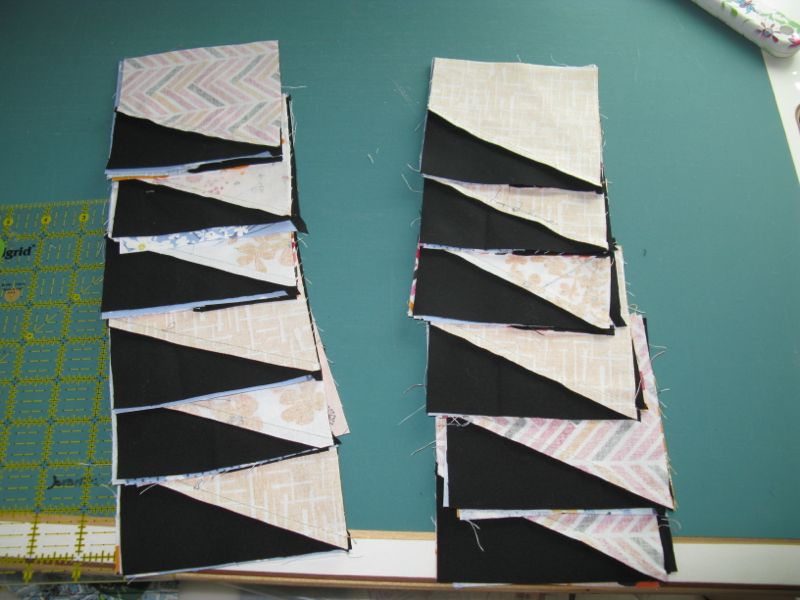
This is a continuation of what-I’m-calling the Portuguese Tile Quilt, a free quilt pattern from *here.*  I arranged my pieces on the board so that no two fabrics were in any block, meaning in the blue quadrants, they were different from each other and the pink quadrants also had fabrics different from each other.  I didn’t care so much if the pinks imitated the blues, but I did watch out for strong fabrics in the same block (like that “plaid”).

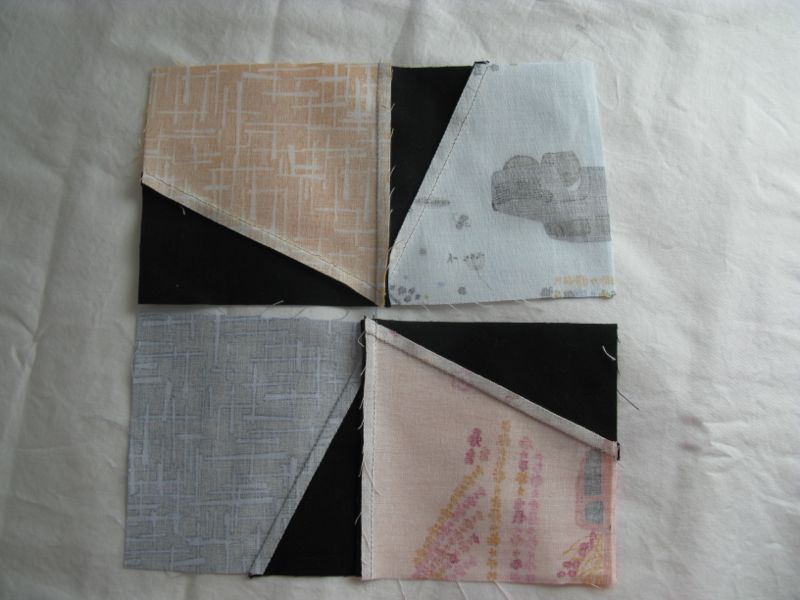
To sew these blocks together, flip the right-hand side of the block onto the left-hand side, then place the top two on the bottom two and stack them on your sewing surface.  That’s my confusing method; you’ll probably develop your own.  The basic idea is to get the quilt block, which is now in four pieces, over to your sewing machine in some semblance of order.

So, on the top, is the right-hand upper piece flipped over on the left-hand upper piece.

On the left on the bottom, is the similar pair.  I have no idea what that other bit is doing–just hanging out?  Quilt blocks are buddies and they seem to like to do that.
Sew the center seams on those pairs, then press the fabric toward the black pinwheel on all of them.
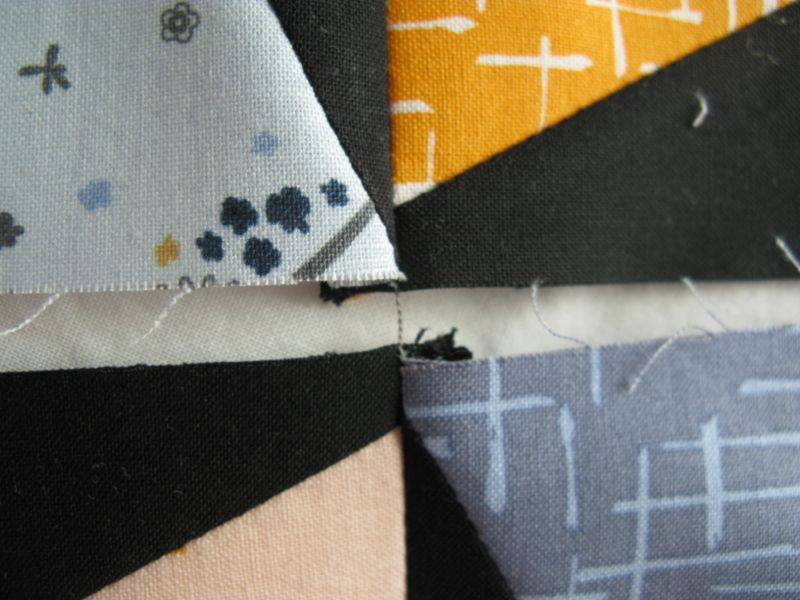
Here’s my little trick.  I sewed these pairs in a chain, then left the pairs that went together hooked in the middle, but cut the chain into “two’s.”  Then when I go the ironing board, I don’t have to match them all up again.  They’re already joined. Flop them right-sides together.
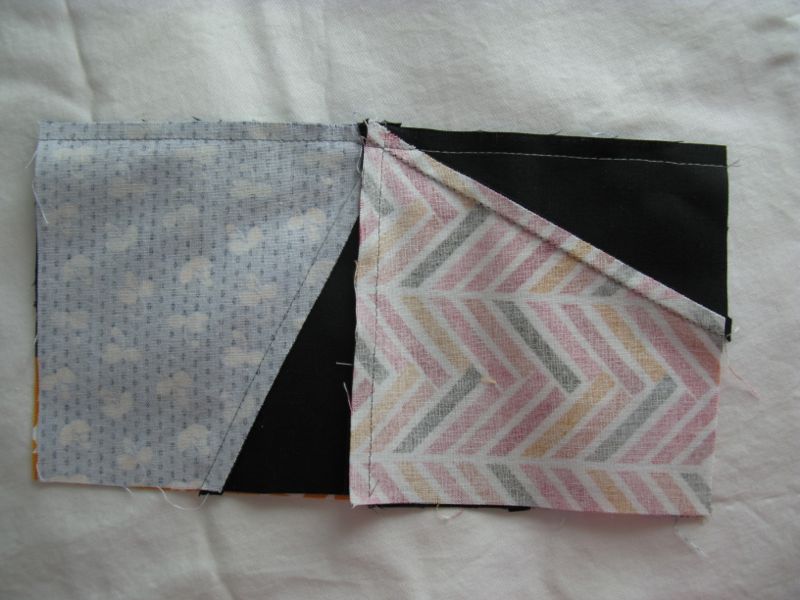
Sew that seam across the two blocks. I found that if I took the step of going to the ironing board to press toward the pinwheel, I could get away without pinning this thing to death, or eliminating the pins altogether.  The block kind of fits together because of the directional pressing.  It’s not perfect, though, so if you are all about perfection, get out the pins.

Head to the ironing board, and clip that little joining thread, and liberate any others that might keep you from opening up that center “flower” of seams.  As you work with it, you’ll be able to figure out the tiny clips of threads here and there.  Don’t cut any of the fabric, please, just the seam-threads.

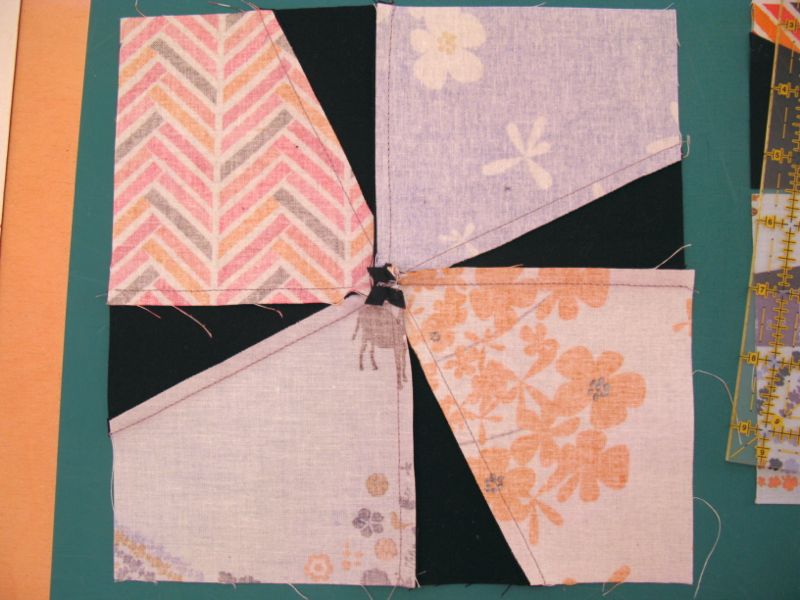
You want that center to lay down into a flower.  I put my thumb on the center, and applying pressure, give the whole thing a twist, flattening out the seams.
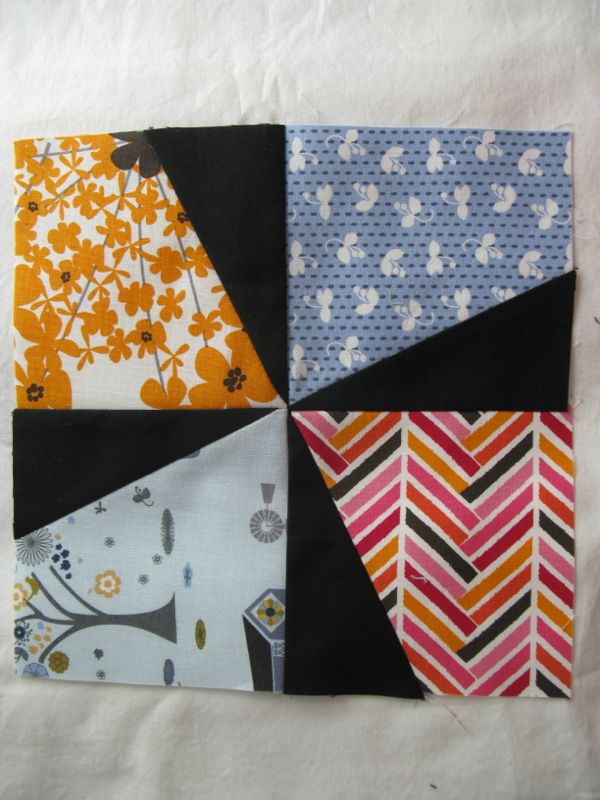
Then press from the front. Even without using pins, I think that center join looks pretty good.

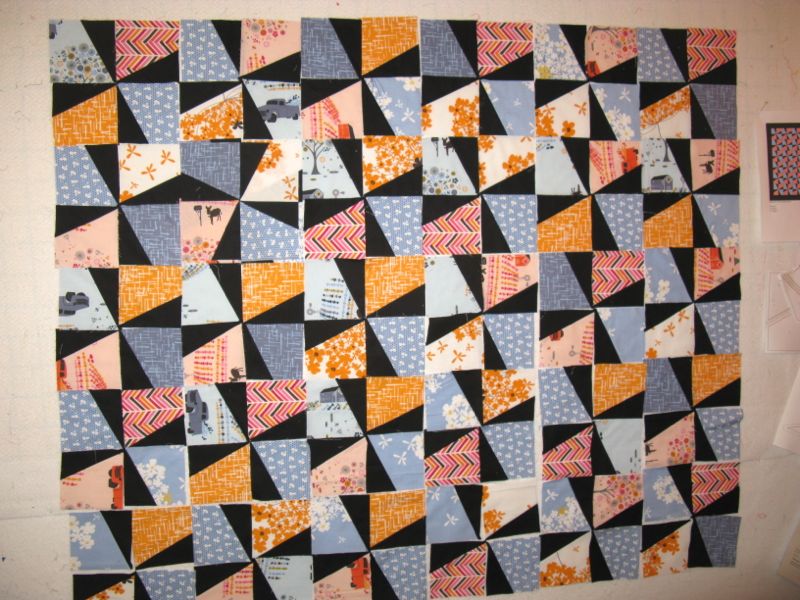
Lay out your first row on your pin wall.  Then you want to add to it, lining up your blocks so there’s no obvious repeats or clashes.  This part goes quickly.  In fact, the whole quilt went quickly: one week from cutting to sewing on the borders.

Stand back and see what is “clumping together” and needs to be separated, like squabbling children.  I find taking photos helpful.
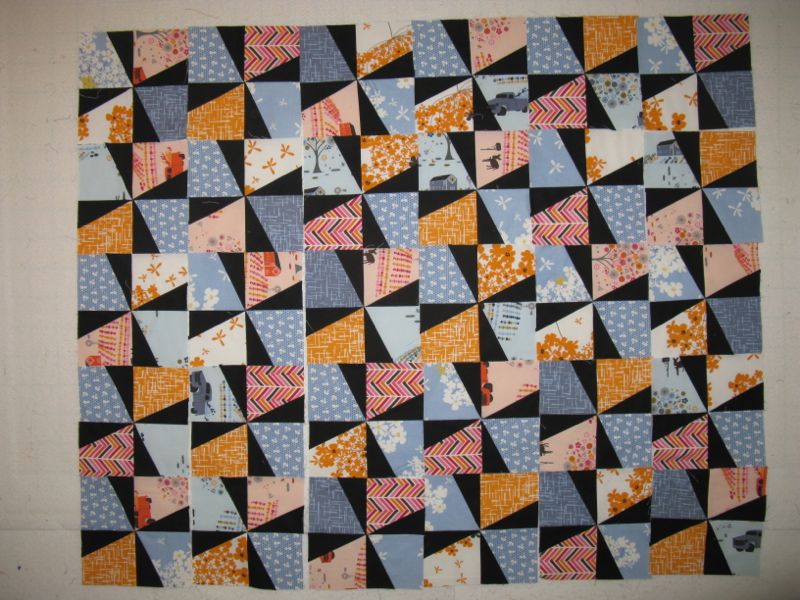
The blocks I moved are not really noticeable, but calmed down the arrangement for me.  Don’t fuss with this too much, just keep moving forward.

Use those nifty row markers to mark your rows and sew them together.
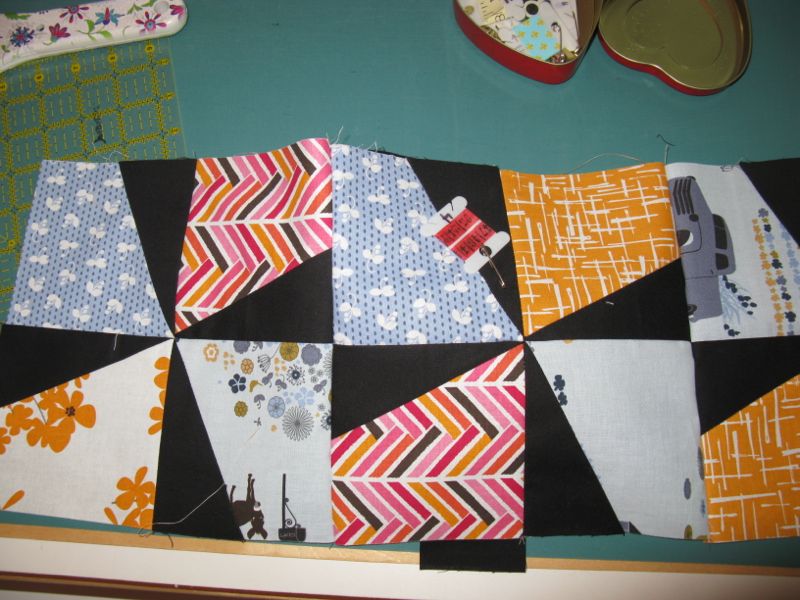
If you pay attention, you won’t sew a block on the WRONG end of the row, like I did up there on the left.  Unpick.  Re-sew.
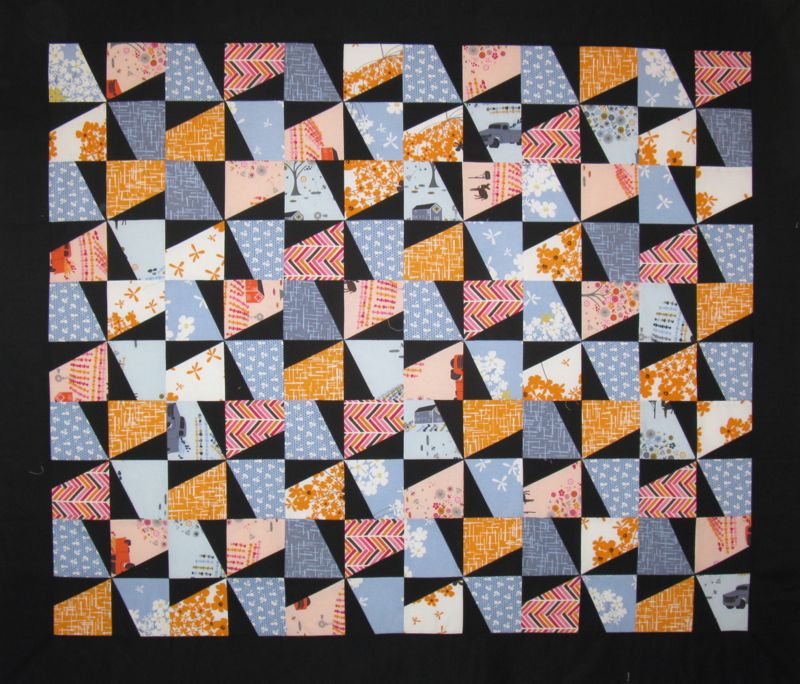
You’ve seen this before, but it’s really fun to show off a completed quilt top, isn’t it?

Feeling blissful over here.  I’ve already pinned it to the backing, and after I finish grading their argument terms tests, making up the next essay assignment, writing the peer review for the current essay, creating the rubric for evaluating their rhetoric presentation, writing another blog post for the class, and calling my mother, I plan to start quilting it.

Books · Quilts

Polaroid Blocks

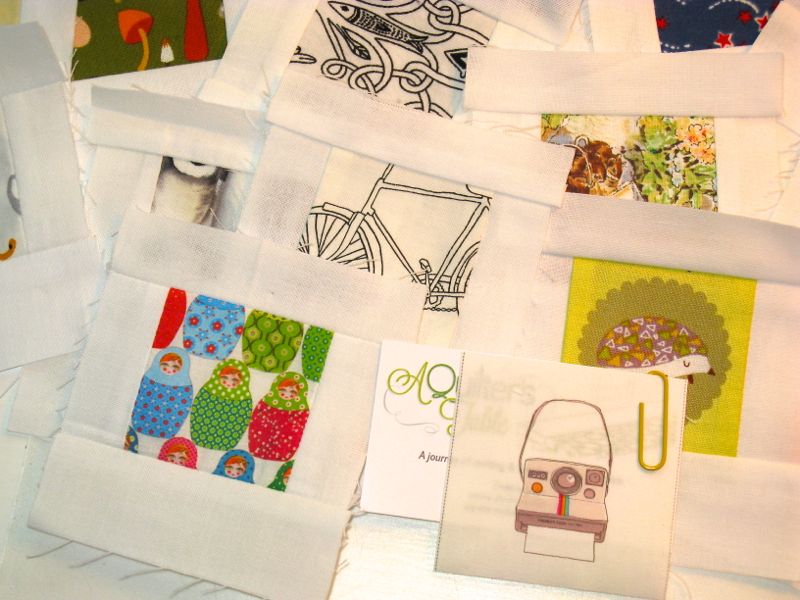
Woo-hoo!  All the little Polaroid blocks arrived from the Polaroid Block Swap.  I laid them out and looked at them all, and really thought some lovely quilters somewhere had done a fine job making little bits of fabric in a frame.

On the left is one of my favorites, a series of matryoshka dolls (Russian nesting dolls) of which I have a small collection, and the small bit of cloth that Debbie sent along with the batch of blocks: a Polaroid image on a 2″ square, which can be either a label on the back, or made into a block to go with the others.  I had a great time participating in this and appreciate Debbie’s efforts.

And from those pictures, to another kind — the old-fashioned kind — taken at local quilt shows.  I used to take a few rolls of film (remember film?) in my bag along with my camera, come home and get them developed, then put them into little photo books to look at in between shows.  At one time, we traded photos, made our own little books, bought magazines in order to get our ideas for quilts.

This is my friend’s quilt, hanging in Road to California, with another friend standing beside it.  These are all in the pre-internet days, but even so, it’s kind of hard to remember what we did before we could just pop onto a series of blogs, or to Pinterest, or even Instagram.

I have six of these little books, tucked away.  On the left in that picture are Dave and I standing by my quilt that was hanging in Road to California (a different year than Lisa’s quilt).  And yes, I’m wearing a quilted jacket.  (Boy, do I look like an early quilter.)  Even though quilt styles change and the modern quilt movement has influenced a lot of our designs, I still like looking through these when I come across them occasionally.

Last book-y thing: I shopped C & T’s clearance sale and came up with these fun books.  While not all the books are new, and even some are sort of “vintage” it is enjoyable to browse through them when you’ve only paid a pittance for them.  You really should get on C & T’s mailing list, if you aren’t already.

So, now I’m off to sew sew sew before reality will hit and I’ll have to grade the Argument Terms Test that I gave in class on Wednesday.

You can bet that I’m putting off reality as long as I can.

Quilts · Something to Think About

PTQ/WIP

PTQ is how I’ve taken to calling the Portuguese Tile Quilt since writing out the long name is tedious.  But tonight when my husband came upstairs to check on me (his cave is downstairs, mine is upstairs) and I said, we really have to go to Portugal.  Really, really.

Here’s my work in progress, which I’ll be posting on Lee’s blog Freshly Pieced, on her regular Wednesday Feature of WIP Wednesday (found *here.*)

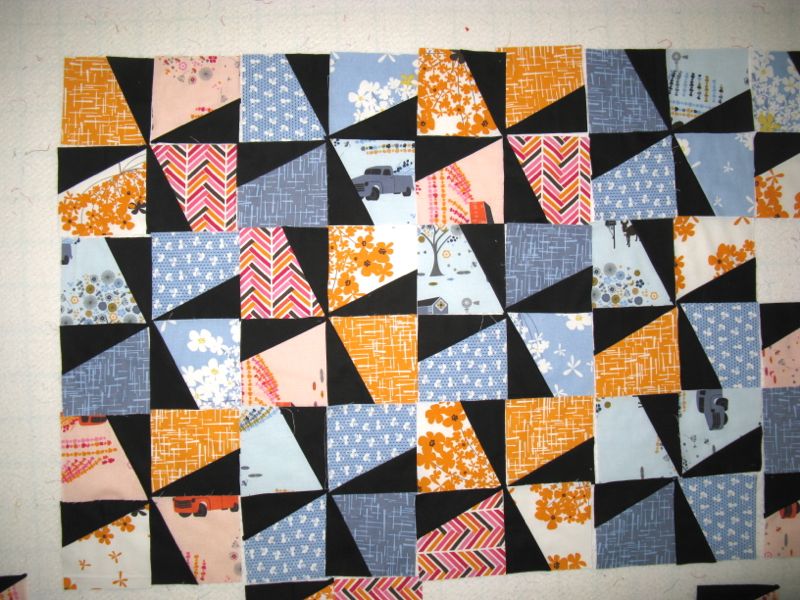
Here I’m working the windmill effect, striving always to keep the pinks in the same place.  I had to cut some more blues, because I’d cut the first ones upside down and backwards.  And I have lots of black points, so I’m wondering if I gave the right amount in the how-to post?  Pretty sure I did.

I noticed that the pattern seemed to be lost in the fabric I chose, so this version is my trying an entire block of blue and an entire block of pink/orange.

Nah.

I laid out what I had and decided I liked the not-square version of 5 rows by 6 rows.  It’s good to change your mind once in a while.

I decided to make up a batch of those “backward” blocks.  I placed one in here–spot the ringer?  I would be tempted to leave it in but it would drive my symmetry-loving husband nuts. I was just trying it.

I pressed the seams towards the black pinwheels on all pieces.  Then you have a lump in the middle, so clip a couple of stitching threads to release it, and pressing down with your thumb, “swirl” to flatten out that center.  This is the backwards block, so your seams will look reversed.

The back of the backwards block.

I was really tempted to sew this row by row, with no regard to the block.  But I need that block to be distinguishable in a subtle way, so decided to start piecing blocks together first, then sew them in rows.  That way the block will be its own entity before losing its identity to the overall tile pattern.

Just like my hair stylist who married a guy with four children.  I went in to get my hair cut today on her first day back at work since her honeymoon.  She said they spent a week on Maui, then got home late Saturday night. Monday morning, he went to work early and didn’t return until late.  She told me she went from “single woman” to “single Mom” in one week.  I admire her and think about her a lot because of my story: my husband Dave married me and my four kids.  He We survived, but even so, it doesn’t stop me from keeping her in my prayers, hopes and thoughts.

So as I work on this quilt, I think about how all of us are individuals with our own lives, quilts, loves, hates and troubles, and sometimes it just doesn’t seem to make sense until we put it all together and see the pattern.  I like that about quilts.  I like that about life, now that I’m old enough to discern some of those patterns now and again — one of the great advantages of hanging in there.