This has to do with quilting, but it doesn’t start out that way. It starts out this way, with a two-year old girl posed on her family’s front lawn.
Then all of a sudden, I was a young mother, then a mother of three-soon-to-be-four children, then a grandmother. When I was that young mother, I took a class on how to make a quilt. I was a Clothing and Textile major in college, so I knew how to sew, but I thought there was something extra you had to know to make a quilt. And with one young child at home, I had absolutely no extra time (or so I thought then) but figured I could squeeze it in somewhere. Between then and when the fourth child was born, I made about eight quilts: each child had a baby quilt, I had a quilt for the bed, and I’d even made a baby quilt for my sister and one I sold in a consignment shop.
Mothering was that life. That was what I chose and on balance, the kids seem to have turned out all right. But somewhere in that life as mother, I also chose a life as a Mary Kay Lady and a seamstress– I was always sewing, making all the outfits the children and I wore. And somewhere after I finished my undergraduate education (I was on the 28-year plan), the number of quilts I made took off like a rocket, blogging happened, rotary cutting happened; things just changed. Again.
I’ve been thinking about this because of two experiences:

The first was the presenting of my quilts at a trunk show at my local guild. I reviewed all my quilts, and each represented some life I lived at the time of the making of that quilt, from the simplest beginning quilt (a small whole cloth quilt with the knots on top) to the recent finish of The Circles Quilt, with all the blocks I designed. It was a satisfying evening and I was happy to share some of my life’s work.
The second was when I flew home last week after visiting my mother for her birthday, and I stitched improv appliqué blocks while on the plane. The young man next to me was reading DeLillo’s White Noise, a book I had read in grad school. The title fit the book perfectly, and that was about the only comment I could make when he and I visited. I realized he saw this grandma-person stitching away and that was the only life of mine he could see. But, I wanted to say, I’ve had so many other lives!
So if all my lives were strung together as pearls on a necklace, what might I see? Would I see only the failures, the quilts I gave away, the moment I lost it and yelled at a child? Would I see the classes I had to drop, the cosmetic saleslady I could never be? Or would I focus more on the pearls burnished from the striving and from the use: a creative life, a life with laughter, traveling and family. A life with happiness, because in addition to all that, I get to walk into my sewing room every day, thread a needle and get to making.
![]()

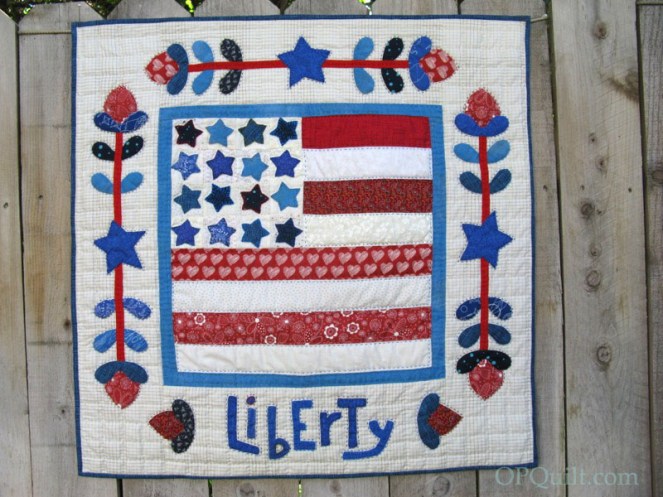
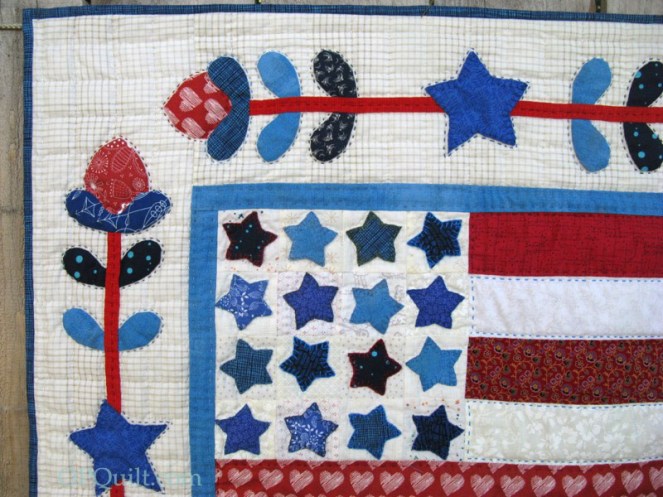
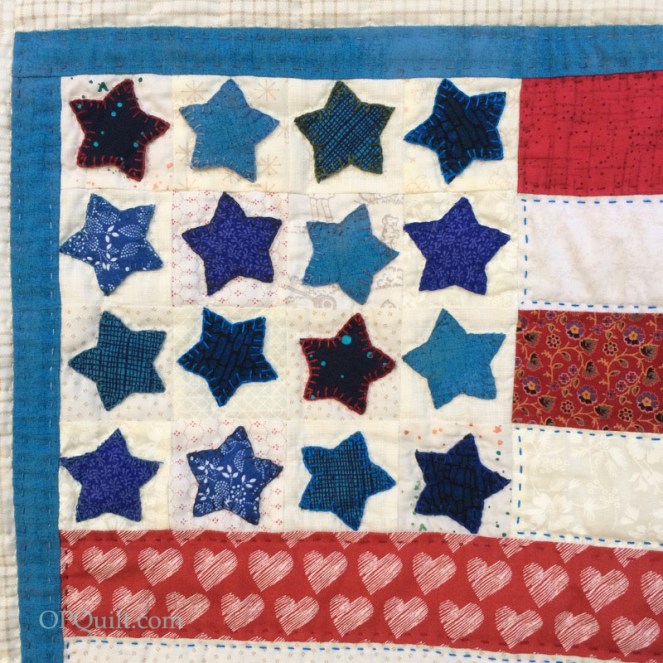
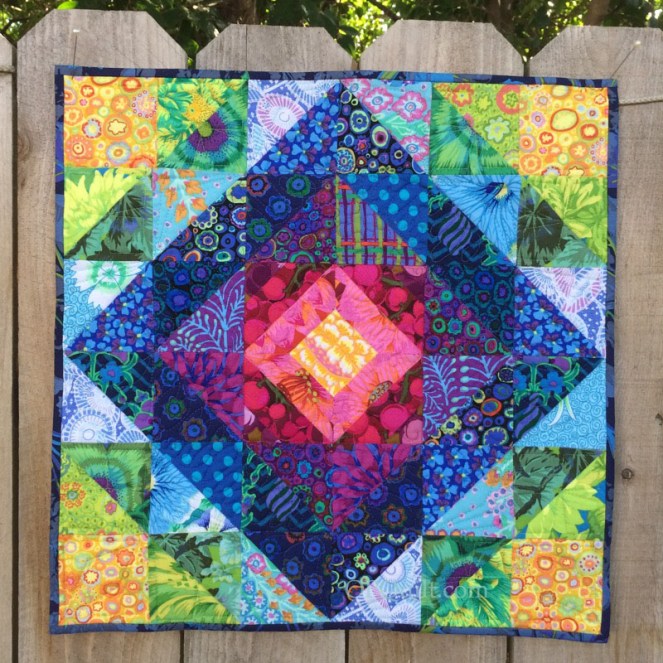
We all put double layers of fabric bindings on our larger quilts, but have you thought about using a single binding on a smaller quilt? It’s quicker, flatter, and really–are you going to wear out those edges any time soon? And if you do, won’t you just repair them? That idea came from Gwen Marston, in one of her last workshops. That idea — that a quilter would just repair them if they became worn — is why she uses single bindings on all her quilts.
Start by squaring up your mini-quilt. Yes, that is a gigantor square ruler, and I use it a lot, actually.
Prepare your hanging corners, by cutting a larger square (for a 24″ quilt, I use a 5 1/2″ square), folding in half, diagonally, and pinning it in the upper corners of your mini, against the back, matching raw edges to the edge of your quilt.
(Here’s what it looks like on another quilt, as my corners just disappeared on this one.)
Cut strips of fabric (lengthwise, if you can) about 1 1/2″ wide and the size of two sides. Pin, then stitch on, using a 1/4-inch seam.
Repeat for upper and lower edges. Pin and stitch, but watch out that you don’t veer off on those corners (I pin them).
Square up the corner, and cut off the excess, both underneath (above) and on the outer edge (below).
While this looks angular, it isn’t.
Press binding out away from quilt.
Fold up lower edge, so the raw edge of the binding meets the raw edges of the quilt.
Fold it up again, covering the raw edges of the quilt. Pin in place, and then repeat with the sides:
Hand stitch all the way around, or if you are a confident quilter, you can use a glue stick to affix the binding edges down, then machine stitch. I personally don’t like the machine stitching, as I think it makes the edges too rigid, but “To each his own,” said the Old Lady as she kissed the cow. (My Dad used to say that all the time.)
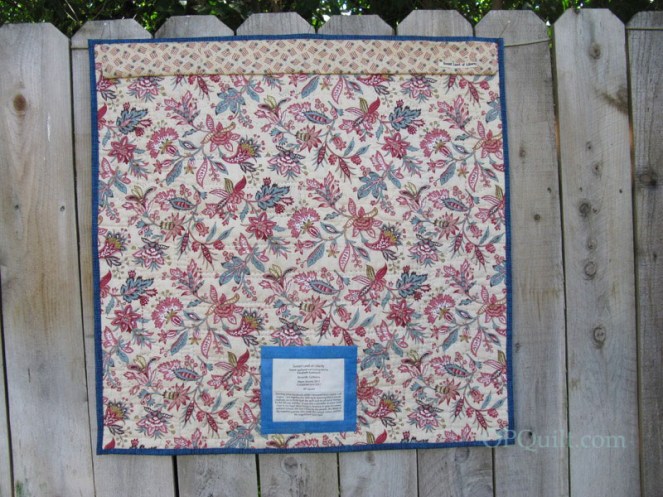
Here’s the corner already on, but it’s hard to see. I cut a dowel the width of the quilt, minus 2″ and slip it into place. Then I hang my minis, balancing it on a push pin.
Thanks to all who came to the Trunk Show and to all who sent their best wishes. It was a lovely evening! If your guild would like to see my Abecedary of Quilts Trunk Show, just drop me a note.

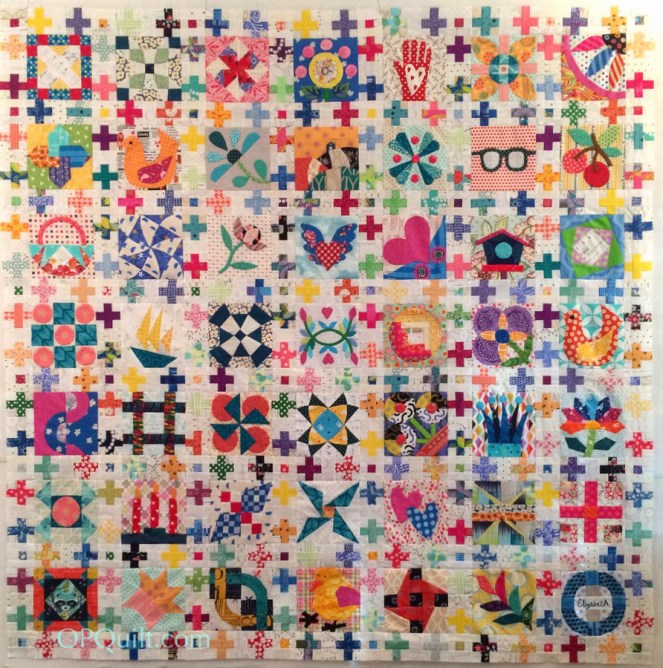
This is beginning to feel like the never-ending quilt.
I then cut matching pieces of fabric into 1 -1/4″ x 2-3/4″ bits. I sewed a matched set of two strip-set-blocks, one on top, and one of the bottom to make a “plus.” Then I sewed 1 -1/4″ x 2-3/4″ pieces of low-volume on either side of a “dot” to create the mini block that is at the intersection.
The “plus” and “dot” units finish at 2-1/4″ square, so trim them to 2-3/4″ square (