Textiles & Fabric · WIP

WIP and Scenes from Italy

I think we are all breathing a sigh of relief that we can answer our phones again without being assaulted during dinner by robo-calls from a candidate.  Or go to our mailboxes without needing a forklift for the thousands of pounds of campaign fliers.  I live in California and thought I had it bad until we talked to our son who lives in Ohio.  My sympathies to all who live in swing states; thanks for participating in the process.

So it is so nice to return to a routine, and today is Works in Progress Wednesday, hosted by Lee over at Freshly Pieced. Actually today it is being guest-hosted by Svetlana, and she echoes my sentiment of enjoying the weekly accounting that we do every week to keep us on track.

Last night as I watched the election returns come in with my husband, sister and brother-in-law (who are visiting), I was able to finish up this seventh hexagon.  I just keep the basket of pieces downstairs by the television and work on it whenever I am parked in front of the tube.  This hexie I could christen the political hexie, for it seemed like that’s what I was watching most as I worked on it.  I don’t know what I’ll do with them all–Downton Abbey starts up in January so maybe I’ll have some more completed before I have to decide.

But I have just returned from a trip my husband and I took to Italy, where he participated in the Collegium Ramazzini, a scientific conference in Carpi (a little town northeast of Bologna).  Not only did we visit Carpi, but also Bologna, Padua (and the Scrovegni Chapel), Venice, and Burano–a colorful island near Venice of brightly painted houses.

This is a wall from the 11th century in a church in Bologna.  Love those patchwork designs.  Everything old is new again, isn’t it?
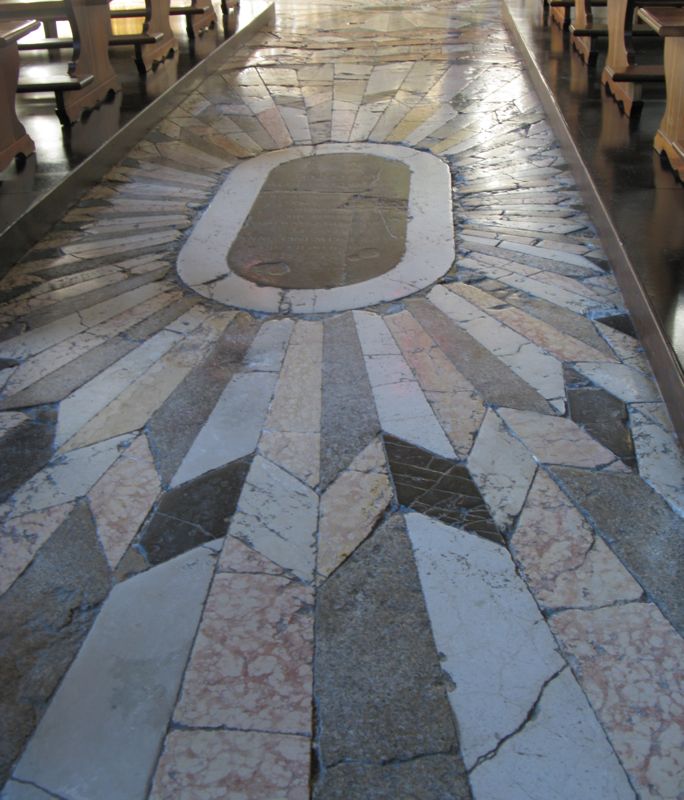
I can’t believe they let us walk on this ancient stone floor from the Peter/Paul Cathedral in Venice, but here it is.

My husband found this fabric shop for us to look at (Bologna), but I only bought fabric in a shop across from the two (slightly leaning) towers.  Below you can see the man cutting my wool challis.

I’m thinking a scarf or something.  Fabric was really expensive over there.

But they do wrap it up nicely to bring home.

I’ve been collecting tea towels for use on the back of quilts, and here’s the one from Padua.  We thought it interesting that the thing we went to see most — Scrovegni Chapel with Giotto’s frescoes — was not even listed on the back.
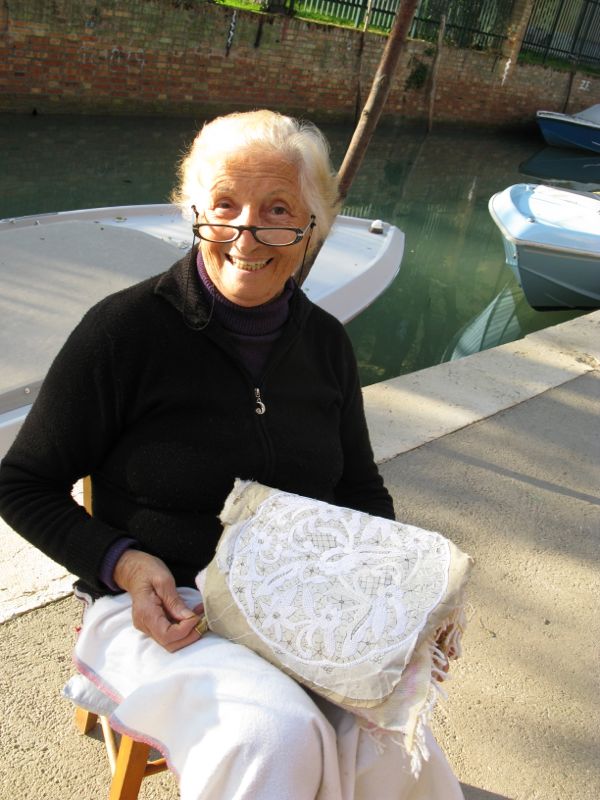
In sunny Burano, we saw a woman sitting out by the canal making lace.  By hand.  Burano is known for its lace and lacemakers, and apparently it’s a dying art because none of the young woman want to learn it.  We watched her for a while, as she used her needle and thread to create tiny stitches and knots over a paper pattern.

Here’s a close-up of her pattern.  She’s created the main flowers, then will come back in and create the webbing to hold it all together.
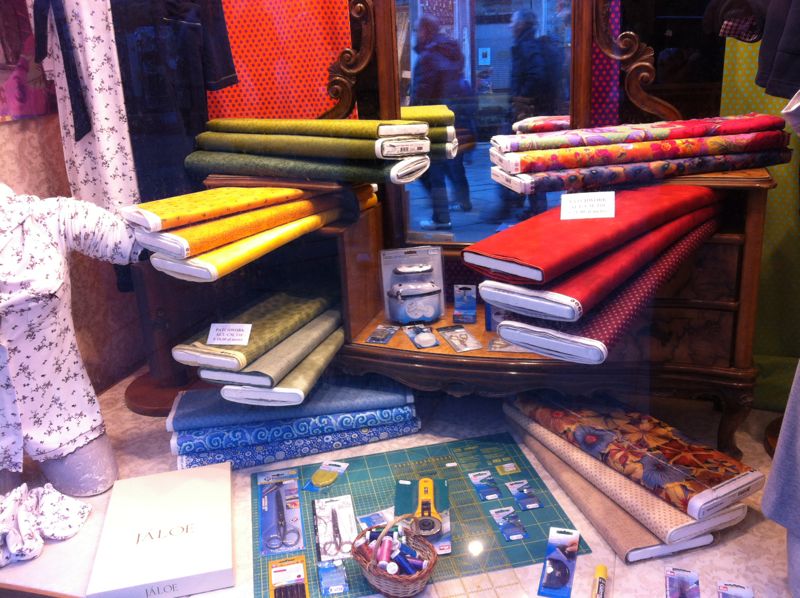
I found the quilt shop in Venice!  This is right as you come off the Ca’D’Oro vaparetto stop.
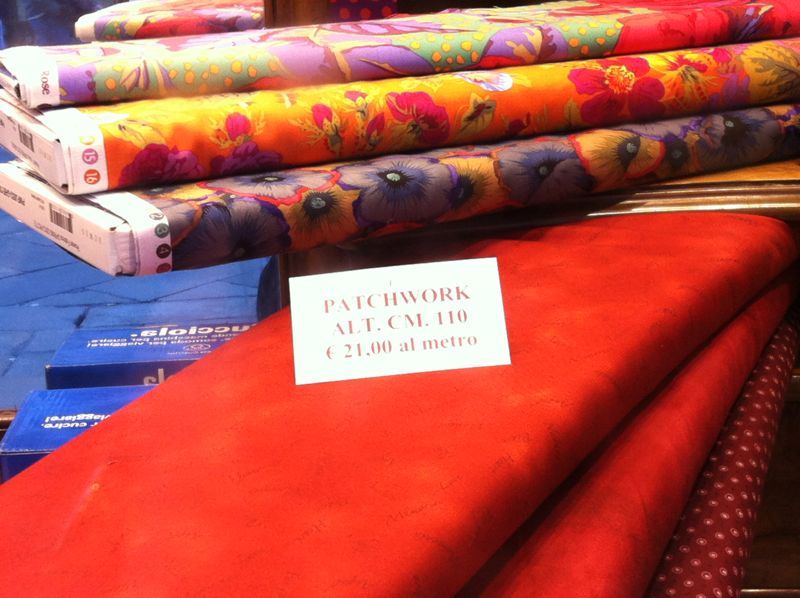
But the prices are enough to make you swoon.  Twenty-one euros a meter (39″) works out to about 25 bucks per yard.  I try to remind myself of the luxury of all the fabrics we have here in the States at about half the cost.  I’ve learned not to buy quilt fabrics imported from the United States when I’m traveling, but if I have time, I’ll duck into a shop for a pattern or an interesting notion.

I’ll leave you with three photos: the first two are from the island of Burano and the last is from our final, foggy, morning in Venice, before we headed home.

Creating · Quilts · Textiles & Fabric

Working in a Series

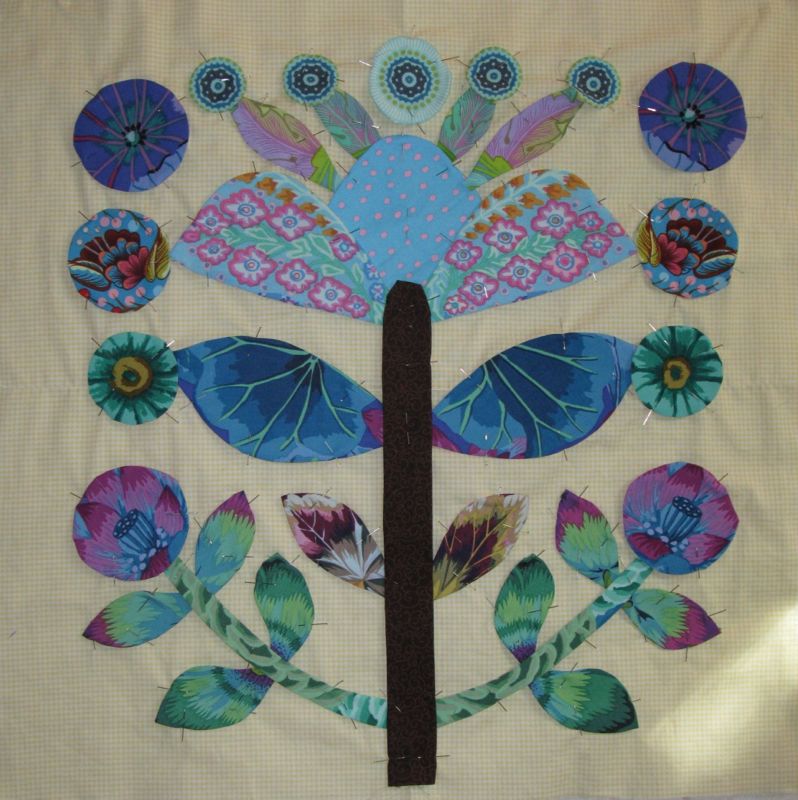
I think part of my discouragement this week was fatigue.  I’m working a stack of Kaffe Fassett fabrics.  There’s probably 40 to 50 different fabrics that I’ve collected over the years, and in this pattern it’s a challenge to get the fabrics to talk to each other within the block.

I can see, though, that working in a series has improved my ability to see what works, as I change out the leaves and some other smaller pieces, as well (above).  I found that I was less enamored of one of the earlier blocks, but it was already appliqued down and I would have been crazy to mess with it.

Here’s the final version of that block.

But I did mess with this one.  The brightly colored circles with red in them are a different line of fabric, Amy Butler, and they stand out among Kaffe’s florals. (Although I am using some Phillip Jacobs, and others from the Westminster line.)

I think the Anna Maria Horner fabric does harmonize well in terms of detail and color (the aqua circles at the top, and the second large circles down from the top, with feathers and berries).

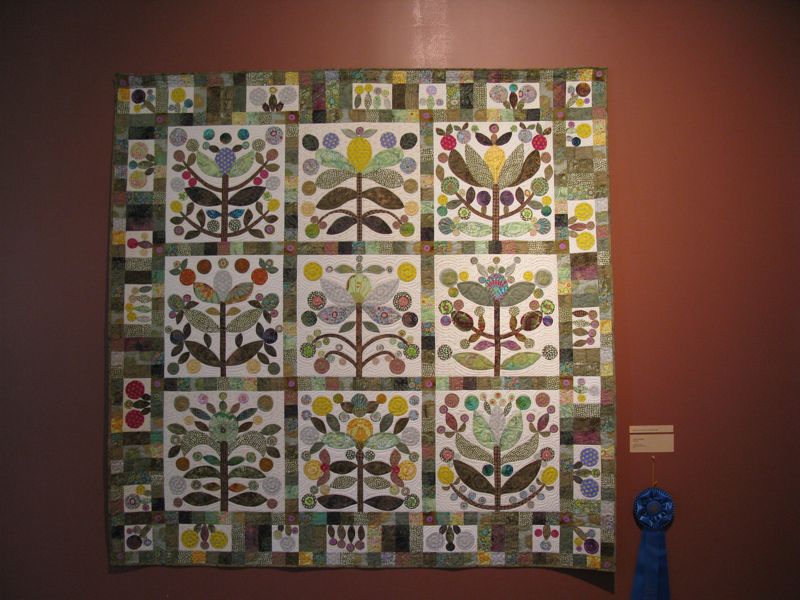
All in all, I am glad I pushed on.  I do love looking at them on the pin wall, although now I’ve turned my eye toward the borders — with more design decisions.  When I went to the Springville, Utah quilt show last summer, a version of this Kim McClellan pattern was done up in softer greens, a lovely quilt and a contrast to the bolder hues usually seen.  In this, you can see the border design.


It was certainly deserving of its blue ribbon.

And you are all blue ribbon readers–many thanks again for your encouragement!

Quilts · Something to Think About · Textiles & Fabric

Nebraska’s International Quilt Study Center

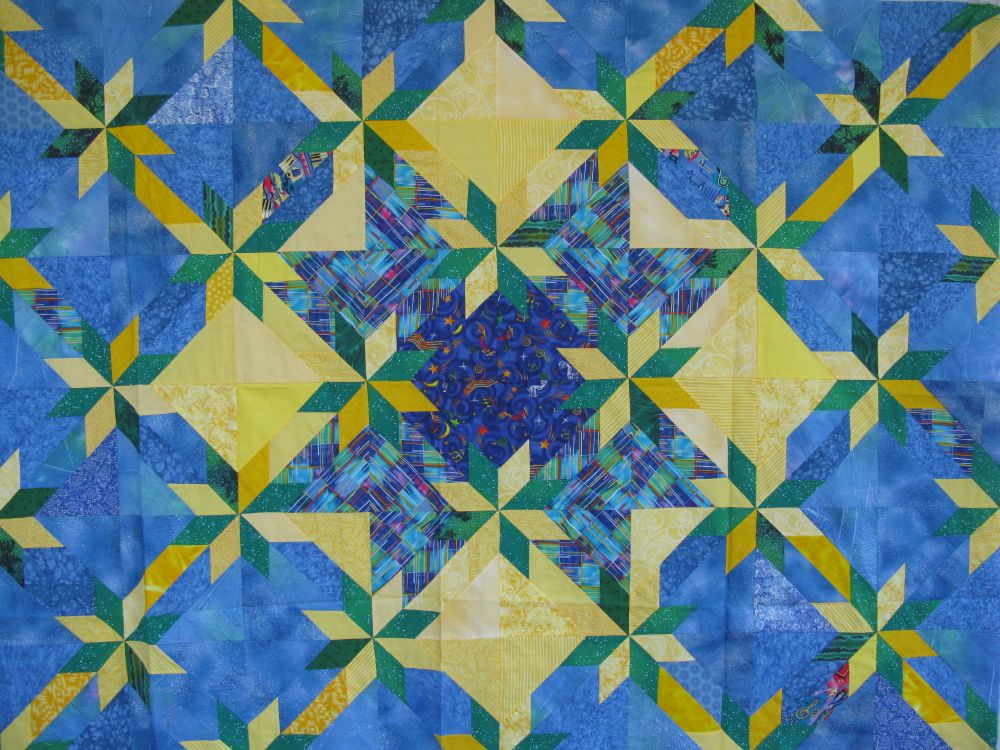
Hunter’s Star quilt top, c. 2003, unquilted

Recently I commented on another Debbie’s block, titled Hopscotch, saying that it was an interesting variation on a Hunter’s Star block.  She wrote me back, included the link to the pattern she used, and said she couldn’t find a Hunter’s Star block that she thought resembled what she was making.

So I had to go and look at it again.  Yep–she was right.  It wasn’t a variation on a Hunter’s Star.  And, yep.  I was right.  It was a variation on a Hunter’s Star.  I could see that the author of the pattern had changed up the triangle to a 60-60-60 from a right-angle, and had extended the strips on the outside, leaving the center in a different fabric.  But not wanting to irritate the Copyright Gods who are already pretty cranky this month, I wrote back to say that I LIKE blocks that have more than just a hint of traditional blocks, for I believe “that creating a new twist on an old favorite, or dreaming up something new that has overtones of the standards, makes me appreciate the long and rich heritage we quilters belong to and participate in.”

While doing this research I dragged out my Barbara Brackman Encyclopedia of Pieced Quilt Patterns (which if you don’t have, save up the grocery money and get one) and then headed over to my other favorite source: the International Quilt Study Center and Museum at the University of Nebraska-Lincoln (IQSCM).  If you haven’t seen this website, head over there.  Click on Collections (in the black bar at the top) and then spend time scanning triangles or Log Cabins or whatever you feel like.  My advice is to set the number of the results per page to 50, as you can scroll through them quickly, stopping to enlarge the ones that catch your eye.

Like this one, made between 1930 and 1950. Info below.

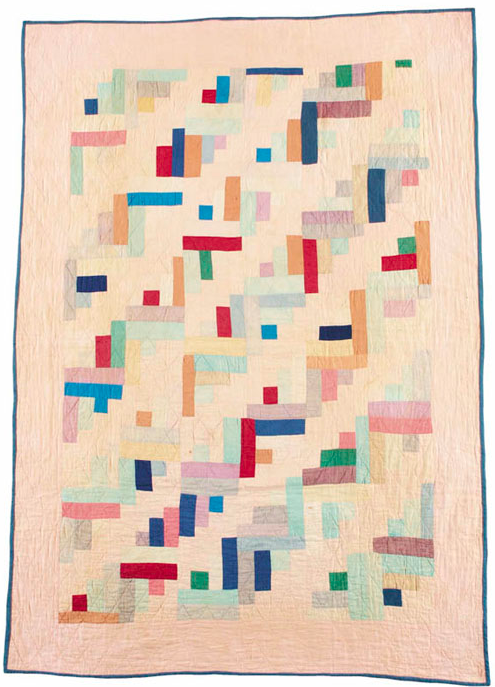
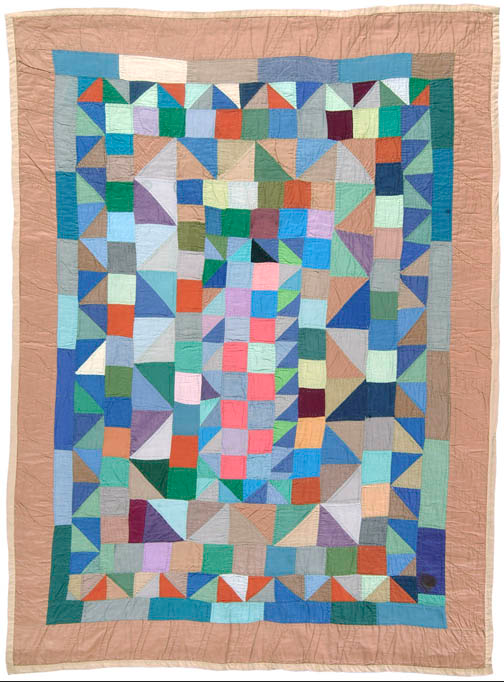
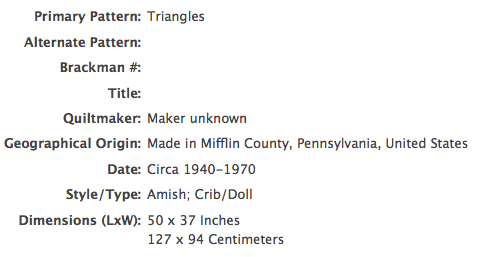
Or this one (IQSC Object Number: 2003.010.0009).  I think the maker, who put this together sometime between 1940 and 1970, may have had our modern sensibilities when she made her colorful creation. Why are we always so quick to declare ourselves free of these amazing women and their quilts?  What is it about our quilting community now that only wants to have the latest thing on the block?  It’s well-known that any new idea is really only about 10% new, and while I hope to have a few new ideas here and there, I recognize my debt to these early quilters.  I also love seeing what women in THIS day and age are creating.  To me, it’s one big happy quilting world.

I think it’s interesting to notice in this screen shot of the listing, that there is a place for the “Brackman #”  (another reason to buy that book).  I have compiled hundreds of numbers of quilt blocks I want to make from Brackman’s book.  Pinterest (of which I also like for the ability to “curate” my own collections of ideas) has feeble numbers of ideas compared to the riches of Brackman and the IQSCM.

(Note to Pinterest Users:  Please don’t “pin” the IQSCM quilts without their permission; they allow only a one-time use of an image, with complete documentation per publication (digital or print)–with the IQSC Object Number.)

Happy Quilting, to all of us quilters–both modern and vintage, new and old!