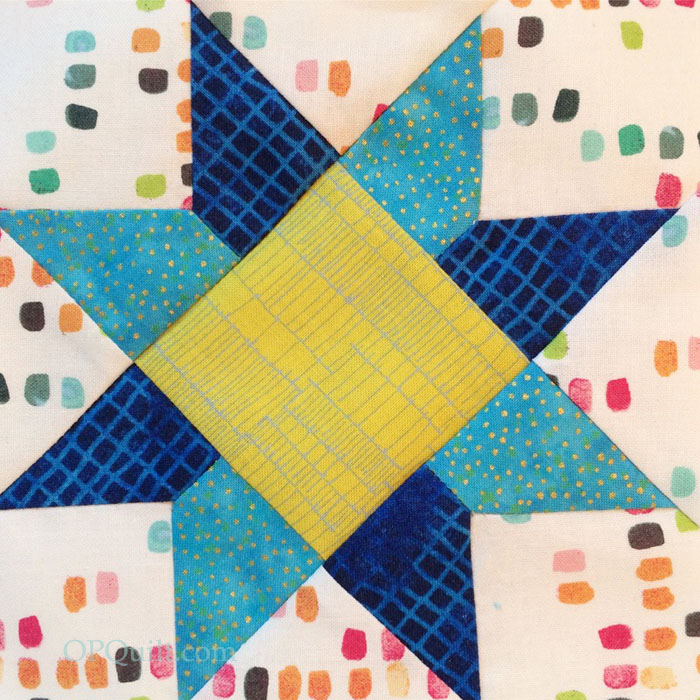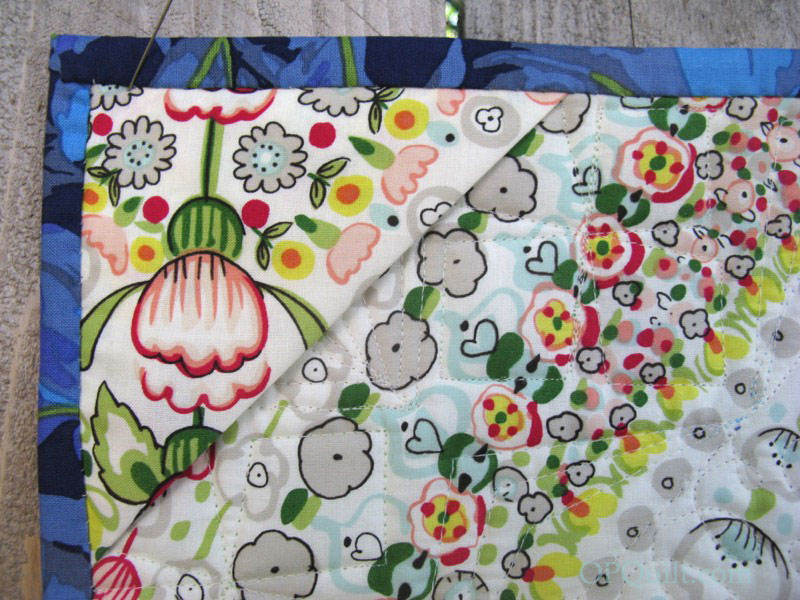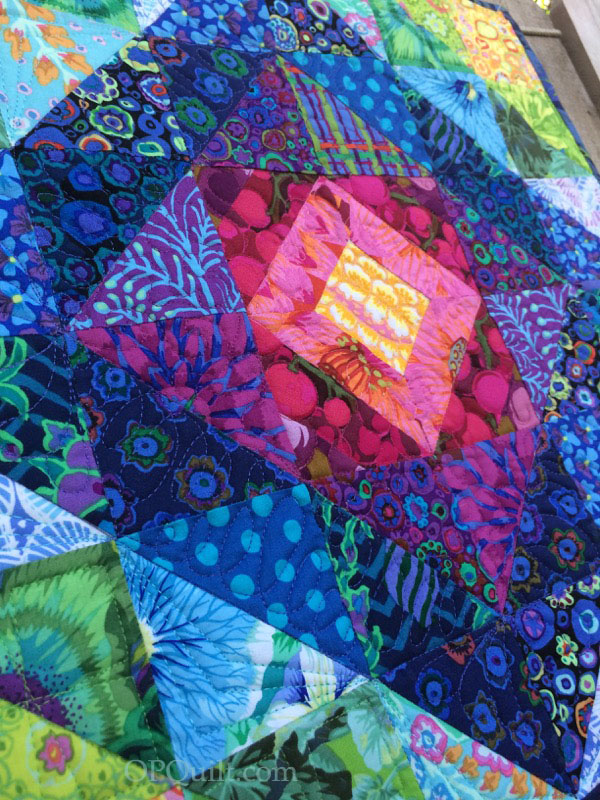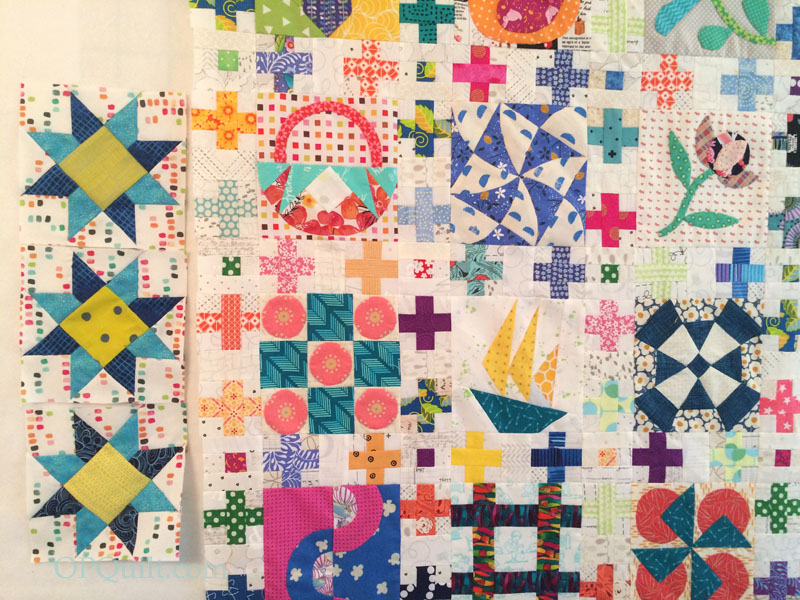
I have been working with Painter’s Palette Solids for nearly two years now in various capacities (quilt designer, mostly) and I love these fabrics not only for their wide range of colors, but also for the hand–or how it feels. They are made by Paintbrush Studios.
I was contacted by them to help them with their launch of the fabrics, to make them a quilt for Quilt Market announcing these solids. I designed a quilt, sent off my fabrics request and started working. I fell in love with the saturation of color, the fine thread count–but not so much that it’s too lightweight, like a batiste (which wrinkles terribly)–but enough that it was easy-to-work with, to cut and to sew.
And since I was sewing for someone else and I was hyper-vigilant about matching the seams, etc., it also held up while I ripped out and resewed seams, without showing cloth fatigue or looking used. I was amazed at this new line of solids and have been working with them for a while now, waiting as they rolled out their fabrics for sale across the United States.
And now again, I get another chance to play with my beloved Painters Palette Solids! They are running a March Madness contest, starting Friday, and at the end of the contest, they will draw two winners to win free fabric…and I hope one of them is you.
More details are coming on Friday (3/24), with voting in brackets (just like the real March Madness) beginning on Monday, March 27th. I’ll have a bundle of colors that will go up against other quilters with their bundles of colors. Vote for the one you like the best in the categories, and send your favorites to the top (I like mine, but it’s also great if you like someone else’s too).
So, play March Madness Mad for Solids and vote for your favorite bundles. See you Friday.
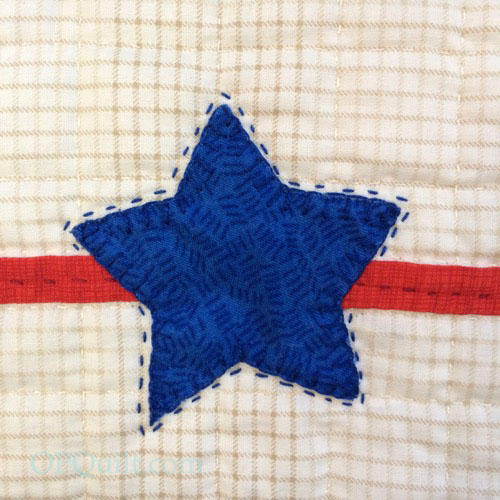
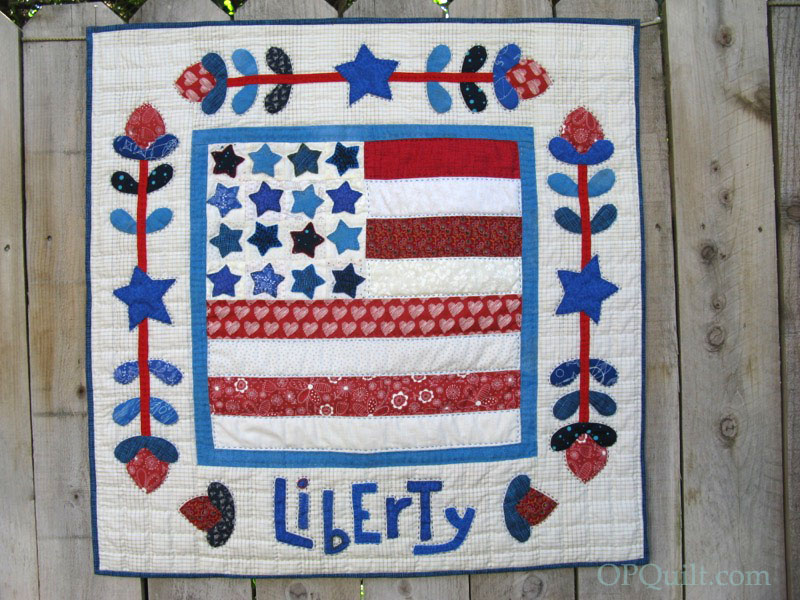
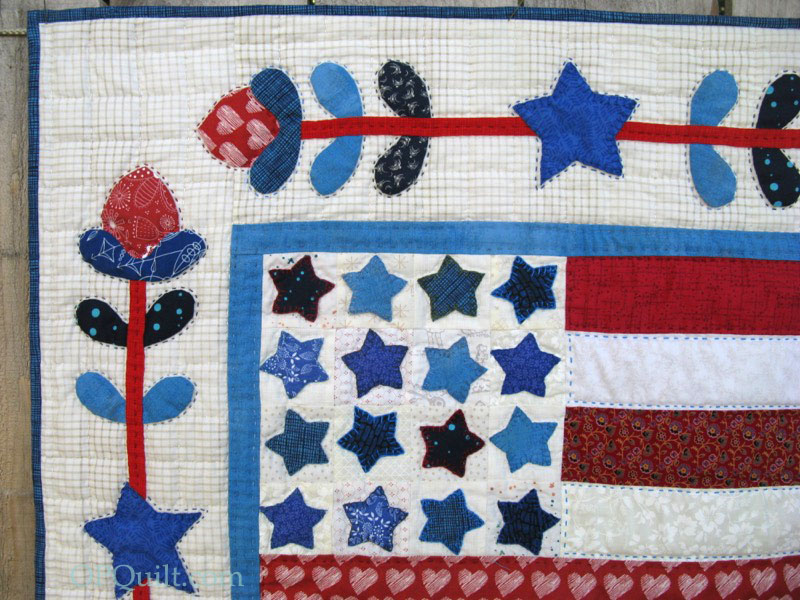
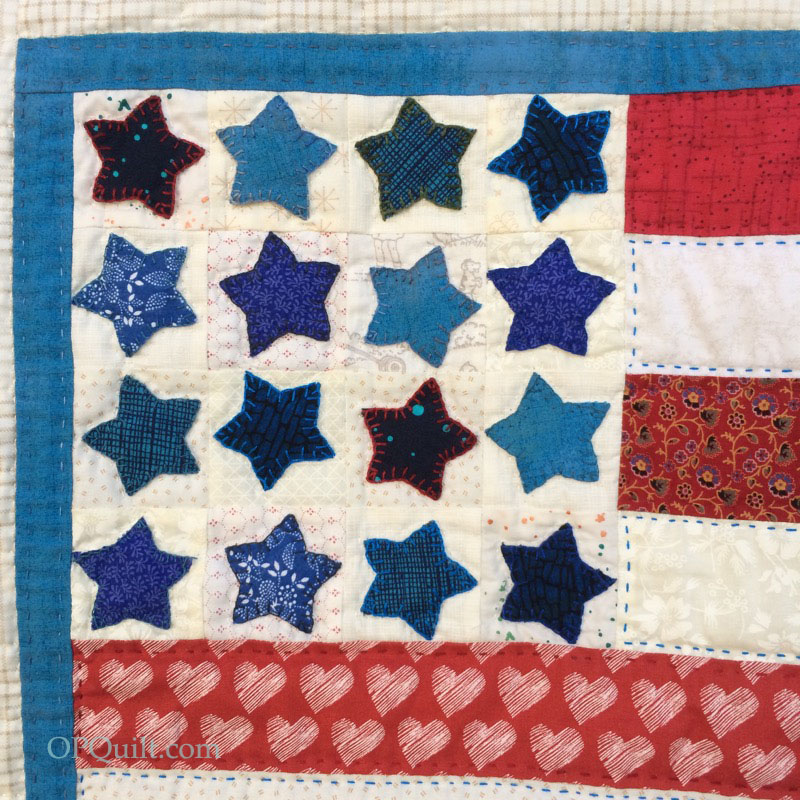
Well, I finished up the top of my Liberty USA quilt. And in other breaking news, I also was cleared to take off my sling. My hands are now free-er than they were a week ago (and I’m even typing more, rather than dictating) but it’s still a slog for a long while. So, this quilt top will rest until I can figure out how to quilt it, since the left arm is more like a wet noodle than a functioning member of a FMQ duo.
But it’s fun to be at this place.
One interesting drawback to this whole one-arm thing, is that you can’t clean up the sewing room very well. So the day after I got my sling off, I noticed the pile of Sarah Jane scraps on the top of the cutting table, as it was one of the last projects I did before heading into surgery. I had wanted to make Eliza a doll quilt to match her big-bed quilt, and now was my chance. I scissor cut some pieces, sewed them together, and finished the top.
I tried quilting my HQ Sweet Sixteen, practicing on a quilt square scrap, but it was a no go. You need two hands for that. So I used my walking foot on my regular machine and was able to get it quilted. Off it goes into the mail today!
I’m not doing much cleaning, or sewing, but I have been doing some thinking about where we get our inspiration from.
This is Ingrid Blood’s Bye Bye Rubric Cube. I have seen it twice now, once in the fall, and once at Road to California, and thought it was terrific. Then, because I sit and read and read and read (lately), I found this:
Look familiar? I wonder if it’s more than a coincidence that Blood used Edna Andrade’s abstracts as inspiration (even to the use of that red center), but I have no way of knowing. Andrade, although she died some years ago, was more popular at the end of her career and after her death. She worked in the Hard Edge school of painting, of which June Harwood was a “member” — a painter brought to my attention by my nephew, who is observant in All Things Art & Design. (I actually have two nephews like this, and their IG feeds are always full of interesting images.) These painters’s ideas are ripe for the picking by modern quilters, as they have a distinct lines between edges, which suits our medium of fabric. Here’s some more Andrade:
I remember being in a discussion in a class taught by Ruth McDowell, where someone posed the question if she should be acknowledged when we finally finish our quilts. Typically self-effacing, she offered that it would be a nice gesture to acknowledge those that inspired us, or helped us.
Why are we loathe to state our sources of inspiration? Does it diminish our efforts, or is it really unnecessary? Andrade didn’t acknowledge the other hard-edge painters in the corners of her paintings, but Wikipedia notes that:
Andrade listed artists who particularly influenced her style including Paul Klee, Piet Mondrian, and Josef Albers. Andrade also notes that she was influenced by architectural design, philosophy, mathematics, and design (Locks bio). She was specifically inspired by things such as astrophysics and Freudian psychology, contributing to the complexity and detail of her paintings.
And from the notes from the Locks Art Gallery:
I think many of us are skittish after the Modern Quilt Guild laid down the law on “derivative works” last year, and we are skittish about recognizing where things come from, just in case the Quilt Juries don’t let us in. While I do think there is some good things that came out of the pronouncement last year (just how many floating rectangle quilts can we invent?) it also did harm to those of us who dabble far and wide in our inspirations. [For an excellent recap of that tempest, head here.] I hope we come back to a more even pitch, so that we can give credit to things that inspire us, just as Andrade did.
Colorwheel Blossom, 2014
I would never have this quilt if it hadn’t been watching the Apple Keynote address when they launched their iOS system changes a few years ago. I boldly put the inspiration on the entry form when I entered it into QuiltCon a couple of years, and they rejected it. Did they reject it because of the Apple connection? I’ll never know, but it doesn’t really matter. Yes, it’s derivative and yes, I love it. It hangs in the front hallway of my home, and it’s still a favorite. Instead of worrying about whether or not quilt juries will accept our quilts if we springboard off of someone like Andrade, we should make what we love, from what inspires us, and not be afraid of our inspiration.
But I also hate Pinterest when I’m trying to do an image search. I recently was searching for “wonky row quilts” and everything took me right over to a Pinterest page, which is a crazy way to try to find something. You have landed on this interminable page of images and then you have to search the page again, without the benefit of Google’s search engines. So this is now what I do.
Your type your key words into the splash page (the first page in a website) that looks like either the one above or the one below.
You are used to the above two views, where you can find your way to an image library. I included the first view so you can see how maddening it is to get all those Pinterest results (and no, I don’t think the Pinterest’s search engines are better than Google’s, but then that’s another post).
You’ll see lots of images, and when you click on one, the screen will split to highlight your choice.
Head to that link up there at the top, the one that says “Search by Image.” Click on it to be taken to this page:
There are several basic subdivisions of this page, and they can be helpful, at times, but I’m looking for a source that doesn’t refer me back to Pinterest. These results are usually in the “Pages” section. Avoid any Pinterest listings, and head for pages that have an address that starts with “https.” You may not need to drill down like this, but in the case that you are looking for the origin of a specific image, these tips may help.
Want to find out if something has been posted from your blog?
In Google Image Search, click on the camera.
From the desktop, drag into the box a photo (or paste in the photo’s URL if you know it). I’ll do my Christmas tree skirt, which I know has gone a lot of places.
This is the result. While there are multiple results, most of them were for other Christmas Tree Skirts.
But in the Pinterest results below, I did notice it’s been pinned nearly 3,000 times. (This photo gets around.)
Another reality of the Google Image search is for personal security. Say you want to find out where an image of your grandchild or child has gone to? Pop in their picture. Many images are lifted from Facebook, so please be careful about what you post, and never post a child’s image without their parent’s permission.
Hope this helps in your searches.
UPDATE: If you know how to use Boolean Operators, you can also add -Pinterest.com to your search terms. (That’s a minus sign before the term you don’t want to show up in your search.) I have mixed success with these, so I didn’t write them into my post, but one of my commenters mentioned it. Try it, to see if it works for you.
When I say the grid, you probably think of something like the image above: a rendition of the electrical grid in the United States.
Or you might think of a street grid, or the computer grid, or any other type of connected web.
I also think of the grid we use in making our quilts. Above is my example of a regular grid, using a 9-patch variant. This style of quilt — that of using repeated blocks set in a grid — didn’t become popular until the 1840s, as earlier quilts were more whole-cloth, medallion, or broderie perse styles.
The name of our Gridster Bee is a nod to the idea of the grid, and since I’ve had some non-sewing time, I did some research about the grid, finding its origin in the way that text was laid out on the printed page. (Note: Where the quotes are unattributed, I could find no source for them.)
This method of intersecting lines and angles, known as the Van de Graaf canon and used medievally, was popularized by Jan Tschichold in his books discussing classical book design, and became the standard for book layout. You can see the proportions at work in the magazine layout (above) on the right.
Some myths about the grid:
Grids are a design trend
Grids impede creativity
Grids are confining, and can only be used for certain designs
The grid is a static, even, regular subdivision of the surface both vertically and horizontally
There are all types of recognizable grids, such as those above, and in the images below:
Patricia Walker Rusk’s Sunset Gardenspencil cubbies in a shop in SwitzerlandBullseye by Vicki RuebelUpward Modbility by Stephanie RuyleChrista Watson’s Square in a SquareLisbon Subway TilesCindy Wiens’ Delta BreezeThree versions of my Neighborhood Quilt, by my students
(more designs from Spain and Lisbon)
Velda Bowen’s Fractured Rainbow
(circular grid used, both above and in combo with a regular grid, just below)
(A diagonal grid, both in Shutty’s and Van Orman’s quilts) )
Tesselation by Jenn Van OrmanStephanie Ruyle’s Embers
I love the grid, as ultimately, the function of the grid is to help determine and define proportion, such as the last two quilts, which seem to have some unseen glue holding them together. That’s why some quilts that seem to use no grid at all can either make us shake our heads in confusion, or can capture our gaze.
And that’s why we’re the Gridsters — not just those in the bee — but all of us in the quilt world.
And a little bit of news.
I wake up everyday and see this:
On some of my harder days, it has crossed my mind that I won’t ever sit there again, happily stitching away, and I feel so far away from the quilting world that I love. Cue the tears and the Sturm und Drang. And then I received this:
Guess the universe doesn’t want me to give up yet. (If you’ll be there at Quilt Festival-Chicago, please take a photo of my quilt, and tag me on IG [occasionalpiecequilt].) And I was also asked by our guild, The Raincross Quilt Guild, to present a Trunk Show on May 16th. I’m pretty excited about this, and have been working on my program notes.
So…guess I’ll be a good girl and keep all my Physical Therapy appointments so I can get back to quilting.