Quilts · WIP

Autumn Quilt Borders

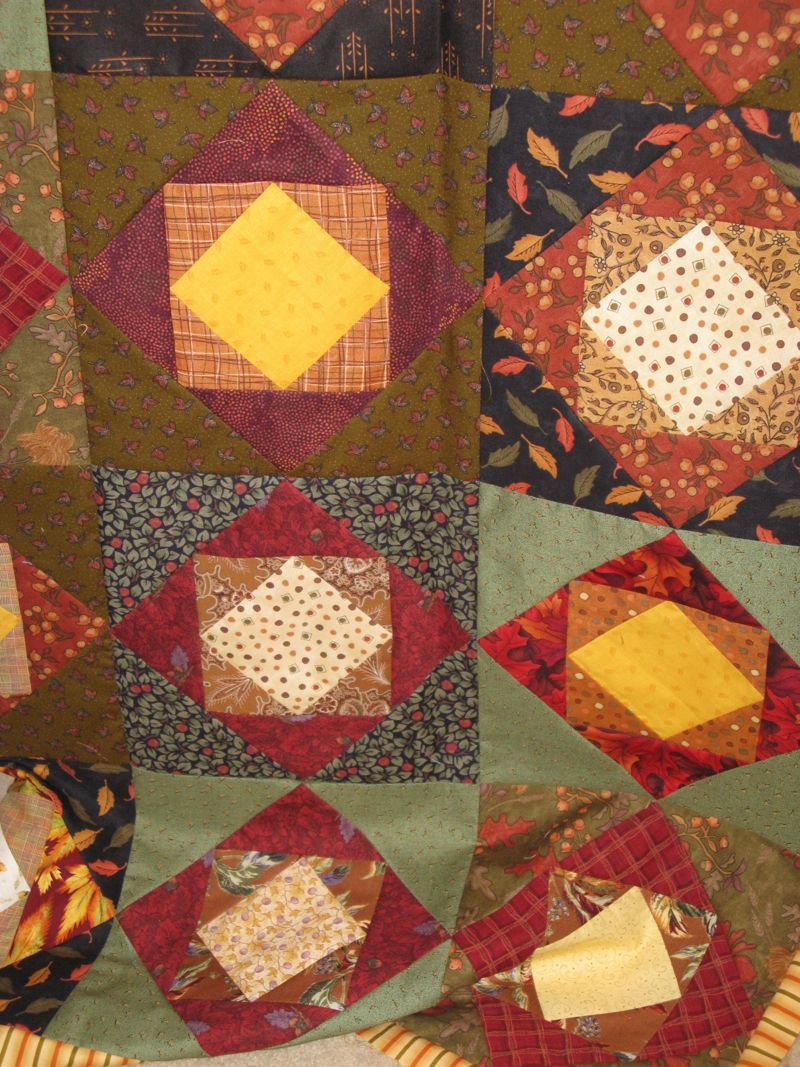
For this WIP Wednesday, kindly hosted by Lee of Freshly Pieced fabrics (click to head back there and see what others are doing), I chose to resurrect an ancient Work In Progress: my autumn quilt.

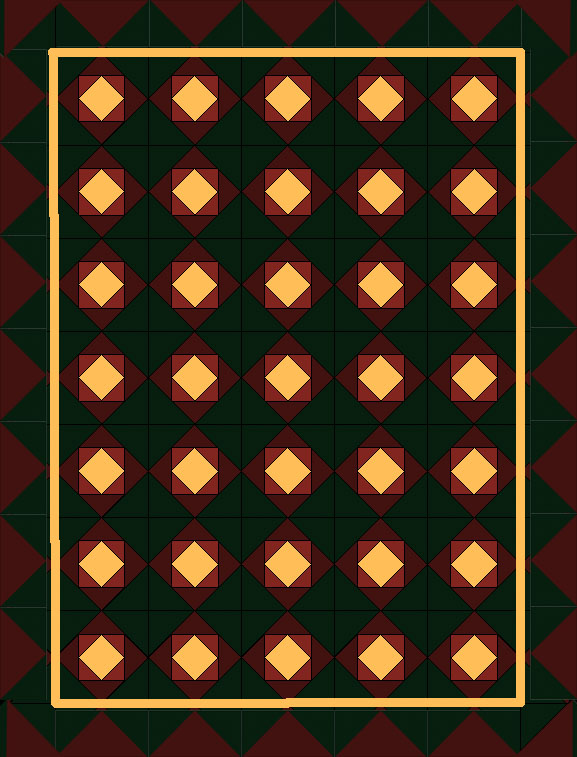
I had updated my computer software to work with my printer, and while you think that’s a strange way to begin a post about borders, I depend on it a lot (I use Quilt-Pro) to help me work out templates and dimensions.  So I had kind of mocked up this one, but didn’t want to go to all the trouble to do square-in-a-square on the borders.

So this was the next version.  While it seems silly to spend time at a computer when you’re working on a quilt, I did it for two reason: my annual Horrid Sickness had descended (complete with a 2-hour Urgent Care visit) and I felt like sludge most of the week, but more importantly, I was running on low in the autumn fabrics that I’d used to make this quilt, and I wanted to use what I had instead of buying more.  I’d been collecting these for about a decade, so the colors weren’t going to be easy to find, even if I did want to buy more.

Then I got a tiny nudge in my brain to use the golds in the outside Flying Geese block.  Anything I do in the program will be more pronounced, as I’m working with solids, but I did like this version.

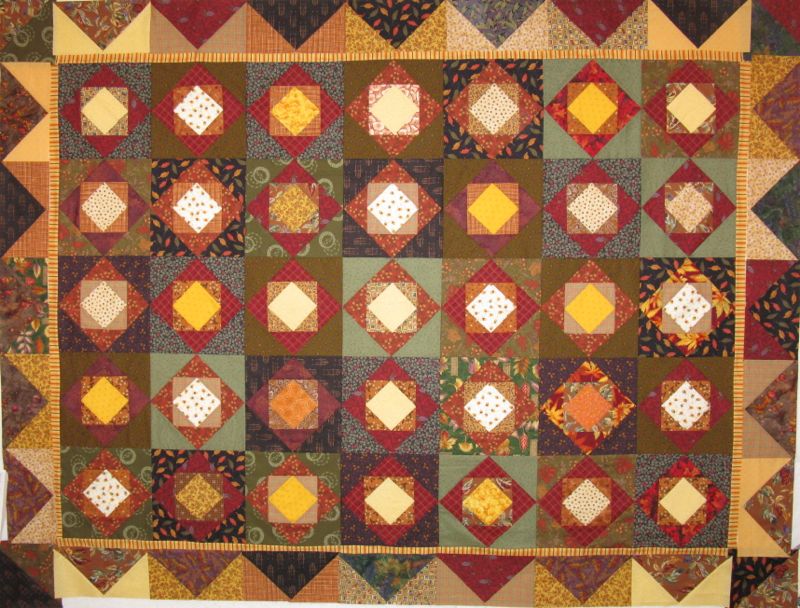
Here’s the quilt.

So here are all the new Flying Geese pieces laid out around the quilt.  I had stopped with that small stripy border and was ready to yank it off if I didn’t like it, but. . . I like it.  Trust me on this.  I simply did two Half-Square-Triangles (HST) for the corners and now have to figure out how it will all work.

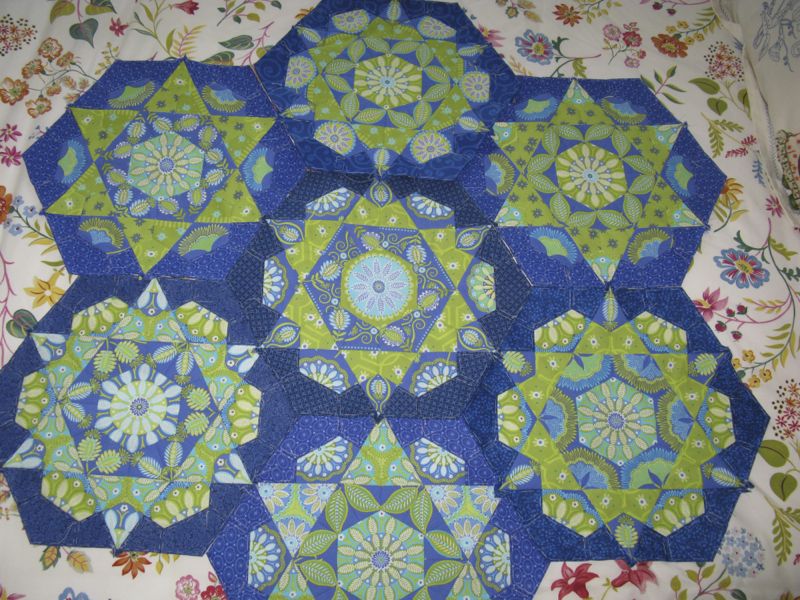
I laid out all the giant EPP hexagons on my guest bedroom bed to see how they all looked together.  I love them, but have lots more figuring out to do.  That will have to wait until after Christmas, I think!

And here’s your funny for the day:

Please head back to WIP Wednesday to enjoy the fruits of other quilters’ labors.

200 Quilts · Creating · Four-in-Art · Quilts

English Elizabeth: First Four-in-Art Reveal Day

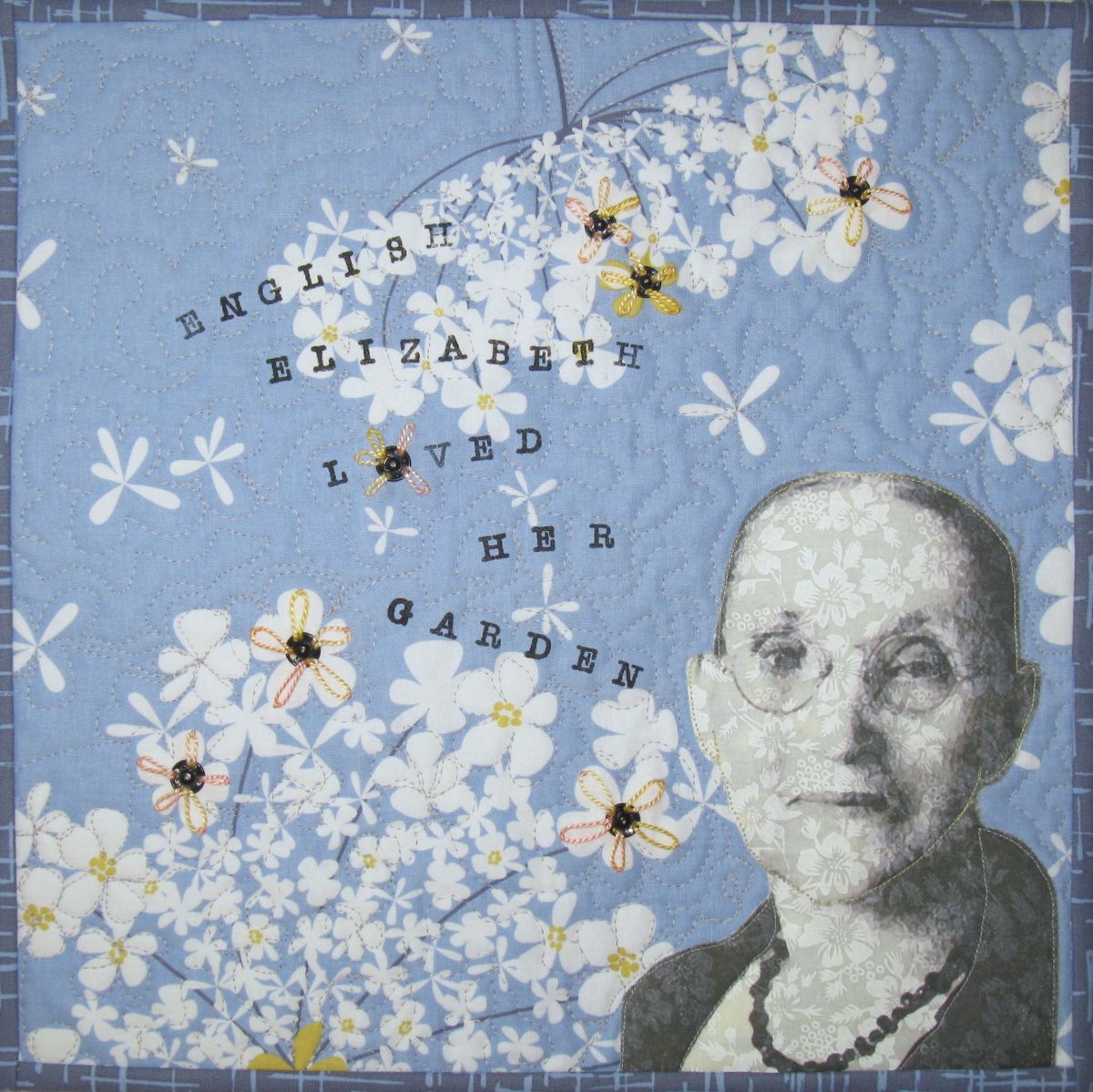
English Elizabeth

Made and quilted by Elizabeth Eastmond,
for the Four-in-Art Quilt Group

Elizabeth Frances Fellow Critchlow, a lass born in England in 1855, in the county of Staffordshire, surely did love her garden.  She is my great-grandmother and I am named for her.

When Rachel announced the theme of Queen Anne’s lace for our first Four-in-Art quilt, my mind immediately thought of my great-grandmother and her gardens.  I looked up the origin of the name of this flower, and most sources believed it had origins in British royalty references, which reinforced that I’d be working with my English Elizabeth, as I came to think of her.  A dedicated Anglophile, she listened to major speeches by the King on her wireless set, tuning in from her home in the mountains of Utah.  My mother tells me that she loved to garden, and her gardens were renowned, with even the local university coming over to study some of her plants and trees.  Although she lived most of her adult life here in the United States (she arrived here at age eleven), I often wonder if she spoke with a British accent here and there on some words.

I chose to work with this picture, because of her smile–just barely there—but a warm welcoming face.  My mother says she likes this picture, but also remembers her grandmother out in her gardens, her straw hat on her head.

And then I thought back to the most recent wedding in our house, that of my son Peter to his bride Megan, and they chose a rendition of Queen Anne’s lace for their announcements as well.  I love how you don’t “see” a flower, and then suddenly it’s everywhere.

~~And now, Two! for the Price of One!~~

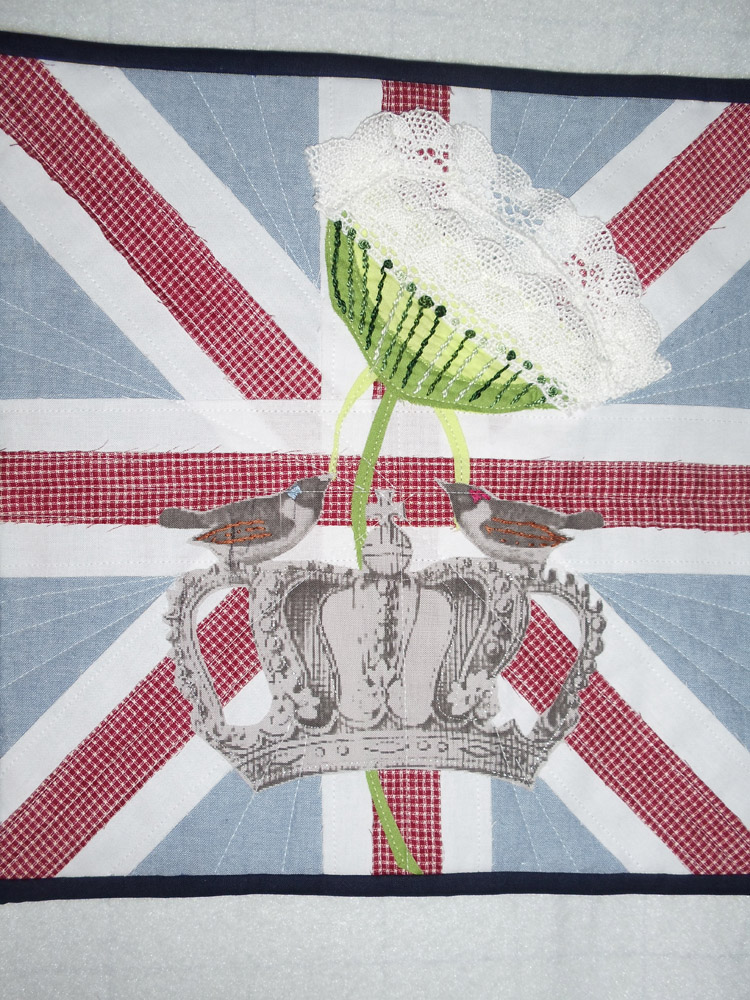
Betty lives in Virginia, and unless you’ve been under a rock this week, you know about Frankenstorm, the combination of weather patterns that spelled disaster, weather-wise, for the East Coast.  Sunday night, before the storm was to hit, Betty emailed me her photos and artist’s statement, just in case her power and internet should go out.  I’m pleased as punch to present to you her Queen Anne’s Lace quilt.

Betty writes:

“This Four in Art challenge, our first, was an opportunity for me to stretch – to stop, for a moment, the churn of easy quilts and do something new.  When the theme – Nature:  Queen Anne’s Lace – was revealed, I sighed.  Love the flower, although it isn’t as highly regarded on the east coast as apparently it is on the west coast, but I drew a blank when coming up with a setting.  So, I took a practical approach:  just love the Union Jack and decided to use that as my backdrop.  I planned to paint my flag, but could not get the red and blue faded enough so decided to go the fabric route.  I was excited to use the crown and copying that onto Kona Ash was a first; one of my favorite details in this piece is the silver metallic stitched onto the crown (which did not come through in the photos).    I had hoped to actually stencil the lace to form the flower, but that didn’t work well so I opted for real lace with pearl cotton accents.  The flower is my least favorite feature of this little quilt, but it is holding its head up boldly and doing its part and I am, overall, pleased.

“The backing is, appropriately, a simple flower piece and I loved making the label.  It is bound in simple navy Kona – had tried to overcast the edges with silver metallic, but that did not work well.

“This was fun and without boundaries (except for the size) and provided we do it again, I will find other new methods to try and apply!”

Betty Ayers • Powhatan, VA, USA

Here are some more photos:

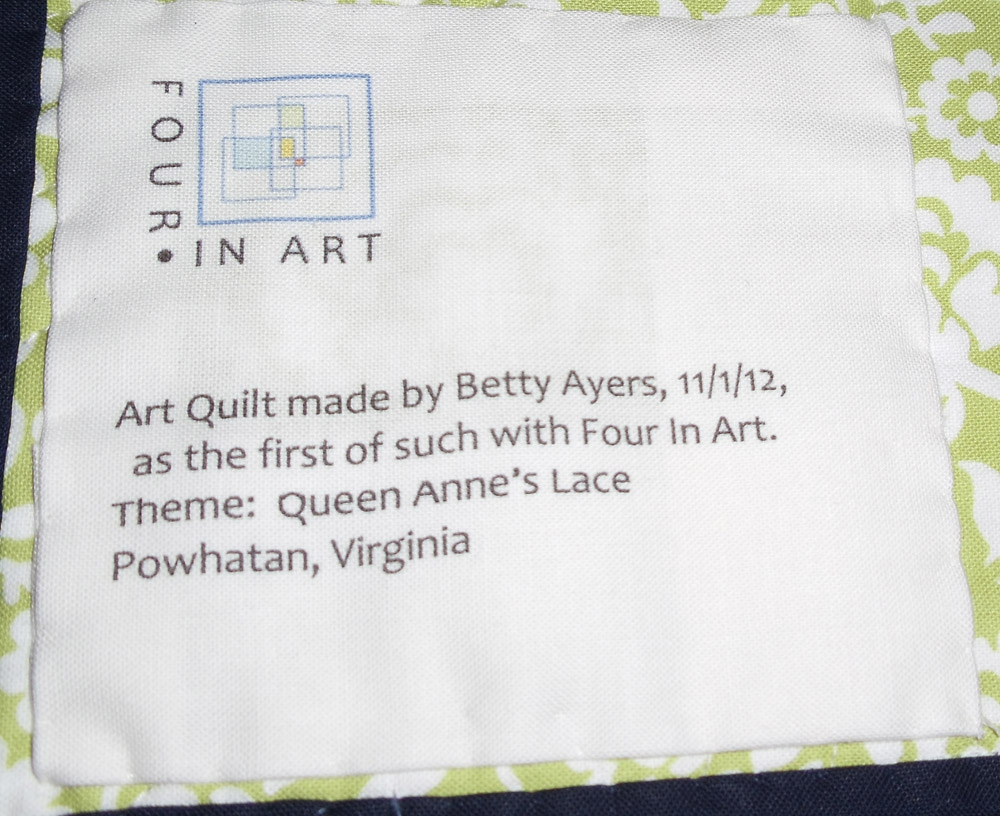
Label from Betty’s quilt. We hope that all will be okay on the East Coast soon.  Betty usually publishes on Flickr.

Check out Leanne, of She Can Quilt, and Rachel of The Life of Riley to see their Four-In-Art Quilts.

And tomorrow, a new theme is revealed!

Giveaway · Quilts

Snapshot: Putting the Quilt Top Together

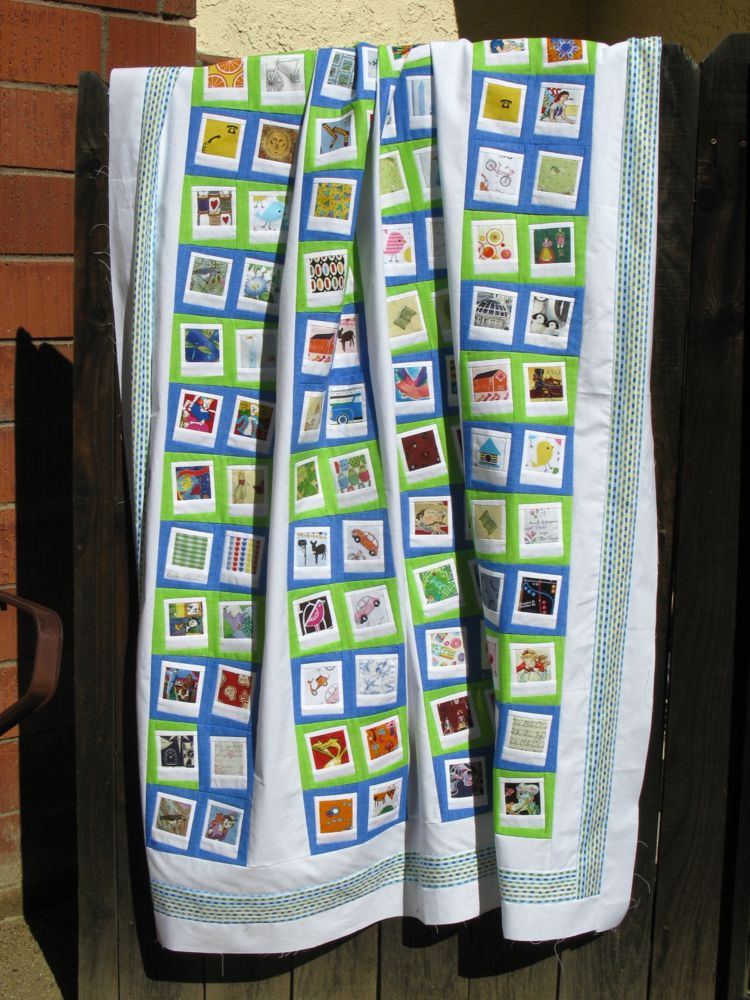
Here’s my Snapshot Quilt, in the requisite rustic pose drooping over a gate with rusty wheelbarrow.  Go yard work for great props.

This is the third and final post in my tutorial of how to make the Snapshot Quilt, constructed from lots of Polaroid blocks.  And at the end, my little giveaway.  I have three sets of 10 blocks each to giveaway, but hey! you must be a serious Polaroid-er to get them.  Leave me a comment telling me what you’ll do with them–have you started your collection?  Do you have a few and want more?  Do you have plans for them?  And for fun, tell me about your favorite vacation photo, since this quilt is, after all, a tribute to vacation photos everywhere.

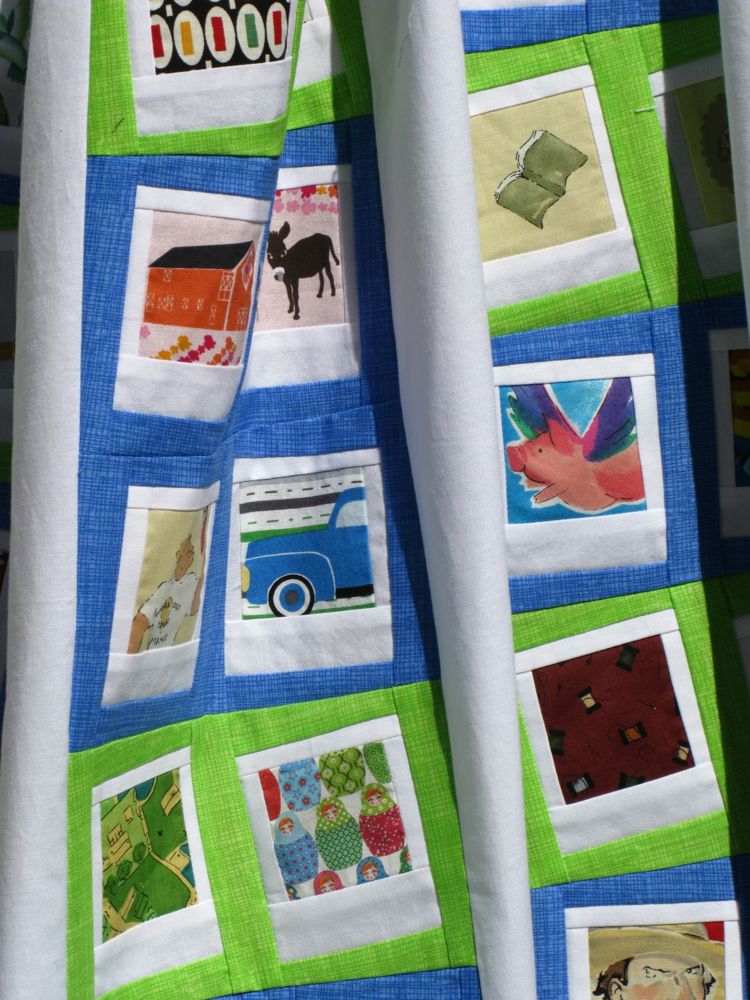
Here’s a close-up of some of the Polaroids.  I received the truck Polaroid in the swap.  Love it!

And that German-looking couple on the right was cut from my Barbie-doll dress.

Now back to work.  I have made a PDF to help guide you with cutting, and it includes the basic bones of the quilt.  Download it: PolaroidQuilt

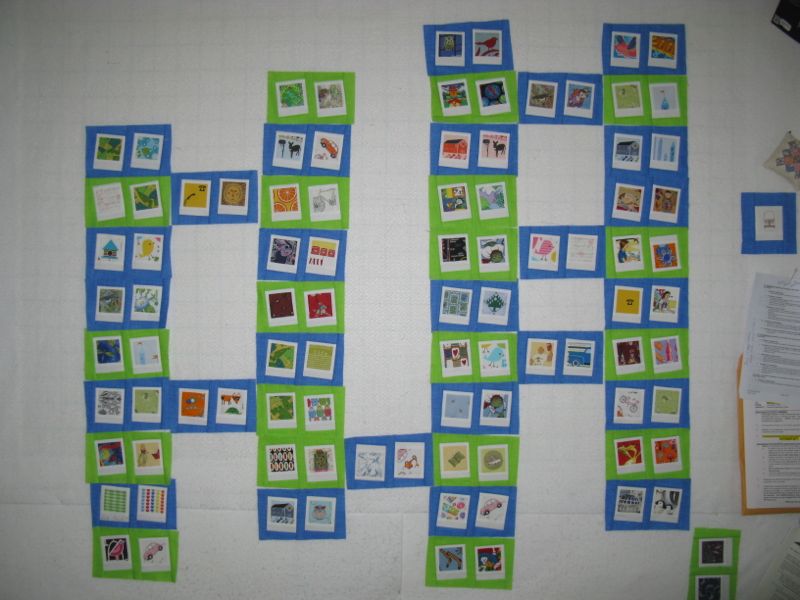
Start throwing up blocks onto your pin wall.  This was my first attempt. I knew I wanted a stacked coins effect, but was playing around with inserting blocks into the middle of the stacks.  Meh.

Second try.  I like this one better, but not keen about the four blue blocks across the top, so I switched them around.  Check the previous post for the doctors-office-view of the quilt, which shows how I ended up arranging all my blocks.  I also checked to make sure that there wasn’t a glob of orangey-red blocks, or too many of one type or color.

After getting the blocks the way you like them, sew them together.  My row tags, made from embroidery holders, indicate which row it is, and which is the top. I pinned them all together in a row, then stitched them.

Cutting the white internal strips and borders:
Internal rows are 4 x 52″ (w/o s.a.) so cut three strips that are 4-1/2″ by 52-1/2″.  I’d STRONGLY advise cutting them on grain, that is, cut them parallel to the selvages of your white fabric.  All these double-Polaroid blocks are slightly on the bias, so they need the strong stable edges of an on-grain piece of fabric.

Borders (seam allowance included):
Border #1, top/bottom: cut two pieces 2-1/2″ x 40-1/2″; for the sides, cut two pieces 2-1/2″ x 56-1/2″” long
Border #2 (print), top/bottom: cut  two pieces 2-1/2″ x 44-1/2″; for the sides: cut two pieces 2-1/2″ x 60-1/2″” long
Border #3, top/bottom: cut two pieces 2-1/2″ x 48-1/2″; for the sides, cut two pieces 2-1/2″ x 64-1/2″” long
NOTE: I’d cut the border pieces slightly longer, to give allowance here and there for ease needed when sewing on borders.

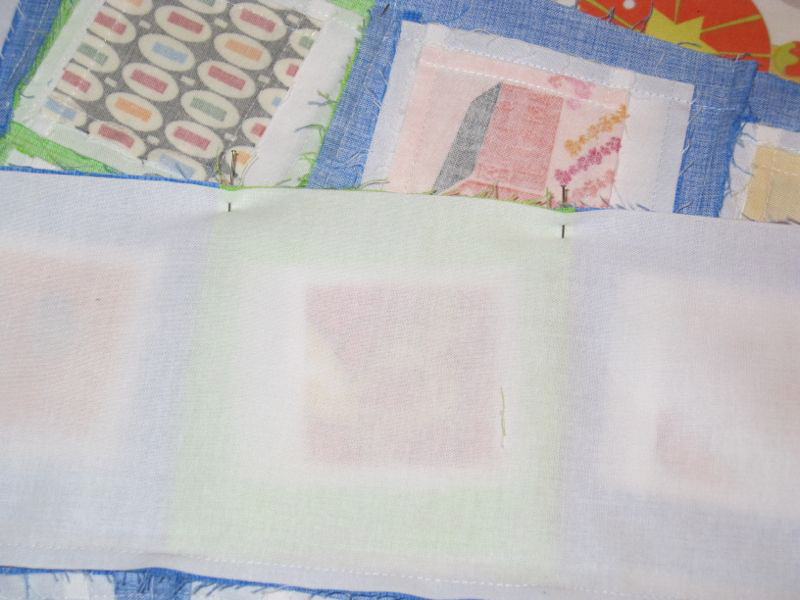
Matching centers and edges, ease the stacked quilt blocks onto the white on-grain strip of white fabric.  Repeat until four rows of stacked quilt blocks and three strips of white fabric are sewn together.  I sewed the seam with the quilt blocks to the throat plate of my sewing machine, allowing the motion of the feed dogs to help ease in any extra fabric.

Sew on the first top border, then the bottom.  Then, matching centers and edges, sew on the side borders as you did above, keeping the white strip UP and the quilt block stack to the feed dogs.  Press seams toward quilt blocks.

Attach the print borders next in this order: top, bottom, side, side.  I was exacting on the lengths and matching edges and centers, but I should have given a little more ease to the side borders.  It’s a challenge sometimes, as you don’t want to get the borders too small so that the quilt “bows” with a curved edge, but you also don’t want it so loosey-goosey that it ripples.  Pin and check, is my advice.  Then press the seams toward the print fabric.

Lastly, attach the last white borders in the same order: top, bottom, side, side.  Press toward the second (print) border.

You’re done!

How do I plan to quilt this?  I’m thinking I’d first stabilize those long stacks with either stitching in the ditch white white thread, or a quarter-inch away into the white.  I’d like to outline along the Polaroids to make them pop.  The white sections call out for some sort of overall pattern, like this pattern from Leah Day of Free-Motion Quilting, Bow-tie Parade:

Go and visit Leah’s site for lots of ideas and a stimulating blog.  I love reading her posts.  I do plan to bind this with more of that print shown in my border.

Now! Leave a message if you are interested in scooping up some of my Polaroid blocks, and mention what you’ll do with them–have you started your collection?  Do you have a few and want more?  Do you have plans for them?  And for fun, tell me about your favorite vacation photo, since this quilt is, after all, a tribute to vacation photos everywhere.

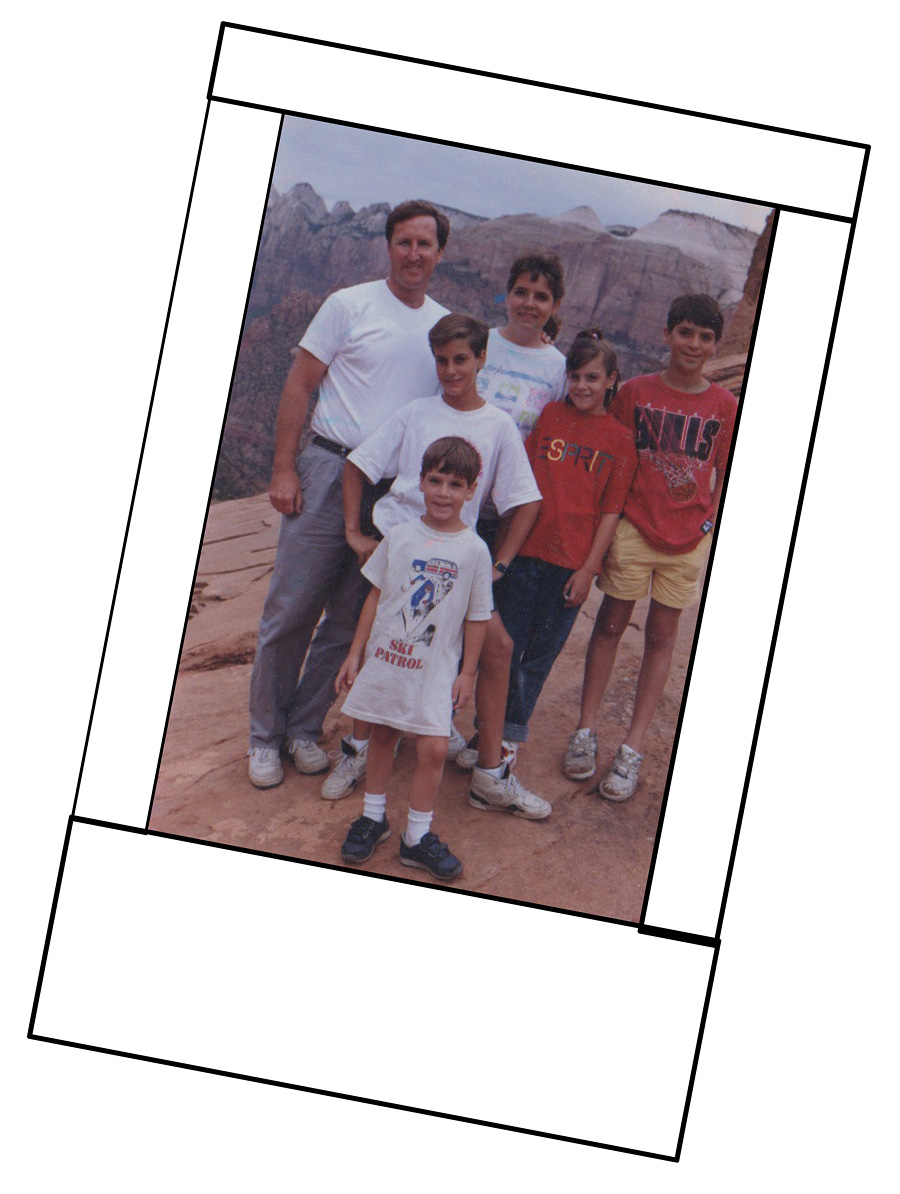
Mine favorite vacation photo is from when Dave and I were newly married (under a year) and we took all the kids to Zion National Park.  We are standing there in the middle of red rock country in our slightly dirty T-shirts, a group of 2 adults and 4 children who were on their way to becoming a family. Now let me hear about yours.


UPDATE:  Congrats to the winners of the Polaroid Blocks: Mary, Cindy and Marilyn.  I’ll look forward to seeing what they do with their blocks, so send those photos over to my email when that future finish day arrives.

Quilts · Tutorial · WIP

Snapshot: Constructing the Double Polaroid Blocks

First, let me say a thank you to Lee of Freshly Pieced Fabrics, who is hosting WIP Wednesday for us.  Click *here* to return to her blog and see other fabulous Works-in-Progress.

If you missed yesterday’s post about Snapshot, my latest quilt (above), scroll down as there is information for fabric requirements and a basic How-To for Polaroid Blocks.

The first picture (top) is Snapshot in a beauty pose.  This one (above) is the one where she’s in under the fluorescent lights in her doctor’s office, wearing only a flimsy gown that opens in the back.  You know the feeling.  But we need to examine the quilt to see how it’s put together, so I thought you needed a clinical kind of picture. Here you can see some of the variety in the tilting, and in stacking the blocks.  I had some scraps of fabric at the end and late one night made the one at the bottom left into two colors. (I should go to bed earlier, I think.)

I did these in sets.  You’ll end up making about 4 sets, alternating the blue fabric with the green fabric (only use one color at a time), as each stack is made up of 13 blocks.  However, I made a few more of each color, because I doubled up on some colors for variety (you can see it above where there are two blue blocks together).  So make 4 1/2 sets.
For each set of 13 double blocks, you’ll need:
8 strips of either blue or green (don’t mix), cut  1 and 1/2″ wide
2 strips of either blue of green (don’t mix), cut 1 and 1/4″ wide
26 Polaroid blocks, in pairs of two (take some time to match up the ones you want together)

Start by sewing the Polaroid blocks to to the wider  (1 and 1/2″) strip, placing Polaroids face down.  You are sewing this to the TOP of the blocks.
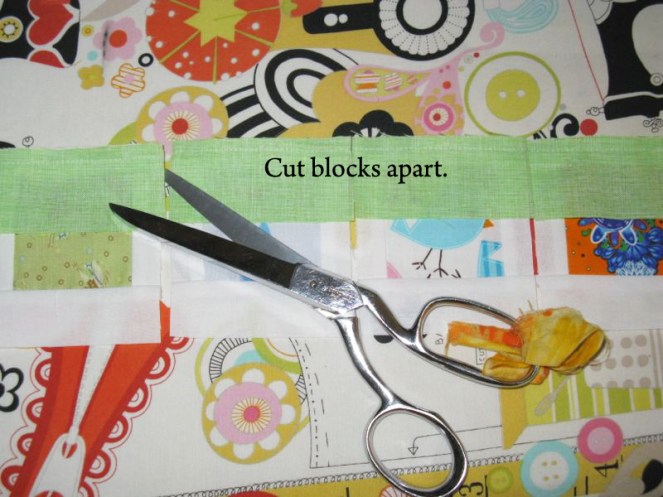
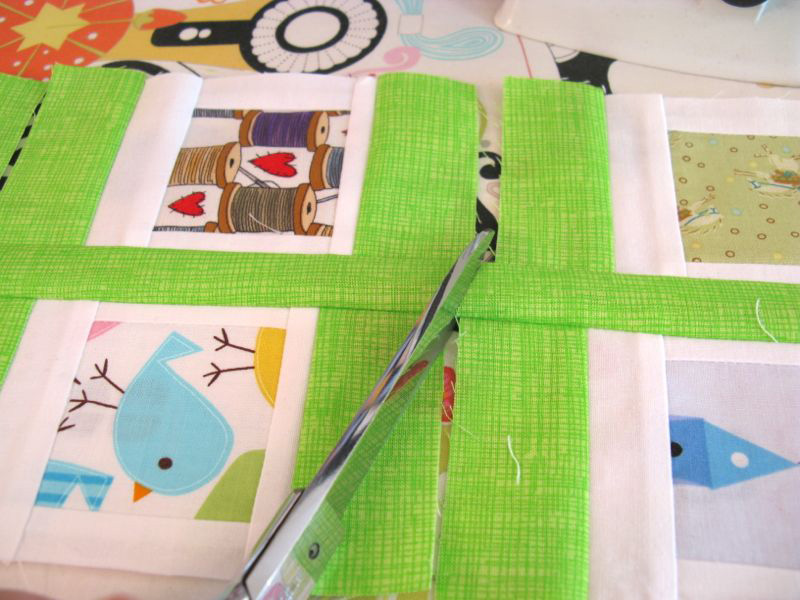
Lay out the strip of blocks and cut the blocks apart.  With scissors.  Remember those?  We finished up our discussion of The Shallows: What the Internet is Doing to Your Brains in class, and the last section talked about tools; when we adapt and adopt a tool, it become an extension of us and we may leave older tools behind if the new one suits us better.  So if you feel like the rotary cutter is an extension of your hand, you may need to practice using scissors again.  Kidding.

Press the fabric away from the block, like this:
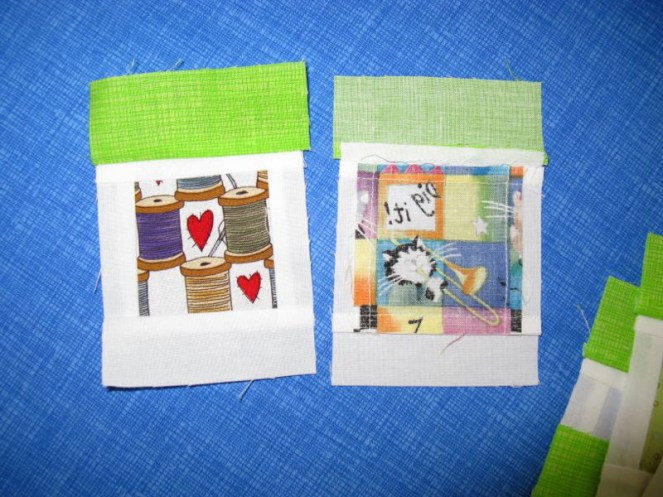
Now sew another wide strip on the bottom of your Polaroids.

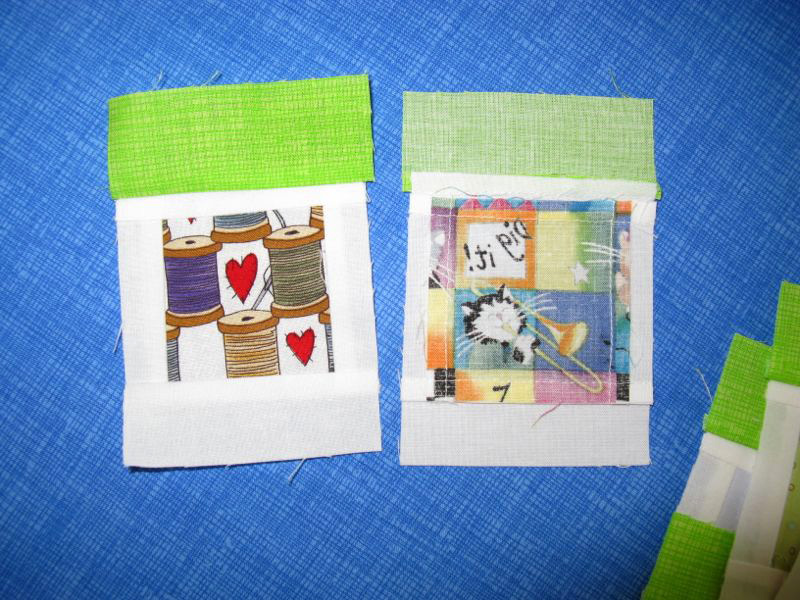
Here’s four blocks, with the top and bottom borders sewn.  Again, you are using the 1 and 1/2″ width fabric.

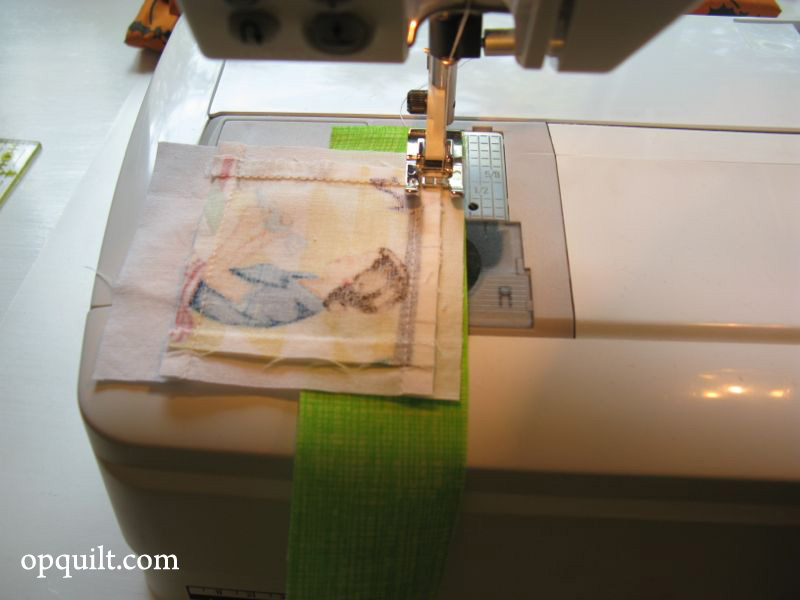
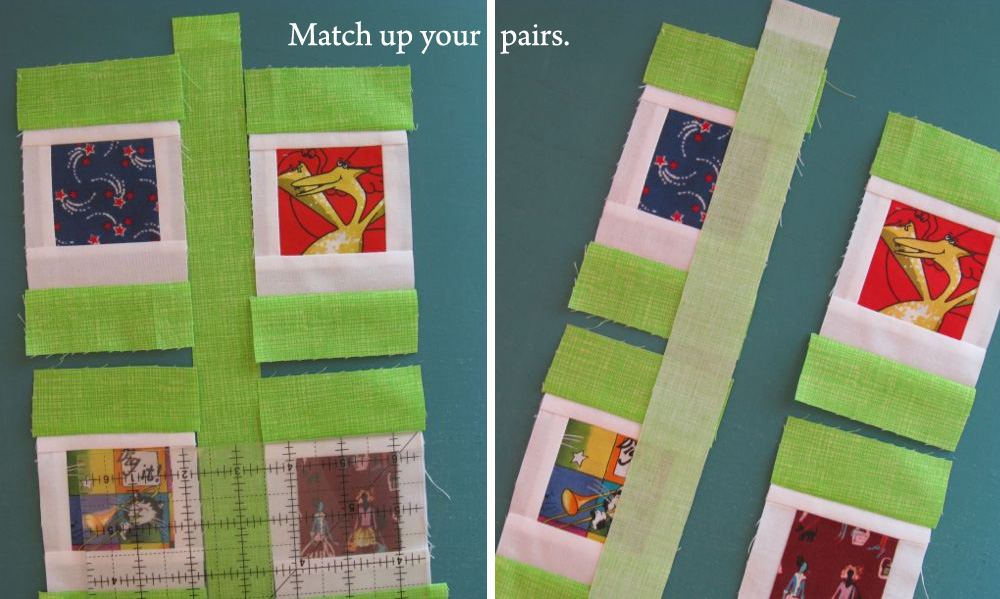
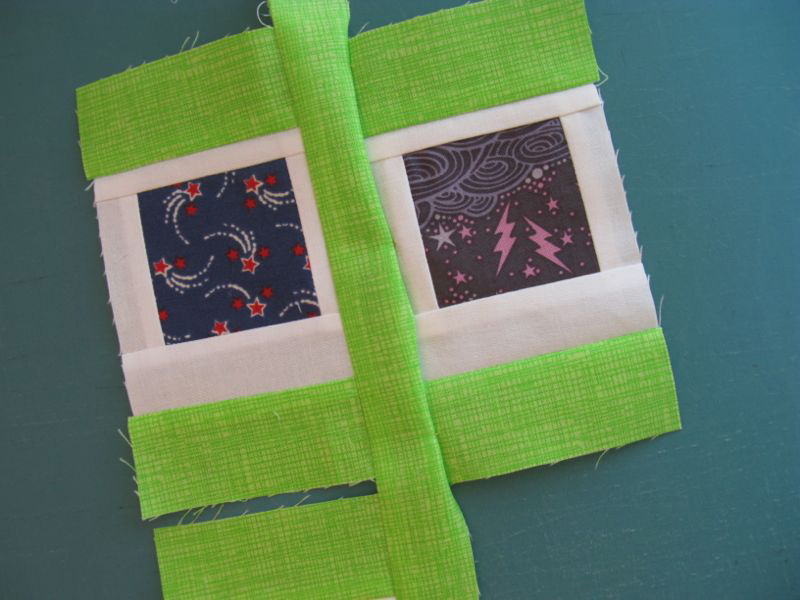
Lay out a strip of the narrower fabric (1 and 1/4″) and place your blocks side by side, matching up your pairs.  Separate them by about 1/4″ at the bottom.   I pinned them so it would be easier to transfer to the sewing machine.  Sew the first set (one side) onto the center strip. You should be able to get about 7 Polaroids per strip.
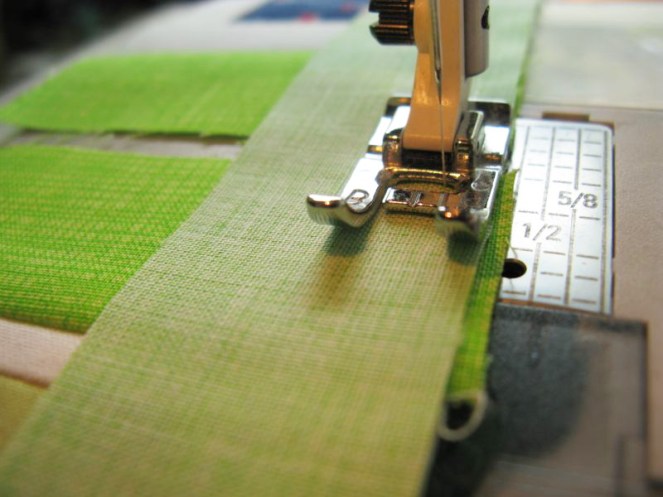
As you sew on the first set, pay attention matching the edge of the Polaroid block to the edge of the center strip, letting those little bits of borders stick out.  You can cut them off in an earlier stage if you need to, but I did mine after sewing them.
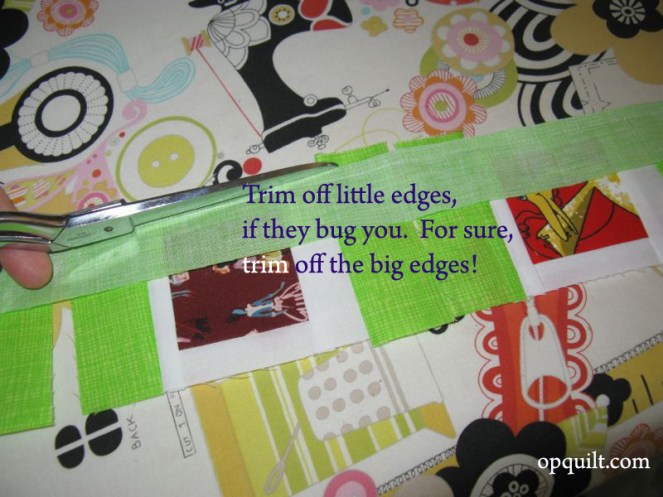
NOW trim off the little edges if they bug you.  For sure, trim off the big overhangs!  Just lay out the strip as shown, and cut the overhangs off, even with the long strip.  DO NOT CUT THEM APART!!!   Let me repeat.  DO NOT CUT THEM APART!!

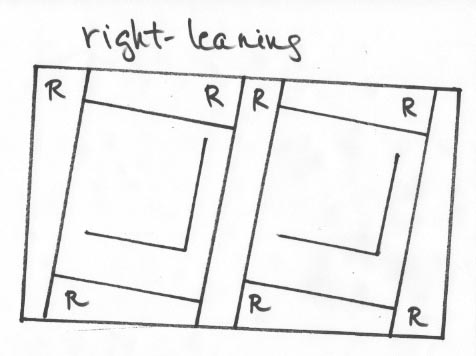
Now, take your “right leaning” and “left leaning” PDF printouts from the last post, and set one of them at a time on the table while you do the next step.  I made all the greens to lean to the LEFT. All my blues lean to the RIGHT.  It feels backwards, but here we go.  I used the picture to get in my mind which Polaroid should be 1/4″ up and which one should be 1/4″ (or the width of that top border) down as I’m lining them up along that center strip.

Notice in this high-quality illustration that the blocks lean to the right.  To accomplish this, you have to offset them when you sew them to the center strip.  The left block is “lower” on the strip, and the block on the right side is “higher.”  This is why I used two colors: to keep things straight.

But my greens tilt the OTHER way, so I used the “left leaning” diagram to help me.

(Diagram in action!)

Again, to get the tilt, you need to jog the one on the top down about one-fourth inch.  What I did was line up the edge of the green border  with the top of my center picture in my Polaroid block.  (I know this sounds confusing, so just look at the pictures.) This will give you that offset you need in order to tilt your block.  Do this with the remainder of your pairs.  Pin, then stitch.

When working with the blue, I reversed the sewing, stitching the blocks on the right-hand side of the center strip first, then the left.

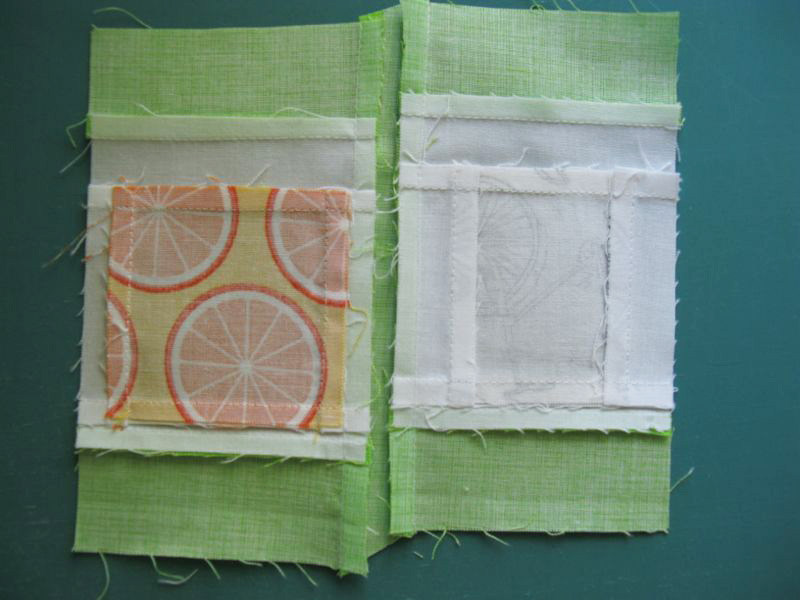
Here it is sewn.  You can really see the slipped alignment here.  Press this seam toward the center strip.  See two steps down, for the why of pressing.
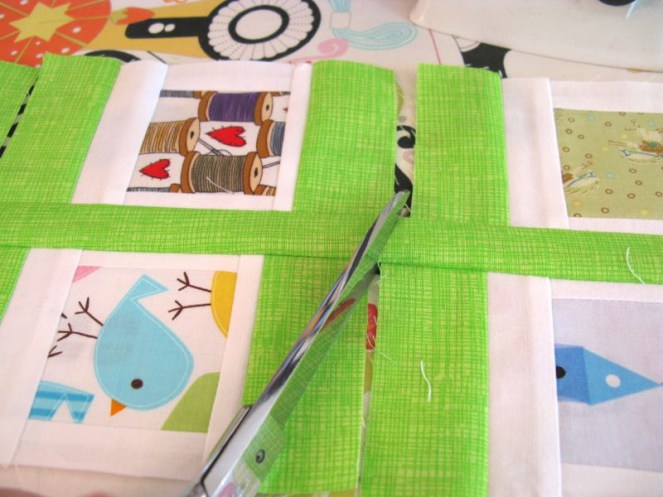
Cut these blocks apart now; the cut will be angled to fit the skewed alignment.
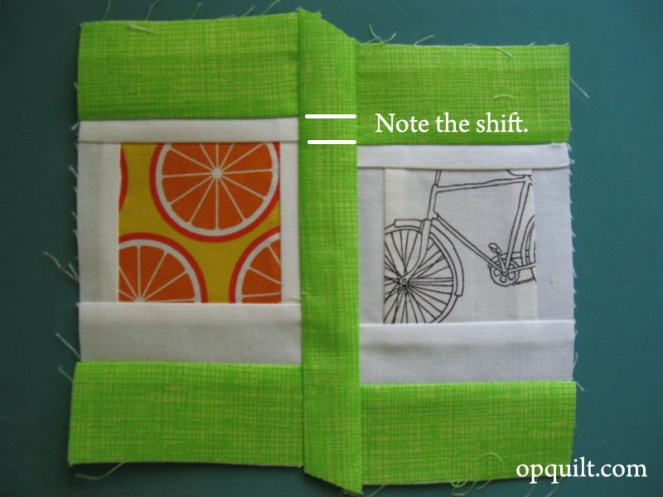
Here’s one that’s been cut apart after sewing.  Here you can see the shift.

And in comparing these two blocks (the one directly above and the one below), you can see the difference the pressing makes.  The pressed edges can either make a block look like it’s resting on the top or like it’s “sunken” into the strips surrounding it.  I wanted my Polaroids to have that look of being bordered by strips, not the strips “supporting” and “lifting” up the Polaroids.  So that’s why all the pressing directions indicate which way to press the seams.

Here you can see the different pressing.  All right Goldilocks, you are through the deep scary forest and just about to claim that pot of gold at the end of the rainbow.

Using the wider (1 1/4″) strip again, sew the outer borders onto both sides of your block assemblage. Cut apart.

You should have 13 blocks that look like this.  Now comes more fun, more forest.
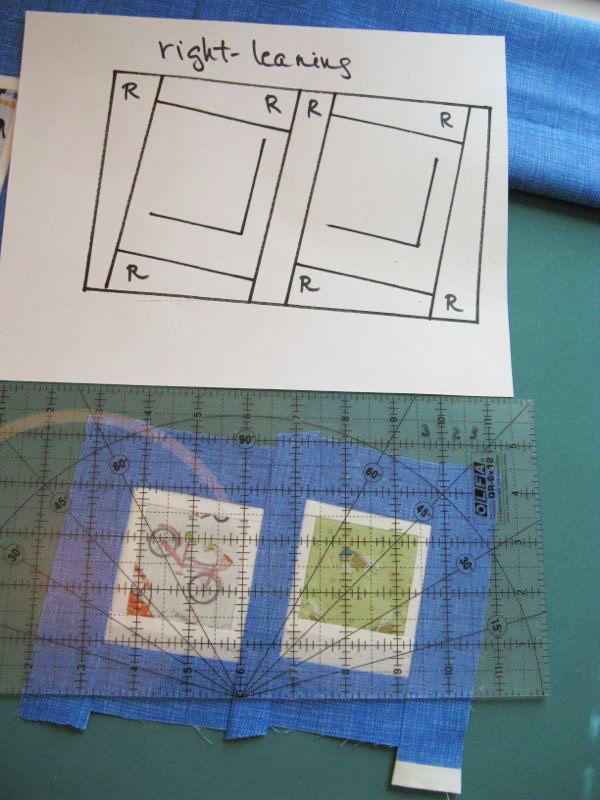
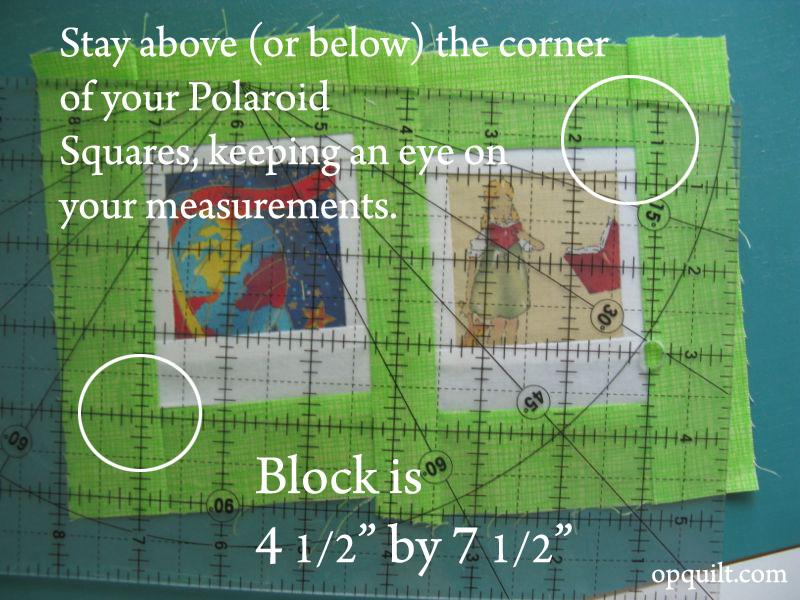
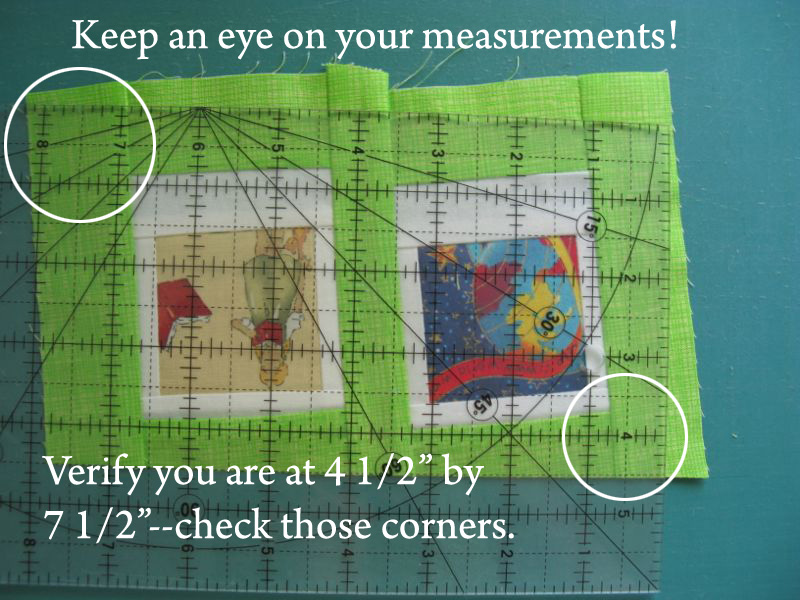
Get out that PDF picture again.  Lay it at the top while you trim your blocks.  The size you want to trim to is 4 1/2″ by 7 1/2″.
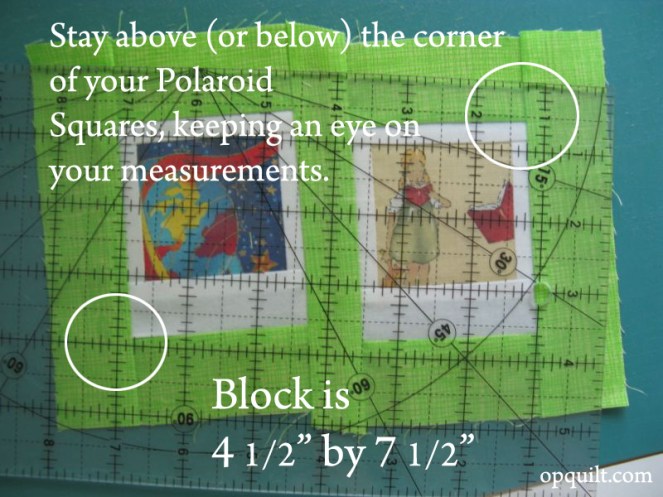
You need to tilt your ruler a bit, making sure you leave at least 1/2″ space between the edge of your white Polaroid interior block and the planned cutting line on the outside edge of your ruler.  (This is why you make extra blocks, if you get my drift.)  I tried to vary my cuts, because I think one of the charm of these Polaroid blocks is their wonkiness when set into their frames, much like a child would paste vacation photos into an album.  So sometimes I was just over 1/2″ from that edge, and other times I was closer to 3/4″.

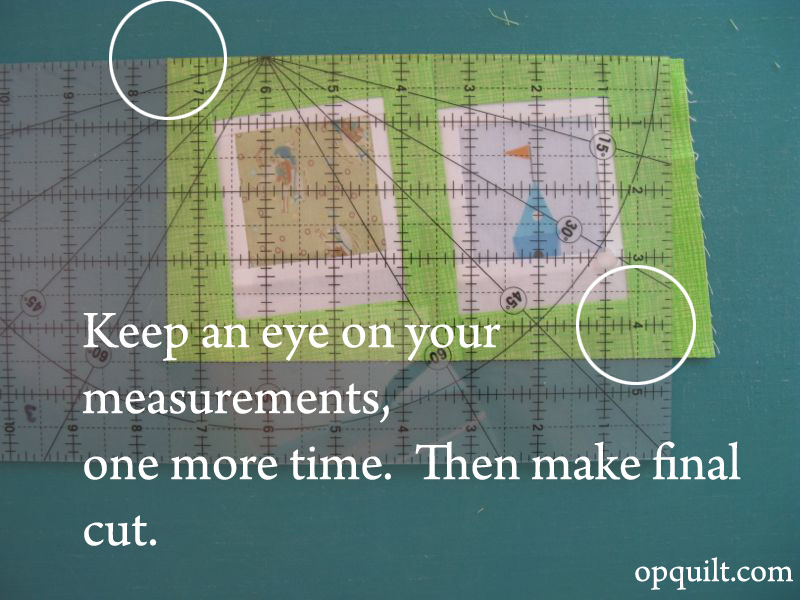
Keep at eye on that 4 1/2 line, as well as the 7 1/2″ line.  Be a juggler, keeping all these things in mind as you go for your first cut, slicing off the top of the block.  Then flip it around, putting the cut edge at the bottom.
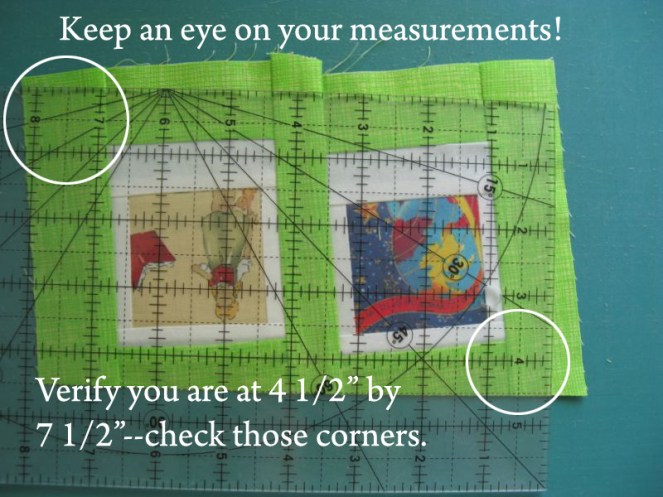
Lay the 4 1/2″ line of your ruler at the bottom, lining up your freshly cut edge.  Check your measurements.  You want the bottom lined up, but you also have to check that the block is centered so when you cut off that right side, you’ll have an evenly centered  7 1/2″ block.  If you are good to go, slice off that right-hand side.

At first, I flipped it around again, as I’d only have to pay attention to one last side (shown above).  But after a while I became confident enough to slice off the top, >flip<, slice off the right and top edges again, then >flip< cut the last edge off.  Which is what I’m doing in the picture above.

I took this photo mid-cutting to show you how the block can feel skitty-wampus when you look at the first two cuts.  But then you slice off the two side edges and you are Through The Forest Again!  In the arrangement of my quilt, I used 28 blue double-Polaroid blocks and 24 green.  Make enough that you have some to play around with, and if you like decorations on the back of your quilts, include some for that too.

NEXT POST:  Putting the quilt top together, and one day closer to my surprise giveaway.