Quilt Shows

Red/White Quilt Inspirations

I recently wrote to a new friend:

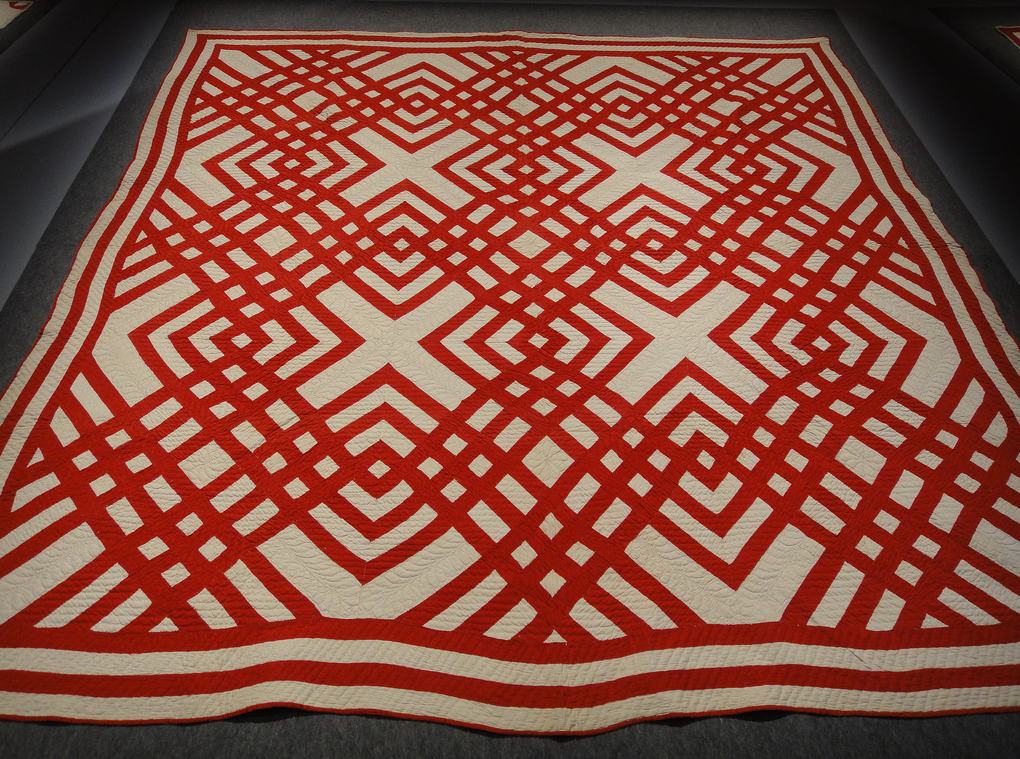
This evening I was looking at the red/white quilt exhibit in that was recently put on in NYC.  My mother has an iPad, so I downloaded the app and was able to view each quilt.  Oh my.  I may spend all my visit here looking at these quilts (which isn’t very sociable).  They are so “vintage,” yet so fresh and modern.  Quite a yin-yang of feeling as I was looking at them.  I noticed that some of the patterns seemed to mimic–or are mimicked by–current quilt patterns.

Enjoy the slide show.

This slideshow requires JavaScript.

Quilt Shows

American Folk Art: Red & White Quilts

Apparently there is an incredible exhibit of red and white quilts.  Judging from this photo it might give the viewer a sense of having tumbled down the rabbit hole and is now gazing upon a whole pack of playing cards, all arranged into circular forms.  From the website:

The American Folk Art Museum has dramatically transformed the Park Avenue Armory’s historic 55,000-square-foot Wade Thompson Drill Hall with the installation of 650 red and white American quilts, all of which are on loan from the collection of Joanna S. Rose.

While I couldn’t embed the videos I saw on their Flickr site, here’s the link to a short clip from someone who visited there.  Can I just say I’m insanely jealous?  What a sight it must be to have all those quilts flying high up in the air above you–and all red and white?  The Museum’s Flickr group–with their 355 photos at this posting–gives us viewers out here in the hinterlands, a glimpse of what it must be like.  Amazing.

This one is reminiscent of what was hanging in my hallway over Valentines’ Day.

How did I find out about this?  I read Carrie Nielson’s blog (she of Schnibble fame) and found this there.  She’s going.  I’m completely and utterly jealous.  Head over to LaVie En Rosie (the title of her blog) to read more.  She has links to slideshows, the museum, an article in the New York Times–yep, she has it all.  I’m now going to buy the magnets and download the free iPhone app.  I may also download the iPad app, just in case I’ll need it for the future.

Quilt Shows

Road to California–Part IV (final)

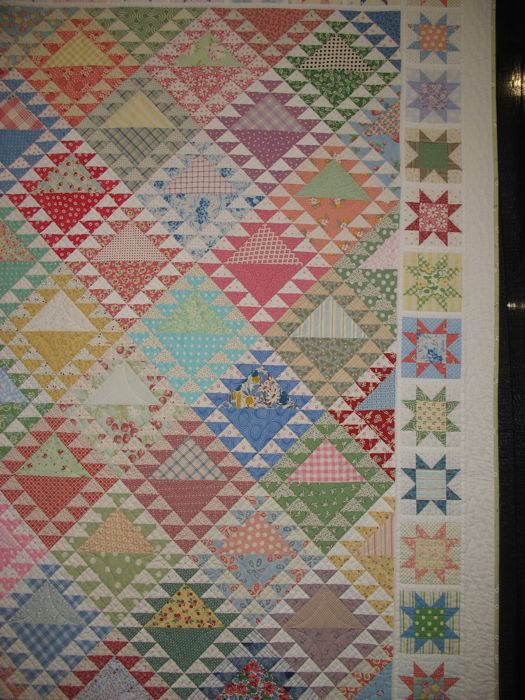
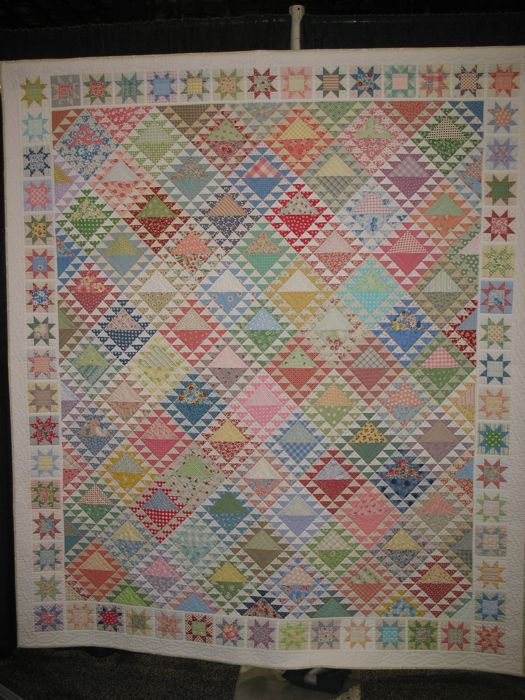
There’s no particular order to the quilts in this post–just some quilts that I saw that were interesting, or lovely, like this one with the eight billion triangles.  Titled Summer at the Lake, it was made and quilted by Rahna Summerlin. It has an old-fashioned look.

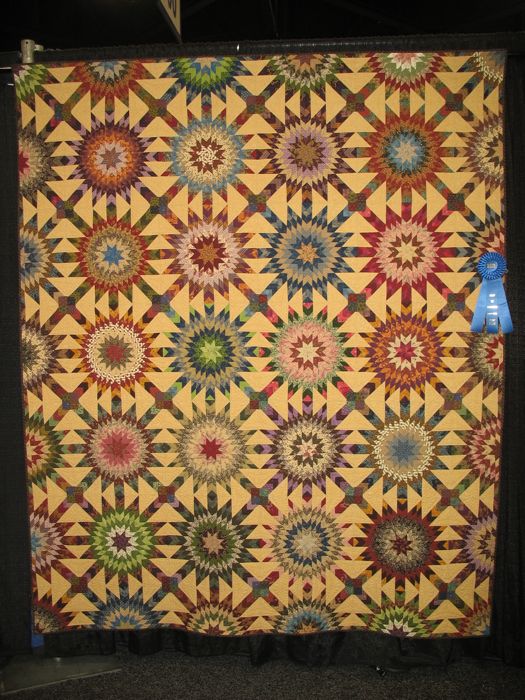
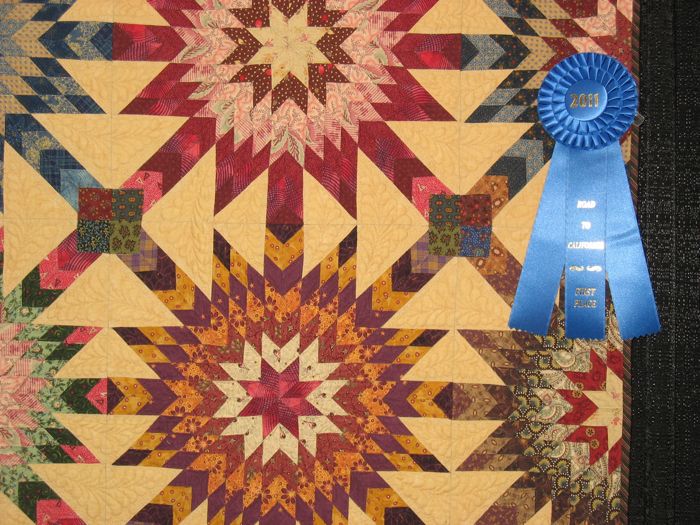
Sandhill Stars, made and quilted by Sandi McMillan  won a first place ribbon. It was terrific.  Detail below.

She said in her notes that she was inspired by a “Stars Upon Stars Variation made by Mary J. Cole Dickerson of Wethersfield, Conneticut in the mid-1800s.”  McMillan is from Nebraska.

Another one of those quilts where each block would be a fun quilt in itself.  The lady standing next to me said she thought this was one Halloween quilt that she could have around–that it seemed to stretch all the way from September to the end of fall.  Agreed.
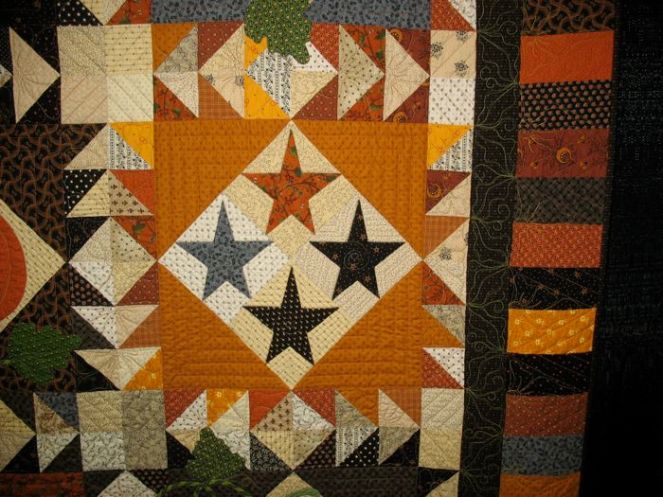
The title of this quilt, made by Mary Dyer and quilted by Sharon Brooks (both of Arizona) is Midnight in the Pumpkin Patch.

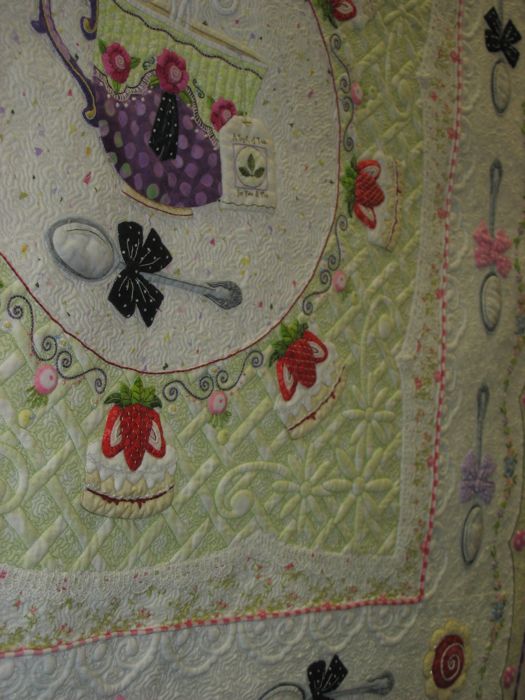
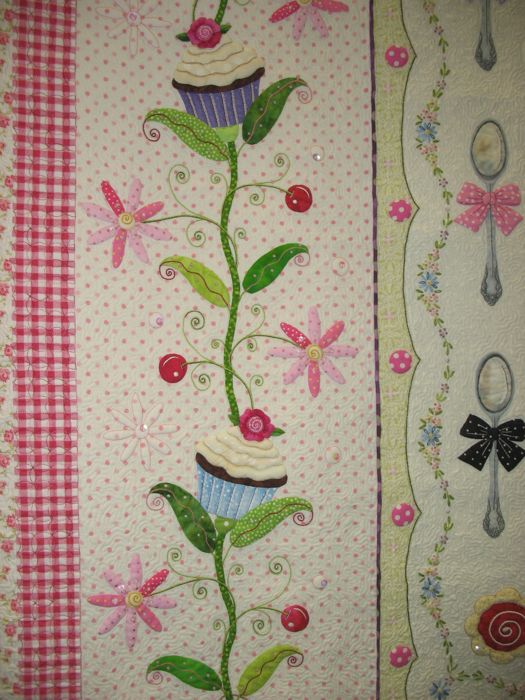
I should probably show this last, because it was one of those quilts that you are convinced probably took them YEARS to make.  Tea with Miss D. is the title, and it was made and quilted by Sandra Leichner of Oregon. Close-ups follow.  I tried to get shots that showed not only the detail, but also the quilting.

I know this is a little bit dark, but the only way I could show you those quilted daisies in the corner was to turn off the flash.

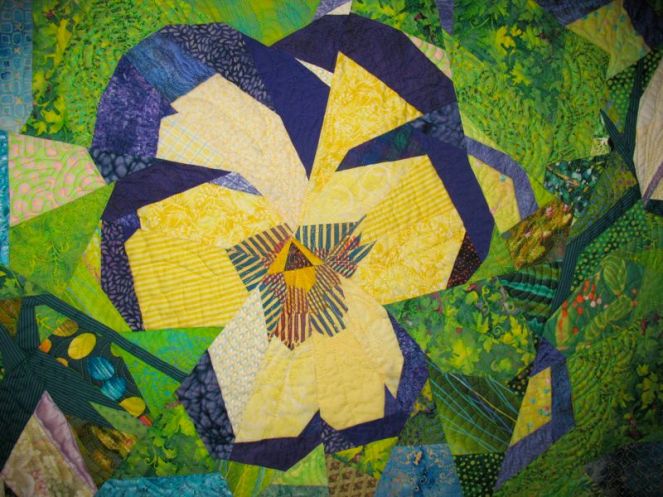
This quilt, made and quilted by Dianna Grunnhauser of Hawaii, was inspired by Ruth McDowell’s template technique.  Sunday Morning took her five years.  Five years?  Yay!! Finally we have truth-in-quilting!

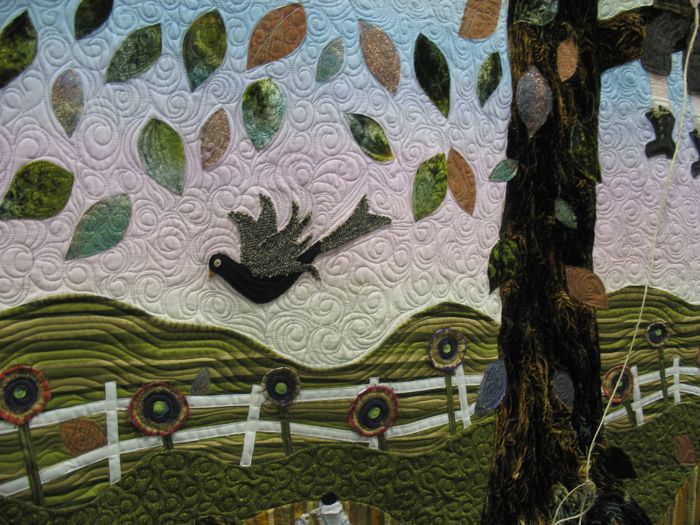
Detail from a quilt showing the final scene of Peter and the Wolf  (you can see Peter’s feet hanging from the tree as he’s captured the wolf.  Made by Kimberly Rado and quilted by Cindee Ferris.
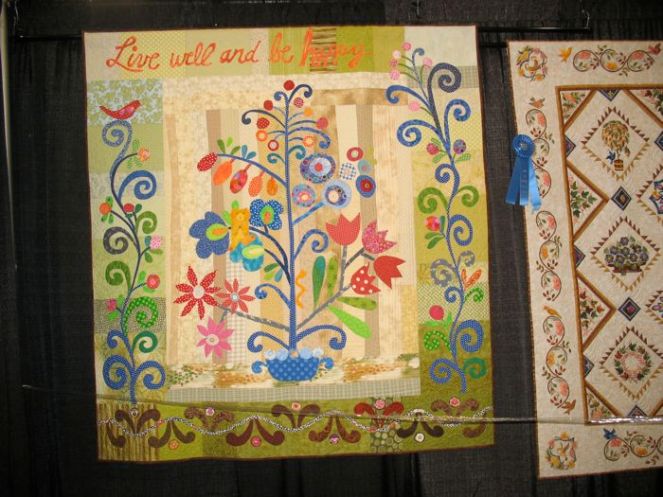
Live Well, Emily was apparently made (and quilted) by Emily’s mother, Jan Hirth, after Emily’s April wedding was called off in March.  What a wonderful tribute to a daughter.

Almost Amish, made and quilted by Linda Thielfoldt of Michigan.

Fresh as a . . . .

Made and quilted by Nancy Ota, from California.  Lots of painting on this, to get the blended petals.

Grateful Dance is an ode to the maker’s two titanium hips, shown here by the silvery fabric on the skeleton.  Made and quilted by Ranell Hansen of California.
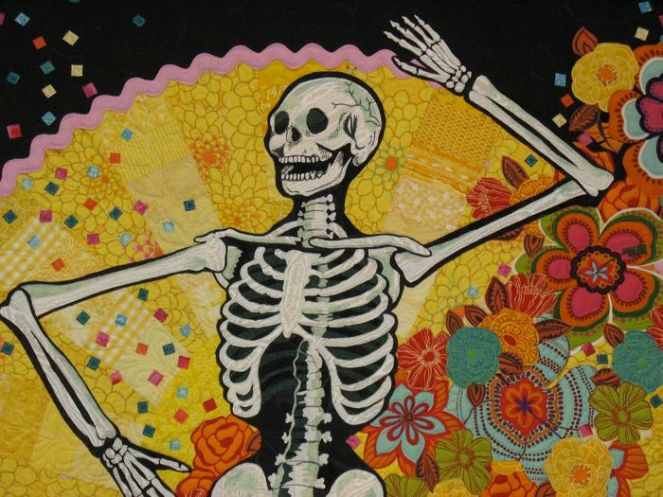
Lots of joy in this skeleton!

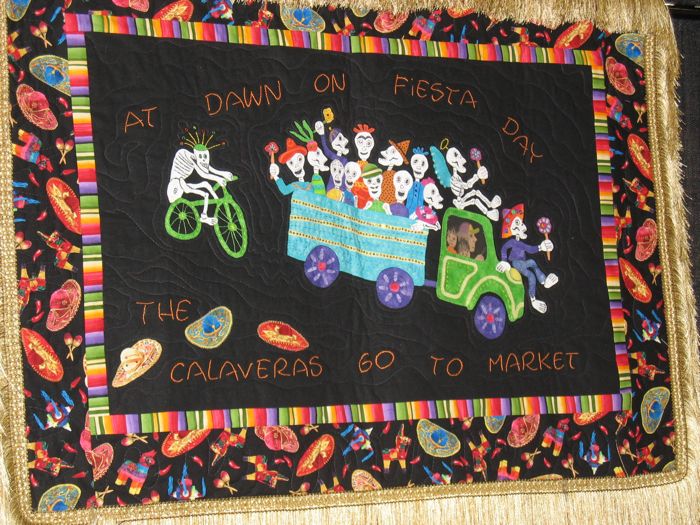
There was also a special exhibit of the Day of the Dead, a popular celebration here in Southern California. Jane Tenorio-Coscarelli and Monica Gonzales curated this booth.  It was great.

Fiesta Day, made and quilted by Laura Fiedler of California
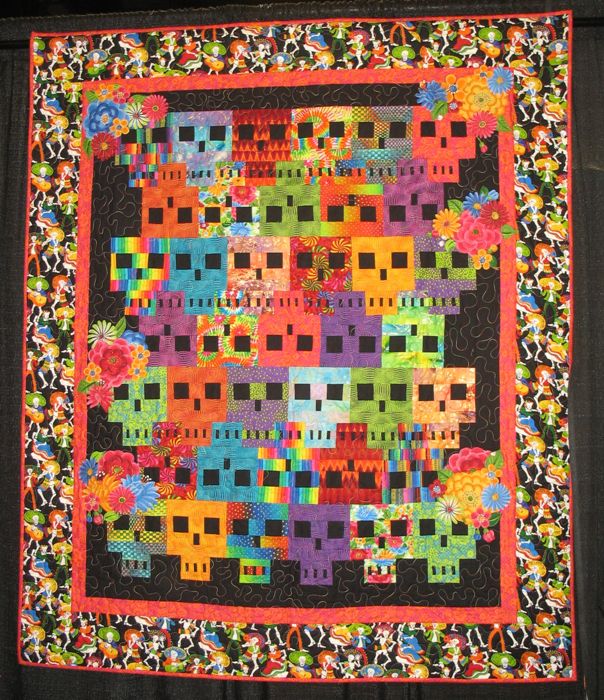
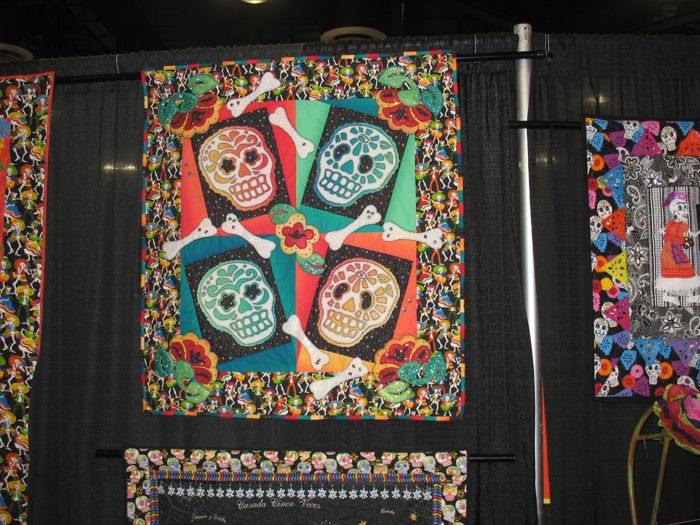
I think this is Dia de Los Muertos, by Evelyn Matinez of Los Angeles, California.  There was some confusion by all of us looking at this exhibit just which quilt went with which sign.  So, I apologize if I got it wrong.  Leave a comment if there needs to be a correction.

And I think this one is Sugar Skulls, by Terri Steinfurth of Ohio.
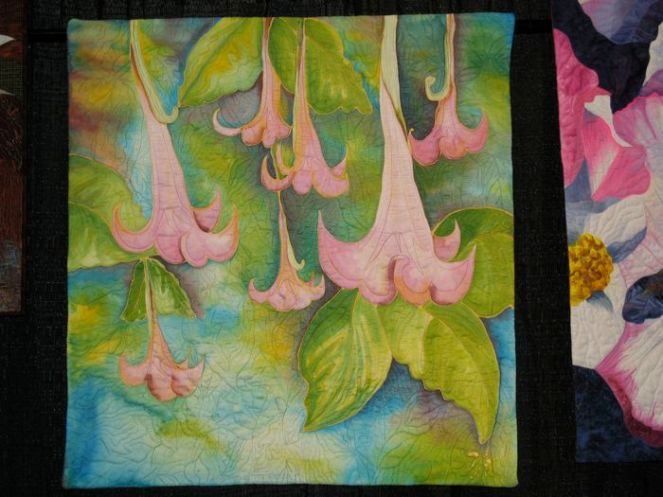
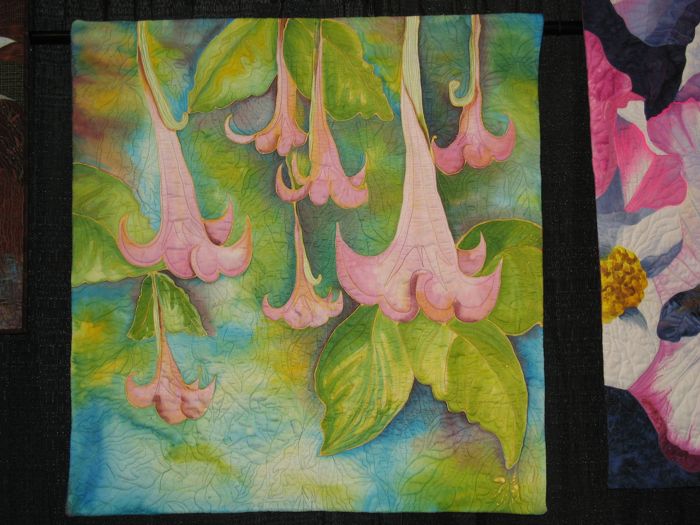
Angel Trumpet Splendor, made and quilted by Janice Paine-Dawes of Arkansas.  She painted this on silk with textile paints, then quilted it.

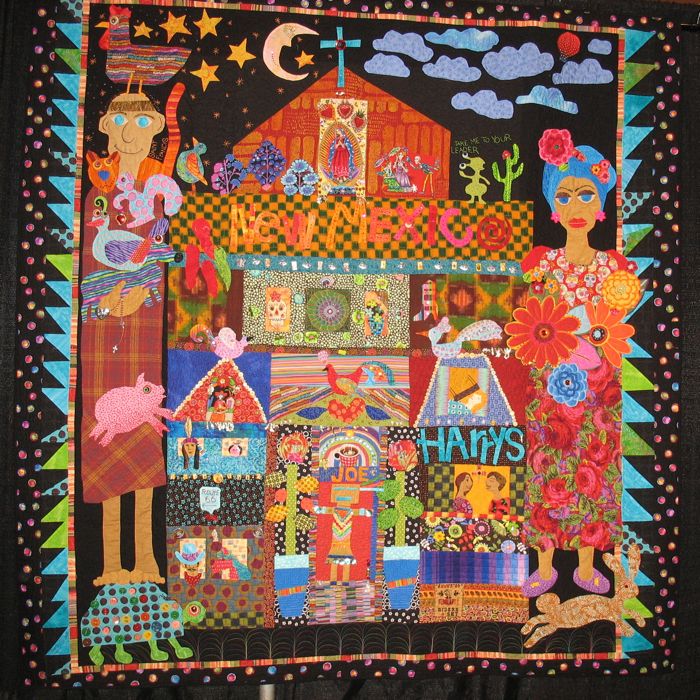
Mary Lou Weideman’s quilts are instantly recognizable. I Dream of New Mexico was finished in three weeks.  I saw her later in the restaurant (a Mexican restaurant, of course) and told her I liked her quilt.  I then showed her the quilt I keep on my cell phone, begun in her class.  She was pretty enthusiastic about it and wanted me to send it to her website.  I might.
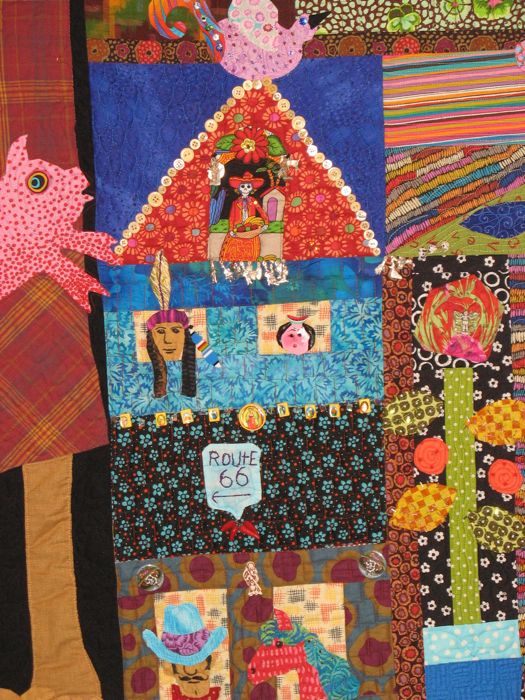
Detail of above quilt.

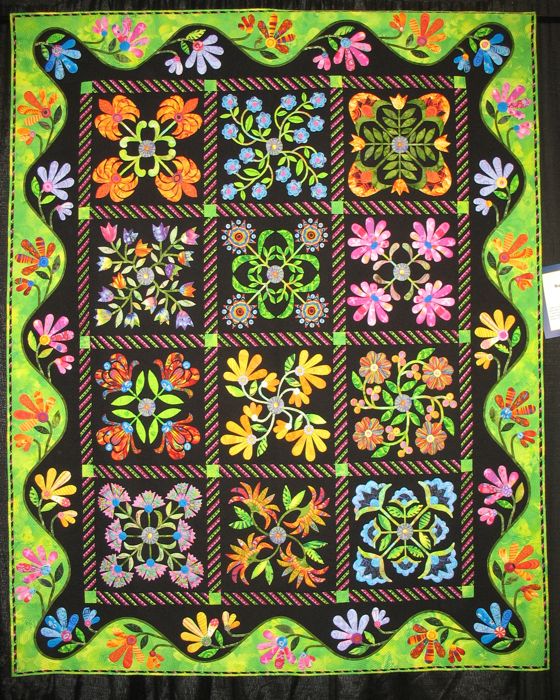
I was completely fascinated by this quilt, titled Buttercups and Butterflies, made and quilted by Gail Brunell of California.  It’s an applique–but I kept trying to figure out if it was done by machine (monofilament thread) or by hand.  I, of course, am currently obsessed with applique (because I’m nuts, I think) and am thinking about how to finish the two quilts I’ve been planning.
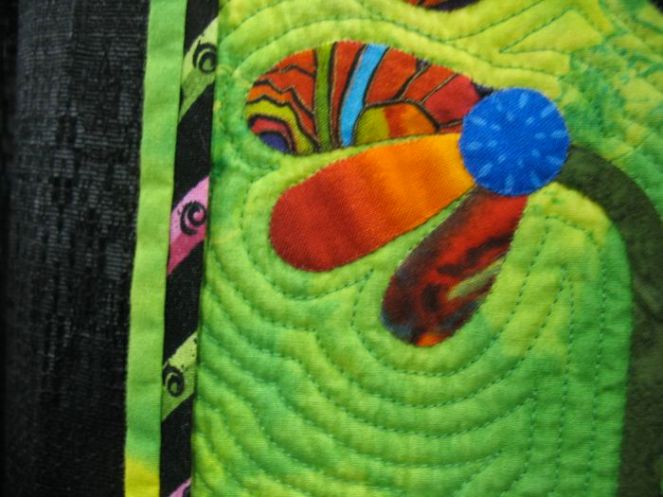
So, I tried to get really close (sorry about the blurring).  I think I see the teeny zig-zag stitching, which made me very happy to know that it could be done so well that even with a close inspection the applique won’t reveal its secrets.

She’d started this in a class on applique, and completed most of the quilt top.  Then she had an accident and put the quilt aside for many months as she “went through physical therapy to recover from a broken shoulder.”
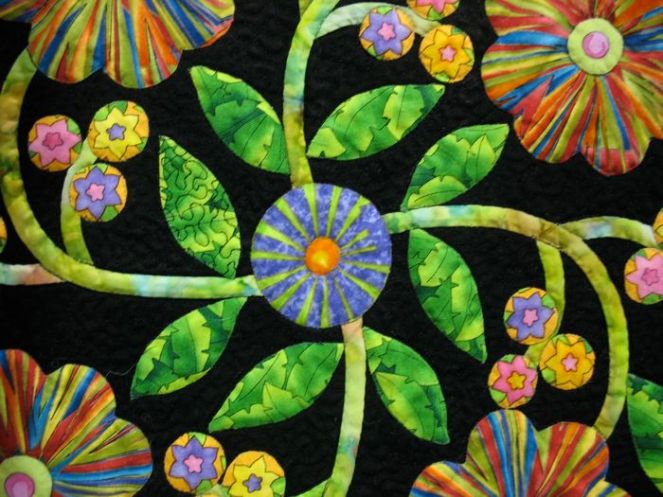
Can you spot where she changed her mind about quilting the leaves (or else oopsed and accidentally quilted one by mistake?  One of my favorite parts!  This quilt was perfection–so lovely.

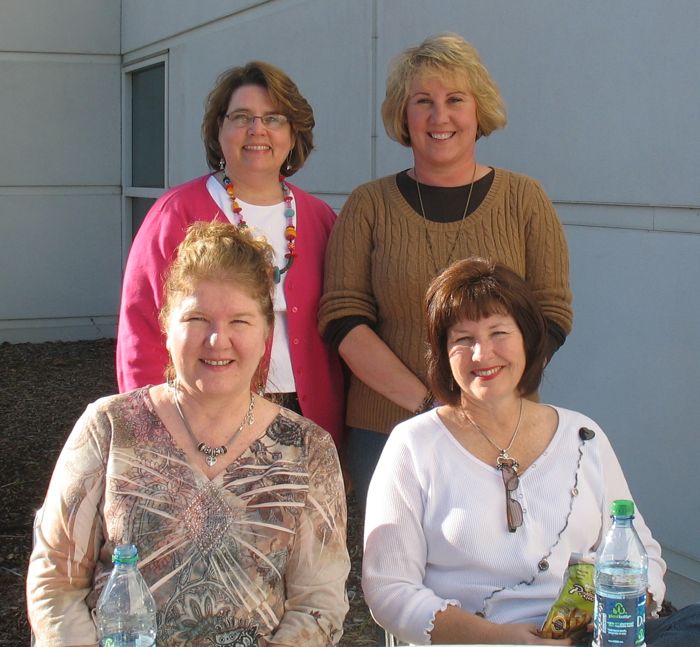
Here four of us from our little quilt group: (front) Jean, Jodi, (back) me, Leisa.  We’re taking a break in the bright California sunshine. I have on my new necklace, purchased at the show.  I had people stop me to look at it, then head over to buy one.
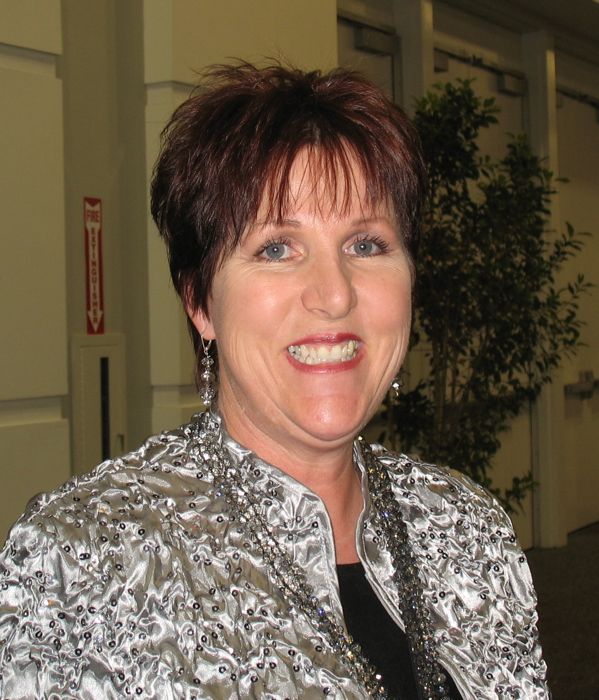
Here’s Heather from Superior Threads, modeling her amazing sparkly jacket.  She is one talented woman!

Thought I’d show you a picture of the second ballroom, where there were lots more vendors and the faculty quilts. This was taken in the afternoon, after all the tour busses went home.

The Olfa guy demonstrating his rulers.  The crowd was as thick as if he were demonstrating a blender or something (like Dan Ackroyd’s Bass-O-Matic).  You can glimpse the crowds off to the right, in this picture. I bought one.

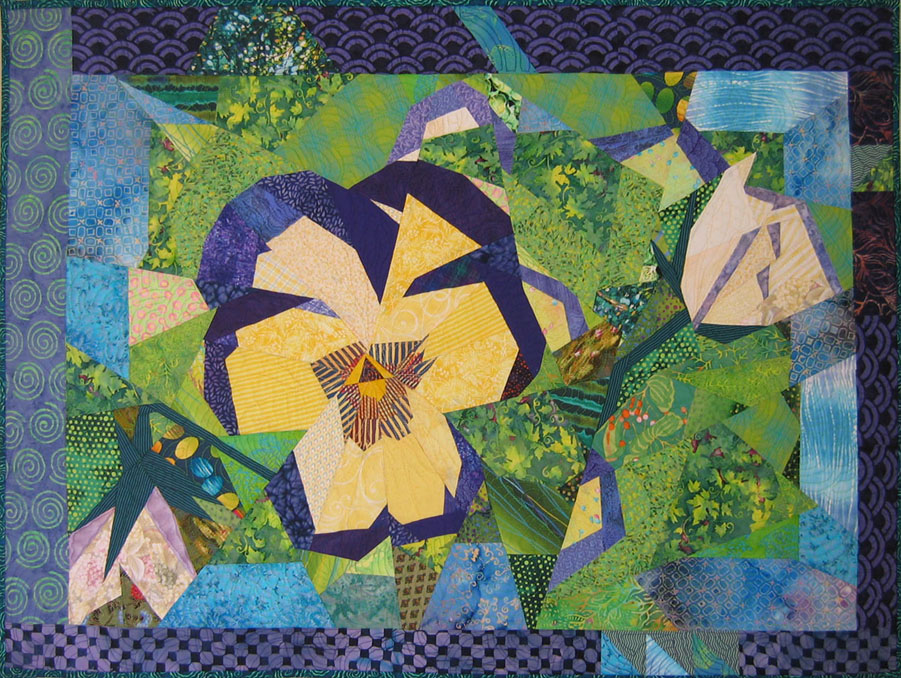
I’ll leave you with a lovely quilt–one of the flower quilts in the show.  Come on out to our California Sunshine and to Road to California!

Begonias at Butchart Gardens, made and quilted by Pat Rollie.



Quilt Shows

Road to California 2011–part III

So, what caught my eye this year?  While I felt in years past I could make a coherent statement about the content of the show, or perhaps an aspect of quiltmaking, the only comment I might make this year is about how the show was hung.  While many shows do hang like quilts next to like quilts, it’s usually subtle, so that the unique characteristics play against each other.

Whoever has hung Road to California, and by hanging I mean placing quilts next to each other, has gotten in the habit of saying (and I’m imagining this), “Gee, animals.  Let’s put them all together.”  So I’ll walk down an aisle and there are dogs, cats, penguins, tigers–all kinds of animals together.  She/He does the same thing with flowers, people, types of quilts.  Whoever this is needs to learn about habituation, or the gradual adaptation to a stimulus or to the environment, with a decreasing response.  This means in a quilt show, if we see eight flower quilts together, they lose their impact.  The last one we see is more of a Hi-Bye sort of cursory glance, because, oh my goodness, I’ve just seen flowery quilts, what more can I take away from another one?

Of course, I realize I just did that in the last post, by grouping all the travel quilts together.  But might not a flower quilt have more impact if it’s next to a child’s portrait, next to a field of daisies, next to an abstract?

I was struck by how many quilters were working in brights–colors that just jumped off the page.  While I  understand the impulse behind this particular quilt, there seems to be a lack of focus in these pinwheels and flying-geese trails.  I saw more than one quilt that admitted they didn’t plan their quilt, but “just let it happen.”  !!! is my first response, like when the speaker in church gets up to the podium and puts their folded talk into their pocket and says they’re just going to speak from the heart.  The talk, while it may have its high points, usually ends up more muddled than not.  Kind of like this quilt, but then her card mentioned that she used “shear [sic] will power” and it was “way off [her] usual ‘cute’ path” and was a “great mental exercise.”A cautionary tale, both in the creativity as well as spelling department.

Eyeballs?  Or flowers?  Or as one observer noted, Black Holes? Boy, we quilt-show-attendees can be tart-tongued, can’t we?

It wasn’t helped much by the quiltmaker’s card who titled this Flowing On, and wrote:

“Fluidity can move and change what seems solid, like water cutting a path in rock.  I am intrigued with depicting, through fiber art, this interplay between what I call “blocks and flowers”. Within these dynamics I see a metaphor for change, how it can move through easily when not resisted.”

Much clearer now, right?

I do like this quilt, aside from the quilter’s blurb, because of the way it moves from grid to curvilinear shapes, almost as if it were one of those very cool looking hot geysers in Yellowstone, and the orange field surrounding the deep colors was the earth’s crust, like this photo, below, from Mike Levin.

Oranges again in Color Blind, this quilt from Gail Eberle, quilted by Kristi Hawkins (both from Kansas).  Check out the quilting in the shots below.

Okay, you’ll never catch me quilting like this–I can’t!  While last year’s crop of quilts seemed to have too many where the quilting overtook the design, this year’s collection has been relatively harmonious between those two elements, and this is a fine example.

The Fires Within, made and quilted by Christine Rocha of California. She writes that the center reds are symbolic of the hearth of the home, and this was “pieced in an improvisational manner with only a vague vision of what it would like once completed.”  This is not the same thing as not planning (see above).  While I loved the wonky blocks, I really loved how she quilted it (see detail below).

Sheila Frampton-Cooper’s quilt, Life in the City, is a riot of color and shape and was one of my favorites.  While she was one of those professed non-planners (but do they “design” their quilts ?), I think that she is being coy.  Perhaps she did just piece all these pieces and they just sort of worked, but given the skill of how these relate along with their color and form, I daresay she worked extremely hard to plan out how their relationship.  This is one of those quilts where even the smaller elements could stand up by themselves as a small quilt, as show in the detail shots below.  Stellar quilt!

Ditto this quilt by Jacqueline de Jonge.  Here’s the detail, and below is the quilt.

Catch me if you can, quilted (and stunningly so) by Elly Prins.  Both Jacqueline de Jonge and Elly Prins are from the Netherlands.

Maybe dots are on my brain, but I loved this one! Timna Tarr from Massachusetts appliqued these circles onto squares and when she had enough of them, she played with the layout until she had a design that “worked for me,” she writes.  “A wool batt puffs up the circles to give them dimension.”  The title?  O Happy Day.

Maybe she and I could make a swap of some dotty fabrics?

This just proves that you don’t need to be big to make an impact.  It was probably all of 14″ inches along the long side, but Alive, by Mary Kay Price of Oregon, was a lovely composition, a lovely little quilt.

“Really Wild” Flowers, Second Season, made and quilted by Sharon Scholtzhauer.  She’s on a roll, for she had one in last year’s show (and it was just as fabulous).  These have the added dimension of being sculptural, with heavy quilted overlays creating depth.  See details below.

The layering of the blossom is more visible here, as is the quilting.

A white-gloved hostess holds up the quilt to show us the back so we can see the quilting.

Antelope Valley Poppies, made and quilted by Laurie Lile.  Nice how she “broke” the borders on this quilt, letting the delicate blossoms spill out.  Her quilting (below) really enhances the blossoms.

Ann Pigneri made and quilted this mandala-style quilt, titled Hope.  Quilting detail below.

Yeah, okay.  I’m pretty much fainting at this point.  If the piecing didn’t get to me–this quilting is astounding!  Bet she skimps on her ironing the laundry, or maybe she doesn’t sleep?

Midlife Crisis: Hot Flashes, made and quilted by Cathy Farris.

This one and the one above are faculty quilts–made by those who are teaching here at Road.  The Square Within, by Karla Alexander.  This would be a great stash quilt.

Joen Wolfrom used the traditional block Rail Fence to interpret Northern Lights.  This is quilted by Veronica Nurmi (see detail below).  I’m glad to see Joen teaching again–she’s incredibly gifted both as a teacher and a quilter.