

First, I need to report on the giveaway held in the last post–all your comments were terrific! and seemed to be a healthy range from “just the kids” to “adults have a great time, too.” I really liked the ones that said to include them both–so now you know.
The winner was Number 7 . . . and it was Leslie, so I’ll get those shipped out to her right away so she can keep going on her Halloween quilt. She wrote:
  I do miss the homemade donuts that our neighbor used to make and for which we, as children, would double back around for. Now it’s only wrapped candies, and we Moms all sort even those for scary things, but I do like Leslie’s perspective. Okay, here we go with the quilts.

Tutti-Frutti Alleyway, by Susan Bleiweiss. She writes: “This quilt is part of my ongoing series of art quilts which celebrate the use of vibrant color and whimsical imagery.”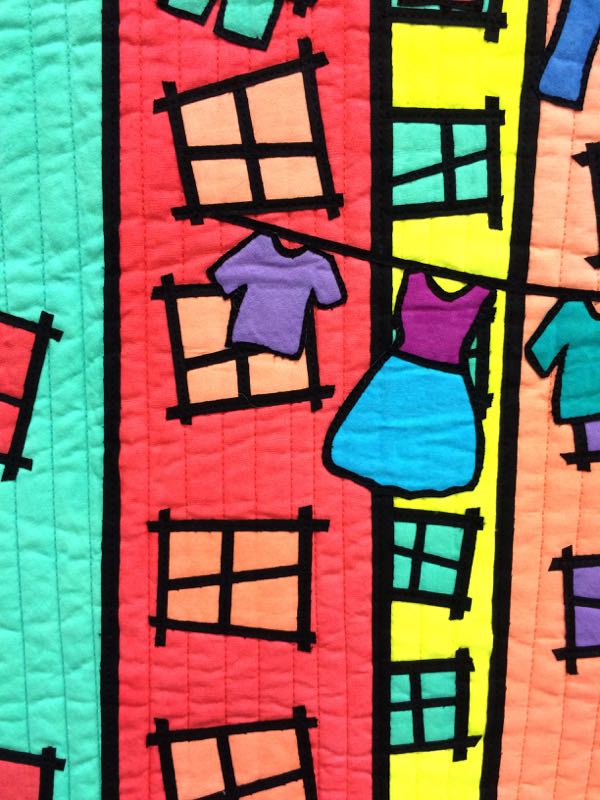
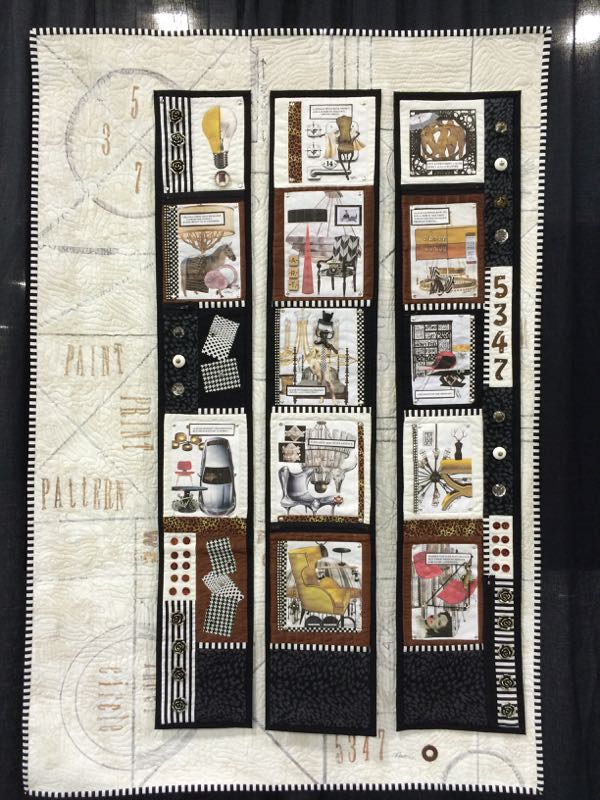 5347 Redfox Circle. . . Blueprint of a Life, by Sandra Branford. Her artist’s statement: “Using my collage skills, I created a fantasy story board of my imaginative home. Through my original designs, I define myself and take the viewers on a journey through my mind. . . some wit, a few brains, and loads of imagination.”
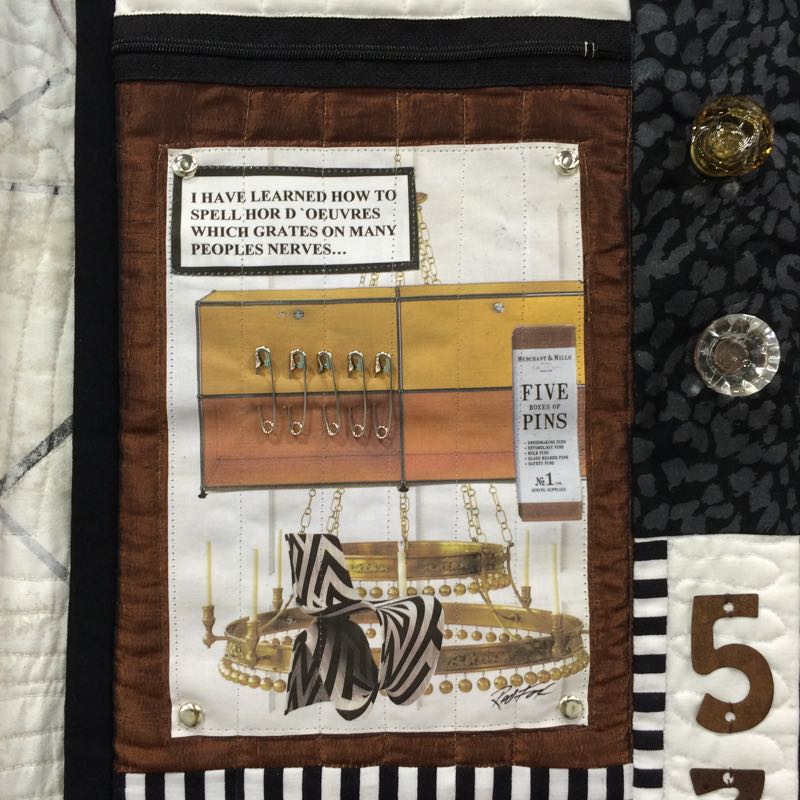
And as an English teacher, I smiled when I saw the misspelling in this text. (You’ll have to find it yourself, and no, it’s not “hors d’oeuvres.”) Whenever I find typos and misspellings in things I write, I die a little of embarrassment, so I understand how things can get overlooked.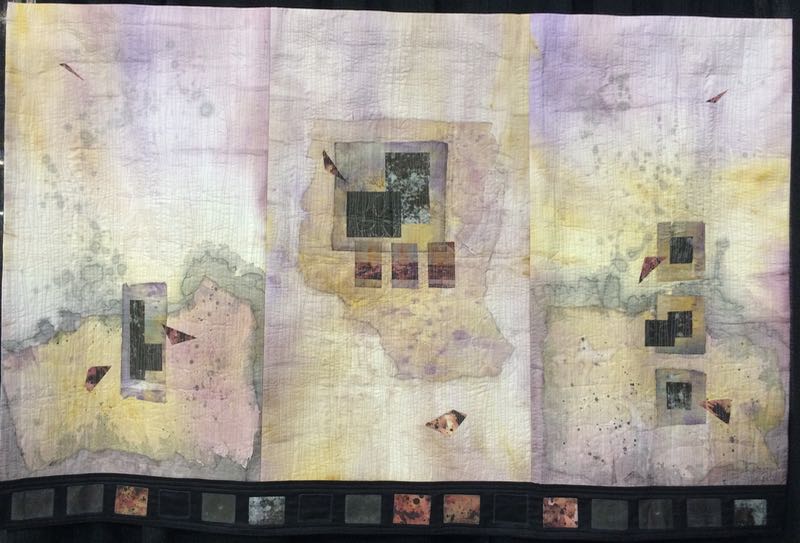
Trilogy, by Peggy Brown. “My goal,” she writes, “was to start with a painted free-flowing design, add collage and overlays of more paint, and compose a well-designed and unique painting on fabric — an art quilt.”
Pink Bird, by Judy Coates Perez (Check out the quilting in the following photos!) She write that she likes “painting images inspired by nature, using photos of real birds as reference for a pose, then altering them graphically; simplifying details, creating new patterns, and choosing different colors to create unique stylized birds and plants.”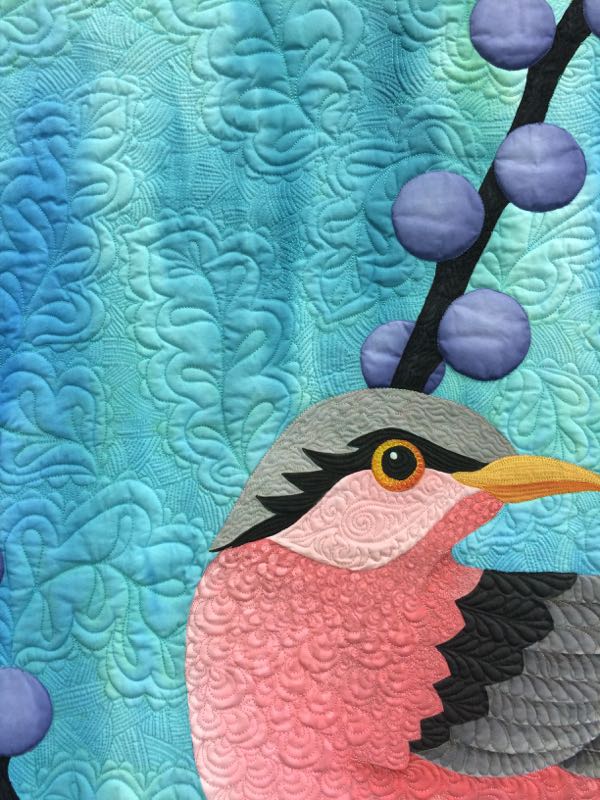
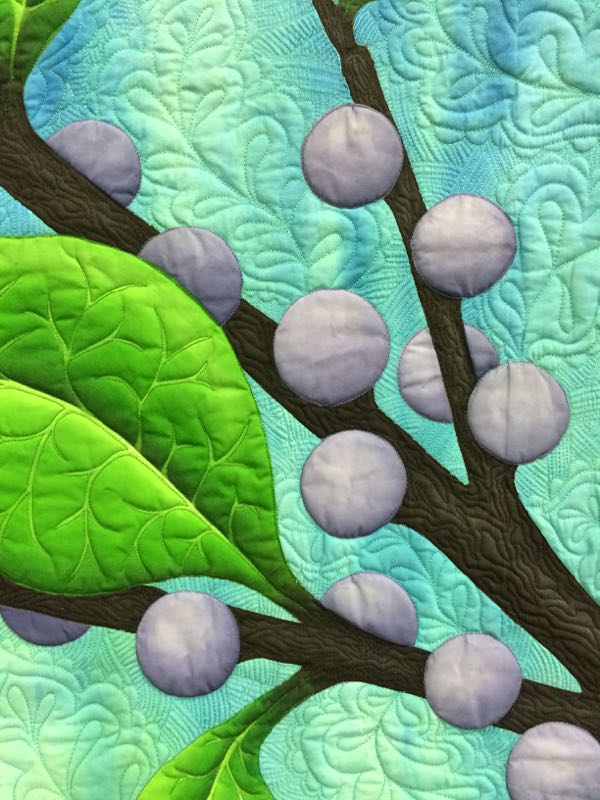


Long Winter Flower Basket Sampler, by Eileen Daniels. During a “long, cold winter in Wisconsin” she “became addicted to embroidery.” She writes that she “spent hours listening to podcasts by Jonathan Welton and to my husband reading books aloud as I designed and embroidered this quilt.”
I noticed more embroidery in this show than I’ve seen before–a welcome addition!
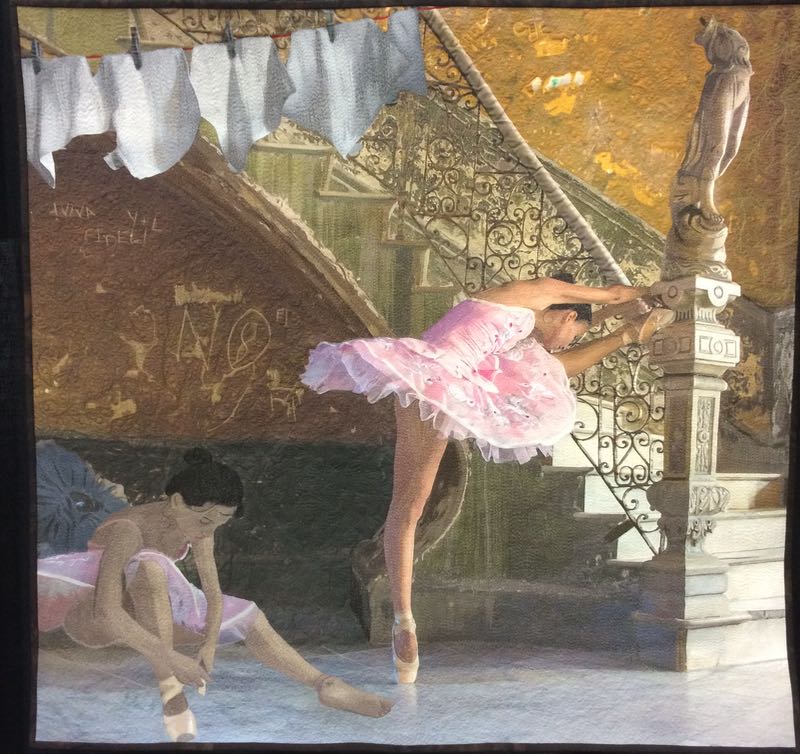
Cuban Ballerina, by Jennifer Day. She writes: “This quilt is based on a photograph that I took of a ballerina with the National Cuban Ballet in Havana. She is dancing in a wonderful old building built in the early 1900s that has fallen into ruin since 1959. This quilt is a testament to the young ballerina who is gracing the building with her beauty in dance.”
More threadwork, but this time by machine. It was stunning.
Nancy Rehak‘s Tea for Two. “Inspired by Cindy Needham,” she writes, “I took an old tablecloth of my mom’s and created a quilt. It was a challenge for me to design my quilting to highlight the tablecloth. I named it Tea for Two because my dad used to sing that song to us when we were little.”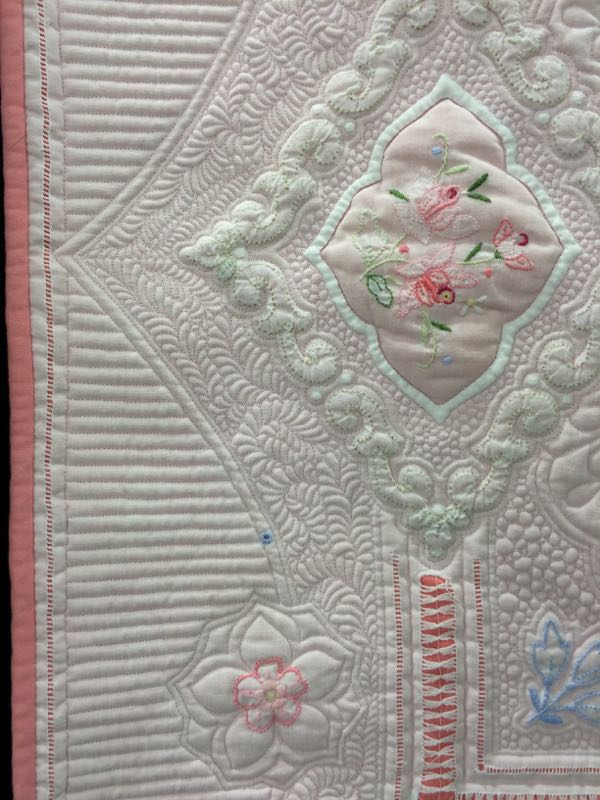

A Tree Grows in Tokyo, by Helen Ridgeway and her friends: Anita Crane, Mary Ann Hildebrand, Linda Humphrey, Marilyn Lampman, Holly Nelson, Bonnie Sprado and Barbara Woodman. The artists’ statement reads: “This was a collaboration by the eight members of the Sew Be It Bee. We each hand appliquéd a block from Kumiko Sudo’s book. One of our members, Mary Ann Hildebrand, designed and made the tree, using a scrunching technique, and made the cherry blossoms out of Yo-yos from a synthetic fabric.”

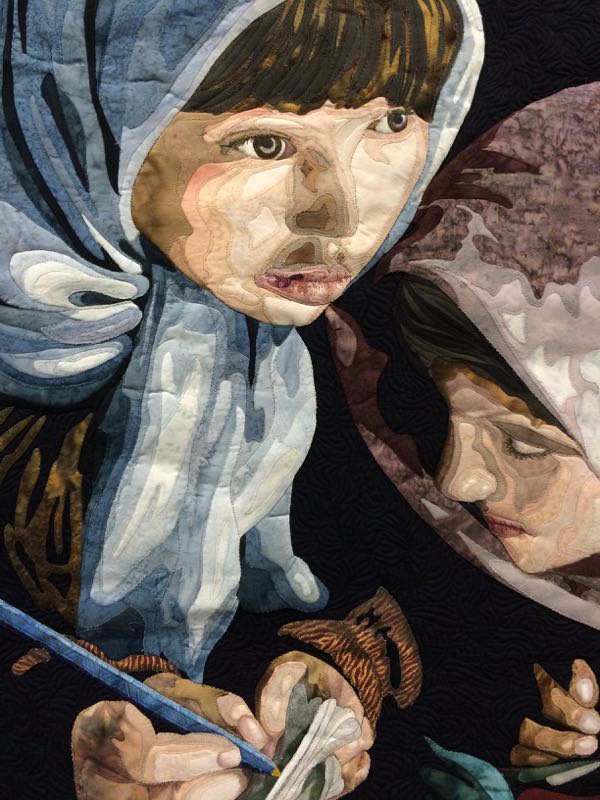
Gillian Shearer’s Eager to Learn – Afghanistan. “In 2011, in Wakhan Corridor, Afghanistan, Ellend Jaskol recorded this image of two girls eager to learn at a new school in Sust,” she writes. “They were studying in a temporary tent until the school was completed. The power of educating girls is slowly breaking through. ‘When you educate a girl, you educate a nation.’ ”
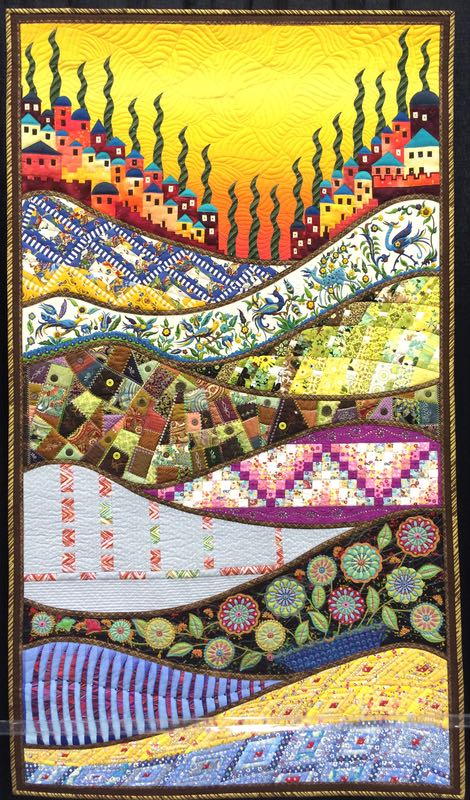
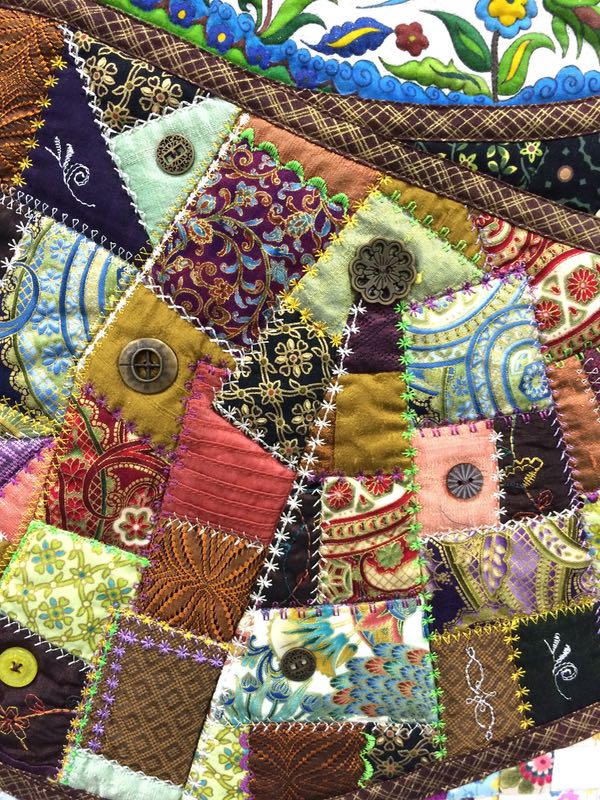
Journey, by Grace Sim. She writes that “This quilt allowed me to try techniques I have wanted to try for a long time — fabric manipulation, liberated blocks, crazy quilting, modern quilting, Broderie Perse, and the use of buttons and crystals. I used them to form my favorite Italian landscape.”

More quilts are coming.
I realized in doing this post that if a person desires to become a quilt artist, it’s pretty important that they create a place in space to reside: whether it be a blog page, or a gallery of images, or just a single place where people like me can go and search in order to read more about them. There are many platforms that can be used: Instagram, Pinterest, blogging, Tumblr, etc.
I was unsuccessful in a finding a couple of the above artists. In this day and age of >instant< and >quick< and rushrushrush there is a tendency to overlook the long form of blogs. But they become important when looking at the bigger picture, or, your journey as a quilter. So if you are just starting, you might consider building your own little place where people can find you. While there may not be much more than four walls and a piece of carpet (where others might have several fully-furnished rooms), it will be your space.


















































 OccasionalPiece--Quilt!