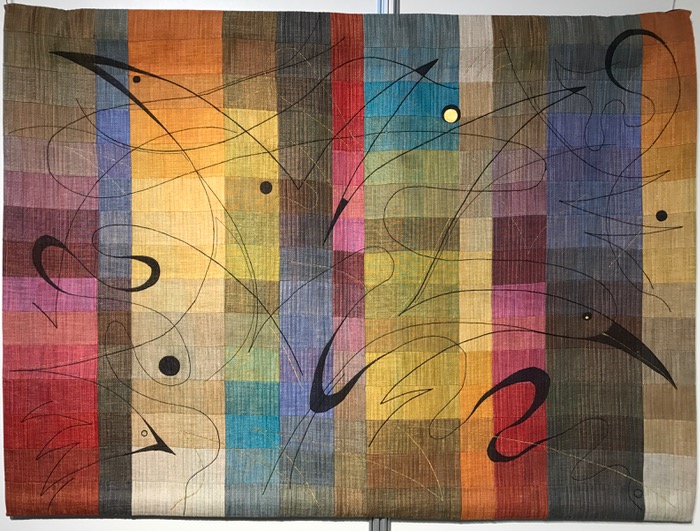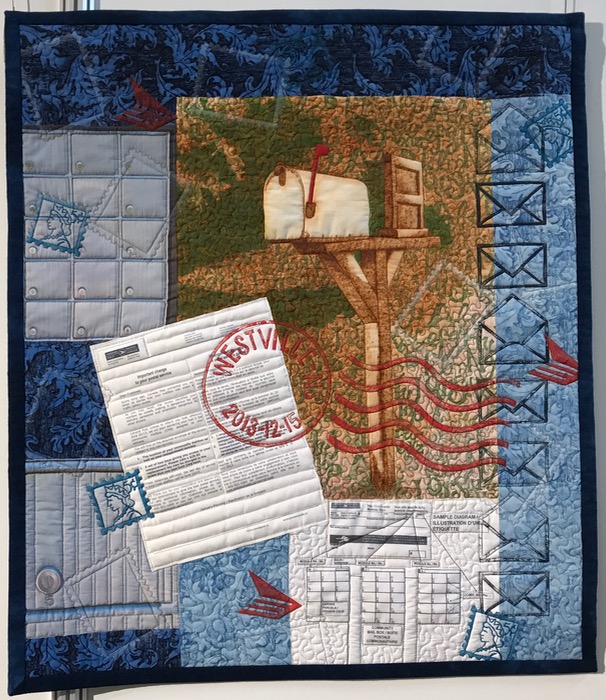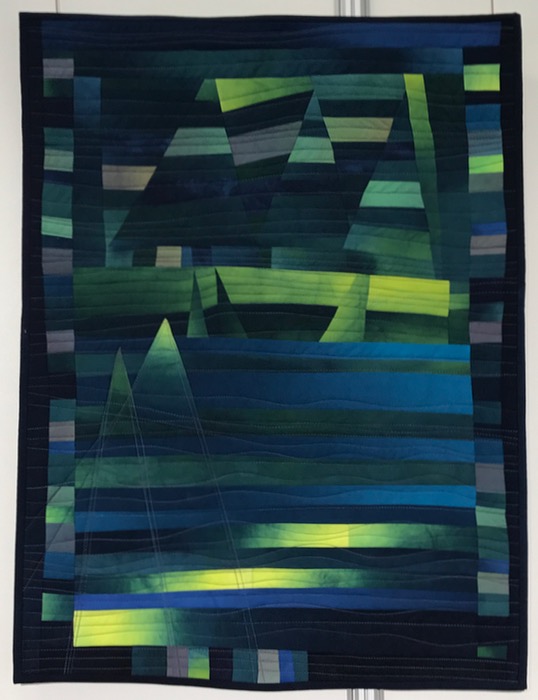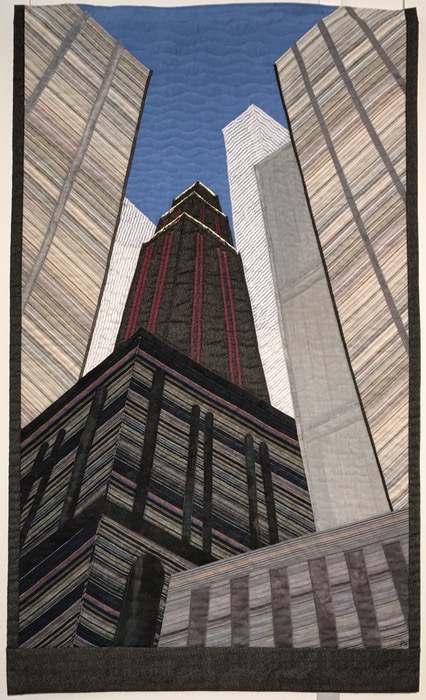
European Patchwork Meeting · Quilt Shows · Quilts · Something to Think About

Luke Haynes, Ian Berry & Nancy Crow

All posts in order are on the European Patchwork (Carrefour) page.
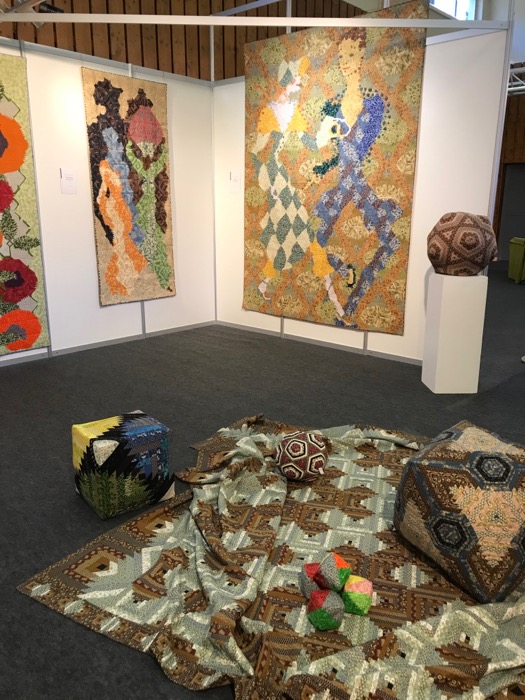
I hope the combination of the above three piques your interest, for it was an interesting juxtaposition of quilters.  We also had SAQA in the same space, as well as Mirjam Pet-Jacobs, with her pieces on wastefulness.

I kept track of who was where by looking at my charts:

(You can click to enlarge them, but really, they are just my scribbles.)

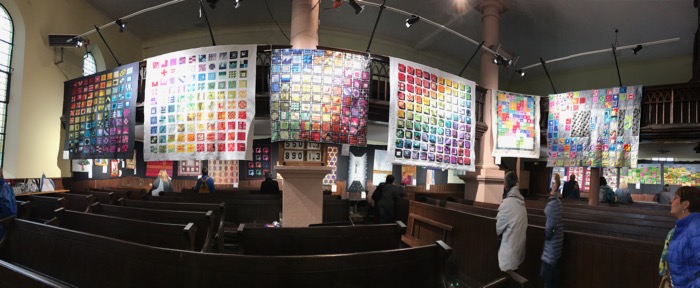
These artists were all in the Space des Tisserands, a large room that had been subdivided to accommodate all these quilters.  While some of these pictures are tiled in groups, you can click on any individual image to see a larger version.

First up is Ian Berry.  Yes, he’s the blue jeans guy.  He cuts up blue jeans into shapes and tones and colors and contrasting pieces, then re-assembles them via gluing, into recognizable images.  We had a few minutes before the crush of fans wafted in again to visit with him, and found him a lovely conversationalist.  We talked about quilting, what else?

EPM_IanBerry6

Then he was called in for a group picture, one of many I saw him do that day. I wish I would have snapped the photo of the group of ladies posing on the blue tiles in front of the washing machines in the laundromat.  I didn’t know you could step into a work of art that way, but no one was stopping them.

EPM_Haynes

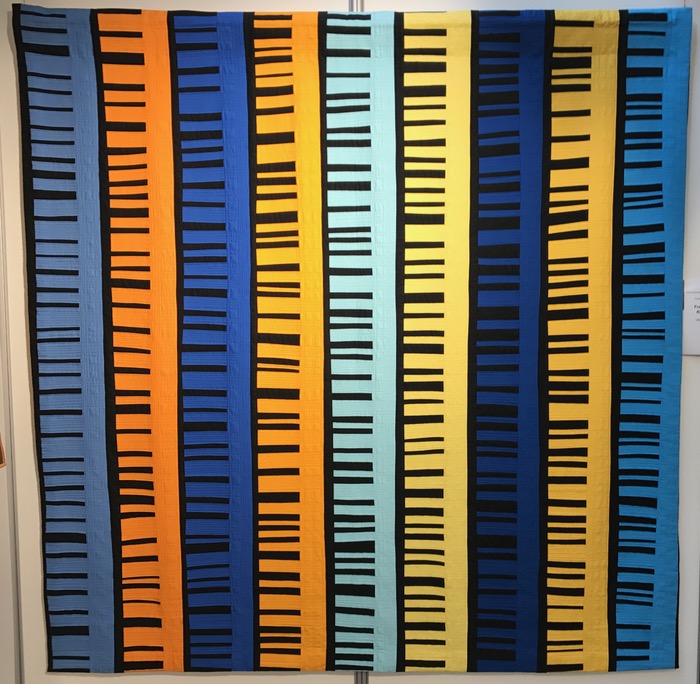
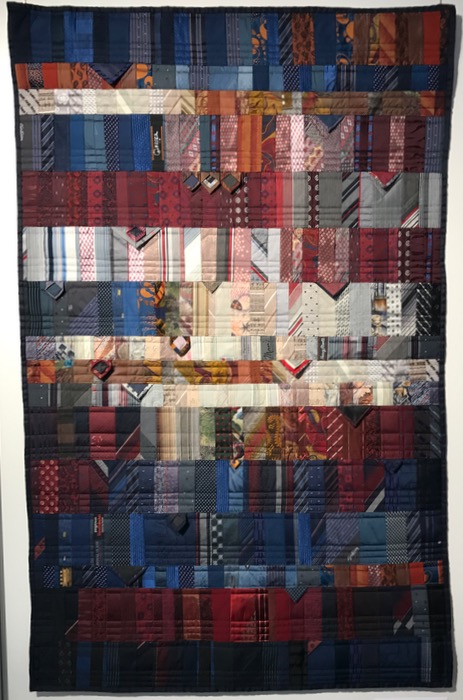
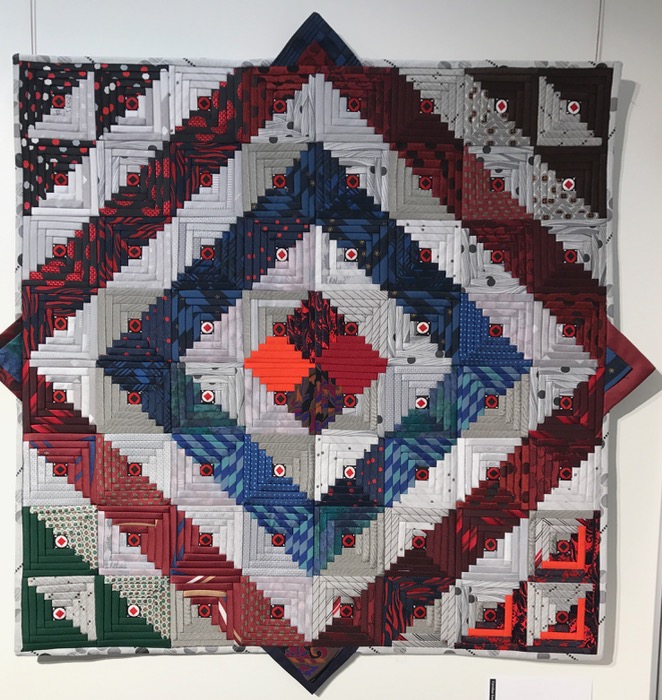
Next up is Luke Haynes (self-portrait, above), who burst onto the scene about three years ago, and remade the quilt world into his world, by utilizing traditional art studio techniques.  This means that he uses assistants to do the work, but they work under his name, and in this way he mounted his Log Cabin show.  At QuiltCon 2016, some quilters weren’t too happy with him, for to them this smacked of the subsuming of “women’s work” into the male creative world.  But Luke is a happy guy (really fun to hear him talk, and I admire his creativity) and he then morphed into this show (of course, this is all MY view of things–he may have a different take), which was called a collaboration of quilters.  Or Quiltllaborations, as his exhibit was called.

Top Row: [Collab #8] Indigo DWR by Luke Haynes and Rachael Dorr (2017)  90″ square
Second Row: [Collab #6] Polka by Luke Haynes and Libs Elliot (2015) 71″ square
Third Row: [Collab #5] Kills It with Fire by Luke Haynes and Libs Elliot (2015) 68″ square
Fourth Row (L): Untitled   It is one of my favorites, so please click on it to enlarge; however, it is not quilted.  Still cool, though.
Fourth Row (R): Another wedding ring, but I didn’t find the title card.  Some of his were nearly on the ground, or around a corner.

EPM_NancyCrow1

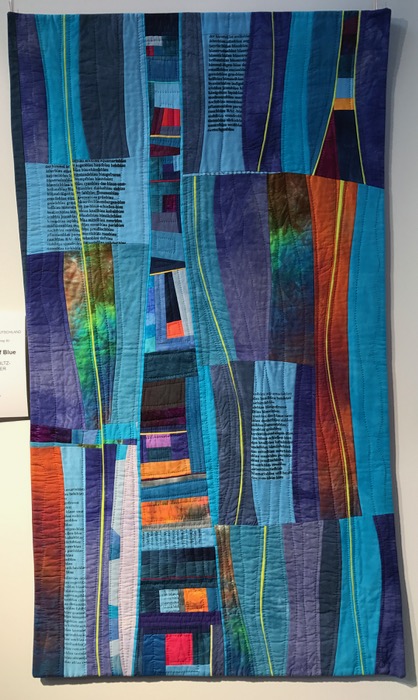
Nancy Crow, who helped co-found the Dairy Barn (in previous post) also had a few quilts  there under her name; I assume they were either colleagues or students.  One of my fantasies in my younger quilting years was to travel to Ohio and take one of her two-week classes.  I have just about every  book of hers, and screwed up my nerve to read her class supply list.  I was completely intimidated and decided that wasn’t the direction I’d be going.  But still, she is one of my Quilting Fairy Godmothers, although she probably wouldn’t like me calling her that.  (She is a serious quilter–she has a quilting studio with multiple GIANT design walls, scads of tables holding yards and yards of fabric).  Serious.

EPM_NancyCrow1a

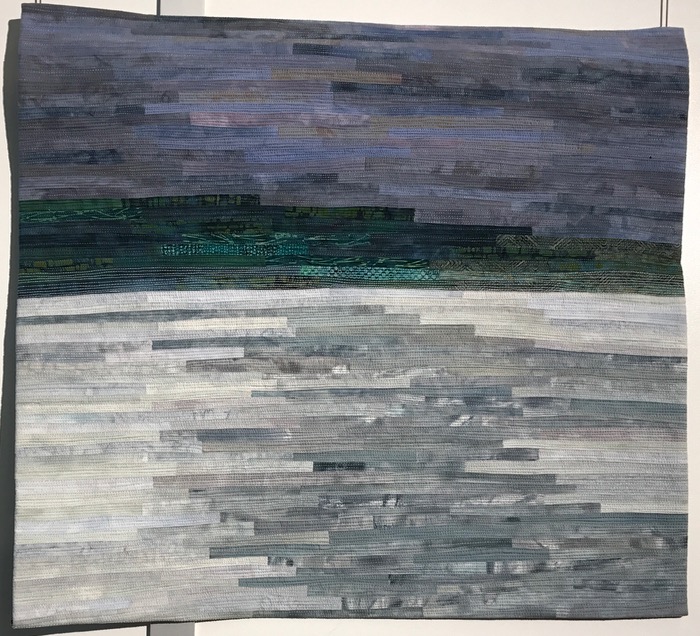
Sea Ice–Cook Inlet, by Bonne M. Bucknam (USA)  79″ long

EPM_NancyCrow2

Conflict No. 7 by Judy Kirpich (USA)  76″ square  If you’ll remember, she had a quilt in the Quilt National exhibit titled Conflict No. 5 Mugging.  I know that Crow encourages those she teaches to work in a series.  If this is two quilts away from No. 5, Kirpich seems like the anguish has eased (if you can read that into a quilt)

EPM_NancyCrow3

Thirty-four? by Helen McBride Richter (USA) 75″ wide 70″ long  Did I mention that the name of this exhibit was Mastery: Sustaining Momentum?

EPM_NancyCrow4

Colleen Kole’s Time Fragments #11 In the Distance (USA 2015)  82″ wide 83″ long  Detail is below, that shows the really interesting quilting.

EPM_NancyCrow4a

EPM_waste1
US – THEM, by Mirjam Pet-Jacobs

Okay, I didn’t love this exhibit of Mirjam Pet-Jacobs, with her pieces on wastefulness, but that could have been just my mindset, or how things struck me that day, for she is a talented textile artist with many exhibits on many different topics (please visit her website to see the range of her artistry). Her exhibit was called “What a Waste!”  The above (on the floor in the middle of the gallery) is the waste that came out of a creative quilt studio.  [Update: She wrote to me to explain that this was a three-years accumulation, which made it feel more real, for after three years, perhaps my waste stream would be the same?]  Perhaps I don’t like to be reminded that there is lots of waste in quilting, and how many of us donate doggie beds full of scraps to our local humane shelter?  My hand isn’t up.  I try to recycle my scraps, using them, sharing them.  But I do know that our textile has long been known for waste–just type in “waste in the textile industry” and see the listings.  We try to ignore all that.  Maybe the way it was presented to me just didn’t make my heart leap?  Or maybe I don’t want to know about this?  Does our cycle of quilt fabric collections — almost too many to keep track of — contribute to this waste?

You can see that it caused me to think.  Also in this building were the quilts from SAQA–Studio Art Quilt Association.  They never let us photograph their quilts in stateside shows, so I felt positively delirious to be able to take photos of these quilts.  That’s in the next post about the European Patchwork Meeting.  I have created a main page, with a listing of posts.


European Patchwork Meeting · Quilt Shows · Quilts

Quilt National 15: the best of collection “Contemporary Quilts B”

All posts in order are on the European Patchwork (Carrefour) page.

Google France

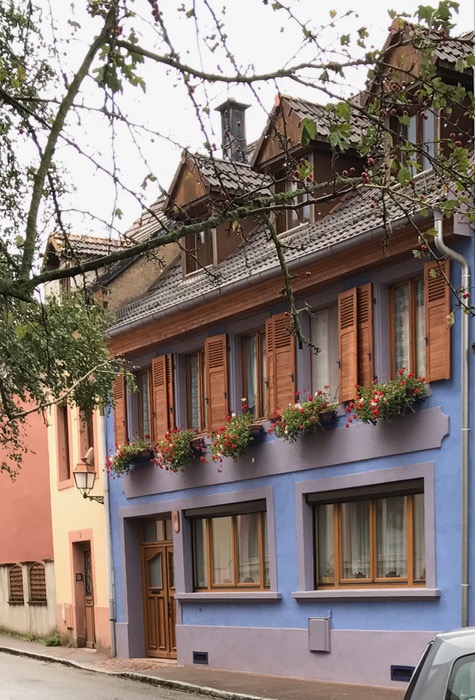
There!  Now do you feel like you are in France?  (This is what I saw every morning.)

I am recapping, in a series of posts, my experience in visiting the Carrefours European Patchwork Meeting, in the Alsace region of France this past September.  In case you came at this topic sideways (which is usually how the internet works), I have created a master post, with links to the exhibits.

After visiting the vendors, and Gabrielle Paquin, the next quilt exhibit we went to was the best of the Contemporary Quilts B collection from Quilt National.  They have several groupings of quilts that travel, and since their European partner is this show, we were lucky to see some of these quilts.

dairybarn_frontofbarn_headerIf you don’t know about Quilt National, whose headquarters are in a former dairy barn in Athens, Ohio (above), you might want to read more about them.  Suffice it to say that their quilts are more artistic, less traditional and always intensively creative.

EPM_QltNational_1

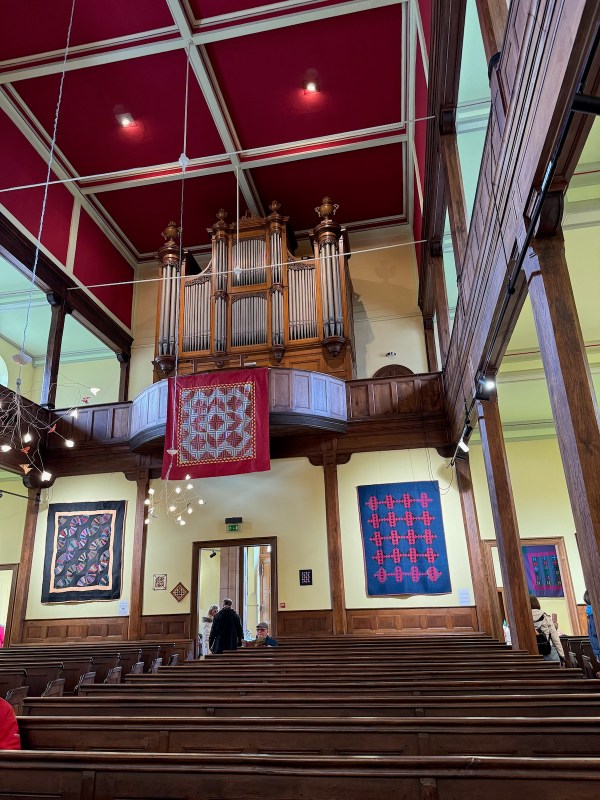
The exhibit was in this site, with its half-timbered walls.  Inside it was very modern.

EPM_QltNational_2
36″ high by 40″ wide

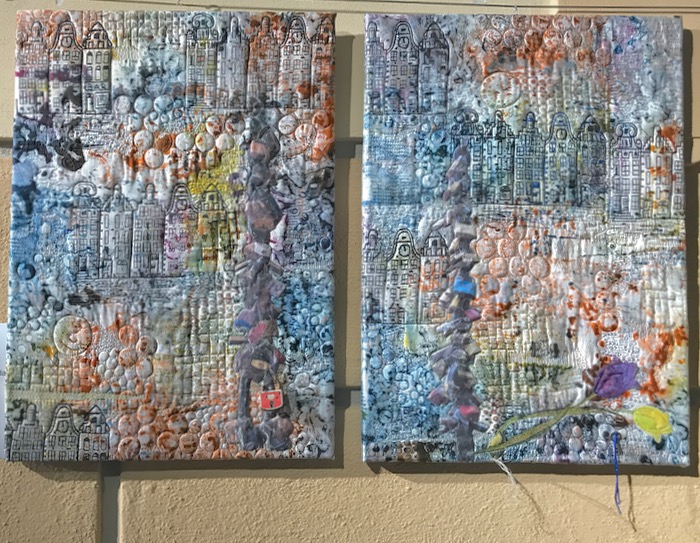
Jayne Gaskins’ Memories (USA, 2014) paid homage to a street scene from somewhere in the Andes in South America (I assume), and was heavily thread-painted.  Detail is below, where you can see the dimensionality of this piece.

EPM_QltNational_2a
EPM_QltNational_3

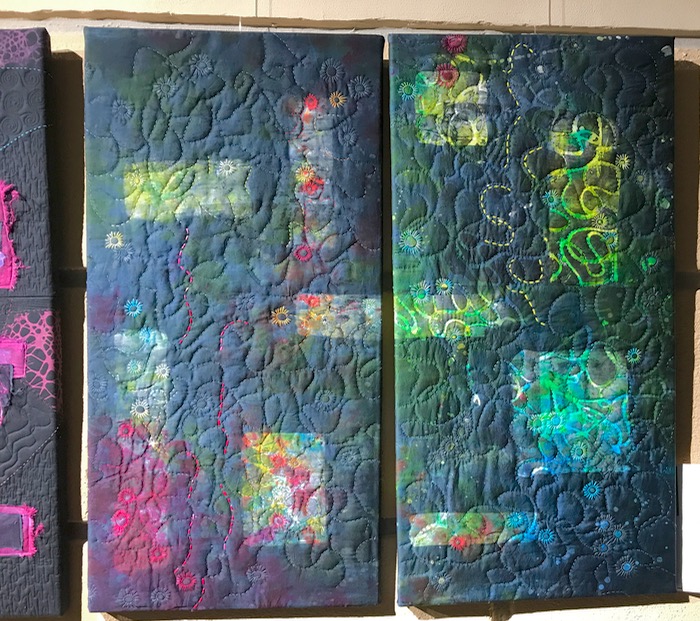
Skylight by Elizabeth Busch, USA, 2014.  Those spatters looked like dye discharge, and I wondered how she did it. It may have also been a batik-like process where she dyed it, then blocked it with a wax resist, then over-dyed it.  As this exhibit had no title cards, there was little information to go on.

EPM_QltNational_3a
EPM_QltNational_4

This piece was quite large; I assume each panel to be about 20″ wide and 40″ long (couldn’t read the dimensions when I got home). It’s titled Entropy, by Kathleen Loomis (USA 2014).  I loved her use of striped fabric, not only to subdivide the sections of fabric, but she also used them like Gabrielle Paquin did, as a way to get texture and design into a flat area but without using floral or other motifs in the fabric.  Detail, below.

EPM_QltNational_4a

EPM_QltNational_5
62″ x 39″

Pam RuBert is a favorite of mine, and this is her quilt London–Wish You Were Hair (USA 2014).  (You can find another one of hers elsewhere on this blog.)

EPM_QltNational_6
35″ long 22″ wide

Rough-edged and exquisitely hand-quilted, Kate Gorman’s A Keeper of Secrets and Parakeets was a quiet, subtle masterpiece.

EPM_QltNational_8
42″ high 60″ wide

Amaryllis Set, by Jill Ault (USA 2014) appears to be multiples of the same photograph, printed on a fine fabric, then cut as to reveal different colors and shading. Detail, below.

EPM_QltNational_8a

EPM_QltNational_9
34″ square

Okay–is this a quilt?  Straps with paint and grommets on a tinker-toy-steel-rod grid?  Diane Nunez’ Cross Section (USA 2014) certainly makes me wonder.

EPM_QltNational_10
37″ x 57″

Roofs of Mumbai, by Jean Renli Jurgenson (USA 2014) was interesting because of the materials used: some stiffened, quilted fabric and some was non-woven, almost paper-like. Details, below.

EPM_QltNational_10a
EPM_QltNational_11

I’m not usually drawn to the deep, dark, moody quilts, but her construction and the material she used was compelling. (See detail below for the small knots she used for keeping the layers together).  Judy Langille’s Nocturnus IV (USA 2014) is about 35″ high by 47″ wide.

EPM_QltNational_11a

EPM_QltNational_12
44″ square
EPM_QltNational_12a

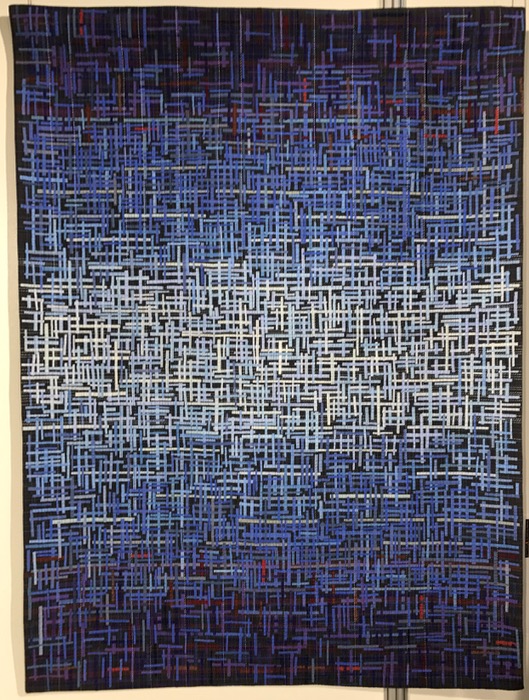
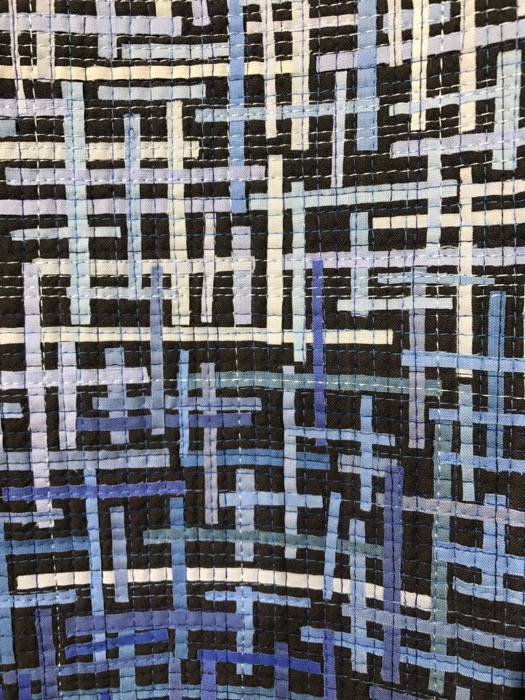
Maria Shell’s To Agnes Martin with Color (USA 2014).  Now I know what to do with all my scraps of solids.  Again, I put my hand up for scale.  Those crosses are tiny!

EPM_QltNational_13
55″ long 25″ wide

This has got to be one of our favorites.  Janet Windsor’s Crumbling (JP 2014) looks like  stream bed with multi-colored stones.  It looked, upon closer inspection, that they were wrapped fabrics around puffiness with a cardboard backing?  Some stones looked like they’d had some color applied, but that could have just been the fabric.  Talk about a quilt that you want to touch–this was it.

EPM_QltNational_13a

EPM_QltNational_14
47″ by 33″

Morning Walk, by Joan Sowada (USA 2014).  I left it uncropped so you could glimpse the exhibit’s layout on either side.

EPM_QltNational_15
64″ by 61″

Conflict No. 5 Mugging, by Judy Kirpich (USA 2014) made me wonder if she was had been the victim of a violent crime, with its shards of red and ominous, oppressive sky.  The quilting (below) was outstanding, expressive.

EPM_QltNational_15a

EPM_QltNational_16
39″ by 40″

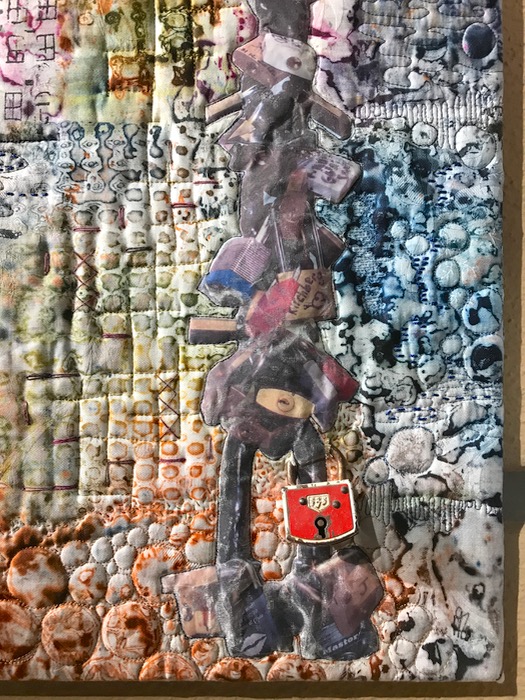
Cecile Trentini’s C5–Red Circonvolutions was Picasso-esqe in its design, the quilting providing all the texture and interest.
EPM_QltNational_16a
EPM_QltNational_17

Central Park West Winter VII by Linda Levin (USA 2013?)  This was large (can’t read the dimensions) but mostly it looked like a very cold and blustery day, writ in fabric.


European Patchwork Meeting · Quilts · Textiles & Fabric

Gabrielle Paquin: Design and Graphics

All posts in order are on the European Patchwork (Carrefour) page.

Moseying along the main street, we headed to Site #7, the Eligse St-Louis, where I wanted to see the French quilter Gabrielle Paquin.  Previous to this, in my hotel room in Geneva, I had previewed all the exhibits, looking up the artists and deciding which ones interested me.  Paquin was one of them.

EPM Paquin_site1b

EPM Paquin_site1d

I had seen photos of previous years’ exhibits, and the fact that many of them were in churches.  But it just doesn’t prepare you for the juxtaposition of the sacred and the quilting, the symbols of religious life coupled with the themes and ideas and colors and patterns of the quilts along the sanctuary walls.  It was wonderful.

EPM Paquin_ESE

She spoke some English, and agreed to pose with me.  Check out her sweater.

EPM Paquin_1
The Round, 2017

In her biography, she writes:

“For several years, I studied drawing and painting in a school of Fine Arts, my first vocation, and since then, I practice painting as an amateur. Simultaneously, I realized traditional patchworks inspired by American models large format of the 18th and 19th centuries.

“This practice evolved towards the contemporary patchwork and the textile art that I have been practicing assiduously for ten years, thanks to a constant inspiration and stimulated by the numerous exhibitions proposed with selection by a jury of artists and curators of museums.”

EPM Paquin_2
Spring, 2016.

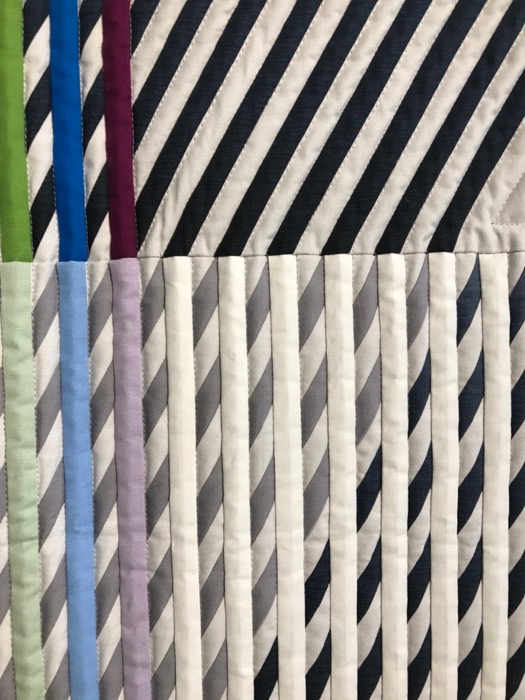
You can start to get a sense of the materials that Paquin works in: striped cloth.  In this one, she uses larger pieces that her usual strips, and has appliquéd them down to the background with a satin stitch on her machine.  I like her small monogram in the lower right corner.

EPM Paquin_3

EPM Paquin_3a
Twilight and Stripes, 2008 (?)
EPM Paquin_3b
Detail.
EPM Paquin_4
EPM Paquin_4a

I didn’t quite catch the name of this one (top, and detail, bottom), but it shows her use of her striped material.  I kept wondering if she cut up old shirts, or old clothing, or haunted fabric shops to find all these variations.

EPM Paquin_5
In/Out, 2017.
EPM Paquin_5a
Detail.

I was impressed with the quilting on this piece, as it gave me great ideas.

EPM Paquin_6
Flight II, 2015.

All the placards were in French, so I’m using Google Translate to write them in English, plus heading over to her website where she has some of these quilts.

EPM Paquin_6a
Detail.
EPM Paquin_6b
Detail.

She has found so many ways to use this fabric; I didn’t include all her quilts in this series, but many of them.

EPM Paquin_7
Two Black Sisters, 2016.
EPM Paquin_8
Storm II, 2012.

What a huge impact the simple reversal of value (light-dark) can make!

EPM Paquin_9asite
Looking towards the back of the church.  She is sitting there at the table with the white tablecloth, waiting for people to come and talk with her.

EPM Paquin_10
R-évolution, 2017.
EPM Paquin_11

EPM Paquin_12
The Eye of the Cyclone, 2009.

We call cyclones “hurricanes,” and after this year, can definitely relate to the eye of such a storm.

EPM Paquin_13

This title says something about a spider, and it was pinned up to show the creature responsible for this exotic web.

EPM Paquin_9site

Please visit the gallery on her website for more quilts and inspiration.


Note: this series about the European Patchwork Meeting has a main page, with a listing of posts.

European Patchwork Meeting · Quilt Shows · Quilts

A Study in Opposities: Lea Stansal and Mary Koval

All posts in order are on the European Patchwork (Carrefour) page.

I am posting my experiences at the recent European Patchwork Meeting, held in a series of four small towns in the Alsace region of France.

 The town of Saint Marie-aux-Mines, the main venue, had many places to find quilts:

Ste MarieauxMines Map

Patchwork Mtg_venues SMAM

The poster above links to the numbers in the map.  Once we left the L’Espace Commercial, we walked across the street to the Theater, where two sets of quilts curated by two different women provided a study in contrasts.

EPM Theater StansalKoval_1

One set of quilts, by collector Mary Koval, was exhibited on the ground floor of a beautifully restored old theater, which you can just see from around the edges of some of my photos.  This set of quilts were all American antique quilts.

EPM Stansal_6

The other woman (from France) is Lea Stansal, who mounted a one-woman exhibit titled La Broderie d’embellissement, which can be roughly translated to The Embroidery of Embellishment.  Her biographical statement from her blog (which I used Google Translate to read) says:
Trained at Met Penningen’s Higher School of Decorative Arts and Interior Architecture. After twenty years in the world of fashion as a textile designer, Léa Stansal decides to explore and deepen more traditional aspects such as patchwork and embroidery.
“Since then, with a thread and a needle, she has created a poetic and original work, which is widely exhibited in the world and has given rise to the publication of half a dozen books of art.”

EPM Stansal_0
Is this the artist? I don’t know, but I did love the quilt behind her head.
EPM Stansal_1
EPM Stansal_3

EPM Stansal_3a
Detail.

None of these are titled, and it flattens them out to put them on this digital medium; I wish you could have seen them in person.  They were wild and embroidered and free and filled with a happiness of creativity.  I think if I could spend 10 minutes in her studio, I’d break all those Rules of Quilting that I carry around inside me.

EPM Stansal_1
EPM Stansal_2

EPM Stansal_2a
Detail from the upper panel, above
EPM Stansal_4

EPM Stansal_4a
Detail.
EPM Stansal_4b
Detail.

I kept thinking about how the Pied Piper had charmed all the little tin soldiers.  Was this a statement about war?  About peace?  I’ll never know, but I’m still thinking about it.

EPM Stansal_5
EPM Stansal_7

Detail from above.  The layers!  The collage!  The broderie perse!  I kept sighing.

EPM Stansal_8

I love how the deer and its antlers are in this piece, but not in the static, overused version we see in America.  Shall we turn some quilts on their heads?

EPM Stansal_8a

My husband, who loves symmetry in all its forms kept sighing, too, as he admitted that this just wasn’t his type of quilting.  Mine, neither, but I kept admiring that freedom to create, a freedom that was a delicious anarchy of cloth and threads.

EPM TheaterStansalKoval

We headed downstairs to Mary Koval’s antique quilts, in an exhibit titled “Piece by piece, our life with quilts.”

EPM Koval_1

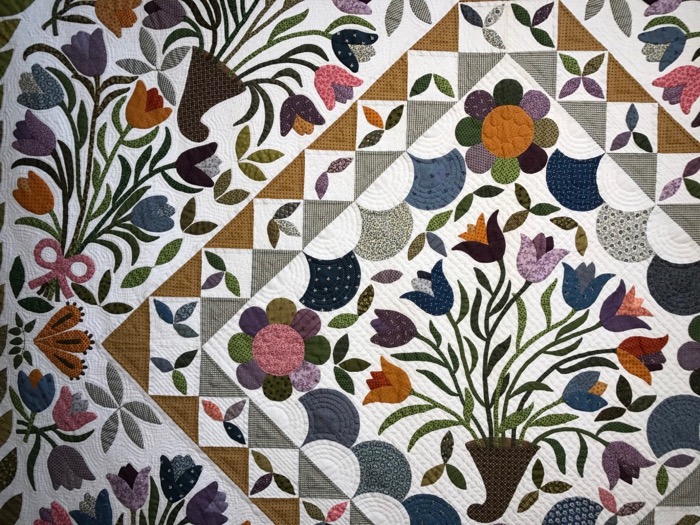
I had carefully included the identifying titles in my photos, but back home, found I couldn’t read them most of them.  The quilts range from the late 1800s to the early 1900s.

EPM Koval_1a
EPM Koval_2

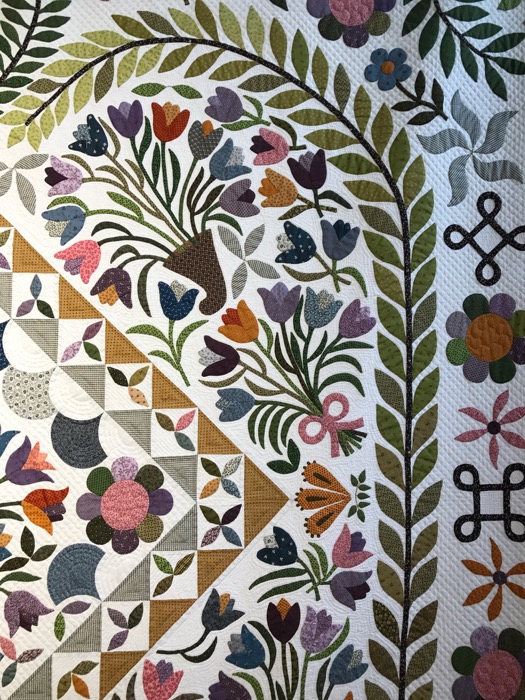
Pickle Dish quilt, from the 1920s.EPM Koval_2aEPM Koval_3

I liked the juxtaposition of these two–the orange-clad guard and the riotous early-American quilt.

EPM Koval_4
EPM Koval_4a

I liked the embroidery detail on this little Uncle Sam. a quilt from the 1920s.

EPM Koval_5
EPM Koval_5a

One of my favorites of the antiques because of its exuberance.  The name “Rev. and Mrs. (?) S. Harvey” is on the first line, with “Park Methodist Episcopal Church” on the second.  “Circle No. 5 1937” on the third line.

EPM Koval_6

Made from silks.

EPM Koval_6a
Detail.
EPM Koval_7
EPM Koval_7a

We weren’t allowed to touch the quilts (of course!) so I held my hand up to show how tiny those triangles are.  This quilt is from Berks County, Pennsylvania, but I don’t have a date.

Kovals

I’m sure all these quilts are from their new book.  Info can be found on their website.EPM TheaterMeal_3

Now we were hungry, so we found this little “cafe” in the back of the theater, with fabulously dressed servers.

EPM TheaterMeal_2

Although the flowers were pretty tired, I loved the attempt at patchwork on the vase, with bits of cloth glued to the glass.

EPM TheaterMeal_1

And this, folks, was the traditional Alsace salad with bretzel (with a “b”).  My husband ordered this, but I went mainstream with the ham sandwich below.  They were doing an active business, so we hurried and ate and went back out hunting quilts.

Note: this series about the European Patchwork Meeting has a main page, with a listing of posts.