Creating · Quilt Shows · Something to Think About

Quilt Festival Entry 2011

Welcome to those who clicked over from the Blogger’s Quilt Festival!
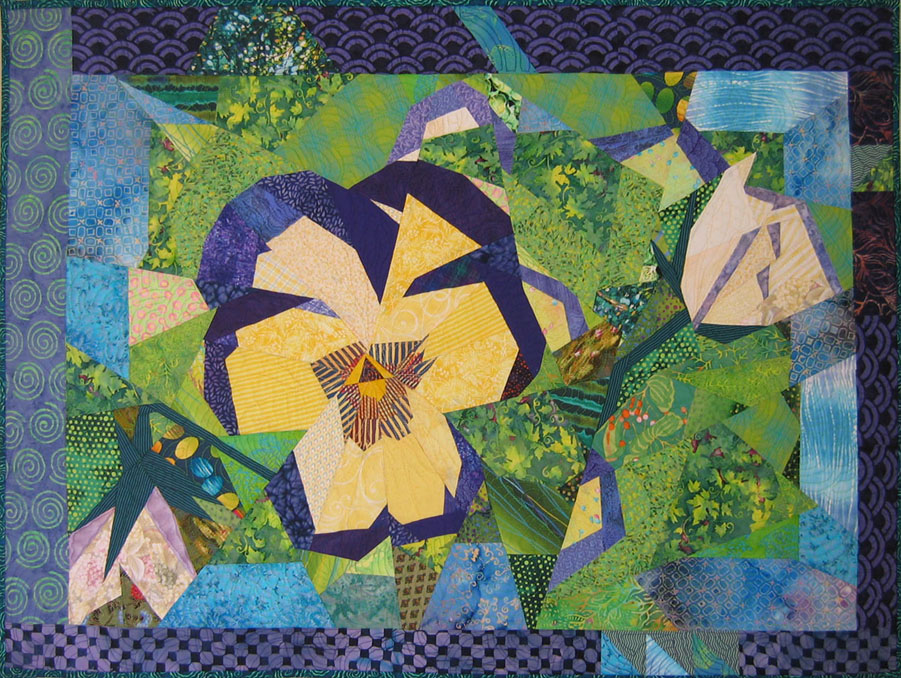
Heart’s-ease

I made began this quilt in a class from Ruth McDowell.  For those who have taken her classes, you know you only begin there, but then go on to spend a good amount of time chasing down just the right fabric to go in a particular spot.  It was a four-day class and by the end, we were all dragging in–our creative juices spent, our bodies dead tired, but our vision–changed.  For Ruth (who by the way didn’t look tired at all!) had changed us.  I was then, and still am now, a quilter who is enamoured with the grid.  I love nine-patch, stars, crazy about sashing, and love love love Log Cabin.  Maybe it’s my orderly nature or something, but when you finish a grid quilt it’s like having cleaned out a drawer or a closet or two.  You’ve restored some order to the universe with your neat rows and sharp points (even if you have cut off a few in construction–who notices?).
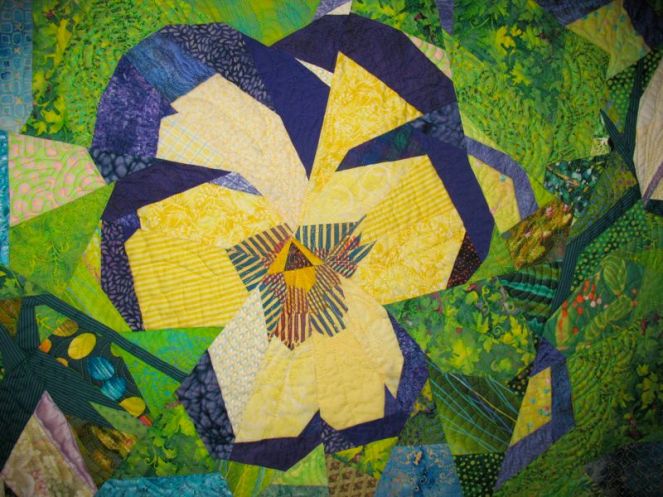
Heart’s-ease is the old-fashioned name for a pansy.
Ruth suggested I use a fabric that my husband brought me from Zimbabwe as the center; she was right–it really works.

So trying to do this quilt–which is a strictly right-side of the brain, pile on your fabrics, cut those pieces of freezer paper and go go go sort of process–humbled me.  The angles–none, except a few around the border–are that blissful 30 or 60 or ninety-degrees cut over and over.  The picture I’d brought in of the pansy determined her own angles, her own coloring and background.  I think I cornered the market on yellow-green fabrics that year.  But after a year and a half–it was finally done.

It had been on my pinwall while I finished my undergrad, earning my degree in Creative Writing.  So in a way, both Pansy and I grew while she lived, unconstructed and grid-free as I wrote short stories and the beginning of a novel and struggled through having my own brain cracked open and reformed.  No tidy endings for either the stories or the pansy, but only a dark, broken border to contain our tales, our thoughts, a few dreams and a degree.
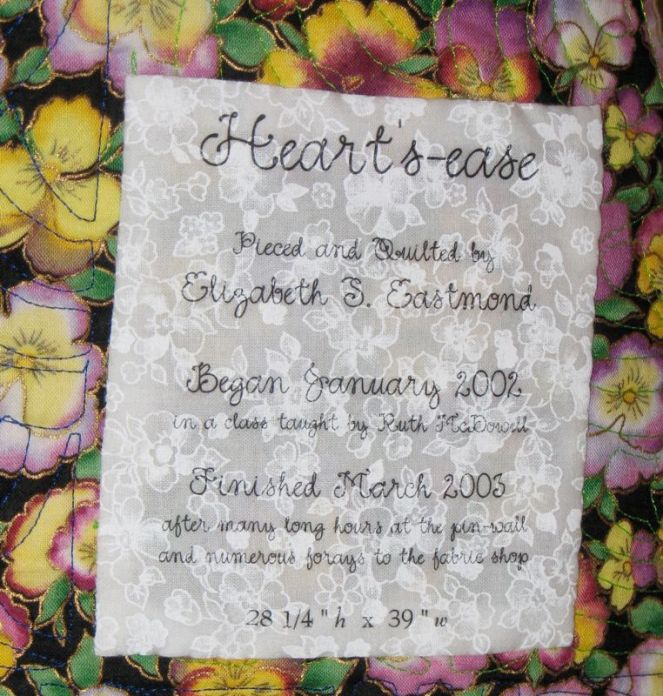
Heart’s-ease label.
When Amy asked for a quilt that taught me a lot–this just HAD to be the one!
Thanks to Amy for hosting this.  Some of the other quilts I’ve been working on are:

Come A-Round (which is at the quilter right now)
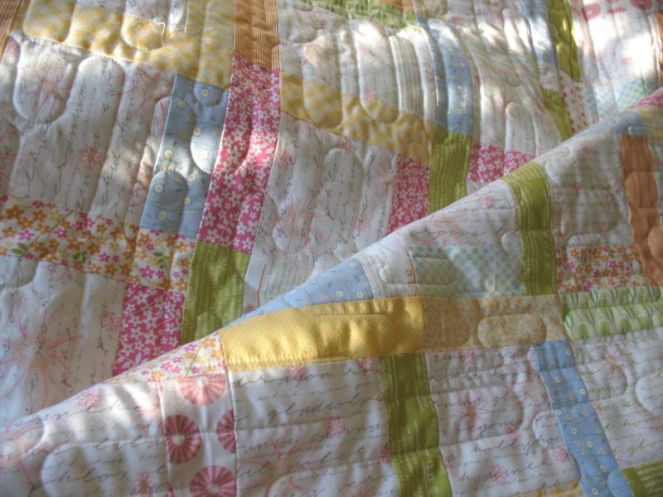
Spring/Life’s Alive (I just needed a light, happy quilt)

Christmas Star (Whew! Made it before Christmas arrived last year)

You can read about these and others by clicking on the collage of words in the right margin.

Hope you find more inspiration and ideas. I’ll be looking at yours as well!

Thanks for visiting,

Elizabeth E.

Click here to return to the 2011 Quilt Festival, and come again!

Creating · Quilts

Lollypop Trees

While some think it takes courage to climb Mt. Everest (and yes, I agree), it also takes courage to finally open the Lollypop Trees pattern by Kim McLean and admit that yes, it’s time to begin.  So I played it safe today.  I cut apart the life-size pattern pieces and jotted down where the trees are in the Grand Scheme of Things.  You can see my penciled-in numbers in the grid on the right. But before I explode the fabric shelves and get crackin’ here’s some background on this pattern.

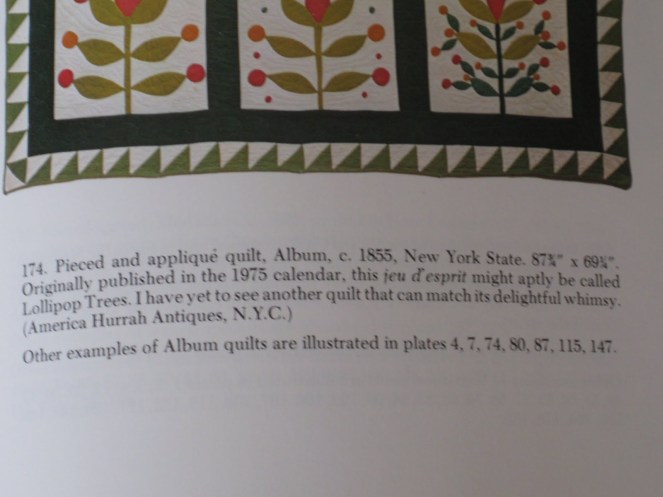
This is a published picture of the quilt, circa 1855 from New York State.  In the notes they allude to the quilt looking like “Lollipop Trees.”  But McLean’s quilt is titled Lollypop Trees, a different spelling.  The original is basically done in three colors: an olive green, turkey red and deep green, and a zig-zag border.

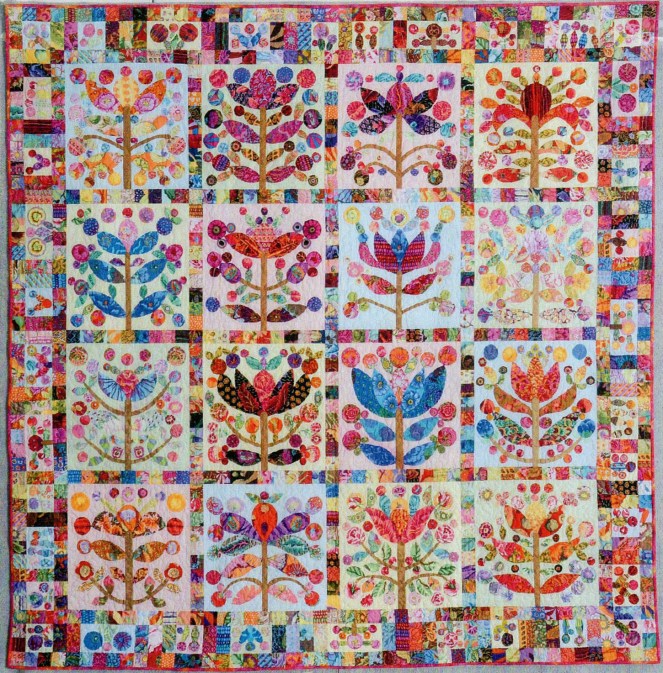
McLean’s version.  You can see some overlap in the design, which I really like.  It’s interesting to have the origins of a quilt paying homage to the past; however, with the use of Kaffe Fasset fabrics, it’s become a different quilt entirely.

Here’s a view without those borders–a twist as well, because of the use of more solid fabrics.

This quilt is huge–nearly queen-sized.  Hmmm.  My friend Rhonda (who is doing this at the same time) suggests we choose our favorites and made it smaller.

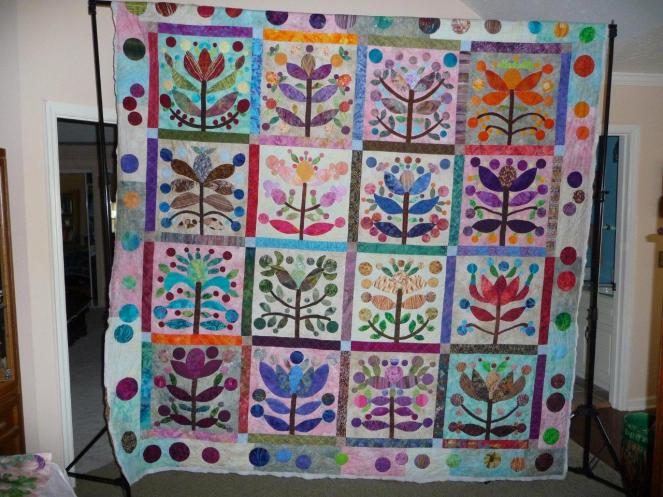
This one is not 16 squares huge, but only 12 squares.  I like the use of the circles in the border, apparently a design taken from another McLean quilt.  This size gives the punch of the large one, but it more suited to what I want to accomplish.

100 Quilts · Blog Strolling · Creating

This Quilt Is A Mess

Whooey!  Another tempest in a quilting teapot! (And this quilting disaster–explained at the very end!)

I love all this controversy.  I love that we are talking about quilt issues, digging our hands deep in the loam of the quilting garden and really talking about things that bother us and that delight us.  Rachel of Stitched in Color was quite frank one day about Saying Things She Didn’t Think She Should.  Bammo!  Millions of comments–some, mostly rants–about one aspect of the quilt world or another.  I should have expected as much from all of us women who run blogs.  Then her next post was about Things We Should Say, and the issues of it’s a subjective world (quilting) that some are trying to categorize objectively (skill levels, style labels).

Here’s my .02:

I’ve read all the posts and it seems like the conversation/comments has generated a healthy discussion, re: the labels of modern vs. traditional quilting.  More about that at the end.
But about the other–the “dumbing down” stream.  I’ve read all *those* original posts and realize that it had its genesis in trying to describe levels of skill.  I think this is sort of one place where there is no subjectivity, and that’s kind of what set off the whole alarm bells and craziness.  Either you have the skills to make successful HST (Half Square Triangles) or you don’t.  It’s meeting an objective standard.  For some, HST are intimidating.  For others, they do them in their sleep.  I do think it can be successfully argued that there are certain skills that come with practice and after having achieved them, a quilter can objectively say s/he’s got those down.  I consider myself a master quilter, having done just about every technique in the book (some while I was majoring in CloTex in college, some afterwards as I took quilt classes to become more proficient).  The point is I was still learning, still trying. And as I want to improve myself,  I’m now trying to master more applique techniques.  So even while I may have objectively met some unnamed standards of skill level, there is always more that can be learned, can be perfected upon.

Now: my .02 on the “modern” quilting business.  A while back ( a year ago?) I read a blog post putting forth the idea that *modern* was one leg of a three-legged stool, the other two legs being *traditional* and the *art quilt*.  I was happy with that idea–that we were all finding ways to be creative.  I love the injection of fresh! new! that the modern gals have brought to the industry.  I started quilting in the 1970’s when I was 21, and personally, I thought we were all getting a bit old and musty.  Something had to change.  I wasn’t ready to go the art quilt route because I still love a good cuddle under a hand-made quilt.  So I was happy to see some fresh ideas, another way to contribute to our big wide world of quilting.  It’s not an either/or.  It’s all of us together, doing what we love.

On that note, I present to you. . . This Quilt Is A Mess.

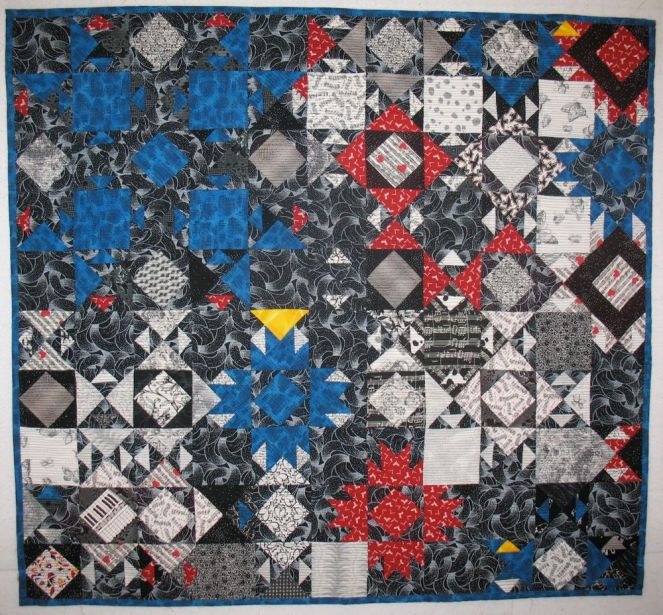
I don’t think that this was its original name, but it is certainly the name it has now.  I’d recently been on a trip to Venice and like so many other quilters, fell in love with the floor of the main cathedral.  I bought the POSTER of the floor (they wouldn’t let us take photos) and started to sketch it out.  This quilt was supposed to be one of those very clever quilts of using one block yet coloring it so many different ways that the quilt would be chameleon-like.  Yeah, right.

It started out that way–I think that section is kind of in the upper right.  Then I got tired.  Then I started piecing things every which way.  Then it sat, like an ugly gnome in a room of beauty queens.  Here’s where the class thing comes in.  I had to have a quilt to take to a workshop with Hollis Chatelain, who was just hitting the circuit after her very successful painted images (then quilted) were winning big prizes.  I knew I would be experimenting with quilting, so grabbed this.  She talked to us about spray basting (so I did that) and brought the “glued-together” sandwich to the second day of the class.  I realized that I had to be plain-jane with the quilting, not swirly.

So the quilting consists of eight billion rows, one-quarter-inch apart, some in black thread and some in red and occasionally switching directions.  I was never so happy to be done with a quilt.  I put the binding on, a sleeve for hanging, but basically it is STILL an ugly gnome in a room of beauty queens.  It rarely sees the light of day.

So, even though I execute flawlessly in objective skill level (well, okay, maybe not ALL the time), subjectively I can say: This Quilt Is A Mess.  To this day, I’m still not a complete fan of tight row stitching, but I have learned from Red Pepper Quilts that there is a fresh, modern way to adapt that technique so it’s not so painful.  So to all you bloggers & quilters out there–keep sharing, keep showing, keep writing.  It’s good for us all.  Even the tempests in the teapots.

Creating

RedWhite–Painting

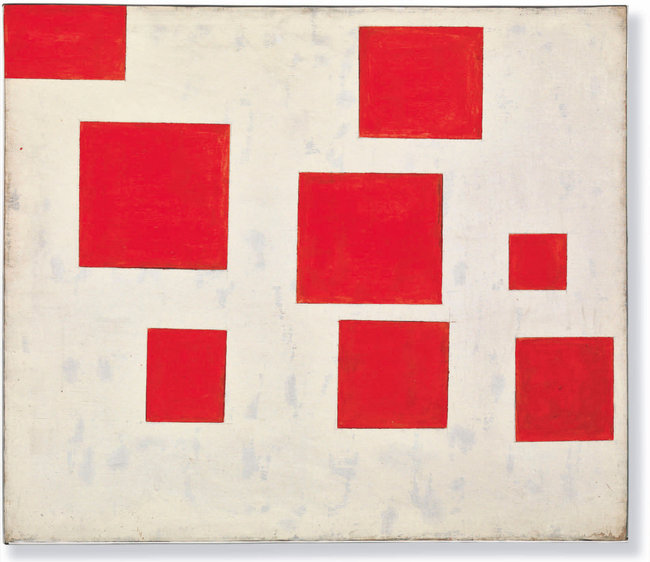
I’ve been gone to see my mother and father (he had an art show of his paintings) in Utah.  While I was there, I took the chance to download the recent red and white quilt exhibit app onto her iPad.  This made it necessary to stay up late a couple of nights to look at all the quilts.  I’ll be posting about this off and on, but given that red and white is on my mind, I was struck by the lead photo in the New York Times about the current Hirshhorn exhibit of Blinky Palermo, a German artist.

The write-up of the exhibit extolled Palermo’s”breaking” of the canvas, and using other shapes and textures to create his art–even to the extent of creating with the canvas off of the stretcher bars.  In other words, what we quilters do.  But when will we ever have our art exhibited in the Hirshhorn?  When a chicken has lips.  We’ll have to content ourselves with being exhibited in folk art museums, as well as art/craft museums.

The piece above is titled “Composition With 8 Red Rectangles,” and was produced in 1964.

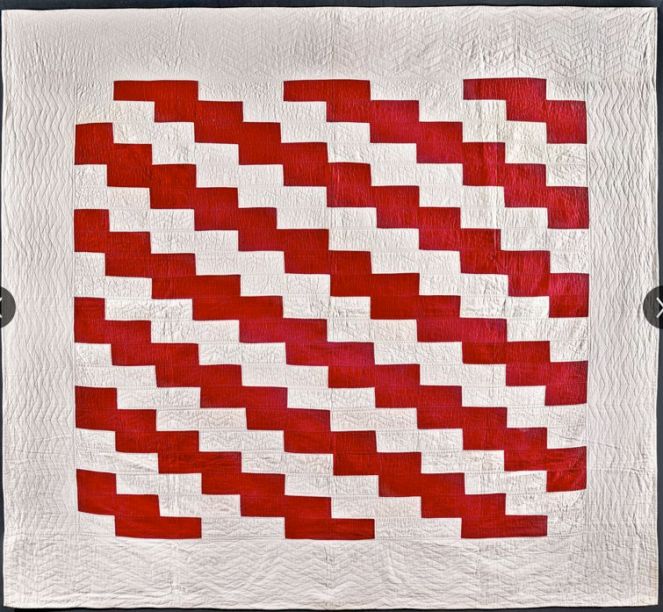
And here’s one from an anonymous woman, which I have titled Stacked Bars, date unknown.  But I know that even if I titled it “Composition with Multiple Red Rectangles” it still wouldn’t make the Hirshhorn.  It’s not ground breaking (notice that Palermo’s composition has squares, not rectangles?), the woman didn’t die young (as did Palermo), she didn’t have time to make more than one quilt a year–if that–and furthermore, she only worked in mediums that are particular to women: cloth, needles and thread.

But maybe, just maybe, in her neighborhood or sewing circle she was looked on as someone who came up with interesting ideas and new ways to arrange them and so influenced the “art” produced in her neck of the woods.  She was the go-to girl for new quilt patterns. She was the one people sought out if they had to get something interesting on the bed and they only had two colors: turkey red and white.  And given the mortality rate of early Americans, maybe she did die young–in childbirth? from a fever?–and is only memorialized by this intriguing composition of stacked squares that fool your eye into thinking they are bars.  A veritable artist who broke the mold.