At least that’s what Google Translate said it meant, when I typed in…
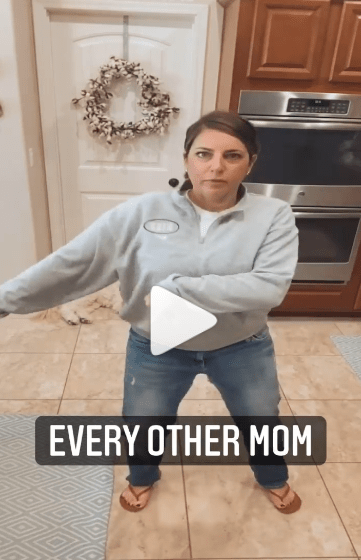
…which is the newest song for the newest dance craze, introduced to me by my daughter on Instagram as well as other celebrities (make sure you turn on the sound):
And this led me to a whole rabbit hole of watching lots of people dance in 7 second spurts (mostly young ones, hence the title of this post makes sense), the thieves being whoever stole all those years from me when I was busy raising children, schlepping groceries and making an occasional quilt.
“If you often exercise, there’s a good chance you also tend to be more creative, according to an interesting new study of the links between physical activity and imagination. It finds that active people come up with more and better ideas during tests of their inventiveness than people who are relatively sedentary.”
There is no hard and fast connection, but maybe all these dancers are on to something. And yes, I downloaded the song to listen to while on my walks, but you can forget me trying to do that dance.
My burst of enthusiasm for the Triple Sunflower took several hits this week, as I tried to figure out where this quilt is leading me. Here’s the progression in two montages, Progression Forward and then, Progression Backward:
Too blah, too pastel, and as my husband pointed out, the flowers and stems in the center were bolder than the borders. The quilt was headed to a pastoral landscape, but I was thinking more Paul Gauguin or Wolf Kahn, with more saturated color. And I noticed the slight curve on the right border and worried it was going to amplify onwards, outward through all the rest of the construction. It was at this point that I emailed The Medallion Quilt Queen, Melanie of Catbird Quilt Studio, who knows everything about medallion quilts. She talked me down off the proverbial ledge, and got me re-oriented towards making progress:
Yes, progress meant I ripped off all the previous borders and then, in between watching young people dance on Instagram, doing all the laundry and shuffling nearly every fabric in my stash from the ironing board to the design wall and back again, I finally added the medium-dark blue border. I am also auditioning some brighter fabrics for the next one. Which I will probably change again.
The happy dance this week was having Kelley, my quilter, stop by and show me some new samples she’d stitched out, and we auditioned them for my Wealth of Days quilt. Can’t wait to see it finished.
As a culture we are in danger of falling out of touch, not only with objects, but with the intelligence they embody: the empathy that is bound up in tangible things….A well-made object is informed by thousands of years of accumulated experiment and know-how. Whenever we make or use an everyday tangible thing, or even when we contemplate one seriously, we commune with this pool of human understanding. ~Glenn Adamson, from the book Fewer, Better Things
I’ve been reading Adamson’s book, Fewer, Better Things, and have underlined quite a few different passages. Not everything in the book is a home run, but I love having books on craft, on quality, or on making available around my house, for just a few lines here and there can re-center my quilting universe. Like this one:
“William Morris, the great craft reformer of the late nineteenth century, was one of the earliest writers to espouse environmentalism, over a century ago. ‘Surely there is no square mile of earth’s inhabitable surface that is not beautiful in its own way,’ he wrote, ‘if we men will only abstain from willfully destroying that beauty.’ He also famously asked his contemporaries to “have nothing in your house that you do not know to be useful, or believe to be beautiful.” This sentiment still rings true today, particularly if we add the idea that objects should be meaningful. Let’s not think of things as ends in themselves, props to put on the mantelpiece. Rather, let’s consider them as points of contact between people.”
Last week I was in the overwhelmingness of QuiltCon, a series of “mores.” More color. More shapes. More wokeness (this got to be a little bit much, frankly). More quilts. More ideas. More fame. More longing. More more more, until it was just more exhaustion. I loved it all, and am so glad I went to this virtual presentation (Karen and her crew did a fabulous job), but by the end, I was kind of glad they took it all down, freeing me to escape that blotto-in-the-brain feeling for a few days. Sorry I missed you all last Sunday. It’s sort of like this:
Like the moon, we go through phases of being full and we through phases of being hidden.
And then I got an idea.
This idea has been preceeded by a long slow couple of months, as I was worn out by allthecovidstuff, and my bandwidth to accomplish or do things, or even to reach out was limited. So my idea was to set a goal to finish up at least one quilt from the past — and I chose my temperature quilt, newly renamed Wealth of Days (I’ll explain in a later post).
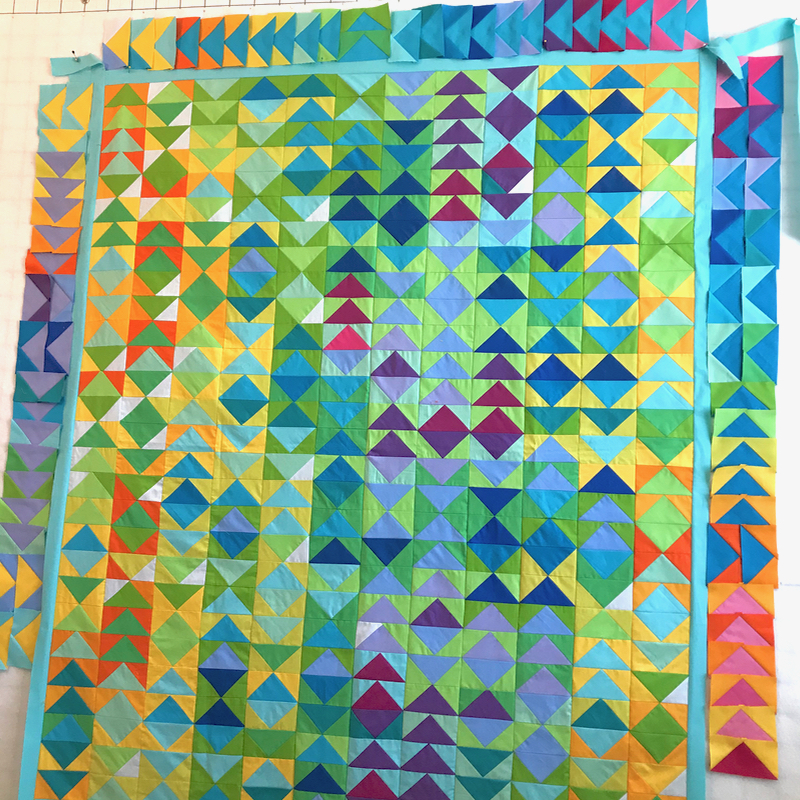
And my next idea was to use up all those triangles that I’d cut and were leftover from piecing together the quilt top, and turn them into a border somehow, because I felt like just the triangles in the center weren’t enough. So I just sewed and sewed.
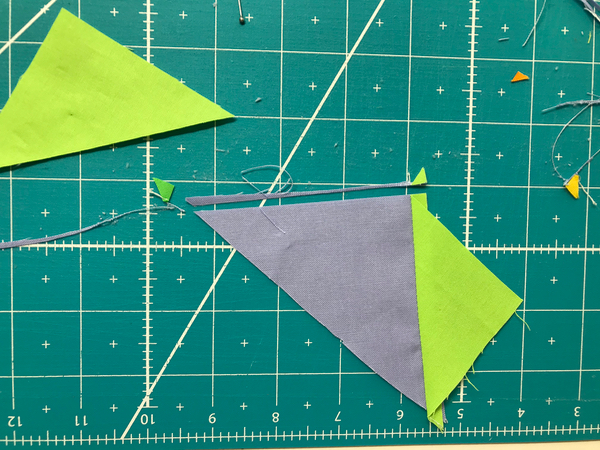
And began to realize I had some problems. I’d started making this way back in 2019 (obviously) but it was right after my second shoulder surgery. Rotary cutting is pretty much out of the question after a surgery like that, so in the beginning everything that was cut was scissor-cut. And this little imperfection of scissor cutting had — as quilty problems do — spread throughout the quilt. Some of the problems I could fix on this go-round, as I squared up and trimmed little slivers off the new flying geese to get them straight and true (above).
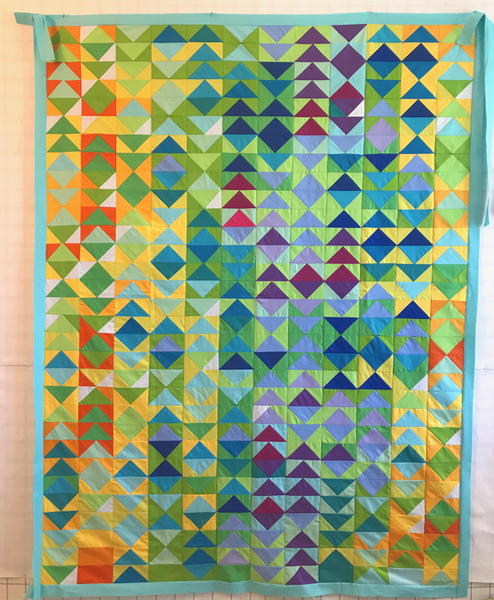
The center is the original series of triangles from my 2019 temperature quilt.
But…it started to look like the gimpy triangles in in the main quilt weren’t going to match up with the new, refined flying geese in the border.
Color placement planning.
Nevertheless, she persisted — and then decided to re-think some things. It became obvious after all my sewing that I really could not fit the borders to the quilt. I started sewing the slivery-est of seams over and over along the outer edges of the inner section of the quilt, trying to ease in the extra fullness of those out-of-shape geese. I took off that lovely aqua skinny border, and cut a darker one:
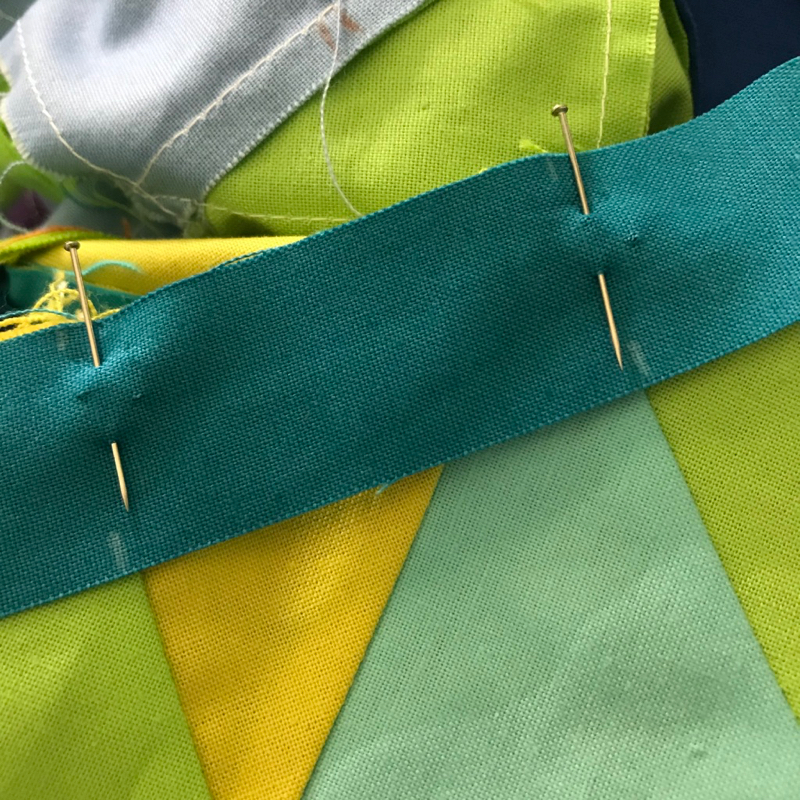
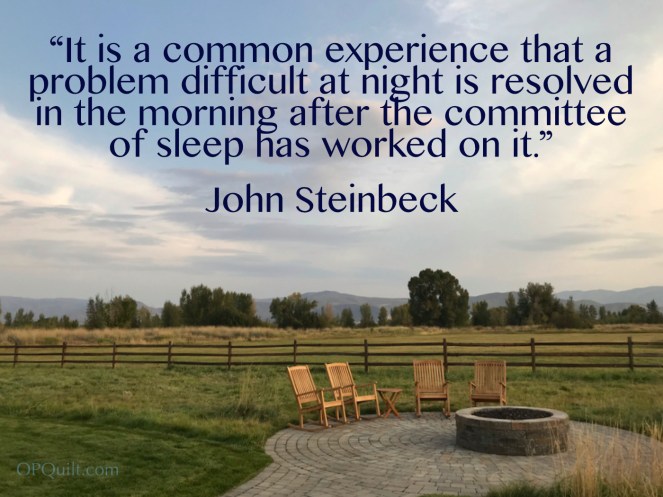
I marked the new darker border strip every 2″ as I was going to force this quilt into submission, which of course…never really works. (I’m hoping my quilter can quilt out some of the bulk that shouldn’t be there.) I then retooled the inner border to make it really really skinny, and kept sewing those triangles into geese. But then. The corners. What to do? I fiddled and sketched and browsed, but when I couldn’t come to a solution, I took Steinbeck’s advice:
This is what the committee of sleep came up with. I’m happy with it.
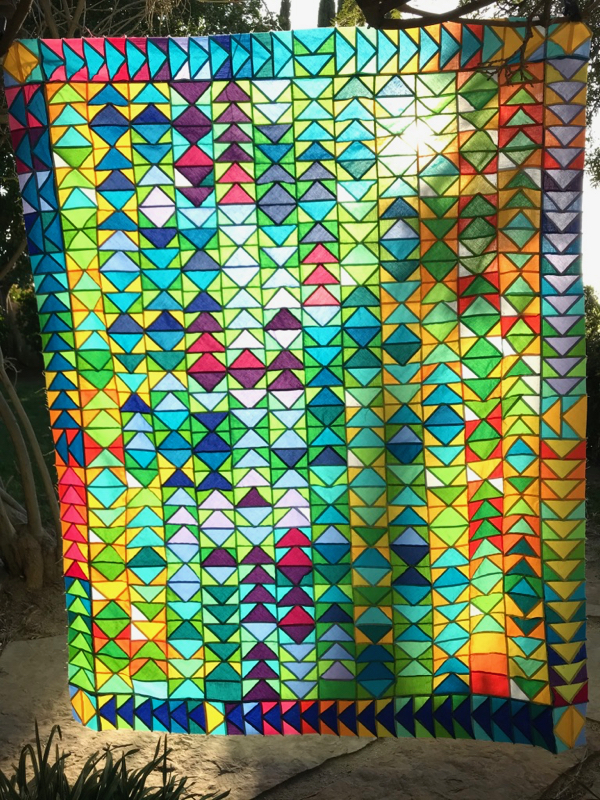
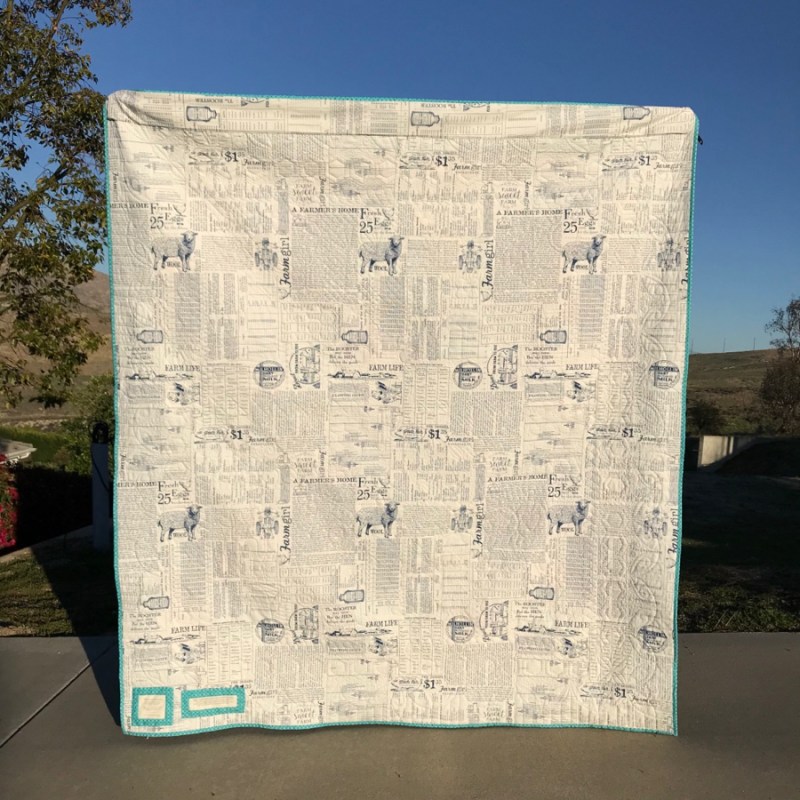
So here it is. Wealth of Days quilt top all completed. I have a few moving parts for the backing, then I’ll call my quilter and hope she can work miracles with the limpy-gimpy triangles, evidence of my craft at that time. I will explain the quilt title when it is finished, and I can do a proper showing off with the fun stuff for the back, too.
stained glass version, taken from the back of the quilt
I did a search for #temperaturequilt trying to see how people finished off their quilts. I came to the conclusion that not too many have finished off their quilts, but I want to finish mine. Working on this quilt this week, remembering my physical self in January 2019 and allowing that woman’s imperfect making to be a part of this quilt, made me realize how vital making quilts is to me. It is not only a noun — as Adamson notes below — but a verb.
When we casually dismiss craft as a vital factor in our lives, however, we miss out on many satisfactions….When many people hear the word “craft,” they think of humble, decorative things: pots, baskets, or macramé plant hangers. But if we consider “craft” in its active form, treating it as a verb rather than a noun, we immediately realize it is much, much broader than that.
When we say that someone crafts an object, we mean that they put their whole self into it, body and mind alike, drawing on whatever skills they have acquired over the course of their lives. This is a deeply meaningful human activity, which can be observed not only in suburban garages and hobby shops, but also in factories (where people craft machines and prototypes) and fine art studios (where people craft paintings and sculptures). All these process-based experiences imbue materials with associations that resonate far beyond the act of making itself. ~Glenn Adamson, from the book Fewer, Better Things
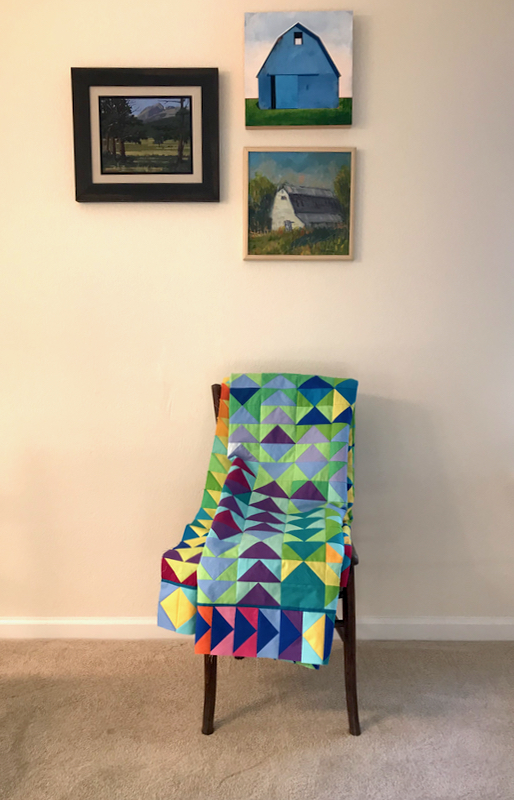
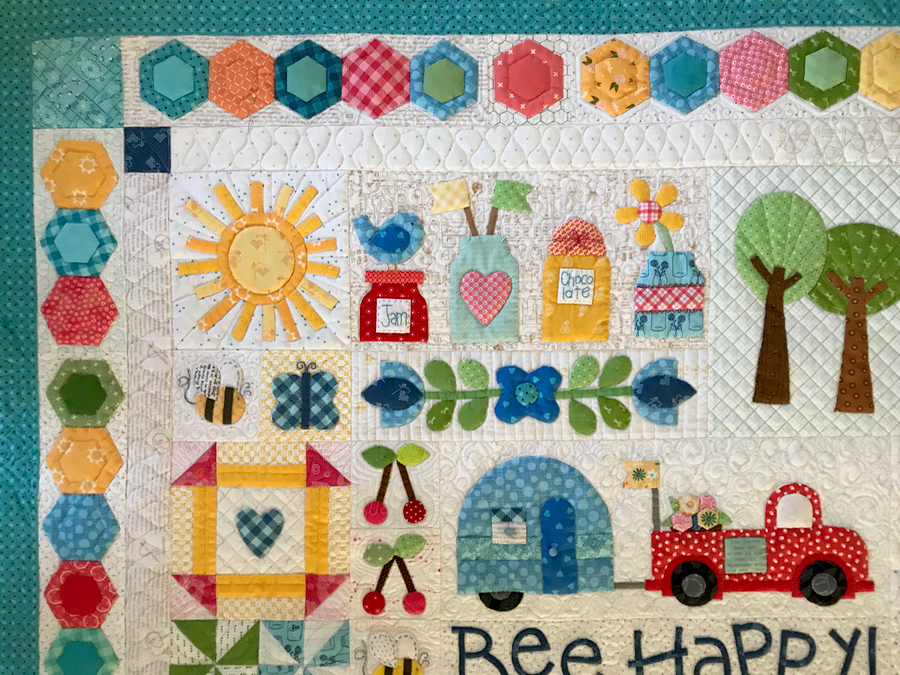
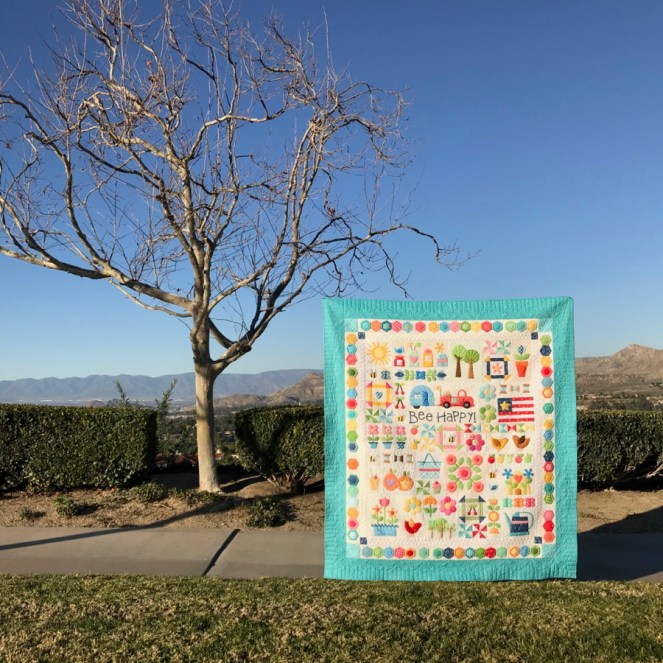
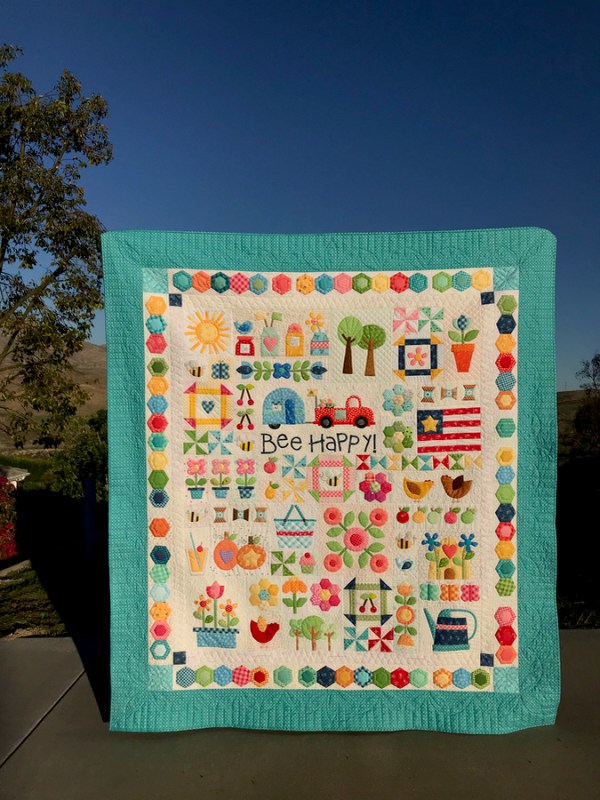
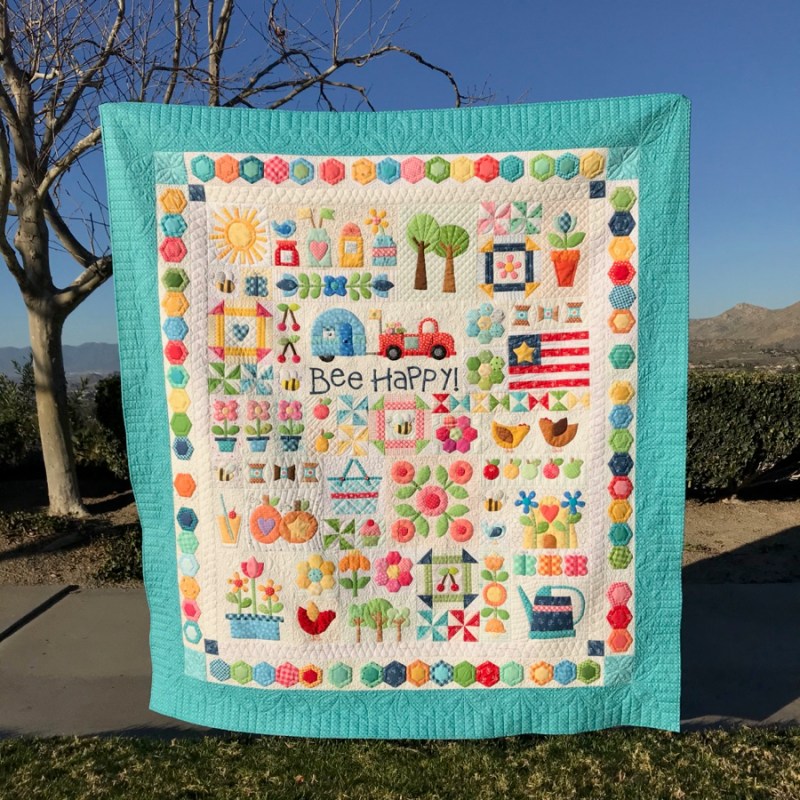
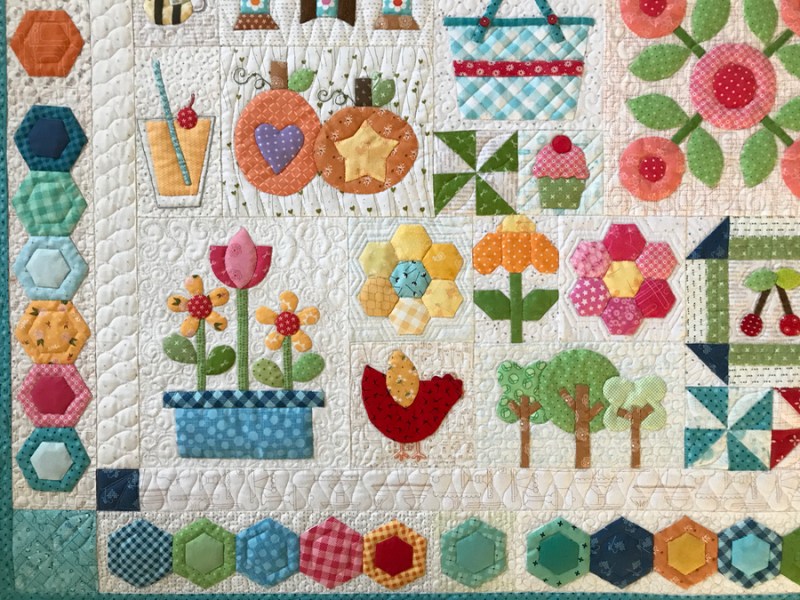
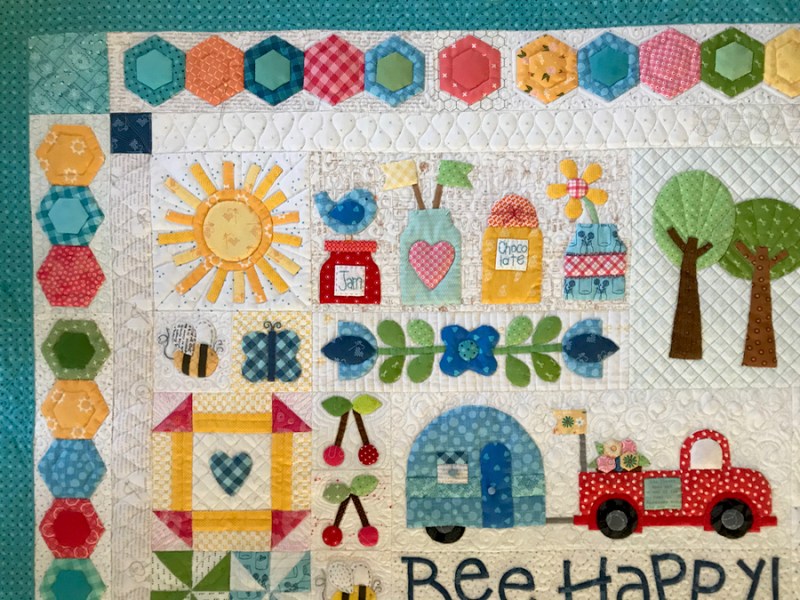
Picties and Verities, quilt #243 71″ wide by 78″ tall
Finally!
This baby has a new name: Picties and Verities.
What, you ask? Well, that phrase was in a poem I read about a thousand years ago, and I liked it and wrote it down and of course I can’t find it now, because that’s my life, when even what we had for dinner last night is cause for wandering around in the corridors of memory.
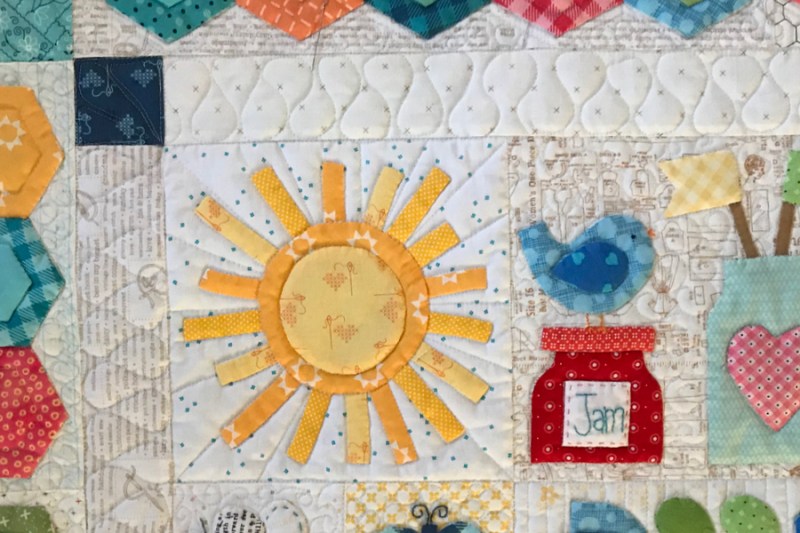
Verities, defined: a true princple or belief, especially one of fundamental importance. Seems to me that striving to be happy, knowing that the sun shines on all of us, as well as the idea that it’s always good to go home — with or without your trailer — just have to be some verities.
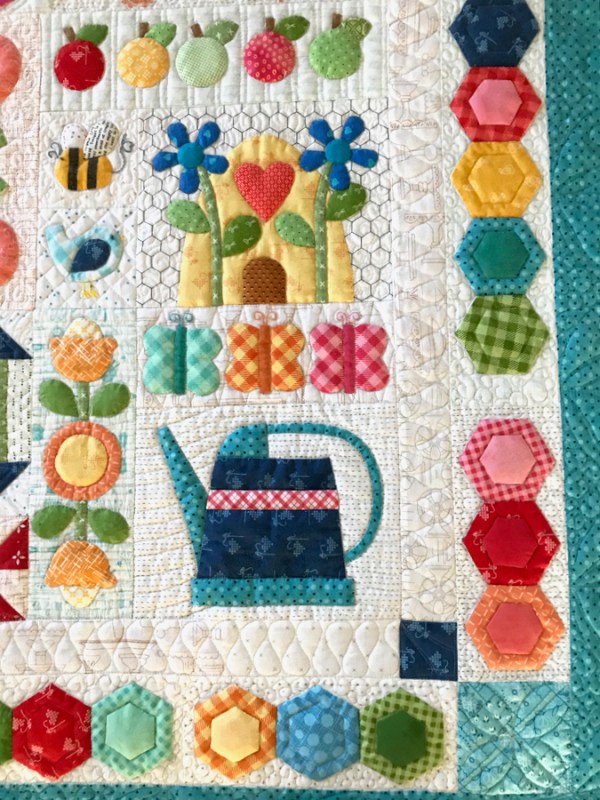
Picties, defined: For this one, I went to my husband’s college Oxford Dictionary, a two-volume set complete with magnifying glass. Pict (rare, it says, from the 1400s) means to paint or depict or represent. I would say all those bits of appliqué up there qualify as little pictures. Of course the Picts were also the ancient name of people from North Scotland, and are associated with elves, brownies or fairies. And possibly old grey castles with dungeons (an allusion to its working title: Trapped in the Dungeon of Cute). And since my great-grandmother was from Scotland, I own that heritage with pride.
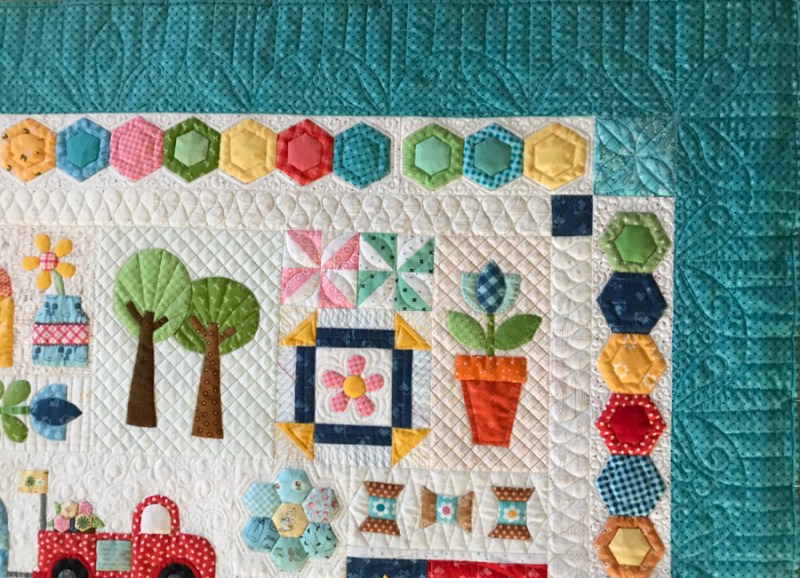
I sewed on buttons last Saturday, while listening to my Guild’s program, and added, as is my usual, “Made in the time of Covid-19” for anyone who receives this quilt after I’ve gone to the afterworld to frolic with Scottish fairies. You’ve seen photos of this, but here’s a last batch of fun.
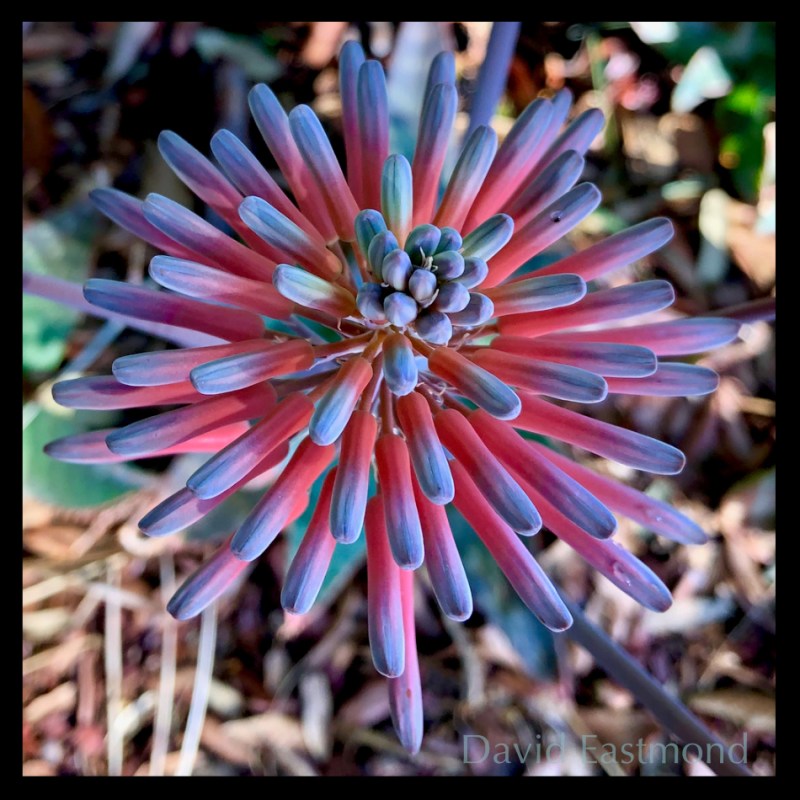
And since you’ve read this far, I now treat you to one of my husband’s beautiful photographs, taken the last week of January:
Aloe Blossom
We retraced his steps to take a look at it this past week, because in trying to identify what it was depended on what the plant’s leaves looked like: if they were cacti-looking, it was an aloe. If they were leafy, it was a kniphofia (aka Torch Lilly or Red Hot Poker). It’s an aloe, but it is a distant cousin to kniphofia, apparently. My husband Dave takes long walks everyday, bringing home pictures like this, reminding me of when my children used to bring me home bits and pieces of their days, spilling them out into the kitchen, a line or a thought floating backwards over their heads deep in the refridgerator.
It’s so nice to watch Dave gather his interests about him now, after having had his nose to the grindstone for years, bringing home the proverbial bacon to put in the fridge for those now-grown children. His process — of snapping pictures of whatever interests him and only later culling and choosing — reminds me of this quote from the artist Ann Hamilton:
“A life of making isn’t a series of shows, or projects, or productions, or things; it is an everyday practice. It is a practice of questions more than of answers, of waiting to find what you need more often than knowing what you need to do….Our culture has beheld with suspicion unproductive time, things not utilitarian, and daydreaming in general, but we live in a time when it is especially challenging to articulate the importance of experiences that don’t produce anything obvious, aren’t easily quantifiable, resist measurement, aren’t easily named, are categorically in-between.” (Ann Hamilton, artist)
Having had three finishes within a couple of weeks, and today teaching a workshop with the Surfside Quilters Guild, my next plan is to do some wandering myself, maybe some daydreaming and find those experiences that don’t produce anything obvious, yet are so critical.
And P.S. Blocks 4, 5 and 6 of Shine: The Circles Quilt are now back on the blog, free to all.
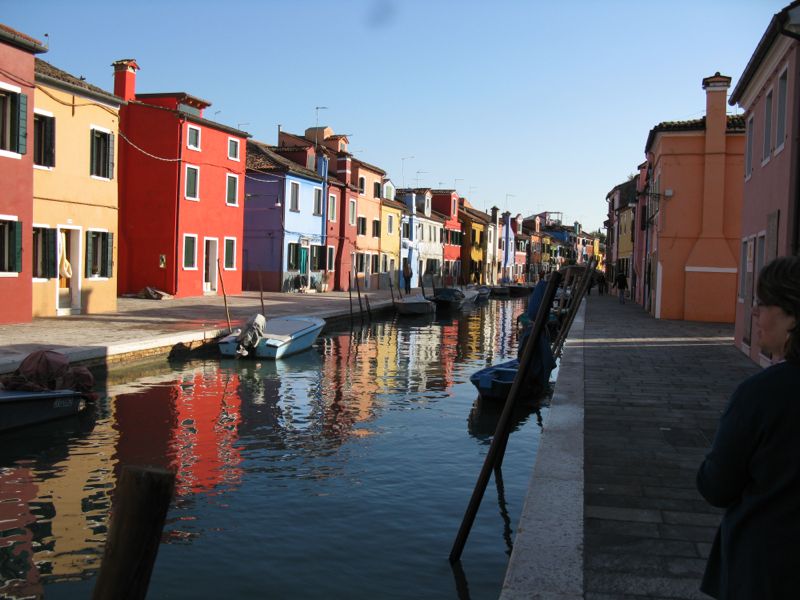
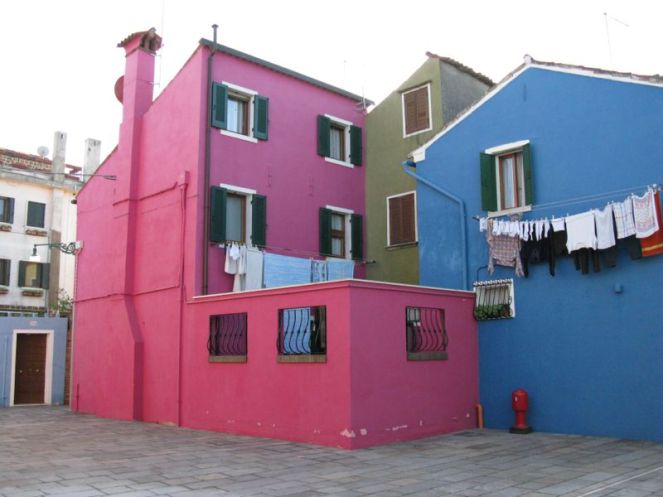
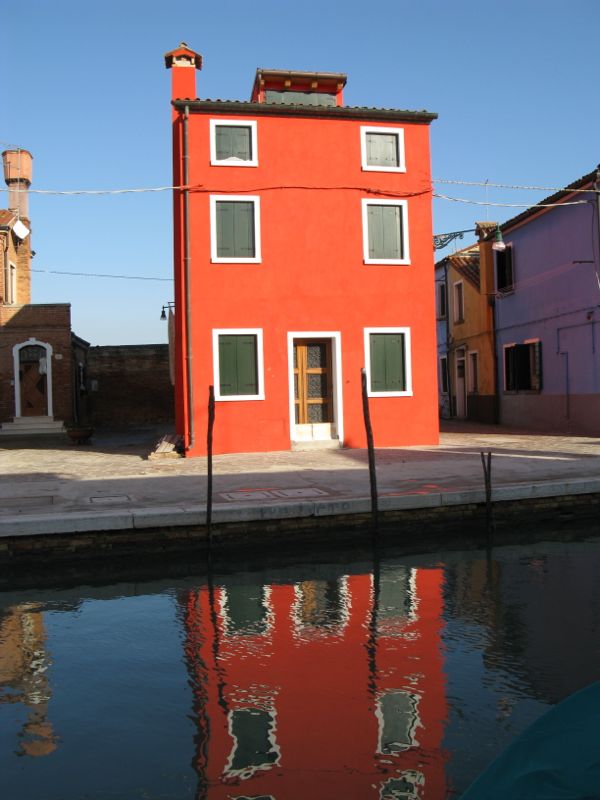
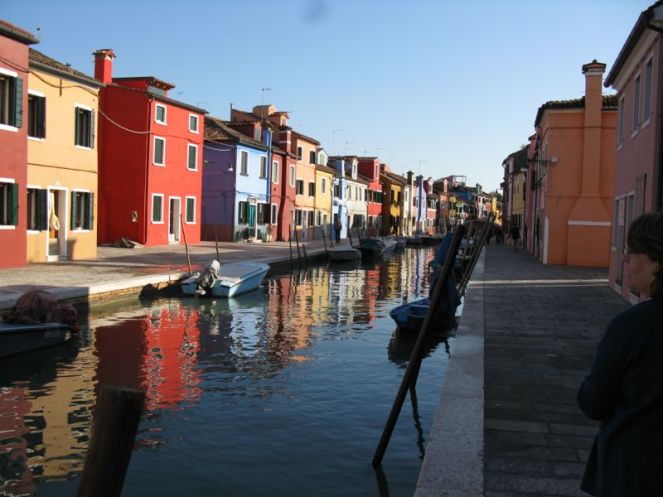
Over the space of several years, I tried three times to get to the small island of Burano, just a vaparetto ride out of Venice. And when my husband and I finally made it there, we had only about an hour before the next ride back to Venice.
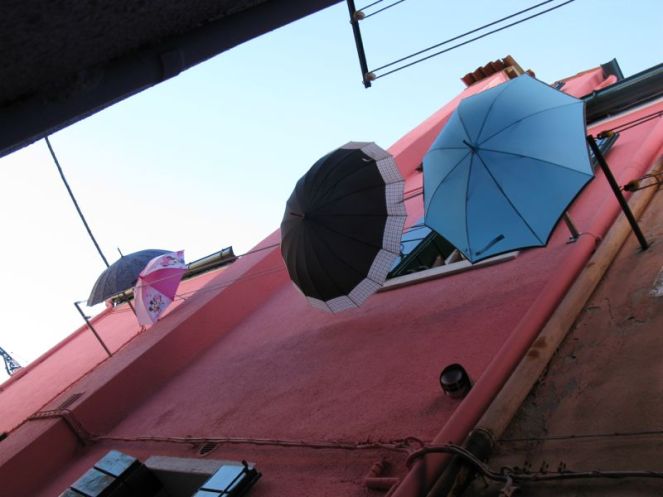
When the boat docked in Burano and everyone turned right to go into the main part of town, we turned left and wandered, taking in the brilliant color, the laundry, the umbrellas, the acqua alta barricades in the doorways, snapping away.
We arrived at the outgoing vaparetto a few minutes early, but stood in line, mentally and physically leaving Burano forever.
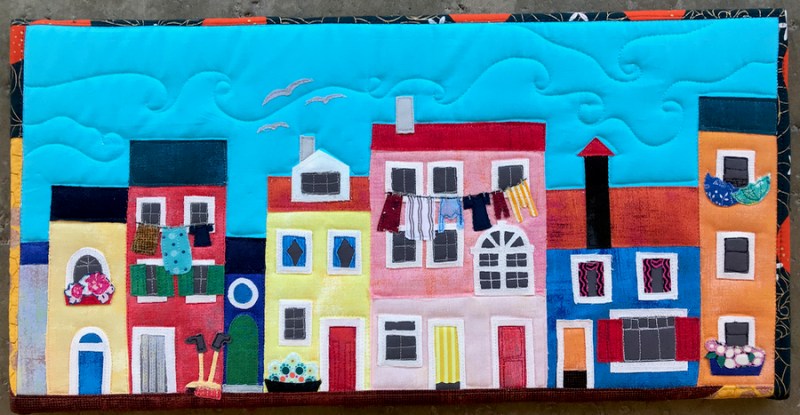
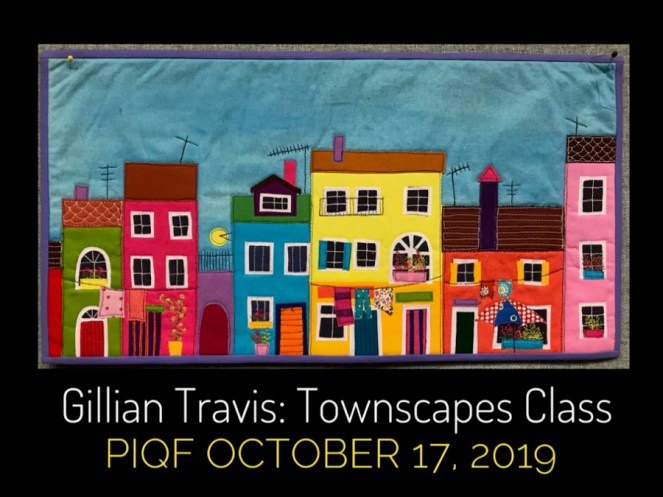
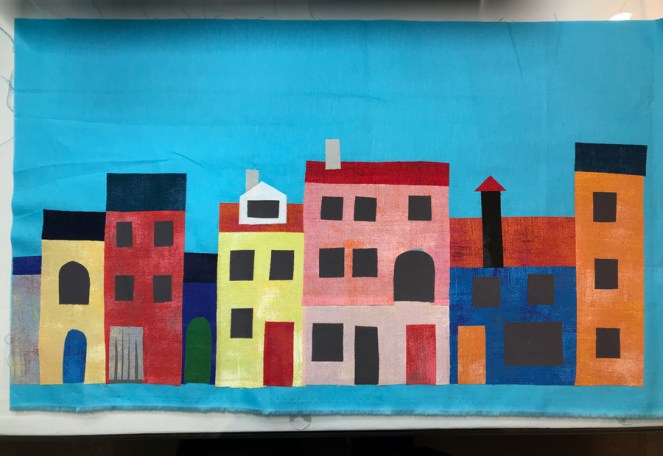
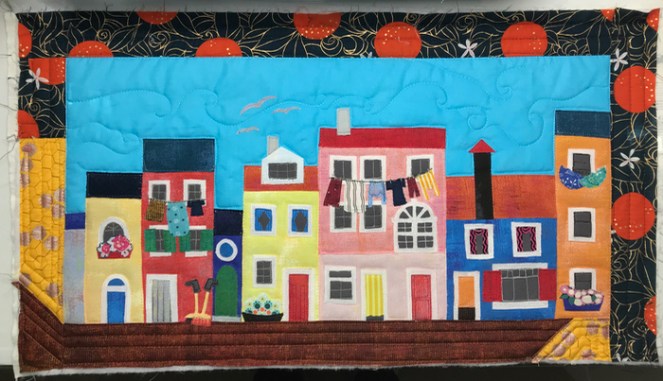
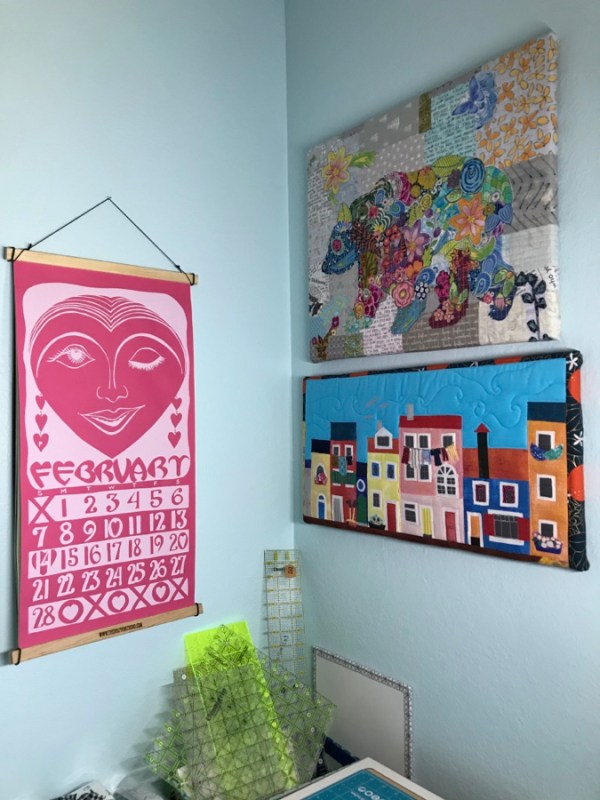
So when I had a chance to take Gillian Travis‘ class in October 2019, pulled in by the chance to do a fabric representation of that small island with its brilliant colors, I signed up quickly. It was at PIQF (Pacific International Quilt Festival); my friend Leisa and I traveled there and spent three days in the hotel, rarely leaving as the Mancuso quilt show had many pieces to see, and then there were all the vendors (of course).
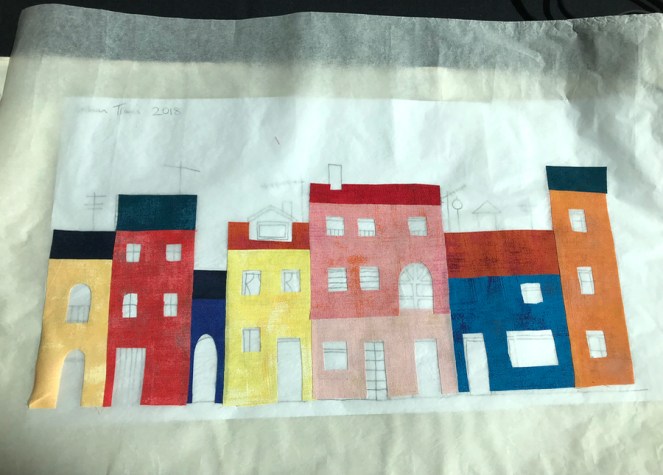
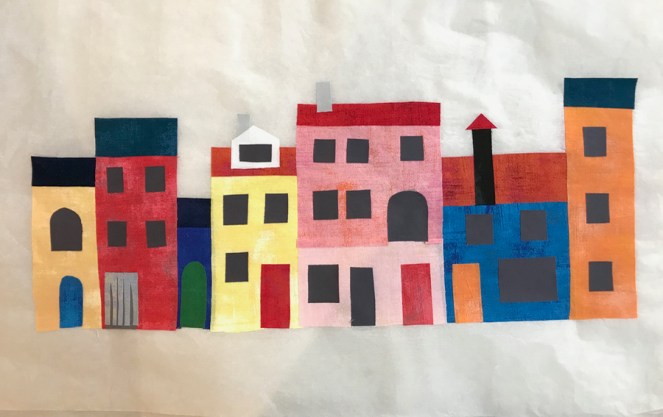
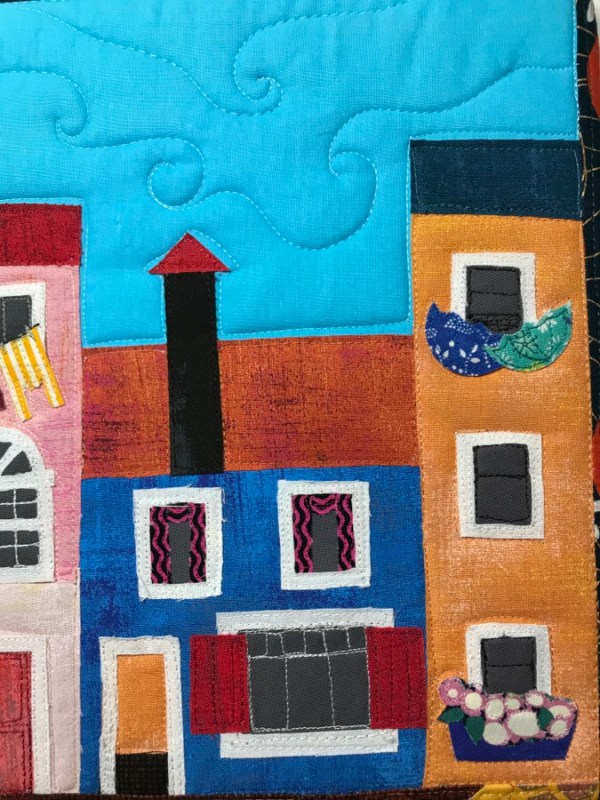
In our Townscapes class, we started by tracing, and Gillian had very specific and helpful instructions on how to do everything. I listened carefully and took copious notes. This was one project I wanted to finish. She’s the one who taught us the trick of using parchment paper as a backing for layers of fused fabric (instead buying those expensive specialty sheets).
When I got this far, she came over, and making sure it was all fused together, peeled it off the parchment paper like peeling off a giant sticker, and we plopped it onto a stretch of blue fabric I’d chosen (in consultation, of course).
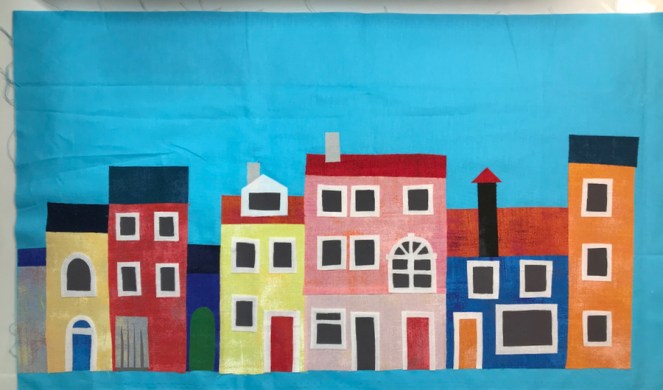
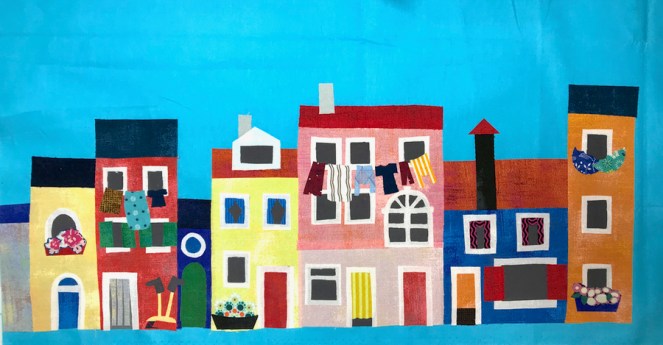
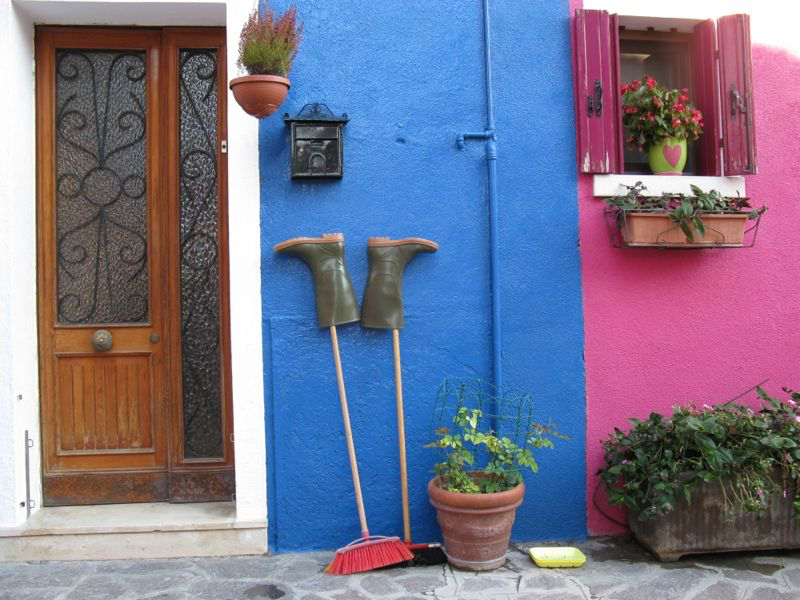
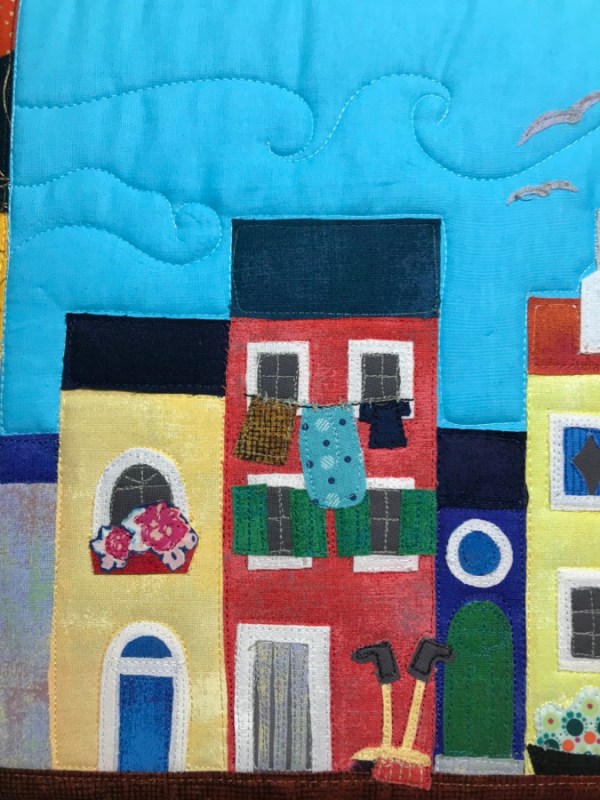
And this is where I picked it up, a year and some months later. But I’d been to Burano and seen the white window frames, the laundry and the umbrellas, so I pulled out my photos and started adding details.
I imitated the upside down boots on the left side, having found that in our visit:
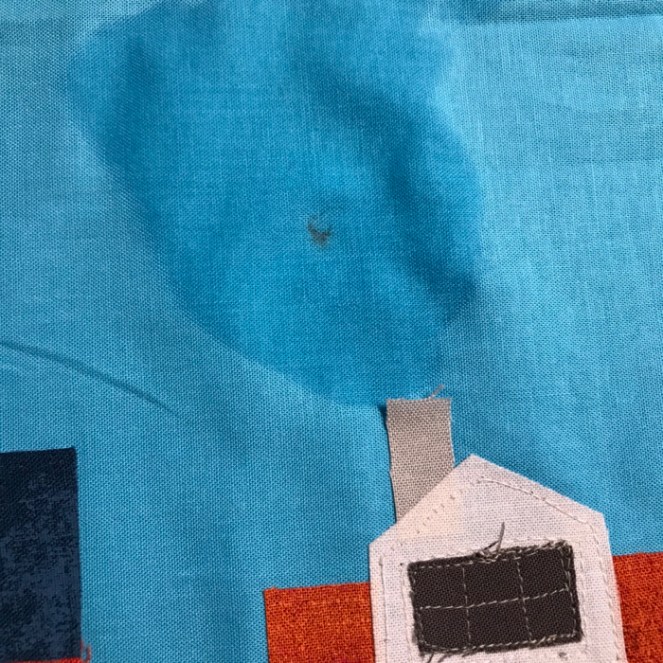
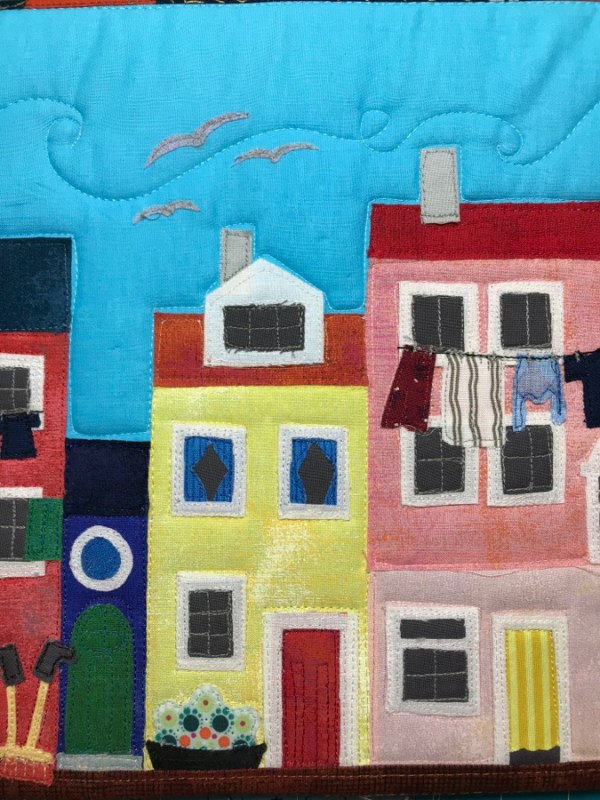
In the course of time, a lovely splotch affixed itself above one of the chimneys. I tried to get it out with soap and water; it just means that some of the gulls of Venice would now fly through my sky. Her method is to stitch details into the picture while stitching down the fused pieces.
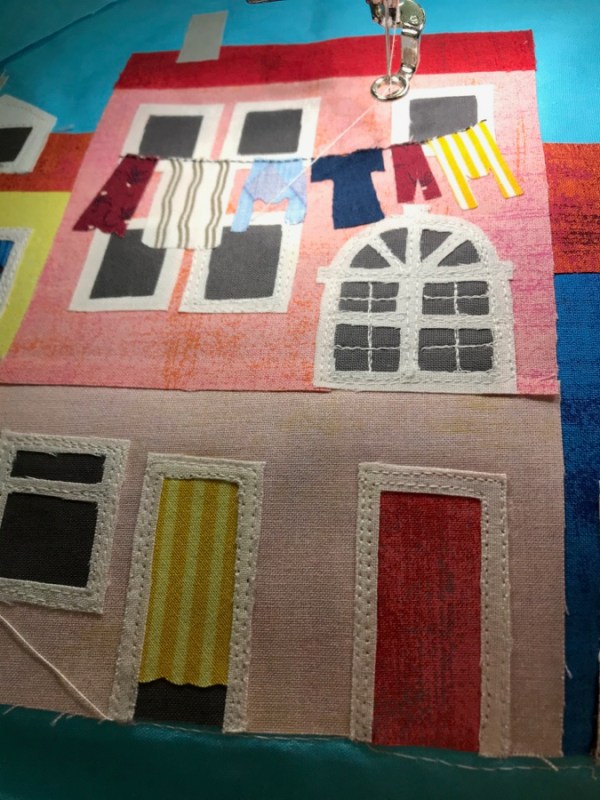
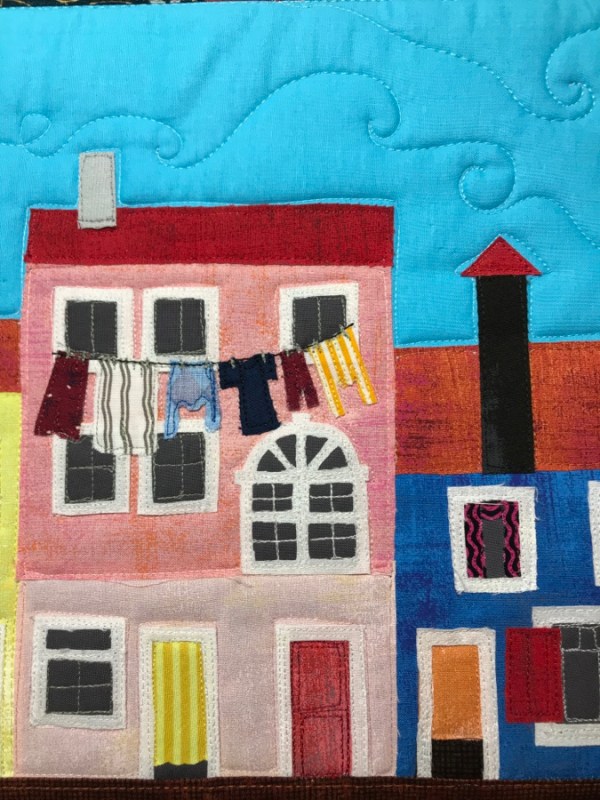
I did that, constantly referring to all the snapshots I took during class. I used a free-motion quilting foot, realizing I would sacrifice another needle to the gunk of fused fabrics.
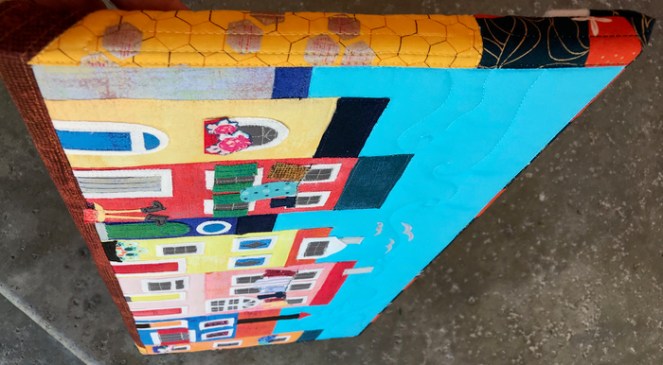
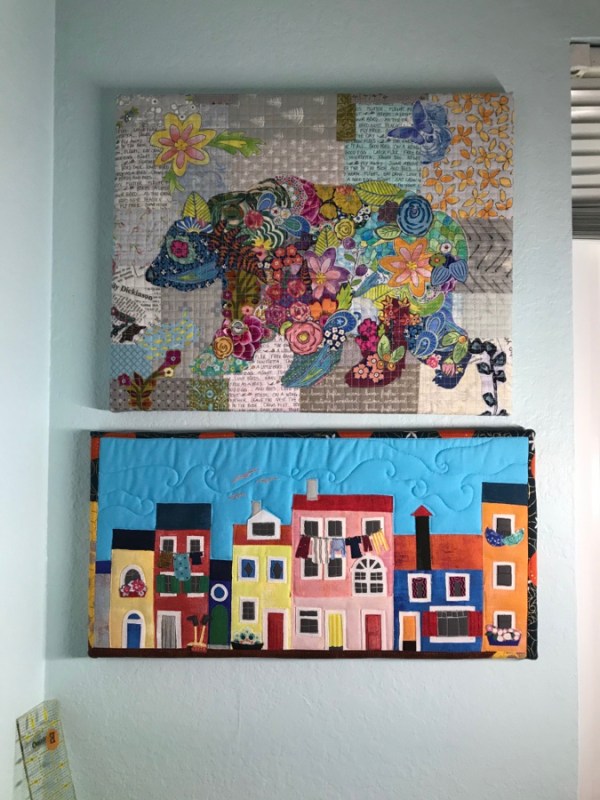
Then I added borders, as I knew I wanted to stretch it onto bars like California Bear.
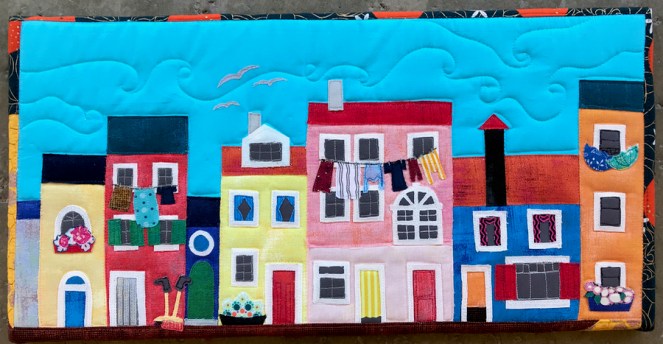
I quilted it lightly, trying to add some detail to the sky, but not too much, winding my way around the gulls.
Side view of the borders wrapped and stapled.
I took shots of all the details. Like the teacher, I tried not to be too pristine about how I stitched the window frames, or added detail to the laundry. I can sometimes be a little too uptight about those sort of things, and while I’ll never be an artist like Ms. Travis, I can imitate in order to learn new things.
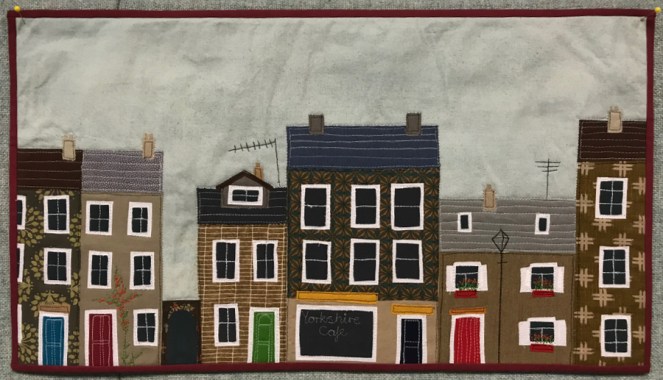
Work of Gillian Travis
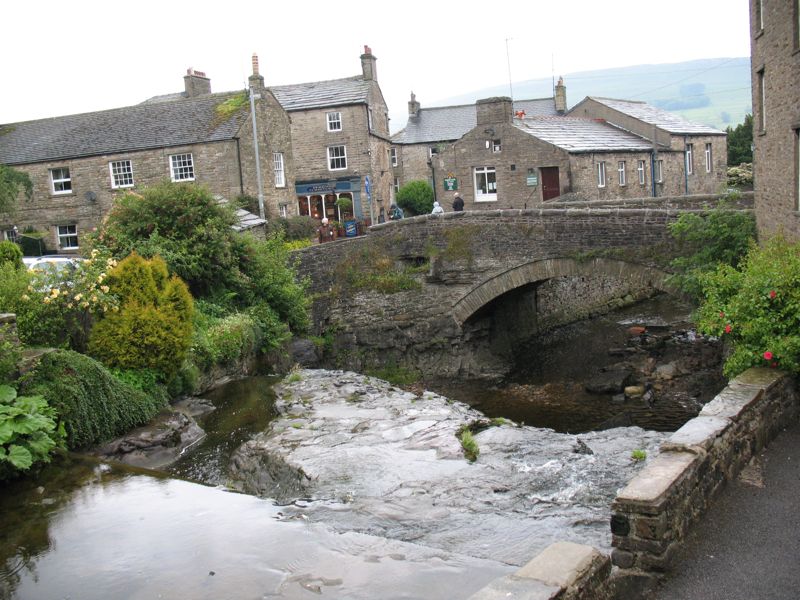
And if you’ve been to the Yorkshire Dales, she has a townscape for you too.
If you want to read about our quick trip to Burano, I include many colorful photos on my travel blog, TraveledMind.blog. (It’s currently under renovation/repair having suffered a loss of domain name recently, and I’m still working to get it back up to where it was.) On the blog, we’re currently in Tokyo, soon heading to Korea and yes, it was a trip from 2017. I’ll get it finished, hopefully before we head out again, maybe in 2022?
Happy February. Wear a mask, get your vaccine, and stay home and quilt!