200 Quilts · Creating · Four-in-Art · Quilts

English Elizabeth: First Four-in-Art Reveal Day

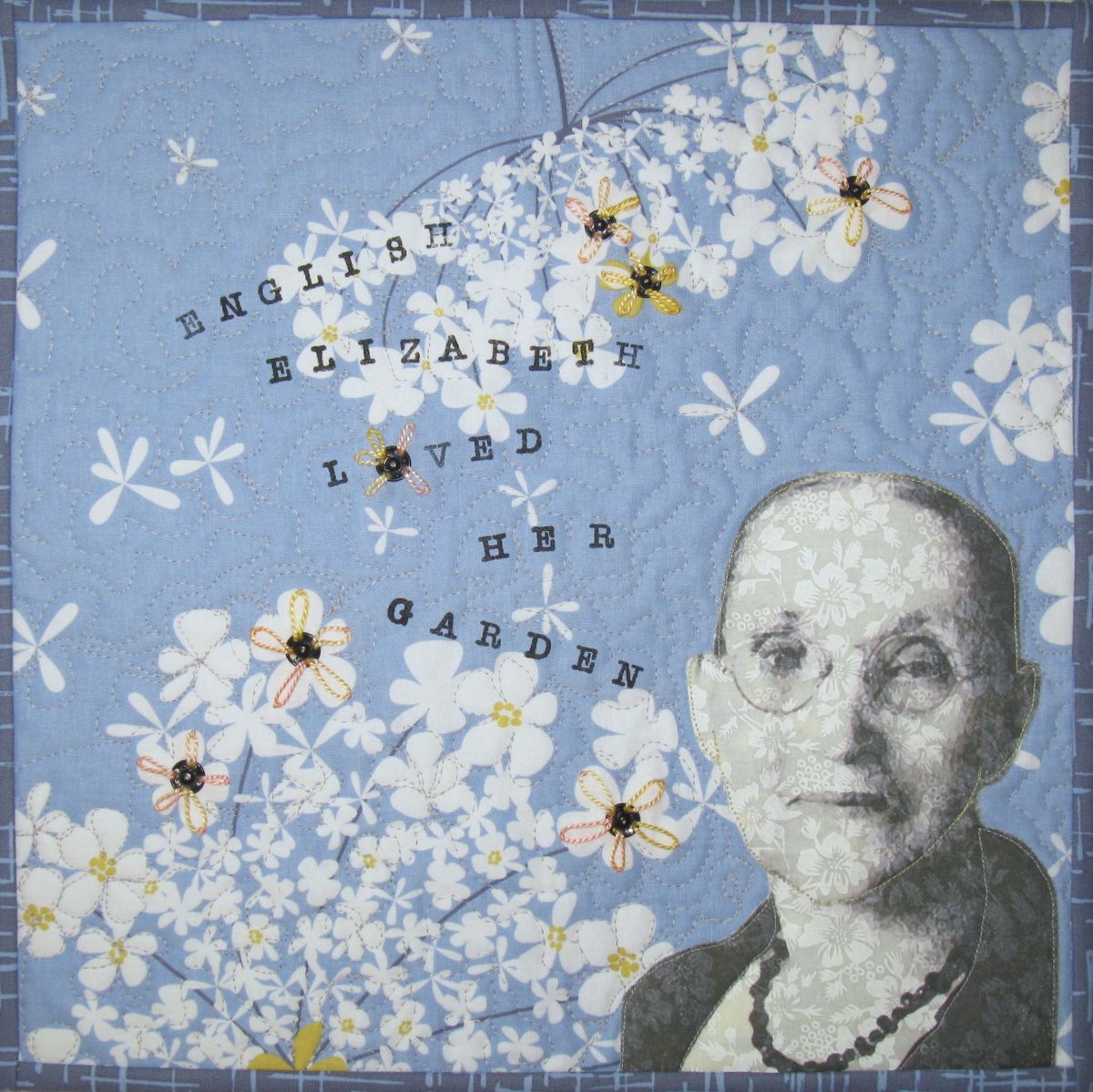
English Elizabeth

Made and quilted by Elizabeth Eastmond,
for the Four-in-Art Quilt Group

Elizabeth Frances Fellow Critchlow, a lass born in England in 1855, in the county of Staffordshire, surely did love her garden.  She is my great-grandmother and I am named for her.

When Rachel announced the theme of Queen Anne’s lace for our first Four-in-Art quilt, my mind immediately thought of my great-grandmother and her gardens.  I looked up the origin of the name of this flower, and most sources believed it had origins in British royalty references, which reinforced that I’d be working with my English Elizabeth, as I came to think of her.  A dedicated Anglophile, she listened to major speeches by the King on her wireless set, tuning in from her home in the mountains of Utah.  My mother tells me that she loved to garden, and her gardens were renowned, with even the local university coming over to study some of her plants and trees.  Although she lived most of her adult life here in the United States (she arrived here at age eleven), I often wonder if she spoke with a British accent here and there on some words.

I chose to work with this picture, because of her smile–just barely there—but a warm welcoming face.  My mother says she likes this picture, but also remembers her grandmother out in her gardens, her straw hat on her head.

And then I thought back to the most recent wedding in our house, that of my son Peter to his bride Megan, and they chose a rendition of Queen Anne’s lace for their announcements as well.  I love how you don’t “see” a flower, and then suddenly it’s everywhere.

~~And now, Two! for the Price of One!~~

Betty lives in Virginia, and unless you’ve been under a rock this week, you know about Frankenstorm, the combination of weather patterns that spelled disaster, weather-wise, for the East Coast.  Sunday night, before the storm was to hit, Betty emailed me her photos and artist’s statement, just in case her power and internet should go out.  I’m pleased as punch to present to you her Queen Anne’s Lace quilt.

Betty writes:

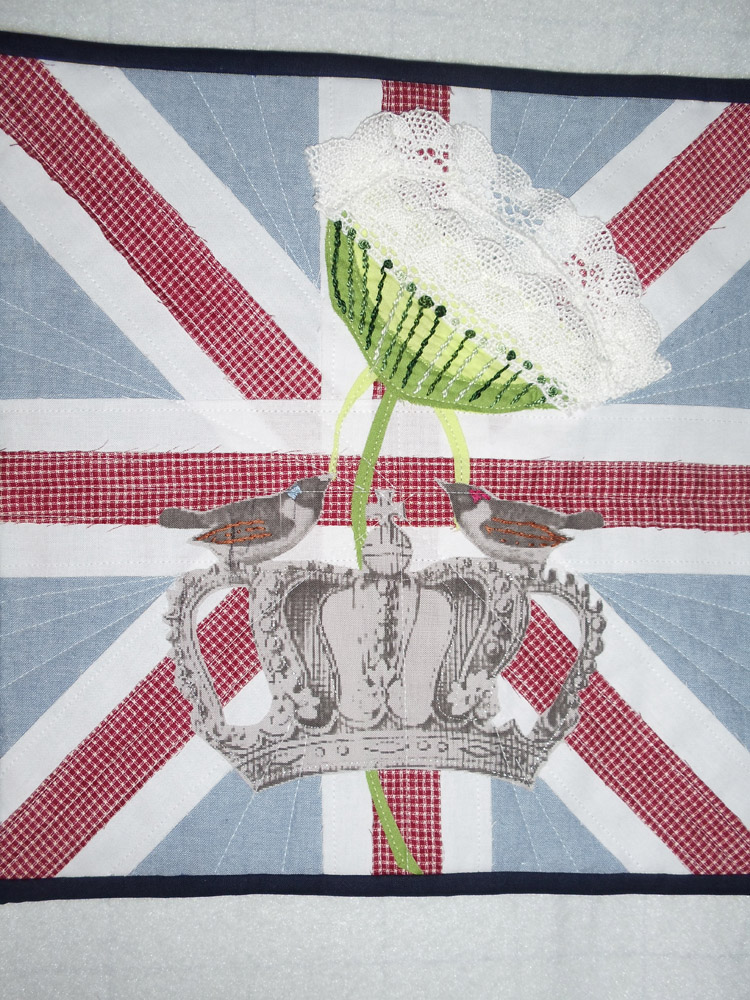
“This Four in Art challenge, our first, was an opportunity for me to stretch – to stop, for a moment, the churn of easy quilts and do something new.  When the theme – Nature:  Queen Anne’s Lace – was revealed, I sighed.  Love the flower, although it isn’t as highly regarded on the east coast as apparently it is on the west coast, but I drew a blank when coming up with a setting.  So, I took a practical approach:  just love the Union Jack and decided to use that as my backdrop.  I planned to paint my flag, but could not get the red and blue faded enough so decided to go the fabric route.  I was excited to use the crown and copying that onto Kona Ash was a first; one of my favorite details in this piece is the silver metallic stitched onto the crown (which did not come through in the photos).    I had hoped to actually stencil the lace to form the flower, but that didn’t work well so I opted for real lace with pearl cotton accents.  The flower is my least favorite feature of this little quilt, but it is holding its head up boldly and doing its part and I am, overall, pleased.

“The backing is, appropriately, a simple flower piece and I loved making the label.  It is bound in simple navy Kona – had tried to overcast the edges with silver metallic, but that did not work well.

“This was fun and without boundaries (except for the size) and provided we do it again, I will find other new methods to try and apply!”

Betty Ayers • Powhatan, VA, USA

Here are some more photos:

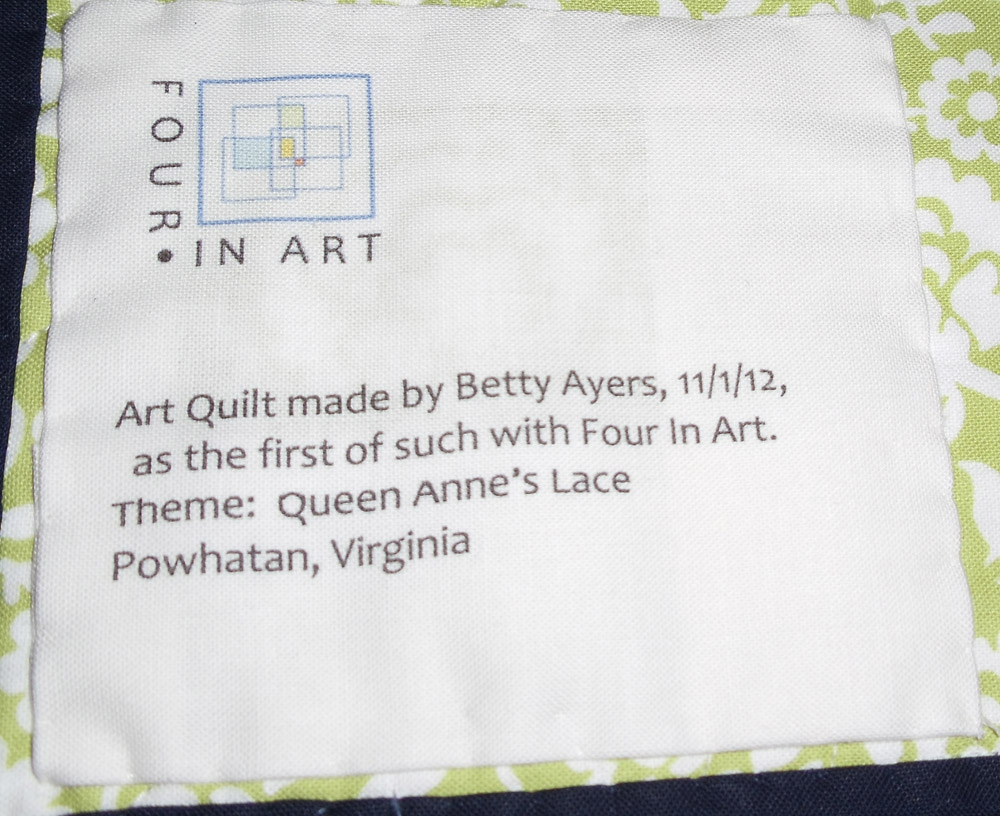
Label from Betty’s quilt. We hope that all will be okay on the East Coast soon.  Betty usually publishes on Flickr.

Check out Leanne, of She Can Quilt, and Rachel of The Life of Riley to see their Four-In-Art Quilts.

And tomorrow, a new theme is revealed!
200 Quilts

Snapshot!

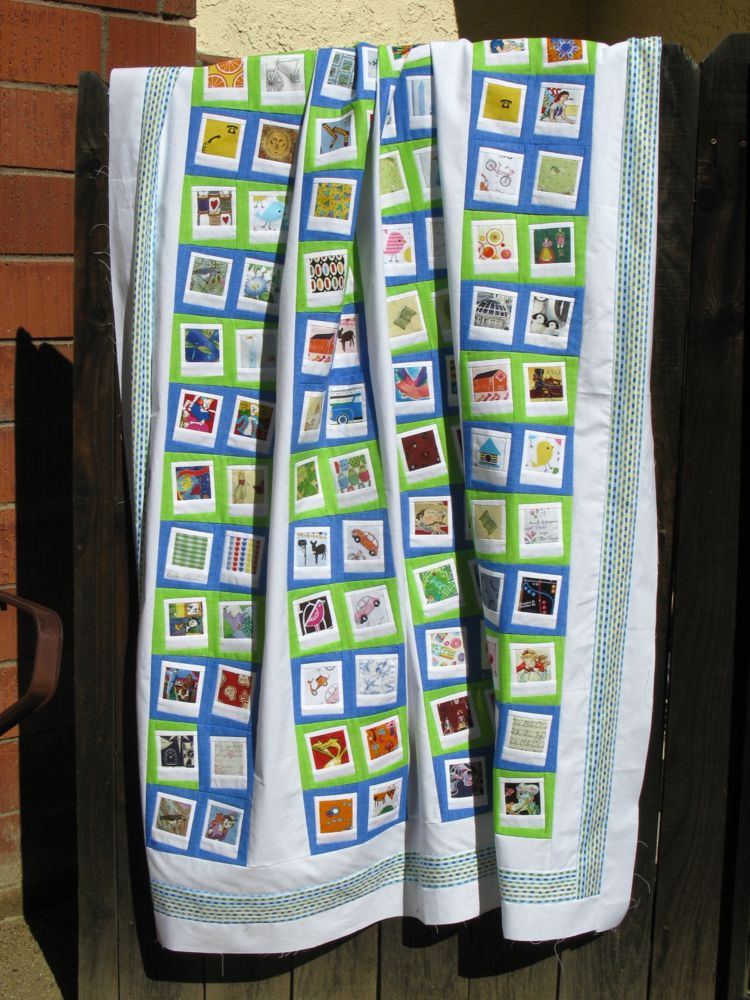
I present. .  . Snapshot!

This is where I’ve been for a while, trying to work out the kinks of this crazy idea I had for my Polaroid Quilt Blocks.  I didn’t use them all, so at the end of this series of how to make this quilt, (it will take a couple of days, sorry–but there are lots of photos), I’ll have a little surprise drawing to get you started on your Polaroid Quilt.  Watch for it.

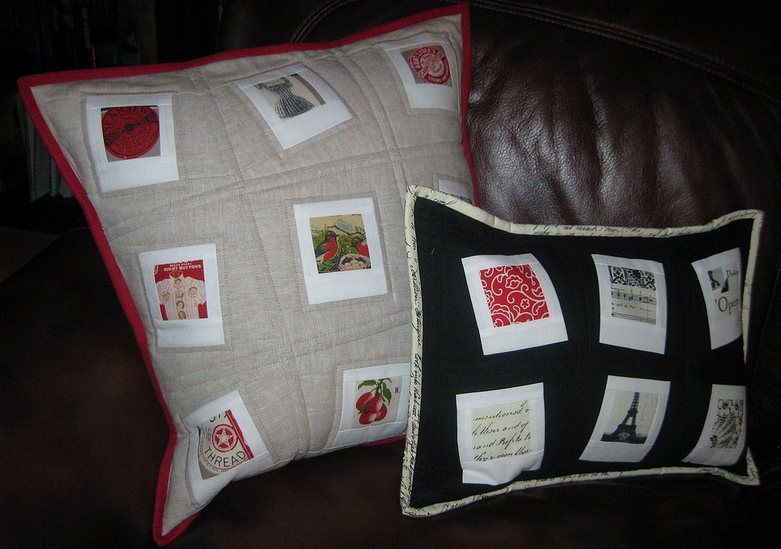
It all started here.  I made a few and joined the swap group run by Debbie of A Quilters Table, and soon had over a hundred of these very cute little Polaroid Blocks.  So I HAD to do something with them but everyone was showing this:

or this:

. . . which are both very cute, but I wasn’t keen about bordering each block. So late one night when I couldn’t sleep, I decided I would try to figure out how to do TWO blocks at once.  So I did.  First, if you haven’t made some Polaroid Blocks, start here:

It takes just five easy steps, repeated over and over, to get a batch going.  And please press all seams AWAY from the center square.  I have some fabric in one of my Polaroid blocks, cut from one of my first sewing projects when I was a child–a Barbie doll dress.  I found that dress (really nothing more than a tube with gathering for the waist), took it apart and fussy cut a piece from it.  So have fun as you gather your centers.

As for the white, I used KONA white.  I do like KONA’s other neutrals, but this quilt just needed that bright white.

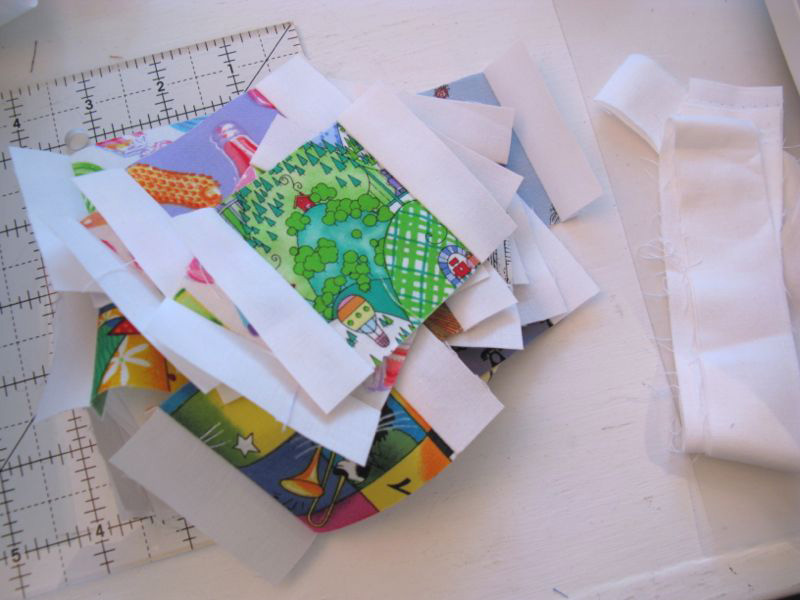
Here I’ve lined up the centers, sewn the 1″ by WOF (Width of Fabric–a shorthand way of saying, cut a strip from selvage to selvage) on one side, then the other and now I’m cutting them apart.

The top goes on now, and then I’ll cut a 1 1/2″ by WOF strip and sew that on the bottom.  That’s what makes the Polaroid “look.”

And. . . here I’m trimming them down to 3″ across by 3 1/2″ in length.  I’m using the center block as my guide, placing the 1″ mark of the ruler on that edge (note that my blocks are upside down), then centering the ruler for the 3″ in width.  Press them all again.  One quilter’s blocks were starched pretty heavily and hers didn’t ravel as much as the others, so if you like spray starch, now’s a good time.

This quilt measures 52″ wide by 64″ long.  It has three borders surrounding the four stacks of double-Polaroid blocks.  I tried to use interesting centers for my Polaroid blocks, along with the swap blocks I found most interesting.  Here’s the basic ingredients:

For blocks:
about 1  yard blue
about 1  yard green
104 Polaroid blocks (have a few more, as when you are matching them together, you’ll need some options)

NOTE: Sorry to be so inexact; I’ve measured and measured and this is what I’ve come up with (well, actually I’ve come up with that you need 31″) but I don’t want you to run out of fabric, so get that extra.

For the print border:
1 and 1/2 yards–you are buying for the length.  If you don’t care to put your border on the straight-of-grain, buy 1/2 yard.
I used a yard of fabric, but ended up piecing it, so if you want it all in one piece, buy at least a yard and one-half.

For the white border:
You MUST cut this on the straight of grain for the center strips of the quilt and the first borders.  The joined quilt blocks are all slightly skewed off grain and you need something to stabilize them.  So buy about 2 yards white, but MORE if you are going to buy for the Polaroid blocks (and you’re on your own for that one).

But peeeples!  You NEED a good white fabric hanging around your sewing room, so do what I do: buy it in five-yard lengths.  I should really do what Cindy does: she buys it by the bolt.

Now print out these two PDFs: one is “right-leaning,” and the other is “left-leaning.”  rightleaning  leftleaning  Just keep them hanging around until you need them.

Next post I’ll start on the construction of the blocks, but here’s a couple more pictures of my Snapshot quilt lounging around the backyard.  For some reason, our summer just won’t quit.  Here in Southern California we have something called the Santa Ana winds, and they are hot blowy hair-dryer-feeling winds that come out of the desert.  It makes us all cranky to be doing HOT SUMMER, when everyone else is doing pumpkins and fall leaves and crisp apples.  But it does make for nice pictures of quilts, resposing on the rose bushes, which still have blooms.

NEXT UP: Constructing the Double-Polaroid Blocks.

200 Quilts

Harvesting the Wind

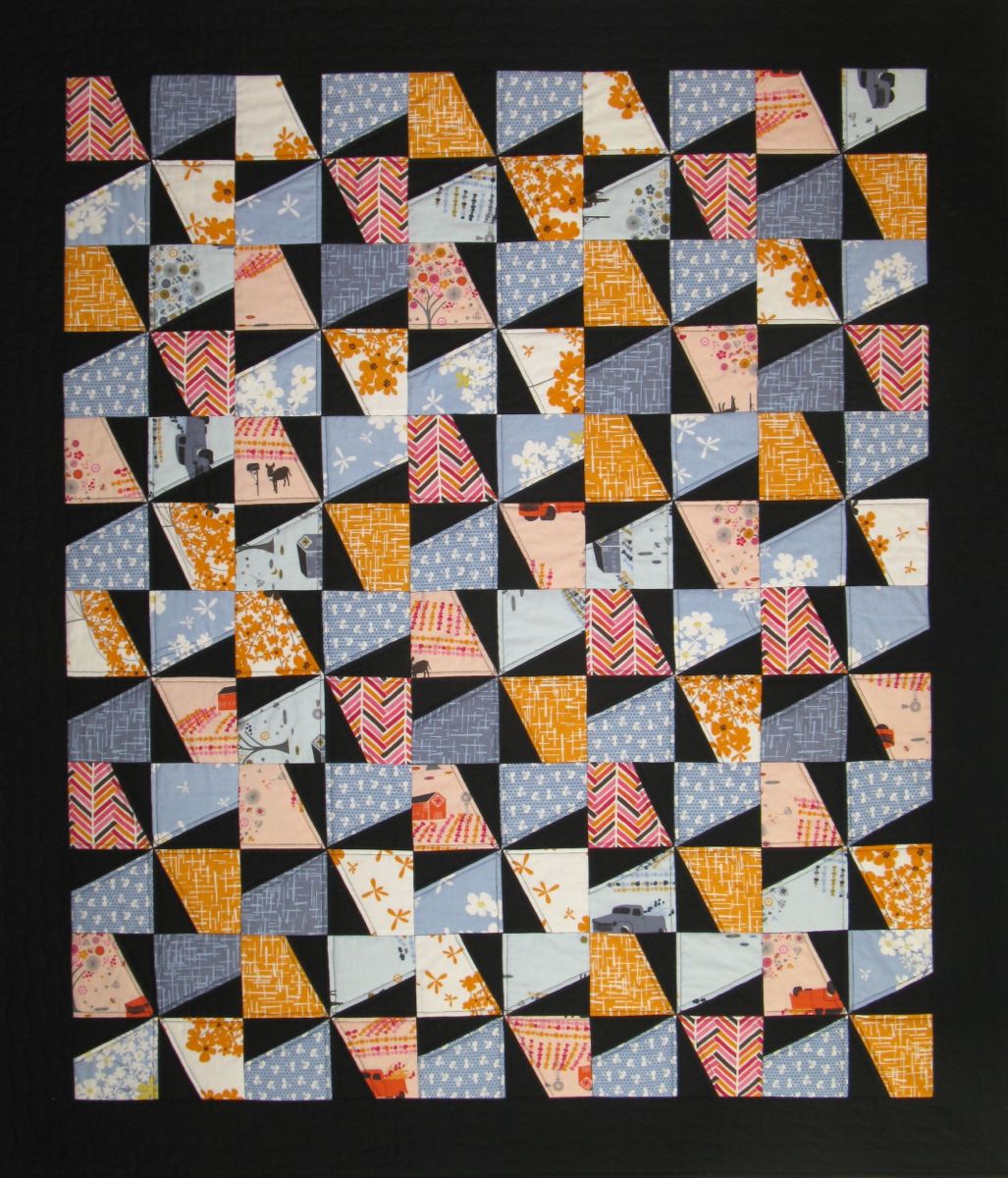
After I finished up the quilting of the Portuguese Tile Quilt, I hung it on the railing over our stairs until I could get to the binding.  I walked underneath it more than once, and studied and thought about it.  So did my husband.  He kept calling it the windmill quilt, even though the inspiration was that tile from Portugal I found.

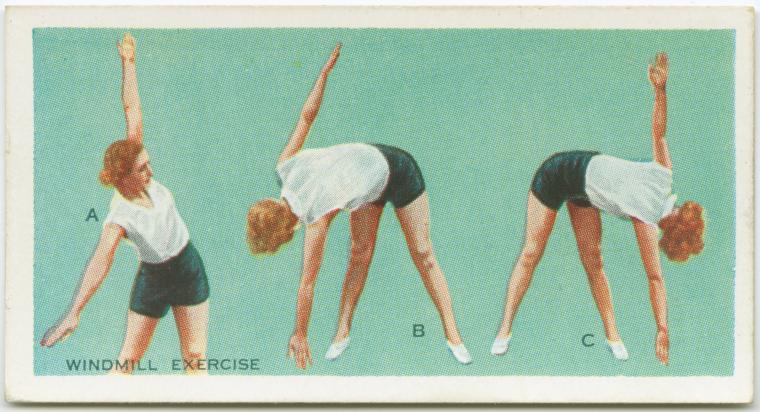
So since the last step of any quilt is making the label, and affixing the name, I started searching for fragments of poetry from which to draw a name, but instead found some of these fun windmill illustrations.

I don’t know about you, but I’ve done billions of these.  Do we even do them anymore?

Sighing deeply, because I couldn’t find anything, my husband started throwing out names.  Even though I’d originally called this quilt something else, the more I worked with it, I realized that it was the windmill, and the farm scenes, and the bucolic romantic notion of farming that came through the design.

So, the name Dave came up with is the name that stuck: Harvesting the Wind.  As I quilted on it, I kept thinking about my mother, who grew on a farm, and her mother–my grandmother–who used a wood burning stove to cook with in the early days, plus do the milking, keep the farmhands fed and worked by her husband.  There’s been a slew of Farmer’s Wife quilts out there, and Cindy of Live a Colorful Life did a series where she wrote about each set of blocks she made.  It is a life with windmills, fields, flowers, old trucks and lots of work.

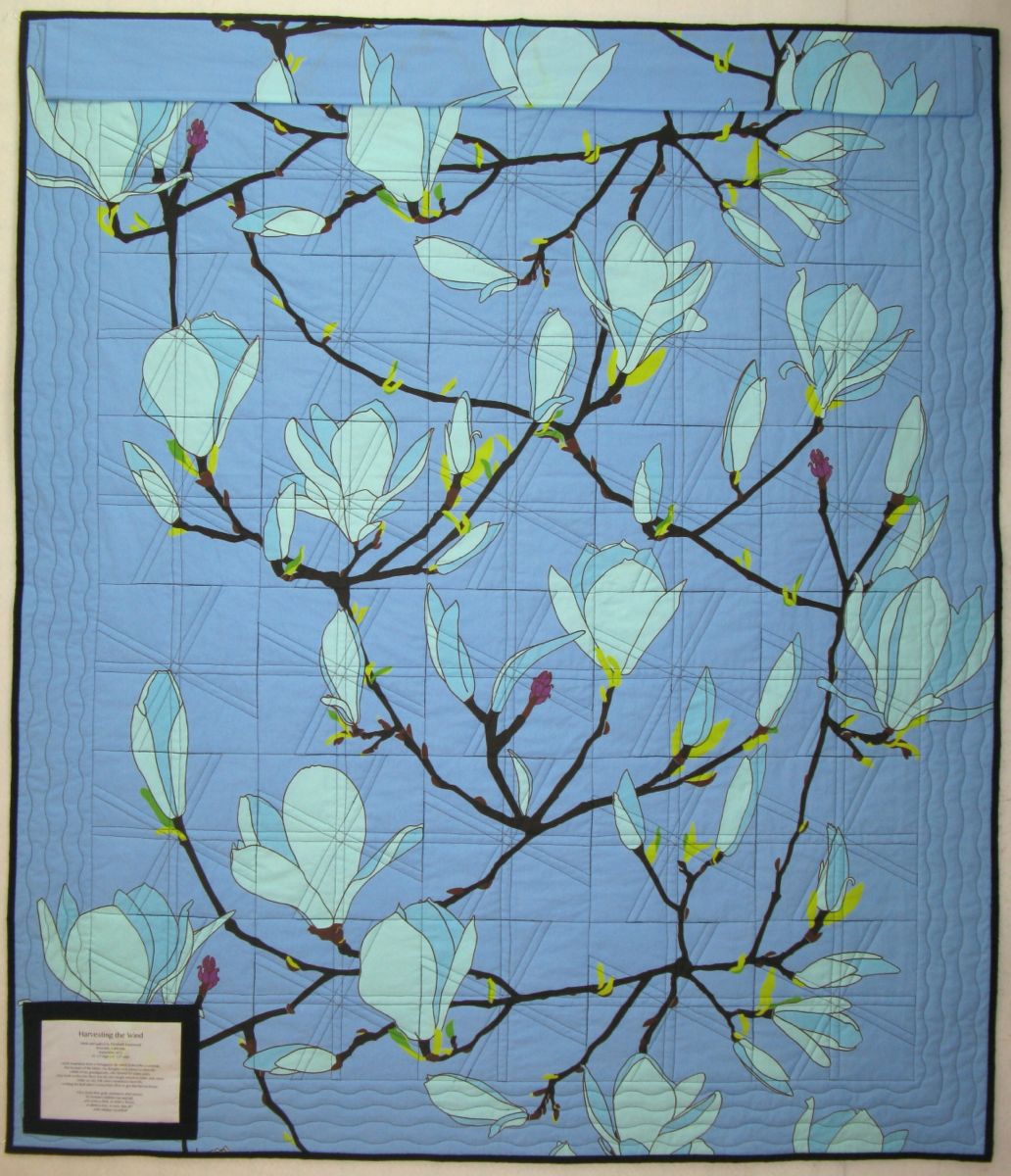
For the back, I drew on my stash of Marimekko cottons.  I love the spareness of the magnolia blossoms on the spring branches.  This fabric was originally earmarked for a skirt, but I like it here, in all its growing glory.

I quilted along each windmill with black thread, then made my own plowing lines in the field of black borders.  To make it easier on myself, I found the serpentine stitch on my sewing machine, lengthened it and made it as wide as it could go.

I also thought a lot about my maternal great-grandmother, my grandmother’s mother, while I worked.  She came over from England with a love of gardens in heart, and brought over seeds of many kinds with which she began a garden.  I may have some of the details incorrect, because my mother has not yet started to write her own personal history (come on, Mom–You can do it!), but the sense I have of this grandmother Elizabeth (for whom I am named) is that she felt a kinship to the earth and to growing things, and yes, to the harvest.

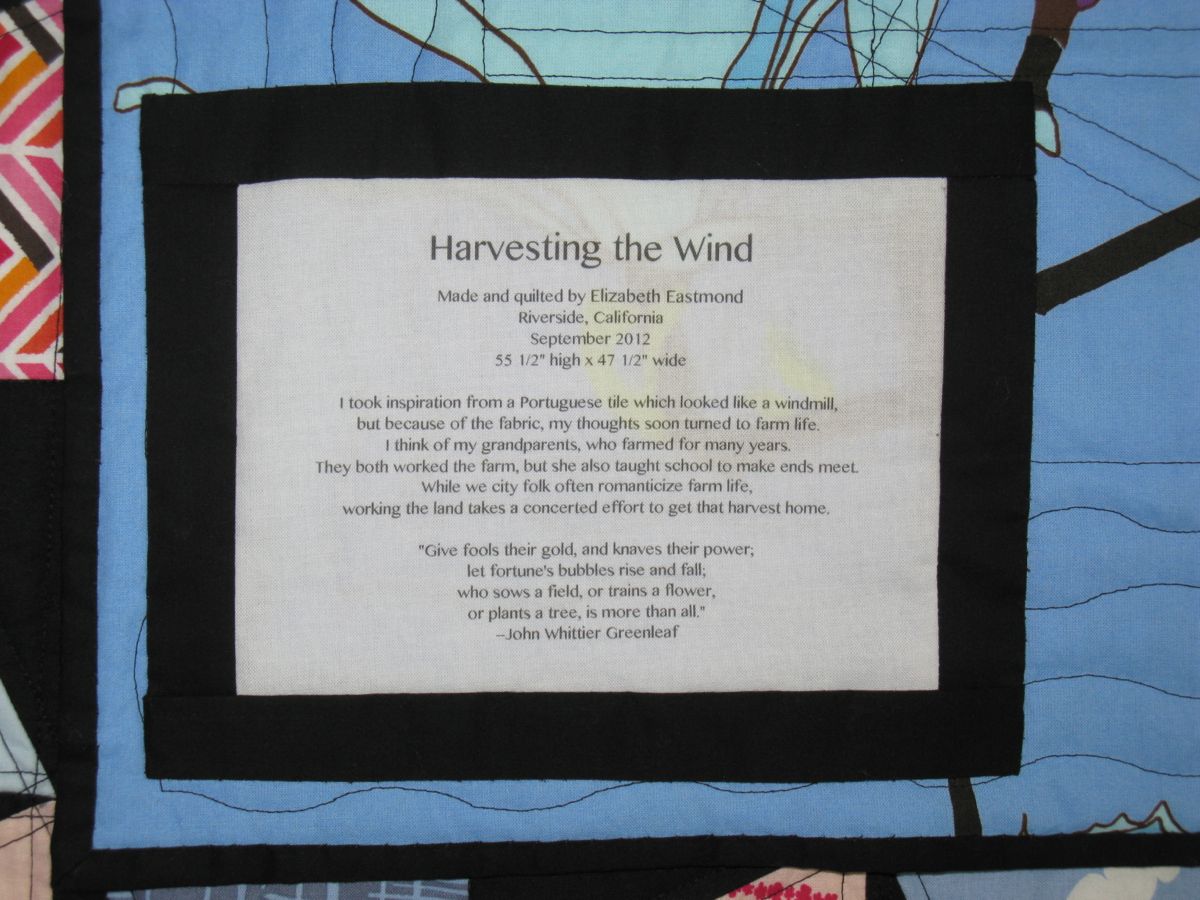
The inscription on the back reads:

I took inspiration from a Portuguese tile which looked like a windmill, but because of the fabric, my thoughts soon turned to farm life. I think of my grandparents, who farmed for many years.  They both worked the farm, but she also taught school to make ends meet. While we city folk often romanticize farm life, working the land takes a concerted effort to get that harvest home.

“Give fools their gold, and knaves their power;
let fortune’s bubbles rise and fall;
who sows a field, or trains a flower,
or plants a tree, is more than all.”

–John Whittier Greenleaf

This is quilt #101 of 200.  How happy I am to be able to say that!  I leave you with a picture of my granddaughter Maddy, learning to use a needle and thread.  I visited them at the beginning of this week when they cancelled classes on Monday because of a power outage, and we sewed all day one day.  Hopefully, I’m seeing a future quilter!

200 Quilts · Something to Think About

Blind Ambition

So I’ve been thinking about old age and dying, especially after the dream I had last night where I was trying to get off of a bridge littered with bodies and it was imperative (like dreams can be) that I not stop and help anyone (maybe they were infected with a ghastly disease, or something) and I kept dodging people and not slowing down and only woke up when I got to the other side, leaving behind, in a rainstorm (! but it was a dream) that site of sadness and death and human suffering.  It took me a long time to come awake, and I watched the sun’s color paint our backyard trees, including the olive that has died slowly from an airborne illness, killing it from the leaves downward, and which needs to be removed.

So from there I  began wondering about how many productive years I have ahead of me.  It’s a fool’s quest, this kind of thing, because I could get wiped out on my way to school tomorrow (two major freeway interchanges, one bout of commute traffic).  Or full-blown arthritis could arrive tomorrow and sewing would be out of the question.  Or maybe those poor souls on the bridge in my dream are only a harbinger of some invasive cancer that I’ll have to navigate somehow. (Does the ending mean that I get to live?)

When you are thirty, these thoughts are considered morbid and completely unnecessary.  When you are post-forty, they are a part of your life, especially as a friend or a grandmother or a close relative dies.

But yesterday, I did something life-affirming.  I added the tag of “200 Quilts” to the post I wrote.  I don’t know if I’ll reach 200 before my quilting thimble gets left in the drawer for the last time.  But I took the ambitious step — a blindly ambitious step considering we can’t ever know the future but pin all our hopes on it — and declared my Portuguese Tile Quilt to be number 101 of 200, a lovely, big, ambitious, and history-laden bi-centennial sort of number.  We’ll just see how it goes.