
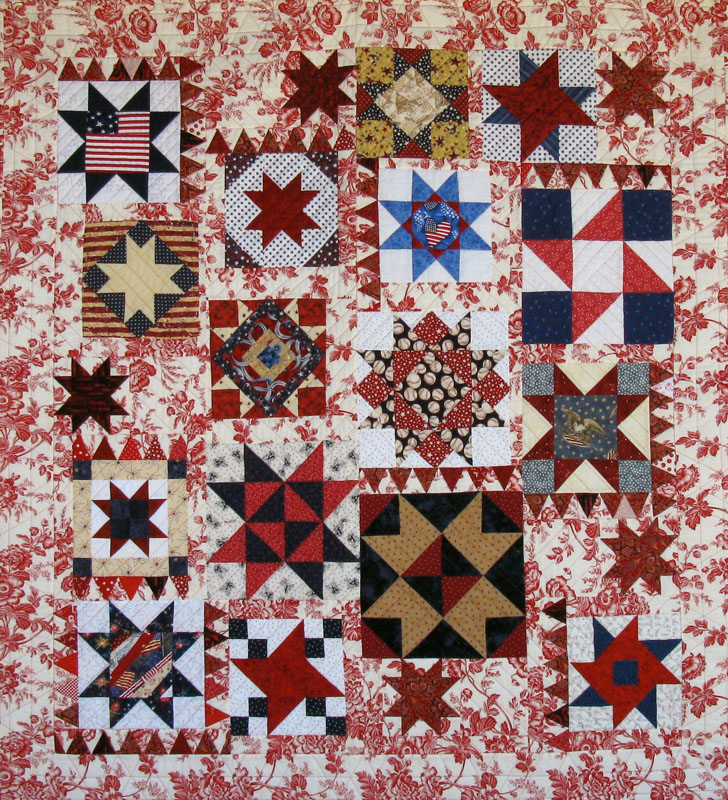
More on this quilt, *here*.
I’m adding this to my 100 Quilts list (above).
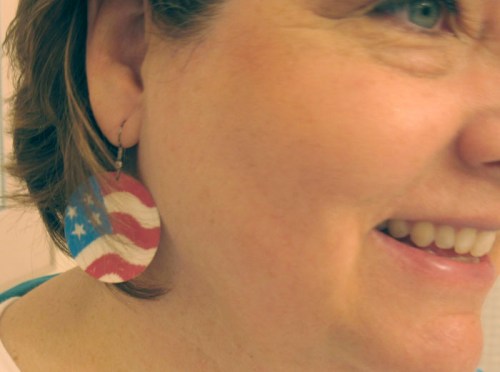
On Memorial Day, I put on the earrings I’d purchased in Washington, DC ages and ages ago on the 4th of July.
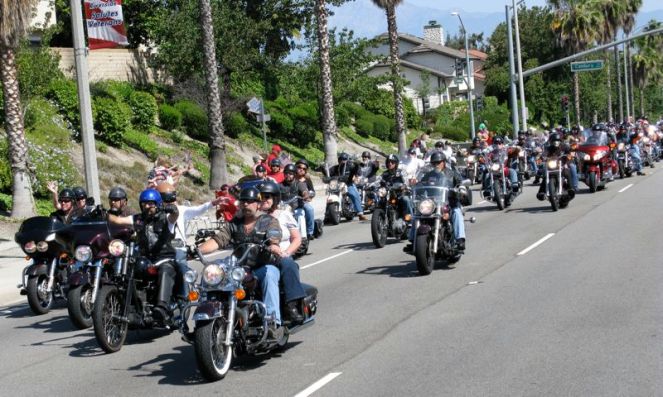
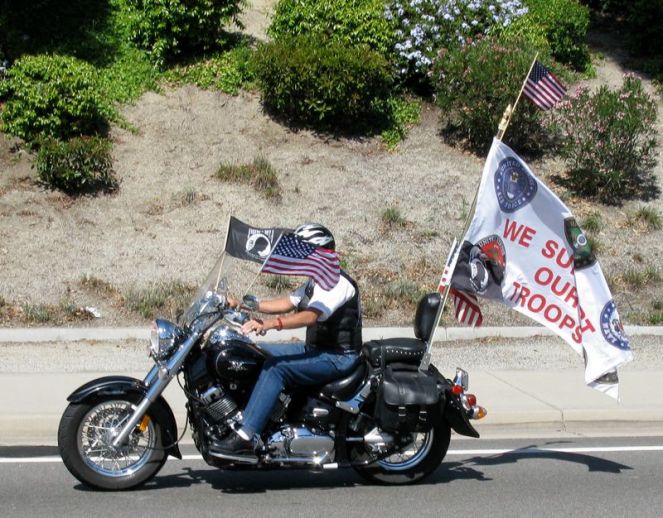
And we walk over to our main boulevard, about half a mile from our house, flags in hand and cheer on the West Coast Rolling Thunder, a compliment to the Rolling Thunder in Washington, DC on Memorial Day Weekend. This year they anticpated about 9,000 participants–it lasted about an hour.
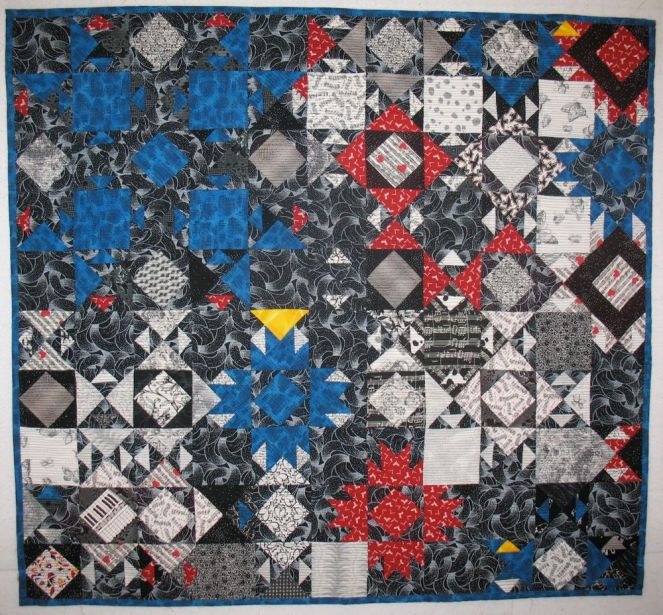
We waved and cheered and then I came home and put up my Red, White and Blue Quilt, made some years ago with my Quilt Night group–before we were zombie-fied.
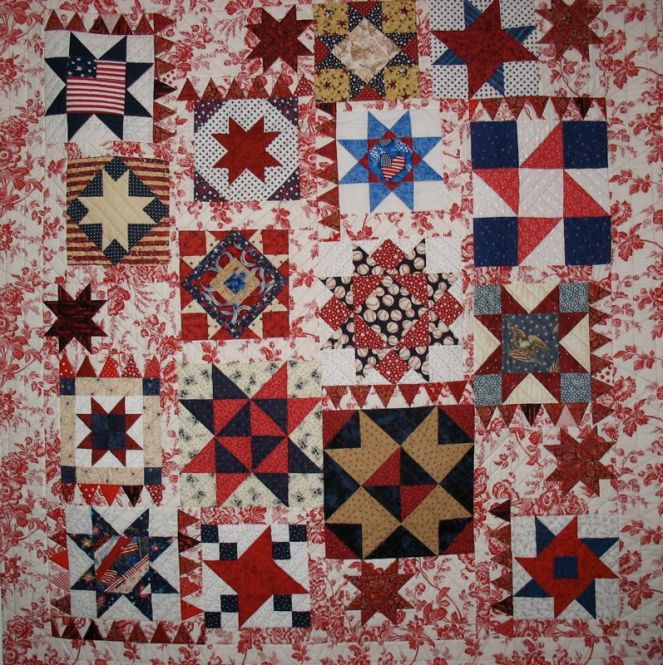
We each made a block. The requirements were red, white and blue and it had to be some sort of a star. We were loose on the definitions, as you can see. I had heard Margaret Miller talk the year before at Camp Watch-a-Patcher in Orange County, and she said you can tilt a quilt more towards one look or another by how you sash it and border it. Because I wanted to push this more towards the red and whites, I chose this toile and made more tiny triangle points and densely colored red stars to pull it that direction.
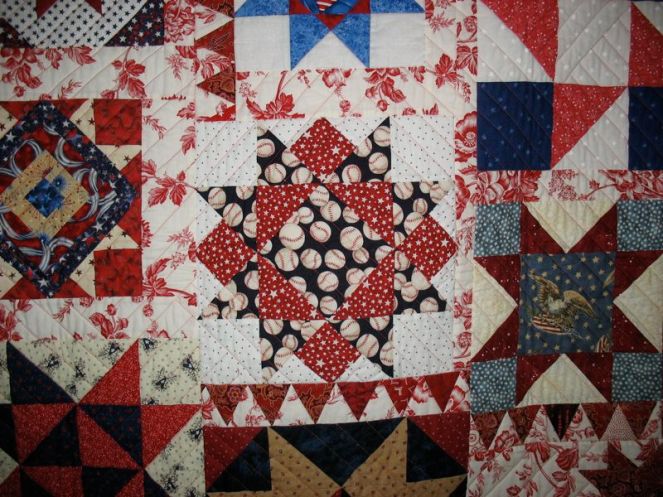
One afternoon, I laid a few of the blocks out for my husband on our bedroom floor and asked him what he thought about them. He pointed to this one and said he didn’t like it very much. Well. . . that was the one I made–trying to work the theme of American baseball into our red, white and blue quilt. (You can see the eagle that Lisa fussy cut for our centers on the block to the right.) I laughed, then made another one.
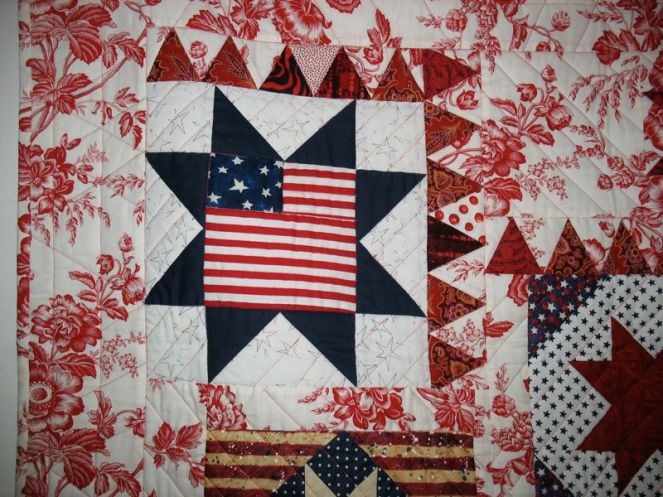
He liked this flag block a lot better.
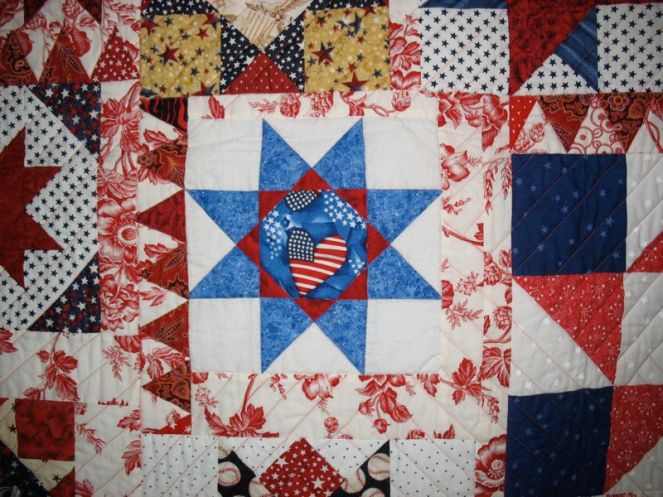
I also like this block, made by Susan, titled Peaceful Hours. She now lives in Idaho, and I think of her every time I see this block. That’s the beauty of group quilts: when you look at them, they remind you of your friends. We used to call ourselves The Good Heart Quilters, but now we just call it “Quilt Night.”
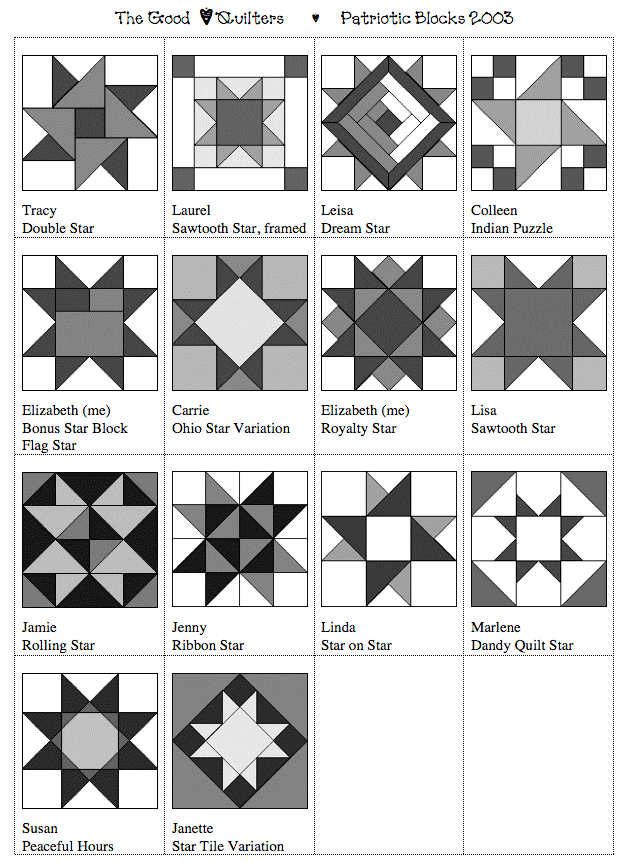 I made up this Master List so I could remember everyone and what they’d contributed. I also did the quilting, lines one inch apart and switching directions when I thought it was a good time to do so.
We also didn’t put size restrictions (that’s evident) and I like the fact that this made for a more free-form arrangement of the blocks. I have Quilt Pro quilt software, so after the blocks were chosen, I put them into the program and worked them up for this handout.
 Whooey! Another tempest in a quilting teapot! (And this quilting disaster–explained at the very end!)
I love all this controversy. I love that we are talking about quilt issues, digging our hands deep in the loam of the quilting garden and really talking about things that bother us and that delight us. Rachel of Stitched in Color was quite frank one day about Saying Things She Didn’t Think She Should. Bammo! Millions of comments–some, mostly rants–about one aspect of the quilt world or another. I should have expected as much from all of us women who run blogs. Then her next post was about Things We Should Say, and the issues of it’s a subjective world (quilting) that some are trying to categorize objectively (skill levels, style labels).
Here’s my .02:
I’ve read all the posts and it seems like the conversation/comments has generated a healthy discussion, re: the labels of modern vs. traditional quilting. More about that at the end.
But about the other–the “dumbing down” stream. I’ve read all *those* original posts and realize that it had its genesis in trying to describe levels of skill. I think this is sort of one place where there is no subjectivity, and that’s kind of what set off the whole alarm bells and craziness. Either you have the skills to make successful HST (Half Square Triangles) or you don’t. It’s meeting an objective standard. For some, HST are intimidating. For others, they do them in their sleep. I do think it can be successfully argued that there are certain skills that come with practice and after having achieved them, a quilter can objectively say s/he’s got those down. I consider myself a master quilter, having done just about every technique in the book (some while I was majoring in CloTex in college, some afterwards as I took quilt classes to become more proficient). The point is I was still learning, still trying. And as I want to improve myself, I’m now trying to master more applique techniques. So even while I may have objectively met some unnamed standards of skill level, there is always more that can be learned, can be perfected upon.
Now: my .02 on the “modern” quilting business. A while back ( a year ago?) I read a blog post putting forth the idea that *modern* was one leg of a three-legged stool, the other two legs being *traditional* and the *art quilt*. I was happy with that idea–that we were all finding ways to be creative. I love the injection of fresh! new! that the modern gals have brought to the industry. I started quilting in the 1970’s when I was 21, and personally, I thought we were all getting a bit old and musty. Something had to change. I wasn’t ready to go the art quilt route because I still love a good cuddle under a hand-made quilt. So I was happy to see some fresh ideas, another way to contribute to our big wide world of quilting. It’s not an either/or. It’s all of us together, doing what we love.
On that note, I present to you. . . This Quilt Is A Mess.
I don’t think that this was its original name, but it is certainly the name it has now. I’d recently been on a trip to Venice and like so many other quilters, fell in love with the floor of the main cathedral. I bought the POSTER of the floor (they wouldn’t let us take photos) and started to sketch it out. This quilt was supposed to be one of those very clever quilts of using one block yet coloring it so many different ways that the quilt would be chameleon-like. Yeah, right.
It started out that way–I think that section is kind of in the upper right. Then I got tired. Then I started piecing things every which way. Then it sat, like an ugly gnome in a room of beauty queens. Here’s where the class thing comes in. I had to have a quilt to take to a workshop with Hollis Chatelain, who was just hitting the circuit after her very successful painted images (then quilted) were winning big prizes. I knew I would be experimenting with quilting, so grabbed this. She talked to us about spray basting (so I did that) and brought the “glued-together” sandwich to the second day of the class. I realized that I had to be plain-jane with the quilting, not swirly.

So the quilting consists of eight billion rows, one-quarter-inch apart, some in black thread and some in red and occasionally switching directions. I was never so happy to be done with a quilt. I put the binding on, a sleeve for hanging, but basically it is STILL an ugly gnome in a room of beauty queens. It rarely sees the light of day.
So, even though I execute flawlessly in objective skill level (well, okay, maybe not ALL the time), subjectively I can say: This Quilt Is A Mess. To this day, I’m still not a complete fan of tight row stitching, but I have learned from Red Pepper Quilts that there is a fresh, modern way to adapt that technique so it’s not so painful. So to all you bloggers & quilters out there–keep sharing, keep showing, keep writing. It’s good for us all. Even the tempests in the teapots.
Or rows of flowers, as the case may be.
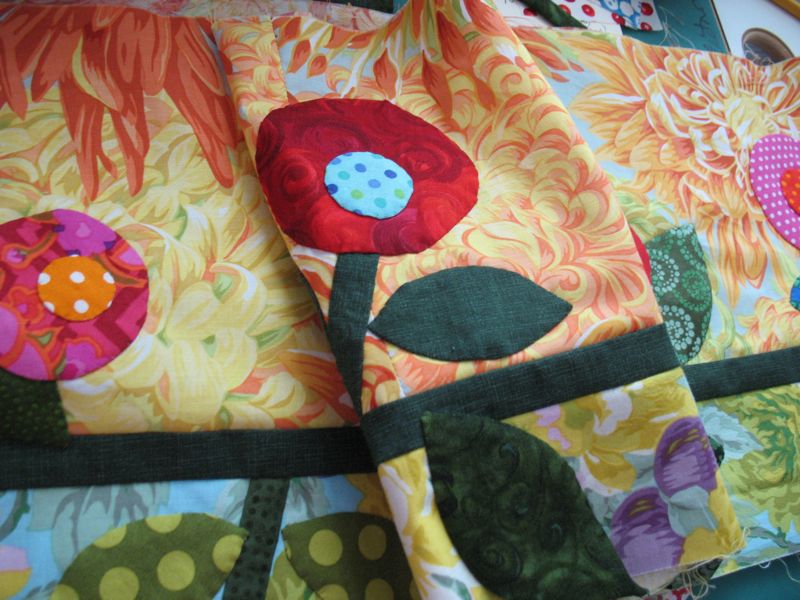
It’s winter, so that means some sort of flu bug or sickness will find its way to me. So, I sat on the sofa and appliqued my flowers while I watched The Social Network. Twice. Once straight through and once with the actors all talking about what they did/thoughtabout while they did their scenes. My husband fixed dinner, cleaned it up (I know–I’m not trading him for anything) and I went upstairs to do lesson prep for today’s teaching–like I had a cotton head or something. Luckily appliqueing doesn’t take much brain power or we’d be in trouble.

I took down the other row this afternoon after class, with all the pins skitty-wampus through the pieces.
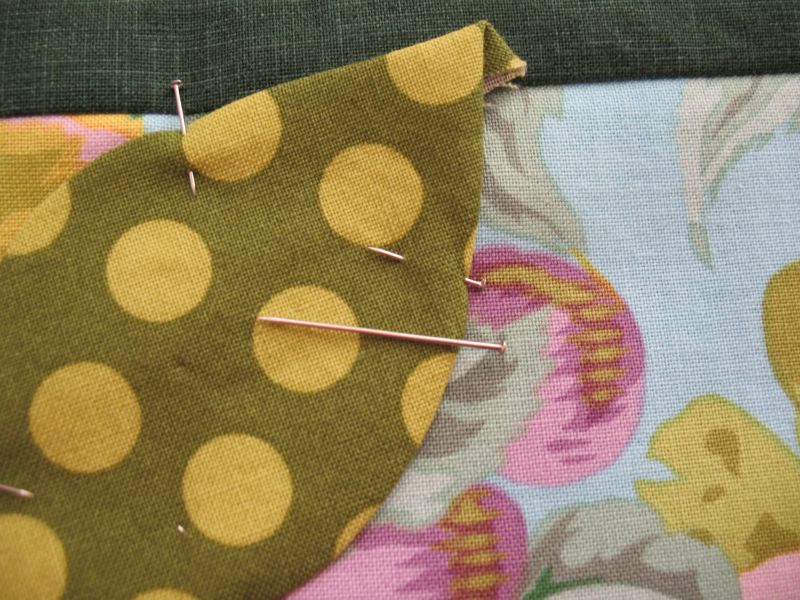
I lay them on my table, and trade out the monster, regular pins for tiny applique pins (see the comparison, above). This is a trick I learned from the quilters when I we lived in Virginia for a year. They are accomplished appliquers, all. They also told me to use silk thread, which I do, for the thread just disappears when the piece is stitched on.

I traded out the Wintery Branches quilt in my hallway a few weeks ago for the Valentine Quilt I’d made out of turkey red and cream. I’d always wanted a turkey red-white quilt, and was at a little teensy-tinsy quilt show, where one booth had some turkey red yardage. I didn’t prewash the red fabric, so I guess I’ll never throw it in the laundry. It would probably end up a turkey red-and-pink quilt then.

It’s a fairly simple quilt, with intertwined stripes, but I like it not only for its coloration, but that lean, linear quality. This is also the first quilt I machine quilted. Ever. I started out with cream-colored thread, but hated how it looked when I stippled over the red. (Everyone did a stippling pattern in those days!) I switched out to monofilament thread after unpicking yards and yards of stitching.

Here’s the label on the backside (sorry, I know it’s a little blurry).

The verse reads:
No cord nor cable can so forcibly draw, or hold so fast, as love can do with a twined thread.–Burton.
The name of this quilt is Twined Thread, and it was completed July 1997. Of course, you all know it’s in honor of that man who will cook me dinner and do the dishes when I am laying sick on the sofa. Love holds us fast together.
 OccasionalPiece--Quilt!