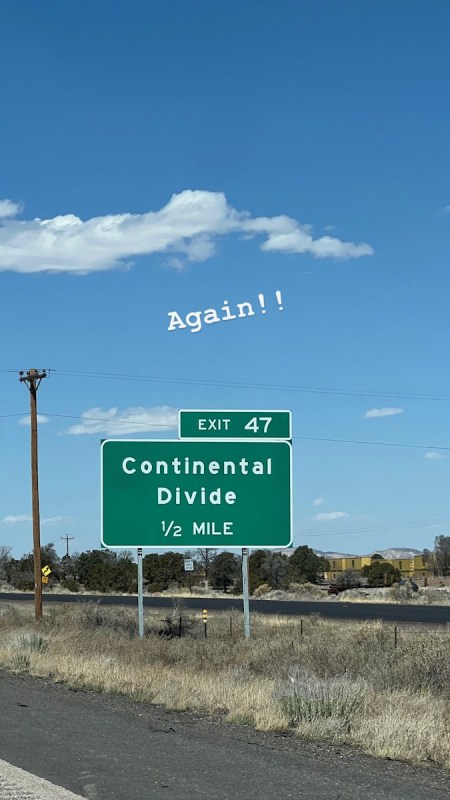
The phrase, crossing the divide, has haunted me for a while now, ever since my husband Dave and I crossed the Continental Divide twice on our April road trip.
While I was driving, and saw this sign, and knew it was coming, we did not take a photo of the actual moment we crossed. And this is like some recent experiences: somehow I crossed a dividing line and found myself in new country, and was not entirely sure how to behave or act.
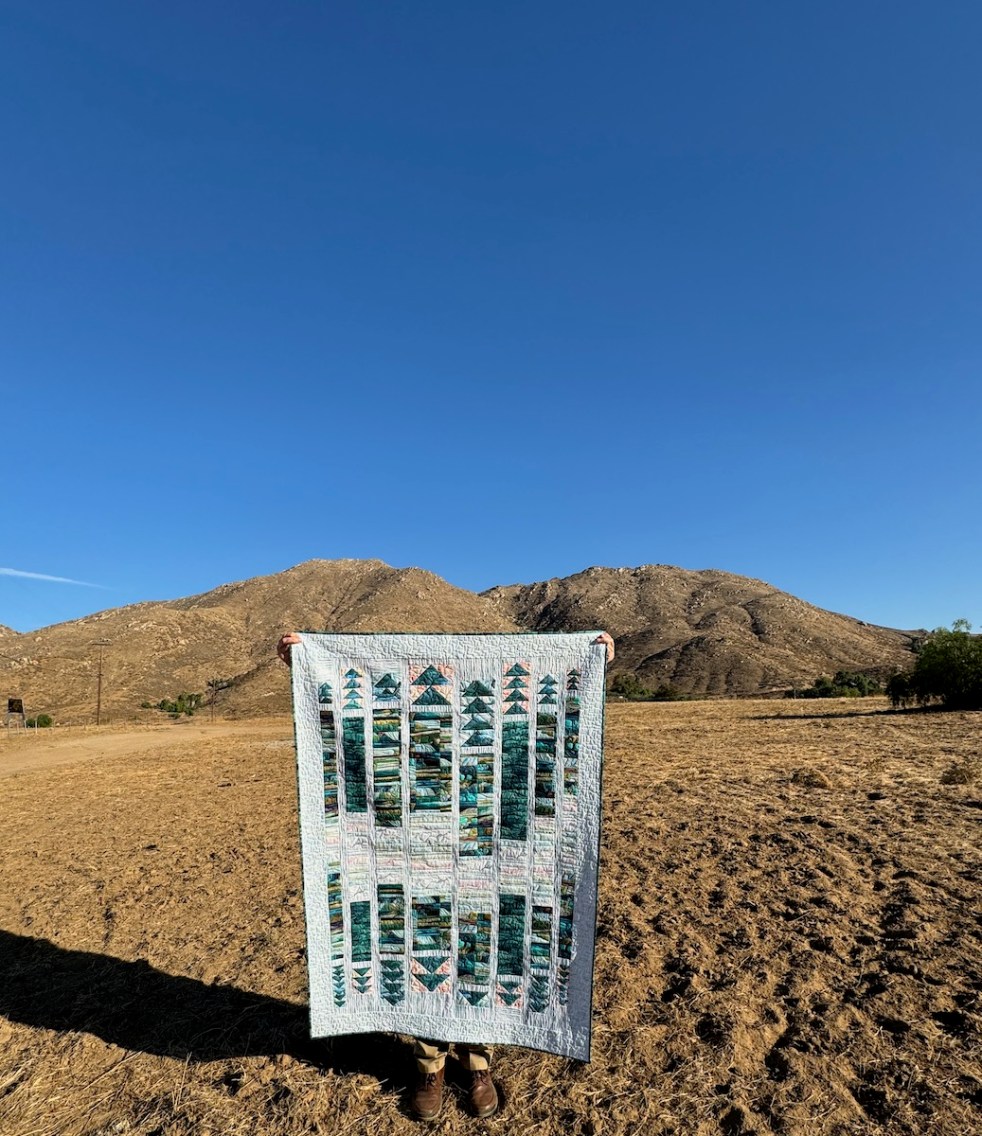
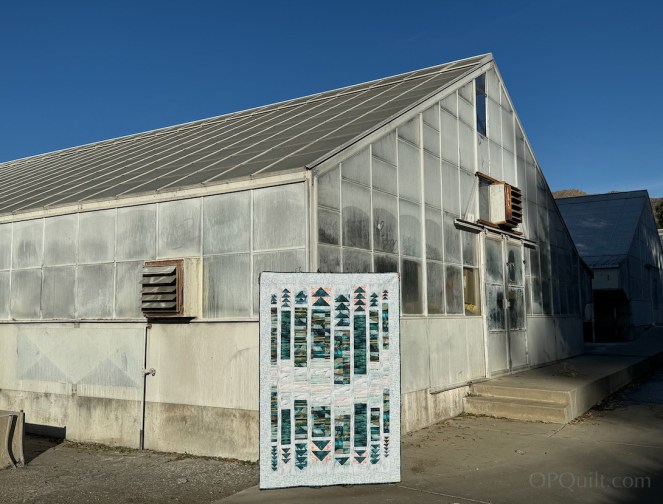
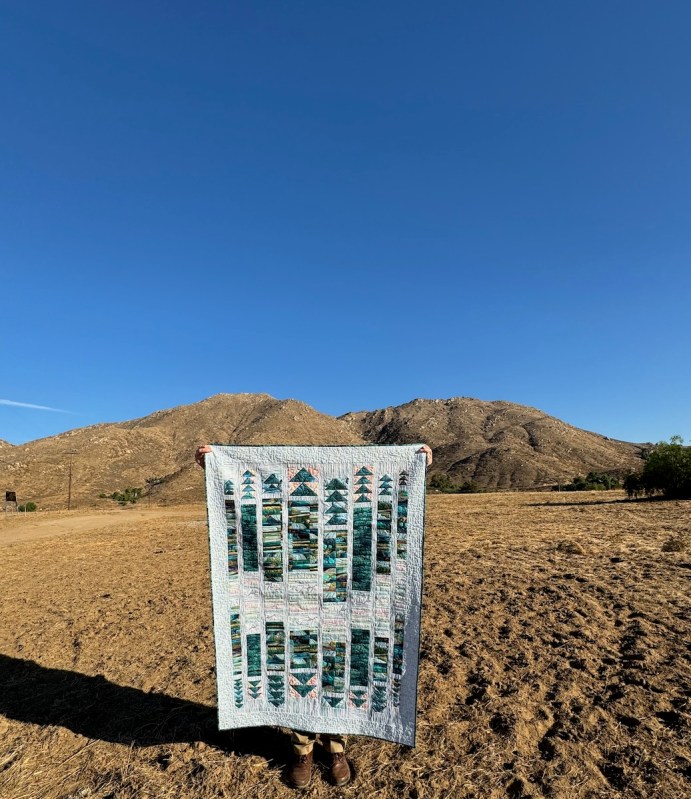
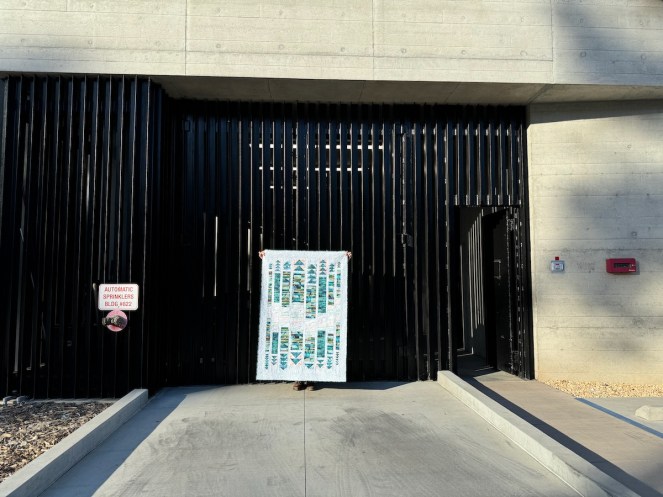
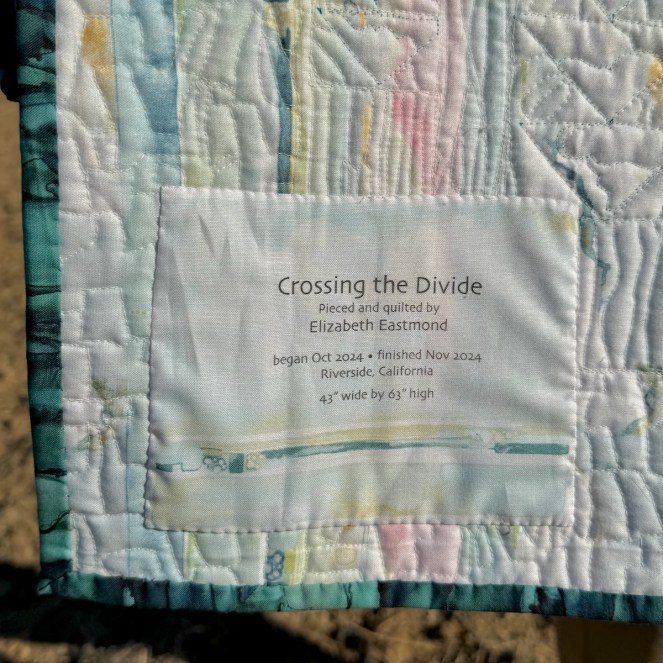
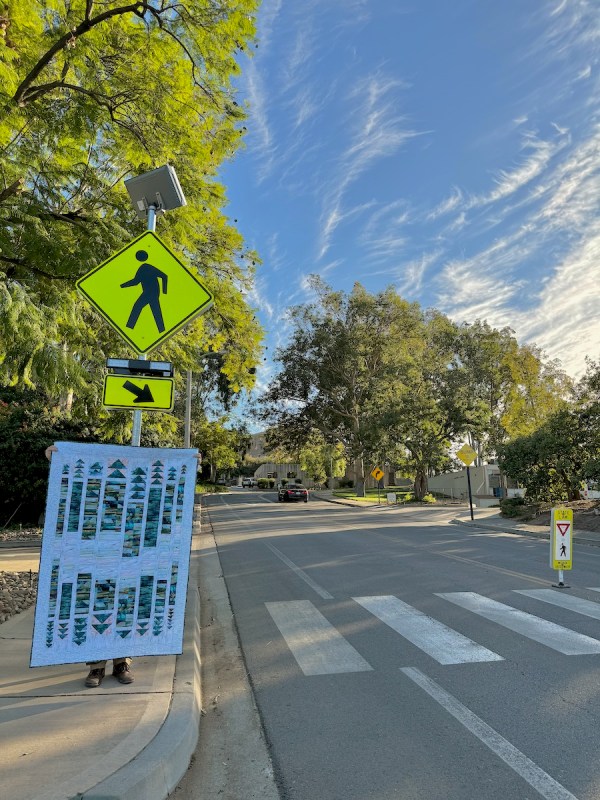
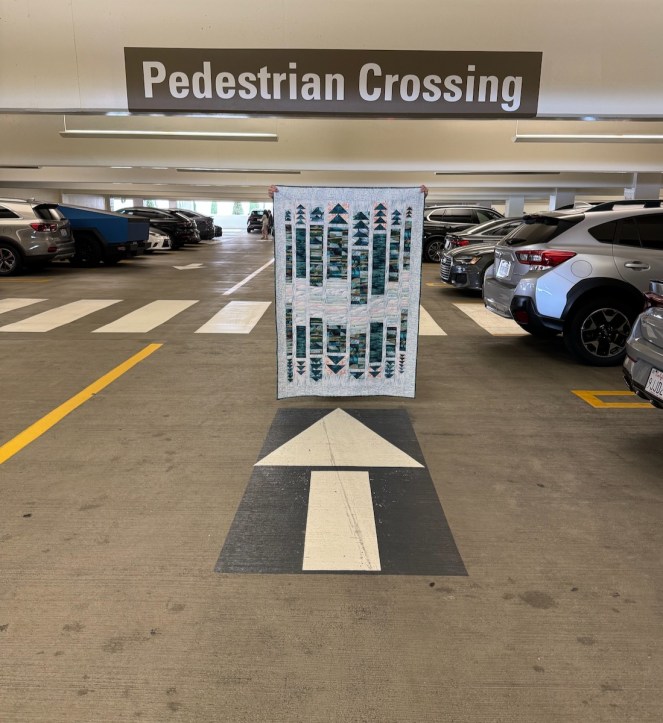
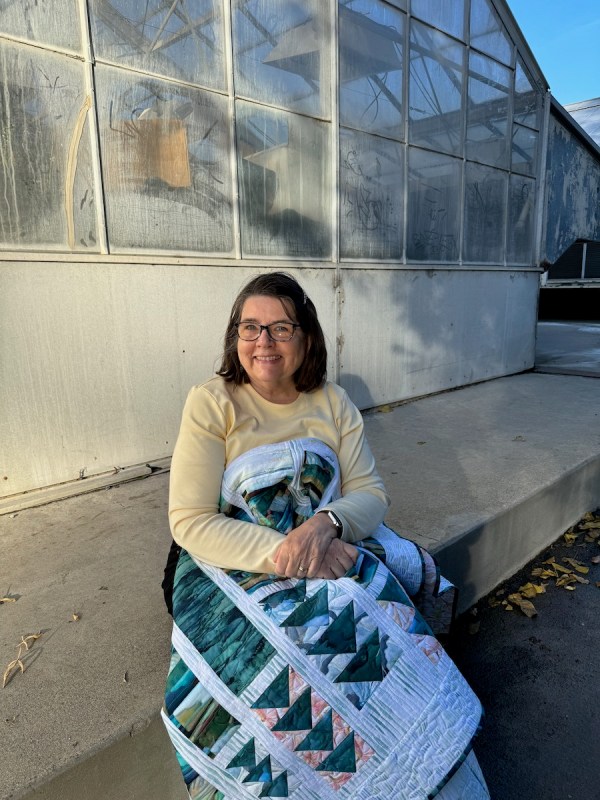
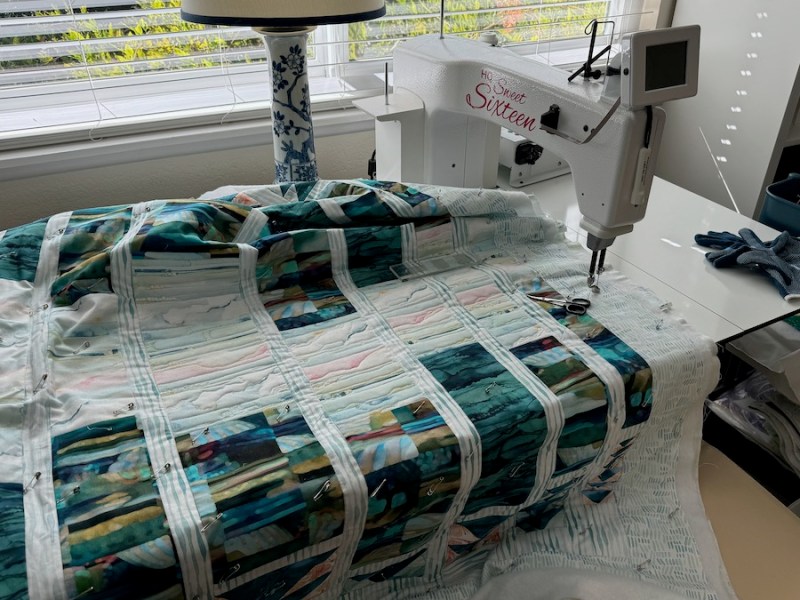
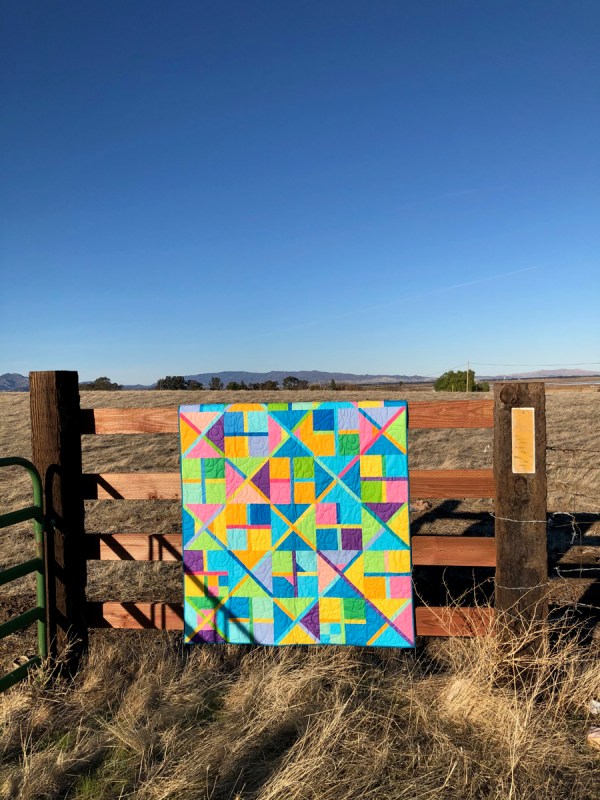
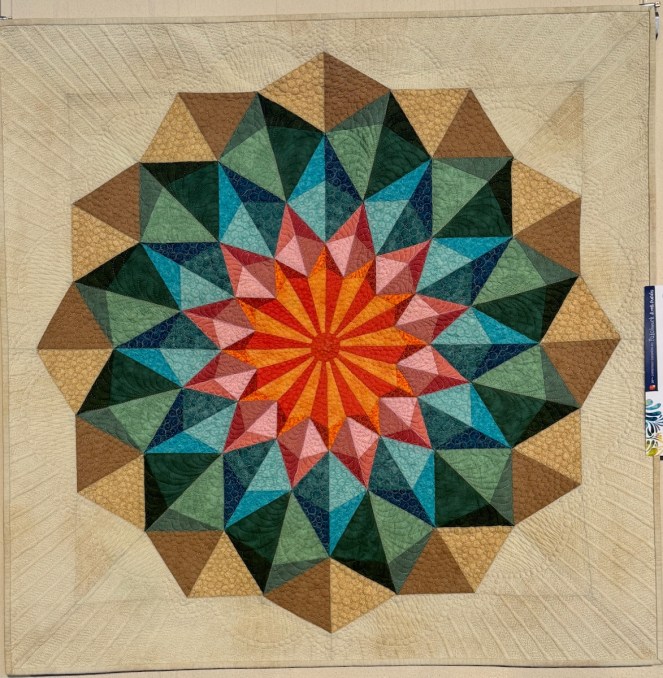
Crossing the Divide • Quilt # 294
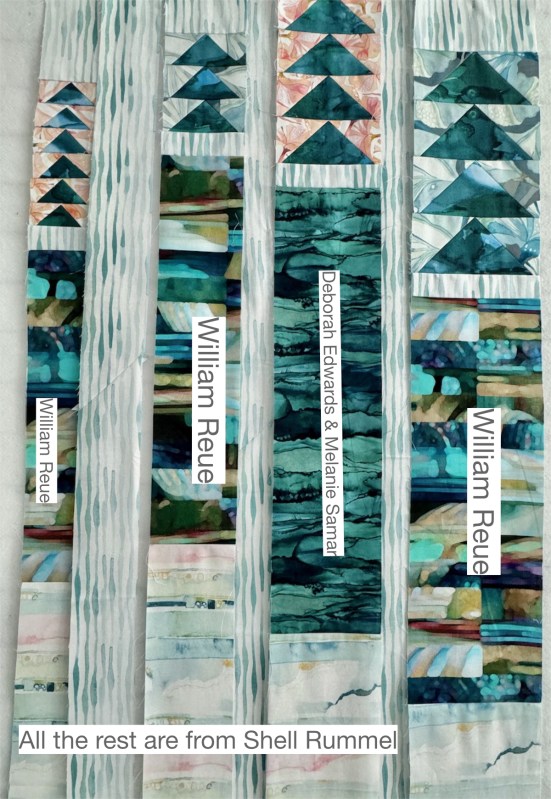
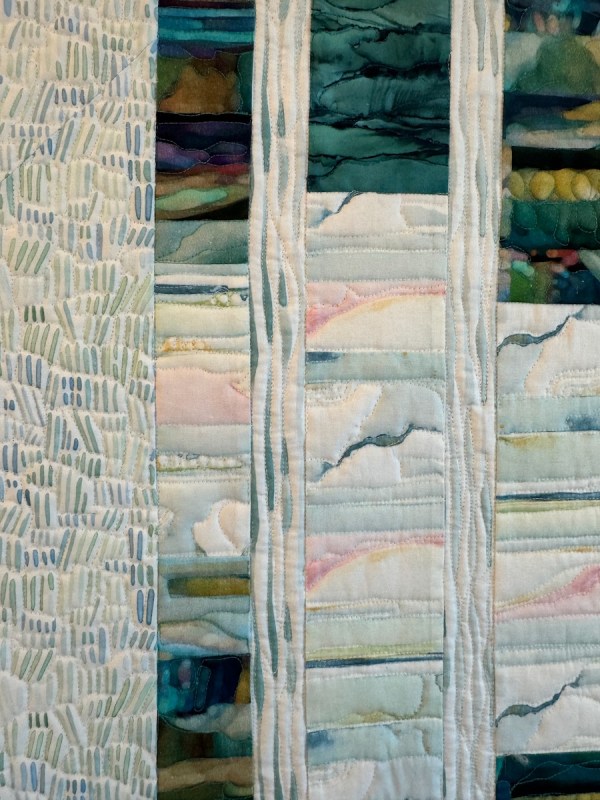
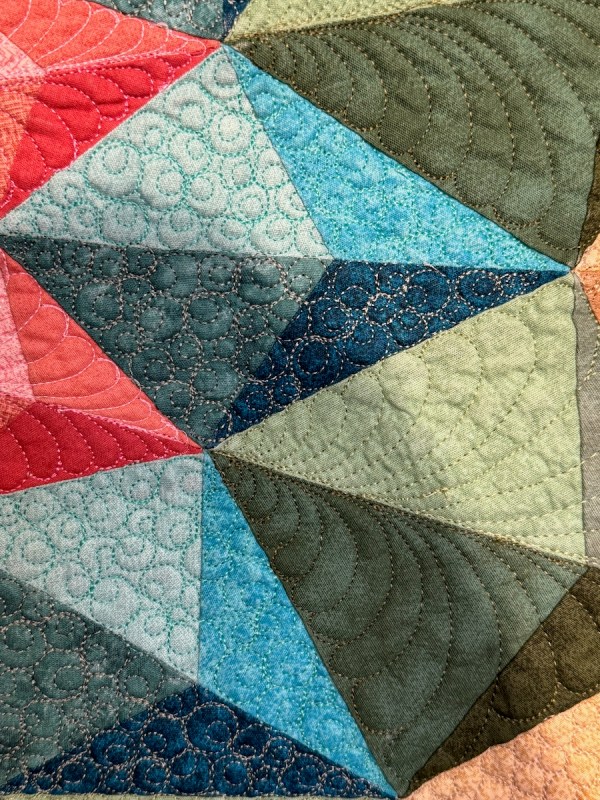
I long had wanted to make this quilt, using some positively ethereal, painterly fabrics from Shell Rummel, William Reue, and snippets from Deborah Edwards & Melanie Samar. I had to modify the pattern, because it called for an older panel which was now out of print. I sewed it all up. I picked apart every seam and re-sewed it (like Crossing the Divide…again). I got stuck on how to quilt it, and Dave talked it over with me: follow what’s in the fabric. I think that’s kind of like going with the flow, an attitude I am always working on/struggling with.
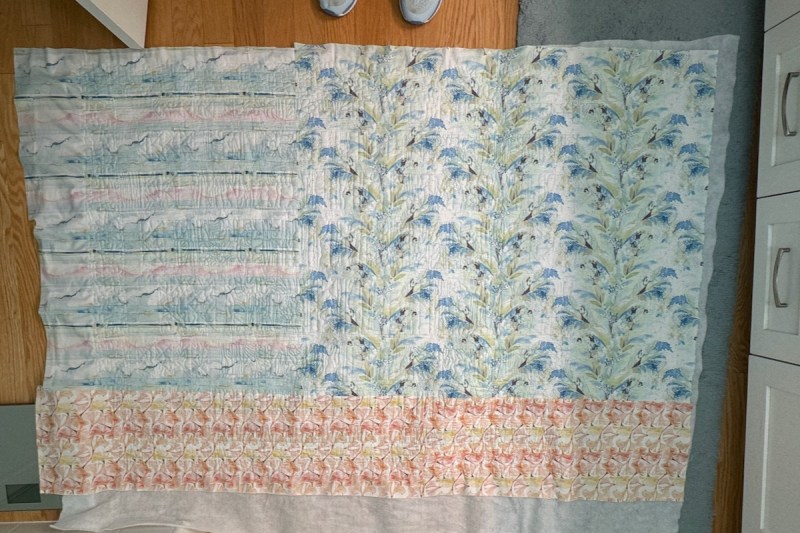
This quilt has a divide in it, with the soft pastel interrupting the more rock-like, stream-like bars of fabric in the top and bottom.
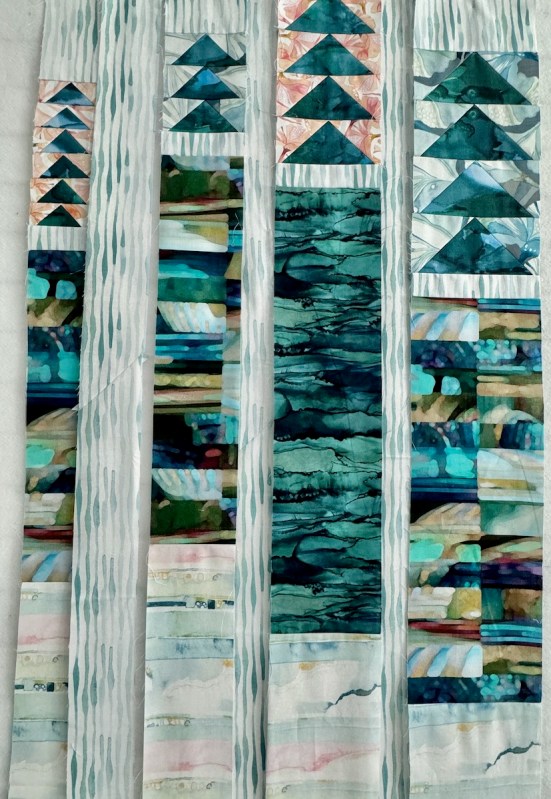
(see detail at end about fabrics)
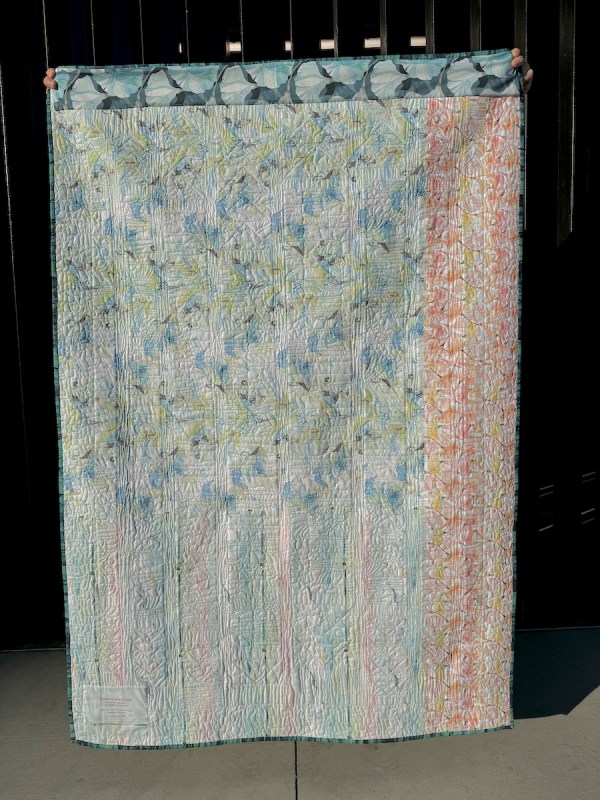
Back.
Crossing the Divide waiting to cross.
Crossings are everywhere. Some I’ve recently noticed:
We honored my mother’s death this week, a two-year anniversary.
My father’s one-year anniversary of his death is coming up.
There are no baby grandchildren.
I wake up every day with something aching.
A milestone birthday was celebrated earlier this year, and the further I get from it, the more I realize I have no idea how to behave in this new place. I get many more condescending comments from people who don’t wake up with something aching. Which is annoying.
I no longer worry about flossing my teeth or cholesterol — it’s a different mindset, but it’s hard to explain. That doesn’t mean I’m not aware of those things, but I just don’t freak out about them.
I do freak out about other, more trivial things (you can ask my husband).
I also freak out about the time left to me in this world to do what I want before I cross over permanently, but this post isn’t about that.
There are divides in this life. While I cross over most of them without being aware, other demarkations come blaring at me like a train rumbling through the night, and I scramble across the tracks as best as I can.
It’s also about seeing the line that keeps divided from each other. Sometimes that line is physical distance. Sometimes it is an age difference, or a political distance, or an emotional distance. It’s also about time-as-a-line: there is much more behind me than in front of me, by any calculation. And all this started with a color and texture division in my quilt.
Here’s to making your way across the divide, in all ways–
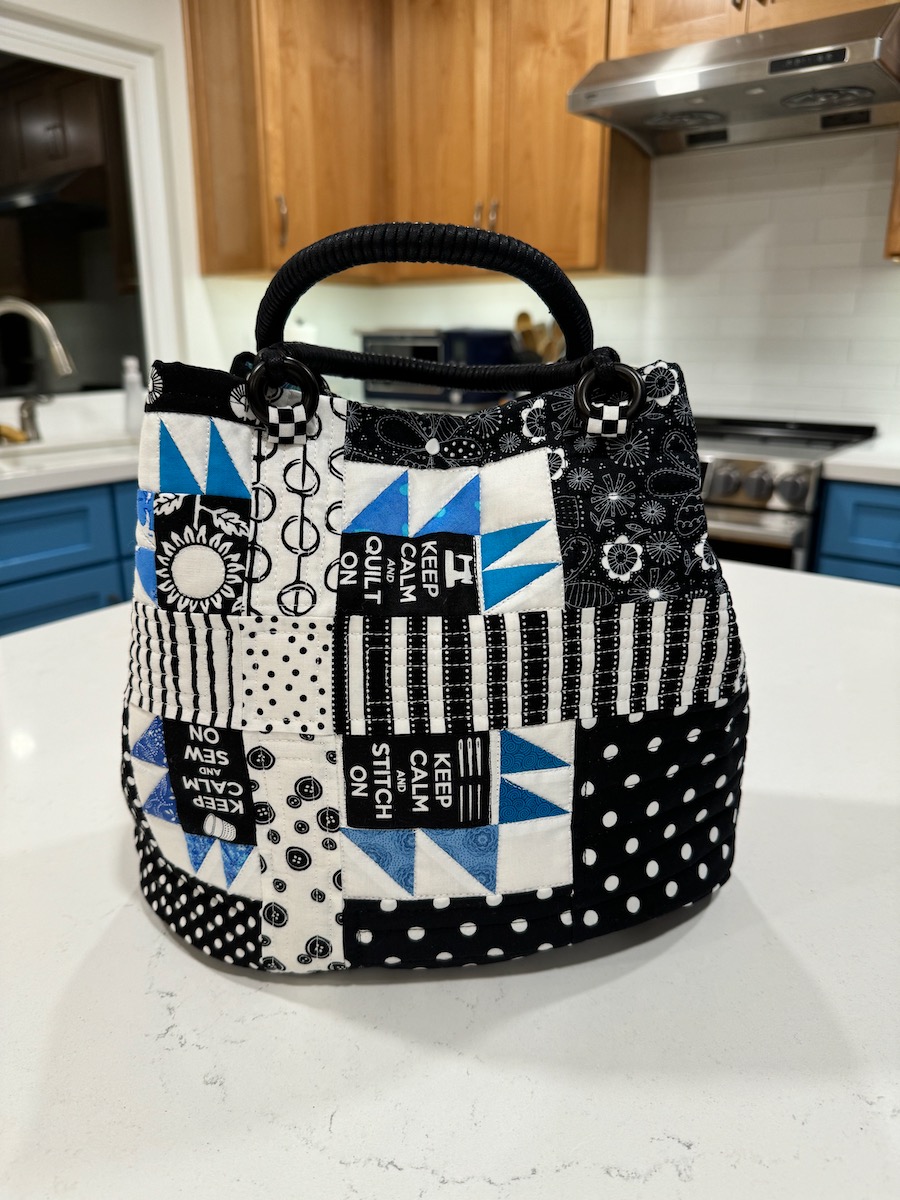
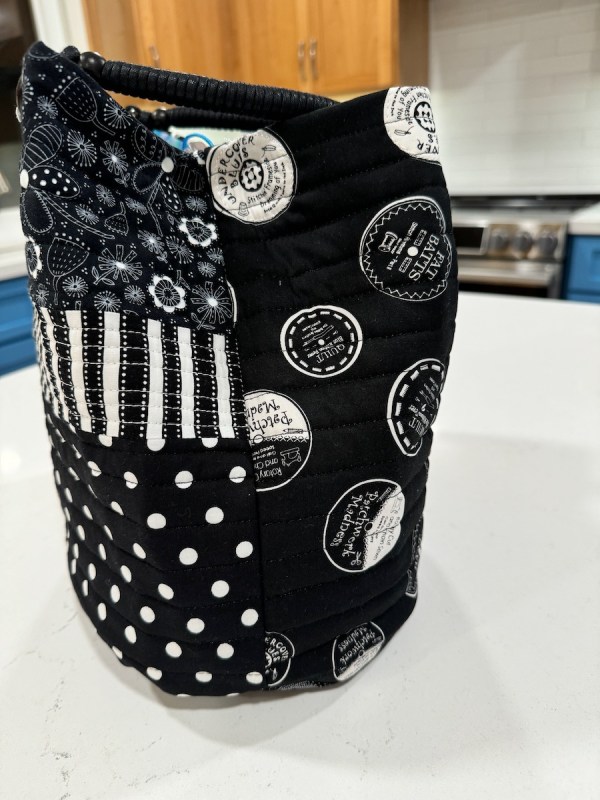
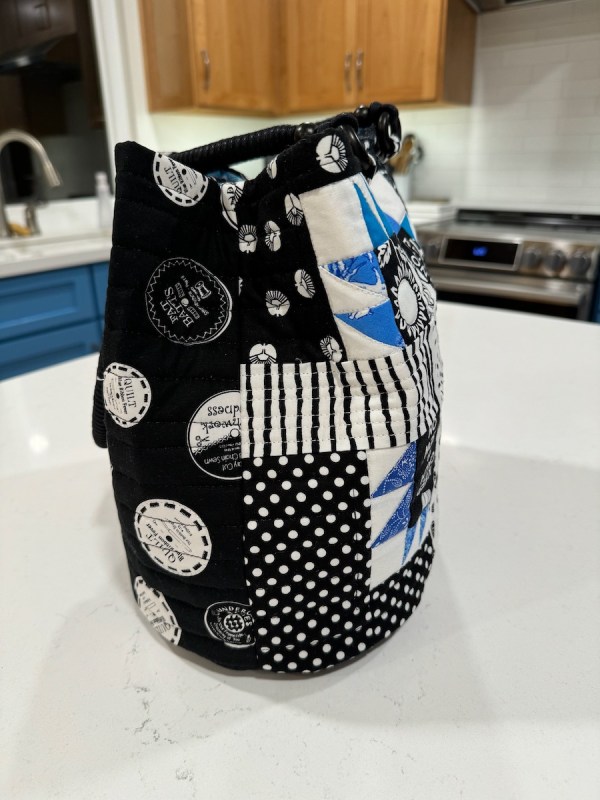
However, I was making this bag the whole last week of the election, and because I was inadvertently using the Keep Calm and Carry On (only it was Press On, Quilt On, etc.) and they had a skit on Saturday Night Light Live with Maya Rudolf and Kamala Harris that had a lot of joy and lot of play on words (including the title of this blog post), you really can’t blame me for merging it into the effort, can you?
I say it’s okay to name things after current events, as I’m just fitting in with my quilting ancestors (thinking of all the quilts I saw in the DAR exhibits while I lived in DC that were named after election things like the Henry Clay Campaign Quilt or the Fort Sumter Flag Quilt and such). Really I just call it the Black and White and a Pop of Color challenge project for my guild, and I’m done a full 6 weeks early, for which I am celebrating! And no, no one from my Guild ever reads this blog, so I’m safe to write about it.
This took me ton of time, because of all that cord-loop business inside.
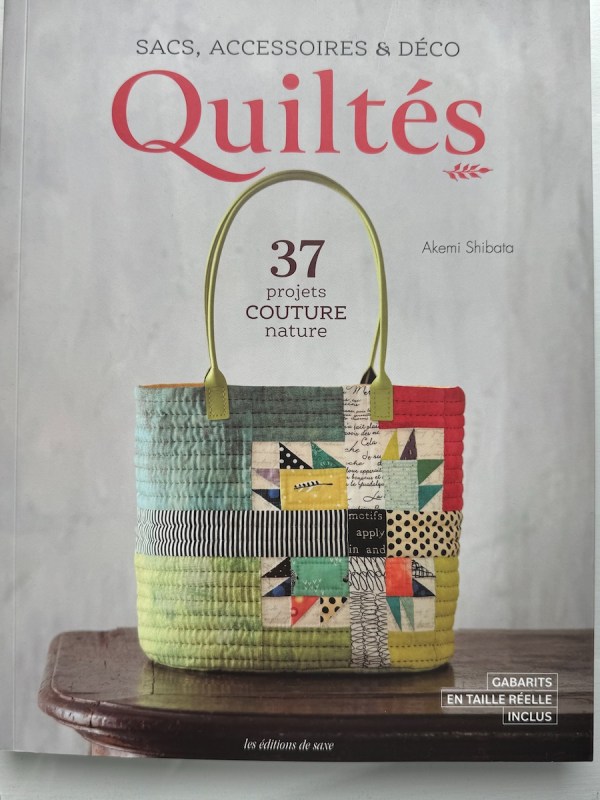
The pattern came from a book I picked up in France, which was all in French, but it was a Japanese designer, and yes, I made some shortcuts and mistakes and no, we aren’t going to talk about those. But thank heaven for Google Translate. Isn’t that colorful one on the cover a lot of fun?
I used some handles I’d purchased ages ago in Japan at Yuzawaya (and attached with little cloth loops), but it took me numerous shopping expeditions both at brick-and-mortar stores and ETSY, to even get something resembling the cord I needed, and I raided another bag for the clasp. Like I said, if I were in Japan, all these parts would be at the local Yuzawaya store. I still think I need to order thicker cord for the right look, but oh well.
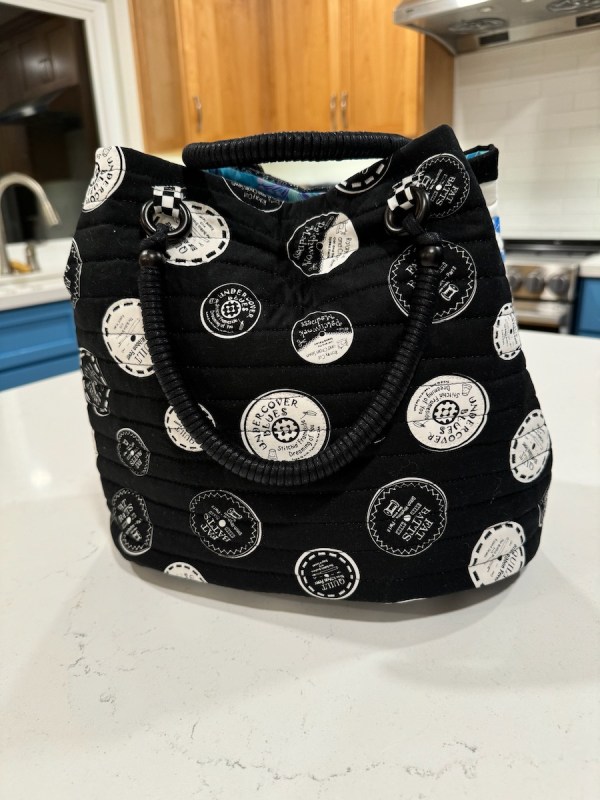
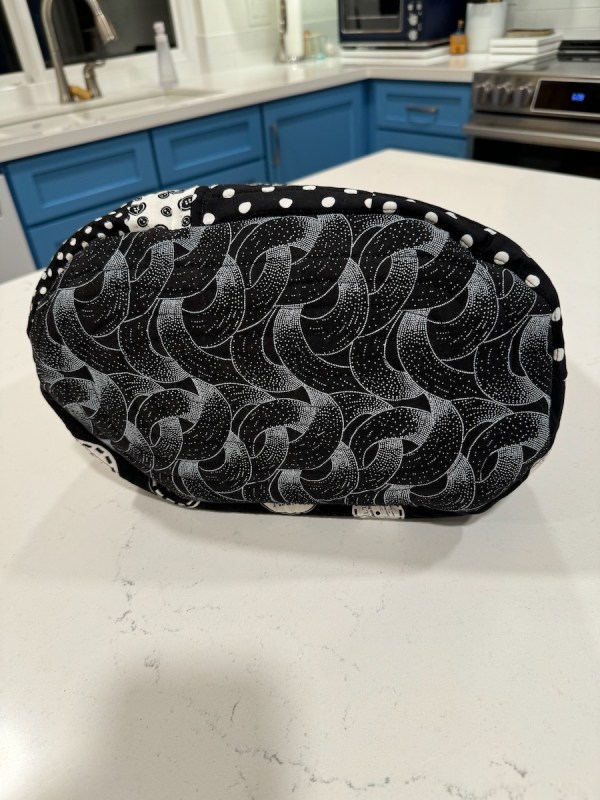
Side, side, and bottom. Since it took me as much time as some of my quilts, it has a number (293) and is indexed in my Indices, above. I do think it’s clever how the cord draws up the bag to give it shape, but just don’t know if it will work long-term. At any rate, the Guild Challenge is due in December, and I’m DONE!
While I was out shopping for cording — in early November — Christmas music was playing. I couldn’t get out of there fast enough. November is a time for gratitude, fall colors and fall quilts.
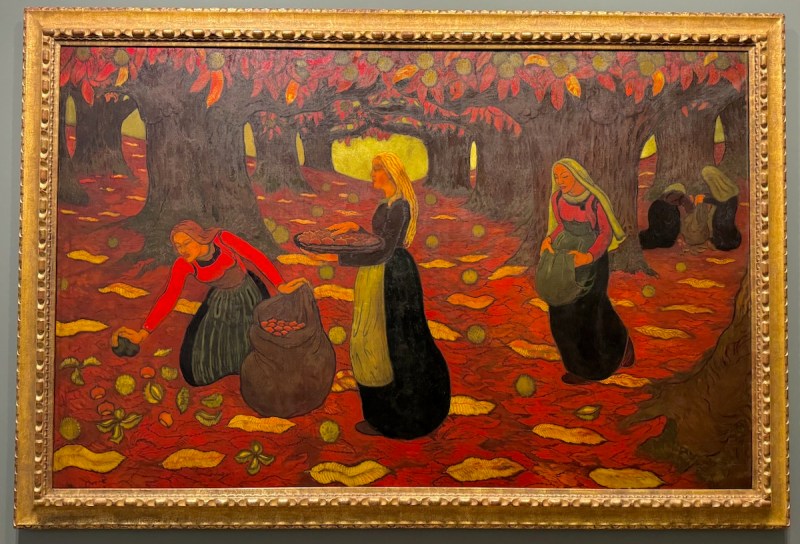
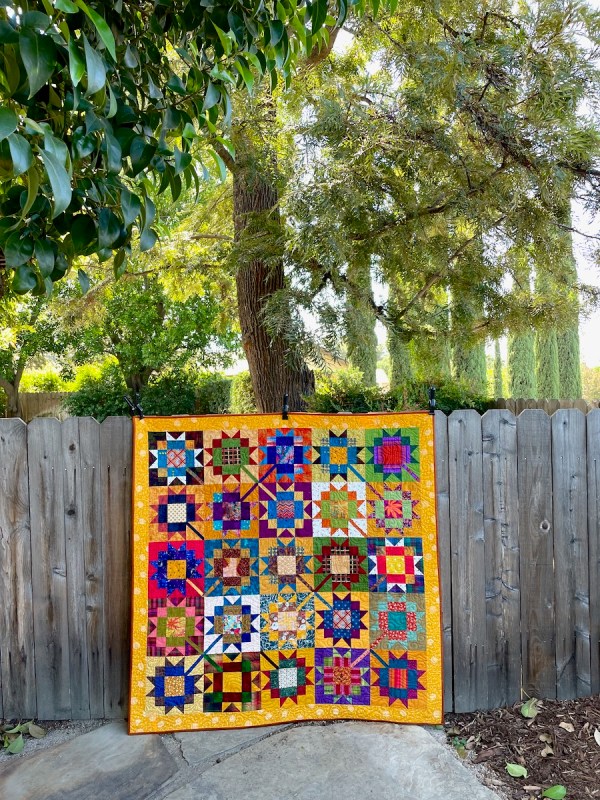
Autumn: The Chestnut Gatherers, 1894 by Georges Lacomb. Seen at the Norton Simon Museum.Autumn Leaves, original design More autumn quilts seen here.
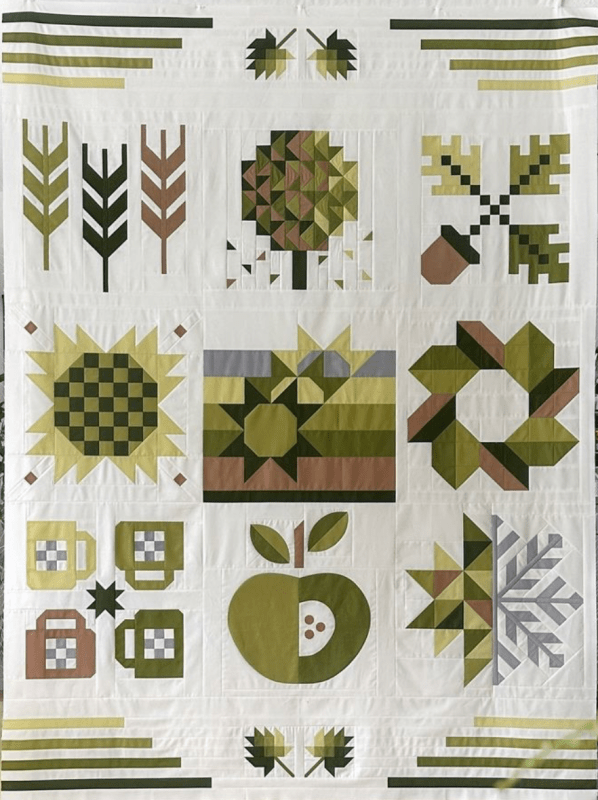
Why do I bring up autumn quilts? Because we’ve all seen these blocks from the #sweaterweathersampler2024 in our Instagram feed, an offering from some very talented women. I like the 2024 quilt offering better than their 2023, but they are fun to see pop up (check out this exhibit from some quilters in Germany). The one above is from Iva Steiner, an incredibly talented longarmer and quilter.
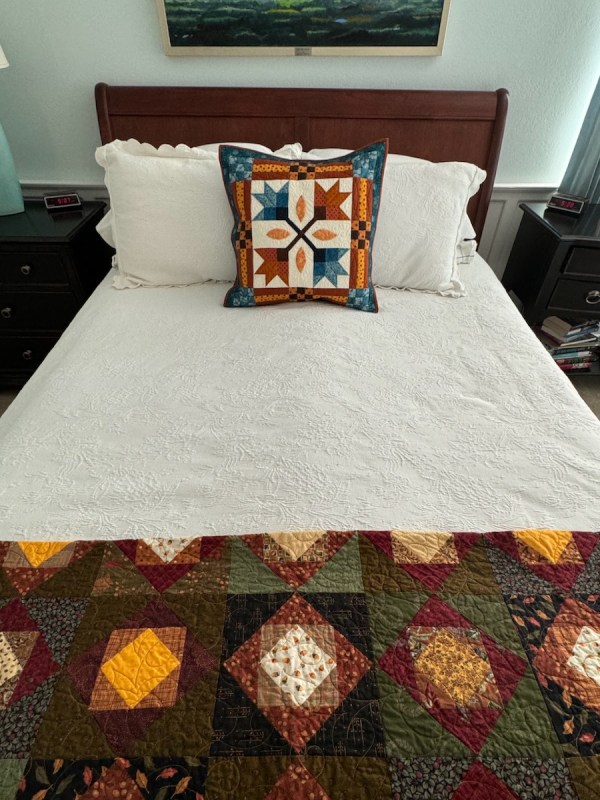
But, given the general season of thankfulness and thanksgiving, I’m happy that I like the autumn quilts that are in my house.
Given the general anxiety we all felt the past two weeks, I’m glad that the election is over and I don’t want to hear anymore about it for a long, long while. I was also feeling anxiety over quilting a very organic quilt that I’d made, and all my usual doodling wasn’t cutting it. My husband suggested just going with the flow, meaning following the lines of the organic fabric.
I guess I knew that in my heart, but it took my sweetheart to state the obvious: all those fancy geometric designs I was familiar with in my usual fmquilting just weren’t going to cut it with this one.
The back, a conglomerate of leftover fabrics. I have great light in my bathroom, so I take progress shots in there a lot.
Even in the border, I went organic, like blocks of waving grain, or striated boulders, or I don’t know what. Full reveal after I get the borders on.
I only have three hours left in this novel. I almost can’t stand to stop, but this morning I’ve got a lesson to teach to the church ladies, so things will slow down on the listening for a while.
But a good book can really get me to sit down and get the quilting done. I’ve got my eye on getting this one and this one quilted up and finished, too.
We’ve spent so much time in the last few months looking ahead, so I thought I would leave you with this quote, from Adam Miller from his book Original Grace: An Experiment in Restoration Thinking:
“Creation unfolds exclusively in the present tense. Nothing is created in the past—though the past was once present. And nothing is created in the future—though the future will eventually arrive.”
This quote has made me think, and ponder a lot. When our Instagram feeds are blitzed full of other people’s achievements and when we are battling one demon after another, it can make us long for days when we used to be super-charged in making, or looking forward to days when we can get to the machines and roll like crazy. But, as Miller notes, creation unfolds in the present. All that we take in now will be fuel for the creativity when we sit down and enjoy the stitching in a present-not-here-yet. We need days when we can stop and notice the autumn colors. Or take a few days to practice forgiveness. Or linger on some days to fill our heart with thanksgiving.
This month last year I saw an eclipse and cranked out not one, but two quilts to the quilter that month.
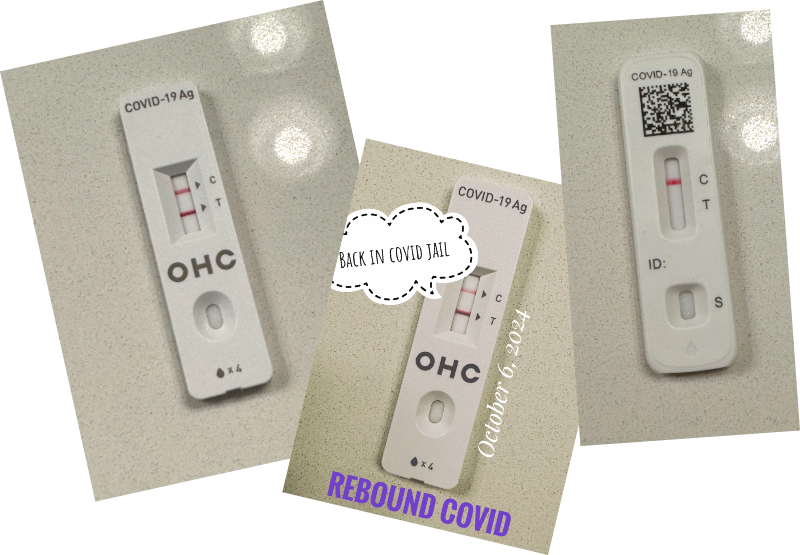
And this year?? A slog through covid, which still lingers with the double whammy of cough and fatigue.
So what a difference a year makes. Oh, maybe I’ve got a triple whammy with the brain fog, which is real. But at any rate, here we go with a This and That, which I haven’t done in a while.
Because I was just hanging around a lot, coughing, I read one book (Orenstein) on my digital reader, and one (Garten) in Real Book form. I learned a lot from both, including the tidbit that Garten and Martha Stewart at one time were friends. But mostly I loved a lot of what Orenstein wrote when she was making “the world’s ugliest sweater.”
“We hang by threads, we lose the thread, we pick up the thread, we have common threads, we thread through crowds, our reasoning is threadbare—and that is not even starting on metaphors involving sheep, wool, fabric, weaving, sewing, knitting. Textile analogies loom large in our world” (Orenstein).
and
She quotes Catherine McKinley, a writer and curator: “This idea that the end product is more important than anything [is] an erosion of something fundamental, of that intense combining of the spiritual with all the other aspects of our lives (McKinley, qtd. in Orenstein).
It was too hot in October, bookending our summer that began all the way in May, which was also too hot.
As you might suspect, this word appeals to me. I’m an autumn-sort-of-girl. (TIL=Today I Learned)
Have I sewn anything? I participated in a bee, and just about half the blocks were unusable. So with my fever-covid-fog (FCF) brain, I unpicked some that were too small and re-sewed them, I was happy I purchased more fabric than I needed, so I could make-from-scratch a handful more. One quilter had eye surgery and I was happy to make hers for her. I was sent some blocks half-finished, and finished them. Some blocks were a couple of weeks late, which gave me angst because of my FCF-brain: I’d grabbed a slot with my quilter so I could have this back for the holidays, and time was slipping away. I decided, in the end, that maybe I’d picked too complicated of a block for some of the quilters, or maybe it was just a bad-karma month for a lot of other people. That happens. But in end, as with most quilts, Mercato Square was finished. I sent it off, after agonizing about which quilting panto to use. Stay tuned.
I sewed my October blocks and November blocks for the bee. One more month to go. I put a tip-sheet on how to make the strawberries and it’s a free download. The block on the right has been around for a while and pops up in different iterations.
Here’s the first example I have for you, from 2013, and I screen-grabbed some of what this quilter wrote:
The above is from a blog titled D & D Adventures (it’s defunct now).
I did a version of cut-block-insert-strip, Criss-Cross Quilt, that uses larger blocks, some with the insert going diagonally and some, vertically/horizontally. I don’t know if you remember, but there is a 31%-off coupon for any one thing in my pattern shop, so if you want this version (or something else), grab the coupon and get it (it expires on Halloween).
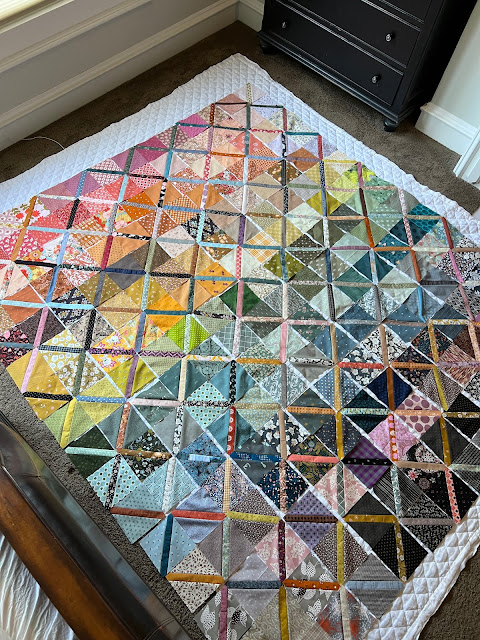
This time around, the Queen Bee sent us to Amber of Gigi’s Thimble, where she has a free tutorial, and her quilt (shown above) is so beautiful. I’ve used Amber’s tutorials before and they are solid. Speaking of quilt patterns, there was a recent kerfuffle online about a pattern maker who resisted the idea that other people could make patterns similar to hers (not copied…just similar). I think, unless it’s a direct plagiarism, ideas get recycled and re-worked. I also check Barbara Brackman‘s Encyclopedia of Pieced Quilt Patterns. If it’s in there, it’s been done before.
And I don’t think I posted about these blocks?
These were spools blocks done in April, and I made a tip sheet for those, too.
from here. Lisa has all the blocks arranged from the Gridster Bee. These are large blocks, not tiny, and what a good way to use up all those long skinny scraps of fabric!
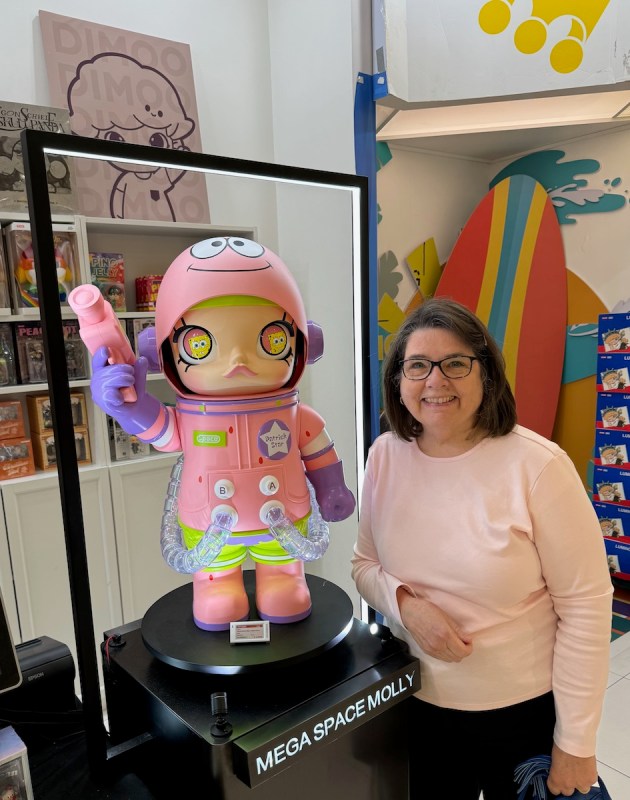
For silliness’ sake, I opened one of my Molly blind-box toys. It was one of those days when FCF-brain was in abundance, I was tired, oh, and about a billion other things, and it was only lunchtime. I make a big deal out of opening these little toy boxes (Baby Molly stands about 4″ tall) by taking it in to sit by my husband in the office and asking him to watch. It was love at first sight with this version, but the motto on the card told me everything: “I can handle it.” (Like, get a grip on things.) The Molly store is far away from us, so I bought two and saved one for Bad Days. Or Good Days.
I have been a collector of political trinkets for ages, even buying one for George Bush from a vendor on the street when we travelled in China in 2001 (after the fact, I know). I have a tin in my trunk holding badges going back to Nixon, the first President I ever voted for (my generation was the first batch of 18-year-olds to get the vote). So when Carol sent me these, I am quite happy to wear them to wherever I go, trying to put country over party, having voted both ways in my life. But won’t we all be happy when these interminable election cycles go away next week!
Please notice I am wearing my Halloween vest in the photo above. I get to wear it about 3x a year, and it makes me smile.
Last October, I was also in Bologna eating persimmons with nuts for breakfast. My husband, Dave, found some more persimmons here at the street market, and we’ve been enjoying them. We peel them, dig out the giant seeds (some varieties have them, some don’t), cut them in half and add a few nuts. Be sure to wait until they are really really soft. If you have a tree, here’s some info and then my version of Persimmon Bread.
I had to look up when my mail-in ballot would be counted. It’s been counted! We’ve used mail-in ballots for a while, and they are so convenient. Last cycle we took them to the drop box at our county building, but this year? The mailbox in front of our own home was so appealing to this FCF-brain. But on balance, we have stupid stickers. After seeing other states’ versions online, our state needs to step up its game.
This year I’ve seen several quilt-a-longs (to get the free patterns you have to agree to sign up for the mailing lists of all the people involved). This one that I’m interested in right now, the #sweaterweathersampler, led me to the QuiltScouts, where I found these badges and stickers. They have more badges, but they ask you to be “on your honor” in buying only the ones that apply. I qualified for most of them, which is what happens when you’ve been quilting for a bazillion years.
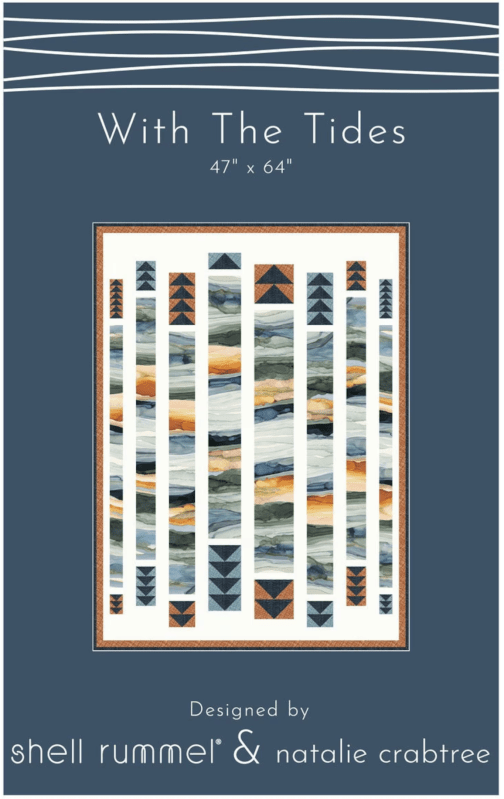
On a day where I was feeling better, I opened up my bin of painterly fabrics that I’ve been collecting for a while. I had wanted to make the first pattern (below).
But since they didn’t have any of that panel left I improvised, still using fabric from Shell Rummel (along with William Reue, and snippets from Deborah Edwards & Melanie Samar). I just noticed they’ve updated the pattern (on the right) to accommodate the newest panel and line. My only advice is to lay it out on a large flat surface when stitching everything together. I just sewed, like normal, and when I finished, the left side of the quilt was about 6″ longer from the right, and I still can’t figure out how that went wrong (FCF-brain?). But I fixed it, and have finally figured out how I want to quilt it.
This is me, on the patio of our City Hall building on the Saturday where I went from “being over covid” to feeling crummier and crummier by the end of our tour and rebounding into covid, a surprising frustrating experience. But at least I have this cool photo of this inset medallion, because you know us quilters: always looking for pattern and color wherever we can. And I’m happy to have covid in 2024, not 2020, when we all suffered through the horrific pandemic. And interestingly, that’s the time period of Peggy Orenstein’s book, which brought to memory how awful it all was, and to what a debt we owe so many who took care of us all.
I’ll leave you with a quote from Orenstein, when talking about the mortification of being judged (often harshly) for what we make, which often discourages us:
The alternative, and the best defense against those potentially psychologically lethal blows, is to focus more on experience than evaluation: to resist “good” and “bad” altogether and instead ask questions, identify what works, wonder what can be improved. It’s recognizing that the gift of creativity is in the way it challenges you, allows you to make meaning, enriches your life.
Carrefour Quilt Show was a lively, interesting and fascinating experience. This final post is about two different places in the 29th Carrefour European Patchwork Show (2024):
Espace D’Exposition (Venue 15): EQA’s Imagine a Bird, France Patchwork guild quilts, Threaded Together, Justine & Cow, Marina Landi, Artextures
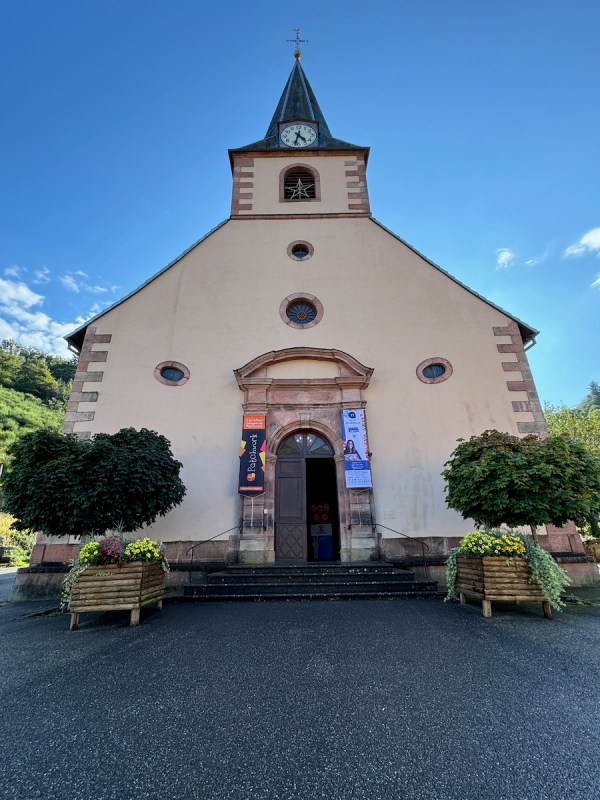
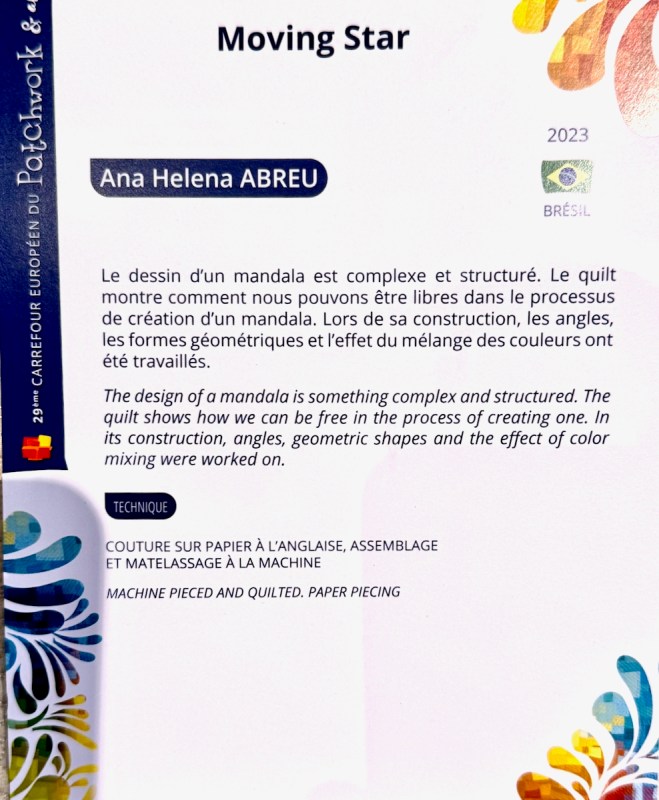
Église St. Rosalie (Venue 17): Ana Helena Abreu
A full listing of all the artists is found on the European Patchwork (Carrefours) website, here. Click on 2024.
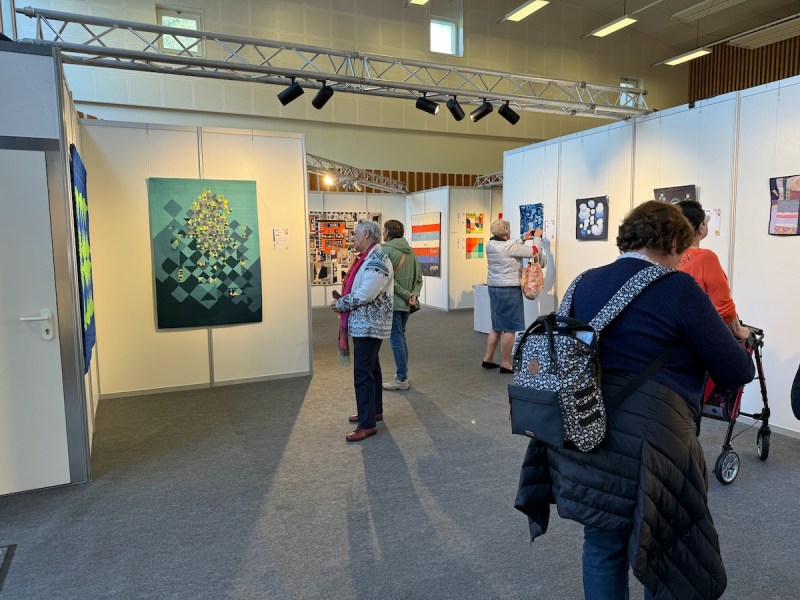
Both times I’ve been to this show, it has rained, so when the skies started drizzling, it wasn’t unexpected. (We love rain, as we live in an area that doesn’t get much.) Last time, I was in the vendor tents, so I was happy this time I was in the car, driving to our last set of exhibits: Venues 15, 16, and 17. By this time in the day, we are getting tired, but don’t want to quit (sign of a good show!).
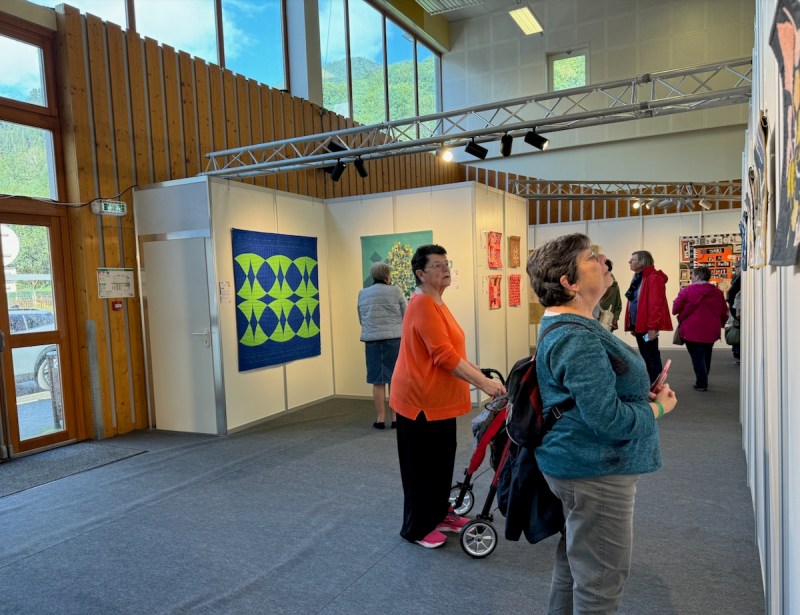
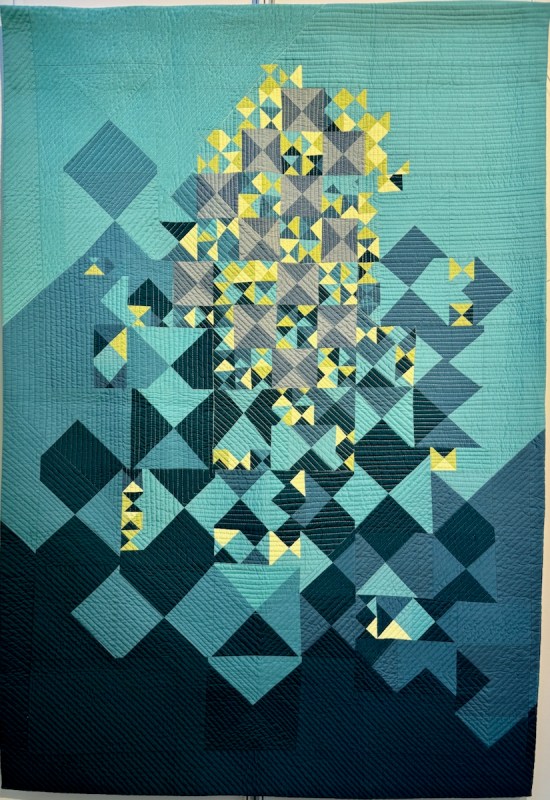
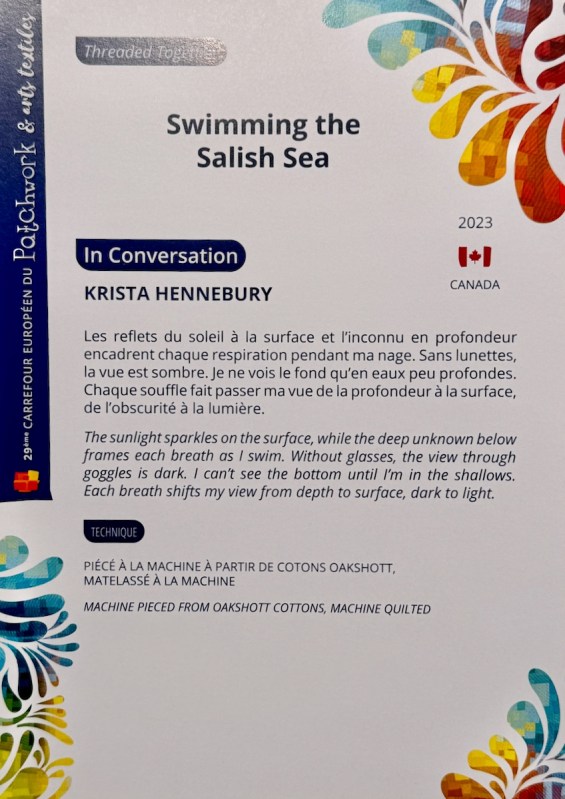
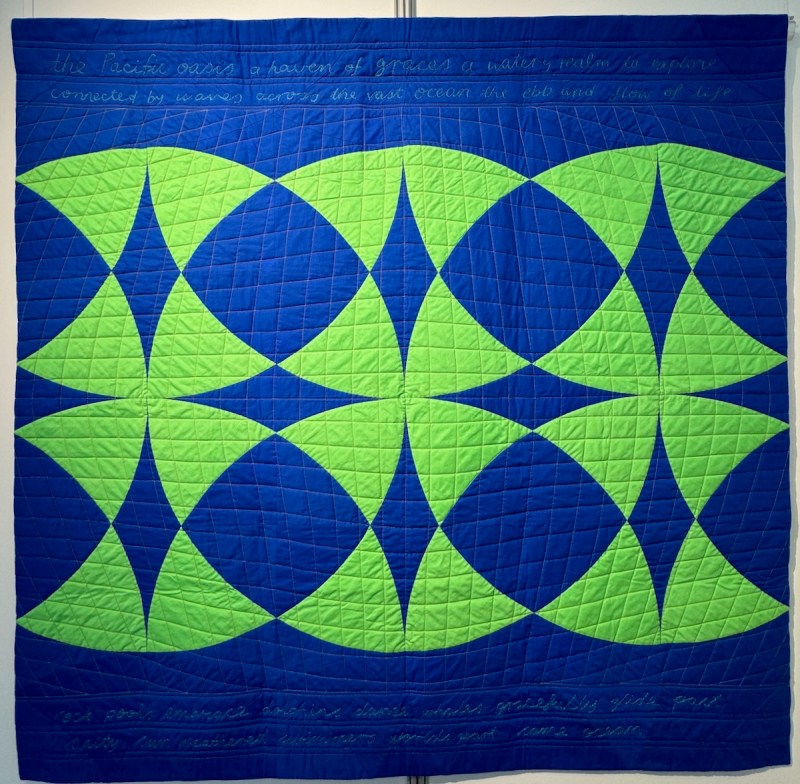
Just inside, everything is light and bright. The first quilts we saw on the left were the quilts from Krista Hennebury of Canada, and Lorena Uriarte, from Australia.
They were part of an exhibit “In Conversation/Threaded Together.”
Click to enlarge any of the gallery images.
We moved quickly to the next grouping, and I thought this quilt was fascinating, but I forgot to photograph her partner’s quilt.
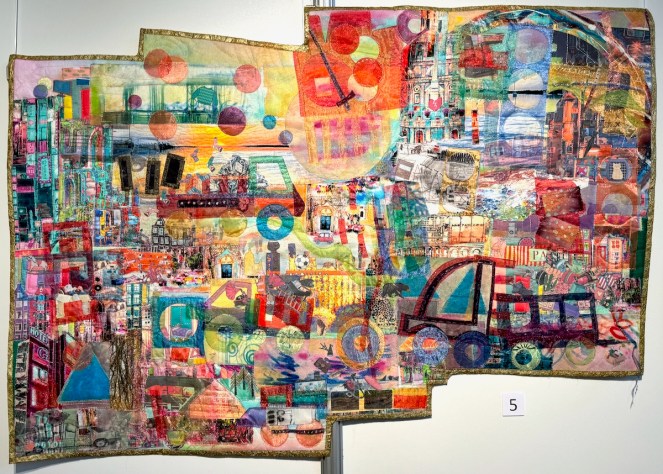
A series of minis, all in conversation. Please click to enlarge; unfortunately the expired address above for the tinyurl doesn’t take you anywhere.
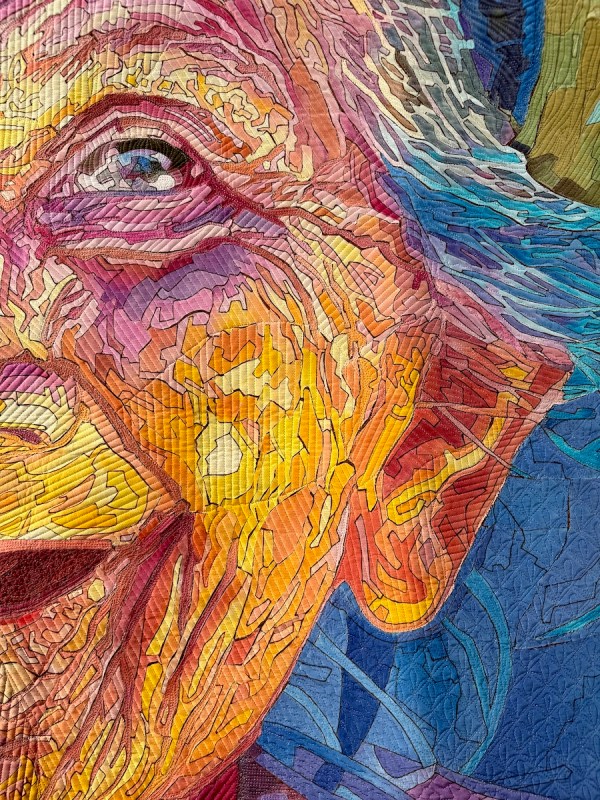
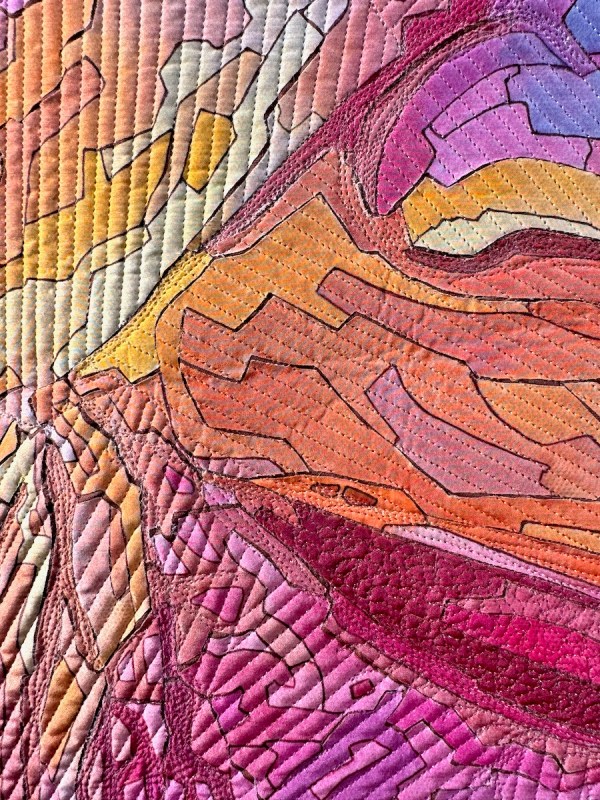
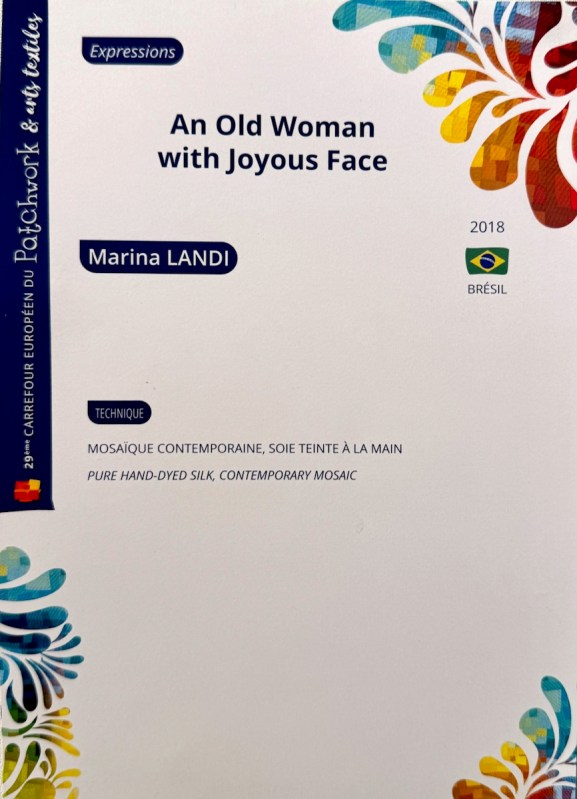
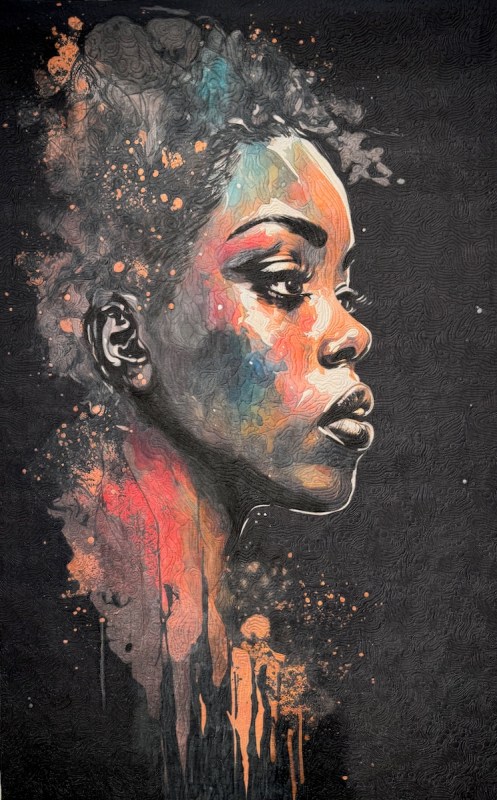
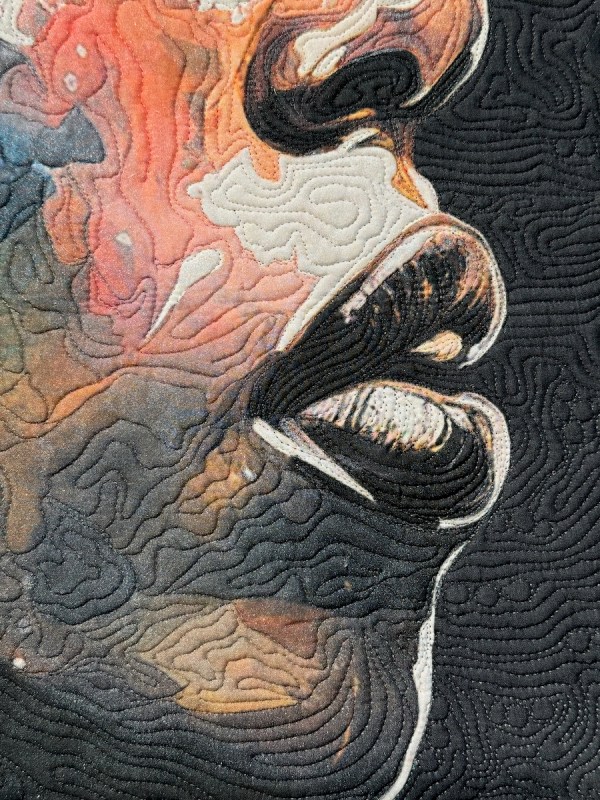
An Old Woman with Joyous Face, by Marina Landi was a fascinating layering of texture and color and quilting. Her skills with this were fascinating, and amazing. Close-ups, below:
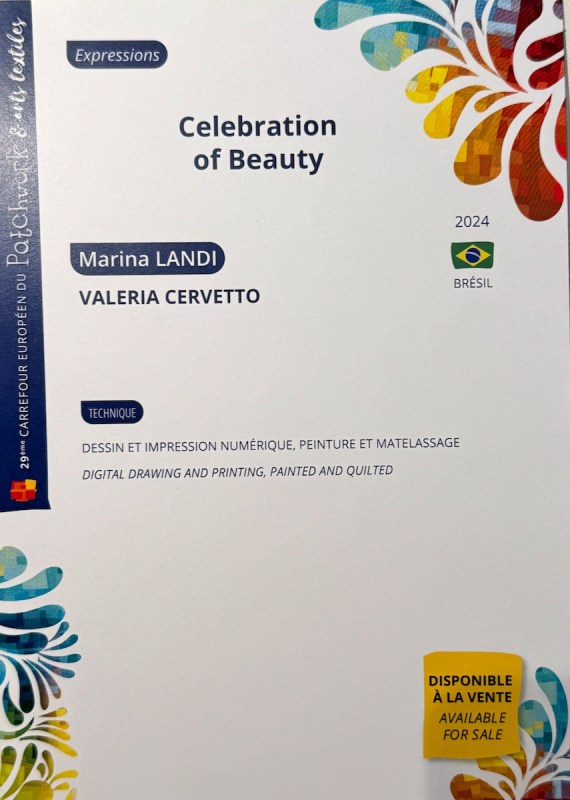
It looks like she layered snippets of a silk fabric onto a darker background in a tight mosaic, then quilted it in directional lines. In her title card (below), she noted that the silk is all hand-dyed.
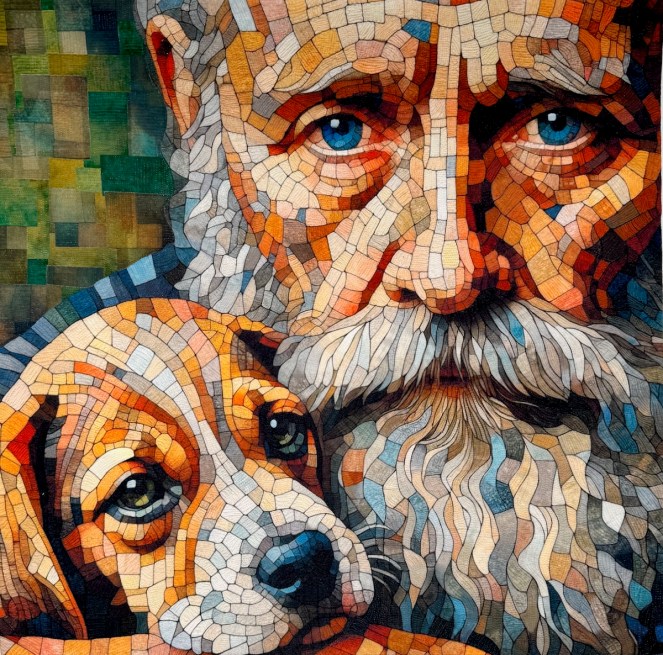
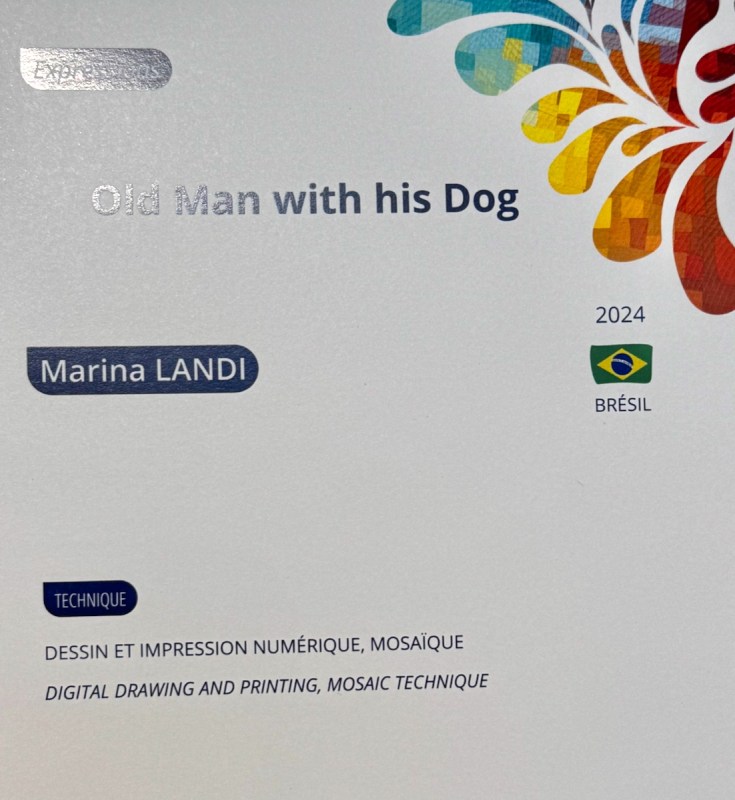
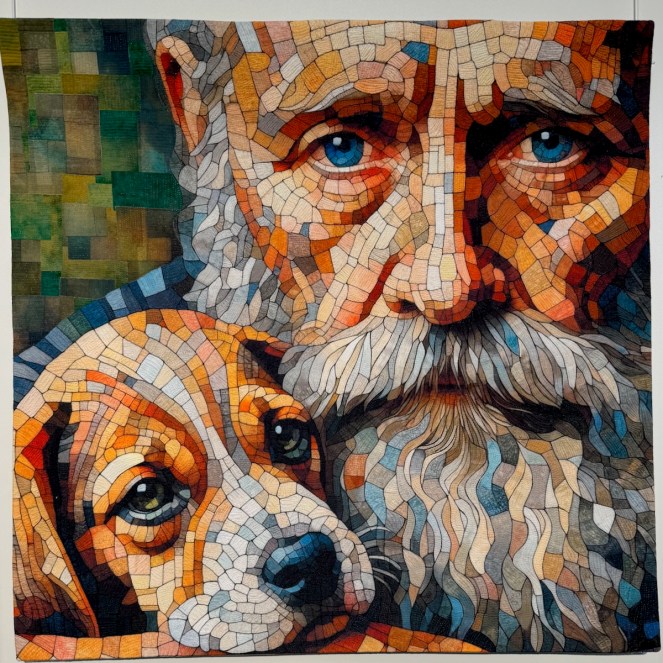
Old Man with His Dog, by Marina Landi.
This one has the same look, but instead is digitally printed; because of this, it has a softer definition. I was cropping all the quilts to give a clean edge, but below I show it uncropped so you can see the faced binding.
Summer Wind, by Marina Landi.
Here are a couple of quilts from France Patchwork.
The one just above is from the Milan series by the fiber-art work artists Daniela Arnoldi and Marco Sarzi Sartori, (DAMSS). They work in tandem; here’s an article I found about them, and their website is here. I loved how the threadwork depicted the Milan cathedral.
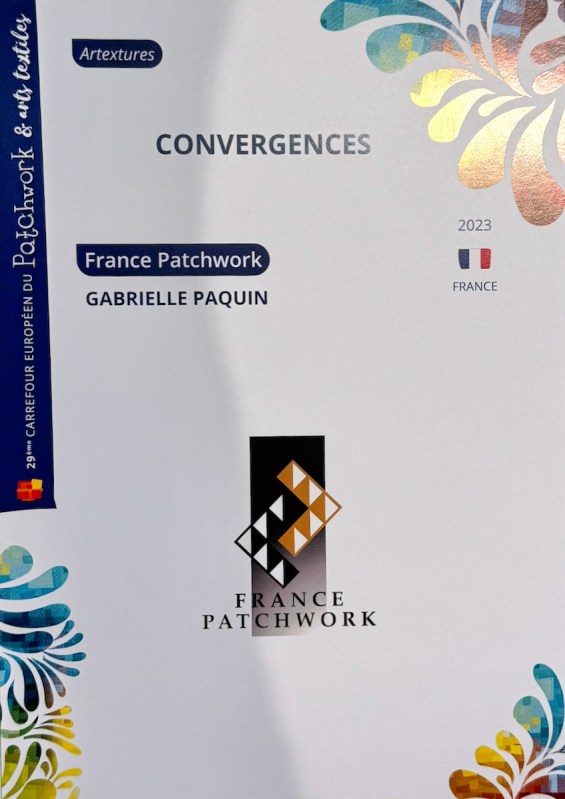
Gabrielle Pacquin, one of my favorite European quilters, had a quilt here in the France Patchwork exhibit Artextures.
Arc en Ciel de Lit [Rainbow Bed] is a quilt published in Issue 158 of the magazine for France Patchwork, Les Nouvelles. They publish this magazine quarterly, and if I could read French, I’d be subscribing. Their website can give you more information (and it can be translated by Google Translate, if your French-language skills need an assist).
Hiver Douillet [Cozy Winter], published in Issues 157-159. I will sometimes hold my hand floating above the quilt so you can get an idea of scaled. Look at those tiny pieces!
Les Pas Japonais d’Antonin [Anton’s Japanese Steps], published in Issue 160.
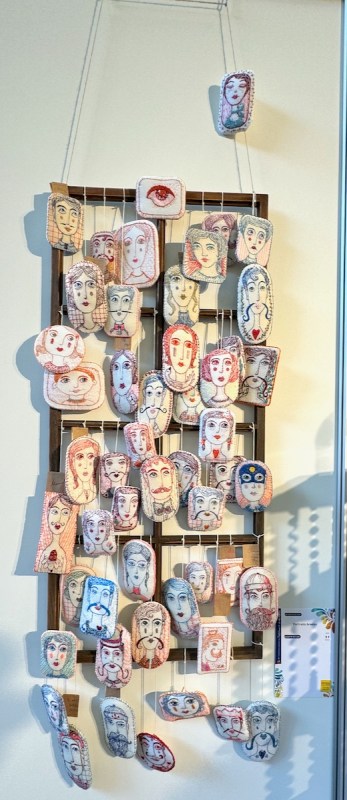
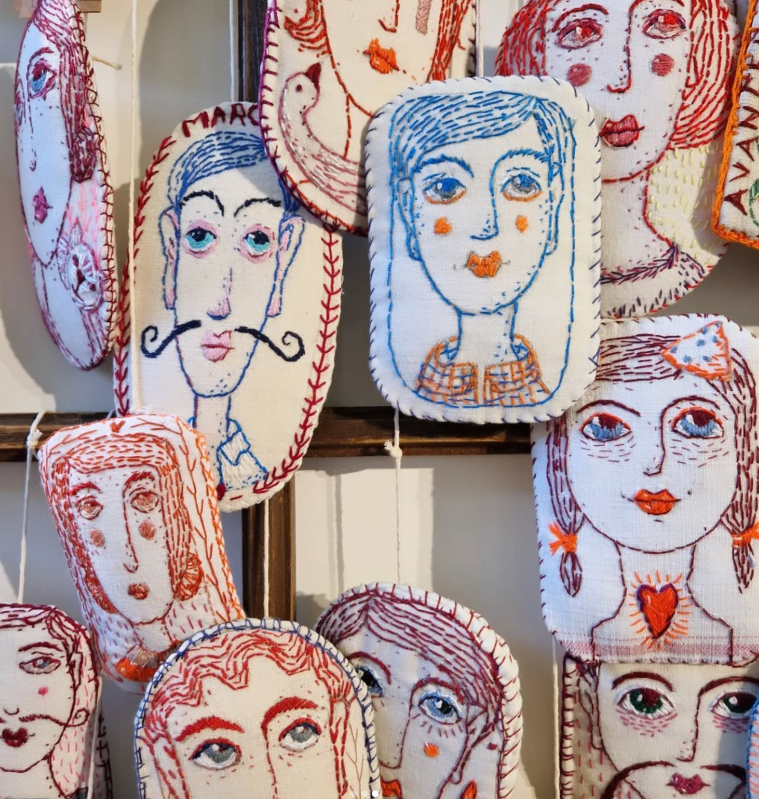
Now we’re heading into the Let’s Have Some Fun section. I loved this family tree, of sorts. It’s named, simply, Embroidered Portraits, and is by Justine & COW. I found her on Instagram, and a post from the time of this show said:
“Obviously, my Amish friends are my Amish.” SMAM, the cradle of the Amish movement.
(SMAM = Sainte-Marie-Aux-Mines)
Take some time to visit her IG and be prepared for some lovely embroidery from the Alsace region of France (where this quilt show is held). Detail from her IG post is below.
Now do you understand why I think it is so lovely to go to France and to be introduced to all these new ideas?
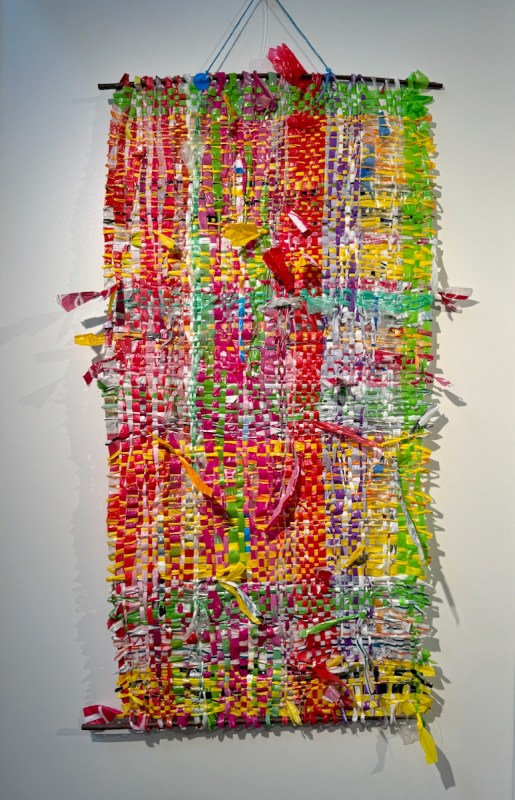
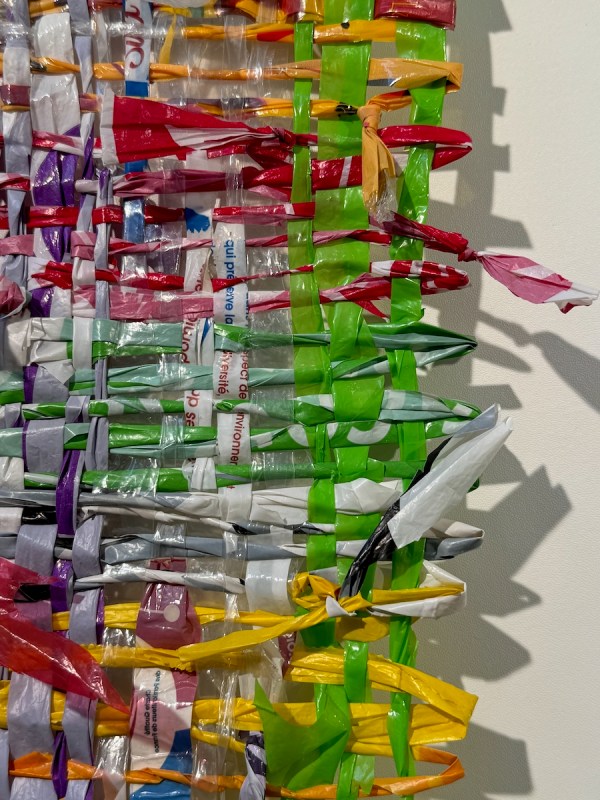
Something to do with all your bags. Corinne Prévotel from France Patchwork wove this, again in the Artextures section. She had two there of this style, and called it Suite.
Lever le Voile [Lifting the Veil] by Ghislaine Berlier Garcia, from France Patchwork.
The title means “Moving.”
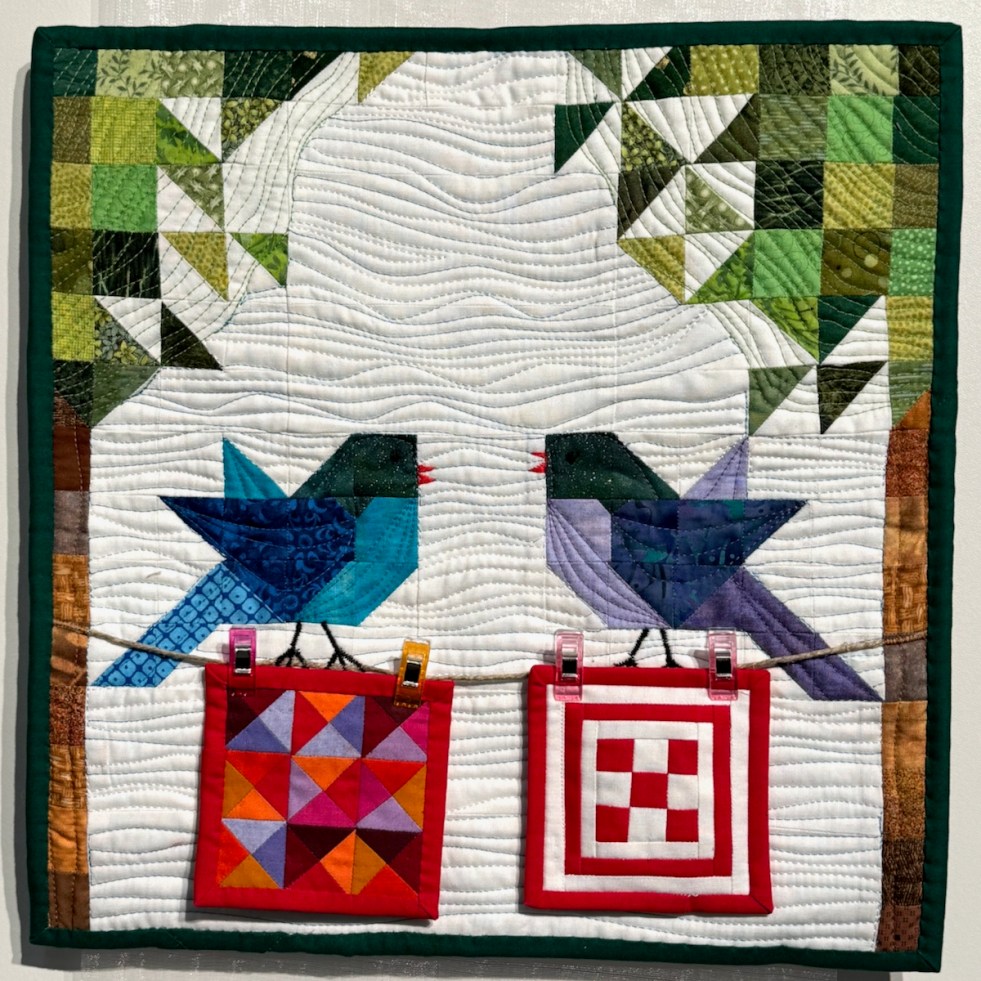
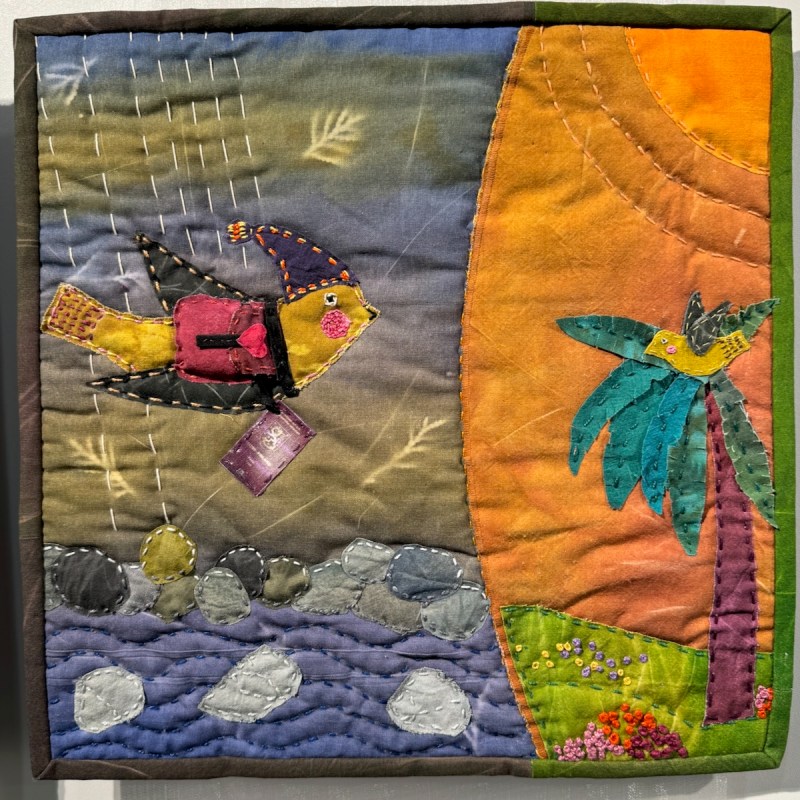
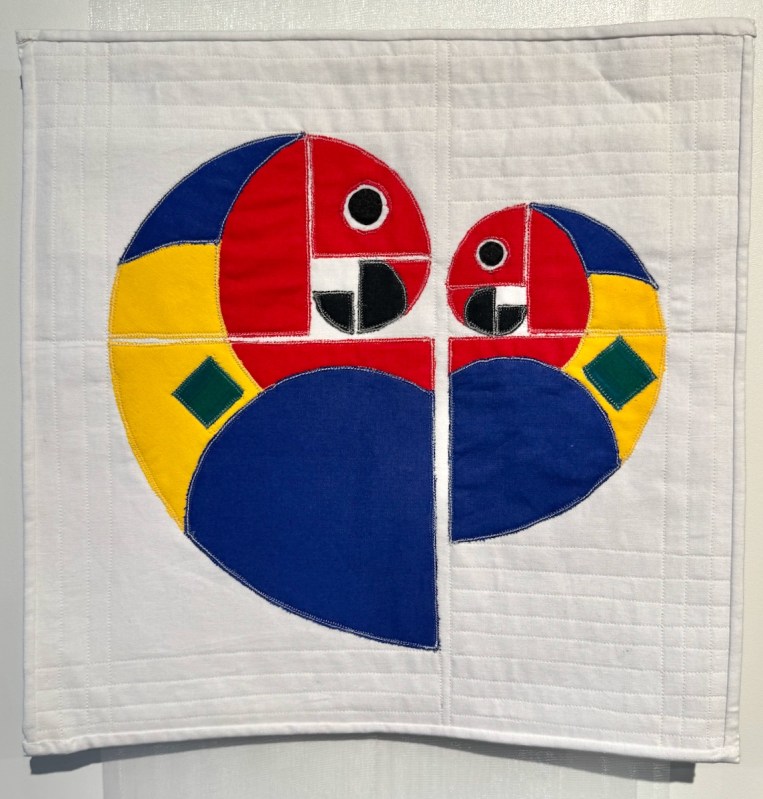
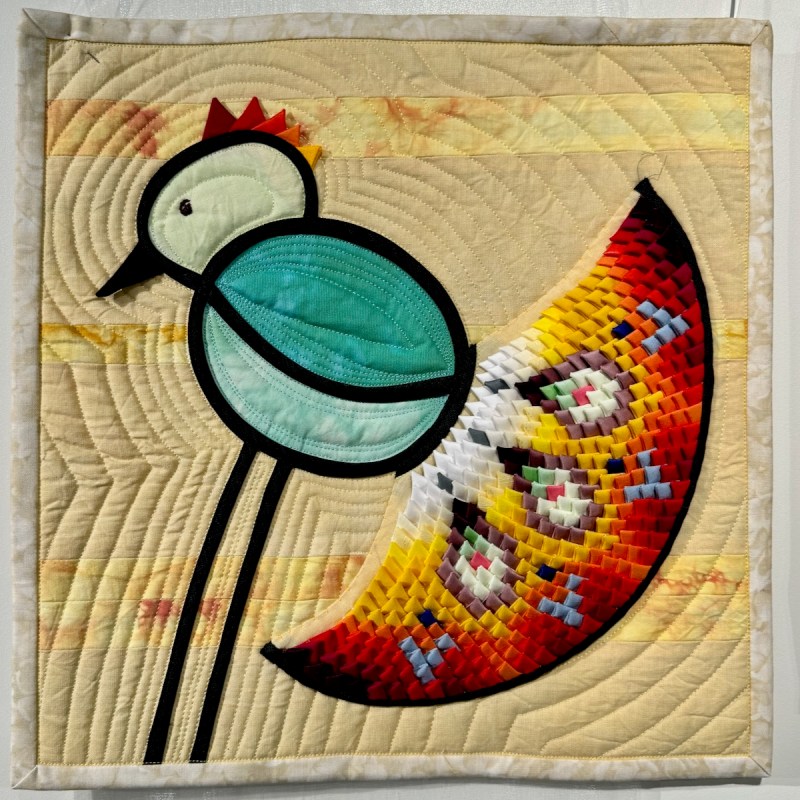
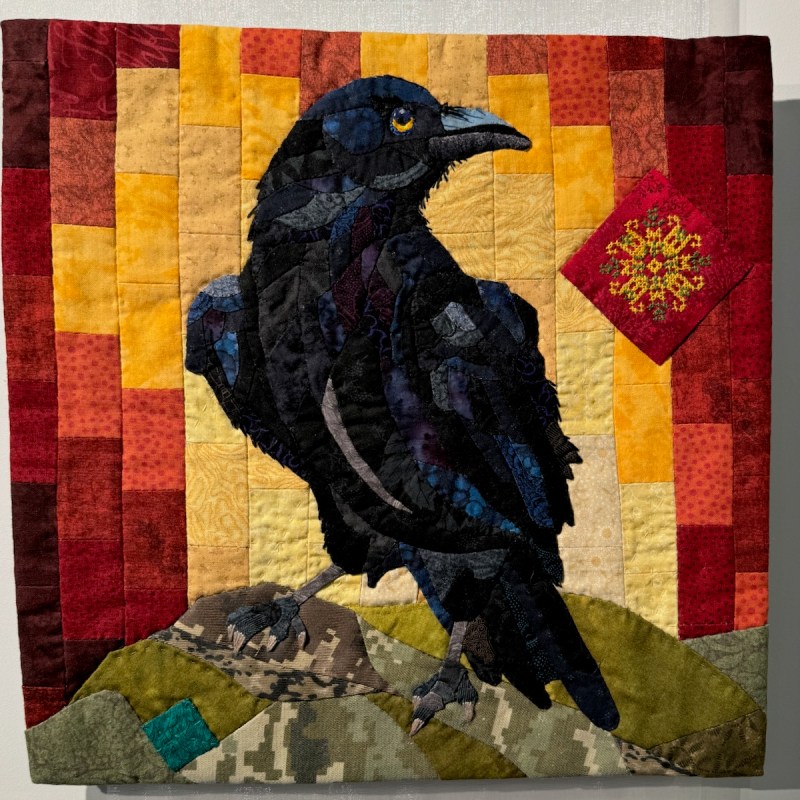
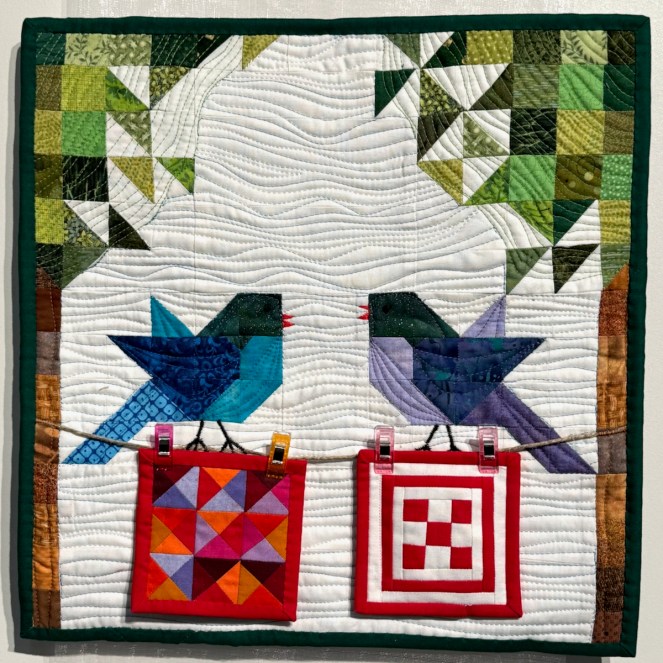
Around another corner and we find the EQA (European Quilt Association) exhibit of “Imagine a bird.” All these little mini quilts were wonderful and it was hard to choose just some to photograph.
Of course I loved this little one, with quilts on a quilt.
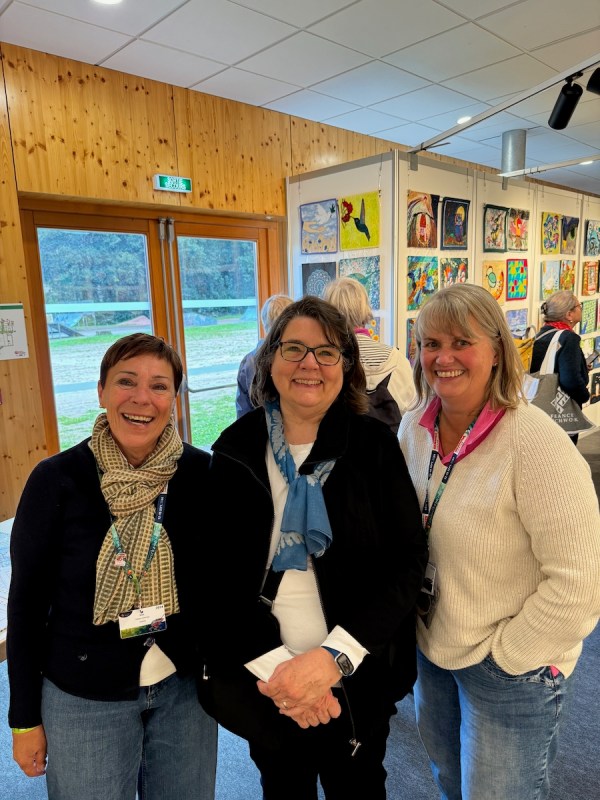
On the left is the representative from Italy, and on the right is the EQA person from Sweden (hope I got that right). I had a wonderful chat with them, talking quilt stuff around the world, as I was especially interested in how their guild quilt shows were faring after COVID (I was last here in 2017, before Covid-19 slammed the planet). The lady from Sweden told me that their last show before 2020 they had about 80 vendors. And now? they had only one in 2022. We talked about the factors of attrition, as well as vendors aging out of the business. I told them that our local shows were equally diminished, and wondered if they would ever recover. It’s good to get an understanding of how we quilters are faring all over the planet, yet also really lovely to find quilters all over the planet, too.
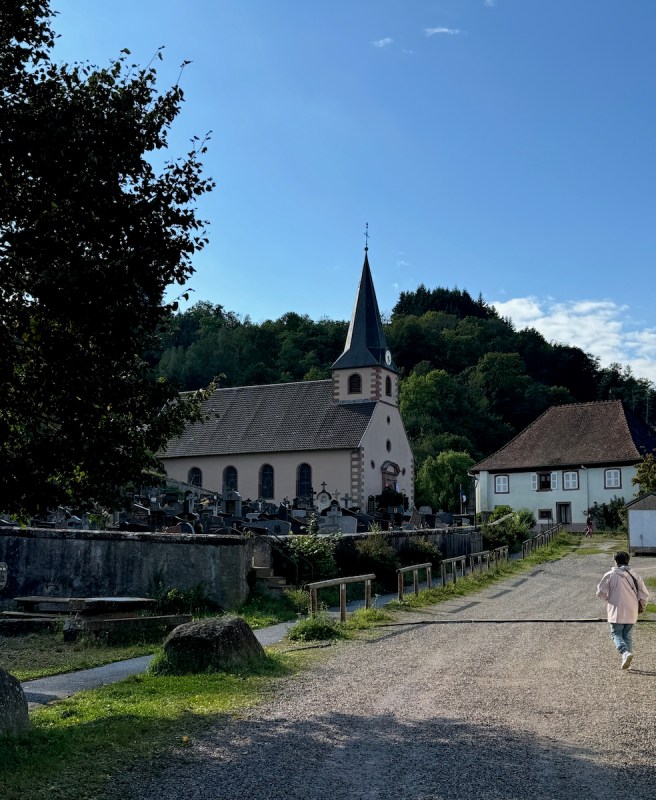
We climbed back in the car, the sun shining brightly, and head to our last stop: Église Ste. Rosalie, a small church in Rombach-Le-Franc. Yes, I am not posting every space or exhibit, so you’ll have to go there to see it all.
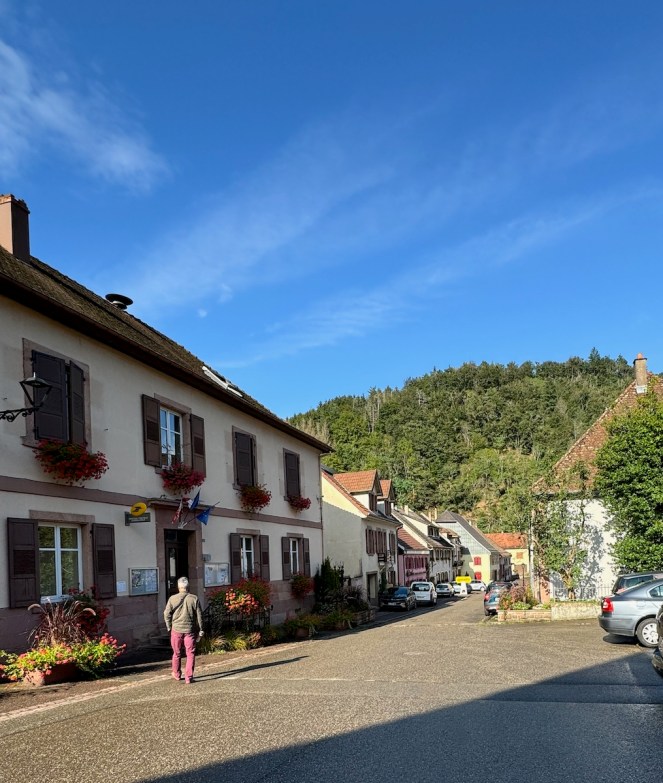
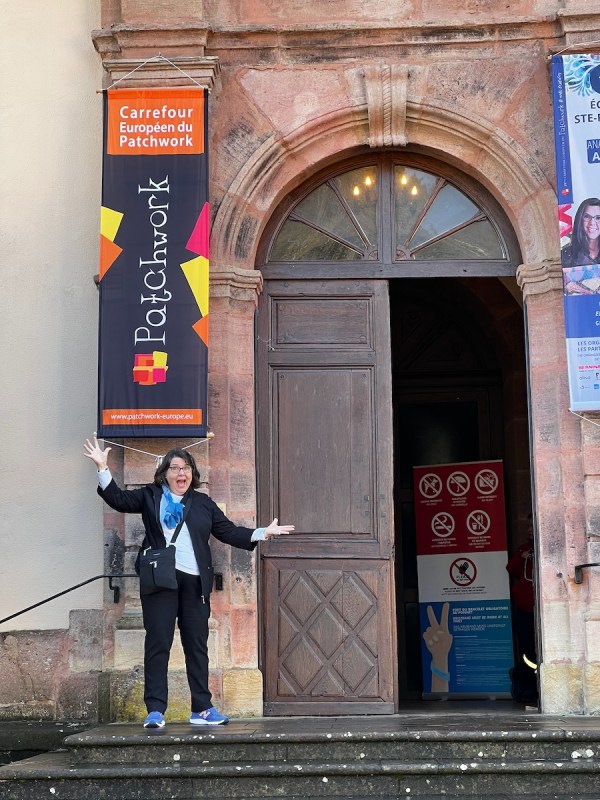
I’m standing just in front of the church, this little lane of this little town all bright and sunny.
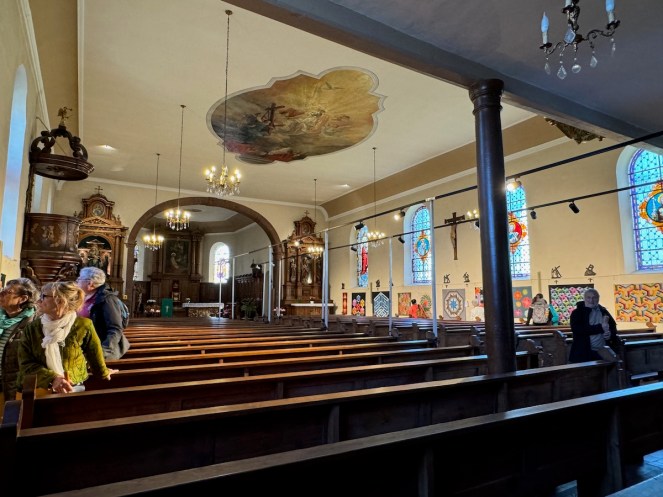
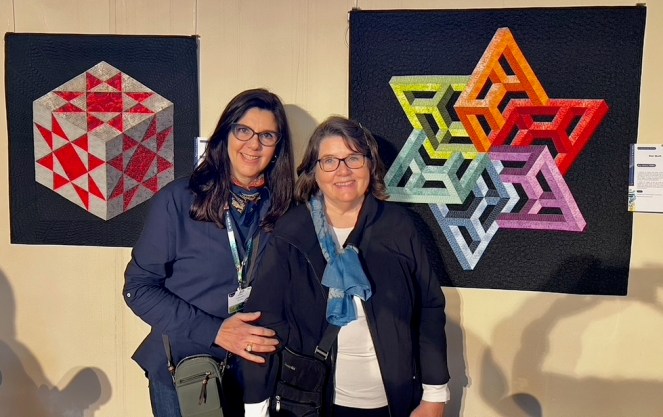
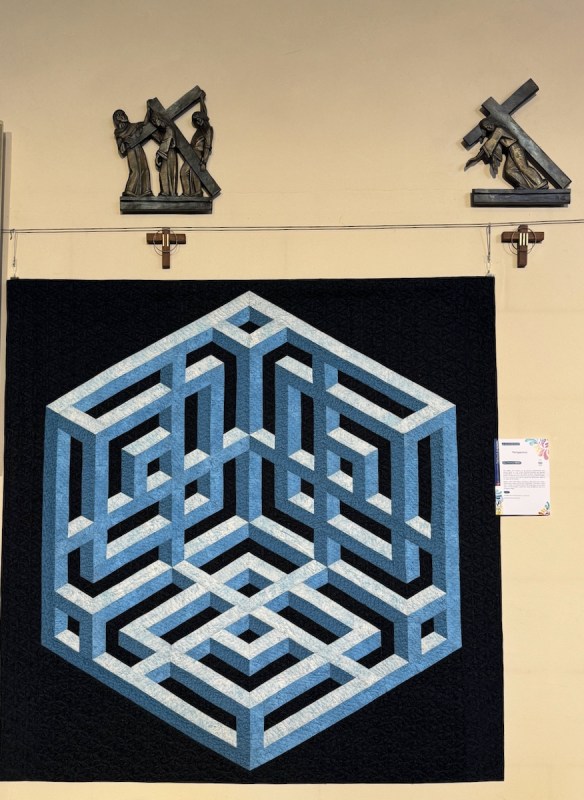
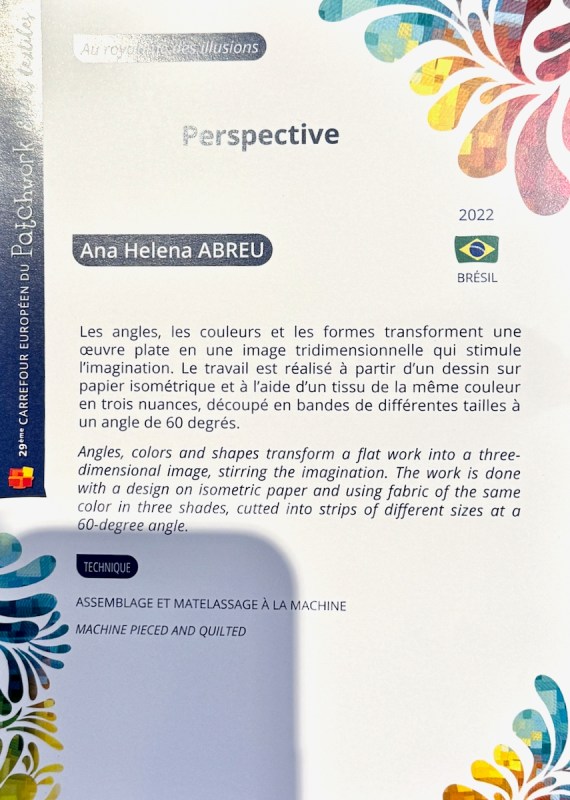
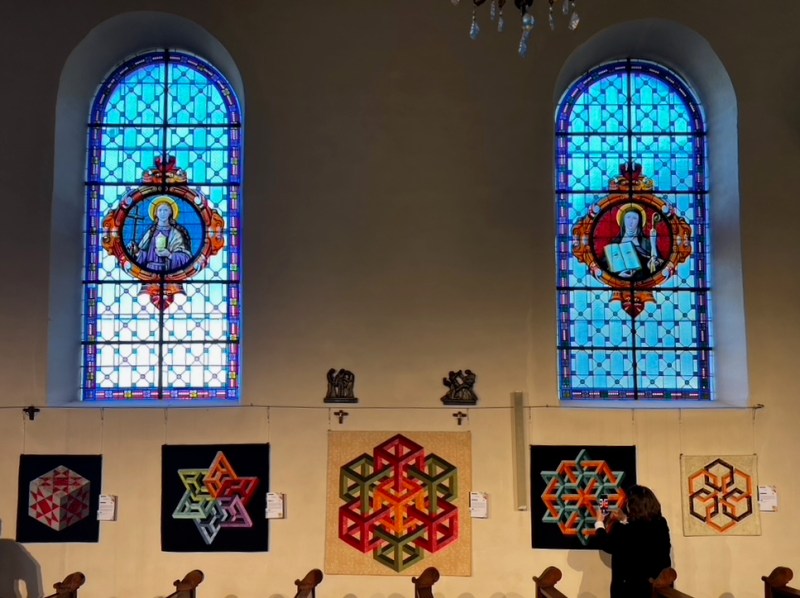
I just want you to get a feel for how this quilt show is laid out. We are here to see Ana Helena Abreau, a woman who excels at geometric art in quilts.
As you can see, all the quilts are well lighted.
Even though I don’t speak Portuguese, and she didn’t seem to speak English, we used the time-honored communications of patting our hearts, and me, gesturing to her amazing quilts, while nodding and bowing. You can find her on Instagram.
I loved seeing her quilting, too.
Sorry about all the shadows — the lights were bright and helpful, otherwise!
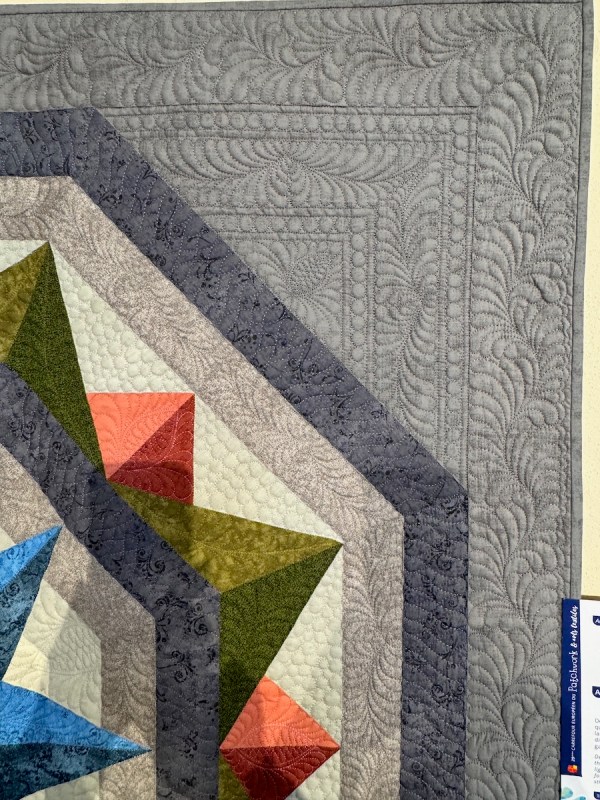
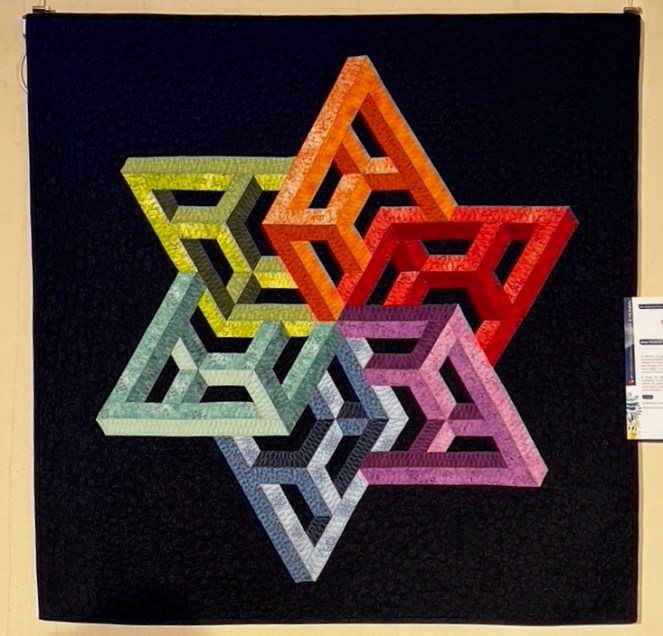
Star Quilt, by Anna Helena Abreau. Machine pieced and quilted.
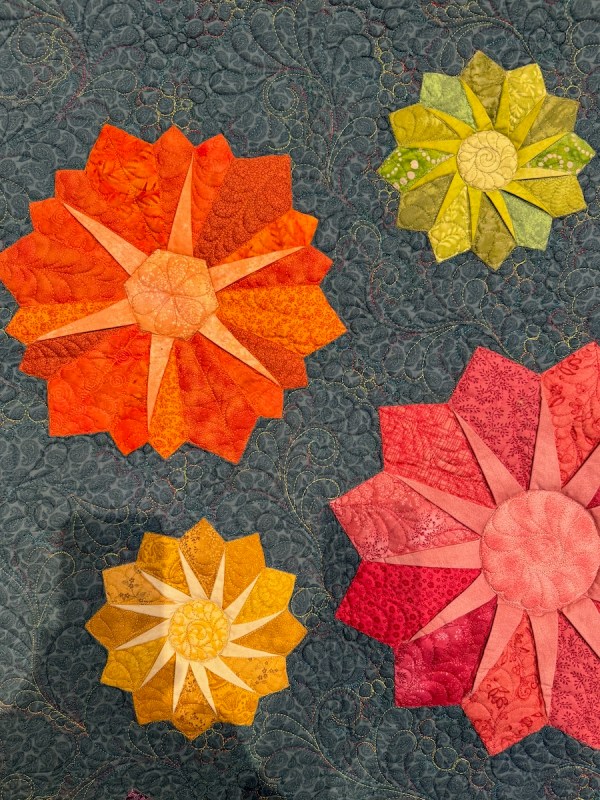
Dresden Flowers, by Ana Helena Abreau. Machine pieced and quilted.
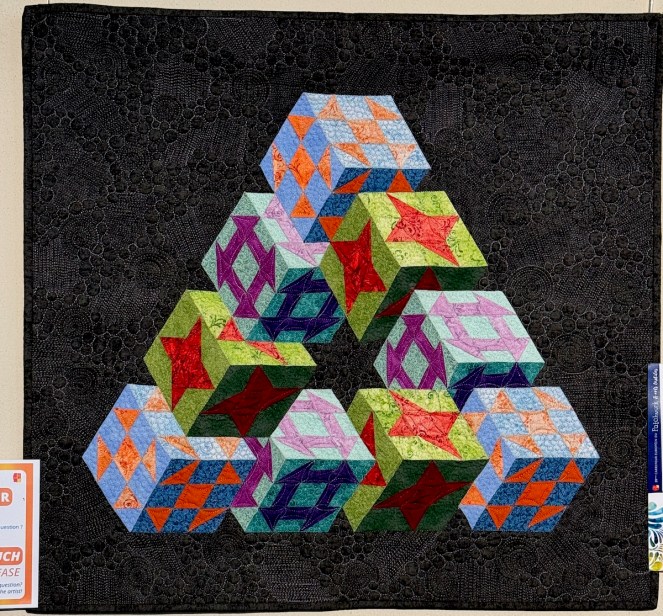
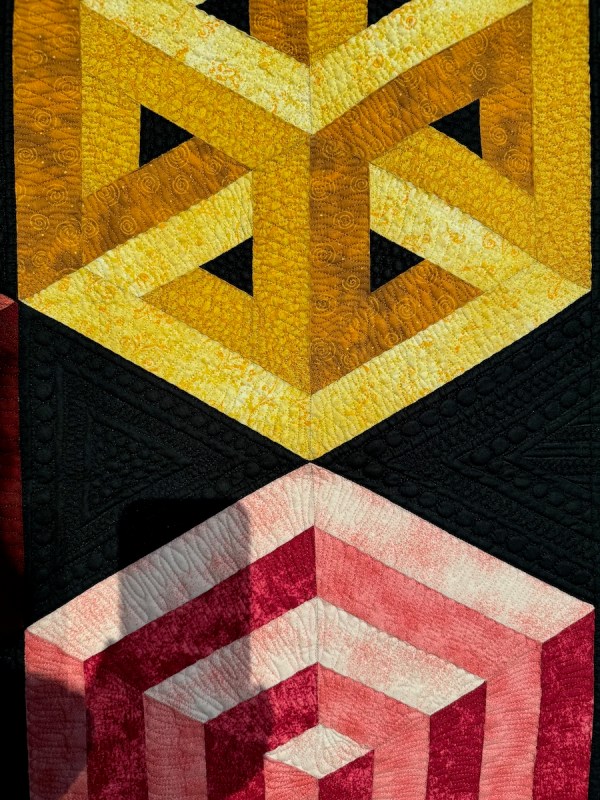
Magic Cubes, machine pieced and quilted. Details of quilts, below:
And that’s it!
(Yes, I was the ham in my family.) It’s almost closing time, and we still have to meet up with our daughter and granddaughters and find some dinner. I’ve already put a wish out there to come back for their 30th anniversary of the show in 2025, and to enjoy this beautiful valley one more time. Happily, we’ve made our plans and our reservations and we’re set. See you in September!
Happy Quilting in a Different Land–
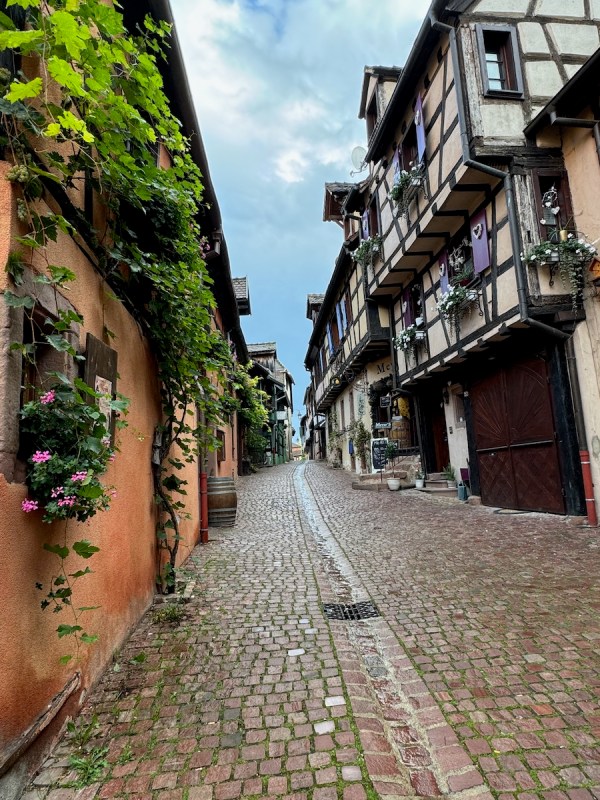
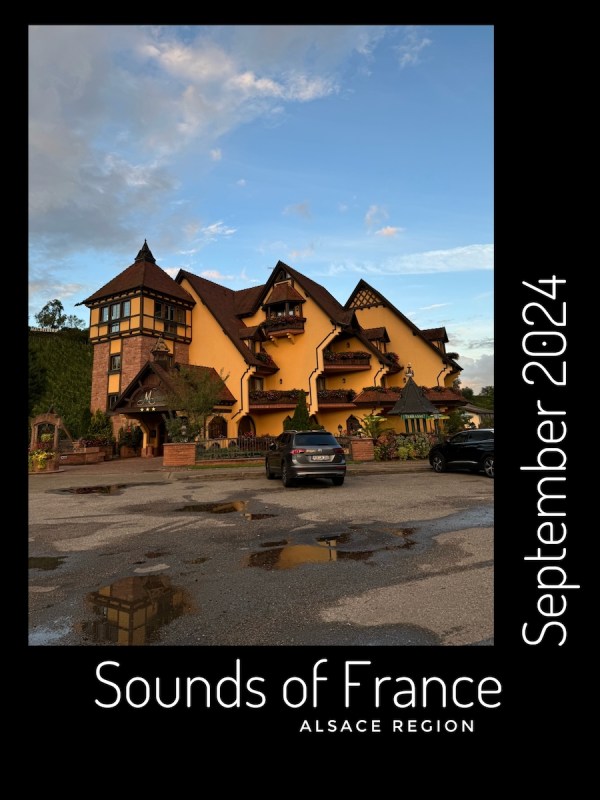
To get to the Alsace region:
We fly Delta from our nearest city direct to Paris. Land. Clear customs, and walk towards the train out along the long hallway following the signs, and take the escalator downstairs. Stop at Paul for refreshments, if you want it. Their food is consistently delicious. We use our Apple watches to pay for things in Europe; they are pretty seamless and common and it’s nice not to have to change big sums of cash.
Wait for the train to Strasbourg to flash up on the overhead screen, and then with ticket in hand, check-in and head downstairs.
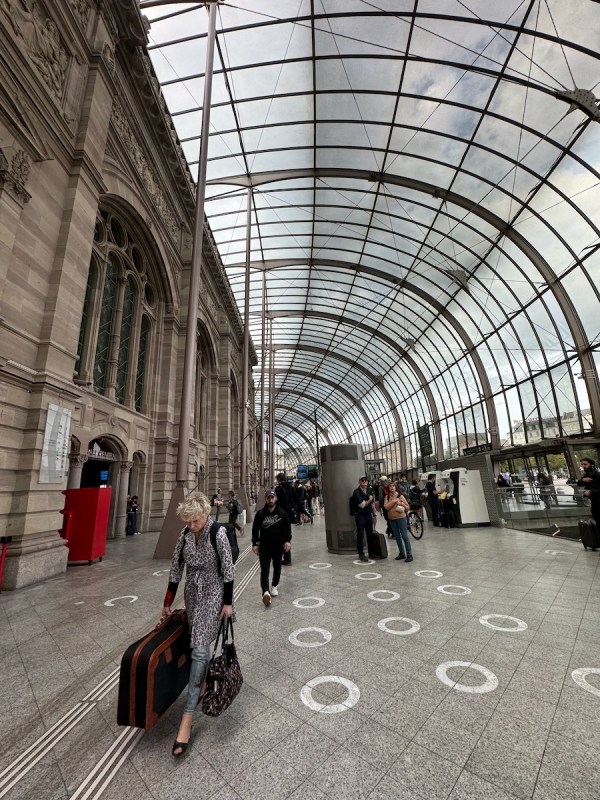
We took the train to Strasbourg, about a 2-1/2 hour ride. Yes, we were just exhausted but a nap on the train helped get us through. We arrived to an old station completely encased in plexiglass gift-wrapping, or so it felt. We picked up rental cars there for the drive to our hotel in Mittelwihr, about another 35 minutes.
It was lovely. Our trip tag on Instagram. This post shows the whole arrival steps. I think once you get over the whole “it’s so far away” business, the journey becomes an adventure.
This past trip, after our time in Alsace we headed back to Paris, because why not Paris? and then flew home from there. There are a lot of hotels in the Colmar and SMAM-region. We find Booking.com to be a helpful site. But if you want to go — get your airfare now, your hotels now, and then get the rental car and the train tickets. While I can’t plan your trip for you, I’m happy to answer general questions. And if you can’t make it this year, plan for next!

































 OccasionalPiece--Quilt!