EPP · Shine: The Circles Quilt

SHINE: Circles Block 4, EPP

Circles EPP Button

EPP #4 front

Circle #4: Pravoslavni Park

Here is the fourth circle in our EPP Sew-A-Long, another circle taken from Ljubljana, Slovenia in an ornately painted church.  I chose not to make the outer arcs in a different color in order to let the star points pop out of this eight-point star.  (If I were doing this one again, I’d make the arcs in a different color.  I just like the look of that circle shape.)

IMG_3660.jpg

Here they are all together, all different, but they play nicely together, I think.  I was asked about color selection for my blocks.  I have to admit I just have chosen my favorite fabrics from my stash.  I do keep in mind that they need to coordinate, but I also know that the repetition of this circular shape would also tie the blocks together.
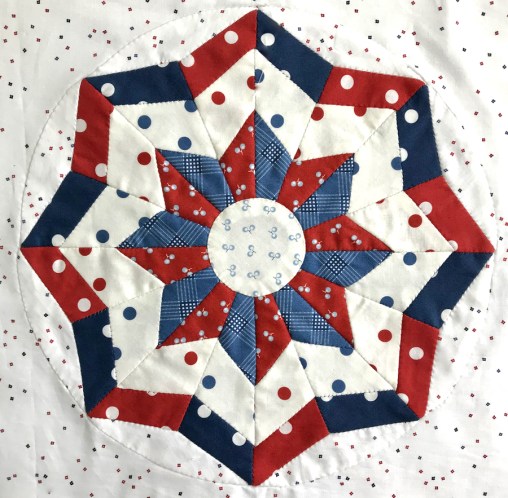
RWB Shine_Block Four

The free patterns are now returning (Red, White & Blue version is above).  I request that you not distribute them, but send people here to this website to get them.  Click to download a PDF file: 

SHINE Block 4 pattern_opquilt

Please remember to set your printer settings to 100% and check the little scale square included on the pattern.  It should measure 1″ in size. Illustrations below are with the OLD version of the pattern, so it may vary from what’s included now.

Pieces for EPP4

As before, print out enough copies so you can make your eight-pointed star, then staple them all together heavily so you can cut them out without them shifting.

EPP 4 cutting pieces

Again, if the pieces have no direction (are the same shape if folded along an axis line), lay them with the printing either up or down. If they are specific, like the point-pieces, lay them out on your fabric with the printed side facing the wrong side of the fabric, and then cut them out.  Sometimes if I whack off too big of a seam allowance, I’ll trim it later as I’m basting around it.  It’s all very forgiving, so don’t stress.  There are more tips and instructions on Circles #3, Ljubljana.
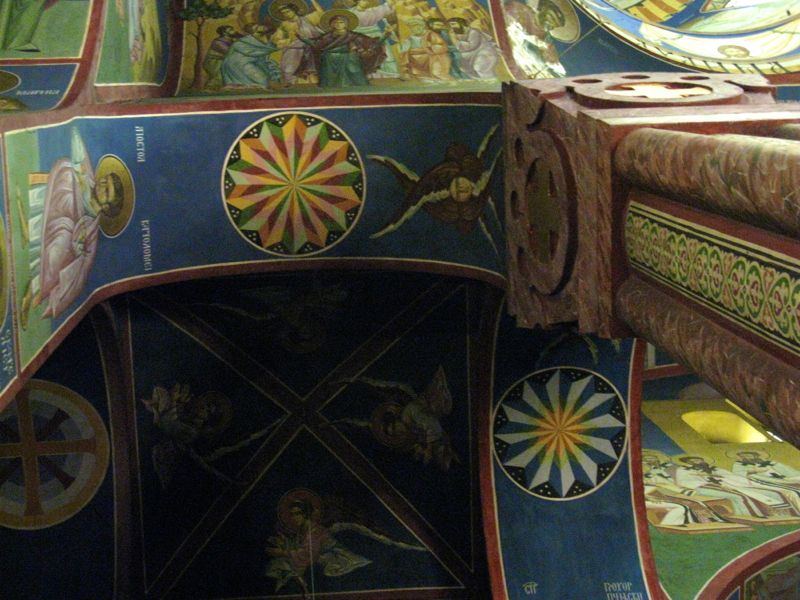
Block Number Four Inspiration

The inspiration for this block came from a combination of the two above blocks.  I wanted fewer points than are shown in the church paintings but I did like the division or the “layers” of points.  Again, these circles are high above floor level, so they are a bit hard to capture in a photograph.

Here’s some “making” shots:

EPP 4 Circle Block making_2

All three sections joined together, the left side and the right side done separately.
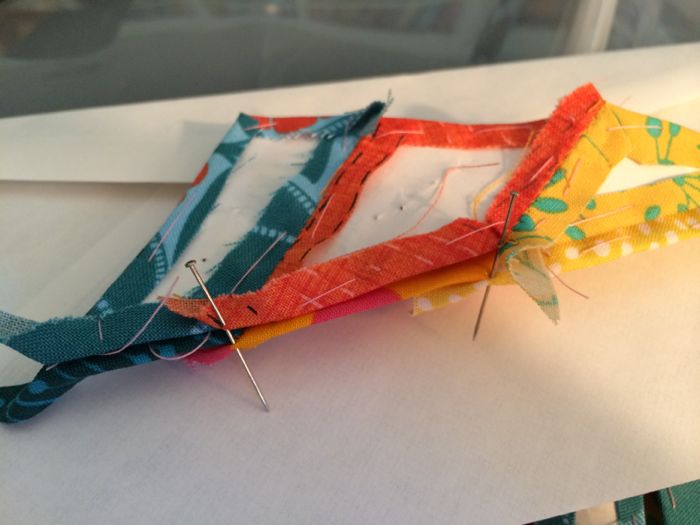
EPP 4 Circle Block making_1

I put pins in the joining seams to keep them aligned as I sew.

EPP 4 Circle Block making_0

I located the tip of the paper inside my basted piece and started sewing them together from the bottom, matching that teensy end first.

EPP 4 Circle Block making_3

EPP 4 Circle Block making_4

This is when I had one done.  I laid out all the pieces to see if I liked it.  I didn’t.

Circles Four Gathering Fabrics

I had started in the usual way,with the fabrics like this, trying to lay them out as I think they will work in the design.

Old and New Fabrics

It looked okay as laid out, but after I finished one, I didn’t like it at all.  I brought out more fabrics.

Choosing New Fabrics

I liked this better, but I kept trying.  As usual, I try not to obsess too much about perfection in design and color and pattern and all those other things we quilters worry about.  Scrap quilts can sometimes boggle our minds as they don’t fit together as easily as those ones we make from one line of fabric, that line of fabrics perfectly keyed to work together.  These kinds of quilts can stretch us as quilters, as well as teach us patience and confidence.  But it’s good practice to make up one point of your star to see if you like it, knowing that with a  few snips, you can change it out.  I kept doing this until I was happy with my choices, and again, made one more star point to check.

EPP 4 Circle Block making_5

I liked it a lot better.  Carry on!

EPP #4 outside

This is the photo I took this morning before I starched and ironed it, and you can see  how it looks, all soft from the handwork.

EPP #4 back

Back.

I used the same technique I used in Circles #3, of appliquéing the large pointed circle onto a 14.5″ square of background.  Then I appliqué that smaller center circle on, cut out the underneath, snipping away the yellow points.  Before I’d done that, it was a bit lumpy there, but it all flattened out once I cut away the points.

EPP #4 front

I love that color of blue against that tangeriney orange in the second division.
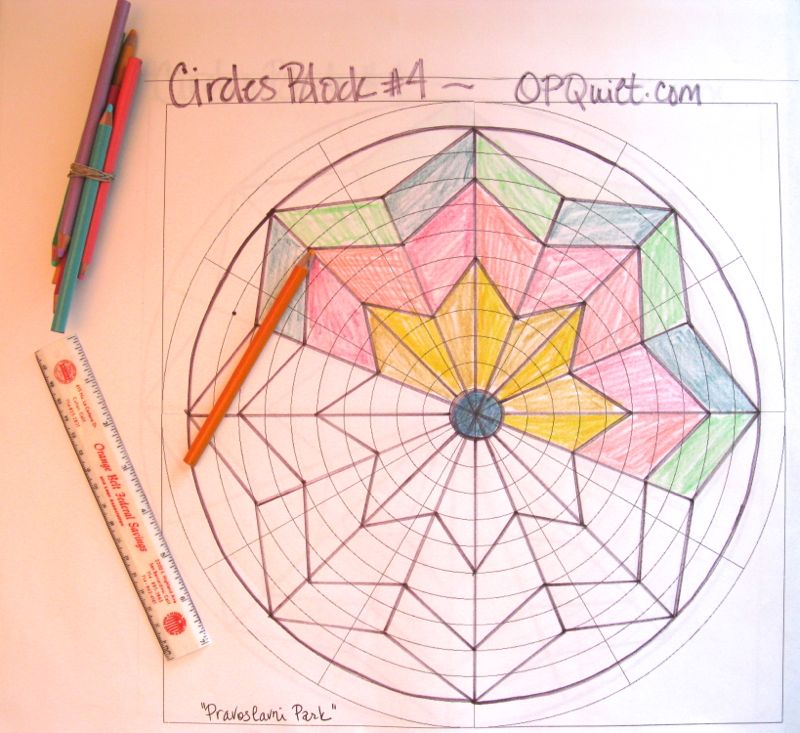
EPP 4 Pravoslavni Park drawing

A couple of quilters have written to me, showing me their circle projects.  Here are a couple:

Missie Carpenter Circle Blocks

Missie Carpenter of Traditional Primitives

Dittany Matthews Circle

Dittany Matthews of Blue Moth

And I found this post from Quilt Inspiration about another quilter’s journey in circles.

 I’ll post the next circles block sometime around the first part of November.  Have fun sewing!
Quilts

Straighten Up and Sew Right

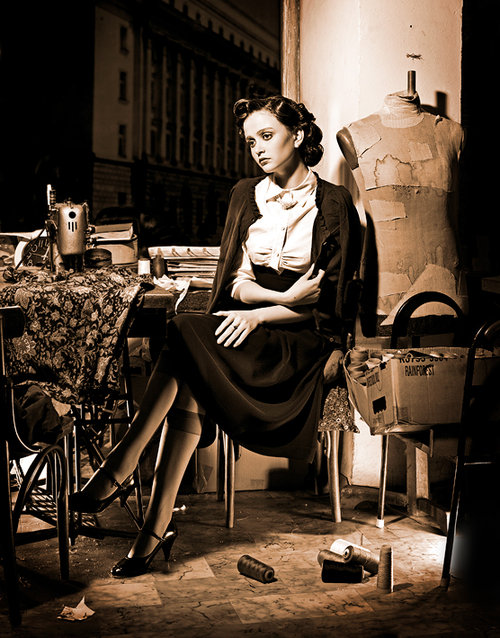
Sad Seamtress(from *here*)

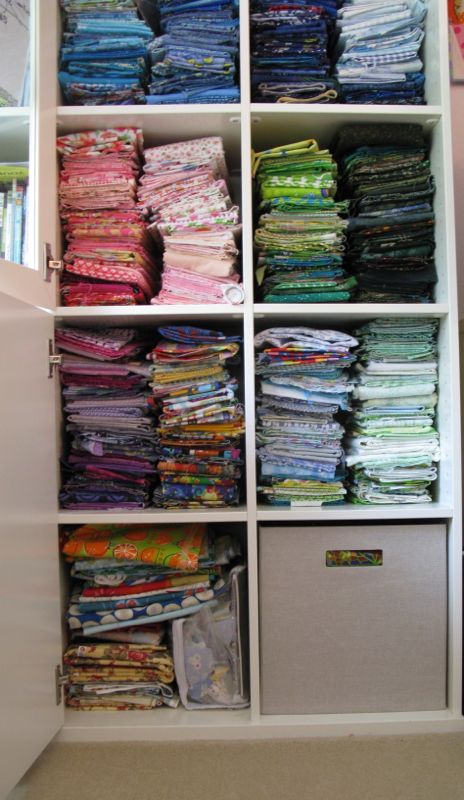
It had been nearly a month since I’d threaded the needle of my sewing machine and sent it to humming, and I felt like the sad seamstress in the photo, above, pining away.  I wanted to get to the machine and have a good sewing session and have something to show for it.  As one Instagrammer said, “My sewjo is missing.”  But I wasn’t idle.  First, I had a root canal, which ought to occupy anyone for a few days.  And I also cleaned out the stash a bit, filling two large mall shopping bags with swatches of fabric to let my quilting group, the Good Heart Quilters, rummage through before donating the rest to our quilt guild.  And here’s some photos to prove I have tidy cupboards, before I start messing it up again:

Straightened Up 1

 I like to organize mine by color and value (light-to-dark).

Straightened Up 2

The lower half of the cabinet.  Inside the pull-out box are browns and blacks–easier on the back this way.  I keep the Kaffe Fassets in another place, and I also have a stack of cream/tans and a stack of “low volumes” (neutrals or pastels), and stack of predominantly white/light background fabrics.

Molly Qee xfour

Here’s a close-up of my Molly Qee collection (the characters with the crowns).  They are hard to find in the States.  I started my collection when my sister Christine and I happened into a collectibles shop in Lyon, France.

More Shelf Stuff

And on the other shelf are other doodads.  My husband gives me the little Japanese dolls (ningyō).  And those fabric-covered binders are all my journals, began when I was a young woman of twenty-one years old.  Since the advent of email and cheap phone calls, I’ve stopped writing them, but I love having them around (they hold all my secrets!).

Pink Selvage BlockSo after a busy month, I pulled out the machine and got started.  I decided to ease my way in slowly, making a selvage block.

Basic Selvage Block Foundation

When I begin, I use my standby translucent paper, cutting, then pasting a strip on one side so it measures 10 1/2″ square. Then I draw lines on it to keep the selvages on straight.  Do I cut all my selvages off when I buy fabric?  No.  I like having them on to keep track of the newer stuff in case I need more.  Most of these selvages happen when I’m going through older fabrics that are in my stash (like those to be donated), of which I know I’ll never need the information again.  Then I slice it off, leaving about one-inch to 1-1/2″ of the fabric on top of the selvage so I have Lots of Options.

Pieced Selvage Strip

I get started by cutting two 4 1/2″ blocks, then slice them on the diagonal to make up the four triangles you see in the center above.  I pin them down, then start sewing on the selvages, placing the selvage edge 1/4″ in from the raw edge of the triangle, as shown.  Sew closely along the edge.  I like it best when the first selvage next to the color is the same, or nearly all the same, so I look for a longish piece. I think it just helps set the stage.  Sometimes I piece selvages to get the printed symbols and the words closer together (above) and other times I just let it be.   Then it’s random, random, random after that, some thinner strips, some thicker strips.  Some people like to trim the fringey pieces, but I just leave it that way.  Sometimes after I sew on a strip of selvage, I’ll go in and trim down the underneath piece just to keep it tidy.

Selvage Block Colors

Sometimes I get things off balance, like in the pink block way above (too much deep maroony-pink in the lower left) but then I figure I’m teaching myself how to let go a bit and just enjoy the process.  And I do.  I now have five colors of four 10″ (finished) blocks, so the block will be twenty inches square after all four parts are sewn together.  This is going to be one big quilt, but I’m in no hurry.

To close with, here’s a quote from The Rise, by Sarah Lewis (the book I wrote about in the Creativity post):

“Perhaps we have grown impatient with the incomplete. We are part of a generation that, as the African proverb goes, wants to eat dinner in the morning, that longs for the immediate, fully prepared for consumption. Yet the strength to linger over the long-left unfinished reminds us that something inexhaustible in us is empowered by striving, that we sense unnaturalness in blunt ends of journeys, of lineage. And that power comes from where we least expect to find it.”

Go tackle something incomplete, and enjoy the power of taking another look at something that in our hands, has had a long journey.

Quilts

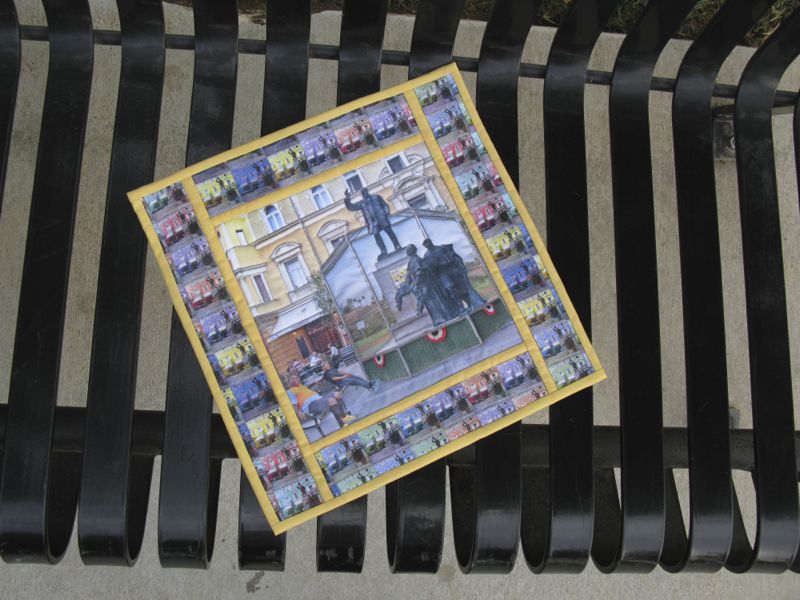
Deconstruction of Ted and Maurice at Lorinc Pap Ter, an Art Quilt

On the Bench at the Park

This post is a deconstruction of the techniques I used to create Ted and Maurice at Lorinc Pap Ter, a small (12″ square) art quilt for the Four-in-Art Quilt group.  Our challenge this quarter was Contrast, under the overall yearly theme of Urban.  Often an idea will come to me, but sometimes I start with the technique.  I knew I wanted to drag out those bottles of Bubble Jet Set and Bubble Jet Rinse that I’d ordered some time ago, and find out if this whole process was difficult or easy.  It was easy.

Bubble Jet Set is a type of mordant that binds to your fabric and allows the ink from your inkjet printer to adhere more easily.  I’ve printed on fabric for years, but haven’t ever prepared the fabrics.  I first started by reading a lot of blog posts, and I’ll post the links at the end.  The one website that described the process best was Caryl Bryer Fallert-Gentry’s (Bryerpatch.com), and I followed her instructions.

Bubble Jet Set

I bought a shallow plastic container at Target, about 4 inches deep with a latch-type lid, as I wanted to store the prepared fabric in there afterwards.  I cut my fabric about 9 inches by 12 inches, grabbed the container and the Bubble Jet Set (I only needed that one at this time) and went down to the kitchen sink.  I put on dishwashing gloves, as suggested, then laid the first piece of fabric in the bottom of the container.  I sparingly glopped some BubbleJet Set (BJS) onto the fabric, smoothing it out until it was thoroughly moistened.  I placed a dry piece of fabric on top of that, again, smoothing until it looked like it had picked up most of the excess BJS, then glopped a little more.  I’m being quite stingy with the BJS, actually, but do want to make sure that the fabric is sufficiently soaked.  I repeated this until all four sheets were saturated.

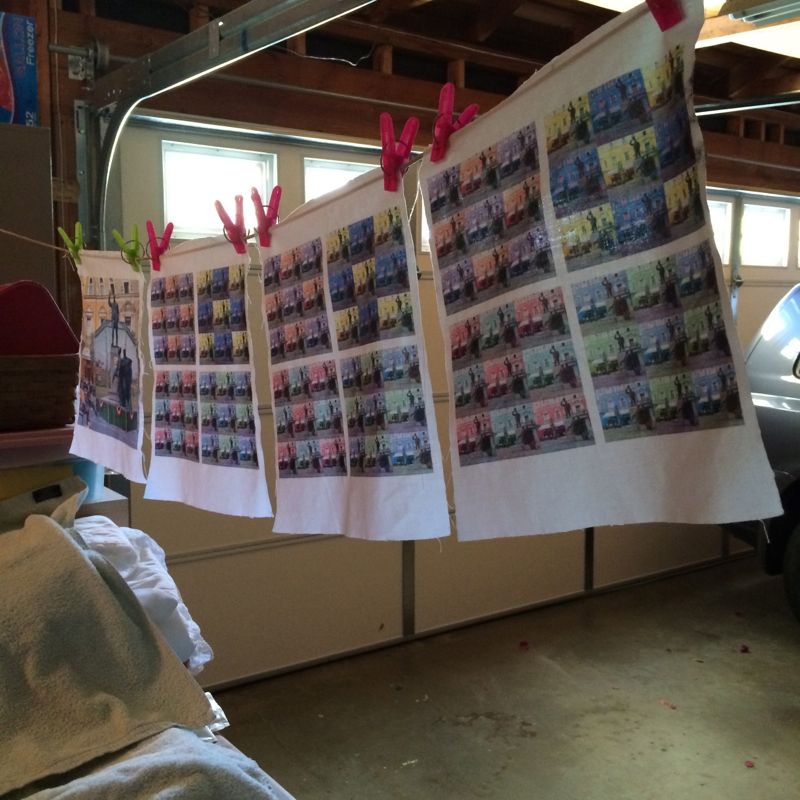
Prepared Fabric DryingI lay down some towels underneath my improvised clothesline in the garage (some say you can put containers to catch the extra drips, but I didn’t have that much excess) and hung up my sheets of fabric until dry.  In our summer heat, it only took about an hour.  Meanwhile, I washed and thoroughly dried my container, and when the fabric was dry, put them in the container until I could get to them.  I read one blog where the crafter cautioned about letting too much time pass between treatment and printing. I had a space of about 4 days, and that was fine.

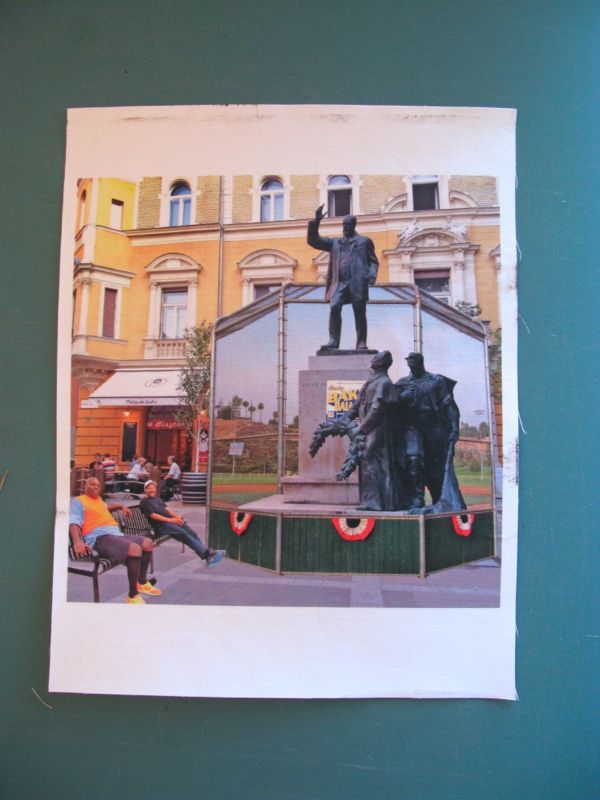
In yesterday’s post, I talked about how I created my art conceptually, but what I did technically was begin with a good photo of the square in Budapest.  I overlaid the baseball backstop photo, sized it, then took it down to 20% transparency, and used the Eraser tool to start erasing a space to let the statuary shine through.  I could have created a Path and selected it, but sometimes I think the Erase Tool does just fine.  I did change out the size of brush I was using, from 1 pixel in some places to 75 pixels in other places.  I did the same with Ted and Maurice, first flipping them around so they faced the other way, as that’s where I had some space to put them.  I merged the layers, as I know from experience that when printing on fabric, it’s wise to pump up the Saturation of colors (enhancing the image without making it garish), and to Lighten/Brighten the entire image.

Four Squares of 9Patch

For the border pieces, I sized each combination of colors to four inches, then pasted them into one document so I could print all the colors at once, first flattening, then then increasing the Contrast/Saturation and then adjusting the darkness through the Lighten/Brighten menu.

Trimming Fabric

When I was ready to print, I backed the prepared fabric in freezer paper, ironing it thoroughly but using NO steam at all — I wanted the freezer paper to really bond with the fabric.  I trimmed it to exactly 8 1/2″ by 11″ inches, and used a High Quality photo setting to print.

Image Printed on Cloth 4-in-art_1

It worked like a charm!  I let it set for the recommended 30 minutes then peeled off the freezer paper.  I let it set some more to let it thoroughly dry–a caution I read on many blogs.

Bubble Jet Set Rinsing

I put four capfuls of Bubble Jet Set Rinse in my container, then added about a gallon of water (about 3 inches) and set the first printed sheet in the water.  I kept it agitating the whole time of two minutes, as you see above.  I held up the sheet to let it drain and in the other sink, I rinsed the sheet well and laid it out on towels that I had set on the counter.  I did the same process with all the other prints, agitating them (apparently to keep the dye from the printing to re-settle back onto the fabric — they cautioned several times to keep it flat, and to not let it crease!).

Leftover Rinse Water

This was the color of the rinse water after I did all four sheets.  The Bubble Jet Set Rinse is a mild detergent formulated to remove excess dye.  In my reading, many said that Synthrapol would work also, but I had this so I used it.

Blotting Printed Sheets

I blotted the sheets gently, pressing out the excess moisture.  I did not wring or crumple the printed fabrics at all, working to keep them flat.

Sheet to Dry in Garage

I hung them in the garage again to let them dry, again taking only a short time.  I was pretty happy with the results.  The colors were vibrant and the fabric was soft and I knew it was washable, although there are cautions about what type of detergent you use.  I never wash my art quilts so it wasn’t a concern, but if you plan on doing so, here are some good websites with information on their experience with using BJS:

http://vickiwelsh.typepad.com/field_trips_in_fiber/2009/04/bubble-jet-rinse-whats-the-point.html

http://quiltbug.com/articles/bubble-jet-set.htm

http://www.bryerpatch.com/faq/bjs_q&a_page.htm

http://www.cjenkinscompany.com/Frequently_Asked_Questions_s/25.htm

The C J Jenkins Company manufactures the Bubble Jet Set, and I thought their page on printers was helpful, although I swear by my EPSON with their Archival Inks.

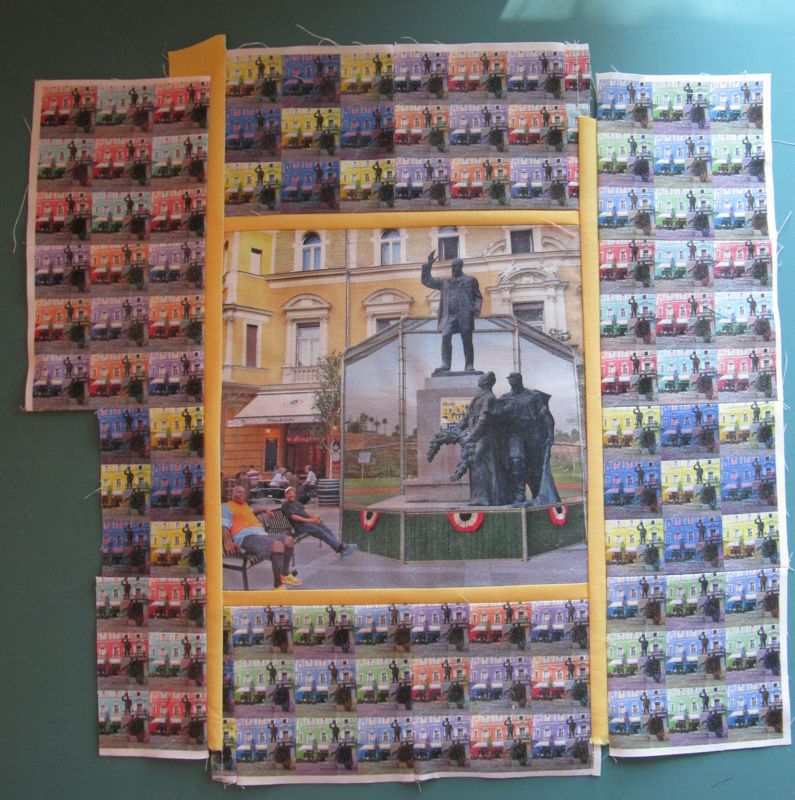
First Layout of Printed Sheets

After this, the construction was pretty straight forward, although I had to do some cutting and stitching to get the dimensions correct around the central image.

Sashing Printed Sheeets

I sashed the central image because I felt it might get lost in the tiny square borders.

Quilted 4-in-art_Aug2014

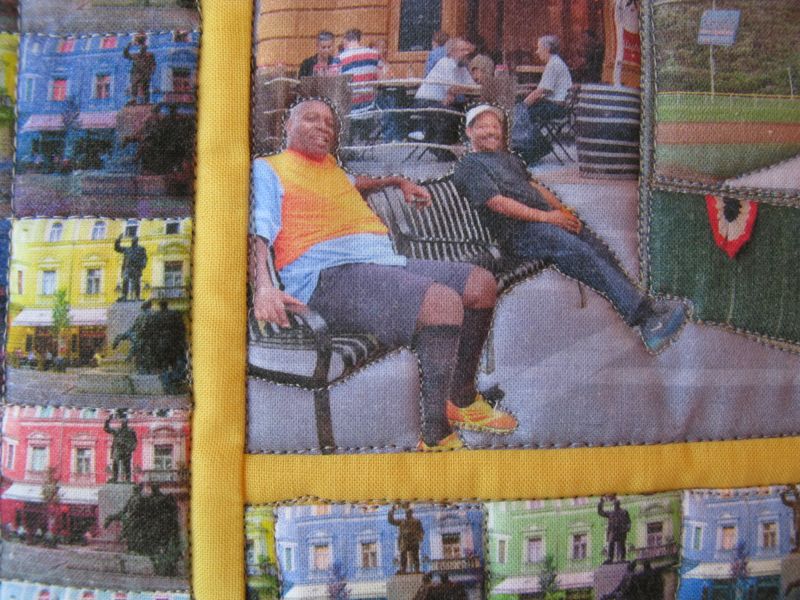
I quilted it, using matching threads (mostly lots and lots of gray).  Detail below.  I didn’t want to “over-quilt” this, but did want to emphasize the various elements.

Lorinc Pap Ter_detail front

Lorinc Pap Ter_front

And that’s it!  I’m pretty happy with how the BJS and BJR turned out, and glad that I had this little art quilt to nudge me into trying that preparing-fabric technique.

Circles EPP Button

Next up? The third block in my Circles English Paper Piecing Sew-Along.  I’ve remade this thing twice, so I’m ready to put it up and move on to the next block.  See the above tab if you haven’t started yet.

˚˚˚˚˚˚˚˚˚˚˚˚˚˚˚˚˚˚˚˚˚˚˚˚˚˚˚˚˚˚˚˚˚˚˚˚˚˚

My blogging software places ads here so I can use this site for free.  I do not control the content of these ads.

Quilts

Some Interesting Circle Quilts

IMG_0862

While looking through this blog, I found some examples of interesting circle quilts.  This one, made by Kathleen H. McCrady and titled  Sawtooth X, is patterned after an old one from 1875, using reproduction fabrics in brighter colorways.

IMG_0863

IMG_0821

This is kind of “circle-y,” but has added oak leaf appliqués in the corners.

American Folk Art Museum Circle Quilt(from *here*)

Known as the Georgetown Circle Quilt, its maker is unknown, but it was made in the era between 1900-1920.

Georgetown circles variation(from *here*)

Here’s a modern variation of that Georgetown Circles quilt.

airship_propeller_std

I found this one on my computer, with a date of 2005.  It’s from Freddy Moran and I believe she calls it Airship Propeller. But I could be wrong about that title.  Jenn Kingwell did a similar design, but turned her blocks on point:

Steampunk1(from *here*)

Circle Block from Smithsonian

Lastly, when I lived in Washington DC, the Smithsonian Institution’s American History Museum had this sort of secret quilt tour, but if you knew about it, you’d call them up and a docent would take you in the back and open lots of archival drawers, showing you positively ancient quilts (some 250+ years old).  It was amazing.  In one drawer was this quilt with circles.  This one looks challenging to piece, but I think easier if is English Paper Pieced.  I’ll save this one for later in the series, once we’ve gotten our skill set up and going.

All this proves that our slow sewing, of making English paper  pieced circle blocks is an idea that has come around again.