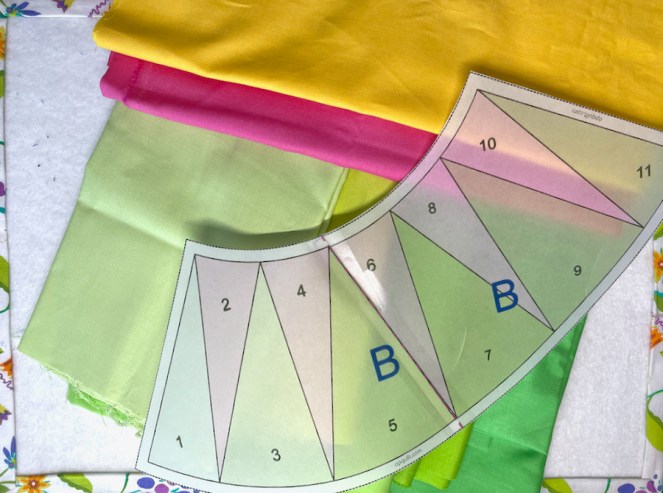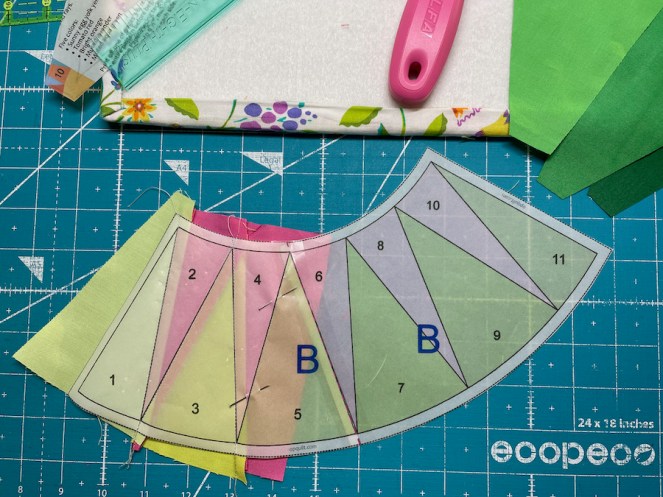
New York Beauties · Patterns by Elizabeth of OPQuilt

Uncertainty is Wisdom in Motion

This phrase intrigued me. It came from a podcast I listened to while out walking, so I’ve been thinking about what happens when we try to learn something new. Or lean away from “what we’ve always done.” Or have to hang out in the middle of a decision, not knowing the best way forward (the temptation is always to force it to a conclusion, apparently, limiting new possibilities). These ideas on uncertainty are from Maggie Jackson:

“Neuroscientists are beginning to unpack what happens in the brain at the uncertainty of the moment, when the realization that you don’t know that you’ve reached the limits of your knowledge instigate a number of neural changes. Your focus broadens and your brain becomes more receptive to new data and your working memory is bolstered. So this kind of rings a bell: you’re on your toes and that’s why uncertainty at that moment is a kind of wakefulness. In fact, Joseph Cable of the University of Pennsylvania said ‘that’s the moment when your brain is telling itself there’s something to be learned here.’ So by squandering that opportunity or retreating from that discomfort, we’re actually losing an opportunity to learn. Your old knowledge is no longer sufficient.”
–Maggie Jackson on the podcast The Grey Area, with Sean Illing

So what does this have to do with quilting? 

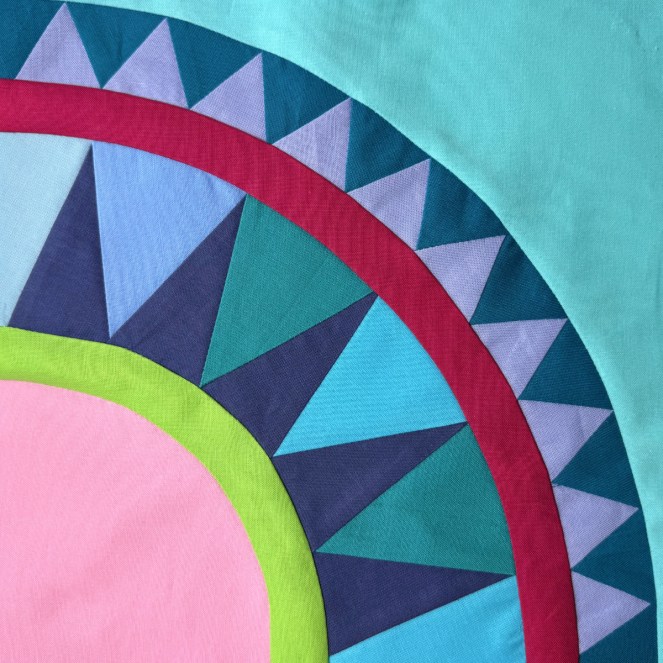
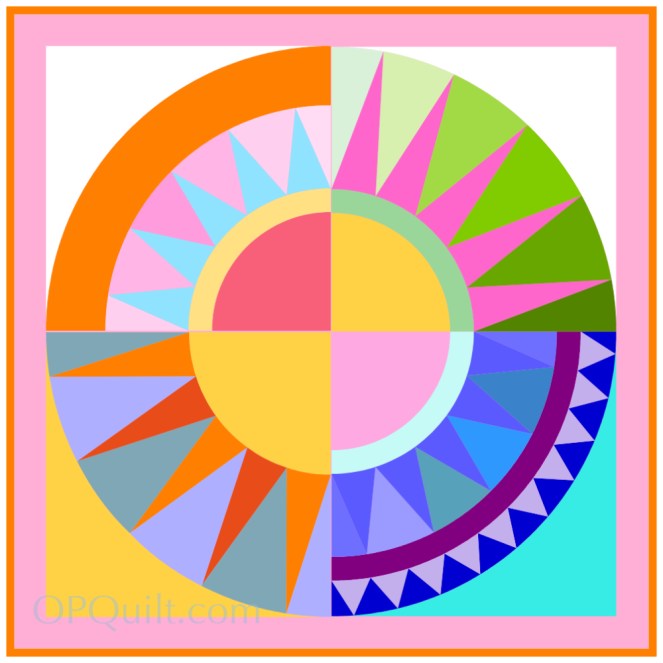
I recently finished up my pattern of the New York Beauties (more on that in a minute) and decided I wanted to make each block in the quilt in regular intervals, but many of those above are multiples of the same block. So I thought I’d test out using freezer paper, instead of my usual parchment paper, and see how I liked it. (Besides that, my regular 17 lb. parchment wasn’t being made anymore–only the 28 lb. Time for an update!)

And the verdict? I like it!
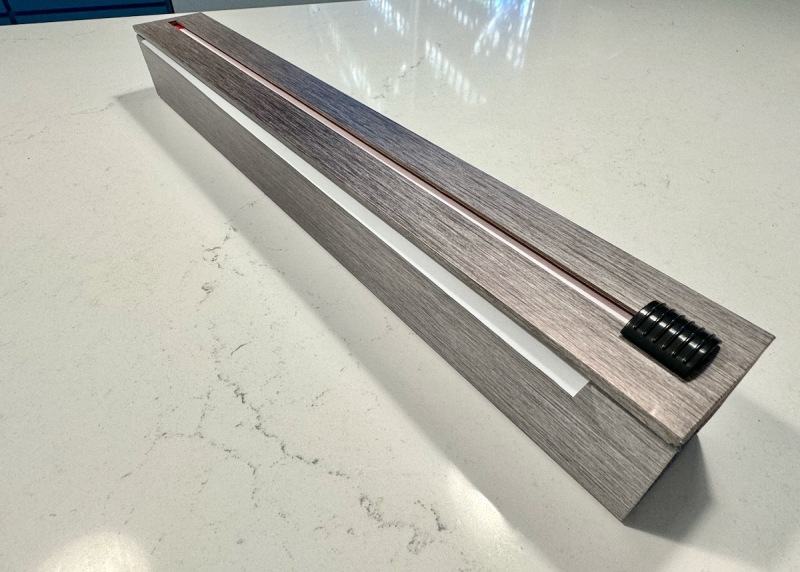
First, start with this: ChicWrap’s 18″ aluminum foil dispenser. It comes with foil, but I put that back in the kitchen, and slipped in my 18″ roll of freezer paper.

You don’t thread it through that slit, but instead, lift the lid, to set up the paper for cutting.
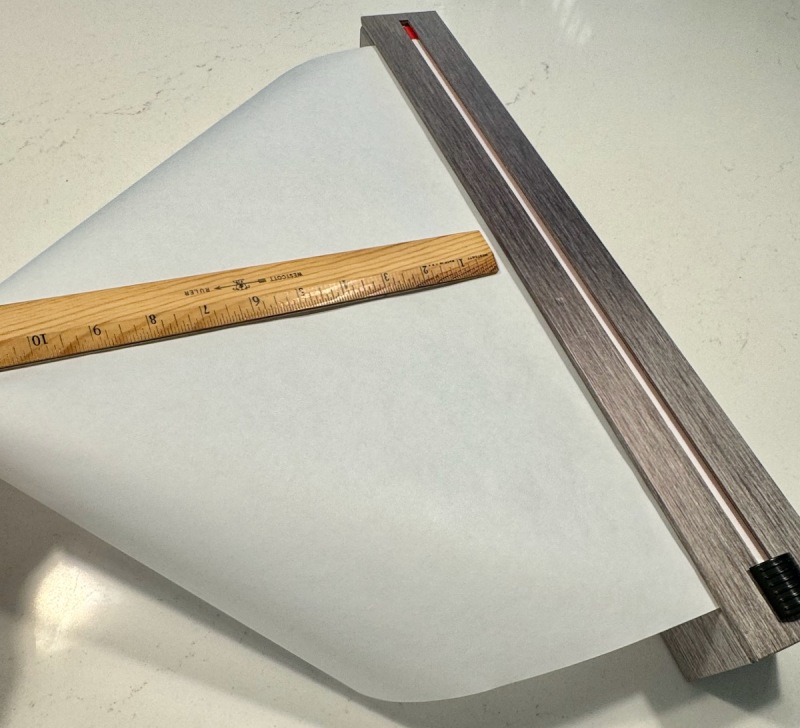
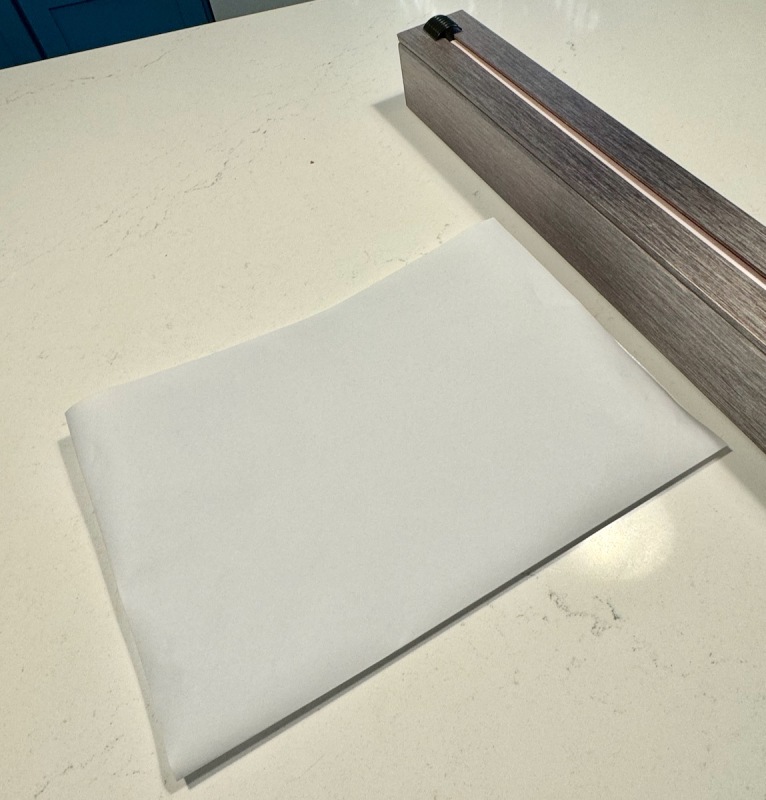
Pull it out so you have at least 11″ of length. Fold it in half (it will measure about 9″ in width), then take it to your cutting mat to trim it up to 8 1/2″ x 11.” Now you are ready to feed it through the printer. If you don’t have a printer that will allow you to feed it one sheet at a time, you can tape the freezer paper to a piece of heavier paper or cardstock (trim the freezer paper down to 8″ x 10 1/2″) and send that through.

I read about buying sheets of freezer paper already cut, but most of the commenters said it was no sturdier than the stuff we use from our rolls, so I just cut it from the roll, and went with it. After printing, I cut it out around the outlines of the piece I was using. You can experiment with this technique by downloading my free New York Beauties single pattern from PayHip:
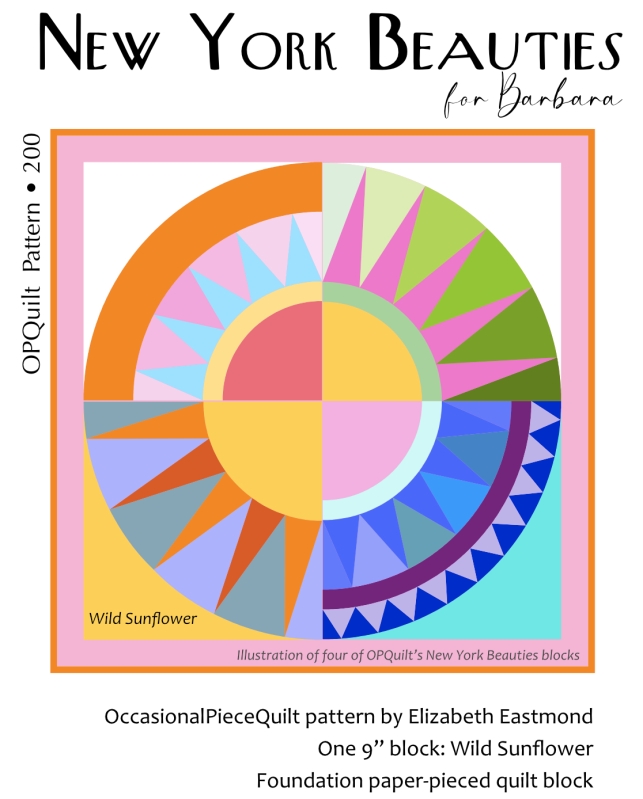
Even though I’d already printed out all the regular parchment papers, my brain was saying “there’s something to be learned here.” So here we go:
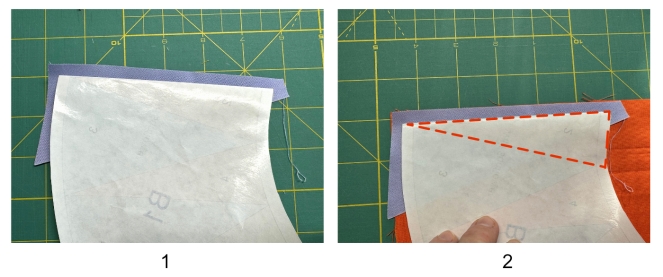
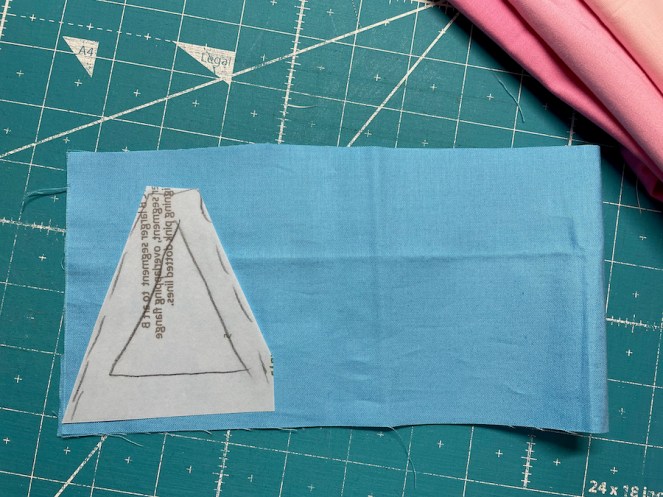
After cutting out your shape from the printed freezer paper, fold on the first line, and press just this section (Ray 1) to your first piece of fabric (picture 1: muted lavender). Then lay that on top of your second color (picture 2: orange).

Later on, I figured that I should make a crease on all the lines of my section, but for now, I digitally outlined the rays in orange dashes to help you see the shapes.

Make sure there is enough of your second fabric underneath your first fabric. Pin, or clip. Head to the sewing machine, and sew next to that folded edge.

Now to the ironing board. Press, smoothing the fabric away from the seam. Iron only on the next section (Ray 2). Fold back along the line between rays 2 and 3. 

At the cutting board, align your ruler for a scant quarter-inch seam, and cut off the excess. If you need to trim at the end of the piece, open up your paper, so you know you aren’t going to cut off something you’ll need later on. Use the edge of the paper as a guide, but rough-cut off the extra. (See picture 12, below.)

Fold back alone the line between sections 2 and 3, revealing the shape of the next ray (shown here in dashed orange lines). Place on your third fabric (picture 5: blue-green). Stitch along that folded edge. Iron Section 3 paper onto the blue-green fabric, smoothing out the fabric underneath.
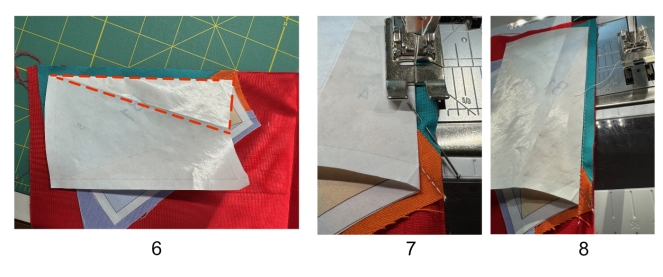
Fold on the line between sections 3 & 4 (Ray 4 shown here in orange dashed lines). Place until on next fabric (picture 6: tomato red). 
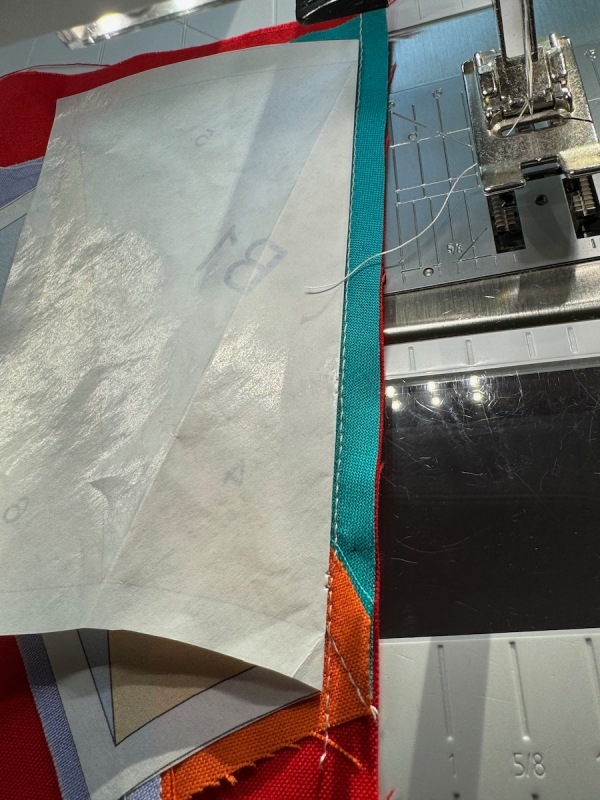
Close-up of stitching

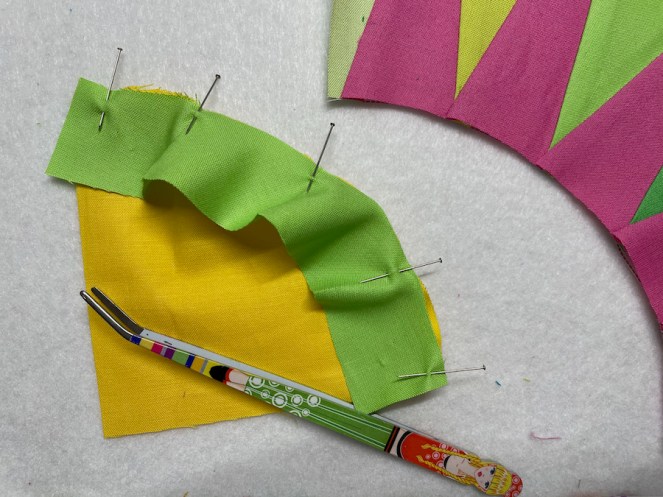
Again, stitch along folded edge, shown in pictures 7 & 8. You can also see how I pin — just in that seam allowance. Did all my fabrics have a straight edge, making it easy for me to align (as in picture 6)? No, not always. If not, I would place, trim…and then pin and sew.
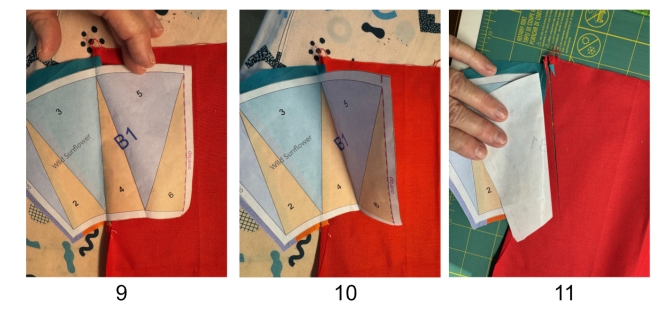
You know the drill now: press just that section (Ray 4), then trim at the cutting table, as shown in picture 11. 
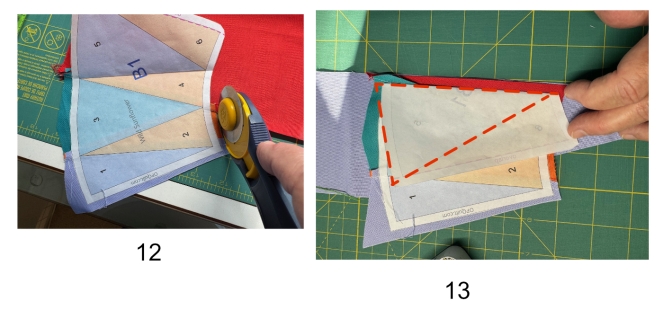
In picture 12, I show how I open up my paper, so I can cut off the excess at the base of the B1 section. Then I fold it back down and trim that scant quarter-inch at the crease of the paper (between Rays 4 and 5). In picture 13, I fold it back down, and lay it on the next fabric, using the shape of Ray 5 to check you have enough fabric. Those orange dashed lines are a visual guide: I do have enough. Stitch along the folded edge.
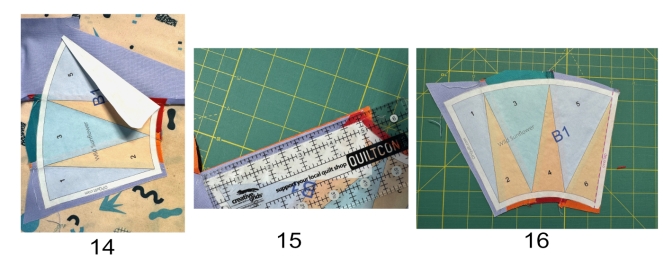
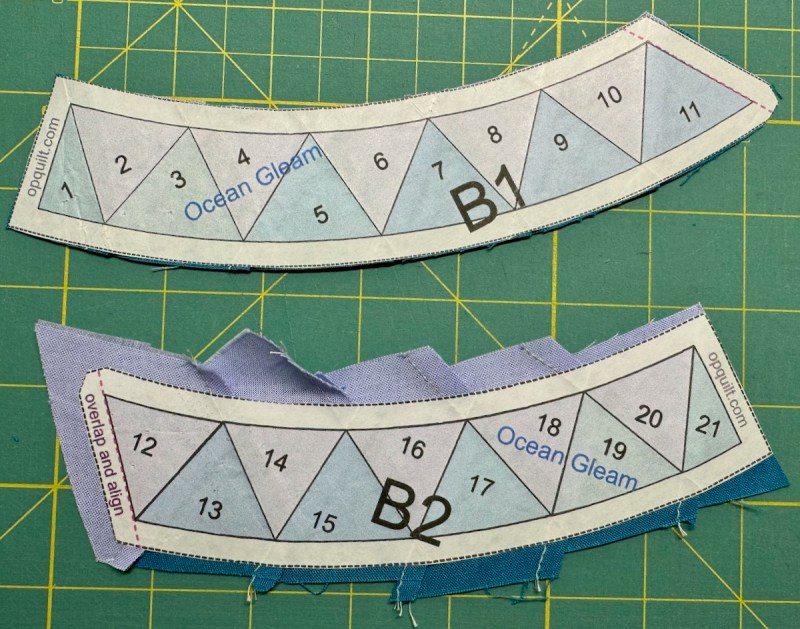
Yep–you know: press only the Ray 5 section of freezer paper onto your fabric. Back to the cutting mat to trim at a scant quarter-inch, then repeat with your final ray (picture 15: a happy orange for me). Press that freezer paper to your final ray. It should look sort of like the image in picture 16. Set aside, and start on B2.
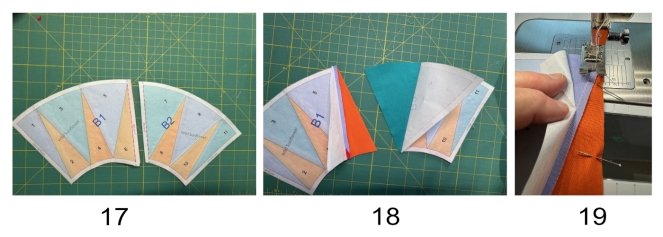
Following the numbers, and using the same technique, stitch all the rays for B2. Trim carefully around the edges of both, neat and clean (picture 17). Peel back the papers for those edge-rays with wrong sides together and pin, aligning lower and upper edges of B1 and B2. Take to sewing machine. I found I had to peel back even a little more. Stitch, then carefully peel off the freezer paper. When you take it to your ironing board, press that last seam the same direction as all the rest (you’ll figure it out).
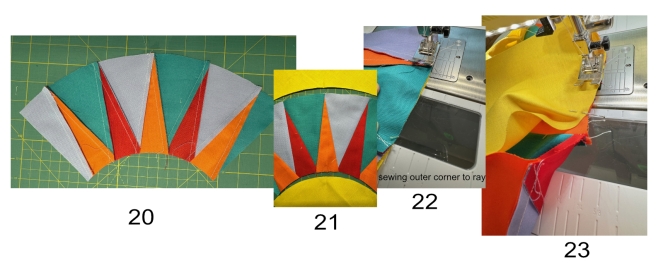
Charging right ahead, press a center mark in the A Outer Corner, the B1/B2 piece, and the C Center. Don’t press down through the whole piece — just the tip of your iron is all that’s needed. Pin the outer edges of the A Outer Corner and the center marks, and head to the sewing machine.

In picture 22, I sewed the A Outer Corner to my rays, PUTTING THE LARGER OUTER CORNER TO THE BOTTOM. This is different than you usually see. Please take it slowly, no rushing, keep aligning as you go from pin to pin to pin (there are only three).

In picture 23, after putting in my three pins, I sewed the C Center to the rays, WITH THE RAYS TO THE FEED DOGS. Again, take it slowly, and keeping aligning the fabric. You can pull it toward you a little as you stitch, because those curves are bias. By elongating them (by stretching them out), it may help them to line up a little easier. But not a big pull, not a big tug. Little adjustments. You are the tug boat, getting that steamship into port — little by little. (Okay, enough bad metaphors.)

Press. Usually you are pressing away from the rays.
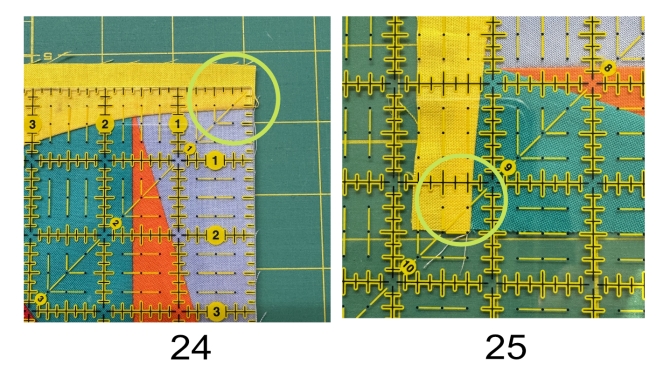
Now to trim up. I gave you extra on the A Outer Corner so if your block went askew, it wouldn’t be a tragedy (just another way I show my love to you in my patterns — I make the mistakes so you won’t have to). Align the corner of your ruler so the 1/4″ line is right at the Outer Corner fold, as show in picture 24.

Then check the opposite corner, lining that 9 1/4″ mark at the folded edge. It’s not rocket science, meaning that it most likely won’t be exact. Get as close as you can. Trim, then turn the block, lining up the 9 1/2″ line with the trimmed edge, and slice off whatever is left (not much on this side).
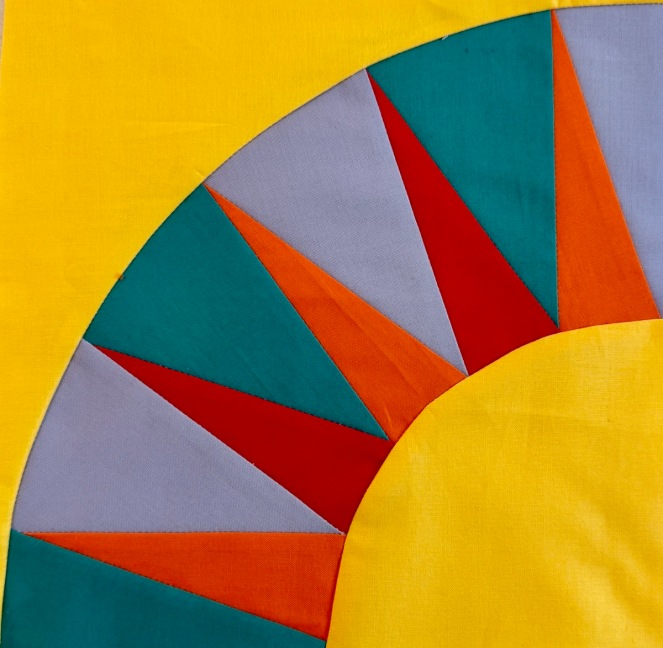
Done! Wild Sunflower block is complete. Now, if you are going for the full quilt, the pattern says to make a total of three. So will the freezer paper keep sticking?
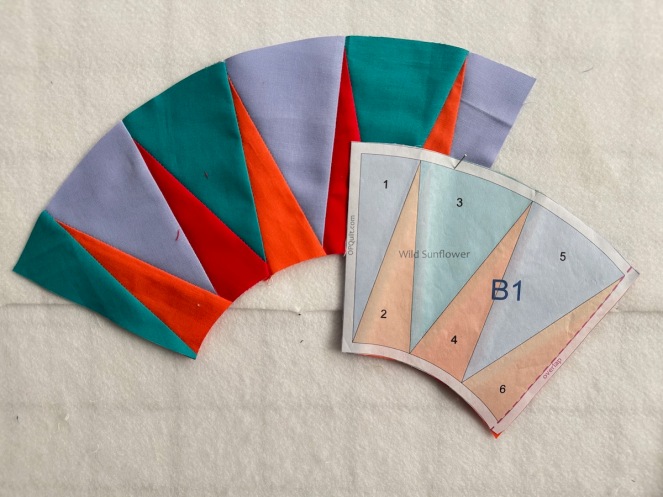
Ray Two is finished, and I’m plowing again into Ray Three, and yep — it’s still sticking. For one of the blocks you make it five times. I’ll be interested to see how that goes. And overall, I felt like using this method is faster, always a plus.

Just like I used a weekly goal to help pull me out of my sewing slump last summer, I’ll be using these New York Beauties to get me going for this year. If you want to follow along, I have a coupon for you to use, if you want to purchase the pattern. (I’ll probably do this every two weeks, so don’t panic.)

Just head to my quilt pattern shop, and when you check out, type in this code (note the three capital letters at the beginning). You’ll get 20% off the pattern. It expires on Leap Day! (February 29)

All of this can be found on the Master New York Beauties page, on the tab above. When the coupon expires, I’ll take it down, but a listing of the blog posts will be linked there, if you want to refer to them.

What we ate for the Super Bowl (no, we did not watch it): Homemade Focaccia
Just before kick-off, Camryn and Landon (he, of Focaccia fame) stopped by to visit, then took off again to their Super Bowl party. Later that night, we blanked out by watching the movie Dune on Netflix, understanding about 60% of it. If you’ve seen it, what was your percentage?
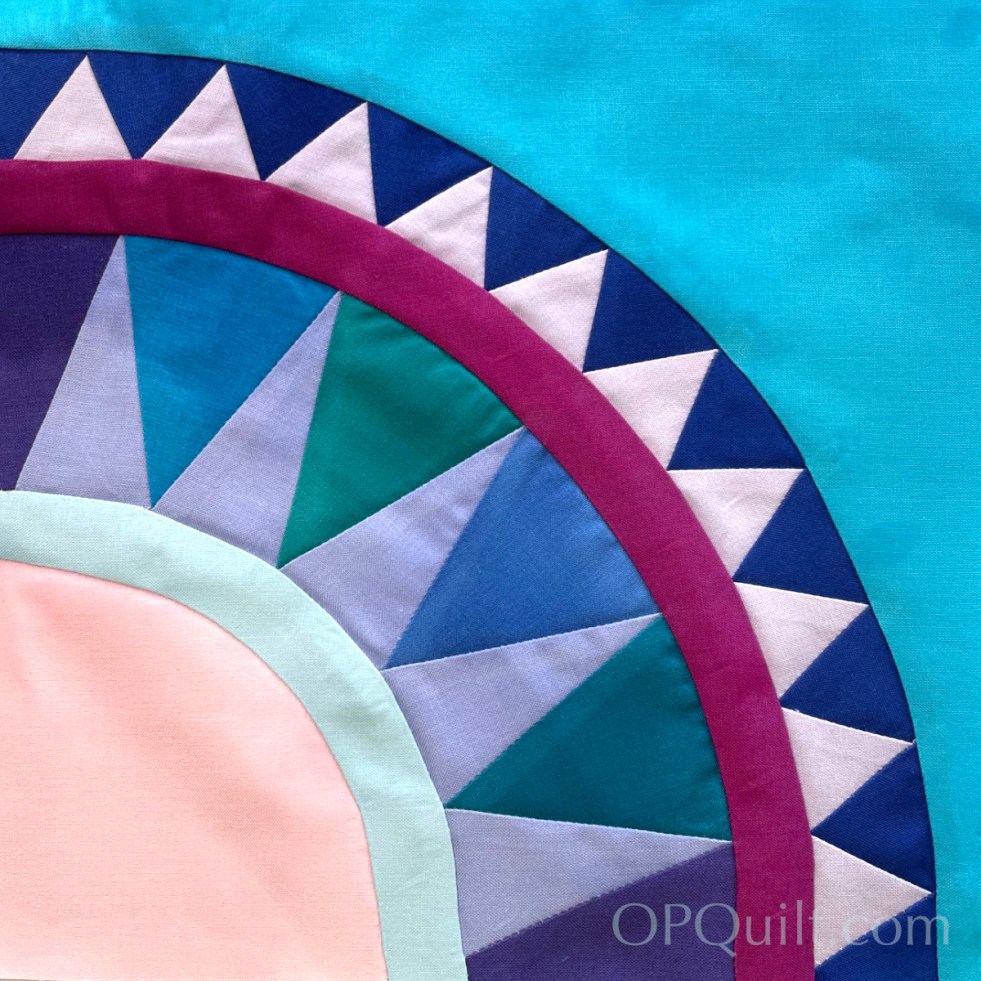
New York Beauties · Patterns by Elizabeth of OPQuilt

New York Beauties, Block 4: Ocean Gleam

THIS IS AN UPDATE ON THE MAKING OF THIS BLOCK.
JUMP BELOW TO THE FOUR SQUARES TOGETHER FOR THE EARLIER POST.

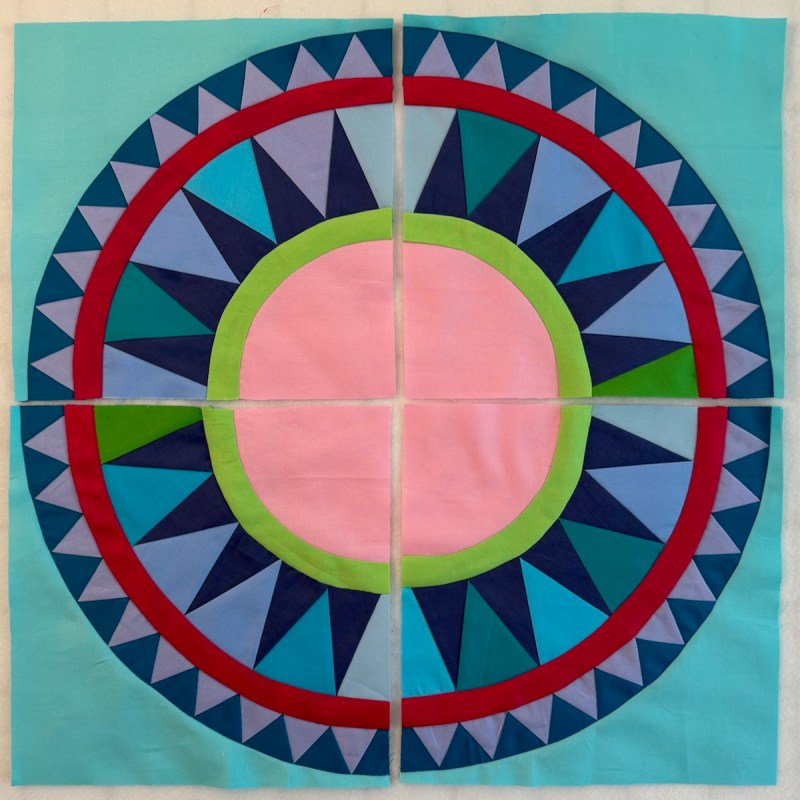
The original post was published just about exactly two years ago, and I needed to make four blocks for the quilt. I changed the colors slightly . They are updated on the Main Page for the New York Beauties, or on the free download on the pattern, which can be found in my pattern shop. Okay, now that we got that business out of the way, here’s how it looked when I was doing freezer-paper piecing.

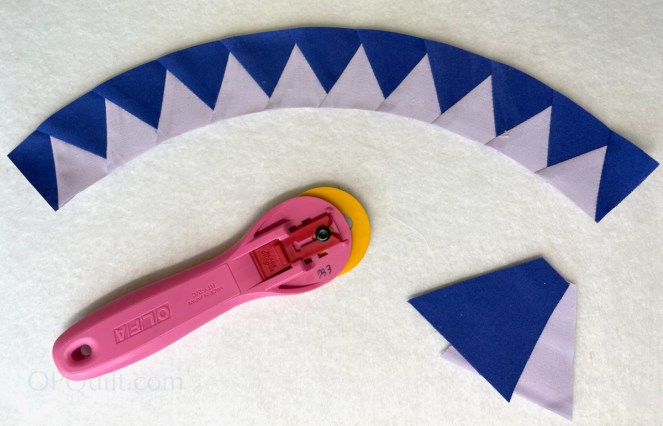
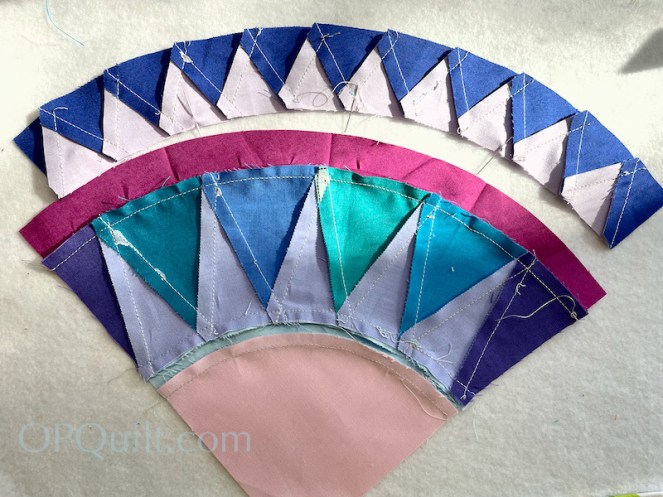
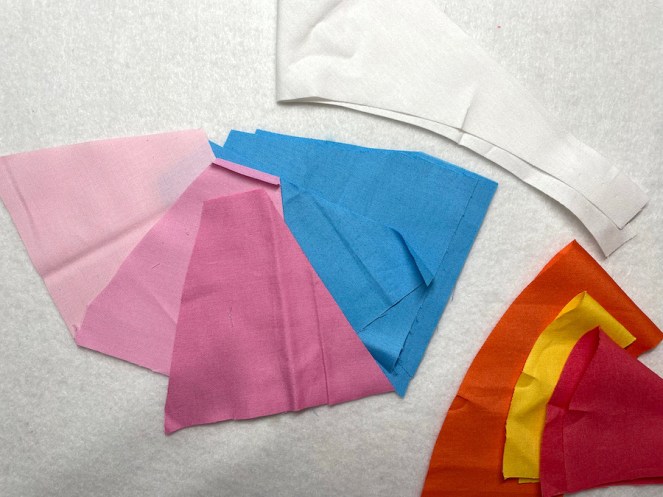
I decided to cut some triangle-shaped blobs to make it easier for piecing.

The top one is all trimmed.

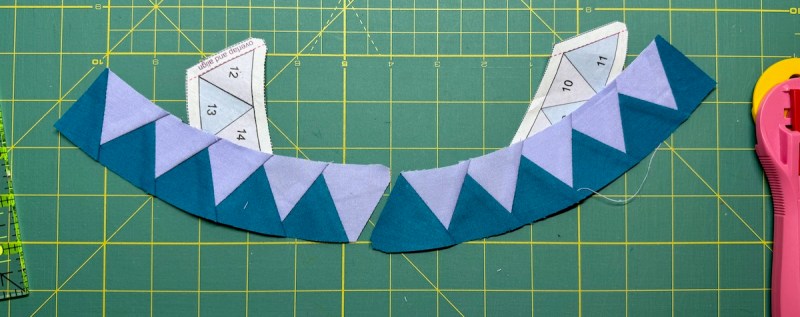
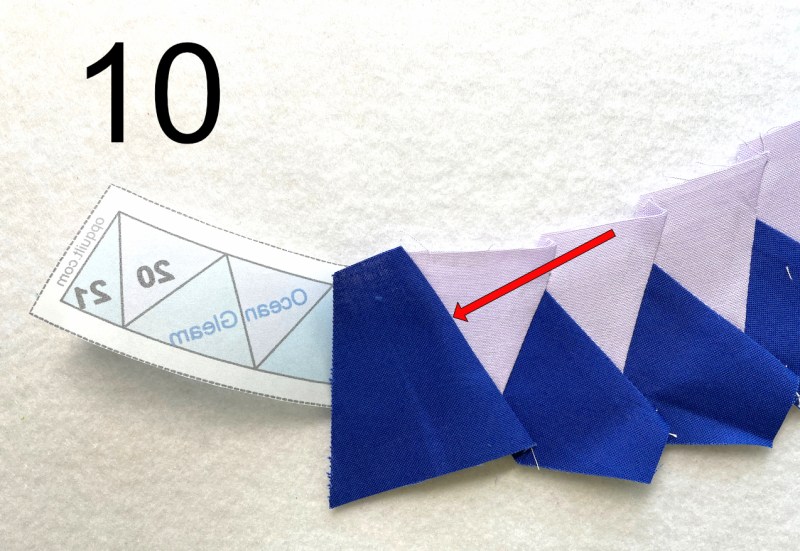
I’ve pulled back the freezer paper a little bit so I can join the two sides.

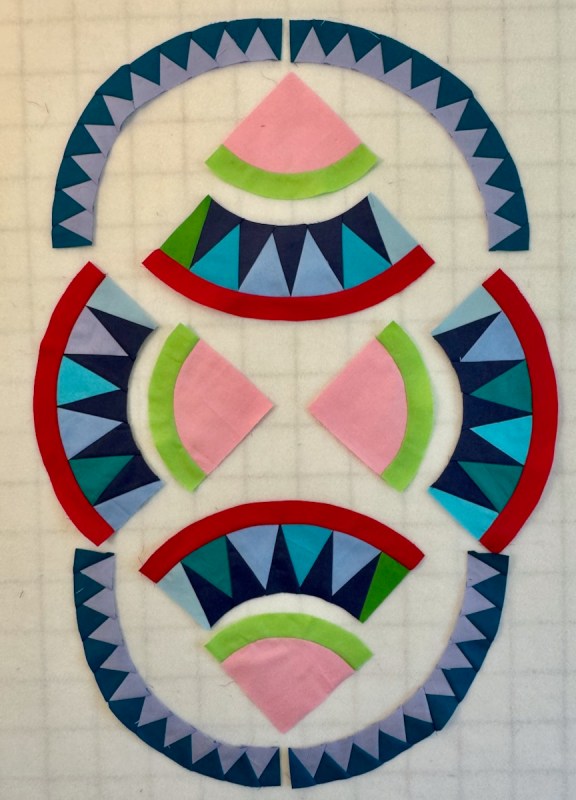
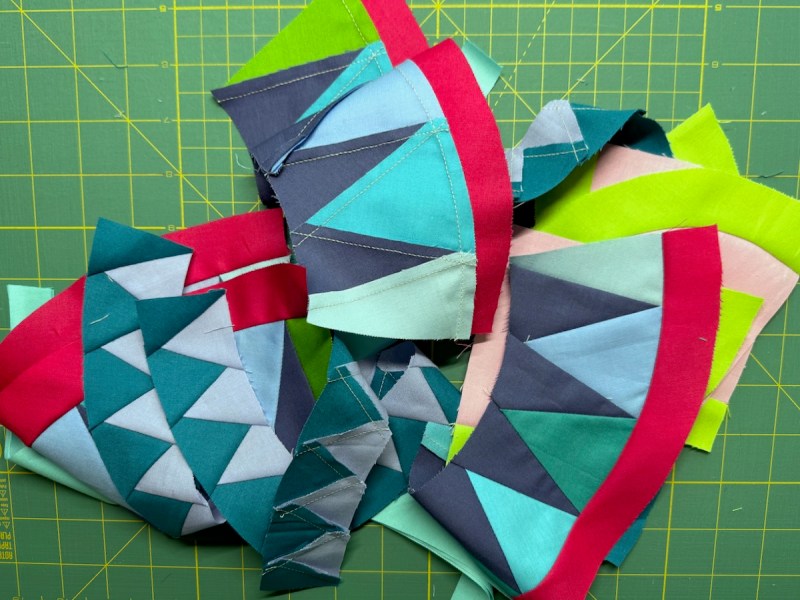
Just playing around with the pieces. Just so you know, all four of the Large-Ray backgrounds are differently arranged. I really did use scraps.

Sometimes I make a block at a time, and other days I make all the parts and then sew them together. My light throws off a yellow cast; I promise that the green band next to the center is not that neon-y.

(Inspiration)

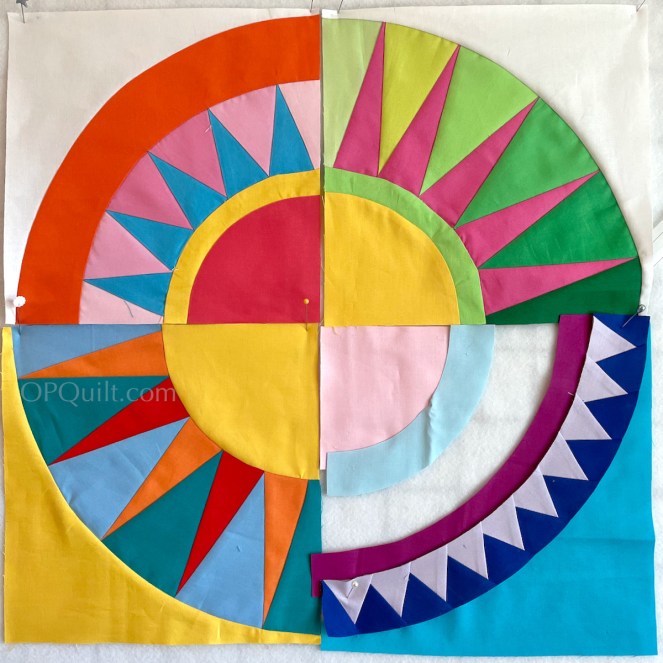
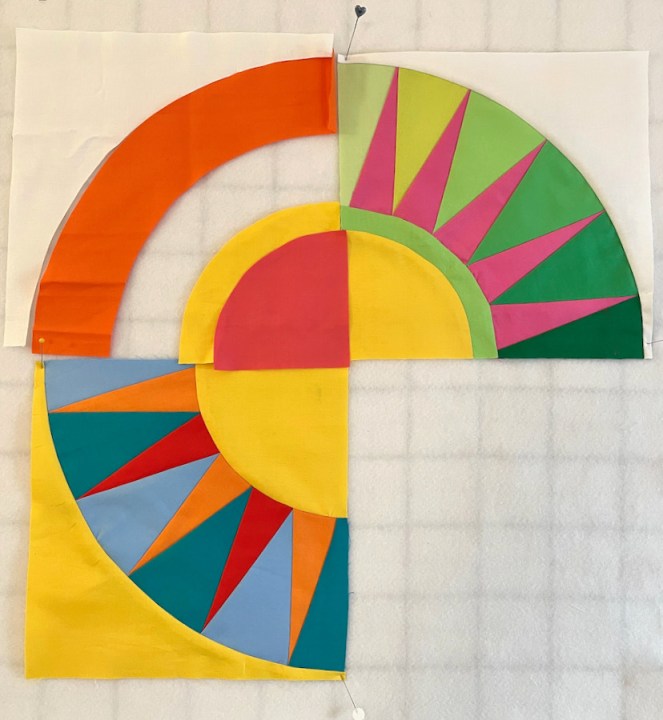
Goofing off with the blocks. All work and no play makes for a dull quilter.

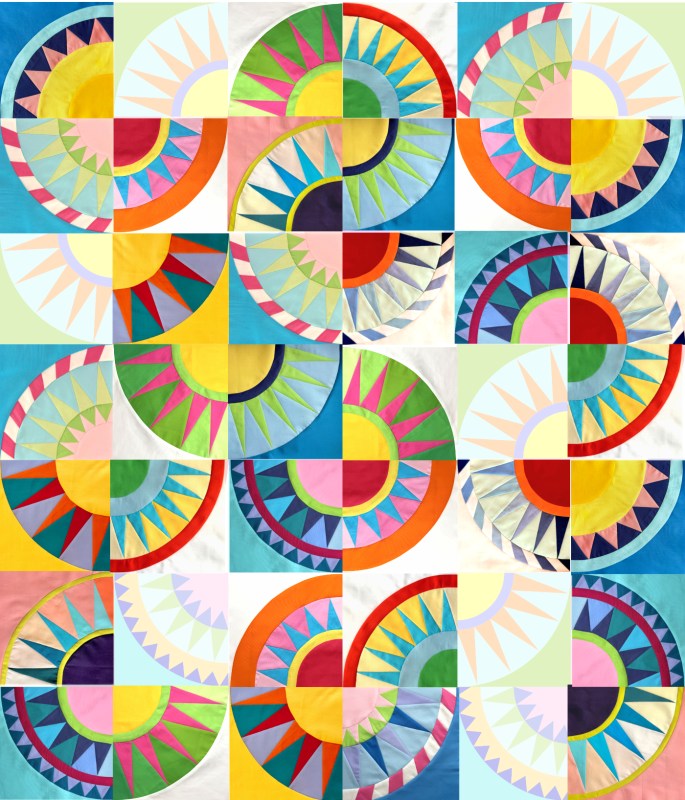
Here’s Ocean Gleam pasted in digitally to the quilt. Looking fun and fancy!

Okay, read on for a jump to the past. Congratulations for making Block Four: Ocean Gleam!


We should stop meeting like this.

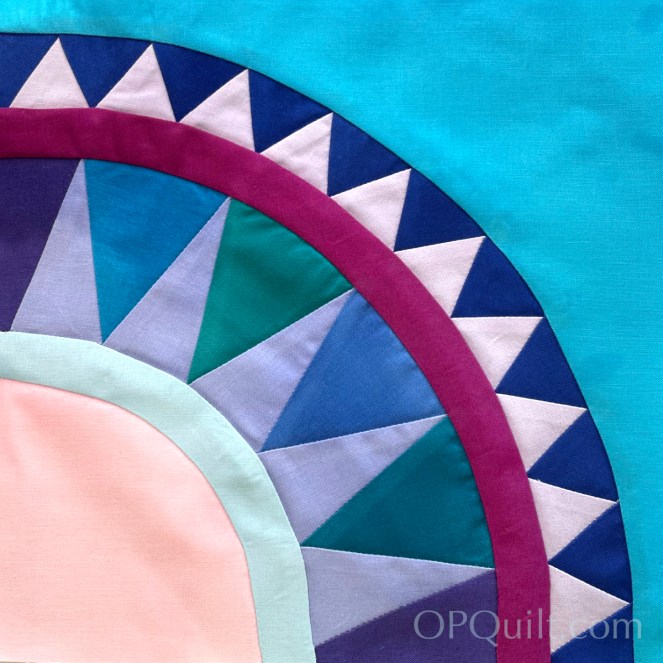
But it’s Wednesday, it’s June, and we’re ready for the fourth make in this series of New York Beauties. And the last in this foursome is Ocean Gleam, the dark dapples and glints that show up when you are lying on that proverbial beach and the ocean’s waves lull you into relaxation. Or something like that.

I dedicated a lot of digital real estate in the last New York Beauties Quilt post talking about how I work with FPP. Head over there if you need more info; scroll down as it is below Block Three. This block has two rows of rays and two bands, but you are up to this task, I know.

Q: How did I get here so fast? A: Read this. (Scroll down)
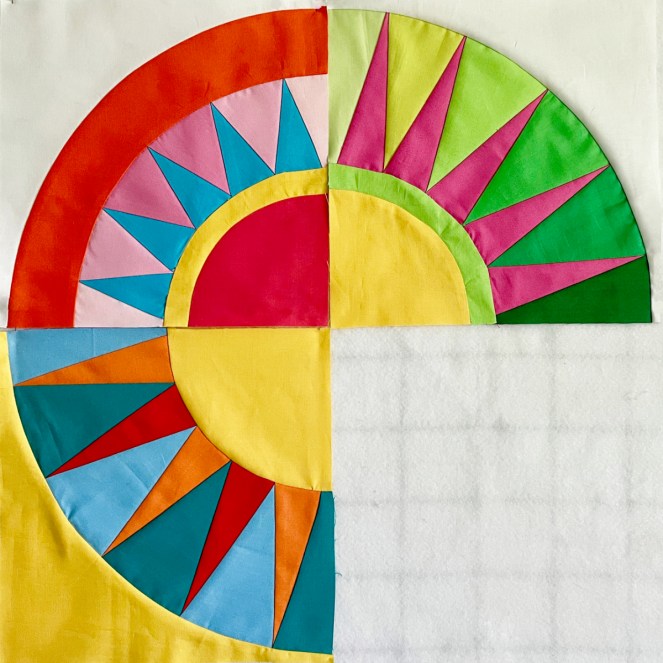
Checking for colors: bits of Block Four pinned up next her sisters.

Sew the parts together, and as usual I have the convex on top.

Yes. I am trying out colors again, but I have committed and am starting, judging by the sewn triangles on the upper arc. (The lower arc’s pieces are just laid out.)

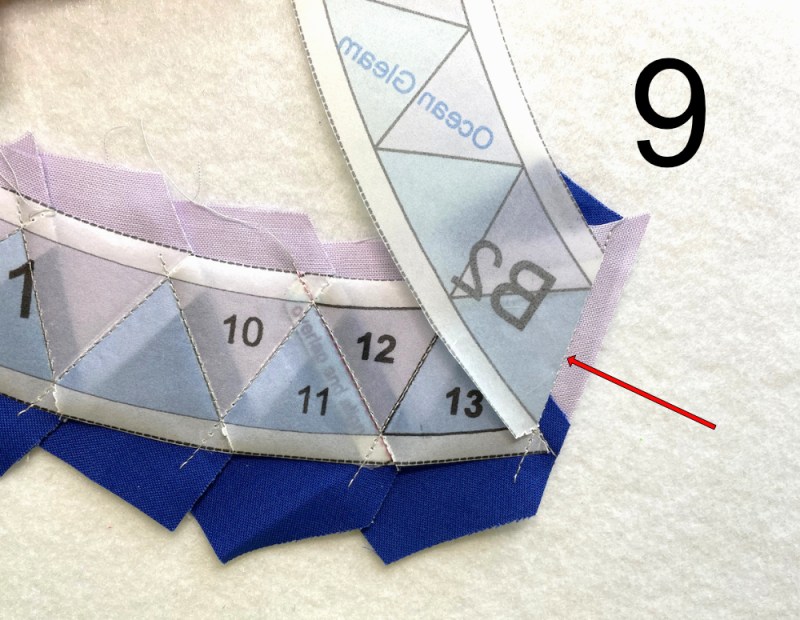
Do you remember in the last post that I told you I figured out I didn’t need the paper on everything? It came from sewing this together. First I ripped off the seam allowances, like I’d learned. I was still wrestling with it under the needle, so I started ripping off the paper on the triangles. This photo was taken when I stopped to rip ALL the paper off. I had already pinned my four marked intervals together, so I didn’t need the paper for that.

Back view. You can see the press marks on the burgundy arc, and the pins on the upper arc, ready to be matched up.

Stitching, again without paper. I use those tweezers to help grab parts that need lining up. Tweezers are definitely recommended.

I just noticed they made a heart! These patterns come with a lot of love, so I shouldn’t be that surprised.

Time to sew them all together. Do your best, but really…remember that the perfect is the enemy of the good.

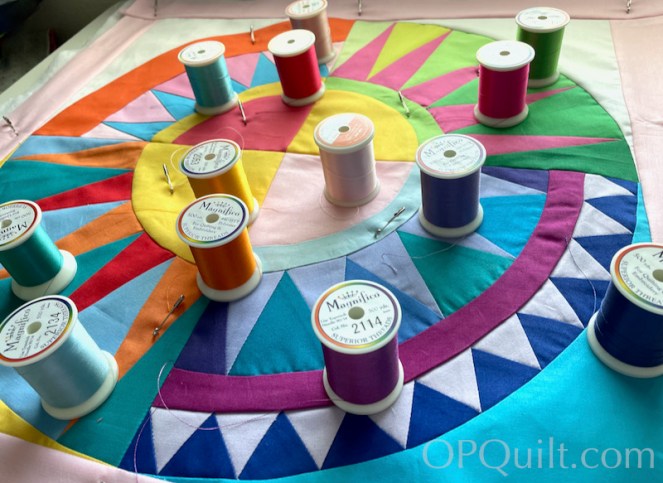
Magnifico Thread into action!!! (Kind of like a super hero or something.) I use either So Fine or Bottom Line from Superior Thread in the bobbin. Test, test, test.

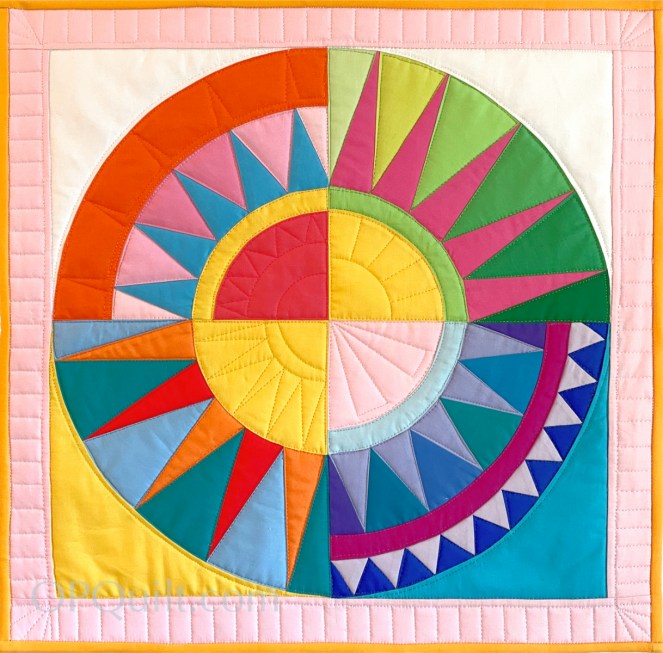
I love a heavily quilted pillow, and I sketched out a lot of possibilities. But in the end, I decided not to have a Battle with the Beauties, and did a lot of outlining and stitching around the bits. But that doesn’t mean I can’t have a little fun:

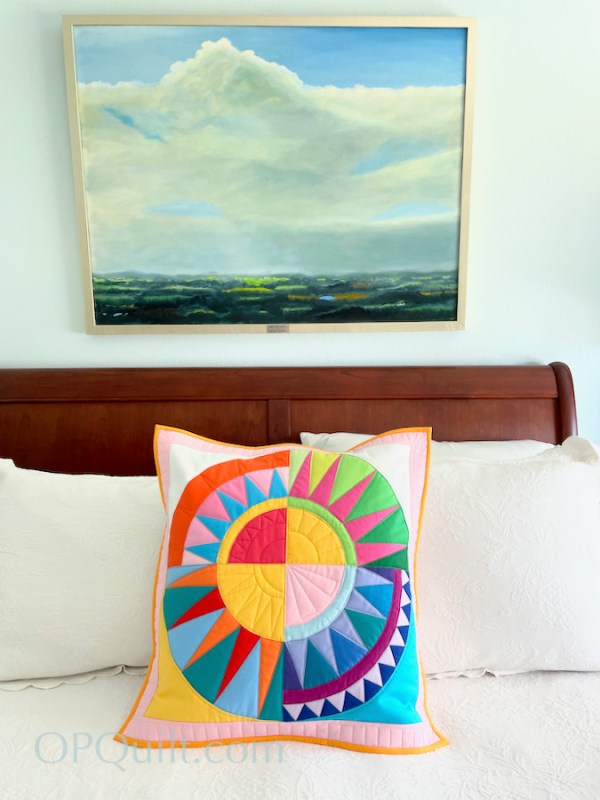
New York Beauty Mini Quilt/Pillow • 20″ square • Quilt #266

Now I have some ideas for more blocks!

This all started when the pillow-of-the-month came from Riley Blake and I wanted something a little brighter. And yes, I know we have four, if not six blocks, and possibly a quilt hanging out there, waiting in the wings. So let’s keep going.

A full quilt of New York Beauties is ready for download in my pattern shop.

Our hashtag on Instagram is #newyorkbeautiesquilt so please post and tag and share your beautiful blocks.  If you feel inclined and want to say a thank you, I’d appreciate a follow on either my blog where I post weekly (or occasionaly bi-weekly).  You can also follow me on my Instagram

Take a breath…and keep quilting!

New York Beauties · Patterns by Elizabeth of OPQuilt

New York Beauties Block 3: Radiate

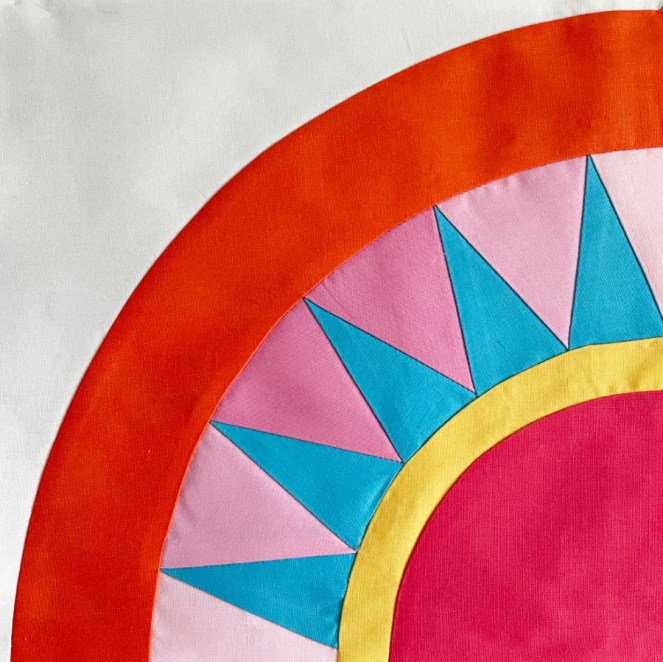
Third Wednesday of June means the third block of New York Beauties, and since I love that orange band out there and it reminded me of the glory days of being a teenager and feeling the warm sun on my face, I called it Radiate.

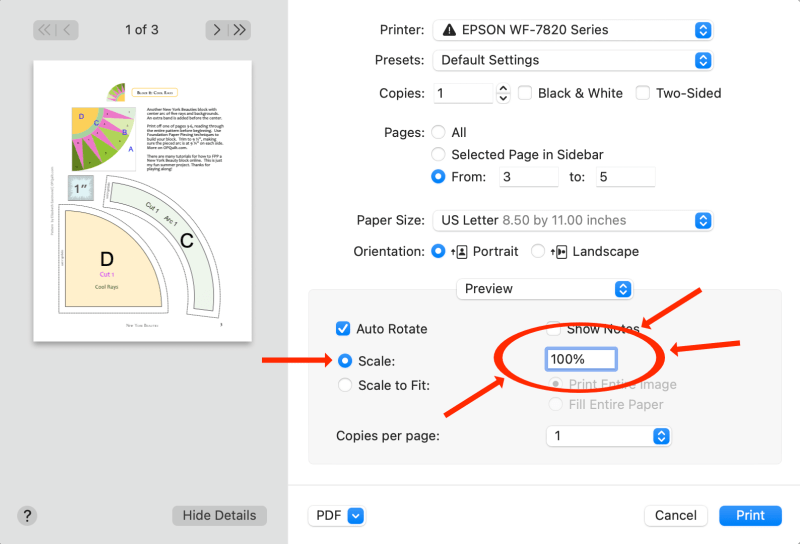
Stats: It will measure 9-inch when finished. Remember to print it off so that the size gauge of 1″ is one-inch square.

Honey, I shrunk the rays.
But then I added the band, so all is good. Are you getting the hang of this? I’ve written a longer post about how I manage foundation paper-piecing (FPP) if you aren’t. Keep reading.

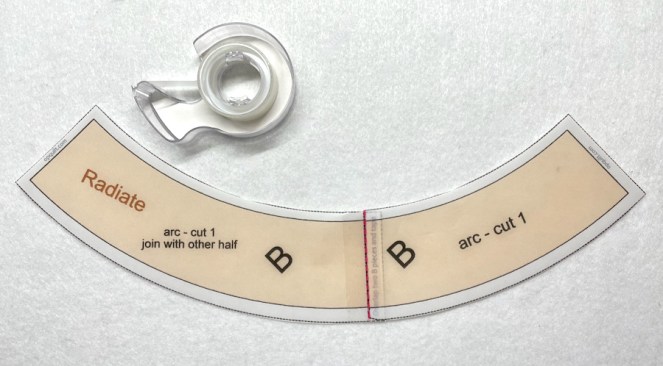
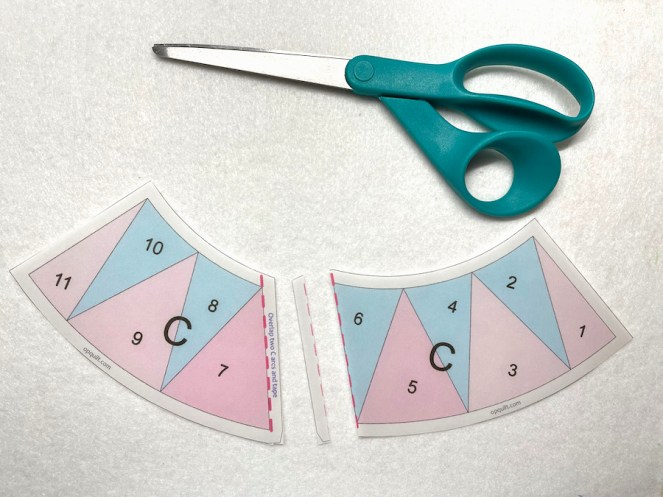
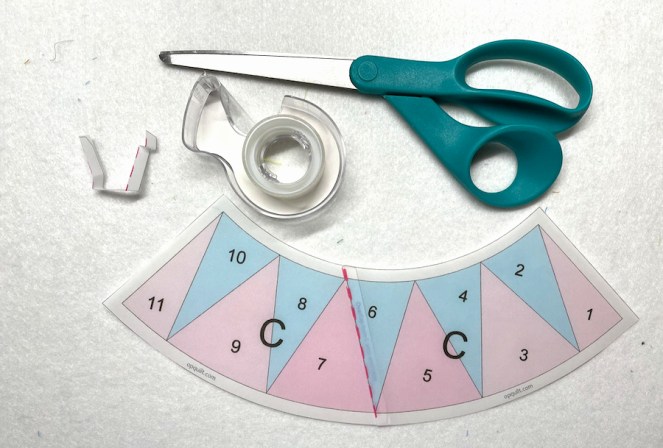
You know the drill by now: overlap and tape or glue at pink dotted line to make the larger arc.

And then do the rays, Piece C. I cut off the little bit of overlap on the top piece and throw it away.

Remember in Block Two how I cut out a rough shape of the ray? I did the same thing here.

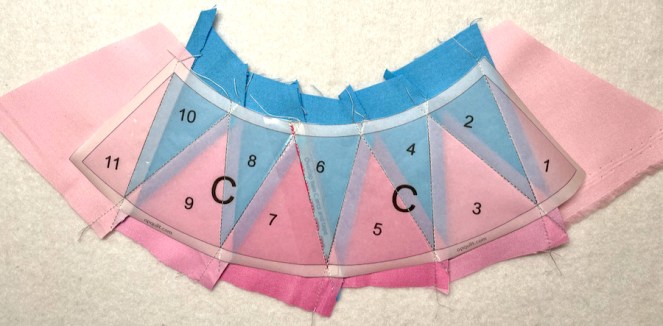
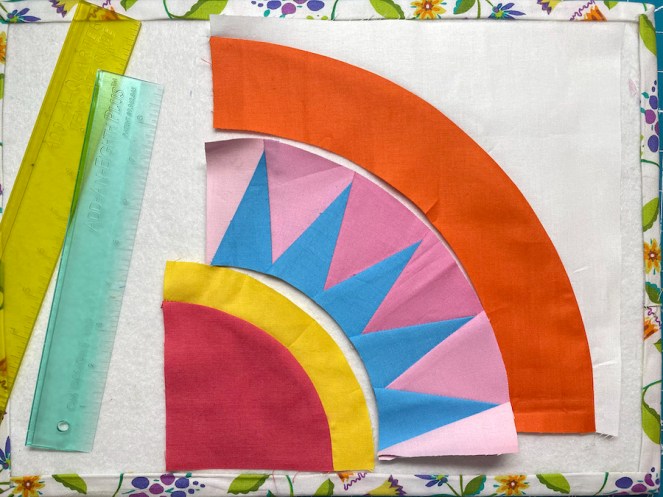
Checking colors. I also did a half-ombre on this set of rays — from lighter pink on the outside rays to darker pink in the middle. I like how the blocks all play together nicely with the shaded areas leading the eye around the circles.

More checking colors. The arcs are just pinned up for the Radiate Block.

Rays block, before the haircut — er, trimming. You can see the gradation of the pinks here. I also tried to color them slightly on the pattern; hope that helps. I pressed this, trimmed it, then set it aside.

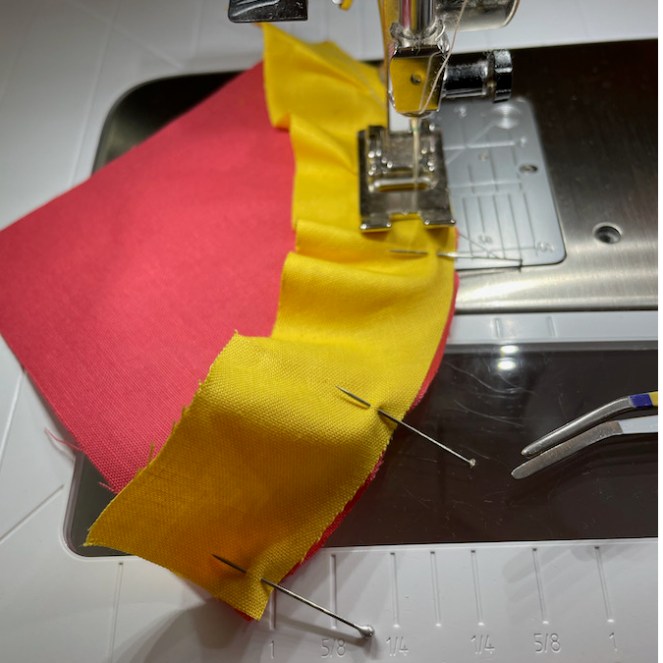
I started from the center, sewing the coral-orangey-red quarter circle to the yellow band. I always press marks at the center, and half-way to the center on both pieces to help with pinning. I have more success with the concave piece on top, and the convex piece on the bottom.

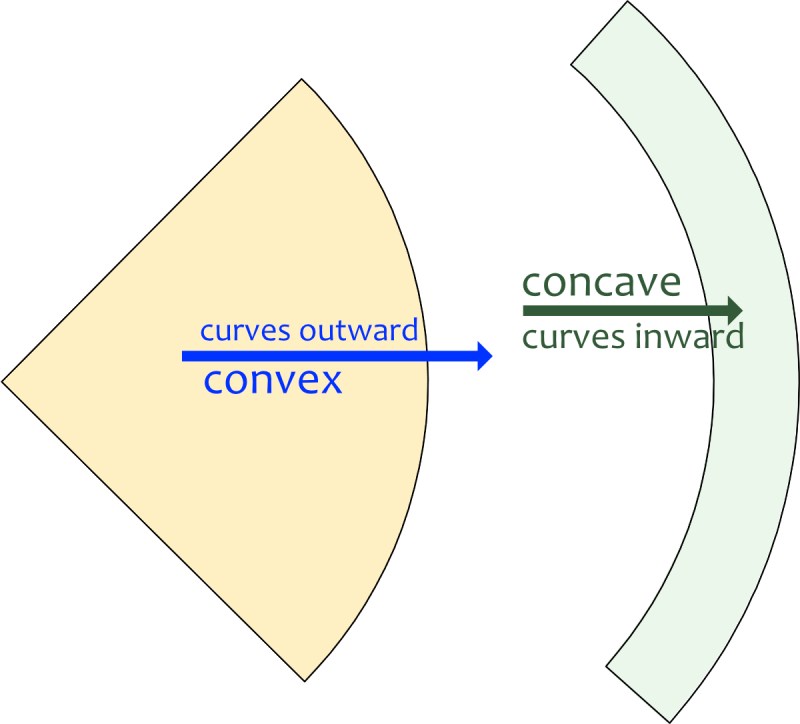
Here’s a drawing for you, if you need it like I always do. The green arc actually has both a concave surface (where it faces the yellow quarter-circle), and a convex surface (on the right side of the arc).

In the top photo, you can see my press marks to help in sewing the arcs evenly onto the matching convex surfaces.

And in the bottom photo, three are finished. I’m working on the fourth one now, and I think I can probably share how I think about the weird-o parts of FPP. The first time I did this ever, it was a nightmare: limited fabric, doing it for someone else, and too much for a novice to tackle. I was terrified about running out of my beemate’s fabric because I was always sewing and cutting it backwards.

Verushka (and you might really really want to take her class–so many good things and I think she explains them well) taught us to fold the next segment backwards, gauge the size of the fabric piece you’ll need, then proceed from there. I’m am using segments from Block Four in these illustrations, and I know so so many of you are Total Pros and will find these tips sophmoric or useless. (Then just move on…it’s for the rest of us.)

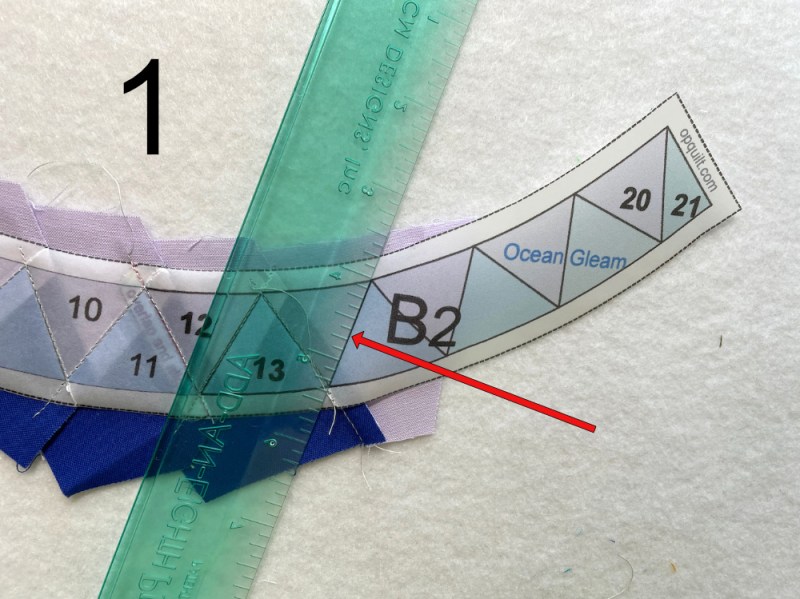
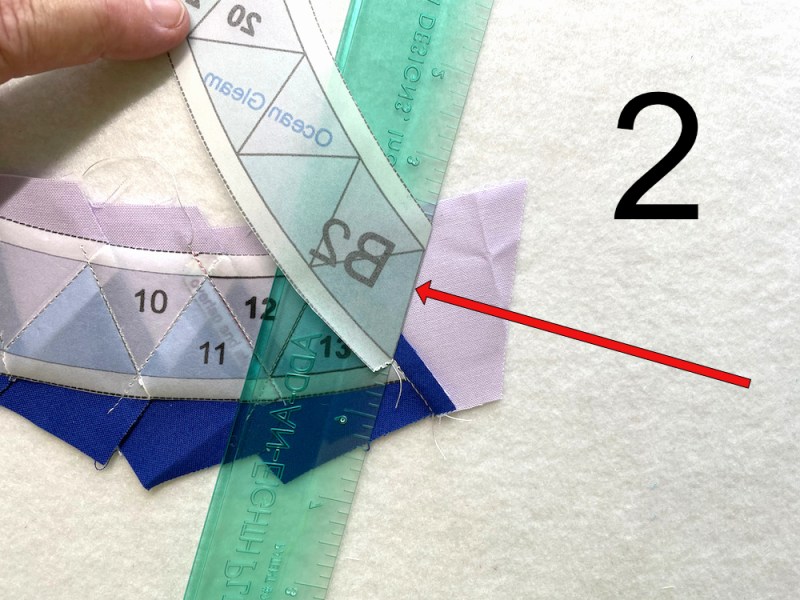
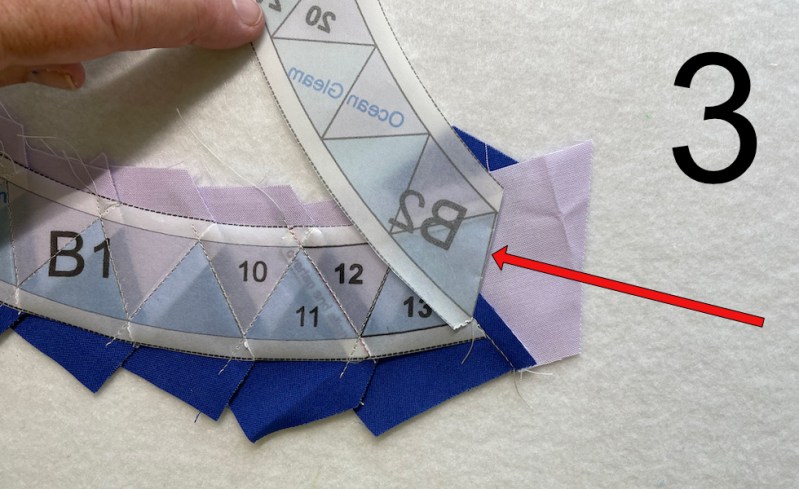
There are two basic rulers used in FPP. One is Add-A-Quarter-Inch and it’s yellow. The other is Add-An-Eighth-Inch and it’s the green one, above. This green one has the sweetest edge, right there by the red arrow. It’s really thin, so it helps in folding (this step). Align that thin edge with the line for the next seam. In this case, we are working on the blue triangle.

Keeping it in place, fold the paper back over the edge, and put a good crease in it.

Remove the ruler. I know you are probably rolling your eyes at this step, but it’s just in case you are sewing at night and your brain is fried.

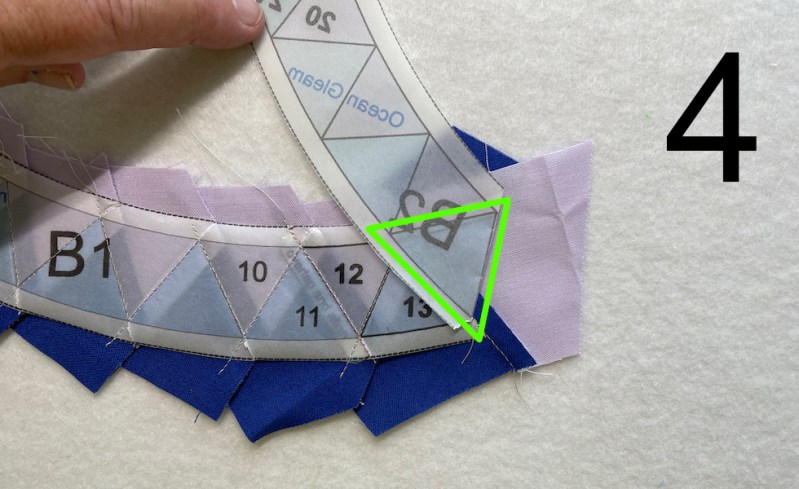
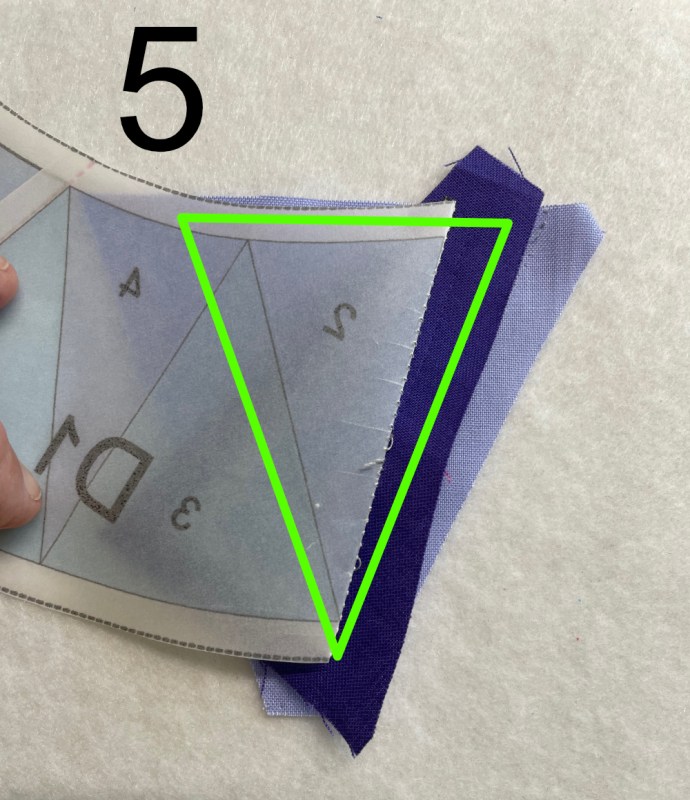
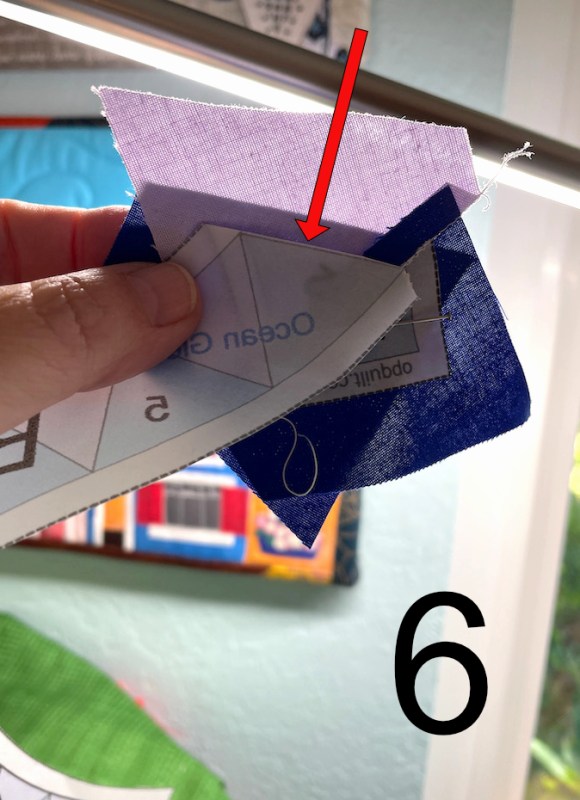
Notice the position of everything: the completed rays are to my left. I work left to right, and concentrate on keeping this oriented this way. Also notice–that triangle marked in green (the blue ray) is what I’m focusing on. If you compare FPP Tip #2 with FPP #4, you can see I’ve brought in a blue fabric triangle and laid it in the approximate position I’ll need to sew that seam (*marked in Tip #3 with a red arrow*).

Now I’m going to show you this step from another set of rays–a little bigger so you can see more easily.

A bigger triangle, same green outline. If you can see behind the deep purple seam allowance, I’ve positioned a lavender piece of fabric, which is cut larger than I need, but in the approximate shape. (Remember how I always trace the ray, but a bit bigger? This is that piece of fabric.)

Okay, back to the small rays.

I’m holding it up to the light (this is where some people use a light table, which is a great idea).

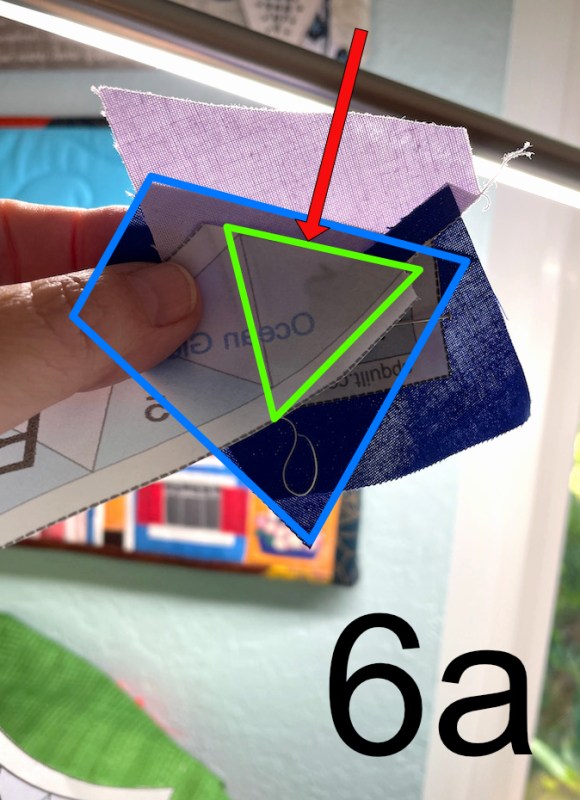
Now here, in 6a, You can see the oversized blue triangle piece behind the FPP assembly (marked in blue). I try to line up the side edge about 1/4″ away from where the seamline will be (red arrow). Some people like to trim this edge to 1/4″ before lining it up. I’ve done that. But when I’m working with small bits and am on a roll, it’s another step. Your call.

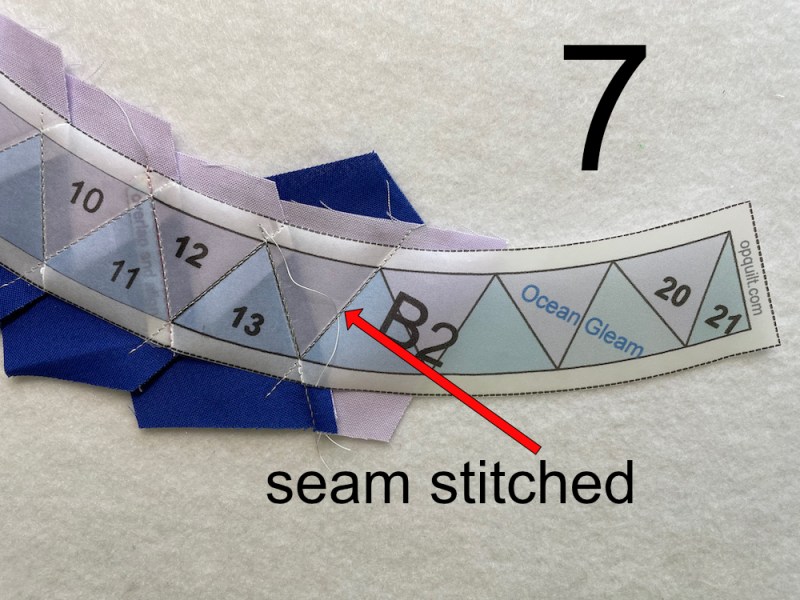
Pin the fabric in place, or just hold on to it tightly. Unfold back your paper, exposing the marked seamline. Stitch with a 2.0 stitch if you are using vellum, or something a bit tinier if you are using computer/copy paper.

DON’T GO ANYWHERE OR PRESS ANYTHING YET!

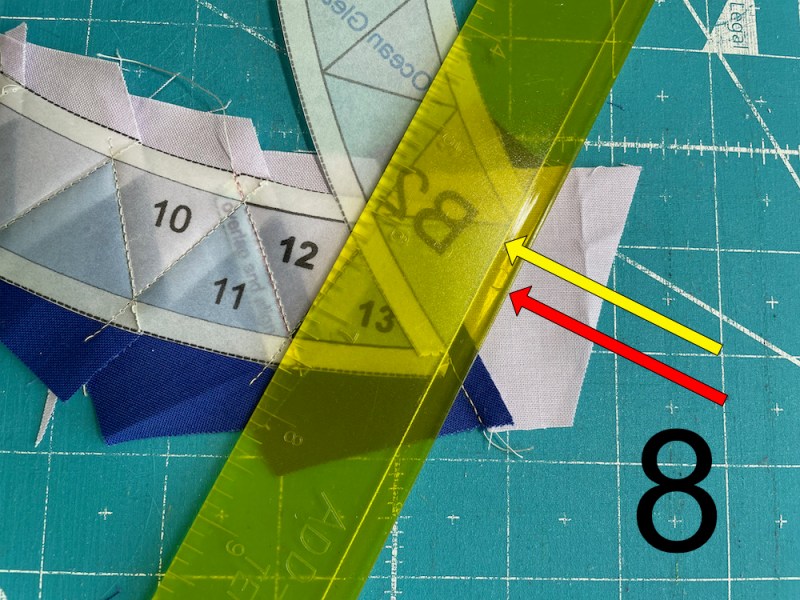
Head to the cutting table. Fold back the paper one more time. Reach for the yellow Add-A-Quarter-Inch-Seam ruler. Lay the inner edge (yellow arrow) bumped up against the folded edge. Lay your rotary cutter against the outer edge (red arrow) and slice off the excess.

Please notice that I still keep the orientation the same: the active place is on my right. The completed and sewn section is on my left. (Verushka has a great way of describing it to help you remember. I am forever indebted to her!)

Now you can go to the ironing board. Unfold the paper (again), and smooth the fabric over. Press from the “right” side. Remember that everything looks reversed now, but this is the weird-o-ness of foundation paper piecing. You’ll start this whole process again, this time with a lavender triangle/ray.

I’ve become much faster at this, and if you are not already a pro, you’ll get get faster, too, as you go through these New York Beauties.

Final Tip

After working on these blocks, it suddenly occurred to me that after I made each arc of rays, and trimmed them up…I didn’t need the paper in there anymore. So I peeled it off before sewing the ray-arcs to the plain arcs. I referenced this a little bit in the last block, where I tore off the paper at the seam allowance. Generally, in FPP, you only need the paper where the seam lines will be lining up. Generally. But in these NYBeauties, the paper just got in the way. Without the paper, I can use a more reasonable stitch length, and the fabrics will work together. Try it and decide if you like it.

Because it’s June and Why Not? Try making Blocks One and Two. Now, with this post, you have three (and a peek at Block Four). I love all the sweet notes you write–if you feel like following this blog, that is also a nice thank you. I post weekly (but this June, it’s like bi-weekly). I’m also on Instagram, if that’s more your style.

Our hashtag on Instagram is #newyorkbeautiesquilt so let’s post and tag and share our beautiful blocks!

The New York Beauties Quilt pattern is available for download in my PayHip Shop.

Take a breath…and keep quilting!

Patterns by Elizabeth of OPQuilt

New York Beauties Block 2: Cool Rays

Second Wednesday in June means the second block of my New York Beauties and since it has a lot of green in it, I went with Cool Rays. I used variegated greens from dark to light in between the rays, just for fun. Because this series is about having fun, right?

STATS: 9-inch blocks, finished Yes, the rays are a bit wonky on some blocks. The perfect is the enemy of the good, as I used to tell my Freshman English classes.

I made the rays on this block twice, because I neglected to follow this one rule:

Yeah, duh. I printed out the first one at 97%. Close, but not close enough. It was a nice set of rays, too.

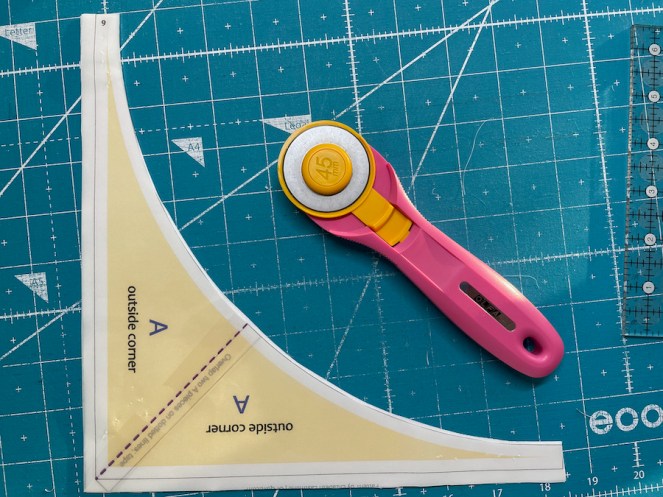
Fun times: the spliced outer corner pattern from Wild Sunflower (block #1) is the same for all the blocks, so I just used it again.

Splicing action needed.

Nice work. I had a question from a reader about the paper I use. It’s vellum, and from what she wrote back, it may be hard to find in a ream. I’ve seen it in smaller packages, so hopefully if you want that, you can find it.

Auditioning fabrics. Notice the range of greens. I tried to color them on the pattern from lighter to darker, too.

I took a scrap of my paper, traced off the two different sizes of my rays very loosely, and used that as a template to cut out fabrics. Since I’m using solids, there is no right or wrong side.

Progress. I always work from left to right.

Cut your arc on the bias, to give it a chance for ease around that outer edge.

I cut out two arcs because I didn’t know which one I would like. No, they aren’t sewn in yet, just draped.

I press in four creases and pin. I also do better if the convex is on the bottom and the concave is on the top, although I keep trying it the other way, which leads to use of the seam ripper. You can pin as much as you want to. No rules.

Ta-Done!

I took them outside to play.

My New York Beauties pattern, which includes this block, is available for download in my PayHip Shop.

And remember, it’s June! We are having fun!

Just breathe…and keep quilting!