Giveaway · Quilts

Snapshot: Putting the Quilt Top Together

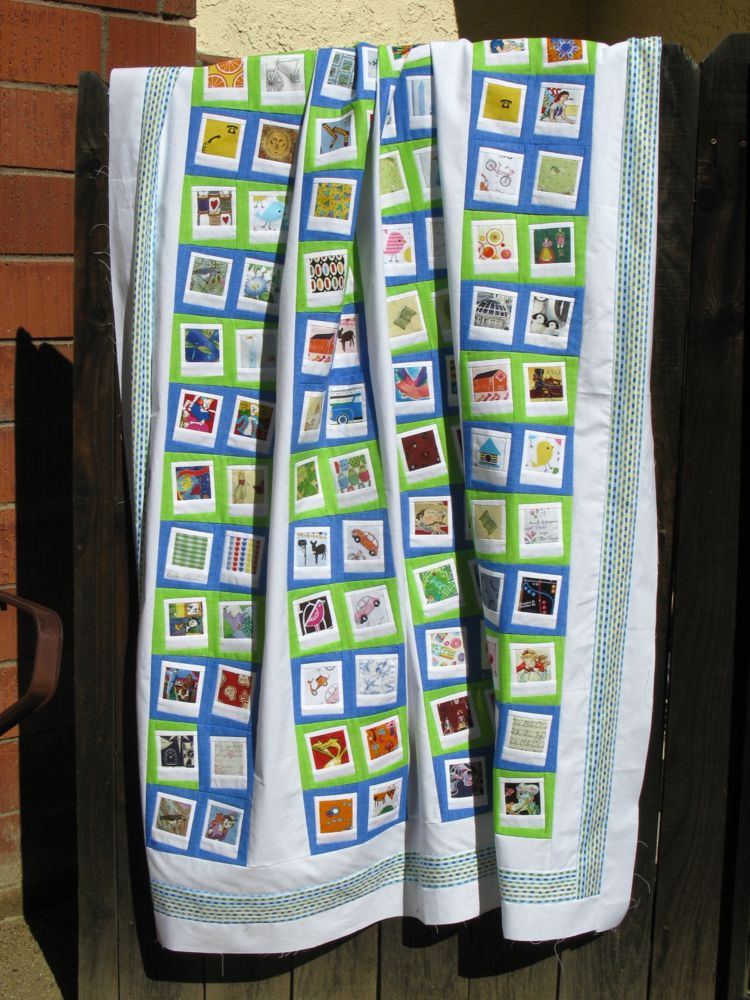
Here’s my Snapshot Quilt, in the requisite rustic pose drooping over a gate with rusty wheelbarrow.  Go yard work for great props.

This is the third and final post in my tutorial of how to make the Snapshot Quilt, constructed from lots of Polaroid blocks.  And at the end, my little giveaway.  I have three sets of 10 blocks each to giveaway, but hey! you must be a serious Polaroid-er to get them.  Leave me a comment telling me what you’ll do with them–have you started your collection?  Do you have a few and want more?  Do you have plans for them?  And for fun, tell me about your favorite vacation photo, since this quilt is, after all, a tribute to vacation photos everywhere.
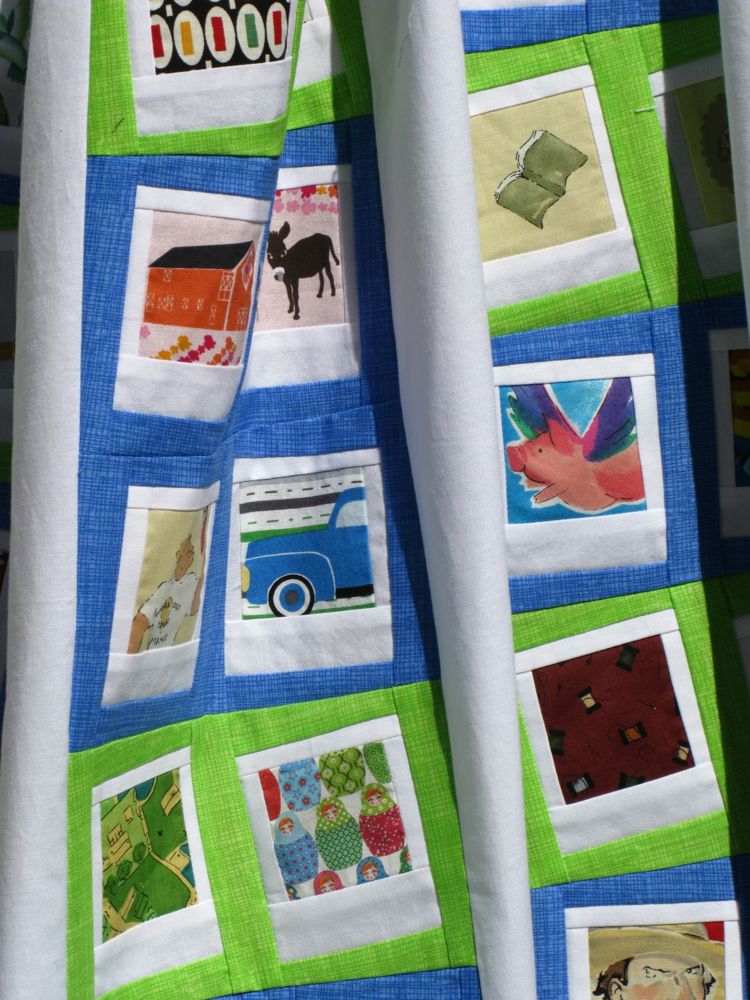
Here’s a close-up of some of the Polaroids.  I received the truck Polaroid in the swap.  Love it!

And that German-looking couple on the right was cut from my Barbie-doll dress.

Now back to work.  I have made a PDF to help guide you with cutting, and it includes the basic bones of the quilt.  Download it: PolaroidQuilt
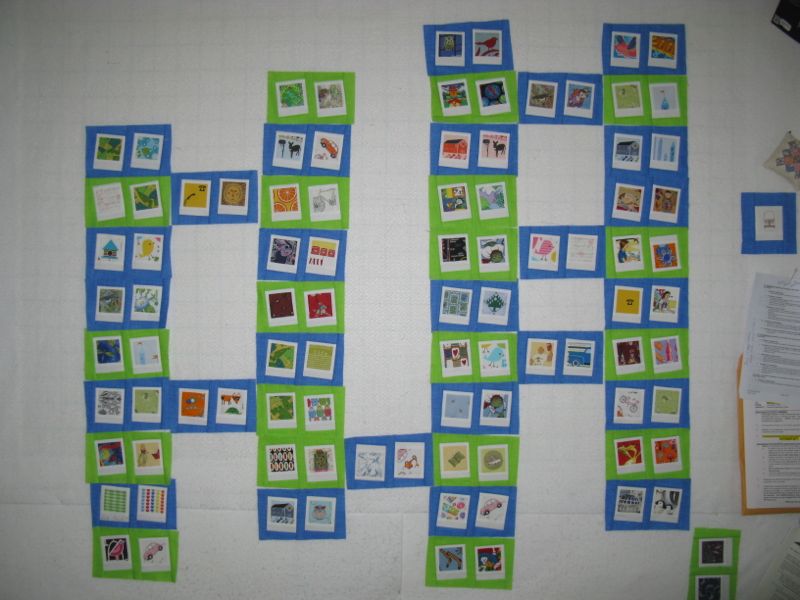
Start throwing up blocks onto your pin wall.  This was my first attempt. I knew I wanted a stacked coins effect, but was playing around with inserting blocks into the middle of the stacks.  Meh.

Second try.  I like this one better, but not keen about the four blue blocks across the top, so I switched them around.  Check the previous post for the doctors-office-view of the quilt, which shows how I ended up arranging all my blocks.  I also checked to make sure that there wasn’t a glob of orangey-red blocks, or too many of one type or color.

After getting the blocks the way you like them, sew them together.  My row tags, made from embroidery holders, indicate which row it is, and which is the top. I pinned them all together in a row, then stitched them.

Cutting the white internal strips and borders:
Internal rows are 4 x 52″ (w/o s.a.) so cut three strips that are 4-1/2″ by 52-1/2″.  I’d STRONGLY advise cutting them on grain, that is, cut them parallel to the selvages of your white fabric.  All these double-Polaroid blocks are slightly on the bias, so they need the strong stable edges of an on-grain piece of fabric.

Borders (seam allowance included):
Border #1, top/bottom: cut two pieces 2-1/2″ x 40-1/2″; for the sides, cut two pieces 2-1/2″ x 56-1/2″” long
Border #2 (print), top/bottom: cut  two pieces 2-1/2″ x 44-1/2″; for the sides: cut two pieces 2-1/2″ x 60-1/2″” long
Border #3, top/bottom: cut two pieces 2-1/2″ x 48-1/2″; for the sides, cut two pieces 2-1/2″ x 64-1/2″” long
NOTE: I’d cut the border pieces slightly longer, to give allowance here and there for ease needed when sewing on borders.
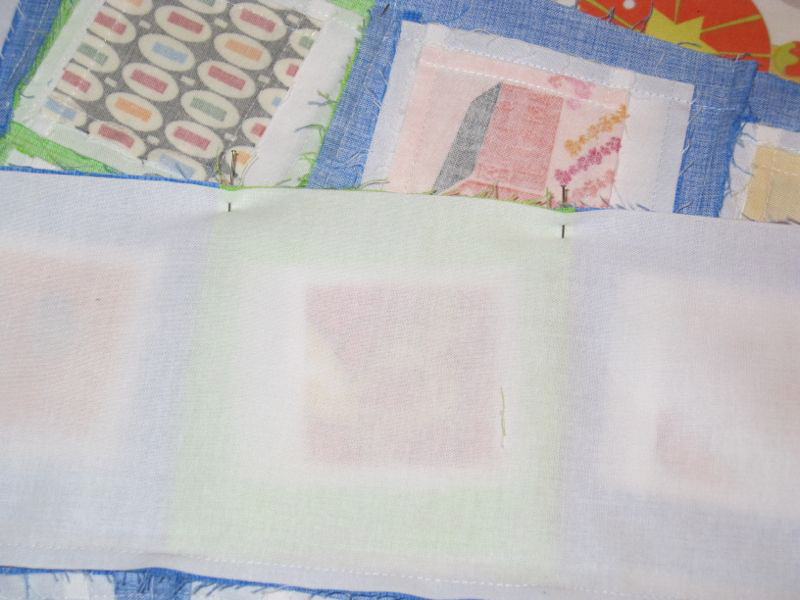
Matching centers and edges, ease the stacked quilt blocks onto the white on-grain strip of white fabric.  Repeat until four rows of stacked quilt blocks and three strips of white fabric are sewn together.  I sewed the seam with the quilt blocks to the throat plate of my sewing machine, allowing the motion of the feed dogs to help ease in any extra fabric.

Sew on the first top border, then the bottom.  Then, matching centers and edges, sew on the side borders as you did above, keeping the white strip UP and the quilt block stack to the feed dogs.  Press seams toward quilt blocks.

Attach the print borders next in this order: top, bottom, side, side.  I was exacting on the lengths and matching edges and centers, but I should have given a little more ease to the side borders.  It’s a challenge sometimes, as you don’t want to get the borders too small so that the quilt “bows” with a curved edge, but you also don’t want it so loosey-goosey that it ripples.  Pin and check, is my advice.  Then press the seams toward the print fabric.

Lastly, attach the last white borders in the same order: top, bottom, side, side.  Press toward the second (print) border.

You’re done!

How do I plan to quilt this?  I’m thinking I’d first stabilize those long stacks with either stitching in the ditch white white thread, or a quarter-inch away into the white.  I’d like to outline along the Polaroids to make them pop.  The white sections call out for some sort of overall pattern, like this pattern from Leah Day of Free-Motion Quilting, Bow-tie Parade:

Go and visit Leah’s site for lots of ideas and a stimulating blog.  I love reading her posts.  I do plan to bind this with more of that print shown in my border.

Now! Leave a message if you are interested in scooping up some of my Polaroid blocks, and mention what you’ll do with them–have you started your collection?  Do you have a few and want more?  Do you have plans for them?  And for fun, tell me about your favorite vacation photo, since this quilt is, after all, a tribute to vacation photos everywhere.

Mine favorite vacation photo is from when Dave and I were newly married (under a year) and we took all the kids to Zion National Park.  We are standing there in the middle of red rock country in our slightly dirty T-shirts, a group of 2 adults and 4 children who were on their way to becoming a family. Now let me hear about yours.
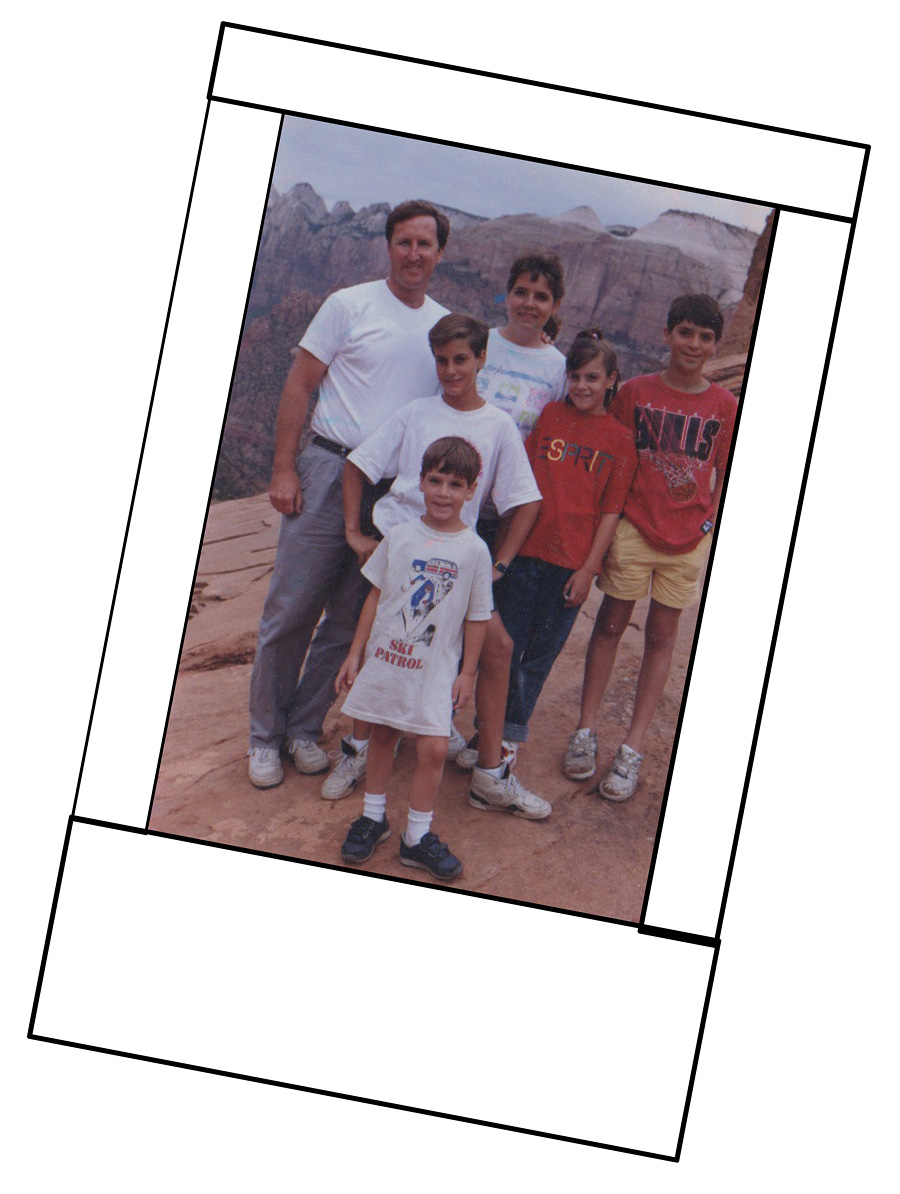
 

UPDATE:  Congrats to the winners of the Polaroid Blocks: Mary, Cindy and Marilyn.  I’ll look forward to seeing what they do with their blocks, so send those photos over to my email when that future finish day arrives.
Quilts · Tutorial · WIP

Snapshot: Constructing the Double Polaroid Blocks

First, let me say a thank you to Lee of Freshly Pieced Fabrics, who is hosting WIP Wednesday for us.  Click *here* to return to her blog and see other fabulous Works-in-Progress.

If you missed yesterday’s post about Snapshot, my latest quilt (above), scroll down as there is information for fabric requirements and a basic How-To for Polaroid Blocks.

The first picture (top) is Snapshot in a beauty pose.  This one (above) is the one where she’s in under the fluorescent lights in her doctor’s office, wearing only a flimsy gown that opens in the back.  You know the feeling.  But we need to examine the quilt to see how it’s put together, so I thought you needed a clinical kind of picture. Here you can see some of the variety in the tilting, and in stacking the blocks.  I had some scraps of fabric at the end and late one night made the one at the bottom left into two colors. (I should go to bed earlier, I think.)

I did these in sets.  You’ll end up making about 4 sets, alternating the blue fabric with the green fabric (only use one color at a time), as each stack is made up of 13 blocks.  However, I made a few more of each color, because I doubled up on some colors for variety (you can see it above where there are two blue blocks together).  So make 4 1/2 sets.
For each set of 13 double blocks, you’ll need:
8 strips of either blue or green (don’t mix), cut  1 and 1/2″ wide
2 strips of either blue of green (don’t mix), cut 1 and 1/4″ wide
26 Polaroid blocks, in pairs of two (take some time to match up the ones you want together)

Start by sewing the Polaroid blocks to to the wider  (1 and 1/2″) strip, placing Polaroids face down.  You are sewing this to the TOP of the blocks.

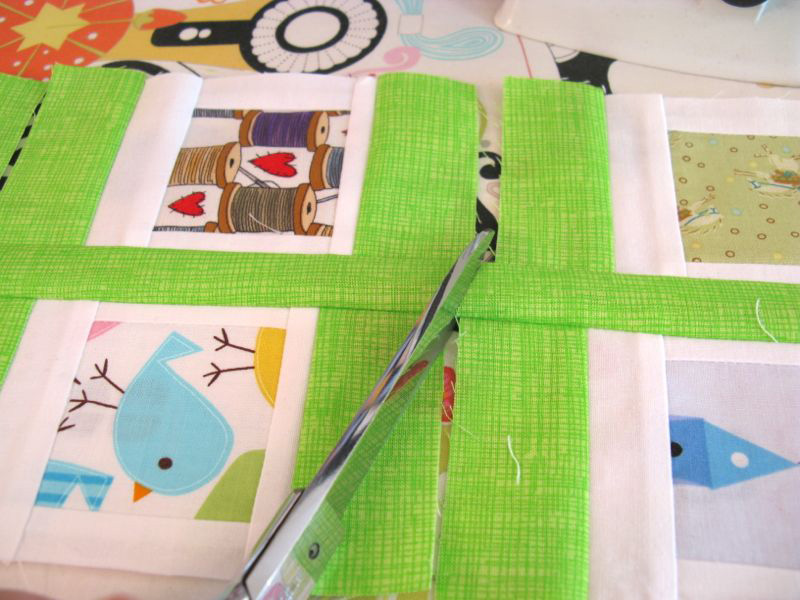
Lay out the strip of blocks and cut the blocks apart.  With scissors.  Remember those?  We finished up our discussion of The Shallows: What the Internet is Doing to Your Brains in class, and the last section talked about tools; when we adapt and adopt a tool, it become an extension of us and we may leave older tools behind if the new one suits us better.  So if you feel like the rotary cutter is an extension of your hand, you may need to practice using scissors again.  Kidding.

Press the fabric away from the block, like this:

Now sew another wide strip on the bottom of your Polaroids.

Here’s four blocks, with the top and bottom borders sewn.  Again, you are using the 1 and 1/2″ width fabric.

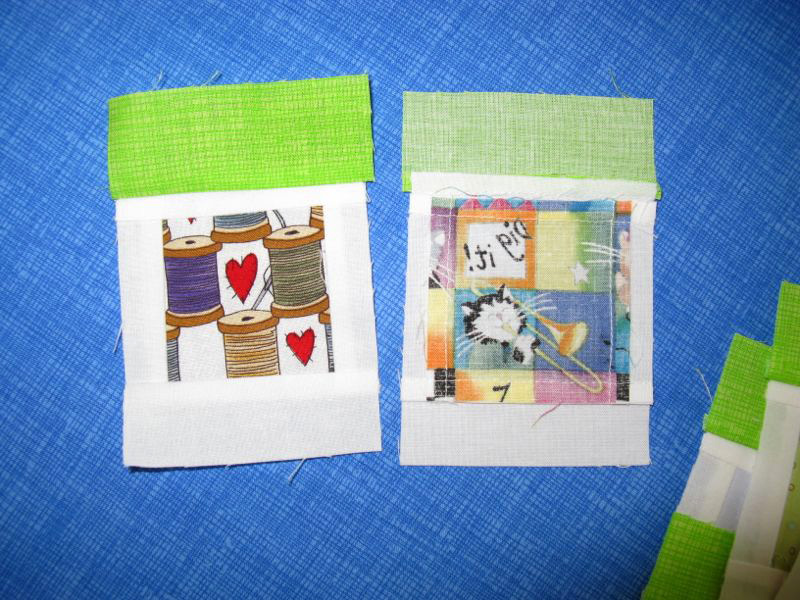
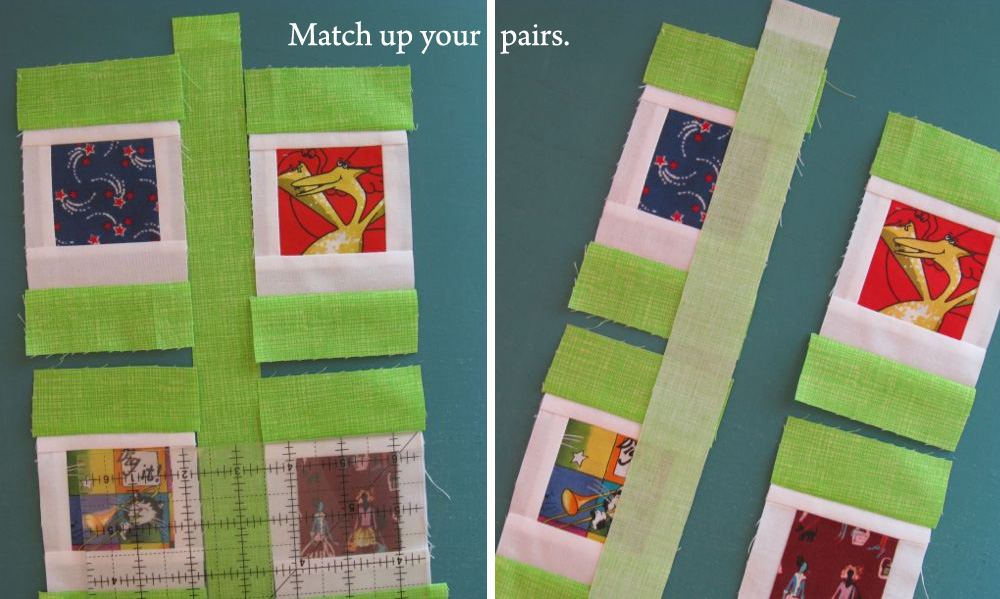
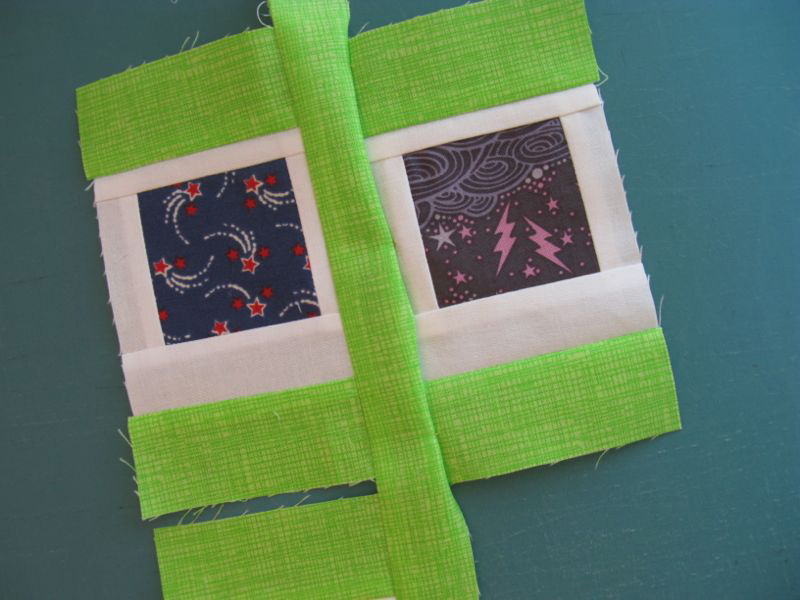
Lay out a strip of the narrower fabric (1 and 1/4″) and place your blocks side by side, matching up your pairs.  Separate them by about 1/4″ at the bottom.   I pinned them so it would be easier to transfer to the sewing machine.  Sew the first set (one side) onto the center strip. You should be able to get about 7 Polaroids per strip.

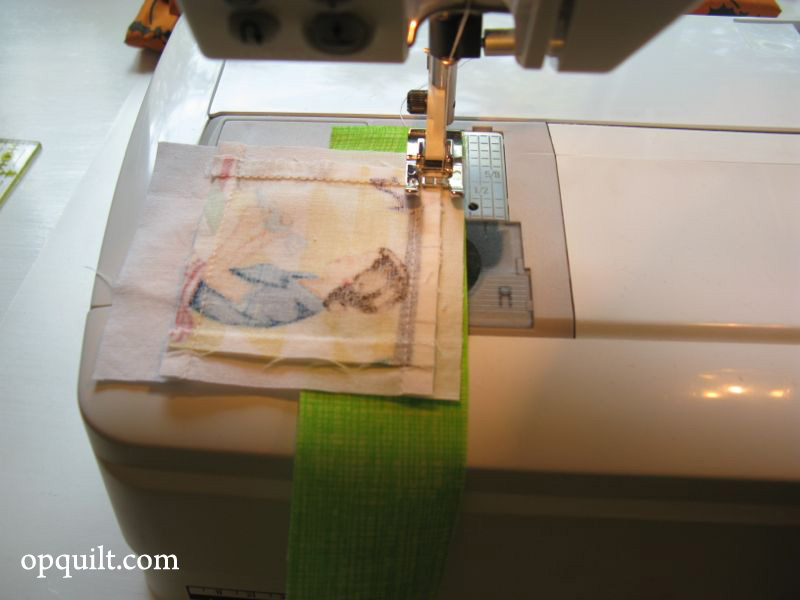
As you sew on the first set, pay attention matching the edge of the Polaroid block to the edge of the center strip, letting those little bits of borders stick out.  You can cut them off in an earlier stage if you need to, but I did mine after sewing them.

NOW trim off the little edges if they bug you.  For sure, trim off the big overhangs!  Just lay out the strip as shown, and cut the overhangs off, even with the long strip.  DO NOT CUT THEM APART!!!   Let me repeat.  DO NOT CUT THEM APART!!

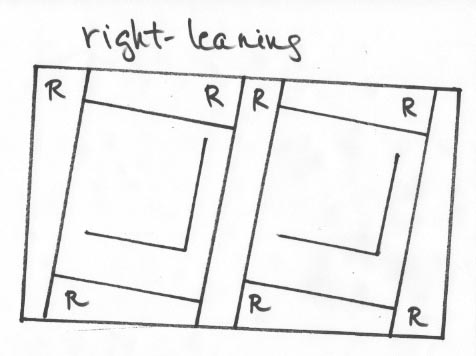
Now, take your “right leaning” and “left leaning” PDF printouts from the last post, and set one of them at a time on the table while you do the next step.  I made all the greens to lean to the LEFT. All my blues lean to the RIGHT.  It feels backwards, but here we go.  I used the picture to get in my mind which Polaroid should be 1/4″ up and which one should be 1/4″ (or the width of that top border) down as I’m lining them up along that center strip.

Notice in this high-quality illustration that the blocks lean to the right.  To accomplish this, you have to offset them when you sew them to the center strip.  The left block is “lower” on the strip, and the block on the right side is “higher.”  This is why I used two colors: to keep things straight.

But my greens tilt the OTHER way, so I used the “left leaning” diagram to help me.

(Diagram in action!)

Again, to get the tilt, you need to jog the one on the top down about one-fourth inch.  What I did was line up the edge of the green border  with the top of my center picture in my Polaroid block.  (I know this sounds confusing, so just look at the pictures.) This will give you that offset you need in order to tilt your block.  Do this with the remainder of your pairs.  Pin, then stitch.

When working with the blue, I reversed the sewing, stitching the blocks on the right-hand side of the center strip first, then the left.

Here it is sewn.  You can really see the slipped alignment here.  Press this seam toward the center strip.  See two steps down, for the why of pressing.

Cut these blocks apart now; the cut will be angled to fit the skewed alignment.

Here’s one that’s been cut apart after sewing.  Here you can see the shift.

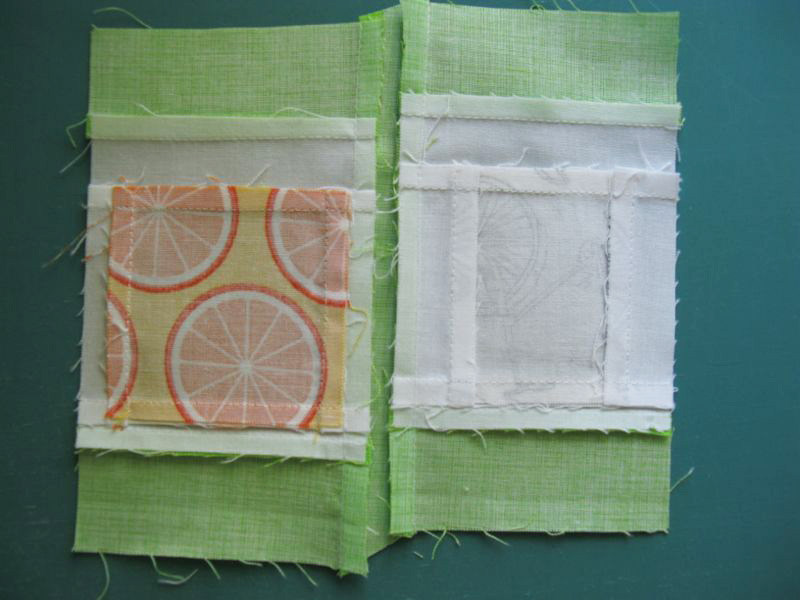
And in comparing these two blocks (the one directly above and the one below), you can see the difference the pressing makes.  The pressed edges can either make a block look like it’s resting on the top or like it’s “sunken” into the strips surrounding it.  I wanted my Polaroids to have that look of being bordered by strips, not the strips “supporting” and “lifting” up the Polaroids.  So that’s why all the pressing directions indicate which way to press the seams.
Here you can see the different pressing.  All right Goldilocks, you are through the deep scary forest and just about to claim that pot of gold at the end of the rainbow.

Using the wider (1 1/4″) strip again, sew the outer borders onto both sides of your block assemblage. Cut apart.

You should have 13 blocks that look like this.  Now comes more fun, more forest.

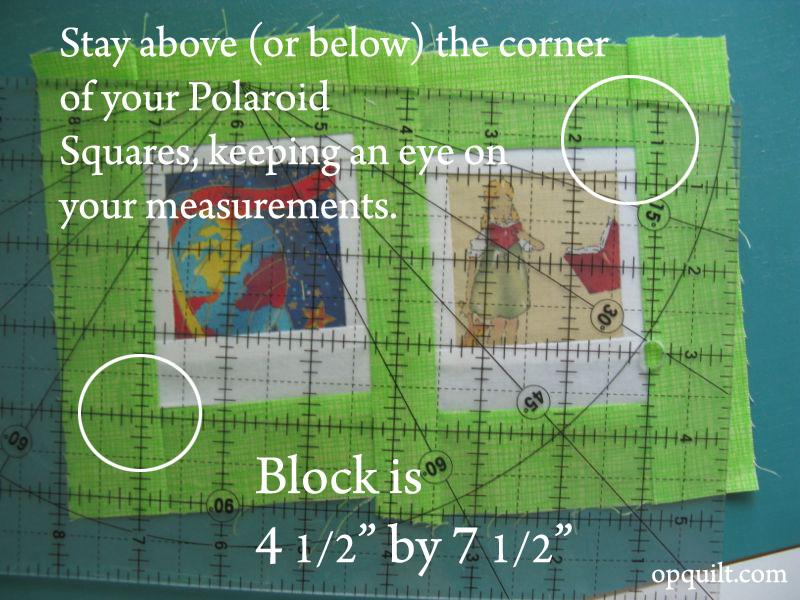
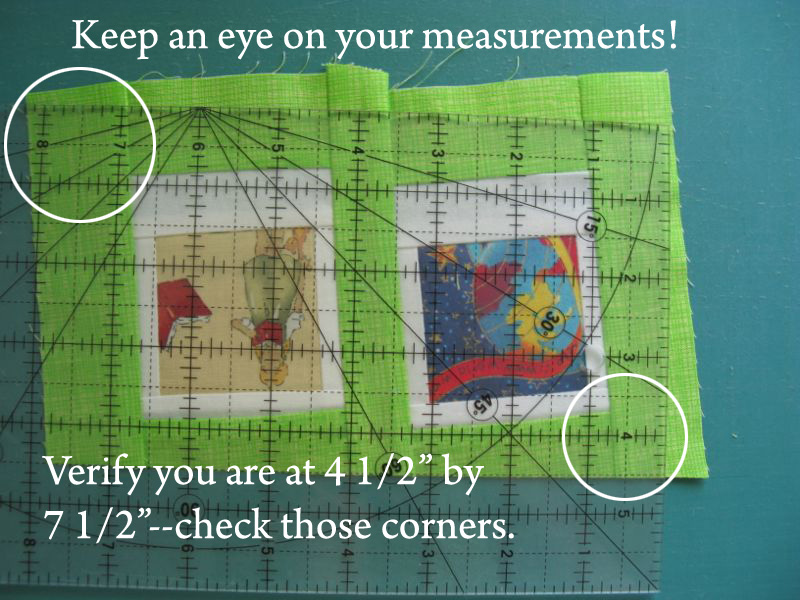
Get out that PDF picture again.  Lay it at the top while you trim your blocks.  The size you want to trim to is 4 1/2″ by 7 1/2″.

You need to tilt your ruler a bit, making sure you leave at least 1/2″ space between the edge of your white Polaroid interior block and the planned cutting line on the outside edge of your ruler.  (This is why you make extra blocks, if you get my drift.)  I tried to vary my cuts, because I think one of the charm of these Polaroid blocks is their wonkiness when set into their frames, much like a child would paste vacation photos into an album.  So sometimes I was just over 1/2″ from that edge, and other times I was closer to 3/4″.

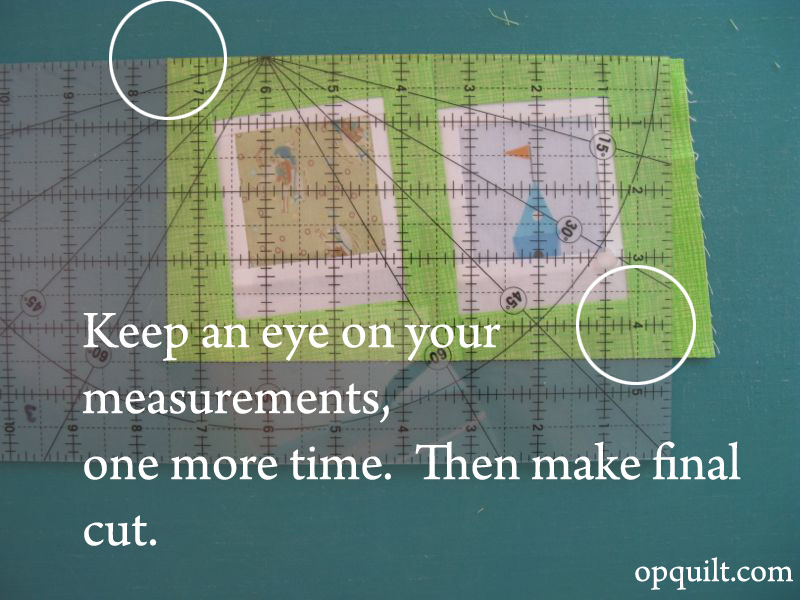
Keep at eye on that 4 1/2 line, as well as the 7 1/2″ line.  Be a juggler, keeping all these things in mind as you go for your first cut, slicing off the top of the block.  Then flip it around, putting the cut edge at the bottom.

Lay the 4 1/2″ line of your ruler at the bottom, lining up your freshly cut edge.  Check your measurements.  You want the bottom lined up, but you also have to check that the block is centered so when you cut off that right side, you’ll have an evenly centered  7 1/2″ block.  If you are good to go, slice off that right-hand side.

At first, I flipped it around again, as I’d only have to pay attention to one last side (shown above).  But after a while I became confident enough to slice off the top, >flip<, slice off the right and top edges again, then >flip< cut the last edge off.  Which is what I’m doing in the picture above.

I took this photo mid-cutting to show you how the block can feel skitty-wampus when you look at the first two cuts.  But then you slice off the two side edges and you are Through The Forest Again!  In the arrangement of my quilt, I used 28 blue double-Polaroid blocks and 24 green.  Make enough that you have some to play around with, and if you like decorations on the back of your quilts, include some for that too.

NEXT POST:  Putting the quilt top together, and one day closer to my surprise giveaway.

200 Quilts · Quilts

PTQ–Tips and Tricks

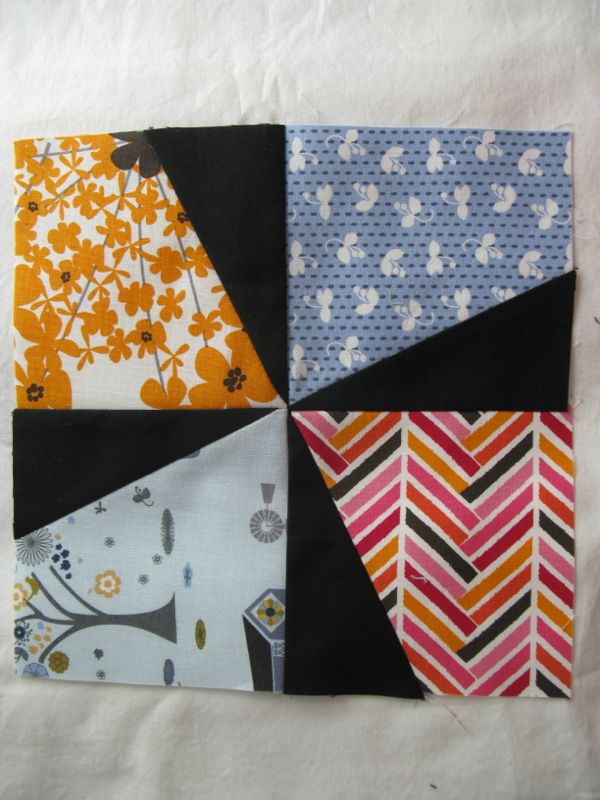
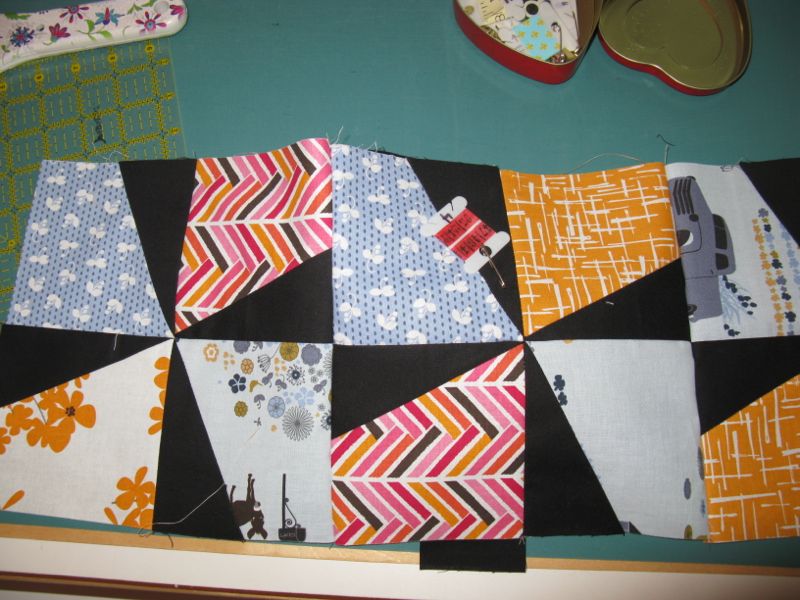
This is a continuation of what-I’m-calling the Portuguese Tile Quilt, a free quilt pattern from *here.*  I arranged my pieces on the board so that no two fabrics were in any block, meaning in the blue quadrants, they were different from each other and the pink quadrants also had fabrics different from each other.  I didn’t care so much if the pinks imitated the blues, but I did watch out for strong fabrics in the same block (like that “plaid”).

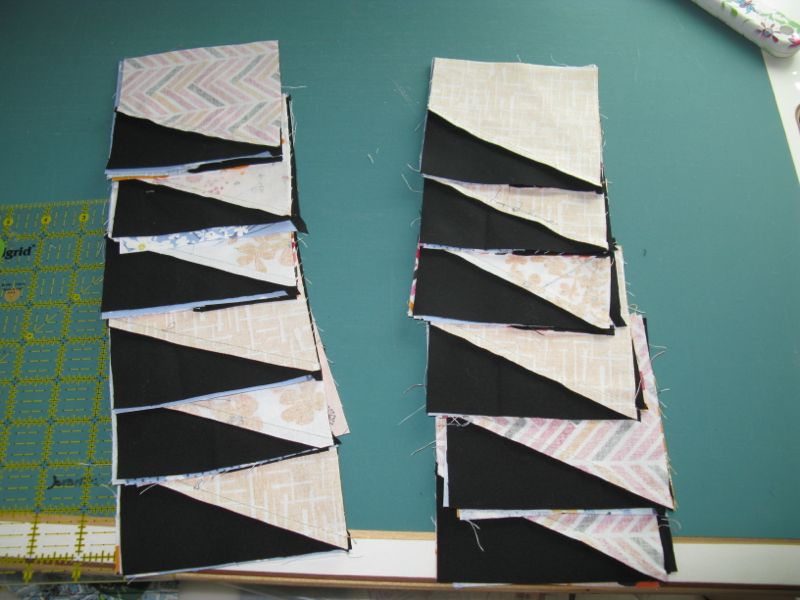
To sew these blocks together, flip the right-hand side of the block onto the left-hand side, then place the top two on the bottom two and stack them on your sewing surface.  That’s my confusing method; you’ll probably develop your own.  The basic idea is to get the quilt block, which is now in four pieces, over to your sewing machine in some semblance of order.

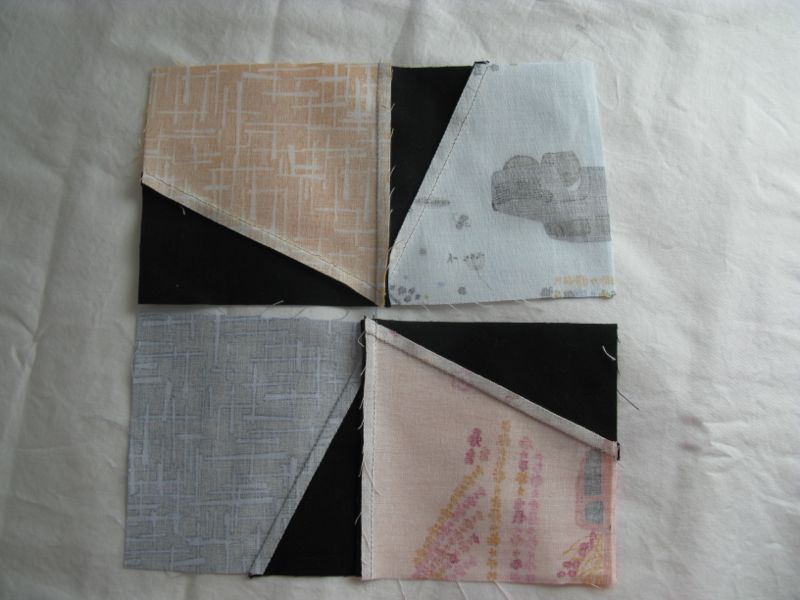
So, on the top, is the right-hand upper piece flipped over on the left-hand upper piece.

On the left on the bottom, is the similar pair.  I have no idea what that other bit is doing–just hanging out?  Quilt blocks are buddies and they seem to like to do that.

Sew the center seams on those pairs, then press the fabric toward the black pinwheel on all of them.

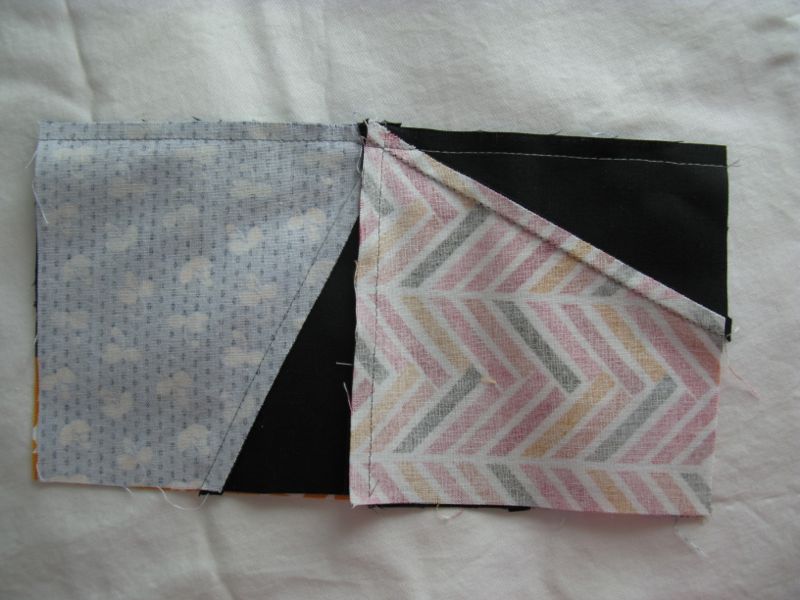
Here’s my little trick.  I sewed these pairs in a chain, then left the pairs that went together hooked in the middle, but cut the chain into “two’s.”  Then when I go the ironing board, I don’t have to match them all up again.  They’re already joined. Flop them right-sides together.

Sew that seam across the two blocks. I found that if I took the step of going to the ironing board to press toward the pinwheel, I could get away without pinning this thing to death, or eliminating the pins altogether.  The block kind of fits together because of the directional pressing.  It’s not perfect, though, so if you are all about perfection, get out the pins.

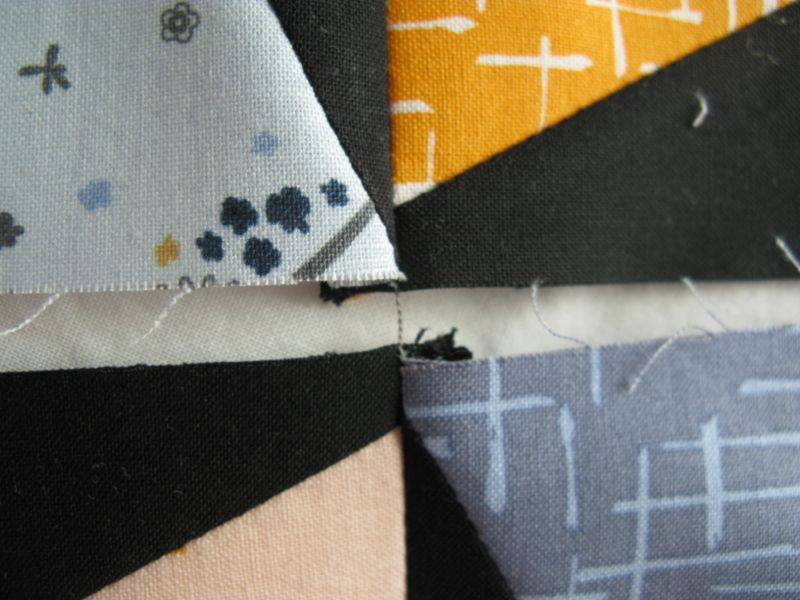
Head to the ironing board, and clip that little joining thread, and liberate any others that might keep you from opening up that center “flower” of seams.  As you work with it, you’ll be able to figure out the tiny clips of threads here and there.  Don’t cut any of the fabric, please, just the seam-threads.

You want that center to lay down into a flower.  I put my thumb on the center, and applying pressure, give the whole thing a twist, flattening out the seams.

Then press from the front. Even without using pins, I think that center join looks pretty good.

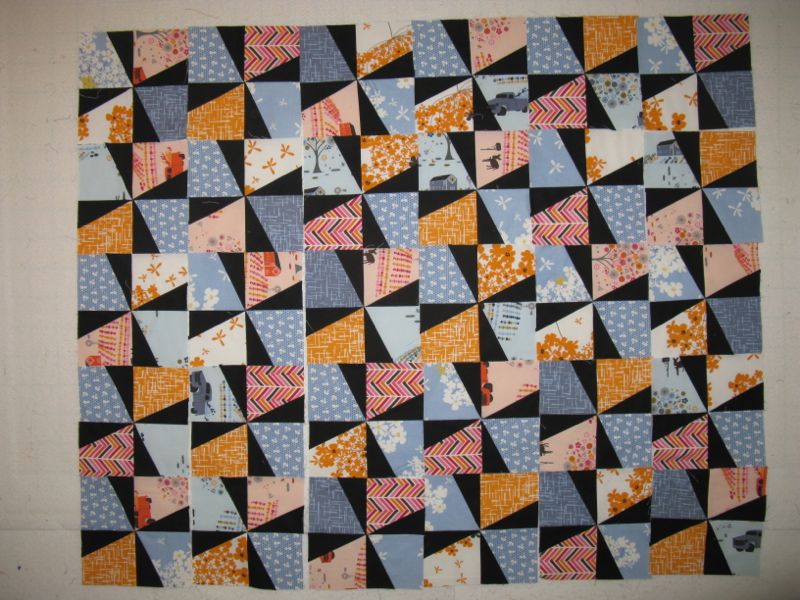
Lay out your first row on your pin wall.  Then you want to add to it, lining up your blocks so there’s no obvious repeats or clashes.  This part goes quickly.  In fact, the whole quilt went quickly: one week from cutting to sewing on the borders.

Stand back and see what is “clumping together” and needs to be separated, like squabbling children.  I find taking photos helpful.

The blocks I moved are not really noticeable, but calmed down the arrangement for me.  Don’t fuss with this too much, just keep moving forward.

Use those nifty row markers to mark your rows and sew them together.

If you pay attention, you won’t sew a block on the WRONG end of the row, like I did up there on the left.  Unpick.  Re-sew.

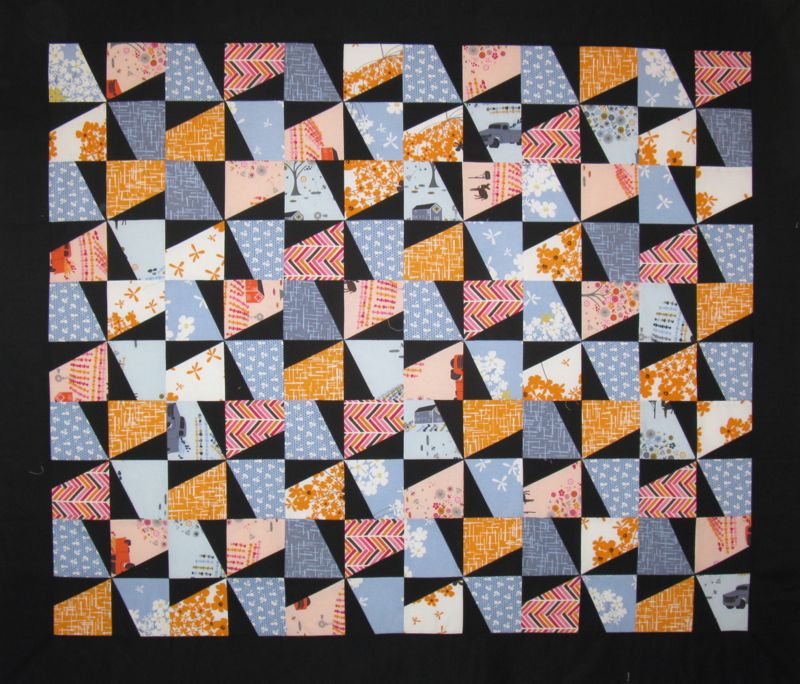
You’ve seen this before, but it’s really fun to show off a completed quilt top, isn’t it?

Feeling blissful over here.  I’ve already pinned it to the backing, and after I finish grading their argument terms tests, making up the next essay assignment, writing the peer review for the current essay, creating the rubric for evaluating their rhetoric presentation, writing another blog post for the class, and calling my mother, I plan to start quilting it.

100 Quilts · Quilts · Tutorial

Village Houses: Joybells Ring in Heaven’s Street

When I was at our sewing group, Lisa brought out her “house” quilt, the earliest group quilt that we’d attempted together.  You saw hers.  Here’s mine:

Quilt #28

We had the common fabrics to use of the fairy print (on navy) and the pink striped (shown in some of the houses).

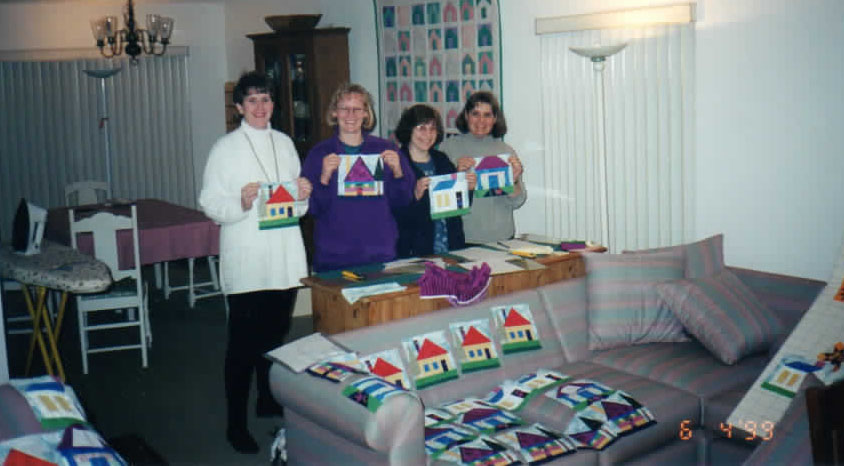
And here we are: Tracy, Lisa, Susan (who has moved away) and me, all holding up our quilt squares.  I love how they are all laid around the sofa everywhere.  And I love seeing that houses quilt in the background (#14 on my 100 quilts list, made 10 years earlier in 1988).

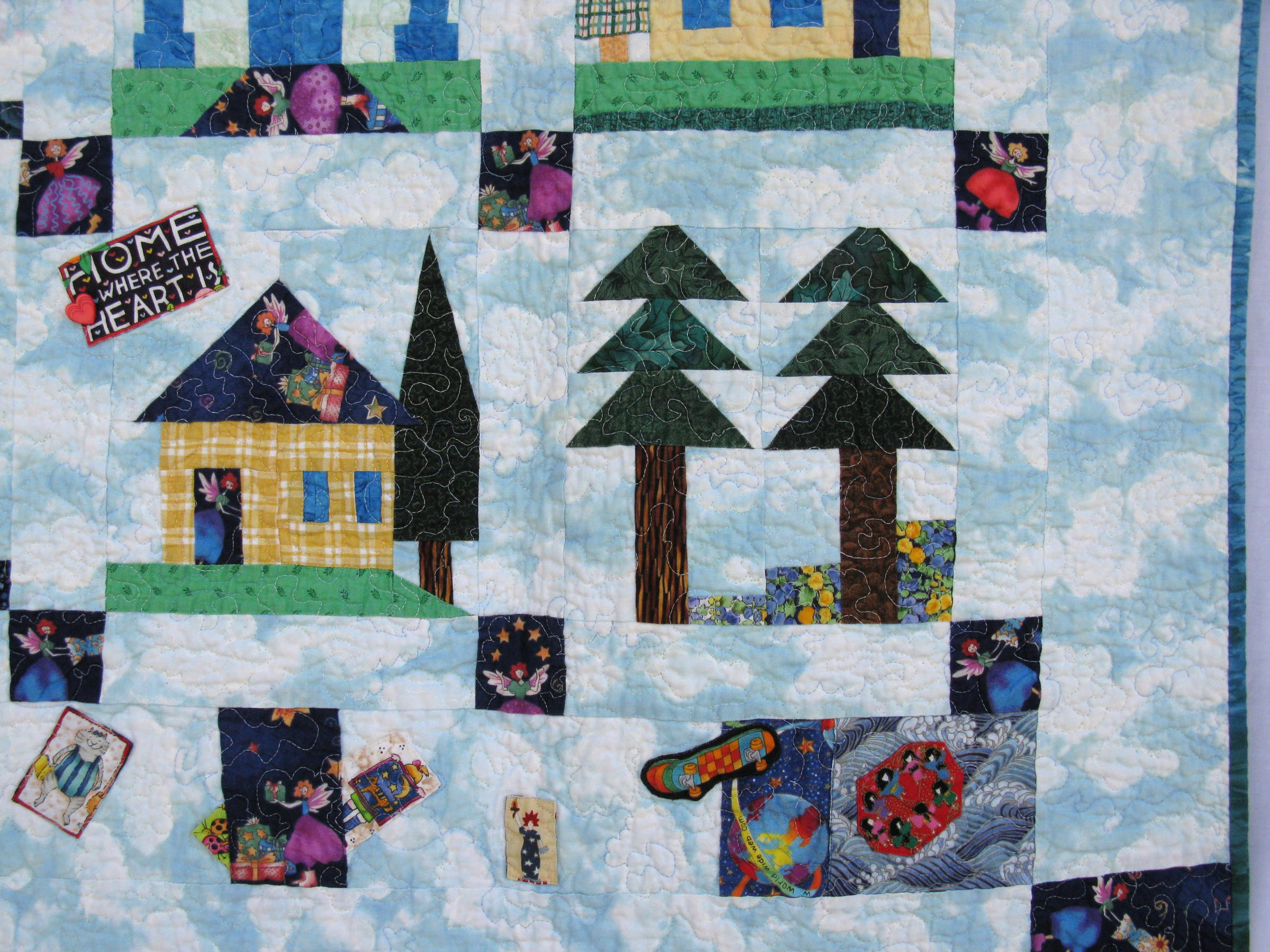
Detail.  I wanted it to have bits and pieces of a neighborhood so I included those things in each deep border above and below the houses.  I guess at the time it had significance, as I notice some World Wide Web fabric there (the earth globe above).  The internet was just getting popular then — seems like a millenium ago.

This one’s my house.  I guess my fairy was tired and lay down on the front walkway.

I entered into Road to California in 2000; here’s what I wrote on the entry form:

As I was designing all the houses, I tried to include a wide variety of styles, to illustrate the diversity of a street in Heaven, a celestial neighborhood that would be knit together in love and faith. In the upper and lower borders, I placed activities that the people in the houses might do: getting together with friends, outdoor activities, celebrating holidays, and of course, quilting.  The name of this quilt comes from an old saying that explains that when a child is given a home, “Joy-bells ring in Heaven’s street.”

You know those things you buy at quilt shows, like the panel above.  Whenever are you going to use them, if not for backs?

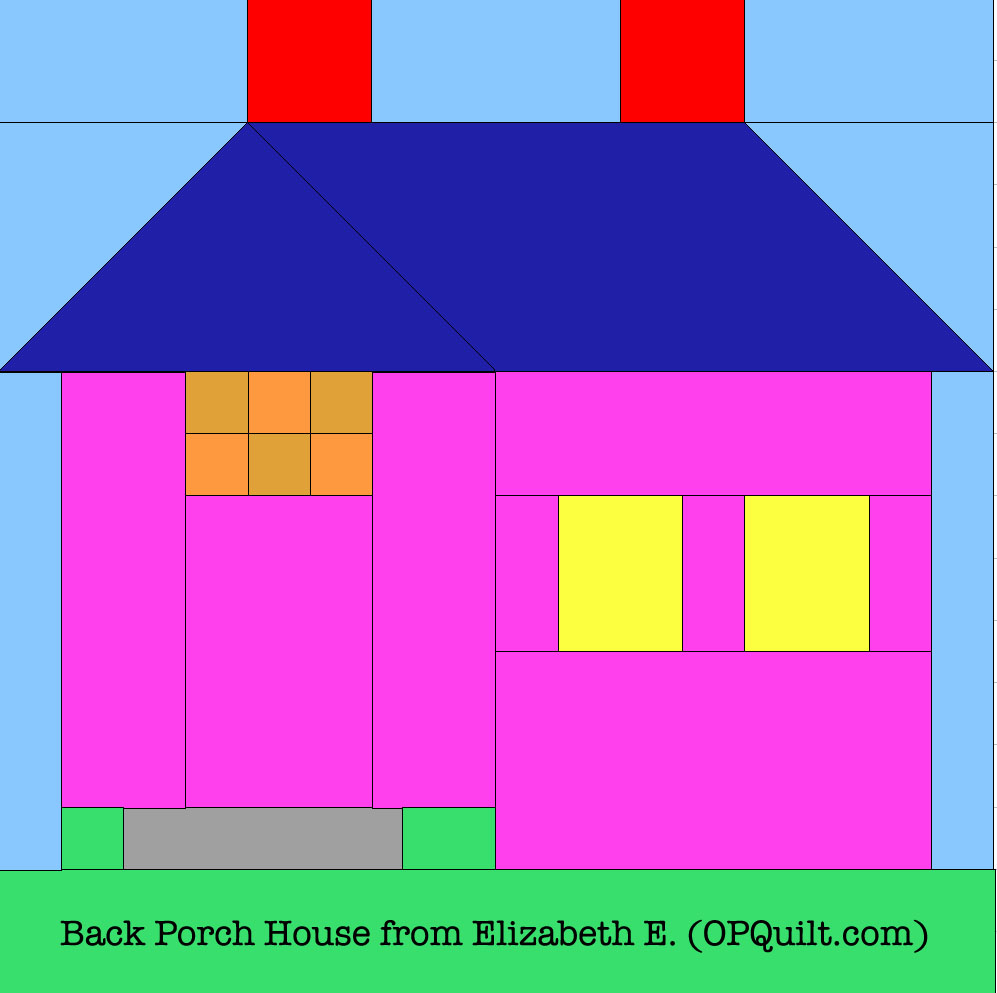
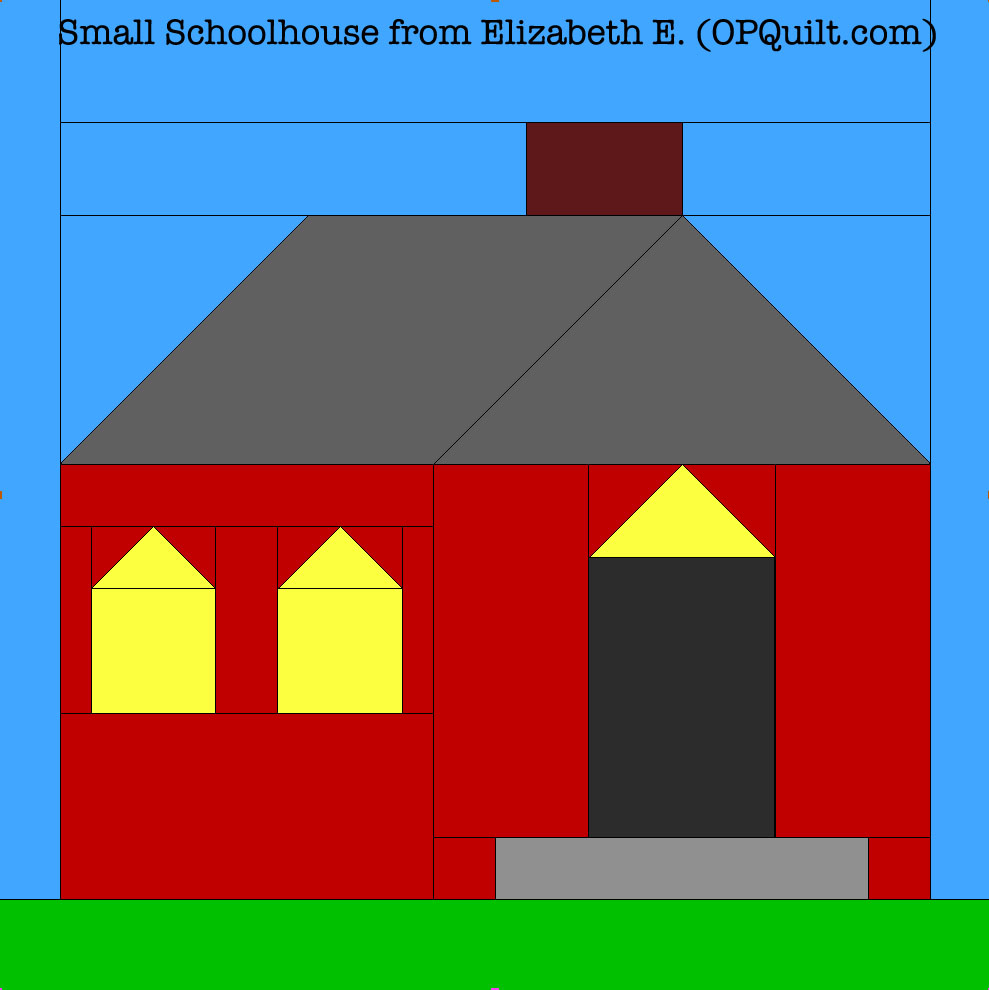
Okay, here’s a few of the houses.  The links underneath each illustration are templates for each house.  They are PDF download files, but I’d ask you to remember that since I was a novice at this software at that time, they aren’t perfect.  Some have a lot of pieces, others are more streamlined.  A mix is best, if you’re making a village.

1930s Prairie House ESE

BackPorchHouseESE

HouseintheVillageESE

RiversideAveHouseESE

SmallSchoolhouseESE

StLouisHouseESE