Circles Block #5 • Capella
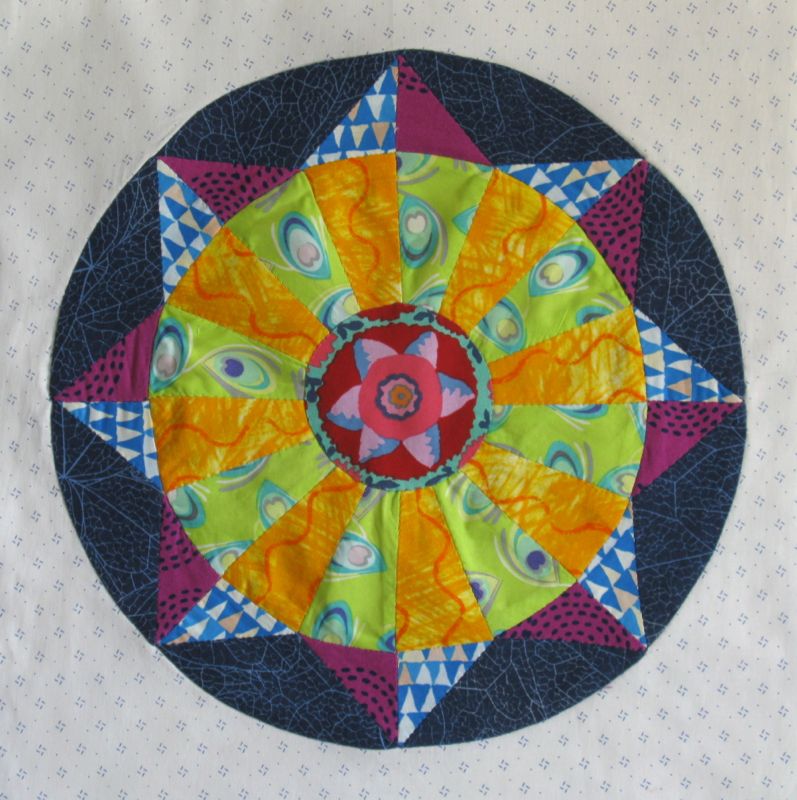
This is the fifth in our series of circle blocks, inspired by circles I’ve seen in my travels, as well as found on other quilts. I think this one was found in Barbara Brackman’s Book, Encyclopedia of Pieced Quilt Patterns and modified slightly. I chose an eight-pointed star to keep the variety in our English Paper-Pieced blocks. I assume you have some knowledge of English Paper Piecing, which is the method of printing out a pattern, cutting it out, then wrapping and sewing your fabric over the little pieces before sewing them together. When I read that last sentence, I know for sure we quilters are a bit insane.
A word about cutting out the pieces and another couple of words about fabrics. The patterns are drawn to the best of my ability, and although I long to be a machine, cranking out the patterns, I am not. So sometimes I might cut the pattern right on the line, sometimes I may fudge and cut it slightly inside the line and sometimes I cut it on the outside of the line, just like it used to happen in those Famous Old Days.
My favorite fabric to use is one that has a soft hand, and is 100% cotton. Why? Because I need to be able to shrink up — using a hot steam iron — any excess caused by my human imperfections. All the fabrics above, except for the green print, are those type of fabrics and after working the circle, they lay nice and flat. The green ones caused many moments of ill will at the ironing board, because it is a sheeting, like what you find in a batik and is very tightly woven. Many Art Gallery fabrics are made from this type of weave. This fabric generally doesn’t move or shrink or give once it has been stitched. It is what it is, so if you need to shrink in a bit extra of the ease. . . um, not happening. I know that when I quilt this thing, I’ll put some extra stitches in those wedges and they will flatten out and be fine, but there were some tense moments earlier this week when I discovered the problem.
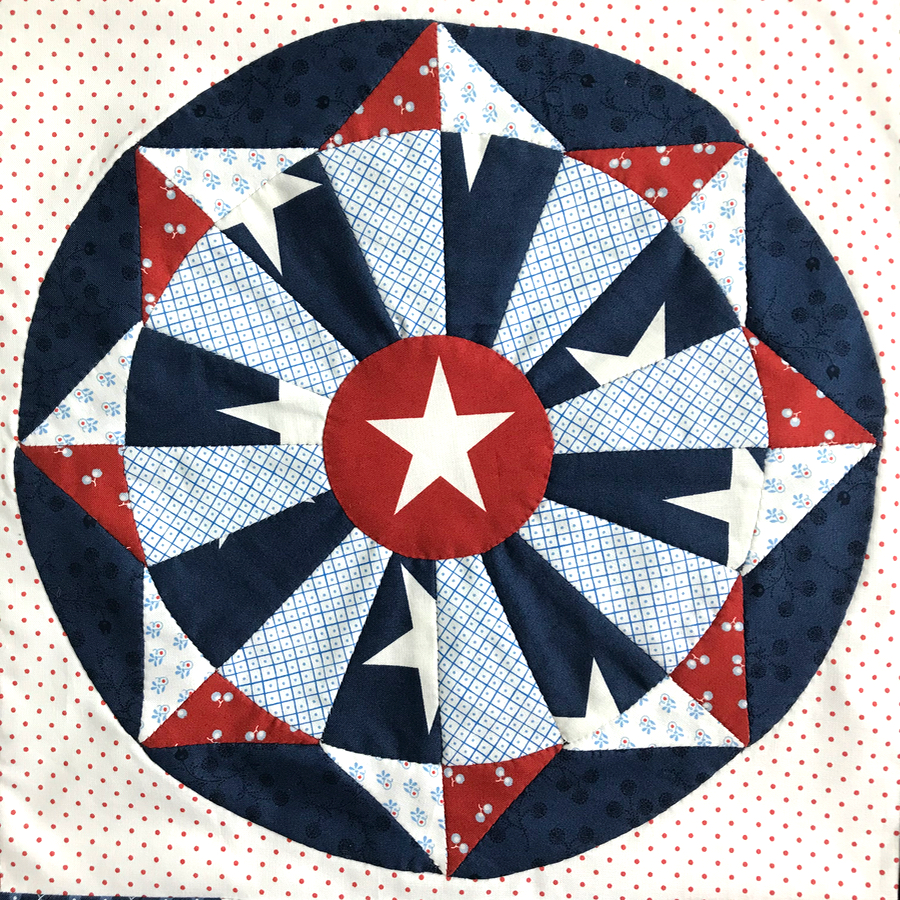
The free patterns are now returning (Red, White and Blue version, above). I request that you not distribute them, but send people here to this website to get them. Click to download a PDF file:
Please remember to set your printer settings to 100% and check the little scale square included on the pattern. It should measure 1″ in size. The illustrations of the patterns below vary from the newer version of the pattern.

Those outer arcs I knew would be confusing once they were covered with fabric, so I prepped up the pattern by drawing arrows pointing to the top center-most point. This will help when I try to sew them together later. (I should have drawn them on both sides, as I ended up putting the printed side UP. Sometimes I am my own worst sewing enemy.)

I wanted to try to fussy cut some chevron fabric so that the zigzags were going down the middle of the double-wedge piece. I matched the chevrons, then lay on the pattern.


And once I’d sewn a few together, I just didn’t like it. Call it a gut feeling, but it just didn’t feel like it was made of the Right Stuff. Back to the cutting board. I printed out another set of patterns, cut them apart, and started again:

Remember to be aware when you are laying out your pattern. Mine are laid with all the printing UP. And yes, I can see where I should have trimmed off those pieces a bit. So don’t be in a hurry.
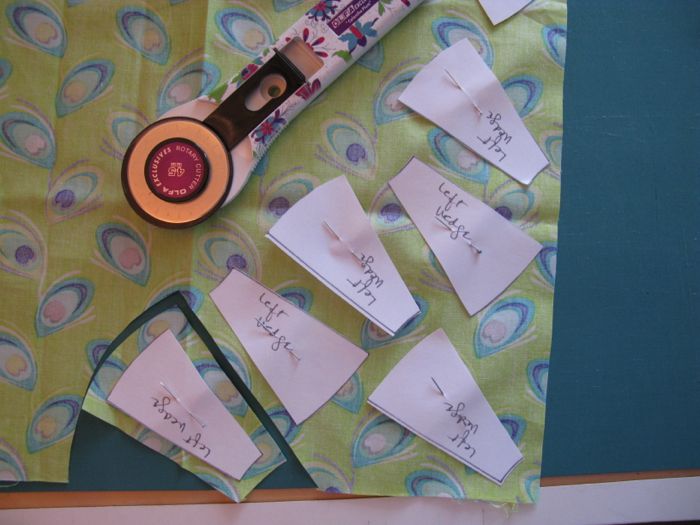
Again, I use my rotary blade to cut the fabric roughly 1/4″ away from the paper. I can trim it more closely when I am hand-sewing if I want.
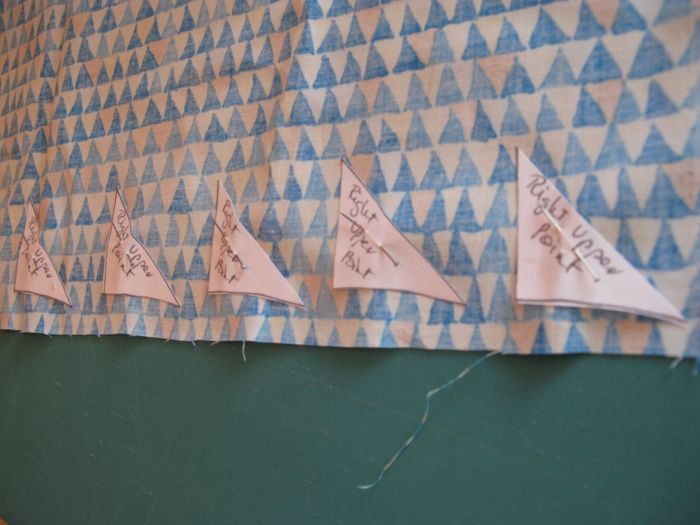

This is from the BEFORE block, but you can see my general layout.

If you have a motif and you want to make sure your circle is centered, one way is to fold the pattern into fourths, and put the tip of the fold in the center of your motif. Pin one side, then carefully unfold and pin the rest.


I stitched all my wedges together, then I constructed the star-point ring: I sewed all the star points together, then joined them to the blue outer arcs.

This is my attempt to figure out if I wanted the blue-triangle fabric over the green, or over the yellow. I try out my combinations as I go. I’m spending a lot of time sewing this and I want to like it when I’m finished.

Blue-triangles over the yellow was the winner. Here is the back with all the paper in it. I will never tire of this view.

But boy, does all the paper make it lumpy. (And that unforgiving green sheeting-type fabric didn’t help either!)

I took out all but the blue outer arc papers and gave it a press. Much better. Now I need to audition that center. The first flower (above) was a definite NO.

I cut out several more. I use a running stitch around the outside, then laying it on a piece of fabric to protect my ironing board, I give it a shot of spray starch.
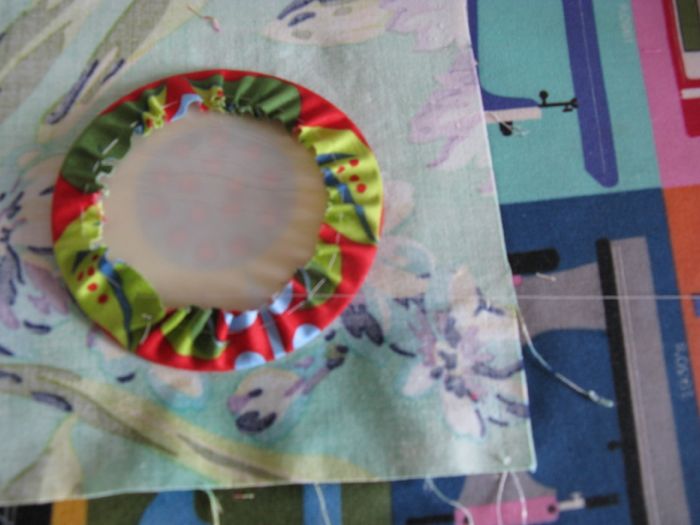
I slip in my cardboard or plastic circle template, then lightly press it, pulling that thread taut to draw the gathers up around the circle.

I turn it over and give a good press. Pick the iron up and down so you are NOT sliding it around–you want your circle to be centered, not skewed and moving the iron can throw it off center. You can moosh it into place with your fingers if it does move off-center, then press it again. Let it cool, then cut the thread to about 4 inches and slip out your template. Tighten the thread back up again.

Aren’t we having fun? Yes, I tried seven different circles. I do keep these little circles though, as they may come in handy further on in our series.

You can choose to English Paper Piece your outer edges onto your circle (pattern is here: EPP Corners) but I think this method of appliqué yields a better product. Prepare a square of 14 1/2″ fabric, then fold it into quarters and give a light press to give you some guidelines for placement.

You get to decide how you want your block placed. This one emphasizes the outer points.

This one emphasizes both the outer points and that cool inner square thing that is happening around the wedge circle. I like both placements, but went with this one.

I smoothed out my circle onto the large square, then used appliqué pins (you can use regular pins) to attach the circle to the background. I leave that mess at the edge of the arc to deal with as I come to it, as I am appliquéing around the circle. When I do get there, I snip out the extra seam allowances from behind to remove bulk, tuck in the raw edges, smooth out the outer line and stitch it down. (I wrote about it on Circles Block #3.) Monkey with it until it is a nice and smooth outer line.
I know there is a lot going on in this little corner of your sewing, but be patient and work with the cloth, use the pins and the tip of your needle to smooth the fabrics into place, and it will happen.
After this large circle is appliquéd on, I cut away the background fabric from behind the circle, leaving a 1/4″ seam allowance. (Again Circles Block #3, shows this step.) Center your chosen small circle over the hole. I like to do this on a hard, flat surface, so that there is no distortion. Pin, then appliqué it on, making sure you have sufficient coverage with no gaps.
And there you have it!
I’m thinking I’d like to do at least twelve circles, but again, feel free to move at your own pace, stopping when you feel like you’ve done enough. I do want to remind you that Downton Abbey is just a short three months away, so you may want to get a hand-piecing project to do in front of the TV come January. These circles might work for you. If you do make a circle, shoot me a photo and I’ll post it up here.
Since this is a free pattern, please do attribute the source of this to Elizabeth at OccasionalPiece-Quilt (or OPQuilt.com) and do not print off copies for your mother or your friends. Please direct them here to get their free copies. Many thanks.