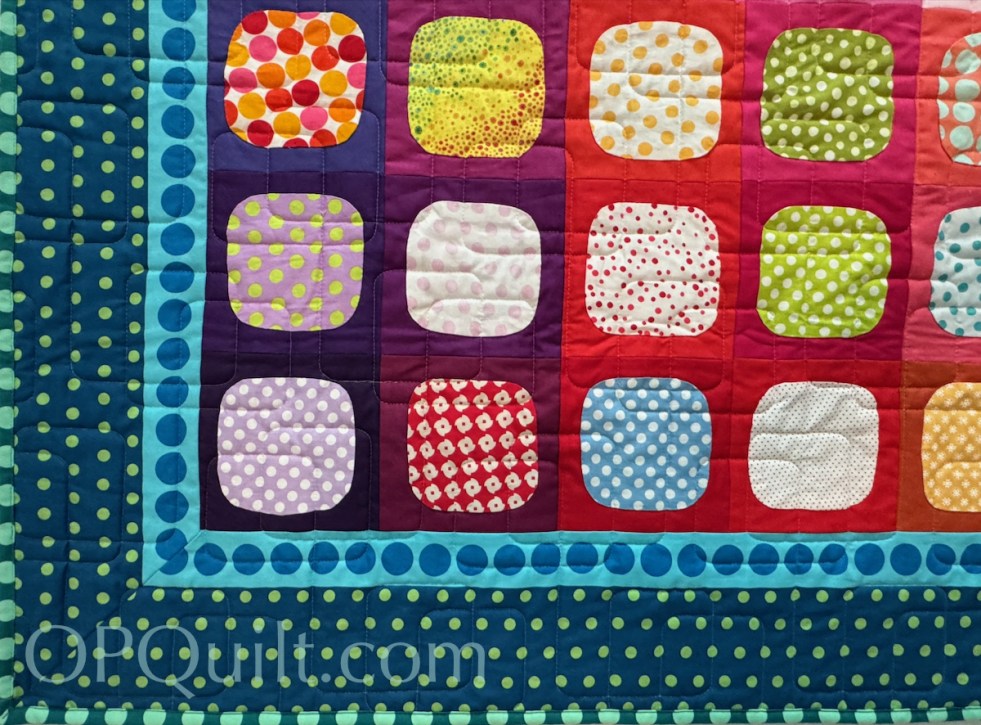
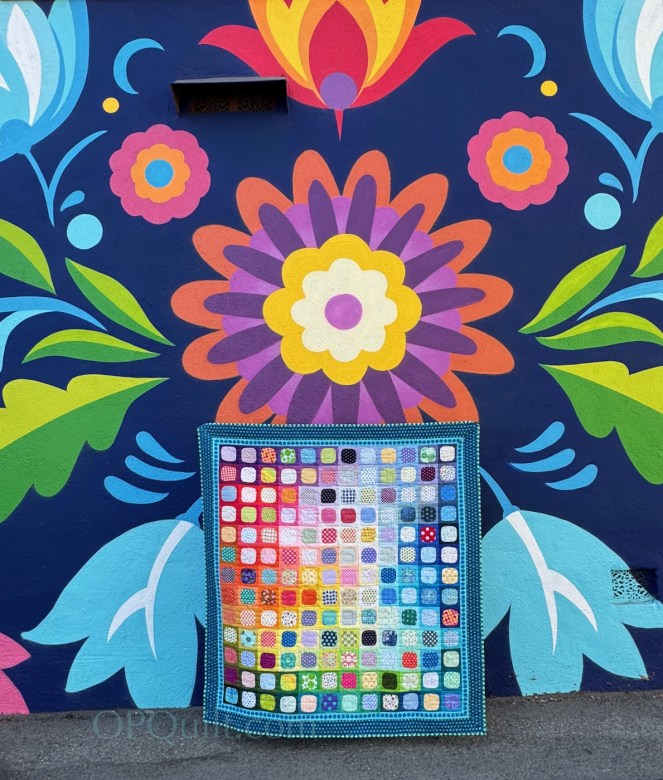
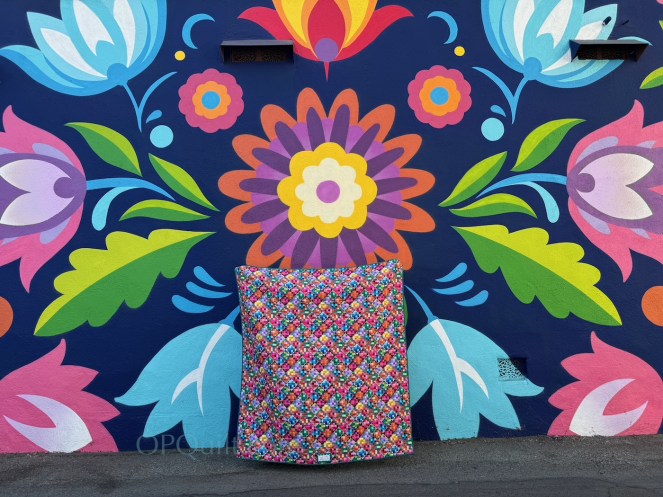
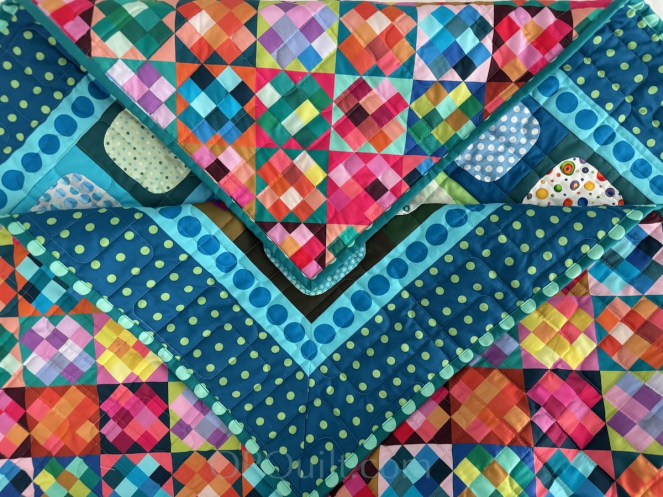
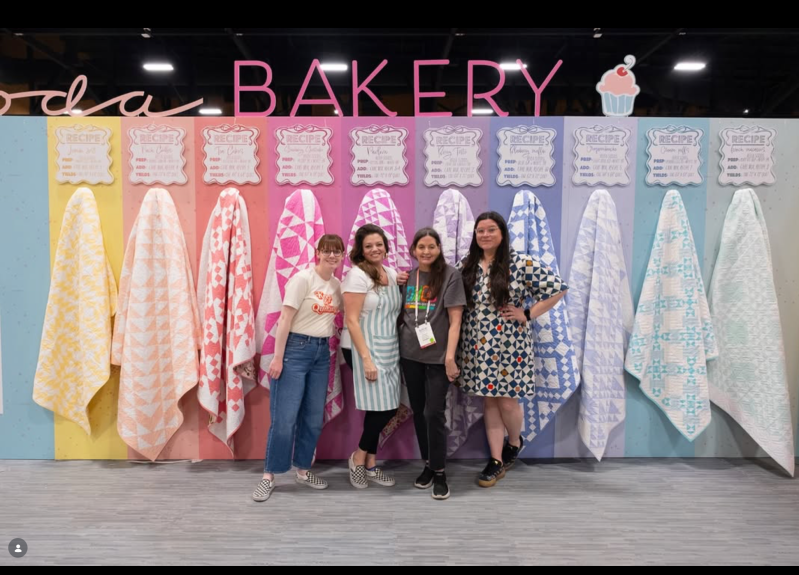
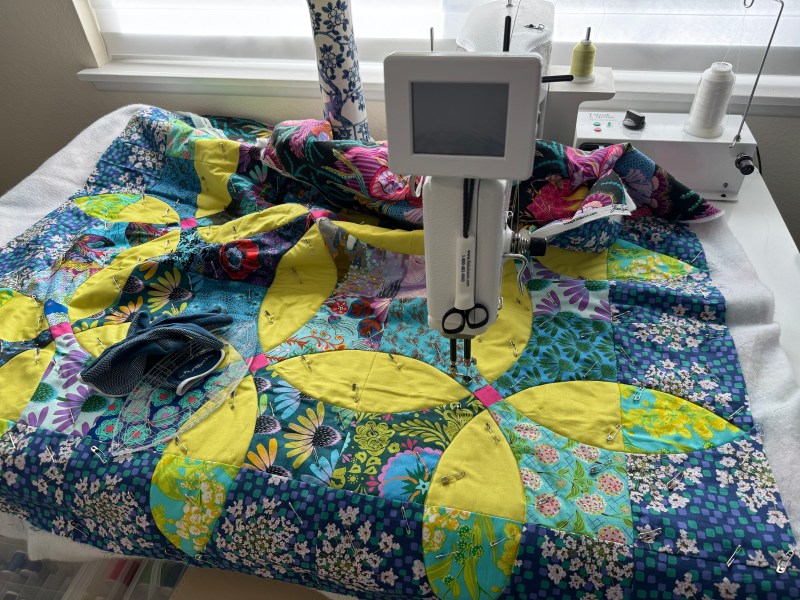
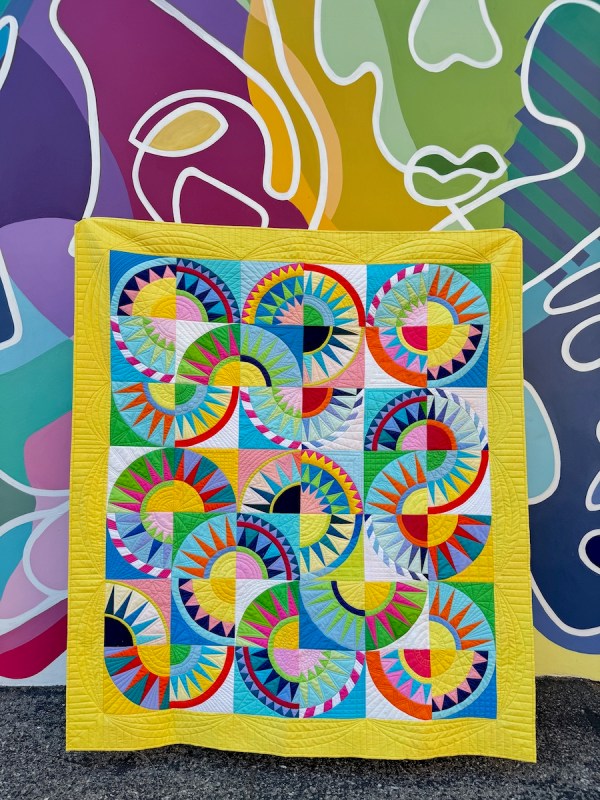
I really liked making this quilt, but it’s good to have it done. My husband found a perfect mural for us for the backdrop, and it echoed all the right colors.
No big thoughts today, just a bit of happiness over the outcome and more than a few photos.
What I found interesting about this backing was that close-up it appeared random. But from a distance, I detected a rhythm of color and pattern.
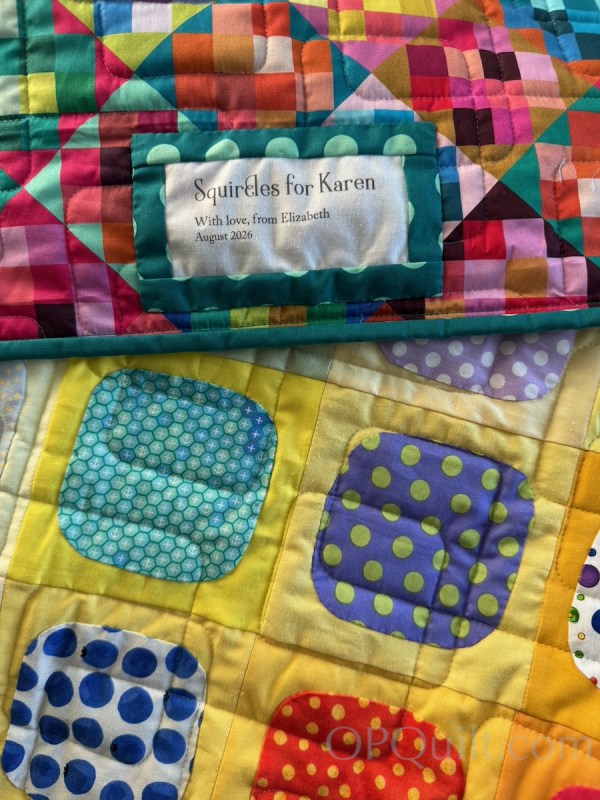
This week I gave it to my daughter-in-law, Karen. When I was trying to figure out the borders, I asked what her favorite colors were: those were the colors I had planned for. Obviously this quilt was meant to be hers, as when she saw the beginnings of the blocks — the squircle (square with rounded shape) — she said that was one of her favorite motifs. And from then on, I stitched with her in mind.
Quilt #321 • Began August 2025 • Finished August 2026 Pieced by Elizabeth Eastmond • Quilted by Nancy Behner • 65 1/2” wide x 71” long FMQ pattern is Four Square Rounded by Urban Elementz • Thread: Superior Microquilter, color 7007
Lots of color in this one. Hope it will be well-loved, and well-used.
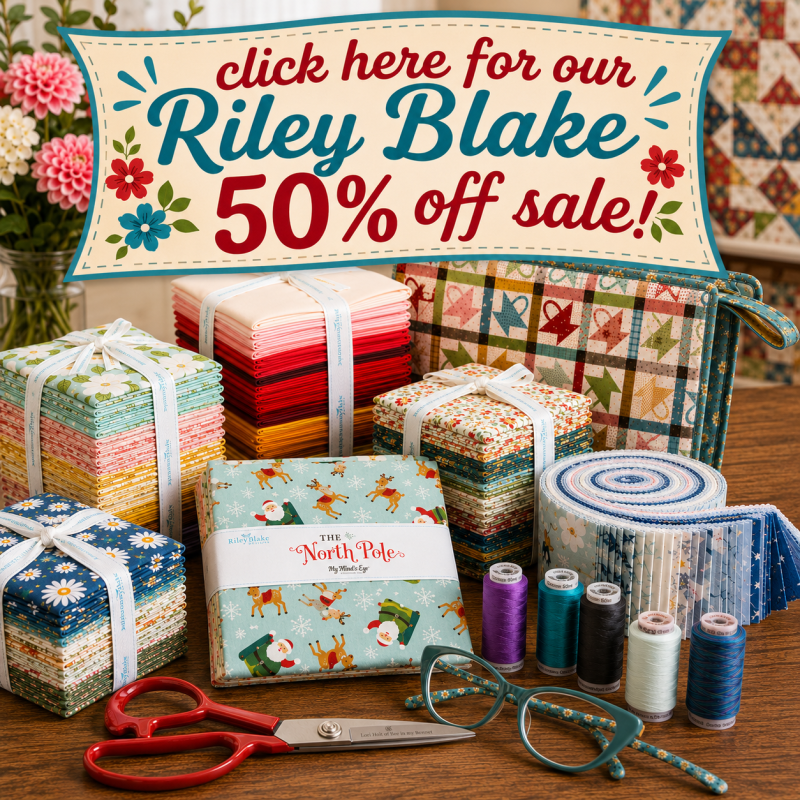
Can I just get this off my chest? I am not a fan of AI, even though — it appears — that we will all soon be swimming in it if we aren’t already. This ad is from a prominent mail-order quilt shop. Love the three parts of the glasses in the front: the lenses part, the eyeglass arms…and the other eyeglass arm, sticking out from the right. Every fat quarter fabric is a perfect shape-replica of the one underneath it/above it.
And then there’s this:
Should I be honored that the Giant Vacuums of AI have hoovered up (if you know the reference, you are showing your age) my blog, the thing that I’ve spent years writing and creating and making quilts and talking and thinking up? And if they’ve come for mine, they’ve come for yours, as well as the text in your gmails, the fun stuff on Instagram and Threads and anything that is online. And now, to make money to pay their data center loans, they are selling MY content back to the world?
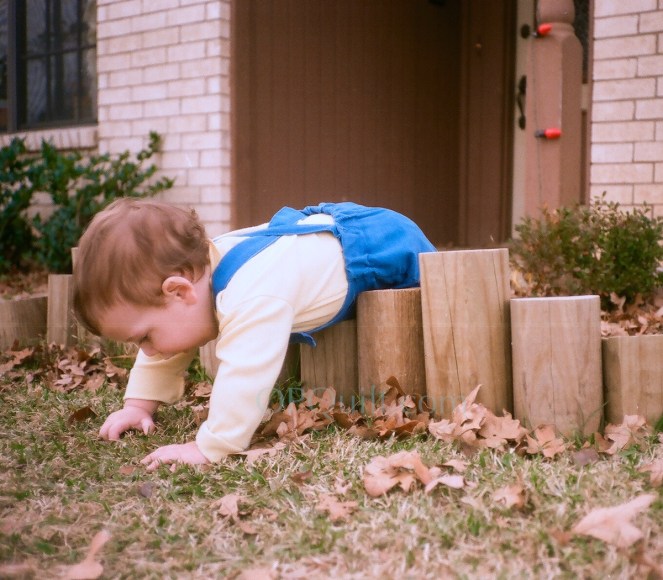
Such a cute baby!
Yes, I’m a bit ragey when I think about this. In my last post, I wanted to grab a picture of a baby crawling. Fifteen years ago, that would have been no problem. I was happy to share my images with others, and they shared their with me. But now every illustration is AI. I don’t want to put AI on my blog — I want it an AI-free zone. So I went back in my personal photo archives and pulled up a picture from long ago of my child, knowing that by putting it on my blog, I was now subjecting it to the Giant Vacuums of AI (I should copyright that phrase) and now it will also become AI by the very fact that it’s been published online. All my quilts are not now “my” quilts. And if you’ve posted online, yours aren’t either.
Ok, rant over. Sigh. Do I feel any better? Please be assured that I don’t use ANY AI to generate any writing either here on the blog, or in the emails I type back to you.
Moving on…A random shot from Moda’s display at Market a couple of years brings joy to my heart: look at these amazing (mostly) two-color quilts! We generally think in red/white, or blue/white, but definitely I want to make a periwinkle/white quilt now! (Add it to the list, she hollers!)
For a mere $5,000, you, too, can wear a Gee’s Bend Jacket made out of old jeans. Don’t forget your $3,000 tote bag!
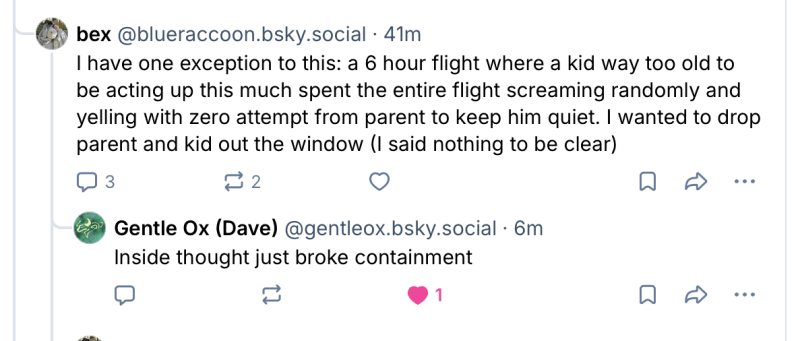
In a recent social media post about screaming children on airplanes, I read this:
“Inside thought just broke containment,” may apply to those paragraphs at the beginning of this blog. I apologize.
Recently an artist covered the Pont Neuf Bridge in Paris in order to make it look like a big mountain.
And inside, you could walk through tunnels to some interesting soundscape music. Please click on the Instagram of @kristinetghardeberg to listen. And thank you to her for posting!
This is why that is so fascinating to me: here’s the guy sitting at his (industrial) sewing machine, cranking it out. Oh, I’m sure those belts and geegaws also played a part.
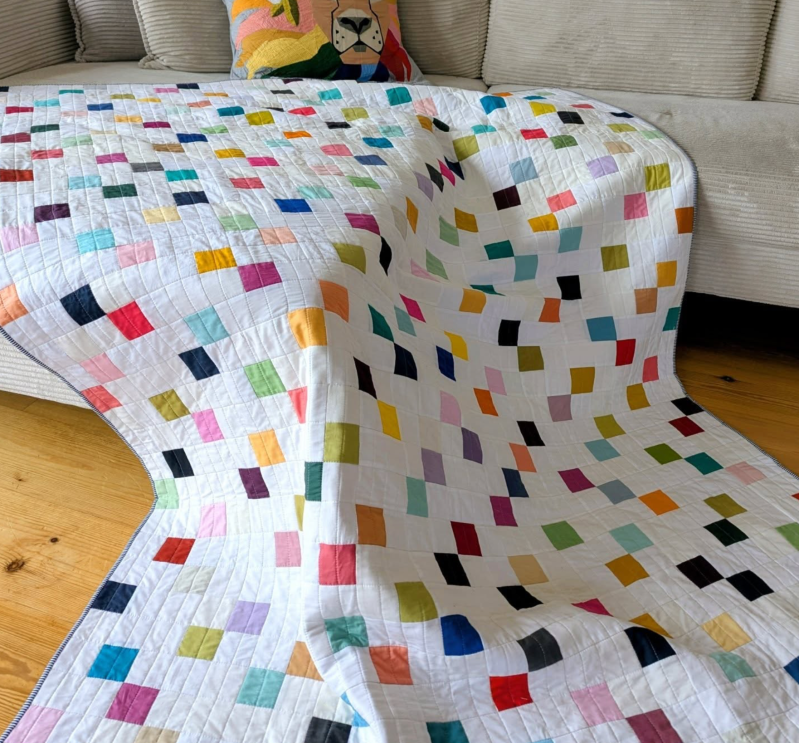
I don’t know about you, but this is more my speed this summer. I did finish up a couple of quilts, but the energy overall has been so incredibly low, for some reason. Good thing I make quilts to nap with! And of course, that’s a screen shot from somewhere and I don’t know who to give credit to. When I did a Google Search, a whole lot more really fun “confetti” quilts pop up. Now I have lots more ideas of what to do with all those leftovers squares from my Oh! Granny quilt.
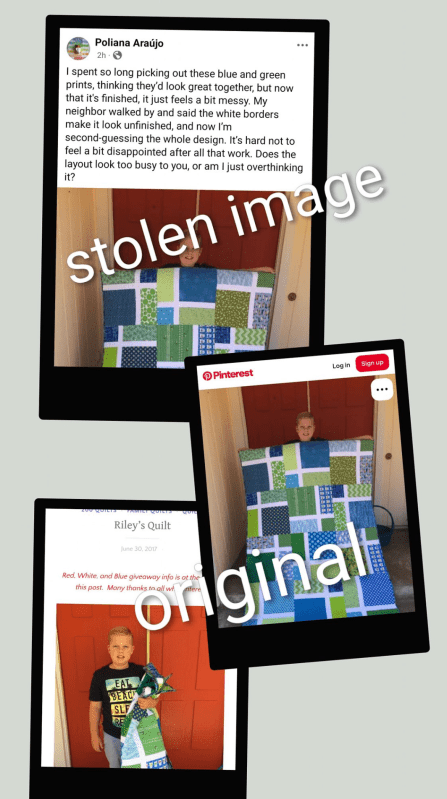
I don’t know who Poliana Araújo is, but really? She spent “so long picking out these green and blue prints?”
And even though I have this declarative statement on my website? Happily my wonderful readers saw the stolen quilt images and connected it to this one that Riley and I made some years ago, and called her out on it. Hmmm. Is this the early version of the Giant Vacuum of AI? Link to her ill-gotten Facebook post.
BACKGROUND UPDATING IN PROGRESS!
Apparently the “Classic Block” is being phased out. So I’ve been busy updating all my posts to the recommended “Block” style. Besides working on that, I’ve also been working on updating the Blog Index that shows a photo from every blog post, as well as a little bit of the writing.
Here’s a video showing a page from far back…and right in the middle of it is Riley, making his quilt! (Sure hope this works on your computer/browser/whatever.)
These represent the blog Four-in-Art blog on Blogspot/Blogger, as well as the Mid-Century Modern blog. I was supposed to delete them several years ago, but just now (sadly) said good-bye. Here’s a record of the quilts I made in the Mid-Century Modern, as well as other bees. The Four-in-Art quilts are scattered through the Quilt Index, above, or you can do a search by typing that phrase into the cute little box, above right.
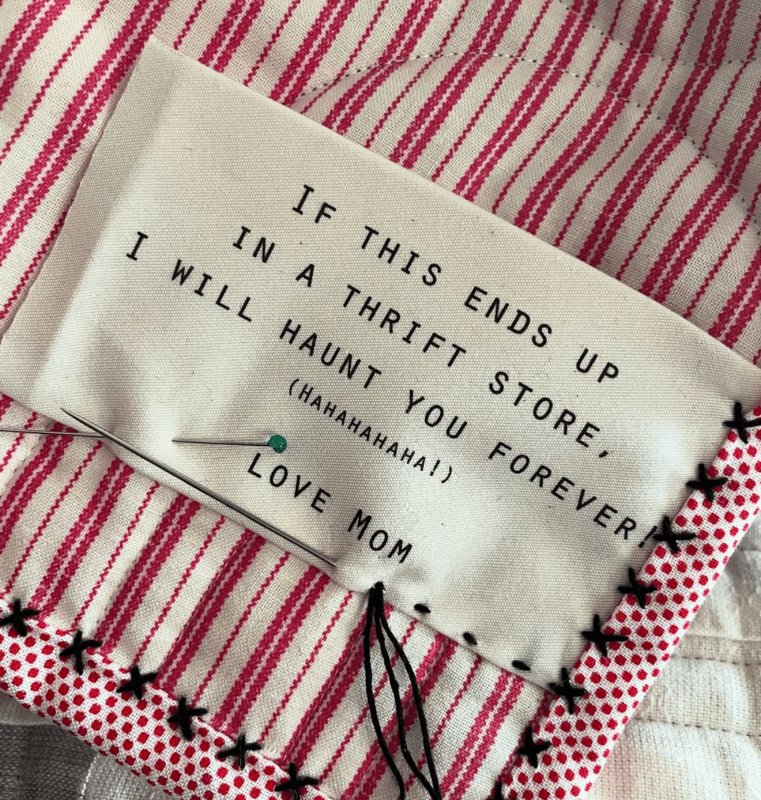
As I’m starting to distribute my quilts more frequently now, I *need* this label! Clever way to tack down a binding, too.
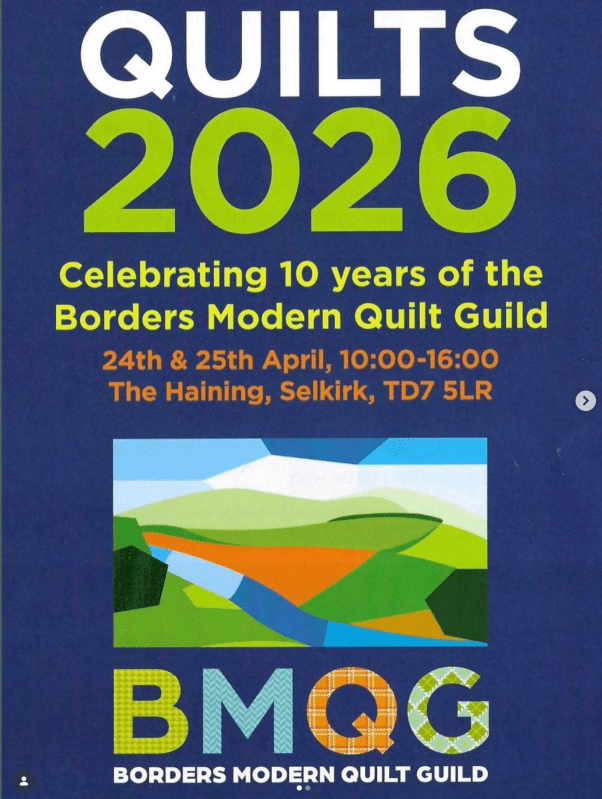
As my husband and I are taking a trip to Scotland soon, I’ve been looking at what connections I can make there with quilters. I’m a bit too late for this one!
However, I did find a quilt shop in Edinburgh, as well as a tartan shop (or twenty).
I was named for two “Elizabeth” great-grandmothers. One of them was my great-grandmother who came from Haddington, Scotland. (The other great-grandmother was born in England). Because of this, I’m figuring out bus routes and times, so I can pay a visit to that village, as my mother did when she visited Scotland some time ago. My husband’s forebears also immigrated from the Edinburgh area, so we have another small village to visit for his relatives, too.
I’ve been doing my searching on Family Search, an online archive of lineage and memories. You can find your relatives, too, by going there and setting up an account. I’m not a genealogist, by any stretch, but my friend Dayna is and she’s teaching me how to use it. I’ve got so many things I want to upload on my relatives’ pages, to “make them known to their grandchildren,” as Dayna says. Maybe I’ll bring back a photo or two of her Scotland for her page?
Lest you think I’m a total slacker, this has been patiently waiting for me while I run around like a chicken with her head cut off…wait…wrong image…while I laze around like a woman in August, trying to beat the heat and keep her sanity. (Better.)
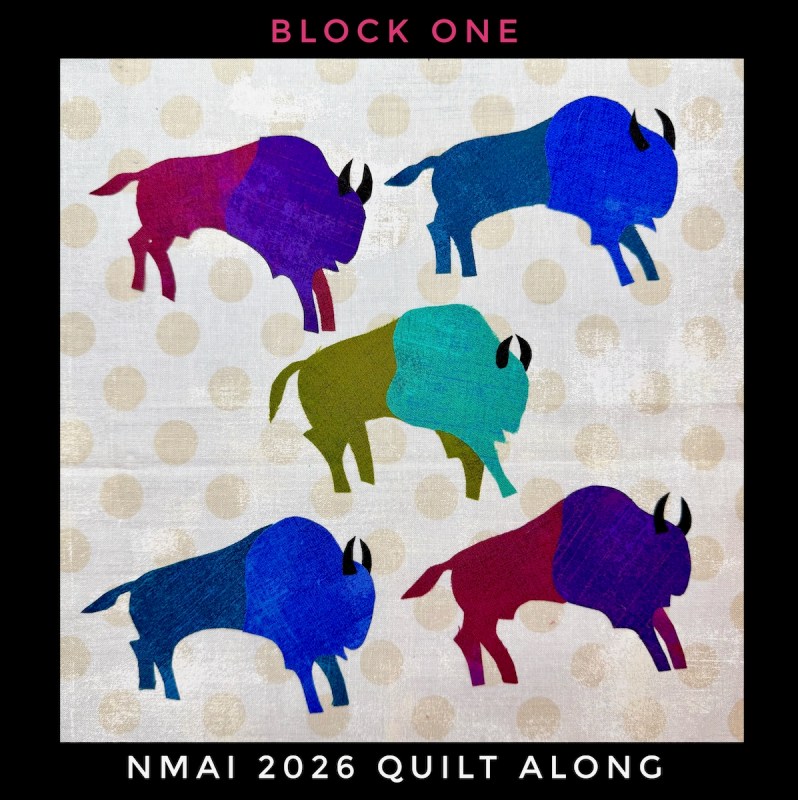
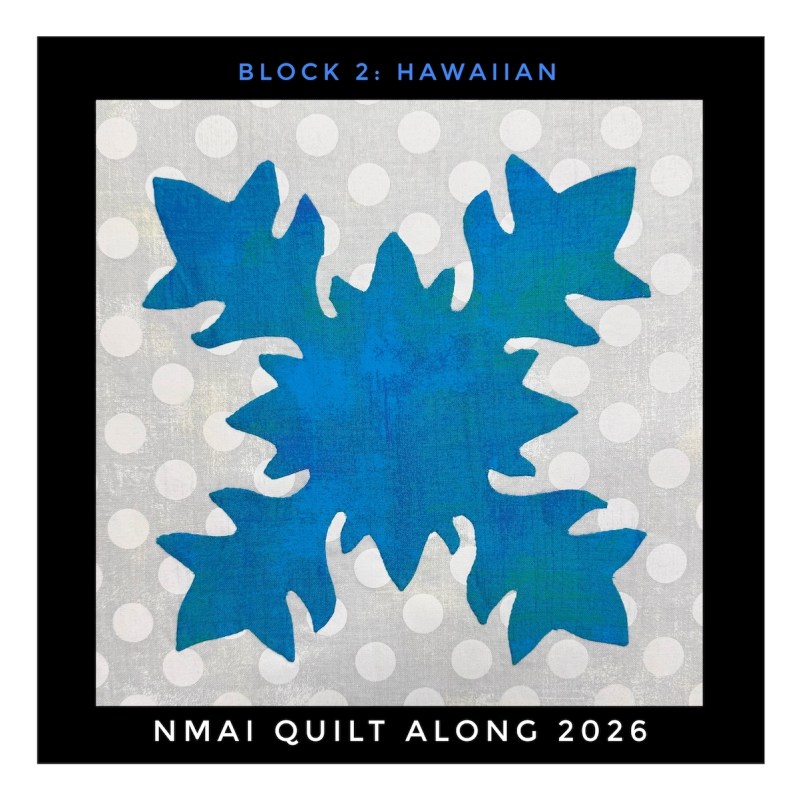
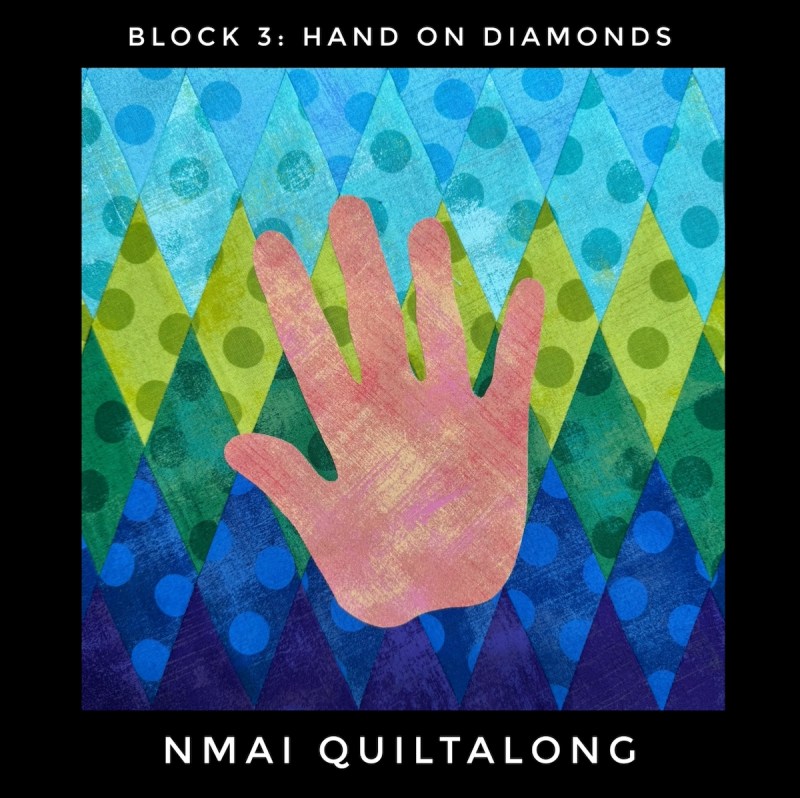
I liked it. I just didn’t love it. So I combed the artist’s Instagram account, looking for other motifs I might like better.
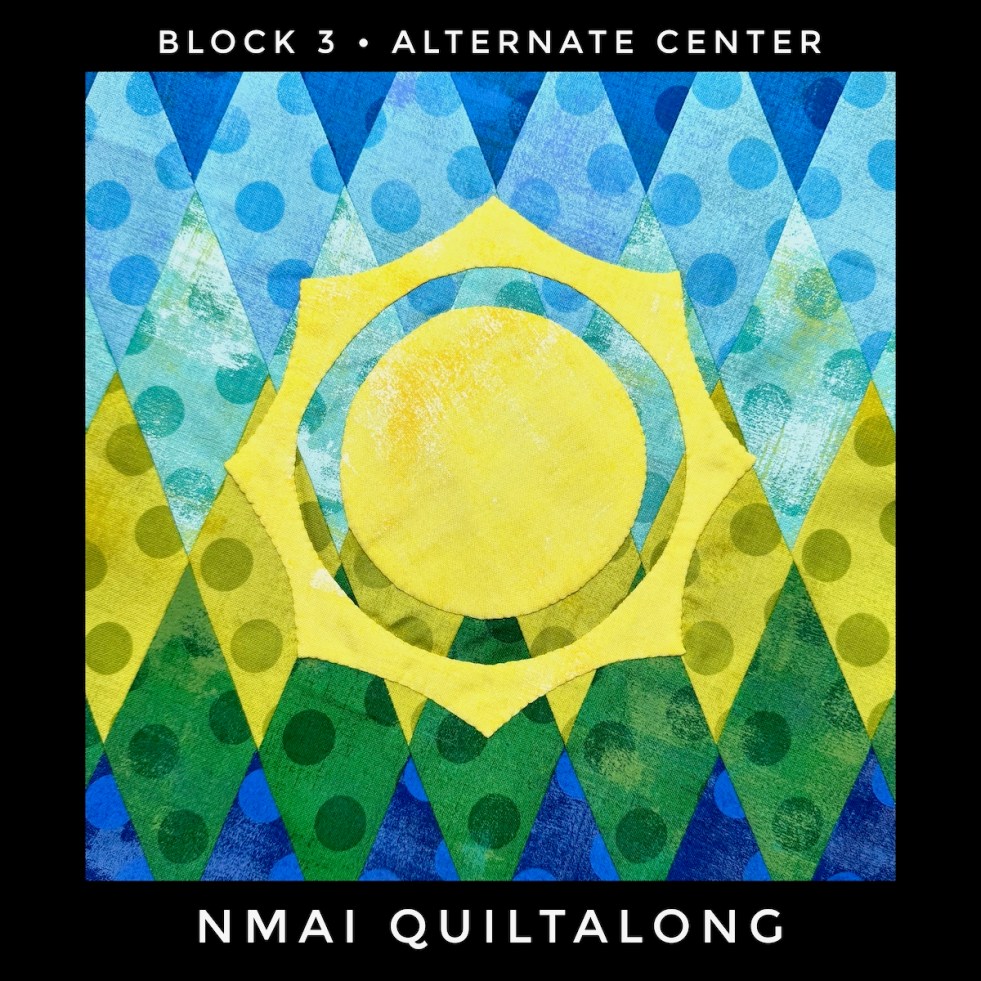
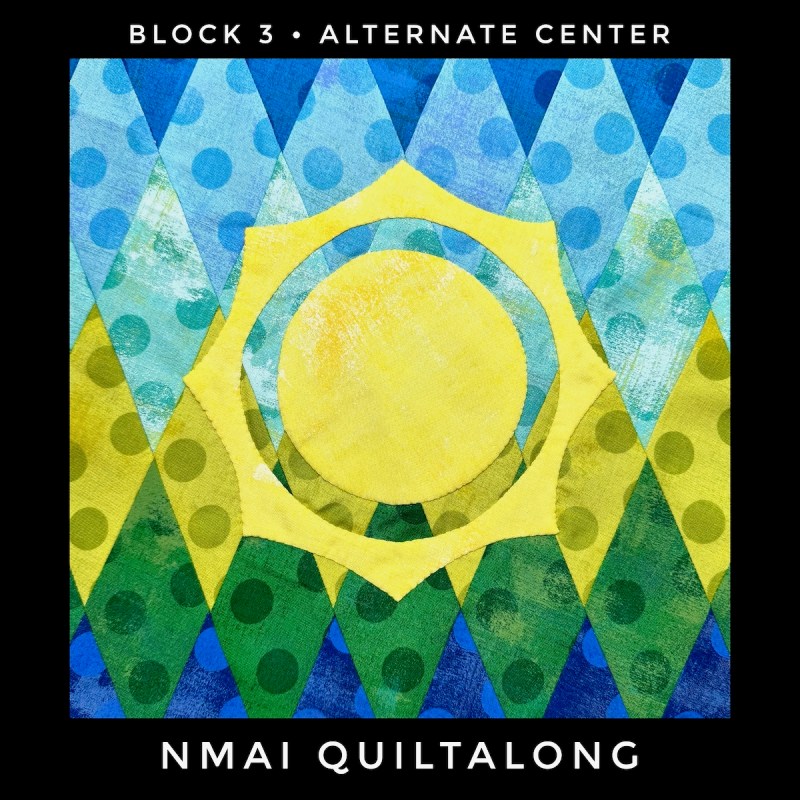
And this was it. I widened the strips, made a different motif for the center. As a quilter, I’m always considering how the subsequent blocks in a quilt-a-long will play with the first few blocks. I feel like this will play a little bit better, to my way of thinking. I may end up using both? Stay tuned.
Here’s the free PatternLite Handout of what I did. I’m calling it Sunrise on the Prairie. Please don’t sell, don’t steal, and if your pals want one, send them over here to download their own from my website. That is very appreciated. And please don’t tell AI this is up here (haha).
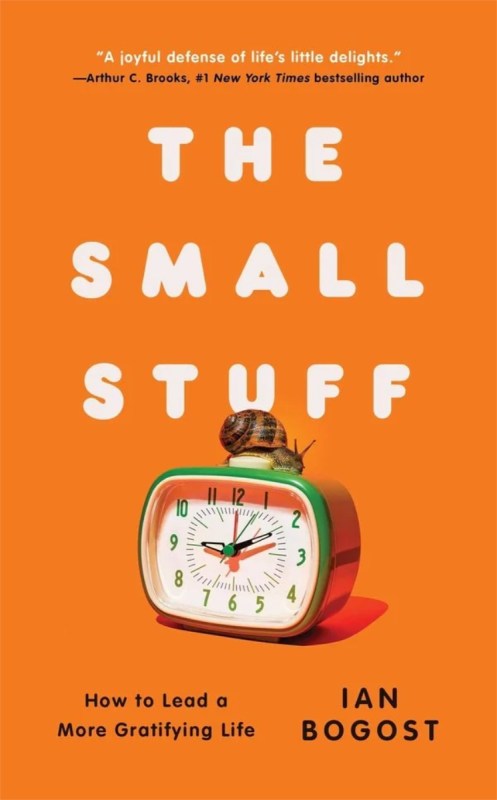
Or so says Atlantic podcaster Charlie Warzel about Ian Bogost’s new book, “The Small Stuff: How to Lead a More Gratifying Life, and why the tiny rituals, sensory pleasures, and routine interactions we tend to overlook may be the very things that make us feel connected—to one another, to the world around us, and to ourselves.” (gift link to podcast transcript).
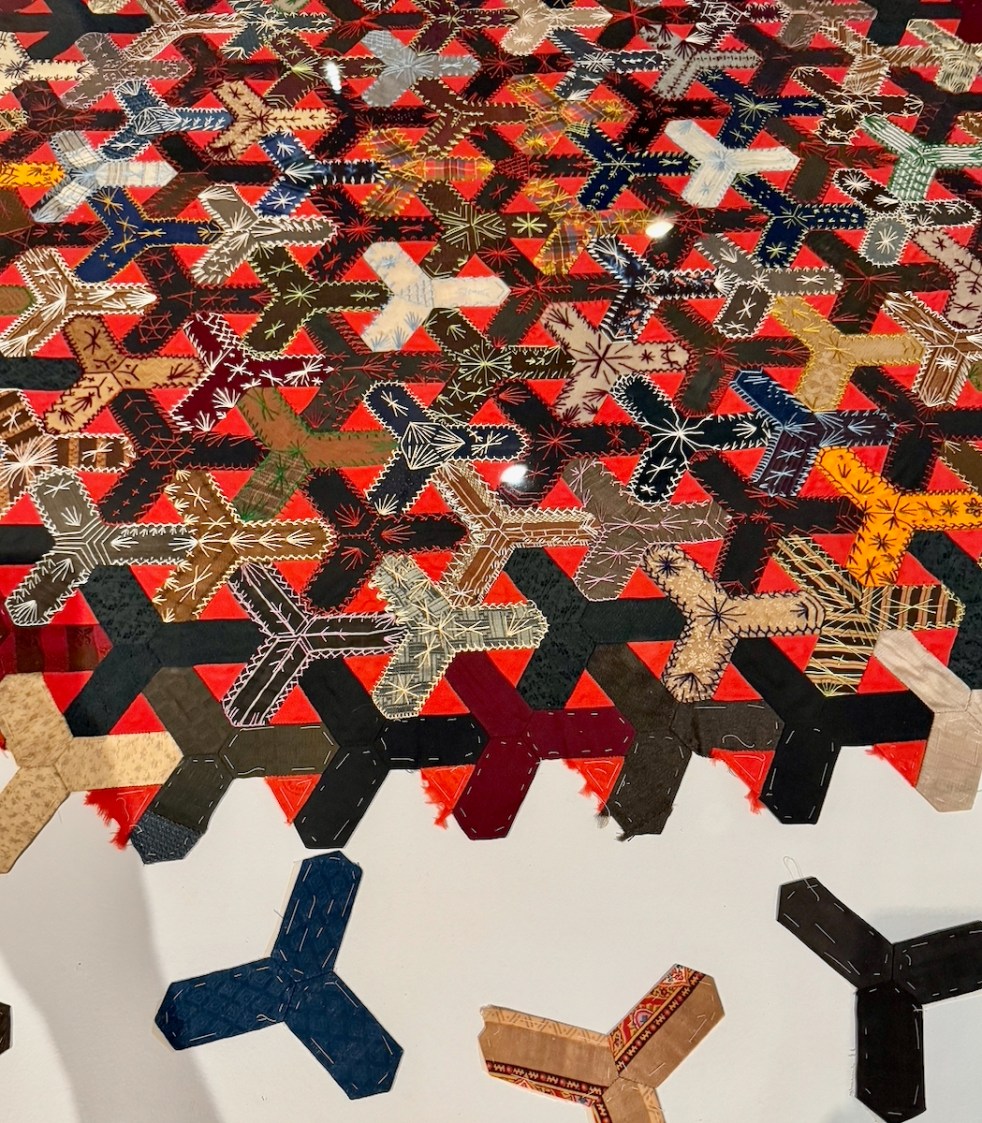
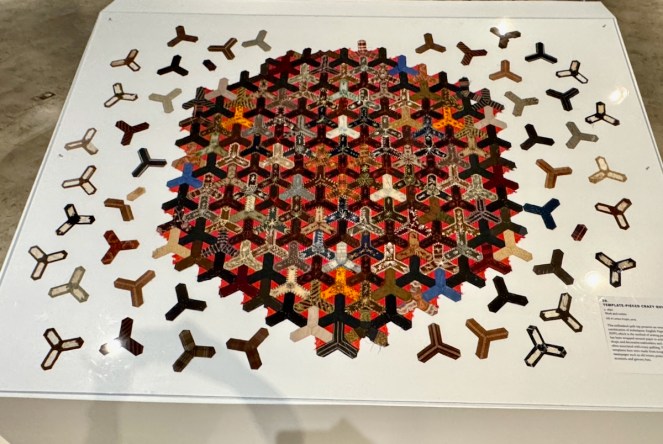
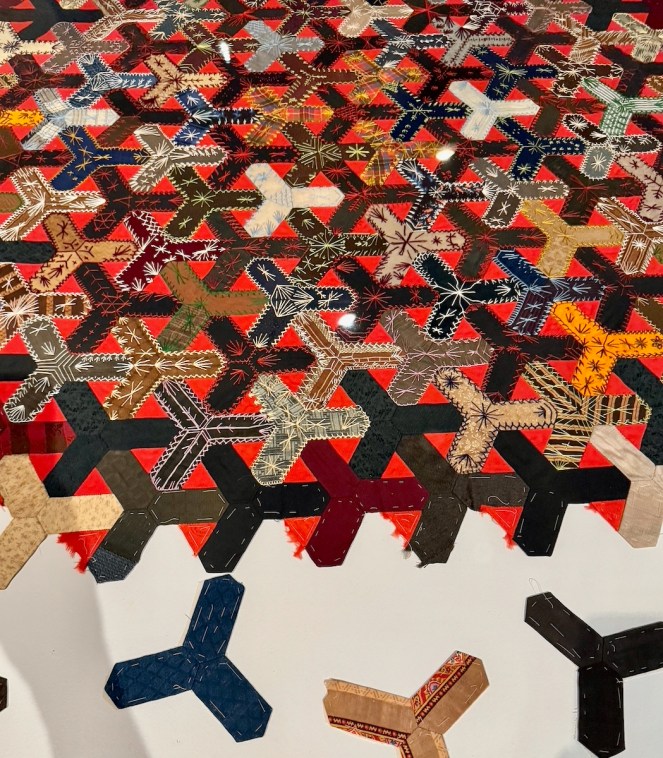
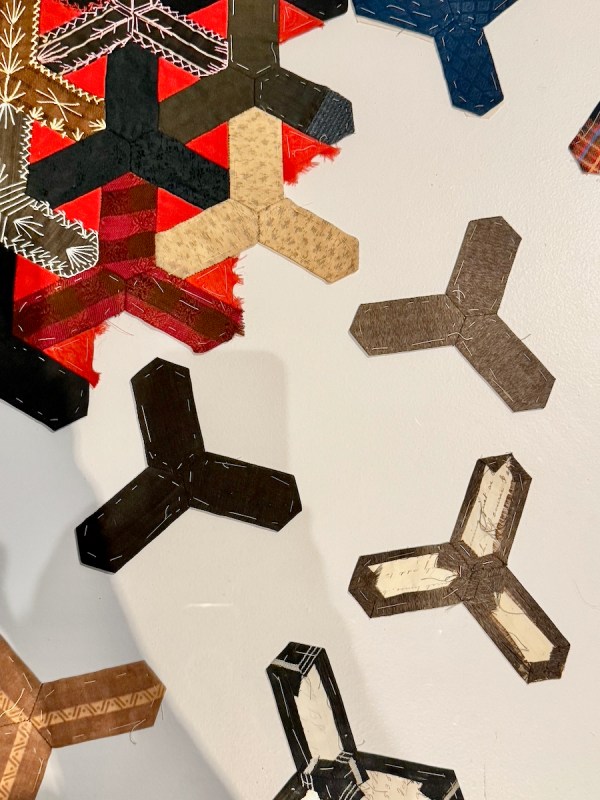
Template-pieced Crazy Quilt, c. 1890
Writer Ian Bogost “makes the case that some of our societal obsessions—self-optimization, career satisfaction, this constant fixation on whether we are adequately happy or not—those are all aimed at the Big Stuff. But our lives are actually dominated by the Small Stuff: the [messing] around that gives texture to our days. This, he argues, is good news, because the Small Stuff is abundant, and it’s actually much easier to notice, to control. And doing so can bring us a sense of genuine gratification, the kind that so many of our technologies just automate away” (source above).
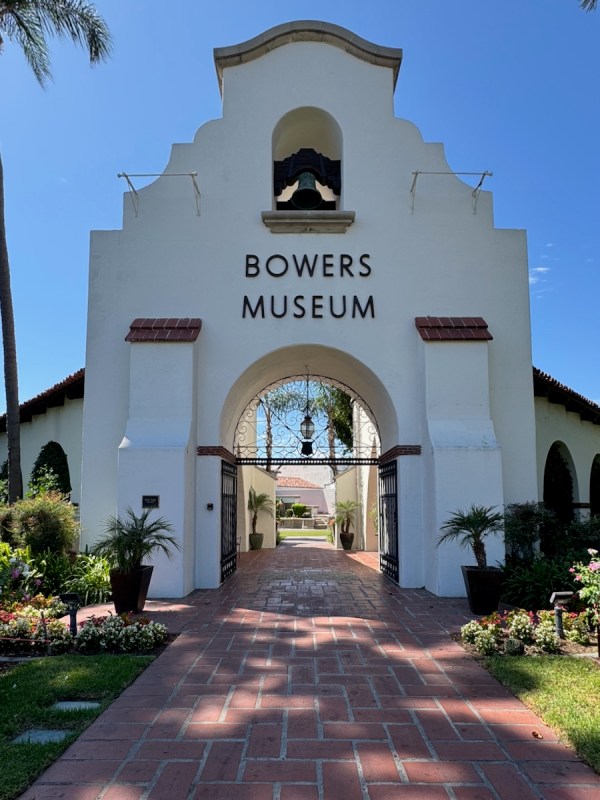
As I’ve been feeling disconnected in more ways than one, I was intrigued. So when I went to an exhibit at the Bowers Museum in Santa Ana with these ideas swirling in my brain, I decided to slow down, to look, to notice, to see the Small Stuff in the quilts.
If you are like me, you usually hit a quilt show, camera in hand and have a rhythm: take the big photo of the quilt, take the detail shot, take a snapshot of the title card and move along. While I started that way, I made a decision to not be so efficient. To notice the details.
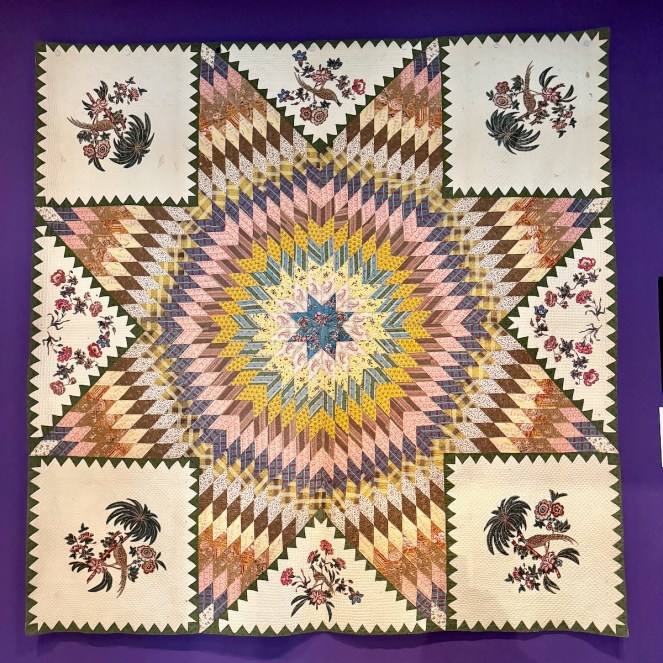
Star of Bethlehem quilt with broderie purse
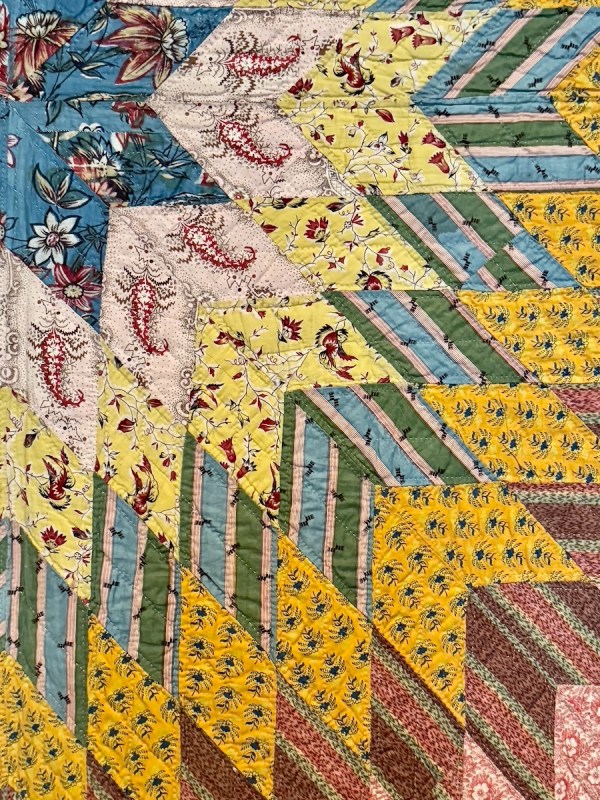
The title card points out that in this quilt from the 1820s-1830s, the use of broderie perse, or the appliquéd chintz cut-outs, may have been a technique to manage the expense of printed cotton, grown and made in America, but then shipped to England to be printed…and then shipped back again to the United States.
The lights were dim in the galleries, so the resolution on some of these photos is very low. But I was fascinated by these two yellows against that Prussian blue center.
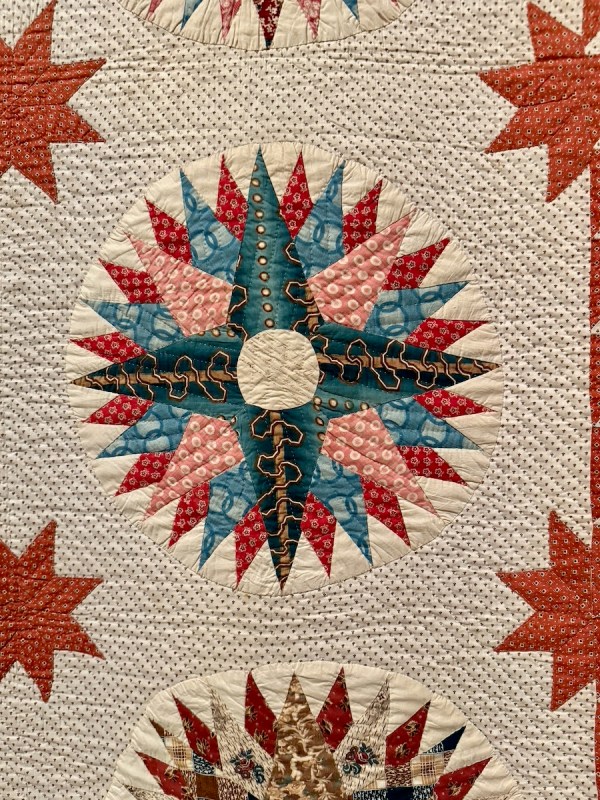
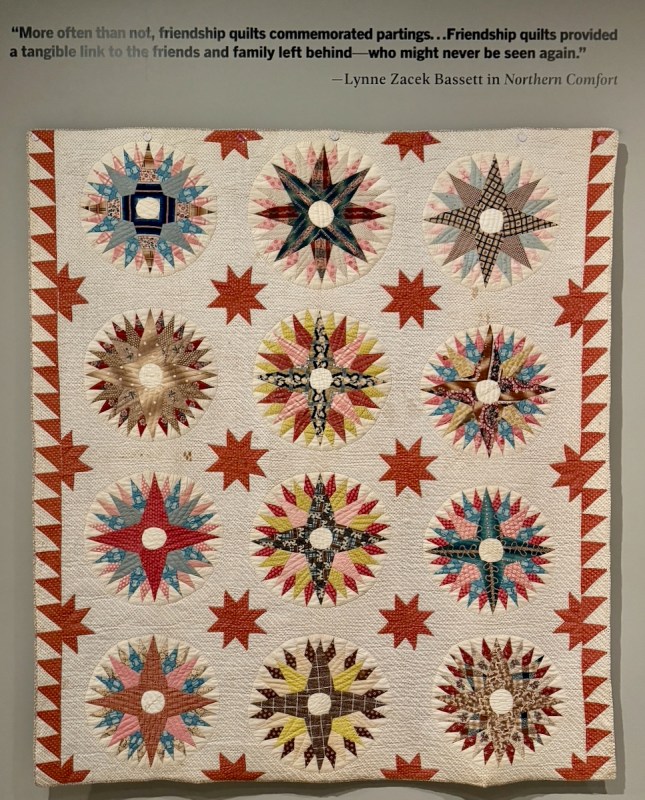
Inscribed Mariner’s Compass Quilt, c. 1850
Here, in another medallion quilt, is that color again.
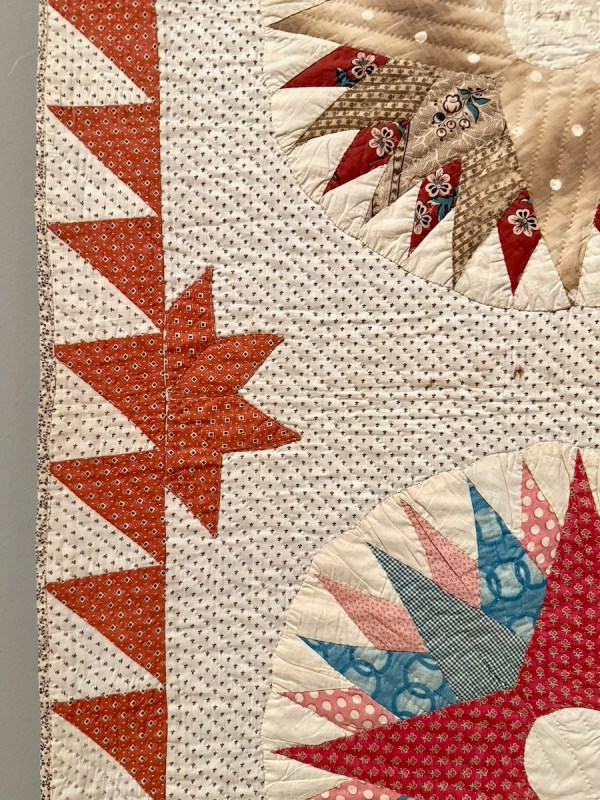
On the right side of the quilt, the binding matches the background. But not on the left.
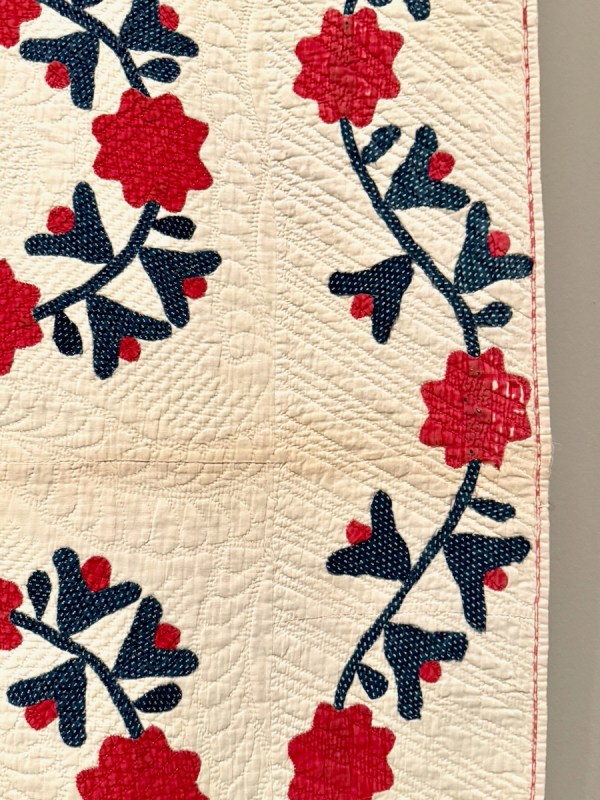
Rose Wreath Quilt, c. 1850
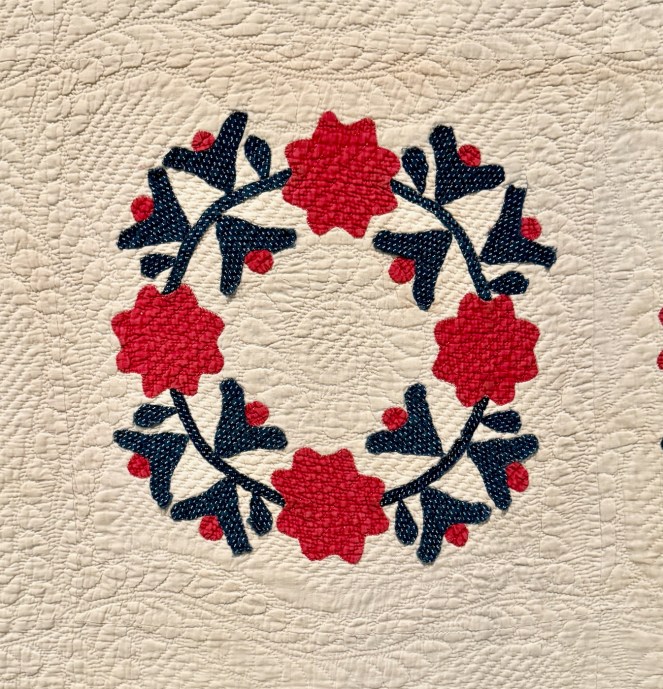
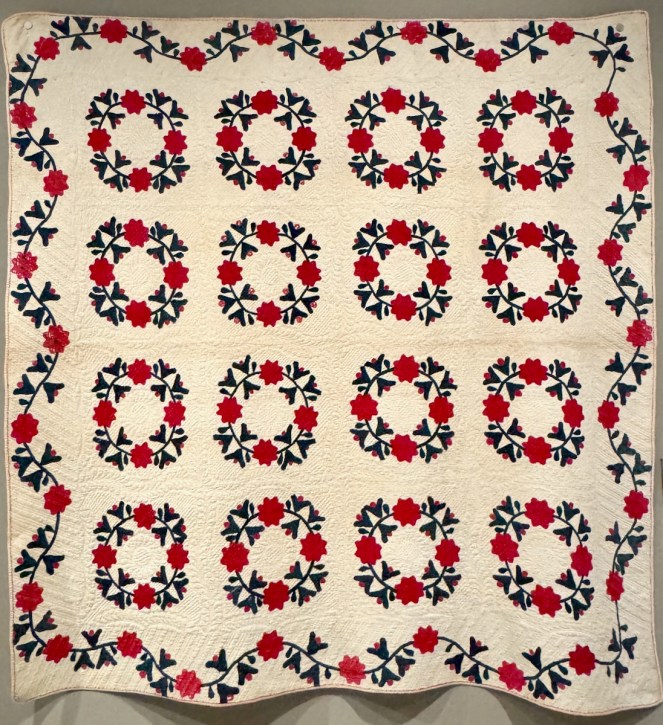
This Rose Wreath quilt has Turkey red fabric, so named because the process for obtaining the color from madder root was originally developed in the region of Turkey. As I have noted in other writing on this website, we really don’t know how people in the past constructed and lived their lives except in the broadest strokes and outlines. Were they excited to have this red? Did they pre-wash like we do? (probably)
(Sorry for the blurry shot — the low light was a challenge, but I knew it helped preserve the quilts and fabrics.)
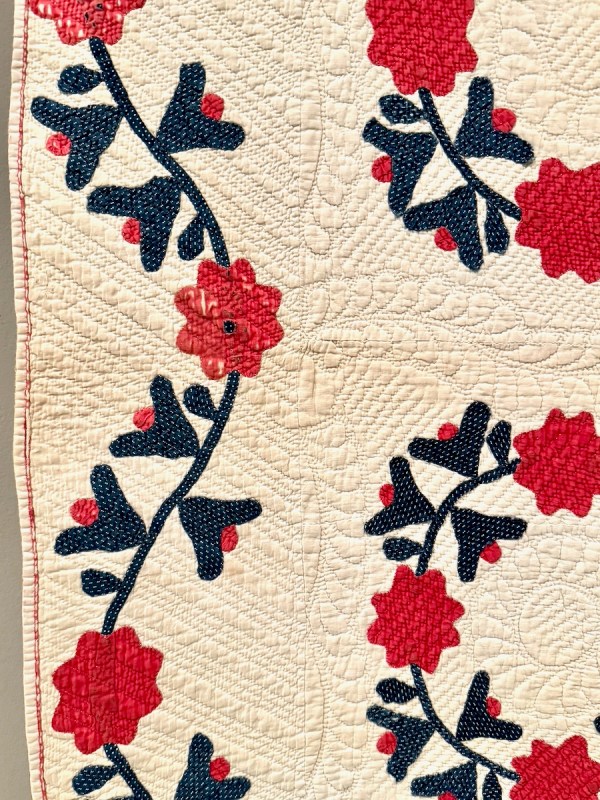
These vines, on opposite sides of the quilt, were not symmetrical, but instead echoed each other, curving in exactly the same way. Usually we see those vines mirrored. One hallmark of Turkey red is that it leaves the cotton fibers more vulnerable to abrasion and wear, as you can see here on the edges of the quilt.
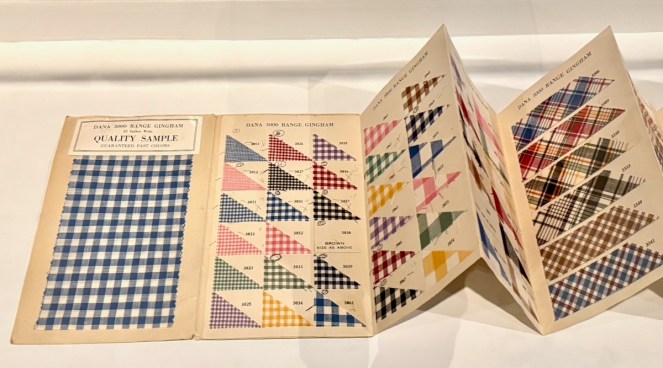
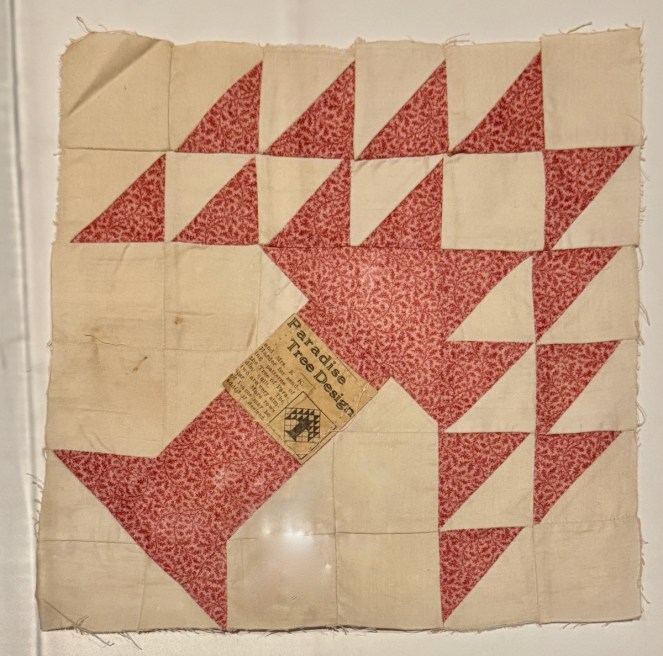
Around the perimeter were some displays; one included this Mail Order Fabric Sample card, from Montgomery Ward & Co, c. 1926. Okay, that’s a century ago.
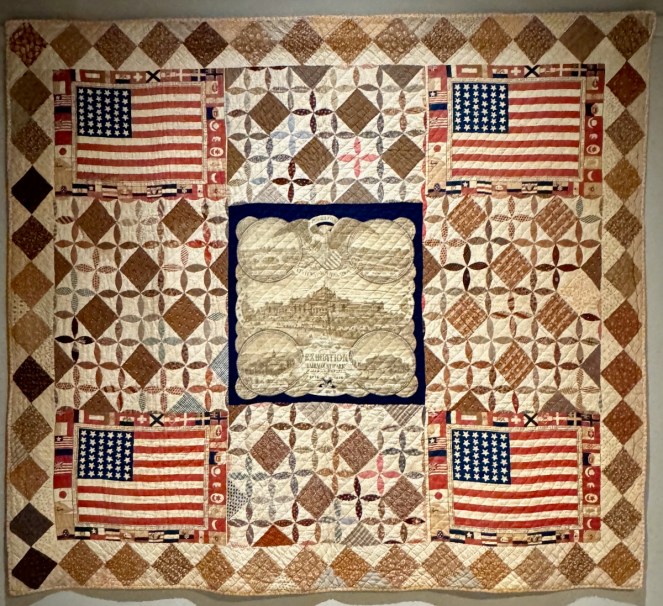
Centennial Handkerchief Quilt, by Sarah Angelina Andrews Whitman and Gertrude Spurr Whiman, c. 1883.
I loved the combination of quilt patterns: the handkerchiefs and panel in the center, the orange peel blocks interspersed with squares on the diagonal, with squares set diagonally around the border. According the title card, “Sarah Whitman collected the handkerchiefs during her visit to the Philadelphia Centennial Exposition, and made the quilt with her young daughter’s help a few years later.”
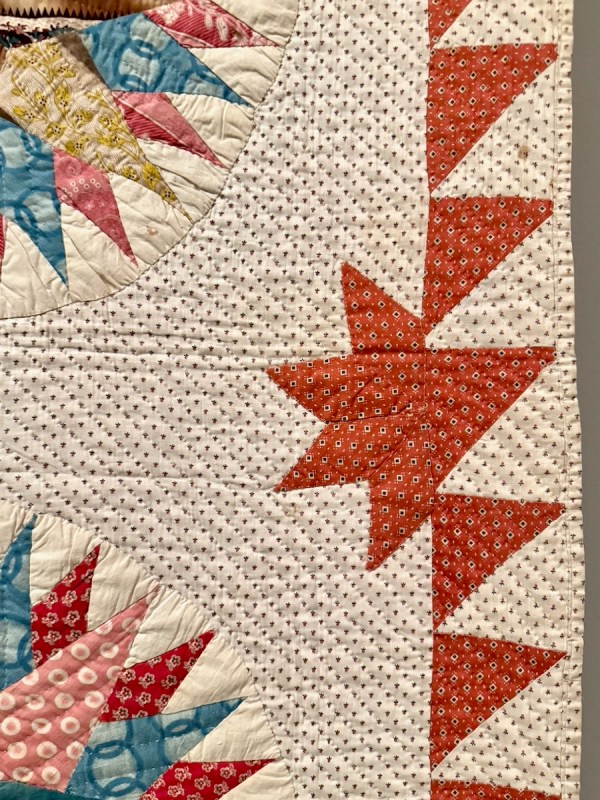
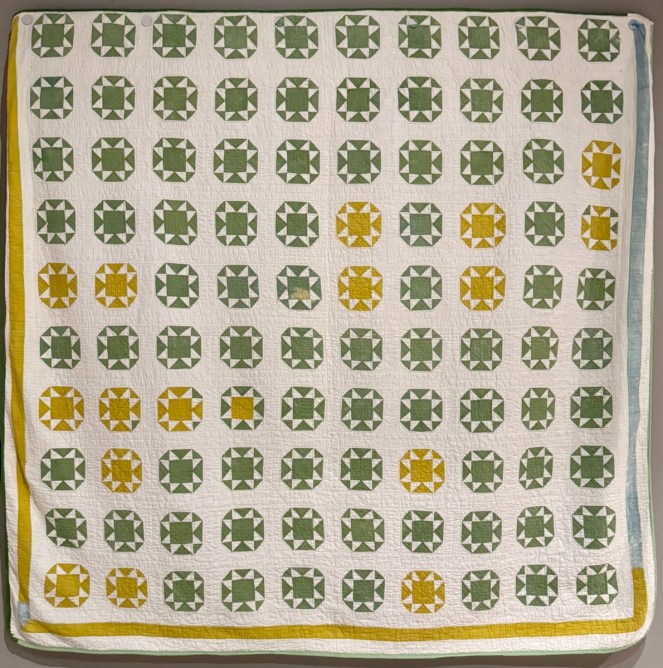
This one really caught my eye with all the variety of colors on the sawtooth blocks. My mind was whirling with possibilities that the quilter had tried, but was disappointed to read that they were all originally the same color (but two different fabrics). The title card says that “laundering the quilt in an alkaline detergent at some later point caused the blue dye to fade from only some of the green fabrics, leaving the yellow behind.” I still think it’s very cool, but I wonder how the quilter felt. The quilt is from somewhere between 1840-1910. And check out that outside border — I suppose that had the Detergent Blues, too.
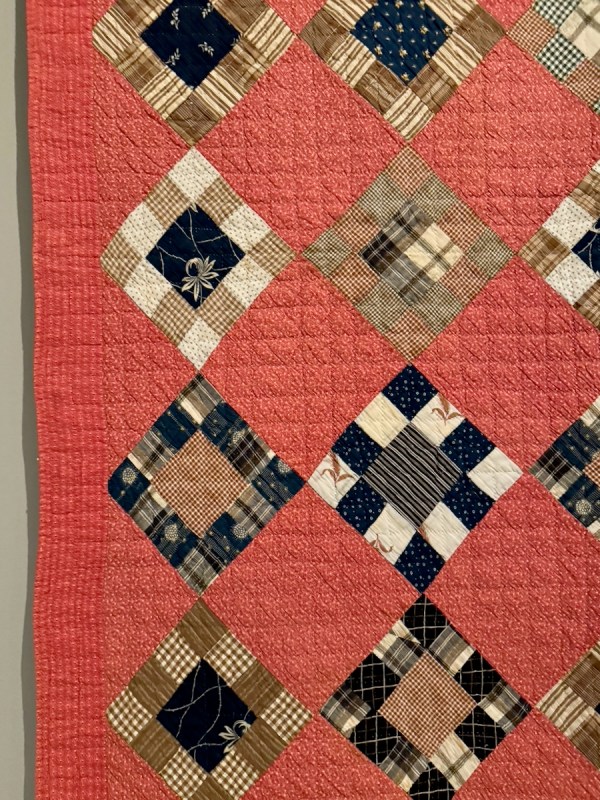
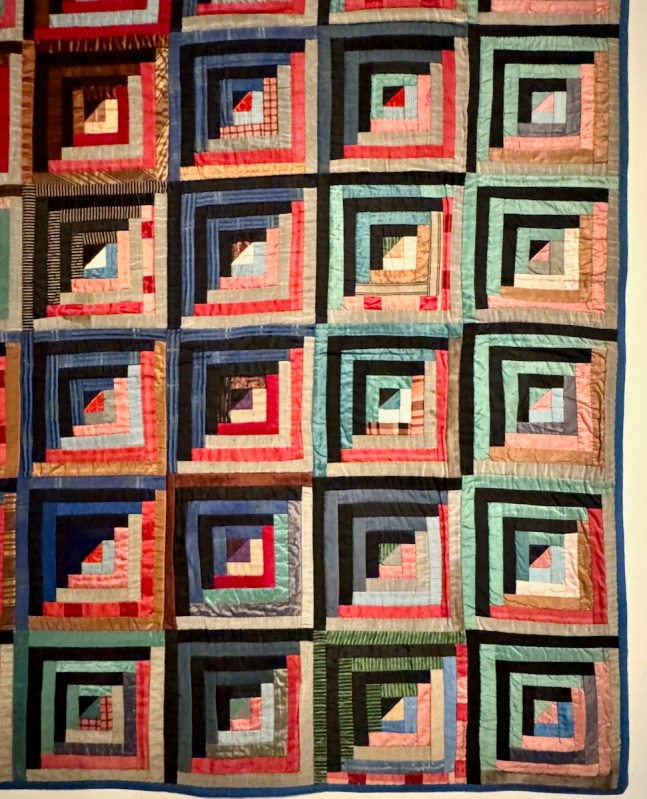
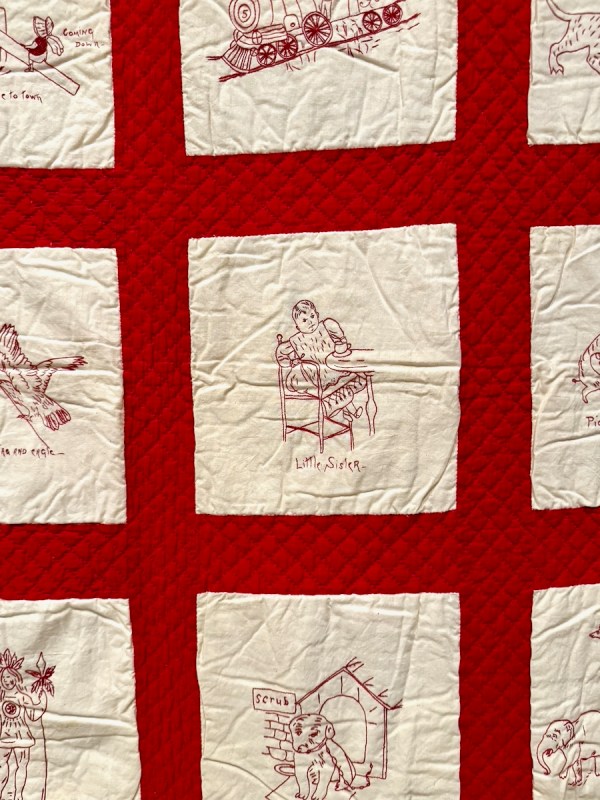
Details from 1) Square within Squares quilt, c. 1980; 2) Log Cabin Quilt, 1880s (made in silk and wool); and 3) Redwork Quilt (1890-1910).
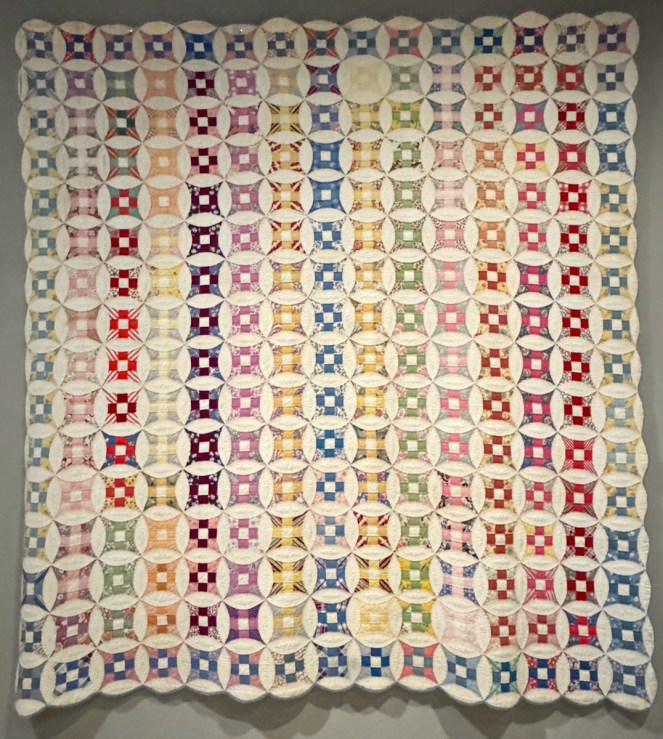
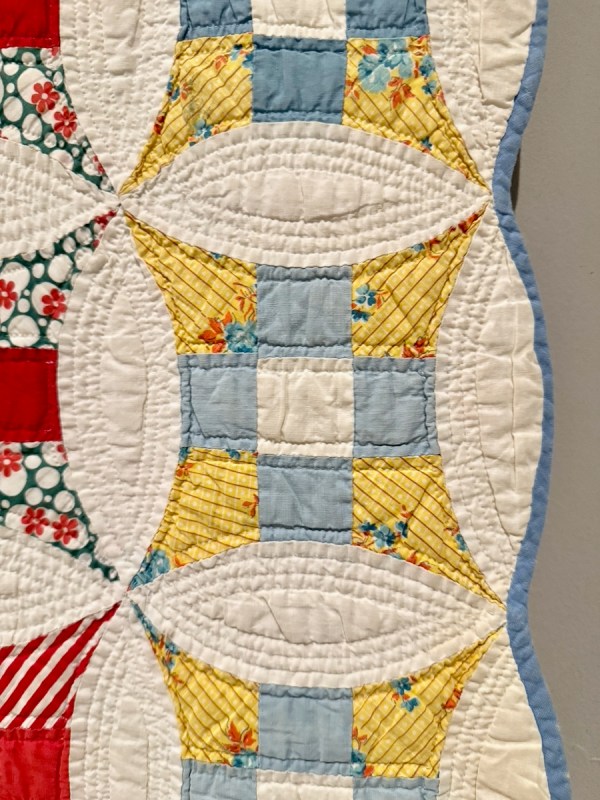
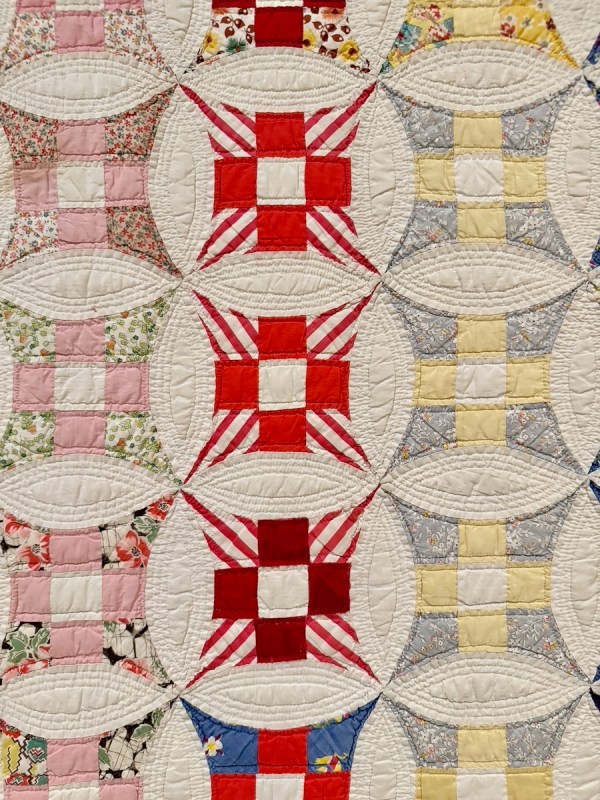
Glorified Nine Patch Quilt, 1930s to 1940s
The nine-patch is a favorite block of mine, but this one was quite “glorified,” if by that you mean “making someone or something seem more important or better than they are.”
What interested me here was how those pointy outer corners were laid on the bias, as shown by the diagonal lines in this print (well, one wasn’t, but the rest were). Was that a design choice, or because it would be easier to piece the curve on the bias?
Here it is again. I think the bold stripes lend some pizazz to the 1930s prints.
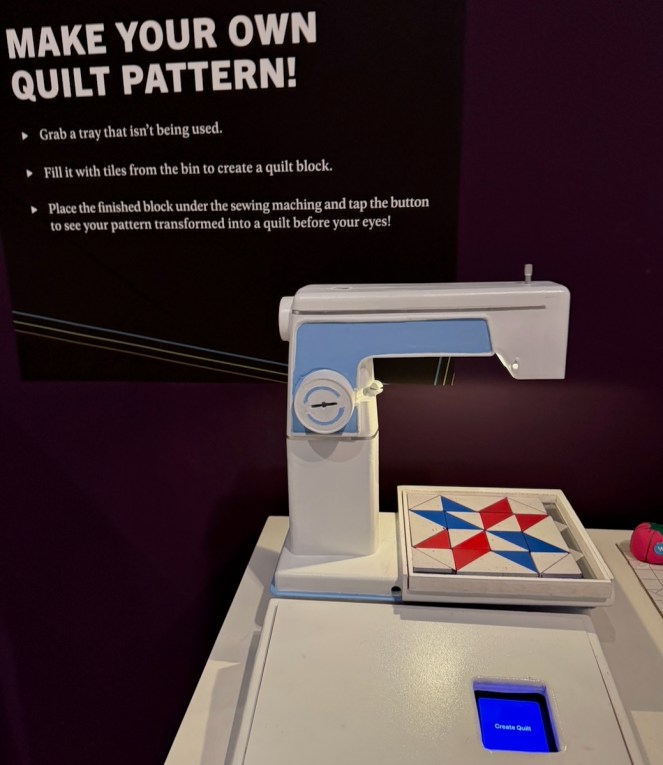
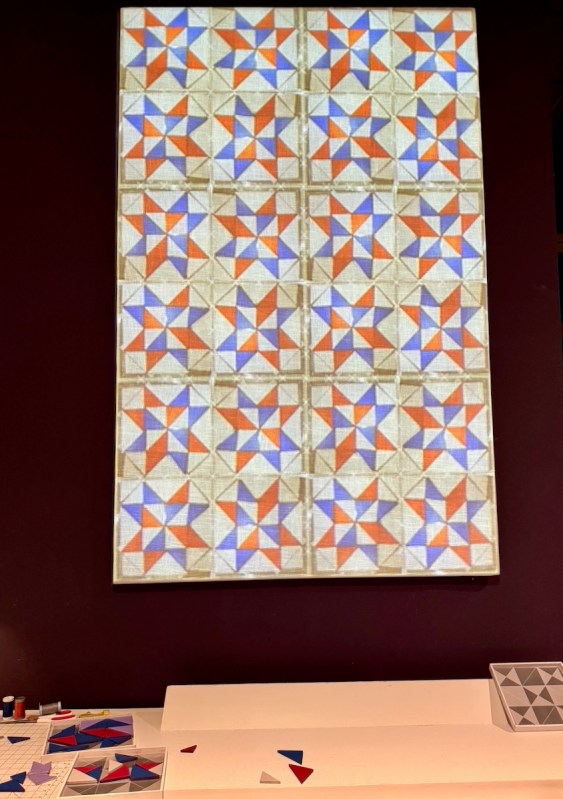
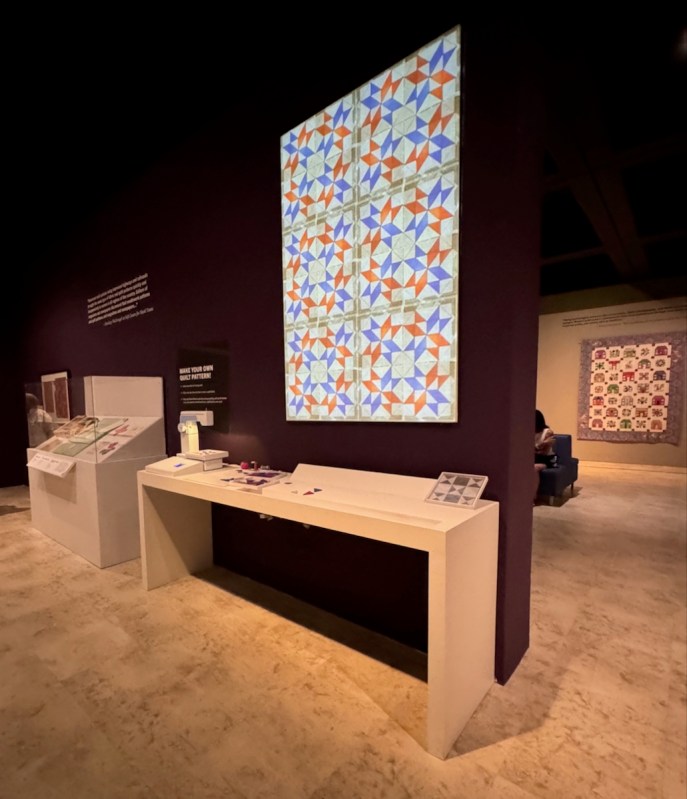
Keeping in line with the idea of messing around and enjoying it as I go, I decided to play their Make a Quilt Pattern game.
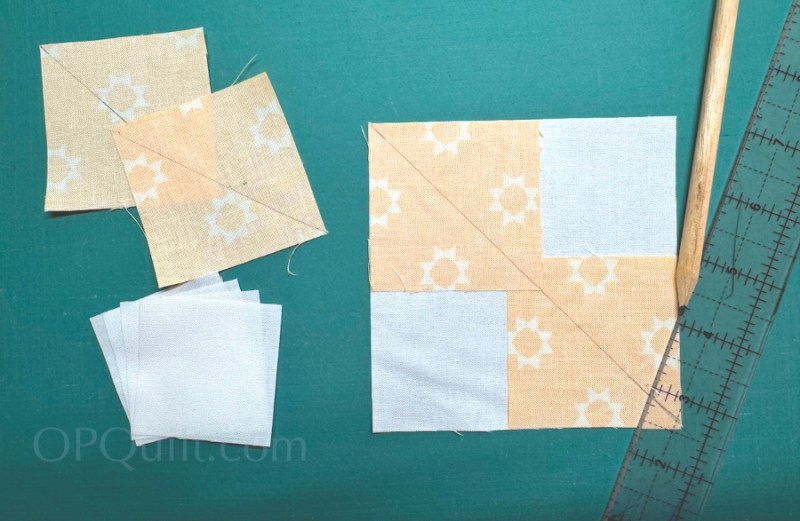
I did the first one on the left, then discovered I could switch a couple of the sawtooth points and get the second (shown here on an angle).
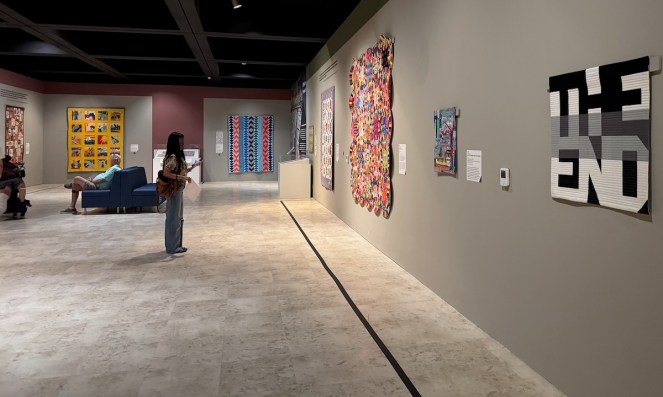
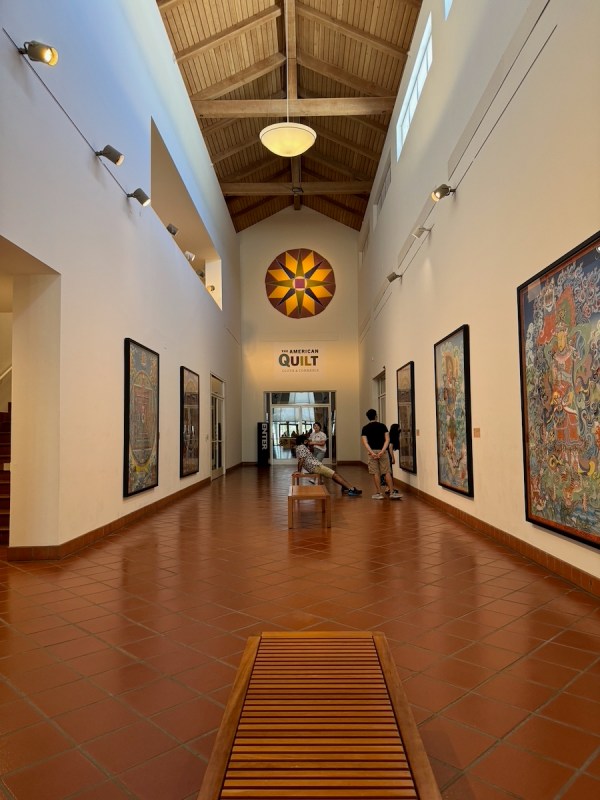
The last room was filled with more contemporary quilts. The exhibit, The American Quilt: Cloth and Commerce, runs through August 30th, if you are in the area. More information can be found on their website.
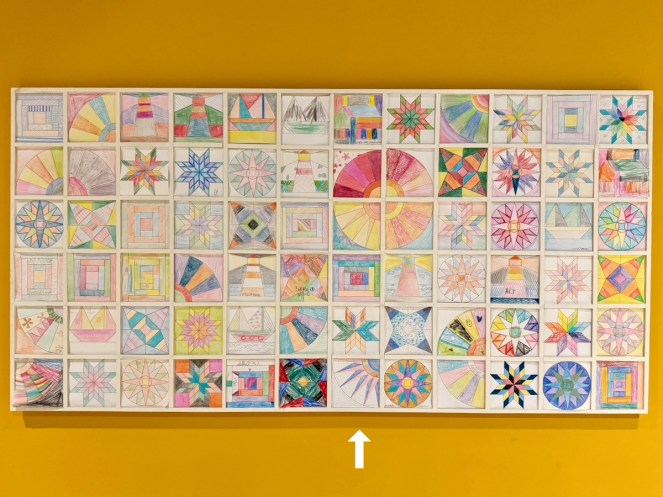
In one corner of the last room, you could color in a block and slap it up into their frames. I chose the “Fan Block,” then said, to heck with Fans, and went to town as if it were a New York Beauty, drawing lines to make it more interesting (mine is just above the arrow). I was in my element:
THE END is by Janet Tranbarger, a well-known local quilter.
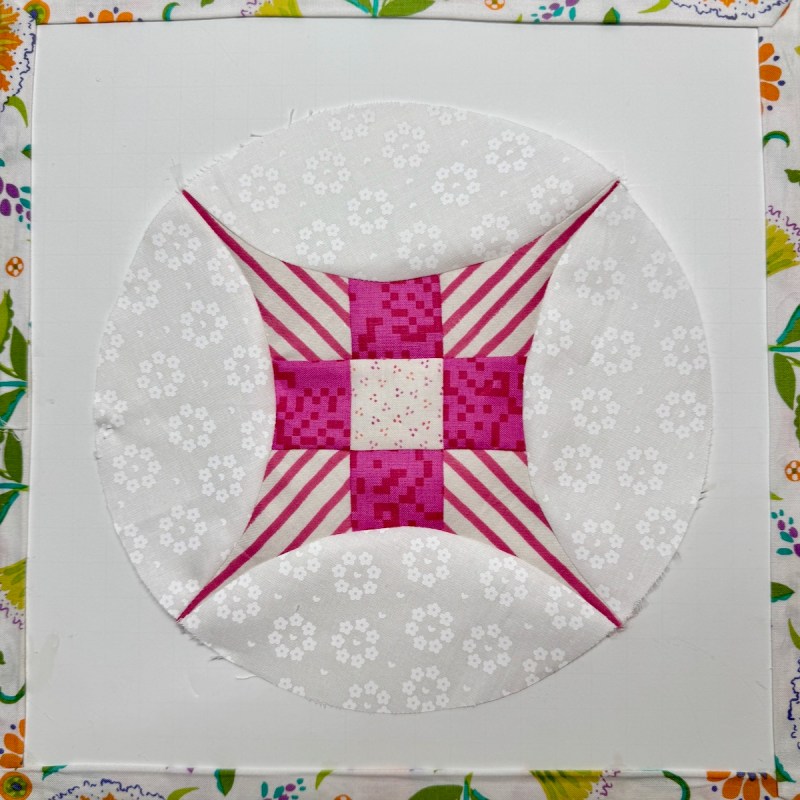
So I found the glorified nine-patch block in the Brackman, and one of its names is Circle upon Circle. I tried it out. This one finishes at 8 1/2″ inches. I’ve got a larger version I want to try (12″) but for now, here’s a free download from my day of doing Small Stuff.
To be truthful, I have no idea how you would put this thing together. Maybe try it as an EPP? Or just be really clever about how you’d sew on the ovals to the fancy nine-patches? Whatever, it’s free to download, if you want it.
Last two quilts:
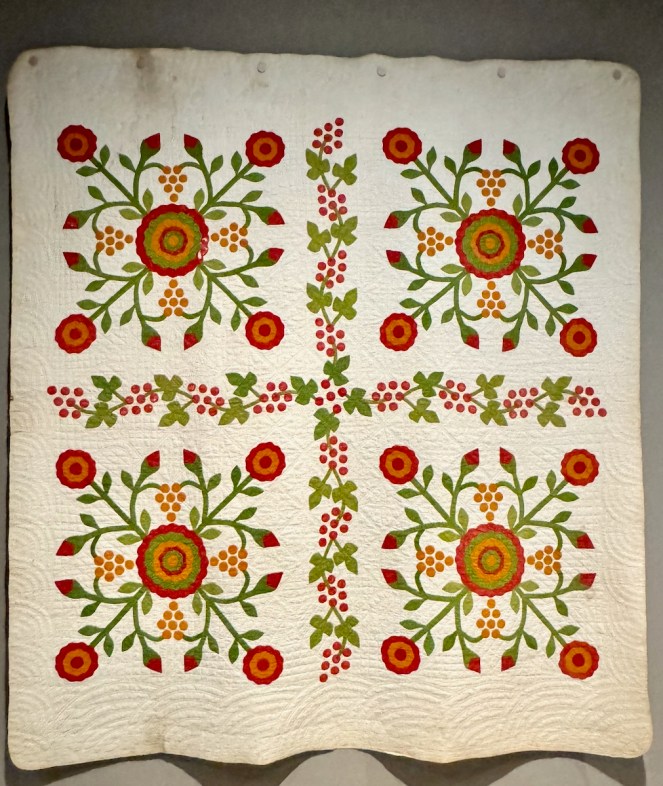
Rose of Sharon — or — Whig Rose Quilt, 1850 – 1870 (possibly Missouri)
The title card said this is made of three different dyed fabrics: 1) “poison green,” an arsenic-based dye; 2) “Turkey red;” 3) and “cheddar,” a dye created with chromate pigment which yields a bright orange similar to the color of the cheese.
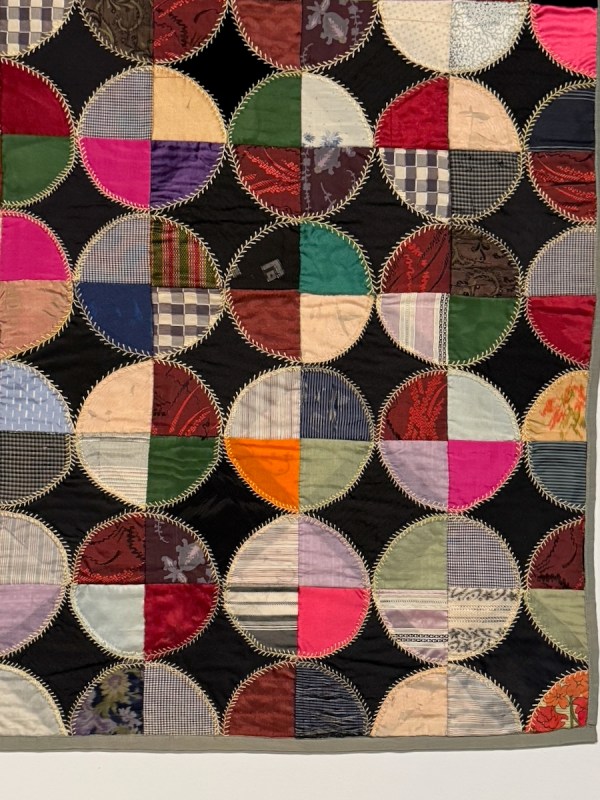
Snowball Quilt, detail (1920s): rayon, silk and wool
The title card noted that “The Treaty of Versailles, which was signed in 1919 to end World War I, included a clause that required Germany to share synthetic dye secrets with the Allied Powers as part of war reparations….The brightly colored patchwork in this quilt indicates that it was likely made after these dyes had become more prevalent in American fabrics.”
I couldn’t get close enough to see for sure, but I’m betting those stitches around the outside edges of the snowballs are done by machine. I’m also guessing that they “snowballed” quarter-circles onto black squares, then sewed them together. You can see some of the disjoint seams here and there.
Final word, from author Ian Bogost (I’d recommend listening to the whole podcast, or reading the transcript):
“So the idea is that we have become disconnected from our sensory lives. That’s sort of the thesis of the book. And this happened slowly over years and decades. It happened in part because of technology, but not entirely because of technology. And we kind of didn’t notice that that was happening. And we maybe, we blamed smartphones instead of a whole host of other factors. But the result is that we feel disconnected, you know? Like, decoupled from the world that we live in, from the physical world.
And that connection, that sensory connection where you engage with the world with your senses, which is what I call gratification: We’ve lost a lot of that. We forgot about it. We were too busy optimizing, planning for the future, trying to make our lives more purposeful or happier, that we forgot how to be gratified. And that’s what I think we should reclaim.”
I did my best to reclaim some Small Stuff, to forget the bigger issues that led me find refuge in this lovely museum, and to get lost in the world of quilts.
Or, the Almighty Sawtooth. Or the Magnificent Sawtooth. Or the Sawtooth Supreme. But first:
The famous novelist, Joyce Carol Oates, talked about what she turns to after she finishes a novel, as she described herself then as spent, and empty. Poetry, she said. I was sitting in that audience when she gave that talk, and it taught me the value of not abandoning the craft when weary. But it also taught me that it’s okay to take a moment after going full steam ahead, a thousand hours a week, pedal-to-the-metal. This week was one like that, maybe not like writing a novel, but the always On, always Going, and by Thursday, I turned to my kind of poetry: sawtooth stars.
A rendering of a current popular pattern, but I’ve done this before:
“This” being to make an outer frame of the sawtooth’s Flying Geese blocks, and insert a design in the center. Why do we like the Sawtooth Star so much? I think the answer to that lies also in why we like star blocks so much. And it was to this I returned this week, after dancing around with multiple combinations of everything for the Granny Square blocks.
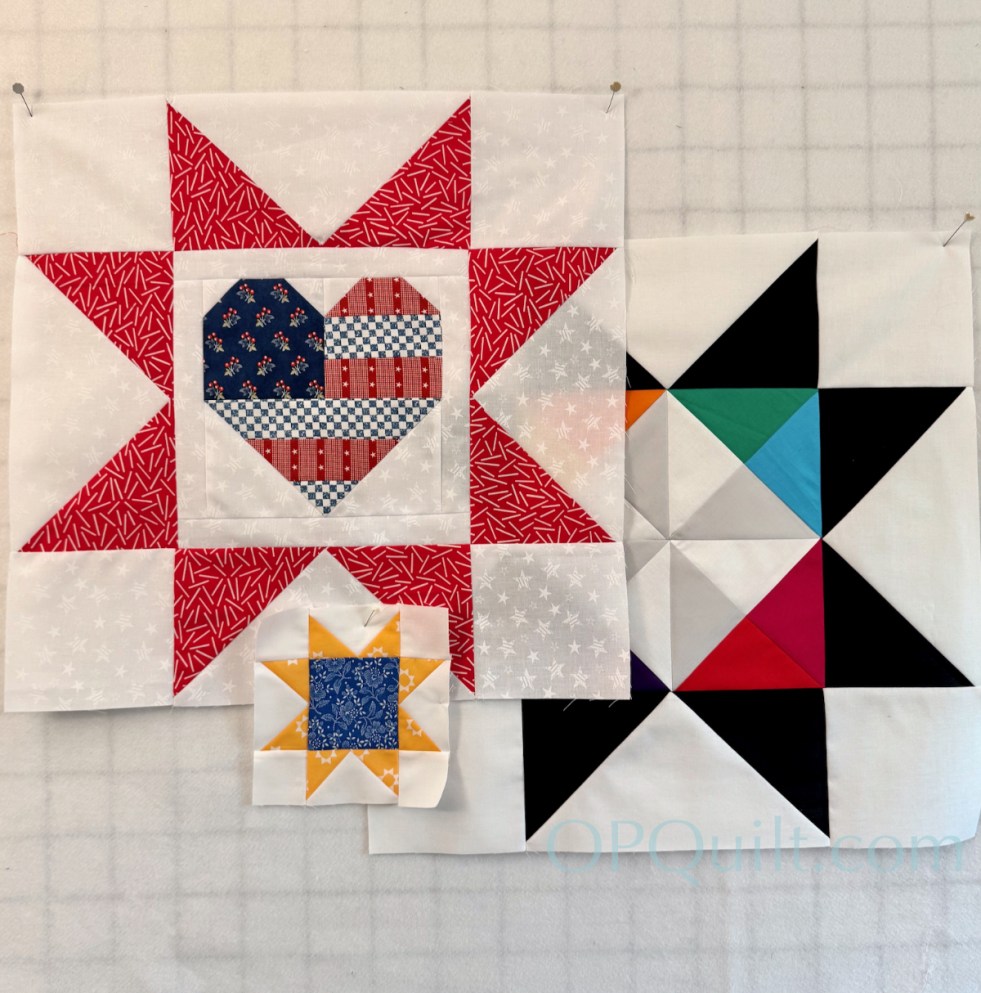
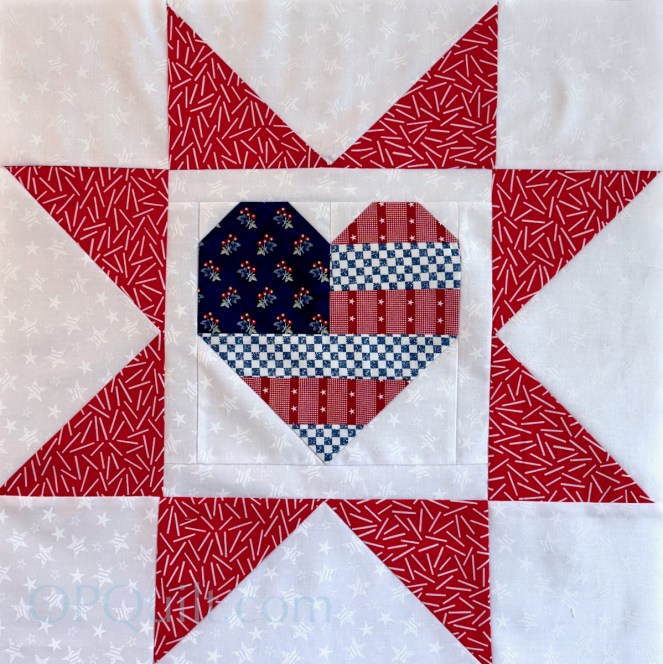
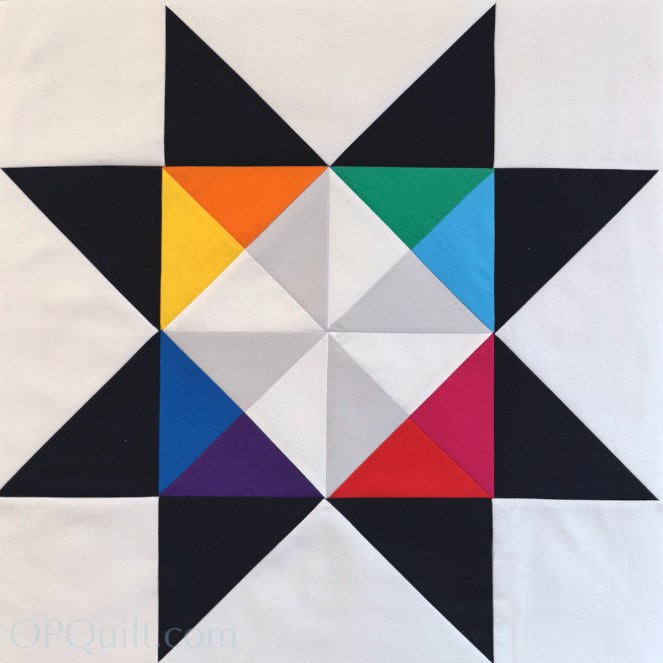
I’ve had this sawtooth star idea floating around my sewing room for probably five years, the how-to sheet pinned to my design wall just to the side (see the free download at the end). It was time. The large block measures 20″ finished.
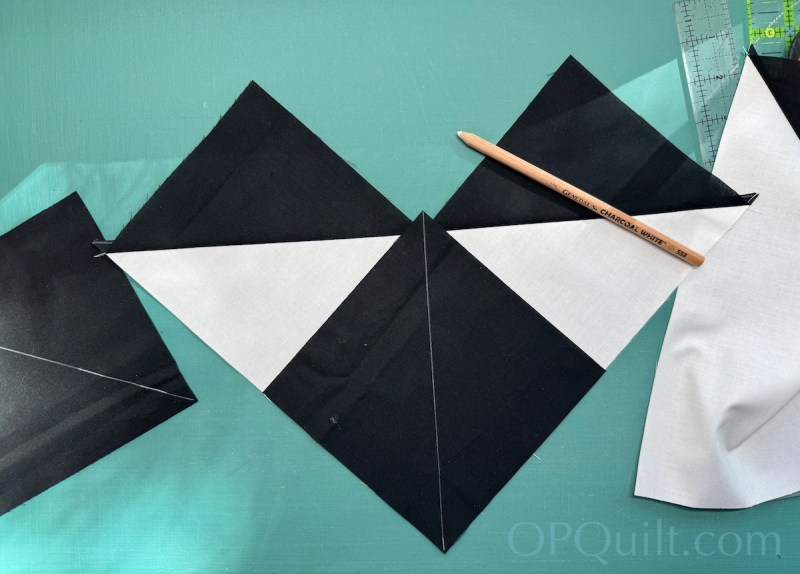
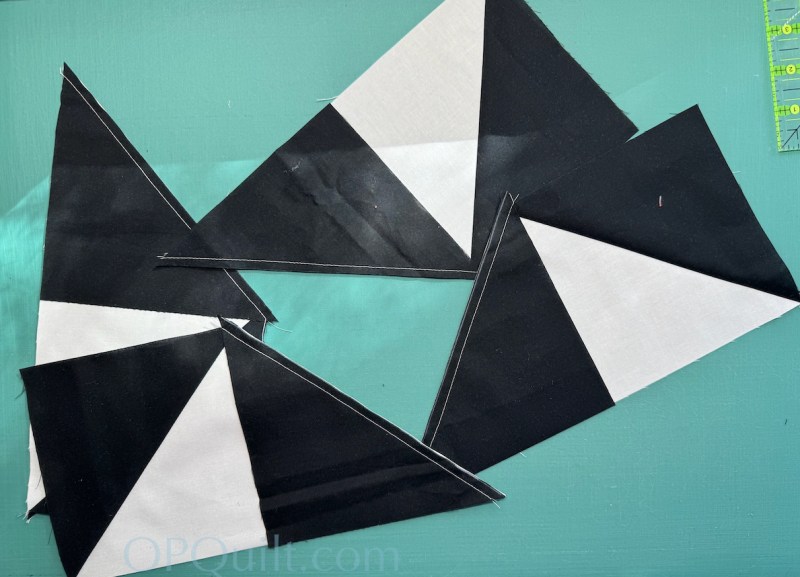
The handout/pattern is pretty loosey-goosey but after you make the inner quadrants, trim them to 5 1/2″ square, making sure you are centered with your ruler. And maybe also centered in your soul. Kidding.
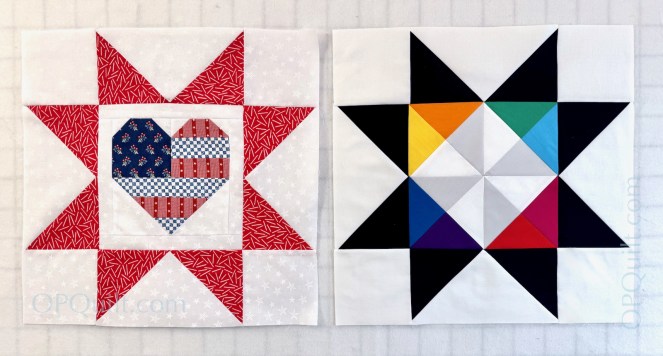
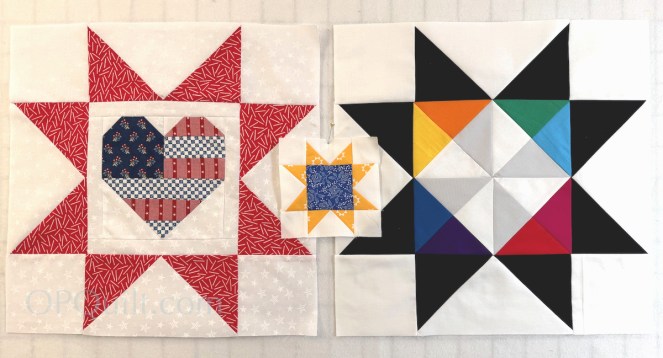
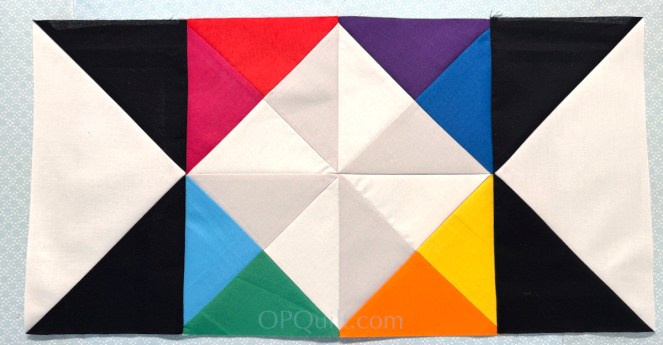
As I mentioned, these are jumbo blocks, 20 inches square, finished. The one on the left is destined to be quilted and then made into a pillow for — what else? — Flag Day, which is today! (Put out your flag and celebrate America’s 250!) The multi-hued block will probably kick around my sewing room for another few years until I decide what to do with it.
But there is one more.
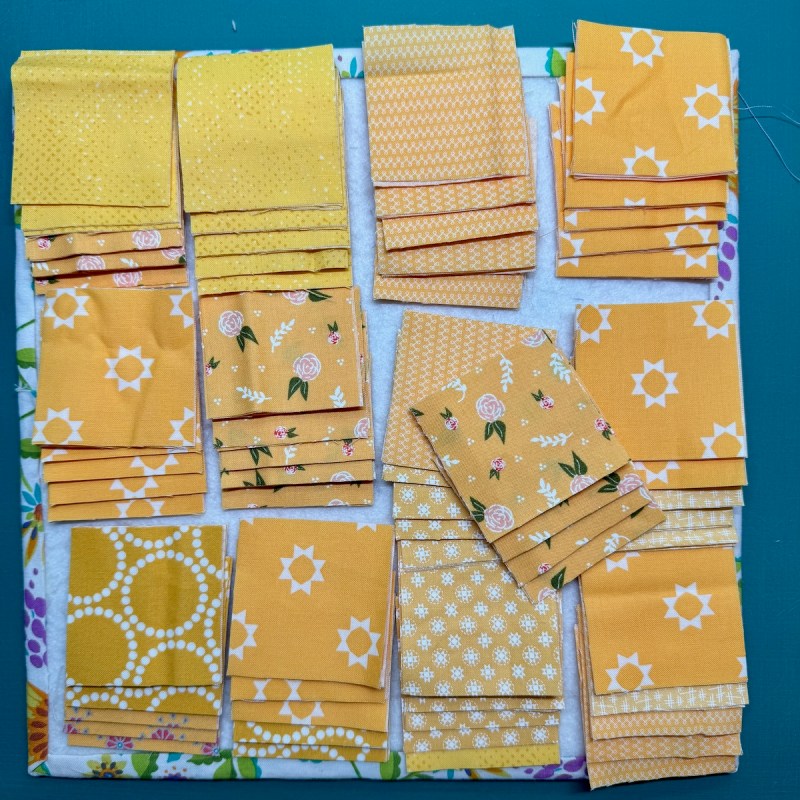
Yellow and blue are two of my favorite colors.
This came from when I was experimenting with BlockBase+ software and wanted to insert blocks into a different frame than a Sawtooth. Original post is here.
And now I wanted to finish this idea.
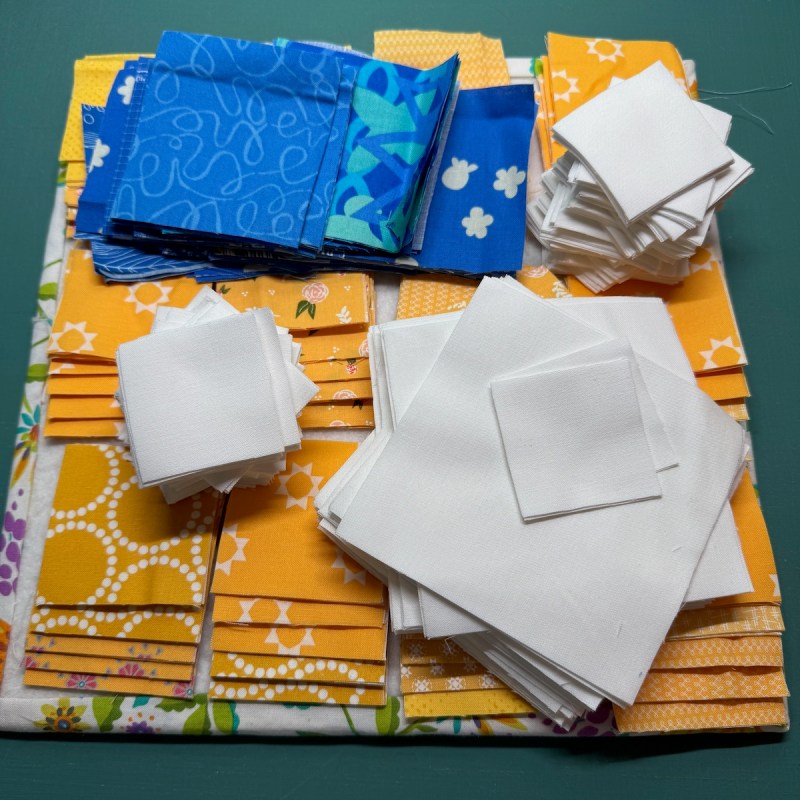
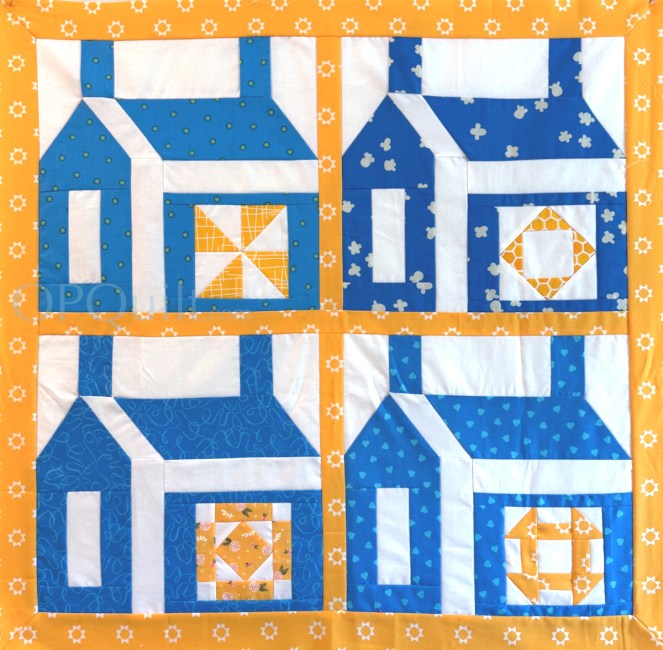
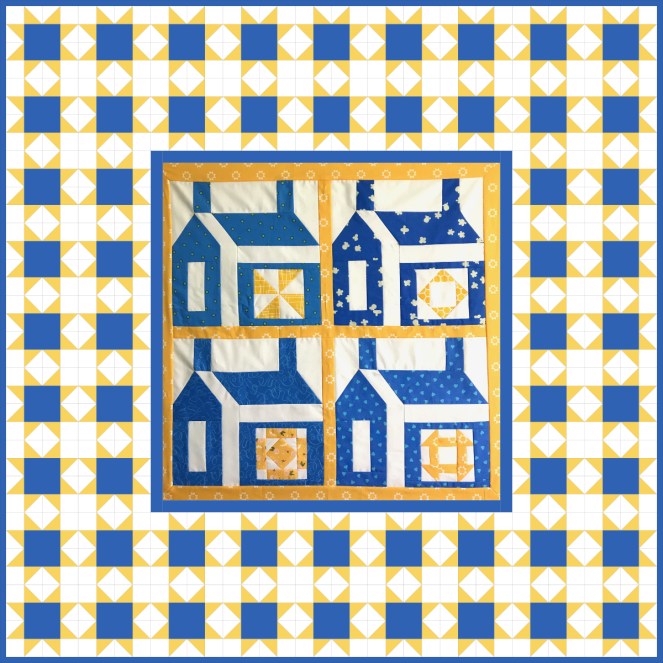
Here’s something I sketched up in my Affinity Designer software. That’s a total of 64 sawtooth blocks surrounding my houses, and finishes at about 55 inches square, a nice wallhanging size. I included the info when I revised the Build Me A House pattern. (It’s a PatternLite pattern: cheap.)
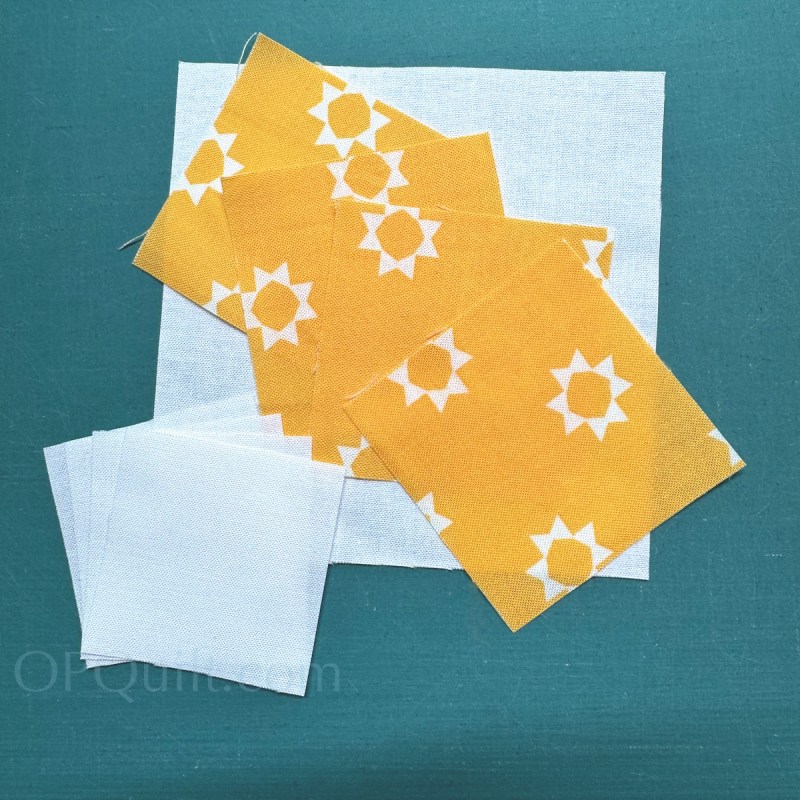
This block finishes at 6″ square — after spending several hours on the two jumbo sawtooth stars, this was made in a blink of an eye, it seemed like.
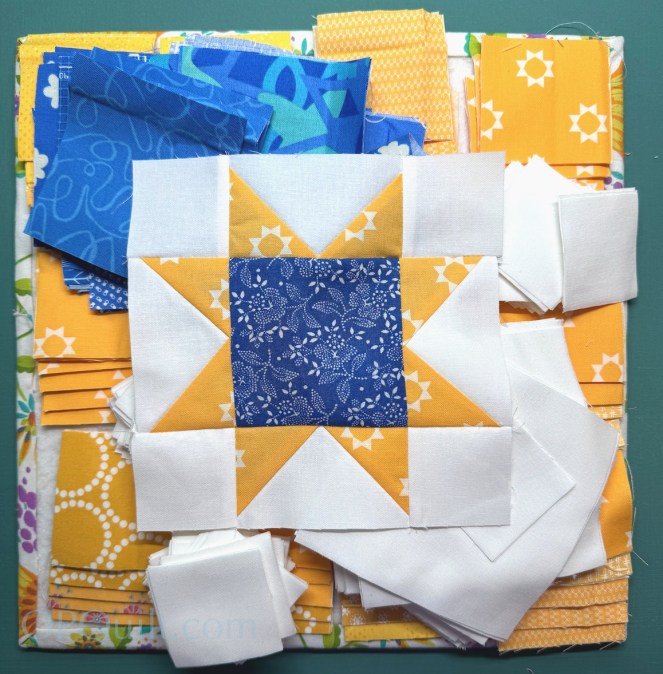
First one done, sixty-three to go. That blue fabric in the center square is from my very first quilt. I try to slip it into my current quilts when I have a chance.
It’s been lovely to spend some time writing poems–
Before I sewed on the top Flying Geese: I thought it looked kinda cool.
If you are honoring the 250 anniversary of the Constitution and Declaration of Independence, be sure to visit the Official America 250 website. There are some fun ideas on there to commemorate and celebrate!