
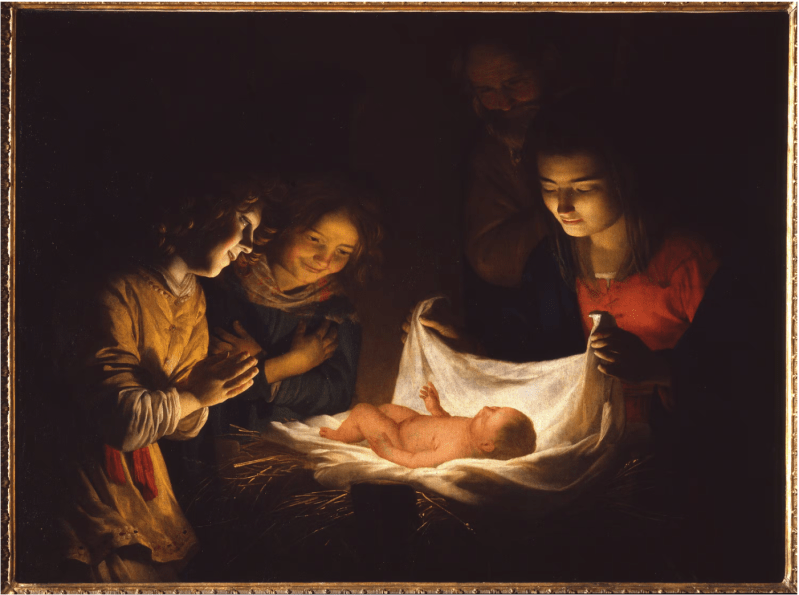
Adoration of the Child
Gerrit Van Honthorst (Utrecht 1590-1656)
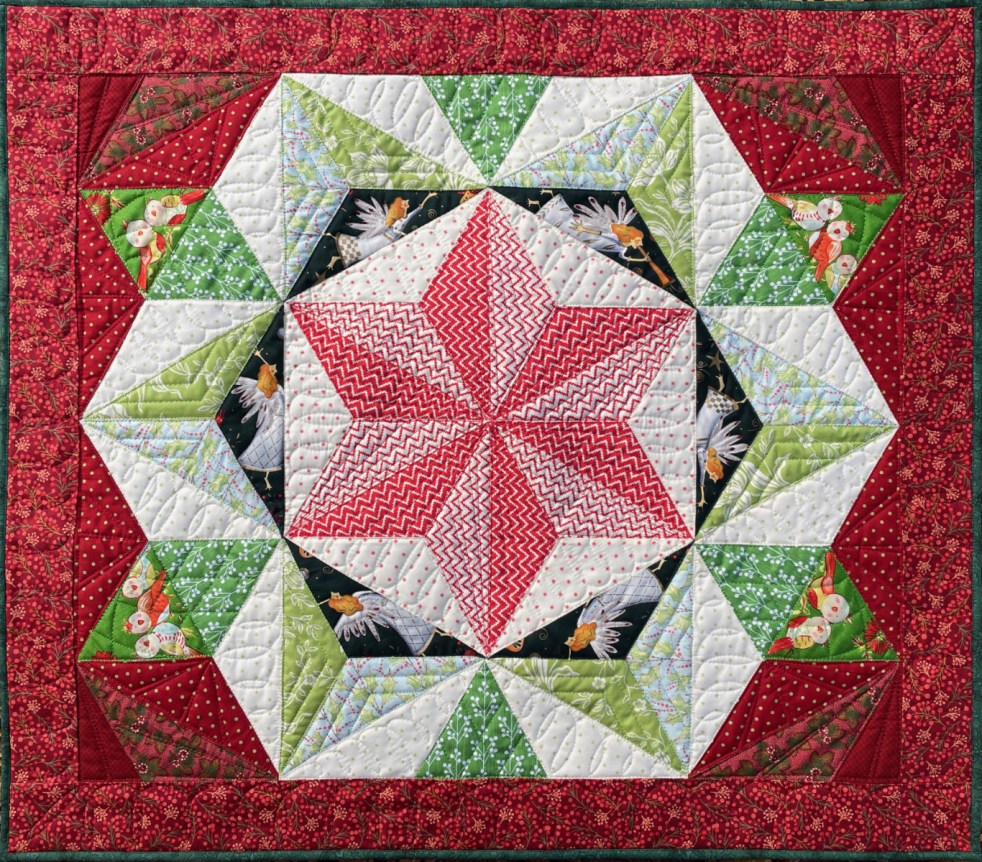
And here’s your Christmas quilt, Stella di Natale:
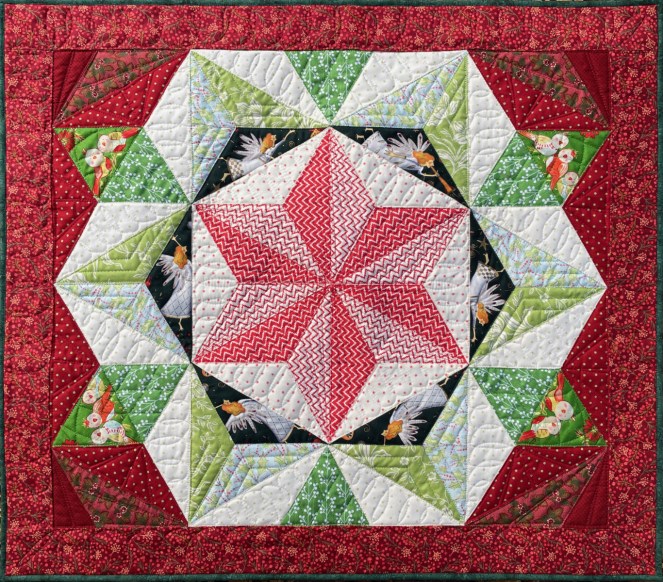
I hope you have a lovely and merry Christmas!

Adoration of the Child
Gerrit Van Honthorst (Utrecht 1590-1656)
And here’s your Christmas quilt, Stella di Natale:
I hope you have a lovely and merry Christmas!
This post covers:
• Venue 7: Église Ste. Madeleine, with Shin-Hee Chin
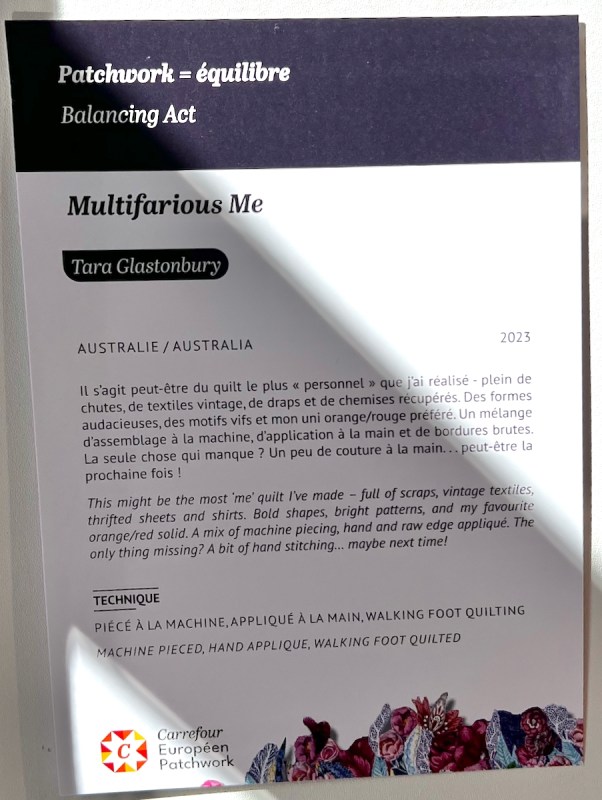
• Venue 8: 86 Wilson, with Tara Glastonbury
• Venue 9: Chapelle St. Joseph, with Janet O’Dell
I have a main Carrefour Quilt Show page that lists all the posts of all the meetings I’ve gone to, and includes the posts from this year too. If I haven’t mentioned it before, you might enjoy these posts more if seen on a desktop computer or even a tablet. Cell phones re-format the layout and can sometimes do strange things to how it looks on the screen.
If you are interested in going to Carrefour, I wrote two posts for them about our travel, and how we put the trip together. You can find them here and here. Their main website is HERE, where you can subscribe to their newsletter (scroll to the bottom).
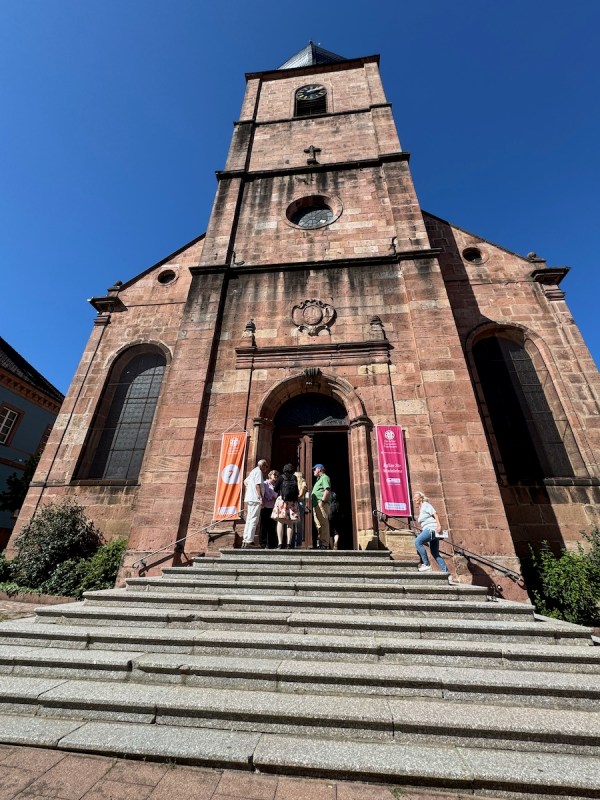
Venue 7 is the St. Madeleine Church.
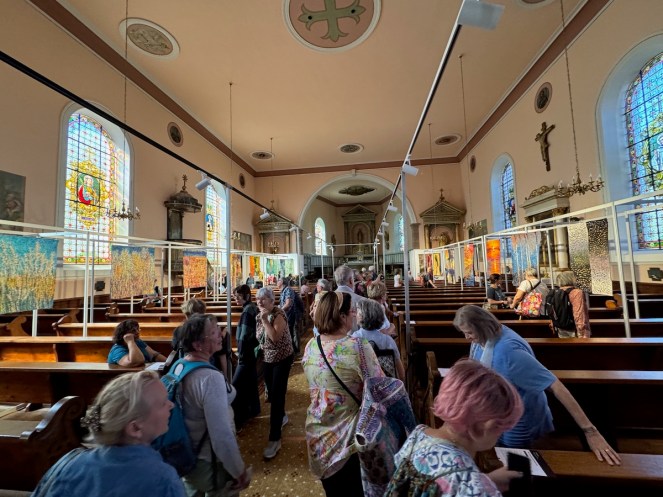
Inside, the organizers set up a metal scaffolding framework to see the quilts. The lights are strong and the quilts are well-lit (sometimes with shadows, but we tried to work around them). I appreciated the effort they made for us to see the quilts. Sometimes, we’d have to walk down the bench to see details, which is what you see going on here with people moving in, then back out to the main aisle.
Okay, here we go with Shin-hee Chin.
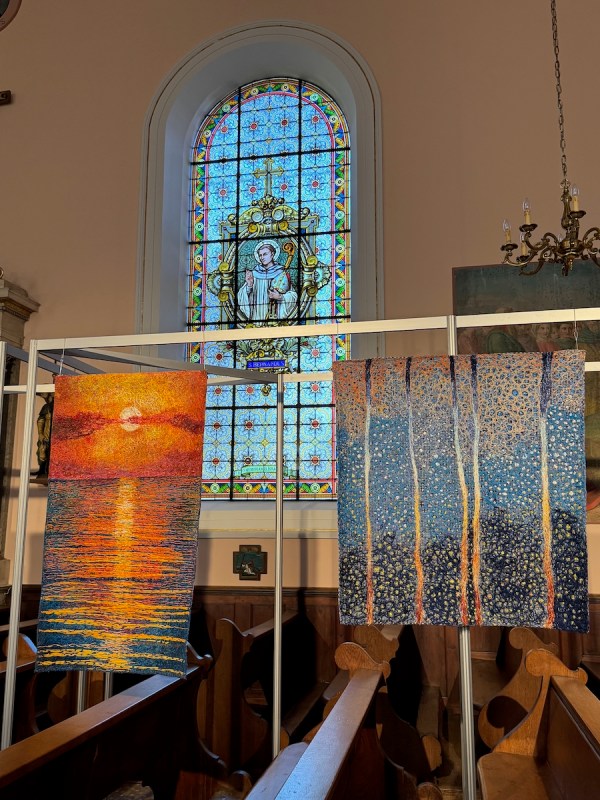
She was born in Seoul, and earned her BFA/MFA from Hongik University and an MA in Fiber Arts from Cal State Long Beach, in California. She is now a professor at Tabor College (Kansas), where “her work explores identity, hybridity, and belonging through feminist traditions and spirituality” (from catalogue). The catalogue goes on to say that her work also “honors the deep bond between humanity and nature. Through meditative hand stitching, she reflects on our share facility and interconnectedness. Each stitch connects with nature’s rhythms, creating texture and depth to celebrate the patterns that sustain life.”


Now here’s the surprise. Perhaps you glimpsed through the threads a different quilt.
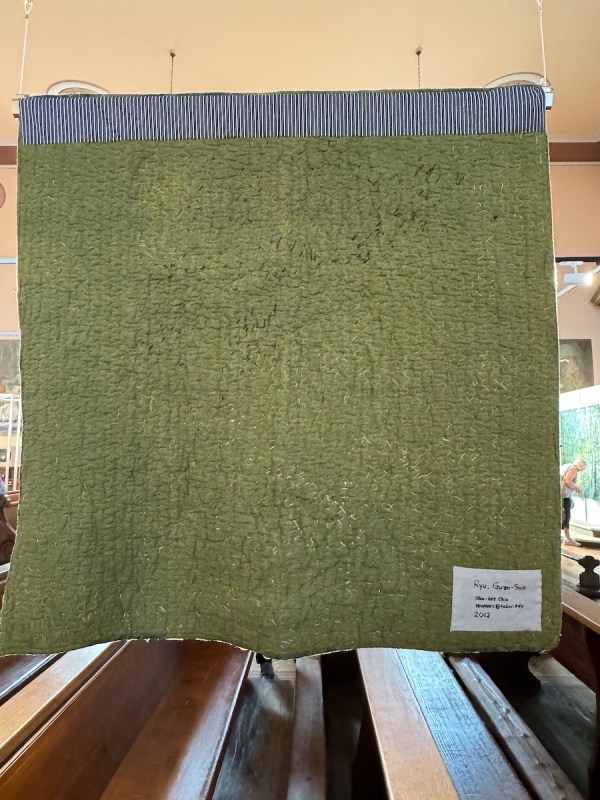
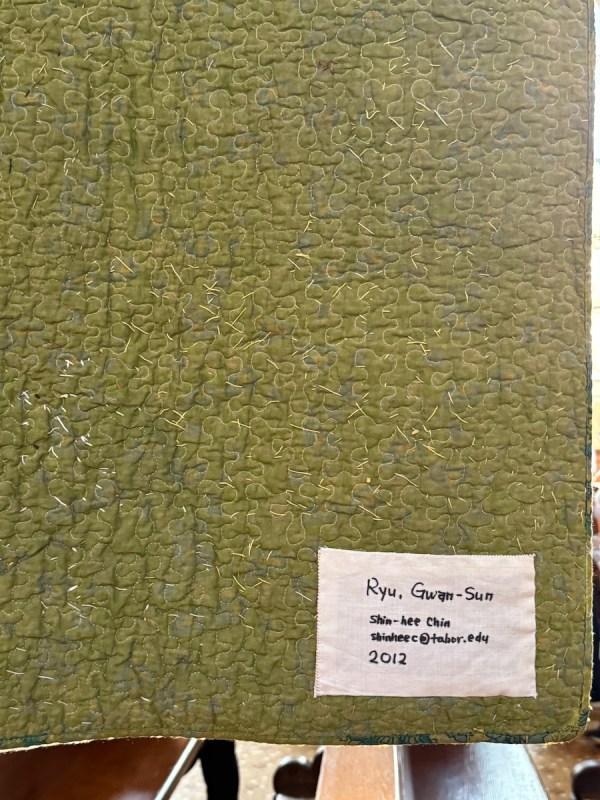
She uses quilts and blankets as the basis for her thread work. This caught me by surprise, and at first I didn’t know how to think about it. We quilters get our knickers in a twist if people make coats, etc out of old quilts. How do we feel about someone obliterating the quilt with their own work? Well, generally that is one reason that I come here: to have my eyes opened to what else is going on in the quilting world. I just needed to accept this artist on her terms, and look at her work. We all have seen quilts at guilds and local shows that surely might be well-suited to a second life (I’m looking at you, pre-printed panels!), and what an impressive life they would have with this quilt and fiber artist.



(Click to enlarge the photos.)

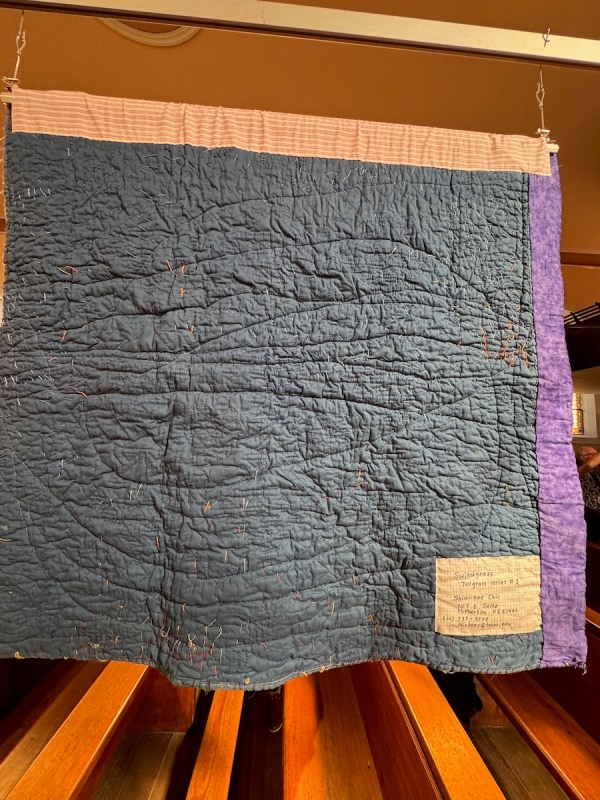
Confession: somewhere along here, I lost track of which quilt belonged this title card (sorry).


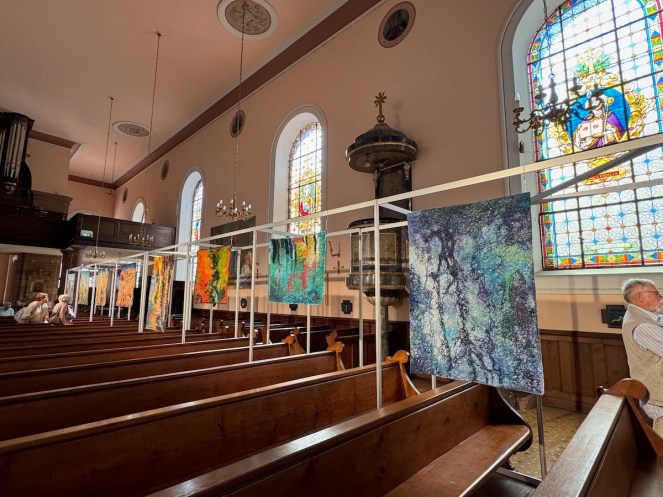
Fronts of quilts…
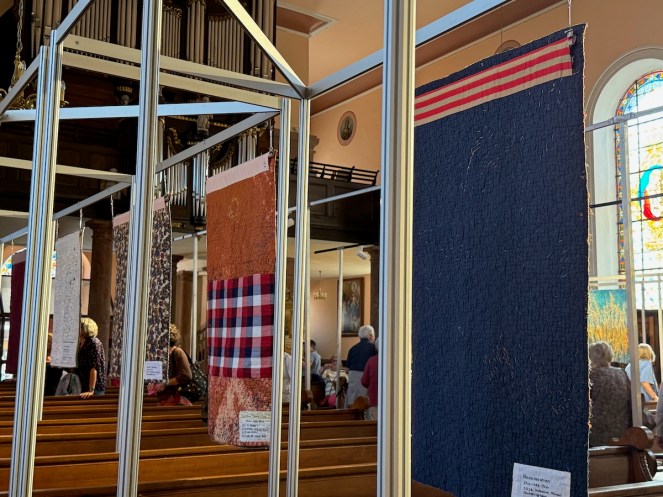
…and the backs of the quilts.

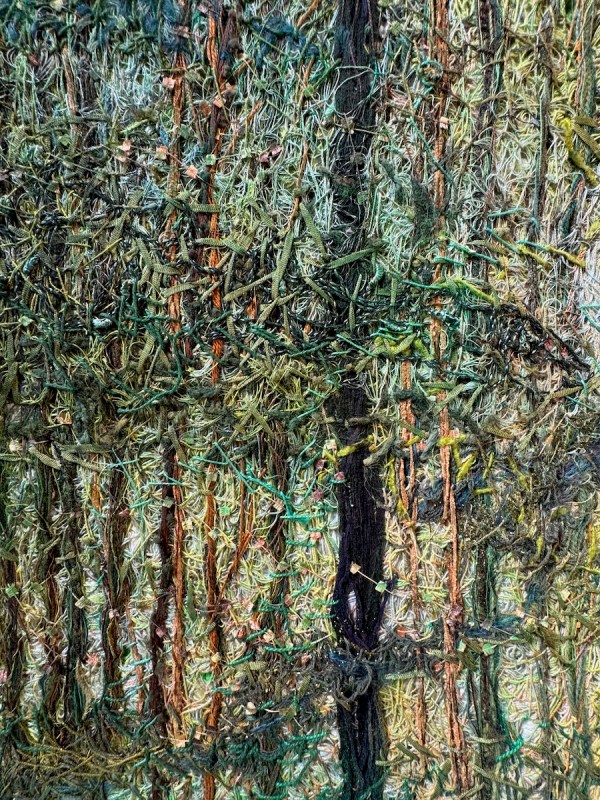
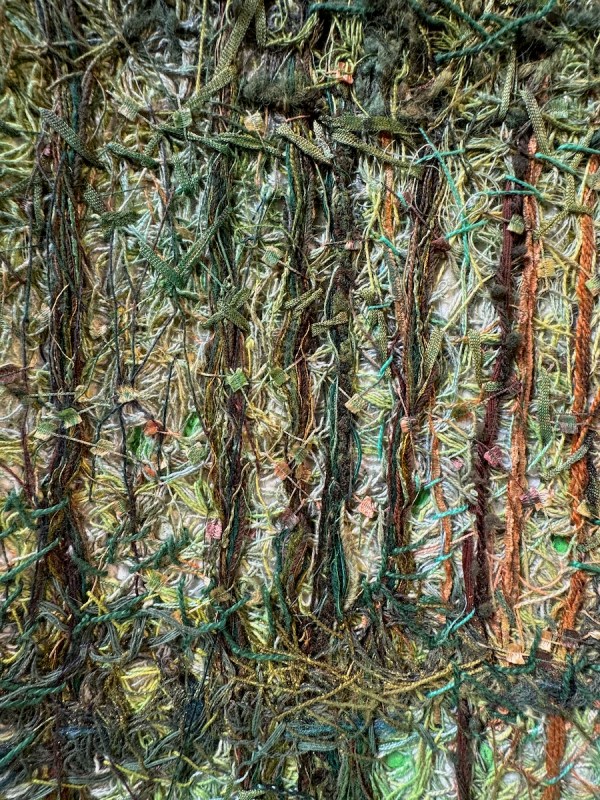
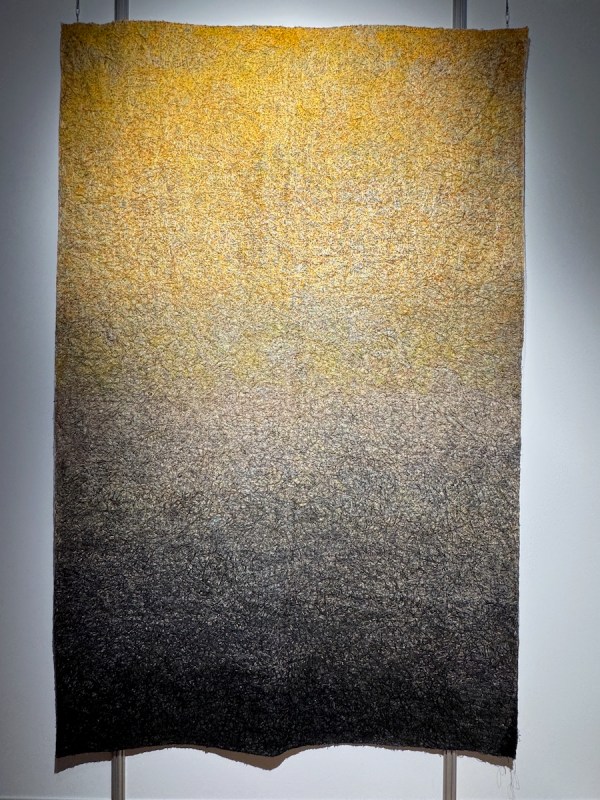
A quilt from her nature series, a collection up on her website. One of the reasons I was interested in this was because her materials: a thick thread with little squares attached, which I’ve seen knitters use to make decorative scarves.
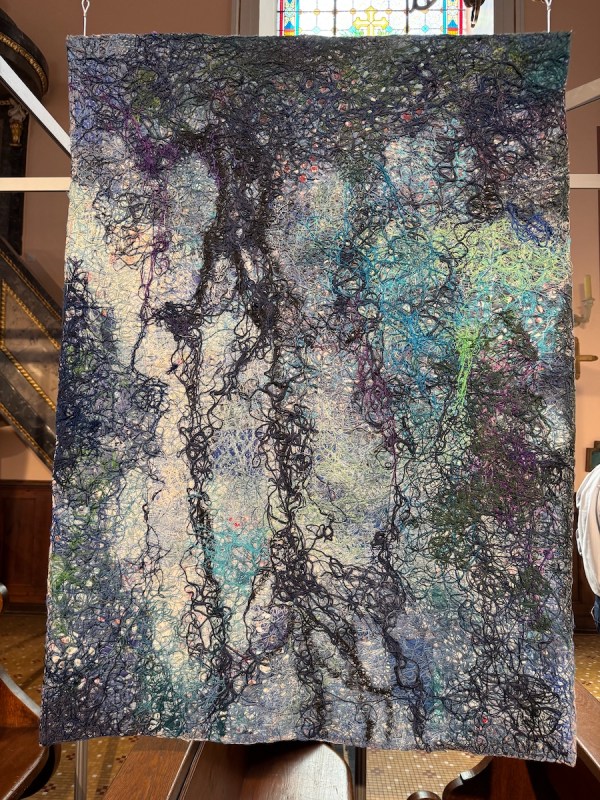

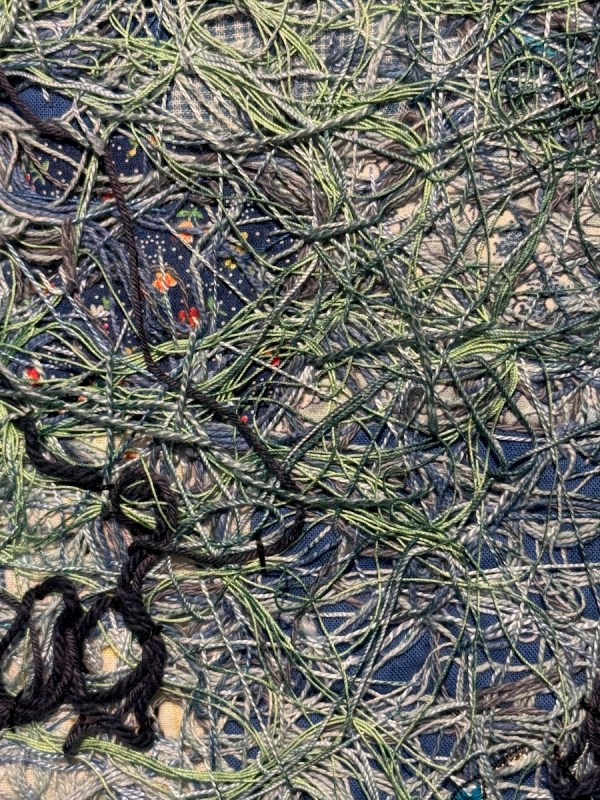

Her work appears literal, like — yes, this is a reflection of tree branches — but then you get closer, and the thread stitches and tangles add another dimension.

The tiled floor, of course.
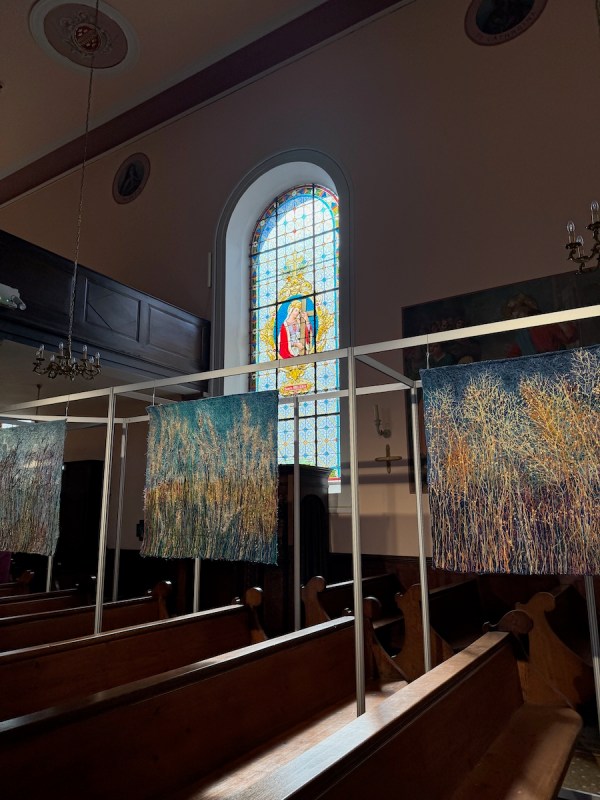
Last look: the interplay of the church’s stained glass with Chin’s threaded images.
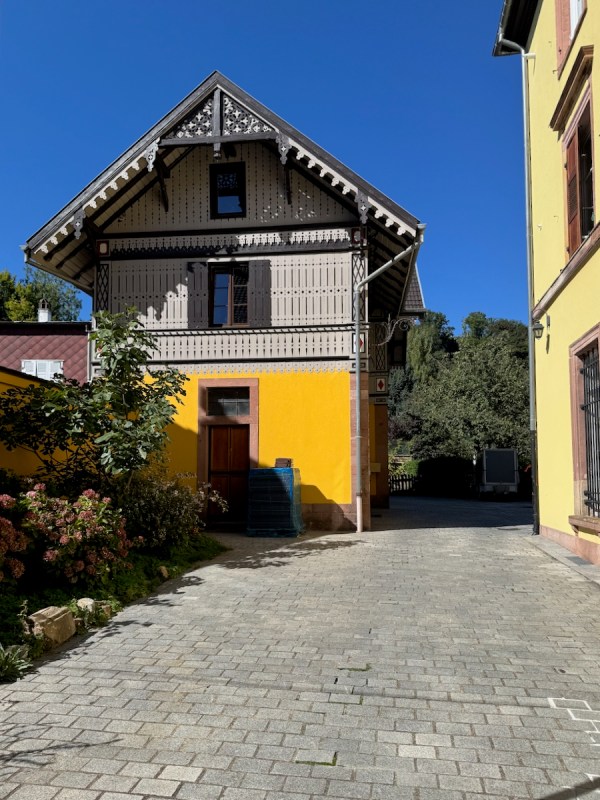
As we walked to the next site, we loved the brilliant yellow against the wood-carving on this small house.
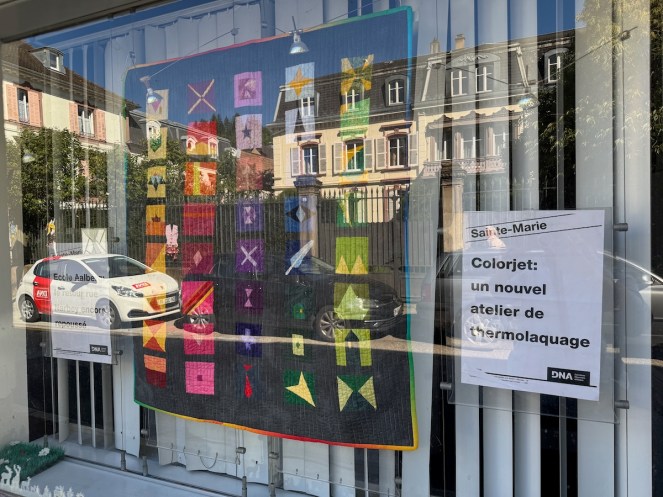
We notice the quilts in all the windows around town. We’re headed to Venue called 86 Wilson, which is really just a street address. It’s where Tara Glastonbury is exhibiting, another quilter from Australia.


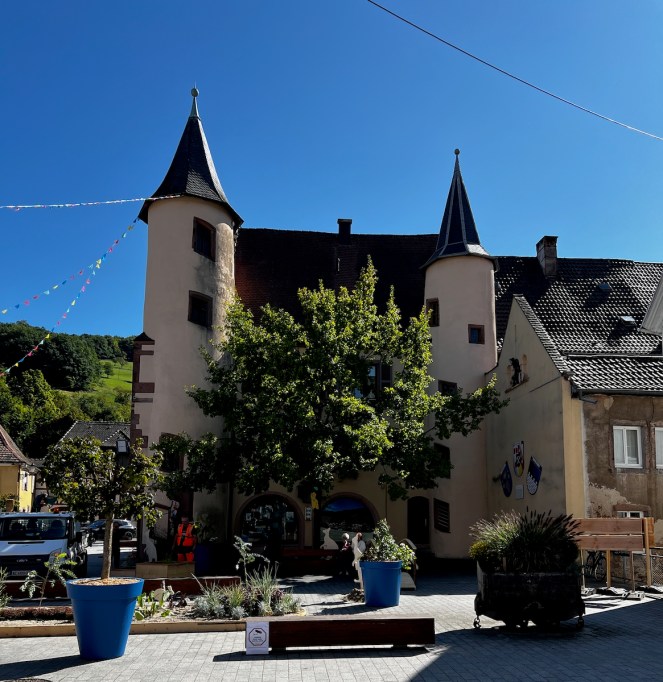
The view across the street.
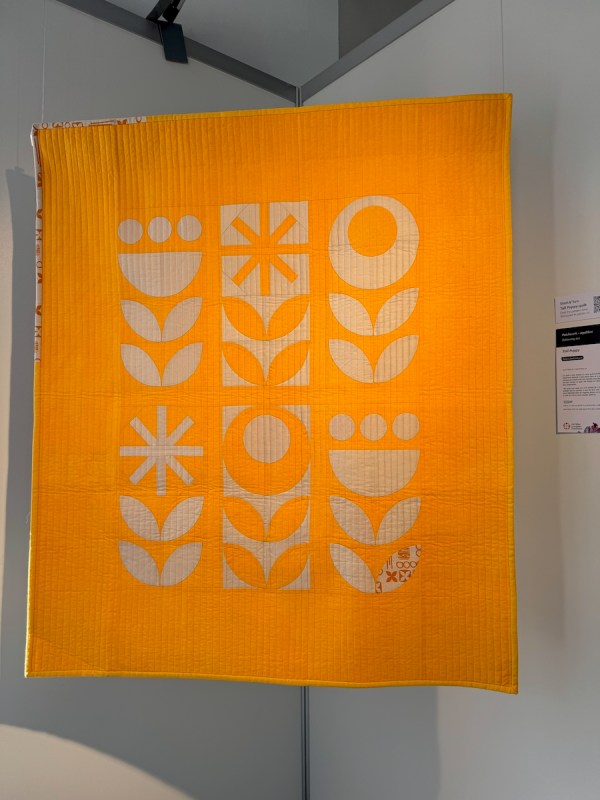
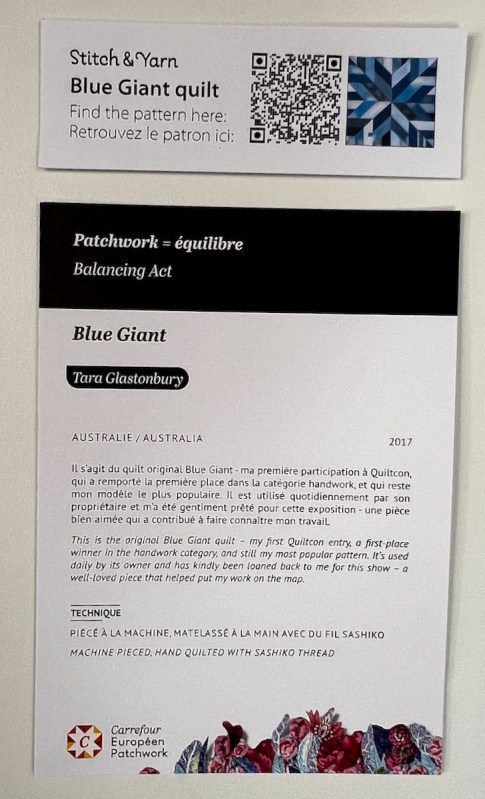
Now do you recognize her work? She has a pattern line, as she has “a background in graphic design, and a long history in textile crafts” (from catalog). She titled her exhibit “Balancing Act,” as it “explores her evolution as a design-led modern quilter through her use of bold color and striking geometry.”
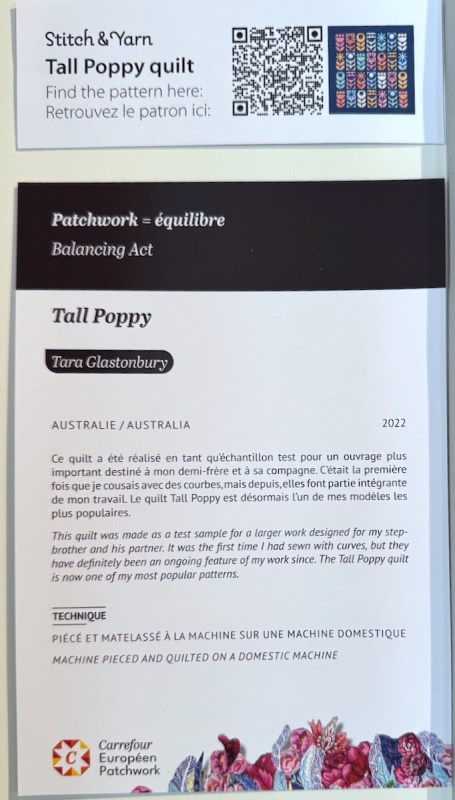
Tara and her mother sat inside, just a bit away from the front door, in front of a sunny window lighting the space. She had copies of her newsletter and patterns (yes, I bought one). The atmosphere was genial and happy.
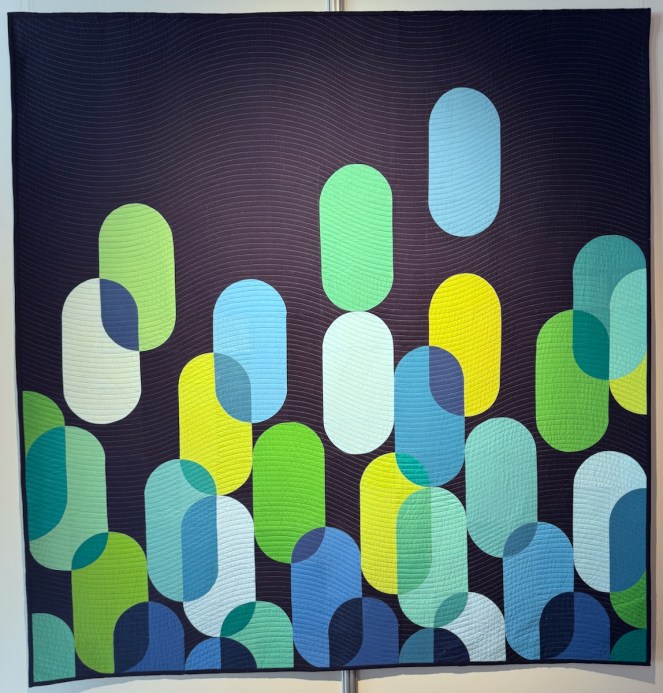
I struggled to get the right color balance, because the lights cast a really warm light.




I love that she had tote bags that echoed her quilts.

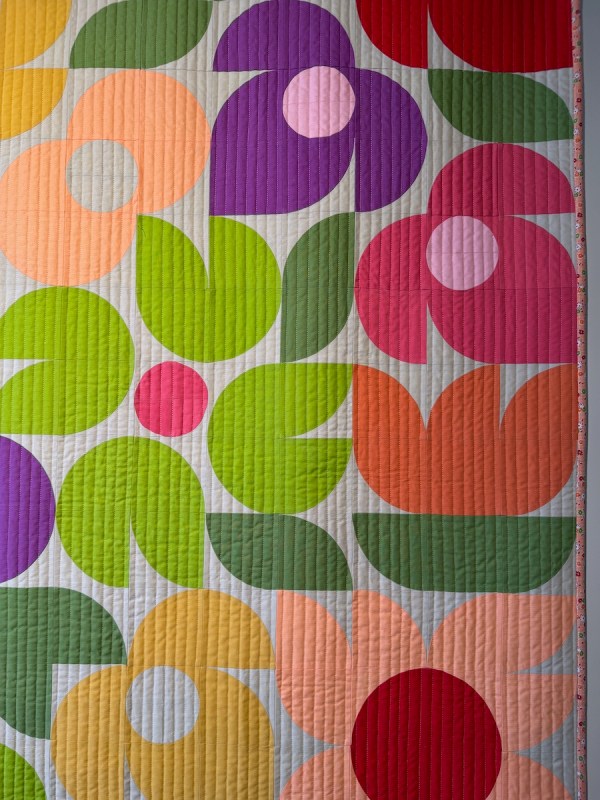
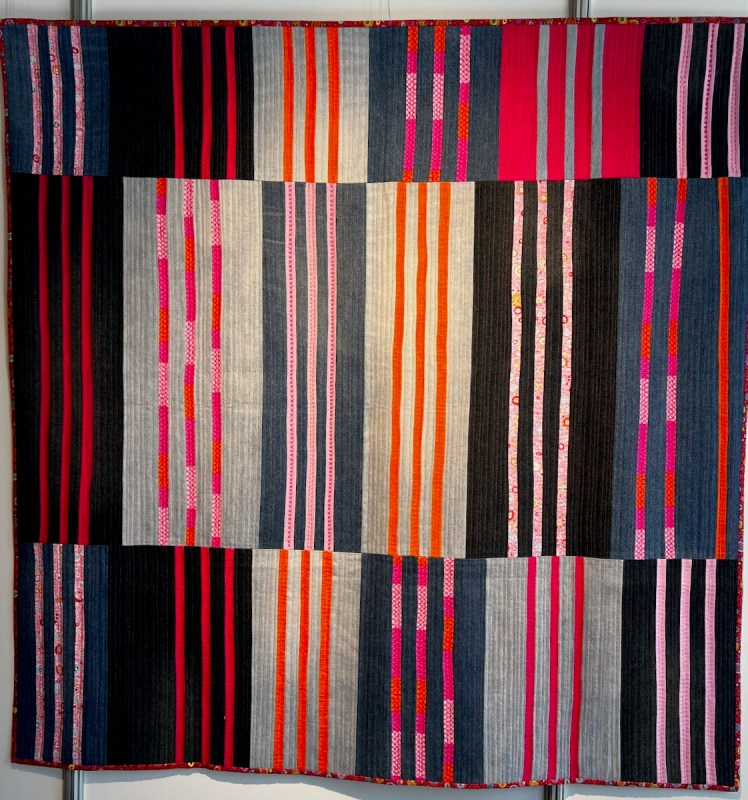
Two quilts that I don’t have title cards for are below, but you can find them in her pattern shop.

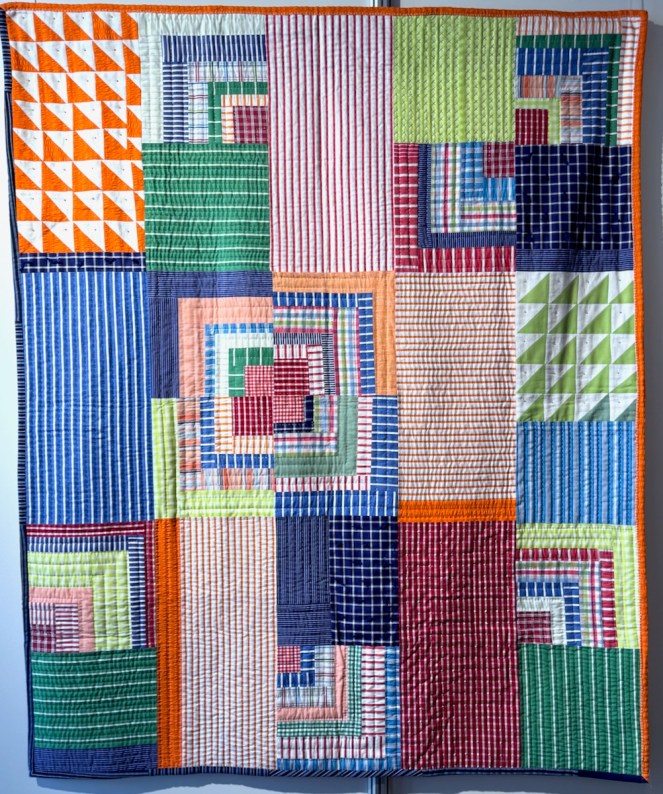
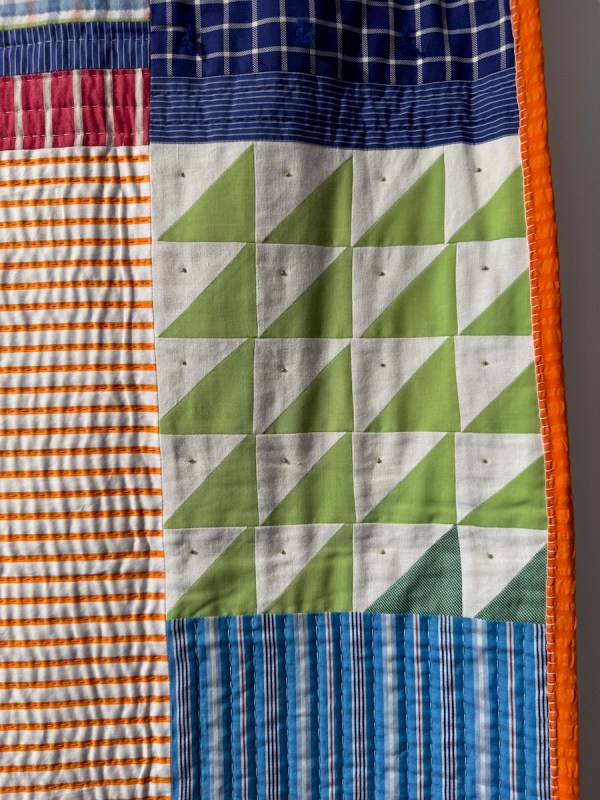
I love that she “jazzed up” her Log Cabin with some triangles.

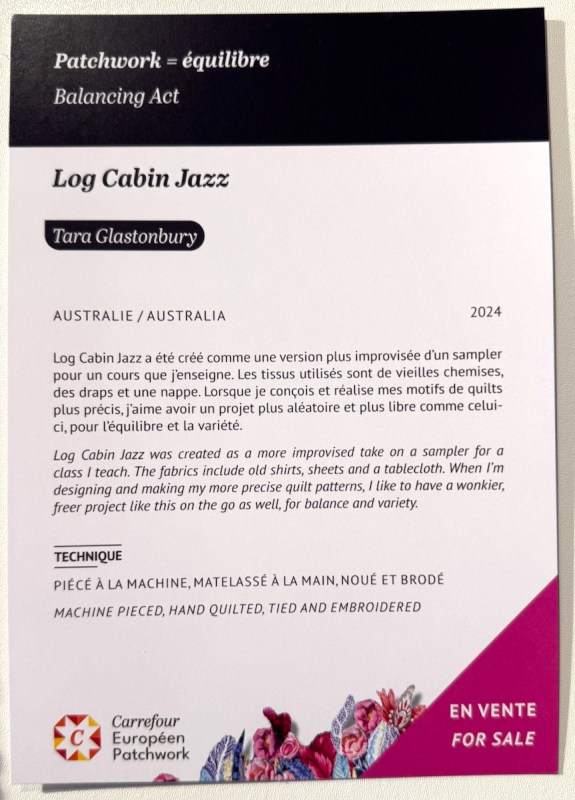
See her card (below) for a truer representation of the colors. It’s such a terrific design.

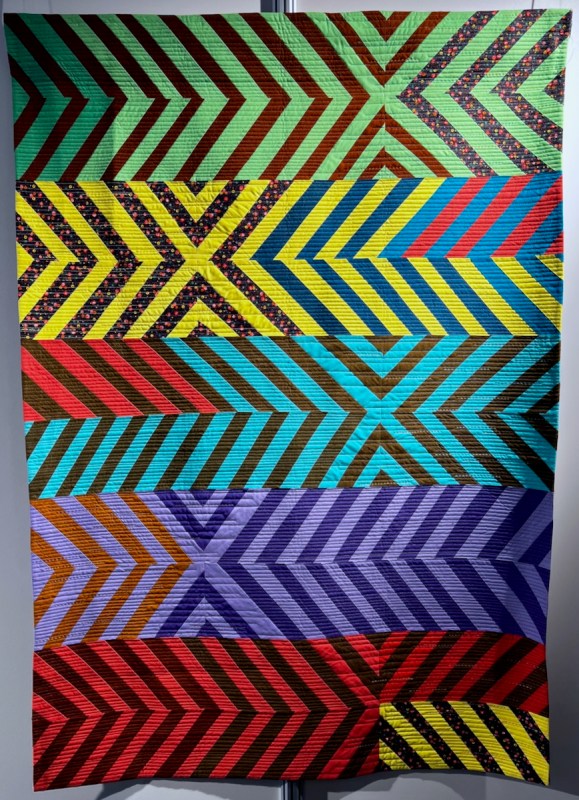
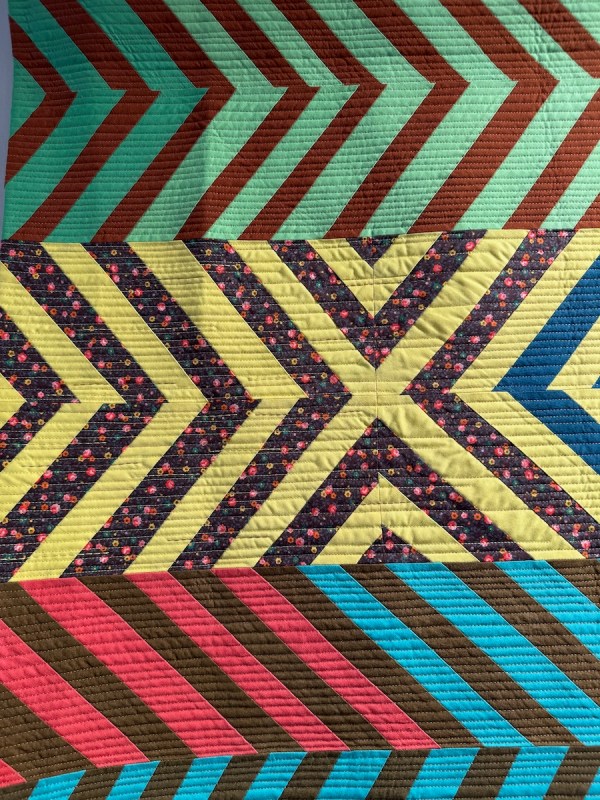

Tara’s penultimate quilt:

She uses small pieces of fabric in an interesting way. Scrappy-not-scrappy, but more ordered.


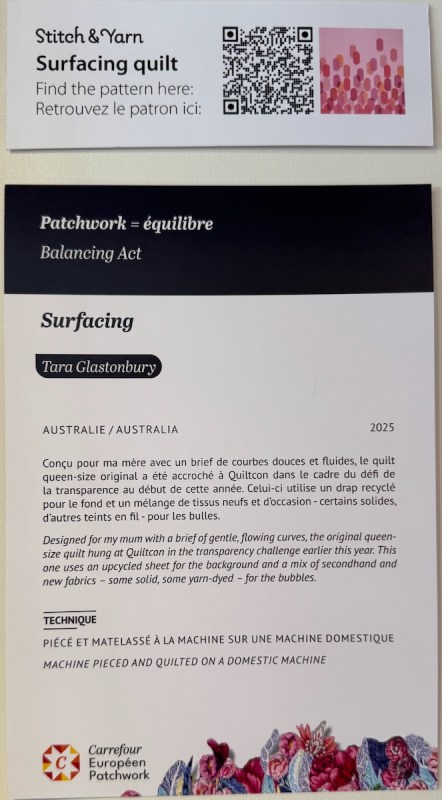
Last one from Tara:


We jumped in the car and drove to Venue 12, passing another house with a carved wood exterior. We’re skipping Venue 11 for now, as it’s not on the way. After finding a parking place around the corner, we arrived.

Venue 9 is a tiny little church where we saw the European Bobbin Spool Invitational Quilts last year. What will it be this year? Again (you’ve heard me say it before), I am always just blown away by the diversity of quilts and quilters at this quilt show — it really pulls me out of the US manufacturers/quilters/design loop and makes me think and appreciate the diversity we have. I hope these posts help you see your quilting and creativity with new eyes, or maybe spark a new idea.

Photo of stained-glass taken by my husband. As always, we both took lots of photos, so many of the images in these Carrefour posts are his.

This time, we will meet our great-grandmothers of quilting.
Not in the flesh, but in the work they left behind, courtesy of quilt collector Janet O’Dell, from Australia. She (as the catalogue says) “is a keen collector of antique quilts. Her collection of hexagon and medallion quilts has been built up over the past 25 years from a variety of sources. All have been chosen because they appeal to her personal taste.”
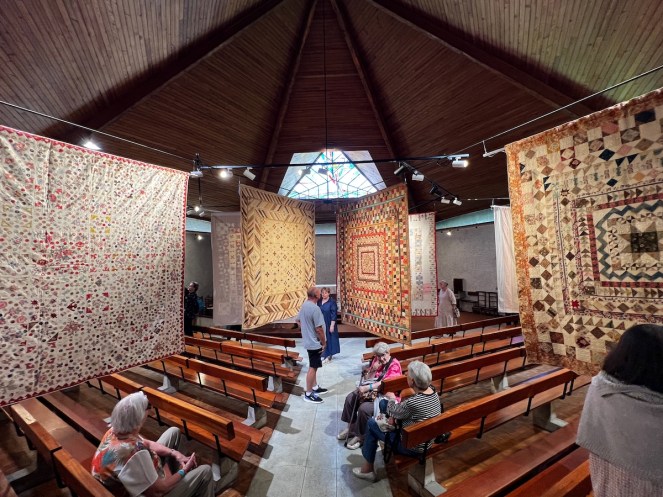
And the one quilt that I will flood here with photos and which I loved-loved-loved, I did not get a photo of the title card. Interestingly enough, it was inspiration for another quilt in Venue 12, from Fiona Lindsay (a future post). Okay, back to Janet O’Dell’s quilts.
Here’s the one I loved and I’ll intersperse my comments with the photos. Just keep remembering. These are OLD.


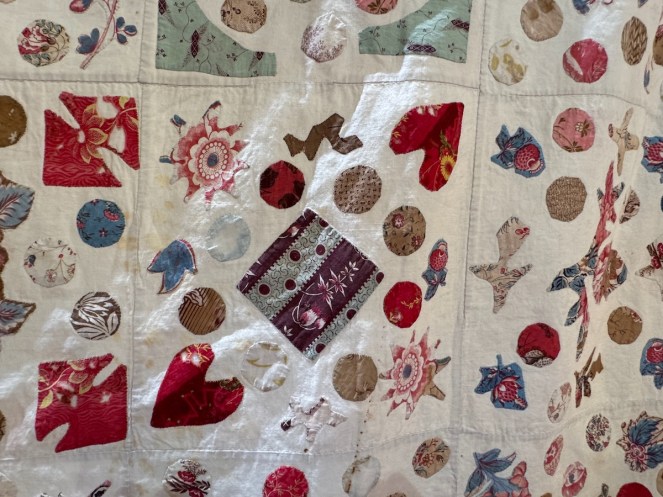
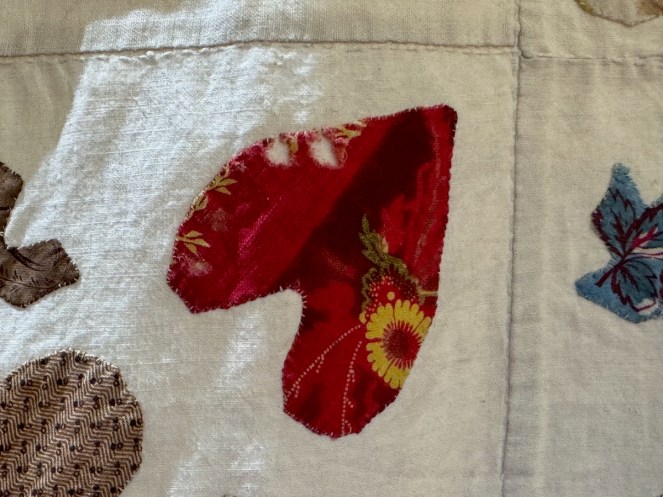
So, the Big Picture, to closer-up, and then to these hearts with their worn spots.
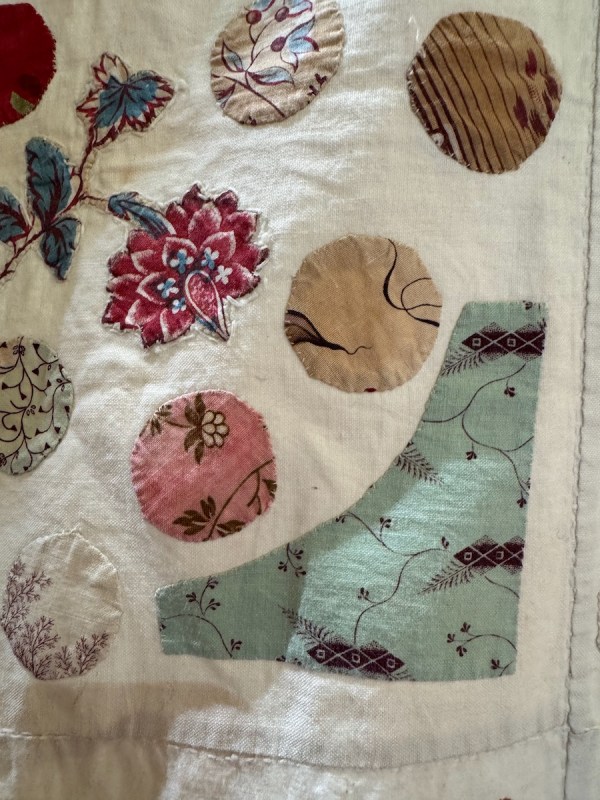


This block, with its free-form cut “corners” of minty blue-green, the broderie perse flower in the center, and those random circles was another favorite. It was interesting being in that space, with these very old quilts. People were quietly moving around them, and then taking a minute to sit and gaze. In so many other venues, we are dashing to take it all in, but here, sitting with the quilts was the point.

Okay, maybe I was just tired.

Or maybe I was fascinated with their technique on their appliqué stitch, each bit of thread taking a bite over the top of the shape, so different than how I do it now: trying to come out on the fold so you don’t see my bits of thread.
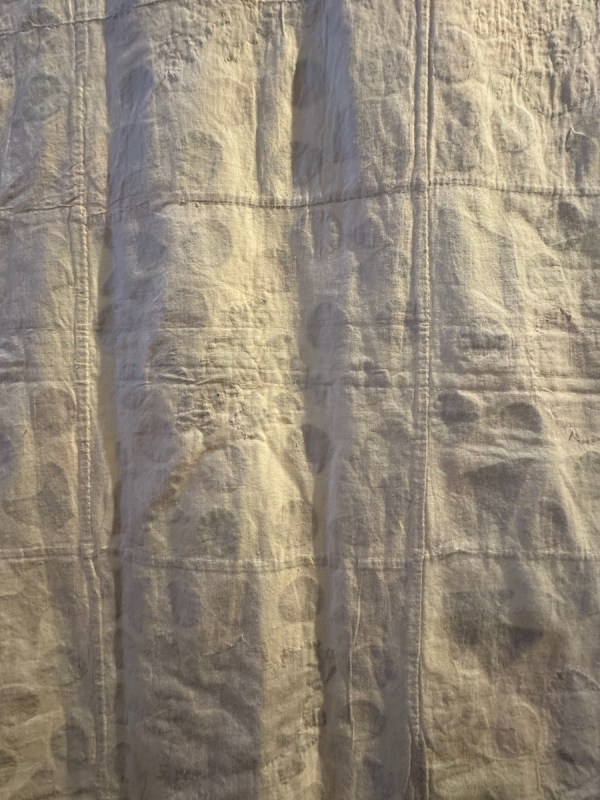
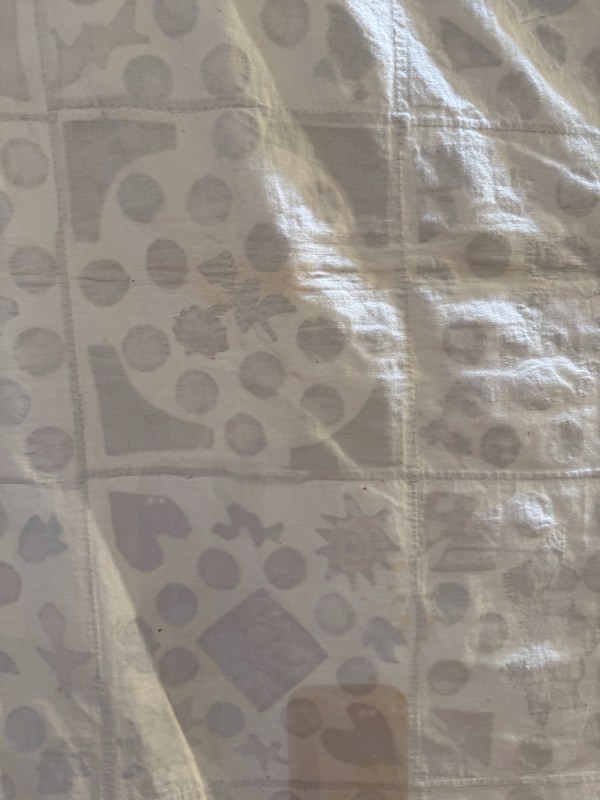
And the back — it didn’t appear to have any batting at all in the quilt, so they must have just done the stitching over two layers of fabric, then did a “quilt-as-you-go” to get those flat-fold seams on the back? I’m not usually that over-the-moon about antique quilts, but for some reason I really liked these.
I read a piece this past week about how difficult it is for us to go back in time and really know how people 100 years ago thought or felt or processed image or feelings — or, since most of these quilts were from around 1830, nearly 200 years ago. And we are so “feeling-centric” these days that we even use the term in all our phrases, such as I felt you might like this — or–I felt badly for you, and so on. Did fatigue register the same way for them, or were they always tired (thinking of their housework)? Did that feeling we all have of a lovely quilt finish, register on this quilter the same way? I’d like to think that this woman, as she put the last stitch on that now-worn red zig-zag binding and unfurled it onto the bed, had a sense of satisfaction over the many years it took to stitch.
(If any reader sees this post, and has any information about this quilt, please leave me a comment. Thanks.)

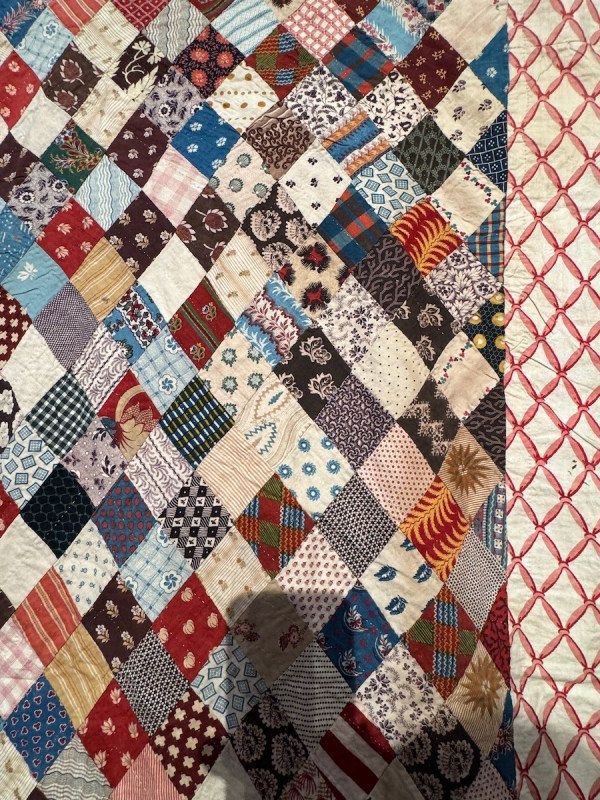

Love that border print! Click to enlarge the title, which is Wood Hey, from the country of Wales. It was made in 1833 and displayed at the National Eistedfodd of Wales in 1933. It’s hand-pieced, with appliqué and is unquilted.
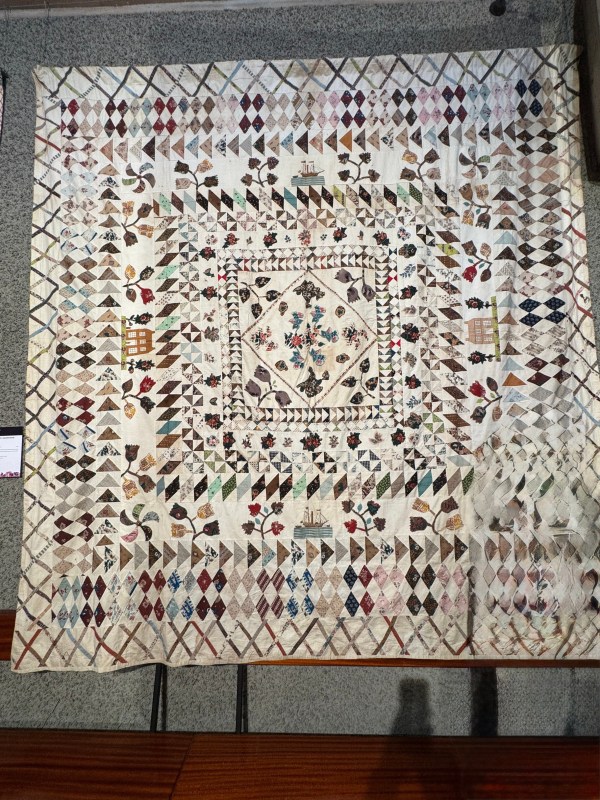
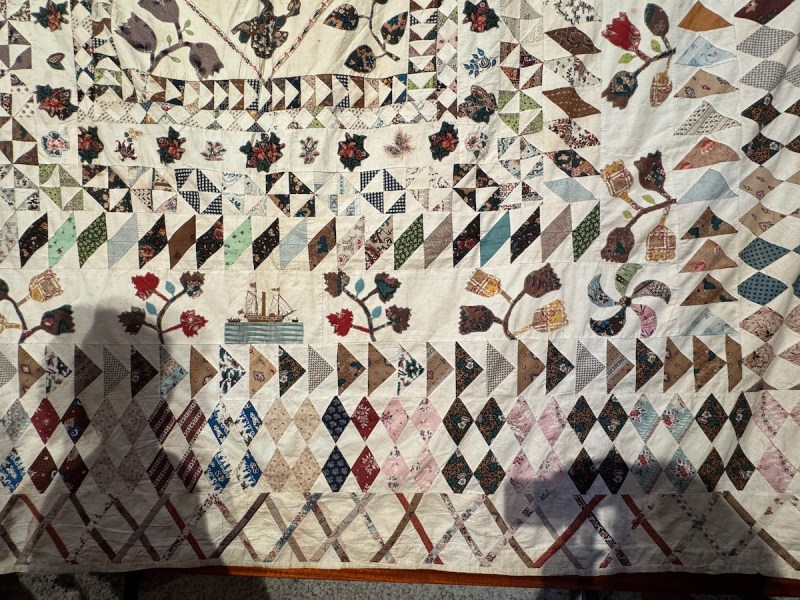

In case you can’t read the title: Sailing Ship & Manor House, from Pays de Galles in Wales, c. 1833. Check out the sailing ship, below.


This quilt was another stunning example of applique, and I love the title: Animal, Vegetable, & Mineral. It’s appliqué and unquilted and was made c. 1842 in England.
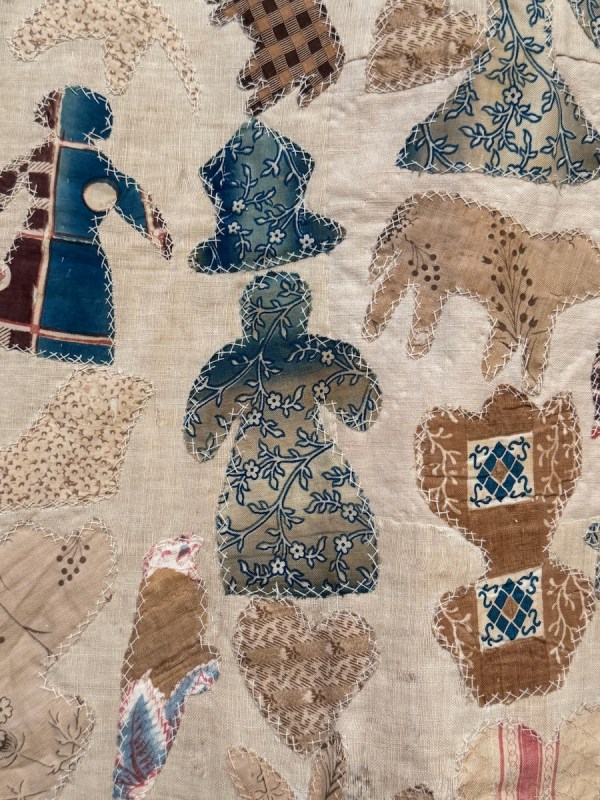
Check out this type of appliqué! Criss-cross, a type of tailor’s stitch; I learned this in my clothing and textile classes when I was a freshman, and have rarely used it since. There is a smaller bite of fabric on one side, and then the needle travels before taking the next stitch, and you are stitching backwards, from left to right. I don’t know what the “official” name is, I just know we used it to tack down our wool jacket facings.
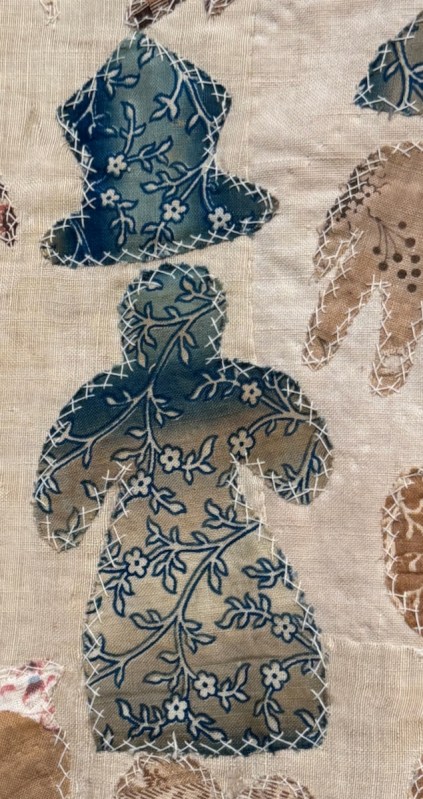
It appears they went over a raw edge. I’ve seen variations of this animal-vegetable-mineral quilt pop up every once in a while. Lovely to see it here. Note the pieced backing, even though it “reads” as a whole piece of fabric. Would we add “digital” to the categories? And how would we depict that…with images of our hardware?
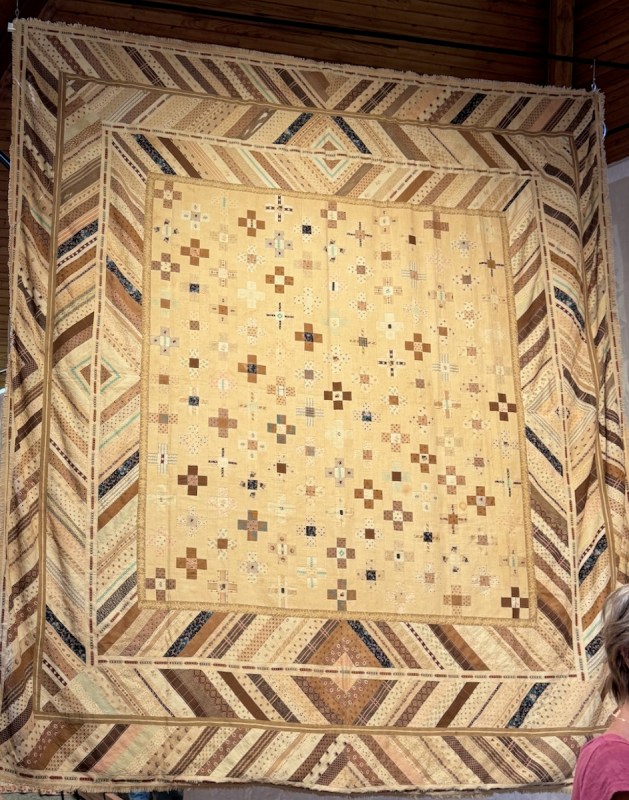


So, a form of offset nine-patches? With a spacer?

Normal quilt show pose.


That is a lot of quilting!
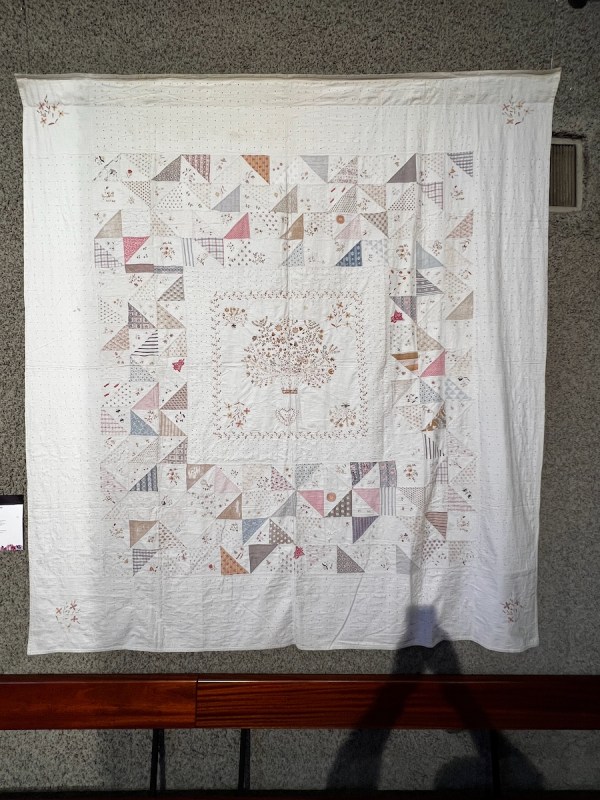
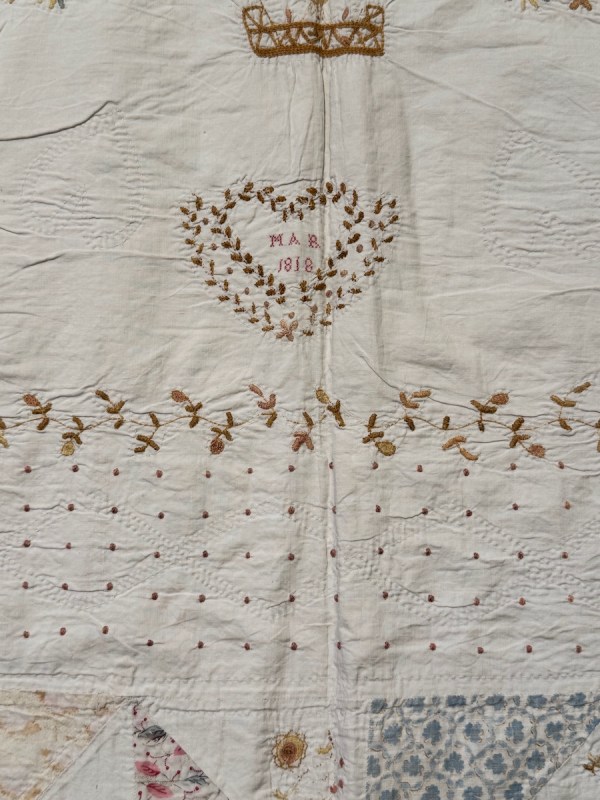
Who was M.A.R? and what was the world like in 1818? (You do realize this quilt is over 200 years old, right?) Some notable events (just to get you in her head, and which maybe she never knew about?) are listed below.


Historical Events when this quilt was made:
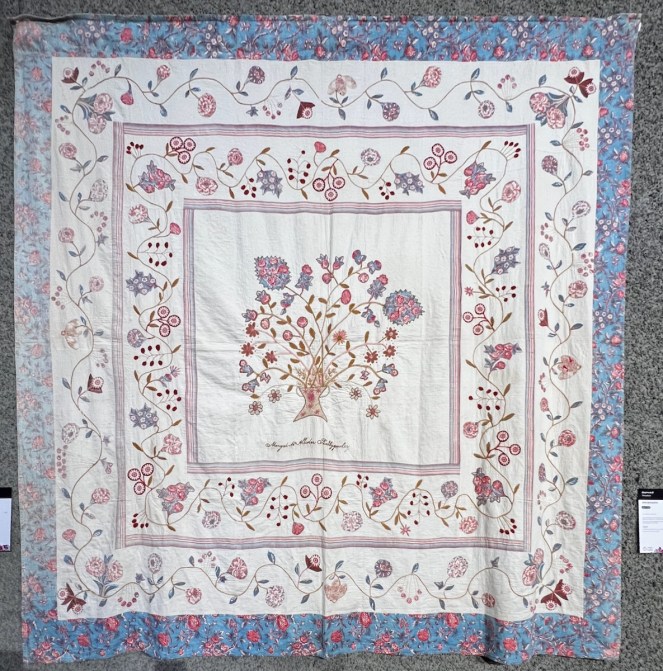

I love the name of this. Apparently BallyGawley is a town in Ireland, north of Dublin, so perhaps the quilt came from there?
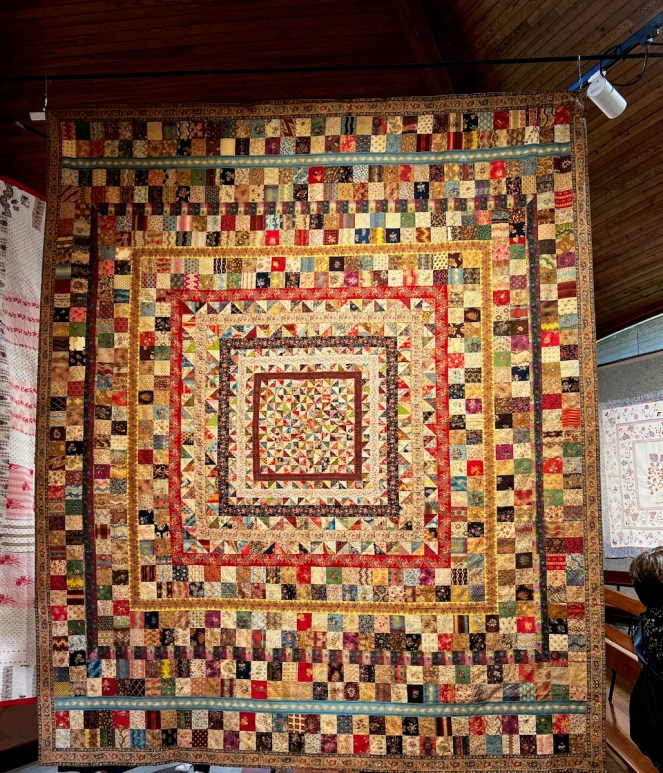
Last one for this post.

This is Broken Dishes Square, and from the United States, c. 1830. It is hand-pieced and unquilted, in the medallion style. These fabrics are so interesting, so busy and I love the bands of color in between each section of the triangles. Some woman spent hours and hours piecing this quilt.
I’m really grateful that the organizers of Carrefour Patchwork Show arranged with Janet O’Dell to have these brought to the show. As always, this show has something interesting around every corner!
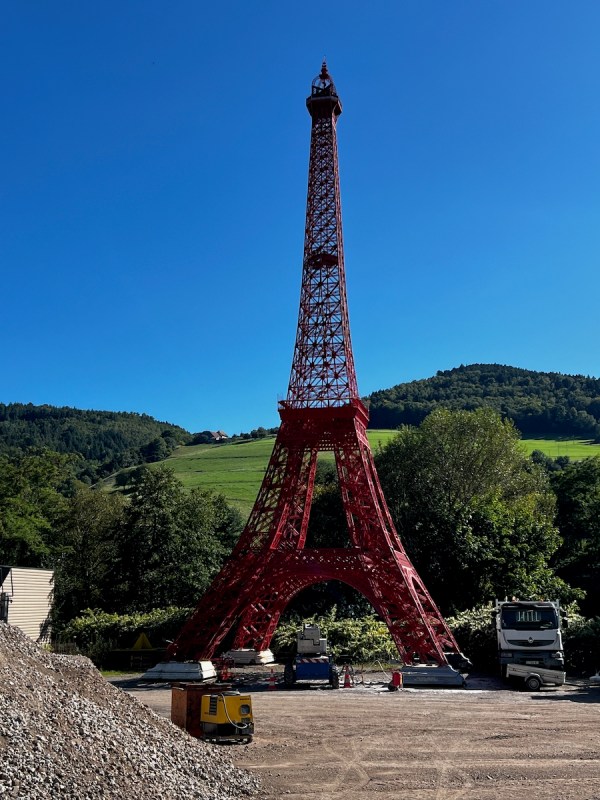
Like this replica of the Eiffel Tower, stuck in some sort of a construction yard. We saw it last year in two pieces, so we’re happy it was put together this year.
More Carrefour Patchwork Show posts to come!

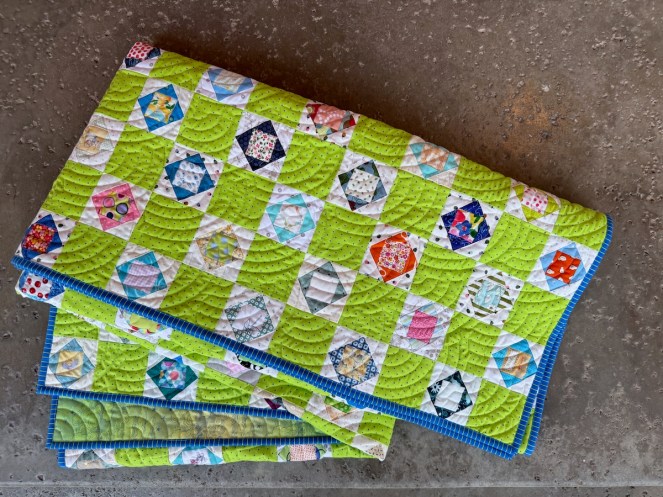
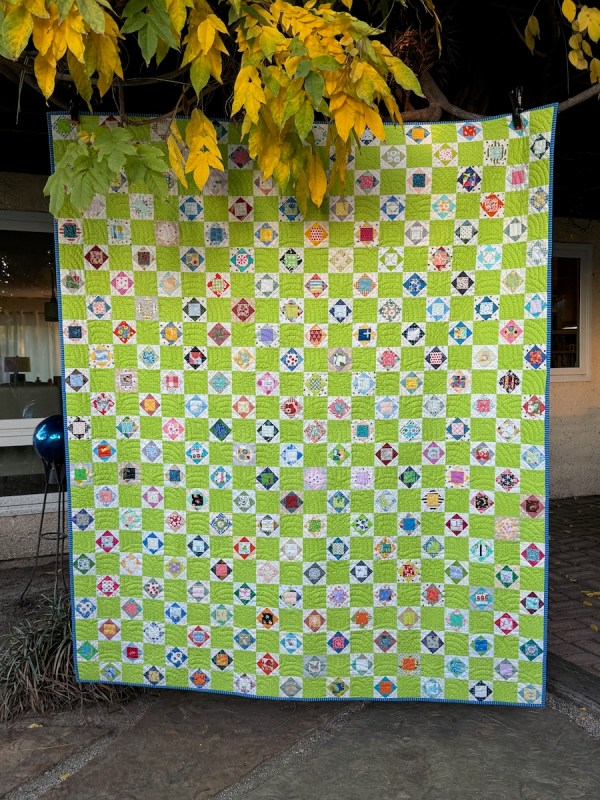
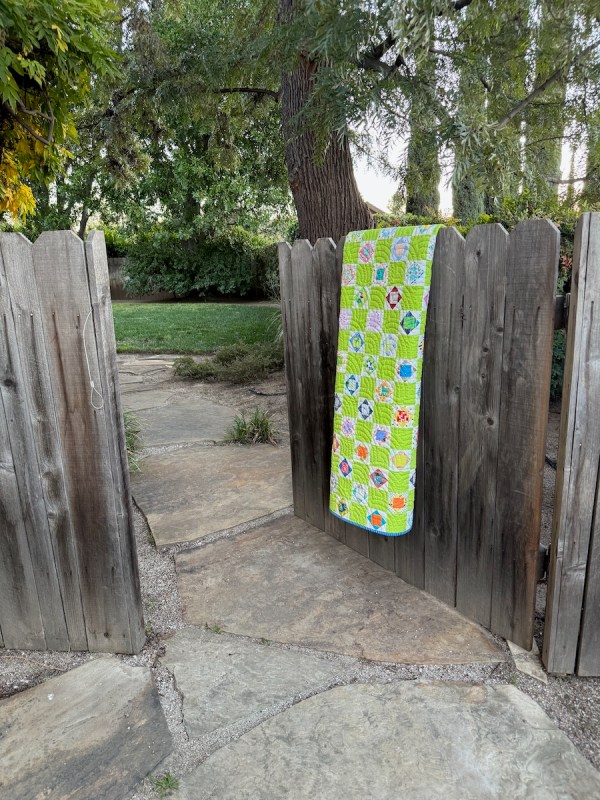
The etymology of the Economy Block is — as are many popular quilt blocks — complicated. According to Barbara Brackman’s Encyclopedia of Pieced Quilt Patterns, it’s titled Economy Patch by Carrie Hall and Rose Kretsinger around 1935. It’s also called the This and That block, in the Kansas City Star around 1944 (you know this is a favorite phrase). And more recently, it’s been known as the Thrift Block as when Taryn of ReproQuiltLover hosted the recent #scrappymeetsthriftchallenge. I have mentioned before that this year I had been making things that helped me make things: quilt-a-longs, Block of the Month, group projects, and so forth. And so this one joined the line-up, and I finished it this week.
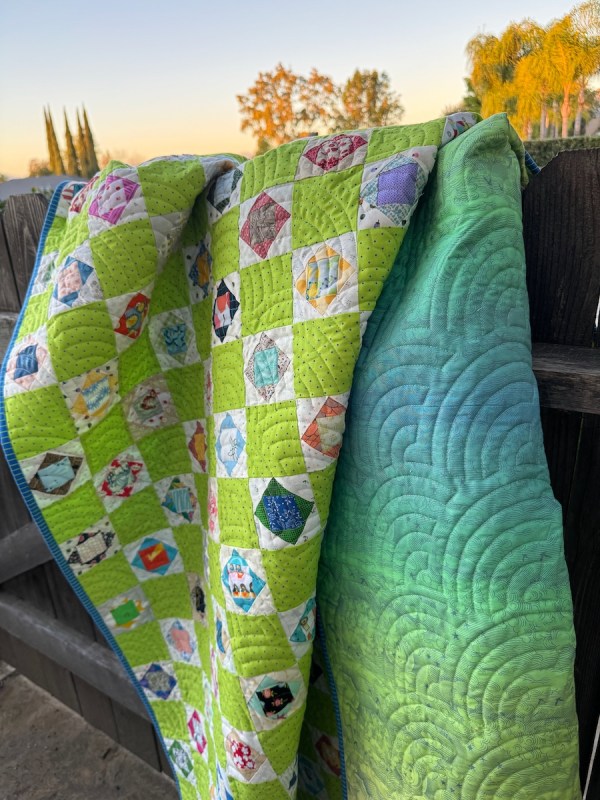
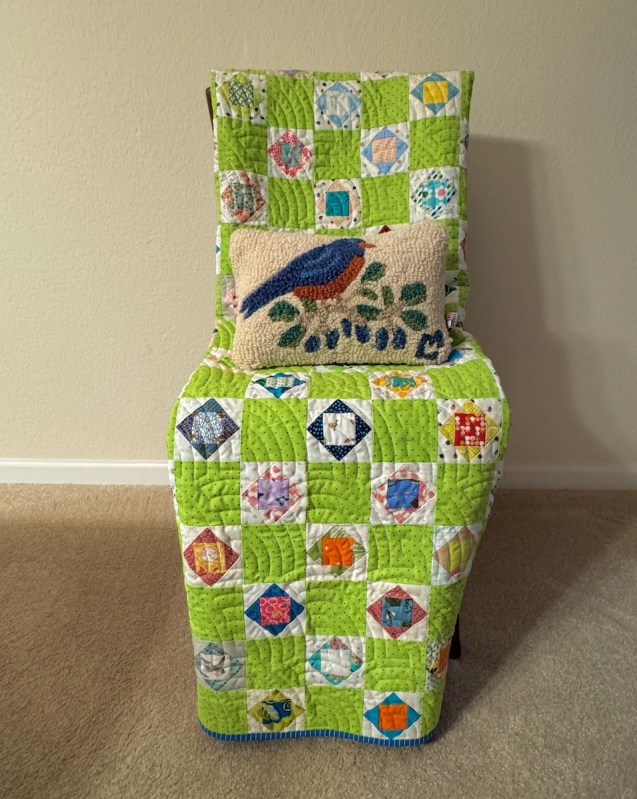
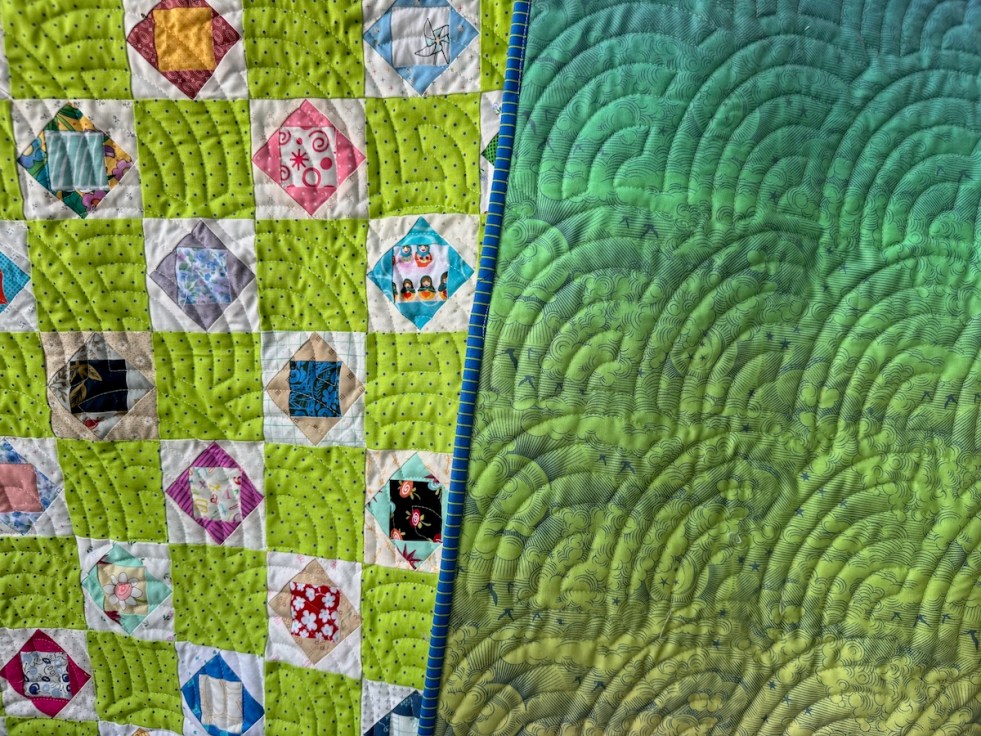
I needed a title for this quilt, and since in early 2020 I had taught it to a small beginning quilt group as the Economy Block, so I went with that name (although many now call it Square in a Square).
Full quilt title: Economy: Gathering Up All The Fragments.
Economy, as we think about it, means thrift. Saving. Making do with less. The exchange of goods. A dollar is worth something and everything is for sale (as the old saying goes). But the idea of economy, says one wag, is really an enigmata**:
The title of this quilt comes from yet another riddle: the poet Emily Dickinson’s punctuation and shape of her small poems. Some think it began with this:
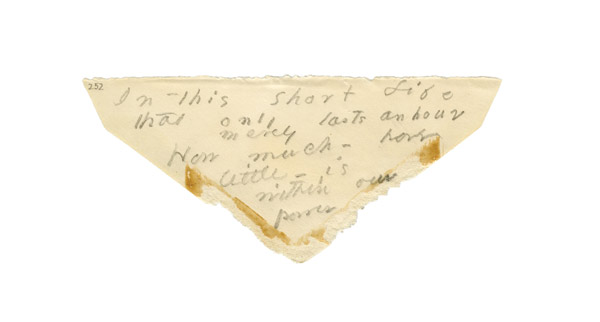
“‘Preserve the backs of old letters to write upon,’” wrote Lydia Maria Child in The Frugal Housewife, a book Dickinson’s father obtained for her mother when Emily was born. It opens: “‘The true economy of housekeeping is simply the art of gathering up all the fragments, so that nothing be lost. I mean fragments of time as well as materials.’” (from a review by Jen Bervin, titled Studies in Scale).
On one of her envelopes, Dickinson wrote: “Excuse | Emily and | her Atoms | The North | Star is | of small | fabric | but it | implies | much | presides | yet” (fragment A 636 /636a).
Like a star is small…but it is its own world.
Or an atom is small… but contains worlds.
Or fragments of fabrics are small…but put them together and they make a quilt.
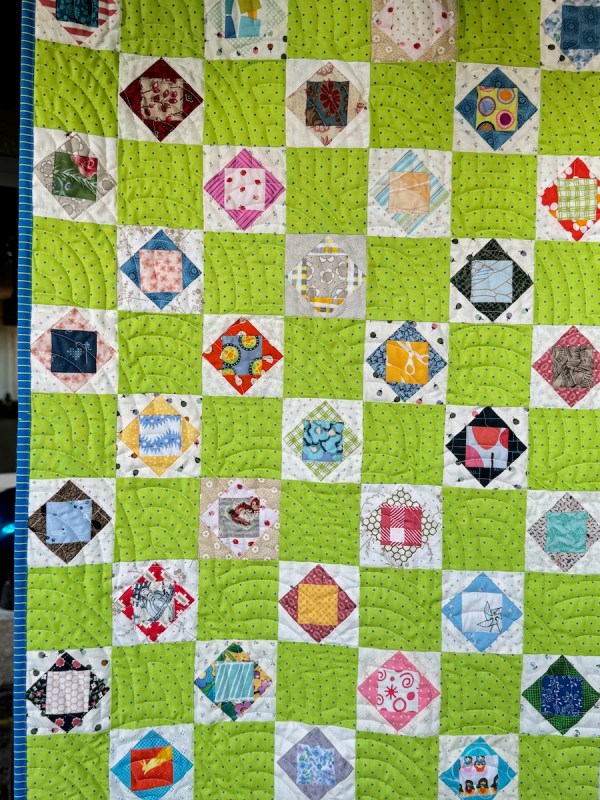
In pulling fragments for this quilt, I opened bag after bag of small scraps from a decade ago, cut into 2 1/2″ squares or 3″ squares, as it had been recommended to me to do that in order to “use up your scraps.” Finally, I was using them up, so this quilt is as much a record of an era, as it is a complication of “gathering up all the fragments.”
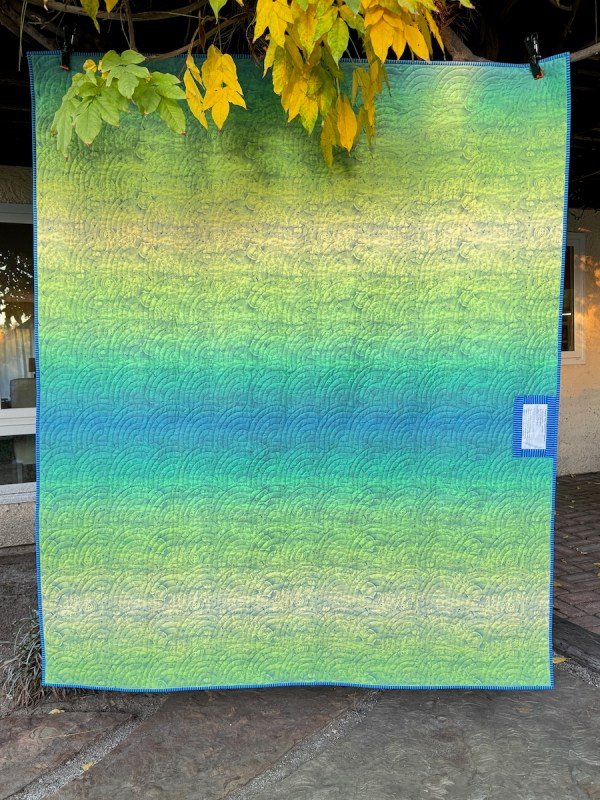
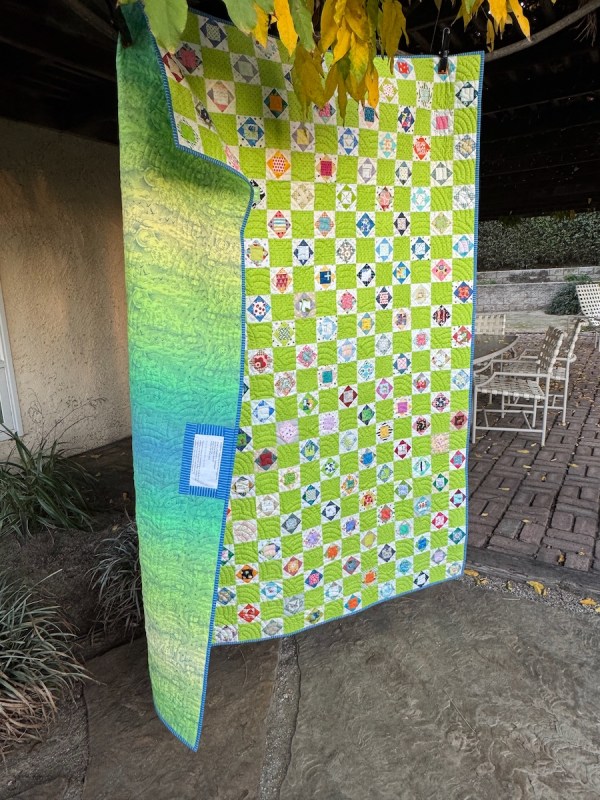
Backing/binding is fabric from Tula Pink, and the quilting is the Continuous Baptist Fan, by Urban Elementz.
Quilt-making is an enigmata, isn’t it? We take our scraps, our fragments, cut them smaller, sew them back together to make something that expresses an idea or a sentiment. And we quilters do it over and over, saving scraps, repeating the process “so that nothing be lost.”
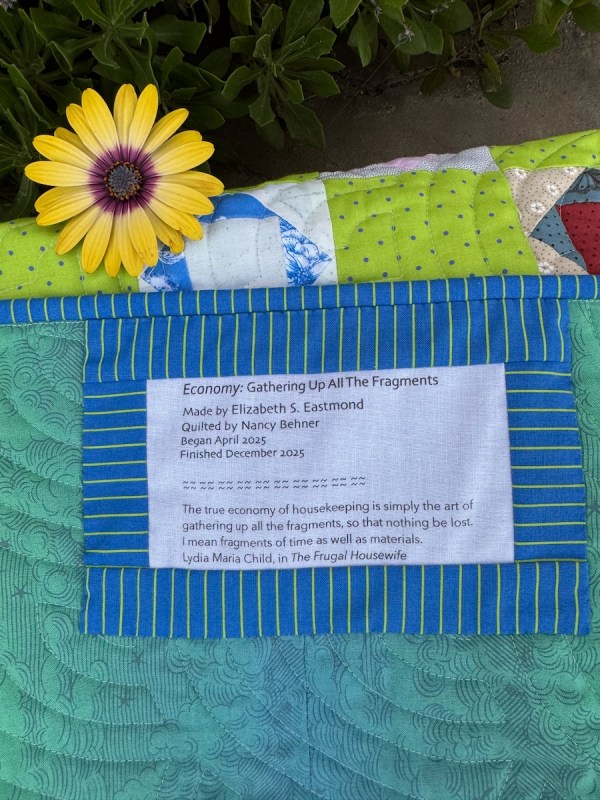
This is Quilt #312, and the last for 2025, as there are no more fragments of time to add to the calendar. I will, however, try to get up another post or two of the beautiful Carrefour quilts, but no promises.
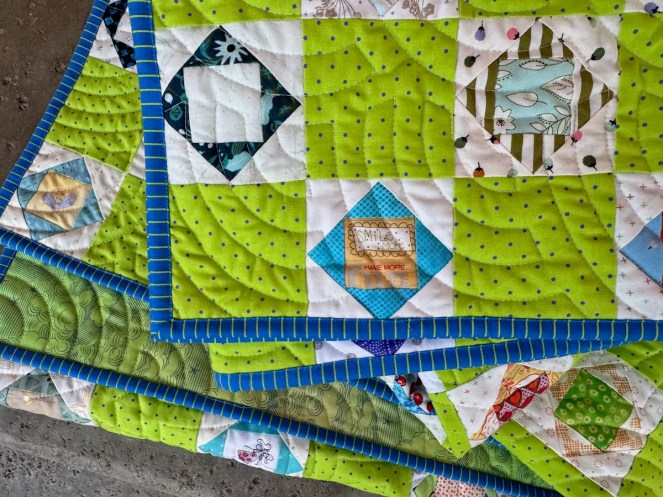
I do promise, however, to make merry the rest of the month and be of good cheer!

The Economy Block was in the series First Monday Sew-days, which has morphed to the title Beginning Quilters. There are a raft of free handouts here.
A Life Full of Yes (which includes the free pattern for this quilt block)
This and That • August 2025 (and a rant about AI)
NOTE: I put the quilt label on the side, as it doesn’t matter which is the top or which is the bottom. It’s really a great size for naps: 60″ x 72.” I use BlockBase+, which is basically Brackman’s book, but in digital form. I also have her book in paper form, too. I’ve been thinking a lot about my quilt tools, such as the software and book, so will try to note them here on the blog as they’ve been used.
**Apologies to Honkai: Star Rail fans, who see Enigmata as something a bit different. And there is more on Enigmata writings by ancient figures, if you are curious.
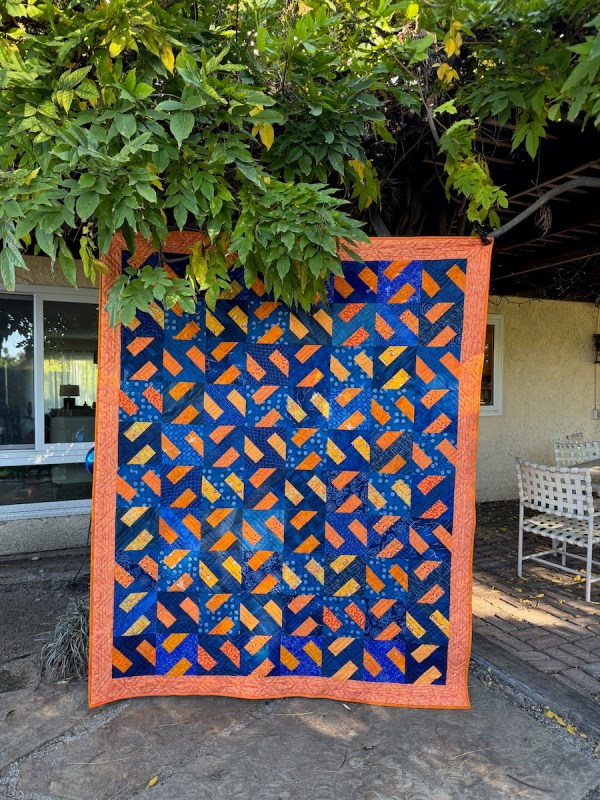
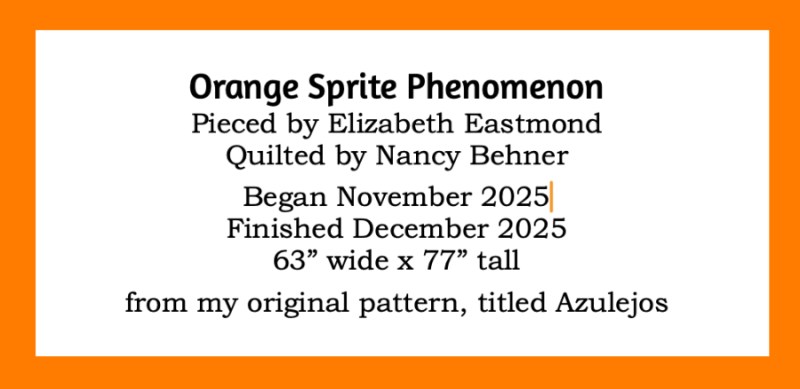
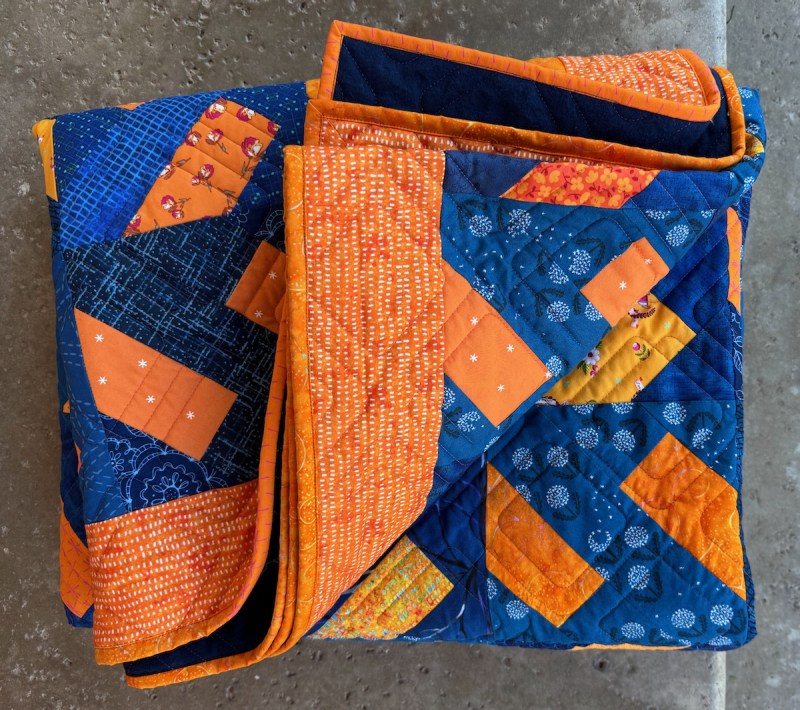
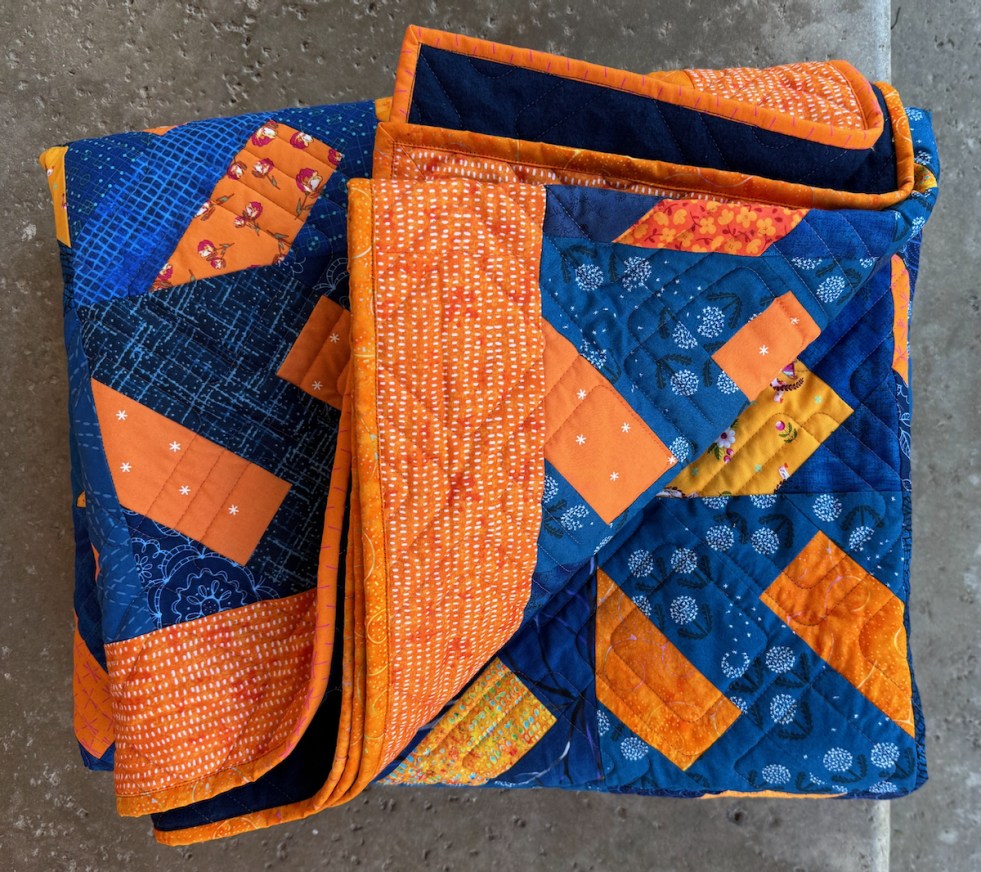
The Blue and Cheddar quilt is finished, bound, and sent off to the recipient. If it were to have a name and a label, I would call it this:
This is Quilt #311 in my Quilt Index.
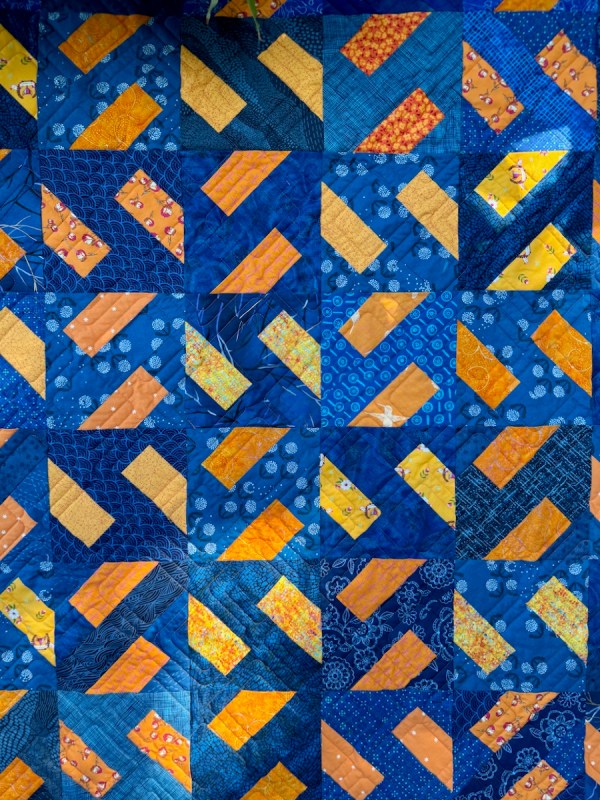
I titled it this because of a celestial event. A rare celestial event.

This is called a red sprite phenomenon, when when lightning flashes above thunderstorms, creating a spikey flash of red light high in the sky. By using cheddar and deep blue, the quilt pays tribute to this transient luminous event: an orange sprite phenomenon. (photo) You can read more about it in this gifted article from the New York Times.
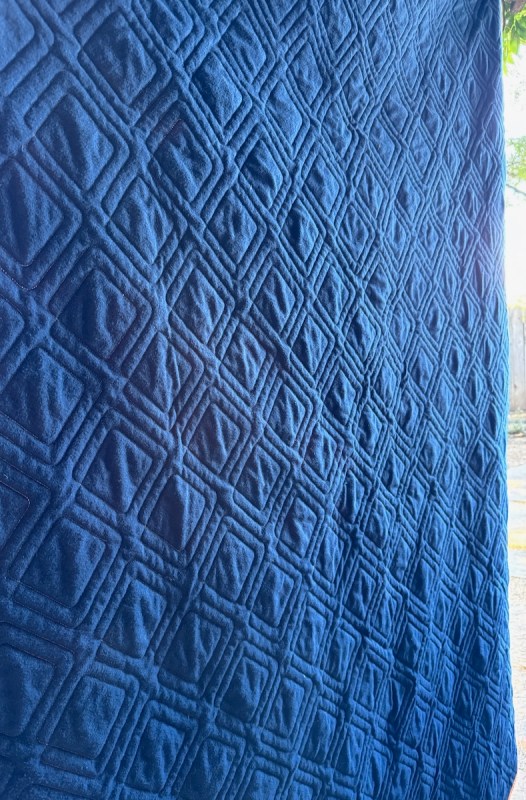
Hawthorne Supply Company was having a sale on Kaufman’s navy blue flannel. I ordered two packs for the back, washed them up. They are so thick and yummy, they are almost like chamois. My quilter, Nancy, did an awesome job on the quilting, with the pattern Diagonal Plaid Bias Cut from Urban Elementz. We used a copper MicroQuilter thread (Superior Threads) on the front and a coordinating thread on the back.
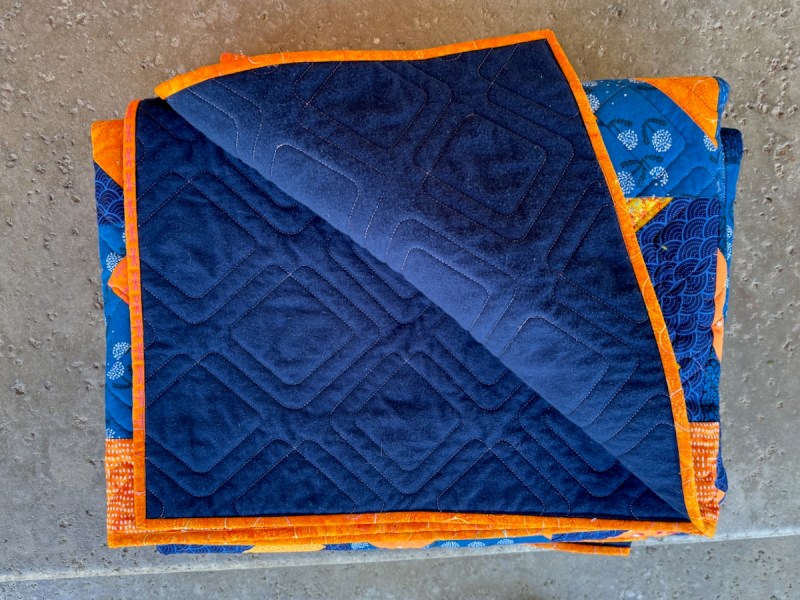
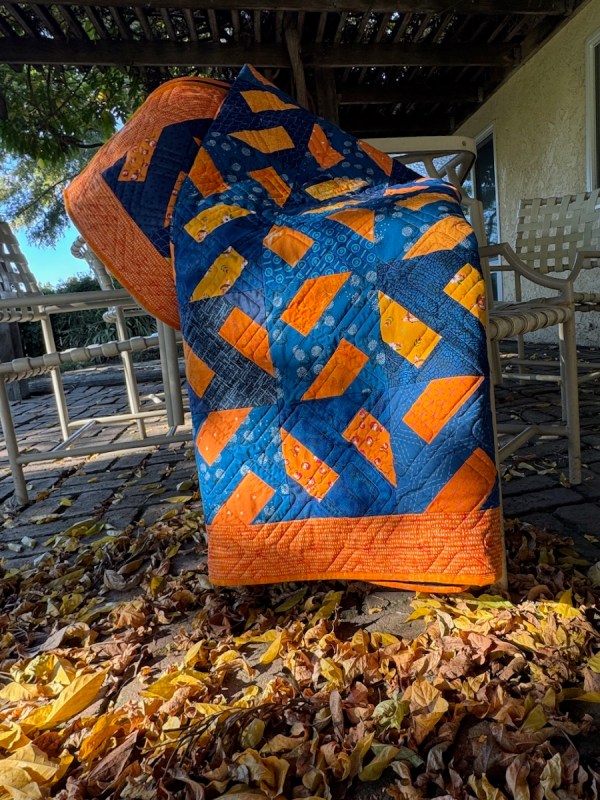
Our wisteria was dropping leaves this week, so here’s the requisite “fall” shot from Southern California. The blue fabrics are just ones I had in the stash, a full spectrum of rich, deep colors. Every so often, I feel like a label would interrupt the quilt back, and not that important (no lectures, please), so I leave it off. This happens like (wait for it) once in a blue moon.
I have long been fascinated by celestial events.
We’ve attended an annular eclipse, a solar eclipse, and a recent total solar eclipse.
When I was first married to my husband, we took our children up and stayed at his parents’ house for a week; one night was a star shower. I spread out a quilt on the grass in the backyard and watched the shooting stars. Since we were pretty much newlyweds (he married me and my four children, saving us all), I wonder what his parents and family thought. But he came and joined me on the grass, on the quilt, and we star-gazed together.
I was fascinated by what Jonny Thomson said this week on his Instagram account about the Korean idea of in-yun. It is not the first time I’ve run across this philosophy, and he described it well:
Imagine you pass somebody in the park and say, you nod, you smile, and you go back to your life. Then, a few days later, you notice the same person behind you in the supermarket. According to the Korean idea of in-yun, something important is happening here. In-yun means fate, but it really means the fate between people and relationships….[E]ssentially, it says that if you see a stranger more than once, it is not just a coincidence. That is the universe trying to tell you something. It is trying to say that here is someone important, they have something to teach you.
The French philosopher Gabriel Marcel argued that we should live our lives in a state of disponibilité, which means that we are ready to be at the disposal of the world.** If you stop seeing events as irrelevant accidents, but as messages, then you start to see the world as an opportunity. If you live your life ready to be helped, and ready to be changed, you will be. In-yun is the philosophical version of the crossing paths theory. It says that if somebody comes into your life, it is for a reason. If something keeps happening to you again, and again, and again, the universe is telling you that there is something to learn.
I’ve had more than a few things that have taught me to stay curious, to live in a state of disponibilité (or availability, as I understand it). Quilting, and the constant rate of discovery that happens in any quilt — from choice of fabrics, to colors, to inspiration — seems to match that idea for me, and I enjoy diving into a new project, and I enjoy finishing up. I also enjoy the quilters I meet, the quilters who teach me, my correspondence with all of you who read my blog, learning from every writer.
And so when my desire to rework my Azulejos pattern kept coming back around, and then I read about red sprites…well, that connection propelled me to this place. I hope the person who receives this gift will enjoy it as much as I enjoyed making it. I had fond thoughts of him (my son-in-law) as I worked on it.
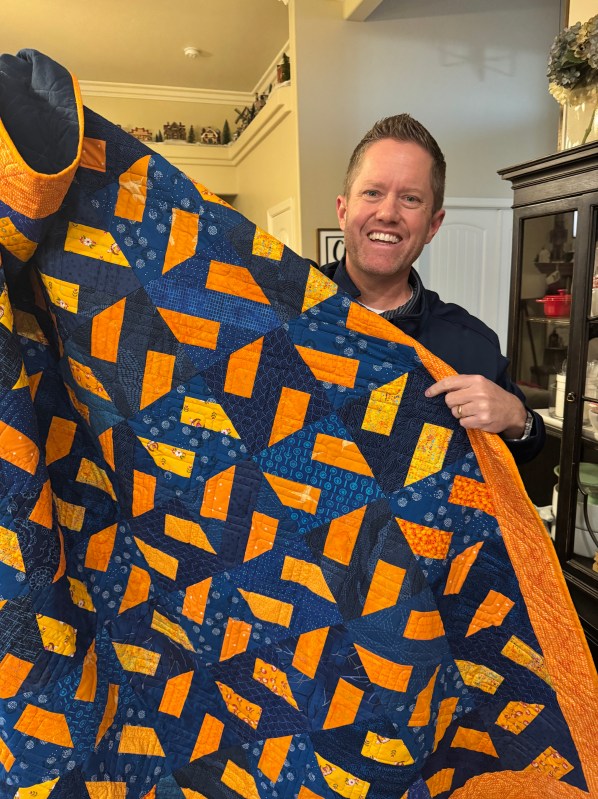
UPDATE: He likes it!!
Stay curious, everyone–

**Availability of mind, thought; state of availability, according to this French dictionary page, which I asked Google to translate into English.
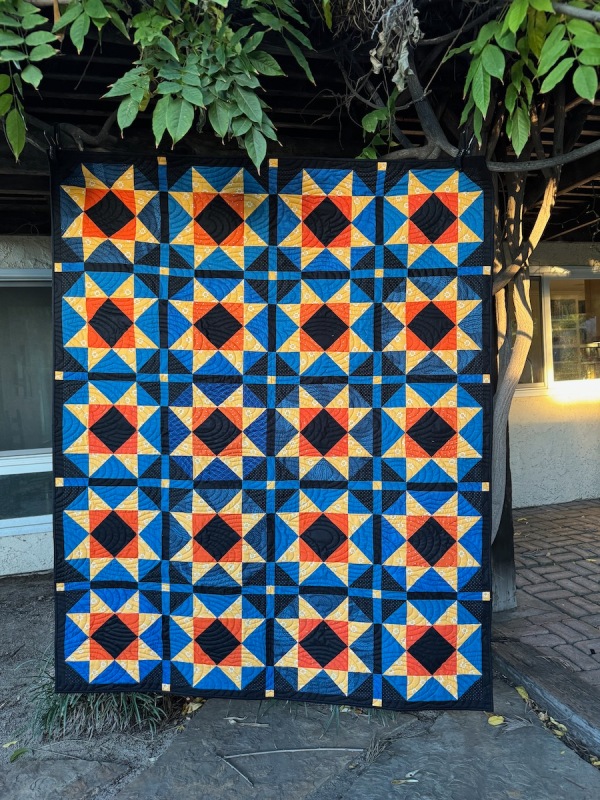
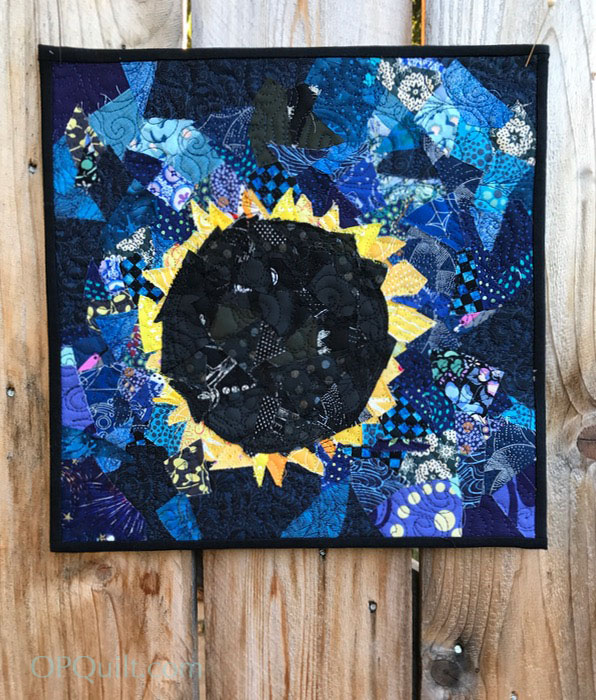
Yes, I once did make, not one eclipse quilt, but two!
And an artsy eclipse quilt:

 OccasionalPiece--Quilt!