Quilts

Laying out the Week/Transit of Venus

One of the advantages of summer is a sense that there is All Possibility.  Because the children are sprung from their desks for their summer break, there’s an exhalation of free-dom! We look forward to the Fourth of July, travel plans, a summer to-do list, laying around, getting bored, as well as getting those things done that had put off until there was more time.  Of course, there never is more time–it’s just our perception.

One challenge of this unstructured time–much like when the husband shows up at the breakfast table on his first day of retirement and you think, now what?–is figuring out how to lay out the week.  I remember reading an article about presidents, and one thing that a new president asked a former president was that very question–how to arrange a daily/weekly schedule of events?

Mondays always seem to have a bit more of that quality–that What Do I Do Today sort of feeling, although on Fridays we start laying on the tasks for the next Monday, thinking–I’ll do it later. Friday, I had cut 500 squares for my daughter’s church charity project (making folded flowers for headbands for pediatric chemo patients) and my arm was sore.  After taking the packet to the post office, I knocked off and did other things.  So here I am, cleaning up those loose ends.
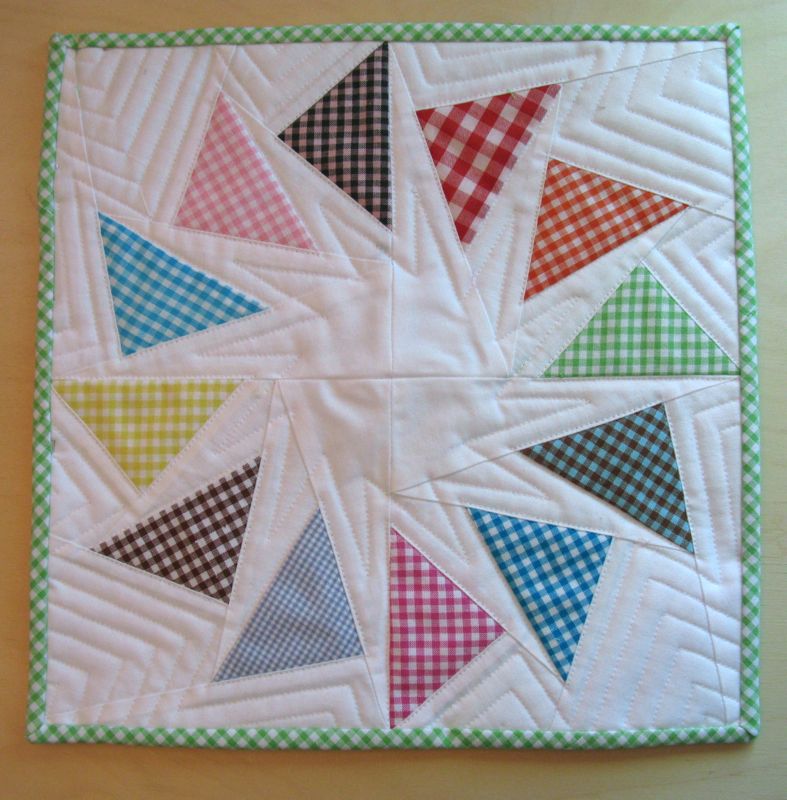
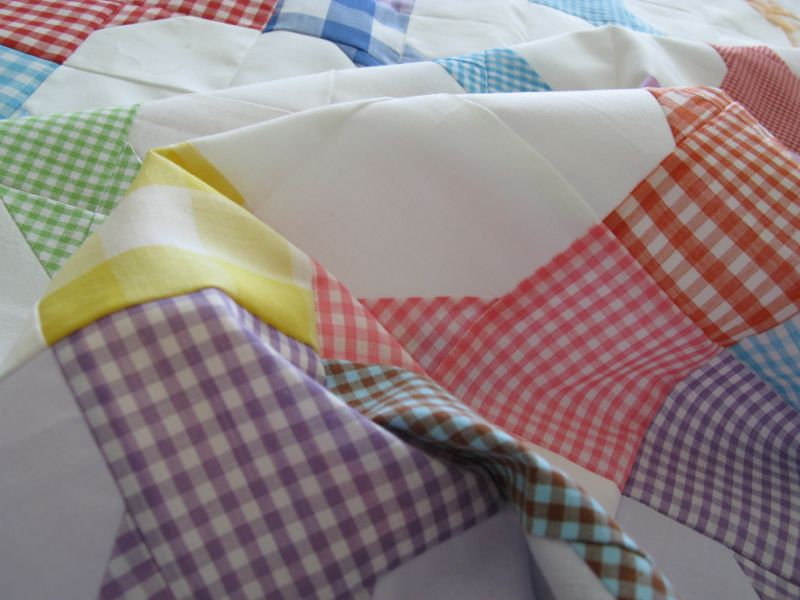
Like getting the binding on my mini Gingham Quilt.  Giveaway in two days!  Check back here on Wednesday.
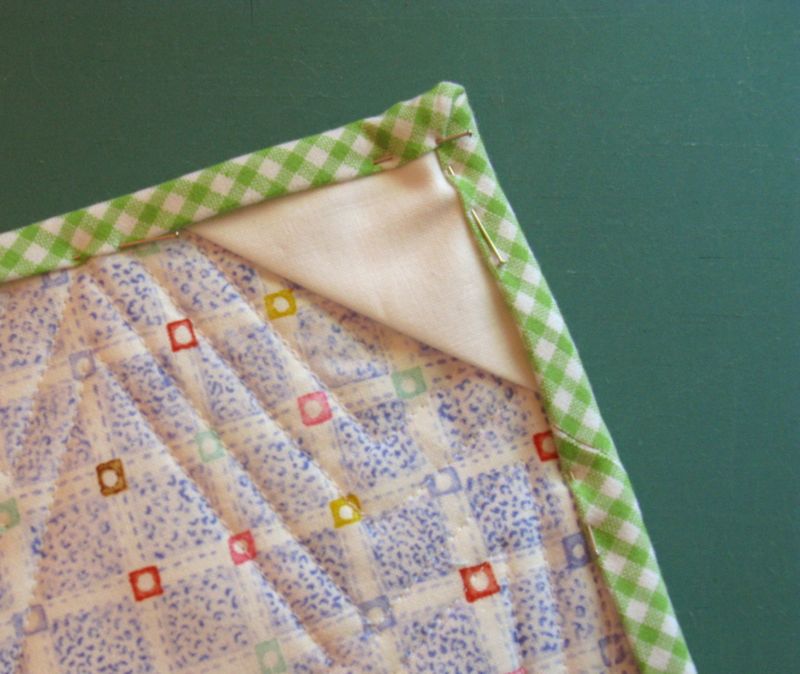
I used that folded-triangle method for hanging it up; I’ll cut a dowel to the length and suspend it over a push pin on my wall.
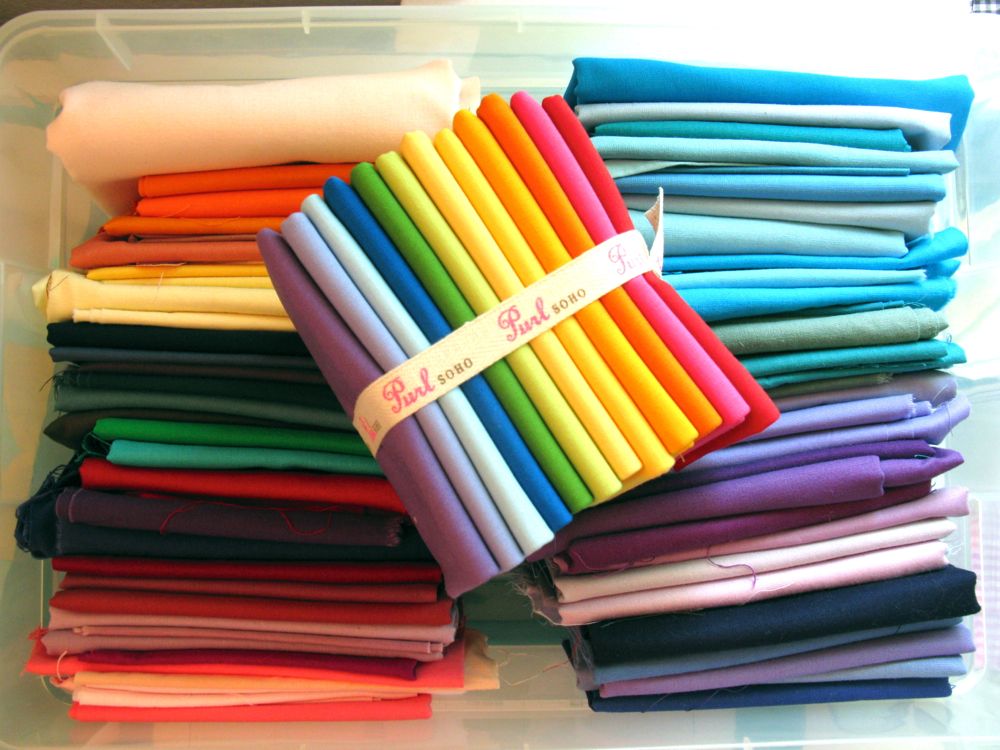
Still cleaning out the corners, I refolded all my solids.  That pack from Purl Soho is too pretty to undo, just now, so I placed it up on a shelf to enjoy.  Most of these solids are from when we quilters did solids the first time around–in the 1980s.  Roberta Horton had launched it with her Amish quilt books, and we were all mad for Amish quilts where I lived in Texas.  I taught a class on making Amish mini-quilts in the local quilt shop, and you’ll notice that there are very few yellows and oranges in that bin of solids, for the Amish didn’t use those types of colors.  I started organizing them so I can finish up my Summer Treat quilt.

Which led me to an expression of Pained Horror! on my face when I realized that the first cutting diagram I’d put up had two numbers inverted. Gee Whiz, how embarrassing.  This morning I quickly made a new, correct version, which is shown above. . . and is on the post with the tutorial.  Chalk it up to that novel I was listening to last week when I did this; The Shadow of the Wind, with all of its convoluted plot and character lines scrambled my brain. My deepest apologies if you already started cutting.

Sigh. I hate being fallible.

While you’re laying out your week, don’t forget to watch the Transit of Venus tomorrow.  The picture above it NOT of a naval orange (our home town is famous for them), but of the planet Venus moving across the face of the sun.  It’s a Big Deal, astronomically speaking, and the next one will occur after we’re all dead and gone and our grandchildren are enjoying our quilts.  Here in Southern California, it begins at 3:00 p.m-ish and continues until the sun sets.

Don’t look at the sun directly!  There are special glasses available to look through and some astronomy clubs will set up sun-filtered telescopes.  According to one website I checked, ” ‘looking directly at the sun can cause severe eye damage, and explained that a simple projector can be made by poking a hole in a paper plate, and shining the image on a flat surface such as a wall.’  Venus will appear as a small black dot gliding across the disk of the sun.”  Some say that if you cut out a square from that paper plate, tape a square of tin foil over the hole, then pierce it with a toothpick, it will give a much cleaner hole.

Here’s much more info:

More info (from Hub City Stargazers):

Unlike eclipses, Venus transits are truly rare. They come in pairs, separated by more than 100 years. The last one occurred in 2004 and next pair in 2117 and 2125.  Since the German astronomer Johannes Kepler first predicted it in the 17th century, only six have been observed. The upcoming one will be the seventh.

Only two people were said to have seen the transit of 1639. The 1882 transit was a bigger deal — people jammed the sidewalks of New York City and paid 10 cents to peek through a telescope. John Philip Sousa even composed a score called “Transit of Venus March.”  The one in 2004 was viewed by millions — in person and online.

Space.com has put up a Transit of Venus FAQ, including about how to see it online.  They include a world map that shows where it can be seen.
Finishing School Friday · Quilts

Gingham Quilt Top All Done!

I sewed steadily while listening to The Shadow of the Wind, by Carlos Ruiz Zafron, a worldwide bestseller when it was released in 2001, and finished my gingham quilt top.  At an especially gripping part of the novel, I sewed in a border block backwards.

I discovered this AFTER I’d dropped it off at the quilter, so had to run back there this morning and retrieve the quilt top to fix it.  She’ll have it to me in time for our Gingham Reveal Date, which is July 4th.  And no, I’m not going to show you the quilt before that.  Okay, maybe a little.

All I’ve got to say is I’m converted to gingham!

On the sewing part: some of the gingham was that lighter weight fabric that is found in JoAnn’s and some of it was cotton.  I really had no trouble at all sewing them together.  I used Kona white as the accent, and the blend fabrics worked fine with the cotton.  My thread was the polyester Guterman from JoAnn’s, and the only difference is how it smells when you press it–you’ll see.  But don’t hesitate to grab some large check ginghams and mix them with the cottons you can buy.  It all worked just fine.

Krista, of KristaStitched, and I dreamed up this gingham thing because I’d come into a load of ginghams.  I researched where to buy more (see this post) and bought a few more.  The finished quilt is so amazingly fun.  There’s just something about gingham that says summer and high spirits and picnics and lazy days.  I’m so glad we decided to do this, and I hope you’ll all play along!

This coming Wednesday, June 6th, we’re hosting a giveaway on three different blogs (ours, plus Cindy’s blog: Live A Colorful Life), for a chance to win one of these fat quarter bundles, which also includes in each bundle is a full half-yard of Kona white.  If you win the Gingham Giveaway, you agree to make a quilt or a block or a mini-quilt or something and post it on your blog  and link back to our blogs as well. For my blog, I want your entry to include a favorite summertime memory from your childhood, whether it be a childhood game or event or taste or activity, so start those memory engines.

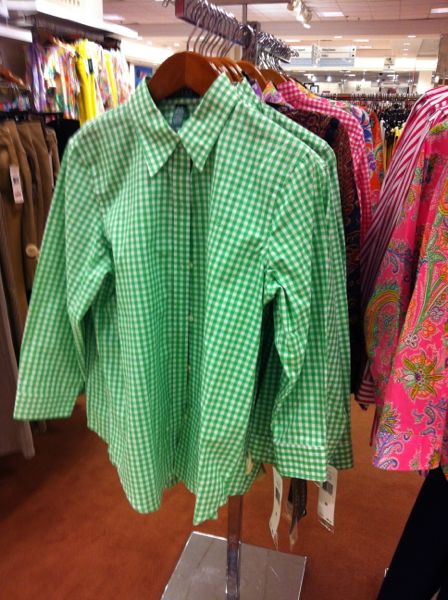
And judging from the following photos, snapped in secret in Macy’s, gingham is going great guns in ready-to-wear also.

and this one from my Dad, who writes:
I’m expressing my pain on being photographed. It’s like shooting yourself.

Ah, Dad.  Now you know why I like to be on THIS side of the camera lens.  But in answer to your question–yes, that’s a gingham shirt too!

Quilts

WIP-Gingham Quilt

I spent the better part of the evening last night researching potential blocks for my gingham quilt–got to get that done so I can move on to other summer projects.  Here’s a slideshow of my Work In Progress: Gingham.  I’m going to make up some samples today to entice you to comment on the Gingham Giveaway Day.  It’s a week away!

WIP–Freshly Pieced

Imagine Lee’s Logo here from Freshly Pieced Fabrics. Because of the vagaries of WordPress slide shows, if I put that image in here it will show up as one of the slides–so, please forgive that it’s not here, yet hop over to her blog to see other great Works in Progress!

This slideshow requires JavaScript.

As you have probably figured out by now, gingham is a strong graphic print that has its Own Thing To Say in a quilt.  So after working with these prints and blocks (digitally, using my QuiltPro program) I think lots of white makes gingham really shine.  I also like minimal seams, for as Roberta Horton noted in her seminal book on working with plaids, Plaids & Stripes, the more seaming done with a check, plaid, or gingham, the busier the design will be.

I think any modern-type design could be used successfully, as many of them are based on simple shapes (think: squares, rectangles) with minimal piecing.  One example of this is Lee’s of Freshly Pieced Modern Meadow quilt here or Mod Times here.  Ashley’s quilts (of Film in the Fridge) trend towards this variety and some examples that would work well are here and here.  And who can’t find a quilt to love over at Red Pepper?  Her latest quilt here would look really beautiful with a pop of gingham in those centers, as would her version of flying geese here.  So I think ginghams, although indicative of an earlier, more nostalgic time, could adapt to the modern life easily.

Hope I’ve given you some ideas for a quilt block or two, or even a quilt.  And check back next week for the Gingham Giveaway: three different sets of fat quarters (that also include a full half-yard of Kona white)!

Quick Quilt

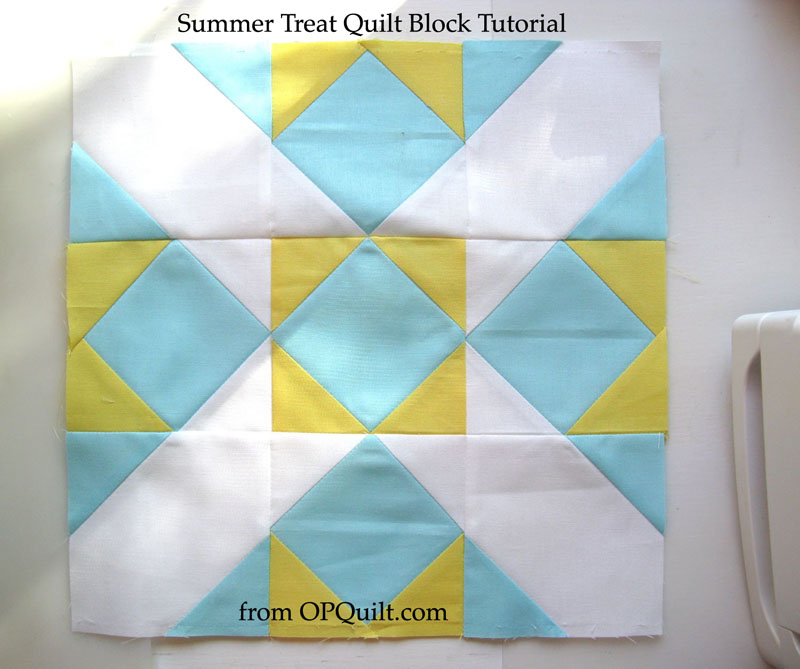
Summer Treat Block Tutorial

This is an OPQuilt Quick Quilt, as the block (even with unpicking my mistake) took me about 1 hour. But I sew quickly.  Your actual time may vary.  (Aren’t I supposed to say this kind of stuff?)

Each block has three colors: main color (color A), white (color B) and accent color (color C).
Cut 4-1/2″ squares–5 of color A (shown here as aqua)
Cut 4-1/2″ squares–4 of color B (shown here as white)
Cut 2-1/2″ squares–8 of color A (shown here as aqua)
Cut 2-1/2″ squares–12 of color B (shown here as white)
Cut 2-1/2″ squares–12 of color C (shown here as yellow)

Now ready, set, sew by propping up your sewing machine on door stoppers as the angle of your machine makes you less tired.  I learned this at a quilt show, which is why it’s always a good idea to take classes once in a while.  You can’t learn everything on the internet.

You need some way to mark the diagonal lines.  Of course, you can eyeball them, but if you’re like me, your straight-stitching skills go out the door.  This is called a Quick Quarter tool, and you can find it at JoAnn’s.  Often I’ll use a template with lines marked that affixes to the bed of the sewing machine, but I just went with this for one block.  That latter-not-shown gizmo is called “The Angler” and is worth every penny of the eight bucks it cost.

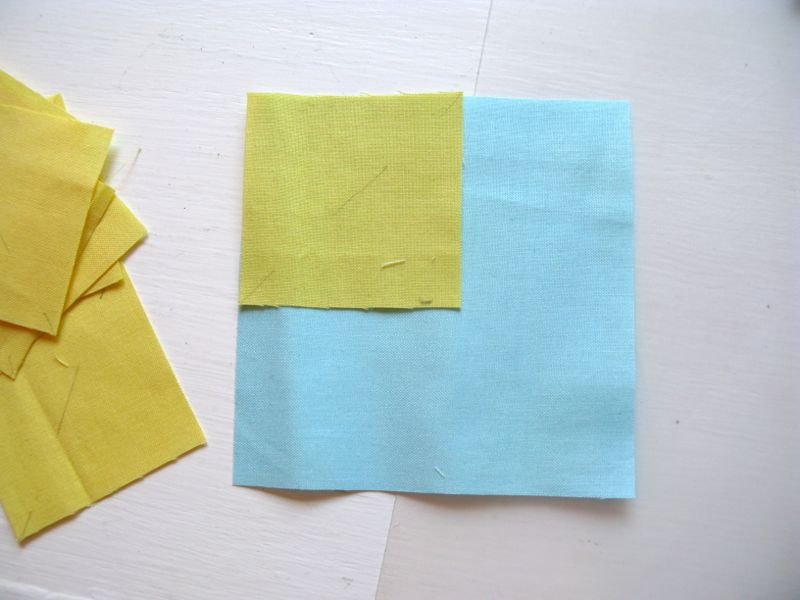
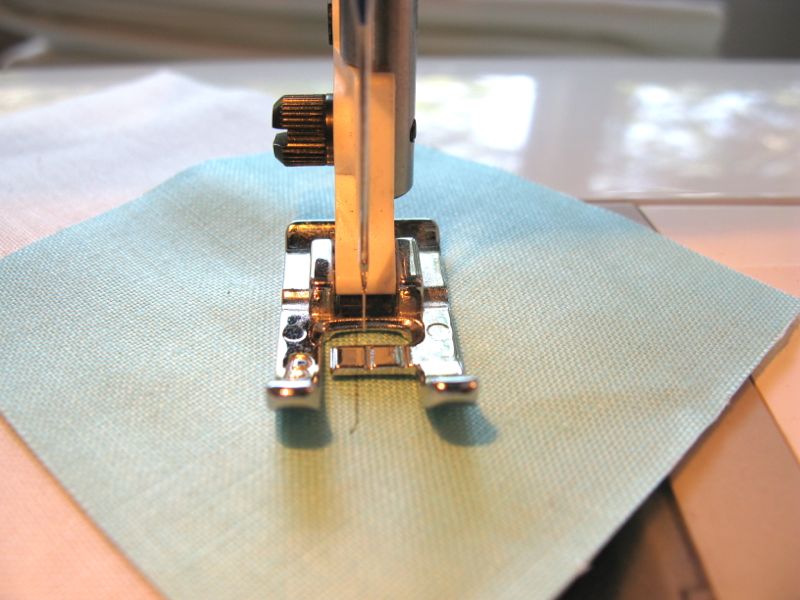
Align the outer edges of the small square with the large square and stitch just to the side of the pencil line, moving your needle towards the outer corner.

You can see it in this photo here.  My stitching line is not ON the pencil line, but towards the outside edge by a couple of threads.  This allows you room for the fold, and so it won’t distort the shape of this smaller unit in your block.

Sew on as many of these corners as you can, as it saves time to do a bunch of sewing, then a bunch of ironing/pressing, then a bunch of trimming.  But I’m sure you already knew that.

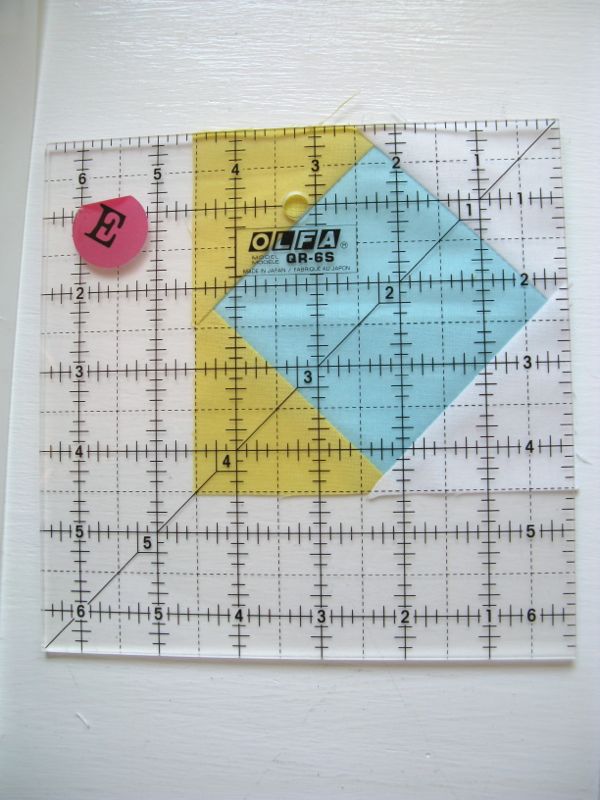
This is the part where you should turn off your music or that novel you are listening to, because you have to think CAREFULLY about what part should be cut off.  I remember it by placing the ruler over the part I want to preserve, then lining up my ruler.  I then cut 1/4″ away from that stitching line.

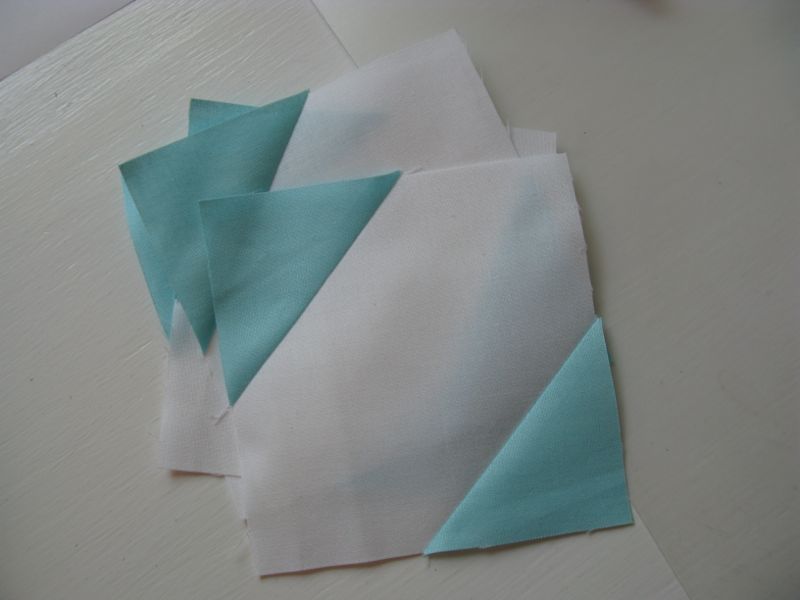
Yes, you are making a bunch of snowball blocks.

Keep trimming.  Love how the white looks pink.  But, it’s white.  After trimming, head to the ironing board and press the snowball corners away from the center of the larger square.

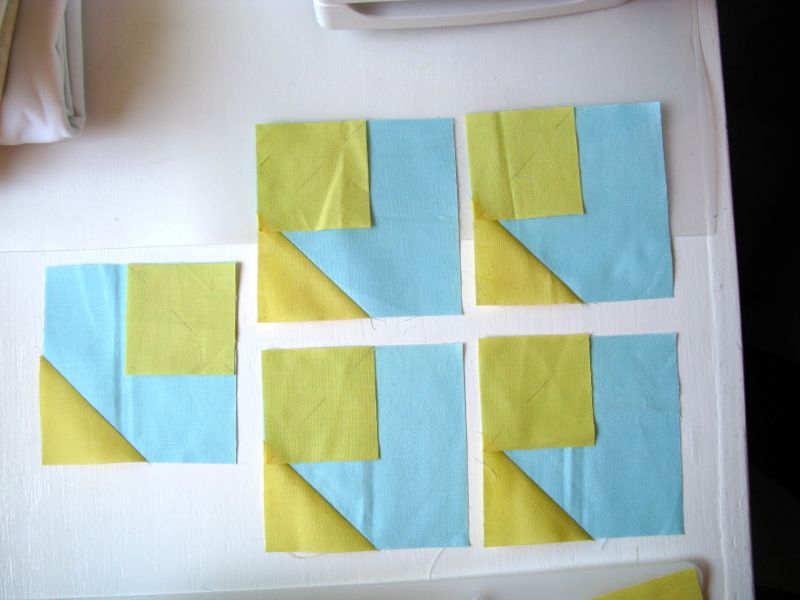
Unit #1 is done, all four of them.  Set them aside.  And yes, I press my seams to one side.  It’s not a gospel with me, this press-seams-open business, like it is with some modern quilters.  If it is with you, have at it.  I prefer them pressed to one side because I own several old quilts, and they are still sturdy  although worn, and I haven’t had to sew any seams back together from popping apart.  Since pressing to one side works for me, I’m sticking with it.  I believe the thinking it that they look “flatter.”  Judging from the appearance of my older, worn quilts, um . . . that’s really not an issue after a few years.

First corner is on, so lay out the next set of stitching.  I put the yellow square opposite on one of my squares, to remind me that only one has all four corners that are yellow.

Stitch, again staying a few threads to the outside edge of your pencil lines.  Chain stitch as many as you can together.  I found that by focusing on my end point and going a bit faster speed, my stitching line was straighter than if I obsessed about staying next to the pencil line.  Aim for a straight seam, as my college Clothing and Textiles professor used to say.

See that thread cutter on the back of the machine that you sometimes use?  Use it now, letting it cut your sewn units apart.  Quick! and easy.

Keep sewing. Keep trimming.  Keep pressing.  Repeat until all the snowball corners are on all the blocks.  Give these units another final press if you haven’t done so already.

Now eat your vegetables, by taking time to true up all the units.  I learned long ago that by truing up the inside units, there is less distortion in the final block (and usually I never have to true up those).  If you are a newbie quilter, it simply means to lay a ruler over your block/unit and trim off those slight edges that don’t belong.  I also take this time to get it back to “square” by checking the diagonal and making sure it runs from corner to corner.

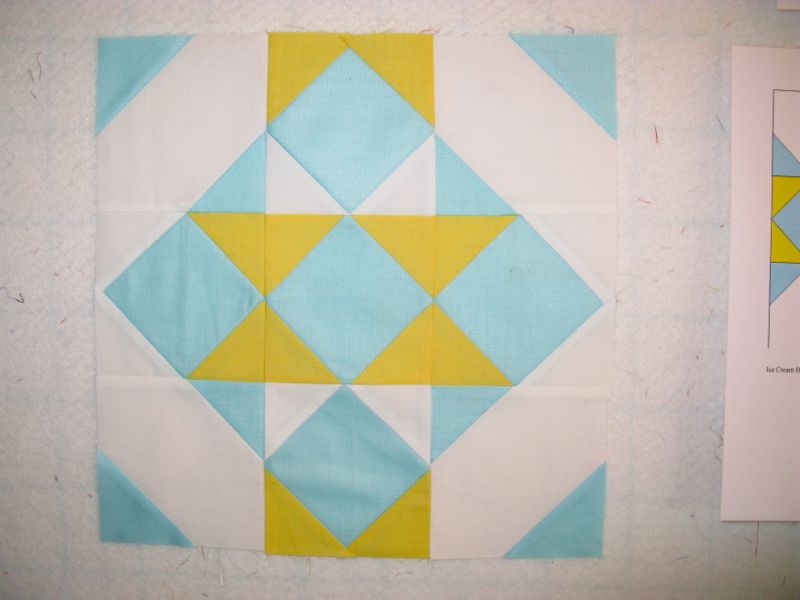
All the units are trimmed up, and I laid them out next to my “pattern,” a print-out of the block.  Now sew the first row’s units together, then the middle, then the last row.

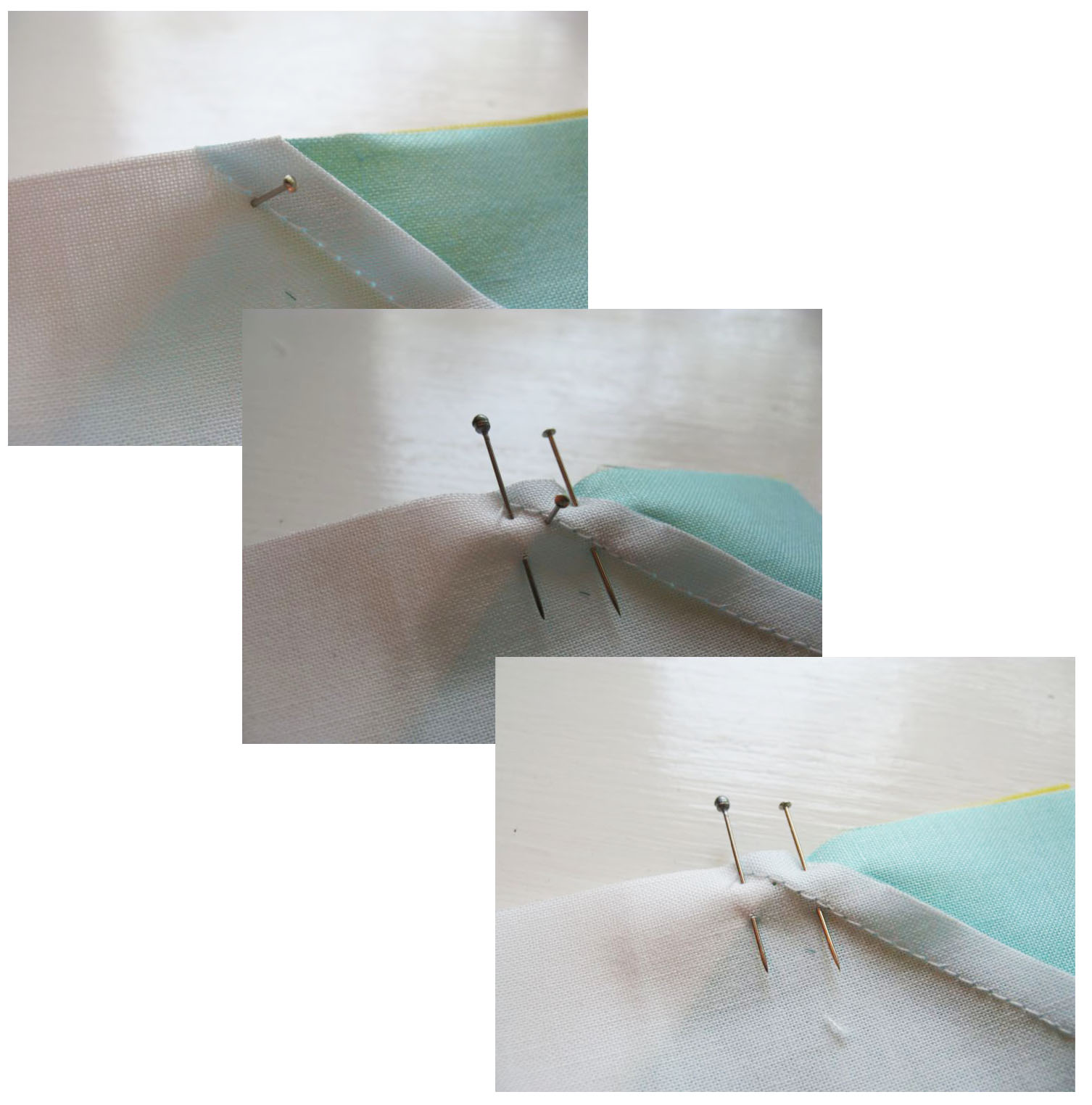
To make sure those intersections line up, stick a pin through them (top photo).

Straddle that pin on either side with two other pins, then remove the placeholder pin (bottom photo).  It shouldn’t shift now under the needle.

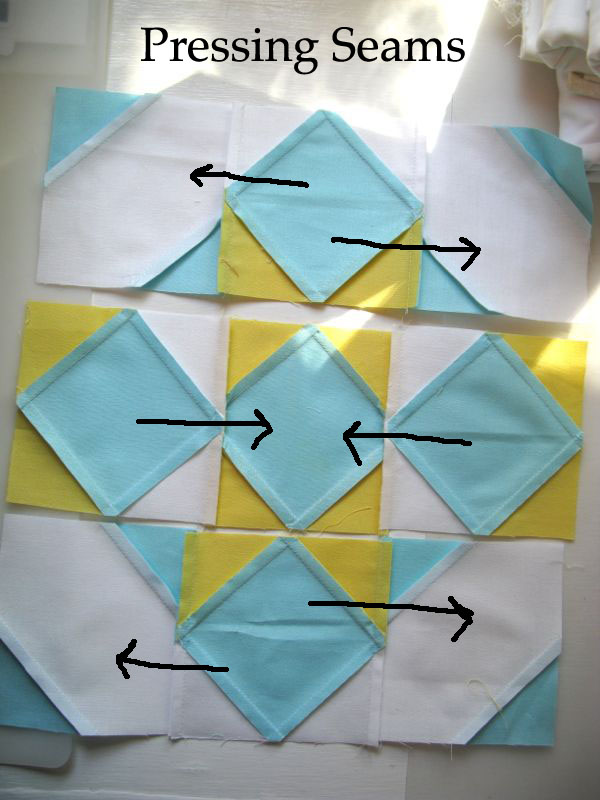
This is how I pressed my seams (seen from the back).  I like to be able to nestle the seams together by feel, so one has to go one way, and one has to go the other.  Now pin the rows together, then flip over the block and check them.

Otherwise, if you are like me and are talking to your mother and wishing her a Happy 84th Birthday, you’ll sew them all together incorrectly.  A nice block to be sure, but not the one I’m trying to make.  Unpick.  Re-stitch.  Then give it a good pressing.  How did I press these last seams?  Towards the middle.  Often a seam will make its will be known by how thick it is, or how many intersecting seams it has.  Just be consistent.  I do admit that if it’s a really pesky, lumpy intersection, I may press just that part of it open, leaving the rest of the seam pressed to one side.  Experiment, but remember you are making these quilts to last.  And last and last.

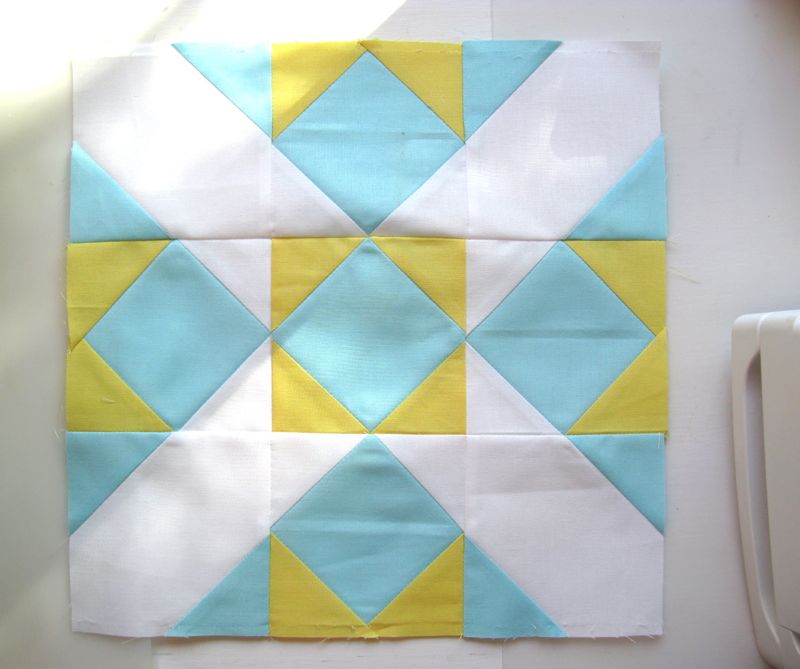
And that’s it!  Now make 11 more, throwing in a random darkish patch here and there to keep the eye moving and give it some interest.  Or not.

Happy Summer Sewing.  Now I’m off to figure out my gingham quilt!