100 Quilts · Quilts

Harvest Weekend

pumpkins

With pumpkins and tawny hues and brown grasses prevalent in the colors at this time of year and in the Northern Hemisphere, falling temperatures, it triggers the idea of harvest: cutting the wheat, gathering the last of the fall vegetables,  All Is Safely Gathered In, and that sort of thing. Well, what constitutes a harvest?
Amish Doll Quilt_detail

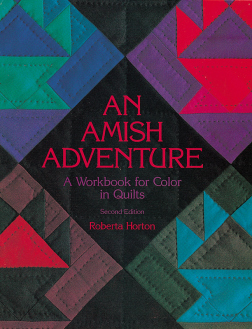
It all starts with seeds, a planting of an idea, a sowing of labor with the yield some time off in the future.  An idea, like beginning to learn how to make Amish quilts from a book, as I sat in the scorching heat of a Dallas Texas summer many years ago, sweat running down my back reading Roberta Horton’s Amish Adventure.
Amish Adventure_1

I had escaped to the back porch for three minutes peace from the marauding hordes of hot tired children in watching some movie on the VCR, steeping my mind in the stillness of these stunning quilts.

Horton Amish-Quilt-1

Strong graphic design and the muted, yet brilliant, colors enticed me, and I began small, with doll quilts, experimenting in the shapes, the colors.  At that time the best we could hope in terms of solid fabrics was a mix of cottons and polyester-cottons.  Purists would gasp now, but we had just barely graduated from using cardboard templates with taped edges to cutting out the lids of margarine tubs to use instead.
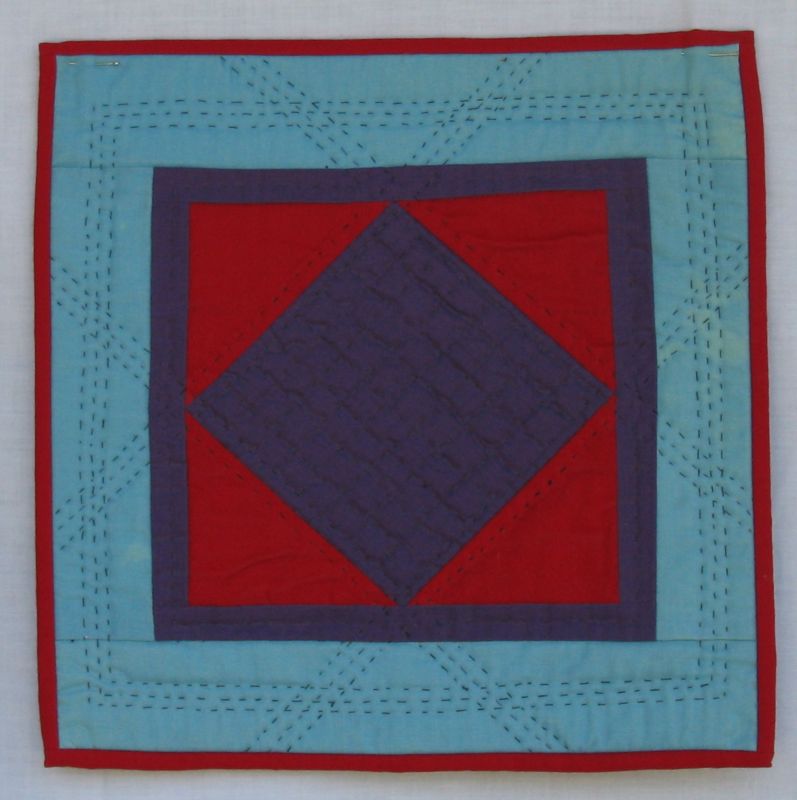
Amish Doll Quilt_2

Roberta Horton’s book, first published in 1983, rocked my tiny isolated world of quilting.

Amish Nine-patch

I moved from doll quilt-sized quilts to a larger wall quilt, still unfinished.  And then to a larger quilt, laid out in rows in the corner of my bedroom for weeks, while I refined the gradations of color.

Amish Sunshine and Shadow

I had drawn out Sunshine and Shadow on graph paper, trying to figure out the coloration, mimicking what I saw in fabric. This was early in my quilting career: all of my quilts on this post are numbers 10 and 11 quilts on my 100 Quilts list.  I also made a faceless doll to match what I’d heard were common in the Amish country.  And then, Amish Quilting was the first quilt class I ever taught, in a small shop in Arlington, Texas, now defunct, and yes, we made a doll quilt, and yes, we used Roberta Horton’s book.
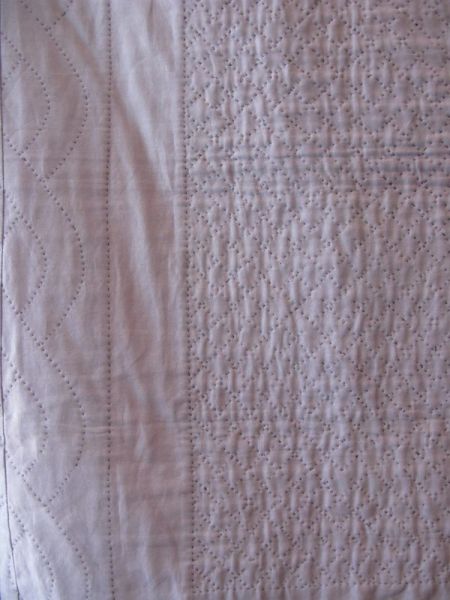
Amish Sunshine and Shadow_back

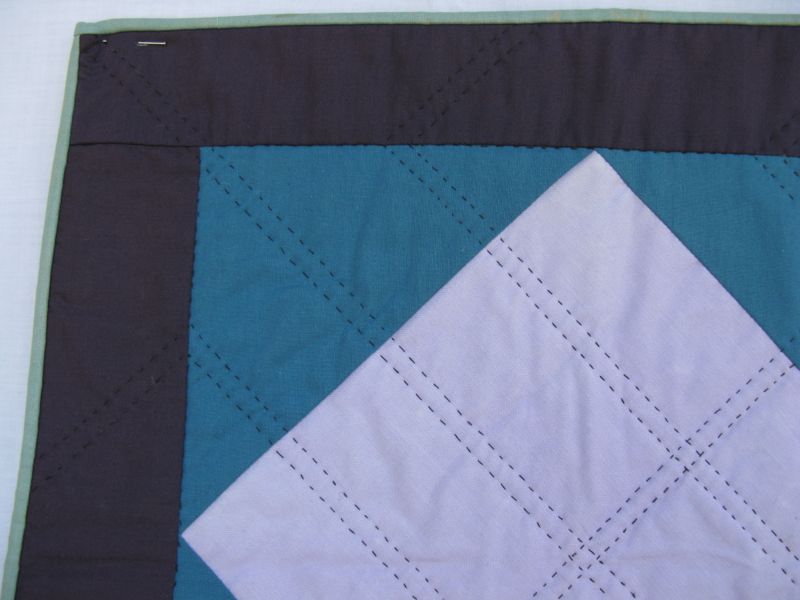
Back to the Sunshine and Shadow, I figured out the borders, sandwiched with flannel (as she noted that Amish quilts were flatter than our fluffy renditions) and I began quilting it by hand, criss-cross, and then cut paper patterns for a twined-vine border design.

Amish Quilts Adventure Continues

The seed planted by Horton and her quilts and her book is now in a second harvest, if that’s possible.  Last summer, C & T Publishers put out a call for Amish quilts of all types to be considered for a new rendition of An Amish Adventure. I submitted my photographs and had one quilt accepted.  The book has now been released and is titled Amish Quilts–The Adventure Continues, and it as much a celebration of that first book in C & T’s publishing history as it is the style and cultural contribution of the Amish quilt–certainly a forerunner to today’s modern quilts.
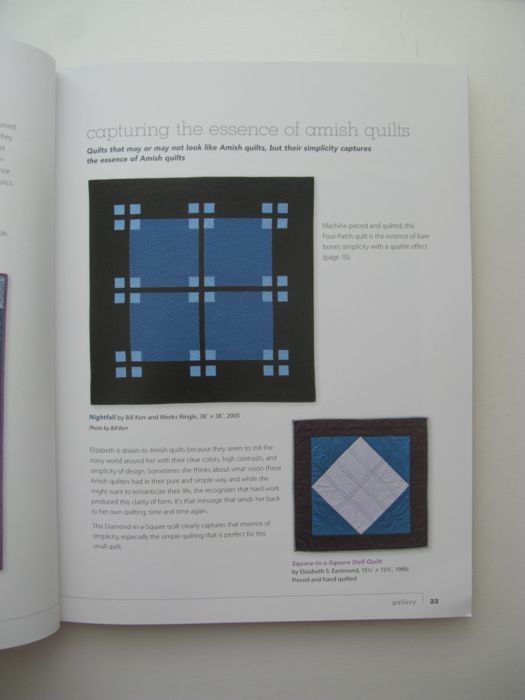
Amish Quilts Book_2a

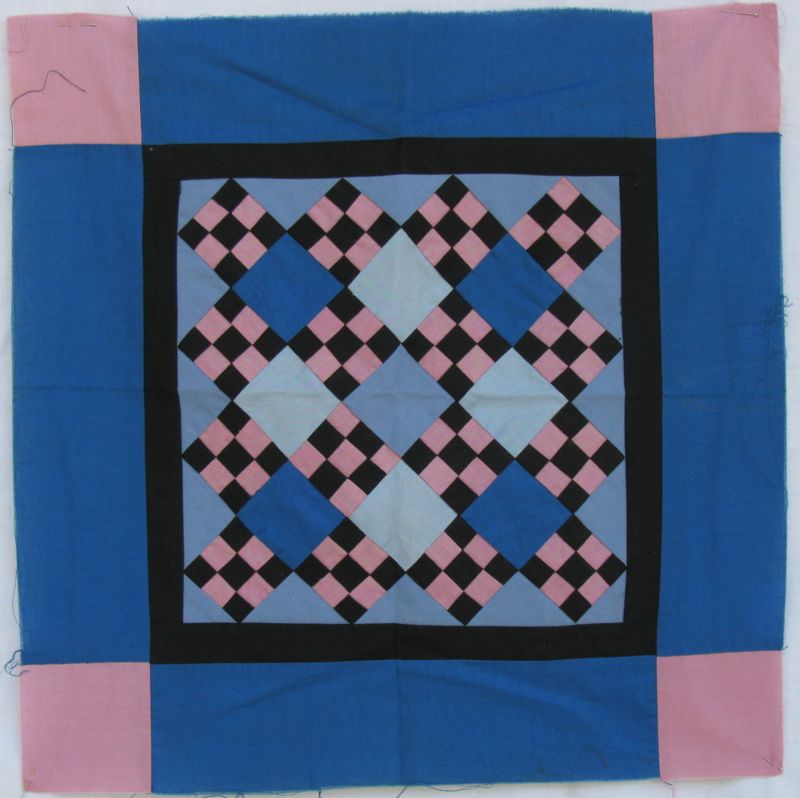
Here’s my doll quilt, made so many years ago.  I now consider it as an entry in the first round of strong bold graphic designs and solid fabrics.  In the book, mine is right next to Weeks Ringle and Bill Kerr, of the Modern Quilt Studio and Craft Nectar blog.  I certainly did do a happy dance in the kitchen as I opened up the package.

You can get the book from the C & T Publishing website and from Amazon.com.  My mother already has her copy, so I know it is shipping.  If you haven’t had a chance to make yourself an Amish quilt, perhaps now is the time, before too many more harvests stride past.

Amish Doll Quilt

I like to think about harvests, as to me it always indicates a leap of faith somewhere.  At some point I made a quilt, and now can “raise the song of harvest home.”

200 Quilts

Childhood’s Wide Avenues, deconstructed

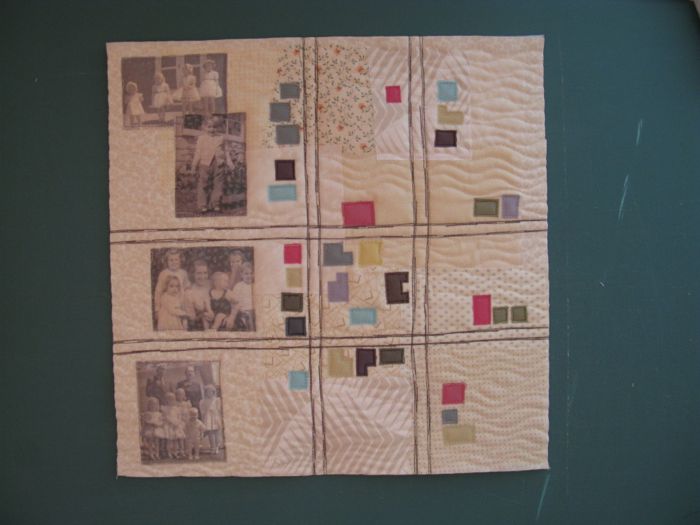
Childhoods Wide Avenues Art Quilt_front

Thank you all for your lovely comments yesterday and for visiting the rest of the Four-In-Art quilts.  The reveal day is one of my favorite days of all the blog writing I do, as it’s such a shared experience.  Today I’ll talk about the technique and the how of the quilt, but first, a little clothing and textiles lesson about four sheer fabrics:

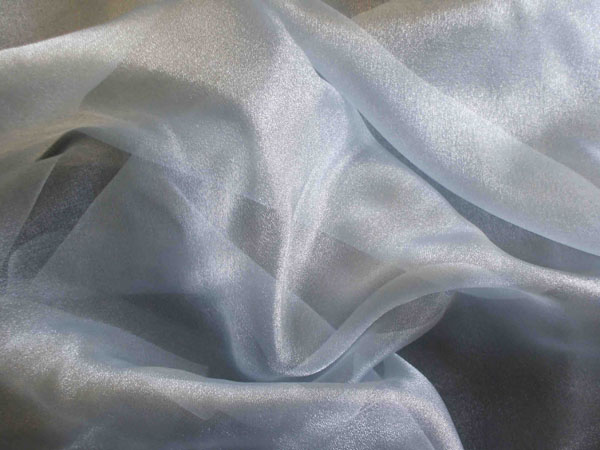
Organza

Organza is a thin, plain weave, sheer fabric traditionally made from silk. Many modern organzas are woven with synthetic filament fibers such as polyester or nylon.  The Casa Collection of sheers at JoAnn Fabrics is an light-reflecting organza, and it is light and soft with lots of drapability.

organzabags

You usually encounter this fabric as jewelry, or wedding favor bags.

OLYMPUS DIGITAL CAMERA

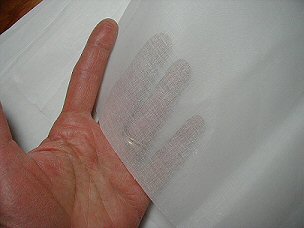
Organdy is a balanced plain weave. Because of its stiffness and fiber content, it is very prone to wrinkling. Organza is the filament yarn counterpart to organdy, meaning it has very thin fibers in the weave, and is used often for interfacing in lightweight clothing construction, or as petticoats or slips for formal wear or wedding dresses. (All images pulled from web.)

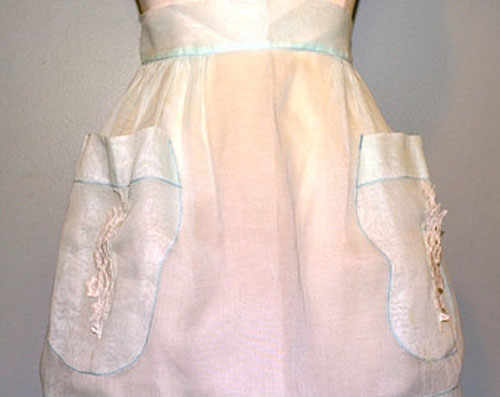
organdy apron

You’ve probably seen it in your grandmother’s or great-grandmother’s aprons–a crisp, sheer construction.

Chiffon

Chiffon is a lightweight, balanced plain-woven sheer fabric woven of crepe (high-twist) yarns. The twist in the crepe yarns puckers the fabric slightly in both directions after weaving, giving it some stretch and a slightly rough feel. Chiffon is made from cotton, silk or synthetic fiber, and under a magnifying glass it resembles a fine net or mesh which gives chiffon some see-through properties, but it is more filmy in its appearance than organza.

Tulle is a lightweight, very fine netting, made of various fibers, including silk, nylon, and rayon. Tulle is most commonly used for veils, gowns (particularly wedding gowns), and ballet tutus.

Lesson over, and this is why I brought those up first: I was a bit stumped on this quilt, feeling like I had no idea where to go.  I keep an art quilt journal just for these projects, and began writing down my impressions (see yesterday’s post) and drawing a few possible ideas.  Once I knew the general direction of where this quilt would go, I wanted to think about a new technique to try, and I wrote down “use tulle,” as I had seen very successful use of this as an overlay to keep teensy pieces in place during appliqué, used to great success by Karen Eckmeier.  But in this smaller piece I thought the texture of the tulle might be a distraction, so decided to explore some alternatives.  I purchased chiffon and organza in both white and ivory/off-white.

Now I had the materials I needed, I began.

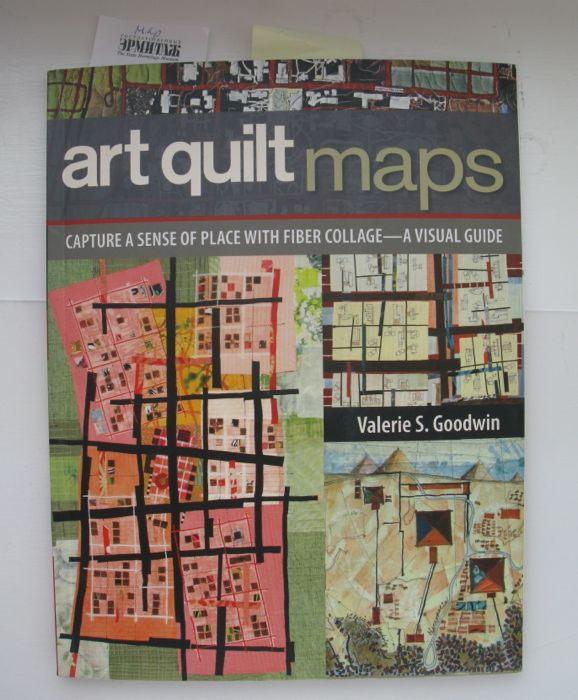
Art Quilt Maps book

Quite a few of us had seen Valerie Goodwin’s book on art quilt maps; I enjoyed it, but the bigger takeaway for me was to build up the background with texture, in terms of the visual space and use of fabric.

CWA_1Choosing Fabrics

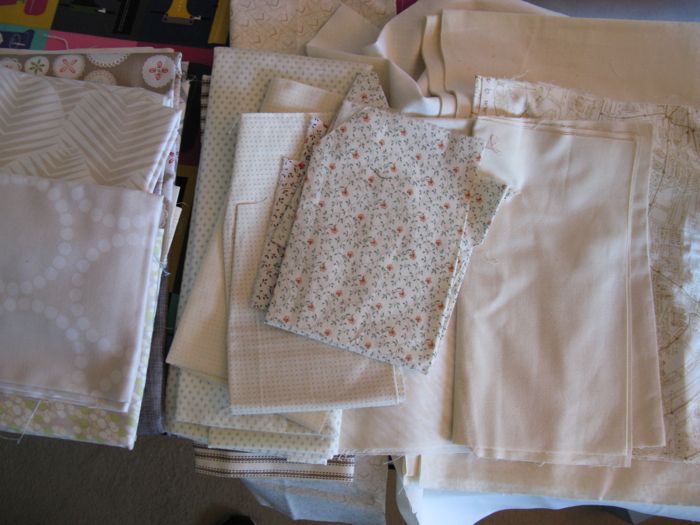
So I pulled all my neutral fabrics (the current vogue term is “low-volume”) and laid them out.  Because this was the background, I rejected any that were to figured or obvious in the print.  I randomly cut out oblongs, squares and rectangles and laid them out over my base muslin.  In my art quilt journal, I had sketched out a few possibilities of layout, and I knew I wanted a clearer left-hand margin of the background for photos.

I auditioned my two colors of chiffon, and my two colors of organza, and decided on an off-white organza as the sheer overlay.

CWA_2 drawing grid

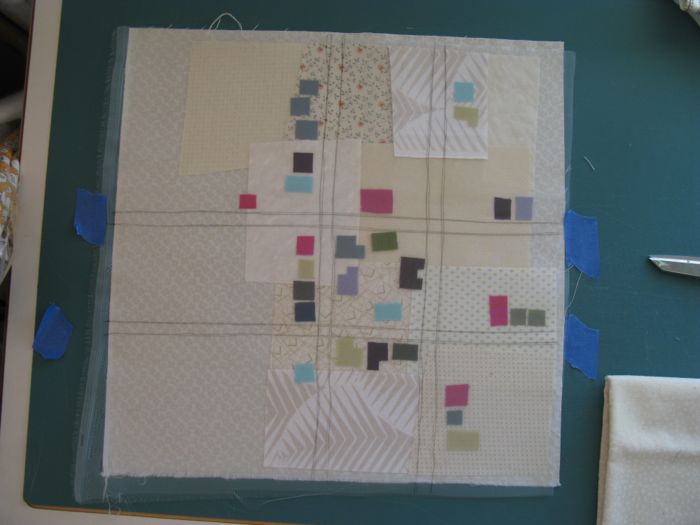
Slipping a piece of paper under the organza so the pen marks wouldn’t transfer to the fabrics, I sketched in my wide avenues, free-handing it (look ma, no rulers!).

CWA_3 adding houses

I cut itsy-bitsy little houses, but trying for a variety of shapes.  I carefully laid them under the organza, along the avenues.  I was temped to draw in streets and lanes, but decided that, for this particular theme, it would only be distracting.  The houses kept moving every time I added a few, so I got out my glue stick and stuck them to the background fabrics, which also had a few dabs of glue to keep them in place.  You can see I used masking tape to anchor the organza to the composition.

CWA_4 adding family

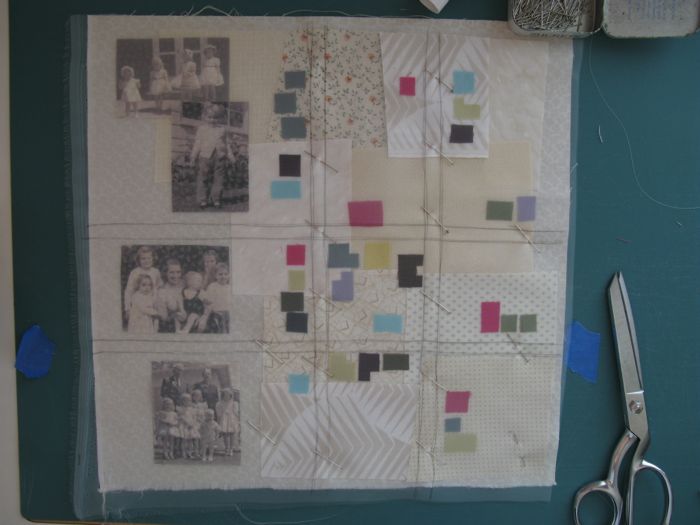
I printed out some family photos, using the usual method (freezer paper-backed fabric, taped to a piece of paper and fed through my trusty Epson inkjet printer), and started to add them.  This was the first try.  I kept moving them around until I got what I wanted, trimming some edges to make it fit, visually.

CWA_4a

I used straight pins everywhere to secure the organza, and then took it to the machine.  Because they are such a small size, it’s easy to manipulate them under the machine.

CWA_7 detail front

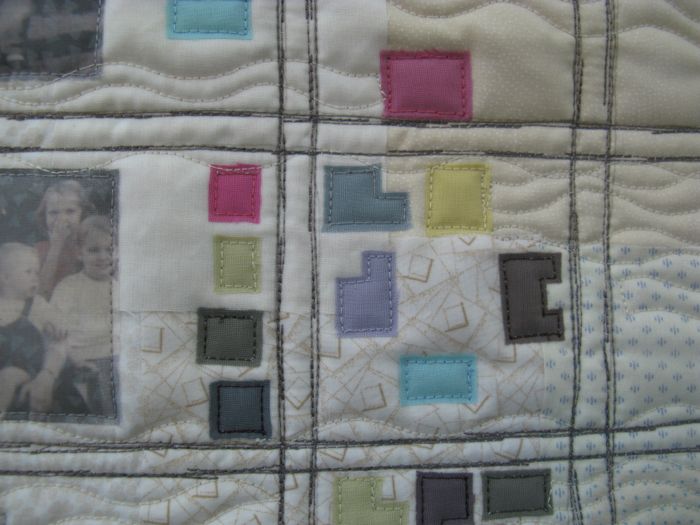
First I used a dark gray and “drew” in the avenues, using the reverse button on my machine to simulate how it might look if hand-drawn.  I went over those several times.  Then I outlined all the houses, using matching thread.

CWA_5 quilted

I quilted in wavy lines that to me represented the flow and movement of the landscape–it could be slight hills, or the movement of grasses, or whatever, but I didn’t want straight lines.  Once quilted, the organza overlay began to act and feel like that thick coating that some topographical maps have, and this change in texture was an interesting surprise.

CWA_6 trimmed

Trimmed up.  I auditioned several bindings–and no binding–but decided to go with a stripe, to further echo the idea of roads.

Childhoods Wide Avenues Quilt_back wo label

For the backing I chose a taupe-cream fabric which depicts the streets of Paris. . .

ChildhoodWideAvenues Art Quilt_label

. . . then added the label.  This is our fifth quilt as Four-In-Art quilters, but I chose to delineate our new series: Urban.

I’m pretty happy with this little quilt, and it joined the others in the Nature series, above my sewing room window in my own little art gallery.  I hope, if you haven’t already, will click back to yesterday’s post and go and view all the other quilters’ creations.  You’ll see some similarities in our quilts, even though we are geographically located all over North America. And perhaps the interesting differences in our vision of this theme come from the different places we live.

The Map As Art

I’m currently reading this book as an adjunct to our study of urban landscapes, and in the introduction the author, Katherine Harmon, notes that maps “can act as shorthand for ready metaphors: seeking location and experiencing dislocation, bringing order to chaos, exploring ratios of scale, charting new terrains.”

In this context of all of the above, I look forward to working with the new theme revealed by Leanne yesterday: Structures.

200 Quilts · Four-in-Art · Quilts

Childhood’s Wide Avenues

4-in-art_3

Childhoods Wide Avenues Art Quilt_front

Childhood’s Wide Avenues is a quilt about memory, of fixing in time a place and a feeling.  I grew up in the mountain west, in Provo, Utah, a town laid out in a grid of wide avenues, criss-crossed with streets that seemed to me to be wide as the sky, although I’m sure if I went back there now, they would be reduced in size and dimension.  But that feeling that I could ride my bike to the top of the street near our house and see all the way down to my elementary school, or across the valley, or to the other side of the world has remained in my memory.

The possibilities were infinite.

ChildhoodWideAvenues Art Quilt_label

A few weeks ago, as I was thinking about this quilt and how to express the theme of Urban/Maps, I found myself traveling down another very wide avenue through the middle of a town very unlike where I grew up: San Bernardino, California.  But the boulevard was so wide and so straight and I could see it head in a straight line for miles, up into the foothills, that I felt as if I had been transported in an instant back to an earlier place and time.  But it seemed impossible, until I learned that Mormon pioneers, a branch off the same tree that laid out Provo, had also laid out the wide avenues of this town two states away, in the early 1850s.  Asked to settle this place far from their original homes in the Utah valley, they laid out a grid of wide avenues, and gave them names like Salt Lake Street,  Kirtland Street, Nauvoo Street, and Utah Street.  These have all been renamed, but those early pioneers left their stamp on the valley not only by naming the cemetery Pioneer Cemetery, but by etching long, wide avenues into the landscape.

CWA_8 Me

I had heard about memory being triggered by sounds, and by smells, but never had experienced memory being triggered by a sense of space, of a geographical series of landmarks making headway into my childhood memories.  For days afterward, I thought of the family I grew up in, and found pictures to place on my quilt that evoked a sense of that time (that’s me, above).

CWA_7 detail front

Who populates these fictional houses on my quilt?  The large pink house is my parents’ and the block below contains houses for my husband and I, and our four children and their families, while the blocks surrounding that central block are where my sisters and brothers might live. And because all of their spouses will want their own families, I scattered the grid of avenues with more houses, so that the circle of family would have place and space.  A dream, of course, as none of our children, nor any of my family live near us.  But in my world, in my memory, we are all there: gathering Easter eggs on the front lawn, jumping in piles of leaves, finding tarantulas in the fissures in the hillside, cracking open walnuts, and smelling the lilacs at the end of the driveway — lovely, amber-colored scenes.

Tomorrow I’ll deconstruct the quilt, describing the technical side of how I put it together.  But for now, more quilts depicting this theme of Urban/Maps can be found at:

Leannemap

Leanne of She Can Quilt

RachelHouse1

Rachel of The Life of Riley

BettyMap

Betty from her Flickr site

AmandaMap

Amanda of What the Bobbin?

NancyMap

Nancy of Patchwork Breeze

Annemap

Anne of SpringLeaf Studios

CarlaMap

Carla of Lollyquiltz

˚˚˚˚˚˚˚˚˚˚˚˚˚˚˚˚˚˚˚˚˚˚˚˚˚˚˚˚˚˚˚˚˚˚˚˚˚˚˚˚˚

FinishALong Button

This is a finished goal on my Quarter Three of the 2013 Finish-A-Long, hosted by Leanne of She Can Quilt.

It is also Quilt # 124 on my 200 Quilts List.

Quilts

Santa So Far

Santa So Far

I received two more blocks from my bee-mates today, and it was a good conclusion to a Terrible, Horrible, No-Good, Very Bad Day in class.

One boy cried, but not because of anything I said or did (horrors! how could he let English interfere with what he was thinking about as he sat in my classroom?)  Thirteen of the seventeen students that managed to come to class were unprepared, madly trying to finish up their assignment as they smiled and looked at me.  Four students were perfect.  I love them.  Three had emailed me that they couldn’t come to class with the following reasons: “I have a migraine and don’t feel so well,” “My mom’s stew didn’t sit so well and I don’t want to be running out of class all the time,” and “I have to be somewhere at 3.” (Our class begins at 3:00.)

After trying for nearly an hour to get the class off the ground, I made everyone sit down from where they were crowding around my desk, seeking help, and said, “You aren’t prepared.  Is it my fault?  Shall we postpone the next essay?”  And then I had what one of our teachers calls a “Come to Jesus” moment, when we re-acquaint them with the Truth, which is that not only does the teacher need to be prepared for class, but the students do too.  “And today, you are not prepared,” I said, calling for a break to clear the air, dismiss  the crying young man (family problems), and figure out where to go next.

So it was lovely to to come home to the two newest blocks, and I arranged them up on the wall, along with the one I’d made to replace Linda’s.  She gets a Full Pass on making quilt blocks because three weeks ago her home burned to the ground.  They escaped with their cat and their hard drive and not much else.  I’ll think of her every time I look at 54-40, or Fight.  Makes a bad day at class look pretty trivial, doesn’t it?

Bad Block 54-40 Fight

Maybe my bad day really began last night as I worked on the block?  Don’t worry.  I “un-stitched” it, flipped around the row, and put it back together properly.

I can only write about this now because a good colleague interrupted her grading to listen to me whine all the way home.

Of course, she took my side.  (Thanks, Judy.)  And doesn’t Santa look great, surrounded by lovely quilt blocks made by lovely friends?

˚˚˚˚˚˚˚˚˚˚˚˚˚˚˚˚˚˚˚˚˚˚˚˚˚˚

Four more days until we reveal our Four-in-Art Quilts.  Come back and see the art on November 1st.