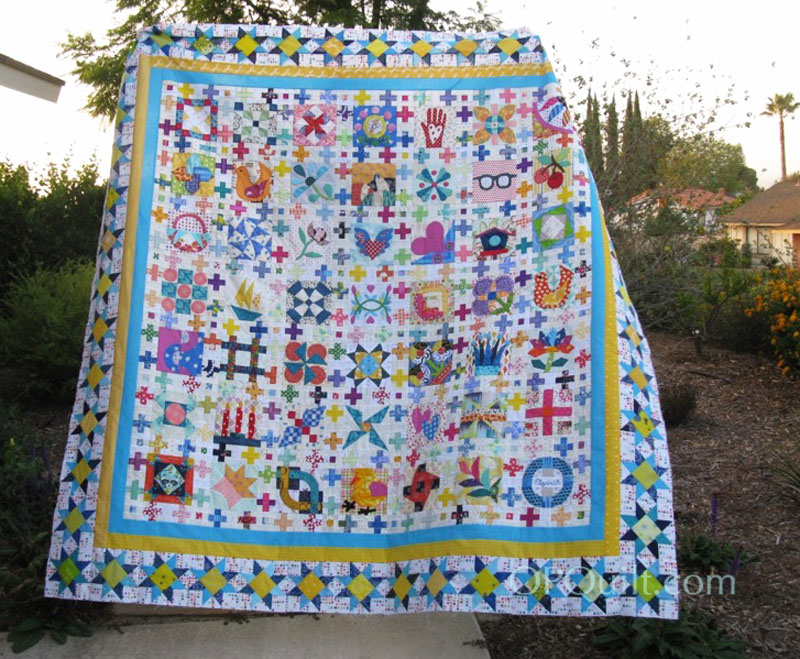
We interrupt this tour of France and the European Patchwork Meeting to bring you breaking news: I finished the Chuck Nohara Quilt Top!
My husband held it up for me, but it’s big — about 80″ wide, and similar height.
Above are the Chuck Nohara blocks that Susan and I chose; we took turns choosing blocks to make–four a month, which sometimes about did me in. I’ll have you know that she is ALL DONE with her quilt. (I took this photo inside, the quilt smoothed up on my design wall, so all the blocks were visible.)
And then we made signature blocks for each other, to commemorate that year-plus of making weensy little fussy blocks. (How did we decide to do this? Blame the Chuck Nohara QAL Instagram Feed.) The above signature block is hers, surrounded by my tiny plus-sign blocks and the final star borders. I have other posts tagged with “Chuck Nohara” so you can either click on the label at the bottom of this one to get more info, or do a search in the box to the right.
Here’s my signature block. Do I love love this quilt? Parts of it, most of it. If I had another millennium, I might have tried something different besides the two borders, then star borders. Let me rephrase that… I DID try a lot of different things but nothing clicked to me (now I have a lot of cut fabric for string blocks). At some point, the old mantra clicked in my head: “Better done, than perfect” as well as “The perfect is the enemy of the good.”
Sometimes it’s fine to have some good quilts. I love so much of what I learned with this quilt–so many different techniques. But I’m also glad it’s at this spot. I’ll bring it back when I finish quilting it, but for now, I’m putting it up on the 200 Quilts List.
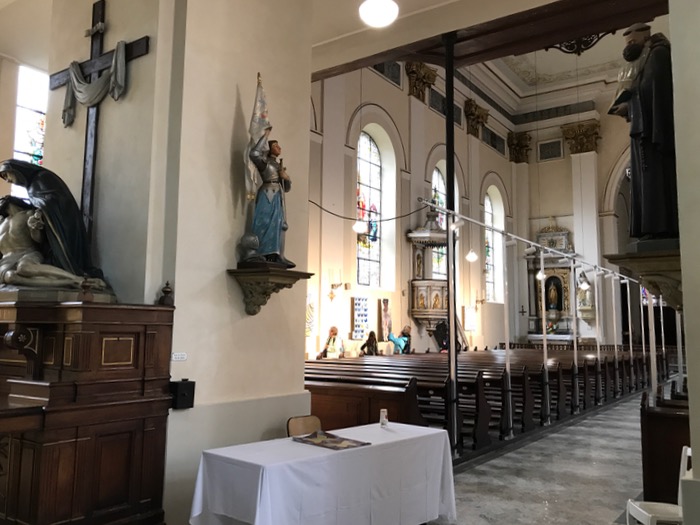
Moseying along the main street, we headed to Site #7, the Eligse St-Louis, where I wanted to see the French quilter Gabrielle Paquin. Previous to this, in my hotel room in Geneva, I had previewed all the exhibits, looking up the artists and deciding which ones interested me. Paquin was one of them.
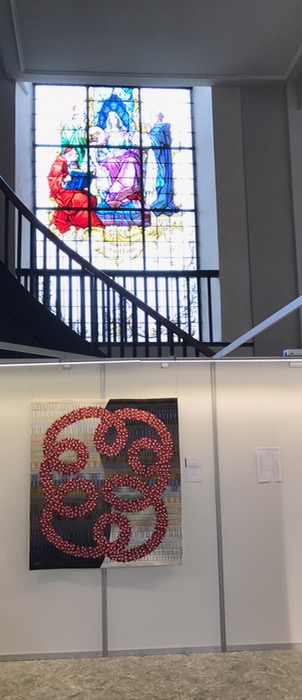
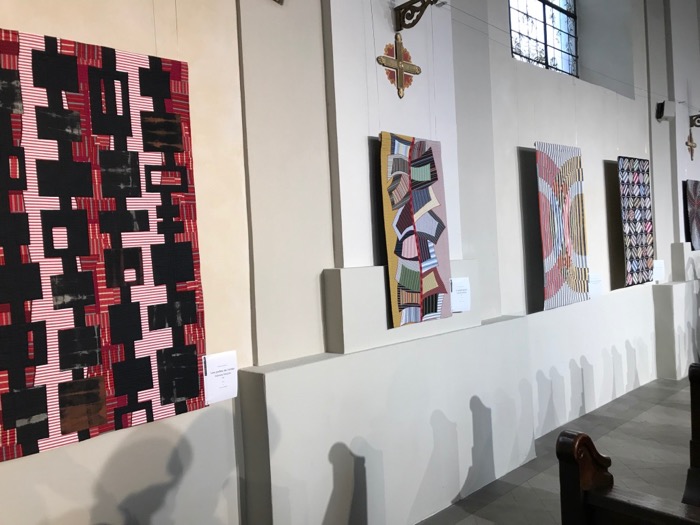
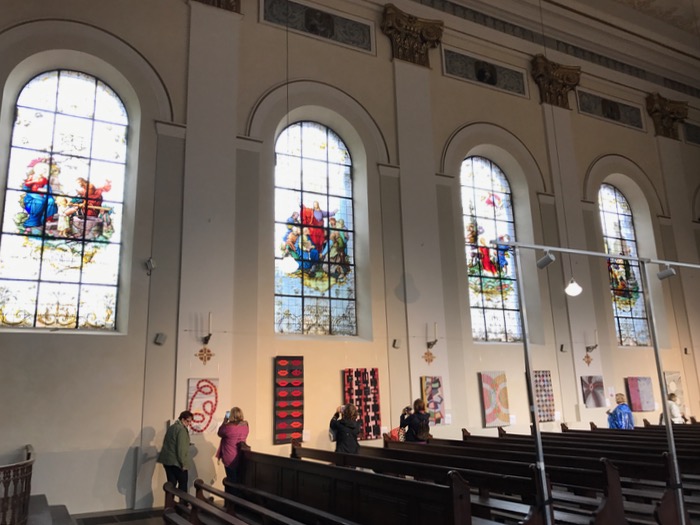
I had seen photos of previous years’ exhibits, and the fact that many of them were in churches. But it just doesn’t prepare you for the juxtaposition of the sacred and the quilting, the symbols of religious life coupled with the themes and ideas and colors and patterns of the quilts along the sanctuary walls. It was wonderful.
She spoke some English, and agreed to pose with me. Check out her sweater.
“For several years, I studied drawing and painting in a school of Fine Arts, my first vocation, and since then, I practice painting as an amateur. Simultaneously, I realized traditional patchworks inspired by American models large format of the 18th and 19th centuries.
“This practice evolved towards the contemporary patchwork and the textile art that I have been practicing assiduously for ten years, thanks to a constant inspiration and stimulated by the numerous exhibitions proposed with selection by a jury of artists and curators of museums.”
Spring, 2016.
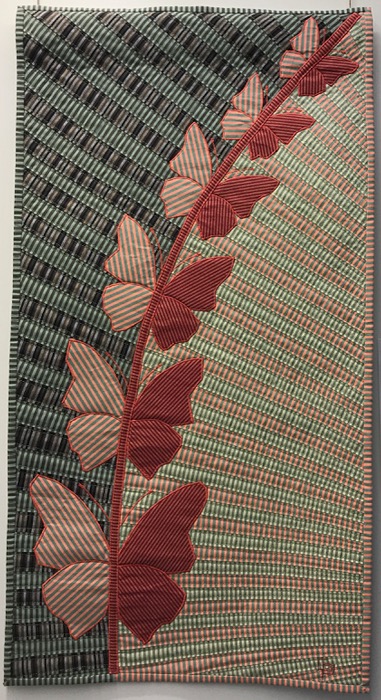
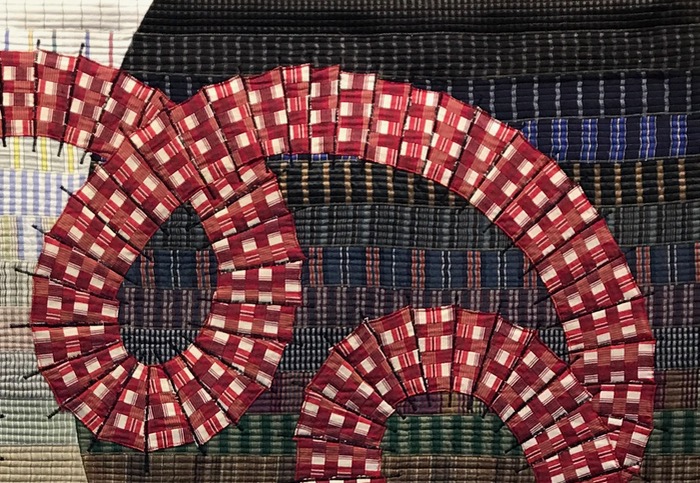
You can start to get a sense of the materials that Paquin works in: striped cloth. In this one, she uses larger pieces that her usual strips, and has appliquéd them down to the background with a satin stitch on her machine. I like her small monogram in the lower right corner.
Twilight and Stripes, 2008 (?)Detail.
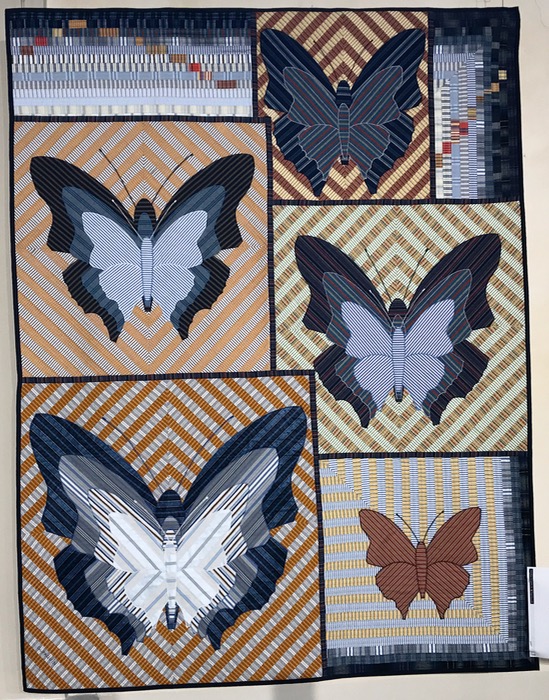
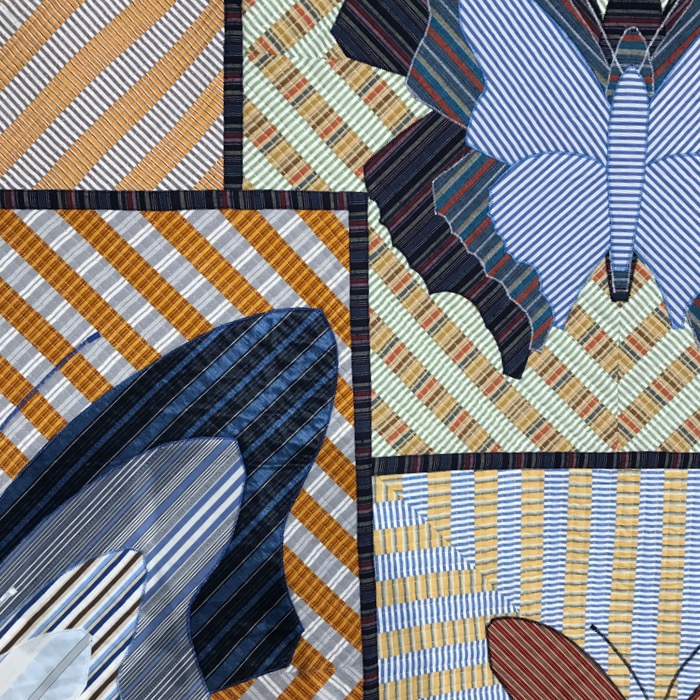
I didn’t quite catch the name of this one (top, and detail, bottom), but it shows her use of her striped material. I kept wondering if she cut up old shirts, or old clothing, or haunted fabric shops to find all these variations.
In/Out, 2017.Detail.
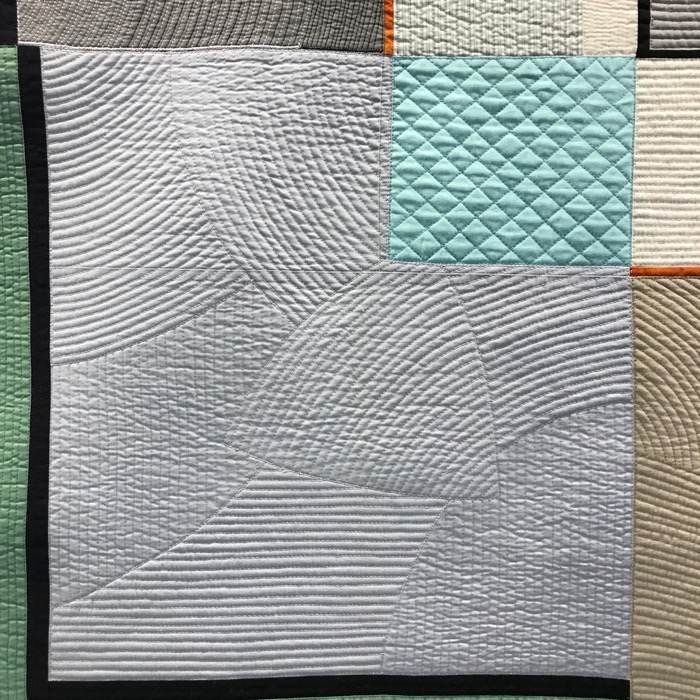
I was impressed with the quilting on this piece, as it gave me great ideas.
Flight II, 2015.
All the placards were in French, so I’m using Google Translate to write them in English, plus heading over to her website where she has some of these quilts.
Detail.Detail.
She has found so many ways to use this fabric; I didn’t include all her quilts in this series, but many of them.
Two Black Sisters, 2016.Storm II, 2012.
What a huge impact the simple reversal of value (light-dark) can make!
Looking towards the back of the church. She is sitting there at the table with the white tablecloth, waiting for people to come and talk with her.
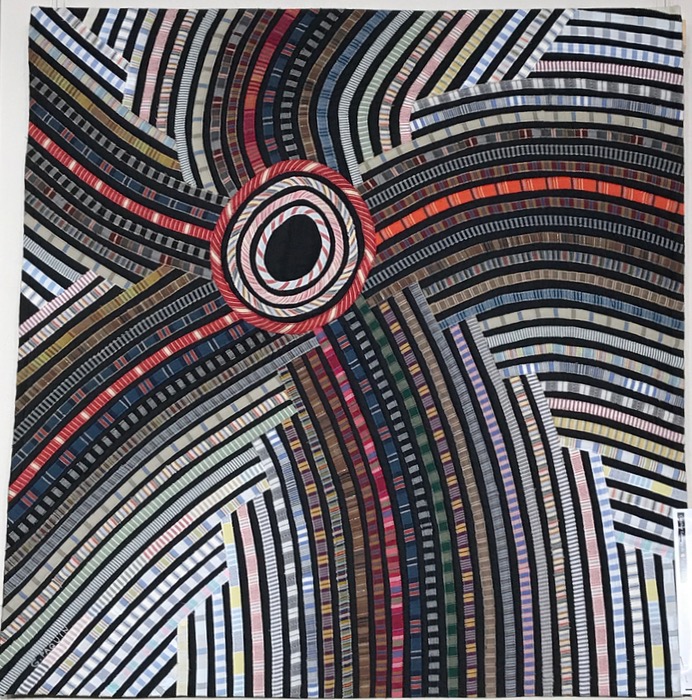
R-évolution, 2017.The Eye of the Cyclone, 2009.
We call cyclones “hurricanes,” and after this year, can definitely relate to the eye of such a storm.
This title says something about a spider, and it was pinned up to show the creature responsible for this exotic web.
I am posting my experiences at the recent European Patchwork Meeting, held in a series of four small towns in the Alsace region of France.
The town of Saint Marie-aux-Mines, the main venue, had many places to find quilts:
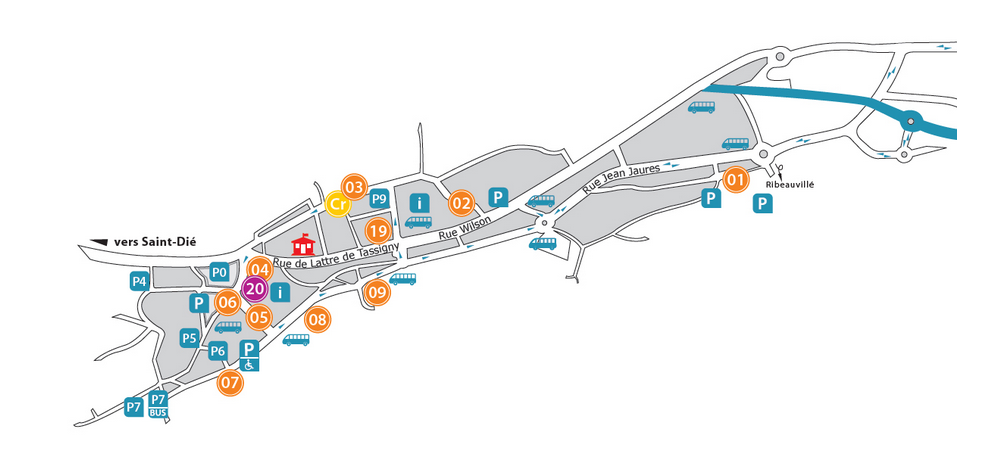
The poster above links to the numbers in the map. Once we left the L’Espace Commercial, we walked across the street to the Theater, where two sets of quilts curated by two different women provided a study in contrasts.
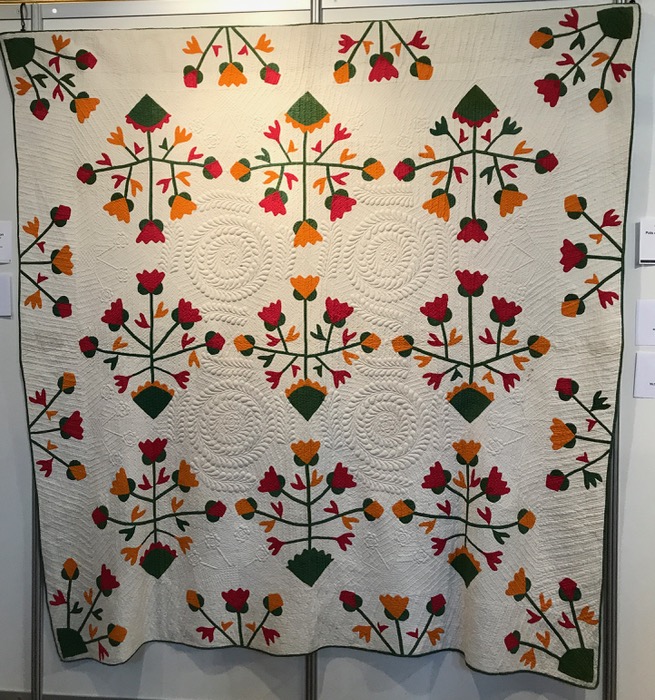
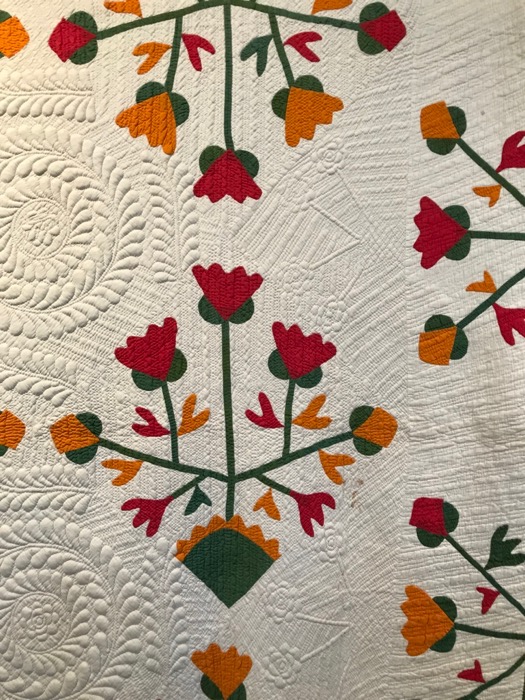
One set of quilts, by collector Mary Koval, was exhibited on the ground floor of a beautifully restored old theater, which you can just see from around the edges of some of my photos. This set of quilts were all American antique quilts.
The other woman (from France) is Lea Stansal, who mounted a one-woman exhibit titled La Broderie d’embellissement, which can be roughly translated to The Embroidery of Embellishment. Her biographical statement from her blog (which I used Google Translate to read) says:
“Trained at Met Penningen’s Higher School of Decorative Arts and Interior Architecture.After twenty years in the world of fashion as a textile designer, Léa Stansal decides to explore and deepen more traditional aspects such as patchwork and embroidery.
“Since then, with a thread and a needle, she has created a poetic and original work, which is widely exhibited in the world and has given rise to the publication of half a dozen books of art.”
Is this the artist? I don’t know, but I did love the quilt behind her head.Detail.
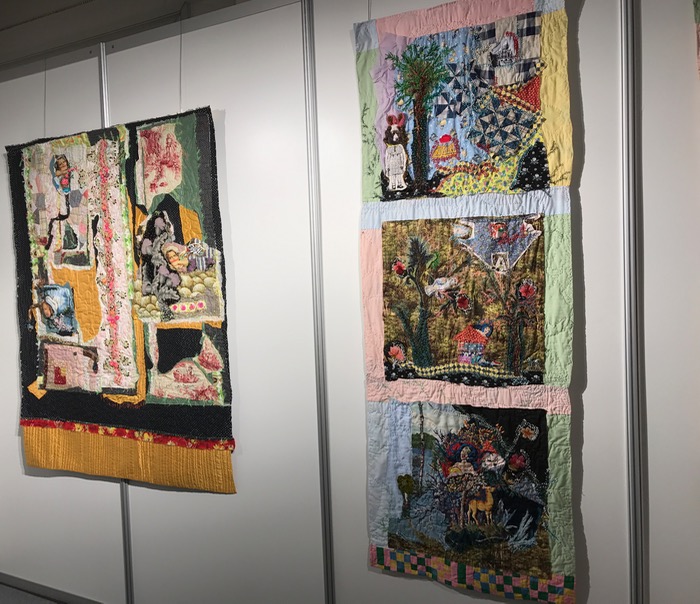
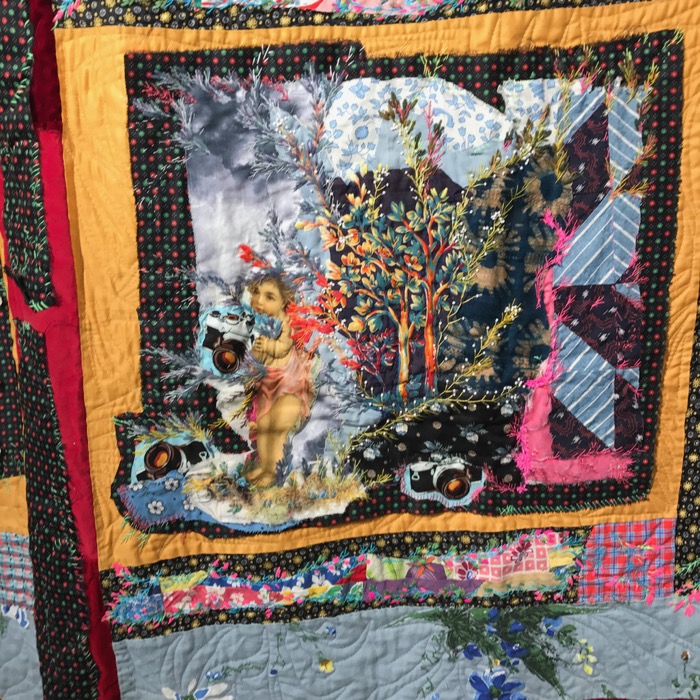
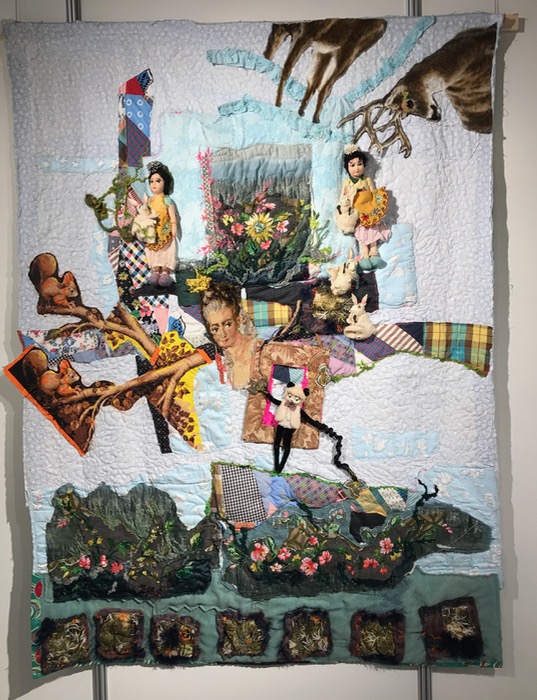
None of these are titled, and it flattens them out to put them on this digital medium; I wish you could have seen them in person. They were wild and embroidered and free and filled with a happiness of creativity. I think if I could spend 10 minutes in her studio, I’d break all those Rules of Quilting that I carry around inside me.
Detail from the upper panel, aboveDetail.Detail.
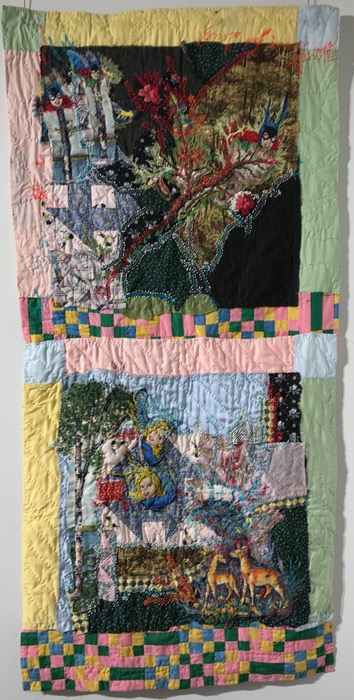
I kept thinking about how the Pied Piper had charmed all the little tin soldiers. Was this a statement about war? About peace? I’ll never know, but I’m still thinking about it.
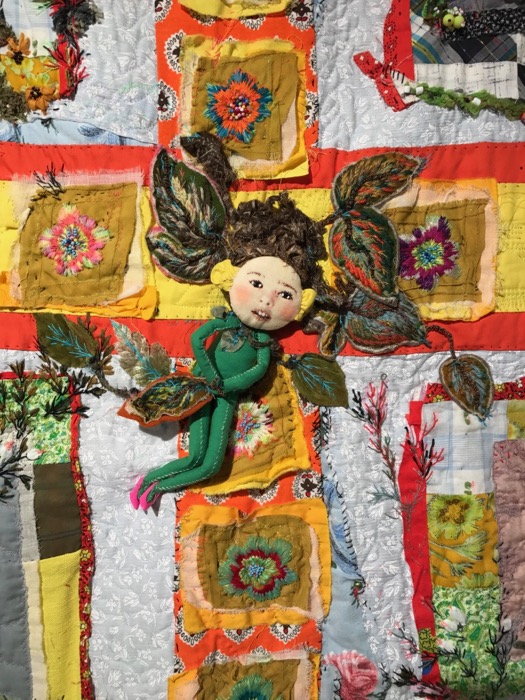
Detail from above. The layers! The collage! The broderie perse! I kept sighing.
I love how the deer and its antlers are in this piece, but not in the static, overused version we see in America. Shall we turn some quilts on their heads?
My husband, who loves symmetry in all its forms kept sighing, too, as he admitted that this just wasn’t his type of quilting. Mine, neither, but I kept admiring that freedom to create, a freedom that was a delicious anarchy of cloth and threads.
We headed downstairs to Mary Koval’s antique quilts, in an exhibit titled “Piece by piece, our life with quilts.”
I had carefully included the identifying titles in my photos, but back home, found I couldn’t read them most of them. The quilts range from the late 1800s to the early 1900s.
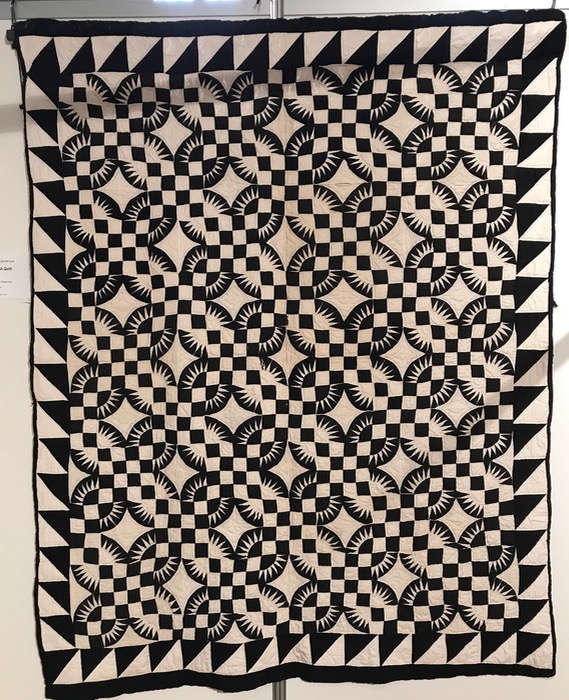
Pickle Dish quilt, from the 1920s.
I liked the juxtaposition of these two–the orange-clad guard and the riotous early-American quilt.
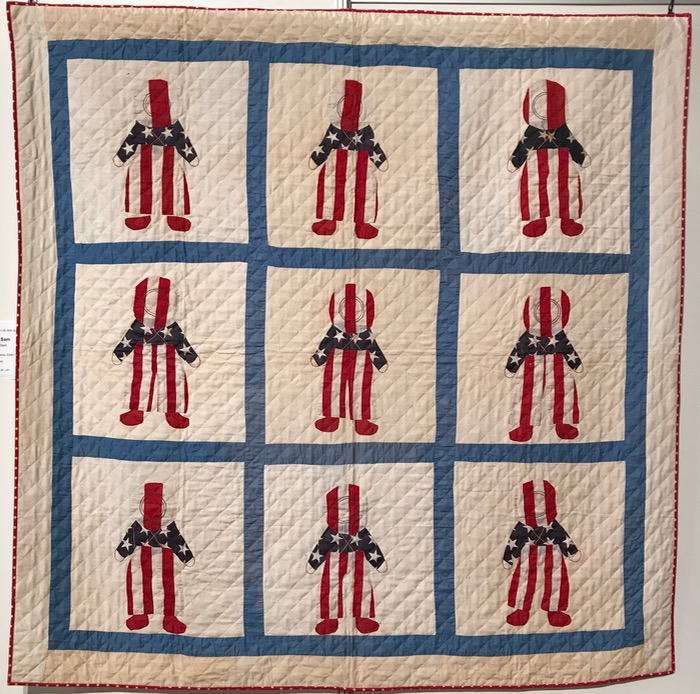
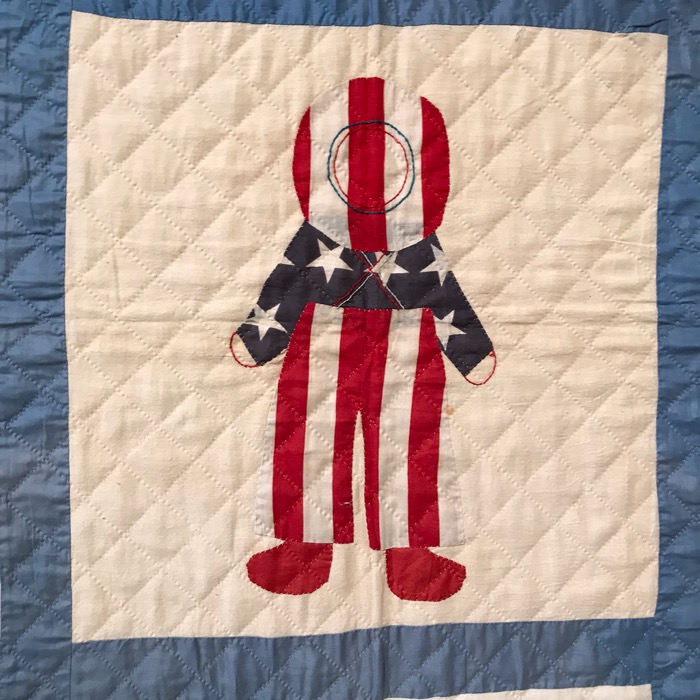
I liked the embroidery detail on this little Uncle Sam. a quilt from the 1920s.
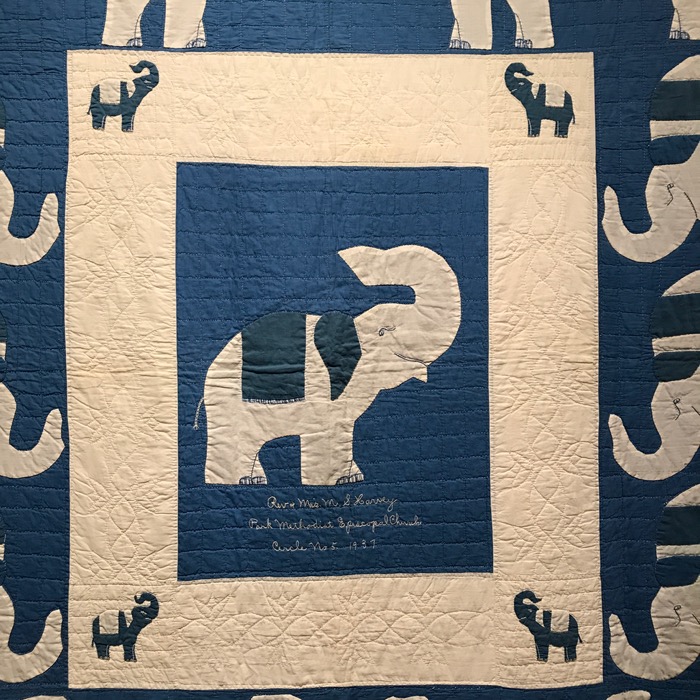
One of my favorites of the antiques because of its exuberance. The name “Rev. and Mrs. (?) S. Harvey” is on the first line, with “Park Methodist Episcopal Church” on the second. “Circle No. 5 1937” on the third line.
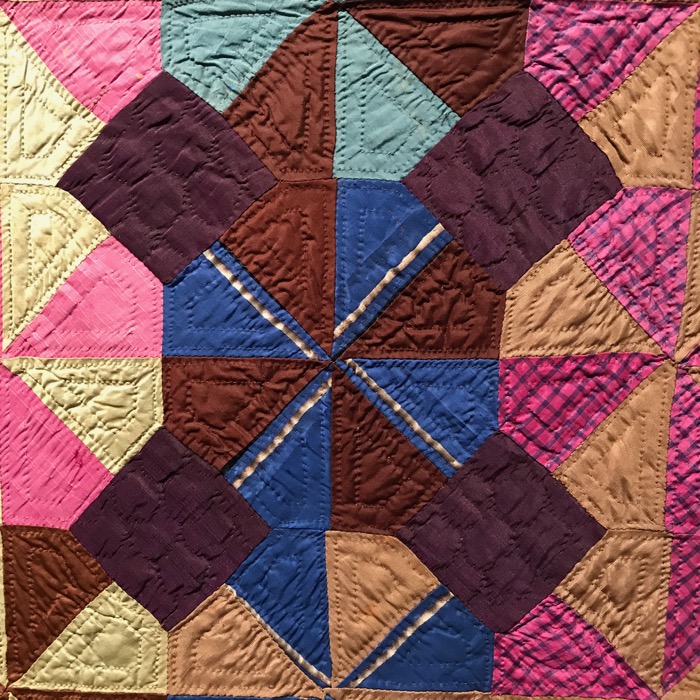
Made from silks.
Detail.
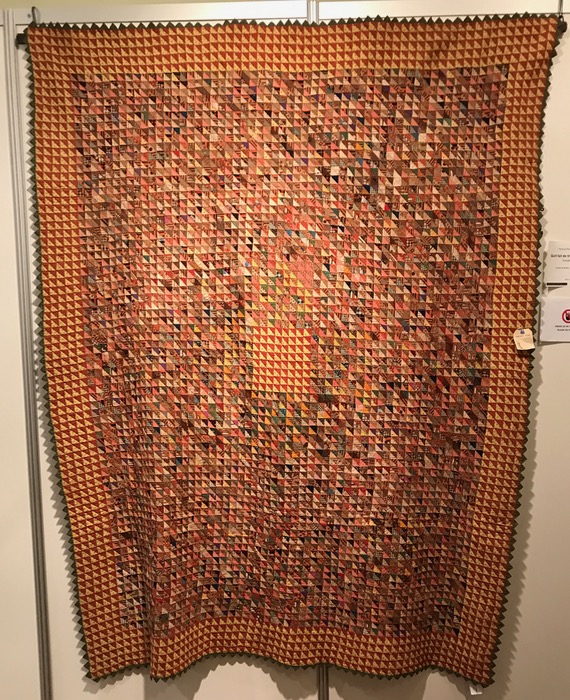
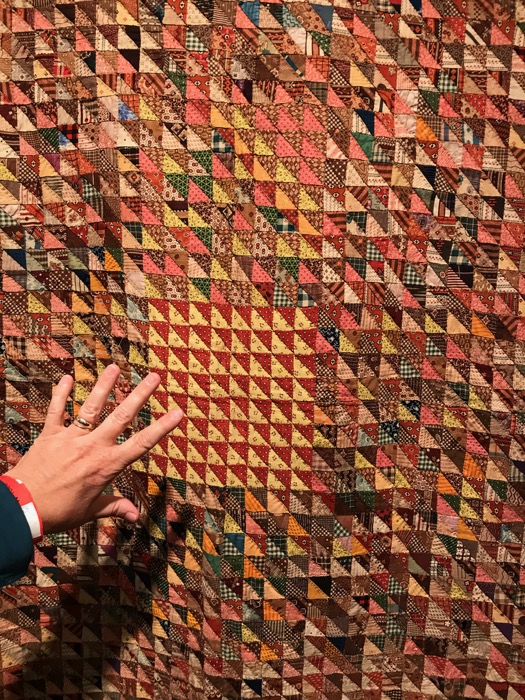
We weren’t allowed to touch the quilts (of course!) so I held my hand up to show how tiny those triangles are. This quilt is from Berks County, Pennsylvania, but I don’t have a date.
I’m sure all these quilts are from their new book. Info can be found on their website.
Now we were hungry, so we found this little “cafe” in the back of the theater, with fabulously dressed servers.
Although the flowers were pretty tired, I loved the attempt at patchwork on the vase, with bits of cloth glued to the glass.
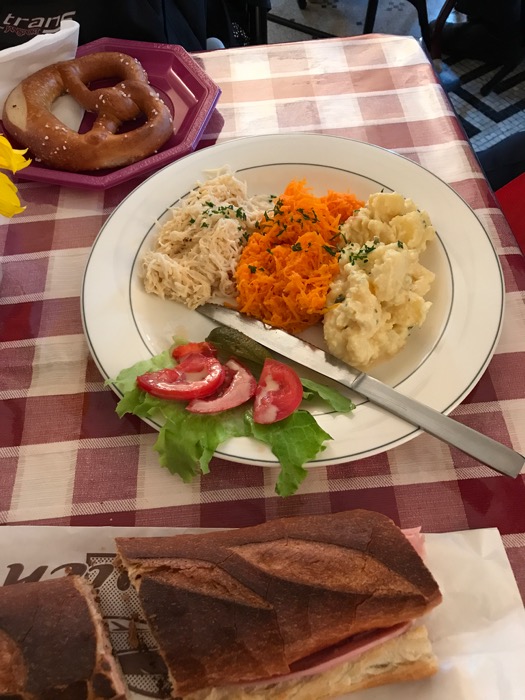
And this, folks, was the traditional Alsace salad with bretzel (with a “b”). My husband ordered this, but I went mainstream with the ham sandwich below. They were doing an active business, so we hurried and ate and went back out hunting quilts.
How’s that for a title? This post is all about the official competition of the Patchwork Meeting, and I have a sampling of the quilts in the contest. I purchased the Catalogue from the organizers and it was interesting that it is printed in three languages: French, German and English (yippee!). The contest theme this year was “Journey to the End of the World” and all the quilts were to be 35″ wide by 47″ inches tall. This was the first indication that it would be a different type of competition than I had been used to seeing in the States.
Car in main parking lot
I realized quickly that this would represent all different nationalities, cultures, countries, skill levels (generally really high) and all types of construction. I chose to notice not only their interpretation of the theme, but also the how and the why they chose to use the materials and techniques they did, always hoping to learn something new. These quilts are in no particular order. You can note the winners by the small rosettes in the lower right corner.
Tatiana Varshavskaya’s In the Beginning. She is from Hungary. Her artist’s statement wrote from the perspective on a three-year old, with “continents to conquer, horizons to overcome. Free, without anchors or restraints, you venture forever in the infinity of childhood’s imagination.” She finishes by writing “You are three years old, and sail to the unknown with a paper boat.”
Small Boat, Small Trip, by Sandra Van Velzen of The Netherlands. She writes “Not so long ago the length of your trip depended on the size of your means of transport. Nowadays planes and the internet seem to make the world smaller and the trip longer.”
Gabriele Yoeller, from Germany, created Finistere evoking “France, Bretange…where the sun goes down and the land ends. Even the Romans called this land: ‘Finis terrae.’ Before you: only water. Is there something else? New worlds…or a monster?”
A quilter from Spain, Eva Arrelano Martin created Into the Deep, an “homage to the effort of thousands of workers who spent and sometimes lost their lives in the their trip into the [great cavity] of the world.”
Two Americans, Jim Smith & Andy Brunhammer made “June 19th,” celebrating Andy’s birthday Their artists’ statement notes that “We are both long-term HIV-survivors, and our end of the world has always been just around the corner. We chose Kaieteur Falls in Guyana [where Jim’s father grew up] as the background. . . Our arm is reaching out with the cascading red ribbon symbolizing the flow or our blood. The clusters of pills are our life-force.”
Esodo, by Angela Minaudo of Italy says that “The work represents the journey of those who run from the land in search of a better life, towards other lands, other worlds, towards the end of their world and often toward the end of their lives.” Esodo means “exodus.”
A Japanese quilter, Chiaki Yagishita, made Japon. Her statement read “I think ‘creation’ and ‘infinity’ equals ‘silence.’ There is ‘silence’ in Japan and it is beautiful. This work expresses ‘Japanese blue’ [or] ‘the silent world.’ “
Anneliese Jaros, from Austria made 101 Views of Vesuvius (my translation of her title). She wrote that she loves the Gulf of Naples, and Mt. Vesuvius. “The eruptions of the volcano in the course of history have been the end of the world to many…Parts of the letters [by Pliny the Younger] describing the eruptions are printed in Latin on cotton, which are then overlaid by my own photos of contemporary views of the mountain.” I tried to capture the detail of the overlay, below.
Au pays des atomes translates to “In the Country of Atoms,” and is a quilt by French quilter Françoise Buzzi-Morel. She write that atoms “are able to reach the end of the world…beyond any human limits. And in one precise order, they geometrically follow parallels, cubes, circles and lines.”
Another French quilter, Eriko Krzyzaniak, made Emmenez-moi au pays des merveilles, or “Take me to Wonderland.” The colors of blue and gold were inspired by the icon of the Virgen Rynecka in the Church of Our Lady in Prague. “The drawing,” she writes, “was inspired but the poetry “The Little Flute Player,” by G. Brassens. It was the starting point of my ‘Wonderland.’ “ I snapped two more photos showing the detail of her work (below).
Rita Dijkstra, from The Netherlands, did a rendition of Mount Fitz Roy (her title). She describes it for us: “The road on the quilt leads to Mount Fitz Roy on the border of Argentina and Chile (Patagonia)….For me Patagonia stands for the end of the world. The only way you can travel more south from this point, is by taking a boat to the South Pole.”
No return was made by Anne Lillhom, from The Netherlands. She writes “From birth to death, we go through different stages. We have good and less good things happening in life, days with more colors and days with less colors. We have periods in life where life goes up and days where it goes down…Nobody knows what the life journey will bring us, the only that is for sure is….there is NO RETURN. We simply have to follow the path.”
Details, below.
Michèle Samter of Switzerland made Excitement of a big city, her tribute to Singapore. She writes that “The vibrating performance of all the lights in different colors from high-rise buildings and traffic all night long evokes [a] feeling [of having been to the end of the world]….The contrast between my home in Switzerland and this other city, which never seems to sleep, had a great impact on me.”
Incredible Voyage to the End of the World is by Dalia Eliraz, who is from Israel. She writes: “The Arctic tern’s [long] trip from Arctic to Antarctic and back is the furthest animal migration. Over 30 years, it will travel the equivalent of 3 roundtrips from Earth to Moon. My quilt is inspired by this super-migration bird, as a metaphor of human behavior [when] motivated by determination to achieve a life goal or purpose….whether it is love, academic ambition, artistic aspirations or nesting…”
Dreamland, by Elly Van Steebeek (from the Netherlands) She writes: “There is a place, [far] from home with a beautiful blue sky, singing birds, flowing rivers and dark rocks. And after a spectacular sunset there is total darkness, only a whispering wind and the sound of the busy. This is the land of my dreams!”
This is Edith Leidi, from Italy, and I was so excited to meet her, I forgot to take a photo of the complete quilt. The title is Stargate. What’s next? and I loved what she wrote: “My idea was born in the swimming pool. I was watching my husband’s hand diving in the water, so I created my stargate. The hand passes through it while the body remains on the other side. There is another hand in the universe, that is going to meet the first one. But…from where does it come?” Detail, below.
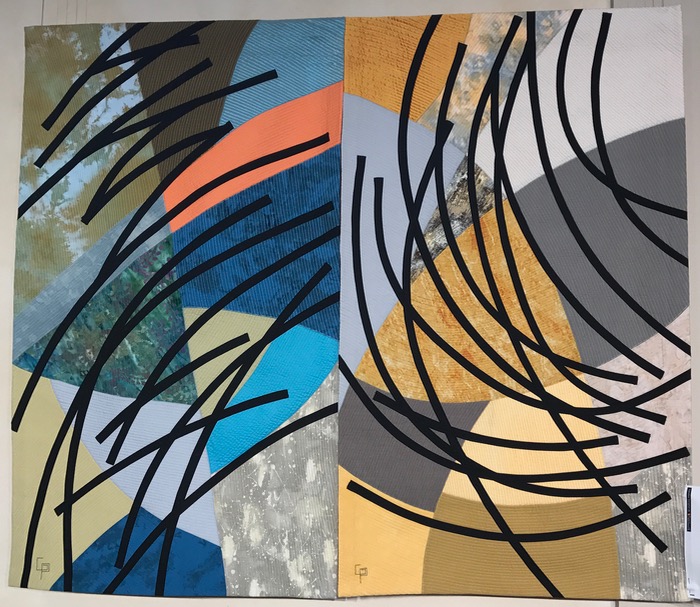
Gabrielle Paquin from France (who also had her own exhibit at the Patchwork Meeting) created Voyage en orbite. She says “The Earth [has] become too little for its population. It is necessary to find some exits in Space….we must in a future time go away for a journey…tempory of definitively.”
This quilt was on the front of their brochure for the Meeting, so we saw it everywhere. Chang Misun, of South Korea, created Pieces of memories. She says: “I think my way of life is like an endless trip. Pieces of past life and future life come together…[some] especially clear and some others are dim. Pieces of all memories were expressed in the works.”
Maryte Collard, of Lithuania, made Song of the Linen. Writing about returning to Lithuania, she notes that it “always feels like the trip backwards in time” due to the ancient language and that is was the “last European country to accept Christianity.” Because of this “traces of ancient customs still remain in daily life….Flax has been a traditional Lithuanian fiber for several thousand years. It has a special place in my heart and it sings to me the song about the trip to the end of the world.” Detail, below.
Watch me breeze through the complete catalogue, which I couldn’t figure out how to upload, which shows a few more quilts. Below is a photo of the giant poster, showing all our venues. The one above was above the L’Espace Commercial.
It was raining that day, but none of our wet umbrellas were allowed in the exhibits. Since I’d lost one already to an umbrella stand, I wasn’t anxious to repeat the experience, so I whipped out my souvenir Patchwork Bag, and we stuffed the umbrellas in there as we walked around. Everyone was happy.
More posts coming. The original post, with links, is found *here.*

 My husband held it up for me, but it’s big — about 80″ wide, and similar height.






























 OccasionalPiece--Quilt!