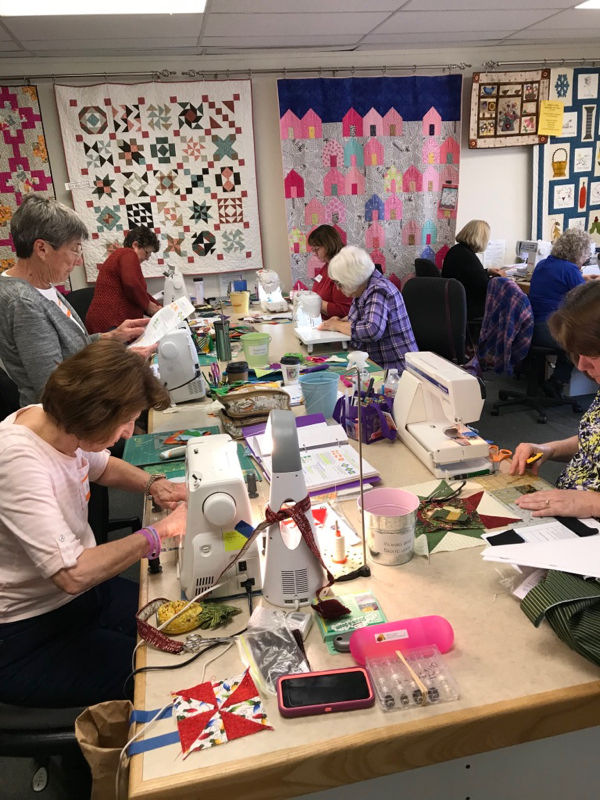
So often I spend days cramming it all in. I read Instagram, blogs, news, newspapers, and the sides of cereal boxes if there’s nothing else. I store up lists of patterns, of quilts to make. In the window of time I have in the day, I join sewing groups, plan trips to quilt conferences. Others head out on retreats, but all of us are filling up the spaces over and over and over.
The last two days I’ve been emptying out, which often happens when you leave home and live in a hotel space and walk in a strange city and ride busses (thankfully, given the time of Covid, they are somewhat empty). That first day is like detox, and you are anxious to pull out the stitchery in your bag, or read something or sew something, anything.
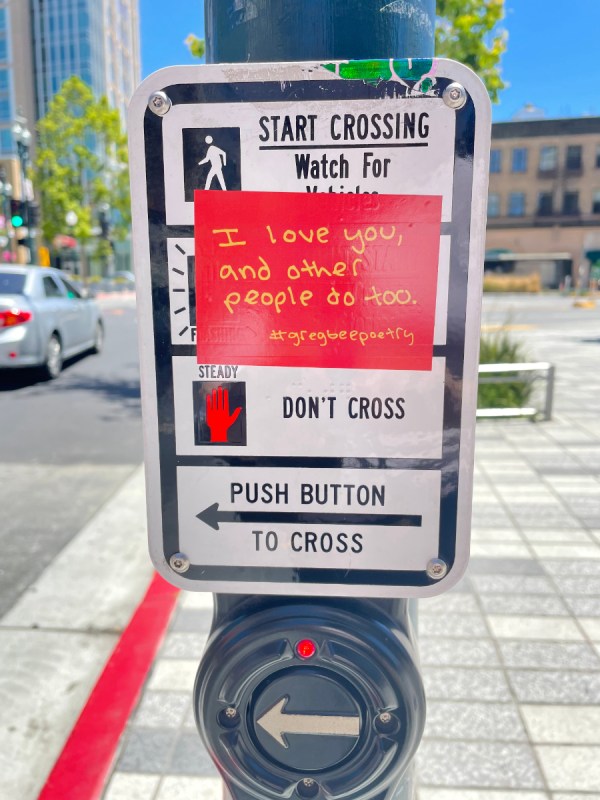
Then you find this notice on a crosswalk button and you smile. You have ten places to chose from for lunch, if you keep walking. You had great cookies yesterday, so you know where to find those today.
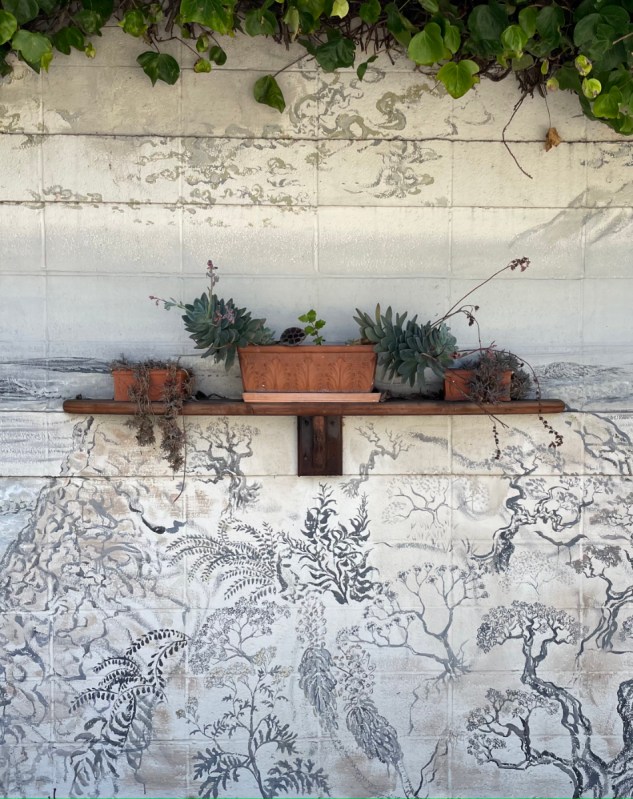
You notice where the tracery of pulled-off ivy creates a conversation with succulents and images inked in below.
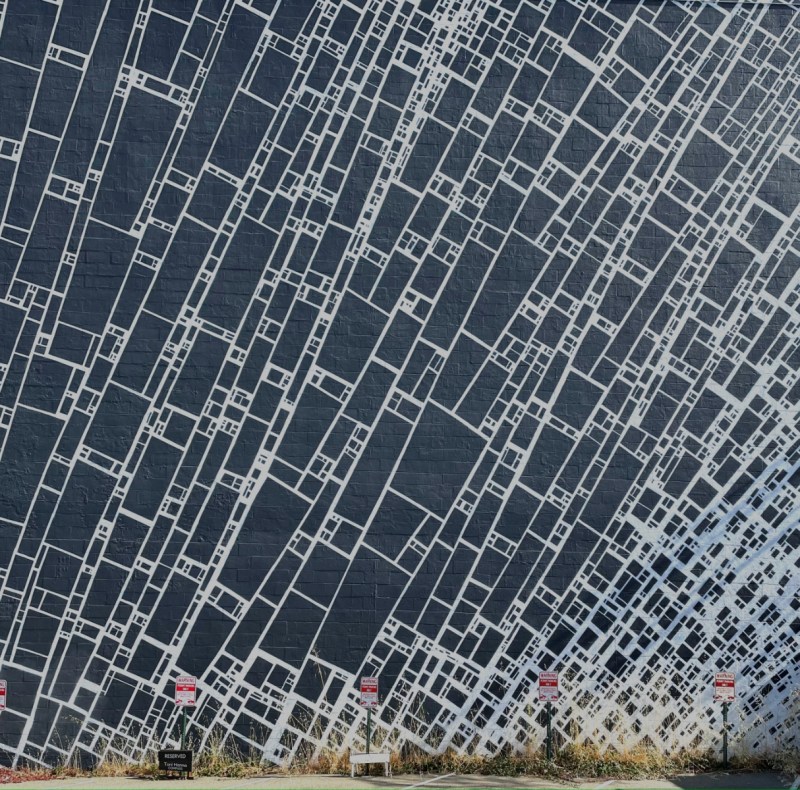
You think: this would be a great wall for a quilt photo, and you see other nooks, crannies, painted spaces, architecture, houses. You notice.
At the end of looking out of windows in hotels, busses, beauty shops (when you decide to get a haircut), your busy life hovers at the edges. It’s now looking in at you, waiting for you to come and pick it up again and make colors and fabrics dance in lines and curves and triangles.
Coming.
Also coming in the next post: Block Three of the New York Beauties series, plus some insight into how I figure out some of the weirdness of FPP.
Well, Happy Mother’s Day a bit early, actually, as tomorrow we are headed to Los Angeles to celebrate my sister’s newest grandchild. We’ll probably wear masks. Our luncheon is outside. Life goes on. Mother’s Day is a day to honor our mothers, and I’m lucky to have a great one. She turns 92 years old at the end of this month, and I am fully in Abraham Lincoln’s camp: “All that I am, or hope to be, I owe to my angel mother.”
I’ve had a great mother-in-law, and a mother-in-law that wasn’t so great — or at least that’s how I viewed things in my earlier life. Now that I’m a mother-in-law, I understand the not-so-great woman much better and hope she will forgive me for my failings. I’ve had great women who taught me how to quilt, mothering me into a craft that has sustained me for years. I owe them a great debt.
Where does the beginning start? We think this weekend of mothers and how they give birth to us and raise us. If we are fortunate we have a good mother. If life throws you a brutal curveball, you had a terrible mother. Reams of paper have been used in writing about those two polar opposites; I will not add my words to that pile today.
But somewhere we all had a beginning. Some beginnings are early, and we can locate the source and revere what gave us our start. Other beginnings come later, often after tragedy, pain, death, or divorce, and the reins of life are picked up again in a new beginning. I think it appropriate that whoever you decide is your mother — whether it be a birth mother, or an adoptive mother, someone who took you in, or someone who freed you to grow and fly — I hope that this day you are able to honor and remember them.
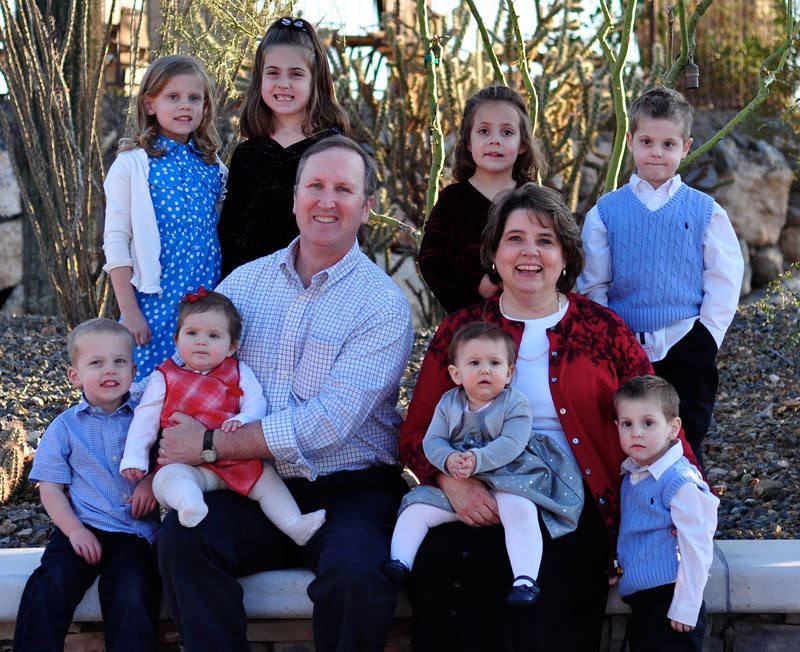
I also honor the mothers of all these grandchildren in our laps, a photo taken years ago, those young children giving us such delight (three are missing!). My daughter and daughters-in-law are all devoted to their families. I also love and respect my sisters, my in-laws, aunts, grandmothers. While there are always a few ringers, women who are best at a distance, I am fortunate to have such a great circle of love from women in my life, examples to follow and people from who I can pick up advice about teenagers, babies, husbands and daily living. And quilting.
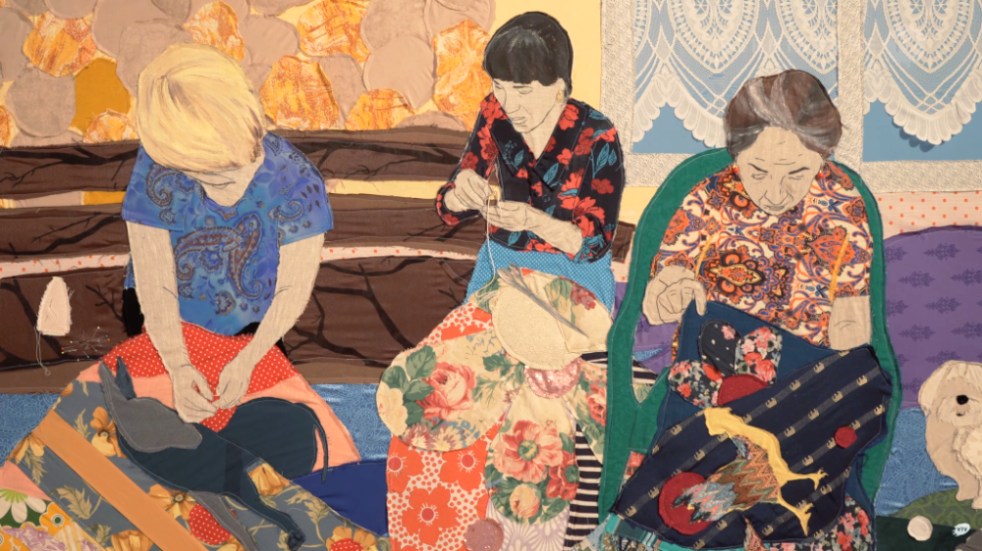
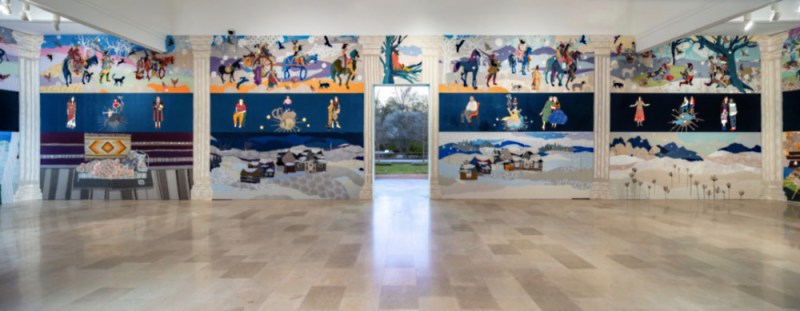
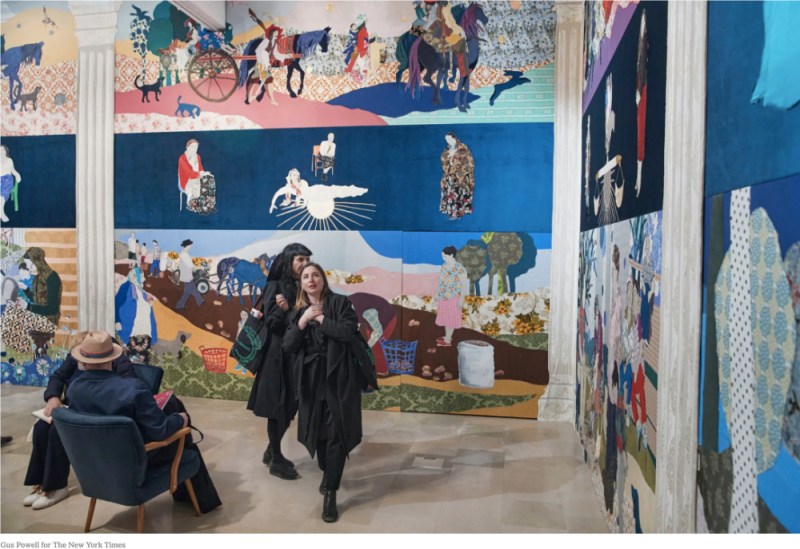
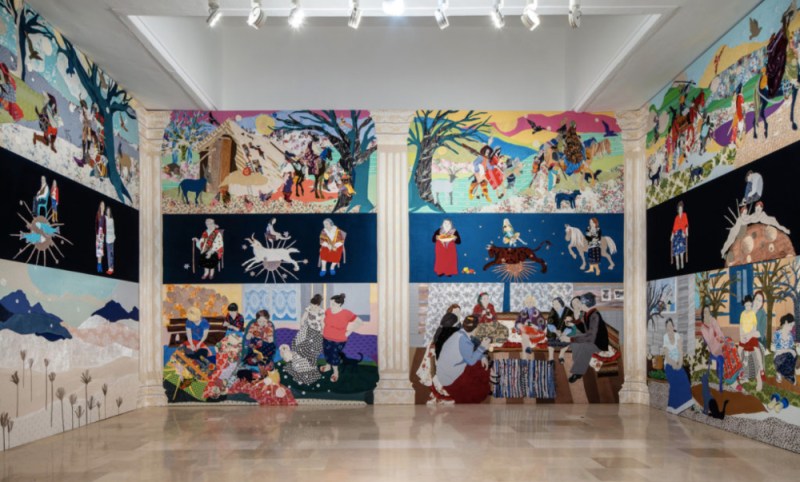
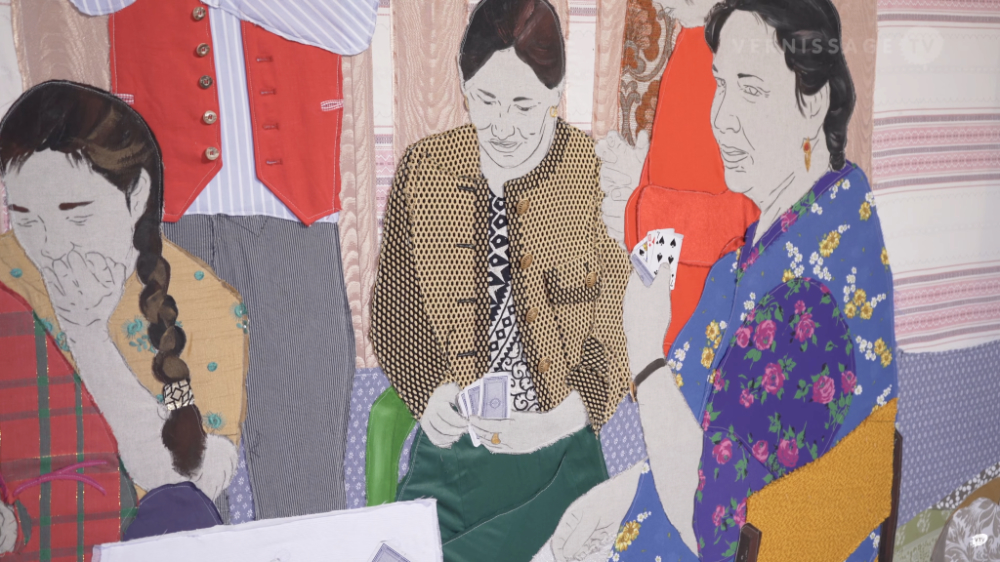
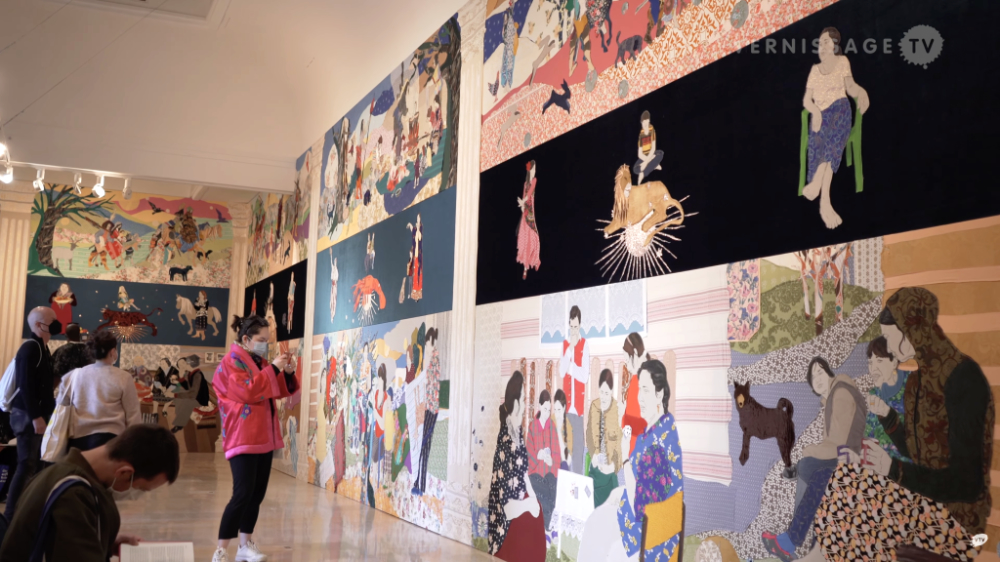
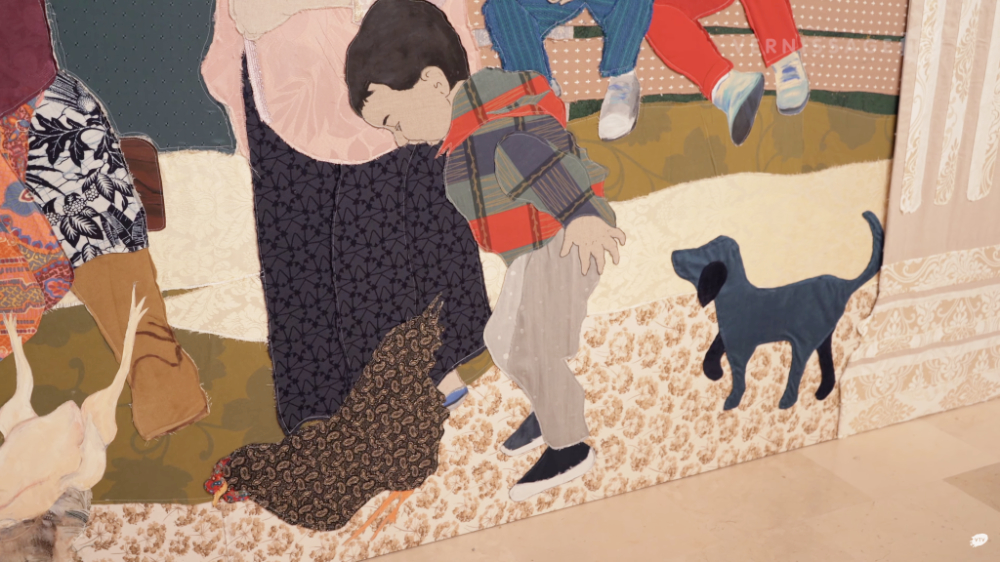
The Venice Biennale, the art or architecture exhibit in Italy, is shown every other year and it just opened. So all the art world has pictures everywhere about what is being shown and who is showing it. This one, using fabric, caught my eye.
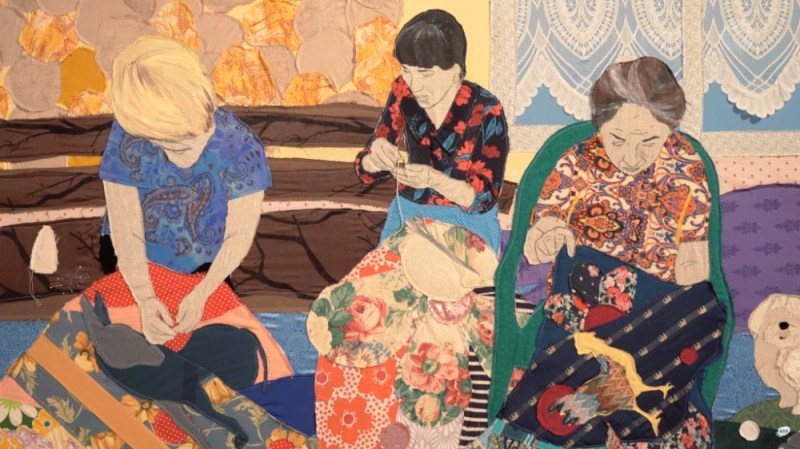
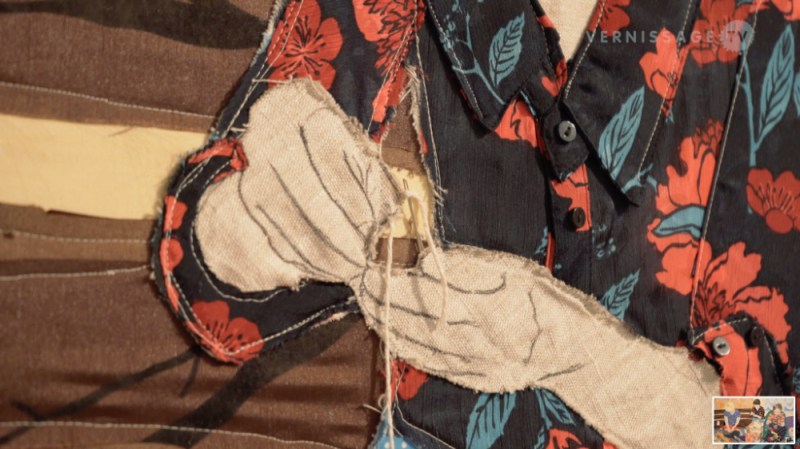
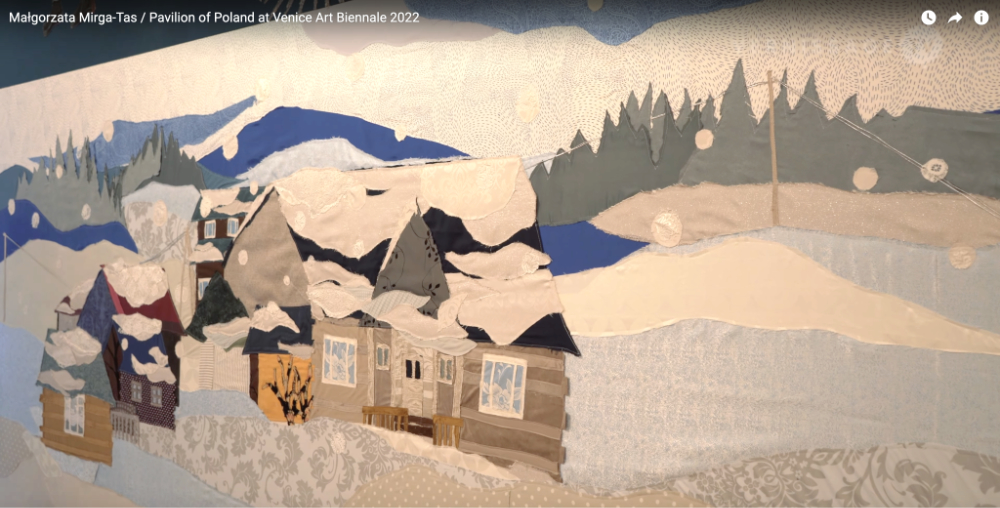
Polish-Romani multidisciplinary artist, educator, and activist Małgorzata Mirga-Tas has been selected to represent Poland at the Fifty-Ninth Venice Biennale. Her “Re-enchanting the World” will occupy the Polish Pavilion during the event’s run, from April 23 to November 27, 2022. Known for a practice comprising sculpture, painting, installation, and large-format textiles, Mirga-Tas challenges discriminatory Romani stereotypes and cultivates a positive image of Roma culture. Her work frequently incorporates clothing belonging to friends and family, which she collages into patchwork screens showing scenes of the garments’ wearers engaged in everyday life, smoking or talking or just sitting around.
There are several places in Venice, Italy where the art is displayed, and many nations participate. I grabbed screenshots from the YouTube video for the pictures below, because hey–it’s FABRIC; the video is a three-minute overview of the art.
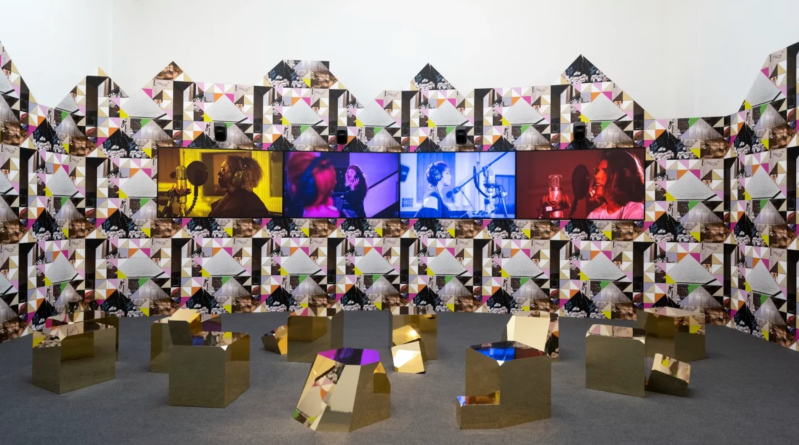
Britain took the National High Award (a golden lion) for their music presentation Feeling Her Way, by Sonia Boyce. I mention this also because the backdrop for her presentation are walls that look like patchwork and because the video is kind of cool to watch, to listen to.
I took a lot of photograph and digital art classes when I went to college and went through many “evaluations” or “workshops” of what we produced in the dark room/hovering over a computer. So I kind of laughed at one of the paragraphs in the Art Forum review, as it is so very “art-speak.” I propose some minor edits that can describe any of us and our quilts.
Original phrase: “unusually attractive visual form (opening the pavilion to a wider audience) combined with an original and deliberate ideological concept ‘proposing a new narrative about the constant migration of images and mutual influences between Roma, Polish and European cultures.’ ”
My Souped-Up phrase: I use an unusually attractive visual form, combined with an original and deliberate ideological concept of using various geometric and free-form shapes in order to propose a new narrative about the constant integration of images and mutual influences between traditional, modern and art cultures in my quilting.
Like that? You, too, can art-speak!
Happy Quilting!
P.S. I’ve been having some problems with some software changes by the hosting service and WordPress and I are monitoring how comments are emailed to me. If you have a moment and could help us out by leaving some sort of comment (even a word would do, but I read everything) so we can see if this is a bug, or a problem with their new forms, we’d appreciate it.
If you send me a comment, I’ll enter you in a drawing for all my old clothes, so you, too, can enter the Venice Biennale and be world-famous. I’M KIDDING. But if you could leave a comment, that would be great.
The famous and prolific writer Joyce Carol Oates was once asked, “What do you do when you finish a novel?” “I’m spent,” she said. “Can’t write another word of fiction. So I turn to writing poetry.”
Late Friday night, I finished stitching on the final border of the Heart’s Garden Mystery QAL (the slice of pink in the picture below). I sunk down into my sewing room chair, took a couple of photos and went to bed.
The next morning, her quip — about poetry — began boinking around in my head. I started my day by cleaning up my sewing space: emptying bins, throwing away junk-that-accumluates, vacuuming crevices and window frames. Then my husband came in and asked me to go out to lunch with him.
We happened on our town’s Saturday morning market and bought vegetables, a perfect tray of strawberries, and lunch at the local deli.
We ate outside on the plaza, escaping before the BoJangles Man set up with his amplifier, microphone and guitar.
We walked down the pedestrian mall and shared a Crème Brûlée donut complete with a crackling sugar top.
We wandered into Mrs. Tiggywinkle’s shop, and came out with this small Elenor Easterly figurine by Lori Mitchell. I sometimes find that aimless wandering and buying tchotchkes can often help a Mood.
Back home, I finished cleaning up. But I kept thinking about poetry. I used to write poetry, and was once Poet Laureate for University of California-Riverside as an undergraduate. I do have times when I hop onto Poetry Daily and just read for a while, sometimes typing in a search keyword but other times, just reading at random. It’s also great for quilt titles, if you need them.
I think, with poetry, there is an assumed connection between the external life and the interior life–one is linked to the other in a reciprocal relationship. But I feel that as well with creative or quilting projects. How I’m feeling internally will affect what I do externally, and if I’m exhausted or unsettled or wrung out, I have to deal with this. However, sometimes that creative connection is automatic — and I have to try to shut it down to relax (like wanting to take a photo of the table because it looked like it could be a quilt design or something.)
Oates’ poetry allowed her to keep creating, yet still leave the scene of her most arduous work. One example of this that we know all too well is our past two years which has kept us immersed in a strange world; many of us turned to our creative connection to help keep ourselves sane. We have all spent our two years chipping away at the gloom while trying to stay mentally and physically healthy. More than once I’ve wondered how my grandmother got through the 1918 flu, but she didn’t write about it. We’ve obviously found tiny slivers of poems (in the abstract sense) to help us — a child’s drawing, a phone call, or just taking a walk — things that can bring us back to ourself.
So after thinking about it, here were my poems for today:
I created a clean space. I admired the completed quilt top Heart’s Garden on the design wall. I created a space for me to listen the jet that roared through the skies, shaking our home, its contrails like two steaming taillights. I opened the window to feel the breeze.
I let myself rest. I let myself empty out.
Saturday afternoon, I sat at my neatened desk and read poetry, then copied and pasted two poems in below; hope you have time to glance at them.
And…I have already found two quilts that intrigue me, here and here.
(QCR’s Posh Penelope quilt, not mine)
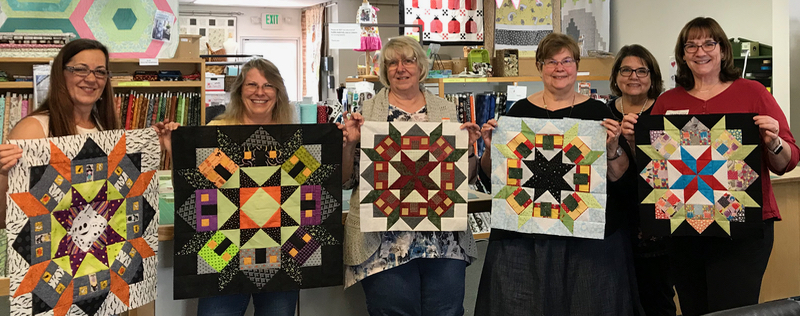
I took a look at the quilt I started at Road, and thought I’d like to make some more blocks. I do have one extra pattern from that day, and will send it to someone, if you are interested. To enter to win the pattern, please tell me what your “poetry” is when you are wrung out–how do you restore yourself…to yourself? How do you replenish that creative urge? How do you find your way back to creating again after a long project?
Leave me a comment below!
Happy Quilting!
Links, etc.
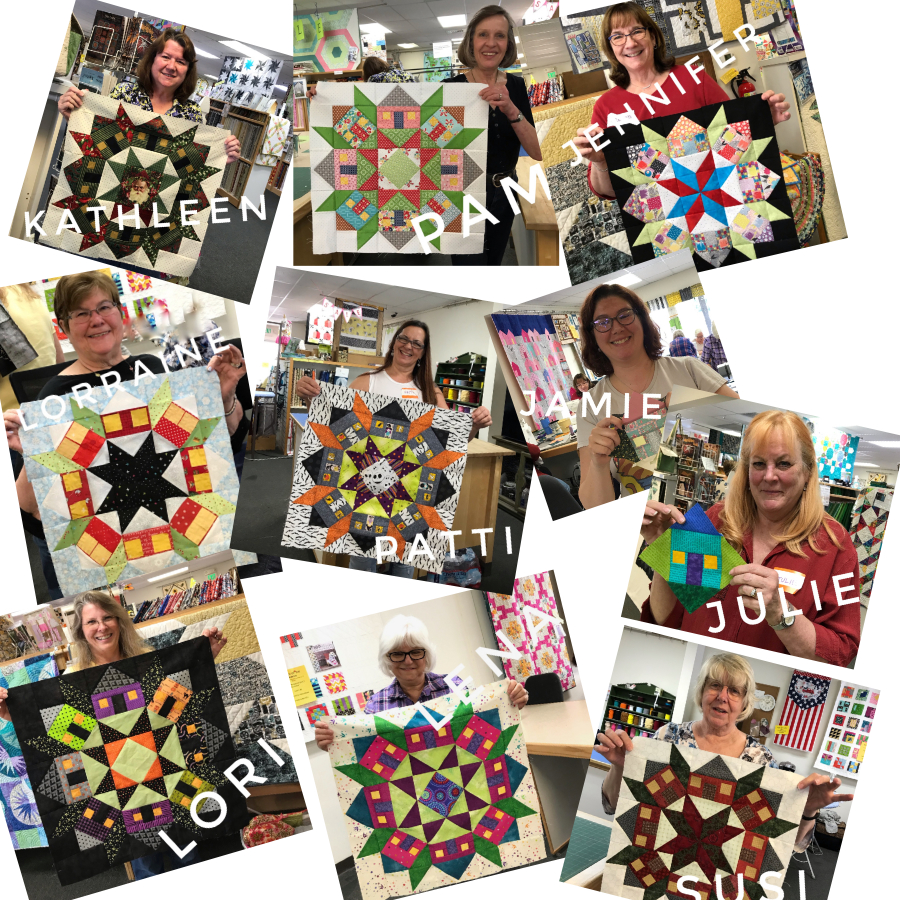
That’s a statue of Eliza Tibbets up there in the collage, with her skirts flowing. Tradition has it that when the first batch of navel orange seedlings arrived in the United States from Brazil, she persuaded the Plant Importation Program to give her some. They sent two, and they flourished — so the story goes — because she watered them with her dishwater. (She really didn’t look like that, but I still love that statue.)
Poetry Foundation, where you can read poems daily, and from where I pulled the following two poems. I also like Poetry.com for reading poems.
My mother has gone blind over the last decade, but she sewed intricate needlepoint canvases. All three of my sisters and I worry about losing our sight. After reading this poem, I should probably take up crocheting.
poem is from the September 1918 issue of Poetry, from here
This poem is haunting, reflecting our world today, but instead of pink roses, we stitch blue and yellow patchwork. Armistice Day for World War I was a month later: November 11, 1918.
Leave a comment about what your “poetry” is, to enter the giveaway. Thanks!