Sometimes, like after I’ve been gone from sewing for a while, I need to ease my way back into the creating. Sometimes I like to visit blogs by quilters, such as Jane Sassaman.
. . .architecture (photos of La Sagrada Familia in Barcelona). . .
. . . and other makers’ work, like yours:
But then I remember that applying the seat of my pants to the sewing chair is what gets things done. Or as Chuck Close put it:
What gets you going, after a dry spell?
I really loved reading about all your travels, and hoped-for travels. You do inspire me to consider new destinations to investigate. Congratulations to Betty, our winner of the pearl cotton threads:
I’ll get those out to you in the mail. Look for my note via email.
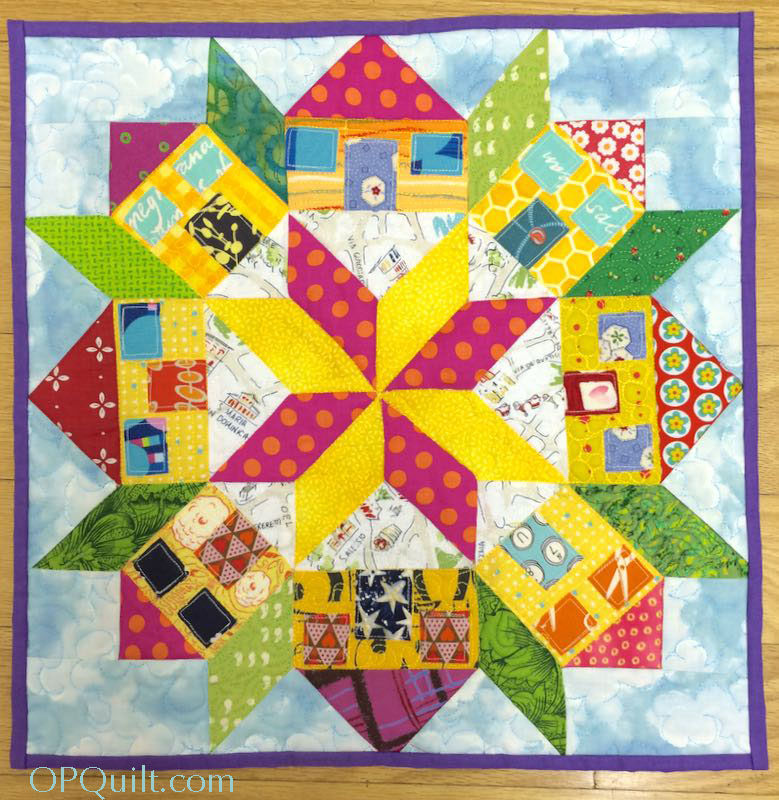
The Road to a Friend’s House is Never Long, Quilt #159
I started this July 2015, and you know what happened to me shortly after that, so it was nice to get it fixed up and quilted, because I’d had a purpose in mind: a gift for a friend.
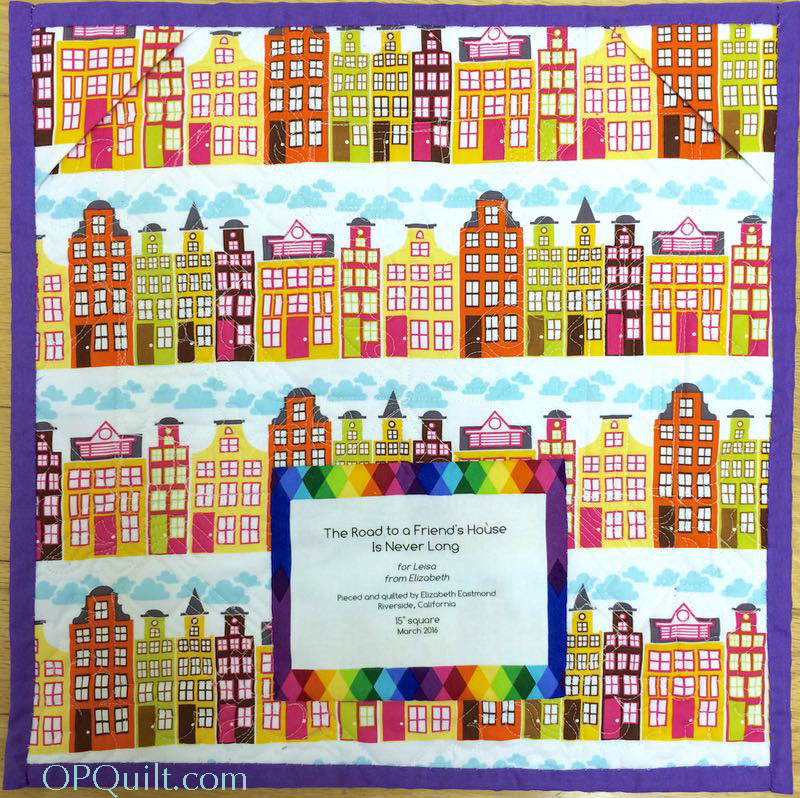
Leisa likes it! Pattern coming soon. I used the new Northcott labels I bought at QuiltCon. I just cut them apart, backed them with freezer paper, and ran them through my printer; see the complete how to under the tab “Tutorials,” above.
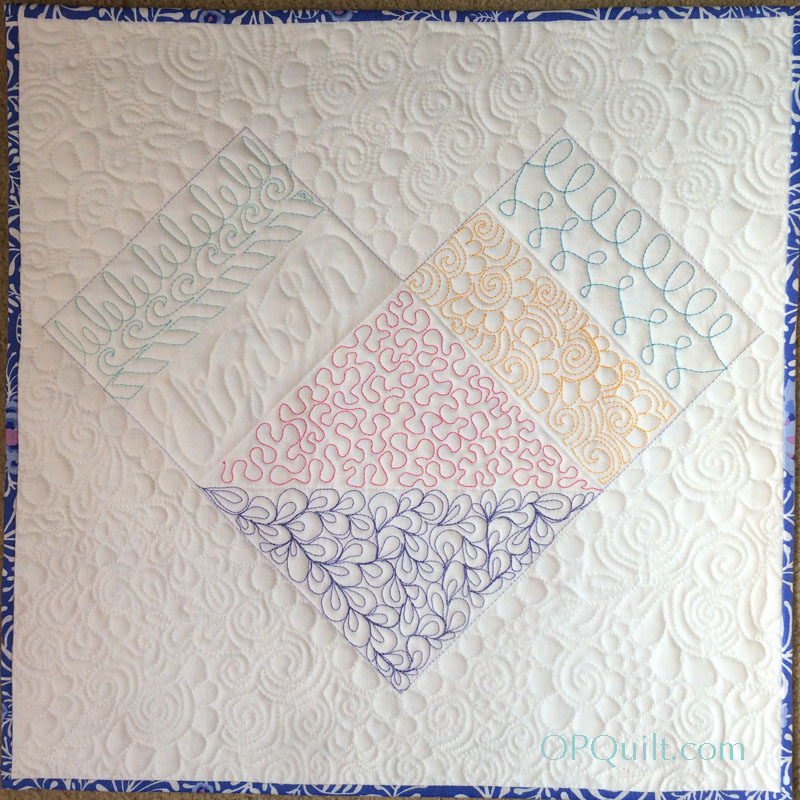
Thread Doodles, Quilt #160
And then there’s this one, a mini quilt made as a class sample for the Free Motion Quilting Class I’m teaching in late summer at Quilter’s Cocoon. I had to think of a way for the students to practice their stitches, yet display what they’d learned in a pleasing way. As soon as they master one of these stitches, I’ll have them stitch it onto their own class sample. They may want to finish it all up that day, or may want to add to it as they get better.
I’m big on naming my quilts. Another Northcott label. After they are printed, I cut a square of lightweight interfacing and fuse it to the back the “light” section of the label so I won’t see the fabric underneath.
Electra Magnetic, Quilt #161
I seem to be finishing up quite a few things lately, a nice change from the months November to February, where I felt swamped all the time, unable to seemingly get to anything. Do you have times like that–like you see everything around you and just can’t get to it at all? Where you are climbing, climbing Mt. NeverFinish and wish you could find the summit? That’s why these minis feel like a success story to me.
So, with all my rainbow-type quilts this past year, I’ve about run out of names. Combine that with the funny comment I got on one of my quilts that they thought it looked like Hal the computer from the Space Odyssey 2001. This quilt might also suffer from that comparison, so I thought I’d go with it. The electromagnetic spectrum is all the colors, from those that we can see to those that we can’t; they call it “wavelengths, both visible and invisible.” Okey, dokey. So I feminized that idea and came up with Electra Magnetic, mother of Hal.
I’m still working on these patterns, and should have them out shortly. Well, maybe not this week; I’ll let you know.
But let not’s stop there today. I have Brain Pickings in my Bloglovin’ Feed, and occasionally they hit a streak of book reviews on topics that interest me, and recently they did a review of Ursula LeGuin’s latest revision of her masterpiece on creative writing, Steering the Craft. Brain Pickings references her written piece “How do you make something good?” and notes that:
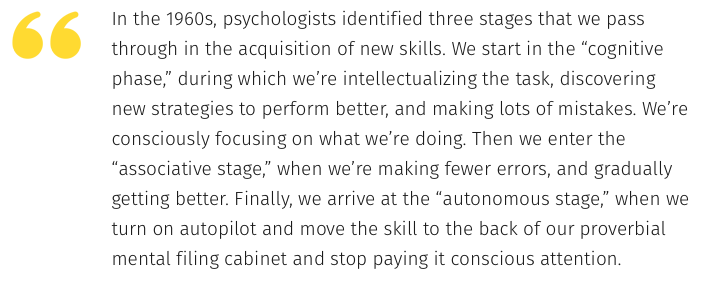
Isn’t that also what quilters deal with? We can make a decent quilt from stuff from the garage sale or someone’s basement (with that embedded fusty smell), but why not go for better ingredients? We are surrounded by loads of high quality quilt fabric. Perhaps instead of focusing on accruing endless supplies of this good fabric, why not focus on being good? That means getting in those oft-cited 10,000 hours of practice, but as Joshua Foer noted, sometimes just making and making doesn’t bring us to the place of making something good.
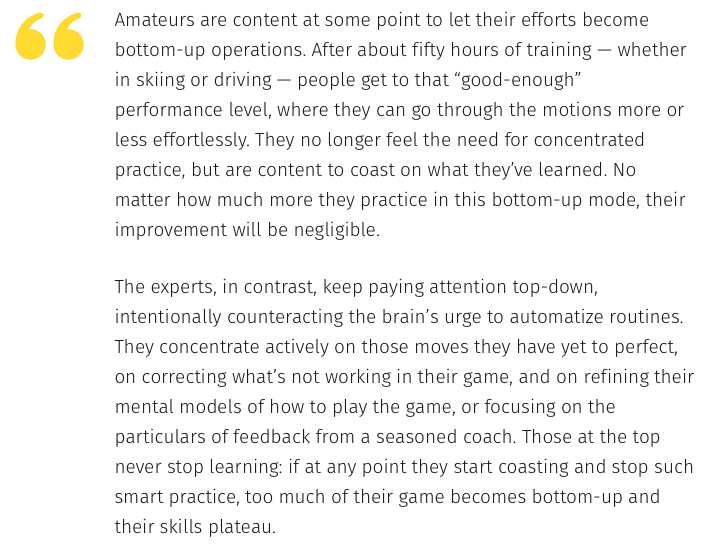
According to Joshua Foer, this is called hitting what is called the “OK plateau.” That’s when we are just going through the rote mechanics of quilting, making quilts of only rectangles, or traditional fixed patterns in a loop that’s known as thinking from “bottom-up,” where we are good-enough, automated, rote practices to get our work done. Yes, even those modern improv quilts with their fluid patterns can get stale. Daniel Goleman notes how we can get stuck here:
Foer also emphasizes this point: our deliberate practicing must be hard for us in order to engage that higher focus of creativity. I, like many of you, can cut and stitch until I’m so bored I can’t slice one more piece of fabric or sew one more HST. I’m falling right in line with studies that indicate that about four hours of concentrated deliberate practice is about the most amount of time we can do anything well. At that point, we have to take a break and do other things. Perhaps that’s why we are sometimes distracted by a new quilt, or a new design, or a new piece of fabric, as we try to restore our ability to refocus. Perhaps we just need a break, in order to deliberately practice well. But what I learned from these authors is that when I do come back to my quilting, I must “counteract the brain’s urge to automatize” and actively concentrate on what I’m doing.
So take a break, read that magazine, scroll through your IG feed, and then get back to it with a determination to make it good, make it better, and to fully engage.
I did the Husband Random Name Generator today and Diane Nelson is the winner of the pearl cotton bubbles. Congratulations, Diane! I mailed them off this afternoon to you. Glad you are making good progress on your Oh Christmas Tree.
I received my latest Frivols tin, with the cutest little scissor holder–it will just fit nicely over my embroidery scissors. I signed up for a year of these as a retirement present to myself. So far it’s going along nicely: I have a stack of seven tins on my sewing room shelf (they have numbers on the side to keep track of them), with none of them made. I think I need to stop putting this off.
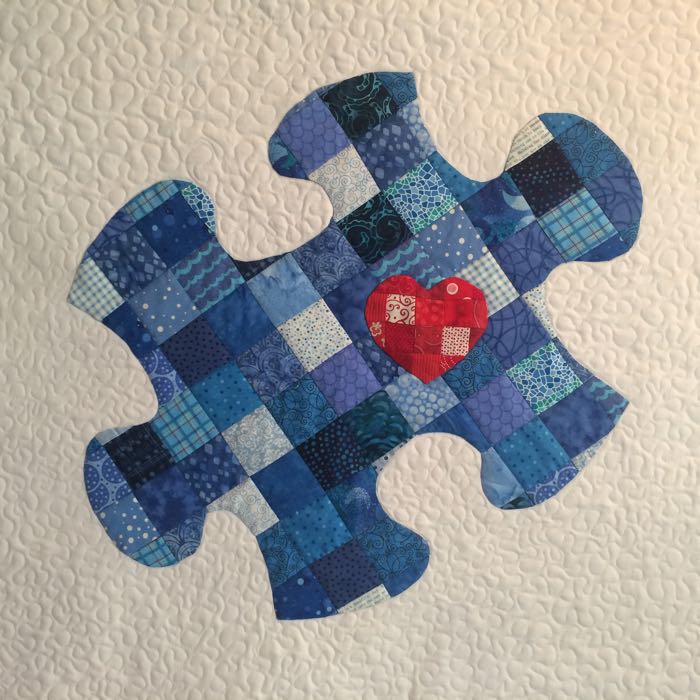
Laurel let me stipple on her quilt for her yesterday. Isn’t this just the dream of a mini quilt? It’s for an auction for Autism Research.
Bee blocks are in my life right now. I was Queen Bee for January in two bees, and they are rolling in–one batch of words for Spelling Bee was held up by a snowstorm in the midwest, and the rest of the words are being held back by my procrastination (see notes at the end of this post).
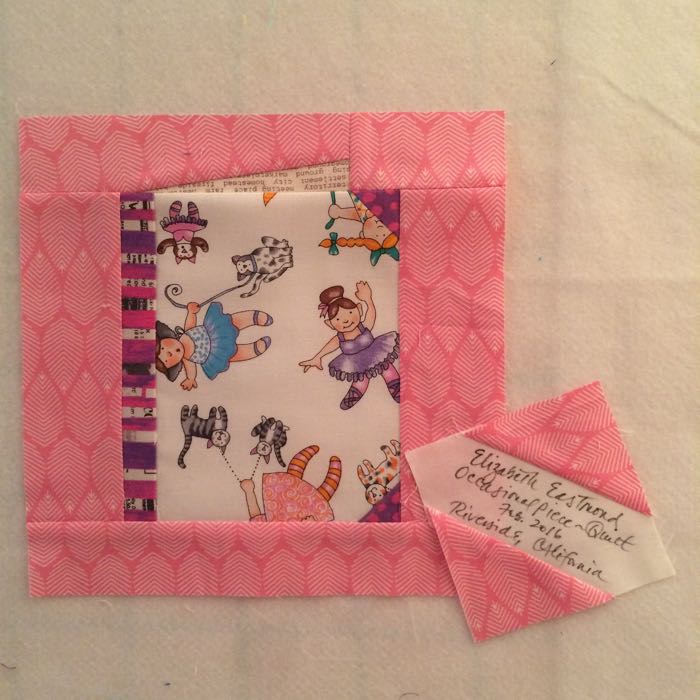
I finished this book block for Cindy’s granddaughter’s quilt last night, and there’s my signature block. I love that in our bee we do signature blocks for each other; we also do them in The Spelling Bee too.
Time to gear up for February’s Chuck Nohara blocks. Looks like we have more piecing than appliqué this time around–should go quickly together. Susan has already started hers: here and here. She’s quick!
Maybe not getting to them until now means I’m just taking to heart the advice from Adam Grant in his recent New York Times article “Why I Taught Myself to Procrastinate.” He wrote that “while procrastination is a vice for productivity, I’ve learned — against my natural inclinations — that it’s a virtue for creativity.” There’s a term for that process of always working to finish things early. It’s pre-crastination. Grant notes that “Pre-crastination is the urge to start a task immediately and finish it as soon as possible. If you’re a serious pre-crastinator, progress is like oxygen and postponement is agony. When a flurry of emails land in your inbox and you don’t answer them instantly, you feel as if your life is spinning out of control.” Some of this is to reduce “working memory loads,” because, as Grant reports, “psychologist Bluma Zeigarnik found that people had a better memory for incomplete tasks than for complete ones. When we finish a project, we file it away. But when it’s in limbo, it stays active in our minds.”
Yes, apparently putting things off can make you more creative.
How can procrastination help? Grant writes that “[o]ur first ideas, after all, are usually our most conventional. . . . When you procrastinate, you’re more likely to let your mind wander. That gives you a better chance of stumbling onto the unusual and spotting unexpected patterns.” Of course, as anyone knows, especially my daughter who was helping her son with his last-minute science project (how do these things slip our children’s minds until the due date??), excessive procrastination can also work against creativity, forcing you to choose the easiest route in order to get things done.
And today, this day in the first week of February, when I’m tired from chasing January’s deadlines and putting away the Christmas tree lights and mailing back all the things that were left in the house over Christmas vacation and summer is too far away to be of any help and QuiltCon is looming so how can I possibly concentrate, it might be helpful to realize that sometimes it’s really okay to put things off, as well as knowing that procrastinators have lots of good company.
I found it while researching images for this quarter’s Four-in-Art challenge of “microscopic.” The overarching theme is color, so of course, I was drawn to this as an idea for a quilt, hating what I’d already started piecing a couple of days ago. As any good grad student knows, the best way to postpone the inevitable work on a deadline is to do more research.
The image of cocaine is from a website run by Michael Davidson, who recently passed away. But he would take the images from his laboratory’s microscope and use them to make neckties. I thought we could keep going and use them to make quilts.
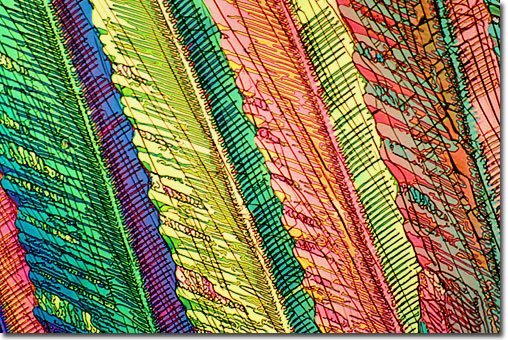
This is nickel oxide on sodium chloride, an image from his website. After exploring his butterfly gallery, I moved on to the pharmaceutical section, and noticed that not only were Mr. Davidson and his team a whiz with microscopy, they also had a sense of humor, as witnessed by the last line in the description of caffeine:
To quote: “Caffeine is a central nervous system stimulant most commonly found in the coffee we drink every morning….Symptoms of overdose include insomnia, restlessness, tremor, delirium, tachycardia, and running of the mouth.”
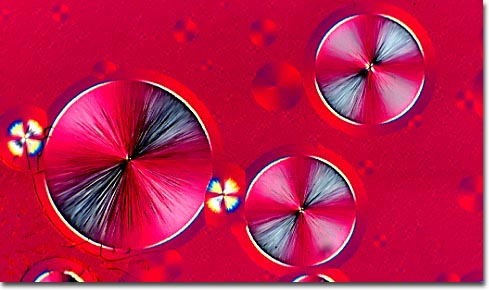
Taxol, a drug used in chemotherapy. I’ve pinned quite a few of these to my Pinterest Board Art Quilts, as they will become the inspiration for this quarter’s efforts.
Not only was wandering through the internets a way to spark my creativity for this month’s looming deadline (to be published on Feb. 1st), but also I allowed myself to goof off do the research because of an article recently published in the New York Times about Serendipity, or more specifically, “How to Cultivate the Art of Serendipity,” by Pagan Kennedy. She talked first about the word’s origins, noting that we “think of serendipity as something like dumb luck.” But it was coined in 1754, when Horace Walpole noted that he “had been entranced by a Persian fairy tale about three princes from the Isle of Serendip who possess superpowers of observation.” In writing a letter to a friend, “Walpole suggested that this old tale contained a crucial idea about human genius: ‘As their highnesses travelled, they were always making discoveries, by accident and sagacity, of things which they were not in quest of.’ And he proposed a new word — “serendipity” — to describe this princely talent for detective work.” So, as Kennedy notes, the word meant “a skill rather than a random stroke of good fortune.”
She quotes Sanda Erdelez, a University of Missouri information scientist, who divides serendipitsts into three groups: ” ‘non-encounterers’ ” or people who see “through a tight focus, a kind of chink hole, and they tended to stick to their to-do lists when searching for information rather than wandering off into the margins. Other people were “occasional encounterers,” who stumbled into moments of serendipity now and then. Most interesting were the “super-encounterers,” who reported that happy surprises popped up wherever they looked. The super-encounterers loved to spend an afternoon hunting through, say, a Victorian journal on cattle breeding, in part, because they counted on finding treasures in the oddest places. In fact, they were so addicted to prospecting that they would find information for friends and colleagues.”
So, maybe in “researching” my Four-in-Art quilt, I’m just really being a super-encounterer, finding that “happy surprises” pop up with each click of the mouse button.
Or maybe, I am just putting off the inevitable: getting the work done.
Four-in-Art Microscopy. Coming soon to a blog near you. Premiering February 1st, 2016.
˚˚˚˚˚˚˚˚˚˚˚˚˚˚˚˚˚˚˚˚˚˚˚˚˚˚˚˚˚˚˚˚˚˚˚˚˚˚˚
P.S. Pagan Kennedy has written a new book, titled Inventology. The blurb from her website says “Inventology is a must-read for anyone who is curious about creativity and imaginative leaps.”











 OccasionalPiece--Quilt!