First Monday Sew-day · Quilt Patterns · Quilts · Something to Think About · Tutorial

Economy and Rough Drafts

Economy Block_6

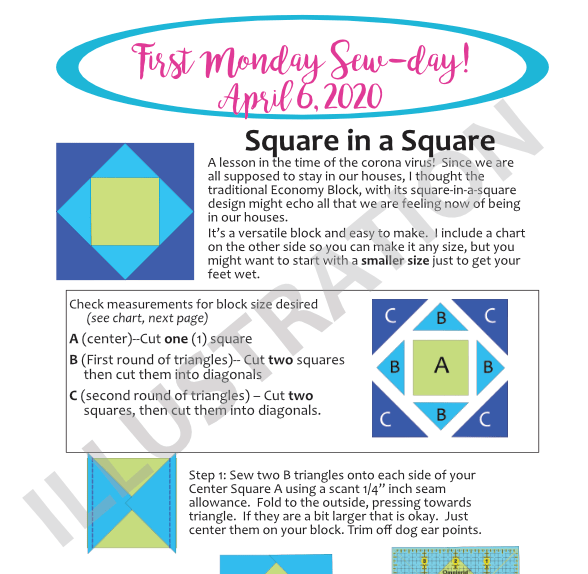
I help teach a group of beginning quilters, and we call ourselves First Monday Sew-day, and yes, I know it’s not the First Monday today, but it’s COVID-19 season and nothing is normal anymore.  For this First Monday Sew-day, I chose to teach the Economy block, also known as the Square-in-a-Square block.
April 2020 First Monday ILLUS.png

I’ve made a little handout to go along with this, which includes a detailed chart of measurements.  Click to download the PDF file:

FirstMondaySewday_4_2020

(NOTE: I’ve also collected all my First Monday Posts and put them in their own page at the top of my blog, just in case you want to find them easily.)
Economy Block_1

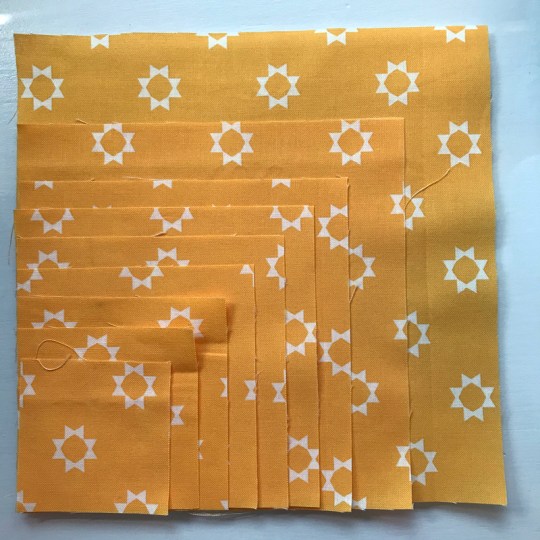
I looked at Catbird Quilt Studios’ chart, but then decided I wanted to test out my own measurements.  First I cut some sunny yellow fabric for the centers.

Economy Block_2

I pulled some neutrals from my stash, cut the triangles, then painstakingly went through each measurement, adjusting it to what I thought would work for teaching beginners, then went to work.

Economy Block_2a

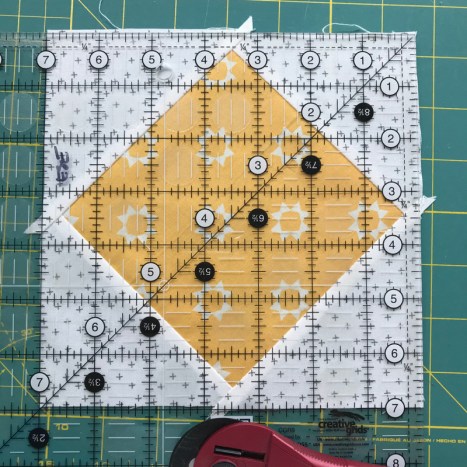
After getting the first set of triangles on, I squared it up, jotting down the measurements as I went through each size.
Economy Block_4cEconomy Block_4bEconomy Block_4a

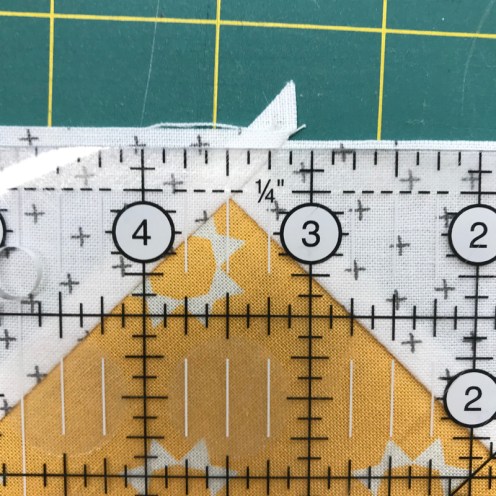
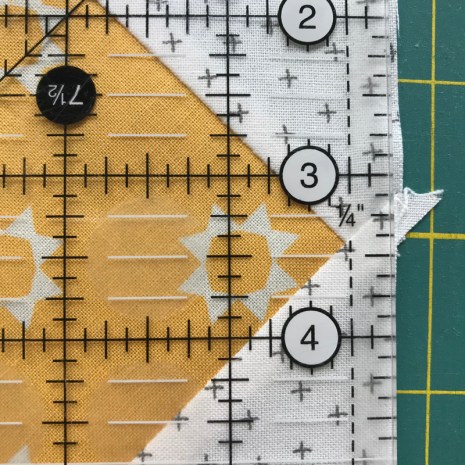
When you trim, do your best to leave a 1/4″ of seam allowance at each point, as shown above.

Economy Block_5

I love this color of blue, known around our house as painting-tape blue.

I’ve already put the triangles on the first two sides and pressed them.  Now I’m starting on the second set, with the finish below:Economy Block_3

Economy Block_7

Here are all the sizes, stacked up together.  I’m thinking bordering the smallest sizes again to equal that large 15″ block in the lower left, and seeing what evolves.

ISpy_ISpyPanel_Bermuda

This is a free pattern from the Robert Kaufman Fabric Company, and it uses the Economy block, but the quiltmaker fussy cut center blocks for more interest.

Into the Woods front

I added one more set of triangles on this economy block to get this quilt. Doing a search on “economy block” yields lots of images to scroll through.
Pinwheel with Economy.jpeg

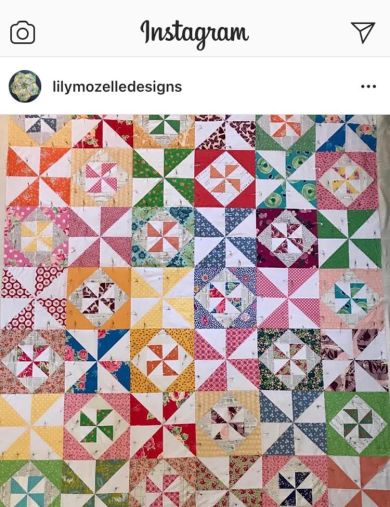
I liked how this quilt maker had pinwheels inside their Economy blocks.  Our beginners learned how to make pinwheels when they learned about Half-Square Triangles.

tiny nine patches

Making Masks April 2020

And I’m still making masks.  I am making them for people I know, friends and family who need them as our particular county is a mask-wearing place.
Mask Iteration 4.jpg

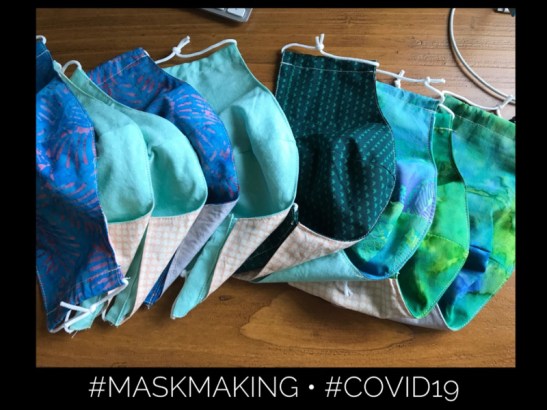
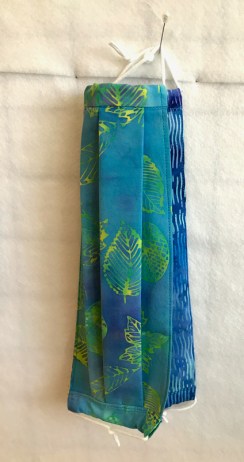
So when two friends came by and I realized that these masks wouldn’t work for them, I went back to the Accordian-style mask, added a nosewire sleeve and turned the sides into plackets, through which I could slip some elastic.

I’d say this is the fourth or fifth iteration of cloth masks that I’ve made.  I kept wondering why I couldn’t be like all the other mask-makers of our particular universe, and just settle into one kind?  I was heartened by “Tear It Up and Start Again,” an article by Harry Guiness, that reminded me of things I used to teach my college students, back in the day.  I reminded them never to turn in their first draft, as the really good writing starts to happen on the third or fourth rounds (inevitably the class would groan about this point).  Guiness notes that “Too often, when it comes to self-improvement, we create idealized, top-down systems with unnatural rules and regulations. We naïvely assume that we will somehow stick to our rigid plans when life gets random and hard, throwing unavoidable chaos and crises into the mix.”

We’ve all had some unavoidable chaos recently.  While this article dealt more with those self-improvement plans we all make for ourselves (I hope you have all torn yours up during this stay-at-home time), I did like his nuggets of truth, such as this one: “When a plan or resolution fails, the solution isn’t to dismiss it and try a new, equally rigid prescription next year or next time. It’s to build on what worked, ruthlessly cut what didn’t and start straight away on a much-improved second draft.”  I like that I won’t have to discard what I learned in my first draft, but can carry forward the best parts.

“I never lose. I win or learn.” This phrase has been attributed to many, but whoever said it was on to something.  Hopefully we won’t lose during this time of forced idleness (for some), crashing boredom (for some), an onslaught of toomuchtodo (for some).  We can win at our tasks if everything goes smoothly.  However, you can tell by my variety of masks that it doesn’t — usually — go smoothly for me, but we can still learn new things about others, or new things about ourselves.

I’ve learned I like to tinker to figure out which mask will fit which face.  I’ve learned that I can’t read the news before I go to bed at night.  I’ve learned that my current forced isolation and distraction (courtesy of the novel corona virus) is not the best working environment for getting my quilting projects done.

I’ve learned a million new science-y facts about peak dates and doubling rates and flattening the curve and so on (I am married to a scientist), which may or may not come in handy in the Life After COVID-19.  But hopefully I’ve also learned that my first drafts can lead to successful subsequent drafts, no matter whether it’s writing, or quilting, or making masks.

tiny-nine-patches

Last Supper
The Last Supper of Christ, by Jorge Coco

Happy Easter to everyone!
Something to Think About

Quilting in the Time of Covid-19

Angel Death_Sculptor

Like so many of you, my life feels right now like this sculpture in the Metropolitan Museum of Art, placed in the American Wing; we seem to take a photo (or five) of it everytime we go there, so that it ranks it right up there with snapshots of anything Monet.  It is titled The Angel of Death and the Sculptor, by Daniel Chester French.  The sculptor is mid-stroke and the Angel gently takes his hand — stilling him —  as if to say, “You’re done for now.” If this work seems familiar to you, French was also one of two sculptors who created our Lincoln Memorial.

I came slalomming down off my very enjoyable time with the Orange County Quilters to a buckets-of-rain day, one where I’d normally stay in, but that day I went to two different grocery stores, trying to stock up our house.  In two-days’ time, our world came roaring to an end with the advent of the novel corona virus, also known as (and always in all caps) COVID-19.  I had it easier: one of my friends was in Brazil at Iguazu Falls, and did about a 28-hour turnaround trip back home.

Yesterday I sent a letter out to some friends and the outward flowing of goodwill back towards me, and to others on the list, has helped me deal with this isolation.  I was feeling undone by the contant drumbeat of bad news and sadness and worry about our hospital workers on every level and the deaths and the lack of tests and misinformation and too much information and should I make masks and will my neighbor give the disease to me? sort of stuff.

So to get myself back on track with doing something creative, I’m listing here some of the projects I hope to undertake.  These are quilting projects only.  I have lists and lists of finishing up the house, regular stuff, and the burning question (which, feel free to comment on) is whether I should have the house painters back to finish up the details on their recent big job?  I’m calling it Quilting in the Time of Covid, with apologies to Gabriel García Márquez.

quiltinginthetimeofcovid

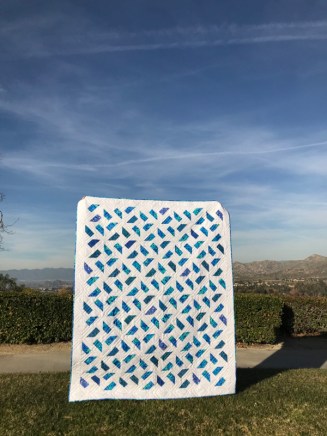
  1. Finish quilting and binding a quilt I’m referring to ReJiggered.ReJigger

It’s a variation of City Streets, just in different colors.  I’d thought about the name Vitrailed, which means to set with stained glass, because the Tula colors are reminscent of our trip to La Sagrada Familia a couple of years ago:

LaSagradaFamilia_3.jpg

2. Totebag with Spectrum Pattern on side

Spectrum Tote Bag EPP.jpg

I’d made this for an EPP workshop I taught last August, and gave it away.  I’d like to try another, in different colors.

3. Make up Azulejos in a tangerine/indigo version

Azulejos Quilt_1

Fabric gathered — check
But that’s all.

4. Work on the quilt that I’m calling Eridani (no image yet).

If we all ever get back our lives, I’m supposed to teach this in October of this year.  Stay tuned.

5. Make face masks.  

Face Mask Orange Dot Quilts

So my husband and I had this conversation this morning while getting ready for our Stay-At-Home Church, and it went something like this: If only the people who get sick are supposed to have face masks, yet all hospital personnel have face masks, should we have face masks to protect ourselves, too? Yes, but…the big caveat is if you are using a purchased face mask, then no.  I’ve chosen Dora’s version (above), and will be making a few for ourselves and family.

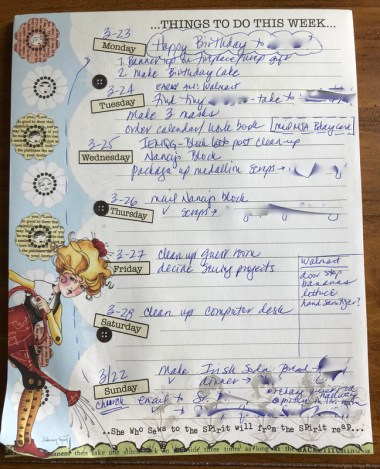
ToDo_March 2020

In cleaning out I found a  To-Do List pad which only has 3 lines on it per day.  So I have to choose only three things to accomplish.  Last night when I couldn’t sleep, I made a week’s schedule, listing only three things.  But then my Frantic Self addded more and more, writing in the margins and on the back.

Why is it that in this time of coronavirus, we still feel the push to do?  I think it’s because we want our routine back, of Mondays at the grocery store, Tuesday at the Quilt Shop Sew-day, First Mondays with my little group of angel sewers, Tuesday-then-Friday-then-Saturday meetings with my guilds.  We just didn’t see that Angel of Corona Virus headed our way, stilling our blur of activity, asking us to stop.

So I write this hoping to find a new balance, a new routine.  I found it helpful when my Gridsters in the group letter talked about what was their experience during this time, and what they were working on. While I’d enjoy having a giveaway from any comments you might write, the problem is that I’d want to mail everyone a little treasure, instead of just two or three (and even though I love my USPS and need them to keep us connected, I won’t do that). However, I’d love it if you’d share what steadies — not stills — and how things are in your COVID-19 world.

Happy Sewing!

Something to Think About

The Ides of March • New Design Wall 2020

Ides of March

When I was in high school, the incredibly dweeby drama kids would go around campus on the 15th of March saying “Beware, beware the Ides of March!” and it took the rest of us a day to figure out what in heavens name they were talking about.  My apologies to you if you were one of the drama kids — dweeby, or not — but apparently Julius Ceaser was stabbed 23 times on the Ides of March.  Ides come from the word divide, which brings me to the the process taking place in my life: once I divided all that stuff in my sewing room in boxes, how do I get it all back in there?

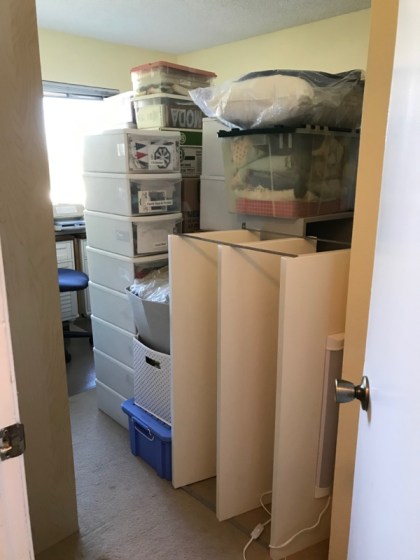
It began with the dividing:

March SRoom redo_1.jpgMarch SRoom redo_1March SRoom redo_2March SRoom redo_2a

We eventually moved all the boxes back into the sewing room, and it’s pretty daunting to see all your stash that way.  I had wanted a glass top on my sewing desk for-e-ver, and bit the bullet and had a piece of glass cut really big to fit the top. When I got home, I realized there was no way I could get it upstairs (my husband was traveling) so the young men across the street who lift weights for fun, were willing and able to get it upstairs for me.  I paid them in cookies.

After I winnowed down the boxes, the fun began: the design wall needs to take shape.  In the past my design wall was made of foam core artboard, but when I went looking for it this time, it was not to be found in the size/thickness I needed.  And the next best thing was going to cost me over a hundred bucks.  So I used the advice found in Christa Watson’s post, and purchased two insulation sheets at our local Big Box Construction store.

I didn’t want to use a giant bed sheet like she had, as I had been spoiled by having a grid on my old design wall.  So I hunted/haunted the internet and soon found a gridded flannel made by Robert Kaufman on Amazon, and snapped up six yards.  Measure before you buy, as we had Just Enough.   I did NOT pre-shrink it, as I needed every inch.  I cut it into two three-yard lengths, sewed it together along the one long (3-yard side), matching the grids.

I set it aside while we did this:

March SRoom redo_3

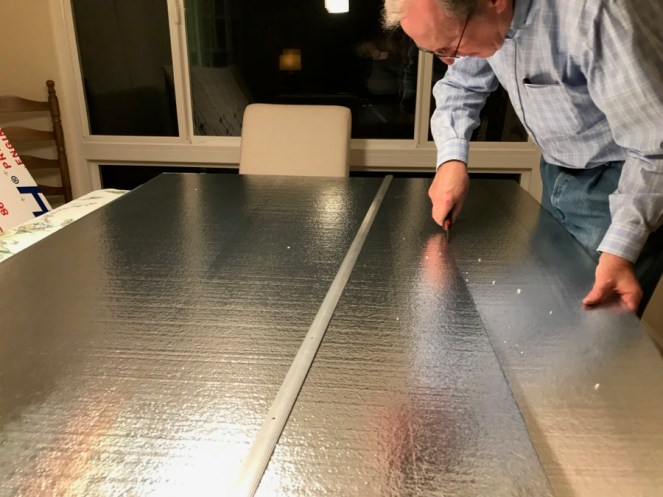
My room is much smaller than Christa’s, so we had to cut down the insulation.  We used a linoleum knife, which has a hooked shape and a sharp blade on the inside curve.March SRoom redo_3a

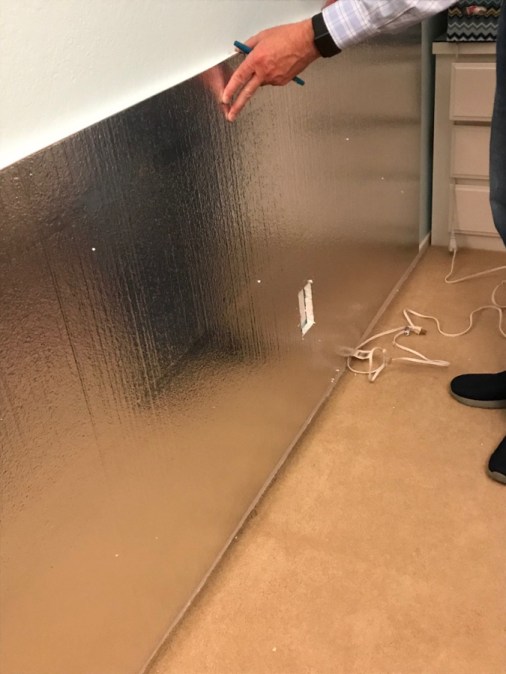
Then we had to account for the outlet on my sewing room wall.  First (above) a template made out of newspaper).  We took that upstairs and traced around it, then double-and-triple checked it.

March SRoom redo_3b

We even checked it against the real wall.

March SRoom redo_3c

Back down in the dining room, on the dining room table, we taped the two insulation sheets together using white duct tape, only better stuff than duct tape.  I don’t know what it was, but it really holds.March SRoom redo_3d

I taped around the cut edges of the socket hole.March SRoom redo_4

Like Christa, we laid out the flannel, and stretched it around the boards, stapling it in place.  The staples did NOT like to go through a double layer of flannel, and we didn’t quite stretch hard enough, but it doesn’t affect the performance in the least.

We followed her advice and purchased these screws and these washers.

March SRoom redo_6

Slipping a screw into a washer, we placed them top and bottom and two on each side of the foam insulation seam.  While the foam board seams go East-West, my flannel seam goes North-South for stability (which you can see in the photo, right in the middle).  The covering does pucker a bit and my husband asked if I wanted to re-do it.  I didn’t.

March SRoom redo_6a

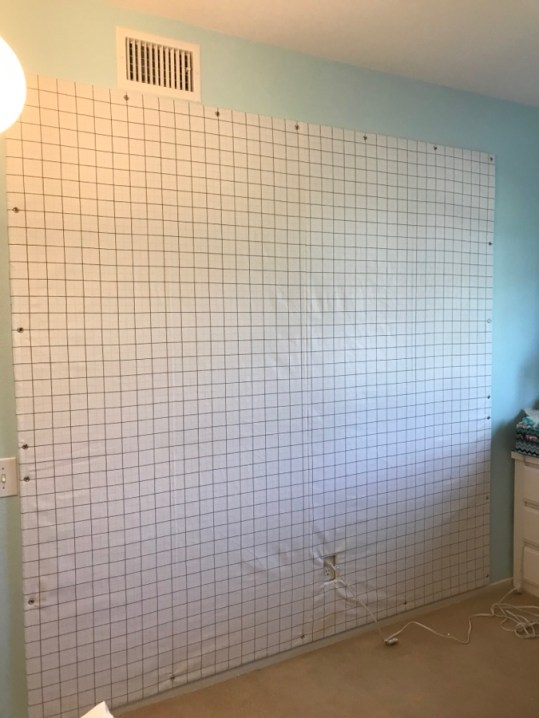
Why does it not matter that much to me?  Because I like to cover my design wall with Thermolam, a type of fleece.  They have renamed it, so look for this number —  TP970  — on the bolt. (Here’s a post on how I did my old design wall.)  I had thrown my old Thermolam/Quilters Fleece/Whatever in the dryer to fluff all the threads off from previous use; it works fine.  I smoothed it out over the flannel, using straight pins to keep it on, and letting it overlap by 1/2″ at the seam (which you can see in the photo below).  It really grabs the blocks and pieces much better than the flannel by itself, and is easily cleaned by running a sticky lint roller over the surface.

March SRoom redo_7March SRoom redo_7a.jpg

I cut out around the electrical outlet and pinned that into place, too.  Immediately I put up the blocks I’d received from The Gridsters, who jumped into #sawtoothmania feet first.  I have only one I’m waiting on, but will start playing with them once I get the last one.  Their signature blocks used my Tiny Envelope pattern, found free on this blog.

March SRoom redo_7a

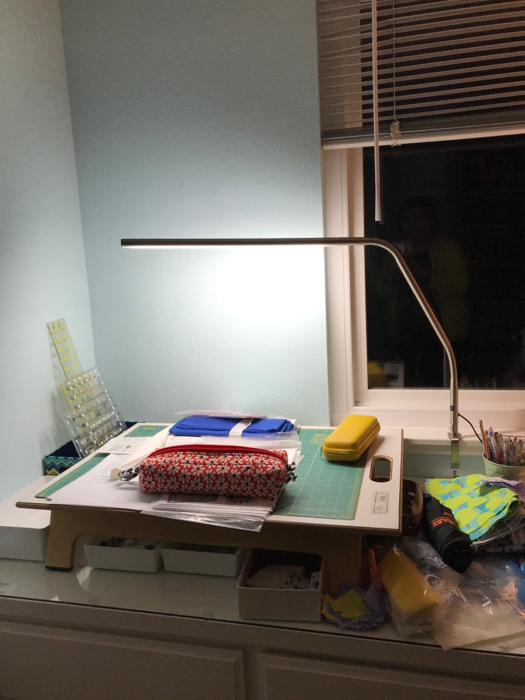
Most recent item was the Daylight lamp, suspended over my cutting table.  My husband screwed it onto my window sill for me, as I couldn’t figure out any other way to get it here.

I emptied the last box today, which was all my doo-dads that had been placed all around the room over the last 15 years.  I love my doo-dads (I’m not a minimalist) but after living with clear walls for a month, I edited down what I want to hang back up. I also sorted through my scraps, separating them into strips and scraps, and found the bottom of that bin, not seen in too many years.

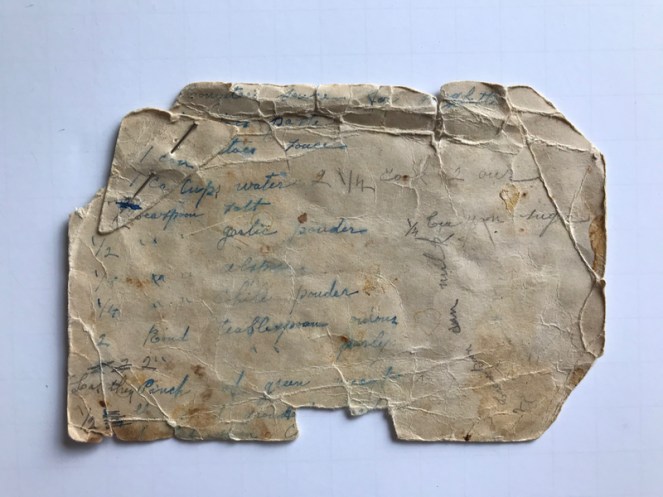
Old Recipe Card_1

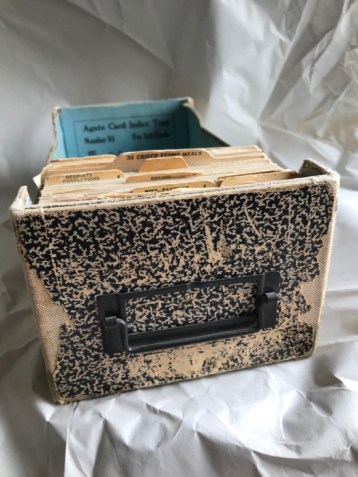
That process has a parallel in this recipe card.  It’s one of a collection of cards that I’d purchased at a garage sale some twenty years ago.  I’d had it at the back of a shelf, always meaning to go through it, and use it to form the backbone of that novel I meant to write when I was in grad school.  Who was this woman who had used this recipe for the spaghetti sauce so much that she had to affix on the corner with a straight pin? I went through all of her cards, photographed some (you may see them again), but threw away most. I’m kind of at a dividing line in my life. Much like I realize that there will be no more spaghetti sauce made with this recipe again,  I also recognize that there will be no novel written about this person, whose recipe cards I purchased when her children cleaned out her house and sold them to a stranger, standing on her front lawn.

In the last few weeks, I have gone through nearly everything in my house with the exception of the kitchen and family room, and like my scrap bin and like the box of recipe cards, I have had to distinguish between the old life that looked forward into mountains of possibilities, and this current one that gazes backwards, happy with what she sees, no longer wishing to be the caretaker for old hopes, for old dreams. While I realize that there still remains in me a creative force, it flows in different ways.  Yes, the scraps that were divided reminded me of projects I’d done, as well as suggested promises of what might lie ahead. But who was that young sewer who cut up all these fabrics?  I hardly know her now.

Today I dutifully divide what might have been, from what is probable now.  While I wonder about that quilter from the past, I must work with this version of me that is sitting here sorting: relinquishing those bits, those scraps, opening up a space for what calls to me now.

Old Recipe Card Box.jpg

Something to Think About

Making: Another view

Christmas Chickadee_Taylor.jpgRecently I attended a lecture by David Taylor (at PIQF), which was humorous and interesting.  One interesting fact was, that while he did these incredible quilts with very detailed applique and quilting — most taking about a year to complete, when he was at home when he wanted to relax, he did very different work for himself.  He worked on the Piecemakers’ Calendars.
(A photo of his Christmas Chickadee is on the left.)

My husband and I had just had a discussion about this, about how I, as a pattern maker and creator of original quilts, sometimes make other people’s patterns.  I had a hard time explaining myself, for both facets of my quilty life give me much pleasure.  Why wouldn’t I alway make my own designs? I have tons more ideas than what you’ve seen, many more ideas to explore.

So I was intrigued by David Wu’s article titled “In Praise of Mediocrity.”  His opening lines hooked me: “I’m a little surprised by how many people tell me they have no hobbies. It may seem a small thing, but — at the risk of sounding grandiose — I see it as a sign of a civilization in decline. The idea of leisure, after all, is a hard-won achievement; it presupposes that we have overcome the exigencies of brute survival. Yet here in the United States, the wealthiest country in history, we seem to have forgotten the importance of doing things solely because we enjoy them.”

joggers

Wu goes on to say that he believes it is because we afraid “of being bad” at our hobbies.  If all the joggers are supposed to be marathoners-in-training, or all the painters supposed to be the next Rembrandts, that places the pressure of linking our identity to our hobby, with the result that we feel “you’d better be good at it, or else who are you?”

TakeMeBacktoItaly frontI just finished the last of my Guild visits for the year, and from early on this year, I worked into my lecture a quilt that I think it a distinct “failure,” on so many levels: the colors don’t work, the pattern is good, but the fabric choices are all wrong, the quilting is meh.  But I show it in among my fancier quilts just to say that not every quilt is a home run, and most quilts don’t make it into the top ten of national shows.

Wu notes that in always striving to be excellent in our hobbies, it becomes more like work.  We lose “the gentle pursuit of a modest competence, the doing of something just because you enjoy it, not because you are good at it….But alien values like ‘the pursuit of excellence’ have crept into and corrupted what was once the realm of leisure, leaving little room for the true amateur.”

The people in my quilt workshops are always comparing their efforts with my samples, some of those sample having been made multiple times, so they are fairly free from errors.  The result is that I often leave them up on the front table when I’m chatting with the students about color choices, or design choices, wanting to see what they want to put where, what colors they want to make their quilts.

CitrusBeltGuildWS_4a

If we, or our students, or the women at retreats, or the neighbors around the small sewing circle feel like we have to be excellent at everything we do, isn’t this like being “trapped in a cage whose bars are not steel but self-judgment”?  Wu does not think that becoming good at something is terrible: “I don’t deny that you can derive a lot of meaning from pursuing an activity at the highest level. I would never begrudge someone a lifetime devotion to a passion or an inborn talent. There are depths of experience that come with mastery.”

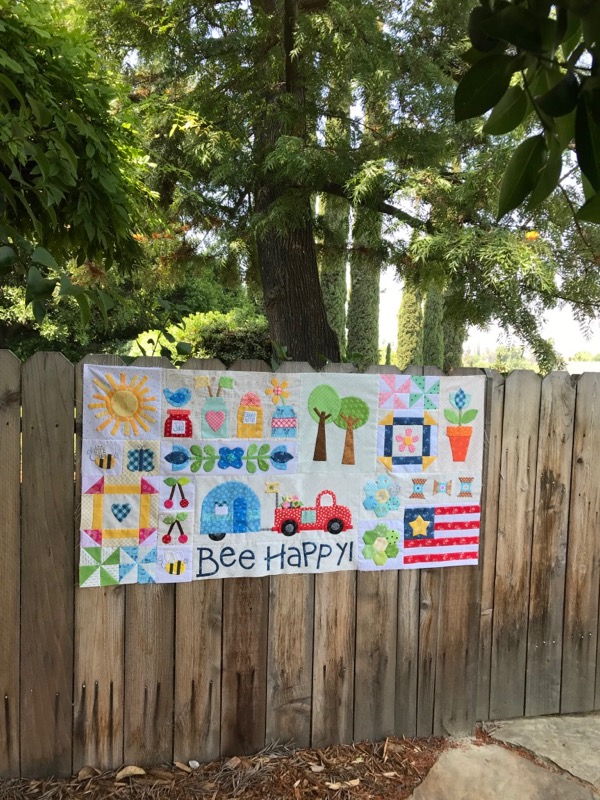
BeeHappy_June_7

I want all my students to want to sew, to enjoy the process.  So what if the quilt doesn’t ever leave your bedroom? Is it less wonderful if it never gets into a show? It hopefully is the making that is the pleasure, or as Wu puts it: “a real and pure joy, a sweet, childlike delight, that comes from just learning and trying to get better,” finding “exaltation in the mere act of doing.”

Happy quilting!