300 and Beyond · First Monday Sew-day · Quilt Finish · Quilt-A-Long · Quilts · Something to Think About

Gathering Up All The Fragments • Quilt Finish

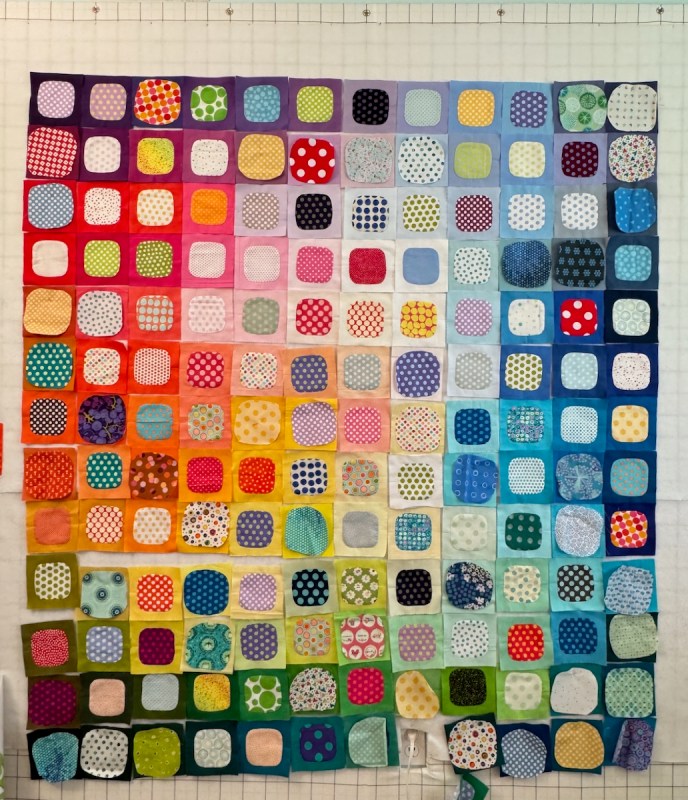
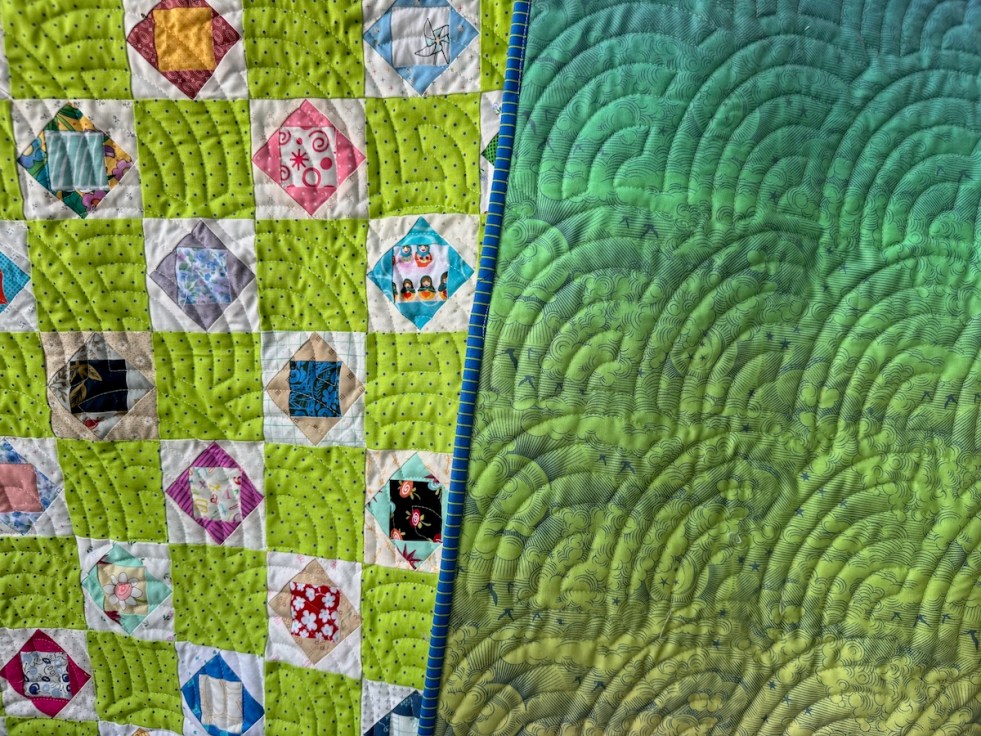
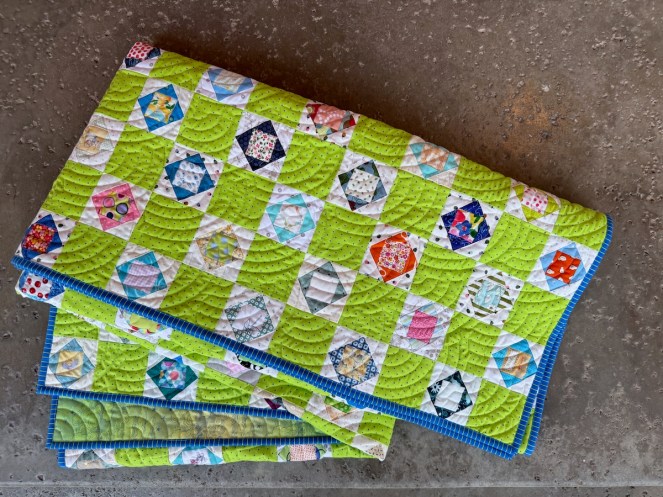
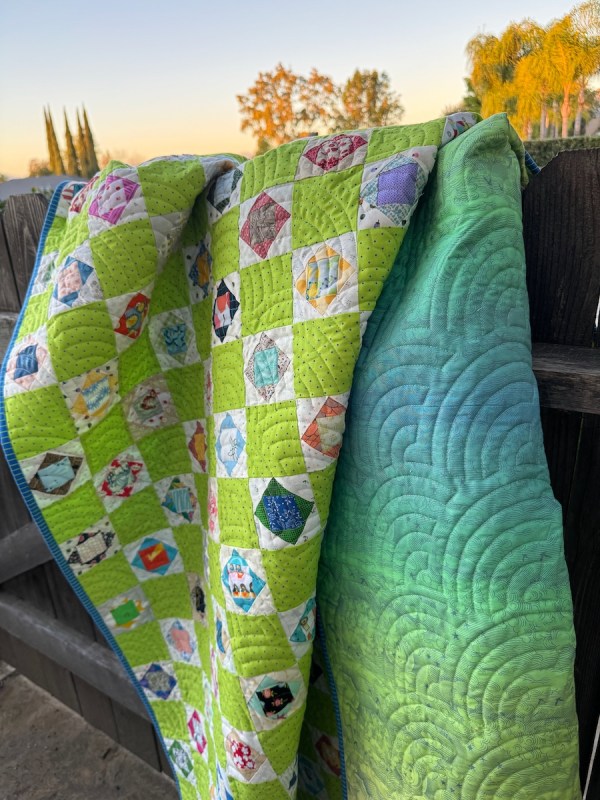
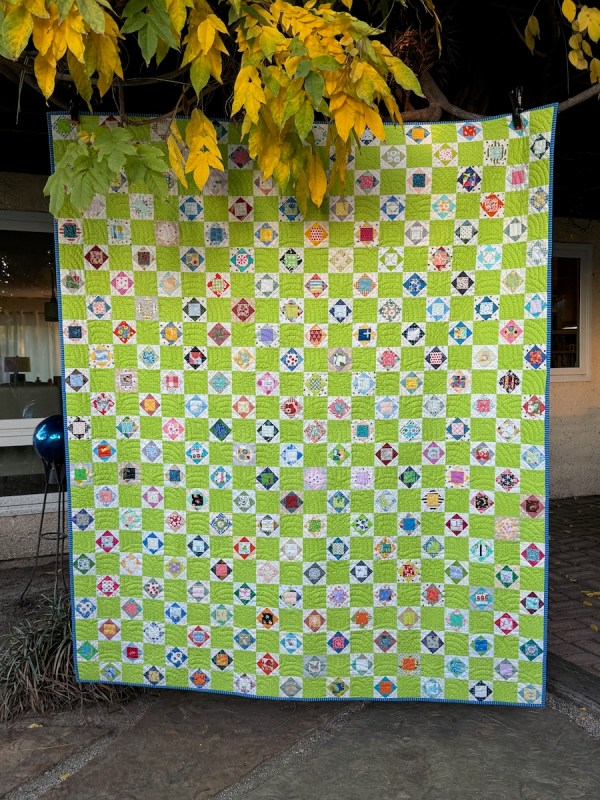
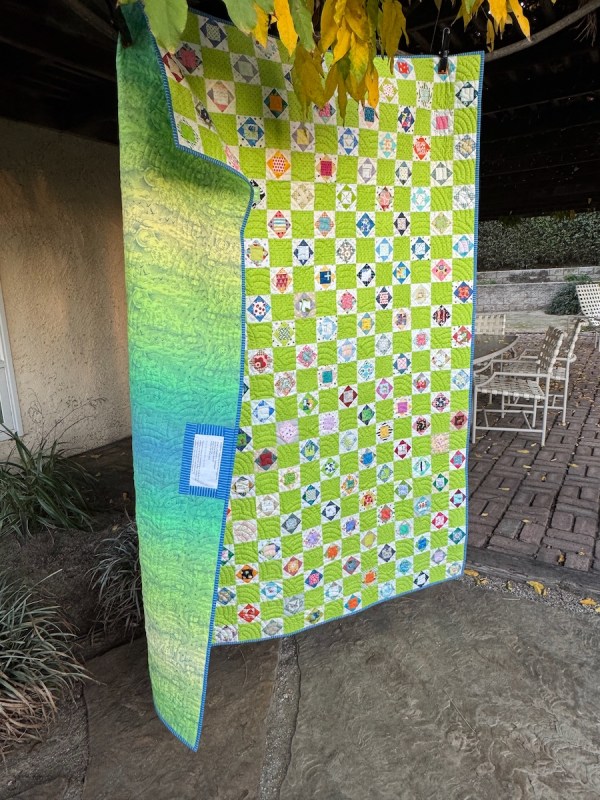
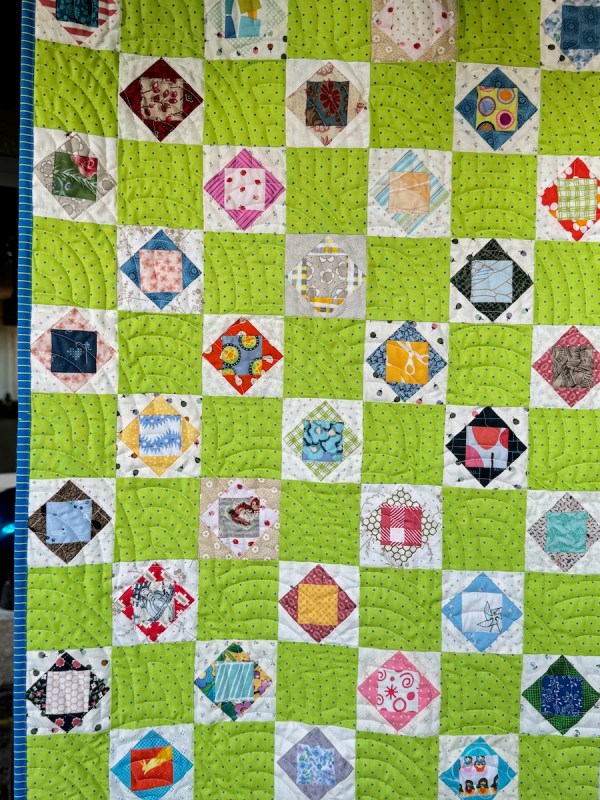
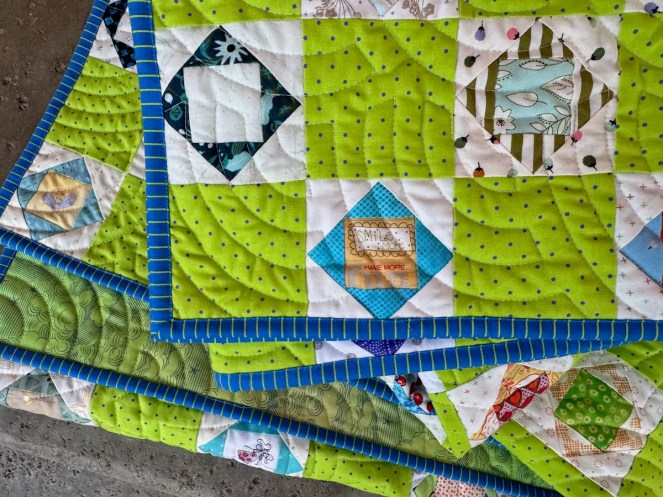
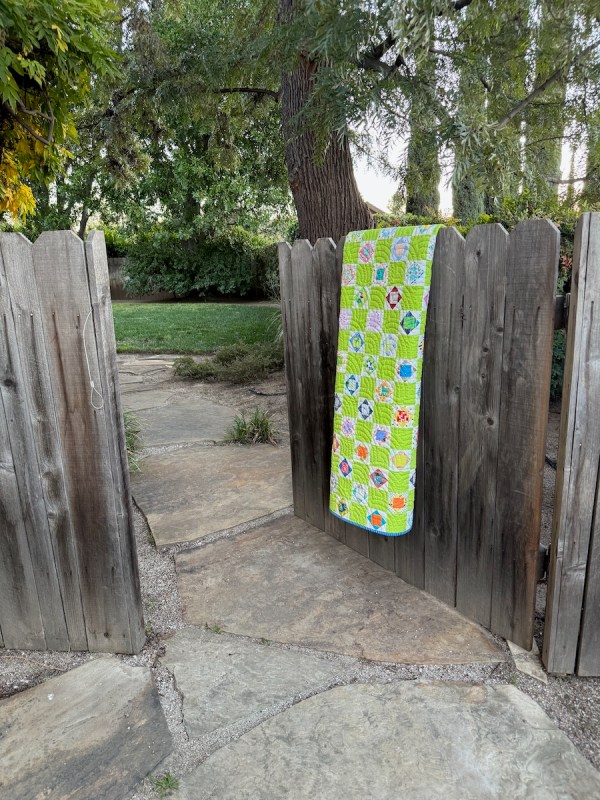
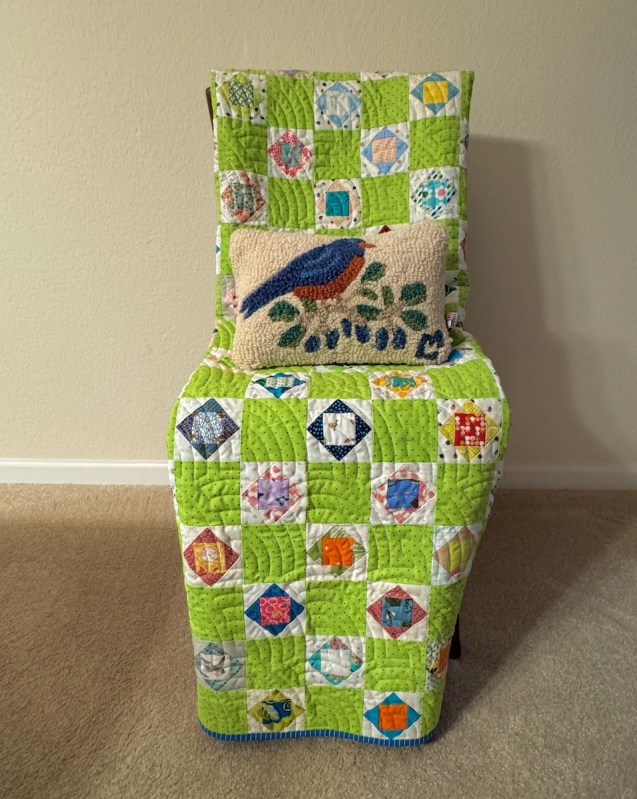
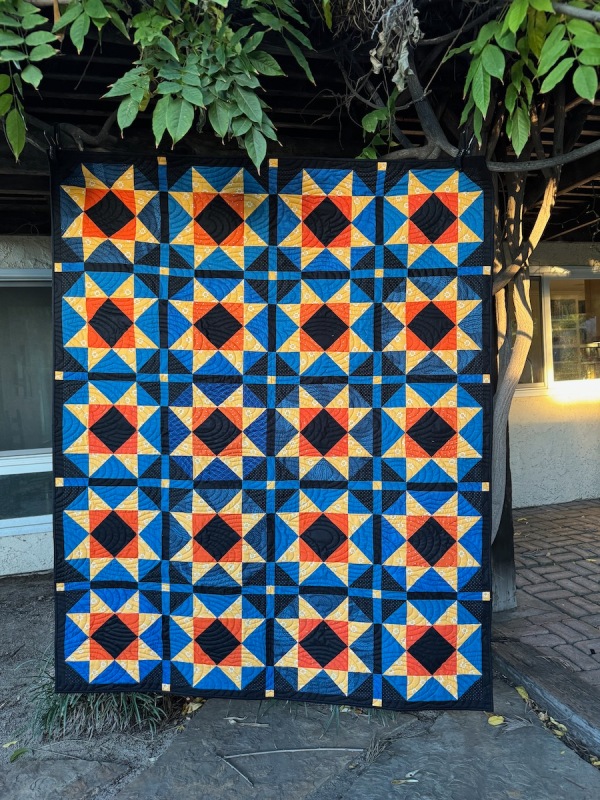
The etymology of the Economy Block is — as are many popular quilt blocks — complicated. According to Barbara Brackman’s Encyclopedia of Pieced Quilt Patterns, it’s titled Economy Patch by Carrie Hall and Rose Kretsinger around 1935. It’s also called the This and That block, in the Kansas City Star around 1944 (you know this is a favorite phrase). And more recently, it’s been known as the Thrift Block as when Taryn of ReproQuiltLover hosted the recent #scrappymeetsthriftchallenge. I have mentioned before that this year I had been making things that helped me make things: quilt-a-longs, Block of the Month, group projects, and so forth. And so this one joined the line-up, and I finished it this week.

I needed a title for this quilt, and since in early 2020 I had taught it to a small beginning quilt group as the Economy Block, so I went with that name (although many now call it Square in a Square).

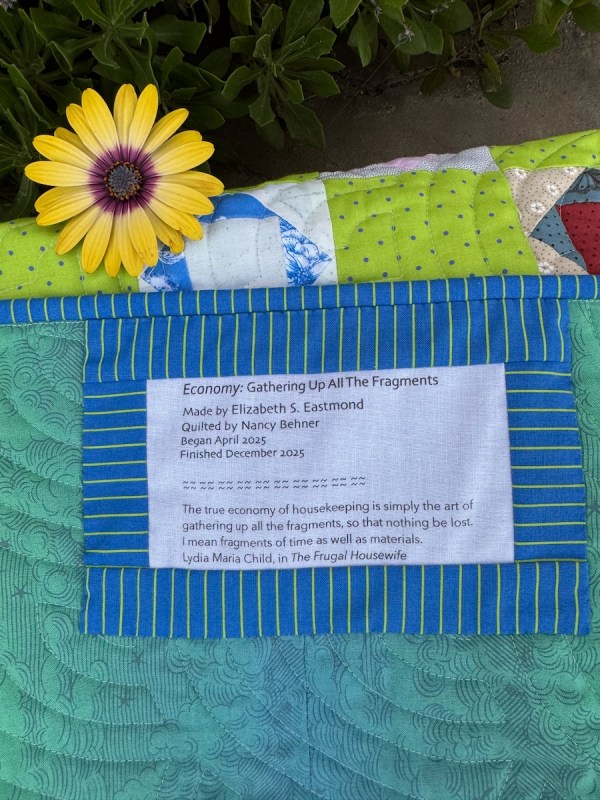
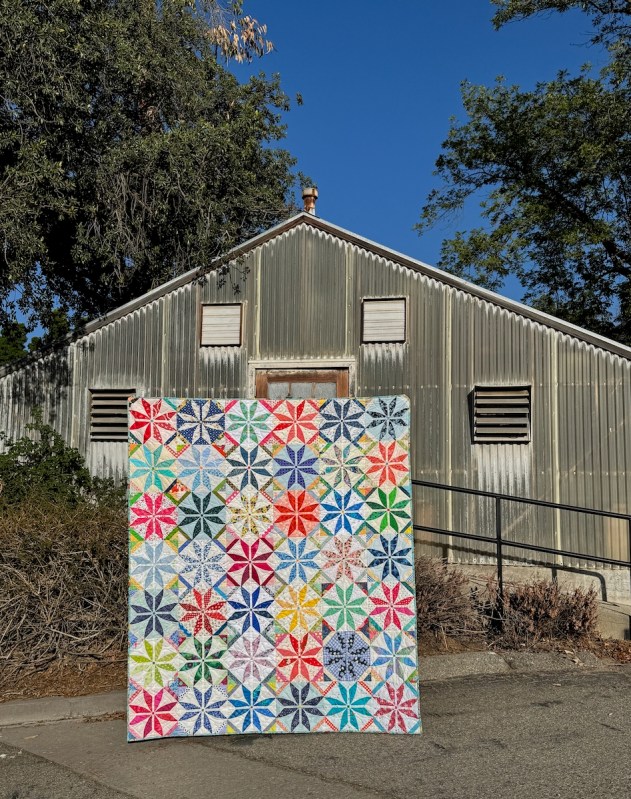
Full quilt title: Economy: Gathering Up All The Fragments.

Economy, as we think about it, means thrift. Saving. Making do with less. The exchange of goods. A dollar is worth something and everything is for sale (as the old saying goes). But the idea of economy, says one wag, is really an enigmata**:

  • Enigmata refers to things that are puzzling, mysterious, or riddles
  • OR, a puzzling or inexplicable occurrence or situation
  • OR, a person of puzzling or contradictory character.
  • OR, a saying, picture, etc., containing a hidden meaning; riddle.

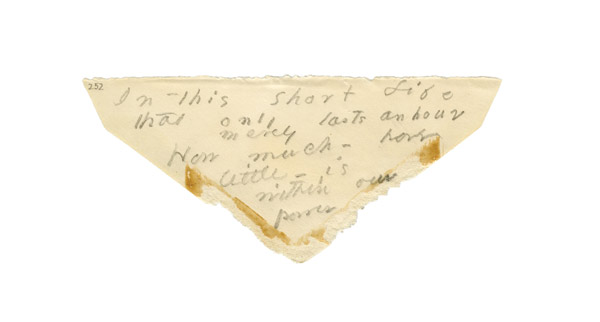
The title of this quilt comes from yet another riddle: the poet Emily Dickinson’s punctuation and shape of her small poems. Some think it began with this:

“‘Preserve the backs of old letters to write upon,’” wrote Lydia Maria Child in The Frugal Housewife, a book Dickinson’s father obtained for her mother when Emily was born. It opens: “‘The true economy of housekeeping is simply the art of gathering up all the fragments, so that nothing be lost. I mean fragments of time as well as materials.’” (from a review by Jen Bervin, titled Studies in Scale).

On one of her envelopes, Dickinson wrote: “Excuse | Emily and | her Atoms | The North | Star is | of small | fabric | but it | implies | much | presides | yet” (fragment A 636 /636a).

Like a star is small…but it is its own world.
Or an atom is small… but contains worlds.
Or fragments of fabrics are small…but put them together and they make a quilt.

In pulling fragments for this quilt, I opened bag after bag of small scraps from a decade ago, cut into 2 1/2″ squares or 3″ squares, as it had been recommended to me to do that in order to “use up your scraps.” Finally, I was using them up, so this quilt is as much a record of an era, as it is a complication of “gathering up all the fragments.”

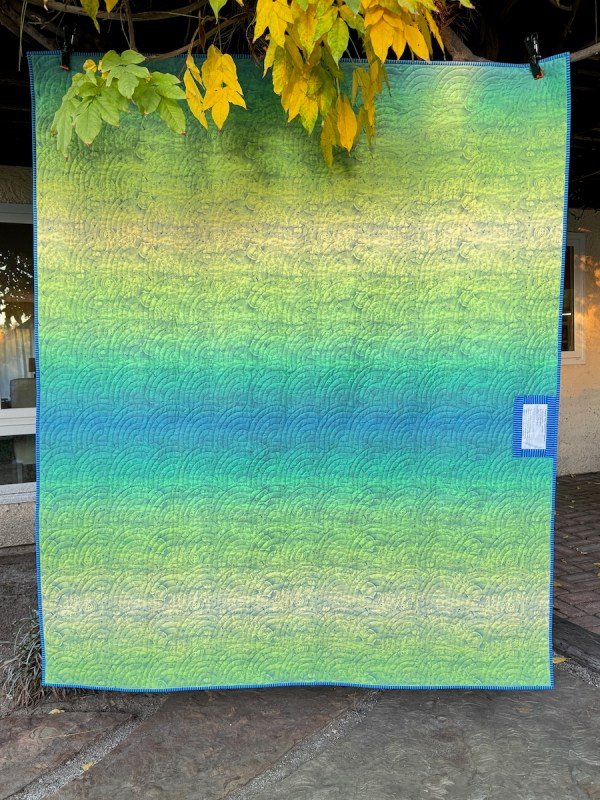
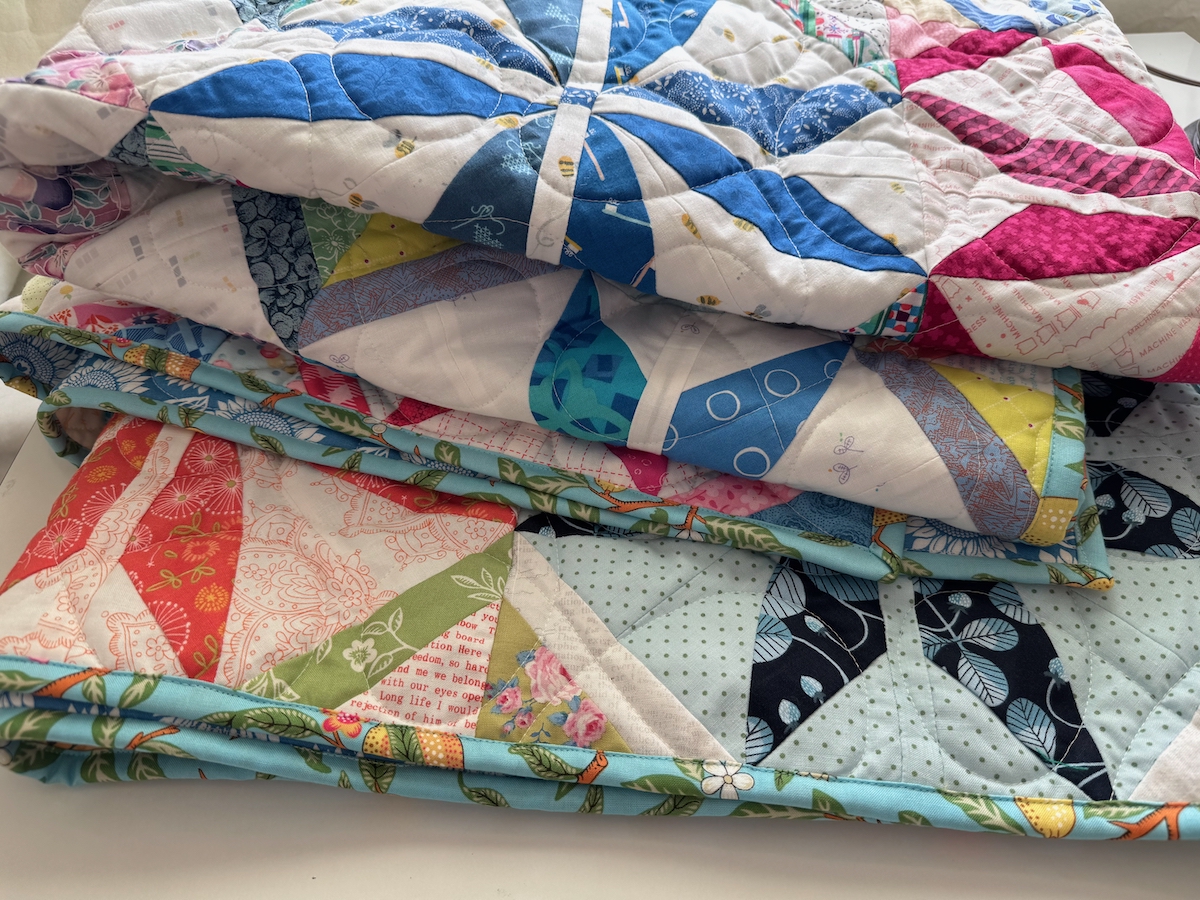
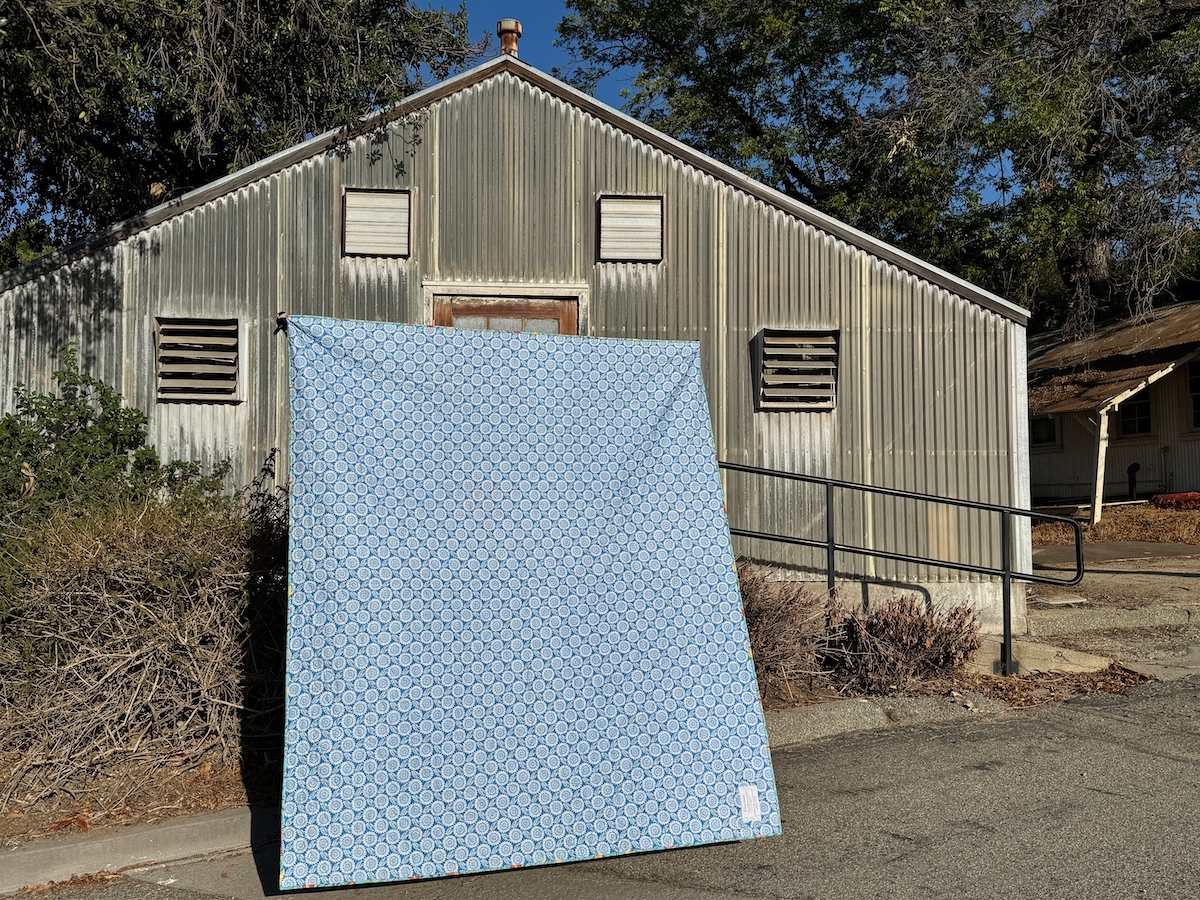
Backing/binding is fabric from Tula Pink, and the quilting is the Continuous Baptist Fan, by Urban Elementz.

Quilt-making is an enigmata, isn’t it? We take our scraps, our fragments, cut them smaller, sew them back together to make something that expresses an idea or a sentiment. And we quilters do it over and over, saving scraps, repeating the process “so that nothing be lost.”

This is Quilt #312, and the last for 2025, as there are no more fragments of time to add to the calendar. I will, however, try to get up another post or two of the beautiful Carrefour quilts, but no promises.

I do promise, however, to make merry the rest of the month and be of good cheer!

Other Posts about this quilt and its process

The Economy Block was in the series First Monday Sew-days, which has morphed to the title Beginning Quilters. There are a raft of free handouts here.

A Life Full of Yes (which includes the free pattern for this quilt block)

If I Do This, Can I Do That?

This and That • August 2025 (and a rant about AI)

This and That • November 2025

NOTE: I put the quilt label on the side, as it doesn’t matter which is the top or which is the bottom. It’s really a great size for naps: 60″ x 72.” I use BlockBase+, which is basically Brackman’s book, but in digital form. I also have her book in paper form, too. I’ve been thinking a lot about my quilt tools, such as the software and book, so will try to note them here on the blog as they’ve been used.

**Apologies to Honkai: Star Rail fans, who see Enigmata as something a bit different. And there is more on Enigmata writings by ancient figures, if you are curious.

300 and Beyond · Patterns by Elizabeth of OPQuilt · Quilt Finish · Quilts · Something to Think About

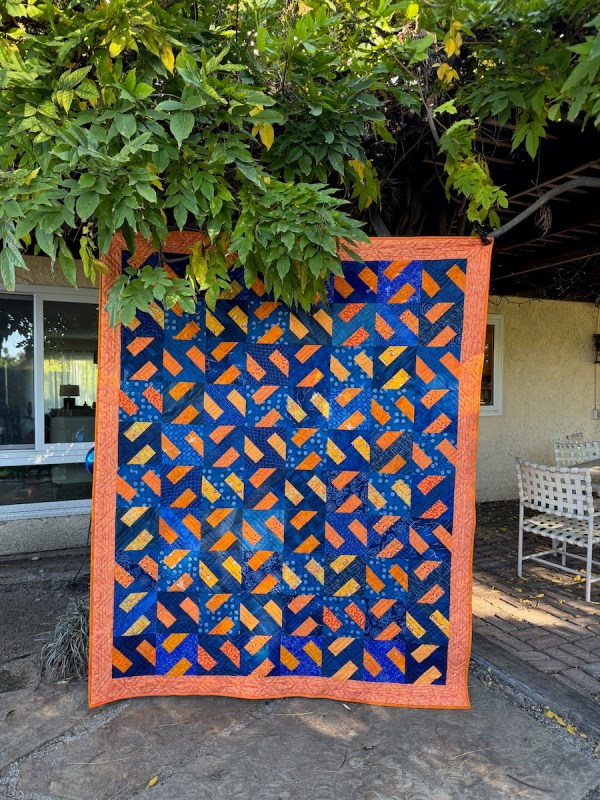
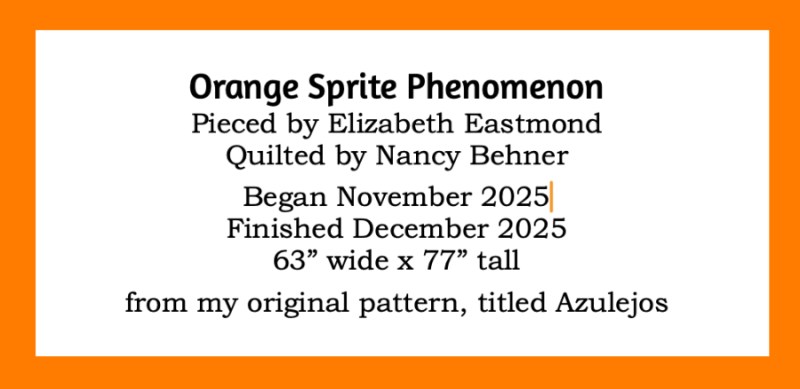
Quilt Finish: Orange Sprite Phenomenon

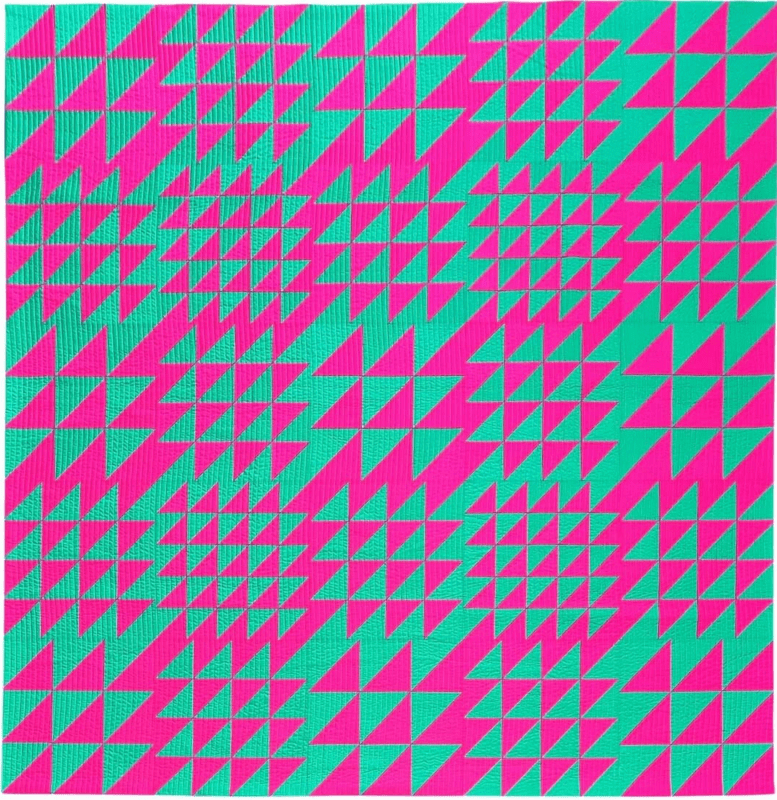
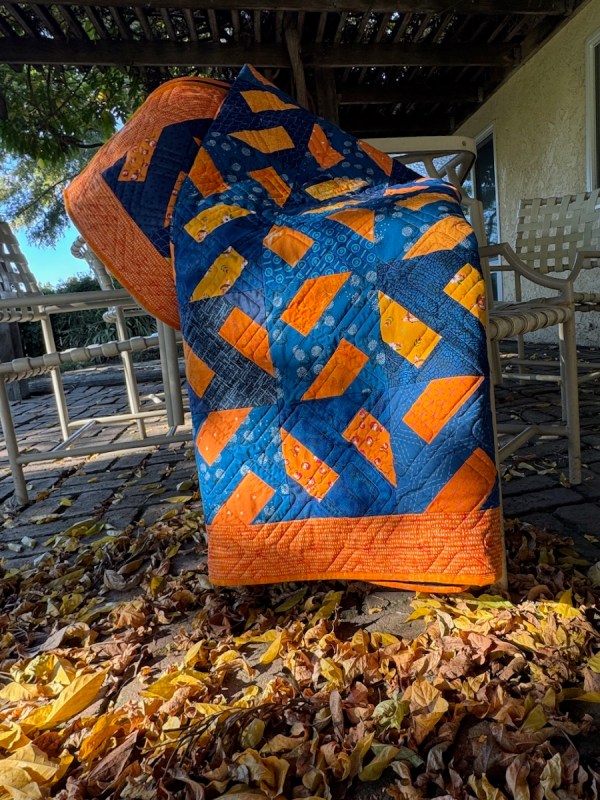
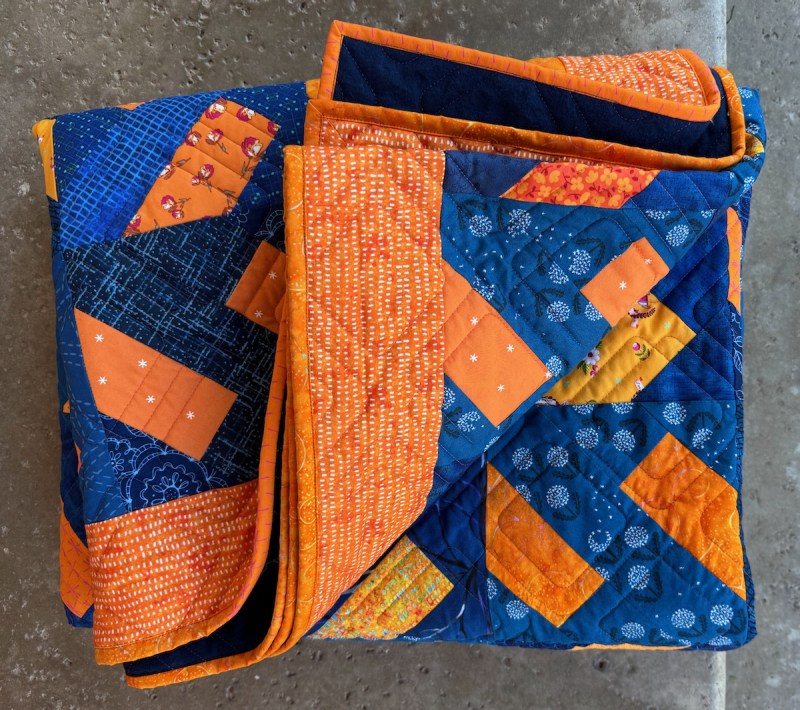
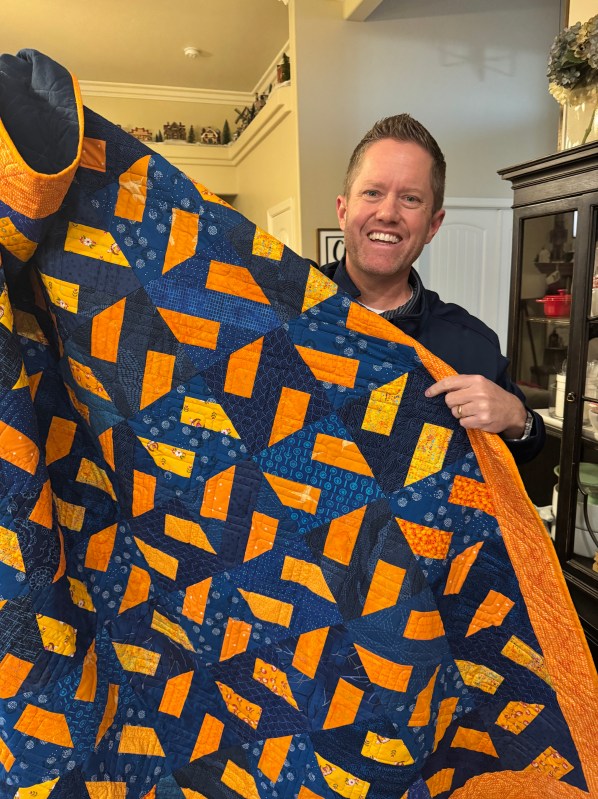
The Blue and Cheddar quilt is finished, bound, and sent off to the recipient. If it were to have a name and a label, I would call it this:

This is Quilt #311 in my Quilt Index.

I titled it this because of a celestial event. A rare celestial event.

This is called a red sprite phenomenon, when when lightning flashes above thunderstorms, creating a spikey flash of red light high in the sky. By using cheddar and deep blue, the quilt pays tribute to this transient luminous event: an orange sprite phenomenon. (photo) You can read more about it in this gifted article from the New York Times.

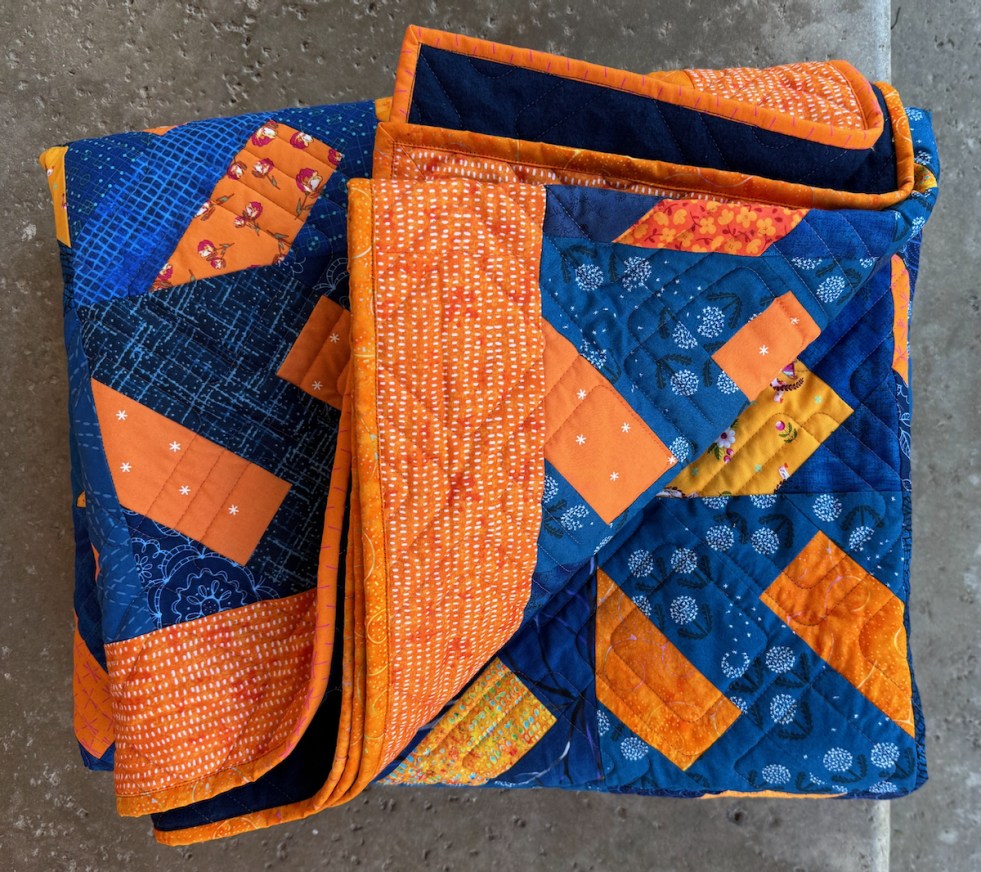
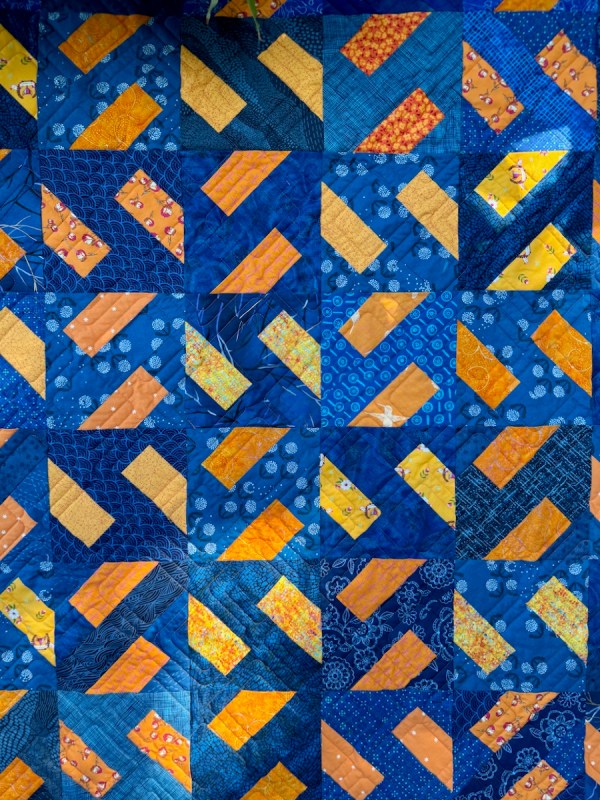
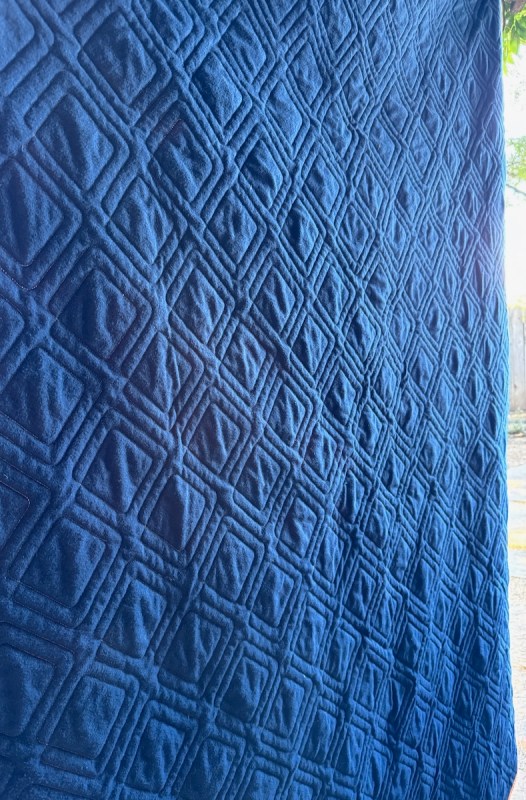
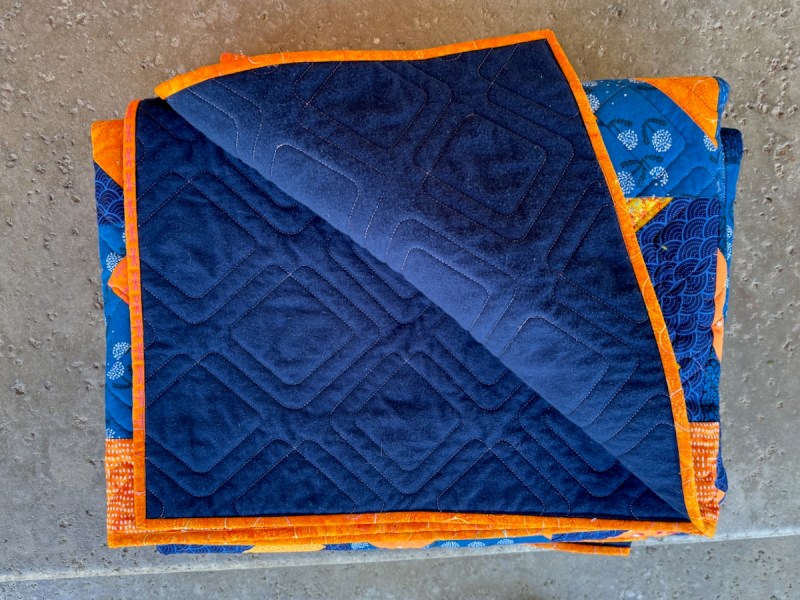
Hawthorne Supply Company was having a sale on Kaufman’s navy blue flannel. I ordered two packs for the back, washed them up. They are so thick and yummy, they are almost like chamois. My quilter, Nancy, did an awesome job on the quilting, with the pattern Diagonal Plaid Bias Cut from Urban Elementz. We used a copper MicroQuilter thread (Superior Threads) on the front and a coordinating thread on the back.

Our wisteria was dropping leaves this week, so here’s the requisite “fall” shot from Southern California. The blue fabrics are just ones I had in the stash, a full spectrum of rich, deep colors. Every so often, I feel like a label would interrupt the quilt back, and not that important (no lectures, please), so I leave it off. This happens like (wait for it) once in a blue moon.

I have long been fascinated by celestial events.

We’ve attended an annular eclipse, a solar eclipse, and a recent total solar eclipse.

When I was first married to my husband, we took our children up and stayed at his parents’ house for a week; one night was a star shower. I spread out a quilt on the grass in the backyard and watched the shooting stars. Since we were pretty much newlyweds (he married me and my four children, saving us all), I wonder what his parents and family thought. But he came and joined me on the grass, on the quilt, and we star-gazed together.

I was fascinated by what Jonny Thomson said this week on his Instagram account about the Korean idea of in-yun. It is not the first time I’ve run across this philosophy, and he described it well:

Imagine you pass somebody in the park and say, you nod, you smile, and you go back to your life. Then, a few days later, you notice the same person behind you in the supermarket. According to the Korean idea of in-yun, something important is happening here. In-yun means fate, but it really means the fate between people and relationships….[E]ssentially, it says that if you see a stranger more than once, it is not just a coincidence. That is the universe trying to tell you something. It is trying to say that here is someone important, they have something to teach you.

The French philosopher Gabriel Marcel argued that we should live our lives in a state of disponibilité, which means that we are ready to be at the disposal of the world.** If you stop seeing events as irrelevant accidents, but as messages, then you start to see the world as an opportunity. If you live your life ready to be helped, and ready to be changed, you will be. In-yun is the philosophical version of the crossing paths theory. It says that if somebody comes into your life, it is for a reason. If something keeps happening to you again, and again, and again, the universe is telling you that there is something to learn.

I’ve had more than a few things that have taught me to stay curious, to live in a state of disponibilité (or availability, as I understand it). Quilting, and the constant rate of discovery that happens in any quilt — from choice of fabrics, to colors, to inspiration — seems to match that idea for me, and I enjoy diving into a new project, and I enjoy finishing up. I also enjoy the quilters I meet, the quilters who teach me, my correspondence with all of you who read my blog, learning from every writer.

And so when my desire to rework my Azulejos pattern kept coming back around, and then I read about red sprites…well, that connection propelled me to this place. I hope the person who receives this gift will enjoy it as much as I enjoyed making it. I had fond thoughts of him (my son-in-law) as I worked on it.

UPDATE: He likes it!!

Stay curious, everyone–

**Availability of mind, thought; state of availability, according to this French dictionary page, which I asked Google to translate into English.

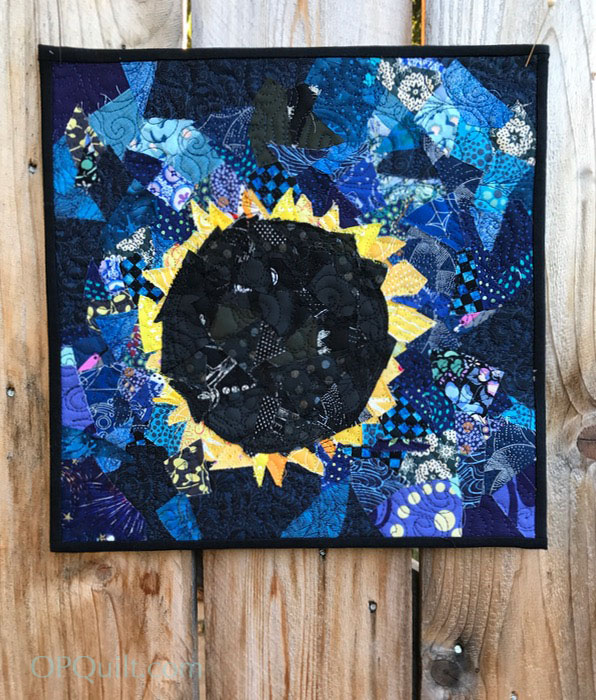
Yes, I once did make, not one eclipse quilt, but two!

And an artsy eclipse quilt:

300 and Beyond · Quilt Finish · Quilts · Something to Think About

Summer Flowers • Quilt Finish • Etc.

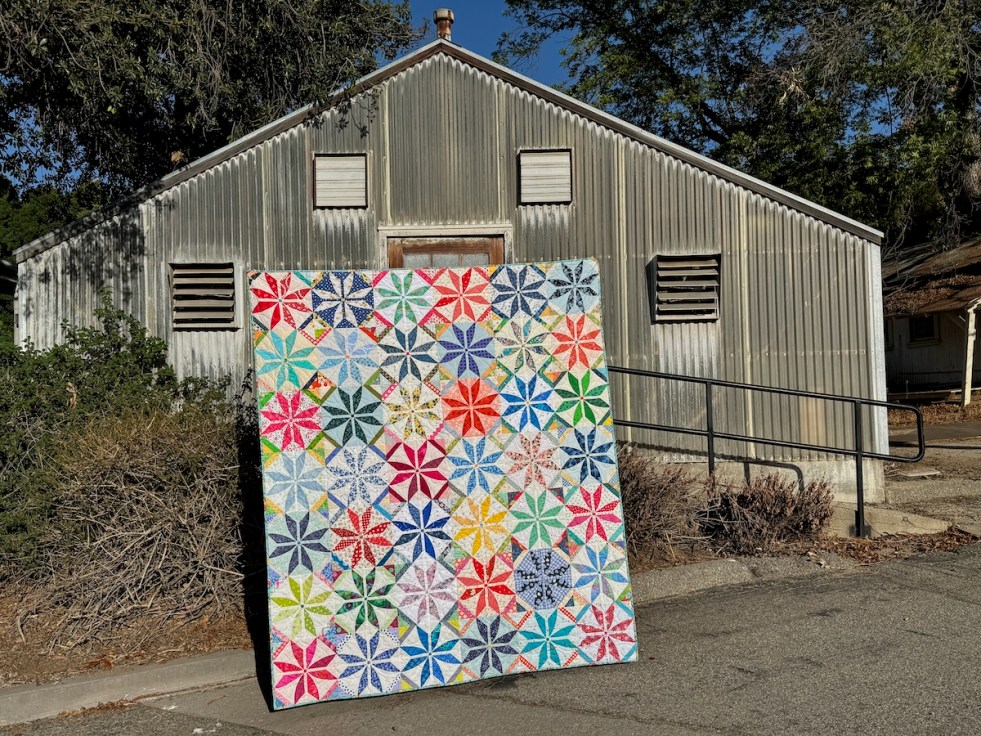
The title of this quilt pattern is Posh Penelope, and as one commenter said, “That is a name that needs to be changed.” So I did.

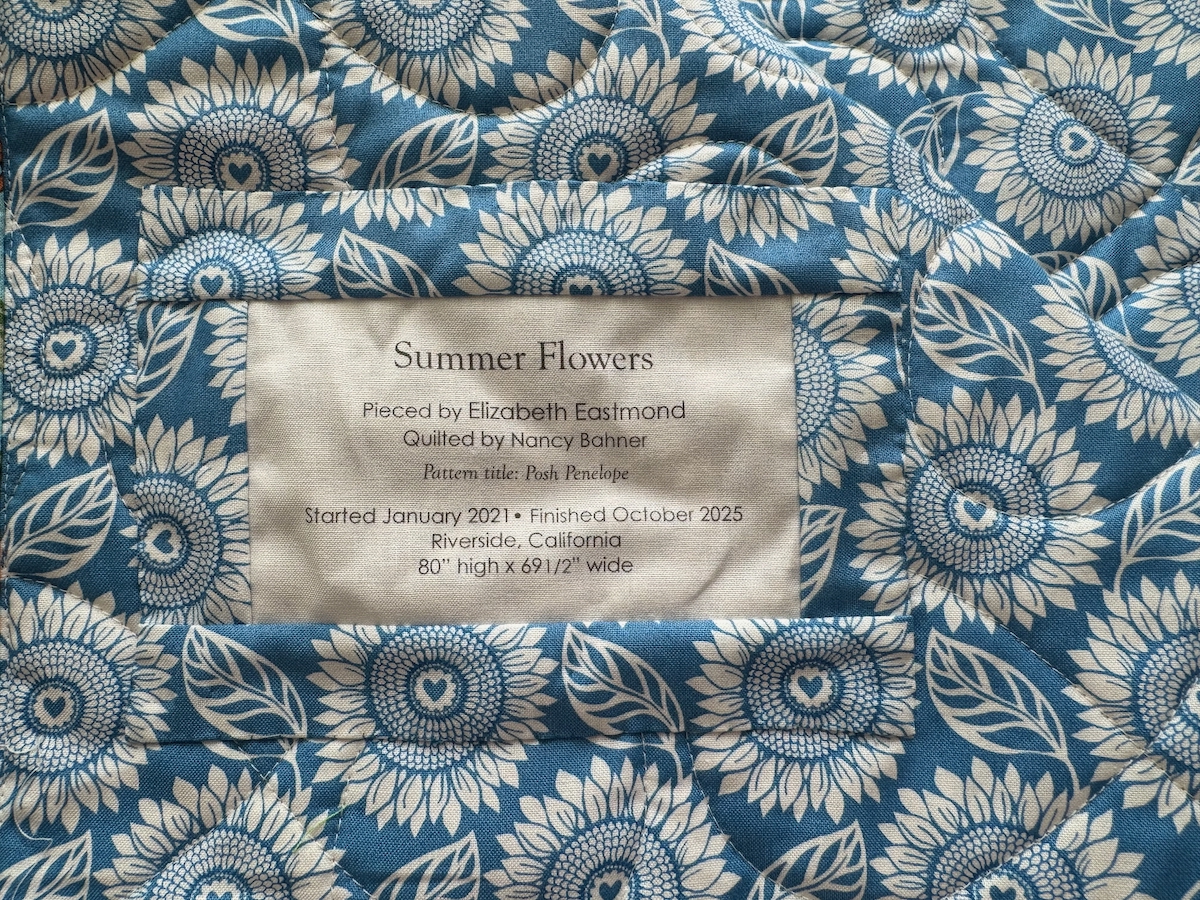
Summer Flowers is quilt #307 and measures 80″ tall by 69 1/2″ wide.

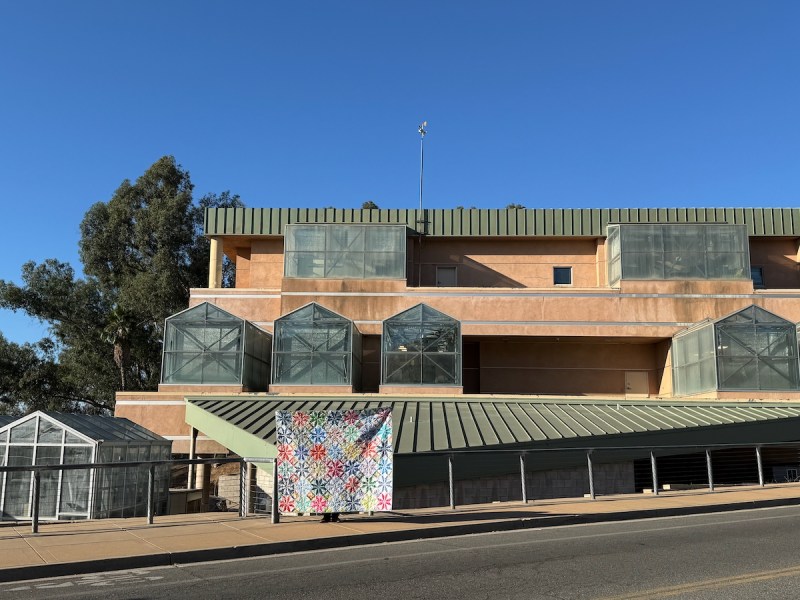
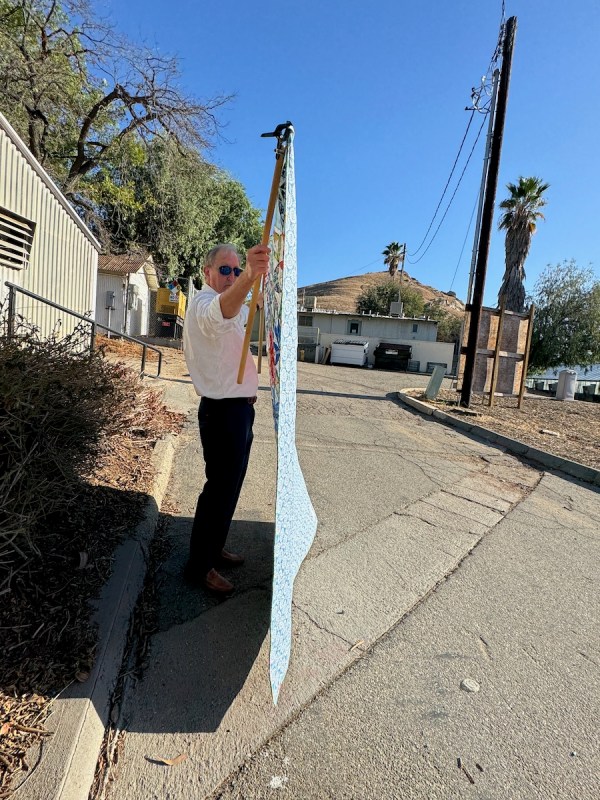
At first we tried this building for the photographs (click to enlarge). Love the building, but it’s not really working. And I had my QHH (Quilt Holding Husband) grab it by the side. Whoops! (This is how I knew the label was sewn on sideways.)
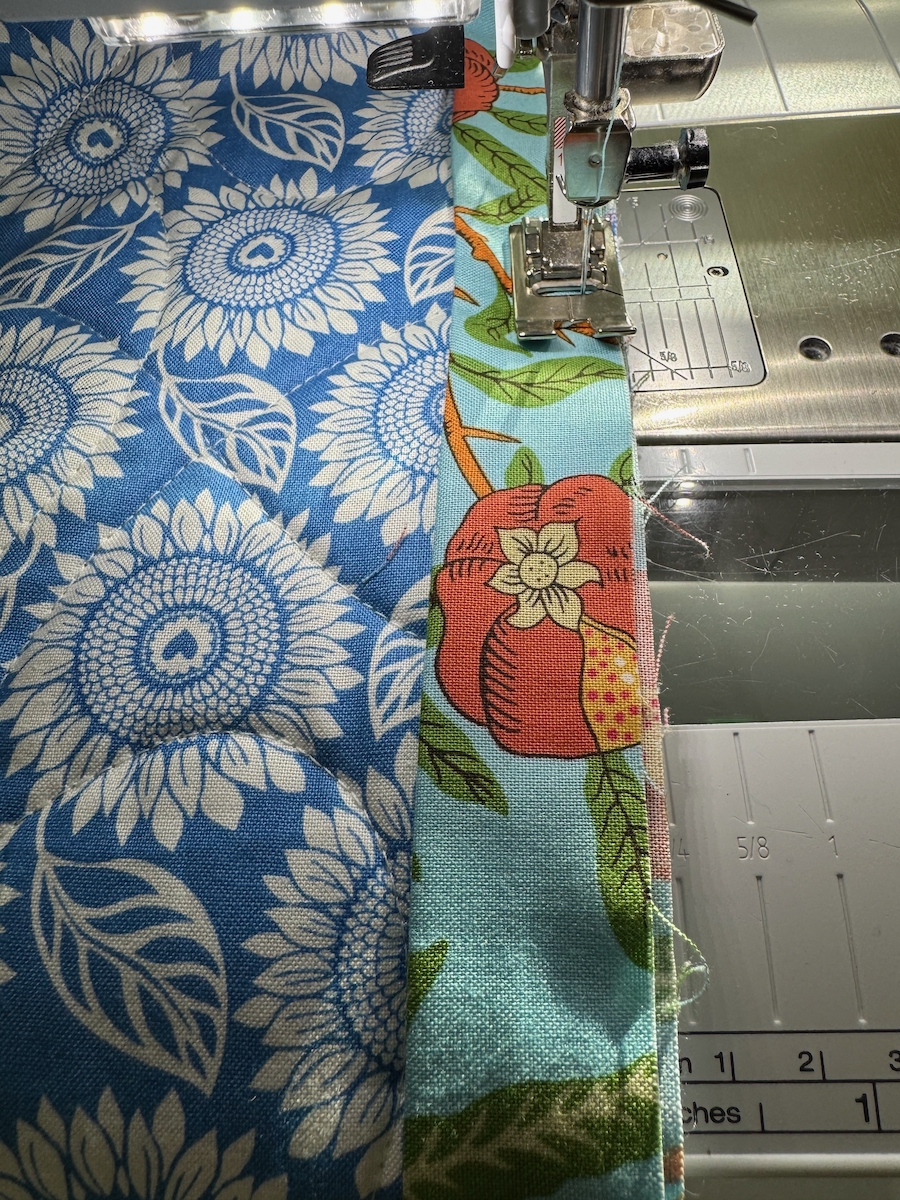
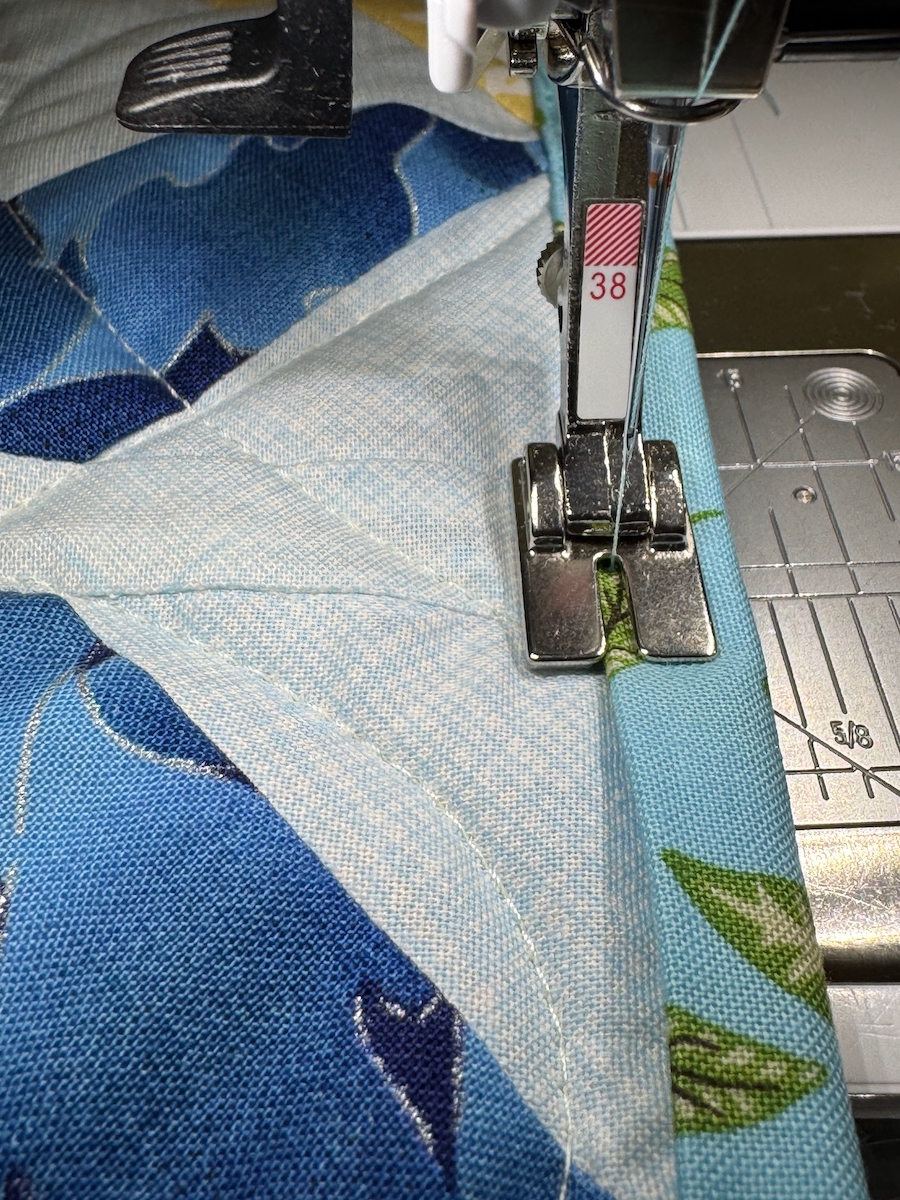
It only took me seven pieces of fabric to audition for the binding, and I sewed it on by machine. There are times when you just have to get it done.

We got the direction correct on this photo. Even though I sewed the label on the wrong way, I’m not changing it. So, this is finished!

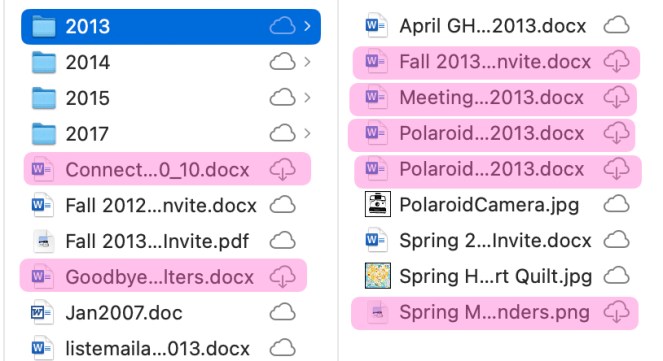
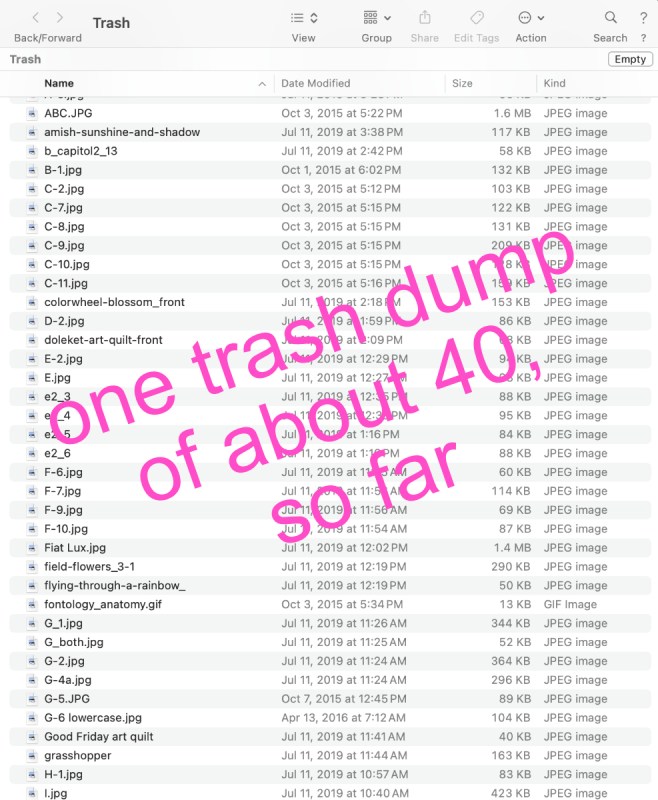
You are all aware, no doubt, of the corrupted digital files saga in my life (see the highlighted pink, above.) After multiple calls to Tech Support, I have resigned myself to the fact that all the files with little down-arrows are pretty much gone, and these date from last month to way back into my history of making little digital files.

So when I’m on Low Energy (lately, that’s been a lot), I sit and go through them, dumping them one-by-one, then when the trash on my computer gets filled up, I dump them. Gone. Never to be seen again.

It looks like I’m fully in the Age of Subtraction, my Dad would say. For years I created and compiled and wrote. Now I’m dumping all that unceremoniously. I lost about half of my journal files. The ones I could recover, like when I had four teenagers in the house, were hard to read, frankly. They were filled with sturm und drang (aka “storm and stress”), and nobody wants to remember that time of life. Reading backwards into my life has triggered some realizations.

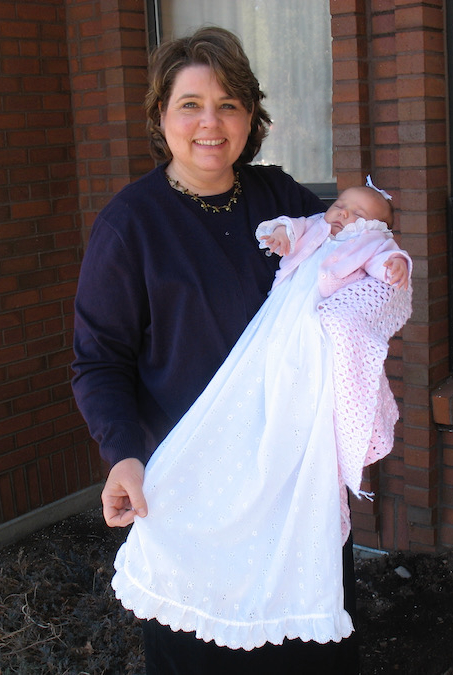
blessing dress story

One: I chose well in deciding to be someone who makes things, if that can be a choice. I have donated dresses I made long ago, but they served their purpose and maybe someone, somewhere is walking around in them. My family now runs when they see me coming, but I have managed to give away quilts, too. That work lives on until it doesn’t, but at least I won’t have to be the one dumping them in the trash.

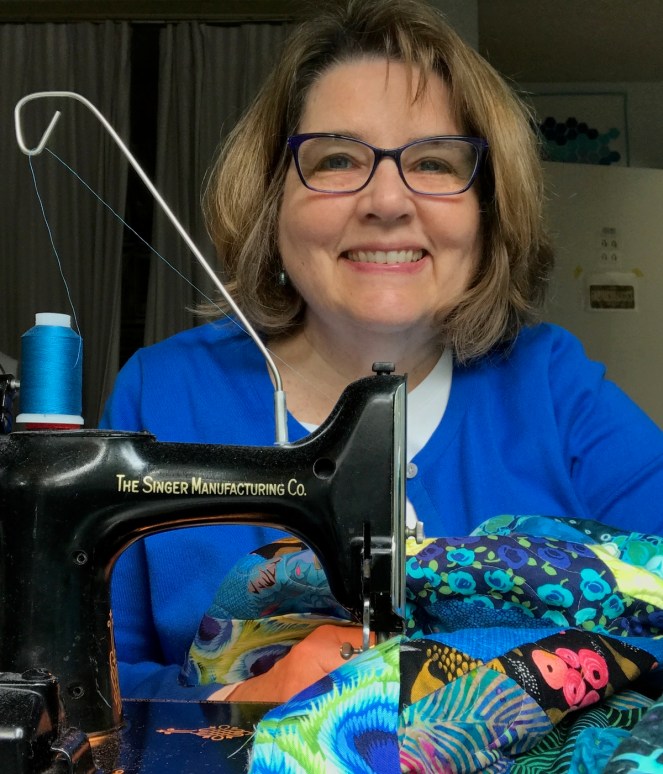
MFA graduate picture and a post with some reflections on my life

Two: I also chose well when I decided to chronicle my life in writing, which is a choice. You are perhaps used to my public-facing writing from reading this blog, but I have come to learn that personal writing is something done just for yourself. That in this kind of writing, we struggle on the page to capture an event, and to write it for our future selves, or for our families, if they don’t throw it all in the trash (just trying to be realistic here). And now that I’m way beyond the baby-toddler-children-teenager stage, I’m glad I have some writings to remind me of how busy a mother of one (or few) can be. I’m glad I have some written evidence of that to which I gave several decades of my life.

taken at a time when I started doing Zoom workshops

Three: Taking photos has surpassed the writing. Is it because we always have our phones on us? When I first started shooting photos of my life as a young mother, it would take three months to use up one roll of 24 shots of film. That was by design, as film was a cost, and developing was a cost, and I was always broke. Now we can capture 24 images on a walk around the park in the morning and compile thousands of photos in our digital drives. Interestingly, I didn’t lose any photographs in this Great Subtraction, as they were not part of the save-to-drive-that-may-have-been-corrupted-which-was-then-uploaded-to-the-cloud-which-was-probably-a-faulty-process-in-itself.

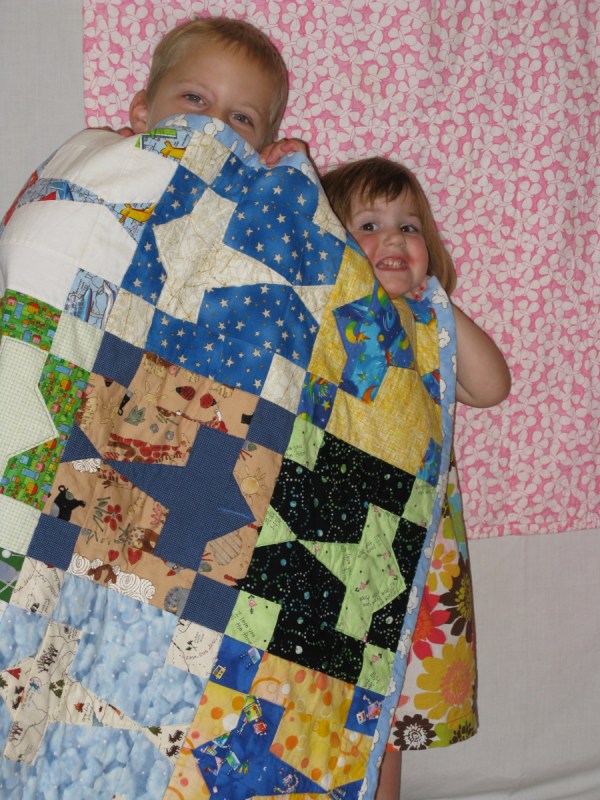
Two grandchildren with a quilt

Four, and last: Quilts last. Scrubbing the house doesn’t. Laundry doesn’t. Our digital lives won’t. Our real lives will someday end and fade away, but a grandchild or someone who is the recipient of our charitable work can wrap themself in a quilt and know that someone’s hands made this, a transfer of self via cloth and stitches.

Keep quilting–

Too Many Other posts about this quilt:

Road to California 2022 • Part I
Writing Poetry
Incomplete
Don’t Ask Me — they all just crept in!
March 2025 This and That
If I Do This, Can I Do That? April 2025
Flying Through Rainbows
This and That: No June Gloom, please.
The Zeigarnik Effect: the Power of the Unfinished
Summer Flowers (aka Posh Penelope)

Thank you, dear!

300 and Beyond · Patterns by Elizabeth of OPQuilt · Quilts · Something to Think About

The Zeigarnik Effect: the Power of the Unfinished

Adrian Zumbrunnen, a human interface designer, wrote recently about how “Blooma Zeigarnik [on the right] and her professor of Gestalt psychology were having coffee at a bustling restaurant…While waiting for the check, the two eagerly discussed an odd observation they both made. Somehow waiters seem to better recall bills that were still open than the ones that had been settled. It seemed like the moment a bill was paid, it vanished from the waiters’ memory. Based on this simple insight, Zeigarnik conducted a series of experiments that showed that unfinished tasks loom larger than finished ones.”

As I was fascinated by this idea, and after chasing down a few rabbit holes (see complete bibliography at the end), I came to learn that the unfinished has a certain power that finished items do not.

The term for this is the Zeigarnik Effect.

This is not hot news for quilters.

Joshua Everts defines it as the “power of unfinished business or interrupted or uncompleted activity to hold a privileged place in memory,” in other words, those undone tasks just won’t leave us alone. He notes that they “create a cognitive burden, weigh more heavily on the mind, and are more easily recalled than completed tasks.”

In another unsigned article, it states that the “Zeigarnik Effect explains why people are haunted by unfulfilled goals and may be more apt to recall what they haven’t achieved than what they have. Some have speculated that the cognitive burden of unfinished work causes some to see themselves negatively and contributes to such problems as impostor syndrome.”

But while it is not hot news for us, the people who coined the term UFO (Un-Finished Object), how do these unfinished objects affect us?

Zumbrunnen notes that “Unfinished tasks lead to cognitive tension, a feeling of restlessness and discomfort that makes us seek closure and come back to it again and again. This effect goes beyond remembering individual items on a bill. It affects whether we achieve our goals, our creative output, and how we pay attention.”

Carol and I were discussing our progress on our Posh Penelope blocks, and I wrote:

Public Service Announcement:

Another Public Service Announcement:
The Zeigarnik effect should not be confused with the Ovsiankina effect, an urge to complete tasks previously initiated. Maria Ovsiankina, a colleague of Zeigarnik, investigated the effect of task interruption on the tendency to resume the task at the next opportunity.

Yes, let’s not confuse the two, although maybe what I was experiencing this week was more of the Ovsiankina effect? Nah. I’ve been working on this Posh Penelope quilt for forever, like since 2020. In my mind, the Ovsiankina effect is more like finishing making dinner. Or changing loads of laundry.

Yet Another Public Service Announcement:
What does the Zeigarnik Effect teach us about multitasking?
The Zeigarnik Effect makes a powerful case against multitasking. Focusing on one task at a time will avert intrusive thoughts of unfinished work that will only create delays in finishing all the tasks. Completion of each task approached sequentially instead of simultaneously will clear mental space for the next task.

Will you please stop with these Public Service Announcements:
Yes. But you should know that taking the first step on a project, no matter how small, can create enough tension when the task is interrupted to motivate the resumption of the task, doing an end-run around procrastination. (I can’t help you if you are addicted to your phone. That’s a whole other blog post.)

So I cut out the rest of the Posh Penelope blocks. Over the next few days, I’ll get to the sewing. Understanding that having this project hanging over my head (like an anvil) was in reality stopping my creative work, helped me get going in going forward.

Other Interesting ideas from Everts to aid in managing these open-ended tasks are:
Create intentional closure points in ongoing projects. Even if an initiative isn’t fully complete, establishing clear milestones allows your mind to experience completion moments.
Develop systematic ways to document and track progress. This helps reduce the mental load while maintaining awareness of important tasks.
Practice regular “mind clearing” sessions. Whether through journaling, team reviews, or simple list-making, giving your brain regular opportunities to process and organize open loops is crucial.

Reading this helped me understand the value of placing little labels (or “intentional closure points”) on my ongoing progress. With the BOM, it will run one year, so I know I’ll be finished with the blocks in December, and the quilt some time after that. With the quilting on my New York Beauties quilt, I mark the days so I know what I have completed as I want to finish this by early fall. With the Posh Penelope blocks, I made a chart to “document and track progress,” coloring in squares. These small signposts help me manage the tension that Zeigarnik identified, and keeps my quilting projects from torturing me with their incomplete state.

Good luck in all that you are working on–

Bibliography, by order of appearance:

Zumbrunnend, Adrian. The Power of Unfinished, blog.

Everts, Joshua. The Zeigarnik Effect: Understanding the Weight of Unfinished Business.

Unsigned article, Zeigarnik Effect, in Psychology Today.

How much does your anvil weigh? question on Reddit, my go-to source for internet information now that Google has jumped the shark and insists on putting resource-intensive AI into every answer.

Ovsiankina effect, discussed in the article on the Zeignernik Effect, Wikipedia.

Multi-tasking discussed in the Psychology Today Article (above), as is Procrastination.

And bonus: a video of Adrian Zumbrunnen talking about talking with bots, if you are into that sort of thing. Starts at 2 minutes in.