Quilts · WIP

Valentine Quilt

More Road to California is coming–just had a lot of lesson prep to do–plus this little detour.

This is a WIP post–Work In Progress post–hosted by Lee of Freshly Pieced Fabrics.  Since having my heck-of-a-December, these weekly deadlines have been quite a blessing for me.  They give me a goal to have my hands on the cloth at least once a week.  Many thanks, Lee!

But this afternoon/evening I stole away from the computer for a few minutes to start on a Valentine Quilt (Let’s hope it doesn’t turn into a Forth of July quilt!).  It all started when Rhonda sent me a photo of a quilt she was doing for a class for Mare’s Bears–a local quilt shop near Alexandria, Virginia, where I used to live.

I fell in love with it–so fun and fresh and so red-and-white.  We talked on the phone and she told me her inspiration was Le Jardin Cerise, in a recent McCall’s magazine.  I looked up that quilt and to me, they looked very dissimilar.  The original was a blender quilt, with more emphasis on color, whereas Rhonda’s had an emphasis on value–the light-to-dark of a quilt.  She gives credit to the magazine for the pattern, but I give credit to Rhonda for making it sing for me!

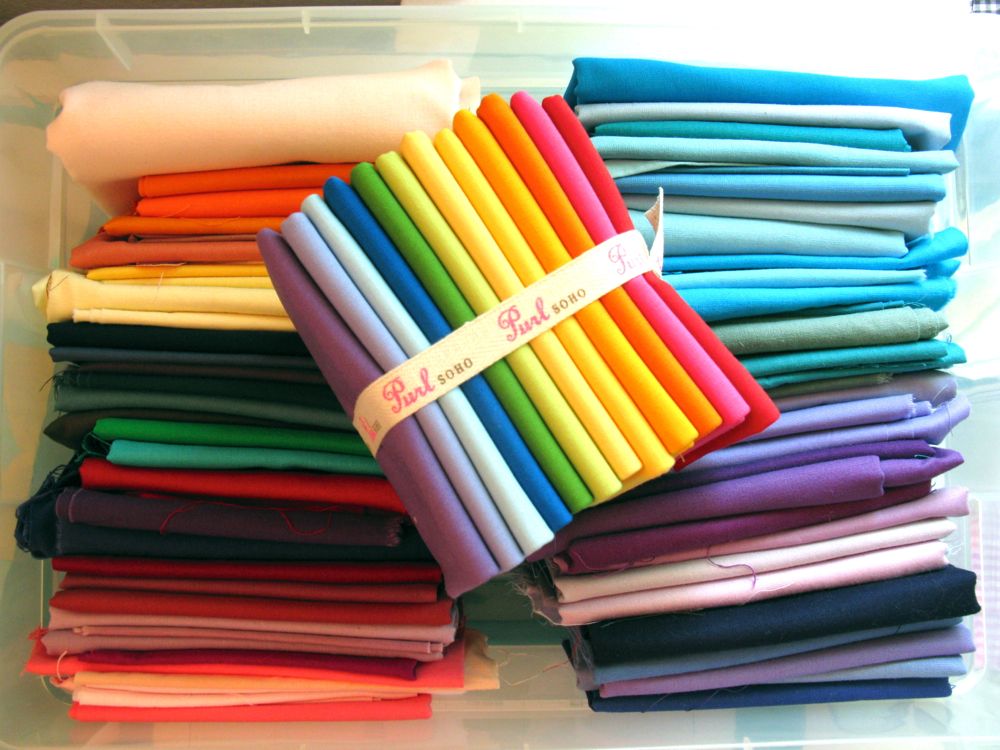
So I opened the “red” cupboard. . .

. . . and picked a swath of reds.

Maybe I had red and white on the brain, having shopped at Sandy Klop’s booth at Road to California, where they gave me this very cute bag.  (See our photo with her below).

And maybe because Cindy and I (on the right) were all decked out in reddish tones.  And maybe because all the stores have put away their Christmas and gone straight to Valentine’s Day.  But I think it’s more because of Rhonda’s amazing skills.

Beginning, I cut red squares, until I remembered that Rhonda said she’d done a more streamlined way of putting it together, sewing the thin strips onto the larger.

Okay.  Back on track.  Then I bordered them with strips on which I’d placed a square, then stitched diagonally to make a triangle.

So here are my first four blocks, with the little pinwheel in the center.  Mine’s much more unkempt than Rhonda’s, because I drew from my stash, while she limited herself to six fabrics.  Of course, I like hers better (I always do), but mine will work.  I have to teach in the morning, but look forward to getting back to this tomorrow afternoon, raiding my stash for reds to make it work.

UPDATE: Pattern links no longer work, so I drew up some loose instructions and have it for you at its new home: Revisiting the Red & White Pinwheel.

Quilts

Practical Applications of Quilting

Whenever my husband and I clean out the garage and are trying to put everything back, I can see where boxes will fit. . . and where they will not.  My husband is a brain, really smart, but I think that my years of working with pieces of fabric, shapes, sizes, corners — all that quilty stuff — allows my eye to notice how things fit together.

Another time, when I was a long-term sub, the 9th grade students needed some help with basic math and geometry.  Since by this time the lesson plans had long run out from the regular teacher, I developed a series of lesson plans that were ordered around quilt patterns.  I gave a lesson on a few shapes, then turned them loose with their pencils, rulers, colored paper and one piece of black paper to use as their foundation.  The results were dramatic and wonderful; I found out later these “quilt blocks” were left up all year long, even after my sub job ended.  I chalked it up to the enduring power of quilts.

So I was thrilled to receive a flyer from a biologist friend of mine, touting a lecture given at the University of Alberta, Canada: “Quilts as Mathematical Objects.”  The above quilt was on the flyer, and was made by Gerda de Vries. She describes herself this way: “I work as Professor in the Department of Mathematical and Statistical Sciences at the University of Alberta.  I am an applied mathematician, specializing in mathematical biology.  I am interested in understanding and explaining physiological processes through the development and analysis of mathematical models.”  So she invents a rule, applies it to her quilt design and carries it through.

This one’s titled “Cyclic Permutations (Study in Red, Black and White #1).”  The rule on this one that each triangle has a certain number of pieces, with the colors laid out in a particular order.  If you study it you can start to see the “rules” she applies.  I started listening to her lecture, “Quilts as Mathematical Objects” available on iTunes, via iTunes U (type in the title in your iTunes–she gave it at McGill University) and can hardly wait to finish.  I only wish I could have been there to see the visuals–which is what matters to us quilters.

She also does traditional quilting, as evidenced by this beautiful example.  She writes on her website that “I have a soft spot for ethnic fabrics.  This quilt highlights my collection of fabrics from the Netherlands.  Most are reproduction fabrics purchased at specialty stores; others were donated by relatives.  Traditionally, these fabrics were used in costumes (shirts, aprons), as well as home furnishings (bed sheets, mattress covers, curtains).  Also featured are a variety of so-called farmers’ handkerchiefs with traditional patters, purchased at town markets throughout the country.  I took particular delight in the construction of this quilt by fussy-cutting most of the fabric pieces.”

I think sometimes we operate in an insular world, in our own little quilty bubble, or at least I do, so it’s interesting for me to think about practical applications of our skills as quilters.  Perhaps if we relish in the color of quilts, we extrapolate that to our clothing, or our home dec.  Perhaps if we like the intricacies of quilting–matching up corners/seams/pieces just right, we will have perfectly ordered drawers and cupboards.  Or perhaps, as in the example of Ms. de Vries, we make our vocation (the thing that pays the bills) coordinate with our avocation (what we love to do) in creating beautiful and interesting quilts.

Creating · Quilts

Quilt Ideas

Over at Stitched in Color, Rachel has declared a scrap manifesto: Use Them!

I think that’s a brilliant idea; she’s culled a lot of ideas using scraps to make quilts and has a challenge going to use up our scraps (see her website for more details).  I think the idea, really, is to stash-bust, using up all those bits of fabrics leftover from our projects (or a too-ambitious buying spree).  I’ve been looking for a few of my own ideas on how to use up the stash.  Here’s one, a free pattern from Lila Ashberry, titled Summer House, and you can find the download *here.*

I’m looking for patterns that have a complexity to them, and will use lots of fabric and be quickly put together.

Or how about Mayra Dubrawky’s Sticks and Bricks pattern?  There would be a LOT less angles/triangles in this one, although it doesn’t have that complexity of the other.

Here’s one idea I’ve had in my files for a long time: a scrappy log cabin.

Join Rachel’s “Festival of Scrappiness.” Your finished quilt top is due by the end of March.

Books · Quilts · Sewing

Quilting Organically

Not quilting with organic fabric.  I was thinking more along the lines of a quilt that just sort of evolves from one stage to the next, getting stalled, then moving forward again.  But Quilting Evolutionarily (is that a word?) just sounded like it was heading somewhere different.  Often I feel the pressure to rush things–you know, to Get-It-Done so I can have something to show off to everyone in the blogosphere.  Because why would anyone want to read about my humdrum, inch-by-inch progress in my projects?  Only because that’s probably how things are going for many of us, especially at the holidays, when we are pulled too many directions.

So, after I put the blue borders on my wonky log cabin, it sat.  Then after finishing the grading, the finals, I actually had a night when I was waiting for my husband to come home from a trip back East, and I wanted to stay up and I had a good novel going, so I was ready to sew.

Forgive the blurry picture–it was at night.  I sewed white strips onto the blue borders.  I also had a stack of “middles” without the blue borders (I’d run out of fabric).  I added red strips to those, and then green.

And then I alternated them up on the pinwall. And there they’ve been for a few days now, while I try to figure out the next step.  They are all different sizes, so I’m trying to decide which ones to cut down, and to which ones I should add a deep blue strip or two in order to get them to become roughly the same size.

The novel I’m listening to is Moon Over Manifest and it’s written for a bit younger crowd; I’m still really enjoying it as it combines two periods of history in the story of the twelve-year-old protagonist.  I’m considering it for my English class next semester: since the main character is 12, I don’t have to worry about inappropriate romantic entanglements that I’d have to deal with in class discussions.  I’m teaching a developmental class (one below Freshman Comp) so this level might be appropriate to most of their reading skills.

So, not that anyone’s reading with a week left until Christmas, and Hanukkah just beginning, and the general rush rush of buying gifts and decorating and baking, but I am making progress on this quilt.  It’s interesting to sew without a plan.  I’m sewing just for the pleasure of it, just to discover what will unfold — the kind of sewing I need right now.