Quilts

Hexies, Bee Blocks and Betty’s Tile Quilt

HexieBig

I finished sewing this together during the last Downton Abbey.  I love it.  But now what do I do with this?  Moving on. . .

Cindy's Block Feb

Cindy, of Live A Colorful Life, asked us to make this block from During Quiet Time’s tutorial for her turn in our MidCentury Modern Bee.  Today, after taking a nap (really, I just couldn’t go any further and I have a life where I can take a nap if I want–that’s why I am in the Mid-Century Modern group, as all of us are over the mid-century mark on the old birthday calendar), I plowed into it.  The tutorial is very clear and easy, and it was fun to draw from my stash.

SignatureBlockFeb

Signature Block for February’s block.  We are each including one of these smaller blocks along with our square.  Tutorial is from PS I Quilt, but I won’t call it a “siggy” block, for the same reason I avoid the word “veggie” (instead vegetable).

Carla Block Jan

This Churn Dash was made for Carla of Lollyquiltz, by following her tutorial.  She uses the two squares-sew the edges method of the half-square triangle.  I found it easy, but did think that the block was a little more fluid because of all the bias edges.  She calls this block Juicy Fruit, and her quilt is something to behold (click on the link to go to her Flickr photo pool).

Signature Block Jan

And this was her signature block–requested in colors from her quilt.  I ironed freezer paper to the back of the white section to get it stable enough to write on.  Okay, that’s where I’m at so far this month, but the really exciting thing was hearing from Betty just before I left last week.  She’d made up my Harvesting the Wind in her own colors and had just gotten it back from the quilters.  She gave me permission to put up photos on my blog.  So. . . here they are!

8441300197_9c442b2591_b

She used all solids, but added that pop of tangerine to really set off the tile block.  I was smiling and grinning from ear to ear, because I loved seeing what she’d done!

8442395866_632db8b59b_b

8442392012_96789c05af_b

Betty, it’s wonderful.  She’s one of the Four-in-Art members, so it’s fun to have another connection with her. I think we are Quilting Twins in some ways, and I keep trying to figure out a way to get to the East Coast to meet her.

Okay, not done yet.  I mentioned I wanted to make the Sunshine and Shadow in another colorway, this time for my grandson.  Here’s the initial mock-up for the quilt.  It looks really different in such bold “boy” colors (he likes blue, red and black but I couldn’t resist lightening it up with those white patches), but I know it will go together quickly.

ChrisQuilt1

Have a nice Presidents Day Weekend!

200 Quilts · Family Quilts · Quilts · Tutorial

Sunshine and Shadow Quilt Tutorial

SunshineShadowBlock

Here’s the recipe for the quilt I gave to my sister-in-law, Janice.  But I think you’ll notice how “lopsided” the block is–and that’s because I wanted to eliminate the sashing step, including it in the making of the quilt.  I also wanted to make this quilt completely from my fabric stash, so I chose colors I had multiples of, in different designs and shadings.  What is sashing?  It’s those long strips that separate blocks from each other and can be part of the design of a quilt, letting each block float in its own little world.  Many modern quilts eliminate them, but I like them occasionally.

Choosing from the Stash

I started with the centers and cut all of them from the same line, but used two versions of the yellow flowers.  Then I pulled out a lot of different fabrics, trying to keep in the same tonality in the blues, and in the yellows, so the quilt top would be harmonious.

1. After cutting, the first step is to sew two blue strips on the sides of the large center block.

SunshineShadow1
2. Sew two yellow blocks on the end of the blue rectangles.

SunshineShadow2

3. Line them up.  After choosing good sets that go well together, stitch the yellow square/blue strip pieces onto the center.  I pressed the seams towards the blue, away from the yellows.  Sew the strips onto the center section.

SunshineShadow3

4. True up, by placing a 9 1/2″ ruler on top.  I found if I trued it up at this stage, the rest of the construction went smoothly.

SunshineShadow4

5. Sew all but one of the blue squares onto the larger yellow strips.  Then get ready to put them all together.  You won’t use all the blue square/yellow strip pieces at this point.  Just set the extras aside.  I wanted to audition how the random yellows and blue fit together, so I took one large block, a yellow strip and a blue square/yellow strip piece, making sure I wasn’t duplicating fabrics in any significant way.

SunshineShadow5

6. I pinned the yellow strip on the bottom, and folded up the other strip and pinned it to where it would eventually be sewn.  Sew on the yellow strip.

SunshineShadow6

Here it is, with yellow strip sewn on, showing that I pressed the seam to the outside yellow.

Pressing

In all cases, first press seam flat to eliminate puckers, wobbly edges, then press the seam open.

SunshineShadow7

7. Sew the blue square/yellow strip piece on the center construction, matching seams, etc.  This is the finished block.

SunshineShadow8

8. Because my pin wall is longer from side to side, than from top to bottom, I rotated the blocks a half turn and laid them out on the wall.  I kept using my digital camera to make sure that there weren’t too many of those darker yellow-gold pieces mushed together, as well as eyeballing a good distribution of the rest of the colors.  The quilt looks a bit strange now, because you are still missing a length of “sashing” on the left side and on the bottom.

SunshineShadow9

9. Because I still wanted to sew these as blocks, I laid out the “sashing” pieces, each with a blue square on them, where they should go. I laid them out, again checking for color and value distribution.  I had to sew that random last blue square onto a yellow strip/blue square piece, then I sewed these pieces onto the adjacent block.  When you replace these new expanded blocks on your pin wall, be careful not to rotate them into a wrong orientation. Use your last digital photo as a guide.

10. Put quilt together:  I put row markers (shown in *this post*) on the blocks on the left side of the wall, in order to keep track.  Then I stitched the rows together, going across.  Stitch rows together, going down, until the quilt top is complete.  I think it goes much faster (have I said this before?) because you are sewing blocks, rather than long strips of sashing.

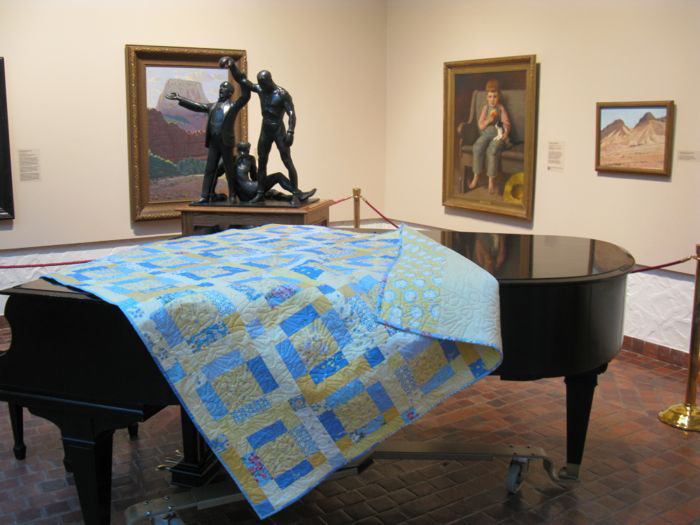
SunshineShadow FavMuseumShot

Quilt as desired (and my favorite way is calling Cathy and having her do it for me).  I used the extra bits of blue strips I’d cut out, plus extra, to make a scrappy binding.

Okay here’s the honest truth: I started out with a completely different idea for this quilt and cut a whole lot of blue and yellow fabrics into 2 1/2″ strips, but realized that my time was short so I had to step up to a quicker quilt.  That’s when I had the idea of adding the sashing pieces to the block, because sometimes sashing just wobbles and stretches and becomes one pain-in-the-rear step to making a quilt.  This was was much faster, and I think the integrity of the quilt doesn’t suffer for it.  You’ll notice I tried to press to the “sashing” side always, as I think that distinguishes those pieces from the “block.”

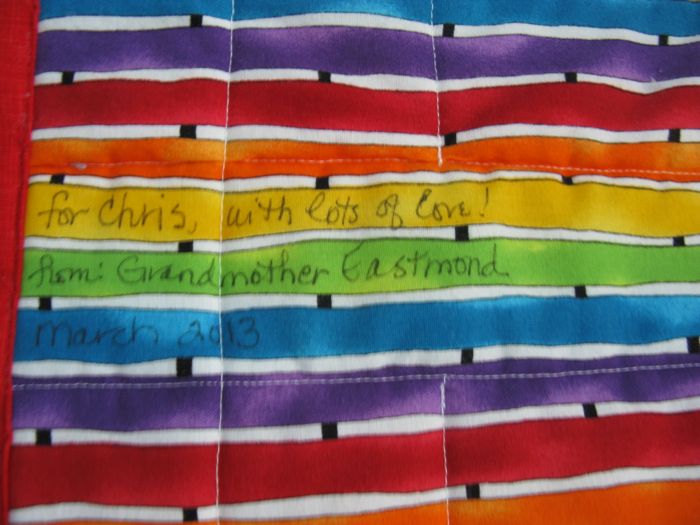
SunshineShadowLabel

To make the label, I did the usual method of pressing some fabric to freezer paper, running it through my Epson printer (they have the best inks), bordering it, then stitching it onto the quilt invisibly around the outside edges.  I also like to do it on the inside edge of the border, where the label meets the edging.  No one can tell, but it poofs out less from the surface of the quilt if it has that second round of stitching.

SunshineShadow

BlueYellowFullQuiltwTitles

I’m actually planning to make another like this, as it is really quick, and I like the fact that I can use up my stash.

I seem to have lost a few days here, but with the weekend coming (a holiday weekend!), I hope to find time to dive into some stitching, and some blogging.

Quilts · Something to Think About

On A Day Like This

What do you serve for dinner on a day like this?  It’s a day where the food needs to be hearty and warm and go down easily in between the tears.  Soup?  Spaghetti made with that good sauce from Trader Joe’s?  Chocolate needs to be in the picture, better schedule some brownies for dessert.  A whole pan, so more can be cut up and carried in the car on the way to the funeral.

What do you do on a day like this?  The news came early this morning, my husband weeping as he tells me of his brother-in-law passing away in the morning.  I am strong.  I don’t cry.  I get more information later, that my husband’s sister was sitting at Bruce’s bedside, having been awoken at 4 a.m. by her daughter, each taking two-hour shifts through the last few nights.  They sat there, his breathing diminishing, faltering, until at 6:30 it ceased.  A quiet, in-sleep, in-home death.  One we all would choose if we could.

IMG_6738

On a day like this, I finish up the quilt and the angelic quilter lady agrees to a rush job and later, much later, after I sit numbly at the computer, and I become not strong, do I realize how Bruce’s death diminishes our family.  This is not a new idea.  I felt it when my other brother-in-law died, when my husband’s parents died, when my grandmothers died and it has been expressed by writers since time began.  It just feels new, each death bringing with it memories and associations and words that can not ever now be spoken.

IMG_6737

On a day like this, I clean out a cupboard and jar breaks.  I look at it, get the dustpan and broom, wander to the mailbox, ask the neighbors to throw the papers on the porch while we’re gone and then the quilter drives up, bringing me my quilt, making me cry again.  Because.  Because on a day like this we need hands to hold us, hearts to share our sorrow.  And something easy to eat for dinner.

200 Quilts · Four-in-Art · Quilts

One Black Leaf, deconstructed

One Black Leaf art quilt1

Inspired by Betty’s photos, I took One Black Leaf outside to be photographed by her sister trees, because of course, with those curves, it’s evident this quilt is feminine.

OneBlackLeaf back

And just like Betty and Rachel’s quilts share a commonality, this one too shares something with Betty’s–we both used the Martha Negley slices of wood print; Betty’s was in the blue colorway and on the front, and mine’s the green on the back.  The binding is from that half-yard of Marimekko I purchased while in New York City last summer with my husband.  So far it’s been in two projects and I still have a scrap or two more.  This post is picture heavy, as I’m talking about the approach I took to creating One Black Leaf, including technical aspects, false starts and home runs.

One Black Leaf 1

So the poem is ringing in my head: one black leaf, one black leaf so I know it has to be a tree with bare branches.  I start by ripping off a piece of paper from the roll of doctor’s examining room paper I got a while back.  It’s great paper — it holds up to erasing, and is thin, flexible and cheap.  Try a medical supply house for yours.  I draw a 12-inch square because that’s one of our group’s parameters, and like what we did in high school art class, I draw a grid both on my square and on the illustration I found that I want to mimic.

One Black Leaf 2

I draw as best I can (not my strong suit), using the grid to guide me, yet I kept thinking of the espaliered tree I’d seen on the web (last post) and even though death comes around for us all, at the heart of it, I know that love survives even mortality.  I color it in with black marker.  Because I’m working on thin paper, I protect my cutting mat with scrap pieces of white paper so no bleed-through. I flip it over and color it in on the back, too, because I want to fuse this onto my fabric and know it has to be backwards.

One Black Leaf 3

I lay the Steam A Seam down, figuring out which of the papers should be taken off first completely ignoring their instructions to determine which is the pressing paper and which paper is to come off first.  I got lucky.  Reminder to fuse the whole design down onto the black fabric before you start cutting.  (Of course I did that.  Not.)  Sigh.  I fused the design to the Steam A Seam, then started cutting it, before I remembered you aren’t supposed to do that.  So I stopped, laid out the traced design on the Steam A Seam onto the black fabric, THEN cut it out.

One Black Leaf 4 fail

I had some problems.  Turns out (after a quick search on the web) that Steam A Seam “wears out” or loses its ability to adhere after it has been in your drawer for a while.  Since I know this batch is at least 10 years old, I’m in a world of hurt.  Who wants to cut out those teensy branches again?  So I call the Quilt Rescue squad. . .

One Black Leaf 5 rescue

. . . and first try placing the paper release sheet from the other part of the Steam a Seam and pressing it lightly to make it stick back on the teensy branches.  Worked okay, but there were still some spots that needed some help.  Then I remembered that once, in a class with Elinor Peace Bailey, she used a plain old glue stick to put things in place, giving it a press to disperse the glue.  I did this.  I had a few problems getting the tree back into place, so I laid my white fabric down onto my design, and arranged the branches until they matched the original design.  And by the way, it took me longer to describe all of this than it did to do it.

Your takeaways from this section:

1. Read the directions.
2. If your Steam A Seam is older, first fuse it back onto their release paper with a warm iron and light touch. And from now on, store it in a plastic bag.
3. Use your design paper to help you get the arrangement into place.
4. Use a glue stick if you still need some sticking down.  Press with a warm iron to disperse the glue.

I decided the block needed a bit more stability, so I ironed on some lightweight interfacing on the back of the entire piece (I did this also for the last art quilt I made, as I had seen it mentioned time and again in the Twelve by Twelve book. If you don’t have this book, you should.)  Then I set my zig-zag stitch for a narrow satin stitch, then went all around my tree in black thread.  I referred to my Jane Sassaman book where she talks about if you have it really close, it frames it, and if you have the zig-zags slightly loose, it blends more.  I was somewhere in the middle.

IMG_6211

She also cautioned the quilter to “take it slowly” and to take our time when doing stitching.  I need to have that tattooed on my forehead. I think if my Steam A Seam had been fresh, and I had been more careful about getting it to stick, I may have averted some of those sticky-outy bits of fiber from the edges.  But because this tree is going every which way, I think some was inevitable.  Small scissors took off most of them.

IMG_6213

Jane Sassaman also outlines her pieces with heavy thread.  I decided to use green for the inside curves and pink for the outside curves. Here’s the pink.   There was a ton of tying off on the back (as I pulled all threads to the back, tied and buried them), but I like how it gave a little pop to the quilt. I used pinkish King Tut (from Superior Threads) and their Poly-Quilter in green, which I understand is being discontinued (but I still love it).  Use a size 16 topstitch needle which has a larger eye, go slowly and you should be fine.  I use their Bottom Line in my bobbin — it’s my personal recipe for quilting success — and used what was close in color as I occasionally I like to use what I have.

OneBlackLeaf detail1

(Another view, after the quilting was finished)

One Black Leaf 6

I had used some white fabric from one of my trips to Germany.  It has a heavy damask woven design of flowers and I didn’t want to completely obliterate it with the quilting.  I laid some wax deli sheets over the tree and using a Flair pen (it won’t go through the paper with its soft tip), I auditioned some quilting ideas.  I’m not a really fabulous FMQ (free motion quilter) but I can do some.  I decided on leaves.

One Black Leaf 7 stitch

I liked the idea that while the black leaves on the tree are for us, there are others that have gone before who are still around us.  I can’t bear the thought that we all just go “poof” at the end of life, and judging from the memorial quilts I see, others feel the same.  Of course, a lot of these ideas are informed by my personal spiritual/religious beliefs as well.  I went at the quilting–doesn’t take long if you are doing a small quilt (another reason why I like this size) and in no time I was done.  And yes, it kind of obliterated the design in the fabric.

One Black Leaf 8 trim

Next big hurdle, which you wouldn’t think would be a big deal, is to trim.  It’s really a decision on how to frame it.  That blotch in the lower right-hand corner of the untrimmed piece?  Where I tried out my zig-zag stitches and also left a burn mark with my iron.  Luckily it was cut off.

One Black Leaf 9 corners

I have a method for hanging these small quilts which involves a dowel (photo at the end) but I have to put in corners to hold the dowel.  That square is about 2 1/2″ in dimension; fold it in half and pin it to the upper right and left corners.

One Black Leaf 10 binding1

My standard small-quilt binding: 2″ strips, folded in half, sewn to the upper and lower edges.  Trim even with the edges and press out away from the quilt.

One Black Leaf 11 binding 2

Repeat with sides, but be careful as you trim even with those sides. Press away from quilt.

One Black Leaf 12 trim

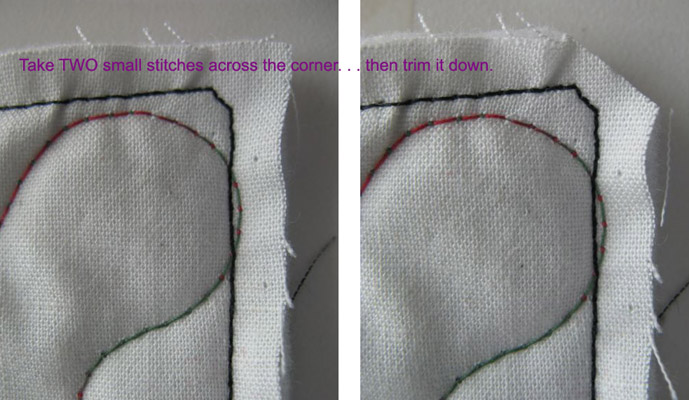
You’ll need to remove any bulk you can in a binding this tiny, so trim off a little of the corner and the bits of seam allowance as shown.  When I say not to cut anything off the binding strips, I mean the business part of the strips–the stuff you’ll need to fold over.  Just follow the diagram as I think my written description is confusing.

One Black Leaf 13 binding3

Then since my assistant left for the day, I had to use pins to hold things in place.  Fold in the sides (1), give a little push to the upper edge to fold in the bulk (2), then fold down the remaining strip (3).  If you go in this order, you’ll always enclose your raw edges.  If your raw edges are still showing after the folds, you’ve reversed it and folded in the top/bottom first.  You’re smart.  You’ll figure it out.

One Black Leaf 14

My friend Tracy taught me ages and ages ago that I didn’t need to pin or clip around the whole quilt, that I could just do the corners and fold in the rest as I stitch down the binding.  I do that even on my larger quilts.

dowel hanging device for art quilt

Cut a dowel the size of the back, minus a scoonch of room, then sand the cut edges.  Slip into place.  It will balance on a push pin nicely.

OneBlackLeaf quilting

OneBlackLeaf

Selfportrait OneBlackLeaf

Self-portrait
February 1, 2013