200 Quilts · Four-in-Art · Quilts

Structure: Four-in-Art Art Quilt, February 2014

4-in-art_3

On Line Art Quilt_front1

On Line
No. 2 in the Urban Series: Structure

IMG_5875

Leanne asked us to consider the theme of Structure for this challenge.  While other ideas teased, the vision of these immense structures of steel and wire kept haunting me.

IMG_5901

My husband and I got off the freeway to follow a few, photographing their massive, yet airy, construction reaching high into the sky, grabbing a line and passing it to their fellow tower.

IMG_5890

It made me think about structure in terms of how electricity — and their cousin, the telephone line — have created their own structure in our lives.  We used to depend on mail, human contact, driving somewhere, but now we email, Instagram, Facebook, Skype, and need scads and scads of voltage to do it all.  The structure of our lives has changed.

Baby Envelope Quilt

I had hoped to make a quilt of tiny envelopes, distress them somehow, then superimpose the grand power scaffolding on top of that, representing the change in communication.  It was not meant to be.
On Line in construction2

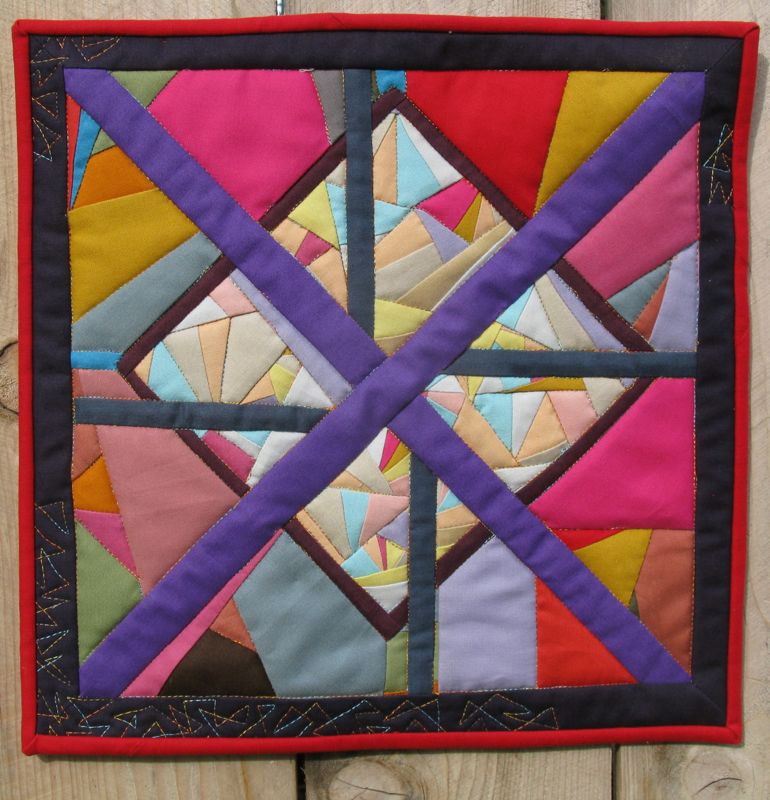
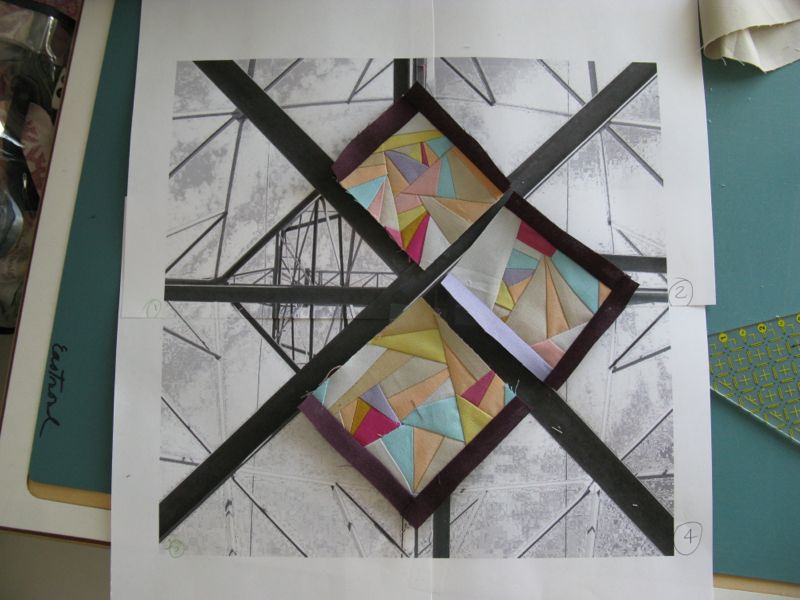
I printed out the upwards view of the tower, intrigued by its criss-crossing lines, then proceeded to sew together a billion little angular pieces.  I kept thinking how proud of me Leanne would be, as she is the queen of improv quilting.

On Line quilt in construction2a

As I completed a section, I’d lay it out.
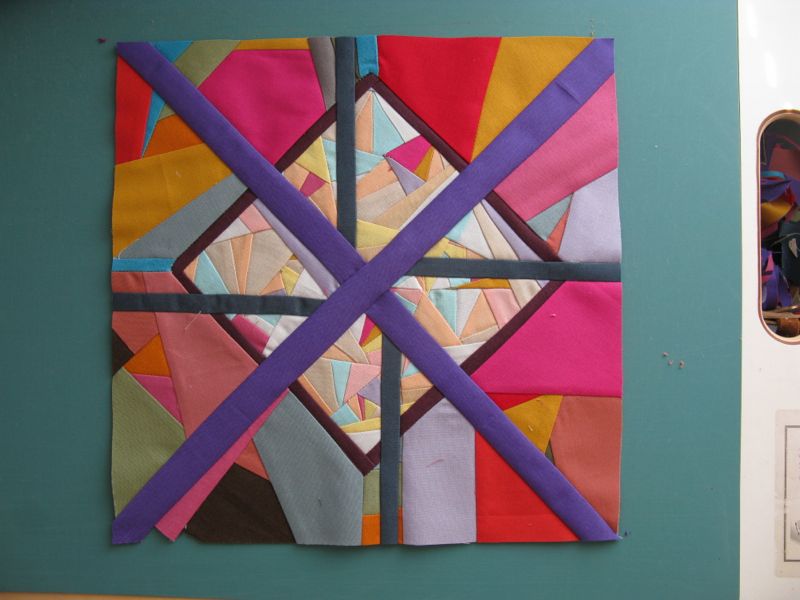
On Line Quilt in Construction3

Done, but it was a bit small, so I added a border.

On Line Quilt in construction_4back

I’m showing it from the back, as I’m mighty proud of those billions of seams.
On Line Art Quilt_detail1

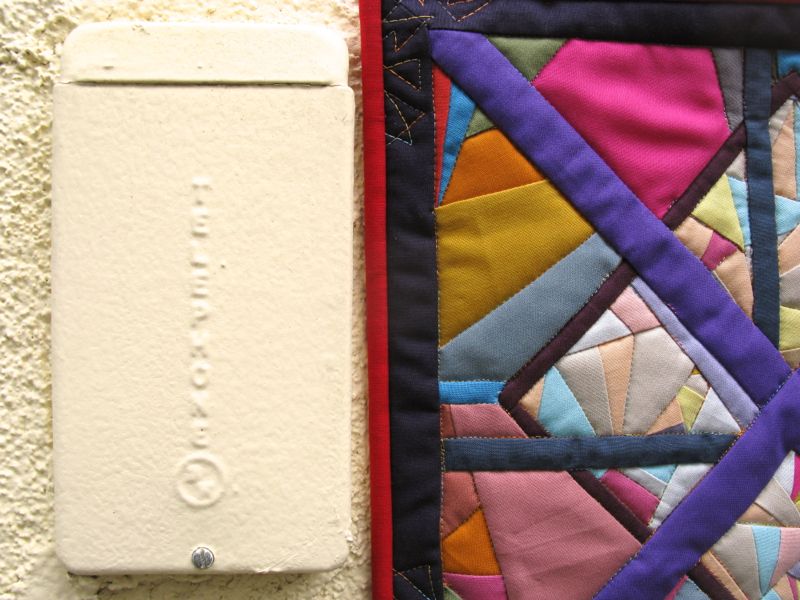
I chose a variegated thread and quilted where I wanted to.  Maybe those scribbled lines in the border are conversations?  Or interrupted code from a blog post?  Or the news from a family member, broken into bits and pieces as it is transmitted?  The fabric is scraps from my most recent quilt, Amish With a Twist Two, perhaps because I wanted to work with line and not pattern (and certainly with all the weeny subdivisions, there is plenty of pattern) but also because the sack of scraps had not been put away yet.

On Line Art Quilt_front2

I like this photo because the leaves and berries of the bush behind this tree call out the color in the quilt.

On Line Art Quilt by PwrBox

Posing with its soul mates: the telephone box and the power meter.

On Line Art Quilt _back

I had planned to piece all the little envelopes together and put them on the back, but I decided that with all the seaming, the quilt would be one gigantic lumpy square.  Plain backing then, from the Collage line of fabric, and then added the label.  That morning nothing would go right, so it’s on and done; not perfect, but sometimes that’s just how it has to be.

On Line art quilt with picture

I owe my associations in this Four-in-Art group to these very structures, long looping lines bringing me quilting and friendship.

Take a look at how our group interpreted this theme:
4-in-art_1

CODA

printed out power tower
Since I wrote about how I made it, I won’t be doing a “deconstructed” post for this quilt.  And when I hear what the new theme is for May, I’ll let you know.  As usual, there was some amount of frustration over this quilt–deadline crept up on me, a “why am I doing this to myself?” moan (or two), and then the getting down to it.
Teresa Amabile said “Creativity depends on a number of things: experience, including knowledge and technical skills; talent; an ability to think in new ways; and the capacity to push through uncreative dry spells.”  At the end, I’m always glad I pushed through any dry spell to arrive at the finished Four-in-Art art quilt.
Four-in-Art · Quilts

WIP on a Thursday

WIP on

I love that Lee, of Freshly Pieced Fabrics, forgot to put up Works In Progress Wednesday until today, for that’s about the speed I’m moving at this week and it makes me feel better that there’s someone else on the planet who is marching to a different drummer.

4-in-art_3But today’s WIP is all about the upcoming Four-in-Art reveal of our art quilts, on Saturday, February 1st (just listen to me hyperventilate!).

Baby Envelope Quilt

This is as far as I’ve gotten–making wee envelope blocks for an idea that is cooking, even percolating, but going no where fast.  Grading, prepping for class and of course, a trip to the Road to California Quilt Show (with Deborah of Simply Miss Luella and Cindy of Live A Colorful Life and my quilt group, The Good Heart Quilters) for the next two days are Mighty Interrupters.  The overarching theme for this year’s Four-in-Art is Urban, and last quarter’s reveal was “Maps.”  This time it is “Structure.”

Birdhouse Burano

I’d thought about recreating a structure on a structure, like this small birdhouse on an existing wall of a house.

Building Gold

Building Silver

Or doing something with these amazing buildings in downtown Pittsburgh; one picture was taken in the late afternoon (the top one) and the other was taken in the morning.

Canal Burano

Picturesque Burano also captured my heart, but I decided that given the parameters of our group’s art (it has to be 12″ square), I’d rather save this for another day when I have a bigger canvas.  And more skills.  (Throw “more time” in there too.)

Freeway bridges PIttsburgh

I love the structure of these freeways, but it reminded me too much of a map, which was last quarter’s reveal.  So what am I cooking with, with baby envelopes tacked up on my pin wall?

See you in a week, and we’ll both find out.

200 Quilts · Four-in-Art · Quilts

Childhood’s Wide Avenues

4-in-art_3

Childhoods Wide Avenues Art Quilt_front

Childhood’s Wide Avenues is a quilt about memory, of fixing in time a place and a feeling.  I grew up in the mountain west, in Provo, Utah, a town laid out in a grid of wide avenues, criss-crossed with streets that seemed to me to be wide as the sky, although I’m sure if I went back there now, they would be reduced in size and dimension.  But that feeling that I could ride my bike to the top of the street near our house and see all the way down to my elementary school, or across the valley, or to the other side of the world has remained in my memory.

The possibilities were infinite.

ChildhoodWideAvenues Art Quilt_label

A few weeks ago, as I was thinking about this quilt and how to express the theme of Urban/Maps, I found myself traveling down another very wide avenue through the middle of a town very unlike where I grew up: San Bernardino, California.  But the boulevard was so wide and so straight and I could see it head in a straight line for miles, up into the foothills, that I felt as if I had been transported in an instant back to an earlier place and time.  But it seemed impossible, until I learned that Mormon pioneers, a branch off the same tree that laid out Provo, had also laid out the wide avenues of this town two states away, in the early 1850s.  Asked to settle this place far from their original homes in the Utah valley, they laid out a grid of wide avenues, and gave them names like Salt Lake Street,  Kirtland Street, Nauvoo Street, and Utah Street.  These have all been renamed, but those early pioneers left their stamp on the valley not only by naming the cemetery Pioneer Cemetery, but by etching long, wide avenues into the landscape.

CWA_8 Me

I had heard about memory being triggered by sounds, and by smells, but never had experienced memory being triggered by a sense of space, of a geographical series of landmarks making headway into my childhood memories.  For days afterward, I thought of the family I grew up in, and found pictures to place on my quilt that evoked a sense of that time (that’s me, above).

CWA_7 detail front

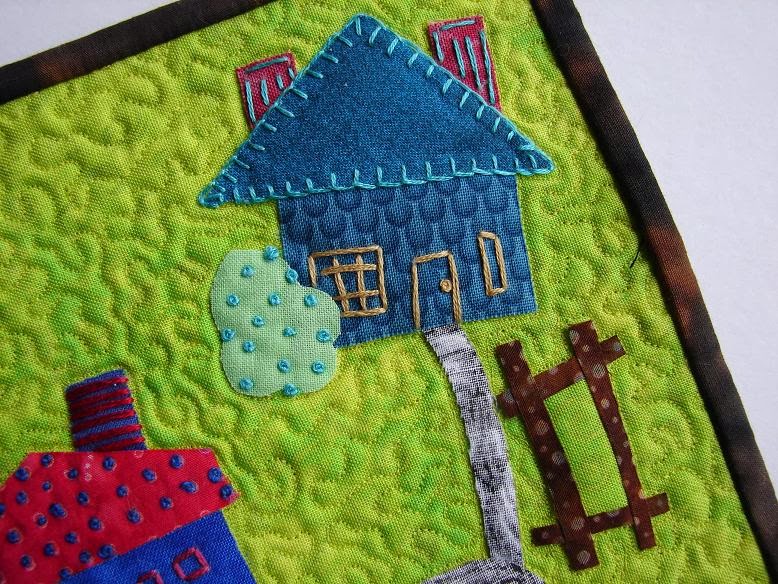
Who populates these fictional houses on my quilt?  The large pink house is my parents’ and the block below contains houses for my husband and I, and our four children and their families, while the blocks surrounding that central block are where my sisters and brothers might live. And because all of their spouses will want their own families, I scattered the grid of avenues with more houses, so that the circle of family would have place and space.  A dream, of course, as none of our children, nor any of my family live near us.  But in my world, in my memory, we are all there: gathering Easter eggs on the front lawn, jumping in piles of leaves, finding tarantulas in the fissures in the hillside, cracking open walnuts, and smelling the lilacs at the end of the driveway — lovely, amber-colored scenes.

Tomorrow I’ll deconstruct the quilt, describing the technical side of how I put it together.  But for now, more quilts depicting this theme of Urban/Maps can be found at:

Leannemap

Leanne of She Can Quilt

RachelHouse1

Rachel of The Life of Riley

BettyMap

Betty from her Flickr site

AmandaMap

Amanda of What the Bobbin?

NancyMap

Nancy of Patchwork Breeze

Annemap

Anne of SpringLeaf Studios

CarlaMap

Carla of Lollyquiltz

˚˚˚˚˚˚˚˚˚˚˚˚˚˚˚˚˚˚˚˚˚˚˚˚˚˚˚˚˚˚˚˚˚˚˚˚˚˚˚˚˚

FinishALong Button

This is a finished goal on my Quarter Three of the 2013 Finish-A-Long, hosted by Leanne of She Can Quilt.

It is also Quilt # 124 on my 200 Quilts List.

Four-in-Art · Quilts · Something to Think About

Map Musings

4-in-art_3Since the quarterly reveal date for our Four-In-Art is coming up in a couple of days, I thought it was high time to sit down and think about this new overall theme of Urban, and the specific quarterly theme of Maps.

Front Page TM

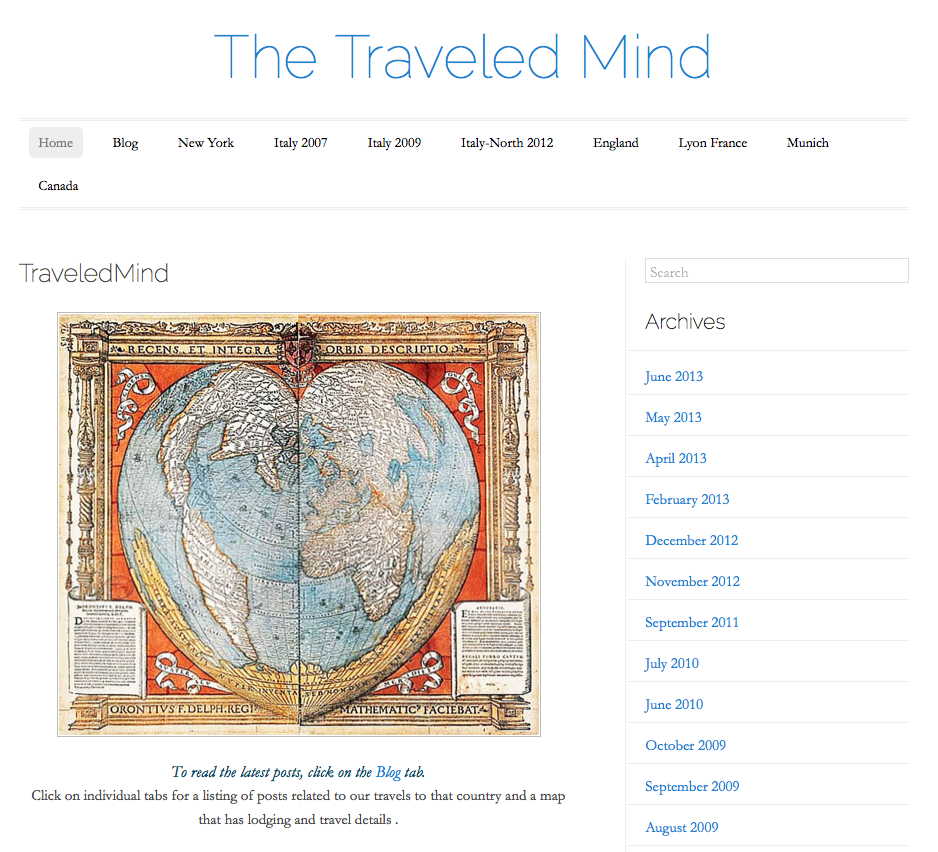
While we love the old maps, shown above on the front page of our family’s  travel blog, we all depend on recently updated maps to find our way around.  I read somewhere (and of course I can’t find it now,) that at some point in history, maps were kept only for those who had money or a position, guaranteeing them power over the masses who toiled in medieval fields.  For to hold a map, and to read it, is to understand your place in the world and how you relate to it.

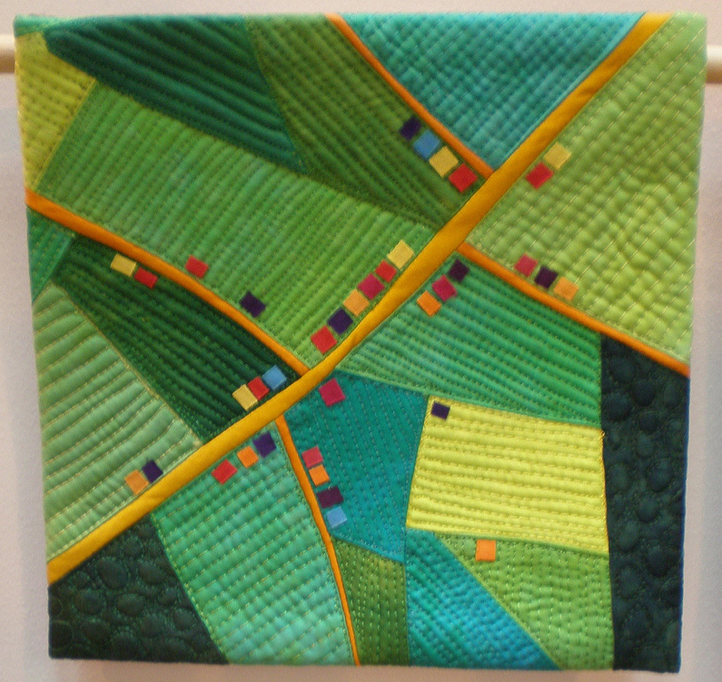
SM Aerial Map Quilt

(Alicia Merritt, Green and Pleasant Land)

In a section of  Nicholas Carr’s book The Shallows: What the Internet is Doing to Our Brains, he writes about how maps develop:

“We progress from the infant’s egocentric, purely sensory perception of the world to the young adult’s more abstract and objective analysis of experience.”  Children’s drawings of maps advance as 1) simple topographical relationships are presented, without regard for perspective or distances, then 2) intellectural realism evolves connecting what is known with the proportional relationships, then 3) a visual realism appears.

Carr recounts that first maps were rudimentary, then realistic, then scientific in both precision and abstraction.  In addition, maps expressed ideas: ” ‘The intellectural process of transforming experience in space to abstraction of space is a revolution in modes of thinking,’ writes Vincent Virga, an expert on cartography affiliated with the Library of Congress.”

TV Map of USA

While no one under the age of 40 will remember this, once it was common when someone was coming to your house, for them to call you with the question, “How do I get to your house?”  Then we’d detail for them the streets to turn on and the landmarks to notice so they could arrive at our home.  Then came MapQuest, then Google Maps, then maps on our phones where can follow the little blue dots, then the aggravation with Apple’s Maps, proving again that he who holds an accurate map has real power.

Nighttime Map over USA

While this is a blurry shot of a city from an airplane, the first maps were of the heavens–of stars and planets and their movement.

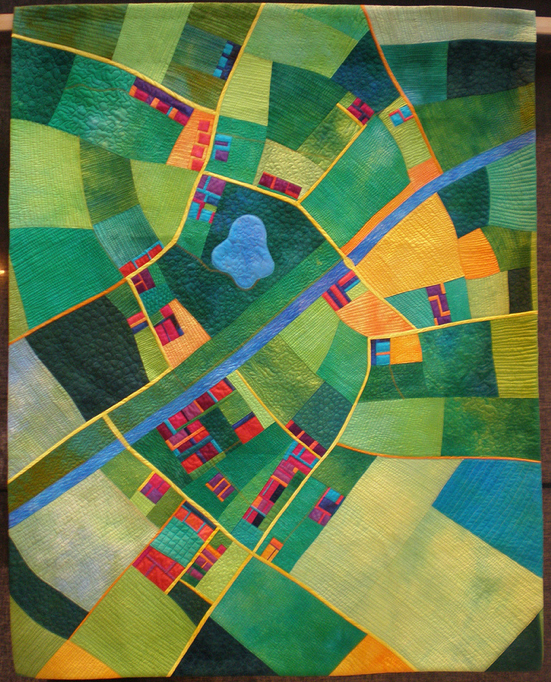
LG Aerial Map Quilt

(Alicia Merrett, Canal Country)

Only later did it invert, so that maps became aerial views of the earth and its landmarks.

Creative Class Workers by Census Map(from the Santa Monica Patch: type in your USA city and see what you see)

Thiebaud Levee FarmWayne Theibaud, Levee Farms

Land Patterns from the air

Don’t we all have multiples of this photo on our cameras?  Aren’t we all amazed by the patterns on our earth, invisible to us as we drive/move/walk around at ground level?

Capturing a View National Portrait Gallery

(view towards the Archives, taken from the National Portrait Gallery, Washington, D.C.)

Maps can also be a window on our lives.

ESE Life Map 1a

I once had a class do Life Maps, where they depicted an aspect of their life, wrote a paper about it, and presented the map to the class.  This was my sample map of my education.  In writing in my art journal last night about maps, I began to realize that maps could also freeze time, evoke a memory.  Unlike my other Four-in-Arters, who seem to be charging ahead, I’ve been at a loss about what to make, how to proceed.  But after sitting down and writing about it, gathering pictures of maps and ideas, I am now creating my own map of where to go with this project.

*******

We are welcoming four new members this year, so the logo, which originally meant four artists, now has — at the suggestion of one of our group — changed to mean the four quarterly challenges we make. We reveal a new over-arching theme in August, then in November, February, April and August we make quilts around that theme, with smaller “subset themes” to guide us.  We hope you’ll come back on November 1st to take a quilt art tour, as the eight of us interpret our current theme of Urban/Maps.