Creating

Naming Quilts

I like the idea of naming my quilts–call it the Eve in me–but I don’t name everything. I read a blog post about someone who named their electronics and I like the idea, but I don’t do it.  I do admit that some of my quilts have dorky names. And you’ve read on this blog before that I think people might want to give a little more thought to the names of the quilts that I see hanging up in the shows.  My secret weapon in all of this business if finally revealed.

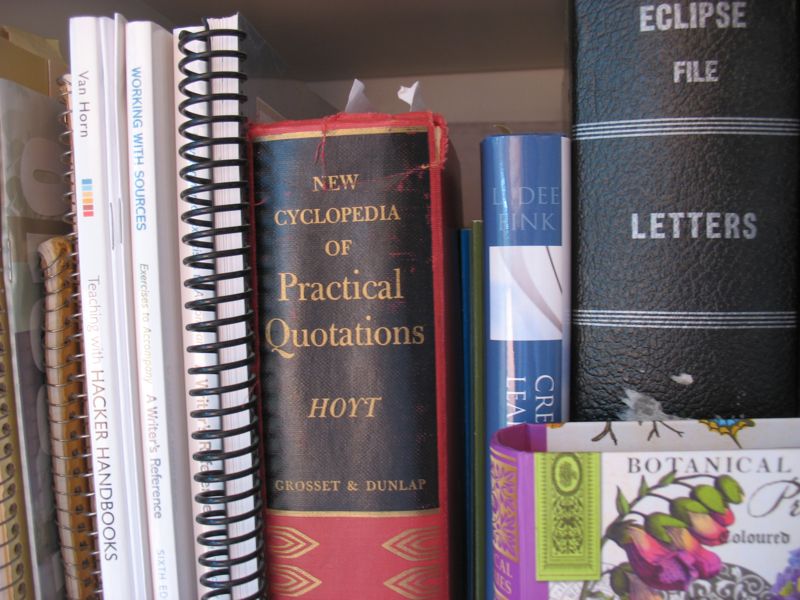
Yes.  Hoyt’s New Cyclopedia of Practical Quotations.  This edition was compiled by Kate Louise Roberts, and if the cracked spine and archaic title didn’t give away its age, certainly the editor’s full name did. Originally published in 1922, the edition I have is the 1940 edition, purchased at an estate sale when I first moved here.  I’m a sucker for pithy little lines of verse, beautifully written epigraphs, quotable quotes, and terrific sayings from people, both famous and not.  I think I inherited this from my father, who, even in his 85th year, still can find a quotable line for almost every situation–and he recites them from memory.  However, I look them up.

So in naming this current quilt, I was intrigued with the idea of “Spring Life” that popped out when writing the last post about this quilt.  I looked up “Spring” in the Cyclopedia, and found several verses that were intriguing:

Spring hangs her infant blossoms on the trees,
Rock’d in the cradle of the western breeze. (Cowper)

Infant blossoms–wow.  What an image.

Now Nature hangs her mantle green
On every blooming tree,
And spreads her sheets o’ daisies white
Out o’er the grassy lea. (Burns)

Lots of old language in this volume.  Liked the idea that Spring puts our her daisy bedding (maybe a quilt?) over the meadow. But the one I liked:

There is no time like Spring,
When life’s alive in everything,
Before new nestlings sing
Before cleft swallows speed their journey back
Along the trackless track. (Rossetti).

Are you bored yet?  Thinking up a title takes a little wandering through this book.  But I think I’ll go with a hybrid:

Spring/Life’s Alive
Creating

Whose Design Is It Anyway?

I wrote yesterday about my Spring Quilt, but in the writing, I realized I had another post about how we come up with our designs, and the tangled strands of the World Wide Web.  This post is about the whole story of design, as I see it. After I had purchased my fabric, for several days, I trolled the web, my quilt magazines and books looking for ideas.
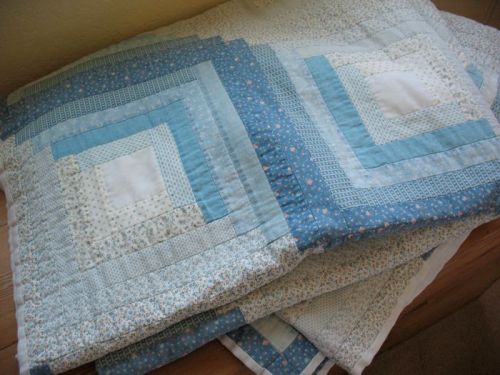
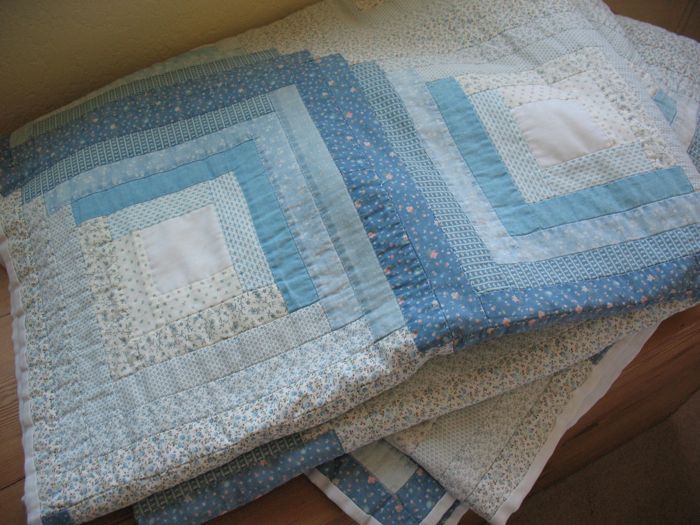
One of my early quilts was a log cabin, and certainly that is the base for many modern quilts: a center square and strips sewn around. I hadn’t sewn one in years, and I thought it would be a good idea.  But how to change it up?  The idea came to me: what if I skewed the strips, wonky-like, like in some quilts?  I sketched out some ideas, but wasn’t quite happy with them.  Since I’m still working on the applique on the wild dotty circle quilt, I hoping for something a little more ordered.  Then I saw another one that had left off one side of the “cabin.”  This one I liked.  I opened up my Quilt Program (since I have a Mac, I use Quilt Pro) and drew my own version.  It doesn’t really have this much white in my vision–I just got tired of clicking to color the strips.

I called it Fractured Log Cabin.  Here is the block on the left, mock-up of the quilt on the right:


I kept surfing through the web after I finished up, and found an almost identical quilt on Red Pepper’s quilt site.  She calls it something different, but I did notice she has a pattern for sale if you don’t have quilt software, or don’t want to draw your own pattern.  I hesitate to draw attention to this, as it could be said the process worked differently–that I may have seen her quilt and copied her pattern.  What I did take away from hers was to move the top strip to the bottom.  It threw the quilt off a little bit–didn’t make it quite so ordered.  I liked that.  But then I thought, what if I re-drew the block to accommodate that design shift, and sewed it like that?  My new block is on the left, the new quilt sketched on the right.

This is where it gets tricky.  When I first started quilting it was a a given that what you were doing was a derivation of what you had seen before.  Only occasionally did quilters make up their own patterns, instead drawing on the rich heritage that was ours, was given to us.  In those early days, some quilters would attempt to call patterns their own.  We didn’t mind.

But I’ve noticed that this idea–this is my design, my pattern–has just exploded, and that now, even if we feel like it’s our own–or mostly our own–there seems to be someone, somewhere who has already done the same design.  Only now they’ve copyrighted it, made a pattern for it, and are making their living off it.  I try to be sensitive to this new reality.  The internet has given us a much wider market in which to sell our goods, and many talented people should be compensated for their work. I am not a fan of those who plagiarize another’s work with the intent to defraud, in one way or another.  That’s why I buy books, magazines, and patterns–not only for ideas, but to pay for the quilter’s work.

But where is the open space for those of us who are long-time quilters with our own digital quilt software, who pull their own ideas from their history, their travels, and have their own ideas, only to find that the zeitgeist has delivered the same idea to someone else? Or that we may–as I have done here, borrowed a detail or a shifting?  Is that okay?  I don’t have answers, but I do try to be transparent about my own creative process.  When I was going to grad school, this was talked about a lot, but in terms of authors borrowing from each other.  Some quilt designers have a “look” just as some authors have a writing style.  Anyone would be nuts to take an idea from Piece O’ Cake designs and call it their own, as their style is so unique and so distinctive.  But I have always been fascinated at parallel evolving in the case of Ruth McDowell and Cynthia England.
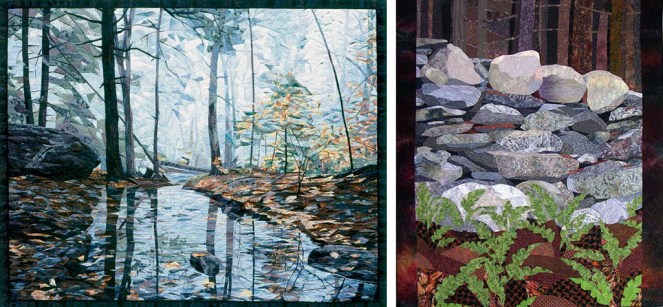
They both use a freezer-paper fracturing approach to their quiltmaking, and while the look can be different as in this example (England on the left, McDowell on the right), the end result of cutting fabrics into shards and shapes and reassembling them is mighty similar.  Should only one woman be using this approach to pictoral quiltmaking?  And here’s the bigger question: isn’t there room enough in our quilting universe for two such quilters and methods?

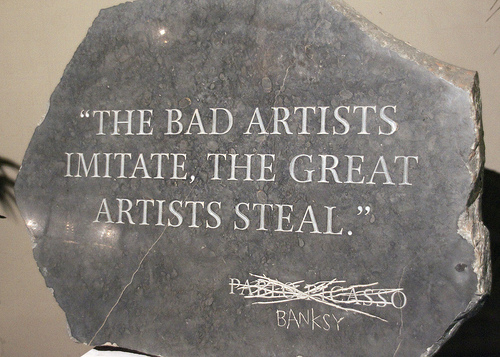
I would be just as flattered if you credit me with the brains to look at a quilter’s site first and to draw on their blog offerings, just as the Old Masters learned from one another by copying each other’s paintings.  And just as authors have always done, and just like this sign that the street artist Banksy, appropriated from Pablo Picasso’s words:
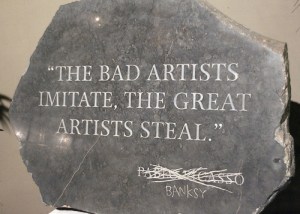
I’m just as happy to have you imitate steal borrow from me, and would be thrilled if we had the same idea at the same time and executed it and blogged about it, thereby adding to the rich offerings of quilts on the web.

Creating

Spring Quilt

So I was just minding my business when my car turned into the local quilt shop’s parking lot on the way home from school (Calico Horse, in Redlands, California).  It had been a bad day, and all I needed was a small fat quarter.  However, this fabric group, right by the door (of course) seemed so fresh, so lovely, and their quilt sample–a cute modern pattern with lots of light colors–seemed so spring, that the next thing I knew I had hauled all the bolts in this line to the cutting table.

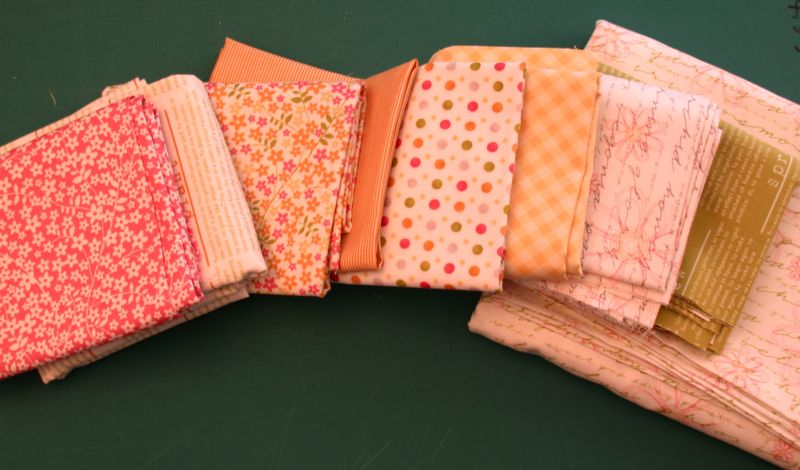
They are all from Sunkissed by Sweetwater for Moda.  It’s less pink that this shows–more of beiges, soft mossy green and a toned pink.  I was also drawn to it because of all the text.  I’m a sucker for text on textiles.  Plus–isn’t that name a reference to a famous citrus distributor?  How nice that I was buying citrus-referenced quilt fabric in the heart of Redlands, California–where they’ve grown citrus from their earliest history.

Twice a year our church hosts a General Conference, which is available via the internet.  I like to keep my hands busy while I listen to the talks, and I usually put together a quilt top while I listen.  Spring Conference=Spring Quilt.

But the first thing I like to do is pull from the stash–adding and augmenting the line.  If you’re like me, you can’t do enough of this.  (We all know that stashes multiply in wild, secret quilting bees while we are sleeping or surfing the internet.)  Besides that, if your stash is like mine, it adds a vintage touch as I still have scraps from my first quilt made some years ago.

My stash scraps are on top and on the right side; the Sunkissed line is on the lower row.  This quilt has another purpose.  We have a thin matelisse coverlet on our bed, and since I get colder in the night than does my husband, I lay a smaller quilt on my side of the bed. In spring and fall, I throw on a regular cotton quilt, which always fall off during the night.  But during the winter I have a cozy double-flannel quilt, which never falls off.  The flannel “sticks” to the coverlet.

This past week I took Leisa to Michael Levine’s fabric shop in Los Angeles (we were celebrating her birthday).  Levine’s has a huge quilt section, and I picked up some lovely green and white flannel for the back of this quilt, so it won’t fall off in the night.

More on the design in the next post.  And an observation or two about design.

Creating

Looky! Part II

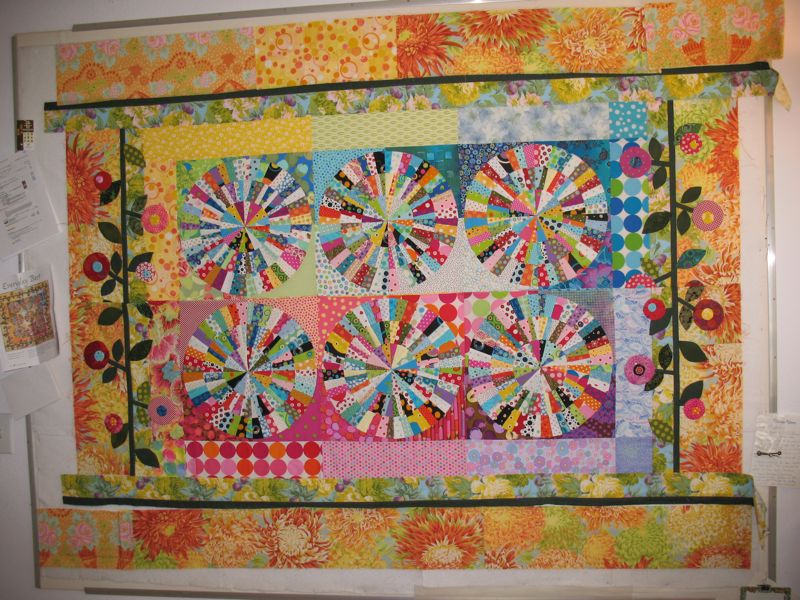
Yep, it’s Looky! Part II.  Applique is all done (obviously by the gap between posts, it’s evident that I’m not a quick appliquer), and I’m ready to attach the two side borders.  One of the difficulties of this quilt–with all due respect to its fabulous designers–is that the instructions are majorly confusing.  REALLY confusing.  And I don’t think I’m that dim of a bulb, either.

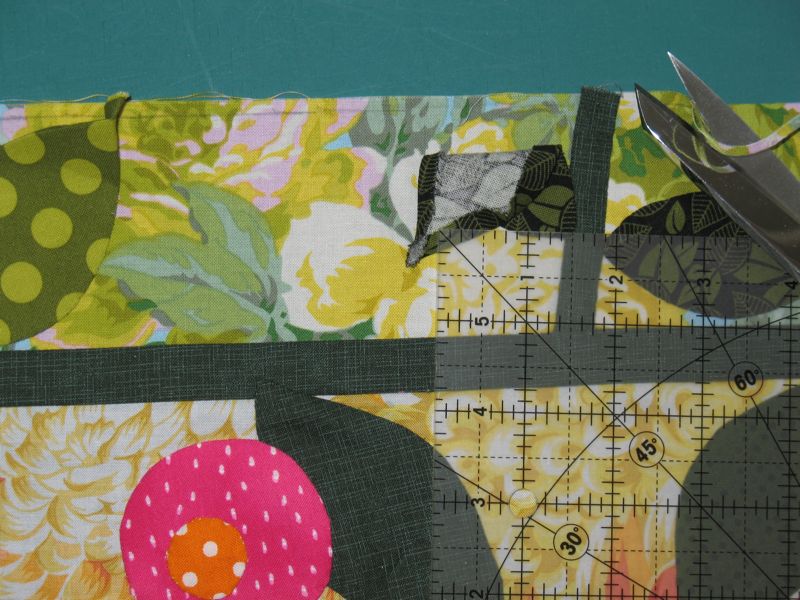
So while you may cut the borders according to the dimensions listed, that won’t be the finished width.  No, you now have to cut them down.  This is a problem if you have leaves and flowers that go near the edge.  I had puzzled over these directions before, and decided I would cut the borders closer to their finished width inititially, leaving a little extra.  So, I fudged on the instructions, not cutting the inner border as narrow as they called for (I was NOT keen about unpicking leaves and flowers).  In the photo above, I’ve folded back the leaves.

I’ve drawn the line and am trimming down the border.

The two side borders, attached, and the extra blossoms and portions of leaves stitched down.  Thank you, Netflix and Downton Abbey, for keeping my brain engaged while I did more applique.

I had already determined that my pin wall wasn’t big enough to accommodate the next task: putting on the top and bottom borders.  So I “pleated” the quilt in half, and pinned it up.

Borders being tried out.  I’ve run out of the chrysanthemum fabric, but now know that there’s no need to obsess over those outer borders.  Just get the fabric up there, and get it sewn on.  So I tried to match the fabric in terms of value (light-to-dark) and hue (color).  I think I did okay.  Another reason why it’s taken me a while was because I was interrupted here and there by having to go to work (imagine!) and grade papers.  I should be doing that right now, but I wanted to get these photos up. It’ll be a late night.

Ta Da!!  Flowers pinned up and placed.

Tomorrow after teaching, I’ll pin them on with my teensy applique pins and start stitching again.

It’s nice to be at this point (reprise).