
This post covers:
• Venue 7: Église Ste. Madeleine, with Shin-Hee Chin
• Venue 8: 86 Wilson, with Tara Glastonbury
• Venue 9: Chapelle St. Joseph, with Janet O’Dell
I have a main Carrefour Quilt Show page that lists all the posts of all the meetings I’ve gone to, and includes the posts from this year too. If I haven’t mentioned it before, you might enjoy these posts more if seen on a desktop computer or even a tablet. Cell phones re-format the layout and can sometimes do strange things to how it looks on the screen.
If you are interested in going to Carrefour, I wrote two posts for them about our travel, and how we put the trip together. You can find them here and here. Their main website is HERE, where you can subscribe to their newsletter (scroll to the bottom).
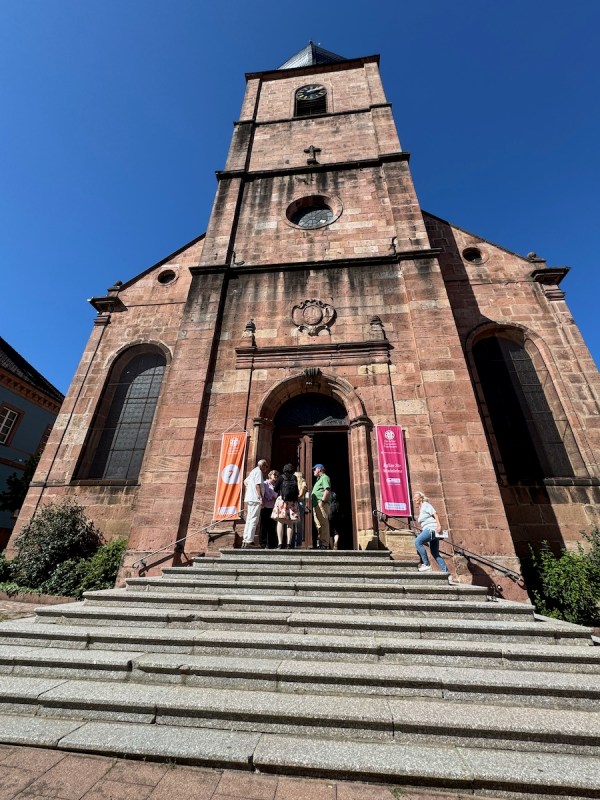
Venue 7 is the St. Madeleine Church.
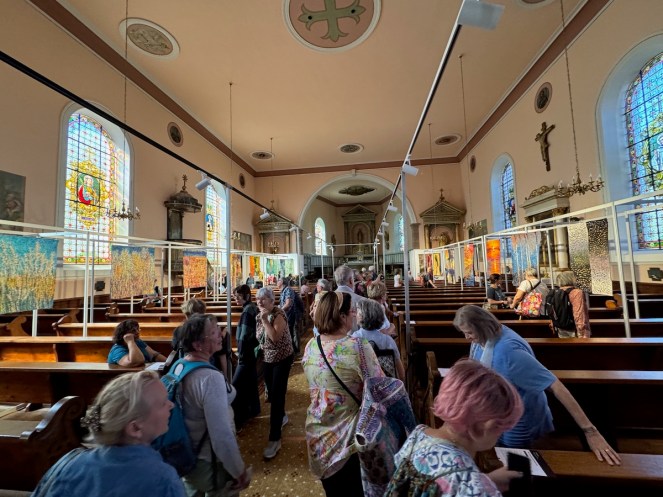
Inside, the organizers set up a metal scaffolding framework to see the quilts. The lights are strong and the quilts are well-lit (sometimes with shadows, but we tried to work around them). I appreciated the effort they made for us to see the quilts. Sometimes, we’d have to walk down the bench to see details, which is what you see going on here with people moving in, then back out to the main aisle.
Okay, here we go with Shin-hee Chin.
She was born in Seoul, and earned her BFA/MFA from Hongik University and an MA in Fiber Arts from Cal State Long Beach, in California. She is now a professor at Tabor College (Kansas), where “her work explores identity, hybridity, and belonging through feminist traditions and spirituality” (from catalogue). The catalogue goes on to say that her work also “honors the deep bond between humanity and nature. Through meditative hand stitching, she reflects on our share facility and interconnectedness. Each stitch connects with nature’s rhythms, creating texture and depth to celebrate the patterns that sustain life.”


Now here’s the surprise. Perhaps you glimpsed through the threads a different quilt.
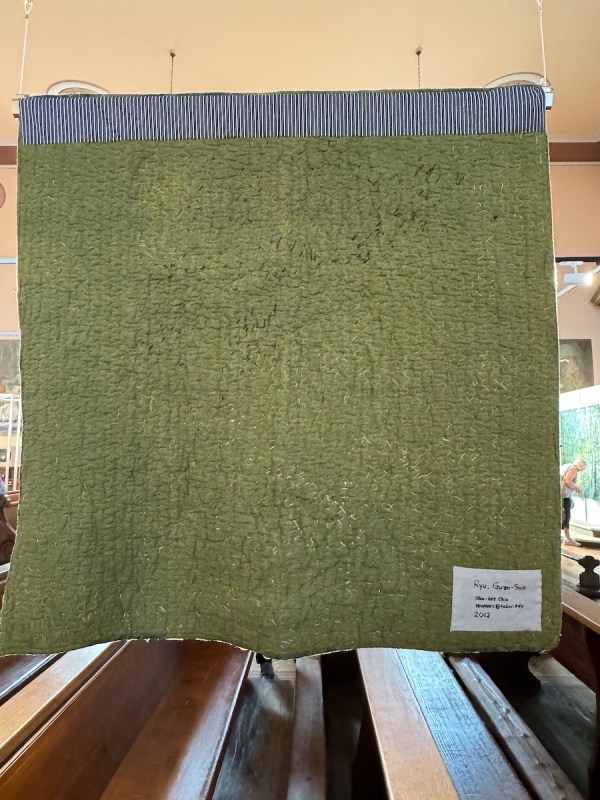
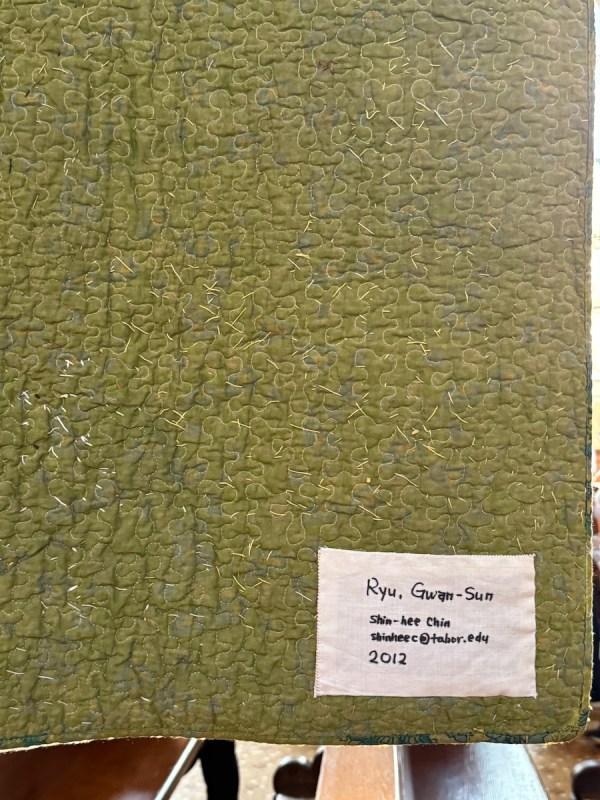
She uses quilts and blankets as the basis for her thread work. This caught me by surprise, and at first I didn’t know how to think about it. We quilters get our knickers in a twist if people make coats, etc out of old quilts. How do we feel about someone obliterating the quilt with their own work? Well, generally that is one reason that I come here: to have my eyes opened to what else is going on in the quilting world. I just needed to accept this artist on her terms, and look at her work. We all have seen quilts at guilds and local shows that surely might be well-suited to a second life (I’m looking at you, pre-printed panels!), and what an impressive life they would have with this quilt and fiber artist.
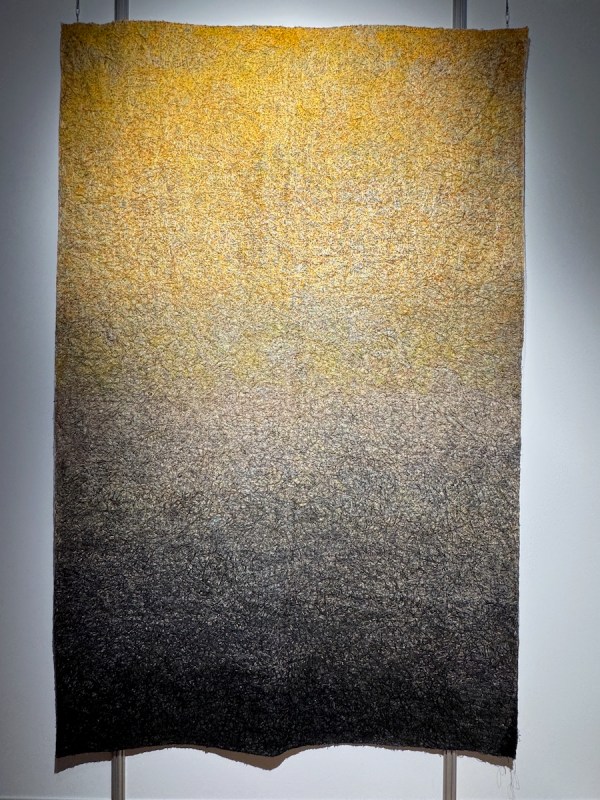


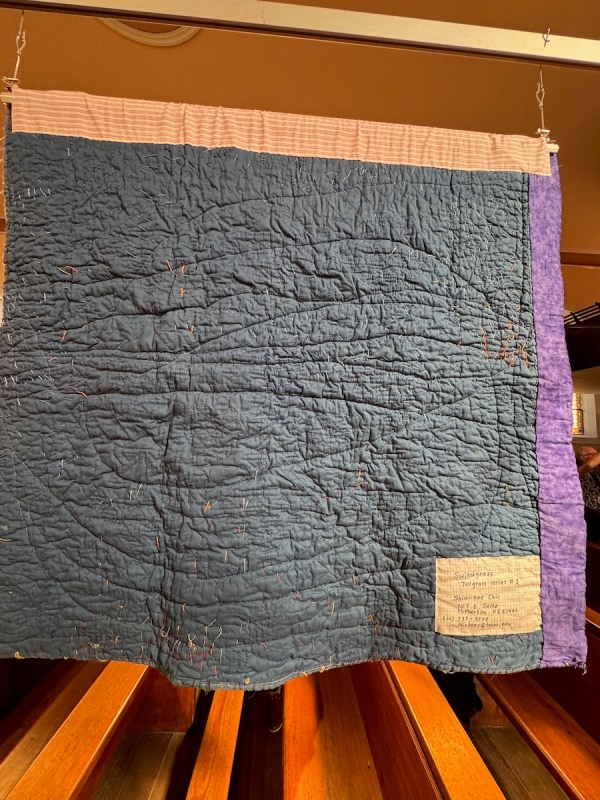

(Click to enlarge the photos.)
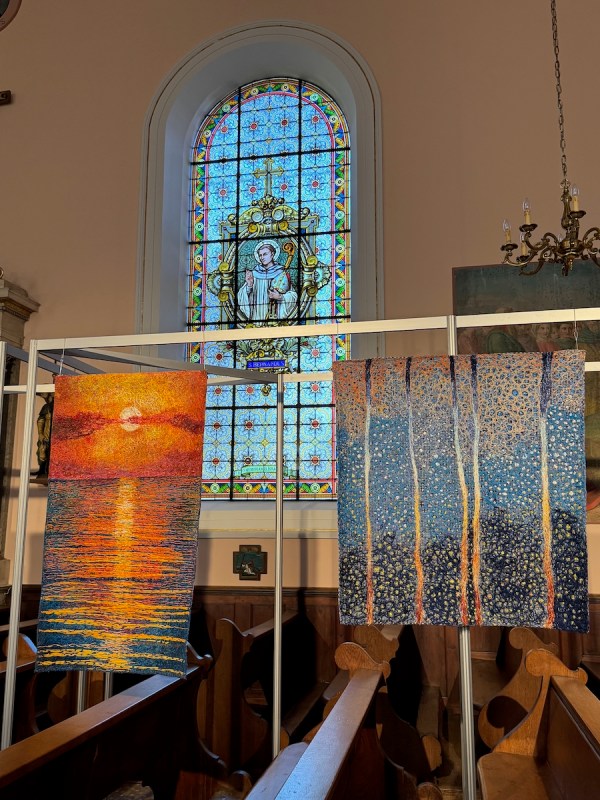

Confession: somewhere along here, I lost track of which quilt belonged this title card (sorry).


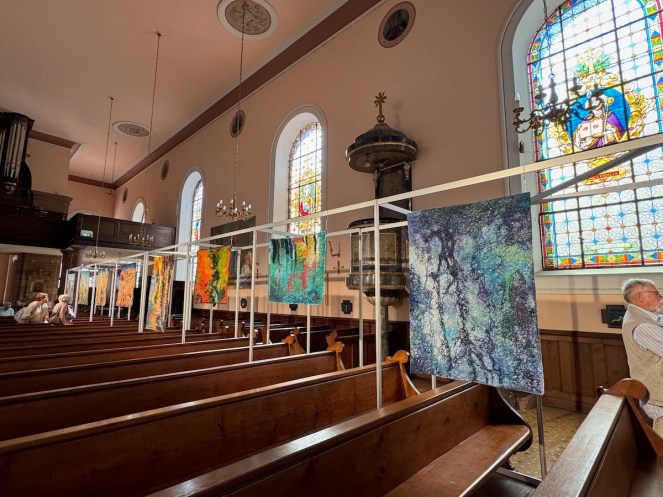
Fronts of quilts…
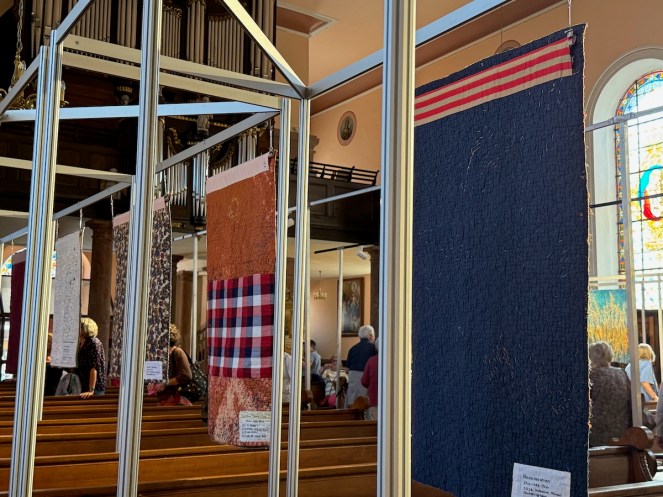
…and the backs of the quilts.

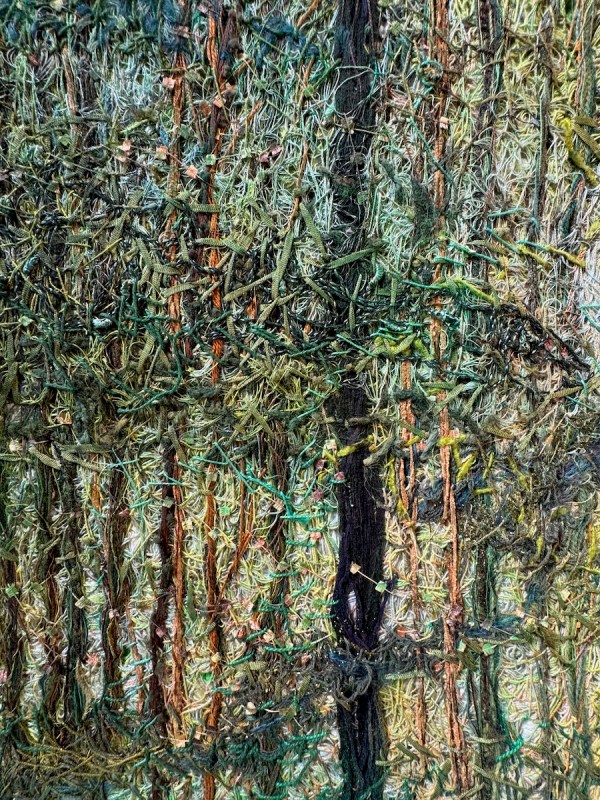
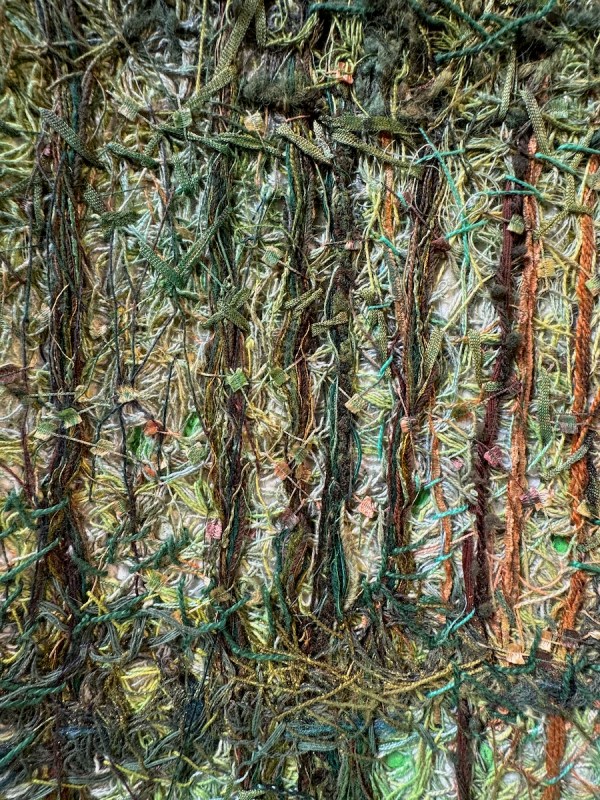
A quilt from her nature series, a collection up on her website. One of the reasons I was interested in this was because her materials: a thick thread with little squares attached, which I’ve seen knitters use to make decorative scarves.
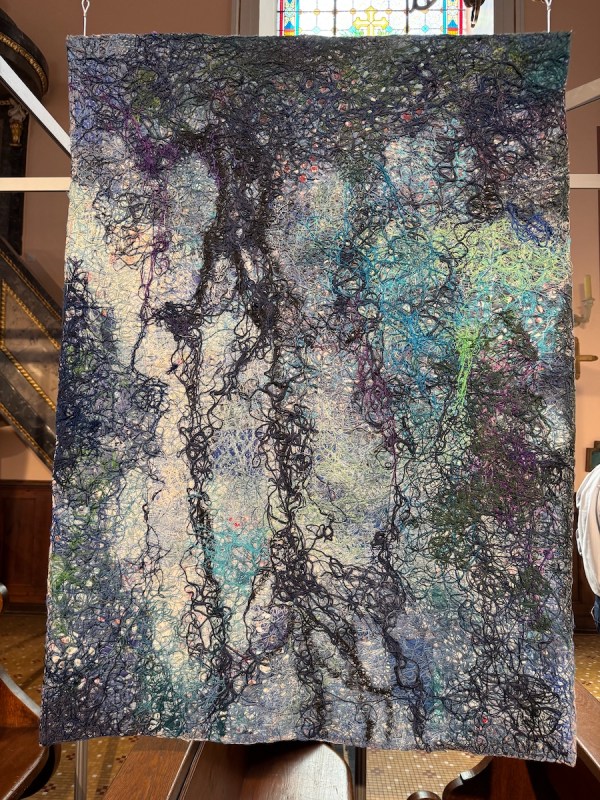

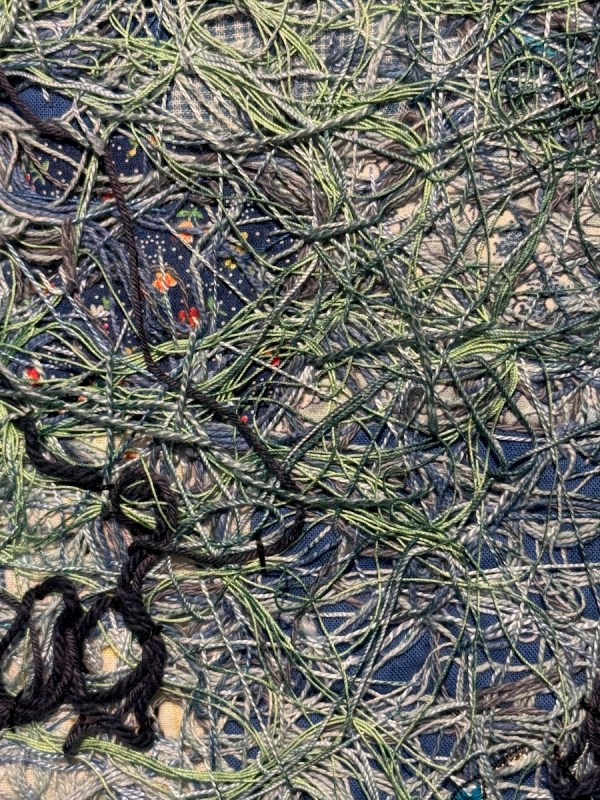

Her work appears literal, like — yes, this is a reflection of tree branches — but then you get closer, and the thread stitches and tangles add another dimension.

The tiled floor, of course.
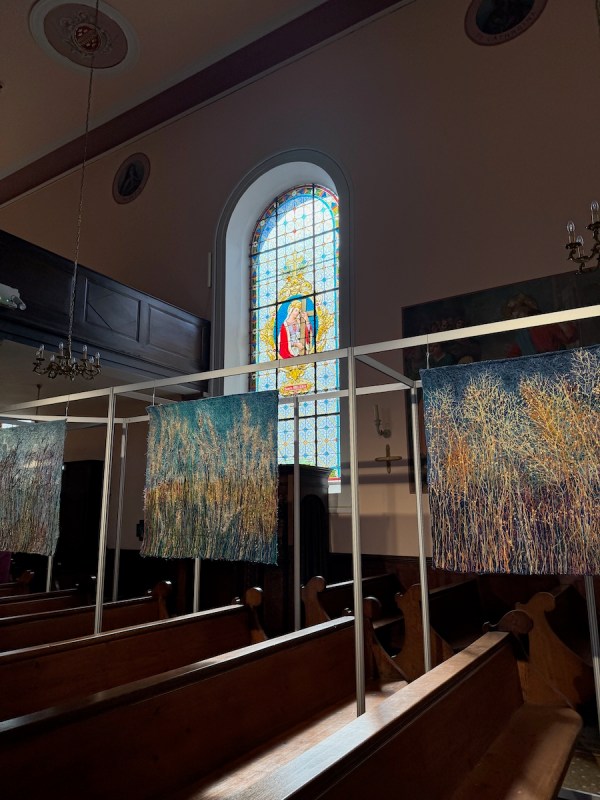
Last look: the interplay of the church’s stained glass with Chin’s threaded images.
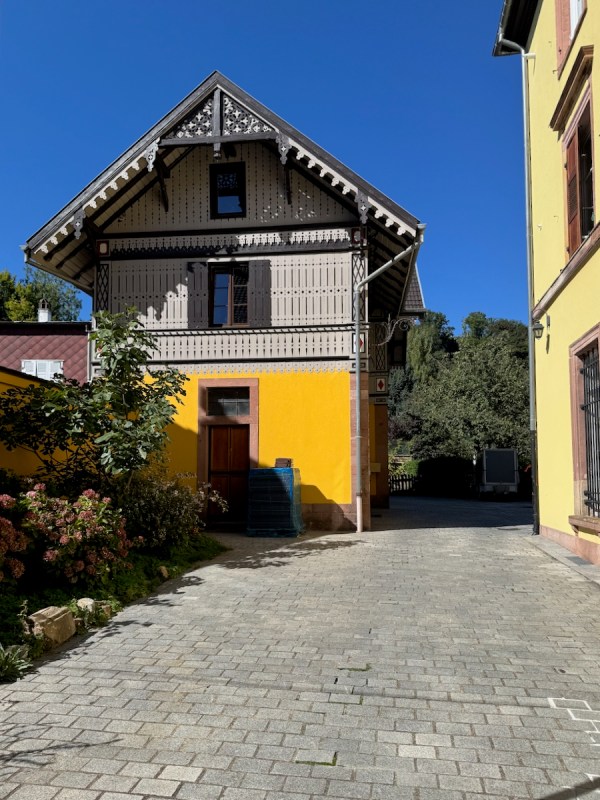
As we walked to the next site, we loved the brilliant yellow against the wood-carving on this small house.
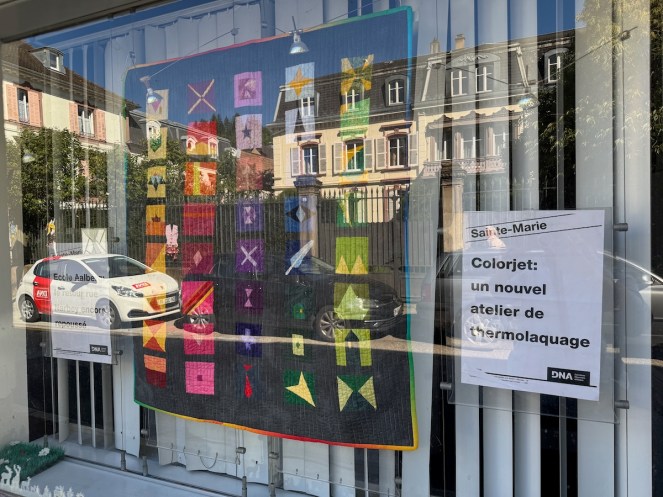
We notice the quilts in all the windows around town. We’re headed to Venue called 86 Wilson, which is really just a street address. It’s where Tara Glastonbury is exhibiting, another quilter from Australia.


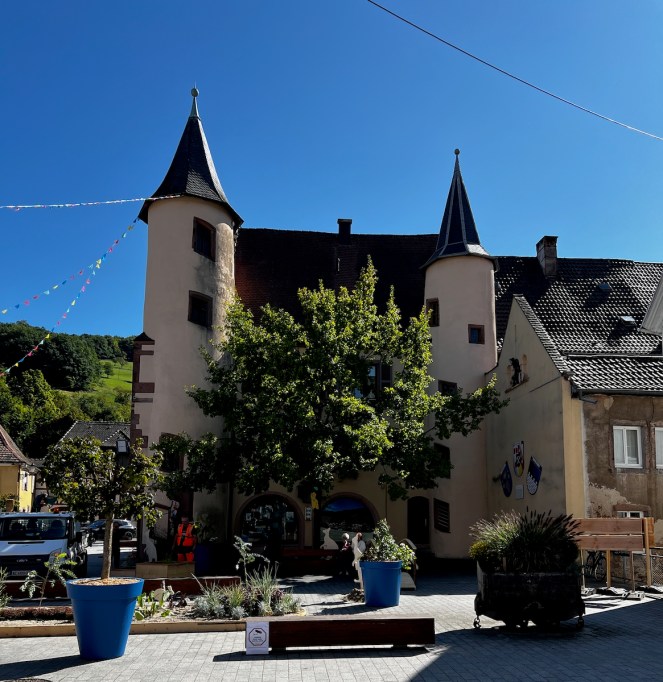
The view across the street.
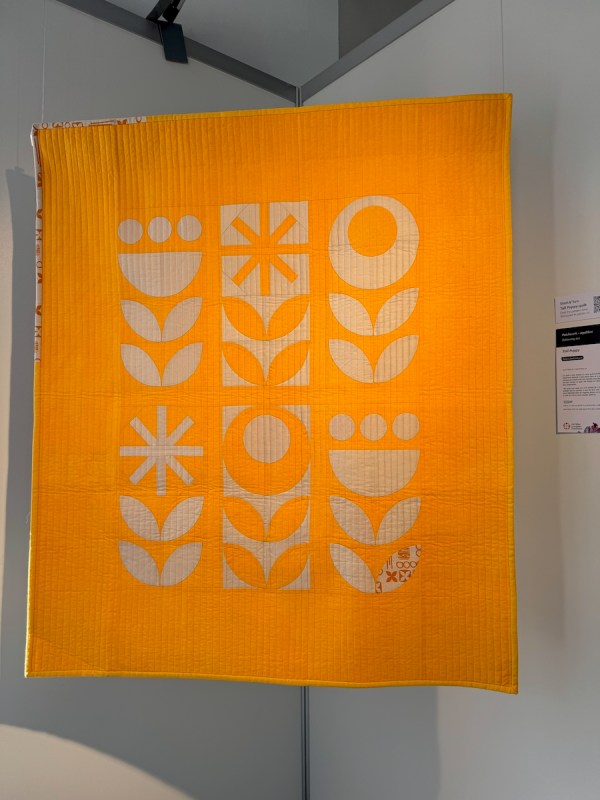
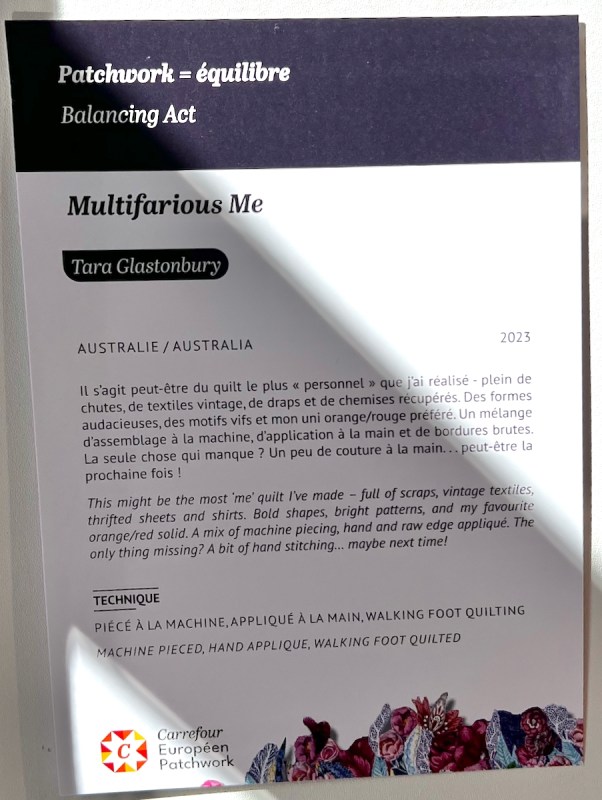
Now do you recognize her work? She has a pattern line, as she has “a background in graphic design, and a long history in textile crafts” (from catalog). She titled her exhibit “Balancing Act,” as it “explores her evolution as a design-led modern quilter through her use of bold color and striking geometry.”
Tara and her mother sat inside, just a bit away from the front door, in front of a sunny window lighting the space. She had copies of her newsletter and patterns (yes, I bought one). The atmosphere was genial and happy.
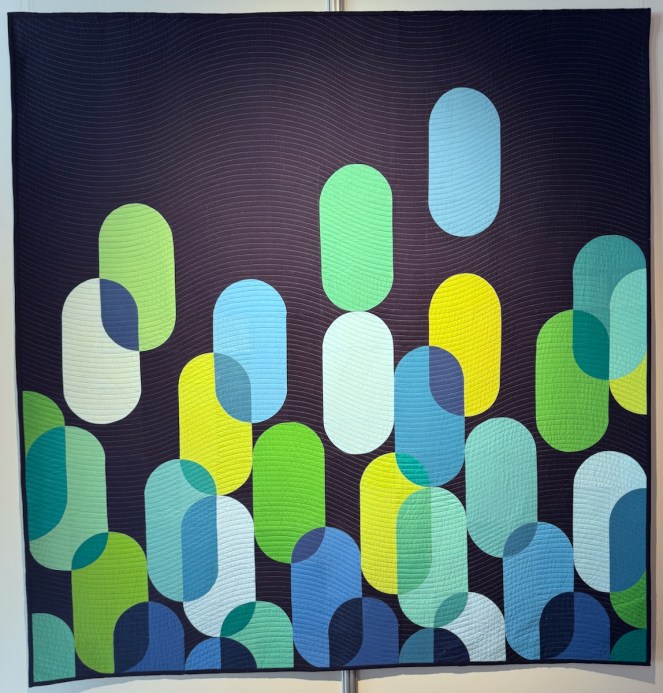
I struggled to get the right color balance, because the lights cast a really warm light.

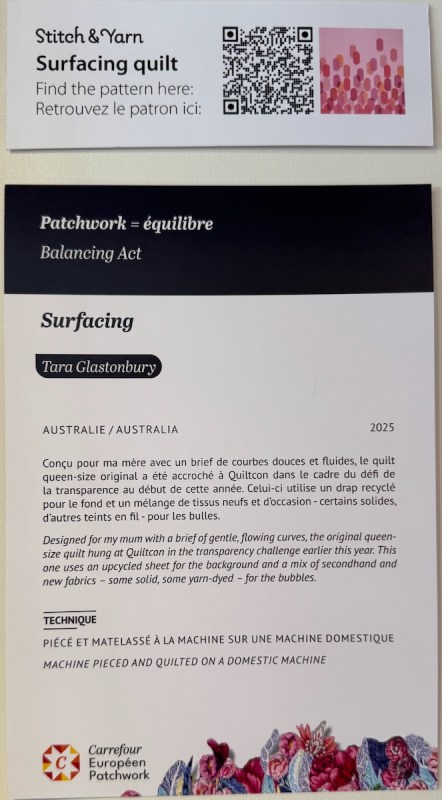

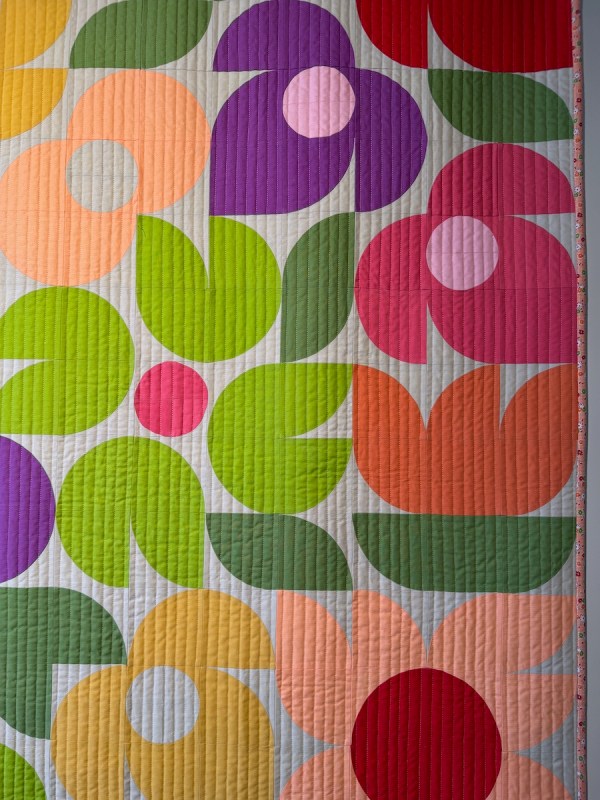


I love that she had tote bags that echoed her quilts.

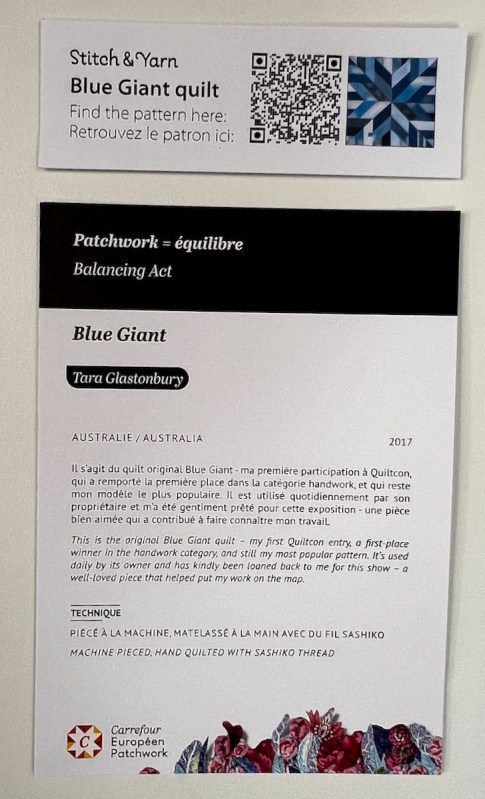
Two quilts that I don’t have title cards for are below, but you can find them in her pattern shop.

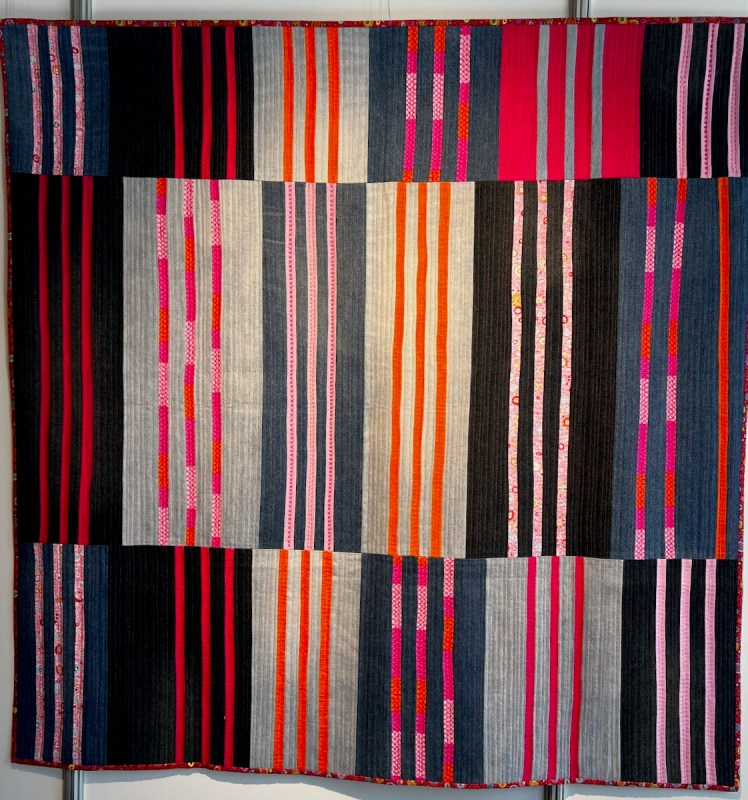
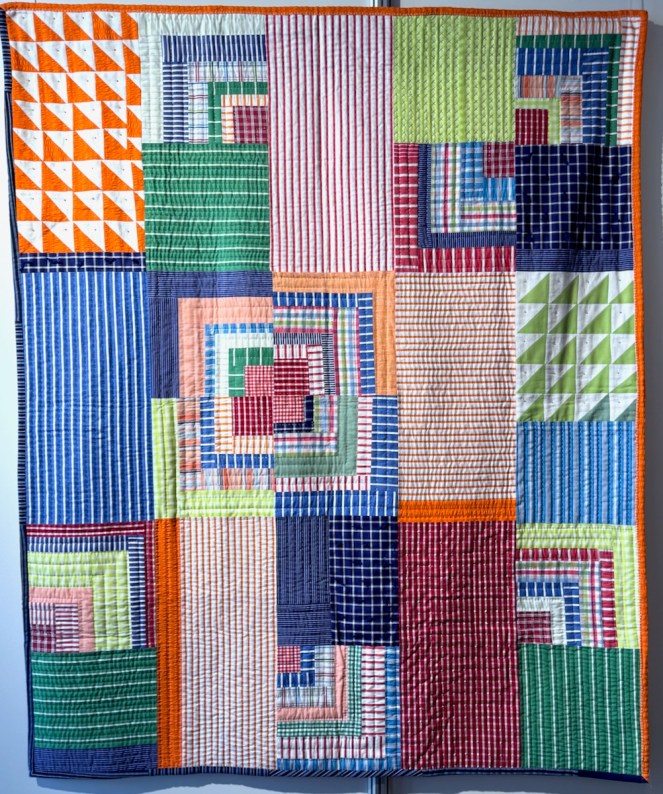
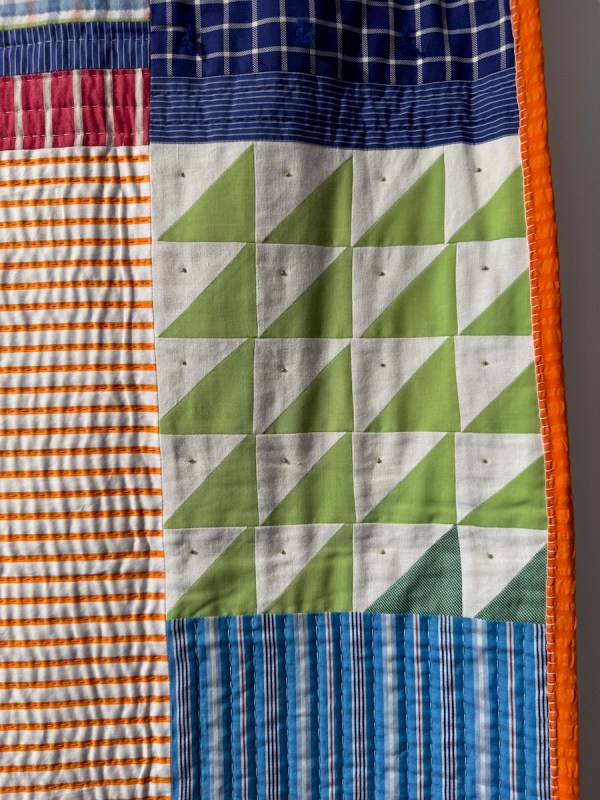
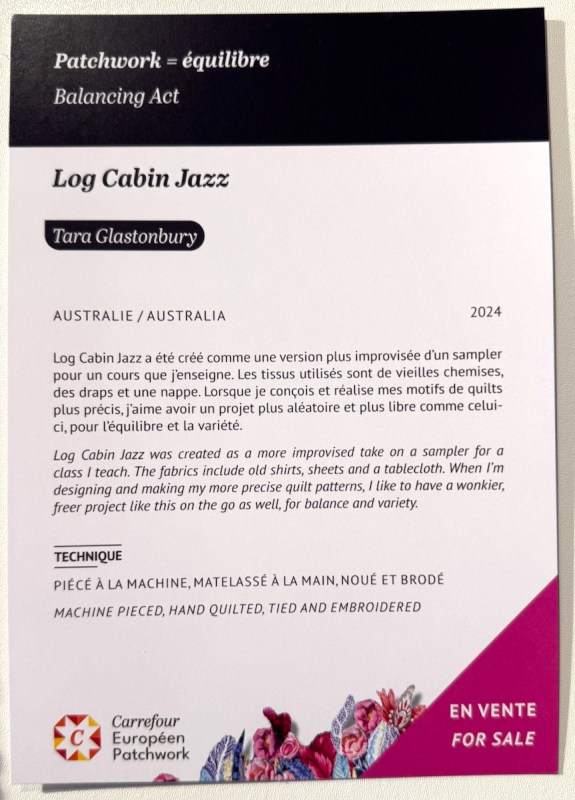
I love that she “jazzed up” her Log Cabin with some triangles.

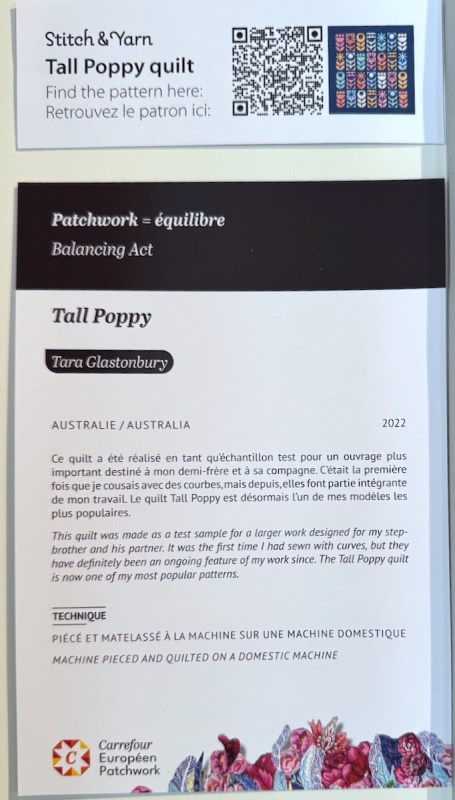
See her card (below) for a truer representation of the colors. It’s such a terrific design.

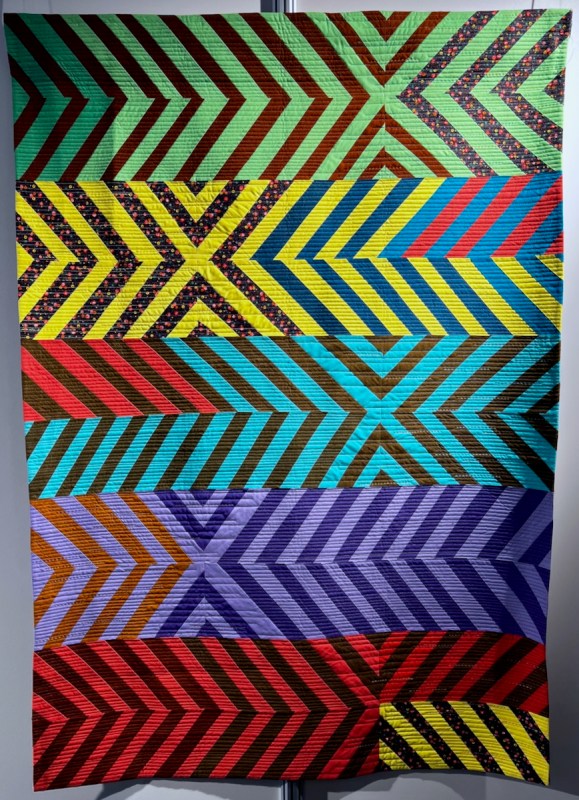
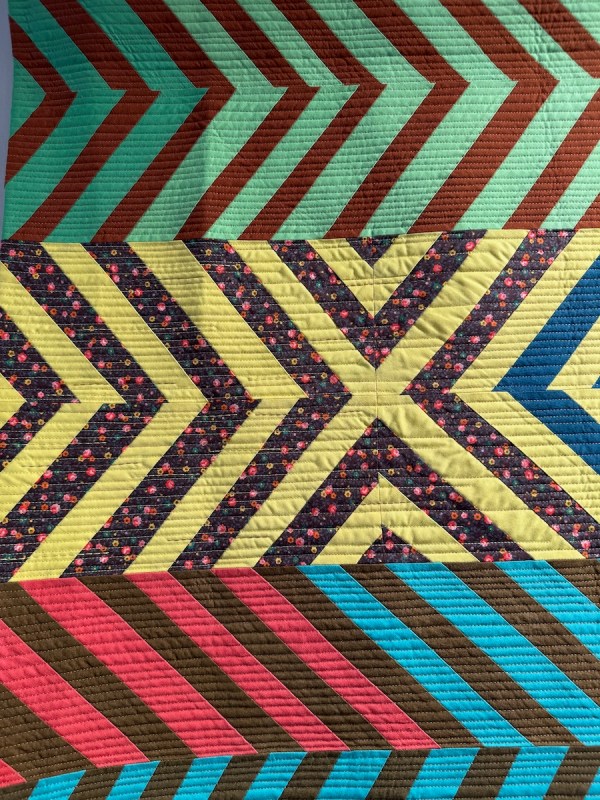

Tara’s penultimate quilt:

She uses small pieces of fabric in an interesting way. Scrappy-not-scrappy, but more ordered.


Last one from Tara:


We jumped in the car and drove to Venue 12, passing another house with a carved wood exterior. We’re skipping Venue 11 for now, as it’s not on the way. After finding a parking place around the corner, we arrived.

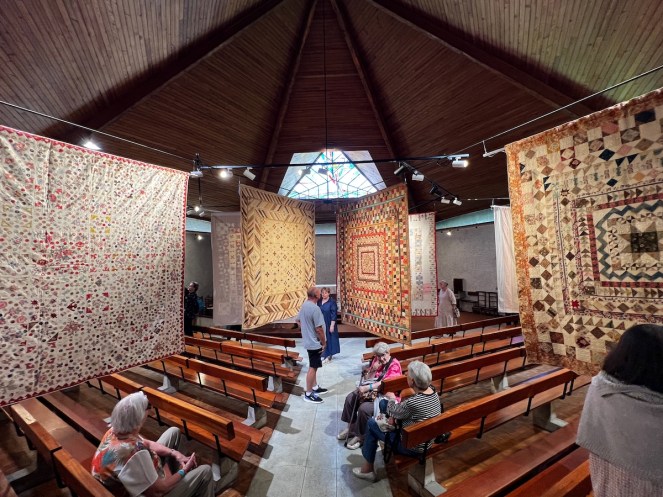
Venue 9 is a tiny little church where we saw the European Bobbin Spool Invitational Quilts last year. What will it be this year? Again (you’ve heard me say it before), I am always just blown away by the diversity of quilts and quilters at this quilt show — it really pulls me out of the US manufacturers/quilters/design loop and makes me think and appreciate the diversity we have. I hope these posts help you see your quilting and creativity with new eyes, or maybe spark a new idea.

Photo of stained-glass taken by my husband. As always, we both took lots of photos, so many of the images in these Carrefour posts are his.

This time, we will meet our great-grandmothers of quilting.
Not in the flesh, but in the work they left behind, courtesy of quilt collector Janet O’Dell, from Australia. She (as the catalogue says) “is a keen collector of antique quilts. Her collection of hexagon and medallion quilts has been built up over the past 25 years from a variety of sources. All have been chosen because they appeal to her personal taste.”
And the one quilt that I will flood here with photos and which I loved-loved-loved, I did not get a photo of the title card. Interestingly enough, it was inspiration for another quilt in Venue 12, from Fiona Lindsay (a future post). Okay, back to Janet O’Dell’s quilts.
Here’s the one I loved and I’ll intersperse my comments with the photos. Just keep remembering. These are OLD.


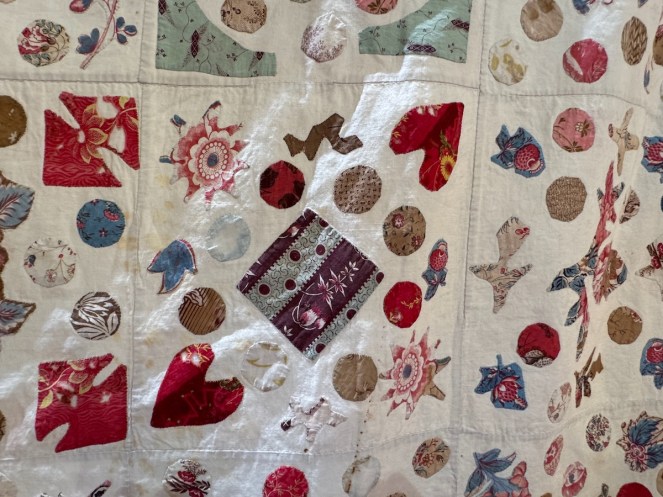
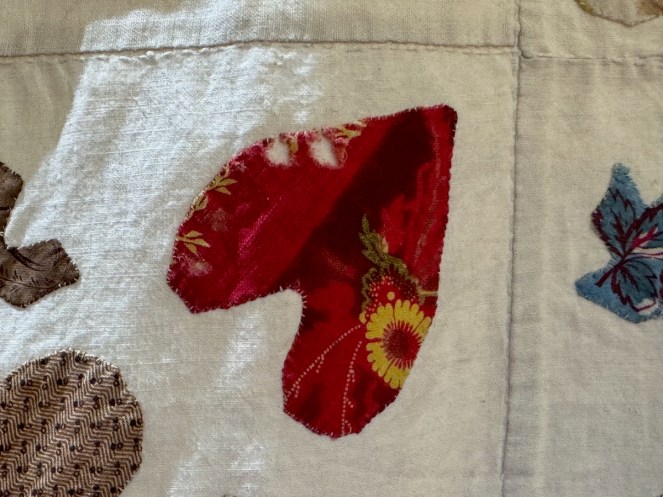
So, the Big Picture, to closer-up, and then to these hearts with their worn spots.
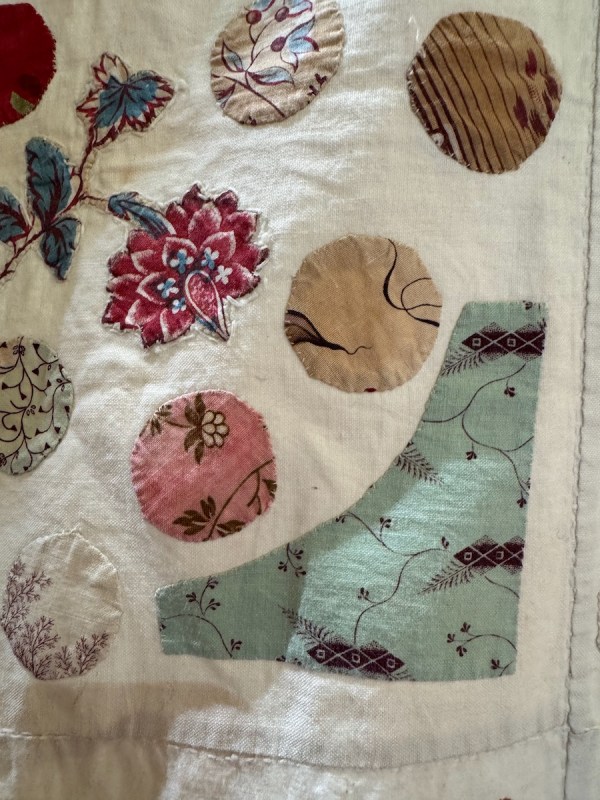


This block, with its free-form cut “corners” of minty blue-green, the broderie perse flower in the center, and those random circles was another favorite. It was interesting being in that space, with these very old quilts. People were quietly moving around them, and then taking a minute to sit and gaze. In so many other venues, we are dashing to take it all in, but here, sitting with the quilts was the point.

Okay, maybe I was just tired.

Or maybe I was fascinated with their technique on their appliqué stitch, each bit of thread taking a bite over the top of the shape, so different than how I do it now: trying to come out on the fold so you don’t see my bits of thread.
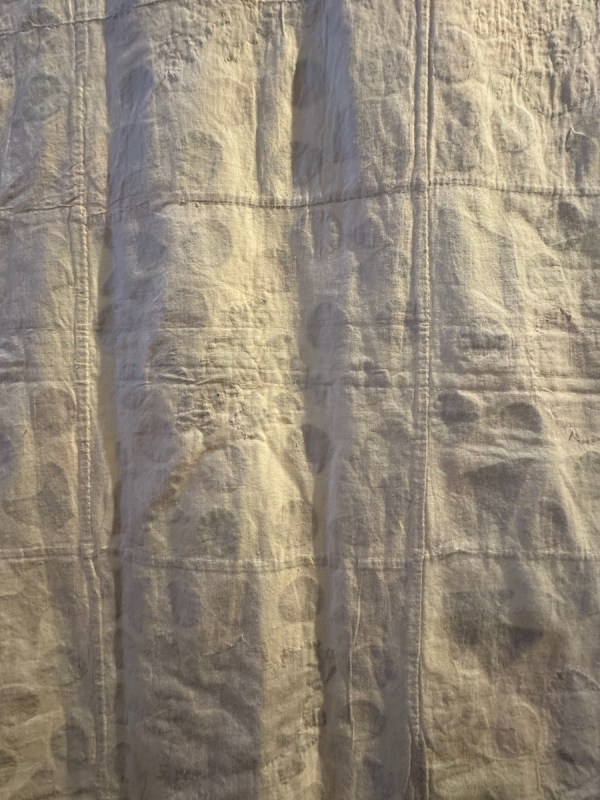
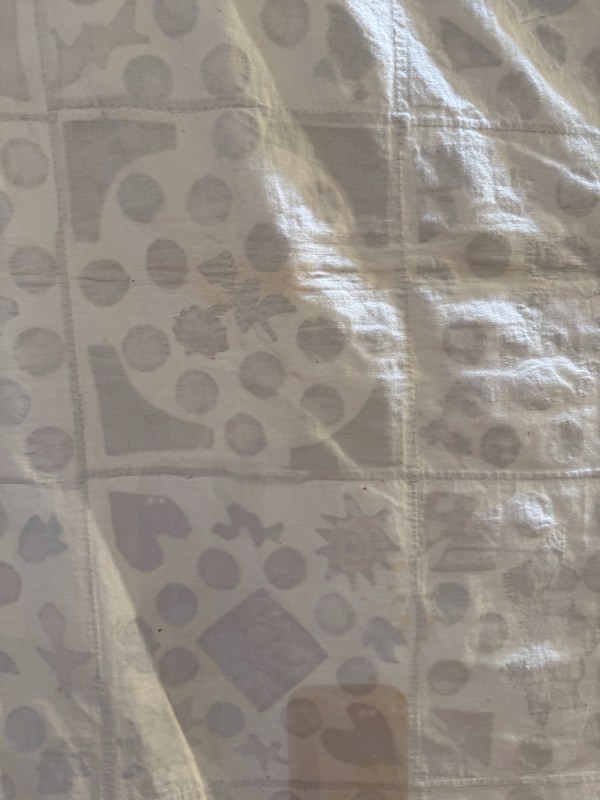
And the back — it didn’t appear to have any batting at all in the quilt, so they must have just done the stitching over two layers of fabric, then did a “quilt-as-you-go” to get those flat-fold seams on the back? I’m not usually that over-the-moon about antique quilts, but for some reason I really liked these.
I read a piece this past week about how difficult it is for us to go back in time and really know how people 100 years ago thought or felt or processed image or feelings — or, since most of these quilts were from around 1830, nearly 200 years ago. And we are so “feeling-centric” these days that we even use the term in all our phrases, such as I felt you might like this — or–I felt badly for you, and so on. Did fatigue register the same way for them, or were they always tired (thinking of their housework)? Did that feeling we all have of a lovely quilt finish, register on this quilter the same way? I’d like to think that this woman, as she put the last stitch on that now-worn red zig-zag binding and unfurled it onto the bed, had a sense of satisfaction over the many years it took to stitch.
(If any reader sees this post, and has any information about this quilt, please leave me a comment. Thanks.)

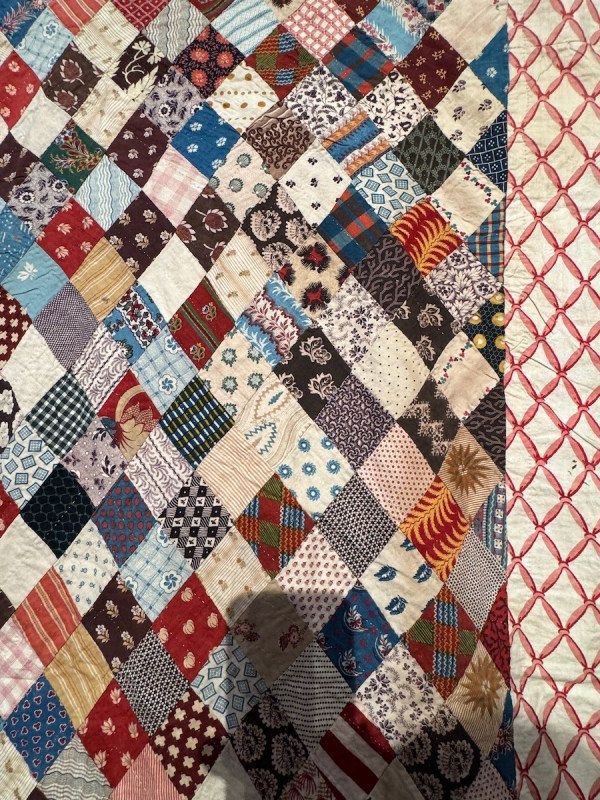

Love that border print! Click to enlarge the title, which is Wood Hey, from the country of Wales. It was made in 1833 and displayed at the National Eistedfodd of Wales in 1933. It’s hand-pieced, with appliqué and is unquilted.
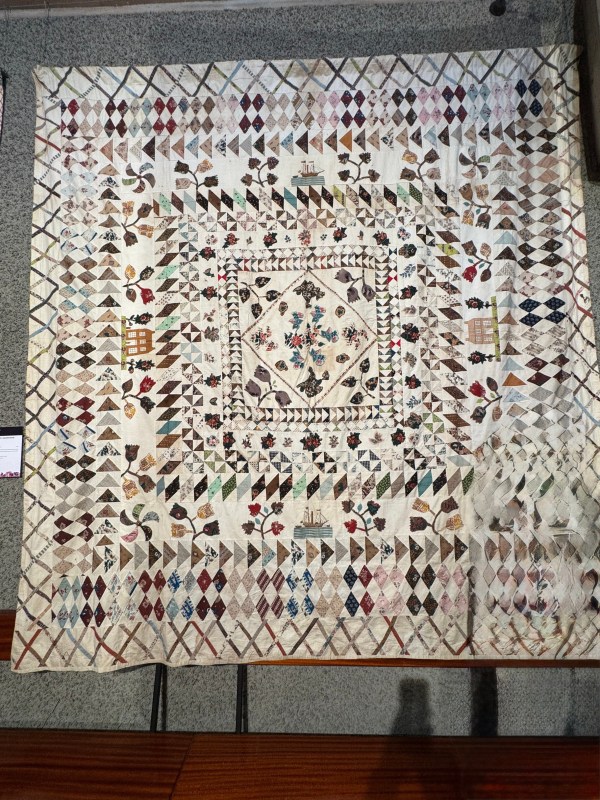
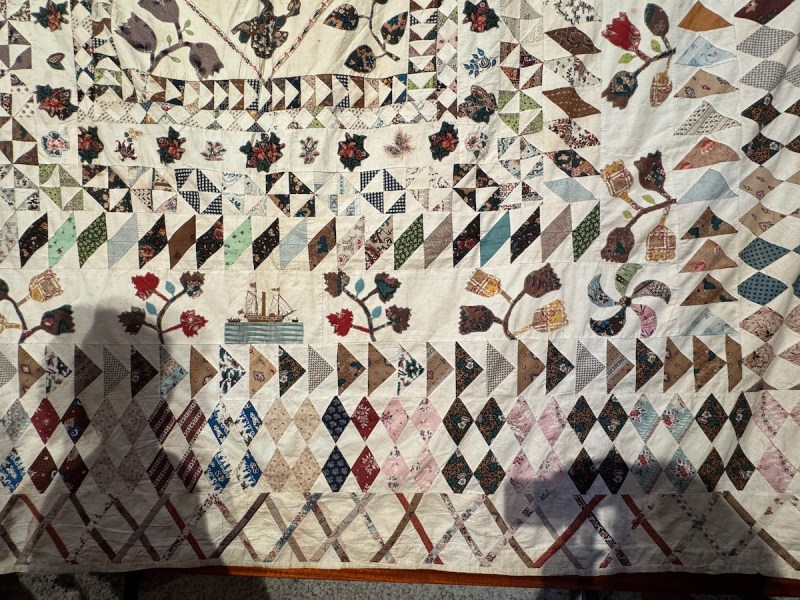

In case you can’t read the title: Sailing Ship & Manor House, from Pays de Galles in Wales, c. 1833. Check out the sailing ship, below.


This quilt was another stunning example of applique, and I love the title: Animal, Vegetable, & Mineral. It’s appliqué and unquilted and was made c. 1842 in England.
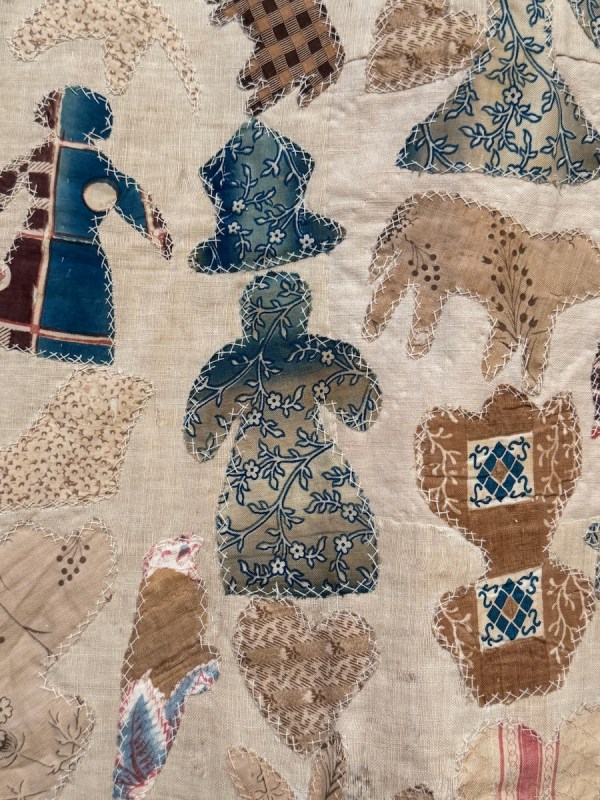
Check out this type of appliqué! Criss-cross, a type of tailor’s stitch; I learned this in my clothing and textile classes when I was a freshman, and have rarely used it since. There is a smaller bite of fabric on one side, and then the needle travels before taking the next stitch, and you are stitching backwards, from left to right. I don’t know what the “official” name is, I just know we used it to tack down our wool jacket facings.
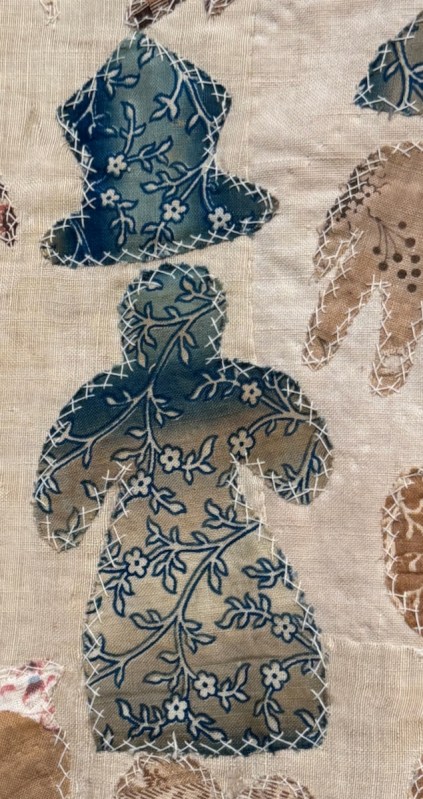
It appears they went over a raw edge. I’ve seen variations of this animal-vegetable-mineral quilt pop up every once in a while. Lovely to see it here. Note the pieced backing, even though it “reads” as a whole piece of fabric. Would we add “digital” to the categories? And how would we depict that…with images of our hardware?
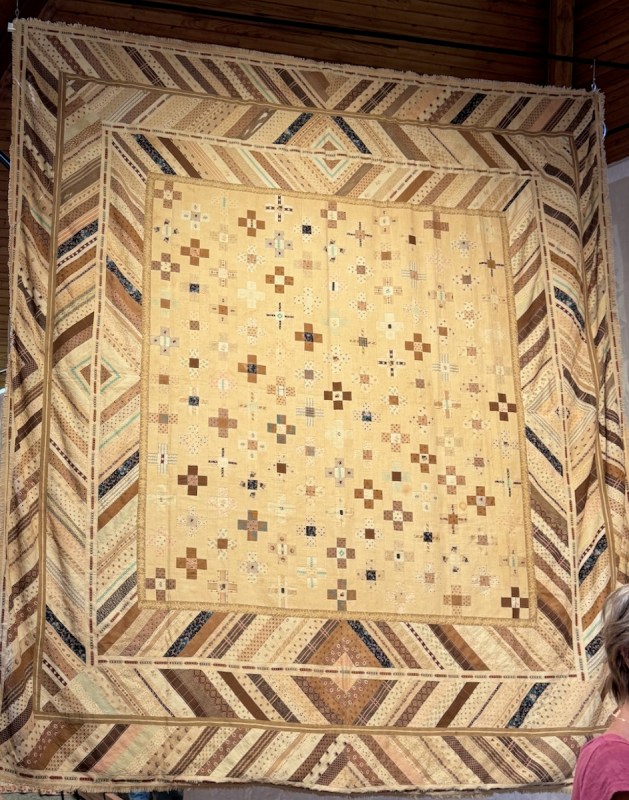


So, a form of offset nine-patches? With a spacer?

Normal quilt show pose.


That is a lot of quilting!
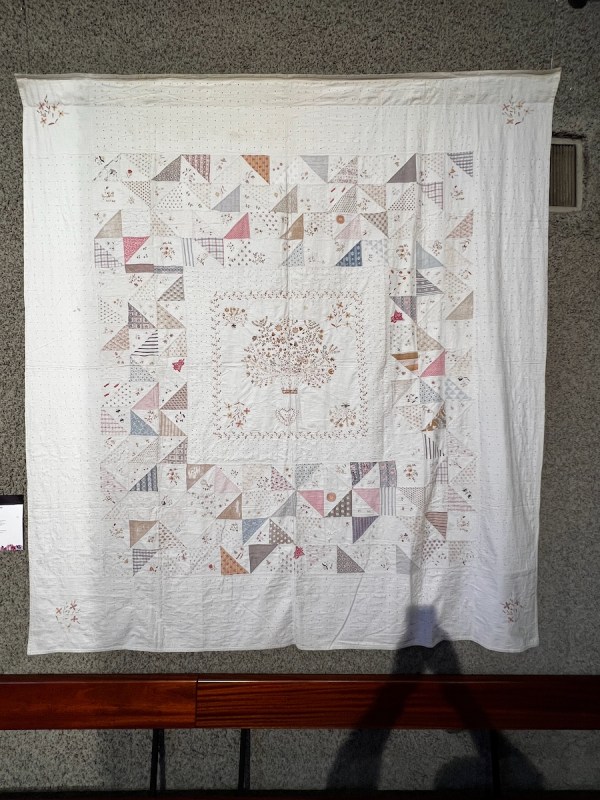
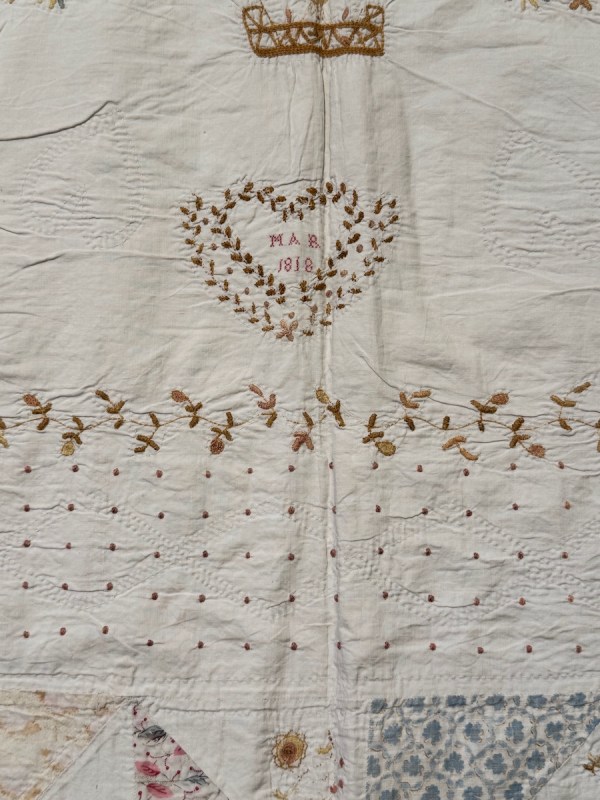
Who was M.A.R? and what was the world like in 1818? (You do realize this quilt is over 200 years old, right?) Some notable events (just to get you in her head, and which maybe she never knew about?) are listed below.


Historical Events when this quilt was made:
- Official reopening of the White House
- Netherlands and England sign treaty against illegal slave handling
- First steam-vessel to sail Great Lakes launched
- 49th parallel forms as border between U.S. and Canada
- 1st known Christmas carol (“Silent Night, Holy Night”) sung (Austria)
- Handel’s Messiah, U.S. premieres in Boston
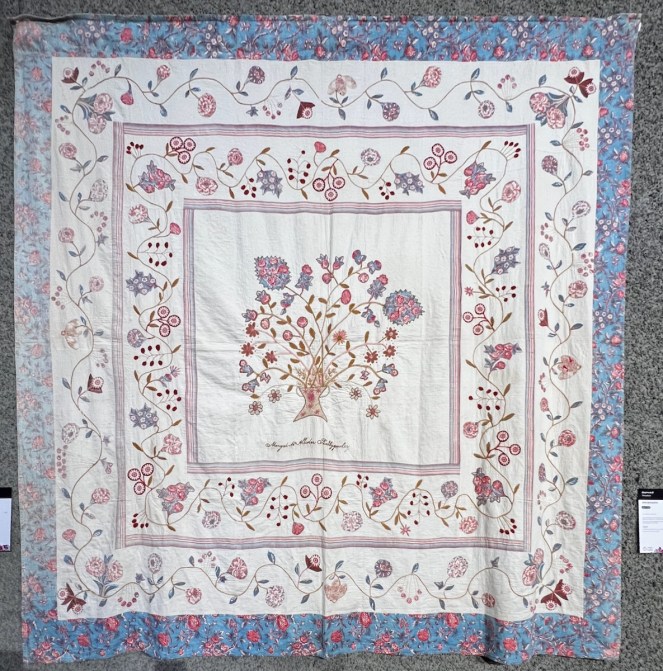

I love the name of this. Apparently BallyGawley is a town in Ireland, north of Dublin, so perhaps the quilt came from there?
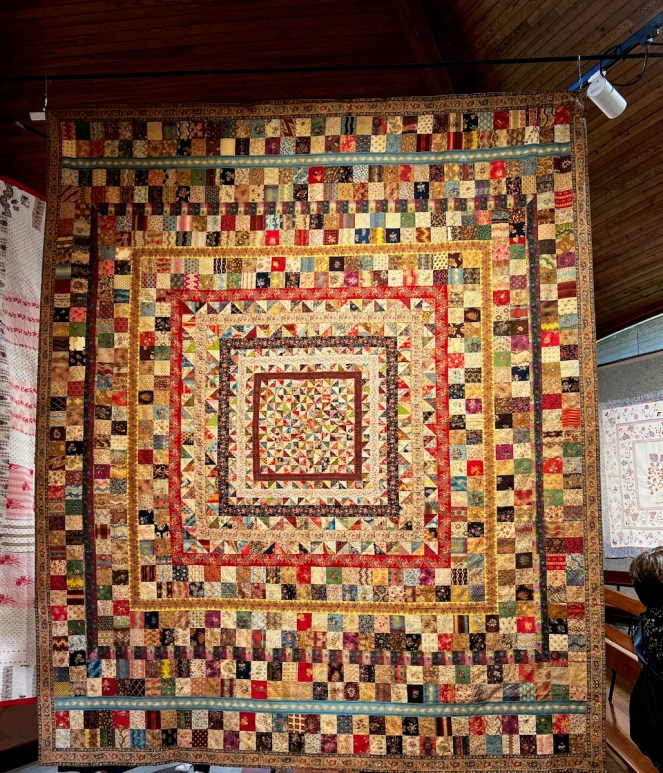
Last one for this post.

This is Broken Dishes Square, and from the United States, c. 1830. It is hand-pieced and unquilted, in the medallion style. These fabrics are so interesting, so busy and I love the bands of color in between each section of the triangles. Some woman spent hours and hours piecing this quilt.
I’m really grateful that the organizers of Carrefour Patchwork Show arranged with Janet O’Dell to have these brought to the show. As always, this show has something interesting around every corner!
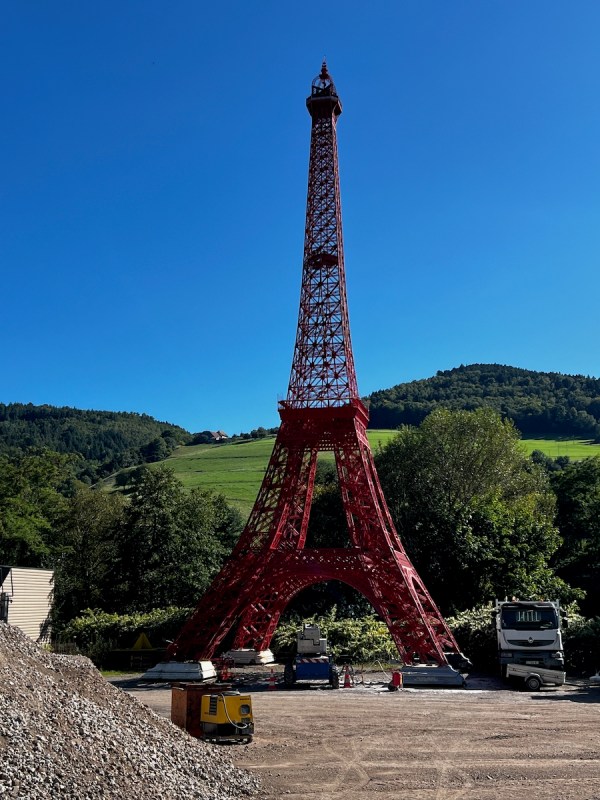
Like this replica of the Eiffel Tower, stuck in some sort of a construction yard. We saw it last year in two pieces, so we’re happy it was put together this year.
More Carrefour Patchwork Show posts to come!

Discover more from OccasionalPiece--Quilt!
Subscribe to get the latest posts sent to your email.

 OccasionalPiece--Quilt!
sharing your journey has been such a beautiful gift. thank you.
I felt for a moment I was sitting with those very old quilts – sigh, how nice. Those different kinds of applique very much appeal to me. Each of these venues was such a different experience and gives so many ideas in colors and finishing – thank you for giving us such a complete tour, it’s wonderful.
I’m so glad you could attend Carrefour European Patchwork again. Everyone should get to go at least once. How great that you could see Tara’s work too. She and I became acquainted in 2020 at QuiltCon Austin. She bought one of my quilts! Then, we met-up again at 2022 QuiltCon Phoenix. Her pieces are always precisely made, with distinguishable designs. Isn’t it fun to visit the different old churches in France? The churches and architecture are what I remember more than the quilts!
Such variety! I’m always curious about the line separating quilts from fiber art. I found myself wondering why the first artist’s work was in a quilt show and then you answered my question. Her threadwork is amazing but it’s still not a quilt in my opinion. I love the clean look of Tara’s work. Her graphic design style is right up my alley. I often myself indifferent to antique quilts as I have no quilting history or heirloom in my family. But your comment about sitting with them and pondering the maker’s feelings and thoughts in her time brings more meaning to the work for me. Writing these posts is surely time consuming. I appreciate your efforts in sharing work that broadens my horizons.
Wow, quilts that are over 200 years old; those deserve the time and attention you gave them (if not more). I really love the cross-stitch like applique treatment and appreciate the amount of time that had to be invested to complete these. Stunning!
Shin-hee Chin’s work is beautiful and it is interesting to consider her use of quilts and blankets for the basis of her work. That is certainly a form of upcycling I hadn’t ever considered before.
And I was glad to recognize Tara’s work so easily. It’s interesting how it is possible for us to develop a voice and style that is unique, even when the roots of Tara’s work can be seen in the 200 year old quilts.
the vintage quilts are ….. soulful. And I have had that tall poppy pattern on my desk forever.
Thanks so much for sharing these wonderful quilts! I find Chin’s work truly astounding and hadn’t realized until your post that they are made using quilts as backgrounds. Wow! Glastonbury’s designs are colorful and fun, perfectly capturing a modern vibe and those antique quilts are well worth studying for the techniques and aesthetics. I wonder about surrounding my squircles with some of those cross stitch-like stitches…🙂! So much inspiration!!
That was quite a day! I love the Tara Glastonbury quilts and will look her up. Australia has some wonderful quilters! And that triangular stained glass window in the modern church was spectacular! Thanks for all the photos!