
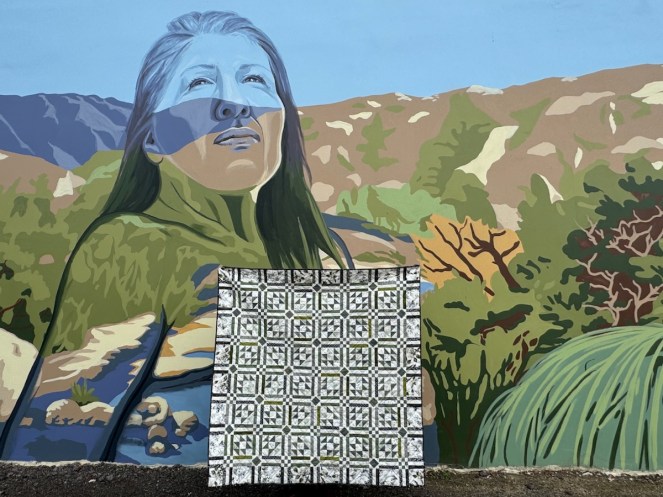
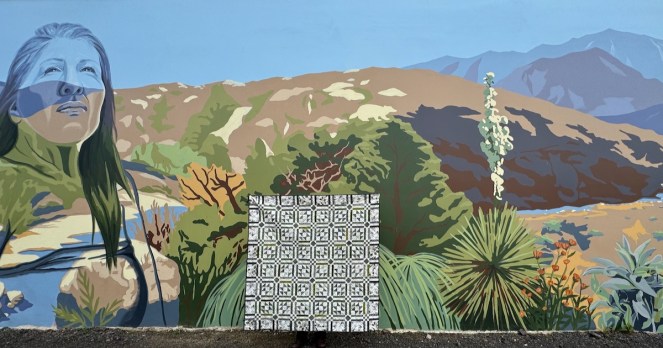


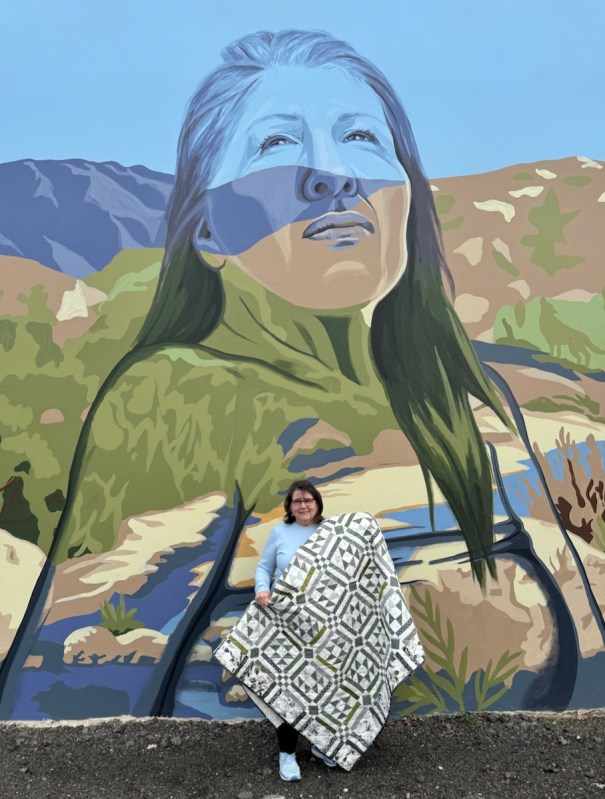

Duck Creek • quilt #302
I know you are really here to see the info on this beautiful mural. It’s by Rosy Cortez, and was done under her guidance by a team of helpers. (Links point to her Instagram page as well as to the website for the mural.) I really love that it’s three different ages/stages of women, honoring our local native tribes. I’ve been two of these ages, and am now in the third (hint: I’m not pregnant).
Sometimes the title of this mural, We Are Still Here, reminds me of all my quilter friends. We cut and piece and hang out in our sewing rooms, studios, basements, garages, spare bedrooms. Every once in a while we pop up with another quilt top finished, the binding on another, and still another in stages of quilting. Dedicated, we follow in the way of artists everywhere: we have the vision. We have to see it through.
Recently an article titled “The Art of the Steal,” discussed the number of original book plots possible. In 330 B.C. Aristotle thought there might be just two: “simple (change of fortune) and complex (in which the change of fortune is accompanied by setbacks and reversals)” (by Emily Eakin, link above should allow you to read the entire article). By 1892, Rudyard Kipling thought there were 69 plots. Between Kipling and our current day, the number fluctuated, and by 2004, Christopher Booker proclaimed there were just seven: “the quest, vanquishing the monster, rags to riches, voyage and return, comedy, tragedy and rebirth” (Eakin, ibid). Not to let the number lay there, another group used a computer in 2016, and proclaimed that the “world’s stories boiled down to ‘six basic shapes‘ (Eakin, ibid.)
So how many original quilts are there in our quilting world? Like the novelists, do we have just six basic shapes?

Two of these are triangles, the rectangle is just a stretched-out square, and the curved wedge is just a segment of a circle. We have rectangle triangles, skinnier triangles, ray-shaped triangles. You’ve used them, I’ve used them. Are we like novelists then? Taking a few basic shapes (boy meets girl, etc.) to make our quilts? I have a child who really likes triangles. Another of mine just likes big quilts, bypassing design altogether. Another likes red quilts, and the last child just wants them all (bless her).
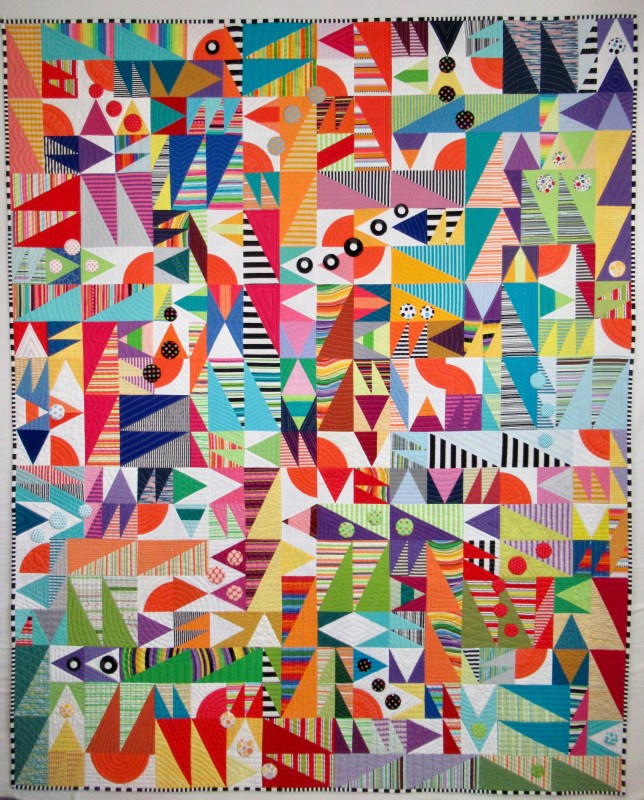
I can satisfy all their requests, for sure. And like my children, some of us are attracted to medallion quilts (my hand is the air), others like samplers, and still others would be happy making intricately pieced quilts for the rest of their lives in a blissful sort of who-cares-about-shapes-let’s-throw-them-all-in-at-once attitude, and come out with spectacular pieces of art. The reality is we take, we borrow, we steal, we adapt, we climb on top of, we turn it around, and then make it ours. Here’s one of my recent favorites, from Linda Hungerford, of Flourishing Palms.
So the bottom line is for me, at least, I think there may be very few original quilt designs. No one gets to claim copyright on a triangle, or a circle; we all know that. But where our creativity comes in, and why we are still here, sewing machines humming, has to do with how we use those shapes, those fabrics, and how big we make it and how small we make it.
I have two copies of Barbara Brackman’s Encyclopedia of Pieced Quilt Shapes, and I also have her version of that for Appliqué. Sorry to say that I feel the same about appliqué: most of us are imitating the vines, swirls, flowers, stars and animals of the appliqué world that we’ve seen before. I have twice had famous quilters threaten me with a lawsuit because they believed I was making money off their designs (seriously?). One was well-known for pinching other people’s designs, too. I pulled that pattern, and have made it free for those who are interested, for who needs a lawsuit? The other quilt I never went far with, but I’ve seen variations of it. One last episode of being accused of plagiarism left me shaken, and I lost a good friend over it, even though the design was available freely online. I really hate run-ins with famous territorial quilters, as most of the time I’m just in my tiny world, doing my thing.
The Duck Creek quilt is made of Cat’s Cradle blocks, sashed with cornerstones and pieced rectangles, and it is the design of Lisa Alexander & Susan Ache, from their book Celebrate with Quilts. I saw this pattern at our Guild night, when Char brought her book to show a couple of us. I was hooked on this design, bought the book and went for it.
The subtitle of the Times’ article has the phrase “Copy that” as in, we get it. But sometimes we quilters seem to be the least able to “get it,” I think. I have seen some incredibly original and interesting quilts this last year, and yes, most all used the shapes above. But they are originals because of the way they used the shapes, colors, negative space and so on; maybe we don’t need to get so territorial about our shapes? We quilters can be “original” even when working with those basics, like Linda’s amazing Feelin’ Groovy.
Nobody can “copy that!”
Keep making, keep quilting, keep being here–and have fun at QuiltCon this week, everyone!
UPDATE: Some truly unique and original quilts were hanging this year at QuiltCon 2025. Here’s a post that will show them off. And here. And here. And here. And here. And here. And here. And here.
Discover more from OccasionalPiece--Quilt!
Subscribe to get the latest posts sent to your email.

 OccasionalPiece--Quilt!
I started as a weaver in 1979 and didn’t start quilting until 2000. As weavers we were always taught that you can’t copyright a weaving draft, because it is a utilitarian object, and anyone who knows what they are doing can figure it out. I believe fashion is also that way — once something is on the runway, anyone can make their own version of it, because clothing is utilitarian, even if it is very fancy. Designers can trademark their logos but not garments. Maybe things have changed since I learned that back in the 70s, but boy! I am glad I don’t have to worry about it. I love looking at complicated quilts like yours and Linda Hungerford’s, but I will never make one. 🙂
Another thought provoking post. Wonderful mural, delightful gray quilt – what is the border of that one? I can’t make out the print. I like how you always find an interesting place to photograph your quilts. As to copyright, I liked what TextileRanger had to say about it. Didn’t quilts start as utilitarian objects?
So much depends on the detail, in plot and quilt. A change of color or value really changes a look even if the same shapes are used. Then there is improv which does expand the shapes available. That’s for makers. Copyright is more of a challenge for people who sell things. (I have never figured out how Words With Friends passed the “derivitive” criterion for copyright. That’s the criterion that stumps me when I think of it.
With your permission, I’d like to take your idea (steal it?) and share it in our guild’s newsletter. It’s worth stating again, as I’ve done before – and like you…. have had some who think it’s THEIR idea. I’ll give you credit, where credit is due, and add a few lines of my own. Just wanted to give you a heads up, and thank you for bringing this to our attention one more time. Love your work and totally enjoy reading your posts. And, by the way … Duck Creek is a favorite spot to camp on Cedar Mountain. Bonnie
There is nothing new under the sun; I always figure I have no claim to originality in my work. Even if I don’t recall the source, I’ve been inspired somewhere. And I love Linda’s quilt, too.
Oh goodness, I can’t imagine ever threatening someone with a lawsuit. Congratulations on the finish, and what a beautiful location for a photo shoot. I’m very much looking forward to going and reading more about the mural. As for QuiltCon, after traveling last week, I’m feeling like I’m fighting off some kind of illness, so fingers crossed I stay healthy enough to go…
Riverside seems to have wonderful murals. This one is so meaningful and also enormous! Not being a writer, I’ve never given any thought to the various plots that are employed. But I certainly agree that with quilting there are only so many basic shapes and you can’t copyright them. We like to think we’re being original but often it’s just an illusion of what’s come before. Different scales. Different fabrics. Different colors. So many things can make a quilt unique even though it’s a common underlying design. That struck home when I went through 20 year old quilt magazines/books before tossing/donating. So much has already been done. I’m sorry for your negative experiences. Just keep making.
I love your new quilt and the setting is wonderful!! I agree with you 100% on your thoughts about original design. When I see that box “original design” to check on show entry forms, I think, “yes, BUT…..” but there’s no place to explain the “BUT” – you’ve done that well!! I’m off to QuiltCon in 2 hours for the first time ever – so excited! You didn’t say if you’re going to be there, but if I see you, expect a hug from a kindred spirit!😊
Home from my little vacation and catching up on commenting! The Duck Creek quilt and the mural are wonderful. And no one should be sueing someone over a quilt pattern! There are surely far more important things to be worrying about in the world today! Just keep making what you love!