Oh Christmas Tree QAL · Quilts

Oh Christmas Tree QAL • Step 7 (Final)

7XmasTreeJuly

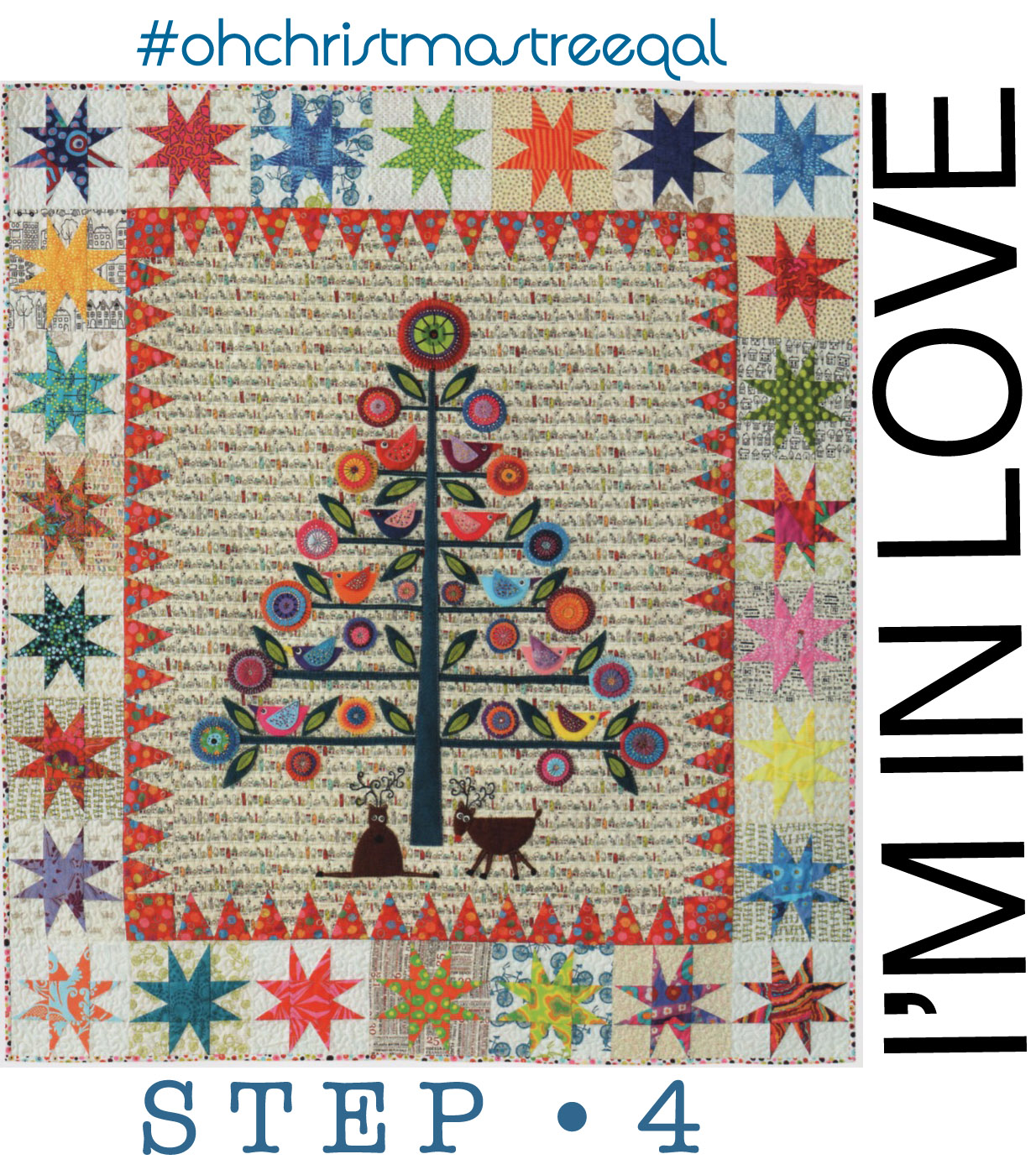
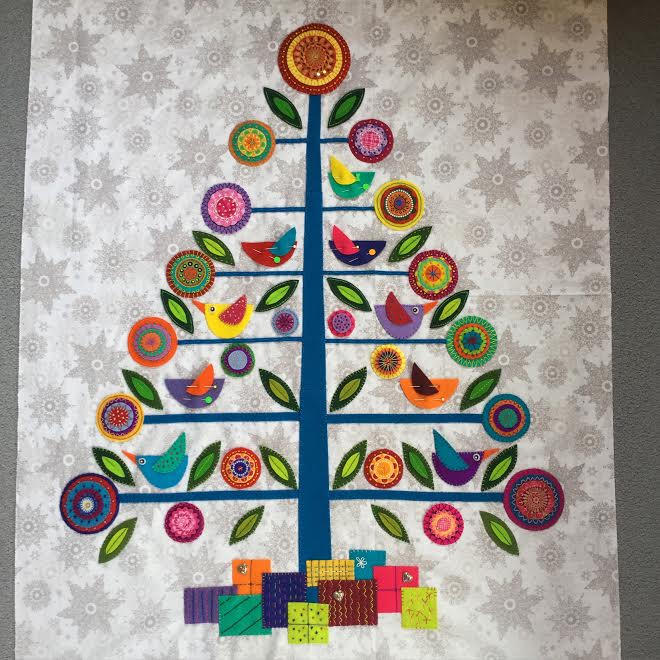
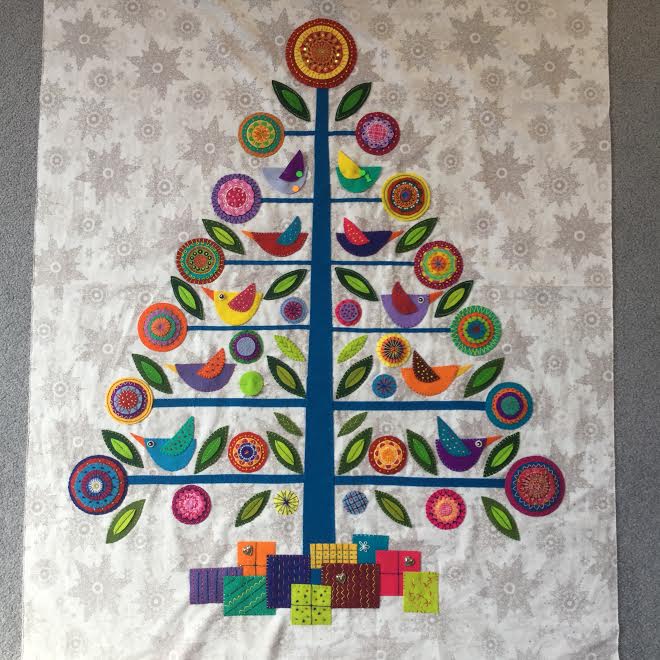
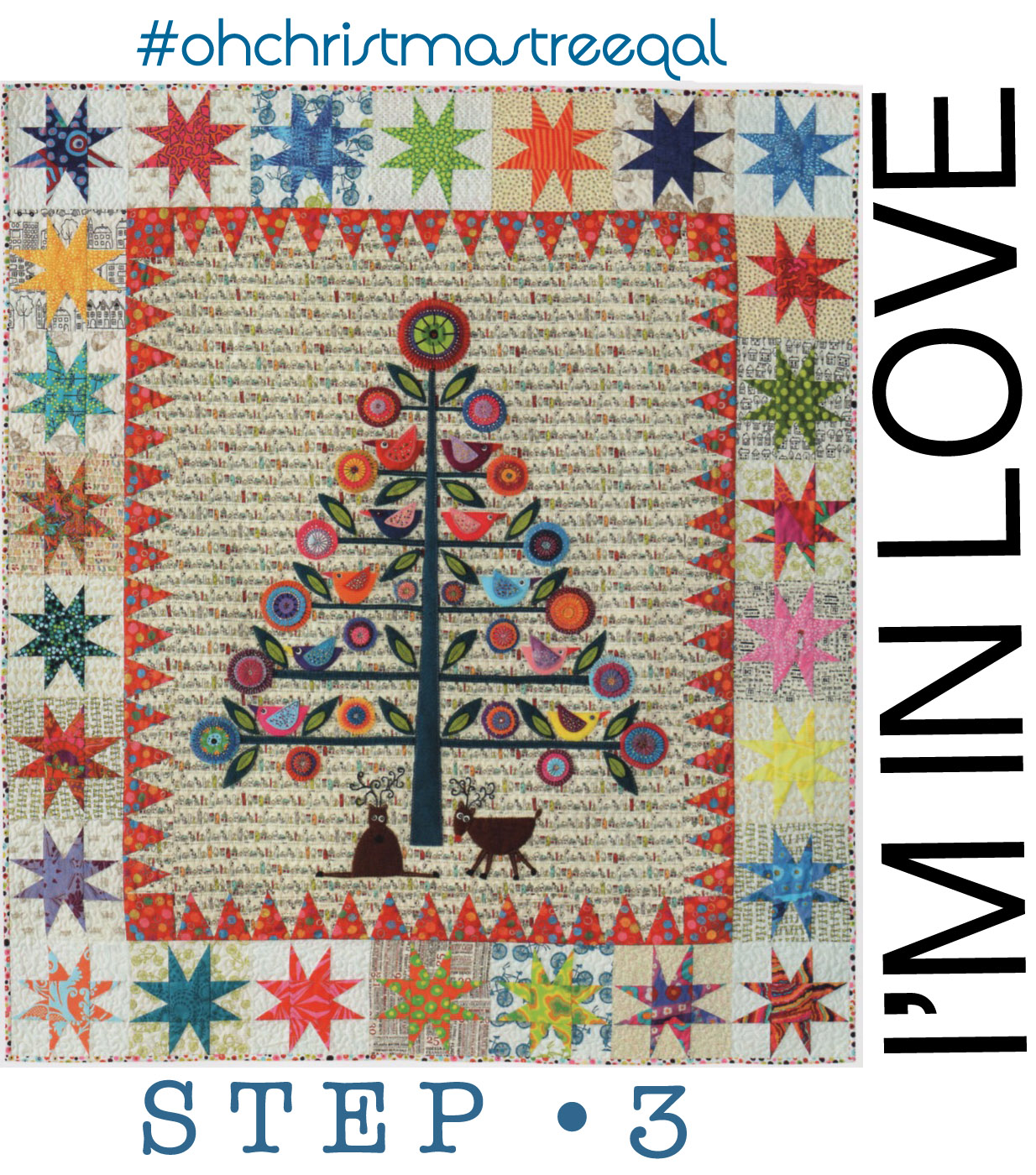
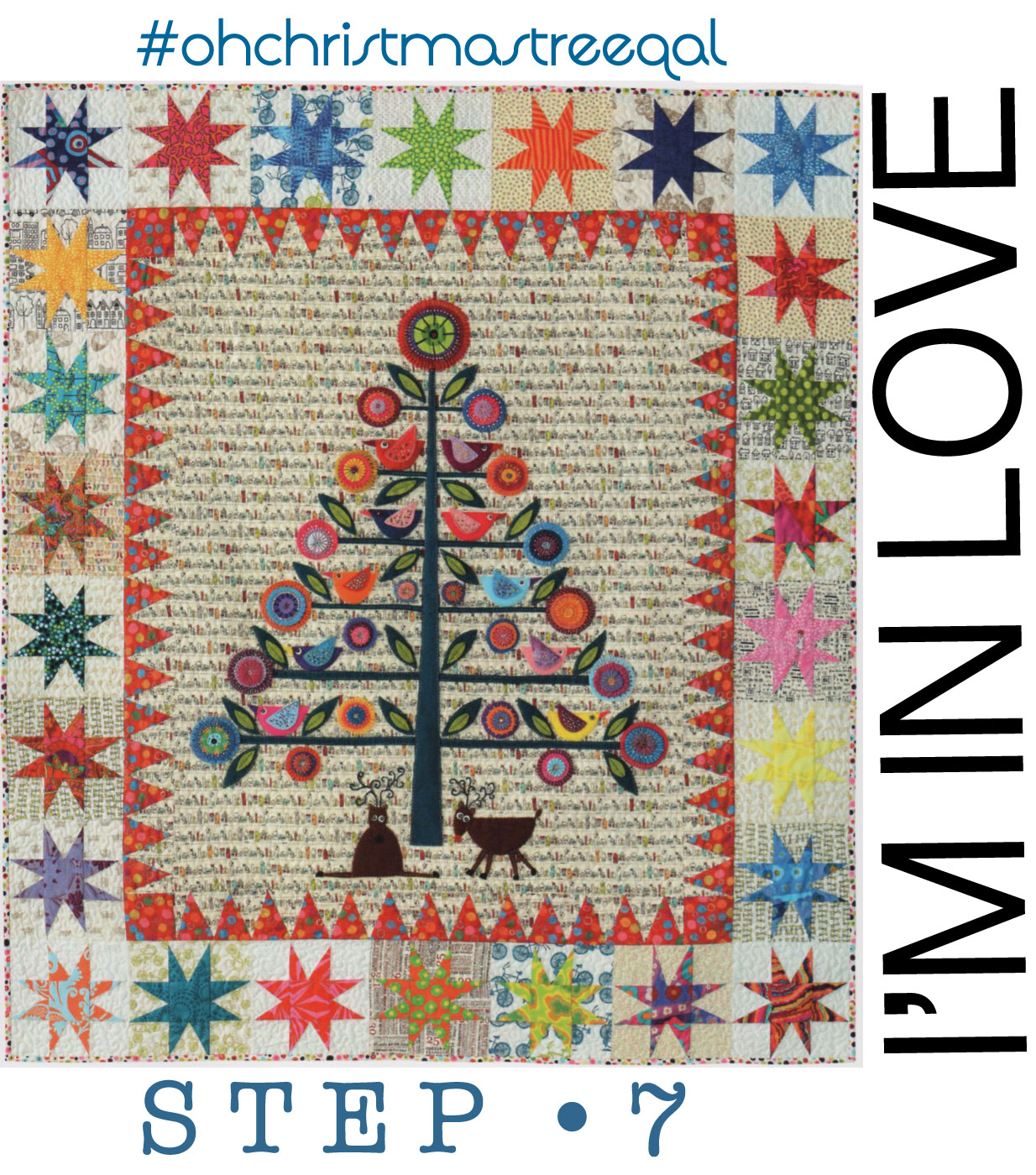
Today is Step 7 — the final step — of our Oh Christmas Tree Quilt-a-Long (#ohchristmastreeqal), following a pattern by Wendy of FlyingFishKits and which was published in Simply Moderne issue #3, by QuiltMania. As always, we have an assist from Wendy of  Wendy’s Quilts and More (blog) and wendyquiltsandmore (IG).  Our hashtag on Instagram is #ohchristmastreeqal so look there for more ideas.

Wish Upon a StarI’ve been keeping a log of the steps in the tab above, Oh Christmas Tree Quilt-A-Long, so consult that page when you need to find a post.

Yes, today we are wishing upon a star, the final part of this quilt.  We started this journey 7 months ago in January 2016, right after the magazine came out, and today we’ll finish it up.

OhChristmasTree6_first border on

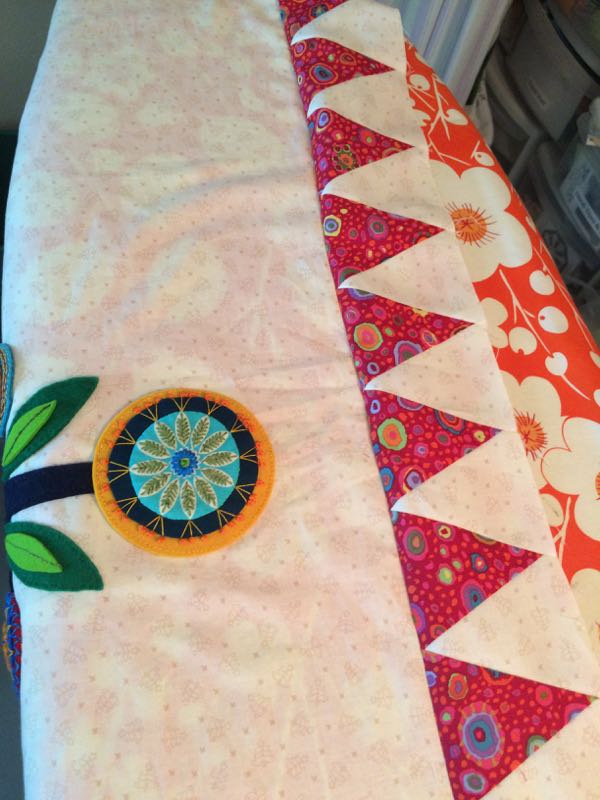
Your tree should have the red triangle borders on.  See earlier post for how to get them on.
Wendy_choosingcolorsborder

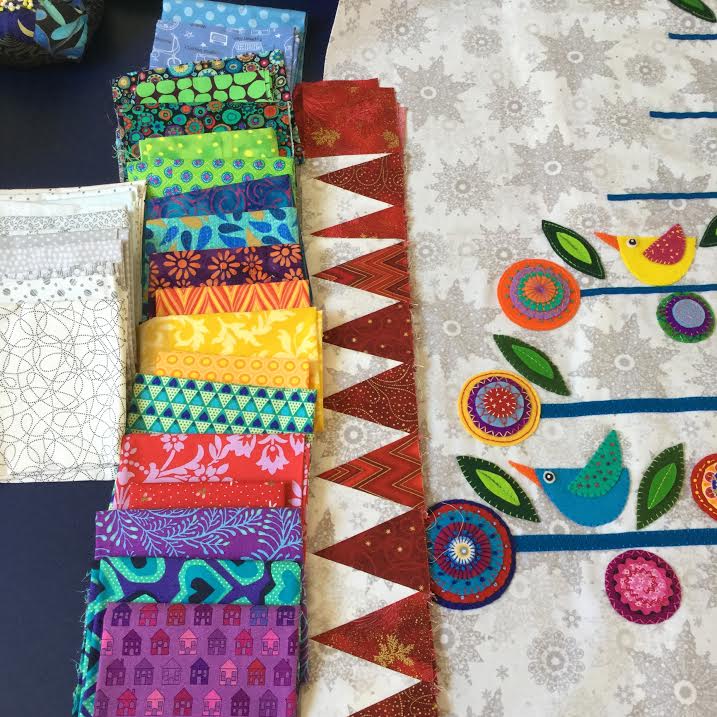
Wendy has laid out several fabrics for her stars, above.  I thought I wanted to go with traditional Christmas colors of red and green, but realized quickly that I should go with colors that coordinated with the flowers and birds.  In other words, be bold in your star colors.

WendyStarPoints

With your fabrics chosen, now it’s time to make the stars, but before you start, one issue with wonky stars is getting the star points too close to the edge.As Wendy writes: “Yellow star is what NOT to do.  Points are at the edge and will be cut off during trimming, or lost in seam allowance.  Star points need to finish further down the sides.”  I’ve circled them in red, so you’ll recognize this when it happens.  It happened to Wendy (that’s her block), it happened to me.  Consider that your Training Wheels Block.  Now one way to be aware of this is to cut all your blocks a bit larger than they ask for, and to slice the diagonal a bit differently as well.

First up, here’s my chart of how big I cut things.  It’s a downloadable PDF document:  Oh Christmas Tree wonkystarchart
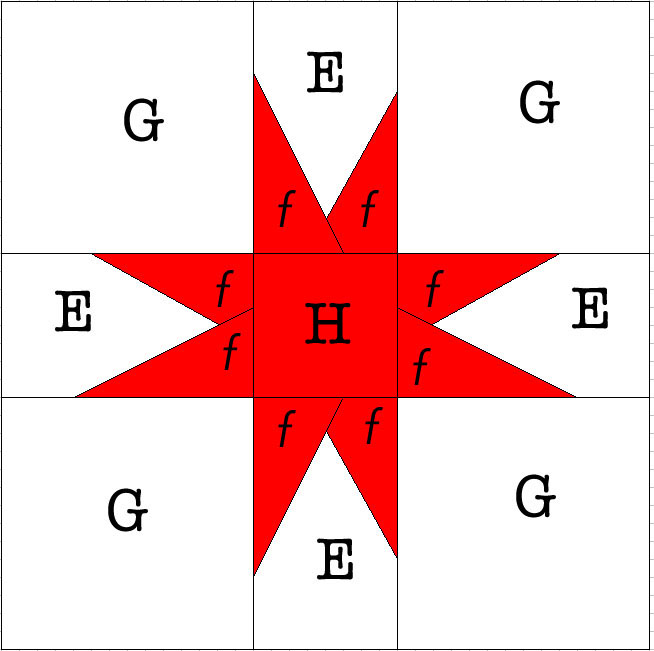
Wonky StarMapAnd here’s your roadmap/key to the letters.  I put the “f” in lowercase and italicized it, as everything was getting a bit overwhelming with that alphabet floating around.
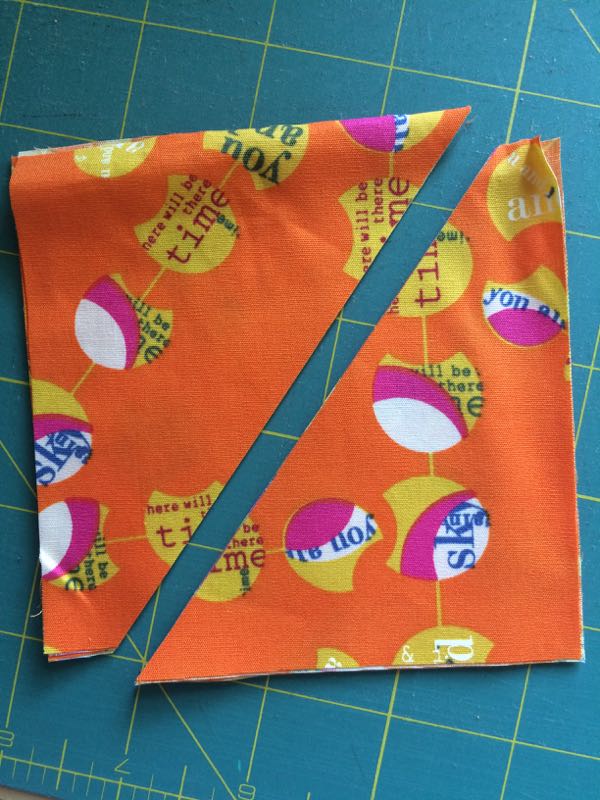
OhChristmasTree7_1splitsquare

You’ll notice on the chart I mention to cut the f-triangles “skewed.”  Cut them like the above shows, so there is a chunky bit on one end.  If you haven’t made wonky stars before, you can try it first by cutting it on a strict diagonal, and after some construction, see which one you like.  I like this way because I feel like it gives me a good angle and I’m less inclined to get the star points too close to the edge.
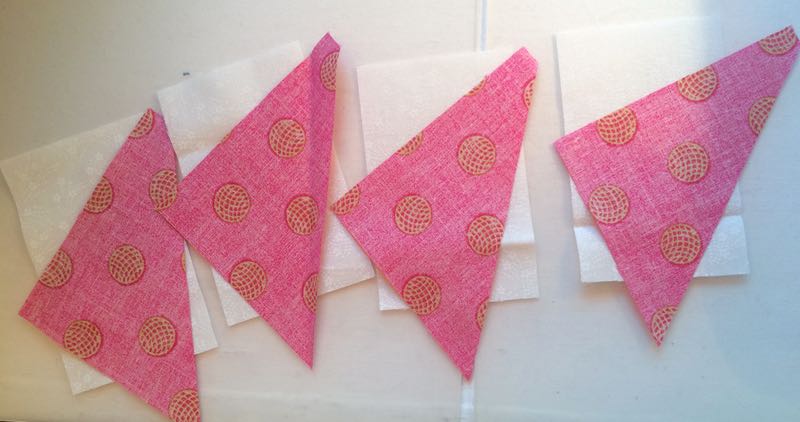
OhChristmasTree7_2

Find the narrower center piece, “E” and lay them out.  Layer four f-triangles on top, with the chunky top down from the top edge, as shown.  Try to have the lower pointy edge near the middle of the lower bottom edge of the E piece.  I often finger-crease a little mark in that bottom edge of the E-rectangle so I know what I’m aiming for.  See the next photo.OhChristmasTree7_2aOn this piece, I’ve got a pretty good start. What counts is the seam line.  So at the top right, it’s down about 1″ to 1-1/2″ and the seamline is about midline, or just a bit to the side of it.  As long as you are in the ballpark of the red X at the bottom, you’re fine.

OhChristmasTree7_2b

Fold it back to check.  Press.  Trim off that wedge underneath the star point fabric, as shown below (I’m doing a stack here.)OhChristmasTree7_2c OhChristmasTree7_2d
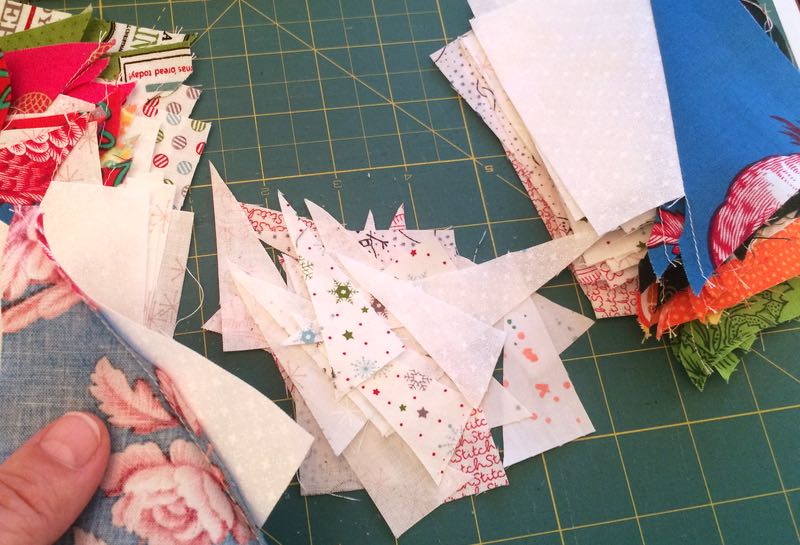
Now line up the next set.  Yes, they are all upside down, as that’s how I’m going to sew them.  Again, the chunky tip is near the top edge, and the pointy edge overlaps the first wonky start point.OhChristmasTree7_3

Stitch, press and turn.  If you are worried, check it before you stitch it by folding it back to make sure your star point fabric covers the background E piece all the way on those two lower corners.OhChristmasTree7_3a

Now trim it up to 2 -1/2″ by 4.” In the photo above, I laid my ruler on the outline of the E piece for placement.OhChristmasTree7_3b
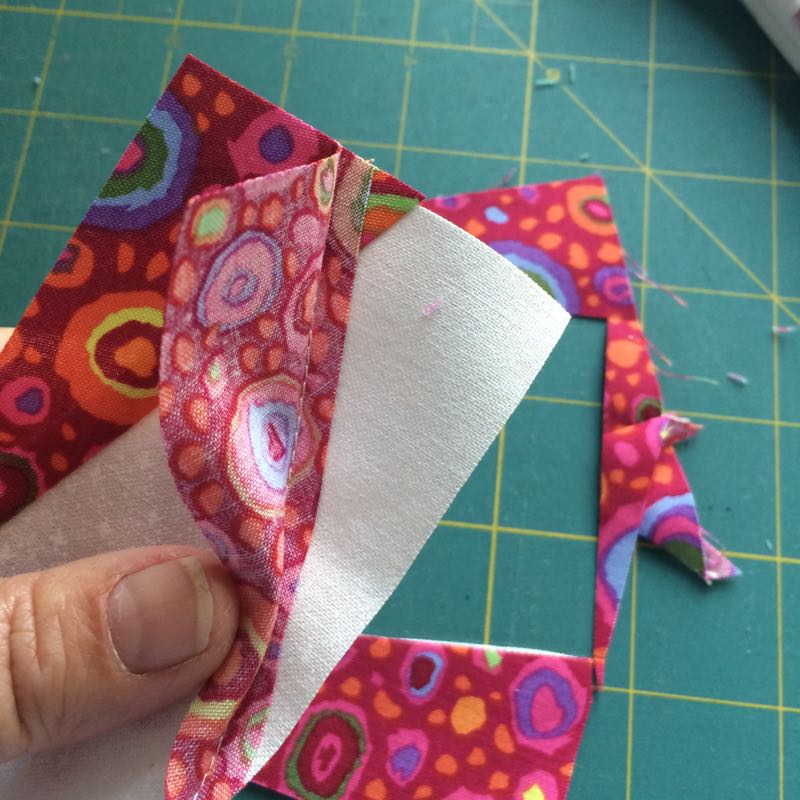
Now trim off that underneath piece.OhChristmasTree7_3c OhChristmasTree7_3d

Done with one!  Repeat three more times for one star block.  Don’t try to get all the points the same–let them be different lengths and placement, as your block will be more interesting.  DO make sure you are not too close to the outer edge–you’ll need that extra space for trimming.OhChristmasTree7_4
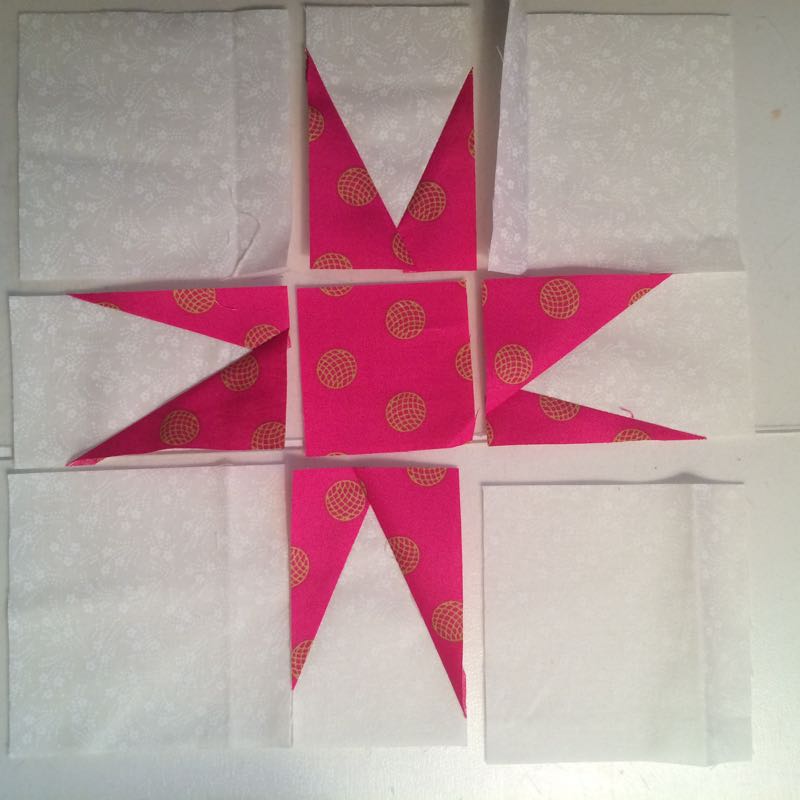
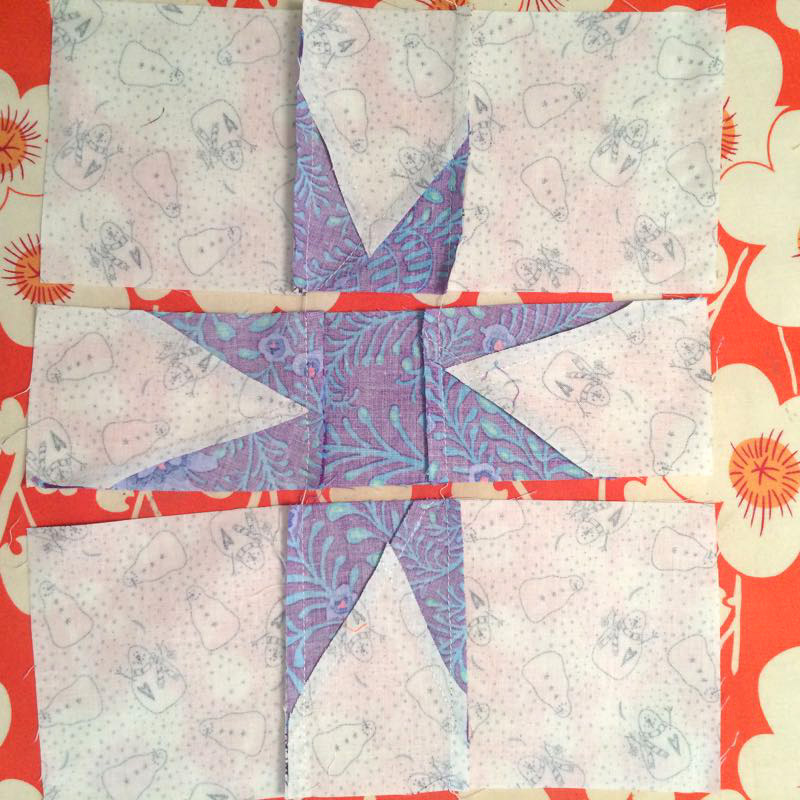
Now line them up as shown, with the H-piece in the center and the four corner G-pieces in their place.

Now you are going to make a “web” of thread, as you sew the pieces into rows.  Keep reading.
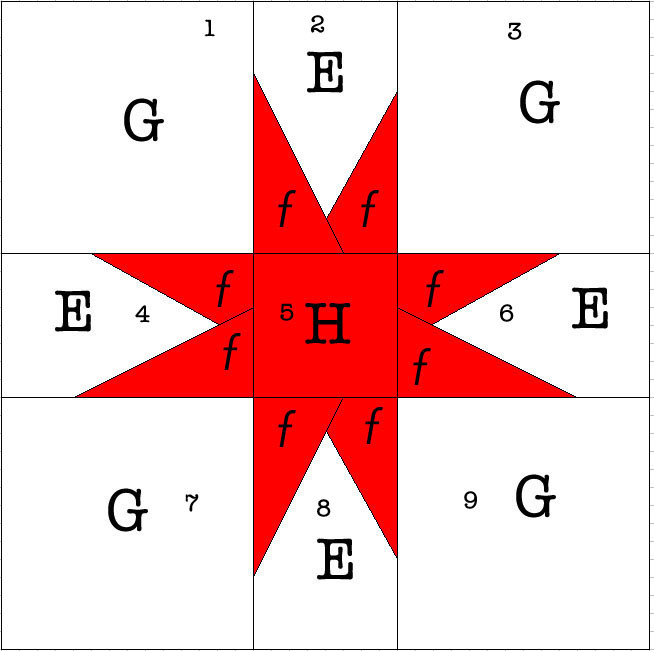
Wonky StarMapSewing

  1. Unit #1: I stitched G-1 to E-2.  Without cutting the thread, I slipped the next pair under the needle and kept stitching:
  2. Unit #2: I stitched E-4 to H-5. Without cutting the thread, I slipped the next pair under the needle and kept stitching:
  3. Unit #3: I stitched G-7 to E-8.

Sew onto a leader/ender piece (mine are just scrap, even though I always think I should be piecing another quilt or something.)

  1. Now to Unit #1 above, stitch on G-3. Without cutting the thread, I kept stitching:
  2. Stitch Unit #2 to E-6. Without cutting the thread, I kept stitching:
  3. Stitch Unit #3 to G-9.

If you can get the hang of this, you can keep all your star points together and really crank through them.

OhChristmasTree7_4aWEbThreads

Here, I’ve circled the bit of connecting “web” threads.  Press as shown: the center row has the seams pressed to the center, and the top/bottom rows have the seams pressed towards the G-piece (outer corner block).

OhChristmasTree7_4b

I’ve sewn them, pressed them, and now I can stack them, ready to sew the rows together.  Because of the thread-web, I won’t get a piece turned around, or upside down.
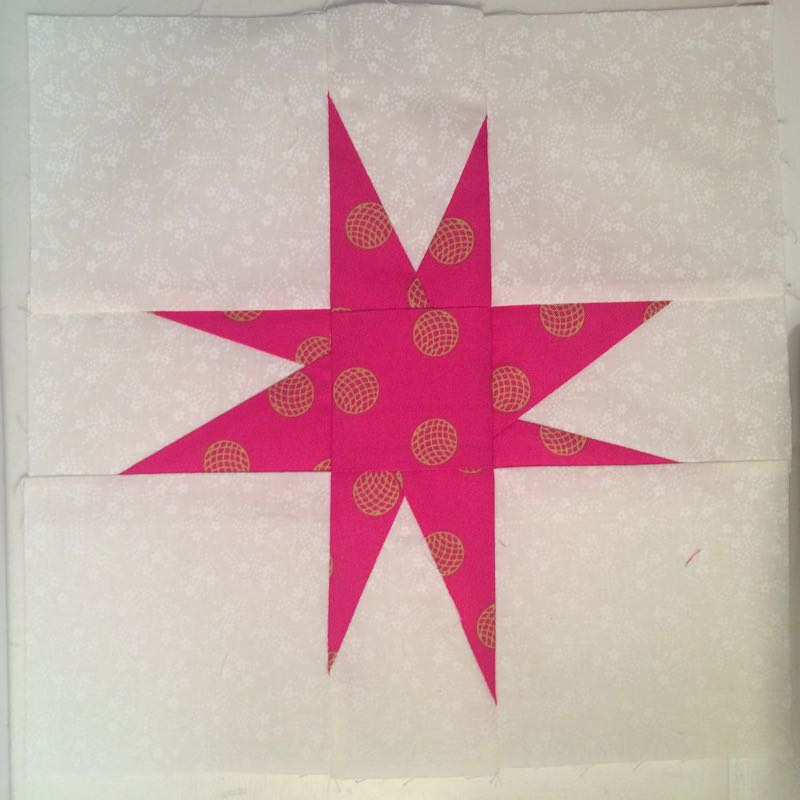
OhChristmasTree7_4c

There’s no magic, just press them how you like them, but I do always believe a seam will generally indicate which is the easiest way for it to fall.  In this case, it was away from the center.

OhChristmasTree7_7arrange

Arrange your stars around the tree how you think you’ll like them.  Take a photo, re-arrange if you want.   In my case, I ended up making some brighter, bolder stars, and shuffling several times.  It also helps if you go get some lunch, or fold a batch of laundry, or maybe snack on some chocolate.  Anything to take a break so you can bring some fresh eyes to the process.   Do this until you are happy with how they look.OhChristmasTree7_5trimmingNow for some measuring fun.  You know that each corner of this quilt will have a star.  And generally, the finished measurement is 8″, or trimmed to 8-1/2.”  Both Wendy and I caution that you need to make VERY SURE that your H-block is centered in your trimming.  Pay attention to the diagonal line and make sure it’s running through the center of the H-piece.
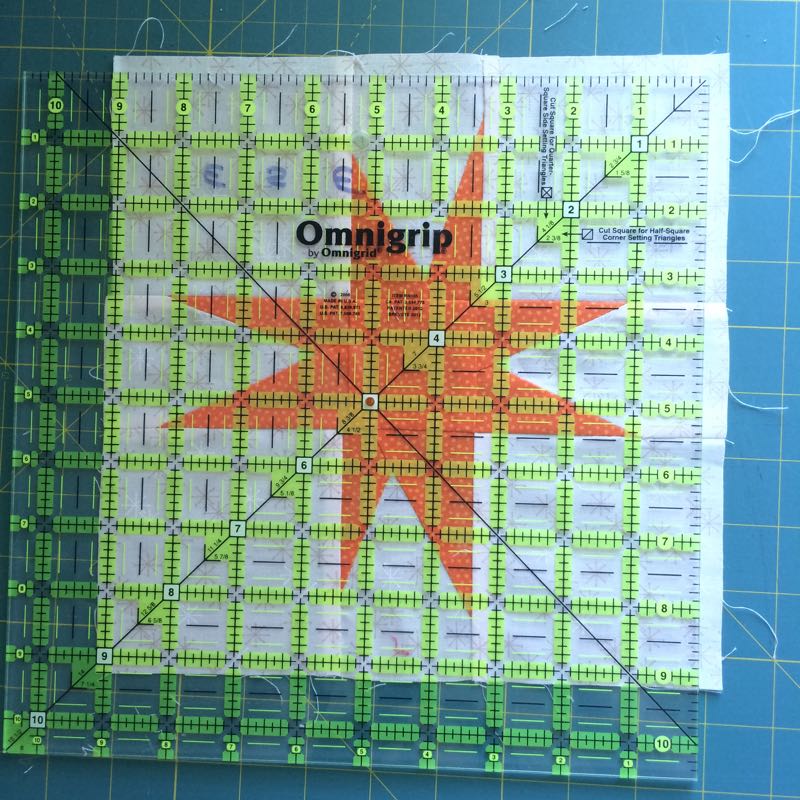
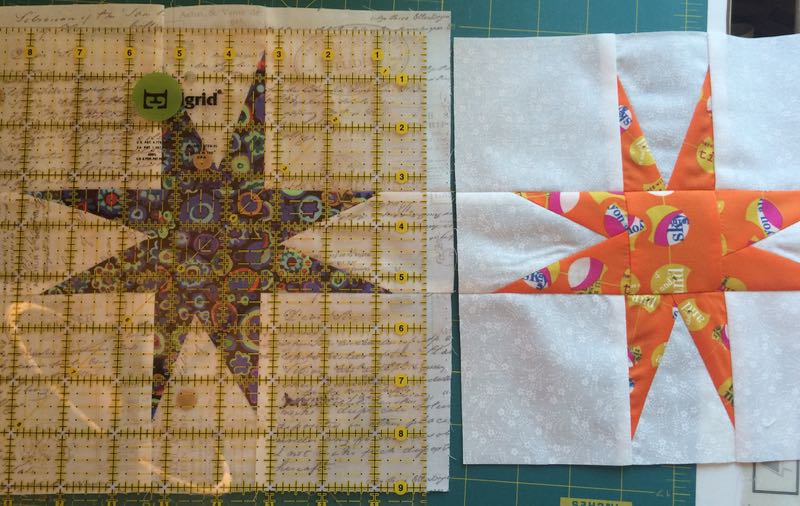
OhChristmasTree7_5trimming2

Trim FOUR blocks only, and set aside.  What you see above is me making sure that the middle row of my stars would line up when they were placed next to each other.  I took my time trimming.  If you don’t have the middle of the star lined up, you can fudge it a bit, but not by much.

confusing diagram
Diagram of how to get the Wonky Star borders attached

Now comes the hard part.

Take a measurement across the top of Border #1 (triangle-border).  Mine was just over 39.” I called it close enough to 40″ as that would fit five star blocks nicely (8″ blocks x 5= 40″); I can also sew a seam or two with a bit bigger seam allowance to get it closer to my measurement (yes, there are all sorts of ways to make our Zen Quilt behave).  In my case, I trimmed them to 8 1/2″ so they finish at 8″ when they are sewn in.

Once you get that figured it, trim up TEN blocks. Use the trimming trick above to make sure the star blocks will line up.

OhChristmasTree7_5trimming3

See how that trimmed edge is away from those star points?  (And yes, I’ve re-done a couple of blocks in my lifetime of wonky star blocks when I trimmed them off.)  Sew the FIVE top star blocks together in a row. DO NOT SEW THE CORNER BLOCKS ON YET.

Border2_stepone

Press the seams to one side, and stitch that row of Border #2 (wonky star) on to your Border #1 (red triangles).  Repeat with the bottom row of star blocks.  Press seam toward the red triangles border.  Your quilt should now look like this.

chocolate

Before you start on the sides, get more chocolate.

OhChristmasTree7_6trimming

Here comes the part where Wendy says it is kind of like childbirth: you’ll forget about it once it’s over with.  I measured the side border, counted up how many blocks were shown in the pattern, and divided that into the border measurement.  That was a scary number, so I subtracted one block, and did the dividing again.  I ended up needing SIX blocks of just about 7 3/4.”  This is the same as the pattern.
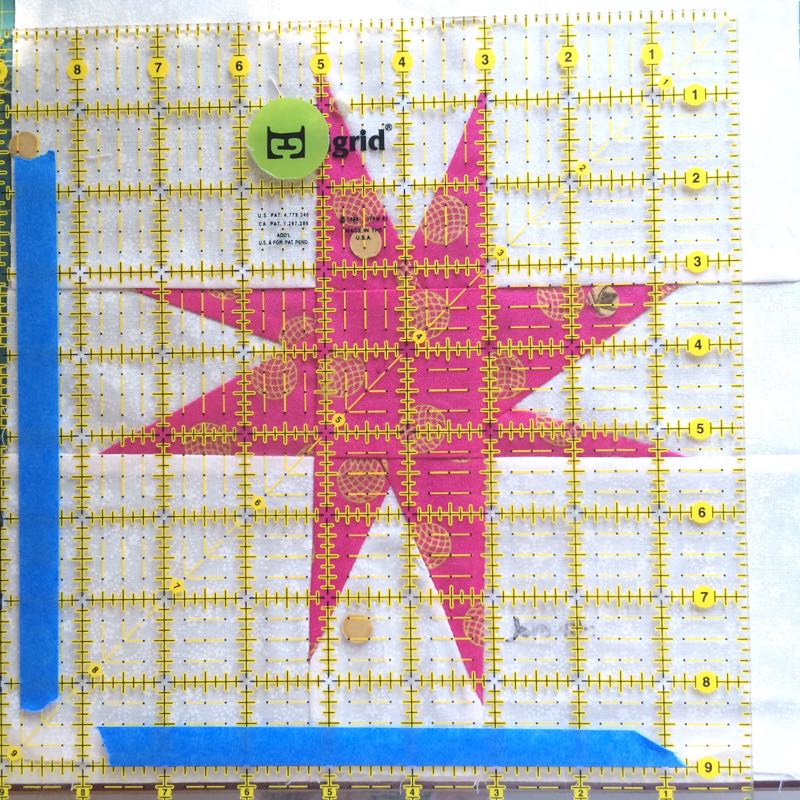
OhChristmasTree7_6trimming2

Because the measurements were kind of weird, I decided to cheat.

OhChristmasTree7_6trimming2AI kept my blocks at 8-inches finished “north-to-south” but cut them to be 7-3/4 inches finished “east-to-west.”  Which means I was trimming them to 8-1/2″ and 8-1/4″ as shown above by the blue tape.  The “West Side” tape is at 8 1/4″ whereas the “South Side” tape is at 8 1/2.”

I just wanted to make sure that I had at least 3/8″ to 1/2″ away from the pointy edges (blue ovals).  Most of the time I succeeded.

Go Zen QuilterTrim up your blocks.  Now rotate them so the 7-3/4″ finished dimension is running north-south, and the 8″ finished dimension is running East-West.  (This is an update from the original post.) Then sew them together.  Press and hold them up against the border.  Chances are they won’t fit–they’ll be too big.  So. . . cheat again.

Take a bit bigger seams between all the blocks: from 1/4″ inch to 5/16ths of an inch.  Check your sewn row again.  If they are still too large (and can’t be eased in), choose the two stars that have the most room between the tips of their star points and the seam, and make another teeny bit bigger seam.  Now you should be fine.

Breathe Deeply.  Go Zen.

NOW sew the star corner blocks to each side border strip–two to each side strip of stars–one on the top and one on the bottom.  Press all seams on the strip towards one side.  Stitch these borders to the existing quilt.
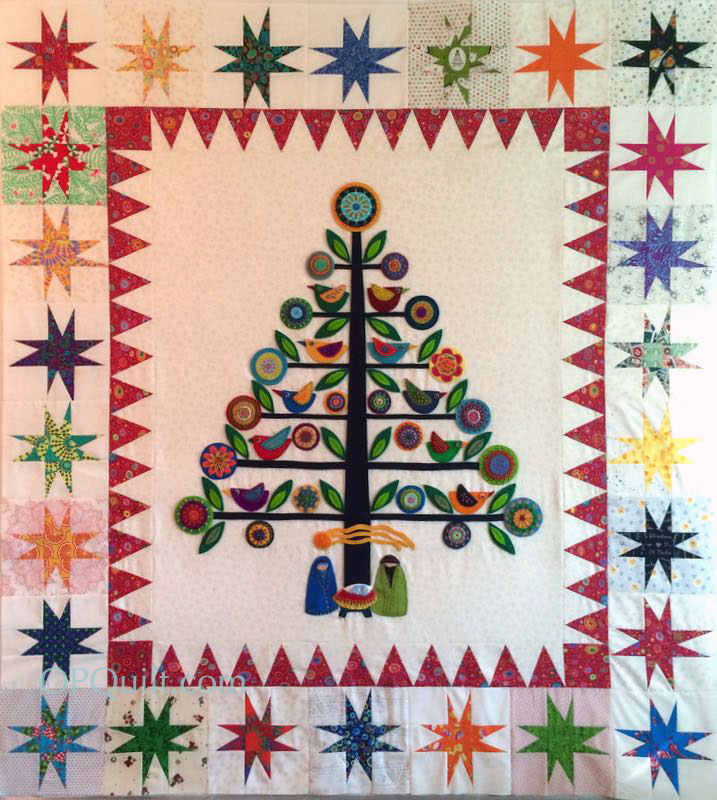
OhChristmasTree7_Final

I then pressed all seams toward that red triangle seam, even if it didn’t want to go there.  Now, in looking at it, can you tell that the side blocks are sized a tiny bit differently than the top/bottom blocks?  Didn’t think so, and no one else will be able to tell either.  I think the solution to the challenging measurements was a success.

As Gwen Marston said, “Nobody ever said, ‘I need a little more stress in my life–think I’ll make a quilt.’ ”  Quilting should be fun, even if it’s challenging (and this was definitely a challenging quilt).
Wendy_finished quilt OCT

Here’s Wendy’s…

Betty OCT

…and Betty’s.

Now let’s see yours.  Shoot me an email when you get yours done, with a photo of your quilt, and if (I mean, when–I’m thinking positively) I get a few, I’ll put up a post showing off your hard work.

Happy DanceTry not to dance, but you are done!  It’s over!  You made your quilt!!
(Click *here* for a fun dance scene from On the Town, a favorite movie of mine.)

Thanks for joining us on this journey, from January to July, of making the Oh Christmas Tree quilt.  I’ve appreciated all your enthusiasm, your comments, and seeing photos on Instagram.

My_Place_Or_Yours

Here’s one of Wendy’s new patterns, My Place or Yours, if you want to feast your eyes on something new.  Pattern can be purchased *here.*

Pieces O My Heart Williams

Another one of hers is Pieces O My Heart, which just won a blue ribbon at the Sydney Quilt Show.  Visit her Instagram feed for more inspiration.

Lastly, if you are not a follower of my blog and you’ve enjoyed this quilt-a-long, I’d like to invite you to become an email follower. Just enter your email in the box above.  I generally post about twice a week, with occasional longer gaps. I try to post worthy and interesting content with an occasional “friends and me doing quilty stuff.”  I think by building communities and sharing discussions about issues and happenings in our world, we shorten the distance between us, forming strong links of like-minded quilters.

Happy Quilting!

Giveaway · Oh Christmas Tree QAL · Quilts

Oh Christmas Tree QAL • STEP 6 and Giveaway

6XmasTreeJune

Today is Step 6 of our Oh Christmas Tree Quilt-a-Long (#ohchristmastreeqal), following a pattern by Wendy of FlyingFishKits and which was published in Simply Moderne issue #3, by QuiltMania. As always, we have an assist from Wendy of  Wendy’s Quilts and More (blog) and wendyquiltsandmore (IG).  Our hashtag on Instagram is #ohchristmastreeqal so look there for more ideas.

I’ve been keeping a log of the steps in the tab above, Oh Christmas Tree Quilt-A-Long, so consult that page when you need to find a post.

And yes, there is a giveaway at the end of this post, so have fun reading through the maze of red triangles.

great wall of china1

Today is the Dreaded Border Problem. No, not that kind of border problem, but a QUILT border problem. To guide you through all the blather this longish post, I’ve broken it into 5 parts: 1) The Pattern and the Problem, 2) The Fix, 3) Construction, 4) Fitting it to the Tree, and 5) More Ideas.

The Pattern and the Problem

As SuggestedThese were the inner red/background fabric border blocks, drawn to the measurements listed on the pattern in Simply Moderne.  You can see the troubles already, right?  None of them can play nicely together (that last shape is the dimension of the half-triangle, minus its diagonal line).

MetricImperial Stormtrooper(from here)

Maybe the Metric vs. Imperial measuring system may have something to do with it?  but I don’t know (and to be truthful, I just really wanted to use that image).

As Re-drawn

When I tried to subtract the seam allowances, and create the wedge piece for use at each end of the borders, it just got messier.

But never fear!  Wendy informed me that the seam allowances were left off the triangle and the wedge piece, EVEN THOUGH IT SAYS THE SEAM ALLOWANCES ARE INCLUDED.  She sent me photos showing a difference in the base of about 3/4″ across.

Which explains. . . a lot.  Like a lot of you have gone ahead and cut out the triangles then got to a place like where Gwen did, when she noticed that they were too small!  She eventually made more triangles to fit across the area needed.  Leslie, another friend who was trying to make this at a retreat, emailed me with the same problem; she decided to stop until I figured it out.

The Fix

But before I knew about the news from Wendy,  I had scrapped their templates entirely and made my own, which work fine (free templates for download are below). I compared my triangles to the revised pattern (now including) seam allowances, and mine are slightly larger by about 1/4″ total on the large triangle (1/8″ each side), but interestingly enough, perfect for the wedge triangle.  So you have a choice: do theirs in their imperfections — first adding seam allowances — or, forget theirs and go with mine.  You should know, however, using my templates will change the number of wonky stars you’ll make for the border, if that matters to you.  The finished quilt photo is at the very end of this post, if you want to compare how mine turned out with the magazine’s photo.  And Simpy Moderne’s  link for the errata; it simply says “add seam allowances.” Okey, dokey.

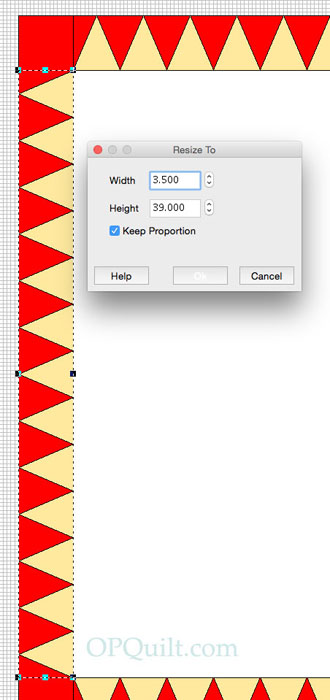
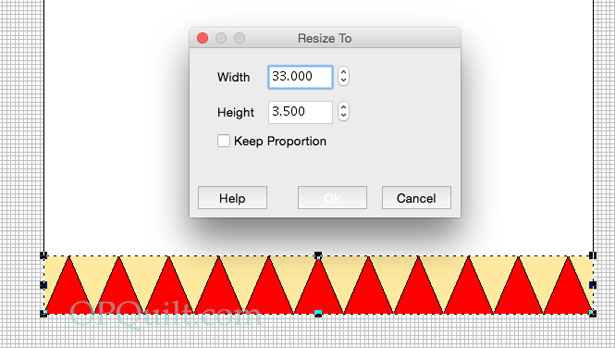
I figured out my templates by starting with their lower border measurement, which just happened to be one that I could evenly divide by 3.  So I redrew my triangles to measure 3″ across the bottom. Then I had to change the side border measurement to also allow division by 3.  Here’s my working snapshots from my QuiltPro software.

OCT6_Side border1

These images show the measurements without seam allowances.  The templates that you’ll print off (at 100%) include those pesky seam allowances.  OCT6_TopBorder

So here is that link to a PDF file that has templates for the new triangles and corner block: OCT New Border Templates.  To make sure you are printing it out correctly, the inside measurement of the cornerstone (w/o seam allowances) is 3.5 inches (or the entire square is 4″).  Please print out only one copy for yourself.  If your mother or friend want the pattern, please send them here to get it.  Many thanks.  

Construction

OhChristmasTree6_1 cutting triangles

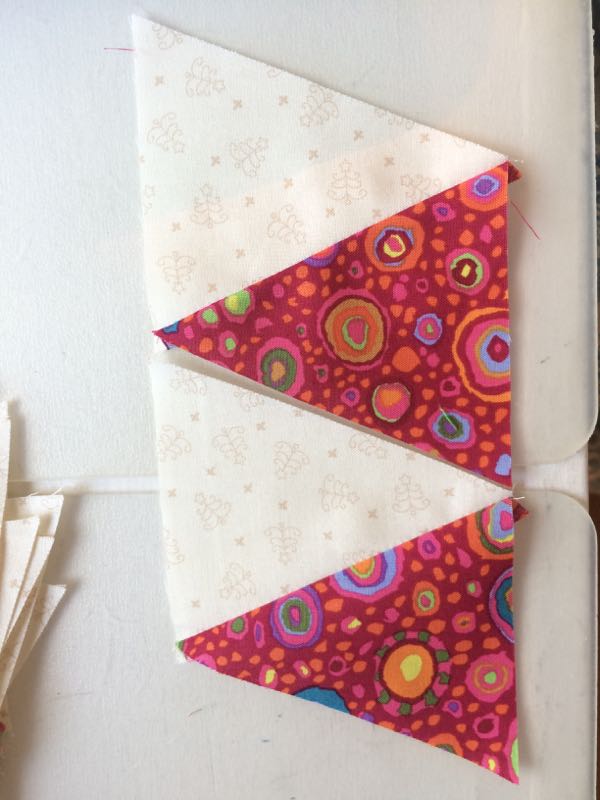
I cut three 4″ strips WOF: as you can see, the strips were big enough to accommodate the triangle pattern.  I did flip it back and forth so was able to get about 10-12 triangles out of that folded cut per strip (I forgot to count).  So, from three strips I had plenty.  You’ll need 11 red triangles each for the top/bottom border, and 13 red triangles each for the side borders.  Cut 12 whole background triangles and 2 smaller wedge triangles for each side border; top/bottom borders require 10 full background triangles and 2 smaller wedge triangles.  [NOTE: I do show you two different ways to think about your placement; read all the way to the end before cutting.]OhChristmasTree6_2

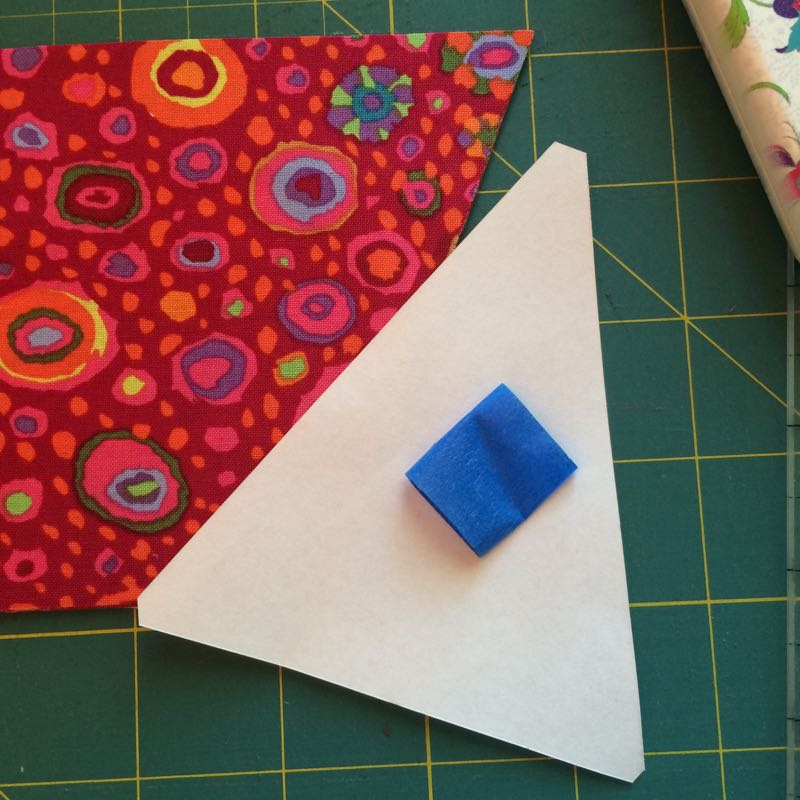
I put a double loop of painter’s tape on the back of my template so it wouldn’t shift while I was cutting.OhChristmasTree6_2a

I also don’t really worry about the outside edge of the template so much, instead focusing on lining up my ruler with the actual dimensions of the triangle.  That way, if I accidentally trim off a bit of the template while cutting, the world doesn’t end.  I’m paying more attention to the inside “actual triangle” shape when I cut, than to the triangle’s outer seam allowance line.OhChristmasTree6_2b OhChristmasTree6_3 cutting arrangement

I’ve also learned to shift the fabric going up away from me (north-south direction) when I cut angles, shifting it slightly left or right as needed, so it’s easier cutting with less stress on my hands.

OhChristmasTree6_4 sewing

All lined up, ready to sew. OhChristmasTree6_4a

Since I cut three strips at once, I work with a stack of six red triangles and six background triangles, laying them out like this.

OhChristmasTree6_4bb

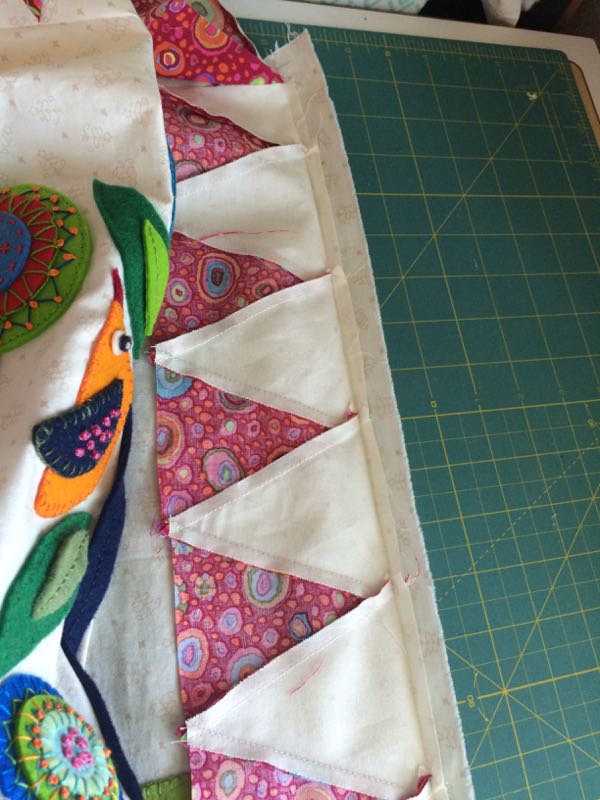
Line up the tip like this, then sew along the top edge with an accurate 1/4″ seam, shown here by the dotted line.  Do your best to get that seam as accurate as you can, as you are working with a ton of seams here, and a little scoonch off at this point can yield big differences later.  Having said that, I wouldn’t worry about it too much, as there are lots of ways to adjust these borders.OhChristmasTree6_5 pressing

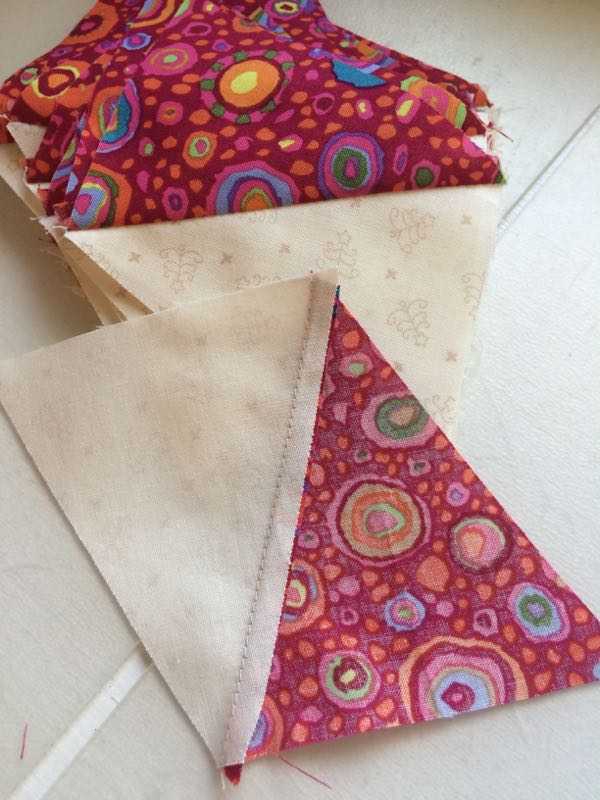
I stitched them in pairs, then pressed to the dark side.OhChristmasTree6_6

Then I seamed two together, pressed again to the dark side, then built out my four different borders by combining these sets.  Watch out–you will have an odd number so you’ll need to sew on just one red triangle at the end of each border, then sew on the smaller half-triangle shapes to make your borders.  To reiterate, you should then have:
•  two borders with 11 red triangles
•  two borders with 13 red triangles

This is different than the pattern in the magazine.  Sew a corner block on the ends of the 13-triangle (side) borders and iron all the seams to the dark side, as before.

Fitting It to the Tree

Find yourself a nice big flat surface, preferably with a grid.

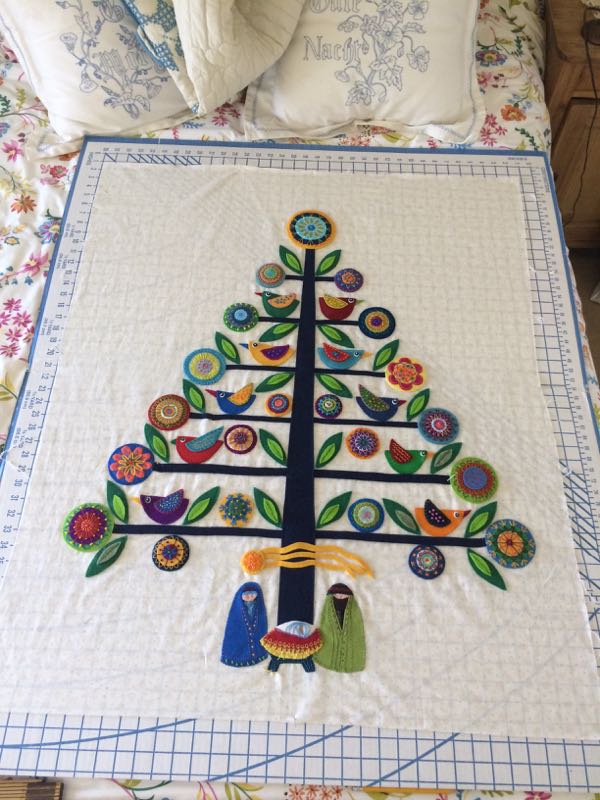
OhChristmasTree6_7 squaring quiltLike a cutting board, or something (Why yes, I do work on my guest bed all the time).  I smoothed out my tree, aligning the tree trunk on one of the lines (north-south) but quickly realized that even though I thought I had sewn the tree on straight on my background, it was slightly off (see the slope of the lower edge).  You’ll cut the background 33 1/2″ by 39 1/2″ if you are using my templates.  Please follow the measurements in the magazine if you are using theirs.

OhChristmasTree6_7 squaring quilt1

I was more concerned that the tree be upright and straight, so I continued lining up the tree trunk and the limbs with the grid underneath, then putting pins to anchor them straight.
OhChristmasTree6_7 squaring quilt2

Since I want the background to be cut to 33 1/2″ inches wide, I put the 16-3/4″ inch line in the middle of my tree.OhChristmasTree6_7 squaring quilt2b

If you have one of these hanging around the house, that’s even better.  They are nifty rulers that allow you to find the center easily.  Just line up the similar measurements on the outside (in this case, the 1-inch marks on the top edge of the Center-Finding Rule) and you’ll instantly find the center.  OhChristmasTree6_7 squaring quilt3

Mark the outside edges.OhChristmasTree6_7 squaring quilt4

Now connect the marks.  I also used the grid underneath to aid me, deferring to those lines, if I thought my marks were a little wonky.  I measured the height of this rectangle (39-1/2″) and it turned out to be almost exactly two inches above the big circle at the top of the tree and the lower edge of my manger in my scene.  (Lucky me!)  I then used the grid underneath and the right angles of my big ruler to draw the top and bottom lines.

The idea is to draw yourself a squared-up rectangle.  If you draw the lines at 33 1/2″ and 39 1/2″ then you can align the raw edges of your borders with those lines as you pin them on.  BUT DON’T TRIM THE BACKGROUND YET!!OhChristmasTree6_8 sewing borders1

Of course, the best-laid plans often go awry.  I’m a bit short here, but instead of stretching the border to fit (which I could do, since it’s mostly on the bias), I let it be a bit short.  I’ll adjust the outside wonky star borders as needed.  Sew on the top and bottom borders first.OhChristmasTree6_8 sewing borders2

While ironing this seam, I just realized that the red triangles should be pointing TOWARDS the Christmas Tree. I un-sewed, then re-sewed, all the while listening to this (30 hour!) book:

Alexander Hamilton

In this season of political intrigues, constitutional fights and jockeying for power, it’s been interesting to revisit the original story of political intrigue, constitutional fights and jockeying for power.  Okay, back to the triangles.

OhChristmasTree6_8 sewing borders3

Sew on the top/bottom borders first.  Then sew the two sides, leaving the corner block seam areas unsewn.  Press, then check them, THEN TRIM THE BACKGROUND FABRIC.  After that, stitch the corner block seams.OhChristmasTree6_first border on

Ta-Done!!  It changes the look of everything to have this first border on, and now I can’t wait until I can get sewing the Wonky Blocks for the outside.  I’ll cover that on our last installment of the QAL, including how to adjust in case your borders aren’t quite what you thought.

Betty, another friend who is doing this, was working parallel with me that day, and we talked back and forth as we worked. The big take-away is that I think this quilt is jinxed, has a spell on it.  Or maybe it was because it was too hot:
113 degrees_toohot

At one point, nearly in tears, I called my husband and told him this pattern had gotten the better of me, and I wanted to chuck it through the window.  So if you have this reaction, you are not alone.  But carry on, it gets better.  Betty’s quilt turned out like this:

BettyOCT_redborders

(Isn’t that background fabulous?)

Here’s the kicker: she had to eliminate the wedge triangles from the two sides at the lower edge, where it joins the square.  In fact, she had to cut those triangles in half.  Her measurements are only 1/2″ different than mine, so that’s when I decided that with this pattern you have to:

Go Zen Quilter

Go Zen.

Oh yeah, that’s totally me up there, but only after I got the red borders on.  Just let go of trying to make this pattern be a precise, precision-cut and sewn quilt, and just work with it.  And by the way, Wendy from NZ was working with the “good measurements” from the original pattern and she still had a hard time getting the red border sewn.  But like me and Betty — and soon, you — she did it.

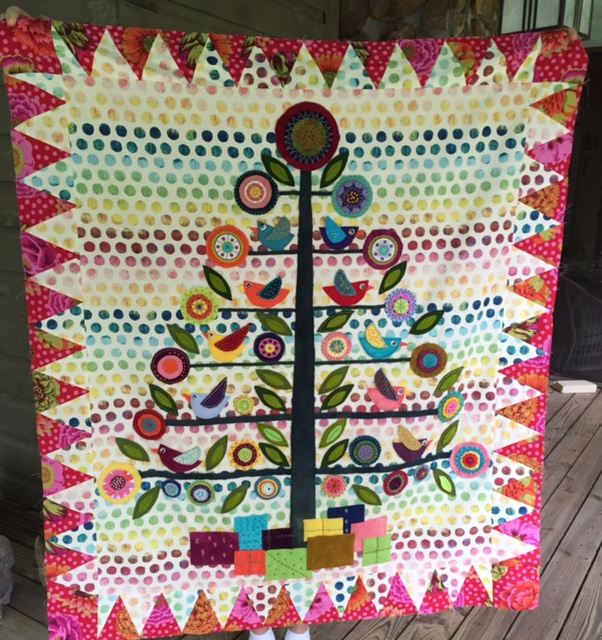
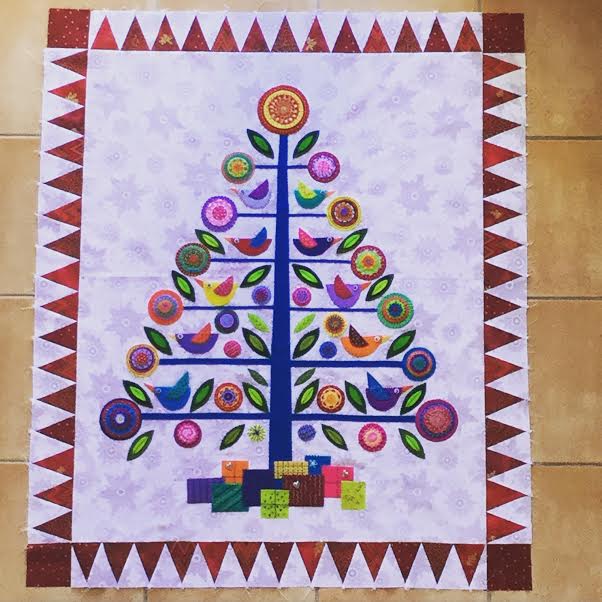
Wendy OCT with first border

Yes, she reversed her triangles, but when I commented on it, told me that she was all finished so they were staying that direction.  I mention this to fit in with the theme of Go Zen.  There are many ways to complete this pattern, and they are all charming.  Keep reading for another.

Once you get here, you’re going to want to keep going and get the whole dang quilt finished off.  So, instead of waiting a month for the next installment, I’ll give you roughly a week to get it on (and to get the cursing out of your system) and then I’ll pop up with the the final installment, where we Finish This Thing.

tiny nine patches

More Ideas

OhChristmasTree alternateborder

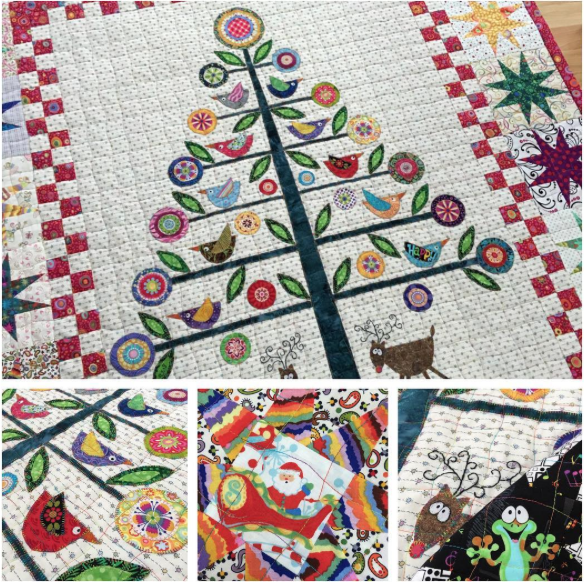
I first saw this on IG.  She did it all in Kaffe Fasset fabrics (apparently, no wools anywhere), with a red/white checkerboard border and that she plans to hang it up all year long.  This photo is from the IG feed from Linderella’s Quilt Works in North Carolina.  (This is the advantage of tagging your photos!)

SusanHolmanOCT

And then Janice of french75too (and a huge EPP enthusiast) sent me this picture that was posted on the Kaffe Fasset FB group.  The quilt is by Susan Holman, who gave me permission to post it here.  She also mentioned that she “had to cut the inner section a bit smaller” and also “re-drafted the stars to finish at 7.5,” as the depth of the border changed the dimensions.

Just to torture myself further for fun, I decided to think about how the quilt top would look if I used different end wedge triangle colors. Here are two pictures to illustrate what I mean.

OCT6_beigetriangles

This is how the pattern goes: small half-triangles made of the background fabric sit next to the corner blocks.  The center triangle, in the top and bottom borders, is pointing exactly at the tree trunk.
OCT6_RedTriangles

In this one, the small wedge-shaped triangles are red, which means that the numbers are slightly inverted (10 full red triangles, instead of 11) and the points of the center triangles are on either side of the tree trunk.  You get to choose.  And because I promised you, here’s a look at my completed top:

OhChristmasTreeFinalToplabeled

This photo is showing number of triangles and the number of wonky stars (which we’ll do next time).

ChristmasTreeLogoSM

Here’s our updated schedule (can you believe we’ve been working on this since January??):

January 2nd, Step “prepare”: buy the magazine, books, gather your fabrics, buy the felt/wool, buy/find the pearl cotton.
February 2nd, Step 1: Make the tree on the background and stitch it down.
March 2nd, Step 2: Make 21 flowers.
April 2nd, Step 3: Make 10 birds and all the leaves.
May 2nd, Step 4: Appliqué down the flowers and birds.
June 2nd, Step 5:  Scene at bottom of tree–make, then appliqué onto background.
July 2nd, Step 6: Sawtooth border (reds); sew together and attach. 

July (sometime mid-month), Step 7: (finish up Quilt-A-Long): Make wonky star blocks, sew them together and attach border #2.

September, Step 8 Show and Tell, just in time for school starting again.  Please send pictures of whatever state your Christmas Tree is in–whether it’s just the bones of the tree, of a completed top–we want to see it!


Giveaway Banner

Dresden Giveaway

Since we are now winding down our Oh Christmas Tree QAL, I thought you’d like to have another project to start.  How about some Dresdens?  This lovely book, Dresden Carnival, written by Marian Gillian and Yvette Marie Jones, has sixteen different quilt projects using the Dresden Plate block in ways you never thought of.  The color pairings are bright and fun and the settings will have you thinking about Dresdens in a whole new way.

To win a copy of this book, please leave a comment telling me what your best Dresden Plate block memory is–from that vintage quilt you saw in an antique store to inheriting a set of blocks from your aunt, to the colorful Dresdens now flying around on the internet (including the free EPP pattern on this blog).  I’ll activate the Husband Random Name Generator and we’ll pick a winner.

UPDATE:

Well, my husband was reading intently, so I fired up the Random Number Generator and it picked a winner.  See next post for more info.

Flag waving

Happy Independence Day!
After listening to Hamilton, this whole process has a new meaning for me.  I owe a great debt to those early patriots.

Oh Christmas Tree QAL · Quilts

Oh Christmas Tree QAL –STEP 4

5XmasTreeMay4

Today is Step 4 of our Oh Christmas Tree Quilt-a-Long (#ohchristmastreeqal), following a pattern by Wendy of FlyingFishKits and which was published in Simply Moderne issue #3, by QuiltMania. As always, we have an assist from Wendy of  Wendy’s Quilts and More (blog) and wendyquiltsandmore (IG), as she is slightly ahead of us in her creating.

ohchristmastree4_0treejpg

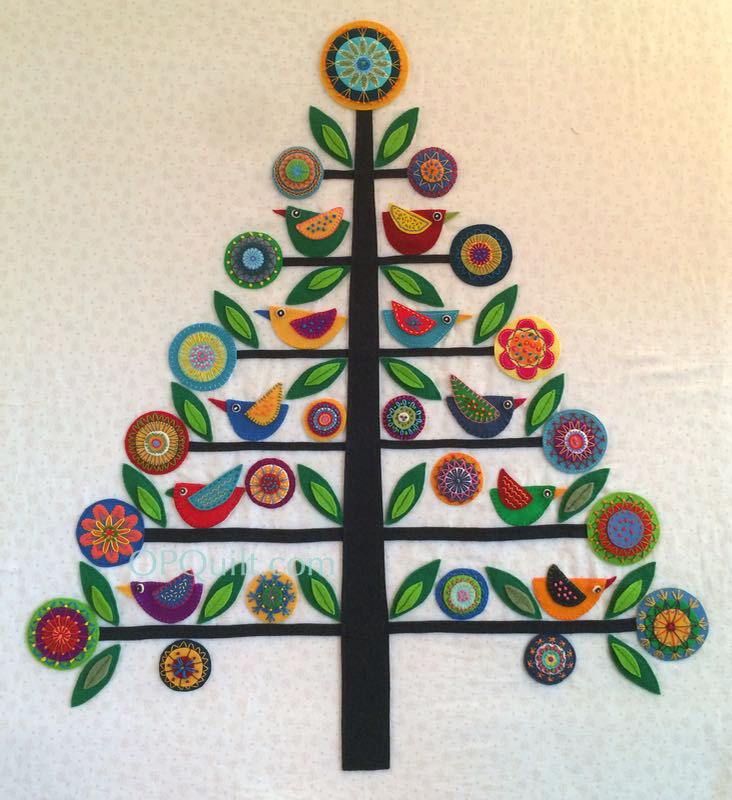
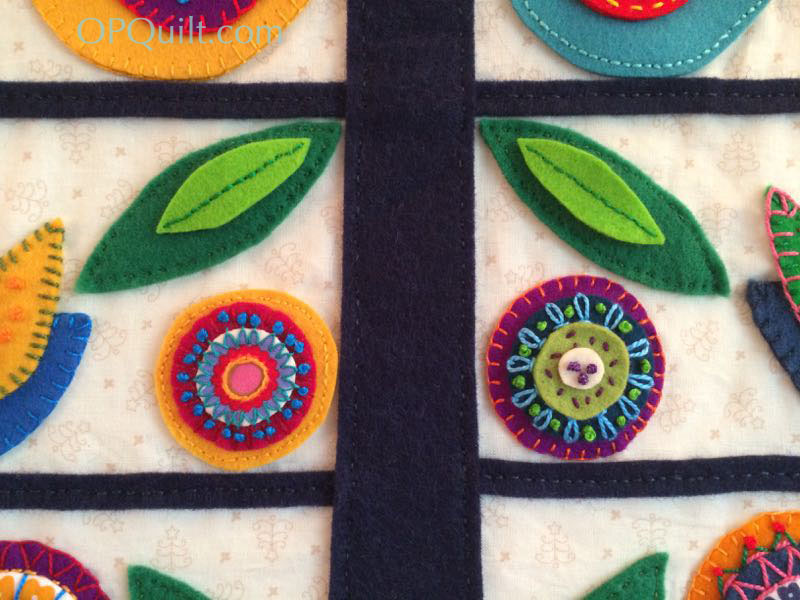
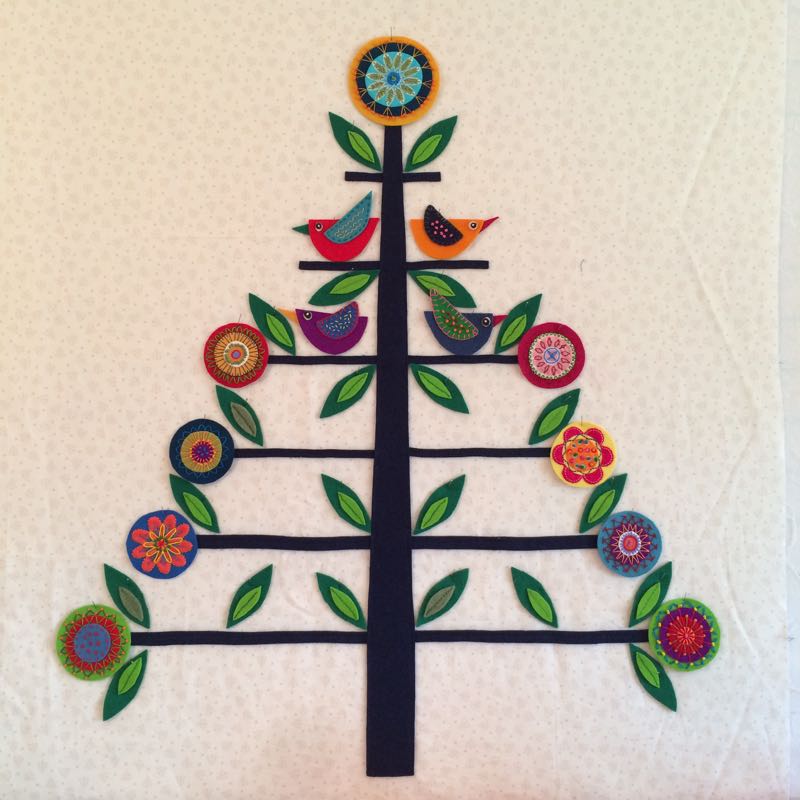
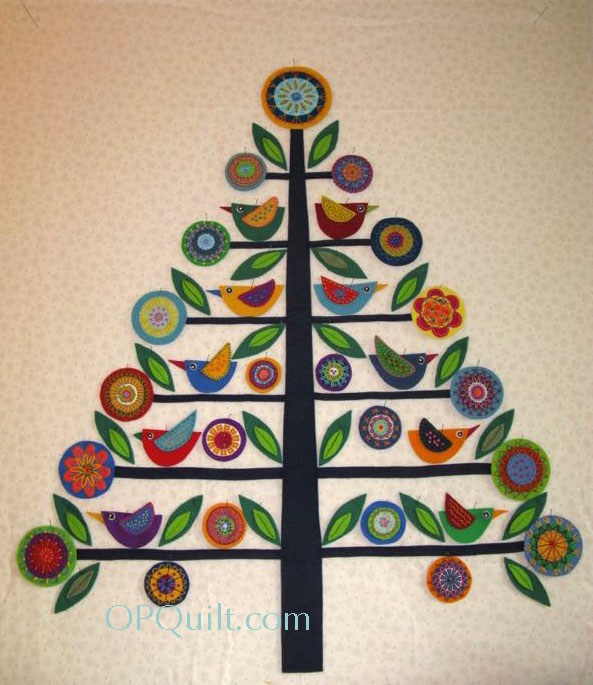
Here’s the twist: instead of creating the under-the-tree scene this month, I’ve gotten so many queries about sewing these things on to the background and the tree, that I think we’ll head that direction instead.  Go with the flow, right?  Above is my tree, everything sewn on.  I’m heading this direction because a lot of those questions have to deal with the idea of how much embroidery to put on that outer edge?  Should you leave a space for attaching and more embroidery?  Should you go right to the edge?

The basic idea for attaching is this: lay out your circles, birds, and leaves to your liking, using the pattern and photos as a guide.   As I go through the rest of the flower photos, I’ll have some tips, so please read through to the end.  But first! Wendy has some tips for us about what’s ON the tree:

ohchristmastree4_20

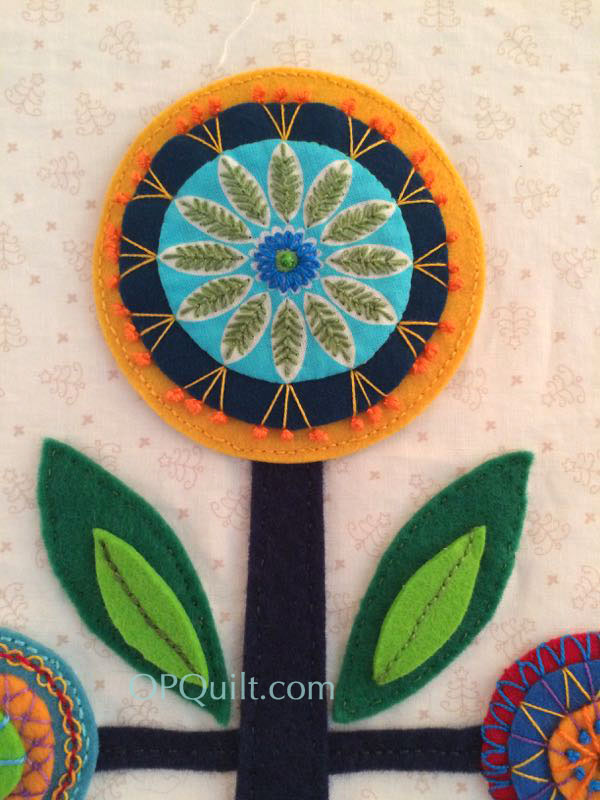
She writes: “I thought I had too much white space in certain areas.  I’ve added 4 more small leaves and 4 more small circles, keeping the additions symmetrical because the gaps were symmetrical.  I just felt some areas were less densely filled than others and I didn’t want gaps in the middle of my tree.  That’s probably because I didn’t exactly follow the pattern for the size of my leaves and flowers, but also because things move slightly as you sew them on.”  She sent me two photos.  The “before” is above.

ohchristmastree4_21

This is the after.  You can see extra circles and extra leaves.  (And yes, I love her under-the-tree scene!  Next month, next month.).  In addition to adding these extras, she attaches them differently than I do.  First she lays them all out, takes a photo so she can remember where they are, and then takes all off but the items closest to the tree trunk.  She sews those down first then adds in the decorations bit by bit, moving from the center to the outside, because she said she got tired of being stuck by pins.

ohchristmastree4_10

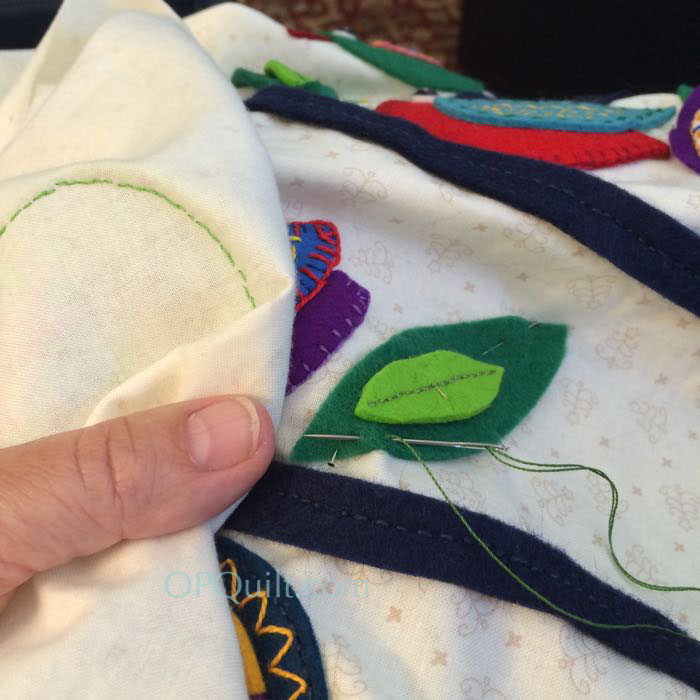
I couldn’t face the thought of re-attaching the flowers after I’d gotten them arranged, so I used appliqué pins (shorter than usual) and sewed on the decorations moving from the outside toward the center. Since I use really small pins, and put my hand around the flowers and birds as I sew, I didn’t have too much trouble.  One IG reader said she used a bit of glue to secure the decorations and from her photo it looks like she’s attaching them from the inside to the outside. Again, try what works for you.ohchristmastree4_11

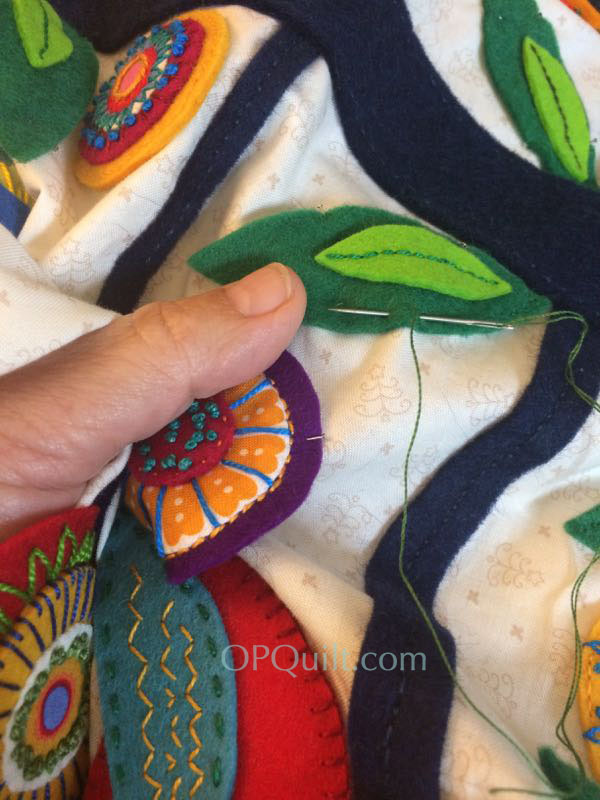
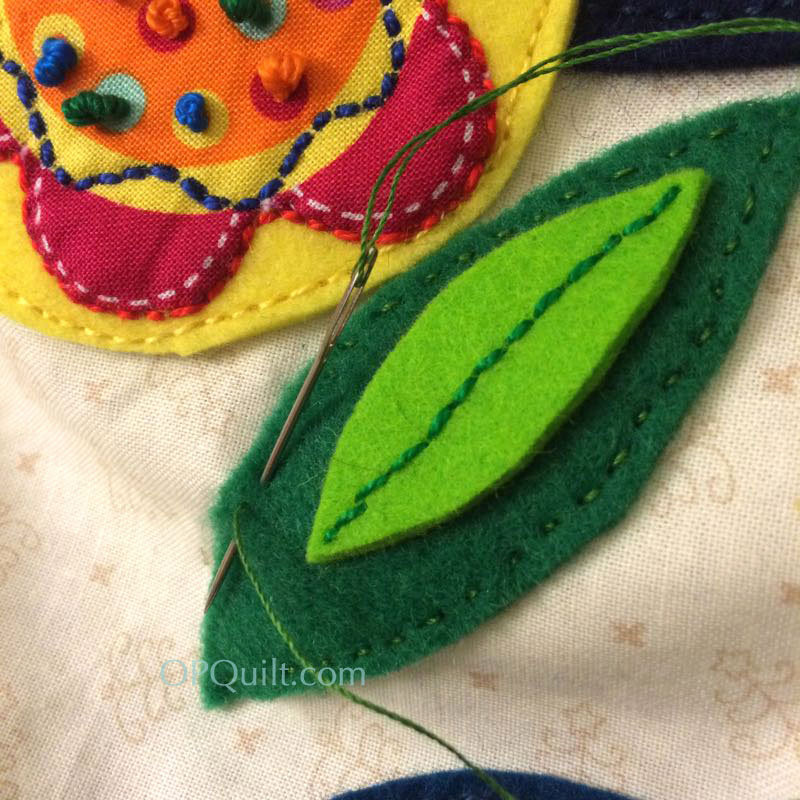
You can see me scrunching things up in my hand.  Since I worked from the outside in, I had very few pin pokes.  I attached the leaves by using the same stitch I used on the trunk: a separated back-stitch (refer to this post for more info).

ohchristmastree4_14I was intent on getting them all on, and doing it quickly.  You could take more time than I, adding an extra embroidery stitch, if you wanted, for it’s YOUR tree.ohchristmastree4_12

I also learned to put a regular pin right in the middle of my decorations just before I started sewing them on, so they wouldn’t buckle.  I have one bird who looks like she is expecting, as the wool can shift as you are attaching, bubbling up.  I’ll show the Mama Bird to you later.

Now for some general tips about attaching the flowers and birds.  Before we talk about different ways to sew them to your tree, here’s a couple of photos of circles before attaching, showing various state of “close-to-the-edgeness” of the embroidery.ohchristmastree4_1flowers

After I pinned these to the tree, I went in and added another circle under the red one, giving it a bit bigger presence.  Ditto on the purple circle below.  You may find yourself making small alternations after you get everything pinned down, either adding leaves and circles as Wendy did, or giving another border to a too-small/wrong-color flower, like I did.ohchristmastree4_1flowers2

ohchristmastree4_5

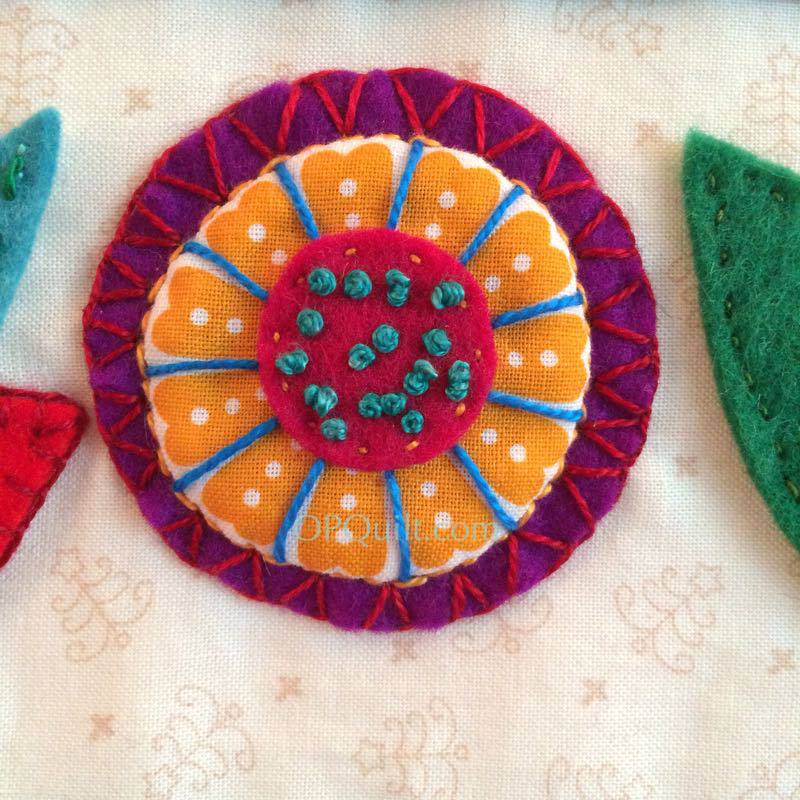
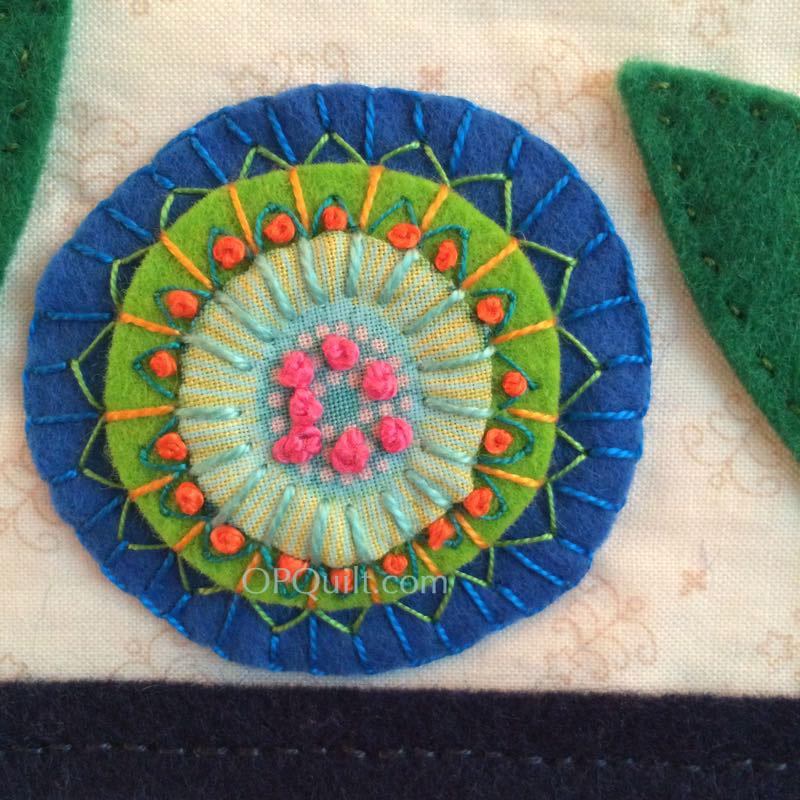
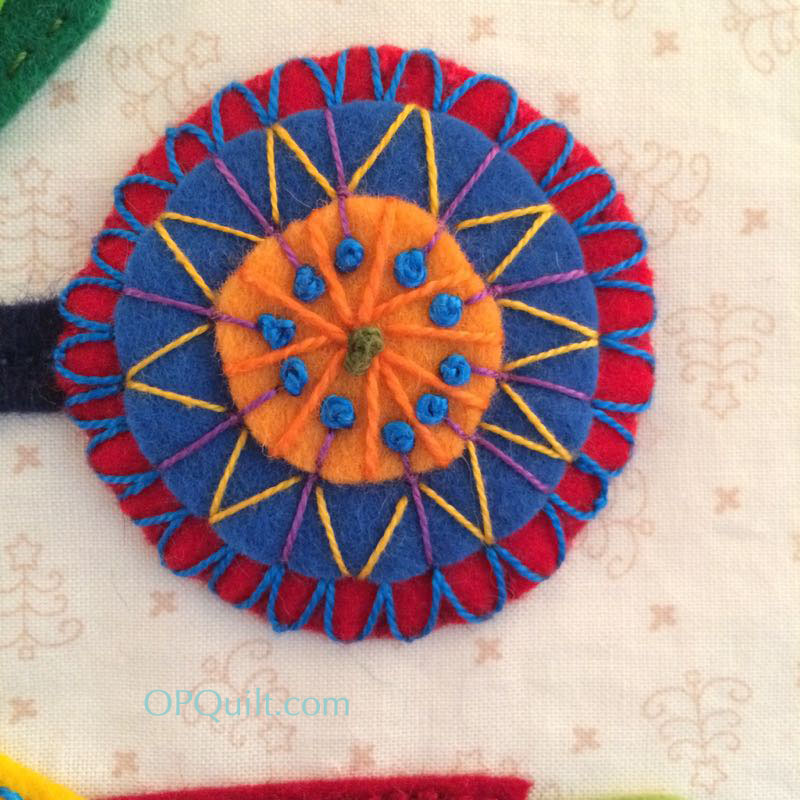
I group the way I sewed these down into two categories: A) snuggle a stitch in or around the existing embroidery, or B) adding another ring of decorative embroidery to affix it to the background.  Let’s do the A-category first.  You saw the flower medallion above; I attached it with tiny stitches at right angles to the outer edge in a matching thread.
ohchristmastree4_5a

Wendy often leaves the wings undecorated, using the “attachment phase” to put the stitches on, but I’d already embroidered them when she told me this, so I sewed it down to the background by using a small matching (green) thread in between the existing decorative (pink) stitch.

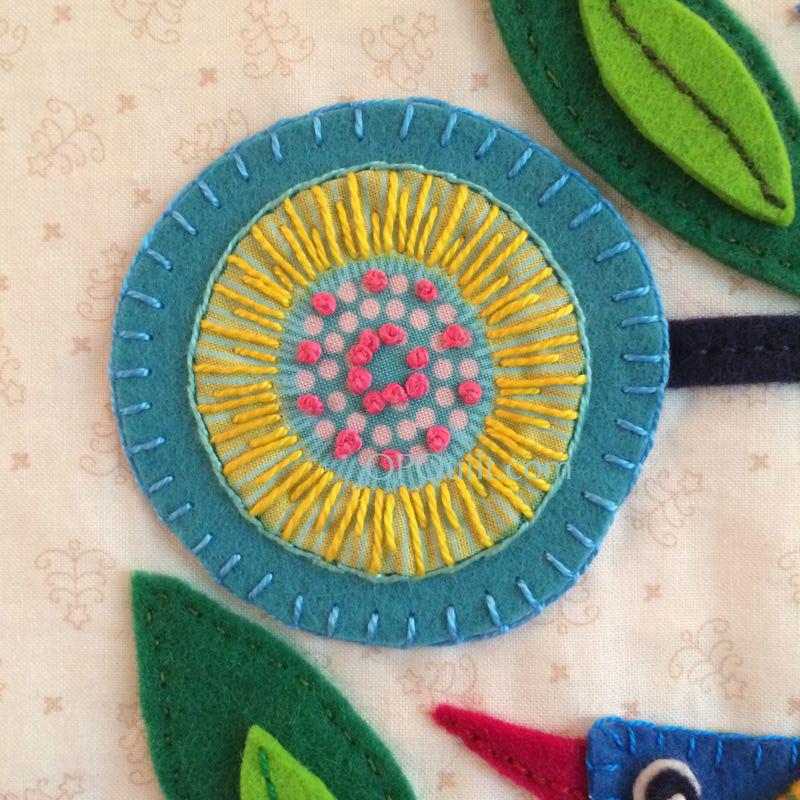
ohchristmastree4_5eI used the small perpendicular stitch again here in matching (blue) thread, but varied the length of them slightly, so the longest are between the yellow stitches and the shorter stitches are near the yellow.

ohchristmastree4_15I also decided to keep some flowers simpler, and did a simple backstitch around the outside edge.  Keep it smallish and even, and you’ll get questions like I do: “Did you do it on the machine?”  No, and if you look closely, you’ll find the bobbly places.  Remember, this is folk art and we aim to enjoy ourselves!  More backstitching:ohchristmastree4_6 ohchristmastree4_6aohchristmastree4_6bohchristmastree4_6c

Now for some B-categories: adding another bit of embroidery to attach them.ohchristmastree4_5b

This is a slanted buttonhole stitch.  It’s done exactly the same as a regular buttonhole, but instead of keeping the needle perpendicular to the outside edge, you slant it.  I like the look of this one a lot.ohchristmastree4_5c

Regular buttonhole.  I used matching thread if I thought the flower was busy enough.ohchristmastree4_5d

Here’s where I used the backstitch (on the small yellow flower, left) and then used a different color of thread in a buttonhole stitch (magenta flower, right).ohchristmastree4_5f

Here’s an “un-even” buttonhole stitch, with shorter and longer “legs” of the stitch, co-ordinating with the existing embroidery.
ohchristmastree4_7

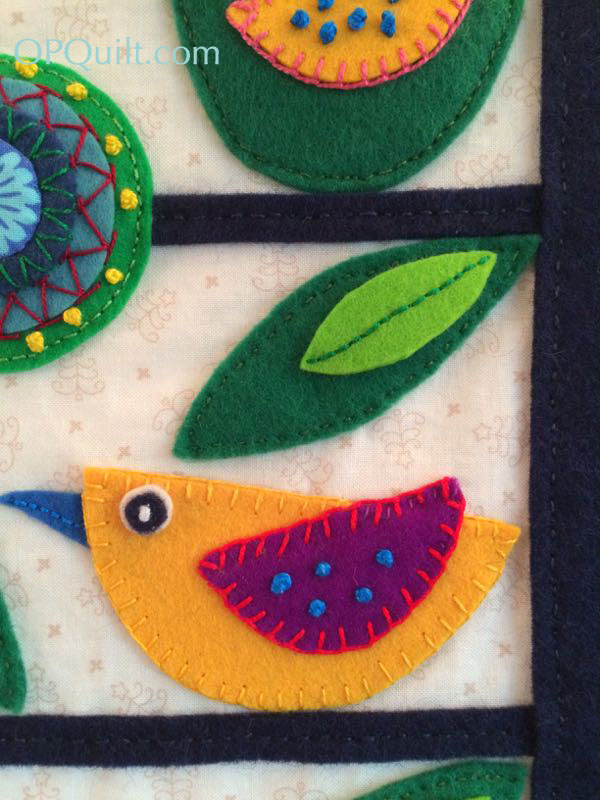
This bird was sewn on with a matching yellow thread, buttonhole stitch.  But I slipped a smaller seed (or regular) stitch in between the existing red buttonhole stitch on the yellow bird’s wing to sew that down.  ohchristmastree4_7a

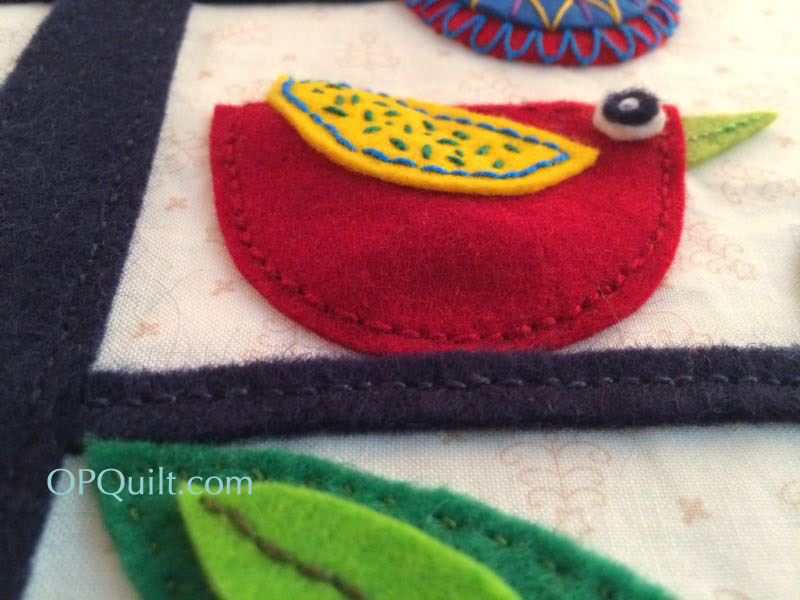
Photography of women depends on flattering angles, but I dropped the camera down low so you could see my pregnant bird.  She didn’t start out that way, but the wool shifted.  The bubbling up is exaggerated from this angle–it’s not really noticeable from the front, but now you know why I started putting that pin in the center of my birds and flowers as I stitched them down.  Didn’t have that trouble with the leaves, for some reason. She’s attached to the background with a simple backstitch.  I also did a line on the birds’ beaks.  I tried to make them happy birds (It’s Christmas, remember?) by the slight curve of the stitching, but some of the birds turned out a bit moody.ohchristmastree4_8

This is another where I snuck a small stitch in between the existing embroidery (A-category), and below, the last photo (!) where you can also see detail on the bird’s beak.ohchristmastree4_9

We are definitely getting closer to the end, now, and I’m pretty excited.  Next month (June 2nd), I’ll have an alternate scene for you for under the tree, and then we’ll roll out from there.

ChristmasTreeLogoSM

No giveaway this month, but here’s a recap of our schedule:

January, Step “prepare”: buy the magazine, books, gather your fabrics, buy the felt/wool, buy/find the pearl cotton.
February, Step 1: Make the tree on the background and stitch it down.
March, Step 2: Make 21 flowers.
April, Step 3: Make 10 birds and all the leaves.

May, Step 4: Appliqué down the flowers and birds.

June, Step 5:  Scene at bottom of tree–make, then appliqué onto background.

July, Step 6: Sawtooth border (reds); sew together and attach.

August, Step 7: (finish up Quilt-A-Long): Make wonky star blocks, sew them together and attach border #2.

September, Step 8 Show and Tell, just in time for school starting again.

Yes, we cut a month off our sewing, so you’ll have plenty of time to finish your quilt before December.

Happy Stitching and we’ll see you in June!

Giveaway · Oh Christmas Tree QAL · Quilt-A-Long · Quilts

Oh Christmas Tree QAL • STEP 3

4XmasTreeApr

Here we are again, gathering together for the next step of the Oh Christmas Tree Quilt-A-Long (#ohchristmastreeqal), using the pattern found in Quiltmania’s Simply Moderne, issue #3, designed by Wendy Williams of Flying Fish Kits.

ohchristmastree3_flowers1 ohchristmastree3_flowers2

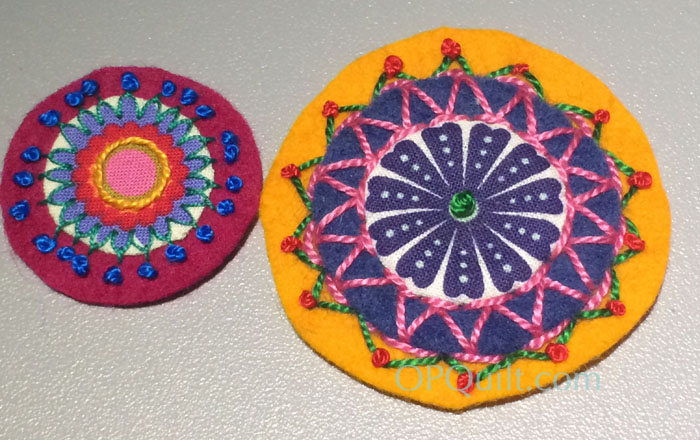
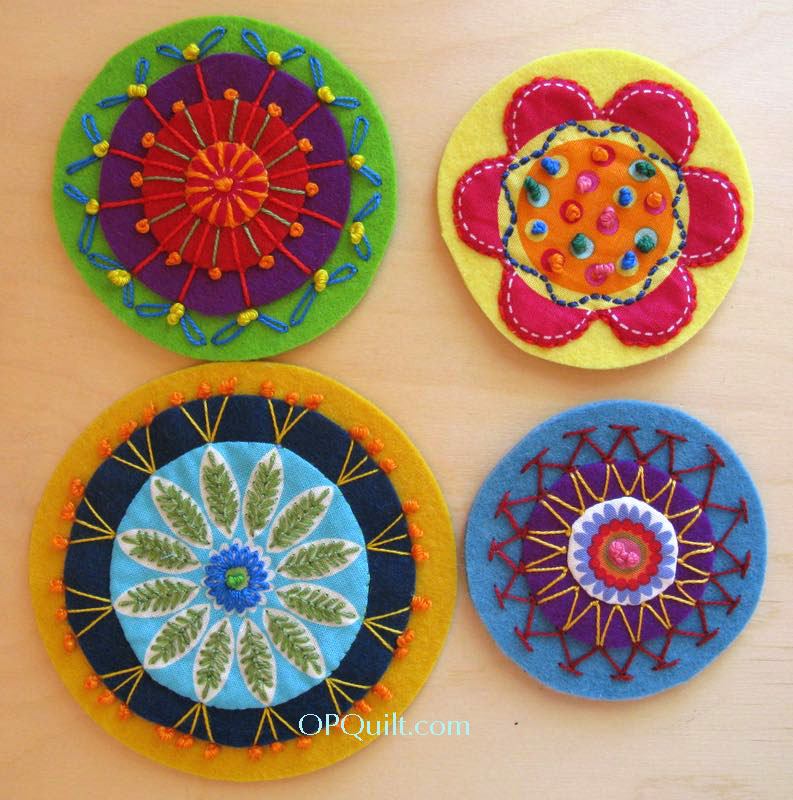
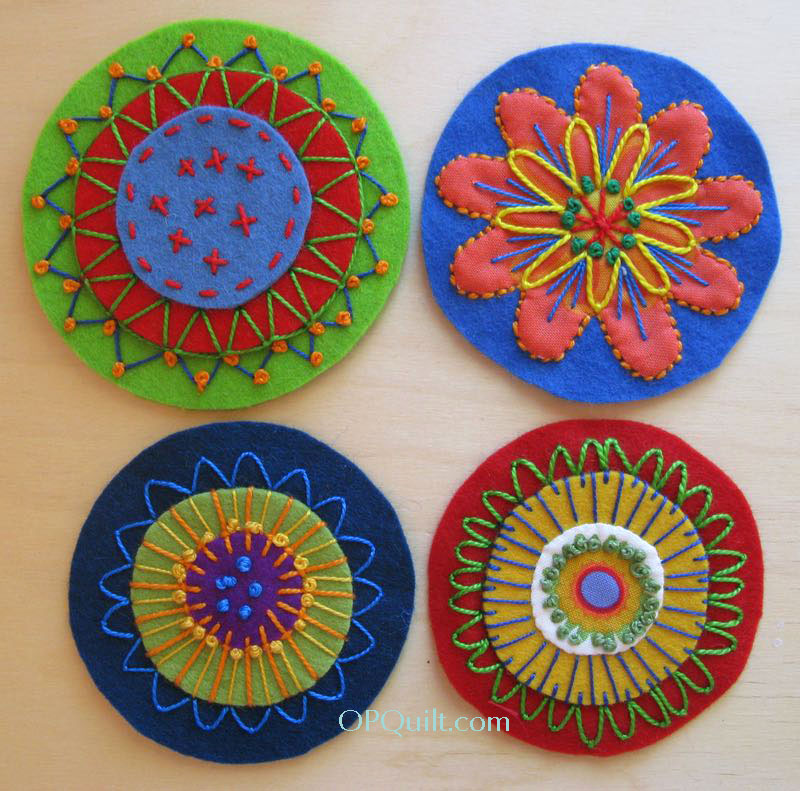
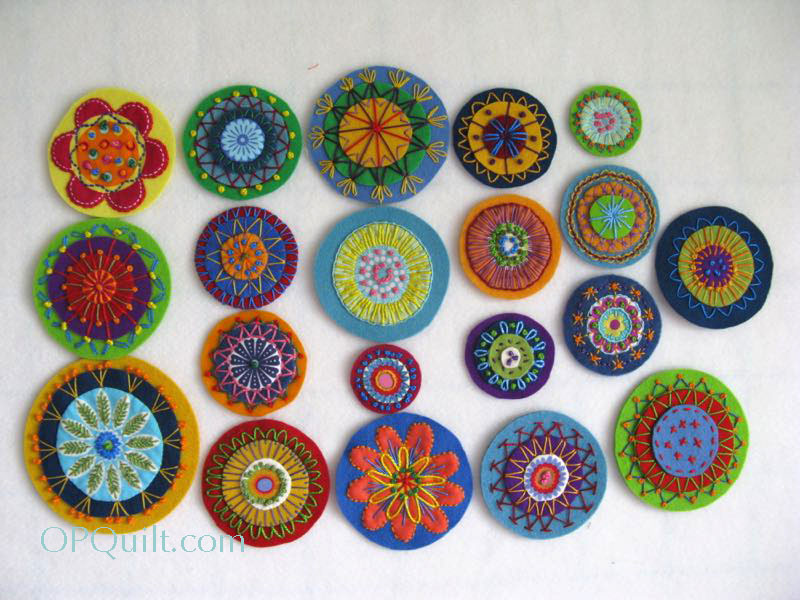
At this point, you’ve been working on your flowers for a month, and if you are like me, that first one was like jumping off a high dive, and thinking the pool was empty and you’d go splat.  But you didn’t, and your flower circles are looking wonderful and you are actually having a great time.  Keep working on them, you’ll need 21 of them in the various sizes shown on the pattern.  I have to admit that all of mine are not the “perfect” size, as some are larger than what is called for.  I mocked up the tree the other day (I’ll show you this at the end) and it was okay.  So no fretting.  Just #startyourneedles and keep creating and stitching.

But. . . this month we’re adding two easy tasks: leaves and birds.  First up, birds.

ohchristmastree3_birdsA

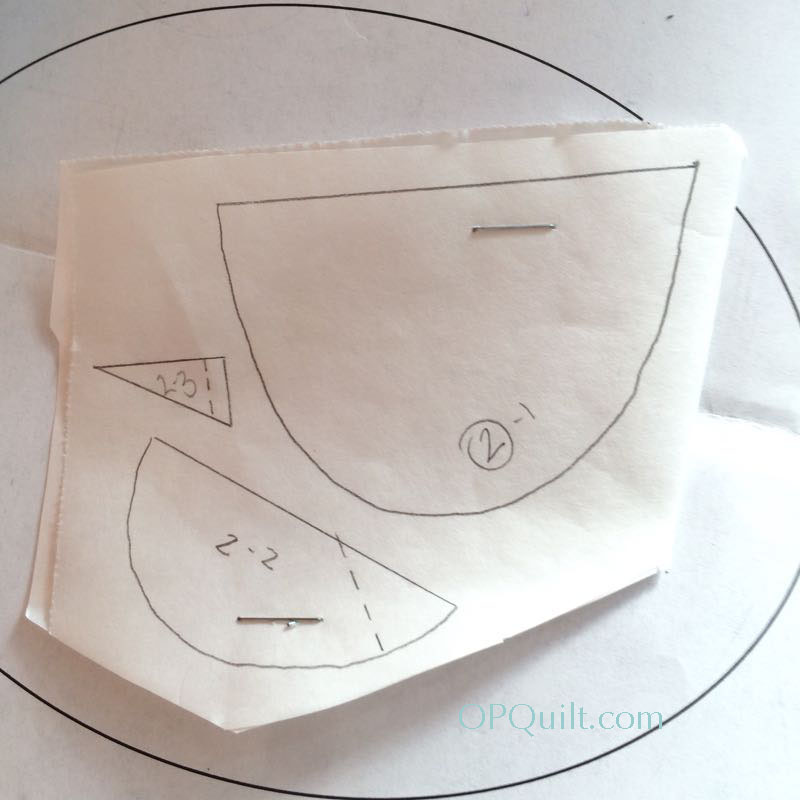
Remember all that tracing you did of the birds, and how you labeled them and marked the dashed overlap lines on a folded piece of freezer paper, so you’d be making two copies of the bird (one regular, and one reversed) and you stapled it together to keep the pieces from shifting? Now’s the time to get them out.  Hold them up to the light and transfer the dashed overlap marking on the wing to the wing piece on the other side, then cut them out and start picking your colors.ohchristmastree3_birdsB

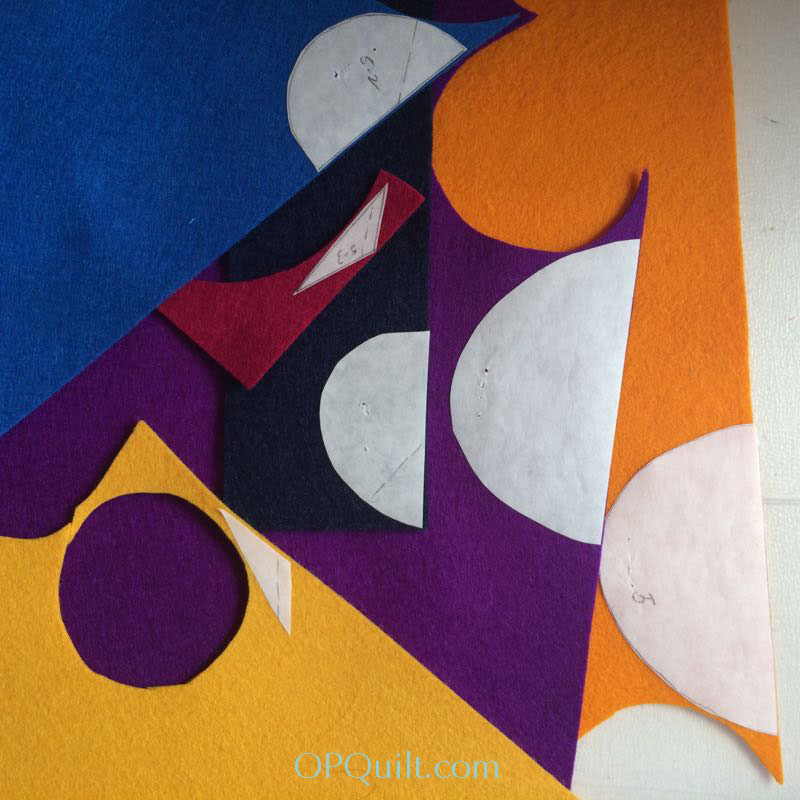
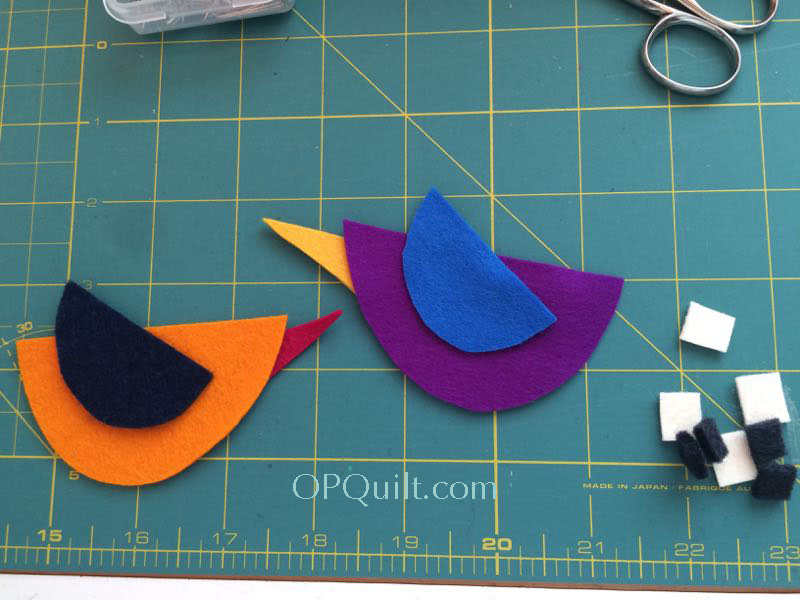
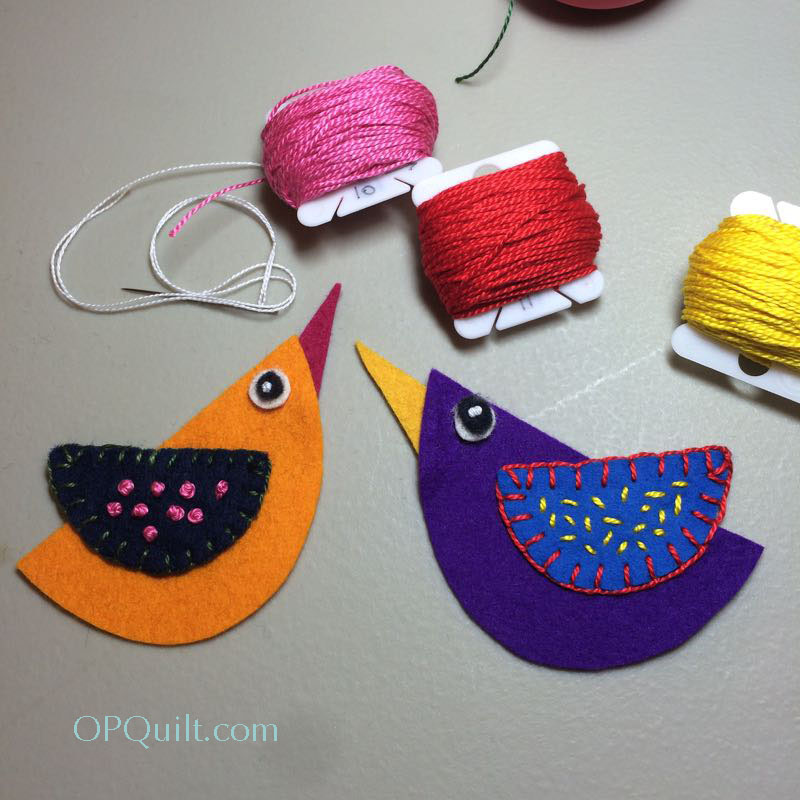
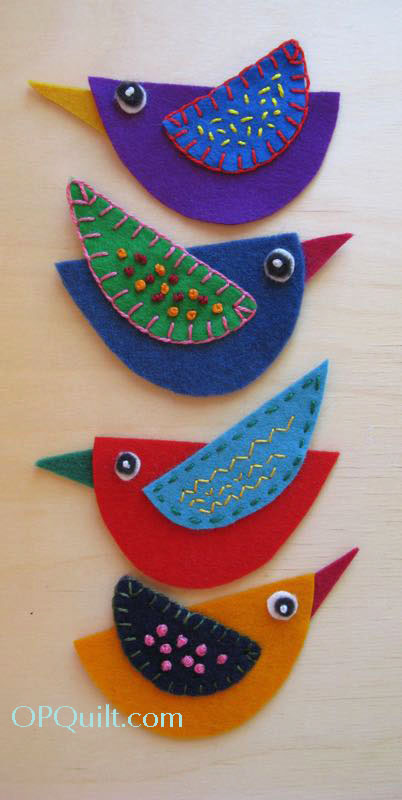
Be bold!  Red beaks! purple bodies! wild wings!  I ironed down the freezer paper patterns, using a wool setting (NOT your regular cotton setting–or you’ll scorch the wool), and then cut them out.  I tucked the beaks under the body, guesstimating where they’d go (hint: NOT even with the top of the body) and pinned them.  Then I place the wing on the bird, using the dashed overlap line to place them, then pinned that in place.ohchristmastree3_birdsC

(No worries…I fixed that purple bird’s wing before I pinned it down!)ohchristmastree3_birds1

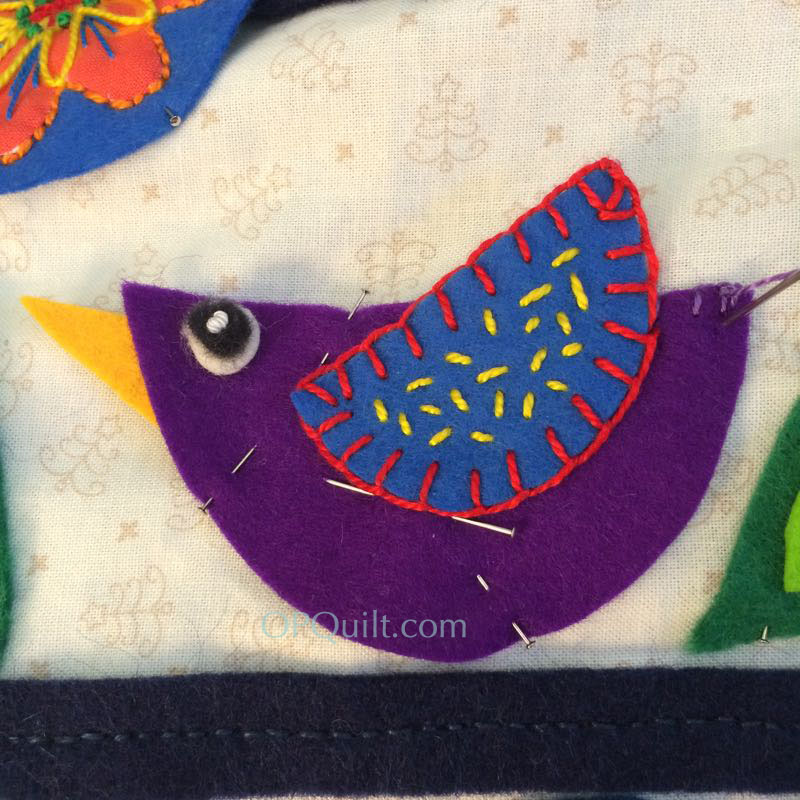
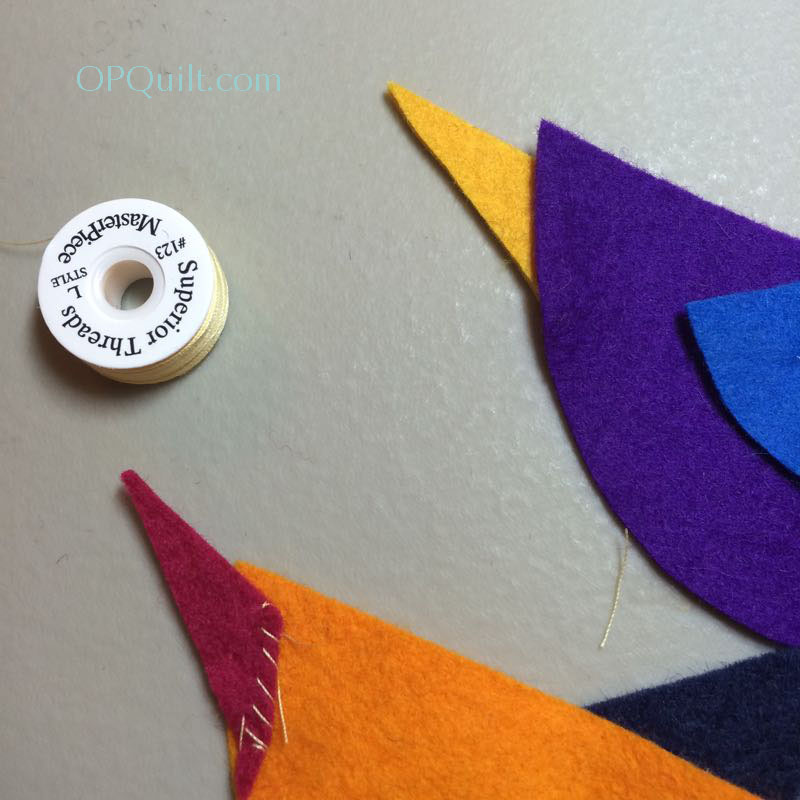
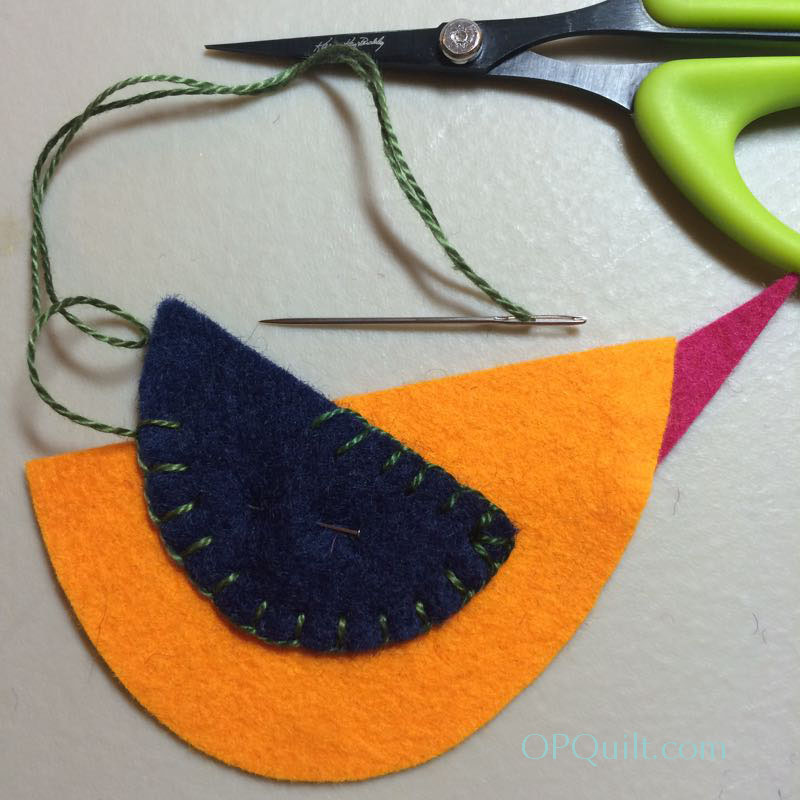
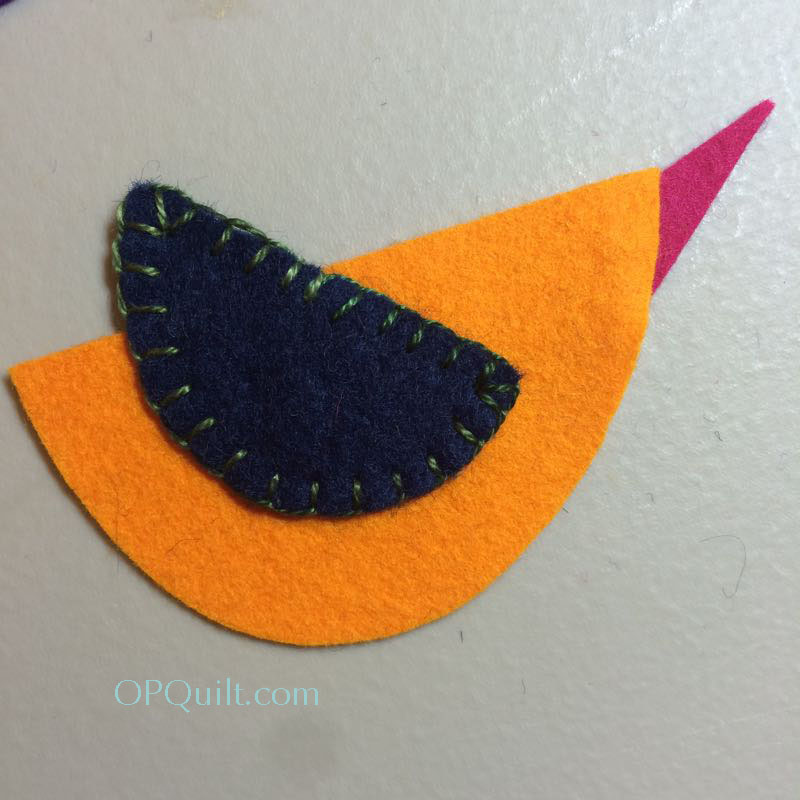
Wendy of Wendy’s Quilts and More gave me a tip to sew on the beak first.  I just used a few overcast stitches to get it on securely.  I’d never qualify for a bird plastic surgeon, that’s for sure.ohchristmastree3_birds2 Then attach the wing by blanket stitches (or overcast stitches, or a back stitch or a running stitch), beginning where it attaches to the body and work your way around the lower edge and back up again. ohchristmastree3_birds3

Now do the floaty part of the wing, and tie it off.
ohchristmastree3_birds4

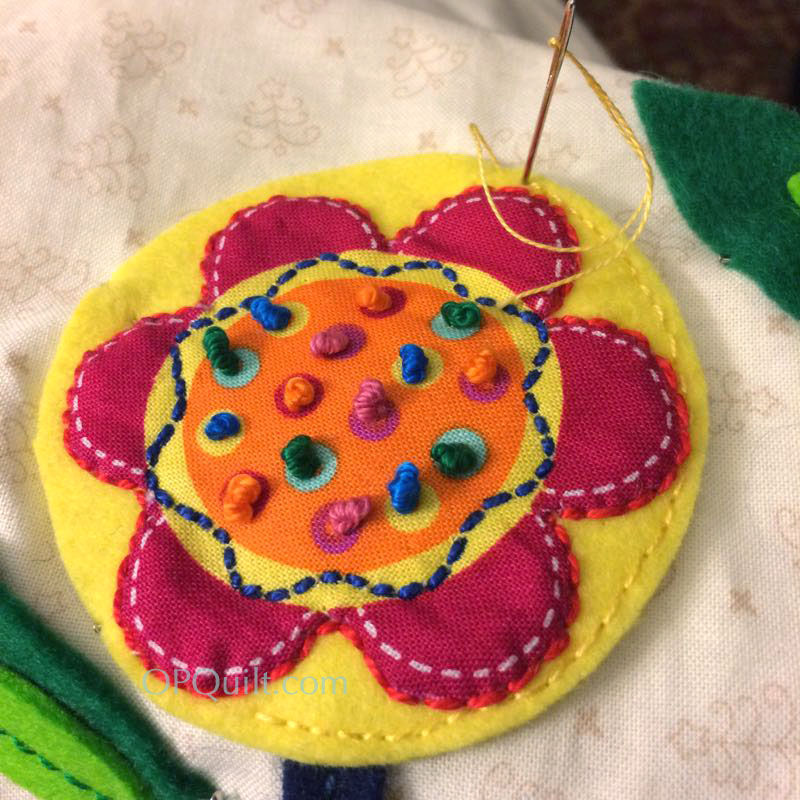
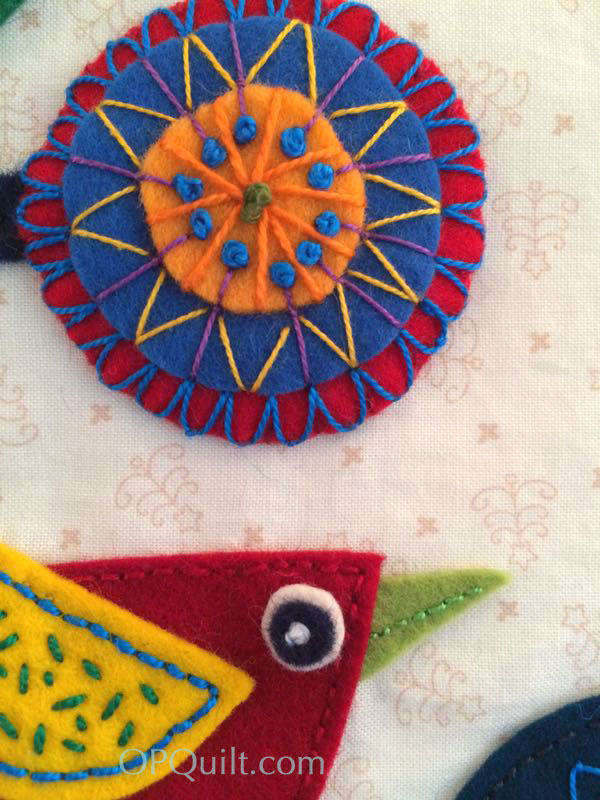
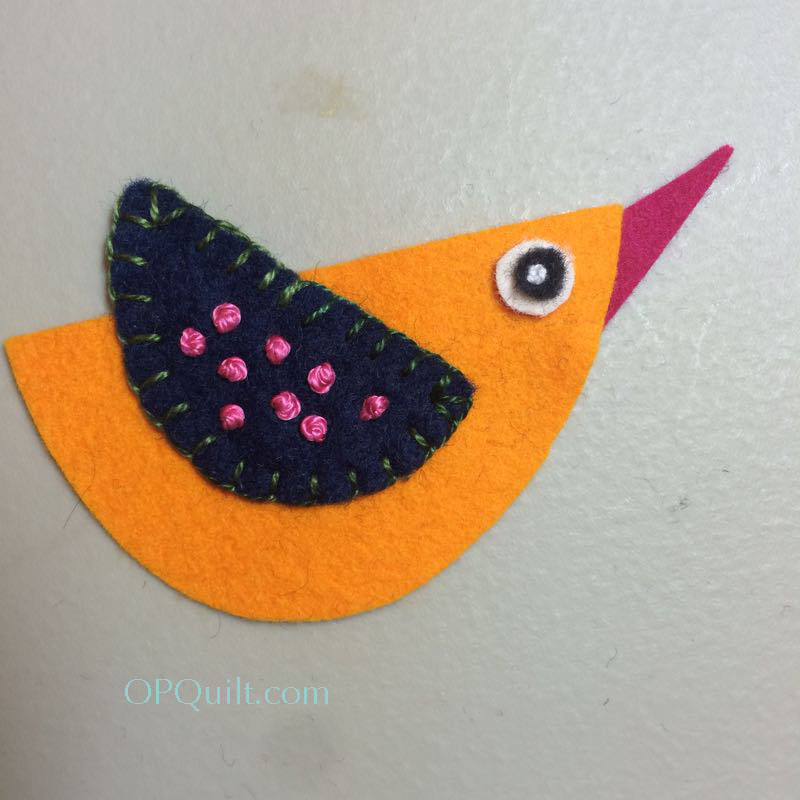
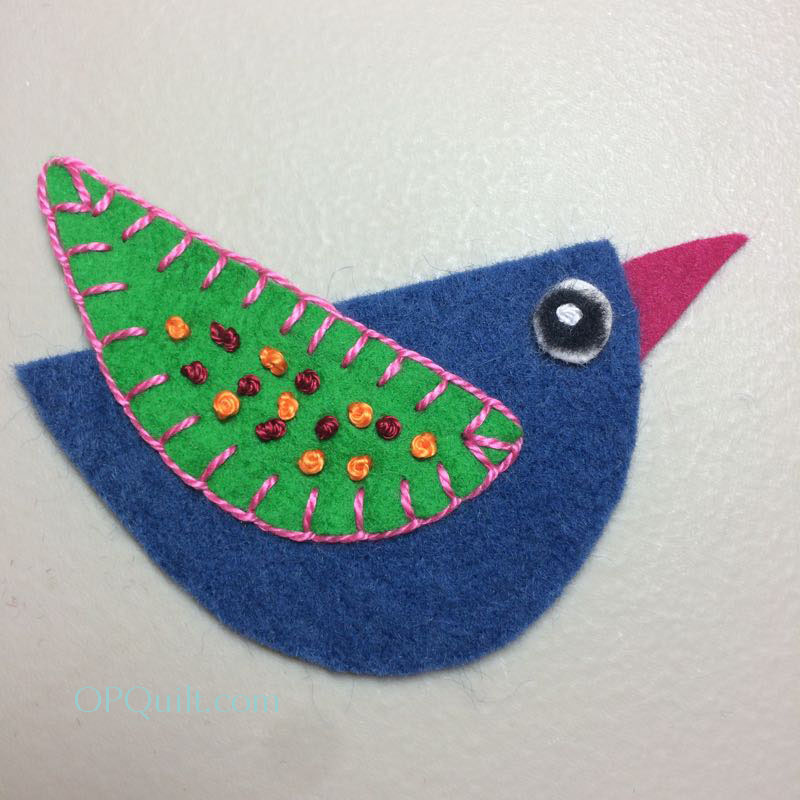
Add a few French knots, or seed stitches, or whatever small decorative stitch.  Cut a teensy circle of white, then an even teensier circle of black and secure them both with a French knot, done with white thread.  I started by cutting 1/2″ squares of white felt, then rounded them off, and then cut smaller squares of black and just kept going around and around, cutting, until it was the right size.  Be prepared to sacrifice a couple of eyeballs until you get the hang of it.ohchristmastree3_birds4a

Ta-DONE!ohchristmastree3_birds4b ohchristmastree3_birds5

I got fancy with that red bird, attaching the wing with running stitches, and doing a zig-zag stitch across the wing.

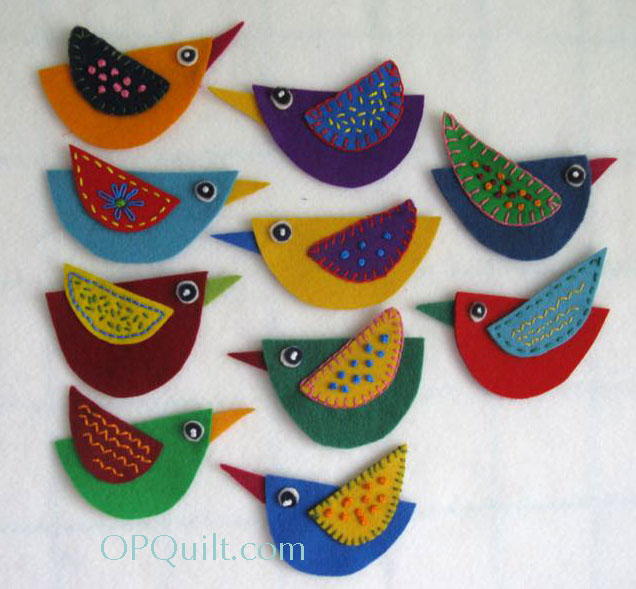
ohchristmastree3_63birdsallI took them with me on my trip to Portugal and Spain (pictures of that trip are on my Instagram, to the right and on a previous post) and was able to get them sewn without too much trouble on the [long] flight out there.  These go MUCH more quickly than do the flowers, so I’m also adding LEAVES to this month’s tasks.

ohchristmastree3_leaves1 ohchristmastree3_leaves2 ohchristmastree3_leaves3 ohchristmastree3_leaves4

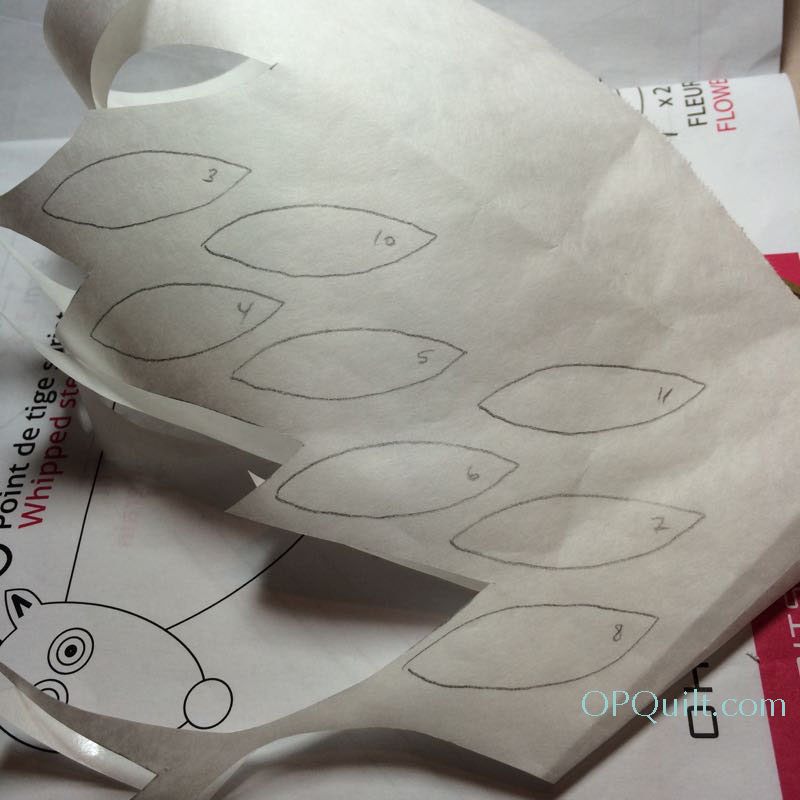
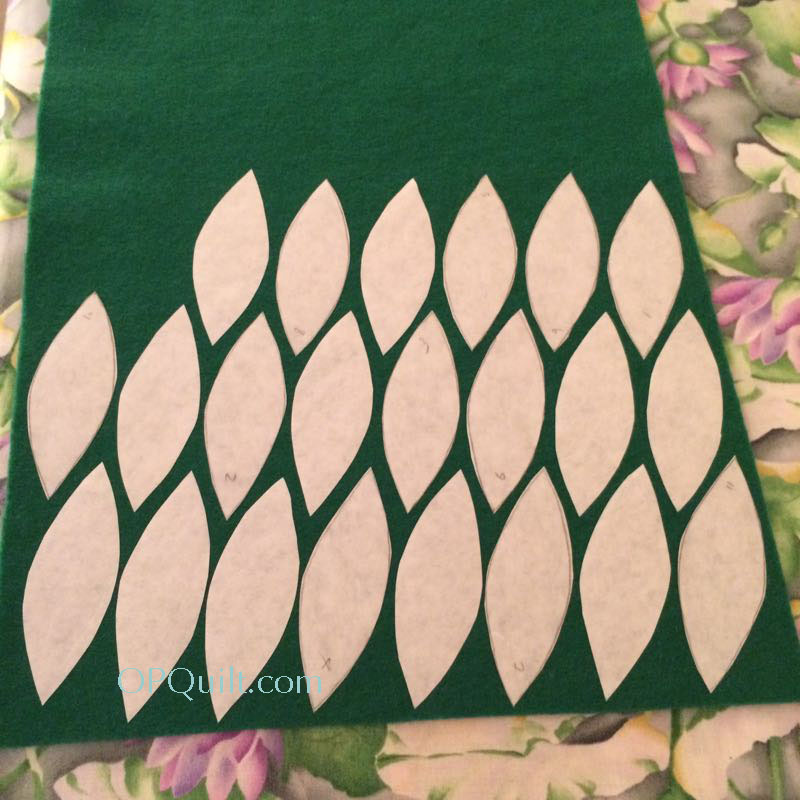
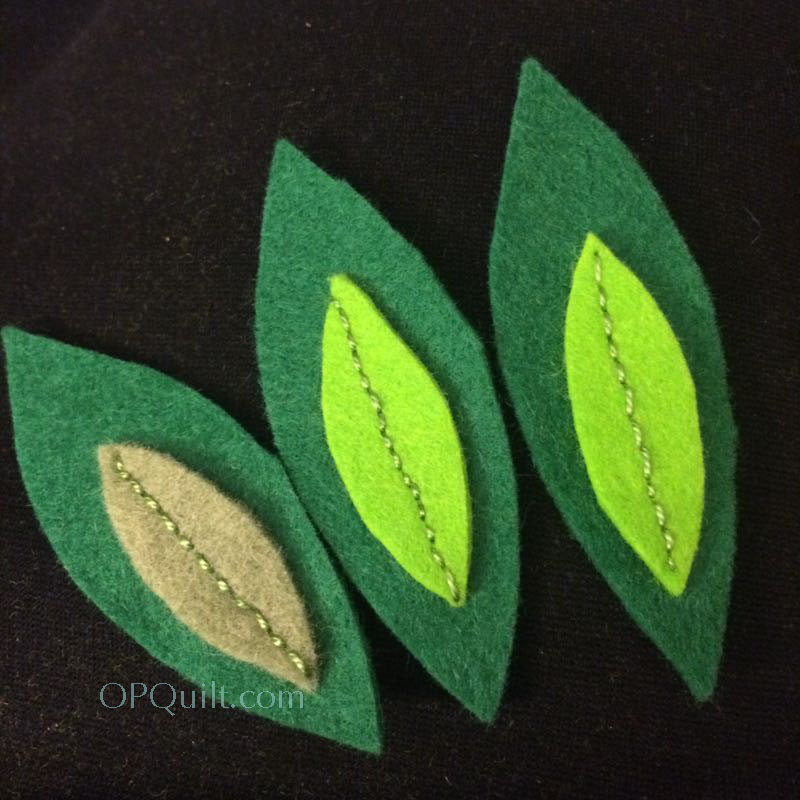
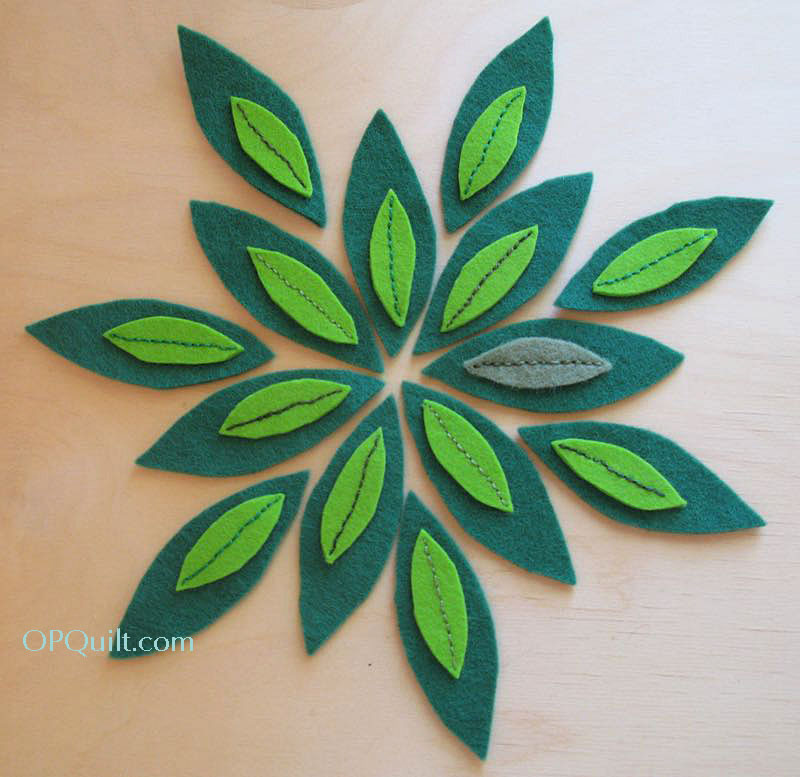
Okay, that wasn’t hard!  I traced half of all the leaves I’d need onto freezer paper, doubled it over to get two layers, then cut them out.  Iron on to your felt using a wool setting, and cut out.  Repeat for the inner, smaller, leaves.  I cut a few out of a different green just to give some variety.  Place the smaller leaves as shown, setting them closer to one end.  Using a backstitch, sew them down.  It’s tricky near the tip, but you can see how wobbly mine are and how it really doesn’t matter.  (Last time I checked, The Creator didn’t use a ruler to create his leaves either, and our world is the more beautiful for that variation.)

ohchristmastree3_mockup1

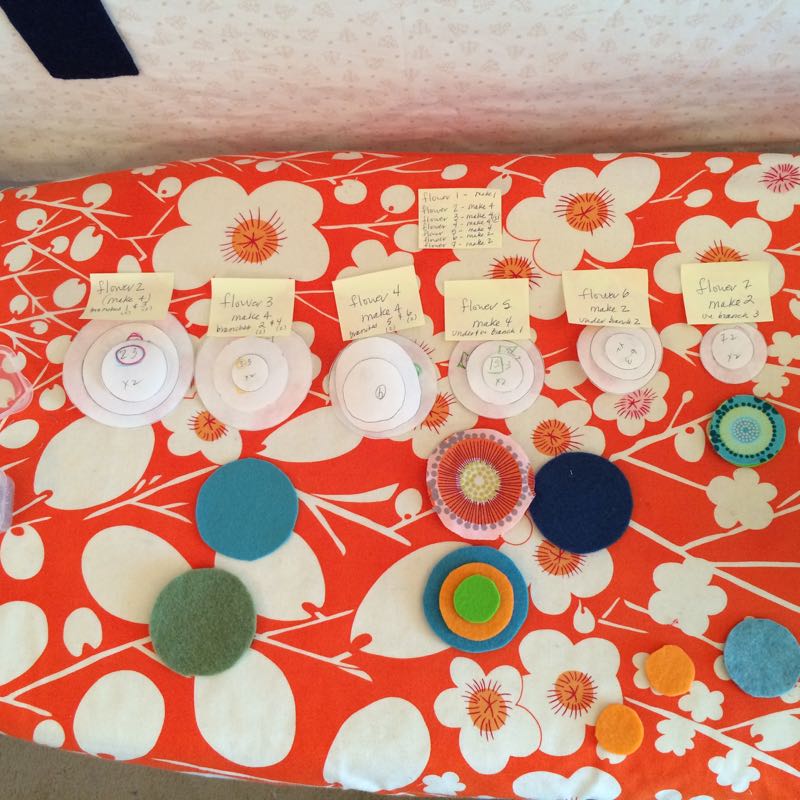
So I was curious as to how I was doing at this point, so I smoothed my tree up on the design wall, and stabbed pins through all the flowers and the four birds I’d finished.  Then, ACK! I was stuck.  What number flowers were where?  What had I sewn and cut and what was I lacking?  I got out all the baggies of labeled flowers and set up a little station on my ironing board, right below the tree.  I wrote out post-it notes labeling the flowers as in the pattern, and then a master list of where they were supposed to go.  I then lined up the circles from the pattern, drawn out on freezer paper below each sticky note, so I could see the relative sizes.ohchristmastree3_mockup2

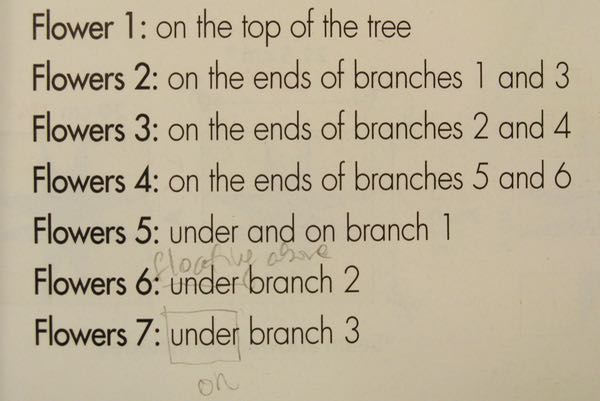
Now that I was organized, I could figure it out.  I had enough of certain flowers and needed more of others.  Some of the directions in the pattern were wrong, so I corrected for those:

OhChristmasTree_pattern errataIf you want it to look like the one in the magazine, Flowers 6: should read “floating above branch 2” and Flowers 7: should read “on branch 3.”  I say, just squinch them all in where they’ll look good.  This is just a test run, but later we’ll do it for real.
ohchristmastree3_mockup3

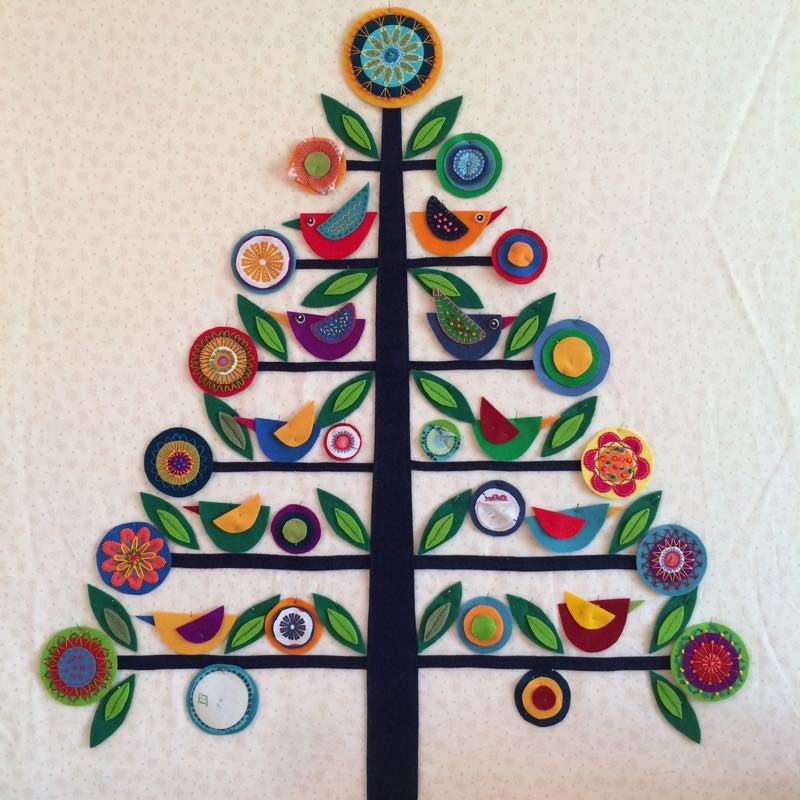
After a while, I could pin up what I’d cut out, fabric medallions, layered felts and all, and was pretty pleased with how it was coming along!  I’d encourage you to do this interim step, if only to give yourself a little pat on the back that you’ve come this far.  After taking the photo, I put everything away in the proper baggies, and planned to keep stitching flowers and finish up the birds.

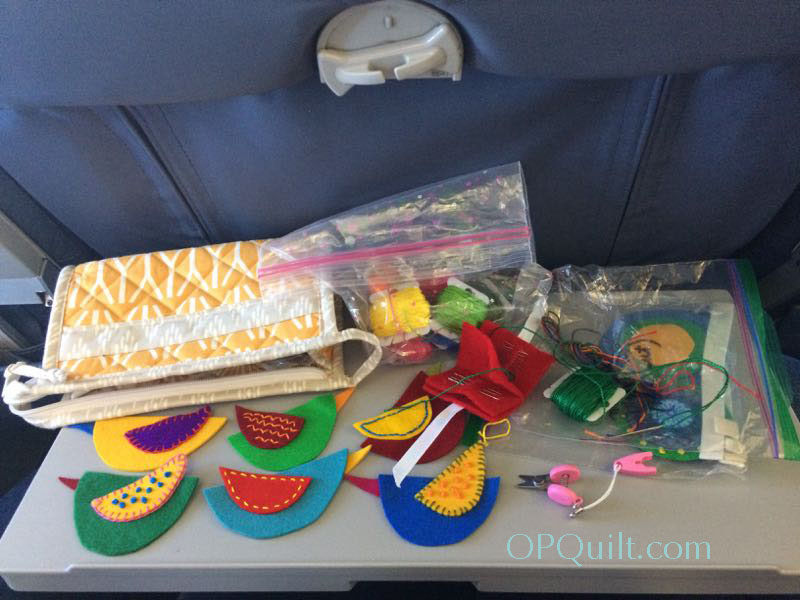
ohchristmastree3_64stitchingAt the last minute, I decided to take a bunch of the flowers with me on our trip, squeezing them into a cute bag made by Sherri of A Quilting Life.  I snapped a photo of my stitching on the airplane tray table.  I kept stitching until I had nearly all of the flowers done:

ohchristmastree3_62flowers
ohchristmastree3_61mockup2

And after getting home, I did another mockup. I didn’t pay too much attention as to what number flower should go where, but instead put my largest one on top, then the next two largest on the lowest limbs, moving on up the tree and thinking more about size and color placement. I’ll let this stay up on the design wall for a few days while I move things around.  I did have one dud–a flower I ended up not liking, but that’s pretty good, I think.  I only had three flowers left to finish, which I did yesterday, so I’m ready to move on to the next phase.

A recap of where we are:

January, Step “prepare”: buy the magazine, books, gather your fabrics, buy the felt/wool, buy/find the pearl cotton. 

February, Step 1: Make the tree on the background and stitch it down.  

March, Step 2: Make 21 flowers.Keep stitching, keep stitching!

April, Step 3: Make 10 birds and the leaves.  Keep stitching, keep stitching!

May, Step 4: Scene at bottom of tree.

June, Step 5: Appliqué down the flowers.  (Wendy gave me some tips for this last week, which I’ll pass along.)

July, Step 6: Appliqué down the birds and the scene.

August, Step 7: Sawtooth border (reds); sew together and attach.

September, Step 8 (finish up Quilt-A-Long): Make wonky star blocks, sew them together and attach border #2.

See you May 2nd for the next step: scene at the bottom of the tree.  Wendy’s done one scene, the pattern shows one, and I’m cooking up another.  See below for the giveaway.

#startyourneedles for the #ohchristmastreeqal

Giveaway Banner

ohchristmastree3_65GIVEAWAY

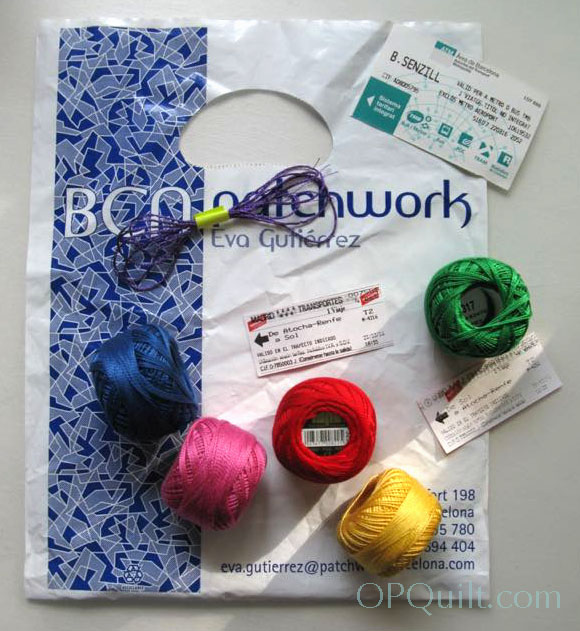
Initially I wasn’t going to do a giveaway, but after visiting with Anna in Barcelona, I thought it would be fun to have a Spanish connection from our trip.  In Barcelona, I purchased five balls of size 8 pearl cotton (my favorite size) and will send that to the lucky person who is chosen from comments left below.  I’m also including a 1 yard piece of metallic purple embroidery floss that I purchased in Lisbon.  Even though it is a little like sewing with tensile steel, it makes fun accents on our flowers (I used mine for some back stitching here and there, and also for some French knots on another flower).

Please leave a comment below, telling me either where you’d like to go a a trip outside the US and why, or the place where you had your favorite trip (outside the US) and why.  I love to read about other people’s trips, or their hoped-for travels!  I’ll let this run for a few days, then will close it off and chose a winner.

UPDATE: Comments are closed now.  Thanks for writing!