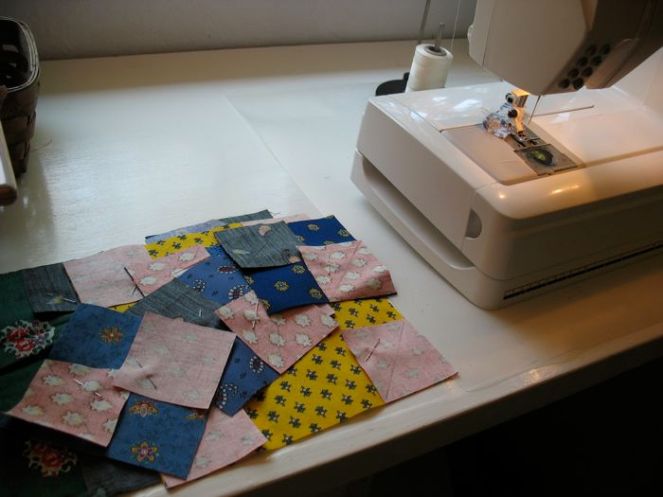
I couldn’t resist this photo, especially with the naming of the bobbin “arc reactor.”
Having taught in various classes both in the community, for friends and at church, one of the dreaded experiences for a teacher is when student brings in a machine that either a) barely functions, or b) they have no idea how to make the thing sew. There’s a real temptation to stop the forward momentum of a class to help that person get their bobbin case untangled, or help the person figure out why the machine is eating their fabric. I’ve found, though, that it’s better to press on, so as not to shortchange the others who are there, and instead, send vibes of sympathy to the struggling sewer. A good machine–used or new–makes all the difference.
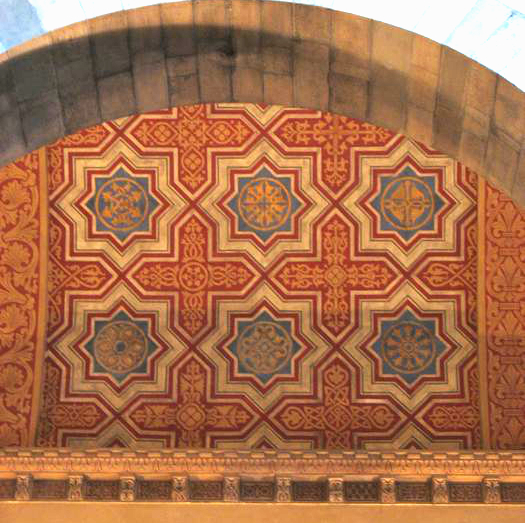
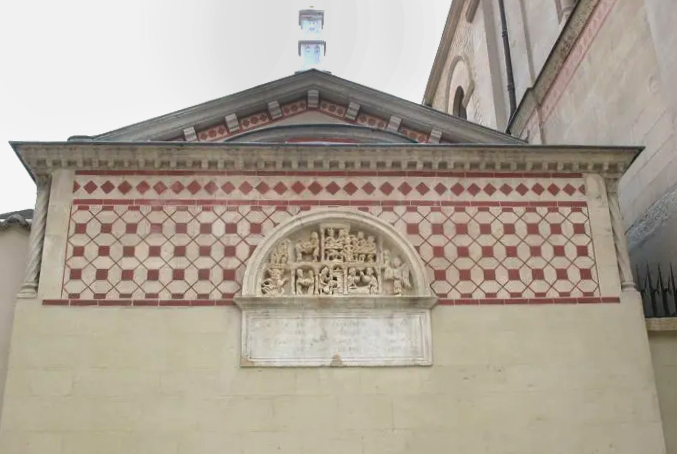
After ignoring the quilt for a day or two, I reluctantly headed into my study to try and make sense of the mess I’ve made. First? Browse through quilt books. This is Balkan Puzzle from one such book, mocked up in my quilt program. Meh. Then I thought I should look at photos from some of my trips to France, specifically southern France. This idea of a block surrounded by a grid seemed to be common:
Both of these photos are from a Carolingian church in Lyon.
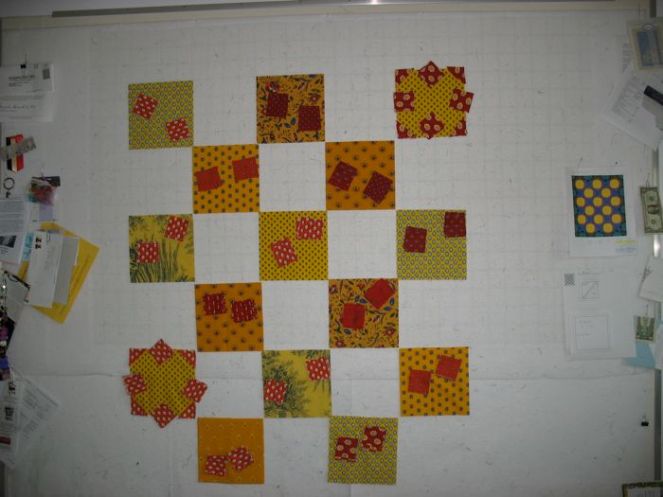
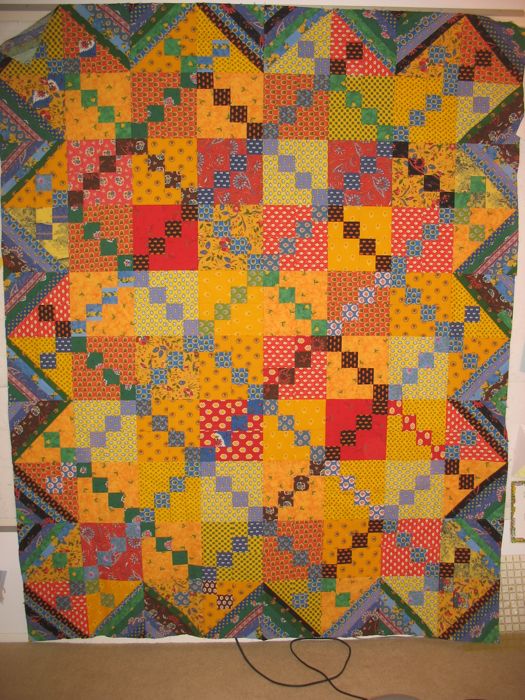
So I monkey around with ideas from the photos, ideas from my files and come up with this one, which is basically the first photo’s design turned on its side. If I focus in on the yellow blocks surrounded by the red “petals,” then it also reminds me of the fields of sunflowers we saw as we traveled in the south of France.
I cut out a bunch of golden yellow squares, and had to piece one of them back together from the previous quilt. Red squares distributed–thanks to the gift of fabric from my friend Tracy, I had just the right kind and color.
I’d found another similar quilt online, and freaked out that mine might be considered a derivative of that one, so I reworked the borders to make it really mine. I probably shouldn’t freak out, as I long ago realized that ofttimes there is a certain zeitgeist in the universe and creative and intellectual projects often overlap. My friend Tracy told me about an experience her sister had about someone apparently trying to claim a Dresden Plate idea as her own. It’s about as silly as Pioneer Woman claiming Texas Sheet Cake for her own (in a post on my cooking blog). So what is new? What qualifies as something truly different and profoundly unique? Once I heard that if an idea was 10% new it was pretty “out there,” and may not even be accepted by the public. Perhaps that’s why retro designs appeal to us–they are new without being new.
Sewing is a slow process, as there is a lot of figuring out of which red square/black square goes where, and the drawing of the line, sewing, cutting, pressing, up-and-down, up-and-down. Another challenge for this quilt was that I was bound by my desire to only use the French fabrics, and there was just no running out to the little shop in Aix-en-Provence in the south of France to pick up something that would work better. Scarcity can make a quilter more resourceful.
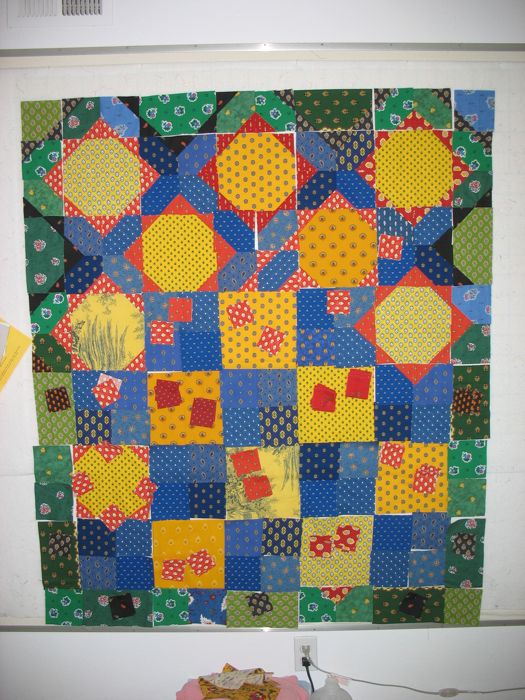
But the fun thing is “opening up” the reds around the yellow square. I think the quilt looks like it’s blooming, like a huge sunflower.
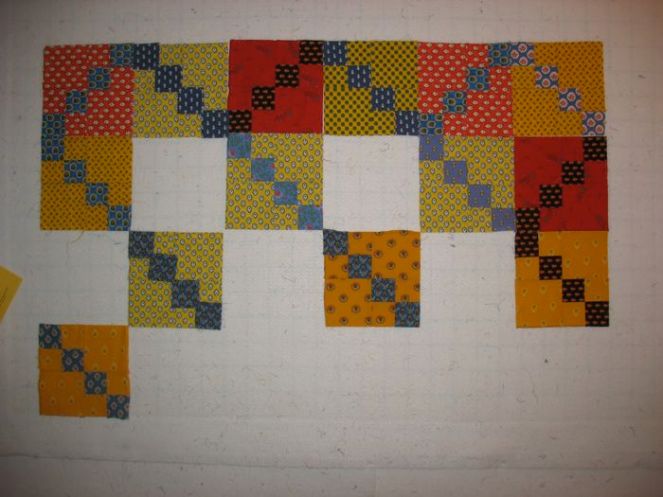
The quilt is now at the cellular level, meaning that not only I have ripped the quilt into many blocks, I’ve now taken the blocks apart into their pieces. Daunting? Oh, yeah. Am I discouraged? Pretty much–but mostly because I can’t figure out how to make a quilt out of this fabric that I think I will be happy with.
Traditional French “Indienne” fabric is printed with little designs in an ordered fashion: polka dots, if you will. And if you’re going to make a quilt out of polka dots, usually it’s the broad strokes of color that will be seen, as in the photo below, where you notice the red squares against the yellow squares.
I was despairing that I didn’t have enough red fabric to complete my current idea. Lo-and-Behold my friend Tracy brought me a fat quarter of some “real French fabric” today from her trip to Spring Quilt Market. What serendipity!
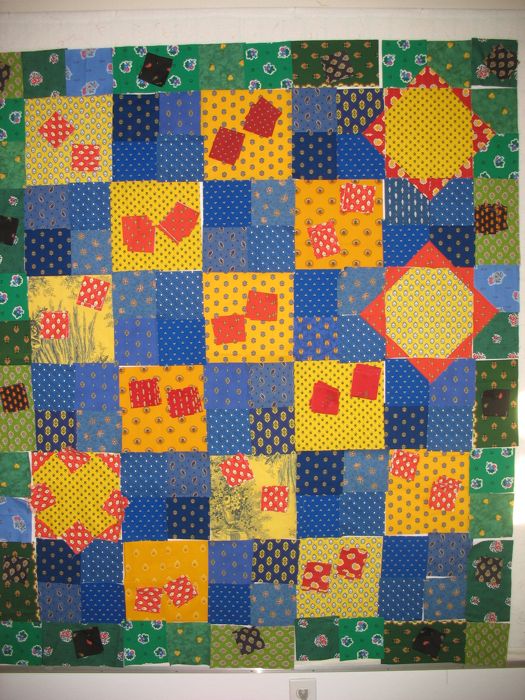
I still like the idea of the zig-zaggy borders being incorporated into the quilt, so that it contains its own border. So I’m kind of hanging onto that idea for now, knowing that whatever I put in the middle with have that as its outer edges. I decided that the color combination of the blue-gray against the yellow (which I personally love) is part of the problem, so in the quilt above, I’ve covered up some of that blue gray with a deeper contrasting blue, helping the little squares to march across the quilt in a diagonal pattern. I wonder if I should bring in a solid, to help balance the “dottiness.”
Frankly, I’m feeling a little dotty. Time to let it rest. ************
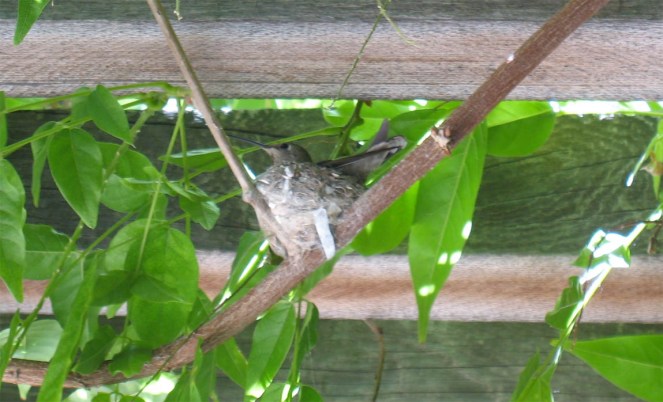
So here’s a change of subject. In our arbor out back, where some of the vines have looped down underneath, a hummingbird has built her nest. She’s about 8 feet from our family room window and we brought down the binoculars to watch her up close. My grandchildren Riley and Keagan had a fun time seeing her on the nest (although the functional use of the binoculars was a bit out of reach for them). That bird just stayed there and stayed there and stayed there.
Once when she finally flew off (to get some food, we assume) Barbara made the comment that she understood perfectly: even the most diligent mothers need a break now and again.
Well now we think the eggs have hatched for the bird flies away far more often, then dips her beak down into her nest when she returns. No sign of the baby birds, though.
I made this quilt a couple of years ago, cutting and piecing all in a rush to get it done, working with my collection of fabrics from France. That was my self-imposed structure: only fabrics that I had from France, and that limitation shows in this quilt.
I liked the design, but I had to use oranges instead of yellows, greens instead of navy, brown and purples instead of deep blues in the border. I had finished it, but it wasn’t working. The contrasts were off somehow, betrayed by the color, for sometimes when person looks at a fabric they think they are seeing something different–for a brown does look different from a green–but the lack of strong contrast can betray a quilt; contrast is needed to strengthen this particular design. Although it was finished, it was weak at the core.
Last year at our local quilt show was a new vendor–one who had bolts and bolts of real French indienne fabrics–those little prints that resemble polka dots or men’s ties. I bought two more lengths of yellow, and 8-10 pieces of navy blue, this quilt in the back of my mind.
But who wants to rip up and fix an old quilt? Maybe that’s how some of those quilt tops that are present in other booths at the quilt show came to be: lovely tops but just not quite right, as if the maker put it all together then decided to move on to something else, the top folded away to be taken up at another time.
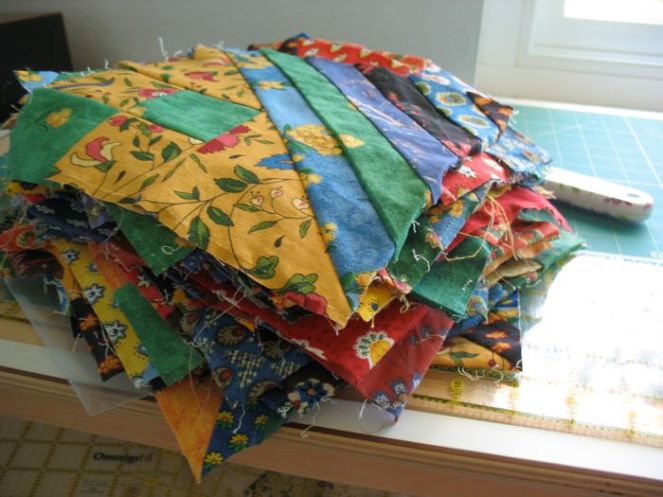
But now I have the fabrics, the time. It’s a leap of faith, I think, to un-make a quilt. This stack could easily become a pile of blocks put back into a box to be sold some years hence at a quilt show. Or passed down to grandchildren who are learning to sew. Or given away to the thrift store. Or simply chucked in the trash. I took several deep breaths before giving a satisfying tug, pulling it apart at the seams.
It took me the better part of an evening to do this. I listened to the radio show This American Life, streamed down on my computer, listened to sounds my husband was making as he worked and moved through the house, thought about someone I loved who had just announced he was divorcing. I’ve been in that situation–divorcing–and that too, is a leap of faith. Only instead of blocks, there are children, houses, cars and sofas. Instead of threads, there are memories. But sometimes a marriage is just not right, and like a quilt, the problems often don’t show up until the quilt is complete.
I worked steadily, setting the separated blocks in a growing stack. When I finished that night, I had a soft pile of four-by-four squares, and a mess of thread on the carpet. I turned out the light, and went to bed, offering up extra prayers for those who are un-doing, ripping apart things to set lives finally right.




 OccasionalPiece--Quilt!