
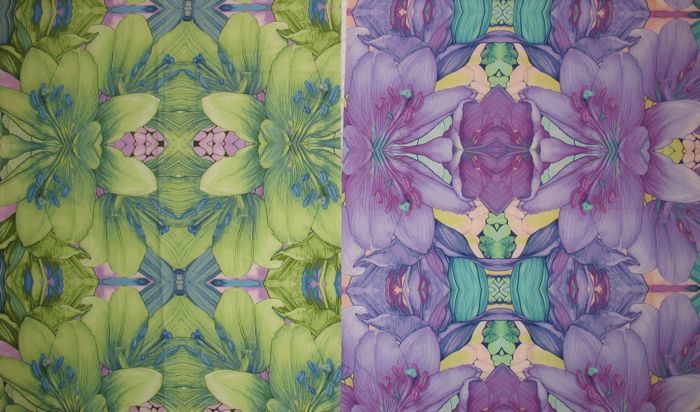
I bought two fat quarters of this fabric at my local store in green and purple, and just my luck–no identifying words on the selvage. Anyone have any info about them?
I bought two fat quarters of this fabric at my local store in green and purple, and just my luck–no identifying words on the selvage. Anyone have any info about them?

I showed this picture in the last post, of the books I’d picked up at a garage sale. The three smaller ones are interesting, and I’ve found a few new blocks to try sometime. The other was intrigued me because it reminded me of the Farmer’s Wife blocks that are being made by several around the blogosphere. The authors, Patricia Cooper and Norma Bradley Buferd, created what they called “a unique oral history” of the quilters of Texas and New Mexico.
I started reading some while standing in the driveway at the garage sale:
“Back in the old days we had to make the quilts so thick. You know in those old dugouts the wind would come through so bad that you really had to be covered to sleep. Papa would bring the cotton back from the gin, you know. Just how ever much Mama needed. It was all clean then. . . . We stayed busy every minute we had quilting. We all worked in the fields and mother didn’t have any idle time. If anything let up, she was working on her quilts.”
I was hooked so I bought it and took it home. But after skimming some of the book, and reading the introduction, I was kind of angry. Here were all these “oral histories” of women talking about hard times as farmer’s wives, as women on the prairie, quilting whenever they could, yet the authors didn’t identify ANY of these women. Not one. How is this preserving oral histories? As the poet Lowell said, “the gift without the giver is bare,” and so likewise these oral histories are just ephemeral without the women’s names.
The authors make an apology, of sorts:
“In the interest of brevity and continuity we have often condensed conversations, monologues, and run-on conversations on similar subjects without indicating that the speaker has changed.”
Yuch.
And then this horrifying note: “We take full responsibility for editing the tapes and our notes in this way.” Is this because someone at the publishing house raised an alarm? I hope that some editor did, somewhere. My sister, who is a REAL historian, would cringe at this. As I do. I still enjoy reading the accounts, but I trust them less. It’s like that old Aunt Jane stuff we read so often, quoted as if Aunt Jane of Kentucky was a real person. She’s not. She’s fiction, and I’m afraid that some of this is like fiction too.
On balance, the play Quilters was taken from this book, and I found that extremely moving the first time I saw it. And the next time, too. Perhaps scholarship meant something different then? That the very fact that these women’s voices — albeit anonymous voices — were published was a Huge Deal? Maybe.
You bloggers are documenting your quilts with your voice, whether you post one day or four days a week, whether you make a quilt a week or a quilt in a year. Your blogs and writing have authenticity as you document your ups and downs, your WIPs, your completed quilts. You have a voice. You are not like these unknown, silent women from the prairies. You put a face and name to your creativity and it enriches us all. Keep writing!
My daughter and her children came last weekend, and then we had a big family party on Saturday. But early that morning, before we even had to wash off the patio chairs, Barbara (my daughter) and I snuck out to a garage sale. I’d heard about it the night before, at Quilt Night, and wanted to see it for myself.

Box after box after box after box of fabric. Most had been purchased from a now-defunct dime store, and most were in pieces less than 1/2 yard. Some was substandard fabric–cheap gauzy stuff with garish prints. But a lot of it was worth looking through.

They’d dragged out their ping-pong tables, some sheets of plywood and set out a few stacks of fabrics to entice us. I found a stack of ginghams. More for my stash. There were a few interesting vintage pillowcases/sheets. I got a few of those. Actually I turned one of the pillowcases into a bag in case I needed to pick up more.
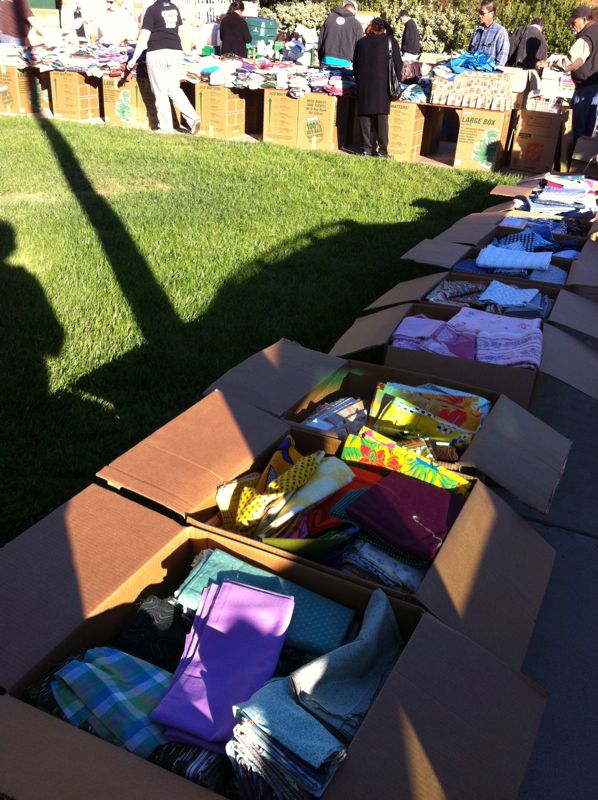
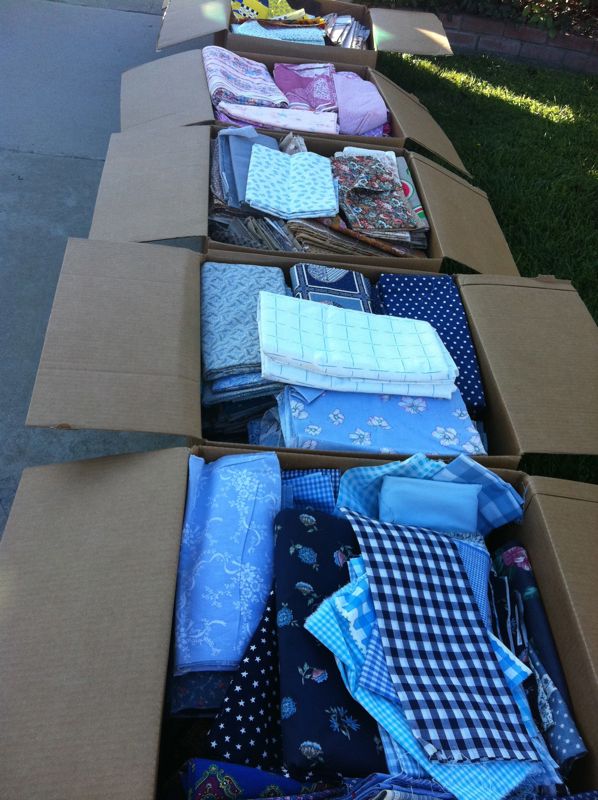

Can you believe all this? Turns out the owner of this house didn’t collect it all. He’s a realtor and to get the listing for a house he was pitching, they made him agree to clean out the old woman’s collection of fabric and books. He called in a used book salesman and they took a slew. Then he dumped the rest of the books — 3 dumpsters full — which about broke my heart, because I’m a book lover.
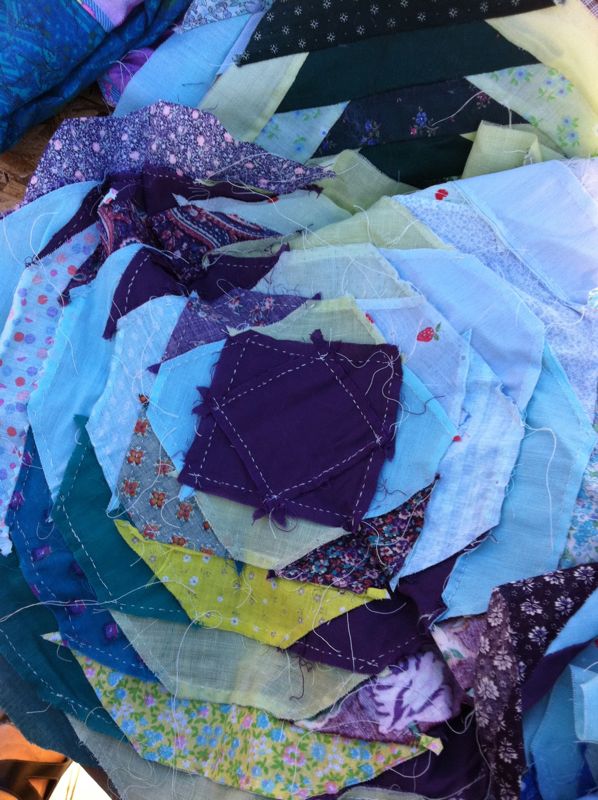
There were even some hand-pieced pineapple blocks, but I didn’t pick them up because I want to make my own pineapple quilt, and the combination of fabrics ranged from sheet batiste to a heavy twill. And strange color combinations, as you can see. By this time, as I was lugging my pillowcase of ginghams and sheets, the jokes started among the quilters that were there. Can you see our daughters having to do this when we all kick off? Poor Barbara, her friend Shawnie said. Poor you, Barbara said. Your mom’s a quilter, too.
I had tried to look through some of the boxes, because it was all just HERE waiting for us quilters to collect it. But I’m used to the high-quality cottons from my local quilt shops and I remembered my husband home with all of Barbara’s kids and at some point, it all became just too much. So I paid for my fabrics and threw the lumpy pillowcase into the back of the car.
I walked back and found what few books there were, and selected some to go. Three of a four-book series on 1000 patchwork blocks. It reminds me of my Encyclopedia of Quilt Pattern by Barbara Bachman, but a lot more home grown. I’ve had fun looking through them.
So, I left most of the fabric there. Be real. Given the paltry amount in my pillowcase, I left all of it there, comparatively speaking. Lately I’ve been trying to shop my stash and to rediscover some of my earlier plans, so I was okay to leave all those possibilities there on the realtor’s driveway. So noble. Such restraint.
Can’t say I didn’t think about it for the rest of the day, though.

I teach college English and currently we are studying short fiction. I had a nice moment the other day when my vocation interlocked with my avocation and I was able to talk about quilts in class. The short story we were studying was “Everyday Use” by Alice Walker and it’s an interesting riff on how our quilts become valuable to others once they become a commodity, or have a price put on them. In this scene, the returning daughter named Dee (who calls herself Wangero) is going through the house looking for decorations, and fixates on some quilts. Ignoring her sister Maggie, who is in the kitchen doing the dishes, her actions are narrated by her mother:
After dinner Dee (Wangero) went to the trunk at the foot of my bed and started rifling through it. Maggie hung back in the kitchen over the dishpan. Out came Wangero with two quilts. They had been pieced by Grandma Dee and then Big Dee and me had hung them on the quilt frames on the front porch and quilted them. One was in the Lone Star pattern. The other was Walk Around the Mountain. In both of them were scraps of dresses Grandma Dee had won fifty and more years ago. Bits and pieces of Grandpa Jattell’s Paisley shirts. And one teeny faded blue piece, about the size of a penny matchbox, that was from Great Grandpa Ezra’s uniform that he wore in the Civil War.
“Mama,” Wangro said sweet as a bird. “Can I have these old quilts?”
I heard something fall in the kitchen, and a minute later the kitchen door slammed.
“Why don’t you take one or two of the others?” I asked. “These old things was just done by me and Big Dee from some tops your grandma pieced before she died.”
“No,” said Wangero. “I don’t want those. They are stitched around the borders by machine.”

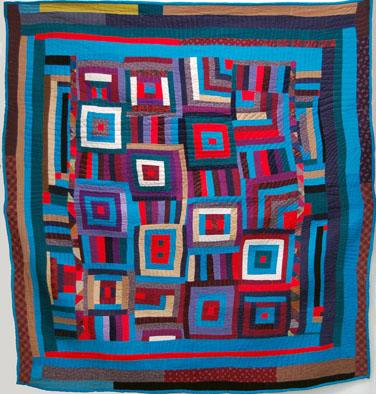
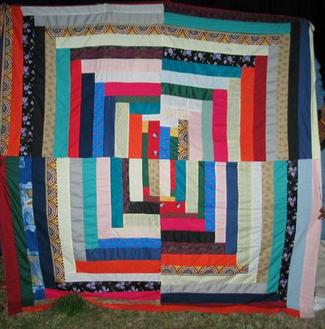
I found pictures of Gee’s Bend (above) and made a Google Doc slideshow about the quilts that these women made. While the quilts mentioned in Walker’s story appear to be more traditional than the Gee’s Bend quilts, I thought it would be interesting for the students to see this body of work.
“No,” said Wangero. “I don’t want those. They are stitched around the borders by machine.”
“That’ll make them last better,” I said.
“That’s not the point,” said Wangero. “These are all pieces of dresses Grandma used to wear. She did all this stitching by hand. Imag’ ine!” She held the quilts securely in her arms, stroking them.
“Some of the pieces, like those lavender ones, come ftom old clothes her mother handed down to her,” I said, moving up to touch the quilts. Dee (Wangero) moved back just enough so that I couldn’t reach the quilts. They already belonged to her.
“Imagine!” she breathed again, clutching them closely to her bosom.
“The truth is,” I said, “I promised to give them quilts to Maggie, for when she marries John Thomas.”
She gasped like a bee had stung her.
“Maggie can’t appreciate these quilts!” she said. “She’d probably be backward enough to put them to everyday use.”
So the title comes from the returning daughter (Dee/Wangero) aghast that these treasures would be put to “everyday use.” She goes about raiding the house for things that ARE put to everyday use: the top of the churn dash, various other household items. The final straw for the mother (who is the alternate voice in those two passages above) is when Dee/Wangero is asked what she’ll do with the quilts:
“Maggie can’t appreciate these quilts!” she said. “She’d probably be backward enough to put them to everyday use.”
“I reckon she would,” I said. “God knows I been saving ’em for long enough with nobody using ’em. I hope she will!” I didn’t want to bring up how I had offered Dee (Wangero) a quilt when she went away to college. Then she had told they were old~fashioned, out of style.
“But they’re priceless!” she was saying now, furiously; for she has a temper. “Maggie would put them on the bed and in five years they’d be in rags. Less than that!”
“She can always make some more,” I said. “Maggie knows how to quilt.”
Dee (Wangero) looked at me with hatred. “You just will not under.stand. The point is these quilts, these quilts!”
“Well,” I said, stumped. “What would you do with them?”
“Hang them,” she said. As if that was the only thing you could do with quilts.
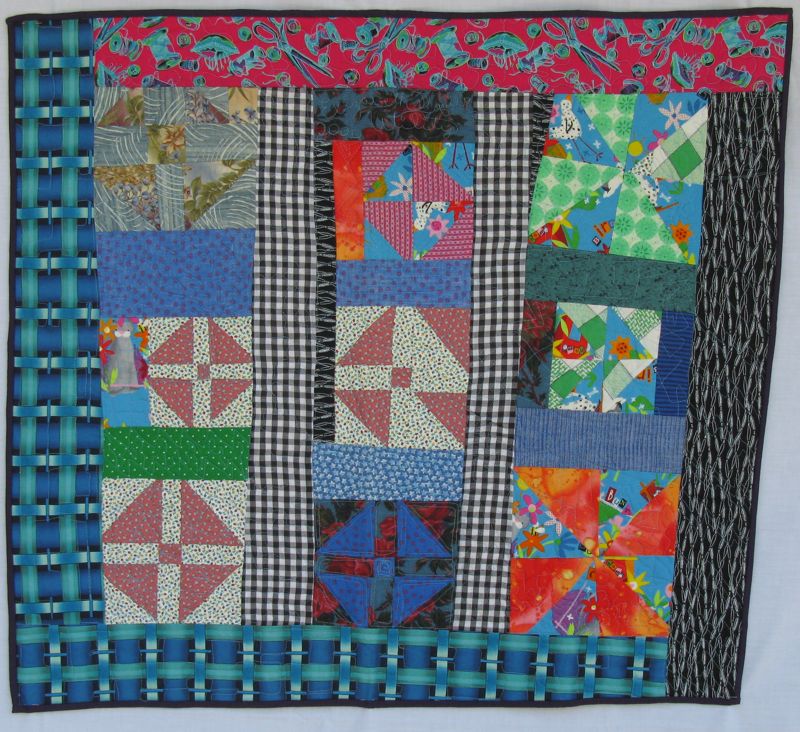
I also took in a utility quilt I had made with Roberta Horton in a class I took when I went to Houston. Roberta didn’t allow us to use our rulers (which made the quilt very “wonky” and crooked), and made us put in an “ugly” fabric so we could learn to work around it. We also had to sew a few of the patches in backwards, but the general appeal for me of this quilt was the idea that quilts don’t always have to be perfection, an idealized thing of beauty. I liked learning that quilts were sometimes made in a hurry and were made to be used.
So it was a lovely few minutes in class, and I resisted the urge to keep talking about the quilts and quilters and focus instead on the Englishy part of class: Walker’s story. But the underlying thread — that many quilts are made to be used and not hung on a wall — resonates with me.

And perhaps it’s why this photo of my grandson Riley is so pleasing to me. He and his two sisters came for a visit this past weekend, and he toted along the baby quilt that I’d made for him. That first morning, he called me in to show me that he’d made his bed, and I couldn’t resist snapping this photo of him, standing atop his quilt. It’s being put to good use — everyday use, even when he comes to Grandma’s house.
 OccasionalPiece--Quilt!