Quilts

Quilting. . . and a Sticky Question

Facets Quilting_1

It begins here.  I printed off a picture of my quilt, then took a fine-point sharpie to “quilt” in the designs I thought I would do.
Facets Quilting_2

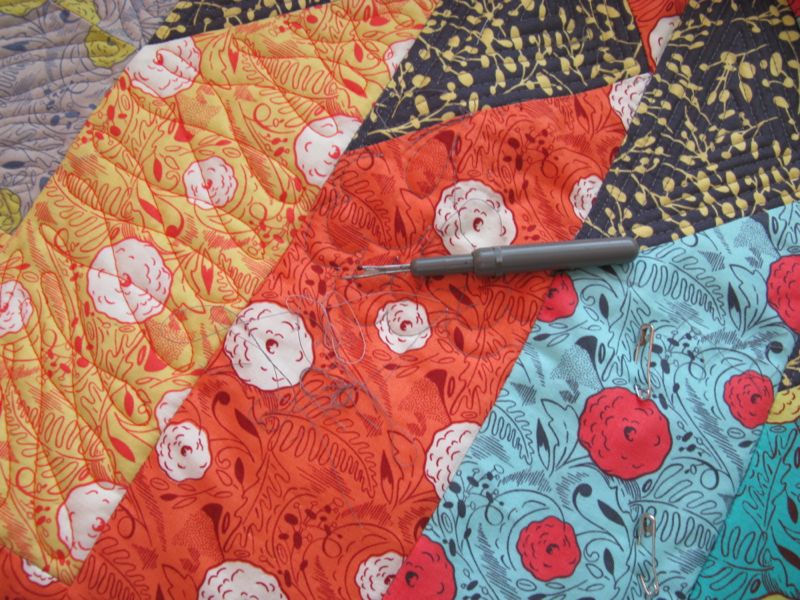
Then this happens.  Over and over, on each row.  For every hour quilting, I spent half an hour unpicking.  Wrong color thread.  Wrong pattern.  Wrong shape.  Wrong style.
Facets Quilting_4

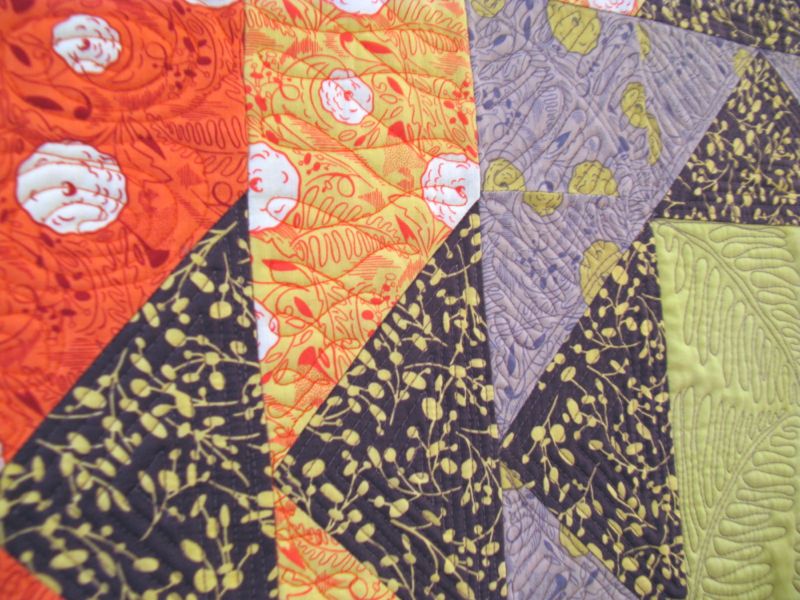
Finally, things start working.

Facets Quilting_3

Facets Quilting_5

I admit it.  The last row got stippled, as I was pretty tired and my shoulders hurt from quilting.

Facets Quilted_1

I put it up on the pin wall, but something’s not working.

Three Tries for Facet

I pin up different centers–hard to see on this small picture, but I know it’s the center.  I call in my resident quilt expert.  “Looks nice,” he says, in the same tone of voice as when he answers the question “Does this make me look fat?”  I know now what is wrong, but I am loathe to admit it.  I turn out the light and go to bed.

Facets unpicking_1

In the morning, I pick up my seam ripper.  Unpicking dense quilting gives you a chance to think.  A lot.  Here comes the sticky question, but first the set-up.  I own a good-quality Viking/Husqvarna sewing machine, but it was purchased before we all started quilting so much on our quilts, even though it is called the Quilt Designer.  After three tries, I finally found the foot that works for me, the tension, the everything to allow me to quilt on my machine.  But my quilting doesn’t look like Judi Madsen’s on The Green Fairy, or on other blogs that I haunt.  And I know why: my domestic sewing machine, without a stitch regulator, cannot compare to what a long-arm can do.  Or even a baby long-arm.  It’s just me and the thread, me and the pedal, my hands moving supposedly in sync with the speed of the machine.

But it’s not enough anymore, is it?
Facets unpicking_2

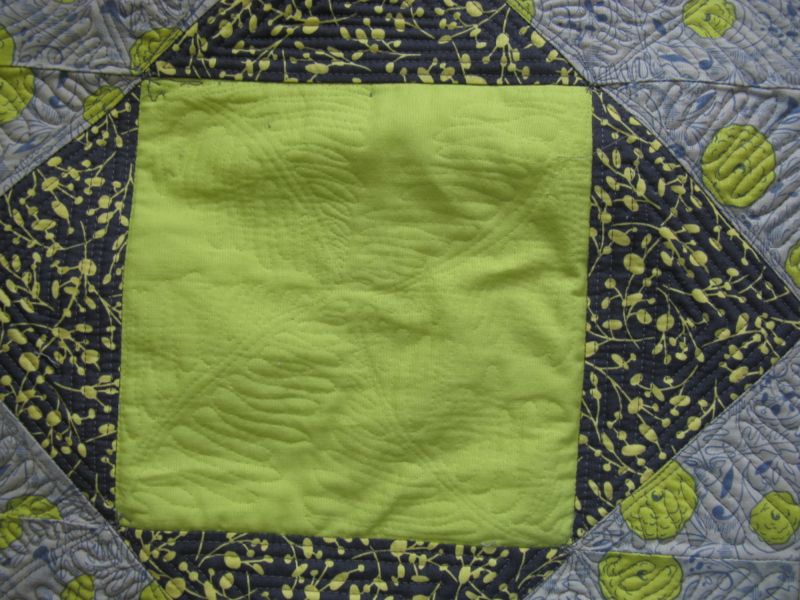
What was wrong with the middle was my quilting.  The shape of the fern, the stitches that hover near even, but occasionally veer into very small or a bit-too-big, the whatever–it was just wrong.  Free-Motion Quilting — the REAL free-motion quilting, has its warts, showing the artisan behind the tool.  But that’s not what we are after anymore, is it?  We want perfection: no bobbles, no wobbles.

So after three hours of unpicking, I am back here.  And the reality of where our industry is heading today is that if I want a quilt that I feel I can enter in a show, or display wherever, I’ll have to step up on the quilting front, because no matter how you look at it, the ones with the bigger, more extensive machines with stitch regulators will always have it over me on my little domestic machine. Because of the limitations of my tools, I don’t know if I can make it right.

But I’ll try.

˚˚˚˚˚˚˚˚˚˚˚˚˚˚˚˚˚˚˚˚˚˚˚˚˚˚˚˚˚˚˚˚˚˚˚˚˚˚˚˚˚˚˚˚˚˚˚˚˚˚˚˚˚˚˚˚˚˚˚˚˚˚˚˚˚

Note: You may occasionally see ads here placed by my blogging software.  They place ads so I can blog for free.  It’s an okay trade-off.

Quilts

From Baskets to a Museum–more quilts in Utah

Nat'lHistoryMuseum
While visiting relatives in Utah, just before I tucked into the new semester of teaching (which would explain why I have been AWOL for a couple of weeks), my husband and I headed to Salt Lake City’s newest museum: The Natural History Museum, high up above the University of Utah.  It is a gorgeous museum, complete with artifacts, history and dinosaur bones.

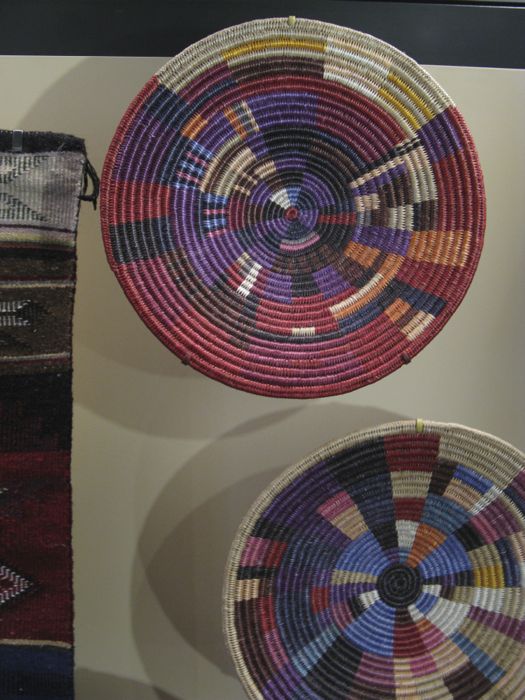
Nati'l History Museum Baskets

But I was more interested in the woven baskets in the Native People’s exhibit.  I guess I’m fascinated by color and pattern, in all forms.

Lino Quilt

Which is why I found this piece of art, in the Millcreek Library so fascinating.  That library, where my sister-in-law Annie works, has a Senior Citizen’s center, a gym, a cafeteria and of course, art.

Lino Quilt detail

This appears to make of some sort of plasticized material–almost like a thin linoleum, cut and sewn in quilt patterns.  I loved it.

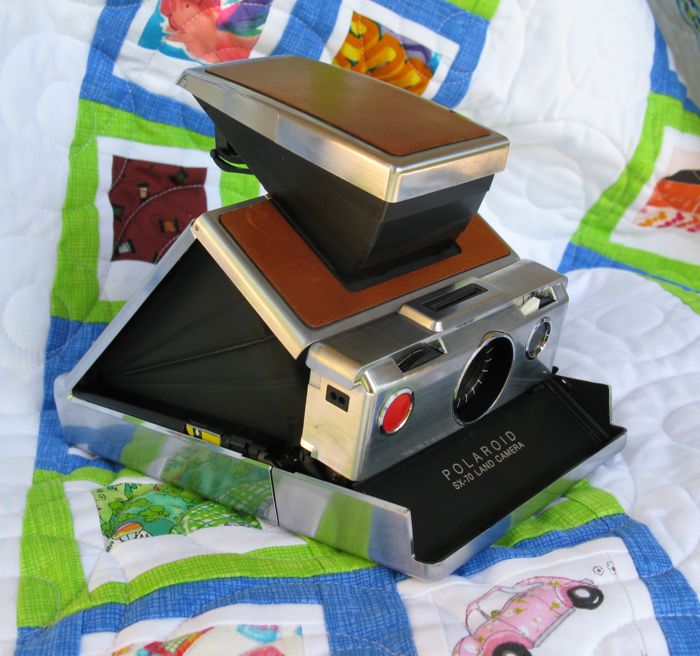
Polaroid CameraQuilt

I had brought up my Polaroid Quilt to show my mother, and my dad held up his finger as if to signal a pause and came back carrying this: a genuine, bonafide Polaroid camera.  Of course, there’s not any film to be found for it anymore, but I thought it deserved a picture with the quilt.

Springville_Toone

On the way home, we headed to the Springville Art Museum, which hosts a quilt show every August.  I snapped a lot of photos, but here are just some of them.  This one is titled Juxtaposition and is by Marilyn Landry Toone, and was inspired by her daughter’s choice of fabrics from her “fabric stash of 40-plus years.”

Springville_Thompson

I’ve Had the Blues is made by Jacque Thompson and quilted by Kim Peterson, and was made “entirely out of scraps using one-inch strips.”

Springville_Thompson detail

Detail of the beautiful quilting.

Springville_Roylance

Kristen Roylance’s quilt Posy Patch was made using a modified disappearing 4-patch block, and was quilted by Molly Kohler.  The dimensional flowers were charming.

Springville_Roylance detail

Springville_quilt detail

I snapped this one without noting who made or quilted it–it’s really beautiful and detailed.

Springville_Olsen

“Look, honey,” I said to my husband.  “A Dear Jane quilt!”  “Dear what?” he said.  The title of this one is Dear Jane Invites Hannah for a Dutch Treat, and is made and quilted by Shirley Olsen.  It was a masterpiece and earned an Award of Excellance from the judges.

Springville_McClellan

Marion McClellan’s Bottle Cap Bangles is a fun use of hexagrams and fussy-cut fabric.  She also quilted her piece.

Springville_Jacobs

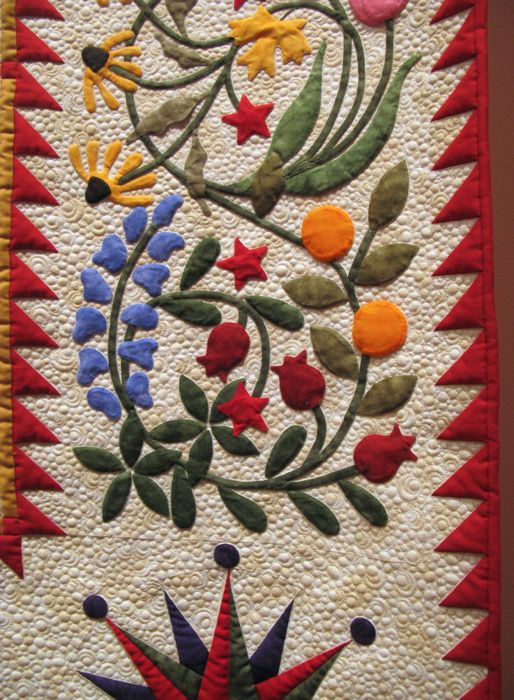
This quilt, Zinnia Basket, was made and quilted by Patti Jacobs, from a Kim Diehl pattern.  Apparently she used to think that quilters were nuts to “spend time doing hand appliqué when you could sew the pieces on with the sewing machine,” but now is a dedicated lover of appliqué.

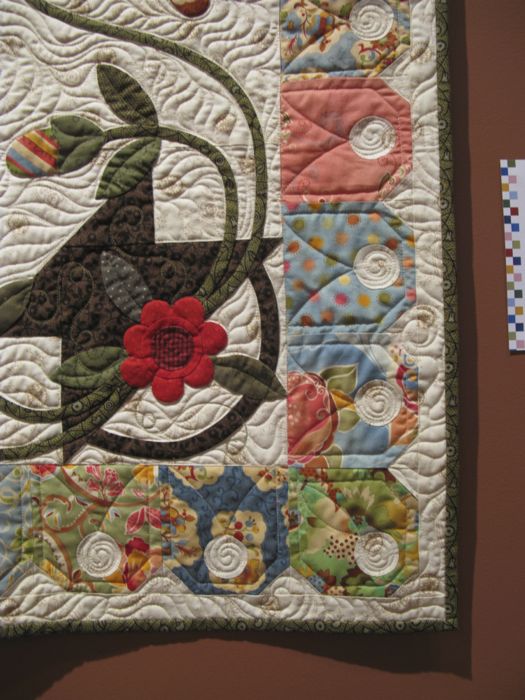
Springville_Jacobs detail

I really liked the border.

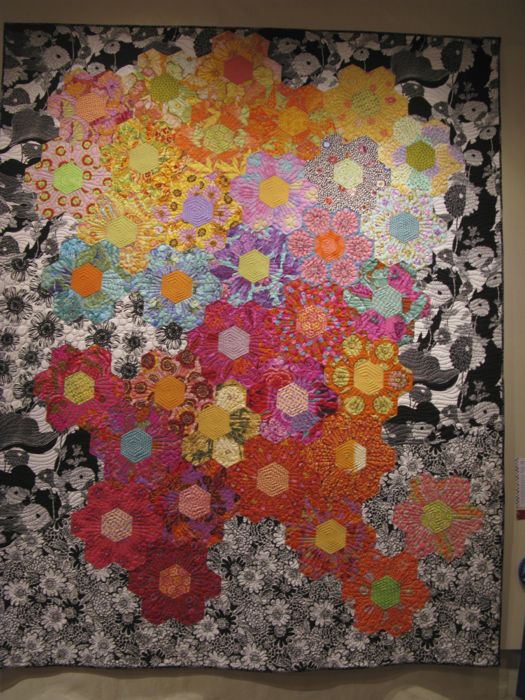
Springville_Evans

Kaye Evans quilt, Just One Weed, is named for the dandelion hexagon in the middle of the quilt.  It was quilted by Sue McCarty.

Springville_display

The quilt display was merged with a display of giant critters made out of auto body parts, springs, doodads and whatevers.

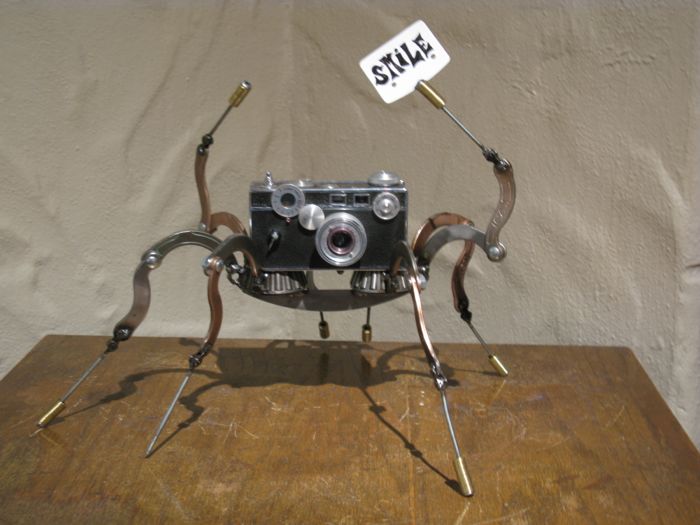
Camera Bug

I liked Tim Little’s Camera Bug the best.

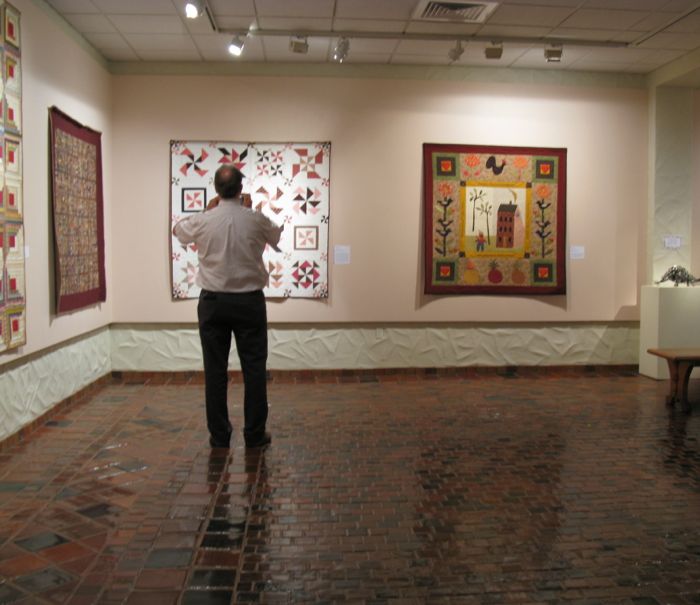
Springville_Dave

My husband knows just what to do at a quilt show: become like a camera bug and start taking photos.  Many of these photos are his–he’s a delight, but was probably relieved that there was no vendor mall here.

Springville_Crawford

Ladies of the Sea was made by Karin Lee Crawford and quilted by Judy Madsen.  It was a pattern from Sue Garmen depicting famous rigged sailing vessels from around the world.

Springville_Crawford detail

Detail.  I have to assume that the quilter is really Judi Madsen, of Green Fairy fame, but I could be wrong.  It was gorgeous in both the making and the quilting.

Springville_Christensen

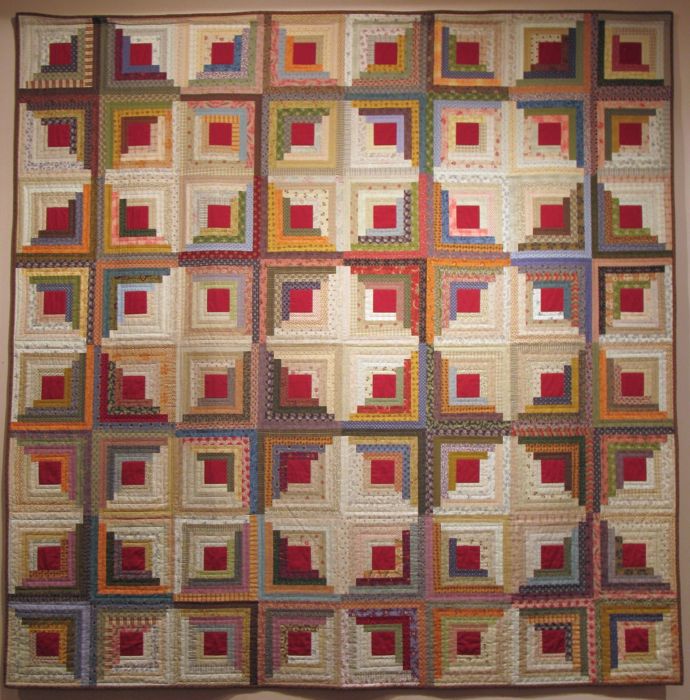
And to finish up this little quilt show, a Log Cabin quilt.  Megan Christensen made the quilt, but didn’t identify the quilter.  The title is A Good Use of Scraps, inspiring us all to get going on our scrap baskets!

Springville_Christensen detail

Quilts

Totes (Like I Need Another One)

Tote_1

My mother used to have a stack of boxes back beside the freezer in the garage.  They were mailing boxes, gift boxes, boxes to put your pet turtle in, and boxes that were there because, well, they were boxes.

Tote_2

So this idea, that I just need a place to put more stuff, maybe runs along the lines of the imagined box mountain of my childhood.  (I can hear Mom saying, “There weren’t that many boxes.”)

Tote_3

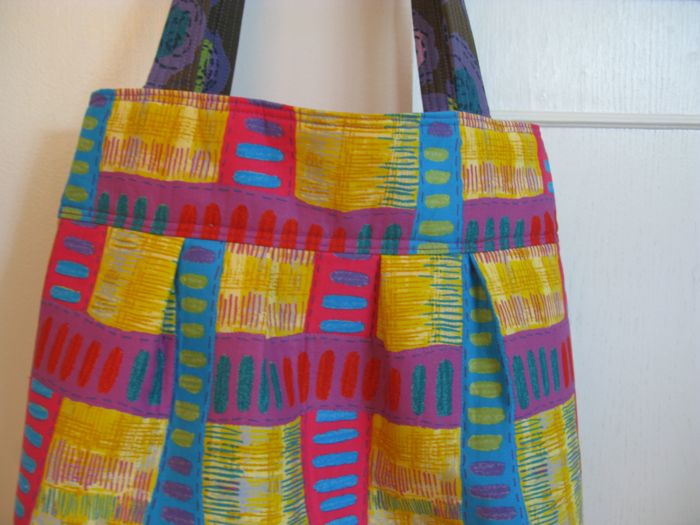
And not only do I have to another another tote or two (what else will I do with that beautiful Keiko Goke fabric?), I have to have pockets inside my totes, to. . . hold more stuff.  Enough pockets of the right shape and size, one with a zipper, put me in Tote Bag Heaven.

Tote_4

This pattern was Pleated Tote, from Ellen Lucket Baker, found *here.*   I made it exactly as she recommended.  Still not keen about the fusible batting on the inside.  It makes the tote too bulky, too stiff, not tote-y enough (I like mine loose and foldable).  So maybe this is more of a purse-like bag?

Tote_Grocery Sack1

This next tote is floppy, roomy, perfect for a grocery store tote.

Cool Cotton6

The genesis came when I visited Cool Cottons in Portland earlier this year, and saw their bag in the front window.  I tried to purchase the fabric, but they were all out of it.  So I saw some at a quilt show I went to–it’s a sturdy lightweight cotton canvas, titled “Farmer’s Market,” made by Alexander Henry.

Tote_Grocery Sack2

I was able to make two totes out of one yard of fabric.  Simple things–just a rectangle with longish straps, no pockets, boxed corners to made them easier to put groceries in.

Tote_Grocery Sack3

While the Keiko Goke can now join the growing stash of totes in my closet, these two are relegated to the car, to use while grocery shopping.  I had intended to include the Goke tote as part of my WIP list, but I persevered and finished it up today.

FinishALong Button

It’s one of the items on my Finish-A-Long list, so I’m happy to be actually getting stuff done.  School started and it always takes a while to recover from all that distraction and get back to the quilting.

Facets Quilt pinned

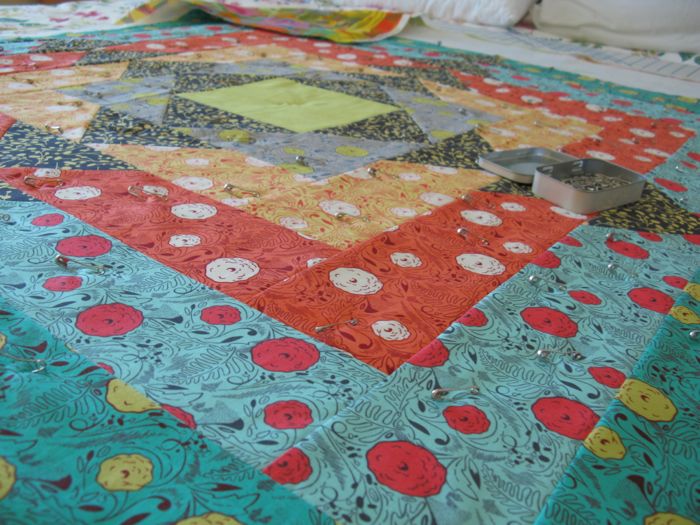
But I am in progress on this Facets quilt, designed by Anne Deister, getting it pinned to the backing today.

Amish With a Twist 2 Log Cabins

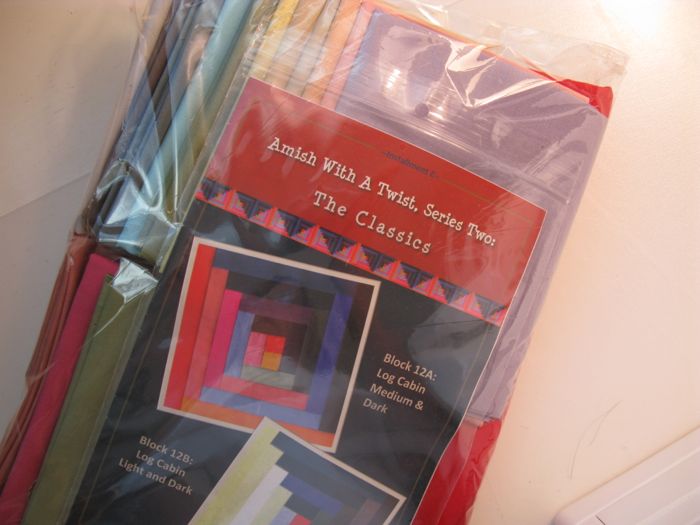
And the next installment of my Amish With A Twist Two arrived this week, so I’ve plenty to keep me busy.  And now we begin the dodging through the school semester, pushing out tasks on weeks of low-to-no grading, dancing around those weeks where papers come in and there are stacks of things to grade and to prep for.

Linking up to Lee’s Freshly Pieced Works in Progress Wednesday.

WIP on

Quilt Shops

Elaine’s Quilt Block–Salt Lake City, Utah

Elaine's_1

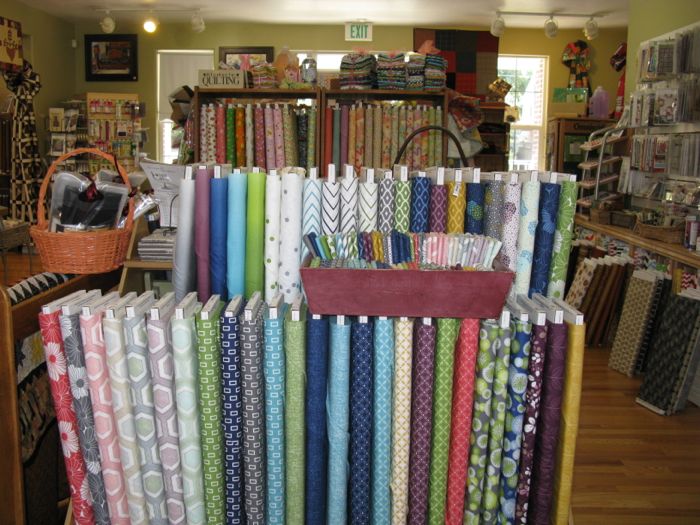
Whenever we go to Utah to visit relatives, I try to find a quilt shop to visit.  Elaine’s Quilt Block quilt shop is very close to my sister-in-law’s house, which could be verrrry dangerous, as you’ll see once we step inside.  Featured in the Quilt Sampler edition of Fall/Winter 2011, the building was built to be a quilt shop, and it is a delightful place to visit.  The address is  6970 South 3000 East, Salt Lake City, Utah 84121, and their website is *here.*  Their phone number is 801-947-9100.  They are located inthe Cottonwood Heights section of the city, up on the southeast bench of the mountains, if you know your way around, and are just off the 215 belt route freeway.

Elaine's_2

Elaine's_3

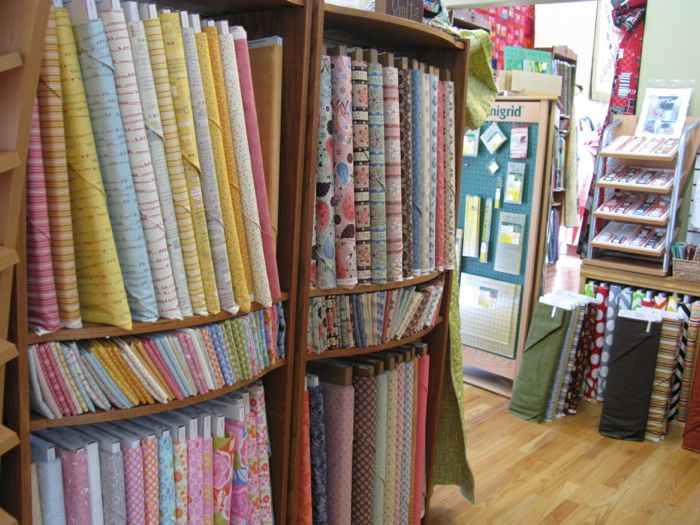
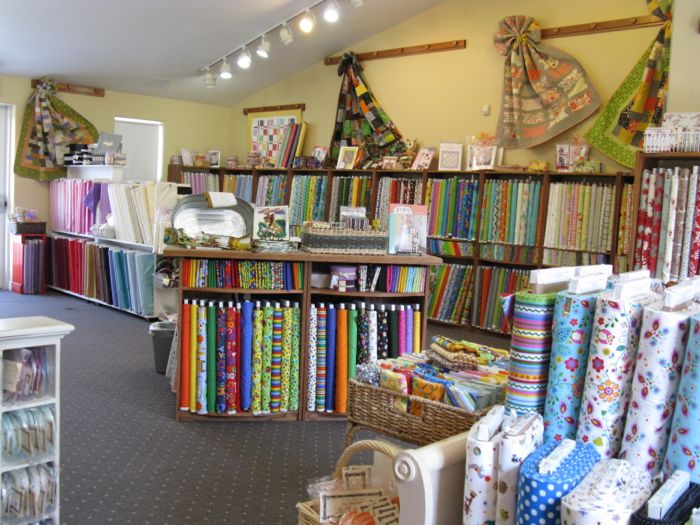
This is the view as you step inside the front door–bolts and bolts of fabrics, notions, light and bright, tall ceilings, a welcoming staff and so much to see!

Elaine's_4

Elaine’s has three levels and this is the stairs headed up to the upper level, which I’ll show you in a minute.  The lower level is classrooms and I didn’t visit there, but wanted to post this photo so you can see the cute displays they have tucked around the shop.  There are many project and quilt samples and they are all such good ideas–I want to make so many of them.

Elaine's_6

Elaine's_7

I’m still standing in the doorway, looking to my right. . .

Elaine's_8

. . . and a little further inside.

Elaine's_9

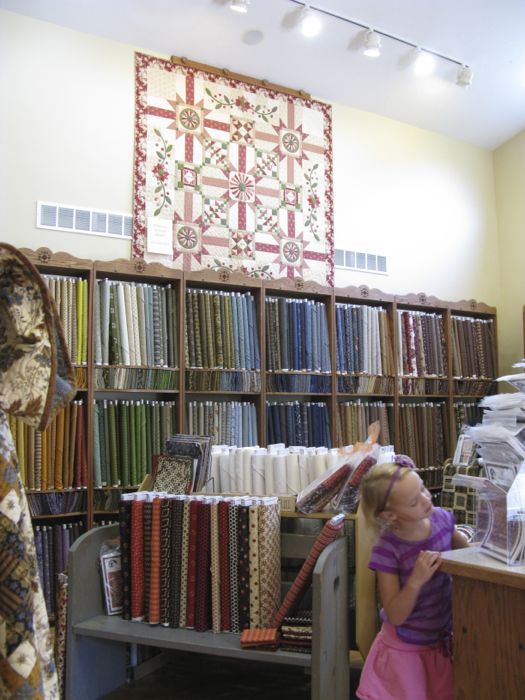
At the back of this main room/entryway, they have all their magazines, some more displays and samples.  The main room is flanked by two other large rooms with dramatic high ceilings–the better to show off quilts!

Elaine's_10

Entryway into the left room, which trends to Thimbleberries, Civil War and reproduction-style fabrics.  They have a huge selection.

Elaine's_11

Elaine's_12

Elaine's_13

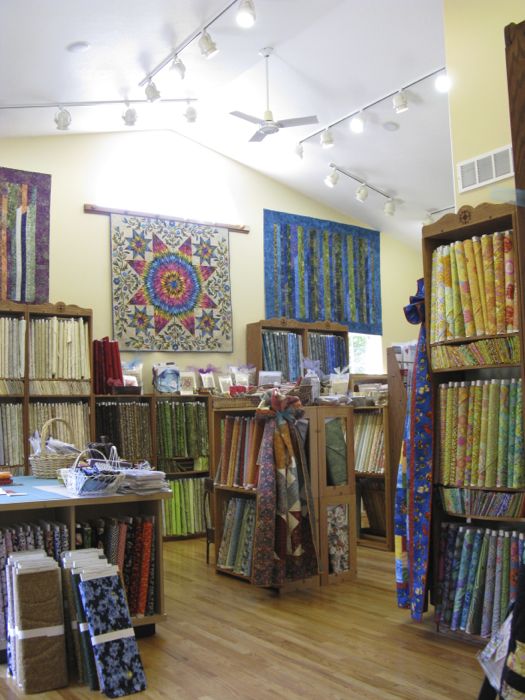
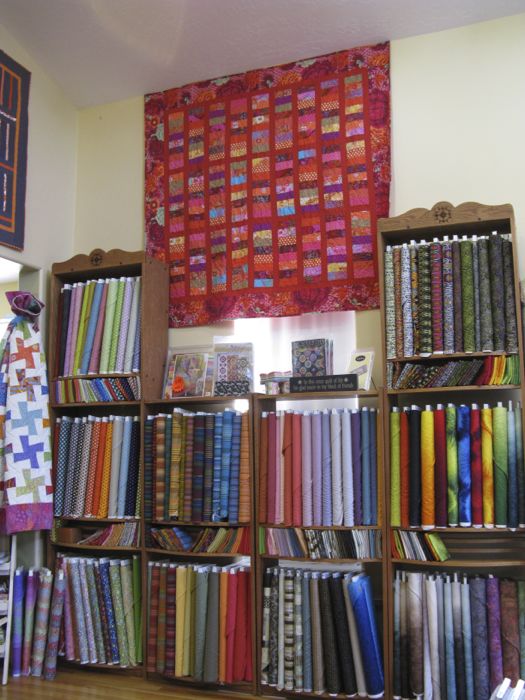
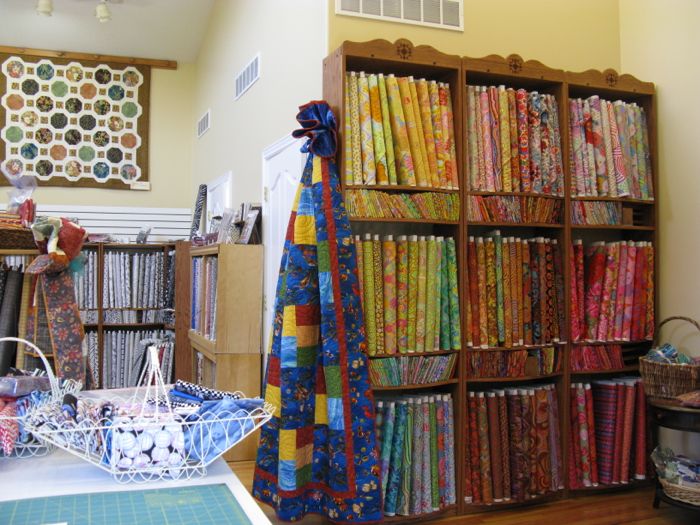
The room to the right is where my heart resides: Kaffe Fassett fabrics, Australian imports, brights, batiks.

Elaine's_14

Elaine's_15

There are tables everywhere so you can lay out the fabrics for selecting colors for a quilt.  I loved the small decorative motif at the top of the shelving units.

Elaine's_16

The black and white section.

Elaine's_17

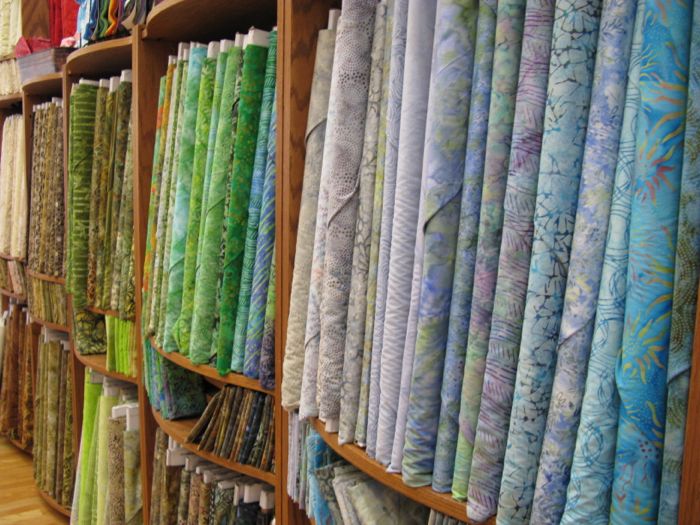
Rows of batiks.

Elaine's_18

And underneath the lines of fabrics are folded fat quarters.  I had a fun time with those, as I had a limited time and had to pick quickly (note to self: leave more time for Elaine’s in the future).

Elaine's_19

Upstairs are children’s and sale fabrics and Christmas and I believe, solids.

Elaine's_20

No, I didn’t have to carry my bolts downstairs to be cut–there is a large cutting table right in the middle of this room, and they cut it for me there.

Elaine's_21

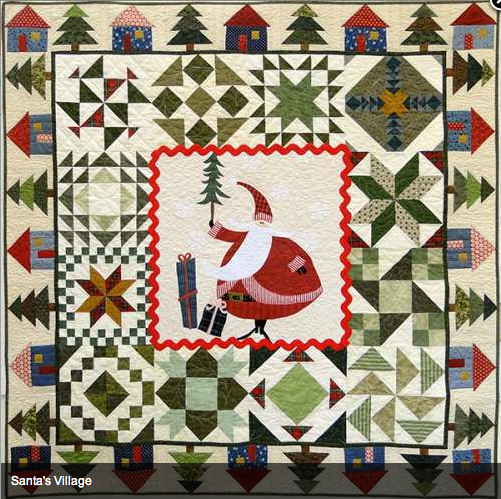
At the main register, where I checked out, was this board of Block of the Month quilts they are running through the store.  I snatched one more pattern to add to my selection of fabrics, because of course, I need another project like I need a hole in the head, but it was the Thimble Creek Christmas quilt Santa’s Village pattern and it was charming (see below).

SantasVillage Thimblecreek

And that to me is one of the values and advantages of shopping at a local quilt shop like Elaine’s.  When you physically step inside, you are energized by all the creativity and samples and ideas that the shop owner has brought to their store.  I do both LQS and online shopping, but I feel more inspired by visiting a shop and seeing the fabrics, touching the samples and projects, turning them over in my hand and in my mind.  I hope you feel the same!