Oh Christmas Tree QAL · Quilts

Oh Christmas Tree QAL –STEP 4

5XmasTreeMay4

Today is Step 4 of our Oh Christmas Tree Quilt-a-Long (#ohchristmastreeqal), following a pattern by Wendy of FlyingFishKits and which was published in Simply Moderne issue #3, by QuiltMania. As always, we have an assist from Wendy of  Wendy’s Quilts and More (blog) and wendyquiltsandmore (IG), as she is slightly ahead of us in her creating.
ohchristmastree4_0treejpg

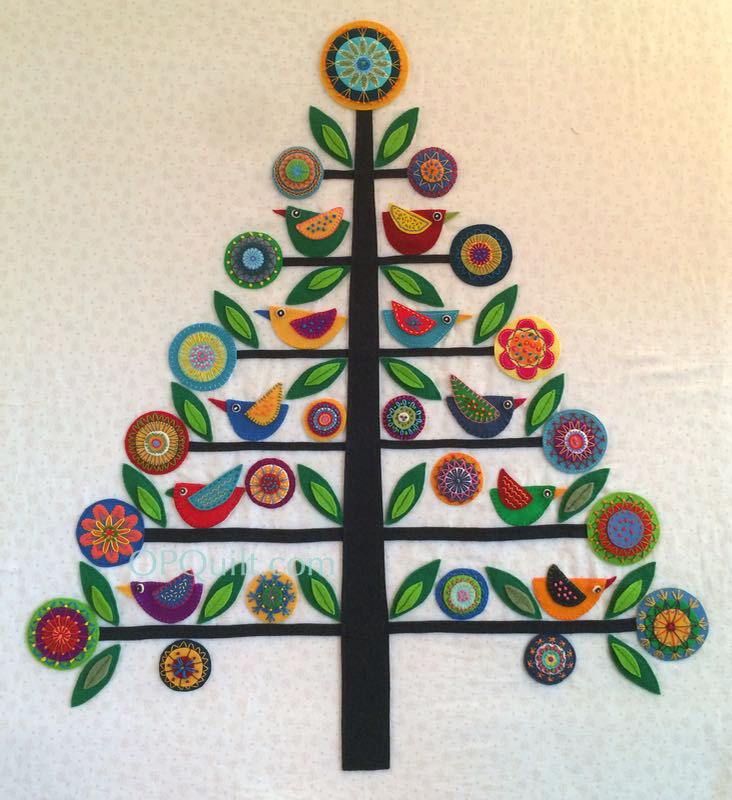
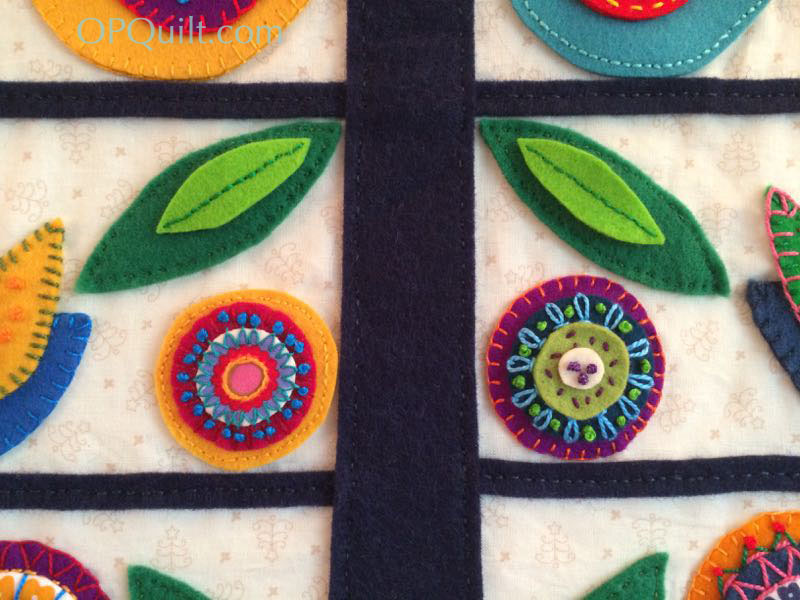
Here’s the twist: instead of creating the under-the-tree scene this month, I’ve gotten so many queries about sewing these things on to the background and the tree, that I think we’ll head that direction instead.  Go with the flow, right?  Above is my tree, everything sewn on.  I’m heading this direction because a lot of those questions have to deal with the idea of how much embroidery to put on that outer edge?  Should you leave a space for attaching and more embroidery?  Should you go right to the edge?

The basic idea for attaching is this: lay out your circles, birds, and leaves to your liking, using the pattern and photos as a guide.   As I go through the rest of the flower photos, I’ll have some tips, so please read through to the end.  But first! Wendy has some tips for us about what’s ON the tree:
ohchristmastree4_20

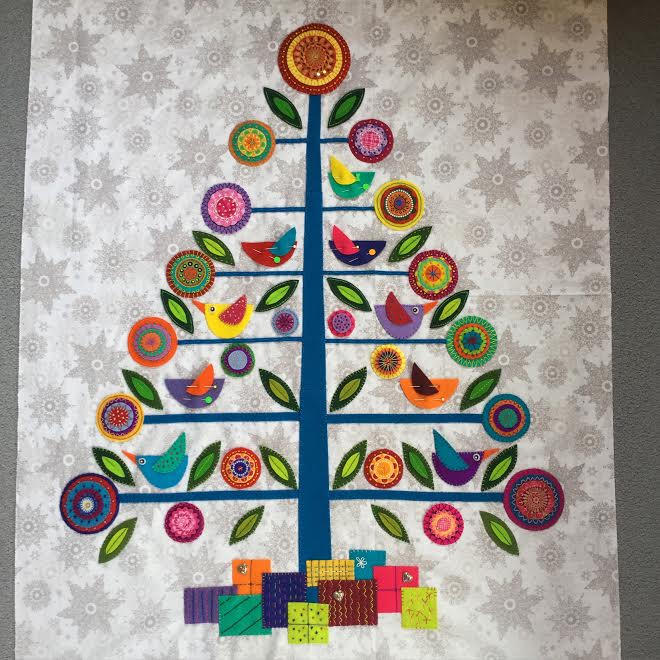
She writes: “I thought I had too much white space in certain areas.  I’ve added 4 more small leaves and 4 more small circles, keeping the additions symmetrical because the gaps were symmetrical.  I just felt some areas were less densely filled than others and I didn’t want gaps in the middle of my tree.  That’s probably because I didn’t exactly follow the pattern for the size of my leaves and flowers, but also because things move slightly as you sew them on.”  She sent me two photos.  The “before” is above.
ohchristmastree4_21

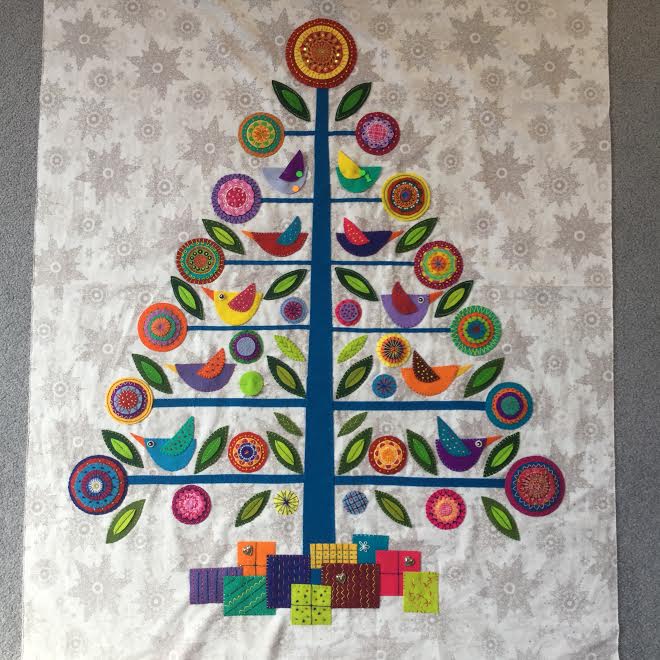
This is the after.  You can see extra circles and extra leaves.  (And yes, I love her under-the-tree scene!  Next month, next month.).  In addition to adding these extras, she attaches them differently than I do.  First she lays them all out, takes a photo so she can remember where they are, and then takes all off but the items closest to the tree trunk.  She sews those down first then adds in the decorations bit by bit, moving from the center to the outside, because she said she got tired of being stuck by pins.
ohchristmastree4_10

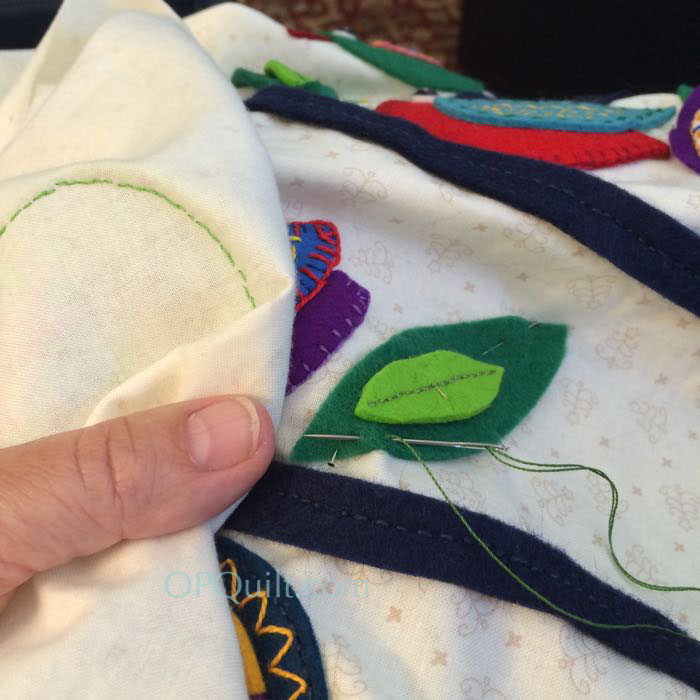
I couldn’t face the thought of re-attaching the flowers after I’d gotten them arranged, so I used appliqué pins (shorter than usual) and sewed on the decorations moving from the outside toward the center. Since I use really small pins, and put my hand around the flowers and birds as I sew, I didn’t have too much trouble.  One IG reader said she used a bit of glue to secure the decorations and from her photo it looks like she’s attaching them from the inside to the outside. Again, try what works for you.ohchristmastree4_11
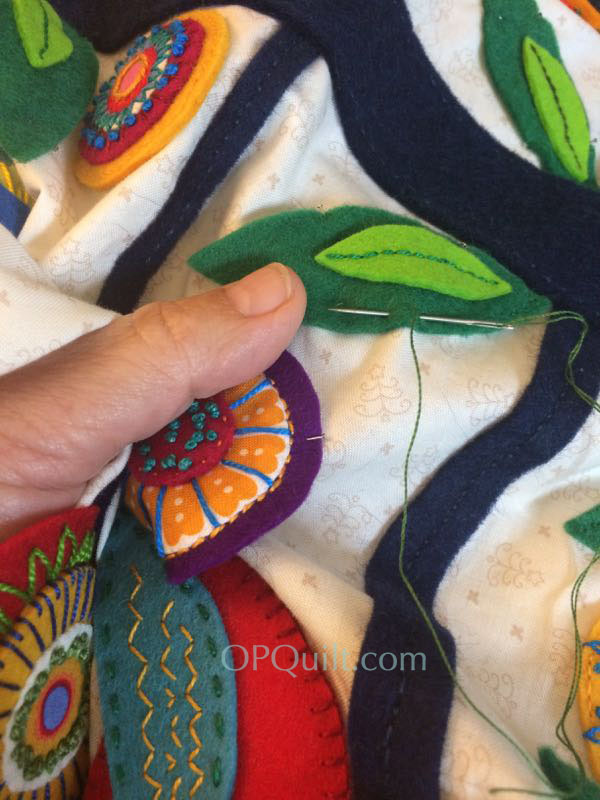
You can see me scrunching things up in my hand.  Since I worked from the outside in, I had very few pin pokes.  I attached the leaves by using the same stitch I used on the trunk: a separated back-stitch (refer to this post for more info).
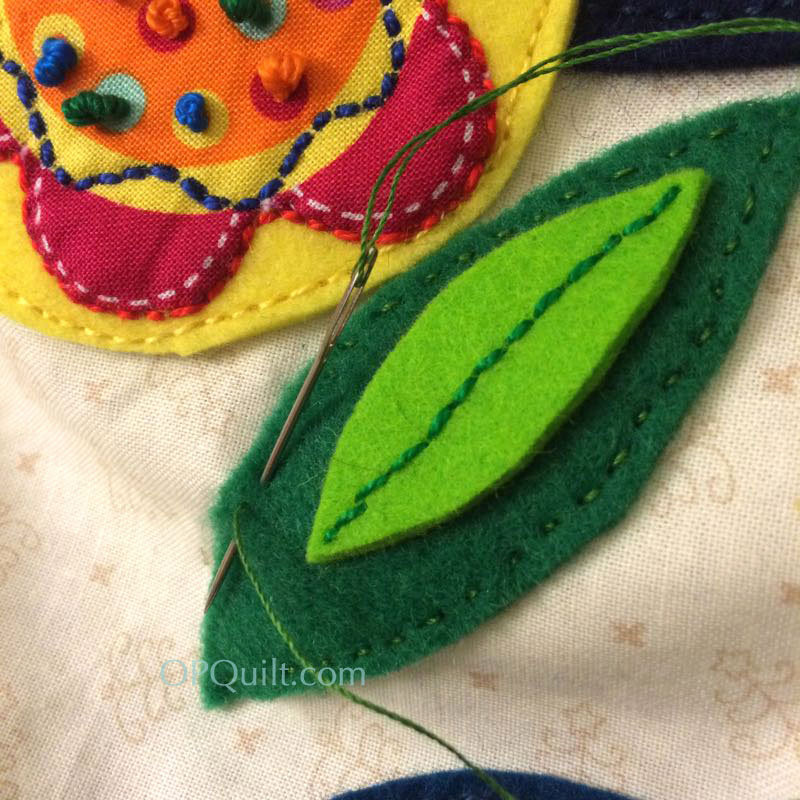
ohchristmastree4_14I was intent on getting them all on, and doing it quickly.  You could take more time than I, adding an extra embroidery stitch, if you wanted, for it’s YOUR tree.ohchristmastree4_12
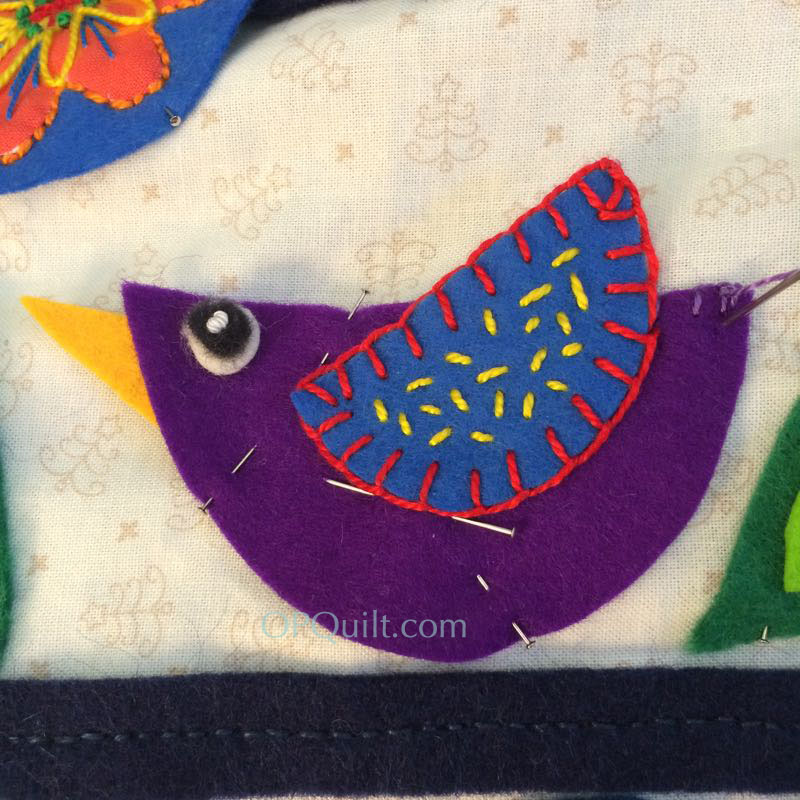
I also learned to put a regular pin right in the middle of my decorations just before I started sewing them on, so they wouldn’t buckle.  I have one bird who looks like she is expecting, as the wool can shift as you are attaching, bubbling up.  I’ll show the Mama Bird to you later.

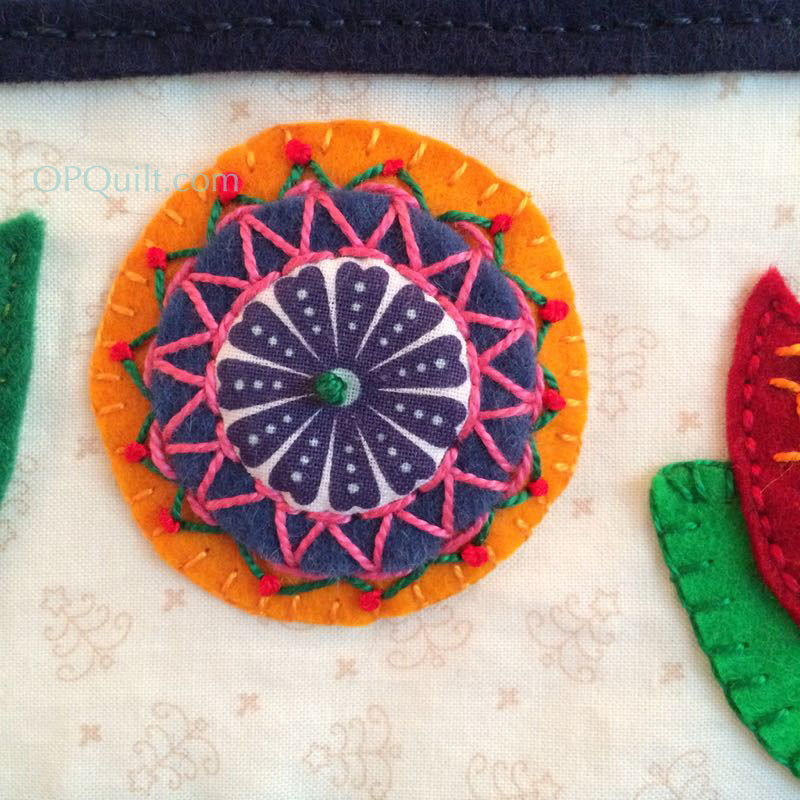
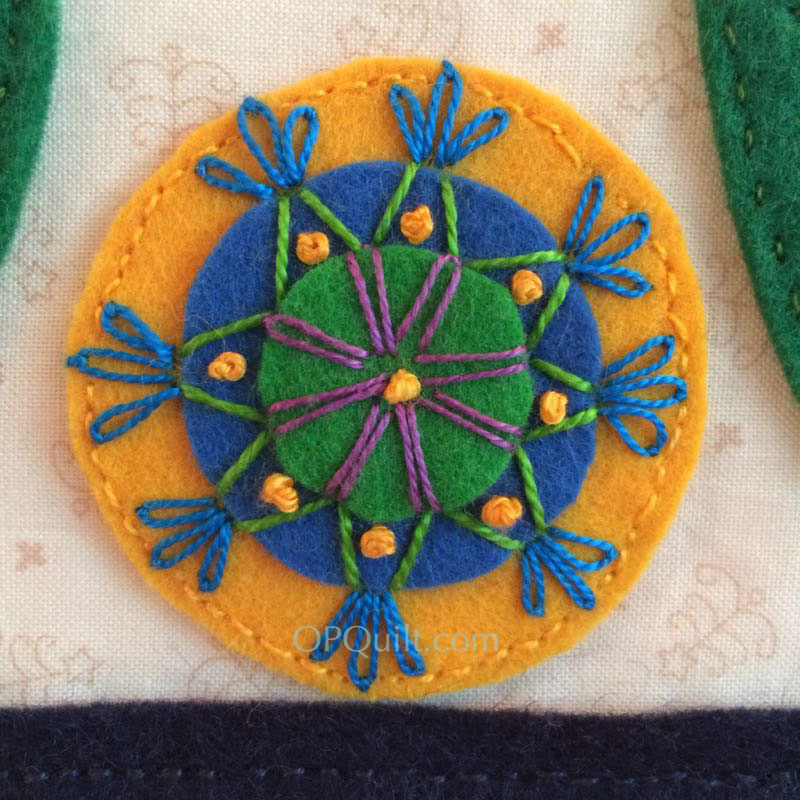
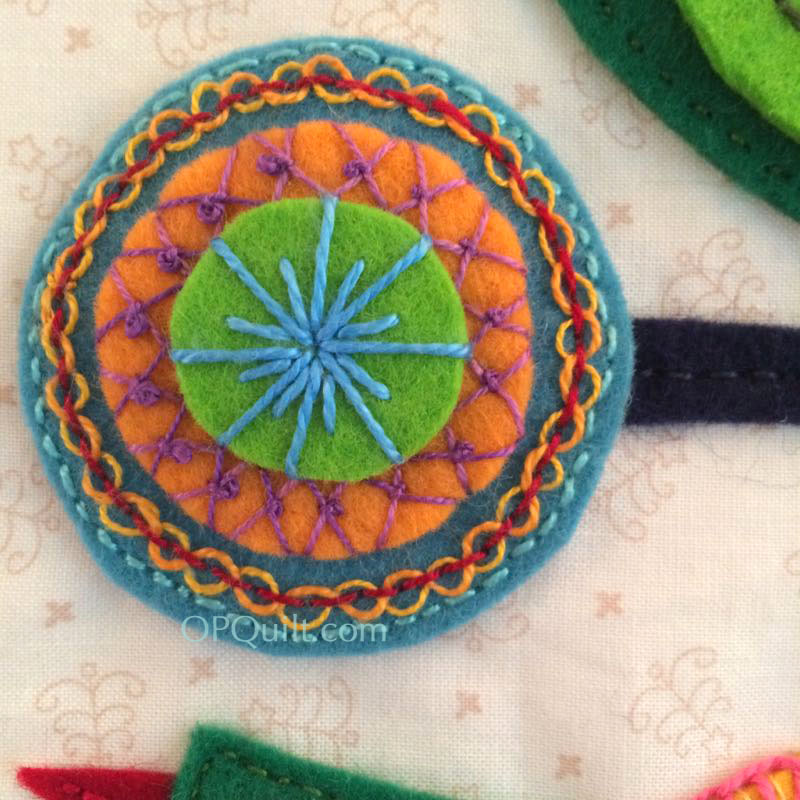
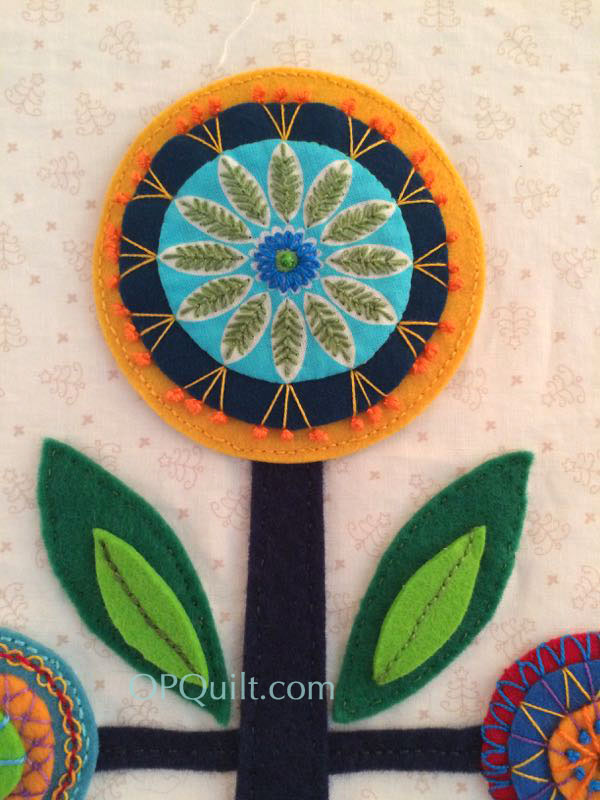
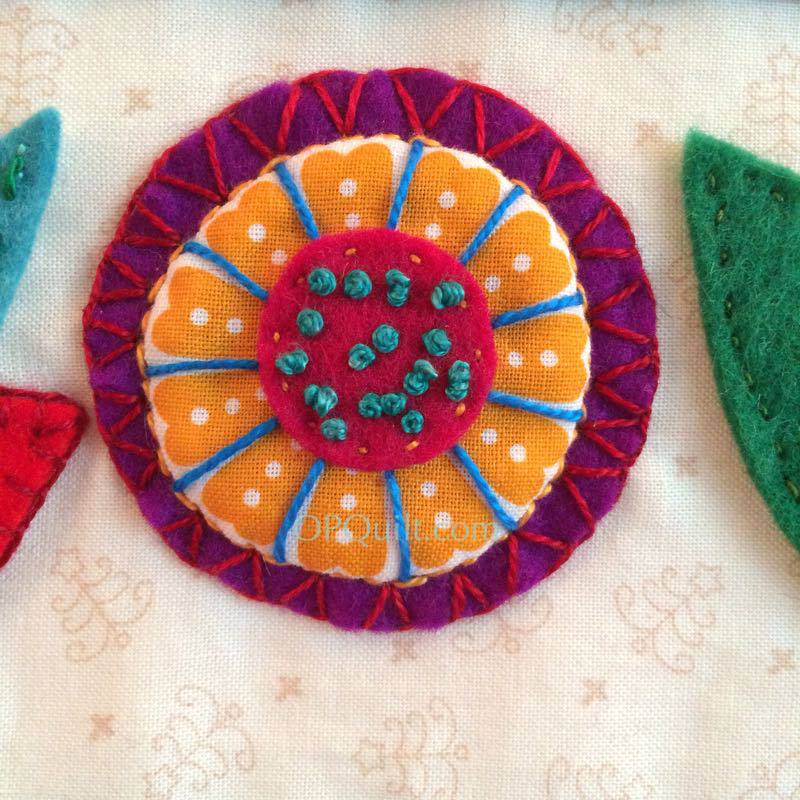
Now for some general tips about attaching the flowers and birds.  Before we talk about different ways to sew them to your tree, here’s a couple of photos of circles before attaching, showing various state of “close-to-the-edgeness” of the embroidery.ohchristmastree4_1flowers
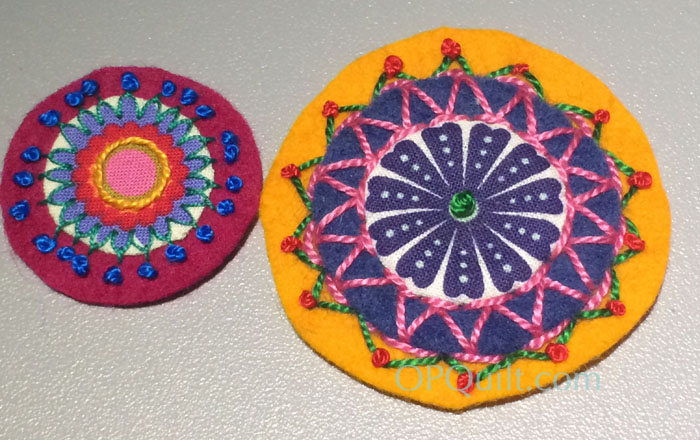
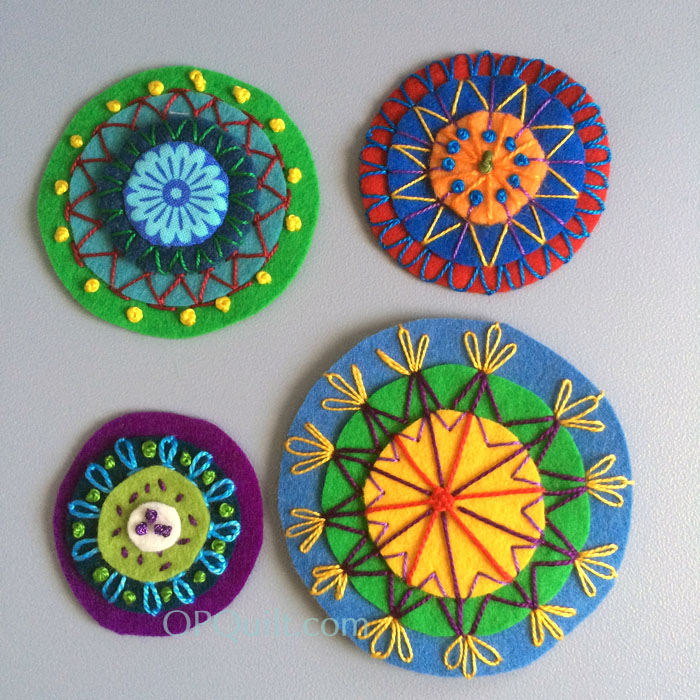
After I pinned these to the tree, I went in and added another circle under the red one, giving it a bit bigger presence.  Ditto on the purple circle below.  You may find yourself making small alternations after you get everything pinned down, either adding leaves and circles as Wendy did, or giving another border to a too-small/wrong-color flower, like I did.ohchristmastree4_1flowers2
ohchristmastree4_5

I group the way I sewed these down into two categories: A) snuggle a stitch in or around the existing embroidery, or B) adding another ring of decorative embroidery to affix it to the background.  Let’s do the A-category first.  You saw the flower medallion above; I attached it with tiny stitches at right angles to the outer edge in a matching thread.
ohchristmastree4_5a

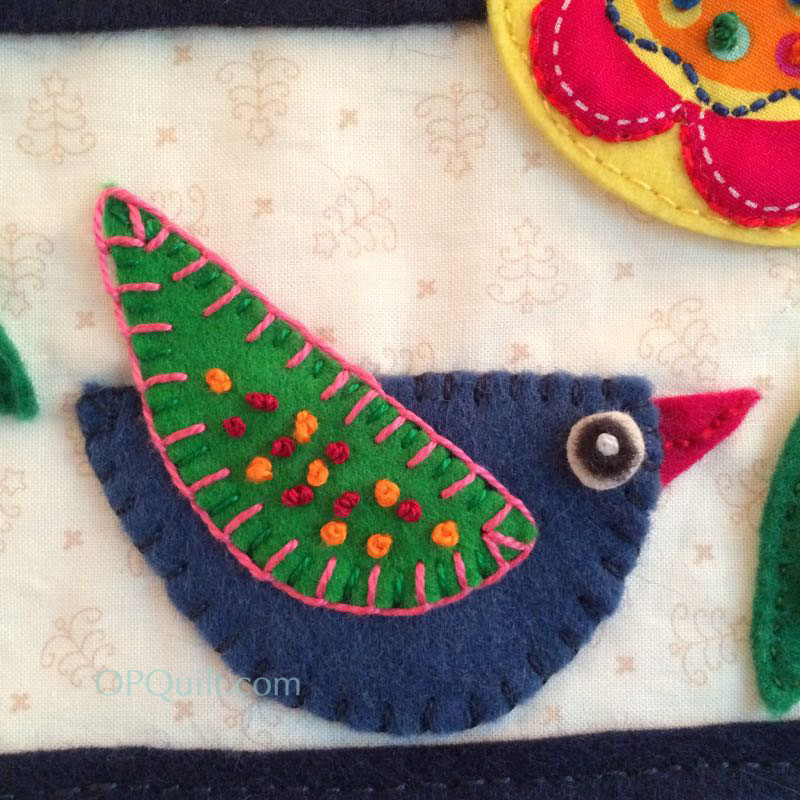
Wendy often leaves the wings undecorated, using the “attachment phase” to put the stitches on, but I’d already embroidered them when she told me this, so I sewed it down to the background by using a small matching (green) thread in between the existing decorative (pink) stitch.
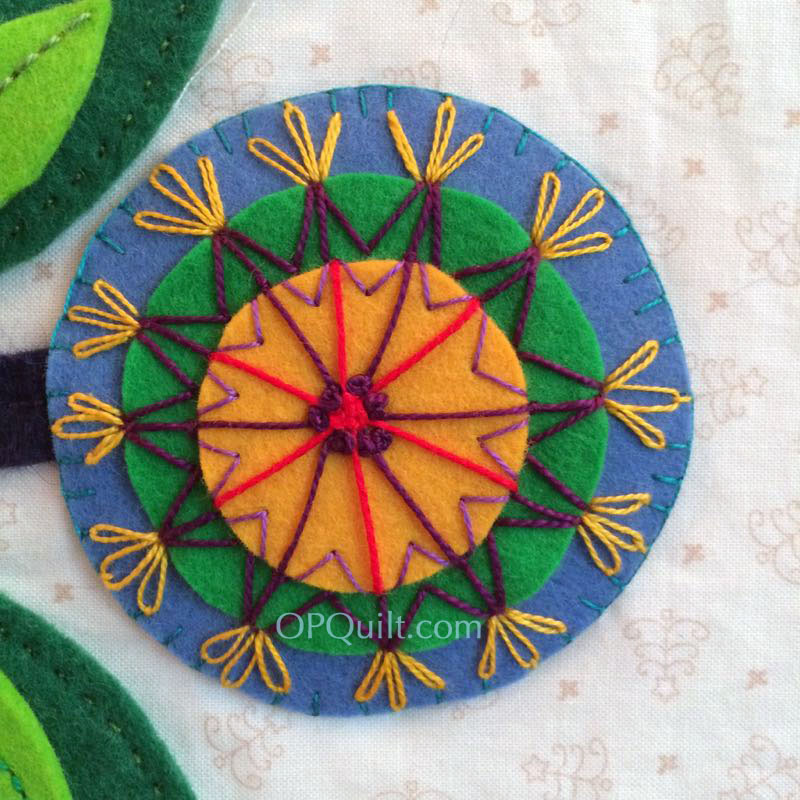
ohchristmastree4_5eI used the small perpendicular stitch again here in matching (blue) thread, but varied the length of them slightly, so the longest are between the yellow stitches and the shorter stitches are near the yellow.
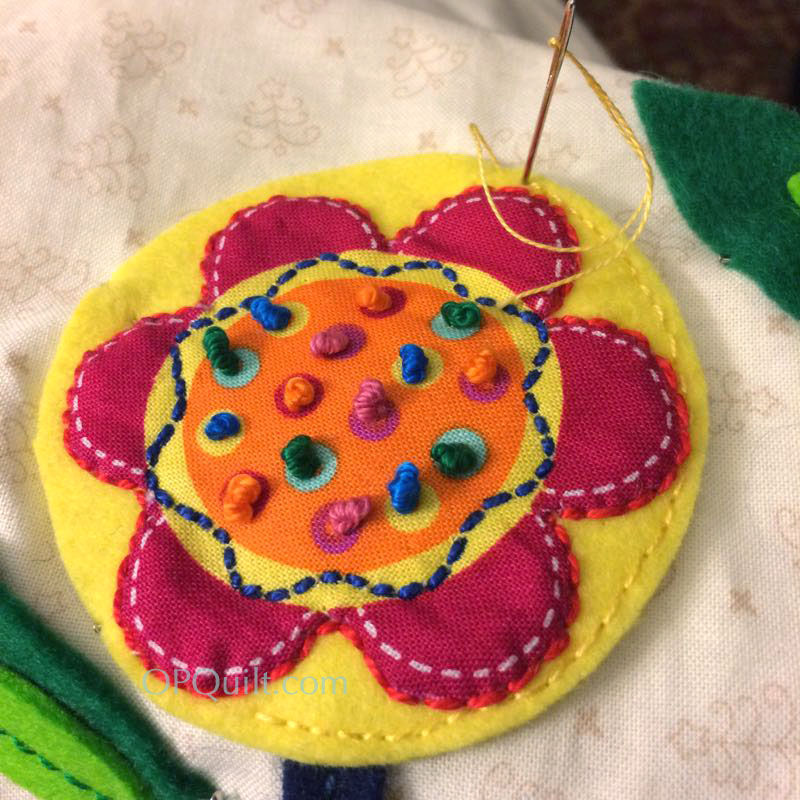
ohchristmastree4_15I also decided to keep some flowers simpler, and did a simple backstitch around the outside edge.  Keep it smallish and even, and you’ll get questions like I do: “Did you do it on the machine?”  No, and if you look closely, you’ll find the bobbly places.  Remember, this is folk art and we aim to enjoy ourselves!  More backstitching:ohchristmastree4_6 ohchristmastree4_6aohchristmastree4_6bohchristmastree4_6c
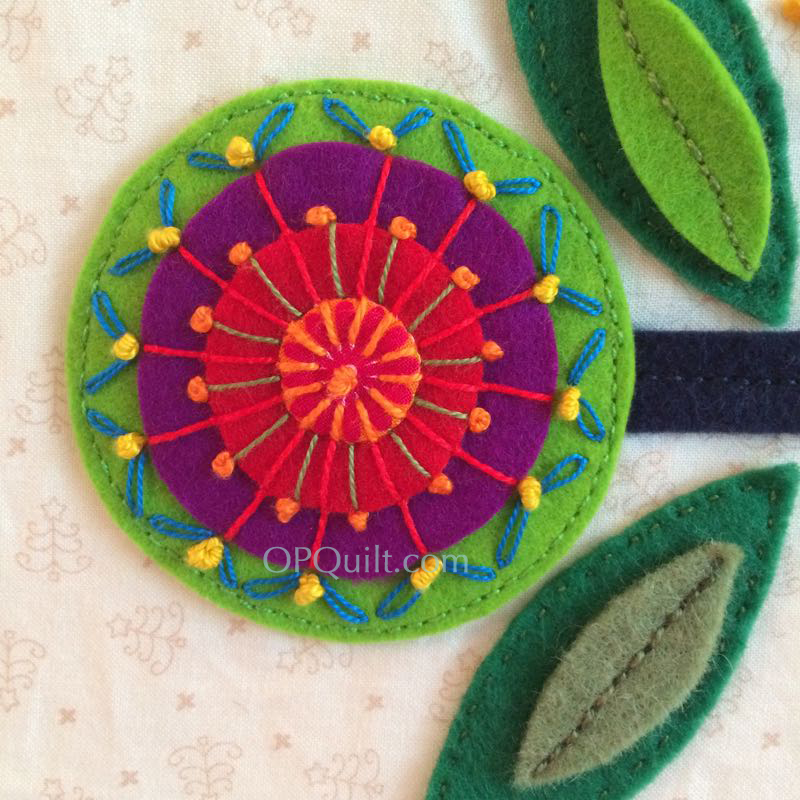
Now for some B-categories: adding another bit of embroidery to attach them.ohchristmastree4_5b
This is a slanted buttonhole stitch.  It’s done exactly the same as a regular buttonhole, but instead of keeping the needle perpendicular to the outside edge, you slant it.  I like the look of this one a lot.ohchristmastree4_5c
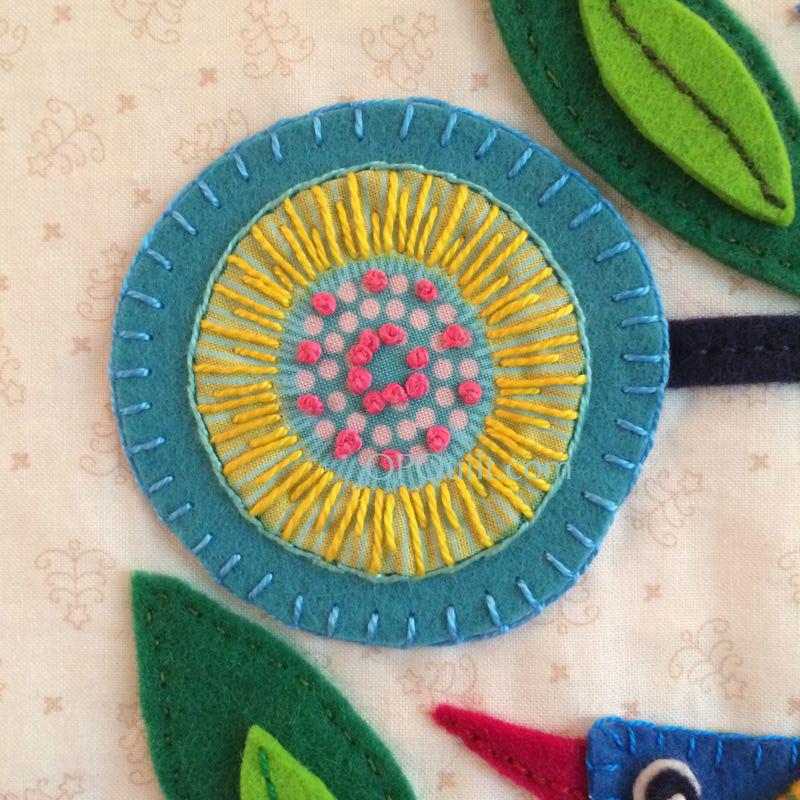
Regular buttonhole.  I used matching thread if I thought the flower was busy enough.ohchristmastree4_5d
Here’s where I used the backstitch (on the small yellow flower, left) and then used a different color of thread in a buttonhole stitch (magenta flower, right).ohchristmastree4_5f
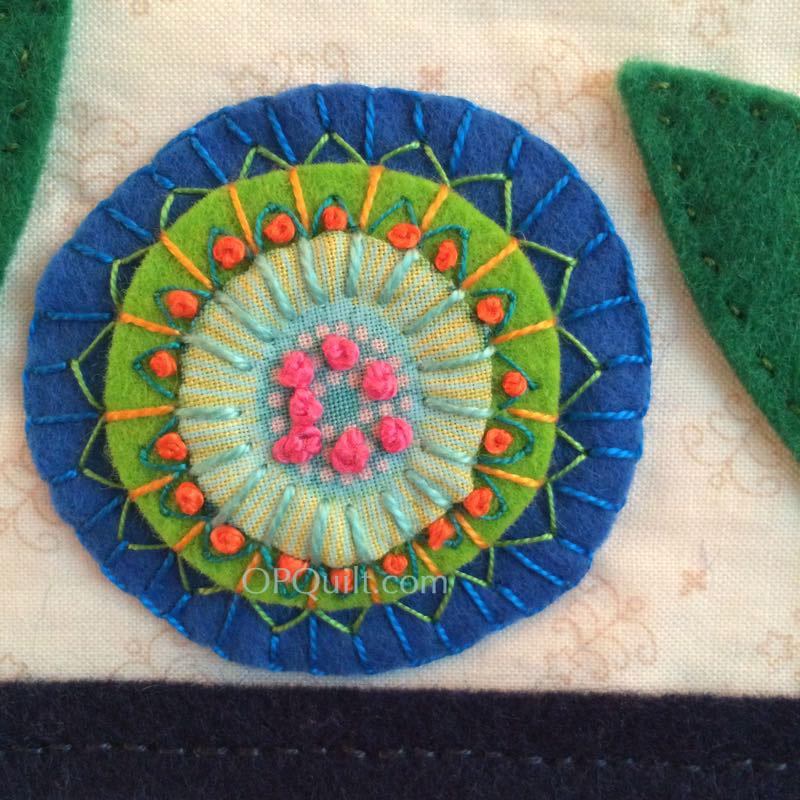
Here’s an “un-even” buttonhole stitch, with shorter and longer “legs” of the stitch, co-ordinating with the existing embroidery.
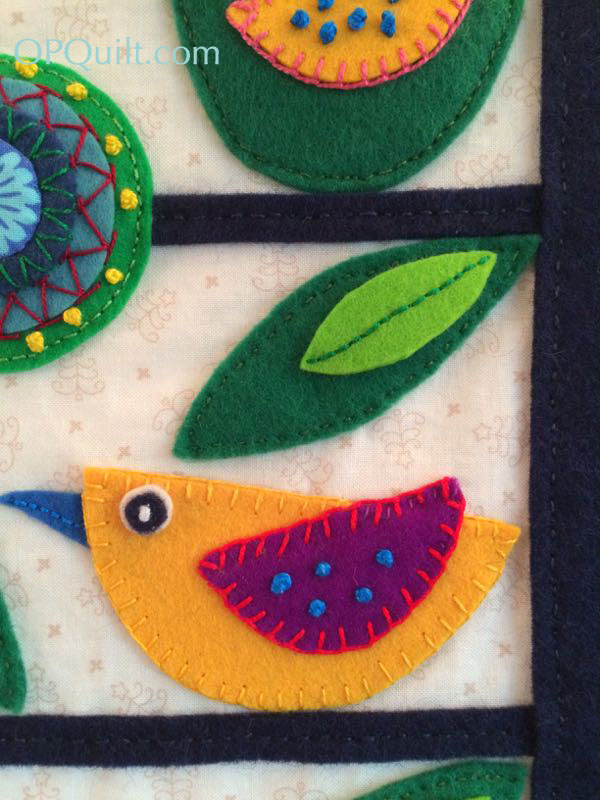
ohchristmastree4_7

This bird was sewn on with a matching yellow thread, buttonhole stitch.  But I slipped a smaller seed (or regular) stitch in between the existing red buttonhole stitch on the yellow bird’s wing to sew that down.  ohchristmastree4_7a
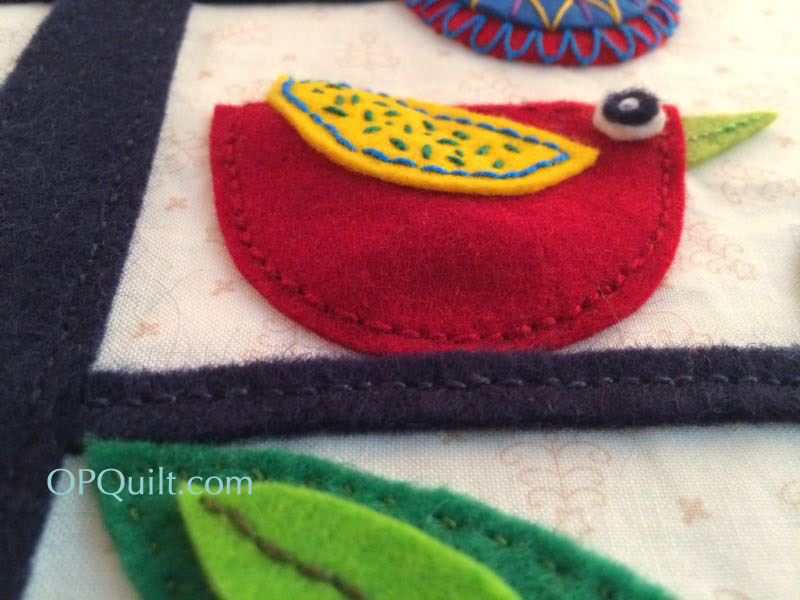
Photography of women depends on flattering angles, but I dropped the camera down low so you could see my pregnant bird.  She didn’t start out that way, but the wool shifted.  The bubbling up is exaggerated from this angle–it’s not really noticeable from the front, but now you know why I started putting that pin in the center of my birds and flowers as I stitched them down.  Didn’t have that trouble with the leaves, for some reason. She’s attached to the background with a simple backstitch.  I also did a line on the birds’ beaks.  I tried to make them happy birds (It’s Christmas, remember?) by the slight curve of the stitching, but some of the birds turned out a bit moody.ohchristmastree4_8
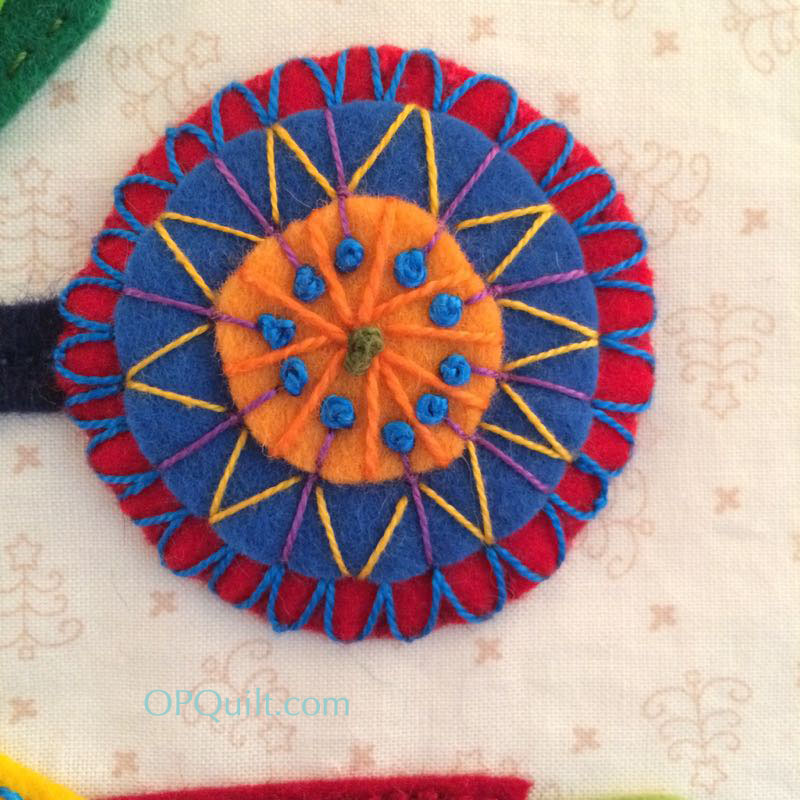
This is another where I snuck a small stitch in between the existing embroidery (A-category), and below, the last photo (!) where you can also see detail on the bird’s beak.ohchristmastree4_9
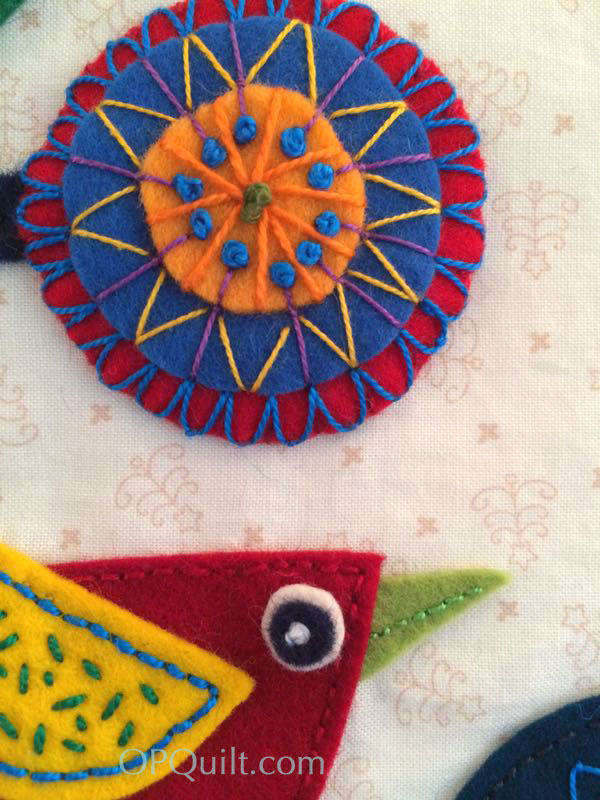
We are definitely getting closer to the end, now, and I’m pretty excited.  Next month (June 2nd), I’ll have an alternate scene for you for under the tree, and then we’ll roll out from there.

ChristmasTreeLogoSM

No giveaway this month, but here’s a recap of our schedule:

January, Step “prepare”: buy the magazine, books, gather your fabrics, buy the felt/wool, buy/find the pearl cotton.
February, Step 1: Make the tree on the background and stitch it down.
March, Step 2: Make 21 flowers.
April, Step 3: Make 10 birds and all the leaves.

May, Step 4: Appliqué down the flowers and birds.

June, Step 5:  Scene at bottom of tree–make, then appliqué onto background.

July, Step 6: Sawtooth border (reds); sew together and attach.

August, Step 7: (finish up Quilt-A-Long): Make wonky star blocks, sew them together and attach border #2.

September, Step 8 Show and Tell, just in time for school starting again.

Yes, we cut a month off our sewing, so you’ll have plenty of time to finish your quilt before December.

Happy Stitching and we’ll see you in June!
Quilts

Downtime Sewing • Odds ‘n’ Ends

chickentimeflies2

Or as my friend used to say, “Time flies whether you are having fun or not.” So what have I been doing?

Spelling Bee Blocks_April 2016

Blocks for our Spelling Bee for Carla, who has just opening a knitting shop.  I made two and then one more for Simone, whose daughter is getting married and she’s making the wedding dress.  She gets a pass, I’d say.MCM Bee Sewing

I made bee blocks for Mid-Century Modern Bee, for Stephanie, who doesn’t really run a blog, but is here on Instagram.  Actually she’s in Russia, but try not to hate her.  It looks like a fabulous trip.Shopping Bags Scout auction packet 4_16

Did (what I call) Duty Sewing to make an item for the Scout Auction at our church.  I was thinking Scouts=Food, so I picked up four boxes of treats at Trader Joe’s, a Dairy Queen gift card and two shopping bags, and wrapped them all up fancy.  It’s to help raise money to send boys to camp.  I used to be in the boat of forking over moolah for Scout camp (I had three boys), and am really really happy to be at this end: donating, rather than doing.planted garden_April16

Planted my summer garden.  This time we didn’t buy the fancy-schmancy tomatoes at the Swanky Garden Center, but instead went to the local nursery and Lowe’s.  They look much healthier.  Things that grow in my garden are an endless fascination to me, and I sometimes check the seedlings daily.  I’m #goofyaboutmygarden, thank you very much.Market Sewing

Did some market sewing for a friend.  I also made plans to go to market, courtesy of Painter’s Palette Fabrics, who I sewed a quilt top for. . . and now I get to see it!  Can’t wait–so excited.IG Fun April 2016

Perused Instagram.  I had no idea that people still crocheted granny square bedspreads.  My horizons are widened every time I follow a hashtag that’s new to me, in this case #makersmovement, which is for (duh) people that make things.  We used to be called crafters.  I like the term Makers much better.Halloween Blocks

Finished up last month’s blocks for the Halloween QAL and got the blocks ready for this month’s post on May 13th.  You know, when you break down a quilt into chunks, it’s much easier.  And I know I would have never have gotten this far, if it hadn’t been for the fact that I had to make the bits of the quilts to post.  Thank you very much for putting up with me.First selfie

Cleaned out Started cleaning out the photo cupboard, where I found my First-Ever Selfie, painted when I was six years old and in Brownie Scouts.  Interestingly, we didn’t have a dog at that time, even though I painted one in the picture (wishful thinking?).GameThrones1 Dbrovnik street

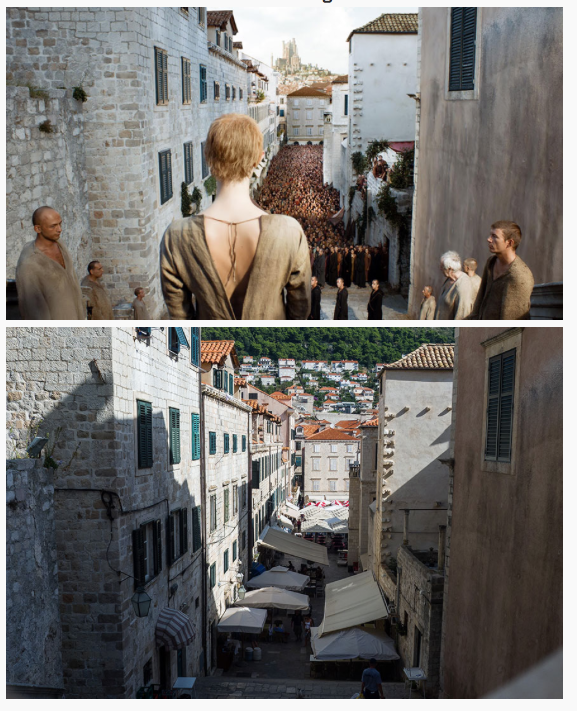
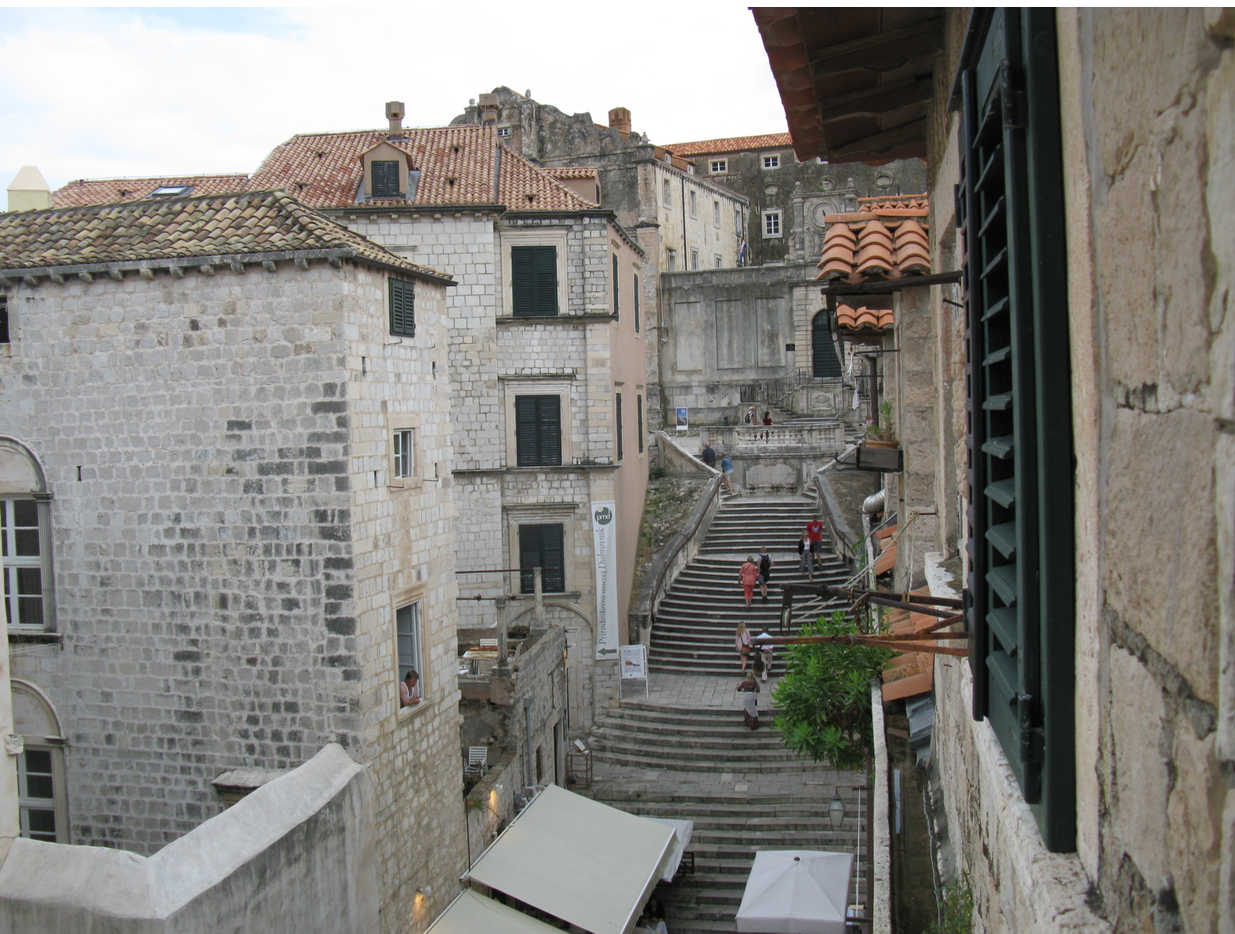
Found out that the street where we stayed in Dubrovnik, Croatia in 2014, was one of the sites used in Game of Thrones, a show I have never seen.  In the top photo (taken from the web somewhere) is the scene from the movie.  The middle photo is their comparison of how it looks when it’s not been movie-fied, and the bottom photo is taken by me, leaning out our window, looking back up the street.  I found this out one day when I was reading the NEWSPAPER (yes, I’m that old) and saw the top photo.  I ran upstairs to compare mine with theirs, then found the middle photo on the Internets.Costco macaron

Another eureka moment was when I discovered that Costco sells macarons.  Yes, I have two boxes in my freezer right now, but I gave away the coffee-flavored cookies to a neighbor (I hate the taste and smell of mocha/coffee).  I’ve also gotten three bids on a new HVAC system, and one guy is wandering around my house right now, taking mea$urement$.biscotti

In the cooking department, I made biscotti to take to my son, who lives in Normal Heights, in San Diego, California. My recipe is *here.*

Normal Heights Fabrics

Found out there is a fabric store in Normal Heights, in a former movie theater, which had some silk shantung, perfect for working on my Four-in-Art project for the May reveal.  I’ve also been to the doctor’s twice, but the patient — like Mayor Shinn’s wife in the movie The Music Man — will recover.

4-in-art_3

Coming soon to a blog near you, on May 1st.Design Wall April 2016

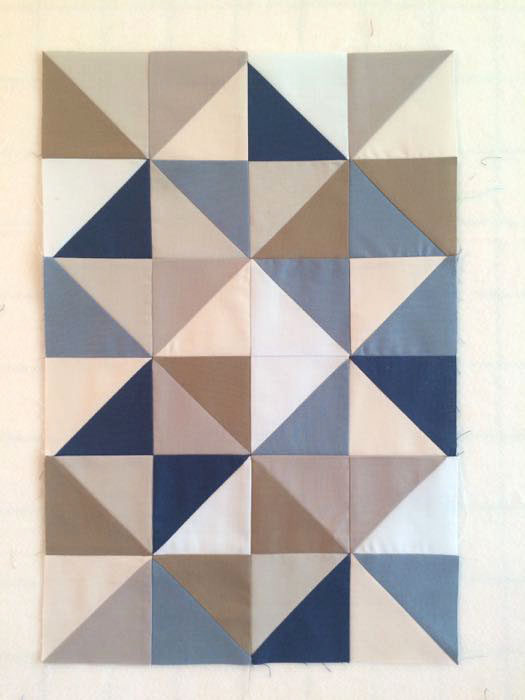
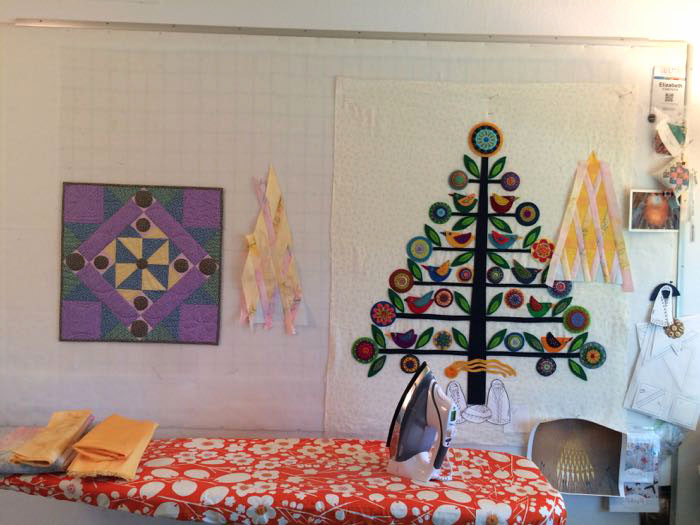
And my design wall last week, as I was figuring out a scene for under the Christmas Tree (next step is coming May 2nd), working on my Four-in-Art art quilt, and enjoyed a completed mini–a sample to check on how my pattern worked for some more market sewing, which I’ll show you very soon.  (You know the game.)  Now back to the sewing.

Quilts

New Quilting Machine

HQ Sweet 16_1 HQ Sweet 16_2 HQ Sweet 16_3

So here’s a short story:  This all started two years ago when I test drove a Bernina FancyPants Machine during one of my Road to California classes.  That thing could do everything but cook dinner, and I pined about it for a year.  I love my current Husqvarna Quilt Designer machine, but it is coming up on it’s 14 year-old birthday and one morning, I woke up with an unhappy touch screen.  Horrors! and so the intensity of my search increased, or at least the anxiety of wondering when my machine would conk out on me.  Then I took a domestic free motion quilting class with David Taylor this year at Road to California and at first, I was unhappy that we were working on Handi Quilter’s Sweet Sixteen machine–what?  No teensy weensy harp space of my regular domestic?  But the techniques are the same, so I took to this machine like a duck to water.

HQ Sweet 16_4

Now I needed TWO machines: one to replace my aging Husqvarna and this new Sweet Sixteen quilting machine.  But I only had resources for one.  After some time to think about it, I decided I could prolong the life of my Quilt Designer if I took the quilting tasks off its back.  One afternoon last week, Richard of Quilter’s Cocoon toted this up to my guest bedroom, set it up for me, gave me my first lesson (so happy I’d had the day with David Taylor to augment what Richard was teaching me), and I was up and running.

Except I wasn’t.

I didn’t touch if for two days.  Scared? Excited? Thinking I was out of my mind?  All of the above?  But I finally put together a mini quilt sandwich and went to town, trying out new stitches, using the two rulers I’d purchased, taking it out for a test drive. Notice how all four corner blocks are different; I was having fun.  No, I don’t name my machines (but know a lot of people do, and invariably it’s always my childhood nickname of Betsy — which explains why I don’t do it) but we do refer to it as the “quilting machine,” to keep it distinguished from my “regular machine.”  (By the way, the pattern for this quilt — Ribbon Star Beauty — will be up on Craftsy later on this week.  It’s a fun little mini that sews up quickly.)HQ Sweet 16_5

My daughter has a new shop in her small town of Kingman Arizona, The Farmhouse Kingman.  I plan to send this to her so she can use/sell it in her shop.  If you drive through Kingman on your way to somewhere else, stop by and see her.  She’s in the old section of town, with a cute shop of fun farmhouse decor items.

And that’s the whole story.  Now back to quilting.

Halloween QAL · Quilts

Hallowe’en 1904 QAL–Step Three

Step 3 halloweenQAL

Welcome again to the Hallowe’en 1904 Quilt-A-Long.

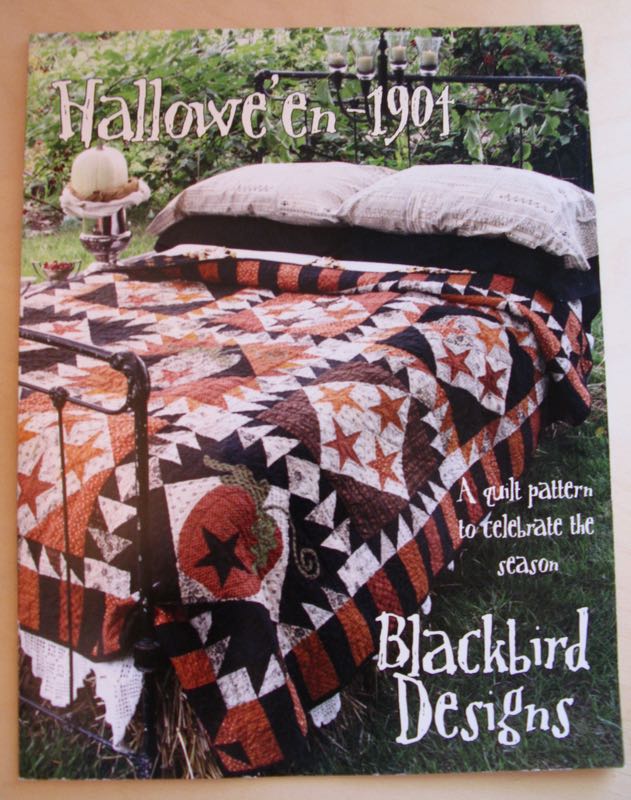
halloweenqal_pattern cover

As a refresher, we are making this quilt, a pattern from Blackbird Designs.  I must admit it took me a while to re-orient myself to what-the-heck-I-am-doing in this process, but I dragged out my box of stuff, found my pieces am ready to get going.  (If you aren’t making this quilt with us, scroll down to read about making 8 half square triangles at one time, as well as some tips for shaping bias strips.)

Springtime 2016

And of course, it’s lovely springtime in Southern California, so that really makes us feel like working on Halloween stuff, but we agreed to work early so we could hang our quilts up at the first of October, not the last.  While the original quilt has twelve blocks, my friend Leisa and I are making a quilt with nine blocks, and so have adjusted all the quantities accordingly: four blocks with appliqué and five blocks with stars.

In Step One, we gathered supplies.
In Step Two, we did all our cutting.  There is a cutting chart you can download and use to guide you.
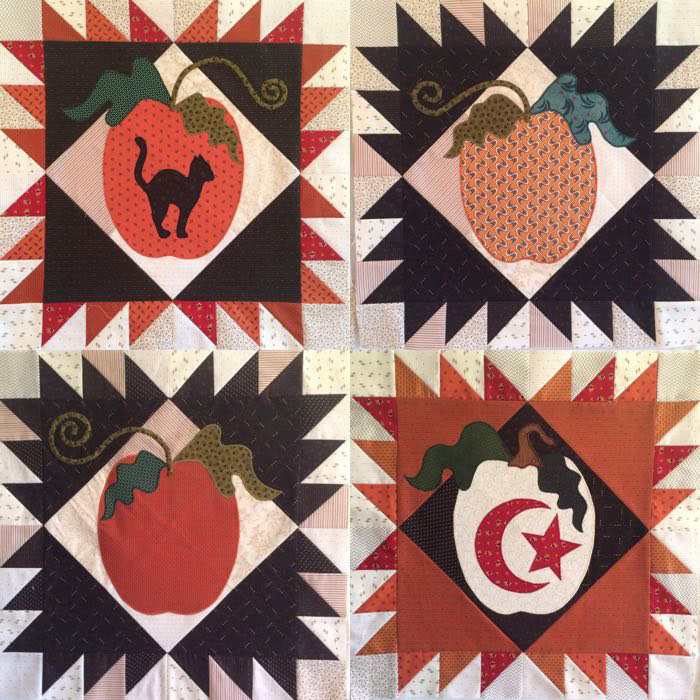
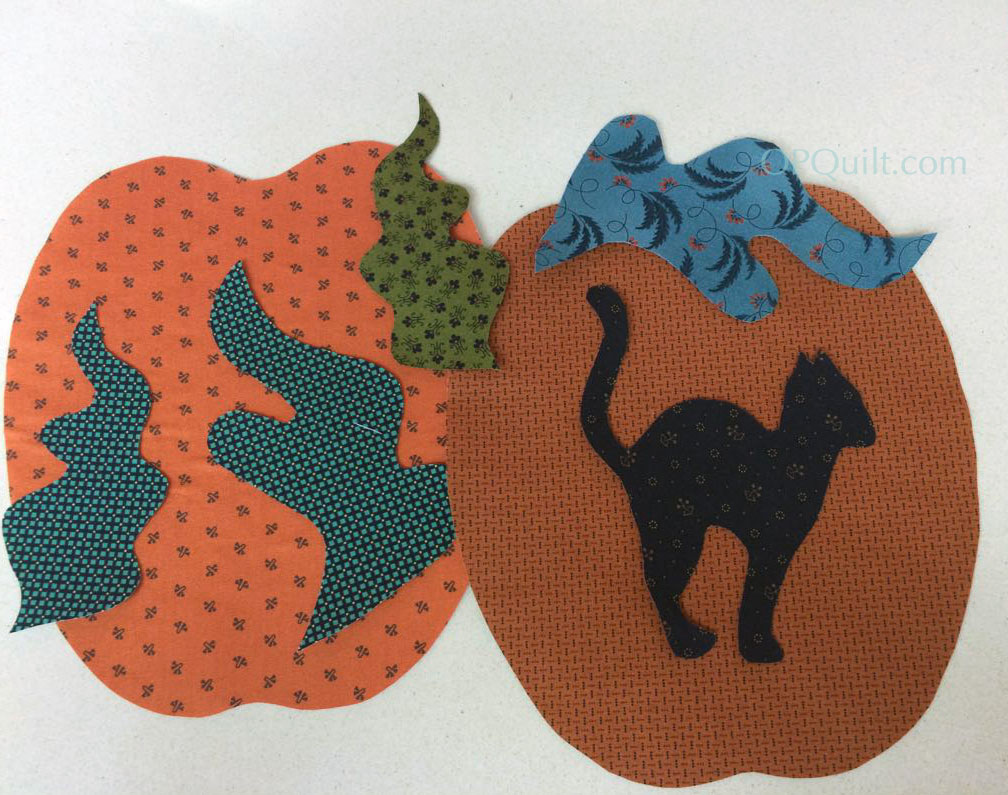
Now, in Step Three, we making the appliqué blocks with the Halloween shapes on them: pumpkin (2), pumpkin with cat (1) and moon and star (1).  We’ll also talk about how to make half square triangles (HST) more efficiently, and then about appliquéing the whole thing down.  Here we go.

Halloweenqal3_0

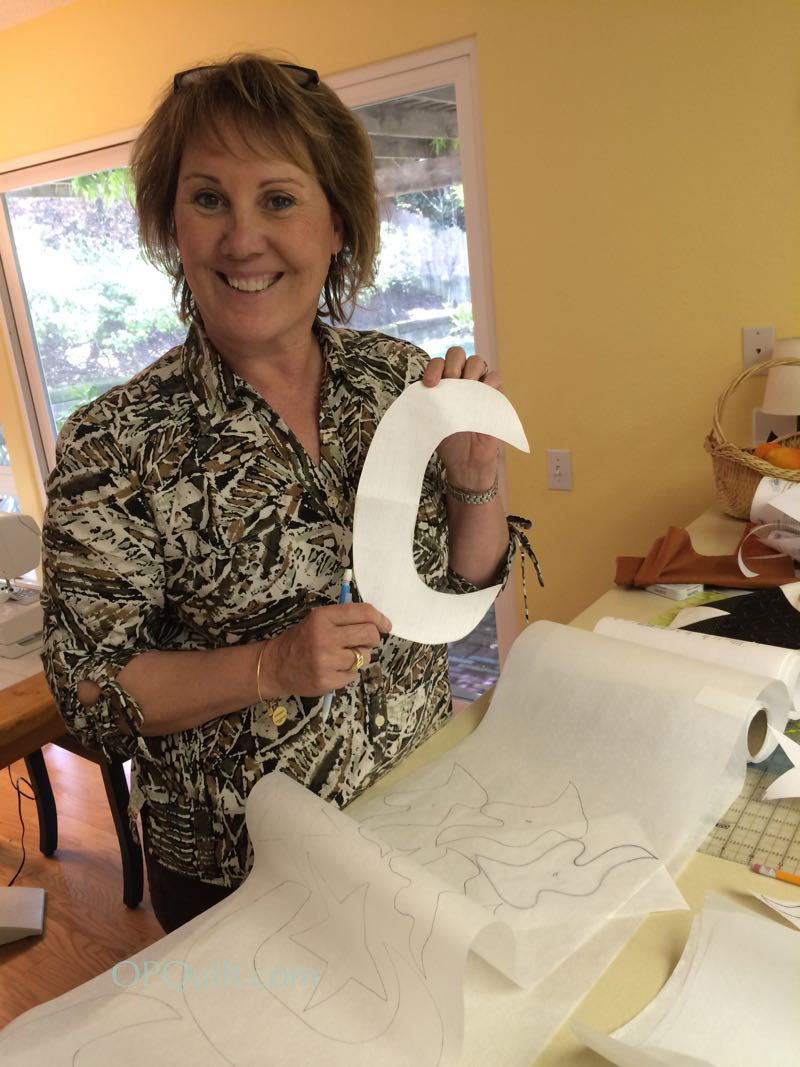
Leisa came over for an afternoon, and we started by tracing around all the templates, getting our motifs organized.  We decided to add a black cat to our pumpkin, so here is the PDF file: Halloween Cat.  Print it at 100%, so it ends up about six inches tall (or tweak it to make it bigger or smaller–whatever you like).  We wanted the cat facing to the right, so flipped it over and traced the outline on the back with a black marker pen.  Then Leisa traced it out for us on the fusible stuff.

Halloweenqal3_10

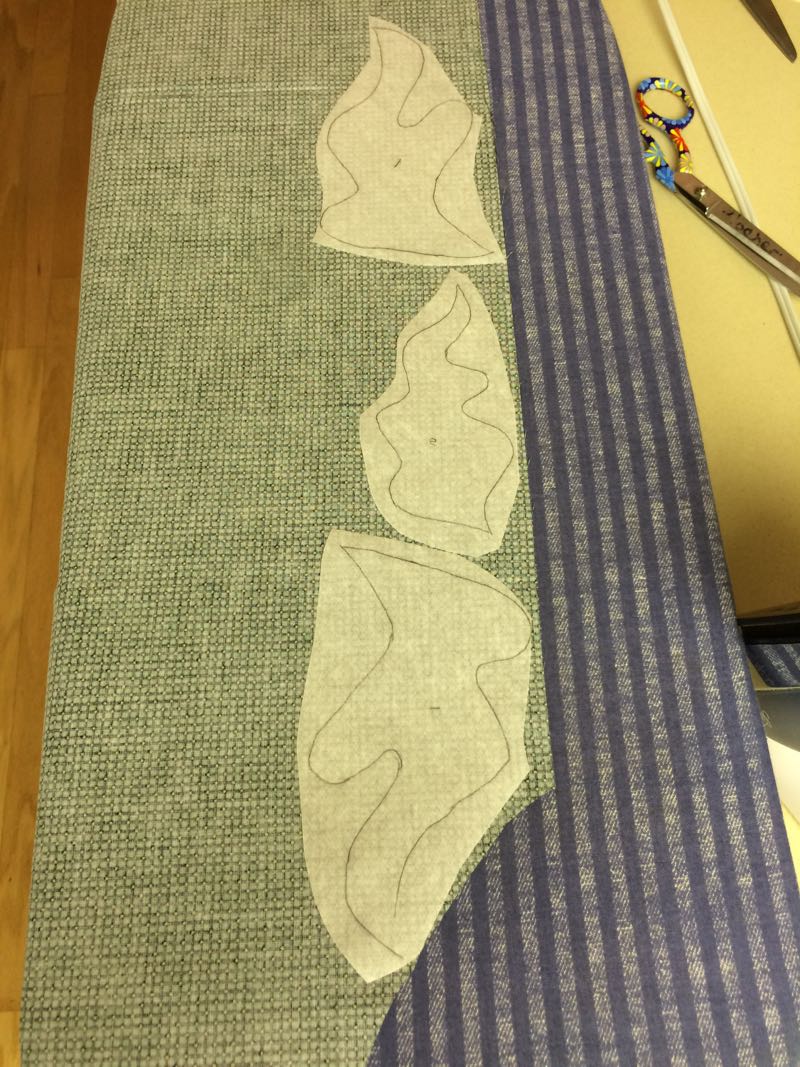
Remember that it has to be backwards, to be facing the right way.  We used Steam A Seam 2, following their directions of which paper to trace onto, and then cut the shape out loosely, after which we ironed it onto the back of the fabric.  I recommend using either a pressing cloth, or a larger piece of their release paper so you don’t get any gunk on the iron.Halloweenqal3_11

(pumpkin leaves)Halloweenqal3_12

Cut out all your shapes and then set them aside.

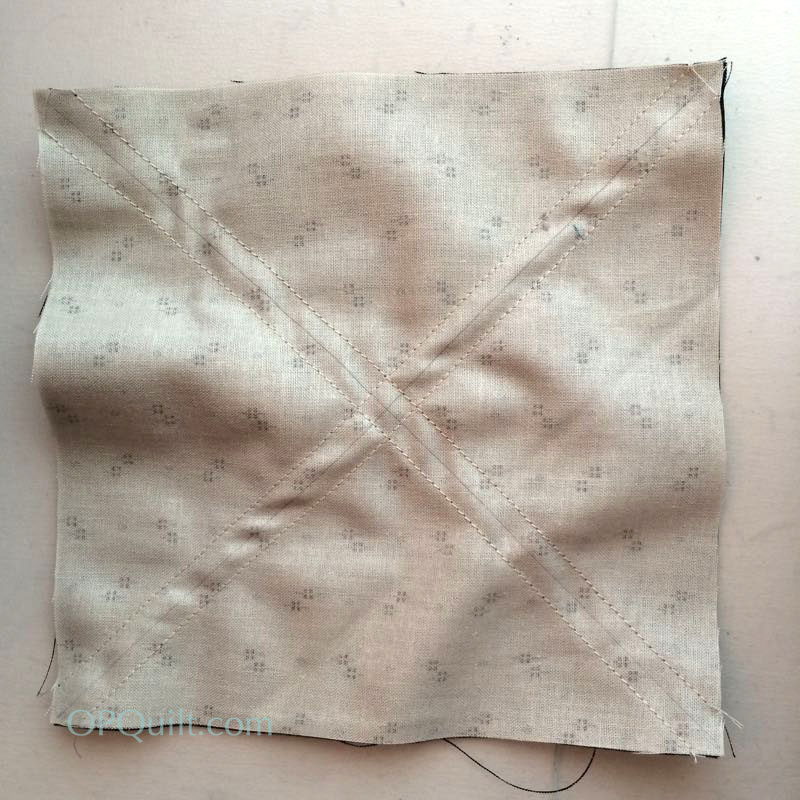
Now grab a stack of your dark and light 7-inch squares.  Layer two together, so the light is on top.  You’ll be making HST eight at a time in this next step.  This is not a new idea, but it’s explained pretty well *here* and *here* and *here.*

Somewhere in my web travels I picked up this chart: HST 8 part

I wish I knew where it was from, because it’s a great chart with lots of sizes.  If you know where it’s from (I couldn’t find it in my searches) let me know so I can give them proper attribution. [UPDATE:  Katell from France wrote in to tell me it’s from Jeni Baker’s Book Patchwork Essentials: The Half-Square Triangle.   I suggest you pick up a copy of her book, as it has lots of great tips for making perfect half-square triangles.]

Halloweenqal3_2

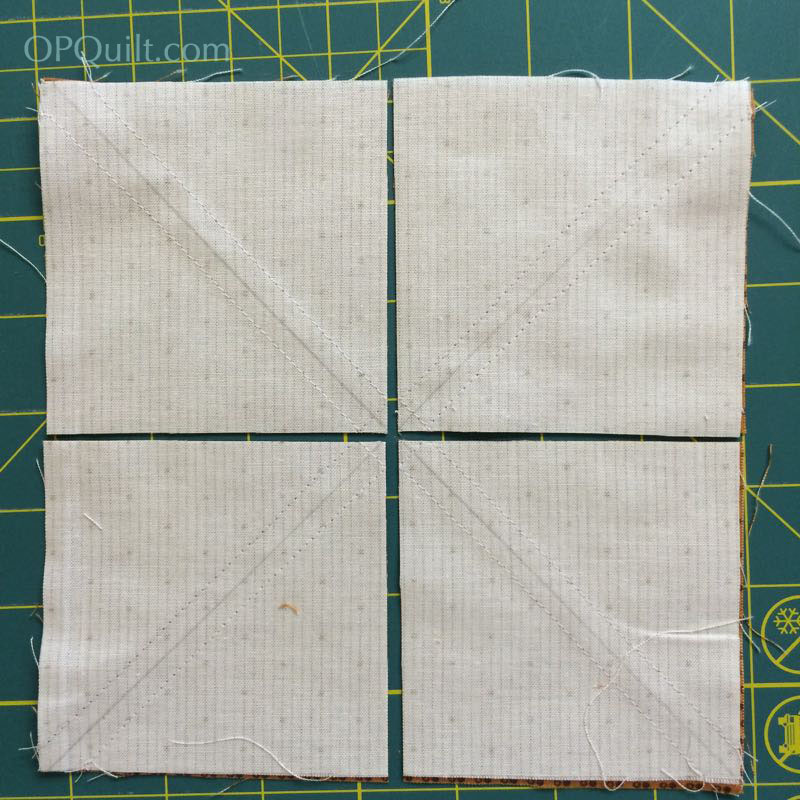
So basically, you draw two lines across the two diagonals of your block, then stitch 1/4″ away from either side of the line.  It looks rumply because you’ve been sewing on the bias.Halloweenqal3_3

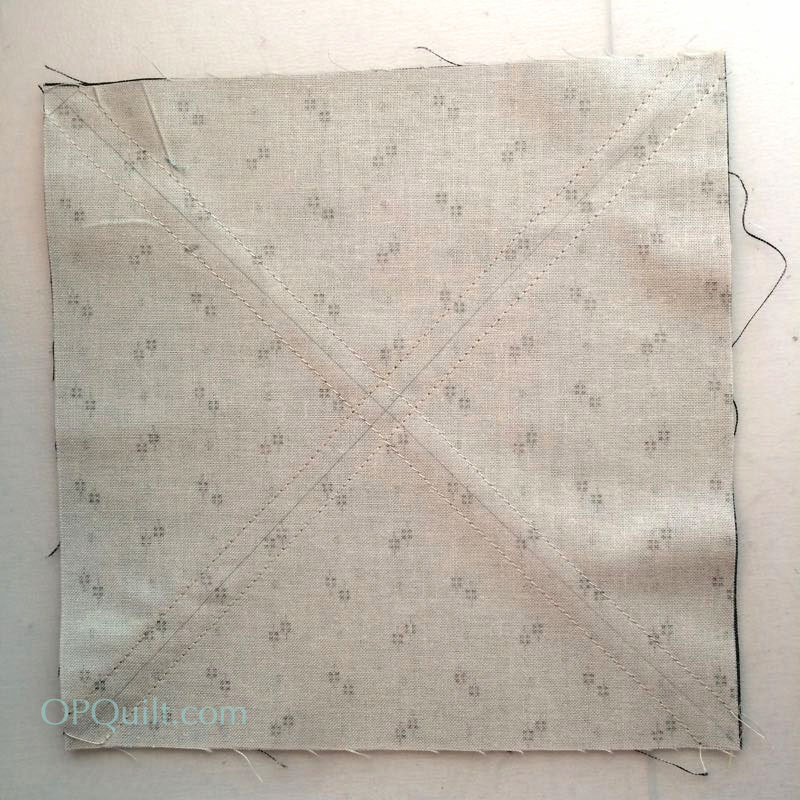
Take it to the ironing board and press and steam out the block so it lays flat, and the stitching is nestled into your fabric.
Halloweenqal3_4

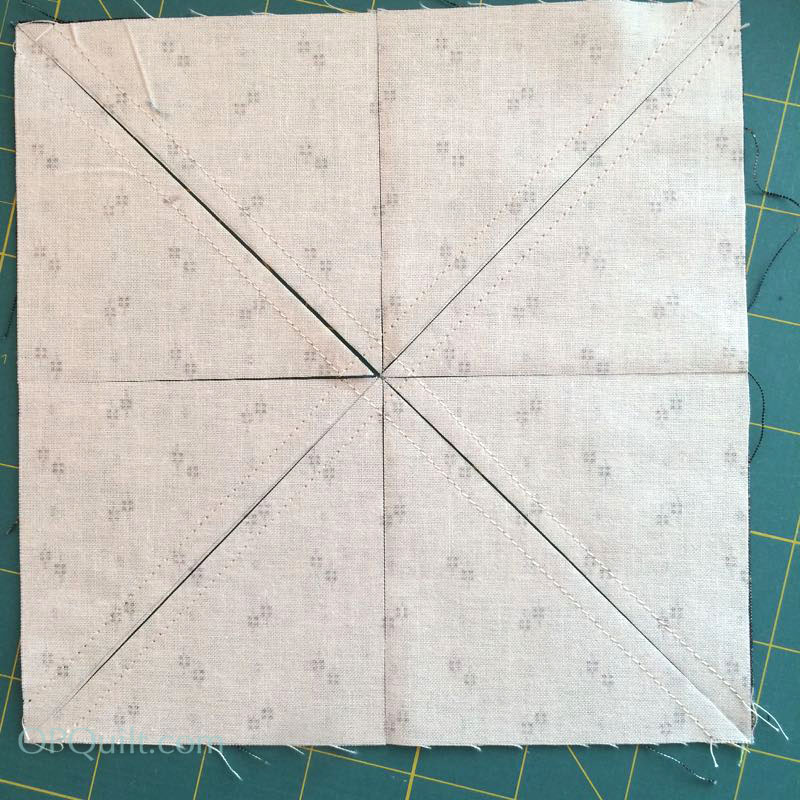
Now you’ll be cutting across the block in two ways, as shown by all these extraneous photos.  I’m sure you’ll get it after seeing all these.Halloweenqal3_4a

First cut side-to-side and top-to-bottom. Don’t slide them apart–mine are that way just to show you.Halloweenqal3_4b

Then cut along your penciled lines.  Again, do it while everything’s together.  Mine are apart for illustration purposes only.Halloweenqal3_5

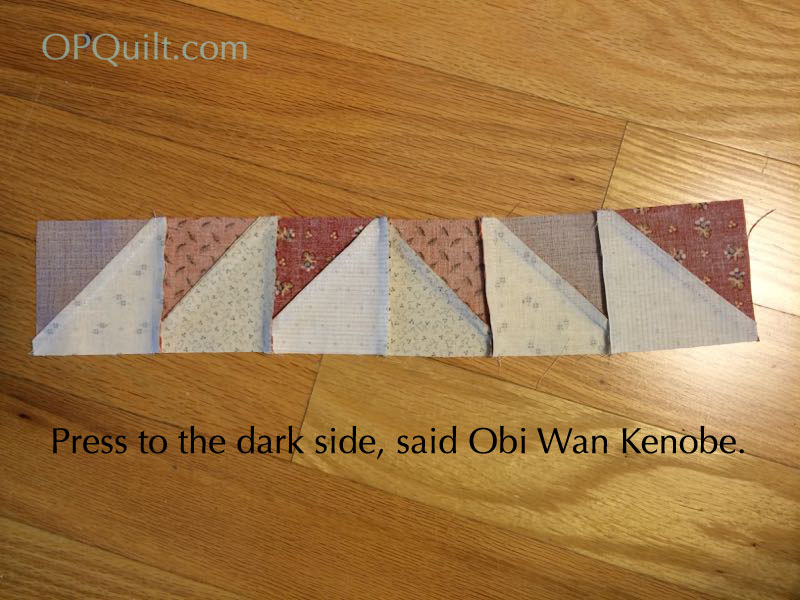
Take the triangles to your ironing board and press to the dark side (insert Star Wars reference here). Halloweenqal3_6

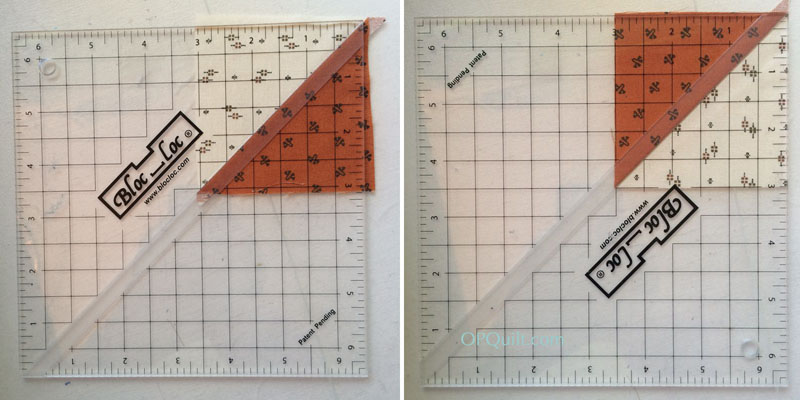
I use a Bloc-Loc ruler (6 1/2″ size) to true them up to 3 inches square; it has a groove in it that fits neatly over your seam and makes truing up much easier.  You’ll need three sets of these blocks for each large block in this quilt.  You’ll repeat this process, choosing different darks and different lights.  Let’s do that math again.

Each Eight-at-a-Time square makes. . . 8 HST.  You need 24 HST per quilt block, so you make three sets.  I tried to vary my fabrics, using three different lights and three different darks (or oranges).  You’ll find out why you want variety in a minute.  After they are all trued up to 3″ square (all 24 per block), set them aside.Halloweenqal3_7

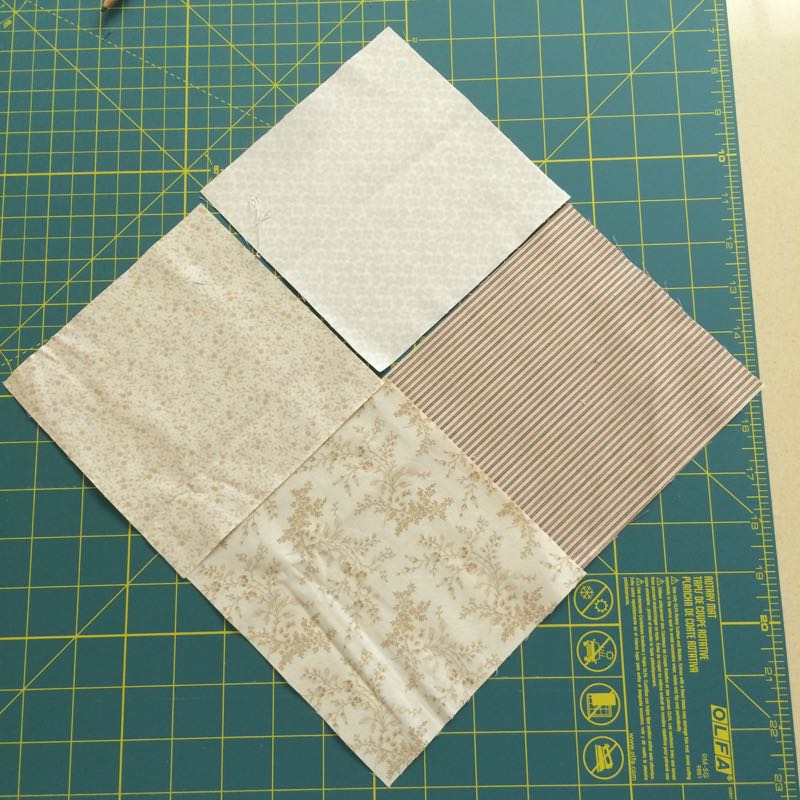
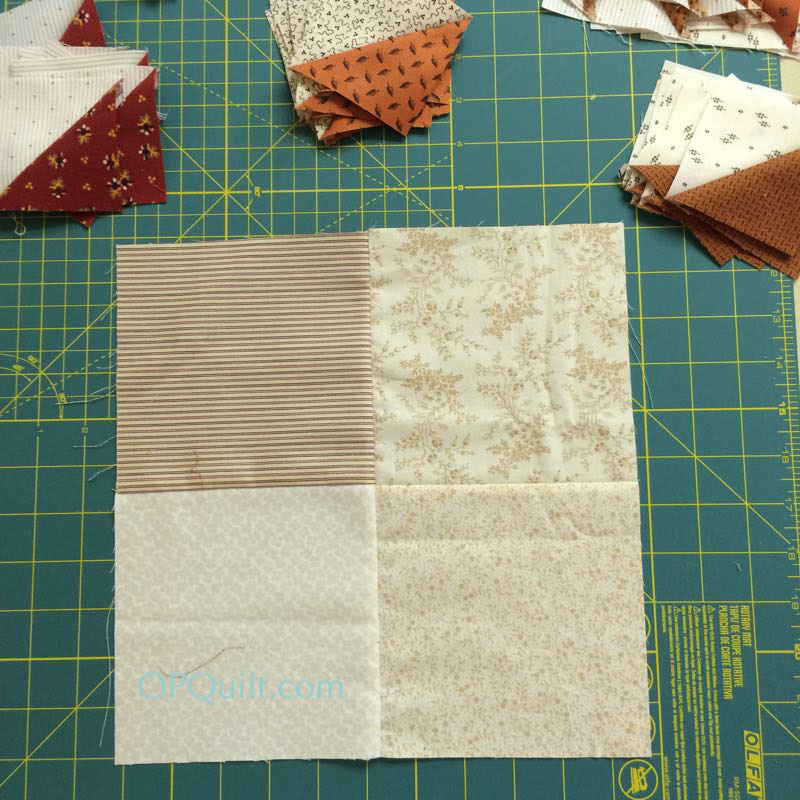
Take the smaller light background squares, and choose four.  Stitch them together:Halloweenqal3_7a Halloweenqal3_8

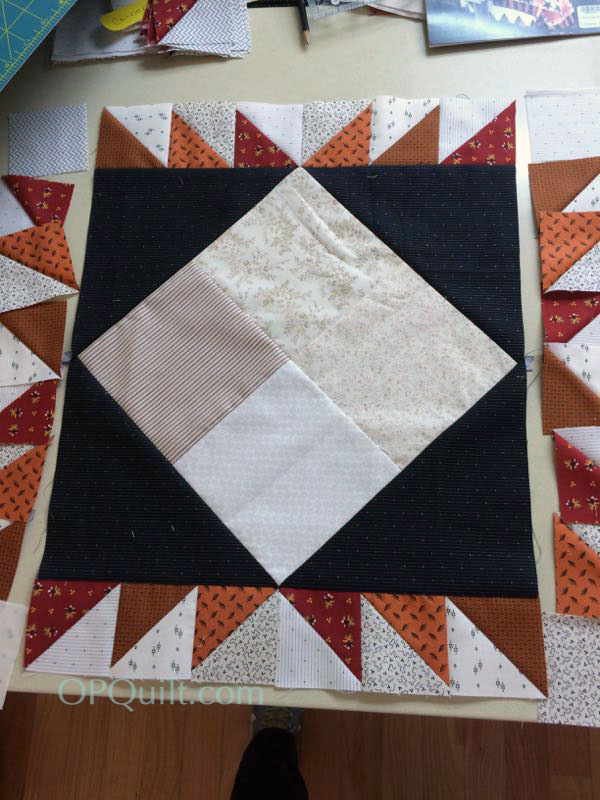
Choosing either black or orange, sew on four large triangles, two at a time, to your set of four light squares.
Halloweenqal3_8a

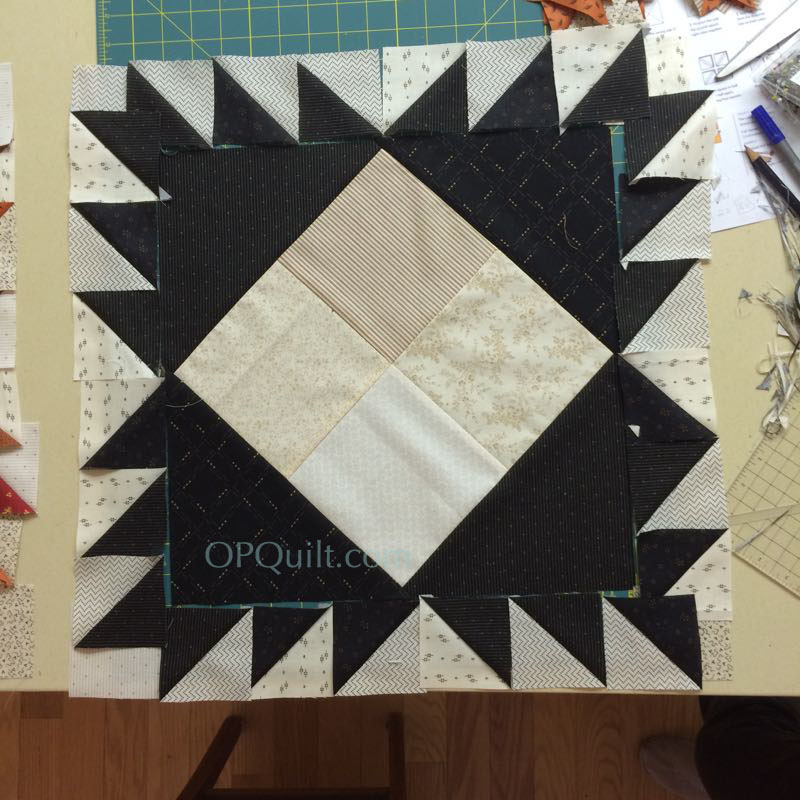
Grab your stack of HSTs.  Starting with one set, distribute them around the block, two per side, spacing them randomly.  I also put my smaller corner blocks down, so I can make sure to keep everything as random as I can (trying NOT to match the fabrics, but sometimes it happens. If it does, don’t fret).
Halloweenqal3_8bHalloweenqal3_8c

Here’s mine (orange HST) and Leisa’s (black HST).Halloweenqal3_9

Start with the lower edge of triangles; sew them together in a strip.  This goes on very smoothly if you are using a 1/4″ seam allowance when you stitch (not 3/16ths” and not 5/16s” Strive for accuracy).  Press to the dark side (okay, I couldn’t resist).

Halloweenqal3_9x

Matching up that center spot, pin, and then stitch the row onto your larger block.  Press toward the larger block.

Now for the side rows: pin, but add on the corner blocks on each end.  Press the row’s seam allowances toward the dark side EXCEPT for those corner blocks.  On those, I pressed toward the corner block, so that putting this together would be easier (the seams will nest–you’ll see what I mean).  Now attach them to the larger block, matching those corner seams, and stitch.  Press toward the block.

Halloweenqal3_9b

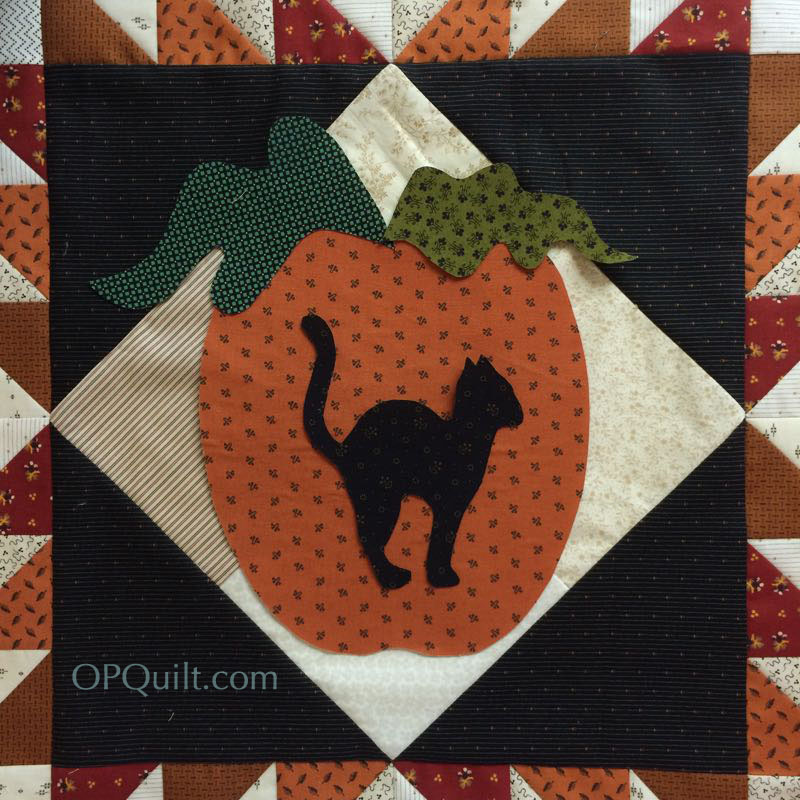
Ta-DONE!Halloweenqal3_13

Get your cut-outs, and start playing.  Remove the backing paper and you’ll find it easier, as the fusible stuff is tacky and will adhere lightly as you arrange and re-arrange.Halloweenqal3_14

When you like where things are, fuse them to your block, following the directions that came with your fusing product (I use a cotton setting, lifting the iron on with an up-and-down motion until it’s adhered, but don’t mash it flat and sear it into the cloth.  Easy does it).Halloweenqal3_15

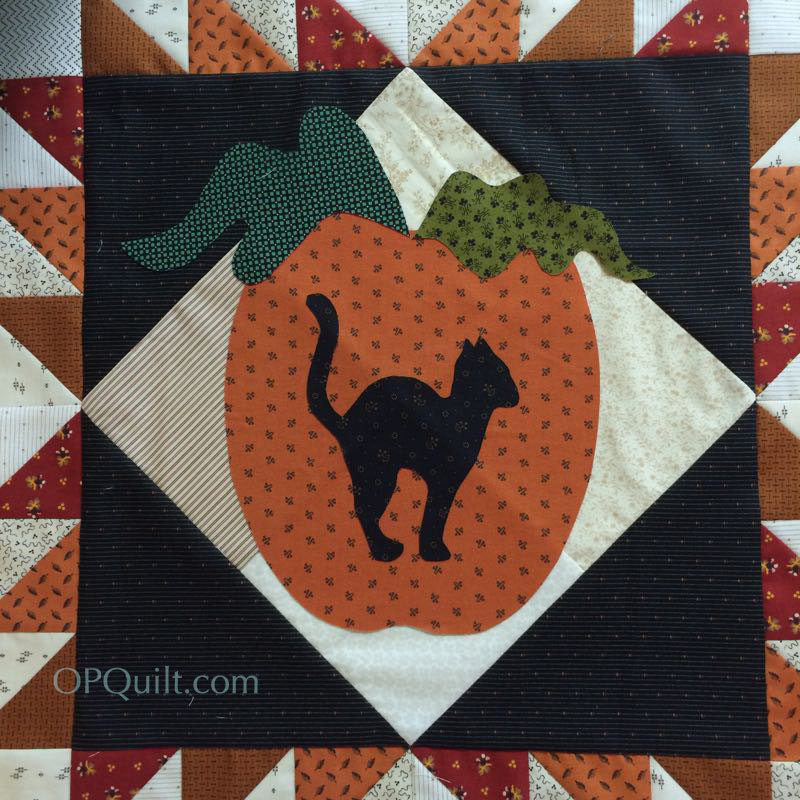
Leisa’s block.Halloweenqal3_16

Leisa’s pumpkin in place.Halloweenqal3_17

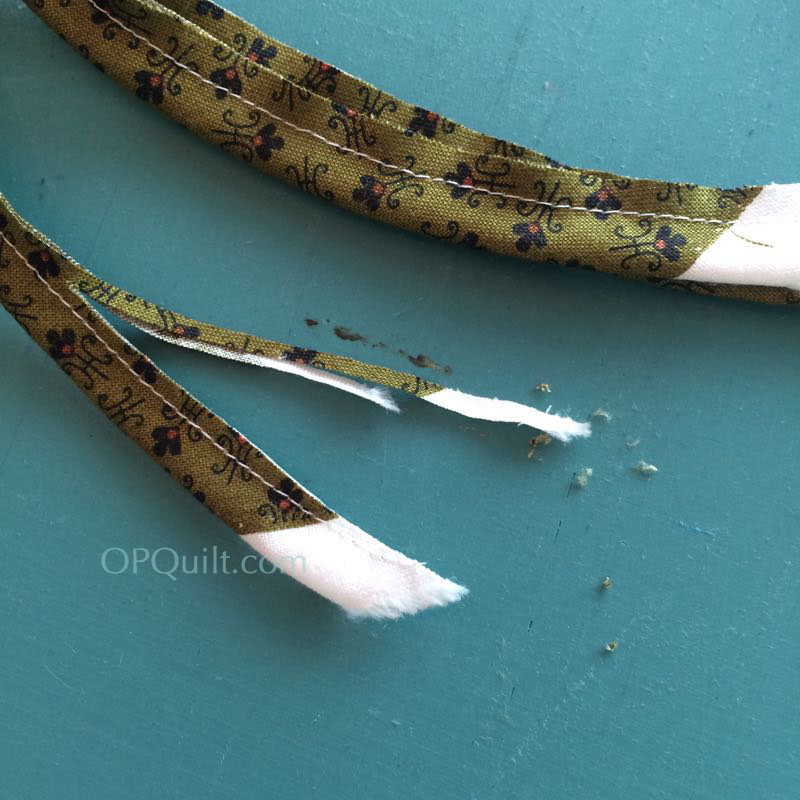
Now it’s time to make that curlicue vine/stem.  Cut a bias piece of fabric, 1-inch wide and at least 14 inches long.  Fold it in half, with the right sides outside.  Stitch in fat 1/4″ seam.Halloweenqal3_17a

Trim the seam to a scant 1/8.”Halloweenqal3_17b

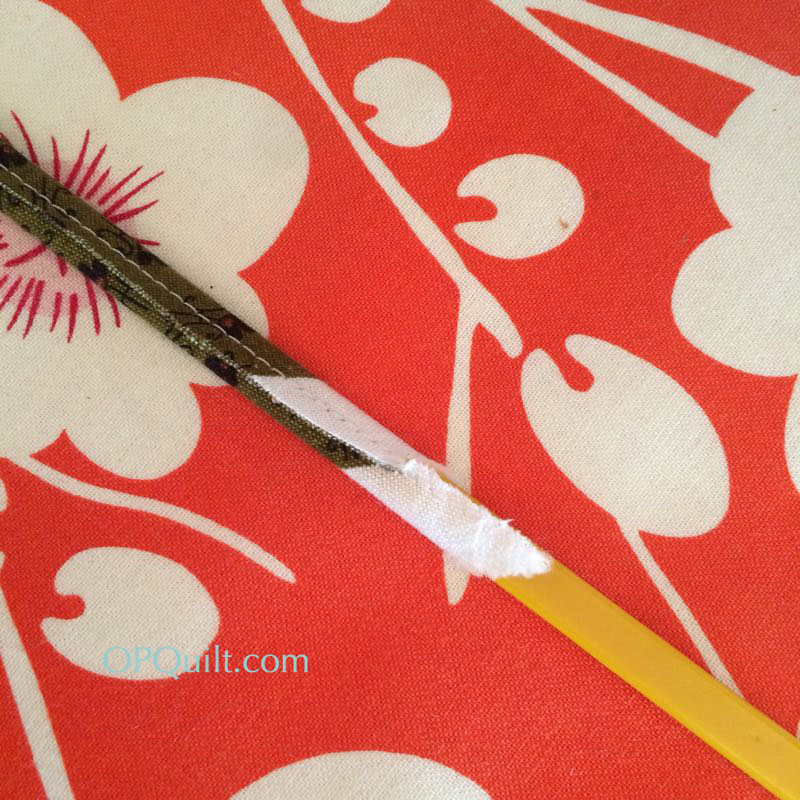
I use bias pressing bars and insert them into the tube, rolling the seam allowance to the top.  Press lightly.  Remove the 1/4″ bar, and press the bias lightly.  You don’t want to mash it flat, but you do want to set the bias tube so the seam remains to the back side.Halloweenqal3_17c

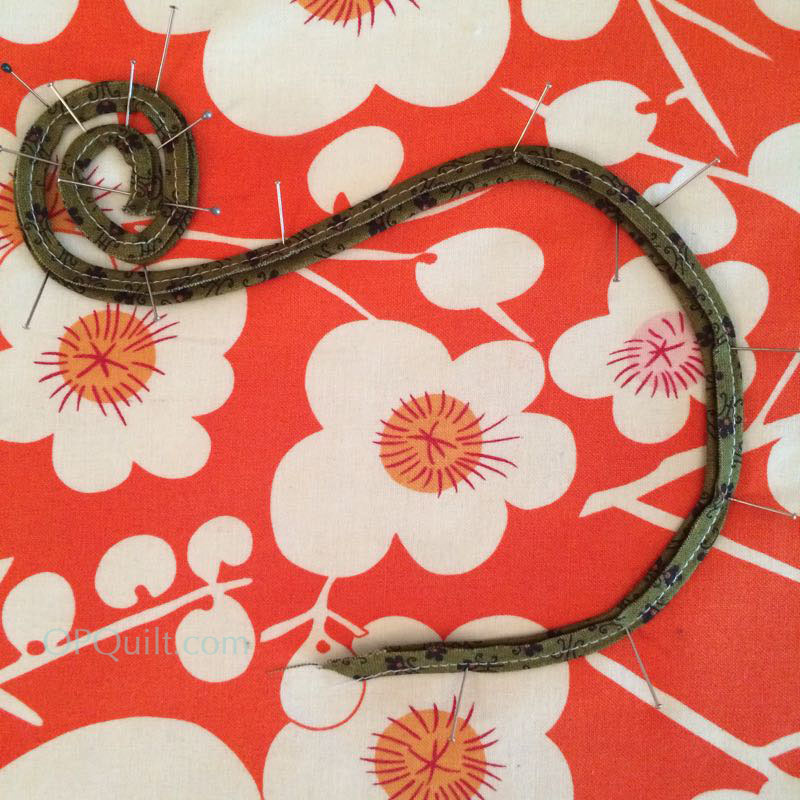
On a padded surface (I use my ironing board), coil and pin one end fairly tightly, then using the pattern pictures as a guide, loosely curve the curlicue stem the other way.  Steam it with your iron, then let it cool.  Remove the pins.Halloweenqal3_18

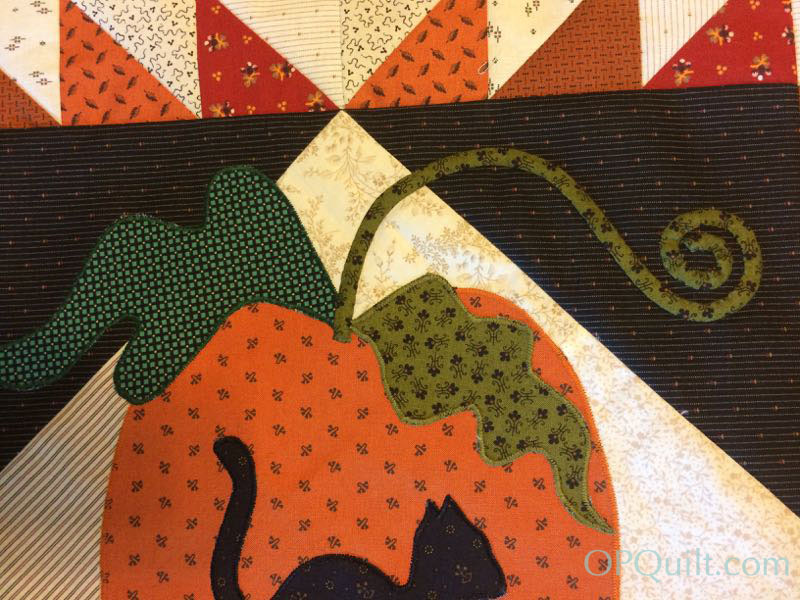
Drape it/arrange it/fiddle with it on your block.  I concentrated more on the coiled up section, then let the curve artfully drape back to the center of the pumpkin, not worrying about how long it was.  Halloweenqal3_18a

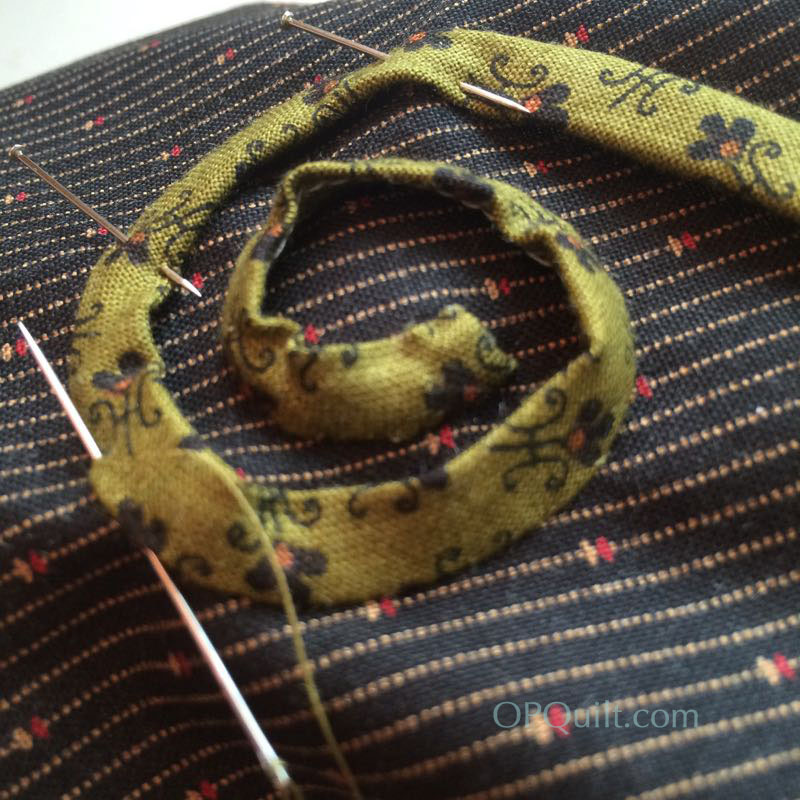
I decided to sew it down by hand.  First sew the outer edge, then the inner edge (shown below), coaxing that inner edge flat with nudges from your finger and by taking smaller stitches.  You are not necessarily aiming for *flat* but more for *nice curve.*  After stitching it down, give it a little steam from your iron to press it lightly.Halloweenqal3_18b Halloweenqal3_19

Next one is prepped up.  I cut off the extra stem about 1/2″ below the pumpkin’s edge and folded this end  (as well as the inner coil end) under 1/4″ and tacked the edges down.Halloweenqal3_20

I’m not a huge fan of machine-done buttonhole stitch, although I really like it on others’ quilts.  If you are skilled at that, try that stitch.  For me, I went with a medium-wide satin stitch, my needle just over the edge of the piece.  Halloweenqal3_20a

I lifted up a leaf a bit as I got to the end, another advantage of not searing your applique piece into your fabric.  I ironed it back down again after I was through.Halloweenqal3_20b

Pumpkin is on.Halloweenqal3_20c

Here’s my secret to getting even appliqué stitching without having the bobbin thread pull up to the top: two sheets of computer paper.  It also prevents stretching as you stitch.  I’ve backed all my stitching with this for years and years and years–it comes off easily, like tearing perforated paper, and makes your stitching nice and smooth.  After stitching down the pumpkin (the shape at the bottom of the stack), stitch down your leaves (next layer up) and finally, your cat.  In some quilts, I’ve seen a star in the middle of the pumpkin.Halloweenqal3_21

Well, that’s it for this step: because we’re doing nine blocks, we chose to do four with cut-out motifs.  You’ll need to adjust whatever you’re doing to the number of blocks you’ve chosen.Halloweenqal3_21a

Close-up of my appliqué.  If truly this bias thing is driving you mad, feel free to try Thelma’s method of drawing a shape and fusing it down.

Halloweenqal3_23

Now I need to get busy and finish these!  I have all of this month to do it in.  Next post in the Hallowe’en 1904 QAL will be May 13th.  I plan to finish up these three, then make scads and scads of HSTs, getting ready for the next steps.  Hope you can finish yours, too!
UPDATE:

Halloweenqal3_24white pumpkin

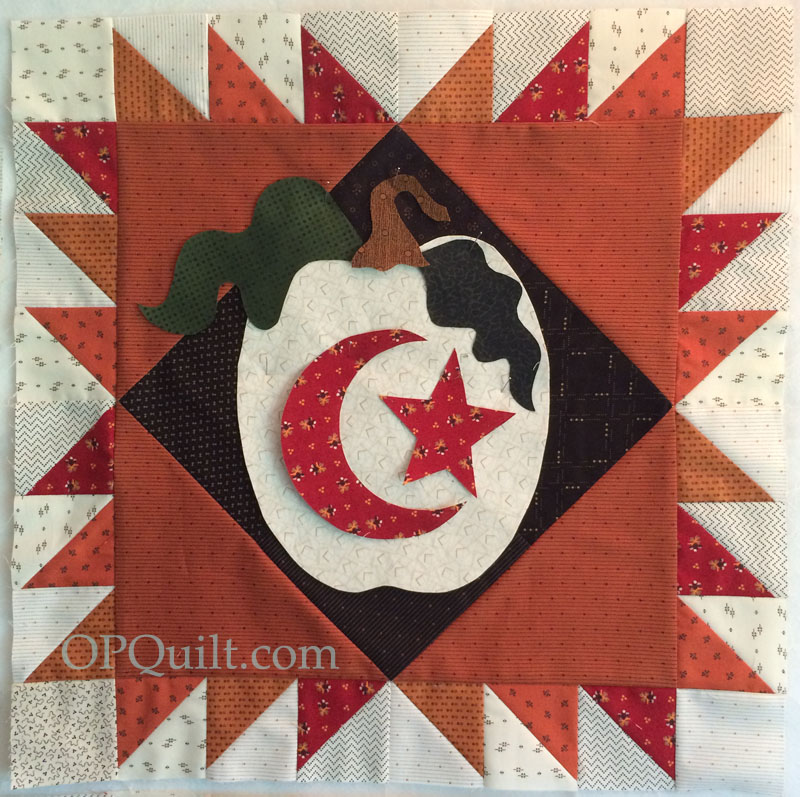
Here’s my latest block.  I cut down the moon because it needed to be more round (according to my husband and I always listen to him) and I smallerized the star, then put them both on a white pumpkin.  I did two layers on that white pumpkin: the fabric you see and I underlined it with some cream solid fabric so the black wouldn’t show through.  I created a stem (2 1/2″ inches high), and a smaller moon and star for inside the pumpkin (PDF file of the patterns are here: StemStarMoon_OPQuilt).  Print it out at 100%.  I’m much happier with things now.  Don’t be timid about playing around with your pieces and colors until you find what makes you happy, too.

1halloweenQAL logo

Here’s our schedule:

Step 1 (Preparation): February 2016–buy all the fabrics and find the pattern.  Mine was purchased from Common Threads in Waxahachie, TX (www.commonthreadsquilting.com).  The quilt measures 90 by 90, which is too large for me, so I’m only doing nine blocks.  Each block is 20″ square, and with the outer borders, that should come to roughly  65″ square.  I may change my mind, but this looks good from here.

Step 2: March 2016–Cut out the quilt: the tan backgrounds of the squares, the border triangles, the smaller half-square triangles, strips for the wonky stars, but save the piano key border for later.

Step 3: April 2016–Assemble four blocks and add large appliques; use Thelma’s method (of Cupcakes and Daisies) for adding the curlicue stem. Make and add half-square triangeles (HSTs) around these blocks, using the 8-at-a-time method of HSTs.

Step 4: May 2016–Cut and make the wonky star blocks from templates and strips. We’ll be using Thelma’s method.  I’m doing five blocks, so will need to make twenty wonky stars and true them up.

Step 5: June 2016–Assemble the rest of the star blocks, adding the large triangles on each corner and their HST borders. In the pattern, and in the photo above from Thelma, they are mixed up and varied, but also harmonized (some have a mix of orange and black, some have just black, some have just orange.)  Make your own rules and go with it.

Step6: July 2016–Arrange the blocks on your design wall and stitch together.  Cut the pieces for your borders.  Make the four corner pinwheels.

Step 7: August 2016–Sew borders together and attach them to the quilt.