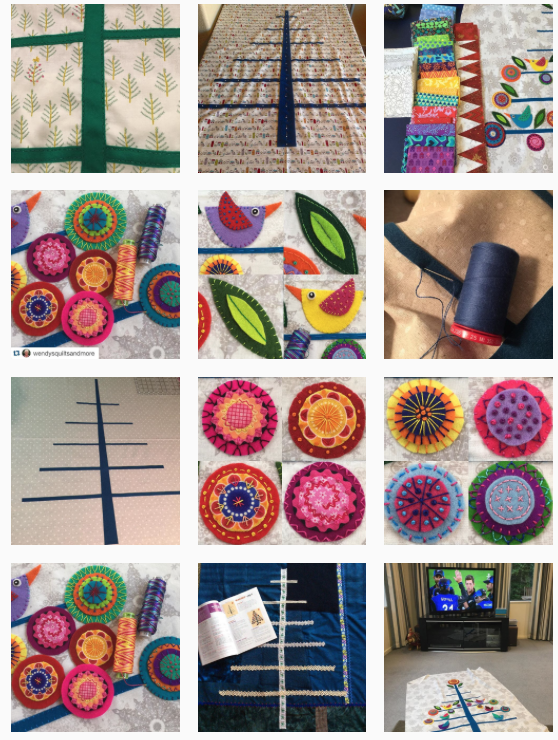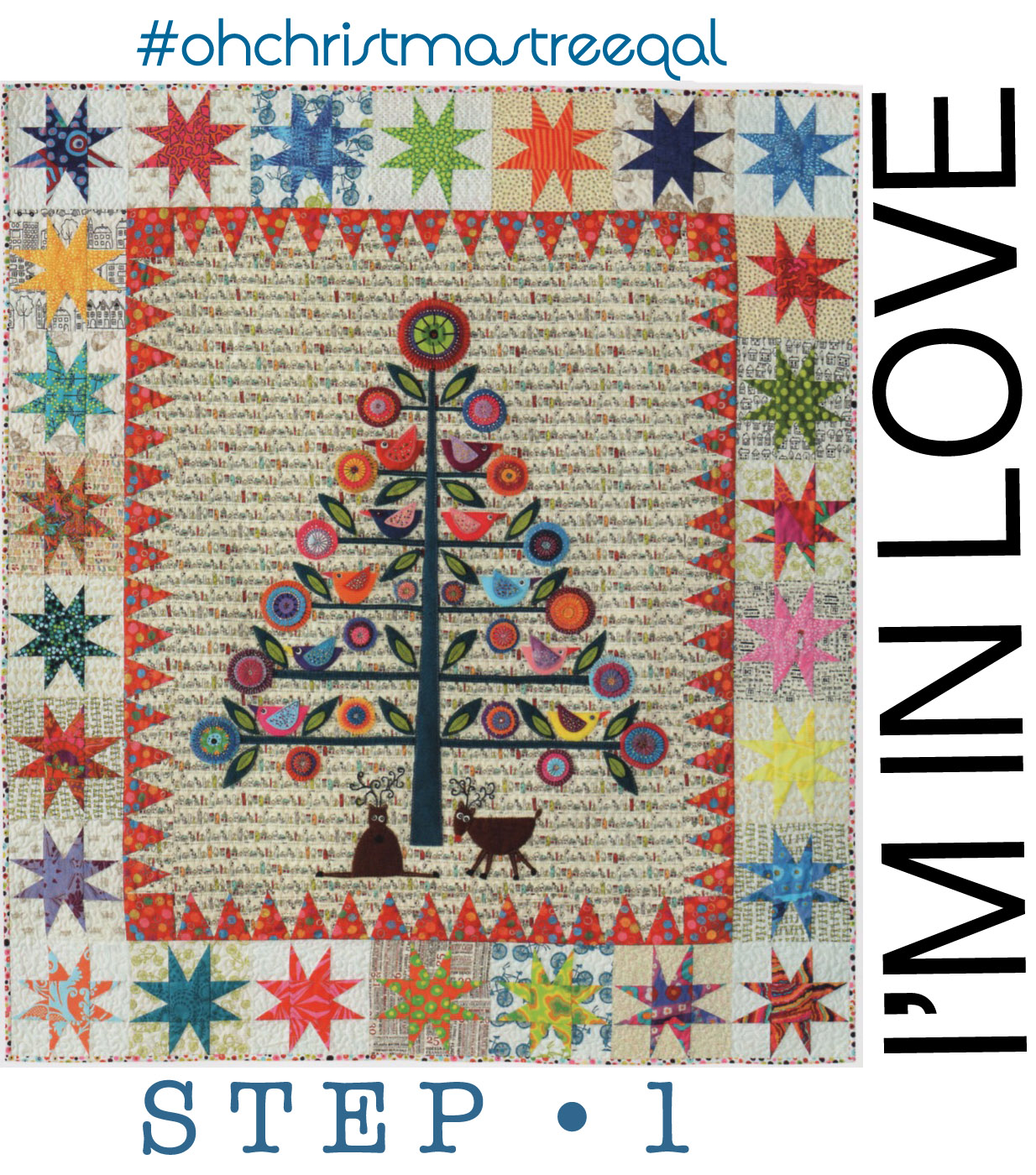
Oh Christmas Tree QAL · Quilt Bee · Quilts

Roaring into March

ChristmasTreeLogoSM

First off the bat, the winners of the giveaway, using the Husband Random Name Generator were:

Janice, who wrote: “WOW! I just began following your blog and missed the start up of this QAL. After seeing your beautiful work, I am inspired to dive in and QAL too. I love the embroidery details. . . [and the] layering [of] the stitches. I’d choose the magazine. Thanks for the great give away. I can’t wait to see your finished tree.”  I’ll send you the magazine.

Camille, who said: “Thank you again for your excellent post. I’m almost done with the tree appliqué. Still have the freezer papers to cut out. This project is so out of my typical arena so I’m thrilled to be pushing myself. Thanks. I’d love to add the fabric medallions to my stash since I have the magazine.”

Good luck on the Oh Christmas Tree project to these two and to all of you (and me).  I tried out making birds last night and they went so fast, as there’s far less stitching work on them.  Can’t wait until next month to tell you about this.

Quilt Night Mar2016_1

In my regular, non-digital life, I attended our monthly gathering of the Good Heart Quilters, a group of friends who have been quilting together off-and-on (with new members coming in, and old members leaving) for the better part of twenty years.  Charlotte, a newer member showed off what I think is only her third quilt top EVER, a Monopoly board.  All the fabrics are Monopoly fabrics.  Terrific!

Laurel brought two new rosettes for the New Millefiore Hexagon and re-arranged them to make more sense.  She has an exquisite sense of color.  Caitlin, whose house it was at, had a nice spread of snacks, including freshly baked brownies, and she worked on Christmas stockings.  Lisa and I did hand work–Lisa sewed together hexies and I worked on Step 3 of the Oh Christmas Tree QAL, which I already mentioned.  We had a lively and interesting conversation, running from mid-century modern furniture to QuiltCon to Donald Trump.Quilt Night Mar2016_2 Quilt Night Mar2016_3 OhChristmasTree_flowers2_1

I wanted to show everyone my newest flowers.  There they are above, all prepped up, with fabric appliqued on three of them.  And below, you can see my progress.OhChristmasTree_flowers2

I sewed the backstitch around the orange fabric not only so you’ll think I’m so clever, but also to cover up some wonky appliqué.  Okay, that’s the real reason.  Then I just got going on it, and kept adding stitching. OhChristmasTree_flowers3

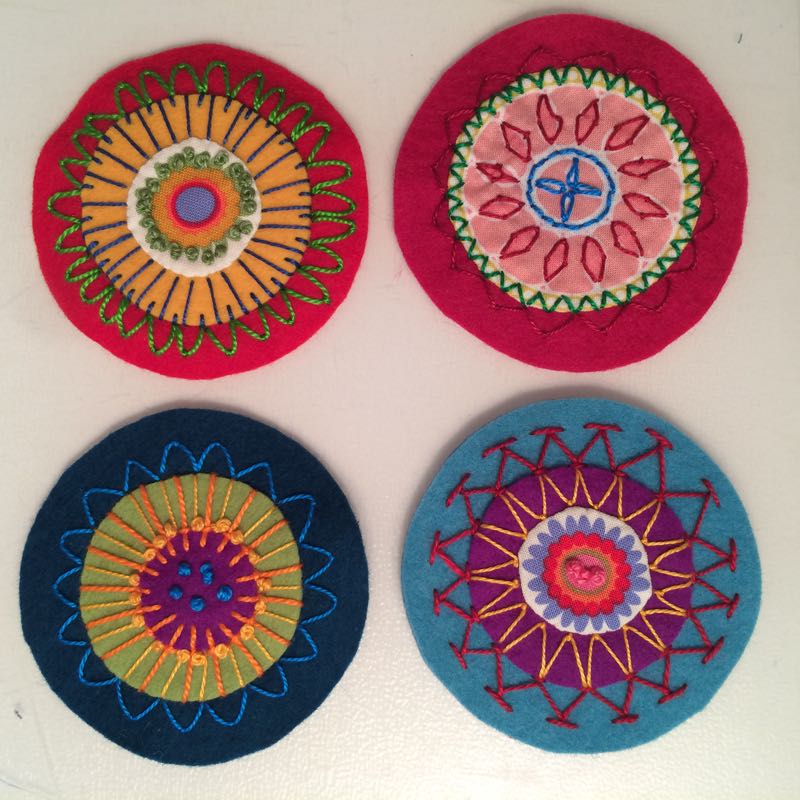
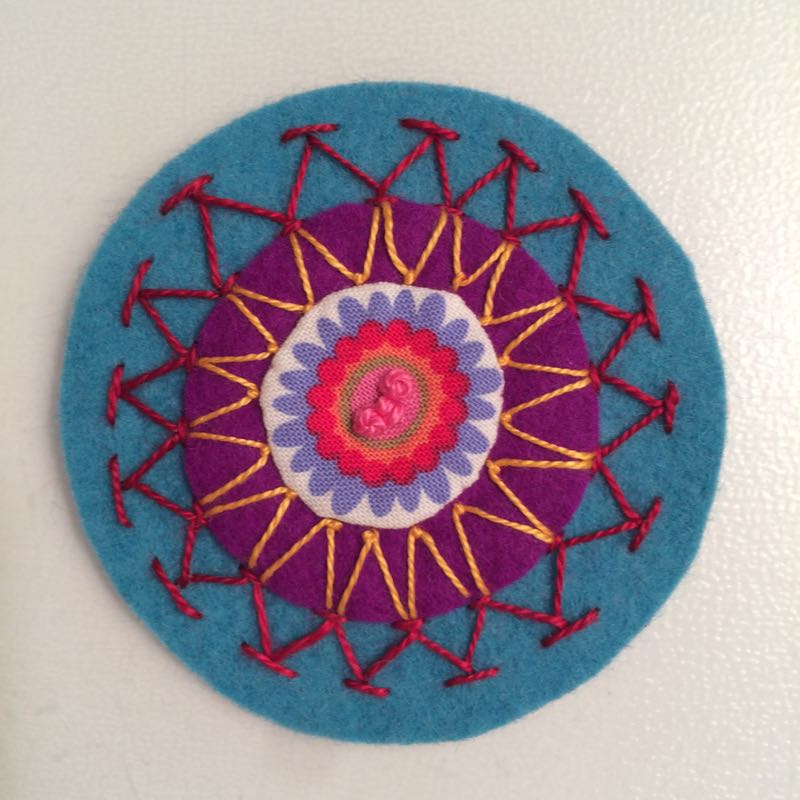
On this one, I borrowed one of Wendy’s ideas for the center, then did “closed blanket stitch” for the green-on-red ring and then just a zig-zag backstitch with small French knots (3 wraps of the needle using size #12 pearl cotton) at each juncture.  It’s really a layering sort of task.  I add this stitch, and ask. . . now what?  It also helped that the program I was watching, “Sagrada,” a documentary on La Sagrada Familia cathedral in Barcelona, Spain was still going on.  We’re headed there this year and I can hardly wait to see all of Gaudi’s surface decoration and bring home more ideas of what to put on these circles.March MCM bee blocks

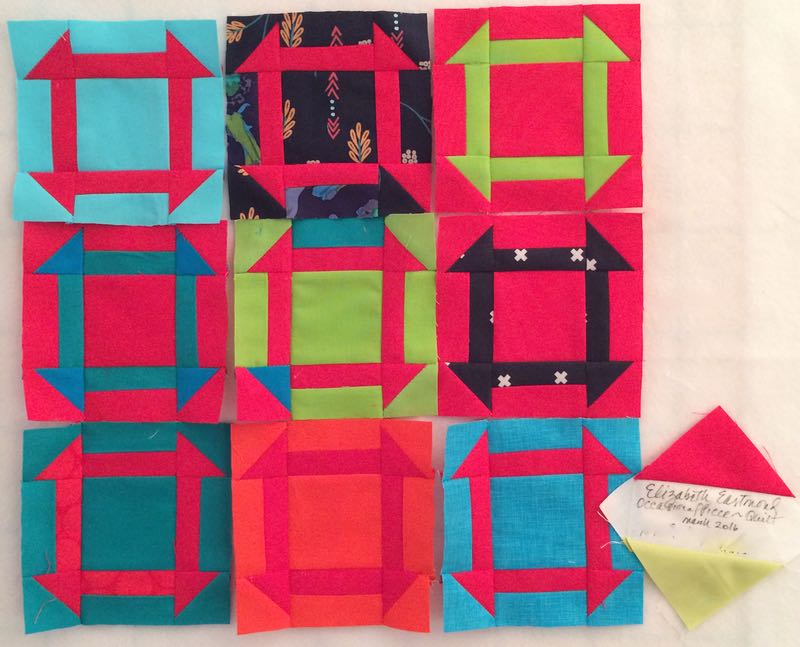
Lastly, I finished up two sets of bee blocks, the first for Linda of the Mid-Century Moderns.  She asked for tiny churn dashes; these are measure 4″ finished.  We were also supposed to make some unusual section but still keep the church dash recognizable.  I wasn’t too inventive, switching around colors and turning corner blocks. March SpellingBeeblocks2_2

Mary of the Spelling Bee (#spellingbeequilt), an IG bee, asked for sewing words, then asked for us to add one more word.  I wonder if that “i” is too long; I included extra fabric in case she wants to shorten it up.

Chocolate

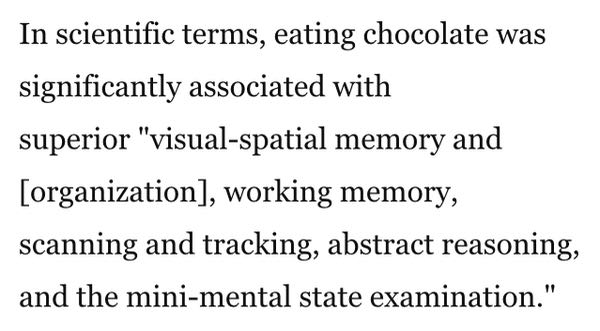
Lastly, I thought you’d be happy to have some solid research behind our quilter’s habit of eating chocolate, from an article published March 4, 2016, in the Washington Post.  Definitely need to keep up our visual-spatial memory and organization in order to keep sewing our quilts together!

chocolate-heart

Oh Christmas Tree QAL · Quilt-A-Long · Quilts · Sewing

Oh Christmas Tree-QAL–Step 2

3XmasTreeMar

OhChristmasTreeQAL IG snap_1

I’ve been haunting the IG feed #ohchristmastreeqal and love seeing all the progress of where the trees are and how things are coming along.  We’ll finish this tree up in no time flat, but I think I’d like to keep sticking to the schedule (below).

Giveaway BannerWe also have a giveaway at the end of this post, so please read all the way through, and then follow the steps to enter.

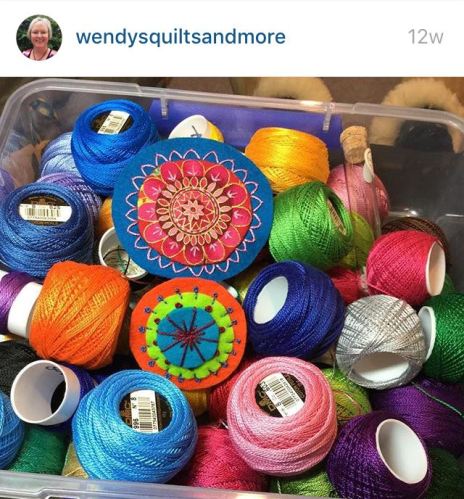
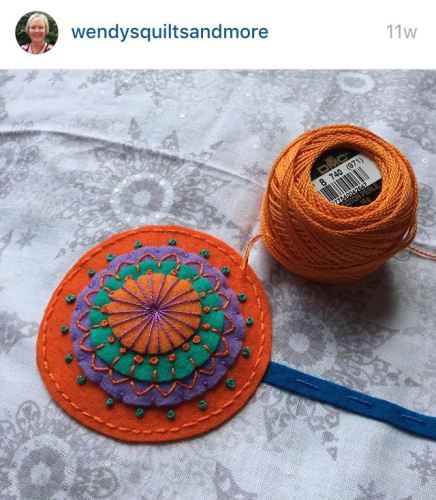
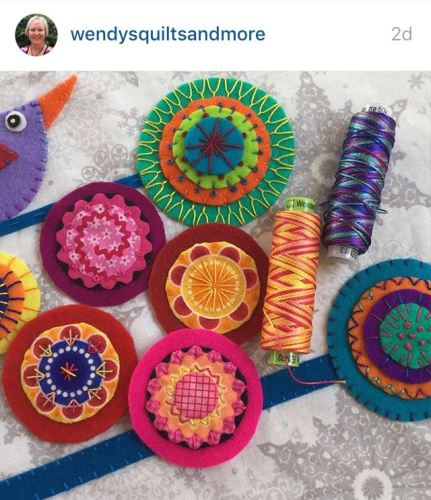
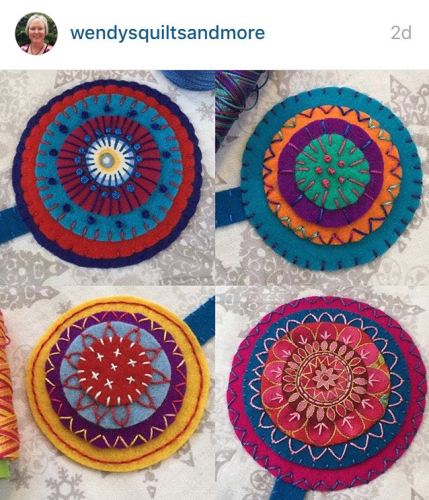
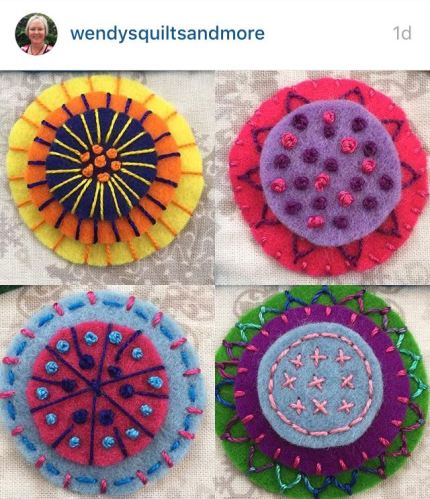
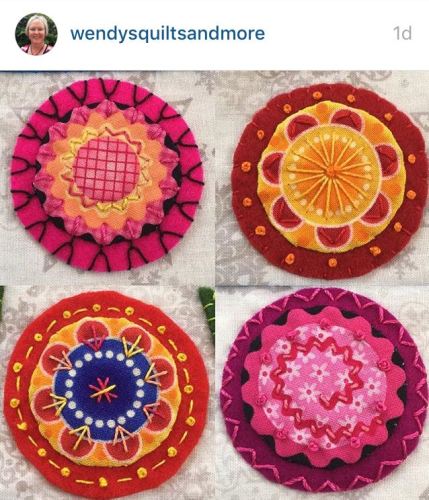
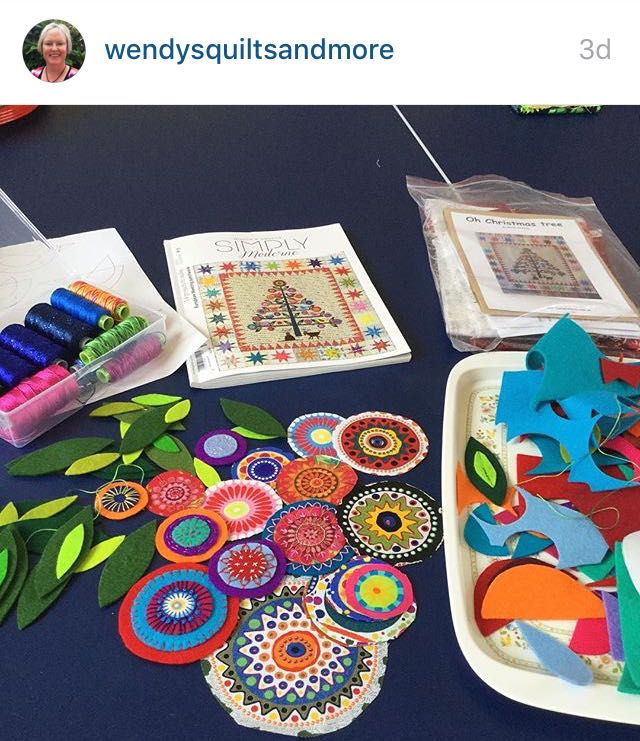
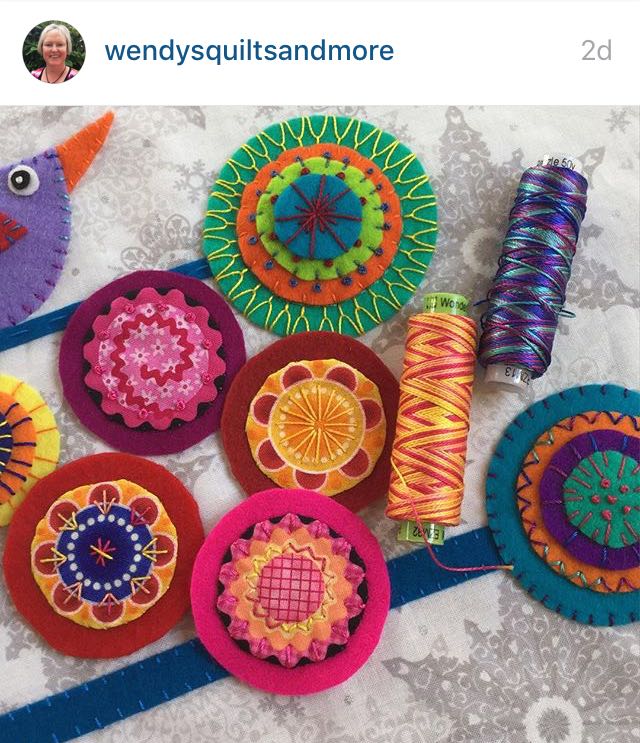
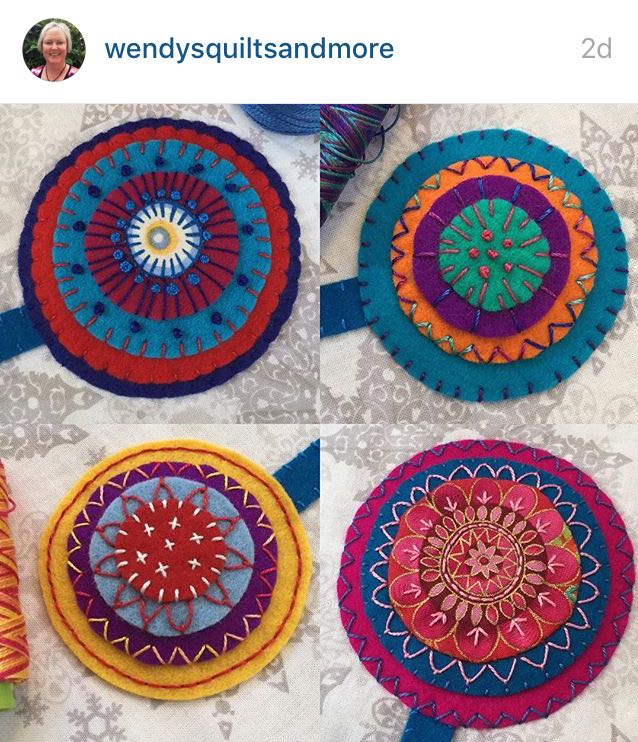
First up, this post is co-authored by Wendy of Wendy’s Quilts and More (blog) and wendyquiltsandmore (IG).  Wendy has been a great partner in this Oh Christmas Tree QAL.  Because she is about 4 months ahead of us, and I can send her different questions and she is unfailingly helpful.  I asked her if we could use a lot of her photos for this particular post about the flowers, and she was happy to allow me to post them, so get ready for a photo-heavy post.

This month is the flowers.  The basic idea is to layer up felt circles, or use a piece of medallion-style fabric appliquéd to a felt circle, then embellish it with embroidery stitches, using pearl cotton.  I originally started cutting out a lot of circles, from the prepped up freezer paper circles in my numbered baggies (see previous Oh Christmas Tree QAL post on tab above), but realized that it might be better to be more of a one-by-one process.  So let’s do one circle and you’ll see what I mean.
OhChristmasTree2_flowers1

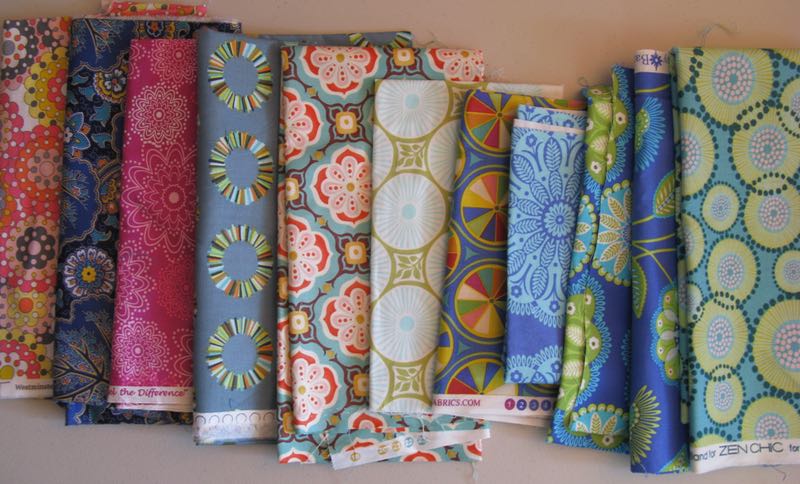
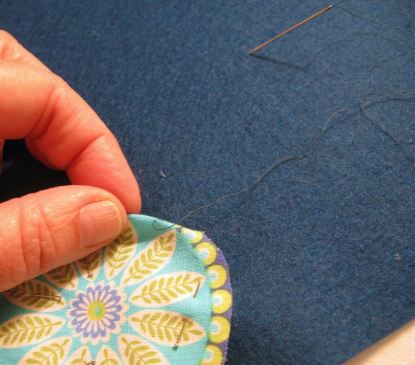
I cut out a medallion print (meaning that it’s a design that is self-contained in a circle), and pinched the edge under all the way around the outside, to set the edge for turning under (a Becky Goldsmith tip for appliqué). Here are some examples of medallion fabrics, from Wendy:

OhChristmasTree2_Wendyfabrics

ohchristmastree1_supplies2

And here are some of mine (above).  After writing back and forth with Wendy, I went through all my fabric stash and found even more than this.  It’s surprising how many I’d overlooked.  We do have some the same. Okay, back to the stitching.OhChristmasTree2_flowers2
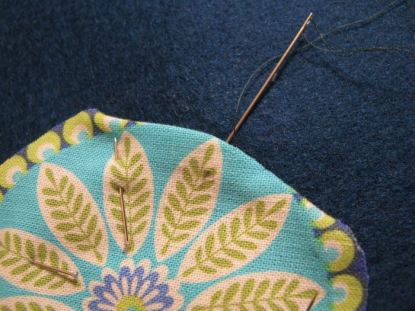
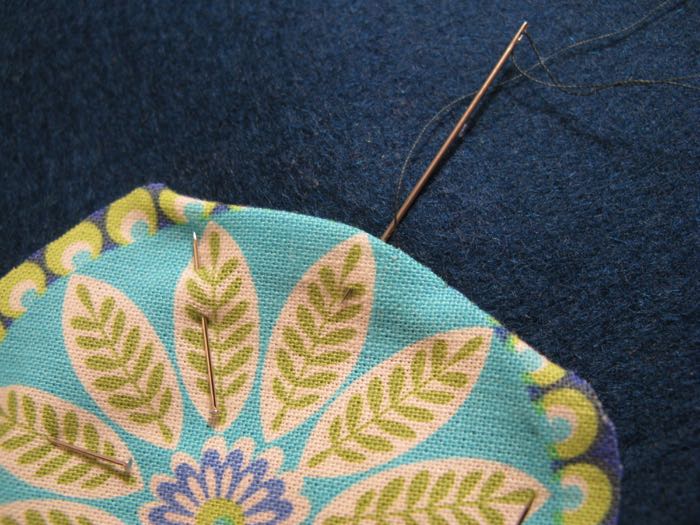
Placing the circle on a larger piece of felt, I sewed down the edge, stitch by stitch, scooping the raw edge under with my needle, sometimes swishing the needle tip left and right under that edge if there was a tuck/sharp point (above).  Often it’s what’s happening underneath that bumpy edge which determines the smoothness of your appliqué, so pay attention to what your seam allowances are doing, even trimming them further to a scant 1/4″ inch if you need to. I also try to have my needle come out the “center” of that folded edge, not on the top.  That way the stitches won’t be too obvious, and then I don’t pull it too tightly.  I want my circle to float.
OhChristmasTree2_flowers3

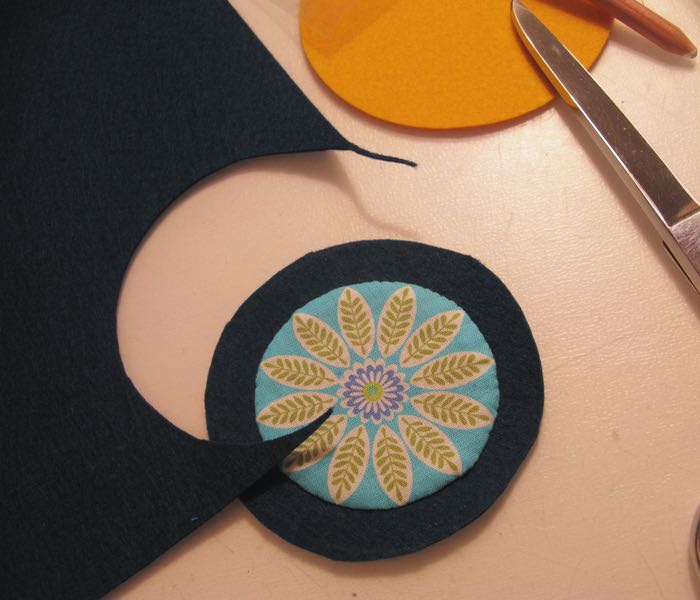
As I mentioned, I am appliquéing this medallion to a larger piece of felt.  Wendy picked up this tip from Wendy Williams, the author of this pattern (and found on IG at Flying Fish Kits–also a resource for stitching ideas), and this tip is also found in Williams’ book, Wild Blooms and Colorful Creatures.
OhChristmasTree2_flowers4

Then just cut around the circle evenly, and you have your first completed appliquéd medallion. Wendy of Quilts and More recommends a medium-blade scissor (although I used a lightweight pair of larger shears, shown in the photo, but they are SHARP).  Her scissors are below:
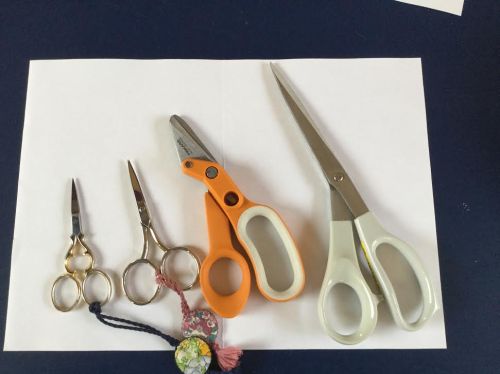
OhChristmasTree2_Wendyscissors

She writes “Once the fabric flowers are on, Wendy just cuts the felt circle free hand, keeping an even margin around the fabric.  She says it’s meant to look hand made, and the circle doesn’t need to be perfect.  Keep the scissors in the same position and turn the felt with the other hand, rather than cutting around corners. Use very sharp scissors with medium length blades. Not tiny embroidery scissors, not huge dress making scissors. I use the orange ones in this photo.”
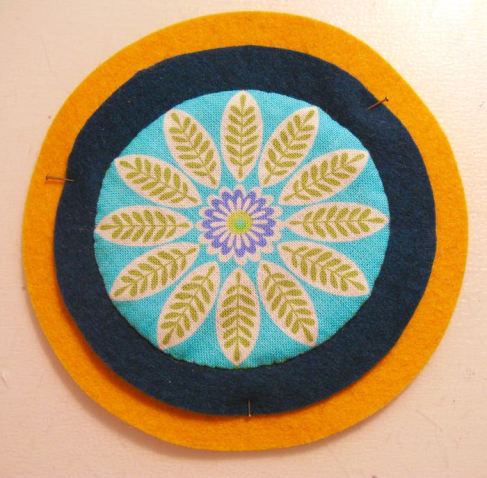
OhChristmasTree2_flowers5

Layer it up, and save it for a good TV program (Wendy of Quilts and More has a great shot of herself stitching while she watched a cricket match) when you can stitch away.  This is circle #1, and is the largest circle of the bunch.

OhChristmasTree2_flowers6

Next up is my auditioning another fabric medallion against several colors of wool felt.  I added more info about where to buy wool felt to the original “Prepare” post, and yes, you can mix the felted wools and the wool felt, without any Quilt Police coming after you, if you want to purchase some.  I am using Kaye Buckley’s scissors, which have one serrated edge that grips the fabric and helps me trim them evenly. OhChristmasTree2_flowers7 OhChristmasTree2_flowers8

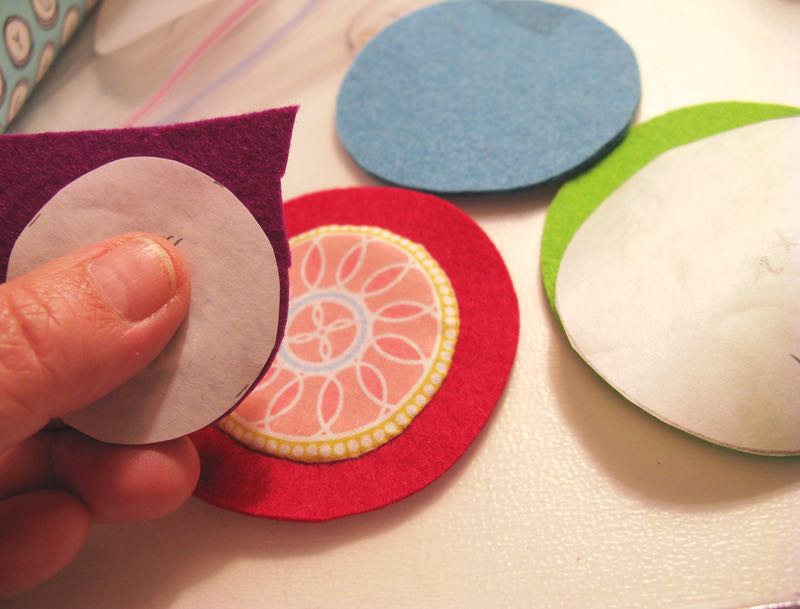
Being the Nervous Nelly that I am (it took me weeks to screw up the courage to start the flowers), I layered  the circle over one of the smaller appliquéd flowers to kind of get the size I needed, then cut halfway around.  I took off the freezer paper, and finished up the job.OhChristmasTree2_flowers9
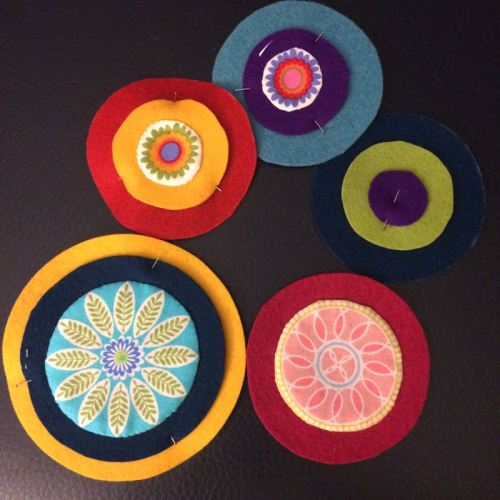
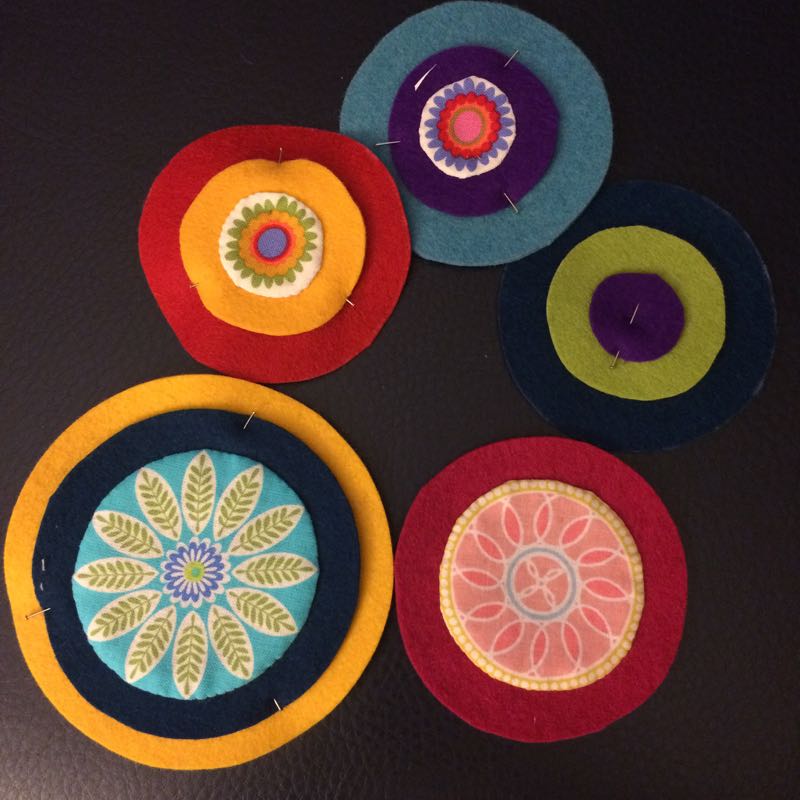
So here is my first batch of prepped-up circles; some have fabric and one doesn’t.
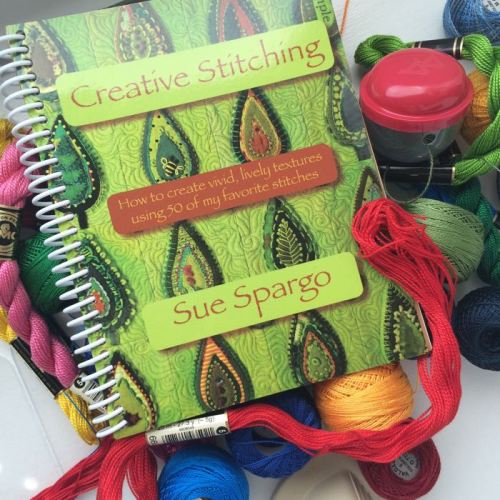
OhChristmasTree2_book

To make my life easy, I pulled out my Sue Spargo book and leafed through some ideas. OhChristmasTree2_threads

I’m using two weights of pearl cotton: size 12 (recommended) and size 5 (larger, more visible).
OhChristmasTree_needles

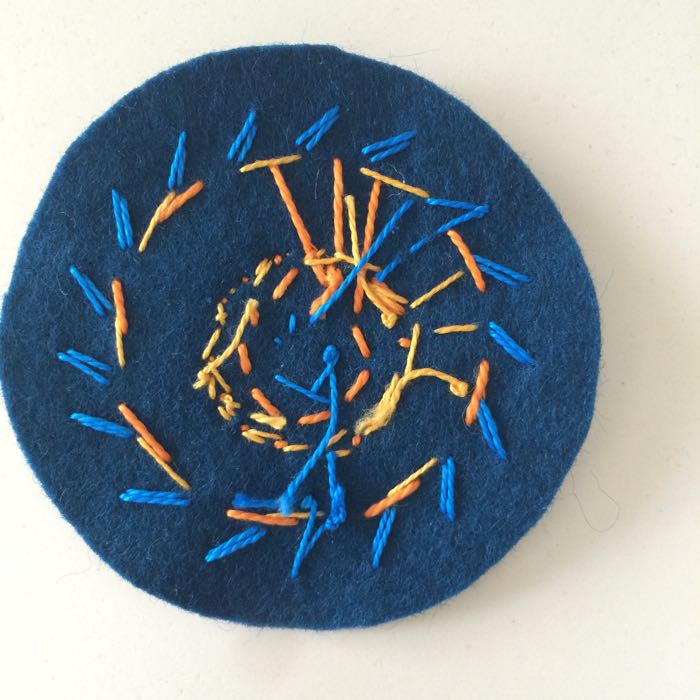
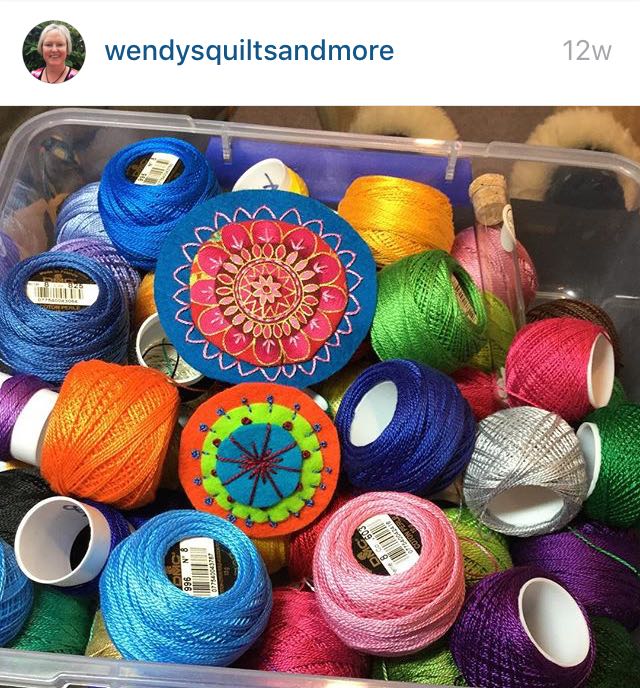
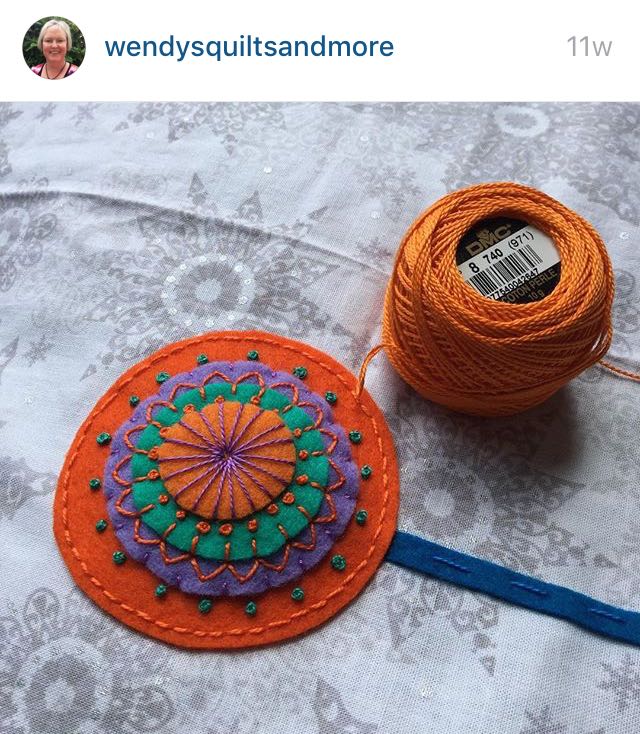
I am using wool appliqué size #22 needles, which have a nice big eye and a sharp point and aren’t too long.  Then I pulled up Wendy’s IG feed (all the photos below) and got a few more ideas, then just put my needle in the center and began. OhChristmasTree2_flowers10I happened to think about what I wanted to do and decided to stitch them all layered up like this.  However, you may, on some circles, choose to embroider one circle, then add it to the next.  I was still trying to gather my courage when I began this, so stabbed my needles into the center of the magenta circle, close to the edge and ran the orange #5 thread all the way out to the edge of the yellow-green circle, working my way around.  Then, I took a small catch stitch over each of those “rays,”  close to the outer edge of the magenta circle.
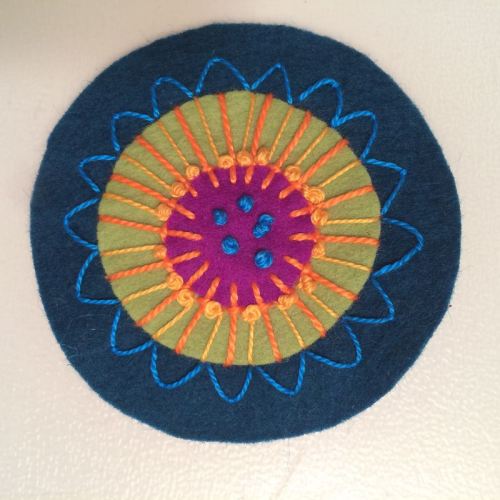
I switched to the thinner #8 thread and did straight stitches in between the others, then went back and added the yellow French knots at the top of each of those “rays.”  I threaded on the blue thread, and did a few more French knots (odd number) in the center, not really caring how they landed, as I wanted a clustery look to them.  Then I did an open Laisy-Daisy stitch on the outside, creating a row of “petals” with my thread.

OhChristmasTree2_back

Truth-in-Stitching: the back.

OhChristmasTree2_flowerTop

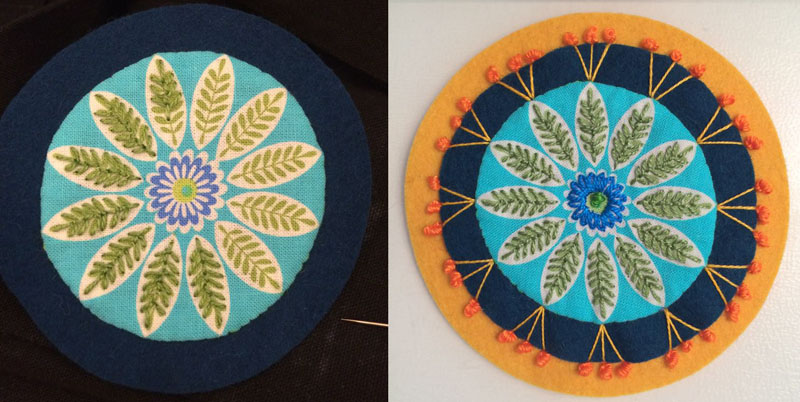
Here’s another.  On the left, the beginning.  You can see on this flower, I chose to echo the print of the center fabric.  I am doing the first layer of felt by itself.  I then layered it onto the second (gold) layer and kept stitching.  This is the biggest flower, destined for the top of the tree, so I wanted something bright, yet echoed the colors throughout.

OhChristmasTree2_flower33

Again, here they are, unadorned.
OhChristmasTree2_flower34

After a couple episodes of Downton Abbey, they are embellished. I wrote to Wendy and asked her how long they took her to stitch (hence that hashtag on IG of #startyourneedles), and she replied that she can get two done in an evening.  That’s about my speed, although I think I as get more familiar with stitches, I’ll be faster. Pay attention to your pearl cotton/felt colors.  I loved the fabric in the pink one, upper right, but after I stitched it?  Not so much.  Either I’ll put that one where it’s not really noticed, or stitch another.  I also started with the bigger circles; I’m sure the smaller ones will go faster.

OhChristmasTree2_flower35

Okay, now for the photo gallery from Wendy:

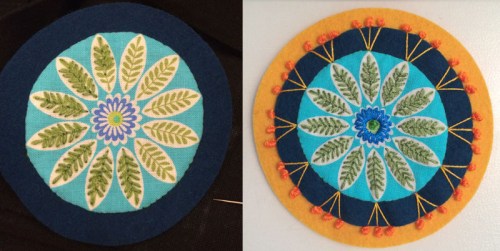
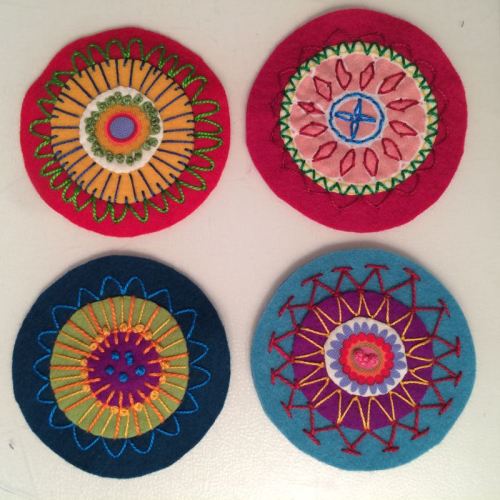
OhChristmasTree2_Wendyflowers6 OhChristmasTree2_Wendyflowers9 OhChristmasTree2_Wendyflowers8 OhChristmasTree2_Wendyflowers7 OhChristmasTree2_Wendyflowers5 OhChristmasTree2_Wendyflowers4 OhChristmasTree2_Wendyflowers11 OhChristmasTree2_Wendyflowers3 OhChristmasTree2_Wendyflowers2

You can see Wendy has a great variety of stitches, and uses the appliquéd fabrics to great effect.

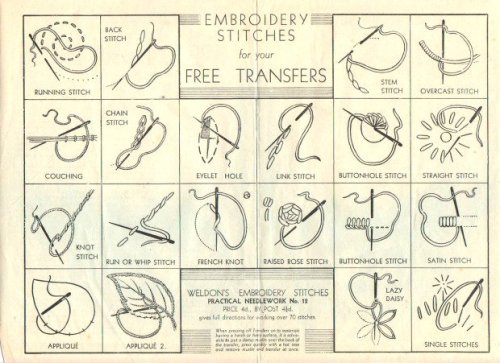
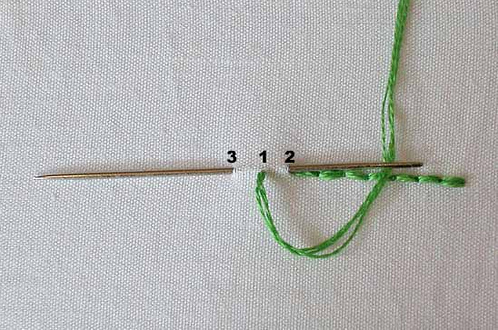
I searched “embroidery stitches” on Google Image and came up with tons, including these two:
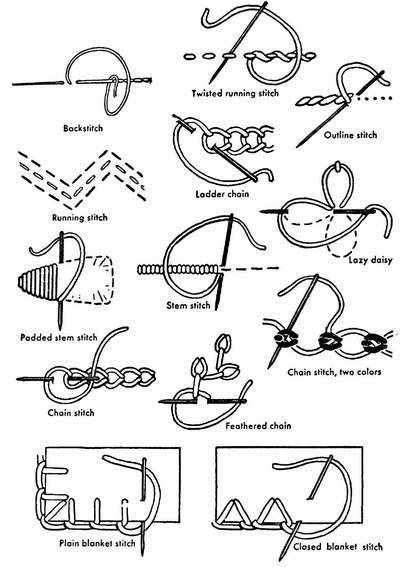
Embroidery Stitches101 embroidery-stitches-29dmwg9

A recap of where we are:

January, Step “prepare”: buy the magazine, books, gather your fabrics, buy the felt/wool, buy/find the pearl cotton. 

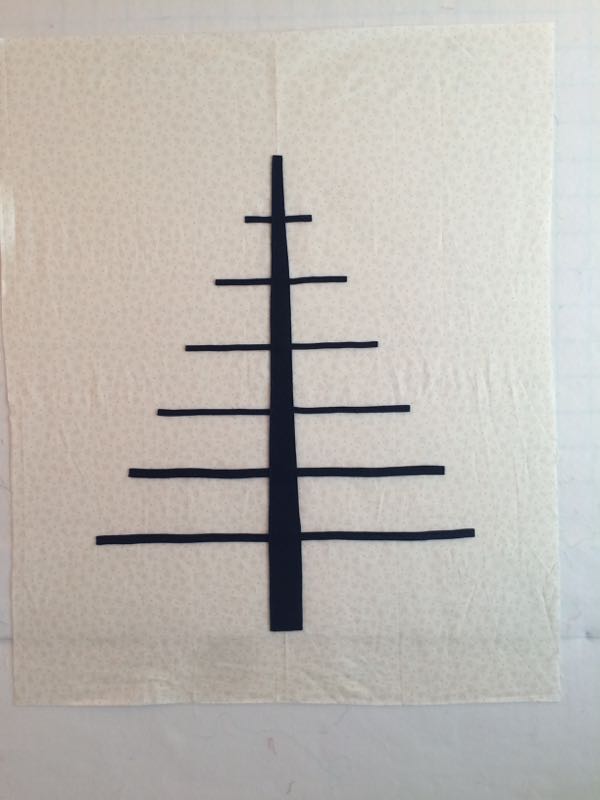
February, Step 1: Make the tree on the background and stitch it down.  

March, Step 2: Make 21 flowers.

—->  I just have to make a comment here.  We have until June to get our flowers done, as well as the birds (which will go really fast because we’ll be so experienced, right?)  So no panicking, please.  Just #startyourneedles, steadily stitching and by the time it comes to stitch down the flowers, you’ll be ready.

April, Step 3: Make 10 birds.

May, Step 4: Scene at bottom of tree.

June, Step 5: Appliqué down the flowers.  (Wendy gave me some tips for this last week, which I’ll pass along.)

July, Step 6: Appliqué down the birds and the scene.

August, Step 7: Sawtooth border (reds); sew together and attach.

September, Step 8 (finish up Quilt-A-Long): Make wonky star blocks, sew them together and attach border #2.

See you April 2nd for the next step: birds.  I have a few tips on these, too, courtesy of Wendy.  You’ll enjoy visiting both her website and her IG feed for great ideas and to see a master quilter and stitcher at work, and take a look at how far she is on her tree.  Inspiration!  Thank you, Wendy, for all your help.
ChristmasTreeLogoSM

Reminder: If you tag your IG photos with #ohchristmastreeqal, we can all help each other out with ideas for stitching, plus it’s just fun to see what you are all doing!

Giveaway Banner

Here we go.  I have two giveaways, and I’ll choose the winners from comments here.
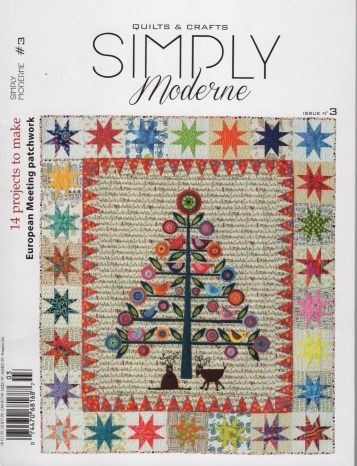
Simply Moderne ScanFirst is another magazine, if you know someone who wants to jump in, or doesn’t have their own copy.  It’s courtesy of QuiltMania, who gave it to me at QuiltCon, when I explained what we were doing.  I’m sure if you wanted to subscribe, they wouldn’t mind a bit, or order the Simply Moderne #4, if you want another eye-popping design (way below).

Second giveaway is an envelope full of fabric medallions, my choice (I’ll cut from my extensive stash of medallions).  You can use some, share some.  There will be at least a dozen to help you get going on your stitching.

I’ll announce the two winners on Friday.  Indicate in your comment which you are most interested in: Simply Moderne #3 magazine (with our tree on it) or medallions.  Yea, you have to choose.

UPDATE: Comments closed.  Winner announced tomorrow mid-morning.

#startyourneedles for the #ohchristmastreeqal

See you April 2nd for Step Three!
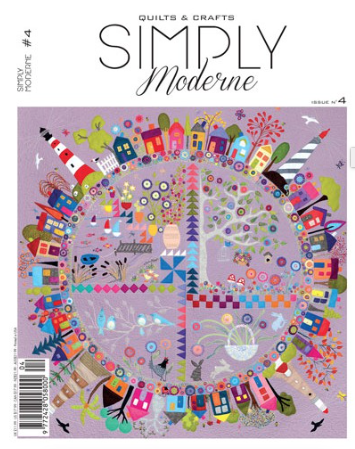
SimplyModerne#4

Of course you want to subscribe! (I’m an enabler, for sure)

Oh Christmas Tree QAL · Quilt-A-Long · Quilts

Oh Christmas Tree QAL–Step 1

2XmasTreeFeb

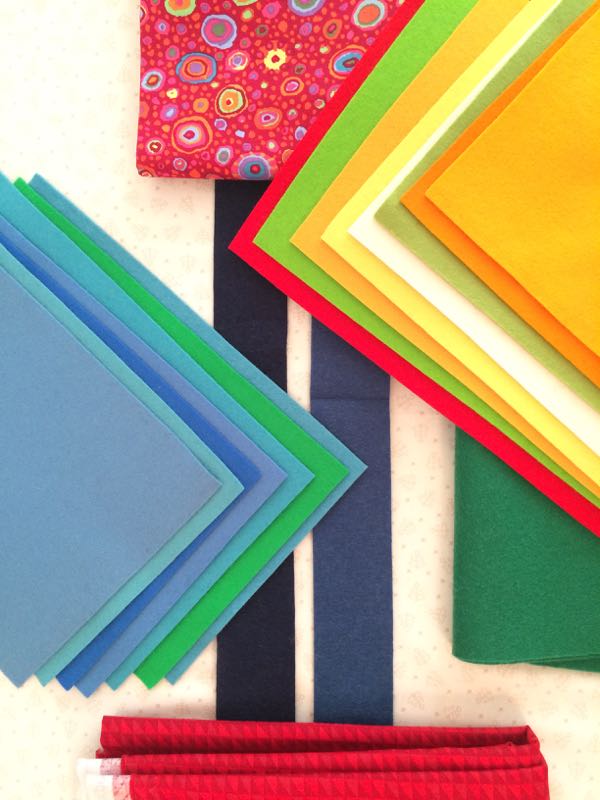
I’ve been busy shopping for wools, wool felts, felted wools and all combos in between.  See below for an explanation of what they all are, although you’ve probably figured it out by now.  For those of us just joining in, the first step we did was to prepare by purchasing the Simply Moderne issue #3, which has the pattern we’ll be using; we also purchased all our supplies of wools, threads and fabrics.  It’s never too late to join, just look for the Oh Christmas Tree QAL tag at the bottom and click to locate all the posts on this blog (plus a wee giveaway to reward you for wading through all this).  We are also on Instagram with the tag #ohchristmastreeqal.

Let’s talk about wool, specifically FELTED WOOL and WOOL FELT:

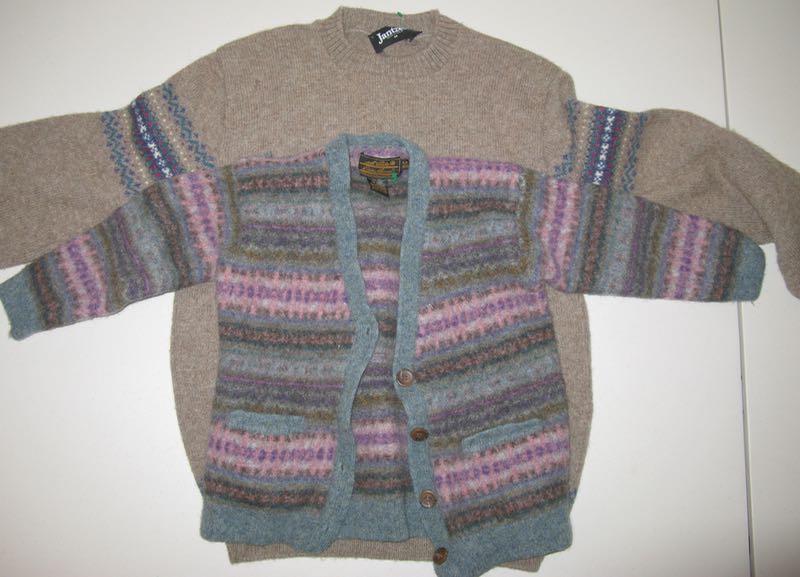
Wool sweaters felted_1 Wool sweaters felted_2

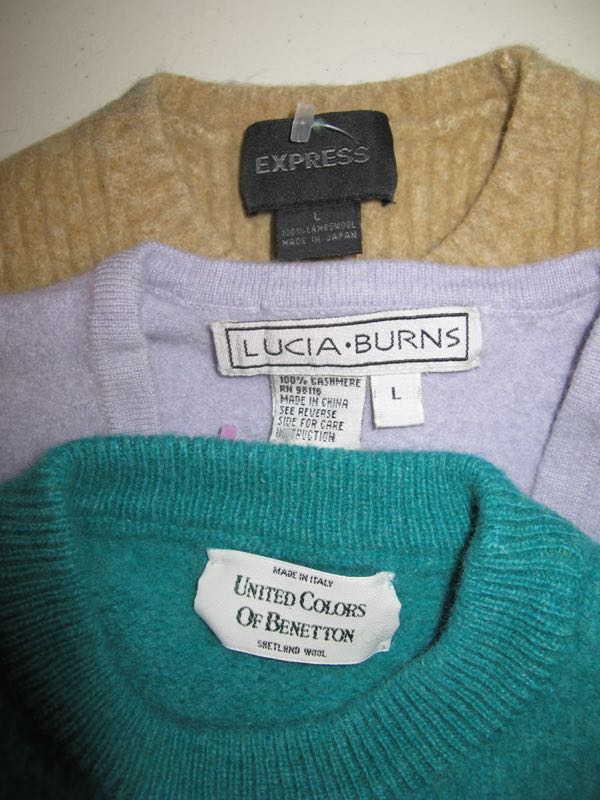
I found some 100% wool sweaters at the thrift store, threw them in the washer with three tennis balls and an old tennis shoe, then dried them.  This process — using hot water, soap and agitation — is called fulling, with the result of felted wool.  I did that twice.  You can see in the top the difference between the two sweaters (they were originally the same size); however, one is called a “washable wool” so it won’t felt.  Some felted more evenly and better than others, but all of them looked like they could fit a toddler, even though they started out as an adult-sized sweater. I plan to use some of this newly felted wool with my flowers and birds.

You can also do this with 100% wool woven fabric.  You want it to felt down evenly so it is dense and won’t ravel.  Many of you purchased already felted wool and are ready to go.  Primitive Gatherings recommends using Steam A Steam 2 on the back to really stabilize the woven felted wool when you are working with it.  If you have tips on working with felted wool, please leave comments on this post, where others can find the info.  Many comments have already been left on the initial post on IG, if you want to look there.

I’m using what Wendy Williams recommended: 100% wool felt, which is that flat stuff your grandmother used to buy in the dime store to make toys, but is now available only in specialty shops (see previous Oh Christmas Tree post and the links below).  Felt does not fray when cut and is extremely stable, although it does shed a bit on first cutting.  It is wool fibers that have been felted together, and is not woven, nor knitted (as in the two examples above).

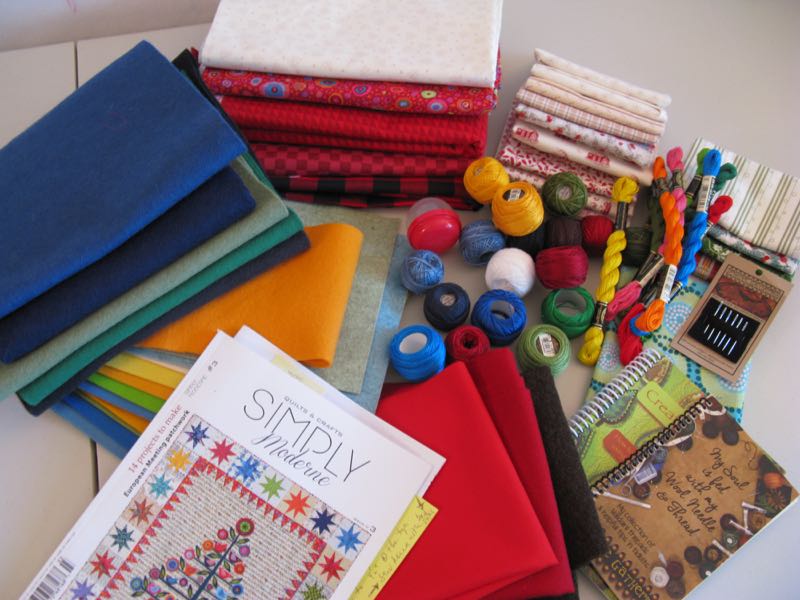
Try to keep these two terms separate in your mind: wool felt (which is what I’m using) and felted wool. There’s a few more links at the bottom of this post for more reading.ohchristmastree1_supplies ohchristmastree1_supplies2

So these are my supplies (top) and some medallion fabrics (bottom).  These fabrics have a circle pattern in them with fairly ornate decorative motifs inside.  Wendy uses them with her wools to add some flair, especially when creating the circles.

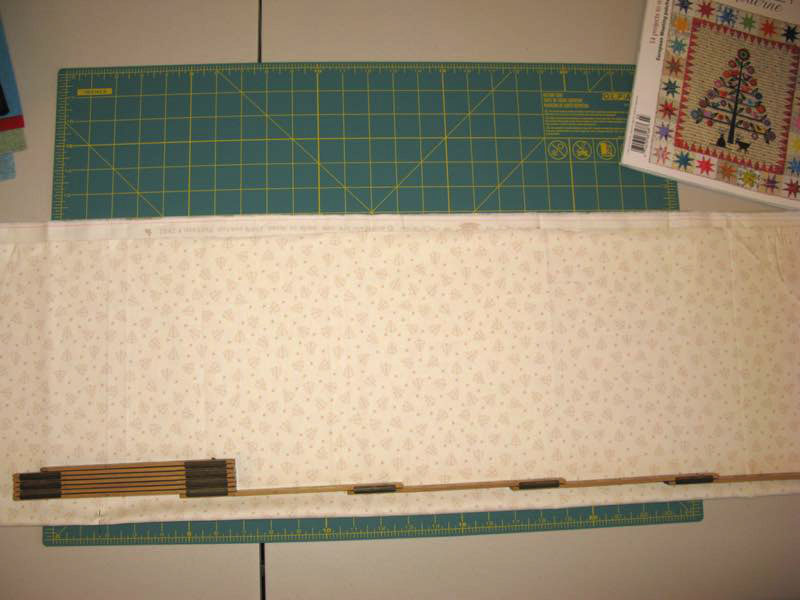
ohchristmastree1_2basefabric

I cut my background fabric, and I added about 1 1/2 inches to the measurements because I’m a chicken about these sorts of things.

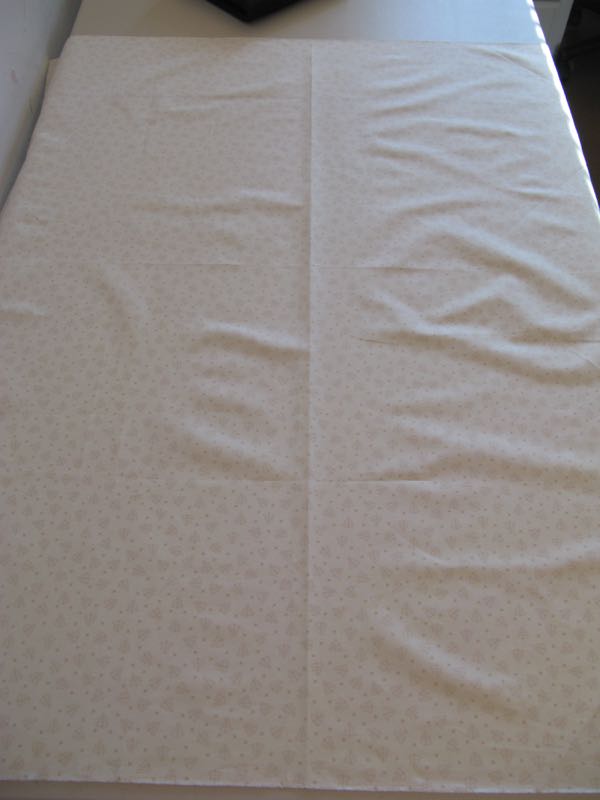
ohchristmastree1_2csoftcrease

I took the fabric to the ironing board and ironed in a soft crease.  Don’t overdo it.

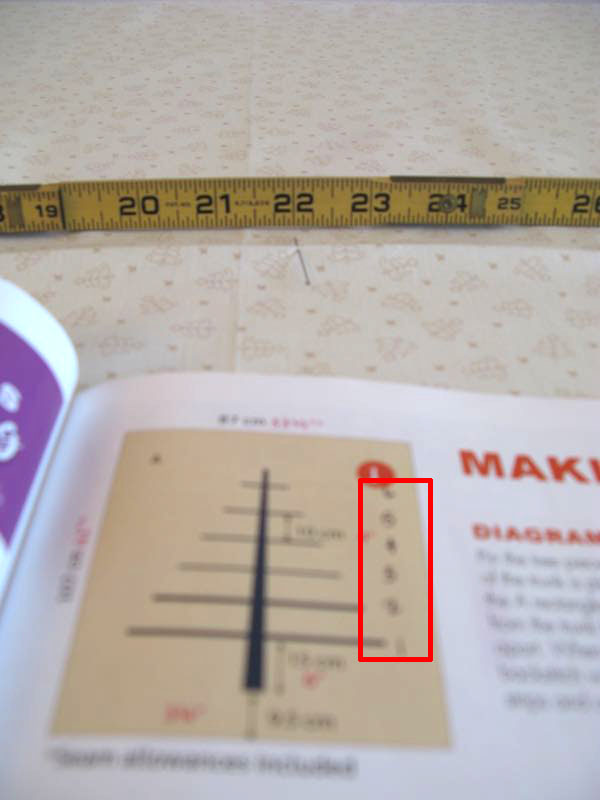
ohchristmastree1_2bmeasuring


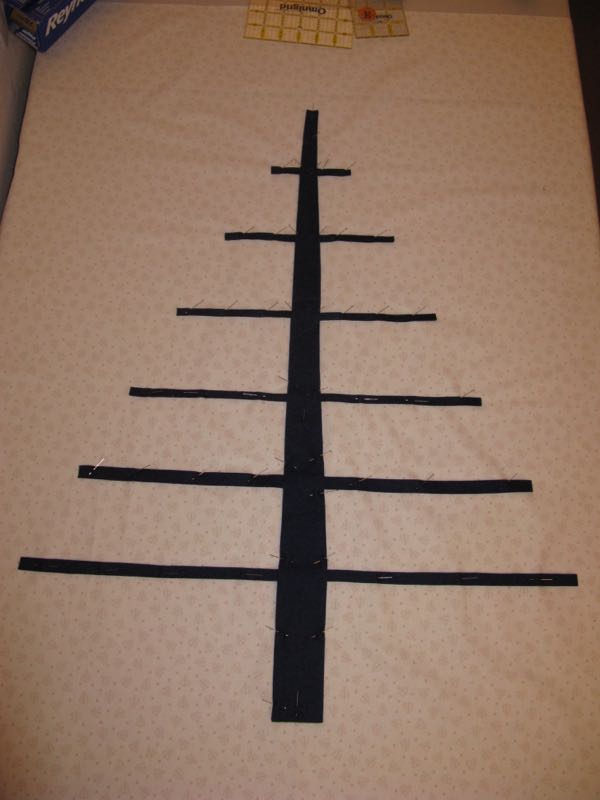
I labeled the crosswise branches on the feather tree in the right margin of the first diagram, which you can see in the red box, and following their directions, and put pins along that soft center crease to know where to place things.

ohchristmastree1_1deciding

I cut first one strip of blue (lighter) and then the dark one, and couldn’t decide between the two for my tree.  So I laid out all my supplies on top of the strips.  I liked the country French blue, but decided, finally, that the darker would bring more contrast to the finished quilt.

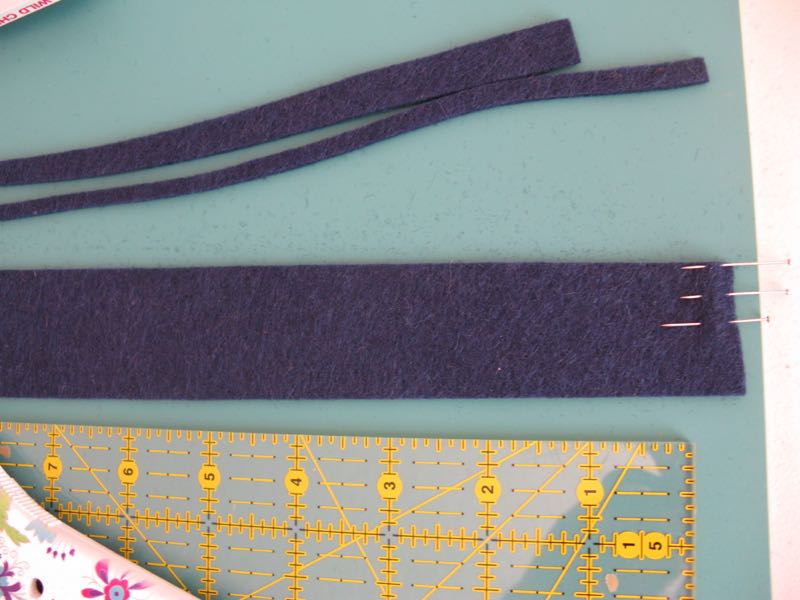
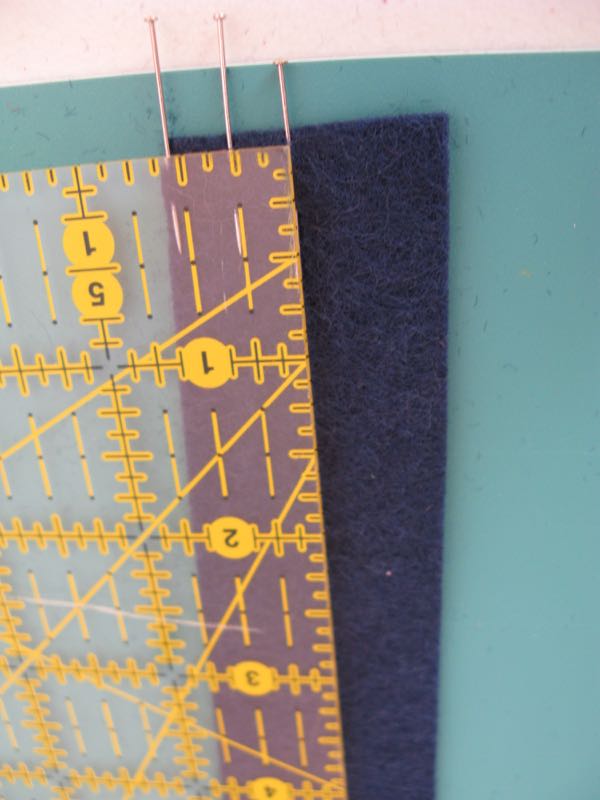
ohchristmastree1_3acuttingI cut the long center strip, using the measurements in the pattern.  She asks you to taper the wool at the top, so I put a pin in the middle, then measured and placed others.  I angled my 24″ ruler from that middle pin to the outer edge of the center and cut away that wedge.  I didn’t cut enough on the first time, so did it again.  I also cut the top a wee bit larger than she asked –just a bit–as I like the look of it.

ohchristmastree1_3bcutting ohchristmastree1_3ccutting

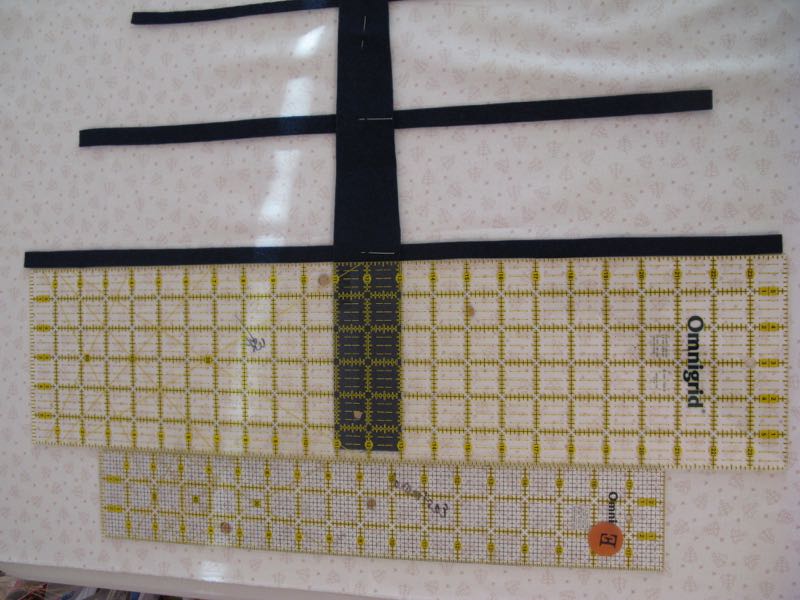
I also cut these crosswise branches a scant 1/8″ larger, especially on the top branches (I have one more set to go up above) and I’m glad I did.
ohchristmastree1_4apinning

I laid them out on my fabric, using the soft crease and my rulers, in order to get them on the fabric straight.  You don’t want a tipping Christmas tree!  I also used the 24″ ruler as I pinned each set, as the wool will bump up against it, helping you get it on perpendicular to your tree trunk.  I was able to get it on fairly straight that way.ohchristmastree1_4bpinning ohchristmastree1_4cpins

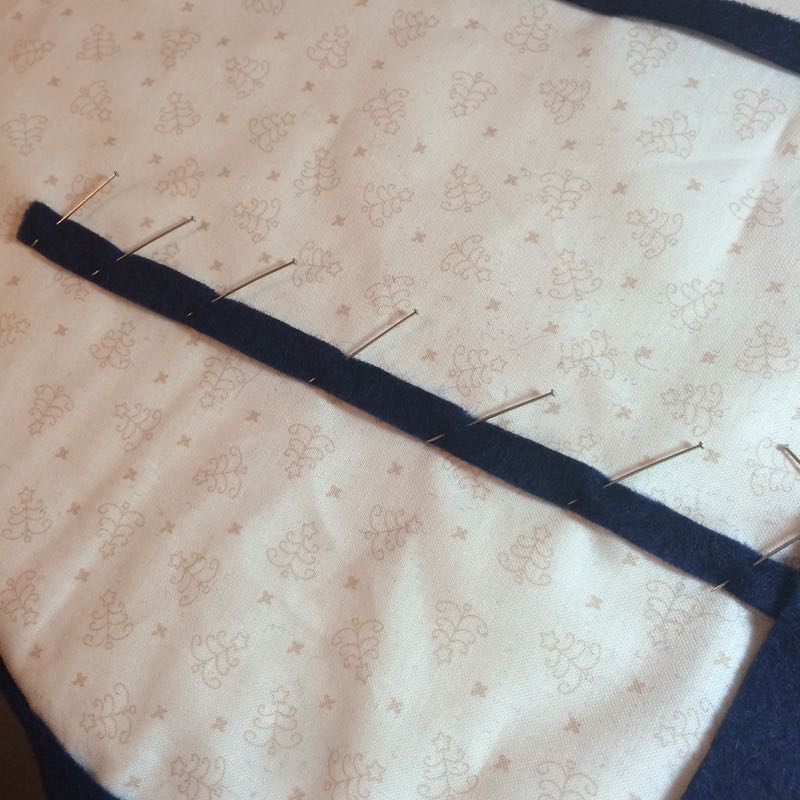
Although I initially pinned them by putting the pins parallel to the crosswise branch, I soon found that it made the wool and the fabric buckle, so I shifted to this method of pinning.  Pin a LOT if you are using felt.  If you’ve used the wool backed with Steam-A-Seam, it will be tacky on the back and it will be easily positioned.  The felted wool people will then go to their ironing board after the first pinning step and press it down.  As Primitive Gatherings notes: “Keep your iron moving at all times so you will not scorch your wools.”  Wool is a natural fiber and can burn and scorch, but you might try using a lightweight pressing cloth in order to protect the wool and not give it a “shine” from too much pressing.  (That’s my college Clothing and Textiles degree being put to good use–thank you, Mrs. Dimas, for your tailoring class.)
ohchristmastree1_7holder

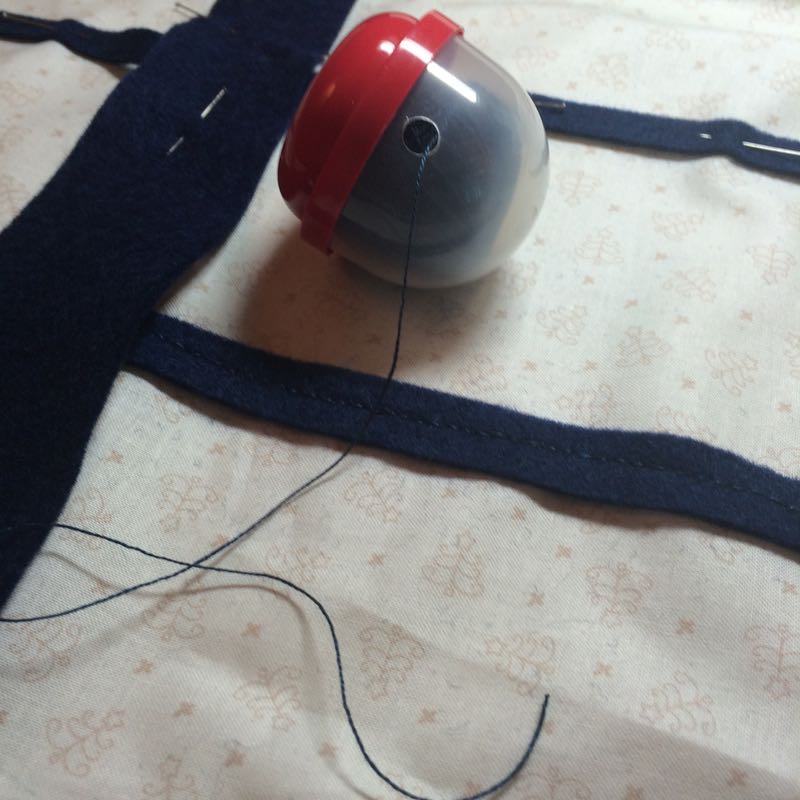
Now start stitching.  I put my ball of pearl cotton in this little holder and boy was that handy.  You can buy one from Bird Brain Designs. (See below for how you can win a couple freebies for yourself.)ohchristmastree1_8stitching

Start with the crosswise branches, and do a close backstitch on them.  I did mine right close together along the branches, like the top example:

backstitch

(from *here*)
You can do a search to find out how to do a backstitch, which is where I found *this* quick YouTube Tutorial.

ohchristmastree1_8astitching

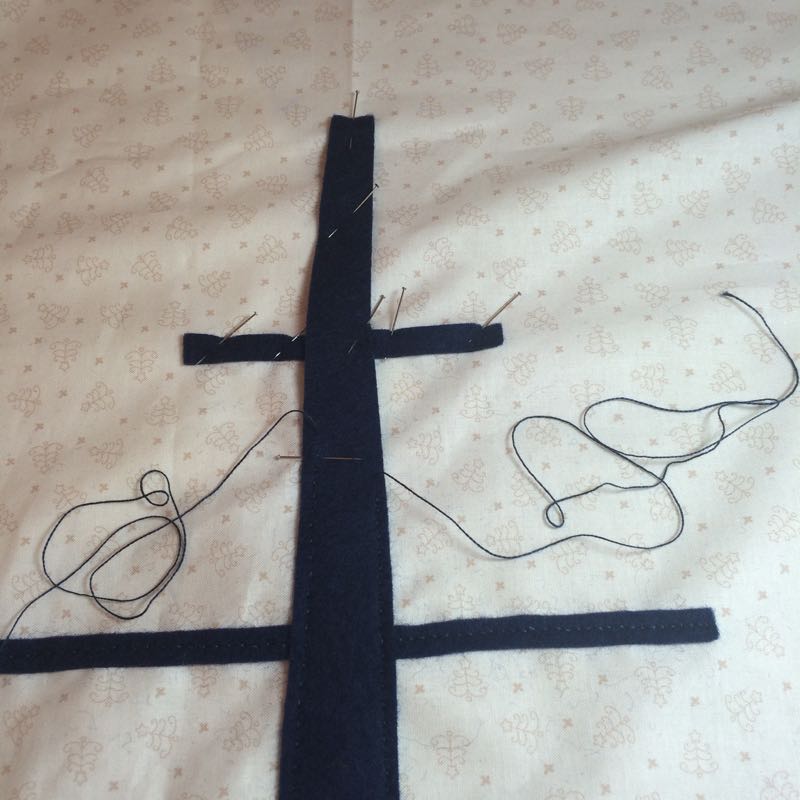
I butted my ends of the crosswise branches together under the main tree trunk and stitched, lifting the “trunk” as I went underneath.  I also tried it with the edges just under the edge of the trunk, leaving a space between them, but felt it was more stable with the wool tucked in further.

ohchristmastree1_9dblthreadsI did an expanded backstitch going up the side of the tree, leaving a space in between each stitch, using two separate threads (one for each side) as I went up.  I decided to sew the tree trunk as I finished each branch, so it would feel quicker to me.  The whole stitching down of branches and trunk took the better part of a morning.

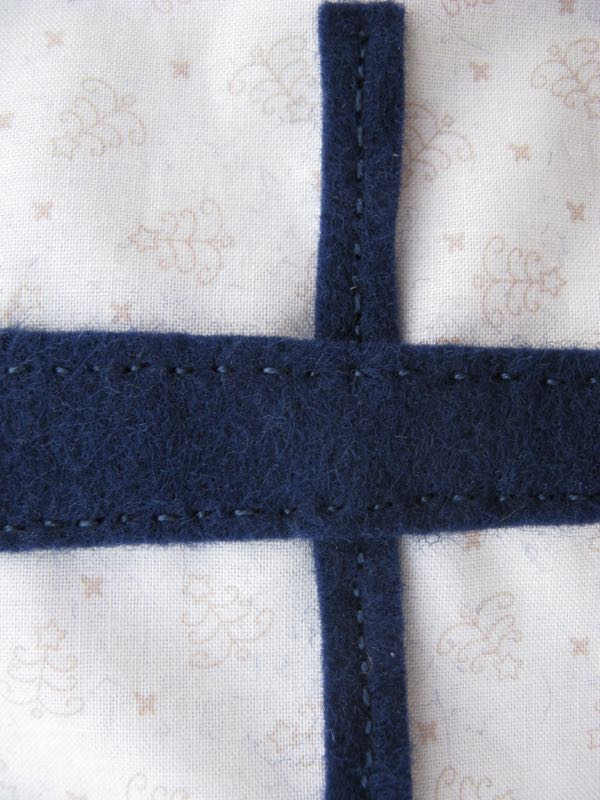
ohchristmastree1_stitches

I have this on high-power magnification on my camera.  I  promise you NO one is going to look at your stitches this closely, so if you make a mistake or it’s not quite right, don’t fret. This whole tree is in the folk/rustic flavor so an imperfection adds to the charm. You can see that I did a closer backstitch on the crosswise branches and an expanded, or open, backstitch on the trunk.  It was easy to stitch.ohchristmastree1_treesewn

Ta-DONE!

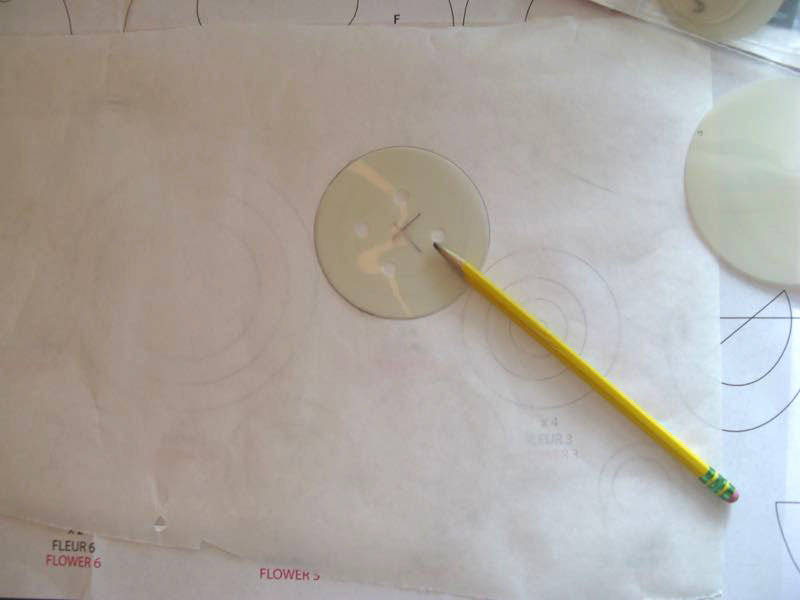
ohchristmastree1_tracingSince we always want to prep up for the next step before leaving our project, I’ve also added to this step the tracing-off the patterns for the flowers and the birds.   I’m using freezer paper, as it can be ironed onto my felt and used multiple times.  There are a lot of circles to cut out of your paper in order to prepare.  I’m using Kay Buckley’s Perfect Circles, matching up to what’s on the pattern and tracing around them.  (Yes, I punch holes in my bigger plastic circles so they won’t warp and buckle under the heat of the iron when I use them at the ironing board–the heat and steam can escape through the holes.  I sometimes also mark the center, which is what you see here.)

ohchristmastree1_tracing first steps

I can use the inside of a Perfect Circle to trace those teeny circles in the middle (inside the green square in the first photo), or a spool of thread, if there isn’t a Perfect Circle to match up with what you are doing.  I labeled each circle on my pattern with a master number and an inner number, as in 1-1, 1-2, 1-3, 1-4 so when I cut them apart I know which goes where.  I placed them all in plastic bags.

ohchristmastree1_tracing4

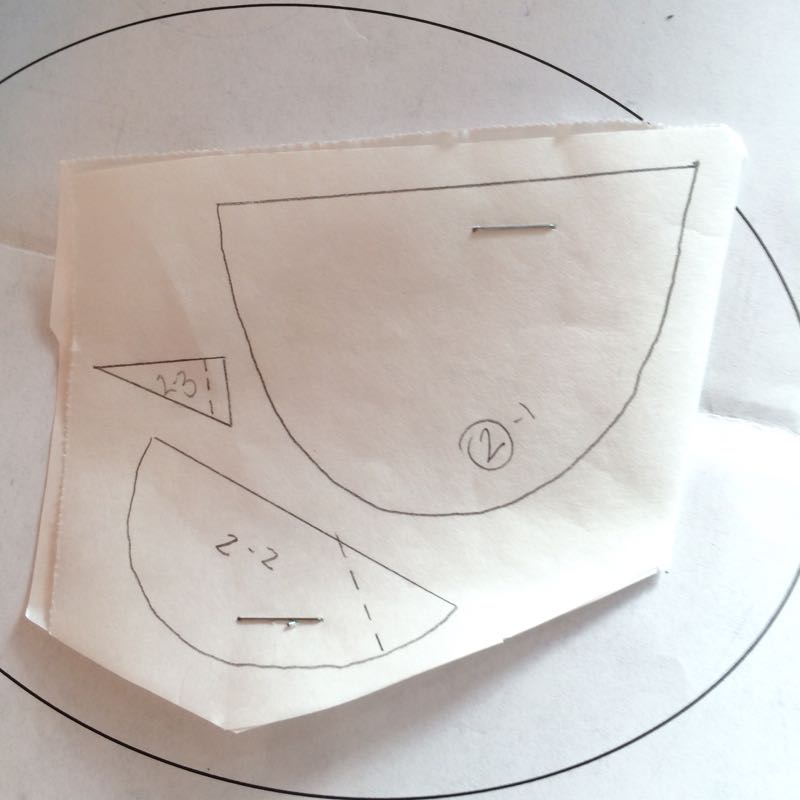
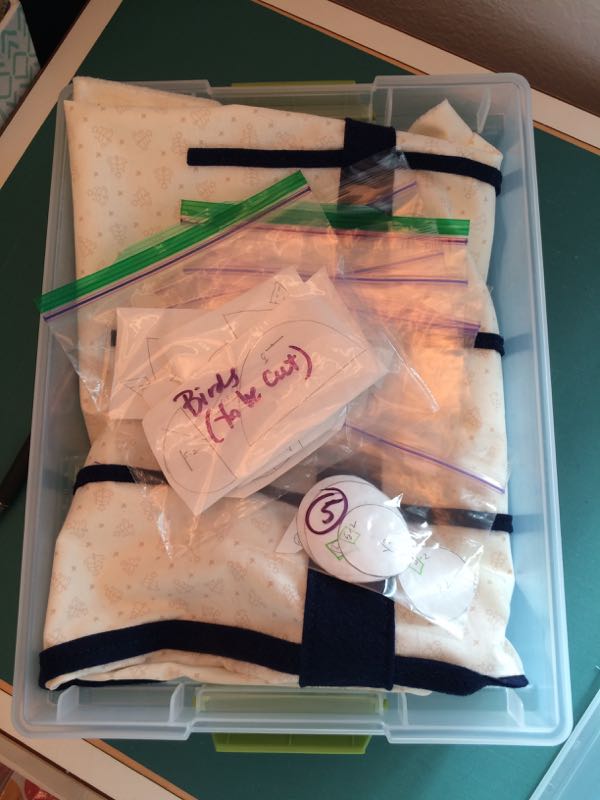
For the birds, I labeled them, drawing a dashed line where it crosses the main pattern piece (or is tucked under), added another piece of freezer paper to it with glossy sides together, and stapled them once in each major piece.  I’m not ready to cut them apart yet, as I’ll do that in April, when we do birds. Pay attention to where she says to reverse the bird patterns.  If you want to, you can also start cutting your circles out of your wools and felts and fabrics (if you are using fabrics).  I realize that things often change as we start stitching the flowers and birds (the under-tree scene will come later), but it’s helpful to get going on this step.

ohchristmastree1_tracing5

It’s all tucked away, waiting for next month’s step.  Here are the steps again:

January, Step “prepare”: buy the magazine, gather your fabrics, buy the felt/wool, buy/find the pearl cotton.  More about that in a minute.

February, Step 1: Make the tree on the background and stitch it down.  If you use wool felt, she has an easy appliqué method. Prep up the circles by tracing them and organizing them together.

March, Step 2: Make 21 flowers.

April, Step 3: Make 10 birds.

May, Step 4: Make the scene at the bottom.  Wendy’s pattern (IG: flyingfishkits) has two cavorting reindeer.  I plan to switch mine out to a simple nativity.  Your choice.  (If I were you, I’d also start haunting her IG site as she has lots of great embroidery ideas for the flowers. I’d also consider buying her book, Wild Blooms and Colorful Creatures, for more tips and helps.)

June, Step 5: Appliqué down the flowers.

July, Step 6: Appliqué down the birds and the scene.

August, Step 7: Sawtooth border (reds).

September, Step 8 (finish up Quilt-A-Long): Make wonky star blocks, sew them together and attach border #2.  Ta-Done!  I just have to deliver you here.  You are on your own for getting it quilted and bound.

We’ve done:

1Xmas Tree and now2XmasTreeFeb


I’ll post Step Two on March 2nd.  The second day of the month will be our regular posting day from now until we finish, and I’ll also put a reminder up on Instagram.

3XmasTreeMar

Some blogposts that have tips for working with wool:

Fresh Figs

Black Mountain Needleworks

American Pie Designs

Molly and Mama

To enter the giveaway for TWO perle cotton bubbles, leave a comment below. I’ll choose someone by Friday and get them sent out to you by next Monday, just as you are ready to start sewing your trees!