Creating

Craft vs. Art

Ken Price: “Untitled Two Parts”

For a while now, I’ve been intrigued by a comment by Ken Price, a ceramic sculptor, an artist.  Since he sometimes did representational shapes like cups, saucers and covered jars, the “cultural prejudice against clay as a hobby-craft material unsuitable for major art” reared its head to often typecast him as a craftsman, not an artist  (quotes from an article in the LATimes).  Just like our quilts.  My art professor in college, when I asked him when he’d ever okay a show of quilts, said “Over my dead body.”  He was kidding (well, maybe not) and the answer stung.  I realized that even though there is now more recognition for the quilt as an art form, too often we are put in the craft category.  So I was intrigued by the following quote (also from the LATimes article):

Price did distinguish between craft and art, but it’s important to note that he respected them both.  “A craftsman knows what he’s going to make and an artist doesn’t know what he’s going to make,” he once said, “or what the finished product is going to look like.”

These words did echo in my head as I worked on English Elizabeth.  Like Price, I took my fabrics and my technical skills and knew that somewhere I’d end up with a quilt.  But I didn’t know what I was going to make, or what the finished product was going to look like.  My quilts will never hang in a museum, but the journey for this quilt was so different than my usual, that Price’s words resonated.

There’s an interesting energy that comes from trying something new, or to use a cliché: “stepping out of your comfort zone.”  Usually, for me, a quilt begins at the computer, doodling around in my computer program or imitating something I’d seen before, but this process–to create out of whole cloth, literally, was an experience that I found seductive, scary and immensely satisfying.

200 Quilts · Creating · Four-in-Art

English Elizabeth’s Technical Side

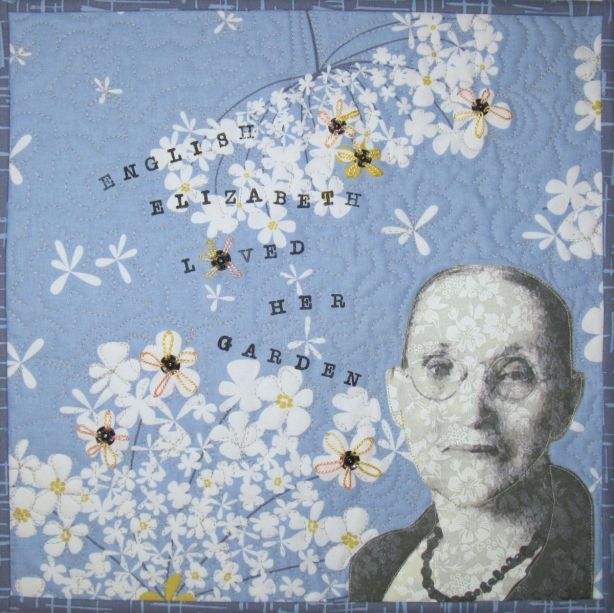
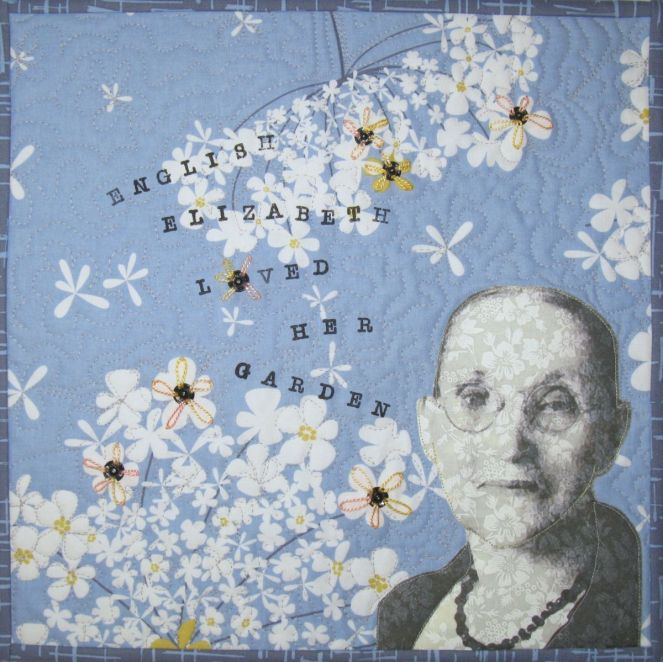
See the previous posts for the reveal of English Elizabeth (above), part of the Four-in-Art quilt group.

One of the Twelve-by-Twelve artists (after who we are patterning our group) said she likes commercial fabrics and always uses that as a starting point for her creations.  And even though I suggested this adventure of an art quilt, I was frankly a bit terrified of the whole idea, so starting with a commercial fabric seemed really appealing.
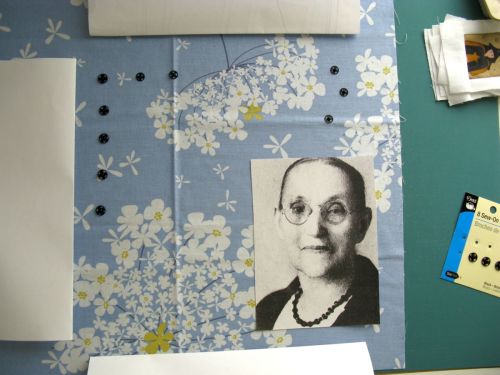
The commercial fabric I’d chosen for the background was from the Madrona Road line of fabrics by Violet Craft (from Michael Miller) and it had Queen Anne’s lace in a blue and an orange colorway.  I had a scrap of blue leftover from my Harvesting the Wind quilt, but it was only about 15″ square.  That was it.

I decided to be open to anything and while I was picking up some fusing supplies in our Jumbo Fabric Store, these black snaps jumped into my basket.  Okay then, great-grandma and I are doing something with black snaps.  I printed out a picture of English Elizabeth, put white papers around the edge to give a sense of the size of this thing, and arranged some black snaps marching up the sides.

Nyet.
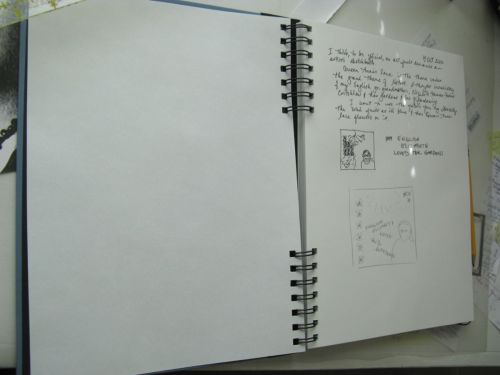
Most of the Twelves used an art journal of some kind, so I dragged out a blank one and started writing–always my fall-back mode.  Then I used my (very) rudimentary art skills and sketched out some possibilities.

Things were starting to click in the old brain.  I have an EPSON inkjet printer with DuraBright inks, and I’d had good success with printing onto fabric for all my quilt labels, so I thought I would try printing English Elizabeth onto some lighter-colored fabrics.  I did some research on the DuraBright inks and apparently they are water-resistant.  I knew that I’d probably never wash this quilt, but I had, in the past, done a test sample and the ink stayed on through a run through the washer.  (However, if you really want permanence, Spoonflower for fabric design or Micron pens for labels might be the best way.)

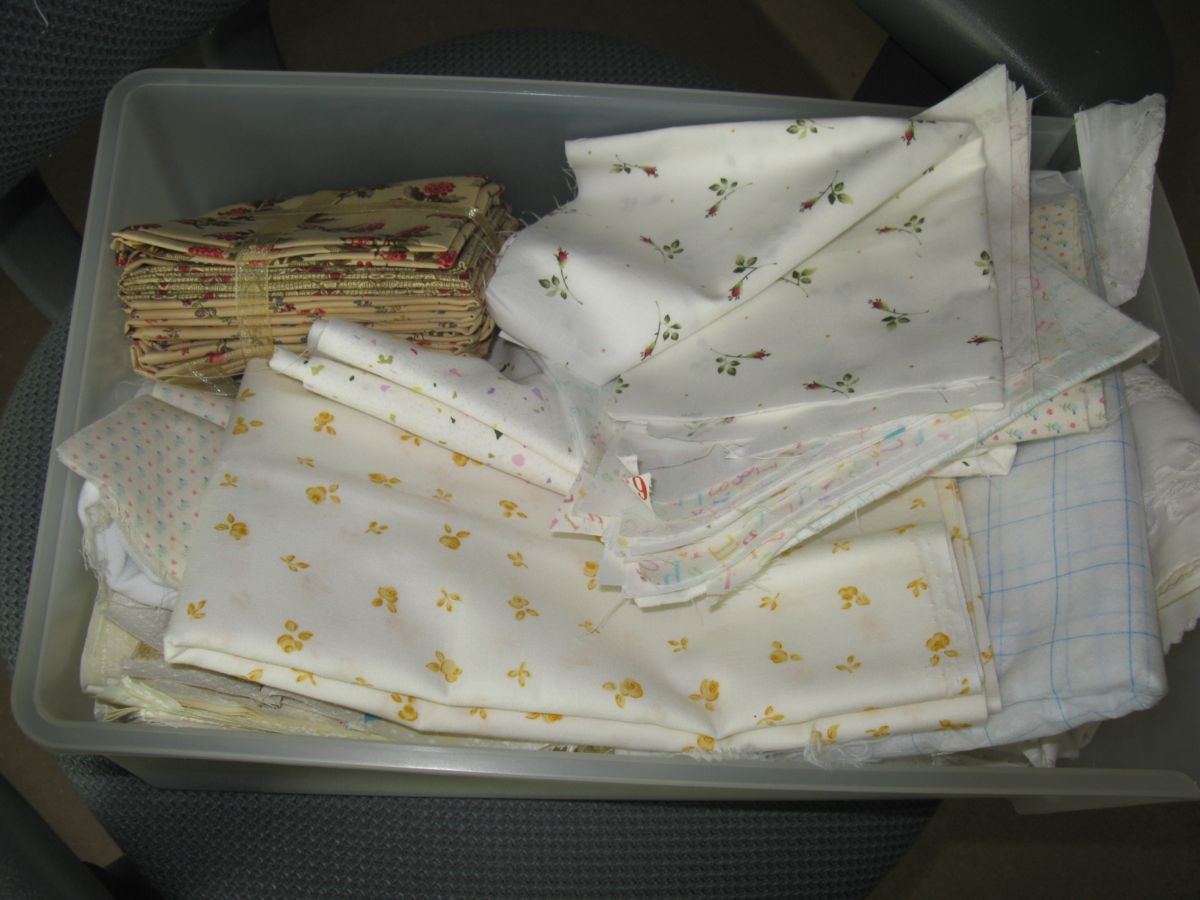
Auditioning fabrics.  I initially thought I wanted to pick up that light mustardy hue in the fabric, but instead I was intrigued by the thought of printing Elizabeth onto some creamy floral fabric–making her into her own garden of flowers.
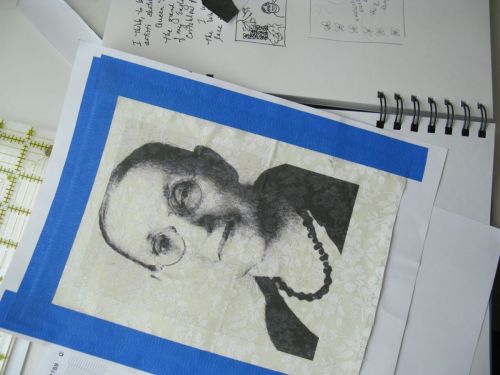
I auditioned several sizes, like the one that was 5″ across. I ironed freezer paper onto a square of two creamy floral fabrics and ran them through the printer, fingers crossed.  (I put tape on three sides of the stabilized fabric, leaving the bottom edge free.)  It was working well!  There was some trepidation every time I tried a new idea.  Would the artsy part of it work?  Would the technical side of it work?  It was lovely having my great-grandmother look at me all afternoon.

I chose the fabric sample with larger flowers, but when I laid English Elizabeth down, the blue showed through.  Before I cut around her head and shoulders, I ironed some featherweight fusible interfacing onto the back of the fabric, placing the printed side against a piece of white paper, just in case the printing would transfer.  It didn’t.

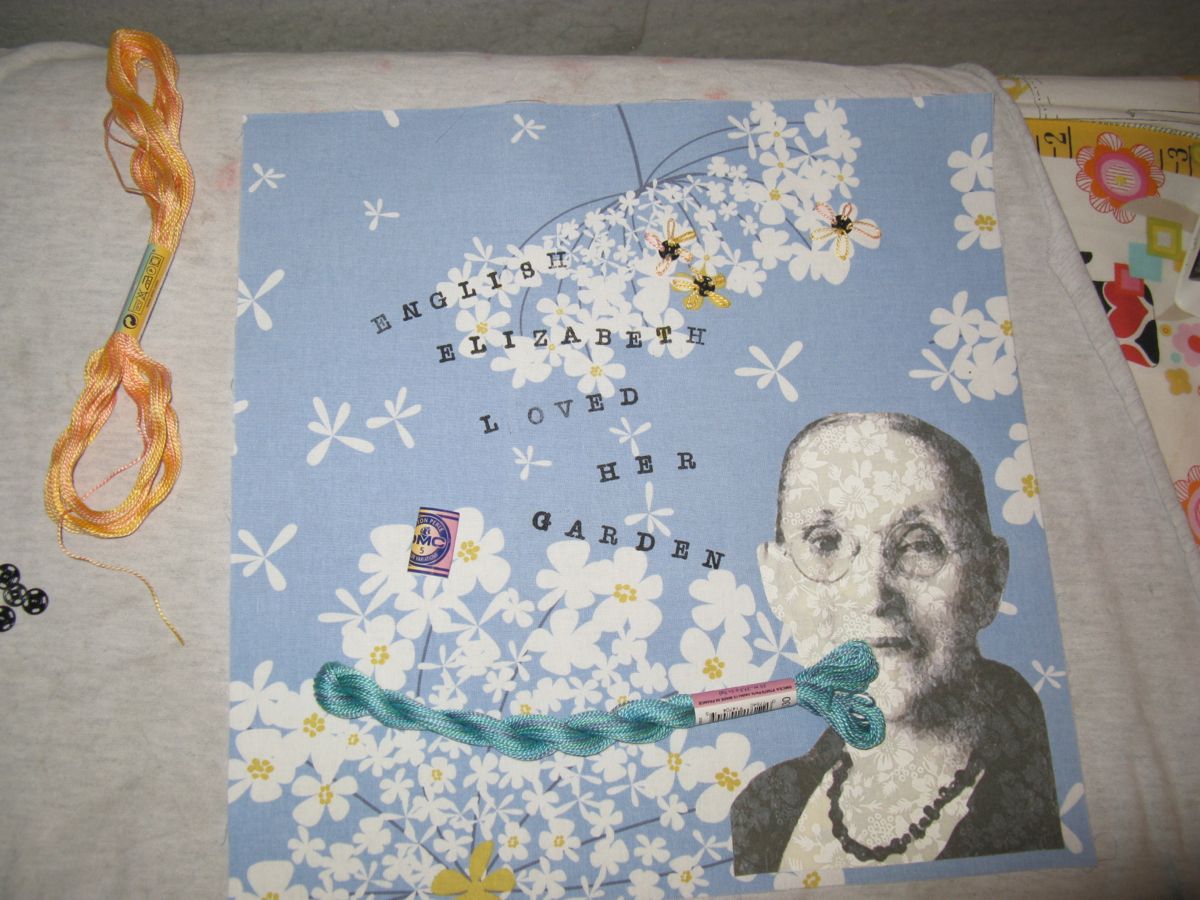
I wanted to print this phrase I’d come up with onto my fabric, but my printer isn’t wide enough.  I had a stamp set of alphabet letters, so it was back out to the Jumbo Fabric Store to buy some fabric/textile paint.  That is a whole other story (did you know how many kinds of puffy paint there is??) but let’s just say I finally selected a “fabric stamp pad” by the brand name of Scribbles, and had enough time to go by the embroidery floss aisle to pick up some variegated pearl cotton for attaching those snaps.  Somehow.

Worried about the “heft” of the fabric, I ironed a piece of featherweight interfacing to the back of the blue, and then started stitching.
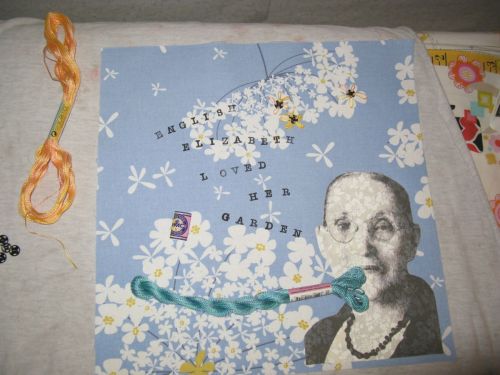
Auditioning colors. I did do a couple of blossoms in the aqua-blue pearl cotton, but ended up cutting them off and going with the yellow-peach pearl cotton instead.  I wasn’t crazy about the spacing in the word LOVED–that “L” seemed to hang off the edge of the word, so I converted the O to a snap-flower to even out the spaces.  I trend to the pristine in my quilting.  You know: all those points sharp and crisp, those seams perfectly joined, so to let the messy and random into the quilting was interesting.  I might even say, beneficial.
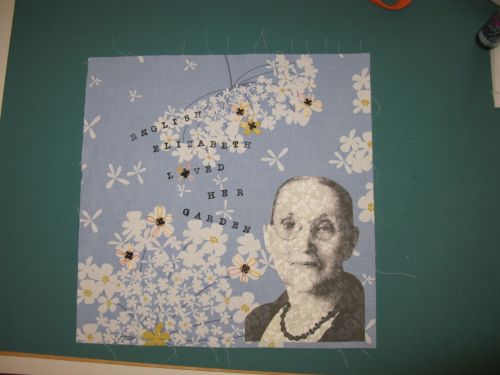
Ready to go to quilting.
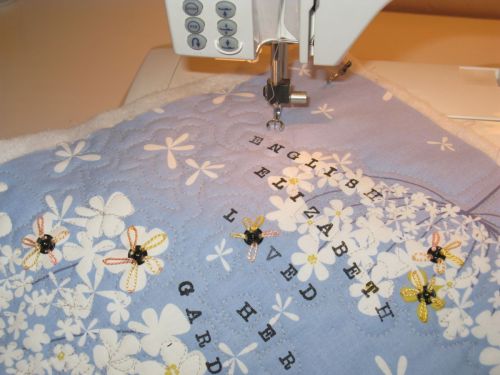
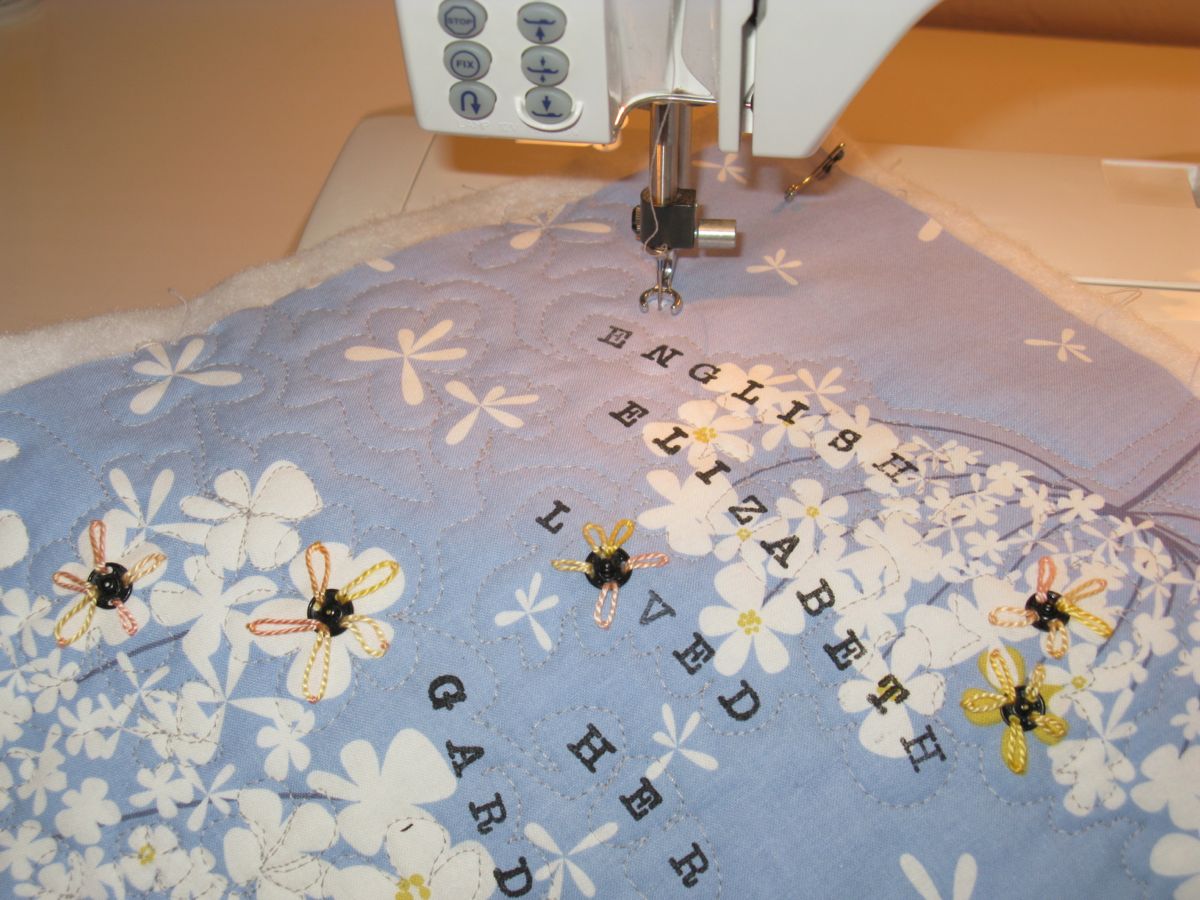
Usually all embellishment comes AFTER quilting, but I wanted those snap-flowers to be a part of the piece and to be able to quilt around them. I quilted with light gray thread in both top and bobbin.
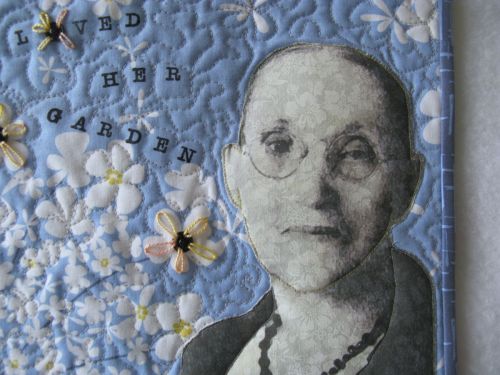
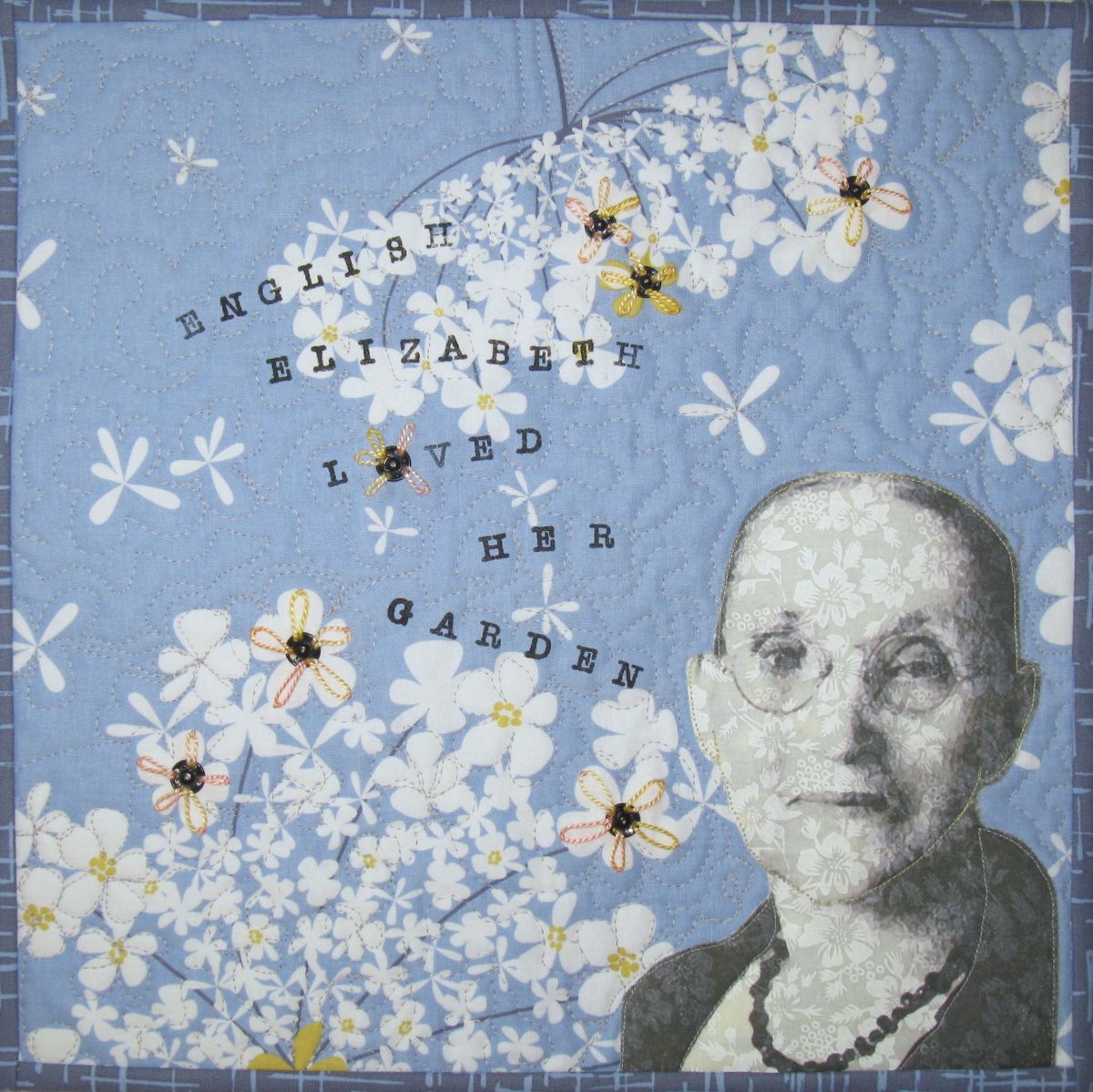
English Elizabeth, detail.  I went in with gray and cream-colored thread to outline the contours of her face and to delineate her jacket.  My mother still has those beads of her grandmother’s and yes, she does wear them.  I wonder when this photo was taken.  It was obviously posed, and she had pulled back her hair into a tight bun.  But that allowed her large eyes to dominate, along with that Mona-Lisa-like smile.

English Elizabeth, detail.

The snap flowers.  There are only four holes, but five petals on the individual flower of the Queen Anne’s lace stalk. So I put two petals into one hole.  Sometimes they looked really funky.

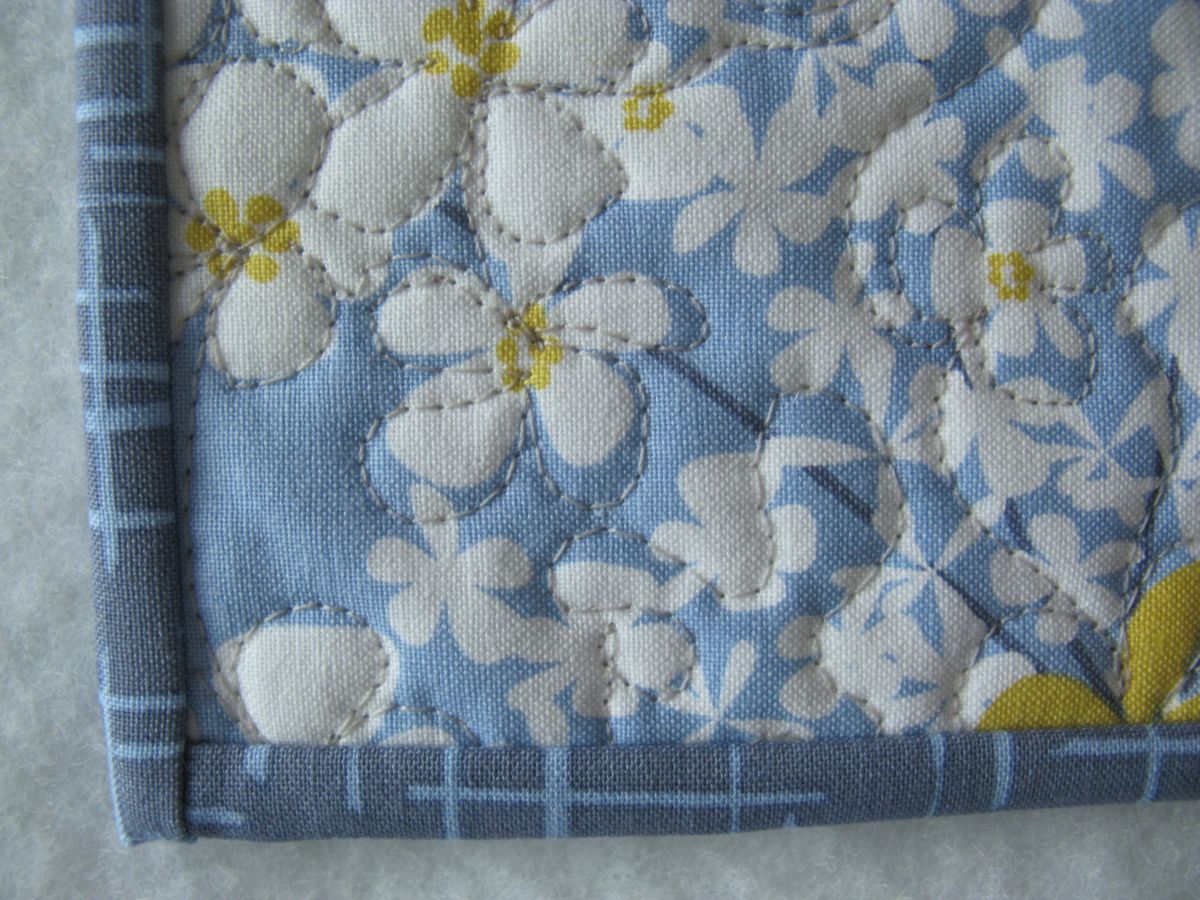
I bound it with a narrow straight binding, using another piece of fabric from that line, the cross-hatches suggesting a fence to me.

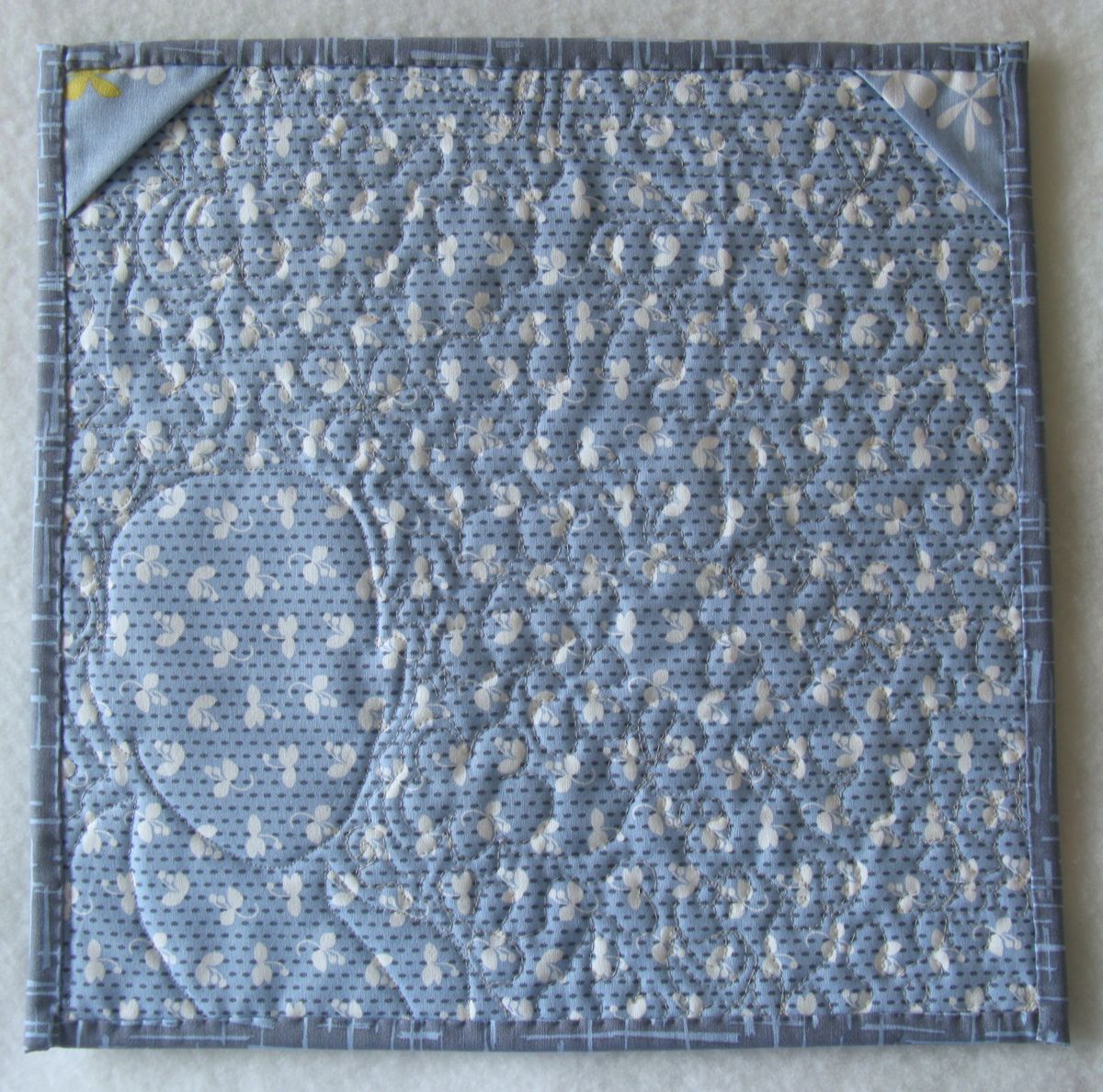
Back of the piece, showing the quilting.  I used the folded corners method to hang this quilt: a dowel, cut to the length of the back of the quilt minus 1/4″ will slip into those corners, and hang on a push pin.

Was making this all roses and fairy dust?  No.  I procrastinated beginning on this piece because the whole idea was so different.  It’s like driving to the frozen yogurt shop, in a way.  If you go there often enough, like my husband and I did during this long hot summer, the way there is easy, smooth and oh-so-familiar.  But when we wanted to try a new shop, on a different side of the city, we had to figure out a way to get there.

I did finally arrive at a satisfying place, and although the road was different and strange, sometimes frustrating and scary, I have the sweet smile of my great-grandmother looking down on me as I work, confirming that, for me, that the new path was good.
SaveSave

200 Quilts · Creating · Four-in-Art · Quilts

English Elizabeth: First Four-in-Art Reveal Day

English Elizabeth

Made and quilted by Elizabeth Eastmond,
for the Four-in-Art Quilt Group

Elizabeth Frances Fellow Critchlow, a lass born in England in 1855, in the county of Staffordshire, surely did love her garden.  She is my great-grandmother and I am named for her.

When Rachel announced the theme of Queen Anne’s lace for our first Four-in-Art quilt, my mind immediately thought of my great-grandmother and her gardens.  I looked up the origin of the name of this flower, and most sources believed it had origins in British royalty references, which reinforced that I’d be working with my English Elizabeth, as I came to think of her.  A dedicated Anglophile, she listened to major speeches by the King on her wireless set, tuning in from her home in the mountains of Utah.  My mother tells me that she loved to garden, and her gardens were renowned, with even the local university coming over to study some of her plants and trees.  Although she lived most of her adult life here in the United States (she arrived here at age eleven), I often wonder if she spoke with a British accent here and there on some words.

I chose to work with this picture, because of her smile–just barely there—but a warm welcoming face.  My mother says she likes this picture, but also remembers her grandmother out in her gardens, her straw hat on her head.

And then I thought back to the most recent wedding in our house, that of my son Peter to his bride Megan, and they chose a rendition of Queen Anne’s lace for their announcements as well.  I love how you don’t “see” a flower, and then suddenly it’s everywhere.

~~And now, Two! for the Price of One!~~

Betty lives in Virginia, and unless you’ve been under a rock this week, you know about Frankenstorm, the combination of weather patterns that spelled disaster, weather-wise, for the East Coast.  Sunday night, before the storm was to hit, Betty emailed me her photos and artist’s statement, just in case her power and internet should go out.  I’m pleased as punch to present to you her Queen Anne’s Lace quilt.

Betty writes:

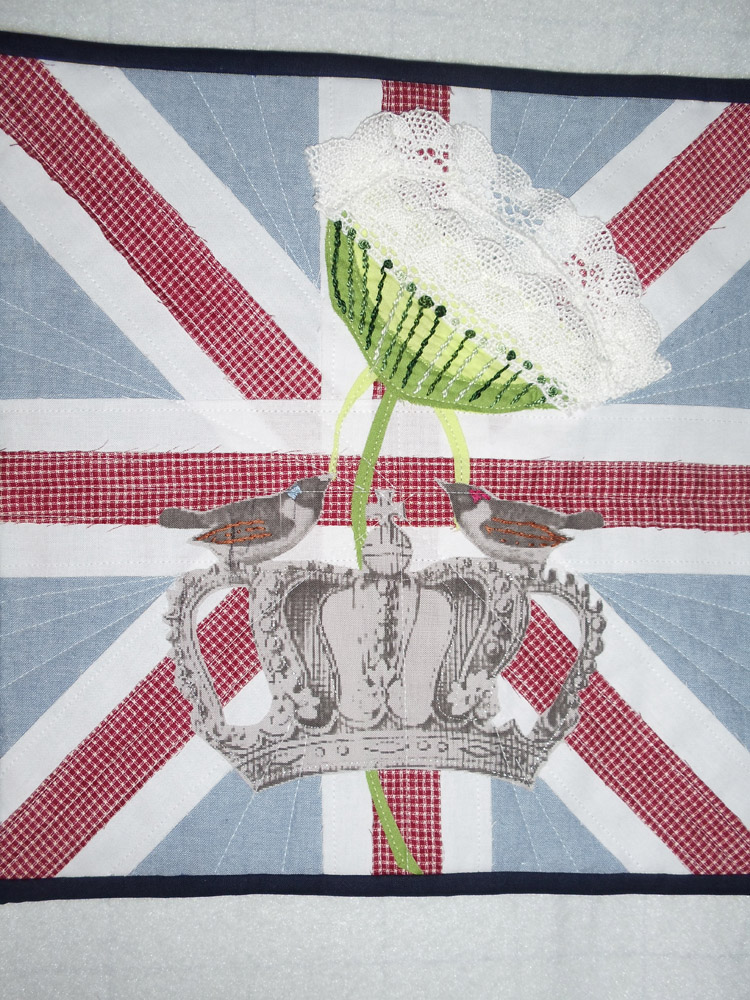
“This Four in Art challenge, our first, was an opportunity for me to stretch – to stop, for a moment, the churn of easy quilts and do something new.  When the theme – Nature:  Queen Anne’s Lace – was revealed, I sighed.  Love the flower, although it isn’t as highly regarded on the east coast as apparently it is on the west coast, but I drew a blank when coming up with a setting.  So, I took a practical approach:  just love the Union Jack and decided to use that as my backdrop.  I planned to paint my flag, but could not get the red and blue faded enough so decided to go the fabric route.  I was excited to use the crown and copying that onto Kona Ash was a first; one of my favorite details in this piece is the silver metallic stitched onto the crown (which did not come through in the photos).    I had hoped to actually stencil the lace to form the flower, but that didn’t work well so I opted for real lace with pearl cotton accents.  The flower is my least favorite feature of this little quilt, but it is holding its head up boldly and doing its part and I am, overall, pleased.

“The backing is, appropriately, a simple flower piece and I loved making the label.  It is bound in simple navy Kona – had tried to overcast the edges with silver metallic, but that did not work well.

“This was fun and without boundaries (except for the size) and provided we do it again, I will find other new methods to try and apply!”

Betty Ayers • Powhatan, VA, USA

Here are some more photos:

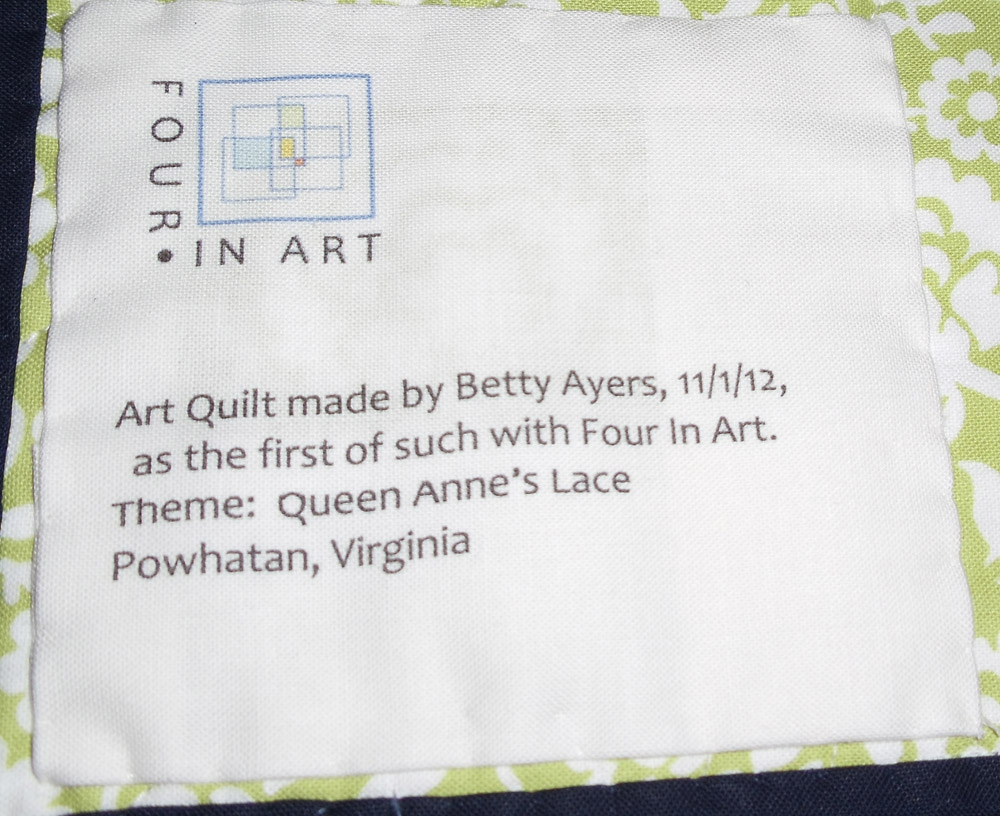
Label from Betty’s quilt. We hope that all will be okay on the East Coast soon.  Betty usually publishes on Flickr.

Check out Leanne, of She Can Quilt, and Rachel of The Life of Riley to see their Four-In-Art Quilts.

And tomorrow, a new theme is revealed!

Creating · eQuilt Universe

Creativity and the Web

I’m thinking about all those affected by the horrific storm on the East Coast.  I have several quilty/blogger friends, as well as quite a few family members who have been affected and hope that they and their families are through the worst of it.  I’ve been on a blogging break this week from the computer (I wrote this post earlier) but I just wanted to jump in and send my thoughts to those who are dealing with this “Frankenstorm” and its aftermath.  Take care, everyone.

****************************************

In my class at school, we just completed a unit that was based on this book by Nicholas Carr, titled, The Shallows: What the Internet is Doing To Our Brains.  We had our Discussion Panels last Wednesday, and it was fascinating that the students were fairly perceptive and able to discuss how the Internet has impacted their lives, for better or for worse.  One young man is fairly sanguine about the whole thing, saying, “Well, it’s here.  We just have to deal.”  Another pair of young women took opposite positions on the question of whether print was dead.  The internet’s main impact, that of re-wiring our brains due to neuroplasticity, was skirted around, but acknowledged when they all complained of the inability to finish a book before distractedly checking their phones for texts or messages.

And I think it’s rewired my brain as well.  Carr goes through the history of civilization’s adding of new technologies, from writing to moveable print to the typewriter and onward to clocks and the internet.  I was interested in his discussion on tools: “The tight bonds we form with our tools go both ways.  Even as our technologies become extensions of ourselves, we become extensions of our technologies.”

 I thought about how quilting has changed from the time when I used to trace a pattern onto cardboard, carefully cut it out and tape the edges for stability.  Then I’d trace it about a bazillion times in order to make a quilt, following along the pencil line for the seam.  I did use a machine for piecing, but hand-quilting was the only way to finish a quilt.  That’s why my list of 100 Quilts took so long to grow: our tools were more primitive before the advent of rulers and rotary cutters.

He also references Frederick Taylor’s Time-Motion studies and how it has changed how workers do their jobs (above: a golfer takes a swing).  Before Taylor came along, “the individual laborer, drawaing on his training, knowledge and experience, would make his own decisions about how he did his work.  He would write his own script” (218).

I think of us at work.  Some of us spread all our fabric out into a lovely mess (like mine, above).  Others fold and organize continually throughout the day.  I like to doodle around with my computer when thinking up a new quilt. Some like to start cutting, throwing the cloth up on the pin wall to see what’s going on.  Carr notes that with Taylor’s regimentation of industry’s messiness, something was lost.  “What was lost along with the messiness was personal initiative, creativity, and whim.  Conscious craft turned into unconscious routine.”

I hope I never become such a slave to a pattern or a ruler or a system of making a quilt that I can’t make  a creative and conscious detour into creativity.  But sometimes I wonder when I make a copy of another’s quilt, using one line of fabric if I’m not caught in a type of quilt-machine using Taylor’s demands for proscribed motion.   Is this creativity?  Am I being creative, or just following someone else’s script and benefitting from their decisions?

And like many of you, I’ve been following #quiltmarket on Instagram.  Carr said more than once, and I’m paraphrasing here, that trying to control the flow of information from the internet is like trying to take a drink from a fire hydrant at full blast.  The internet caters to the new! unique! amazing! as we all know.

I also have Pinterest boards full of ideas, most are quilts which I’ll never make, but pin them up there nonetheless.   Can we be creative 24/7, or is that too exhausting?  Has the Internet made better quilting possible?  More interesting quilting?  Given us an access to a wider range of styles and types?

I don’t know the answers to these questions.  I only know that sometimes the Internet affects us quilters, too.

So my question now, is how has the Internet affected you?  And has it been for better. . . or for worse?