200 Quilts · Quilts

Silver and Gold Friendship Quilt

SilverGold_draped

Silver and Gold
The Toni Jones Quilt
finished December 2013

Toni Jones moved into the house up the cul-de-sac from mine, a welcome addition to our neighborhood.  With her six children to my four, our houses were jumping when we got together, and we did that a lot.  Her mother lived with them, and the three of us women got along famously. One late summer day,  Toni gave me a jar of her homemade pickles, made from her mother’s recipe and which used grape leaves as the secret ingredient.  As a pickle lover, I thought I was in heaven and still have her recipe in my file, although I have never made them (grape leaves are not easy to come by).

We because close friends very quickly, as we tried to sort out the three main things that concern young mothers: will our children grow up to be good citizens?  how do we manage our marriages? and how can I lose this weight?  The first is a universal, the second was harder for me, and the third was harder for her.  Too soon, my husband took another job and moved us to California, where the marriage finally cracked apart, and we divorced.  Toni moved to a town further south of our Texas meeting place, got a job driving a bus to help out with finances and our letters and phone calls still resonated with the three questions, occasionally adding in a few more thorny conundrums, such as: will I ever marry again (mine), will we ever feel happy inside (both of ours), and can I clone myself to get everything done?

Then I fell in love, married and moved to Southern California.  She and her husband, mother and family moved back to the Midwest from where they’d first moved.  That fall I received a lovely letter from Toni.  She was noticeably slimmer, posed in a family portrait with her husband and children surrounding her like bright satellites.  She was all heart, that girl.  Her letter glowed with satisfaction: she loved the Midwest, happy to be “home” again, and everyone was doing well.  And yes, she’d canned some pickles and wished she could share.

I sent off my Christmas card in 2004, adding a scrawled a note and busied myself with preparations.  Shortly after the holiday, instead of her usual Christmas card, I received a letter from her husband.  He wrote that just before Christmas, Toni and her mother had been killed in a head-on collision on an icy road.  By the time the accident was discovered, they were both gone.  The news was stark, severe, sucking the breath right out of me.

Silvergold_ToniJonesBlock

Toni was the first woman close to me that had left too soon, and I resolved to capture all my friends, those who were close relatives, women who had mentored me.  I decided to make a quilt with everyone’s signature, my own memorial to Toni and to my friendships.

SilverGold_full

So many lived far away, so I ironed fabric to freezer paper, enclosed a letter giving instructions to sign the square in pencil, and included a self-addressed stamped envelope so I’d get them back.  Most did.  Other times, I carted my squares with me to family reunions, to church, to a therapist’s office, to quilt group, as I had made a list of women I needed and began checking off the names as  the squares grew.  Not all of my close friends are included, as I decided to limit it to a time frame, otherwise I’d never be done.
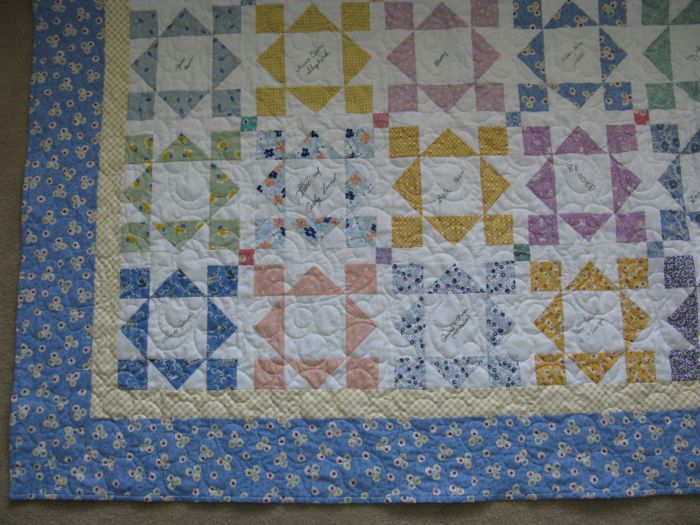
Silvergold_detail4

Silvergold_detail3

I gathered up all my granddaughters’ names this fall, and made them squares.
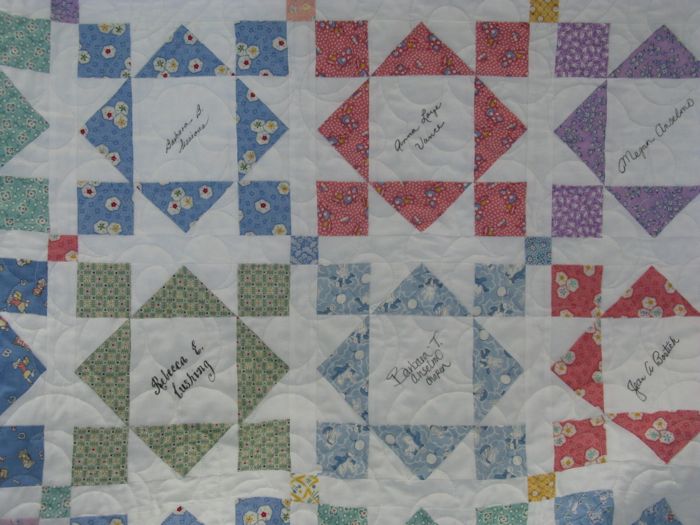
Silvergold_detail2

My mother, Barbara, and my daughter, named for my mother, are kitty-corner from each other.

SilverGold_detail1

I took the quilt to my quilter a week before Christmas and she turned it around quickly, so I could show my granddaughters when they came to visit.  Emilee, the oldest daughter of my son, beamed brightly when I showed her the square with her name on it.  Brooke, the four-year-old, wanted to sign another one, but I’ve left two blank in case my last son has daughters.

Silvergold_detail5

I had purchased the backing when I bought all the fabrics for the quilt, so it came together quickly.  I felt some urgency to finish it off, as this Christmas we celebrated my 60th birthday (it’s really not until January, but all the children were in town, so we did it early).  I hesitate to say the number, because I remember being thirty and thinking that sixty was the kind of number where people were shipped off to Old Folks’ Homes, fitted with canes, walkers and rocking chairs and consigned to a life of reminiscence.  But I am young in my mind (although sometimes the body doesn’t get the memo) and want to celebrate what I’ve learned and the people who have touched my life, providing instruction, guidance and a listening ear at critical junctures in my life.

So, with this quilt, I remember Toni.

With this quilt, I celebrate a lifetime of women.

˚˚˚˚˚˚˚˚˚˚˚˚˚˚˚˚˚˚˚˚˚˚˚˚˚˚˚˚˚˚˚˚˚˚˚˚˚˚˚˚˚˚˚˚˚˚˚˚˚˚˚˚˚˚˚˚˚˚˚˚˚˚˚˚˚˚˚˚˚˚˚˚˚˚˚˚˚˚˚˚˚˚˚˚˚˚˚˚˚

This is Quilt #126 on my 200 Quilts List.
FinishALong Button

It is also a quilt from the 2013 FAL Quarter 4, hosted by Leanne, of She Can Quilt.

200 Quilts · Quilts

Santa Claus Has Come To Town!

Santa Claus Quilt_1

Jolly Old St. Nicholas
Finished December 2013

Doesn’t Santa arrive on the 24th?  Well, we just made it in time, over here.

Santa Claus Quilt_2

I started this in late September of this year, and finished it early this morning.  It’s done enough for display, but I want to go in after the rush is over and add some detail quilting here and there.  Okay, and maybe re-do a square or two, but really, I’m pretty happy with how things turned out.

Santa Claus Quilt_Back

The back, with my beemates’ signature blocks along one side.  They made the green/white large patchwork blocks.

Santa Claus Quilting_1

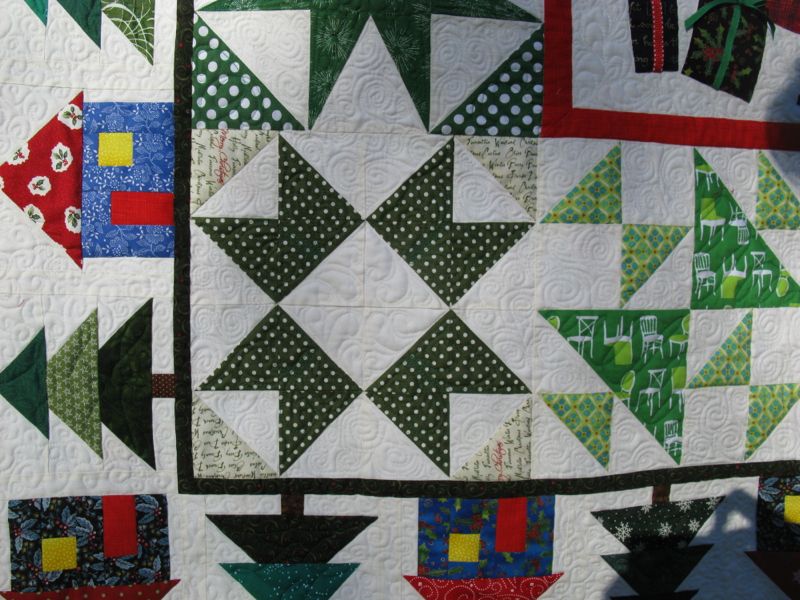
This shot, in the shade, shows some of the quilting.  Each level is slightly different, and each block is different.

Santa Claus Quilting_2

Merry Christmas, everyone!

˙˙˙˙˙˙˙˙˙˙˙˙˙˙˙˙˙˙˙˙˙˙˙˙˙˙˙˙˙˙˙˙˙˙˙˙˙˙˙˙˙˙˙˙˙˙˙˙˙˙˙˙˙

This is Quilt #125 on my 200 Quilts List.

FinishALong Button

It’s also one of my Fourth Quarter FAL Finishes, hosted by Leanne, of She Can Quilt.

200 Quilts · Creating · Quilts

‘Twas the Week Before Christmas

Well.  Almost the last week before Christmas (ten days to go, says the Advent Calendar on our fridge).

Dec MCM Bee Blocks

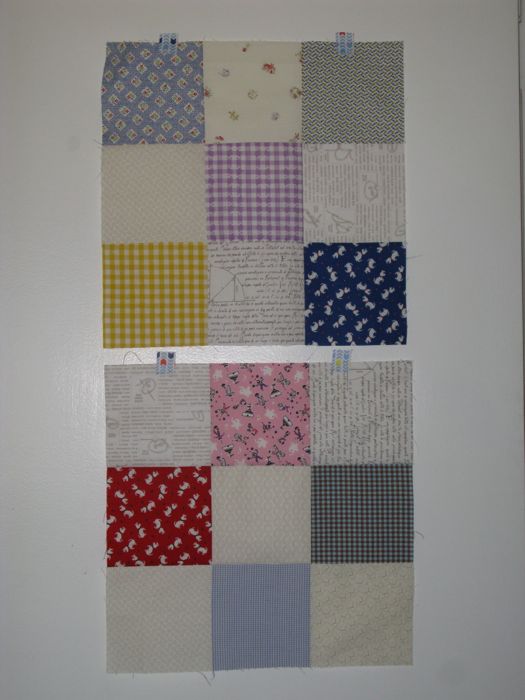
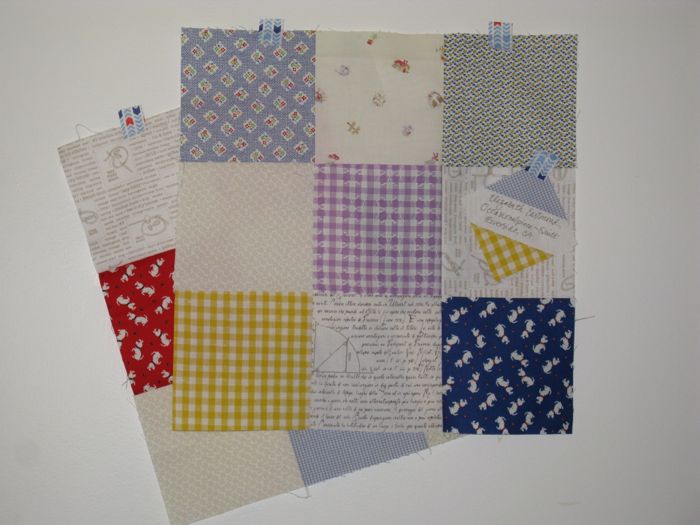
Given that I’ve been >>sick<< with ick and asthma and blah for too long, and that I have TONS of stuff to do, I leapt into action and made my bee blocks for December for Mary at Molly Flanders.  I mean, that is the prudent thing to do, right?

Dec MCM Bee Blocks_2

It was actually quite restorative working with old-fashioned prints and calming neutrals.  A whole lot more fun than trying to get the last of the Christmas decorations up (but I did finish them today, thank you very much).  I enjoyed the process.  One thing that our bee does, which I like, is that we make each other a signature block with our name, our blog name and our location and send it along with the blocks.  I have a row of signature blocks on the back of my Santa quilt (which has been idling all these past couple of weeks on my sewing room floor while I have graded and rested) which makes me smile when I see them.

Blocks all done

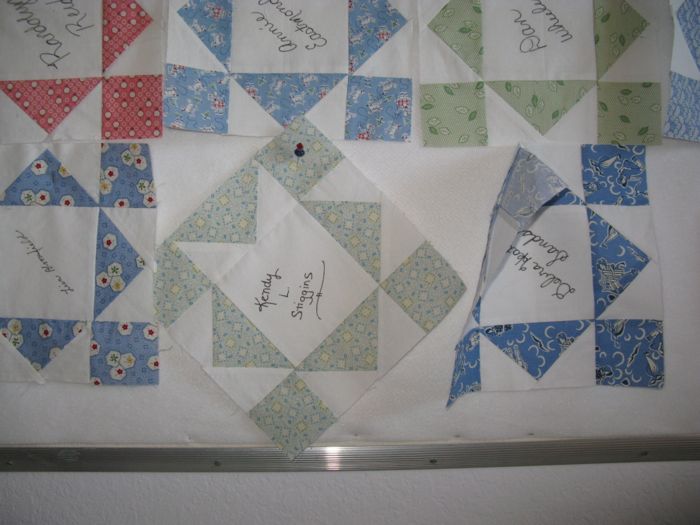
And maybe it’s because I have signatures on my brain.  Here are all the blocks for my signature quilt put up on my pin wall. They lack the sashing and the borders, but what fun to see a flower garden of my friends!

Mistake on block

Whoops.  I had to fix one of them.  Mind you, that block has been like that for nearly eight years, and I’m just now noticing it. What’s fun about working with signature blocks is that you think about the person who’s name you are holding.  Kendy would have a fit if her block were wrong, as she was always perfectly put together and perfectly modulated in all comportment.  (Look it up–I kid you not.)

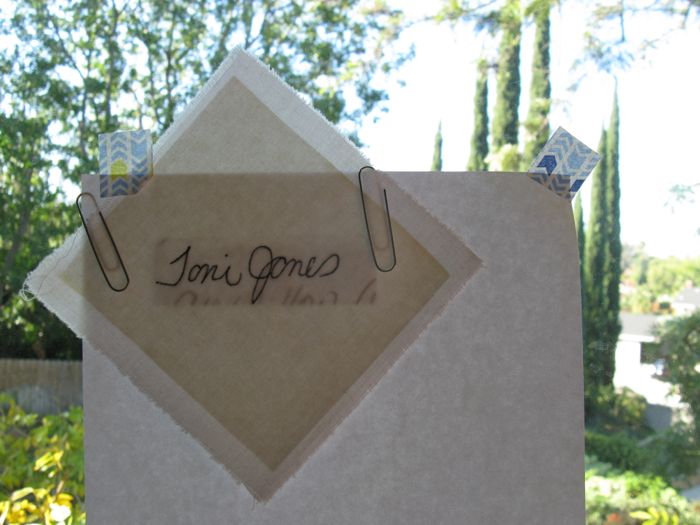
Tracing Toni's NameI had one more signature that I had to get, and I couldn’t just contact her and get it lickety-split (more on Toni in a later post).  So I found her Christmas card from a few years back, enlarged her signature and traced it onto a prepared fabric square (a square of fabric that had freezer paper ironed to the back of it).

Toni's Block

Toni’s square, all bordered in greens.  She would be pleased.

Often at Christmas, all the relatives gather, or we go to their houses.  If you want to start a signature quilt, have a stack of squares ready for them to sign.  Choose a block with a wide open space for writing, and a simple frame for that signature.  Then cut the center square about an inch larger than you’ll need it, back it with freezer paper.  I drew the 4″ center square directly onto the freezer paper, so that it would show through and give people an idea of their boundaries.

I used a Micron .05 pen for people to sign their names.  Those who I couldn’t get (who lived too far away), I sent the block to them and had them write their name lightly, but legibly with pencil, and then I traced it in the Micron pen when it came back to me (I included a SASE so the blocks would come back).  I only had one that never returned to me, but then that woman get could get her dander up quickly, and she carried a grudge longer than anyone I’ve ever seen.  She was still wonderful to me, though, and I loved her.  I’m sorry she didn’t return the square.

Yes, all this quilt is women.  Relatives, friends, mentors, and the latest batch of my granddaughters.  At some point, I realized I had to cut off the additions, otherwise it would never be done.  So, with the exception of my granddaughters, I stopped adding, even though there are still people who are important to me without their names on my quilt blocks.  I love looking at it.  I drop it at the quilter tomorrow, and since my granddaughters are coming for Christmas, she has promised to have it done by the 23rd.  (I’ve already made the binding!)

Why did I start this?  Because of Toni.  I’ll tell you more about Toni, and why she was the inspiration for this quilt in another post–probably after Christmas, after all the company’s gone home!

200 Quilts

Childhood’s Wide Avenues, deconstructed

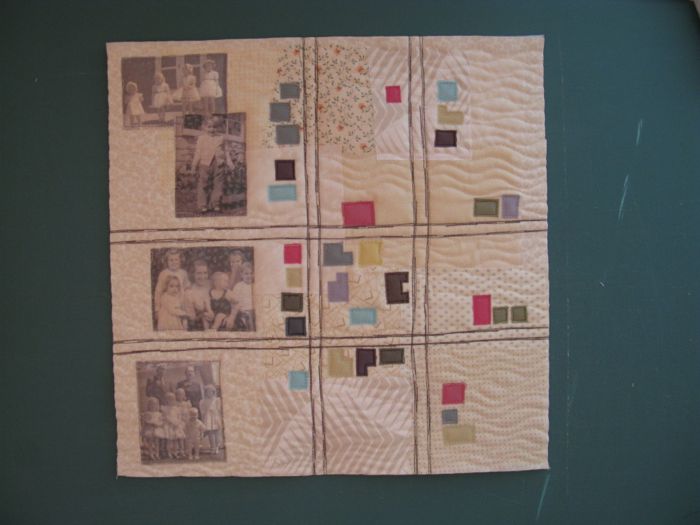
Childhoods Wide Avenues Art Quilt_front

Thank you all for your lovely comments yesterday and for visiting the rest of the Four-In-Art quilts.  The reveal day is one of my favorite days of all the blog writing I do, as it’s such a shared experience.  Today I’ll talk about the technique and the how of the quilt, but first, a little clothing and textiles lesson about four sheer fabrics:

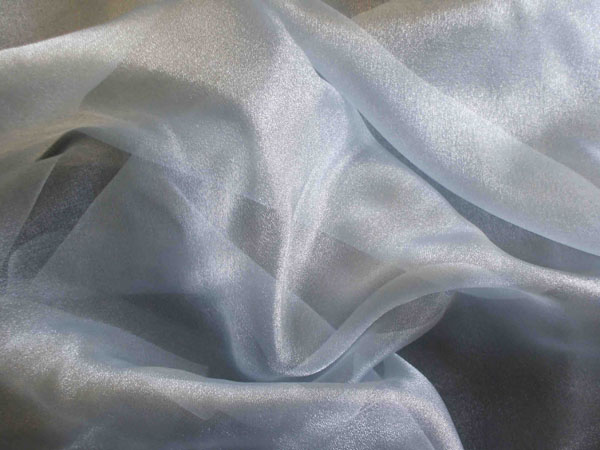
Organza

Organza is a thin, plain weave, sheer fabric traditionally made from silk. Many modern organzas are woven with synthetic filament fibers such as polyester or nylon.  The Casa Collection of sheers at JoAnn Fabrics is an light-reflecting organza, and it is light and soft with lots of drapability.

organzabags

You usually encounter this fabric as jewelry, or wedding favor bags.

OLYMPUS DIGITAL CAMERA

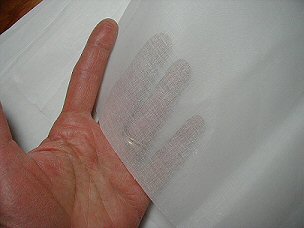
Organdy is a balanced plain weave. Because of its stiffness and fiber content, it is very prone to wrinkling. Organza is the filament yarn counterpart to organdy, meaning it has very thin fibers in the weave, and is used often for interfacing in lightweight clothing construction, or as petticoats or slips for formal wear or wedding dresses. (All images pulled from web.)

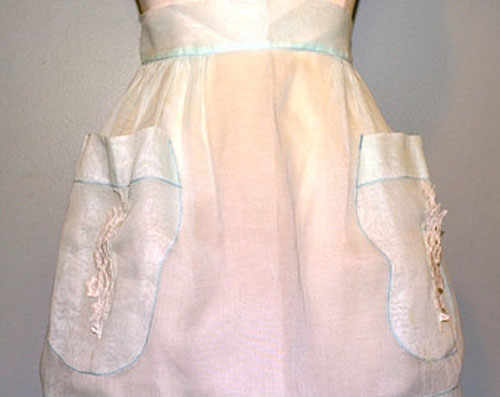
organdy apron

You’ve probably seen it in your grandmother’s or great-grandmother’s aprons–a crisp, sheer construction.

Chiffon

Chiffon is a lightweight, balanced plain-woven sheer fabric woven of crepe (high-twist) yarns. The twist in the crepe yarns puckers the fabric slightly in both directions after weaving, giving it some stretch and a slightly rough feel. Chiffon is made from cotton, silk or synthetic fiber, and under a magnifying glass it resembles a fine net or mesh which gives chiffon some see-through properties, but it is more filmy in its appearance than organza.

Tulle is a lightweight, very fine netting, made of various fibers, including silk, nylon, and rayon. Tulle is most commonly used for veils, gowns (particularly wedding gowns), and ballet tutus.

Lesson over, and this is why I brought those up first: I was a bit stumped on this quilt, feeling like I had no idea where to go.  I keep an art quilt journal just for these projects, and began writing down my impressions (see yesterday’s post) and drawing a few possible ideas.  Once I knew the general direction of where this quilt would go, I wanted to think about a new technique to try, and I wrote down “use tulle,” as I had seen very successful use of this as an overlay to keep teensy pieces in place during appliqué, used to great success by Karen Eckmeier.  But in this smaller piece I thought the texture of the tulle might be a distraction, so decided to explore some alternatives.  I purchased chiffon and organza in both white and ivory/off-white.

Now I had the materials I needed, I began.

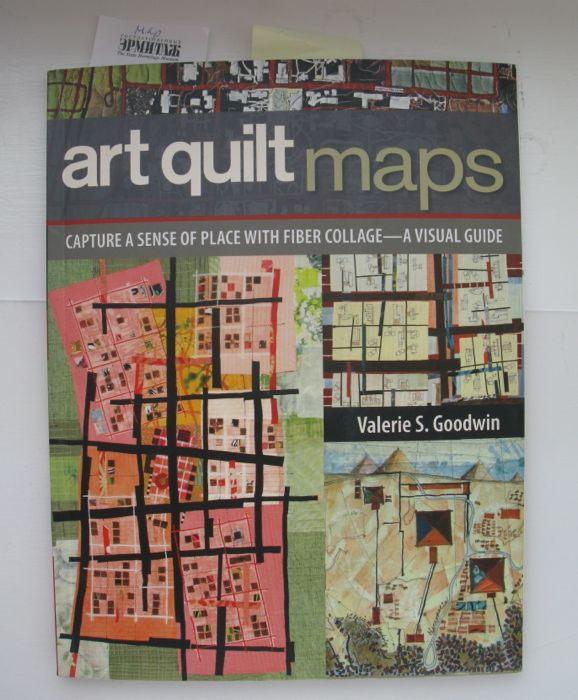
Art Quilt Maps book

Quite a few of us had seen Valerie Goodwin’s book on art quilt maps; I enjoyed it, but the bigger takeaway for me was to build up the background with texture, in terms of the visual space and use of fabric.

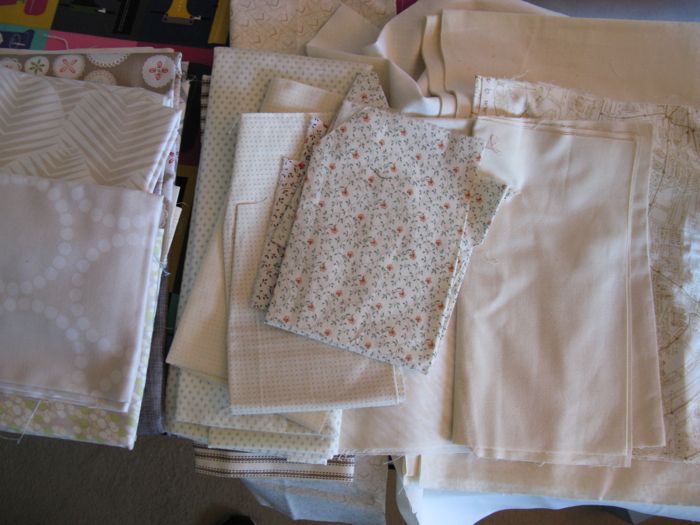
CWA_1Choosing Fabrics

So I pulled all my neutral fabrics (the current vogue term is “low-volume”) and laid them out.  Because this was the background, I rejected any that were to figured or obvious in the print.  I randomly cut out oblongs, squares and rectangles and laid them out over my base muslin.  In my art quilt journal, I had sketched out a few possibilities of layout, and I knew I wanted a clearer left-hand margin of the background for photos.

I auditioned my two colors of chiffon, and my two colors of organza, and decided on an off-white organza as the sheer overlay.

CWA_2 drawing grid

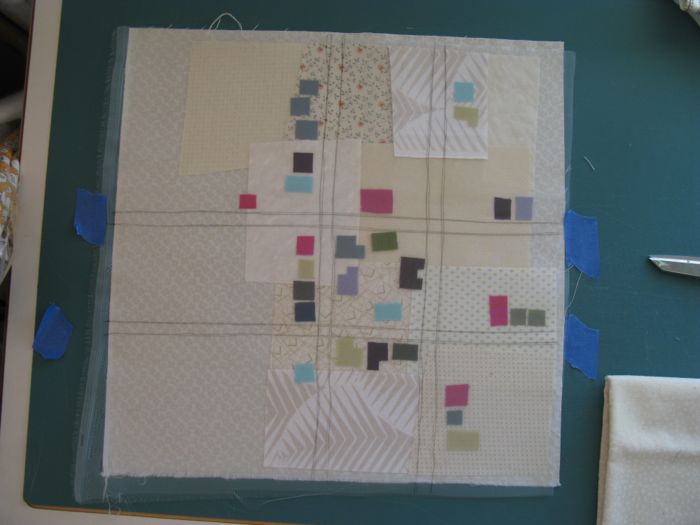
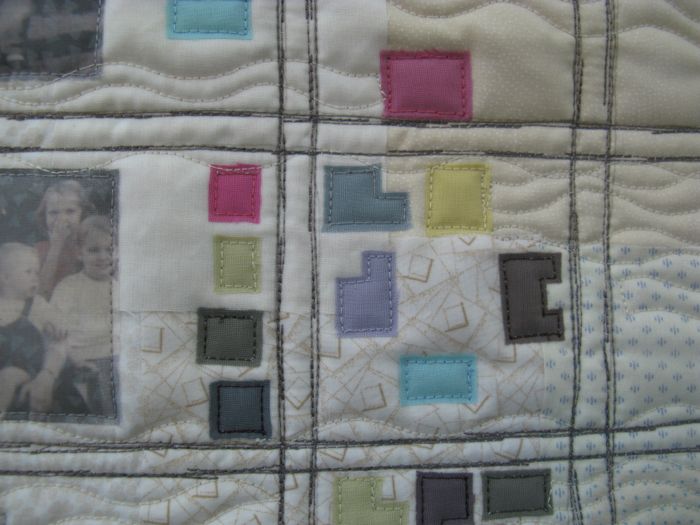
Slipping a piece of paper under the organza so the pen marks wouldn’t transfer to the fabrics, I sketched in my wide avenues, free-handing it (look ma, no rulers!).

CWA_3 adding houses

I cut itsy-bitsy little houses, but trying for a variety of shapes.  I carefully laid them under the organza, along the avenues.  I was temped to draw in streets and lanes, but decided that, for this particular theme, it would only be distracting.  The houses kept moving every time I added a few, so I got out my glue stick and stuck them to the background fabrics, which also had a few dabs of glue to keep them in place.  You can see I used masking tape to anchor the organza to the composition.

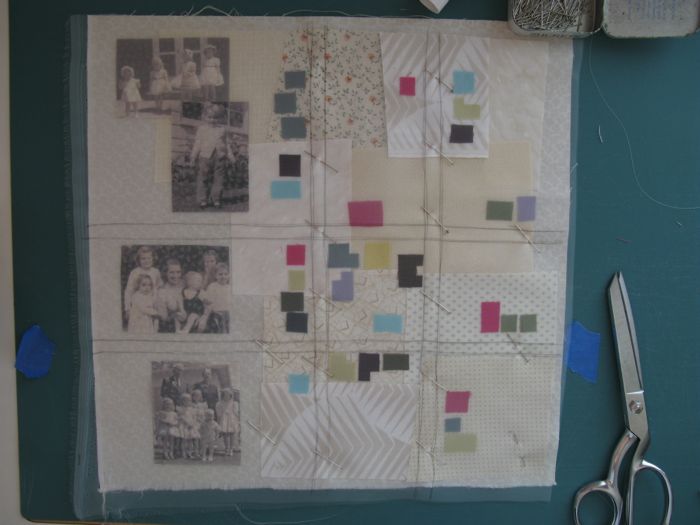
CWA_4 adding family

I printed out some family photos, using the usual method (freezer paper-backed fabric, taped to a piece of paper and fed through my trusty Epson inkjet printer), and started to add them.  This was the first try.  I kept moving them around until I got what I wanted, trimming some edges to make it fit, visually.

CWA_4a

I used straight pins everywhere to secure the organza, and then took it to the machine.  Because they are such a small size, it’s easy to manipulate them under the machine.

CWA_7 detail front

First I used a dark gray and “drew” in the avenues, using the reverse button on my machine to simulate how it might look if hand-drawn.  I went over those several times.  Then I outlined all the houses, using matching thread.

CWA_5 quilted

I quilted in wavy lines that to me represented the flow and movement of the landscape–it could be slight hills, or the movement of grasses, or whatever, but I didn’t want straight lines.  Once quilted, the organza overlay began to act and feel like that thick coating that some topographical maps have, and this change in texture was an interesting surprise.

CWA_6 trimmed

Trimmed up.  I auditioned several bindings–and no binding–but decided to go with a stripe, to further echo the idea of roads.

Childhoods Wide Avenues Quilt_back wo label

For the backing I chose a taupe-cream fabric which depicts the streets of Paris. . .

ChildhoodWideAvenues Art Quilt_label

. . . then added the label.  This is our fifth quilt as Four-In-Art quilters, but I chose to delineate our new series: Urban.

I’m pretty happy with this little quilt, and it joined the others in the Nature series, above my sewing room window in my own little art gallery.  I hope, if you haven’t already, will click back to yesterday’s post and go and view all the other quilters’ creations.  You’ll see some similarities in our quilts, even though we are geographically located all over North America. And perhaps the interesting differences in our vision of this theme come from the different places we live.

The Map As Art

I’m currently reading this book as an adjunct to our study of urban landscapes, and in the introduction the author, Katherine Harmon, notes that maps “can act as shorthand for ready metaphors: seeking location and experiencing dislocation, bringing order to chaos, exploring ratios of scale, charting new terrains.”

In this context of all of the above, I look forward to working with the new theme revealed by Leanne yesterday: Structures.