300 Quilts

Garden Flower • Quilt Top Finish

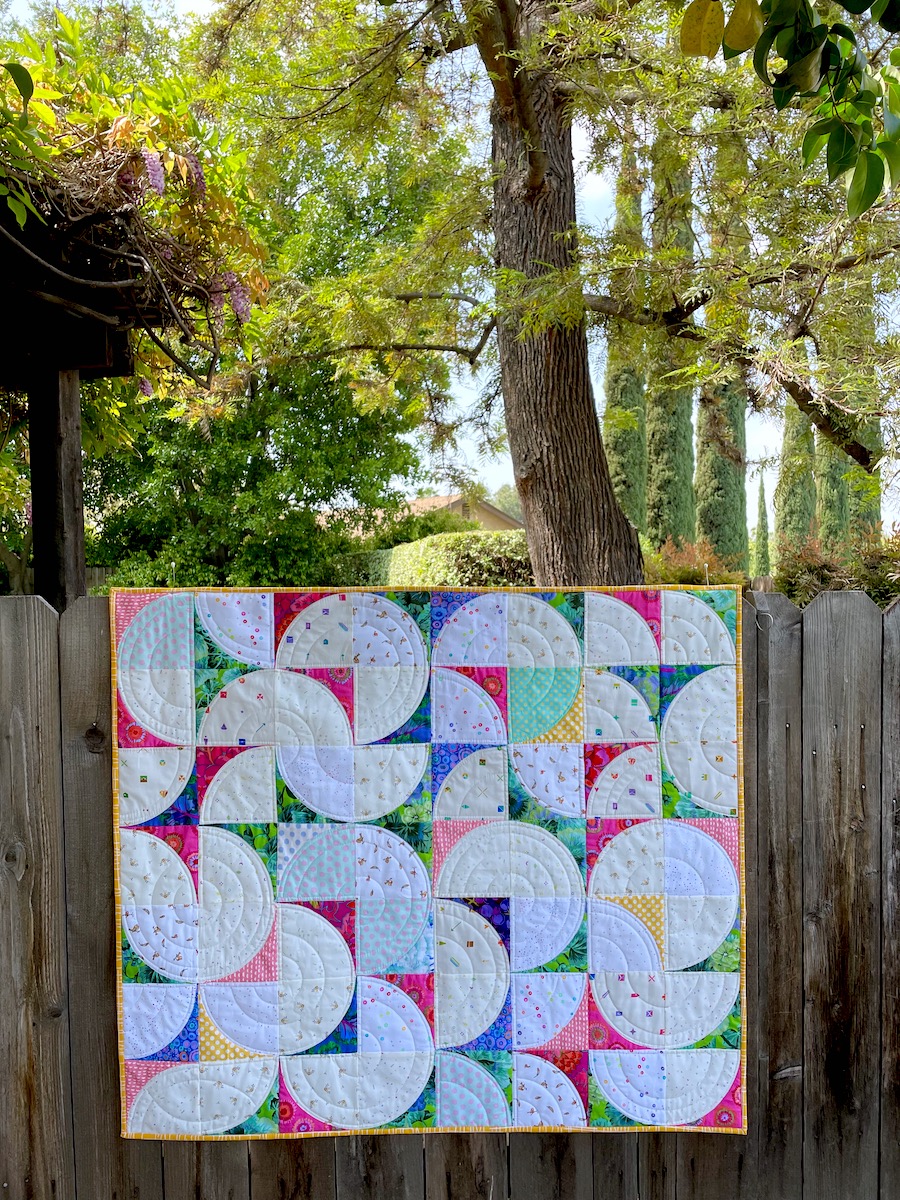
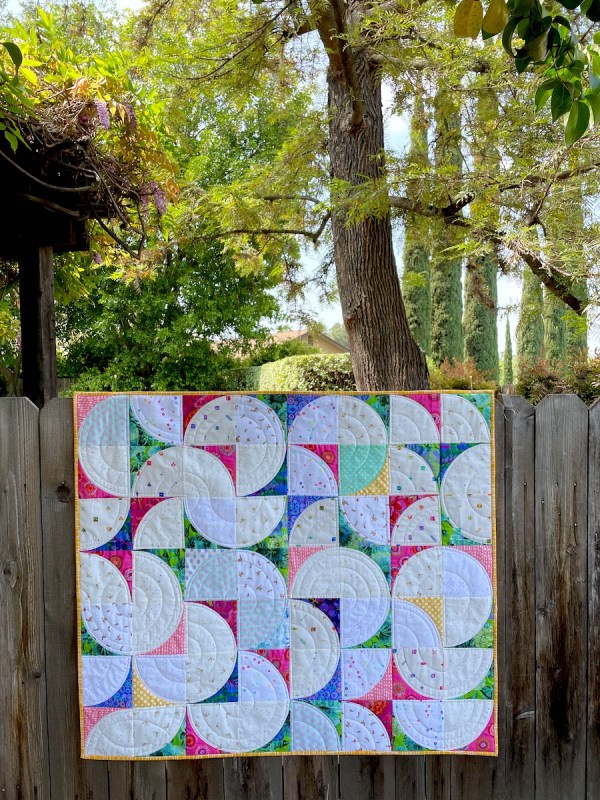
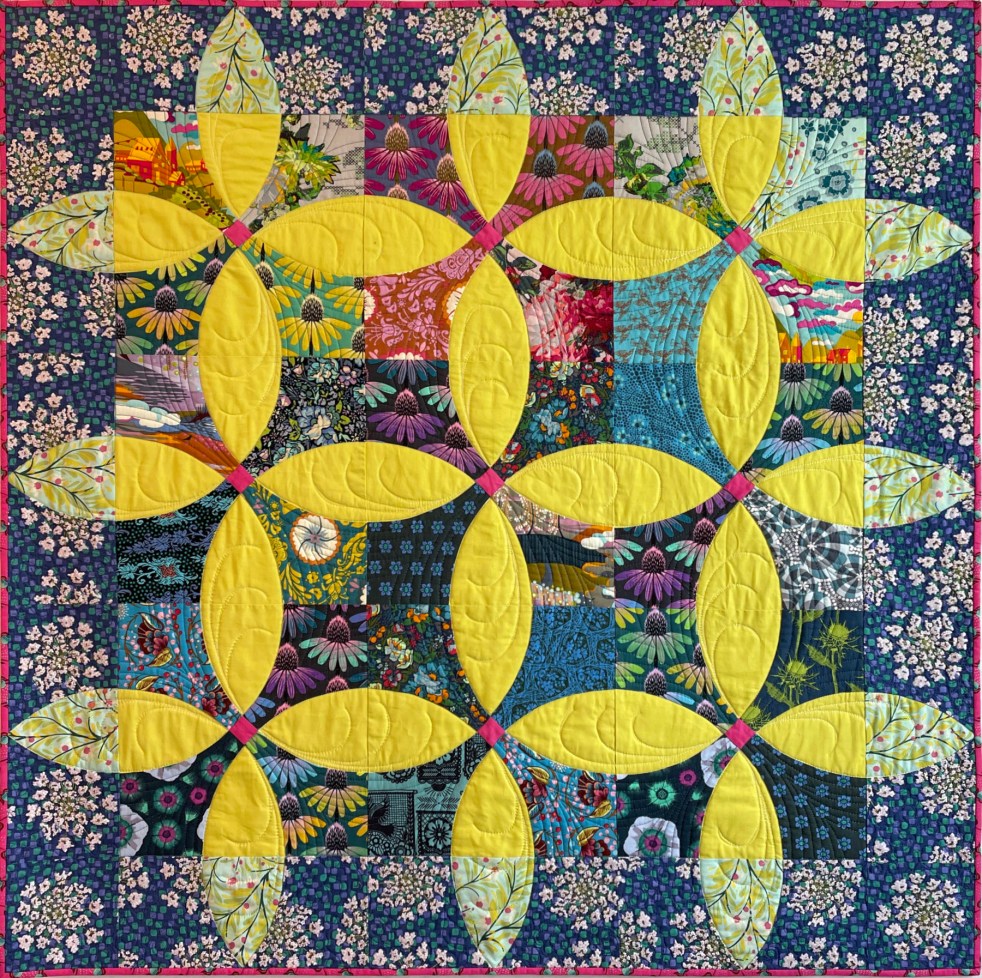
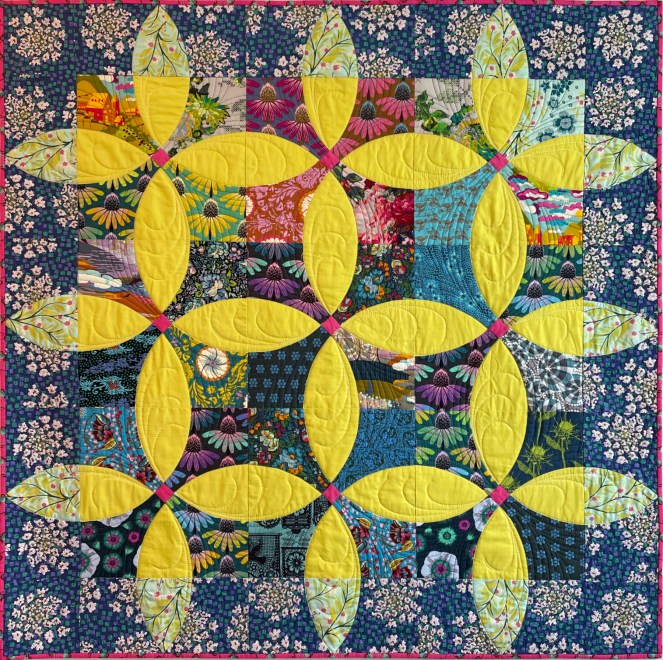
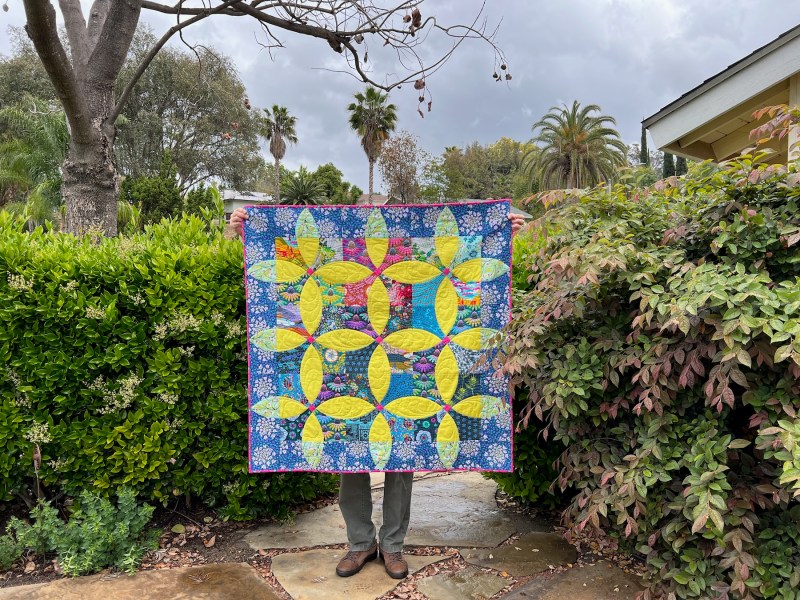
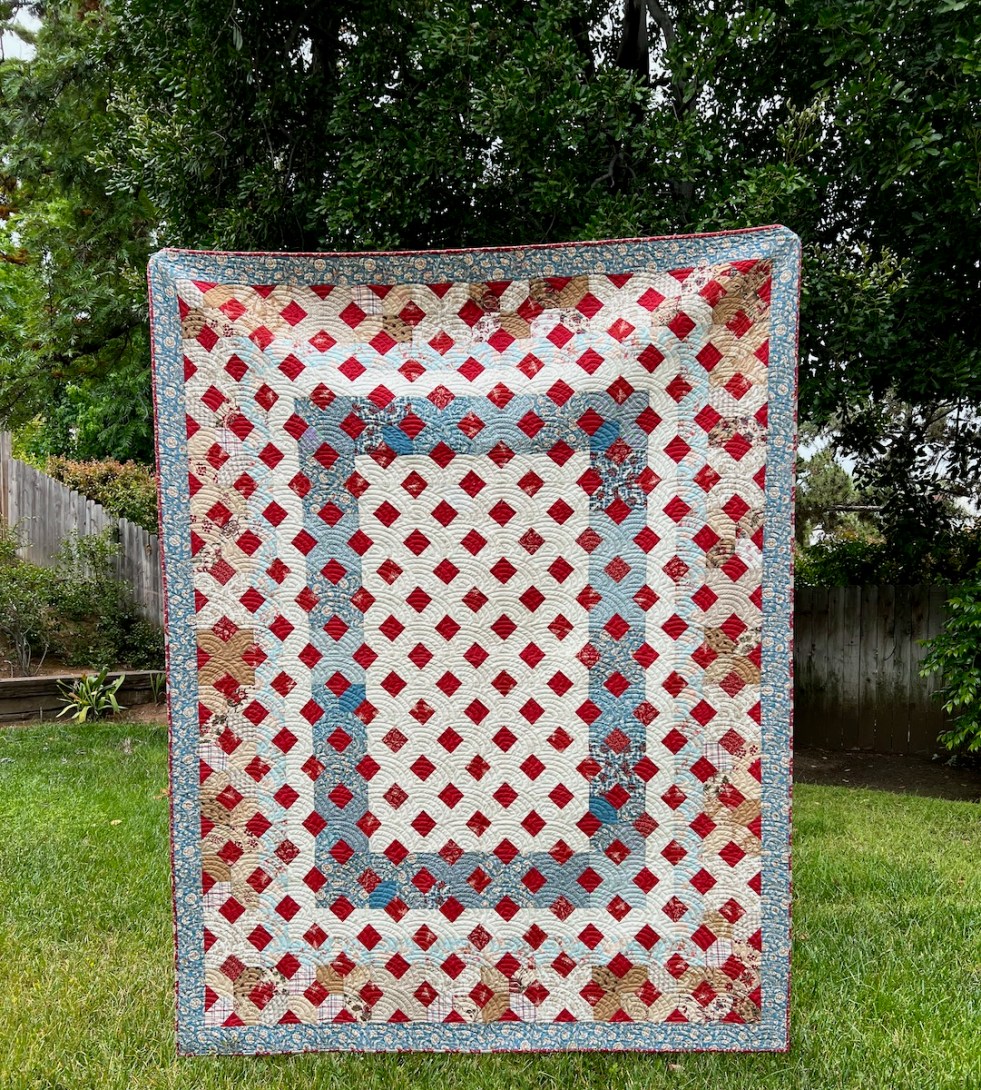
Floods! Snow! Storms! Rain! More Rain! That old saying about April Showers really doesn’t apply to California, because for us it’s March showers bring April flowers, so yes, my garden is overflowing with flowers which is where my latest quilt started.

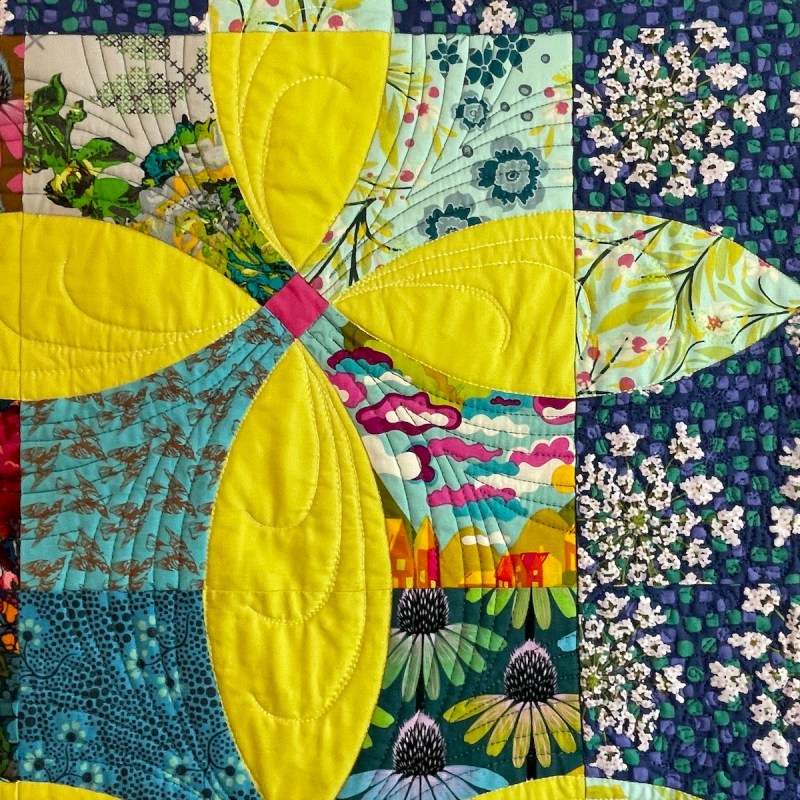
This pattern is also where the quilt started, with Yvonne’s wonderful Garden Peony quilt pattern. Yvonne is a master of shape and space (her handle is Quilting Jet Girl), and love how the inner path of this quilt mimics the ruffling of a peony blossom.

I’ve highlighted it here.

But I’ve always wanted to make this in Kaffe prints, just knowing it would make a wonderful big blossom. Luckily for me, Yvonne put out a new edition of her pattern, so I was in business.

I busily cut out all the green I wanted to use (an old Kaffe geranium print) and then started mocking up the center. I remembered that our peonies had that brilliant yellow center, so that’s what I cut next. However, there wasn’t a blossom big enough for the solid circle Yvonne had in her pattern, so I ended up with four smaller blocks. I didn’t know it at the time, but I was already in trouble with this quilt:

Can we say Color Mush? Can we say Pieces Turned Awry?

Admittedly, this was taken at night, but I couldn’t see any delineation between the outer three colors. I went to bed, dejected, as I just knew her design would be beautiful in Kaffes but couldn’t see my way there.

Thank you, Committee of Sleep. Out with the treasured geranium fabric. In with dots.

I tried three different pinks around that center yellow, and have a shopping receipt and the cut-out shapes to prove it (some fabrics were already in the stash). I had to make another hard decision about the 2nd ring: I inverted it, largely because the shape of the blossoms in the Kaffe were fighting the natural flow of soft scallopy petal shapes. It was a hard call, as I loved how Yvonne had the ruffle effect (see above). But now I was in new territory, and I was determined to make it work.

But apparently the quilt wasn’t done with me yet.

This just didn’t work. So I re-made a new one, with a better match of pink blossom and a stronger background, and pieced it in. I even rotated it a quarter turn for better balance.

Admittedly the two outer rings are still very similar in value, even though one is Kale and the other Geraniums. I’m hoping the quilting will help fix that.

Yvonne has great directions. I was worried that I wouldn’t have enough big blooms to make full-blocks in one section, and I shouldn’t have. It’s one of my favorite parts. I wish I’d been braver on the other sections (this is a “before I switched it out” photo).

There are many good tips on construction in the pattern, so you shouldn’t have any troubles.

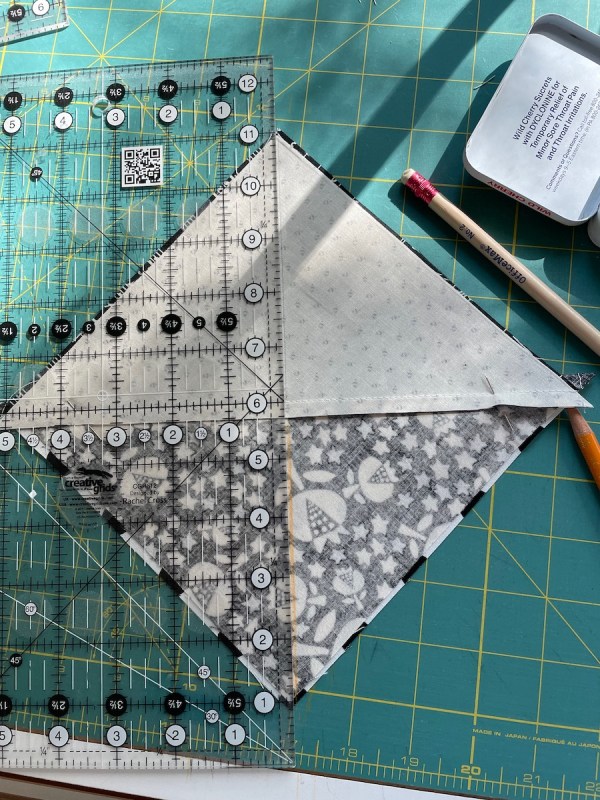
I printed out the pattern onto card stock, and put two loops of blue painter’s tape on the back to keep it in place when I was cutting. I set a ruler on top of the straight edges to help with cutting (large rotary cutter). I followed her directions for cutting multiple shapes, using my smaller rotary cutter on the curved edges.

Put your sewing machine speed on slow, whether it’s you that’s on slow, or the machine. Pin the center of the arc. Then one more at each end. I always tried to use a scrap to start the seam before stitching that beginning edge, and used the natural flex and give of the bias to help align the edges.

I pressed nearly every edge to slide under the larger arc piece, with the exception of the center circle. Then trim it up and put it on the design wall.

Sew together, pressing well.

I had to do a last photo in our under-construction kitchen. This is the Day Six of Week Four, showing the floor all finished with its patching (sense a theme?). We’ve chosen our cupboard color (the Great Angst of the last two weeks), but you’ll have to wait to find out which one we chose. I woke up from a dream the other morning where I was being tiled: tiny pieces all over my face. Hmmmm, I thought, when I was fully awake. Better get on the tile stuff for our backsplash. And the stories! I’ve loved reading about painting, buying, kitchens, workers, counters, windows–your experiences have helped me be more sanguine about mine.

So just like making a quilt, from choosing a shape to material to color to size to revision, the kitchen is coming along. I had thought I’d just sit upstairs and sew merrily away for six weeks while they hammered and sawed downstairs. That was an illusion. The reality is we’ve spent nearly every day making some $ignificant deci$ion, or shopping to learn about that significant decision. But we think we’ve purchased just about everything, and now it’s just time and other people making in their workshops, sawing and planing and cutting wood.

I much prefer fabric.

Happy Easter!

300 Quilts · Free Quilt Pattern

Bright Ladies (Well Read) • Quilt Top Finish

There was a young lady named Bright,
Whose speed was far faster than light;
She set out one day
In a relative way,
And returned home the previous night.
(limerick by Arthur Henry Reginal Buller)

Our high respect for a well-read [wo]man is praise enough of literature.
(Emerson)

Perhaps the most valuable result of all education is the ability to make ourself do the thing you have to do, when it ought to be done, whether you like it or not. (Thomas Henry Huxley)

But now my task is smoothly done,
I can fly, or I can run.
(Milton)

Have faith and pursue the unknown end. (Oliver Wendell Homes)

***************************

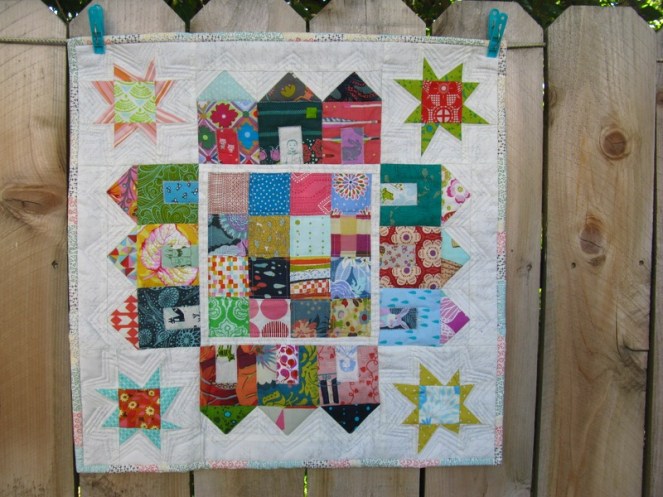
I’m just having fun here, typing in some quotes that fit my happy mood at having finished the Ladies. For a while this unfinished quilt top fell into the worst place for a while, as it became a metaphor for my sadness, my sorrows, my frustrations, my pain, my inability to finish a task, the mess downstairs in my under-construction kitchen, and it mocked me at night when I would come in to try and finish it. I had to hack off a border to get it to this place. I did like that border — but it was either make more to even things out • or • take it off and be done — so the rotary cutter came out. We are all friends again, the ladies and I.

****************************

I don’t really have a title for this quilt yet. Ladies has to be somewhere in that title, though.

*****************************

I decided I did not want to snowball a million rectangles to get that border. So I figured out a pattern for two triangles and a diamond that would fit together. It’s not that I hate making snowball corners. I just hate having to figure out what to do with all those leftover triangles. Yes, I know: make more half-square triangles, but then it begins to feel like real work, instead of fun.

The free pattern for the zig-zag idea is up in the tab marked Pieced Quilter Ladies & Notions (scroll down to find it).

Okay, that’s about it for today. Happy April!

Patterns by Elizabeth of OPQuilt

Poppies!

Anne of Springleaf Studios recently wrote to me, including a photo of her poppy quilt:

Anne is an amazing colorist; seeing her quilts is always a treat, as they are rich in color and perfect in value. She wrote that she enlarged my Poppies pattern a bit, and added circles for the centers. I love her version, and it made me think of the first version of this quilt (pattern is downloadable; see below).

From ages ago, this was the first iteration. My distantly related niece knew I was a quilter and wanted to make a quilt for her mother who was undergoing treatment for breast cancer; they wanted poppies. I drew it up, heard that she finished it, but it wasn’t until much later that I was able to get a photo of it for my archive. (I wrote about the process earlier on this blog.)

This is a more traditional poppy block, with the red petals and the black center, but I’m in totally in love with Anne’s version. Hmmmm, I think I’ll have to add that to the list. I also have a lot of Kaffe prints and need to use them up.

The first Poppies pattern was written in 2017; I recently re-wrote the pattern, and included the more traditional setting which is over in my PayHip shop. I’m happy to share with you.

(Fabric companies picked up my pattern for Remembrance Day, 11 November)

Another way I share is by not having advertising on this blog. As some of your know, we’ve been re-doing our kitchen, We thought about it about a decade ago, then more earnestly in 2020 (haha!) and this year the time had finally arrived for us to update. The other night I was trying to figure out how to use our new Breville Smart Oven to cook some potatoes and I jumped online. It was like jumping into a pool of advertising, swimming upstream looking for the content/recipe/can I use the convection? So the only money that comes to me now is through the patterns; this is just a choice I made. Maybe I’m crazy (possibly–to do a kitchen remodel might be proof), but I very much like writing and visiting with those who find this blog.

Here are some more poppies — this time in California Poppy orange — a welcome visitor in March.

I mentioned that my friend Judy passed away mid-February and her memorial open house was March 17th. While cleaning out, her daughter found a completed batik quilt and backing and wondered if I could help her get it finished for her father? I contacted Jen of Sew-Mazing Quilting and she turned it around in no time flat. I got it bound (we took off the last border and used that for the binding — no one will ever miss it), and delivered it to them on March 16th.

I’m sure all the guys in the kitchen tearing out my kitchen cabinets wondered what in heavens name we were doing.

Hmmmm…the usual. Quilting!

The Poppies Pattern is found in my Pattern Shop.

Covid-19 Times

An Auspicious Anniversary

January 2020 • Road to California, where I showed Jen Kingwell my completed Small World Quilt

February 2020, QuiltCon: Shown here finishing my first block in Yvonne’s class (QuiltingJetGirl)

March 2020 • Quilt Guild Lecturing and Teaching

And then March 19, 2020, I post up the Milmore Memorial, as all of a sudden we are aware that the Angel of Death, bearing her poppies, will be stopping many of us mid-gesture.

March 31, 2020 • This becomes my nightly reading. Covid is real, even though we hardly know what it is.

All these musings were inspired by three things: a few random “Where were you in March 2020?” Instagram posts, my friend Laurel sending me a picture of her Small World quilt, newly hand-quilted and finished that very night, and an article titled “Three Years into Covid, We Still Don’t Know How to Talk About It,” by Jon Mooallem and published in the New York Times, the place that was kind of the horrific epicenter to the quake that still rattles the United States.

“The [NYC Covid-19 Oral History, Narrative and Memory Archive] makes clear that, with respect to Covid — with respect to so much — we are a society of anecdotes without a narrative. The only way to understand what happened, and what’s still happening, is to acknowledge that it depends on whom you ask. People’s experiences were affected by their race, ethnicity, wealth, occupations, whether they had children at home. But they also turned on more arbitrary factors, or even dumb luck, like if someone happened to be living with a sort-of-annoying roommate in March 2020…. A man compared the pandemic to a game of musical chairs: The virus shut off the music; you were stuck where you were stuck.

Now, it’s as though we’ve been staring into a fun-house mirror for a long time and our vision is correcting — but it’s correcting imperfectly, so that we may not pick up on all the bulges and dents. We are awash in what [Ryan] Hagen referred to as an “onslaught of narrative repair,” scattershot attempts to clarify or justify our experiences, assignments of blame, misunderstandings and misinformation flying in all directions. It will play out and reverberate for years or decades.”

from here

I don’t have any brilliant thing to add to this article (which, you should read, all the way to the end, even though it has a slow start), but it made me realize that we’d all been through this incredible experience — or experiences (as everyone’s was so individual) — and unlike those in the article, I realized quilters (who by our very natures are the type to sit inside away from everyone and sew) might have their own dialogue to add.

“At first, the pandemic seemed to create potential for some big and benevolent restructuring of American life. But it mostly didn’t happen. Instead, she said, we seemed to treat the pandemic as a short-term hiccup, no matter how long it kept dragging on, and basically waited it out. “We didn’t strive to change society,” she told me. “We strived to get through our day.” Marooned in anomie and instability, we built little, rickety bridges to some other, slightly more stable place. “It’s amazing that something this dramatic could happen, with well over a million people dead and a public health threat of massive proportions, and it really didn’t make all that much difference,” Swidler said. “Maybe one thing it shows us is that the general drive to normalize things is incredibly powerful, to master uncertainty by feeling certain enough.”
(see above for citation)

I got through my covid days by quilting, and it was instructive to look back through the pages of this record, to see how I tried to “build little rickety bridges to some other, slightly more stable place.” I generally was very lucky: a lovely home, with lots of supplies, a supportive husband, and an ability to isolate away until the vaccine came (for me) in January 2021, a relief and a welcome day. Maybe quilting is well-suited to helping us cope with our “drive to normalize things” — cutting patches, sewing them together, using the well-established tools of social media to keep us connected on one level, even though all the social aspects: guild meetings, classes, retreats, and sewing groups went by the way.

Orange County Quilt Guild March 2020, before the meeting started

Their use of the word anomie is intriguing, and loosely, it can be defined as “normlessness,” meaning “that the underlying rules are just not clear…Anomie sets in when a society’s values, routines and customs are losing their validity but new norms have not yet solidified. “The scale is upset,” [the early French author] Durkheim wrote, “but a new scale cannot be immediately improvised. …The limits are unknown between the possible and the impossible.”

When Laurel sent me her photo Thursday night, she bridged a time from 2015, when Jen Kingwell’s pattern was published in QuiltMania, to September 2019, when Paula James (@the_secret_sewer) and Nicola Kelly (@nicola_picola_) challenged us all in to finish these quilts, leading a quilt-a-long on Instagram. I finished mine in time to post with Jen Kingwell (top of the post) just before we were all slammed.

A well-known bridge on California’s I-15

I like to think of our quilts as those bridges, helping find our way back to civility, to health, and even to mask making (our batik fabrics were champs!). I hope we continue to figure out how to write and think about what we all went through, sharing our individual experiences with acceptance and kindness. And I hope we keep quilting!