Creating · eQuilt Universe

Creativity and the Web

I’m thinking about all those affected by the horrific storm on the East Coast.  I have several quilty/blogger friends, as well as quite a few family members who have been affected and hope that they and their families are through the worst of it.  I’ve been on a blogging break this week from the computer (I wrote this post earlier) but I just wanted to jump in and send my thoughts to those who are dealing with this “Frankenstorm” and its aftermath.  Take care, everyone.

****************************************

In my class at school, we just completed a unit that was based on this book by Nicholas Carr, titled, The Shallows: What the Internet is Doing To Our Brains.  We had our Discussion Panels last Wednesday, and it was fascinating that the students were fairly perceptive and able to discuss how the Internet has impacted their lives, for better or for worse.  One young man is fairly sanguine about the whole thing, saying, “Well, it’s here.  We just have to deal.”  Another pair of young women took opposite positions on the question of whether print was dead.  The internet’s main impact, that of re-wiring our brains due to neuroplasticity, was skirted around, but acknowledged when they all complained of the inability to finish a book before distractedly checking their phones for texts or messages.

And I think it’s rewired my brain as well.  Carr goes through the history of civilization’s adding of new technologies, from writing to moveable print to the typewriter and onward to clocks and the internet.  I was interested in his discussion on tools: “The tight bonds we form with our tools go both ways.  Even as our technologies become extensions of ourselves, we become extensions of our technologies.”

 I thought about how quilting has changed from the time when I used to trace a pattern onto cardboard, carefully cut it out and tape the edges for stability.  Then I’d trace it about a bazillion times in order to make a quilt, following along the pencil line for the seam.  I did use a machine for piecing, but hand-quilting was the only way to finish a quilt.  That’s why my list of 100 Quilts took so long to grow: our tools were more primitive before the advent of rulers and rotary cutters.

He also references Frederick Taylor’s Time-Motion studies and how it has changed how workers do their jobs (above: a golfer takes a swing).  Before Taylor came along, “the individual laborer, drawaing on his training, knowledge and experience, would make his own decisions about how he did his work.  He would write his own script” (218).

I think of us at work.  Some of us spread all our fabric out into a lovely mess (like mine, above).  Others fold and organize continually throughout the day.  I like to doodle around with my computer when thinking up a new quilt. Some like to start cutting, throwing the cloth up on the pin wall to see what’s going on.  Carr notes that with Taylor’s regimentation of industry’s messiness, something was lost.  “What was lost along with the messiness was personal initiative, creativity, and whim.  Conscious craft turned into unconscious routine.”

I hope I never become such a slave to a pattern or a ruler or a system of making a quilt that I can’t make  a creative and conscious detour into creativity.  But sometimes I wonder when I make a copy of another’s quilt, using one line of fabric if I’m not caught in a type of quilt-machine using Taylor’s demands for proscribed motion.   Is this creativity?  Am I being creative, or just following someone else’s script and benefitting from their decisions?

And like many of you, I’ve been following #quiltmarket on Instagram.  Carr said more than once, and I’m paraphrasing here, that trying to control the flow of information from the internet is like trying to take a drink from a fire hydrant at full blast.  The internet caters to the new! unique! amazing! as we all know.

I also have Pinterest boards full of ideas, most are quilts which I’ll never make, but pin them up there nonetheless.   Can we be creative 24/7, or is that too exhausting?  Has the Internet made better quilting possible?  More interesting quilting?  Given us an access to a wider range of styles and types?

I don’t know the answers to these questions.  I only know that sometimes the Internet affects us quilters, too.

So my question now, is how has the Internet affected you?  And has it been for better. . . or for worse?

Something to Think About

Digital Images-NYPL

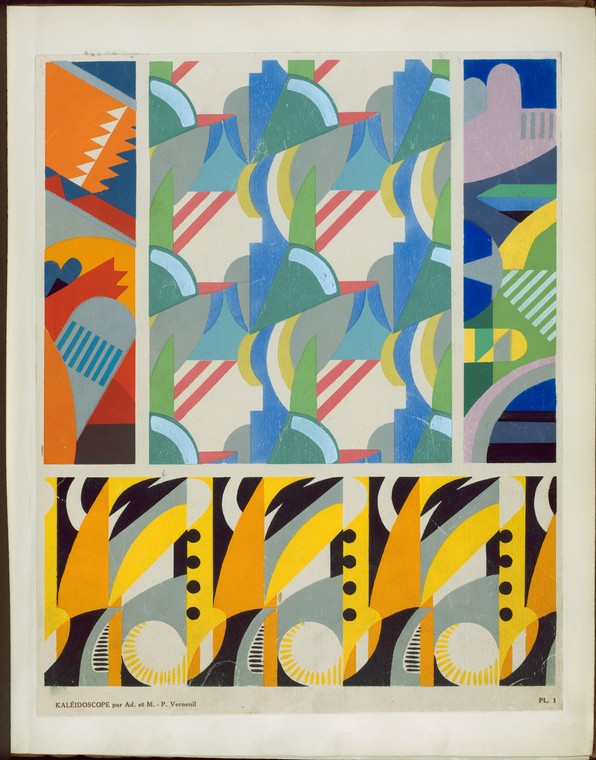
While I do think that the internet sucks up my time and not always in a good way, occasionally there are places that are interesting to visit, to gain inspiration.  The above image is from the New York Public Library’s Digital Gallery.

These two prints are by Maurice Pillard Verneuil from 1869.  More are found *here.*

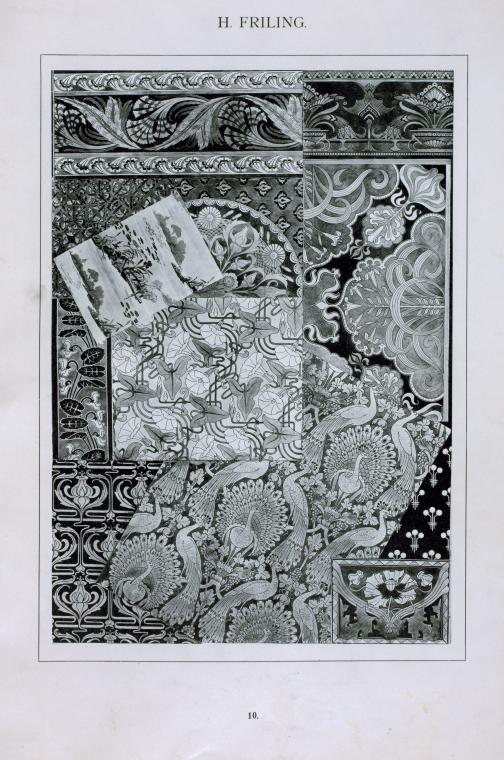
I went into their Printing and Graphics section from the main page, then randomly clicked on the list as I didn’t want to wade through all the images.  Here’s another:

It’s harder to see this one, but the catalog indicates it has plant forms, peacocks, and a waterscape.

And this one could provide ideas for machine quilting when the quilt is done.

Applique, anyone?

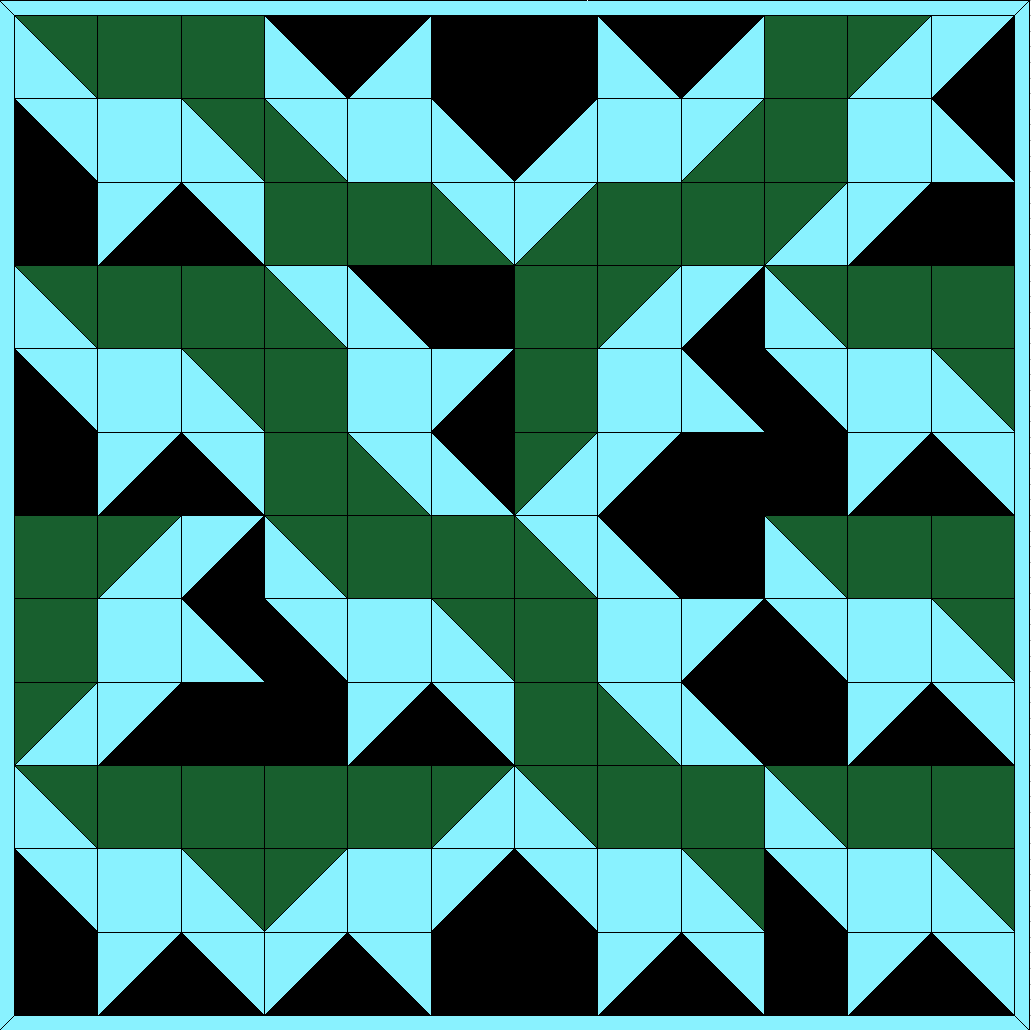
So how does this relate to quilting?  By encouraging me to see new shapes and new relationships between shapes.  I sketched up a block, taken from some of the ideas in the first one, then played with it in my quilt program (flipping and twisting the block), gaining the slightly weird, but somewhat intriguing design below.  While I have to work mainly in solids on the computer, I could see this in rich florals, or another type of print where the edges blur from the colors overlapping from one square to another.

The idea, at least for me, is not necessarily to have a quilt to bang out in one week, but perhaps to tuck these doodlings away in a sketchbook, whether it be the digital or colored-paper-and-pencil kind.  The idea is to make new connections.  The idea is to have an idea.

Where do you get your ideas?  Other blogs? Flickr groups?  (You’ve already seen my take on Portuguese Tiles.) Nature? Quilt shows? Something a friend has done? All of the above?

Four-in-Art

Four-in-Art Quilt Group

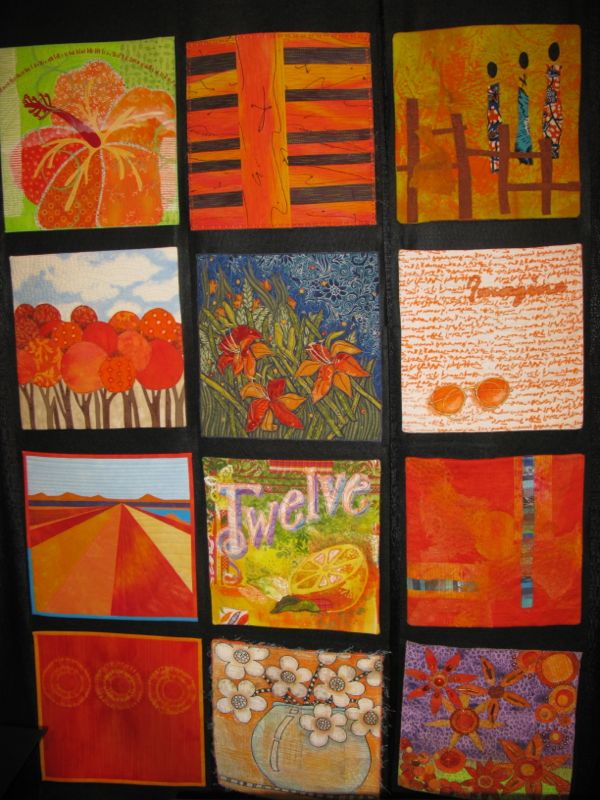
When I was in Long Beach at the quilt show, I fell in love with the Twelve-by-Twelve art quilts that graced one area of the exhibit hall.  I wrote about them *here,* and wondered on my blog if anyone wanted to join me in a new group?  Three other quilters did, and we came up with a name and a logo.  Four-in-art, a play on “foreign” and the four of us, was dreamed up by Betty, and we were launched.  Some of the Twelve’s work is below:

While Betty doesn’t have a blog or a Flickr page, the other two do.  They are Leanne of SheCanQuilt and Rachel of The Life of Riley.  We set up some rules, using a lot of the guidelines from Twelve by Twelve: roughly two months in between quilts with an extra month over the holidays, size about 12″ by 12,” any medium is okay but it has to be a “quilt” with a front, middle, back.  All kinds of techniques are encouraged and are possible.

For me, it was a bit scary.  My father and my sister Christine are artists, both with dedicated studios.  My father does painting, and my sister does that as well as mixed media.  But all of my family exhibits creativity in one way or another, from the way they arrange their desk (really, it’s quite artful) to their gardens to the choice of art that is hung on their walls.  But I’ve always been a quilter/photographer and only occasionally, a digital artist.  So to jump into the idea of making art quilts, well, really I just swallowed hard and did it.

The four of us chatted via email and Flickr and came up with a theme for the first series: Nature.  And then Rachel selected our first art quilt theme of Queen Anne’s lace, a flower that can grow wild.

That last photo is from Leanne’s garden, the first is from some random grab off of Google Images.  It’s helpful to think about the meaning of the flower as well, trying to draw out ideas, so we have posted ideas and insights on our Flickr.

One of the artists in Twelve by Twelve confesses that she loves commercially printed fabrics and while she’ll make some changes here and there, it’s always her starting point.  Since I’ve never taken a dying class or tried it myself (although in the Hippie-Dippy 1970s, I once tie-dyed everything in my camp suitcase while up at a church girls camp), so I knew I’d be starting with commercially available fabrics, too.

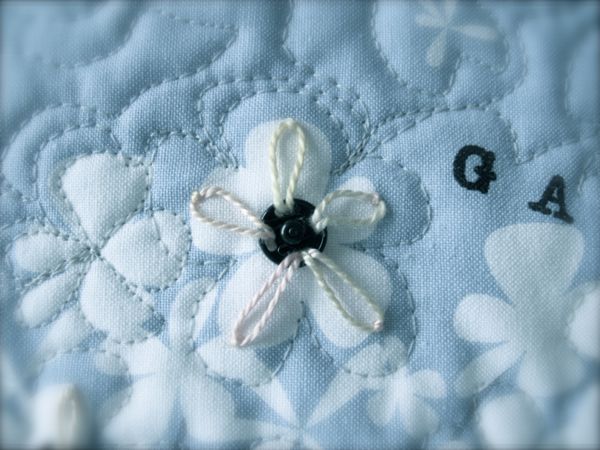
Our first reveal date is coming up on November 1st.  Check back then for my art quilt, but for now, here’s a sneak peak:

Here’s another version of our logo:

Giveaway · Quilts

Snapshot: Putting the Quilt Top Together

Here’s my Snapshot Quilt, in the requisite rustic pose drooping over a gate with rusty wheelbarrow.  Go yard work for great props.

This is the third and final post in my tutorial of how to make the Snapshot Quilt, constructed from lots of Polaroid blocks.  And at the end, my little giveaway.  I have three sets of 10 blocks each to giveaway, but hey! you must be a serious Polaroid-er to get them.  Leave me a comment telling me what you’ll do with them–have you started your collection?  Do you have a few and want more?  Do you have plans for them?  And for fun, tell me about your favorite vacation photo, since this quilt is, after all, a tribute to vacation photos everywhere.

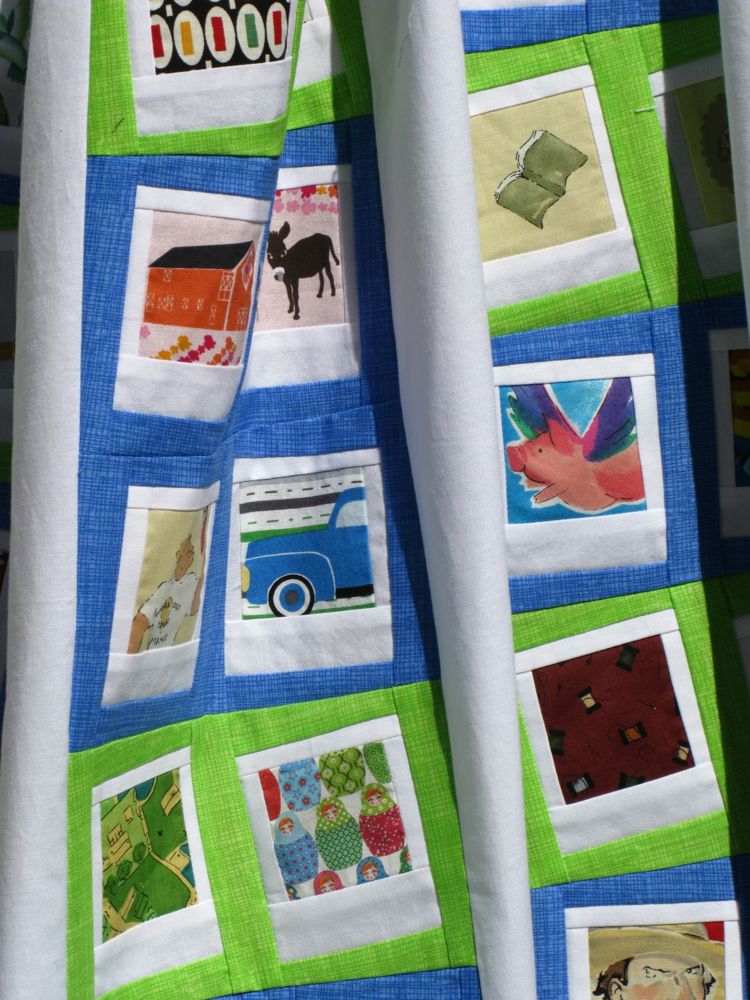
Here’s a close-up of some of the Polaroids.  I received the truck Polaroid in the swap.  Love it!

And that German-looking couple on the right was cut from my Barbie-doll dress.

Now back to work.  I have made a PDF to help guide you with cutting, and it includes the basic bones of the quilt.  Download it: PolaroidQuilt

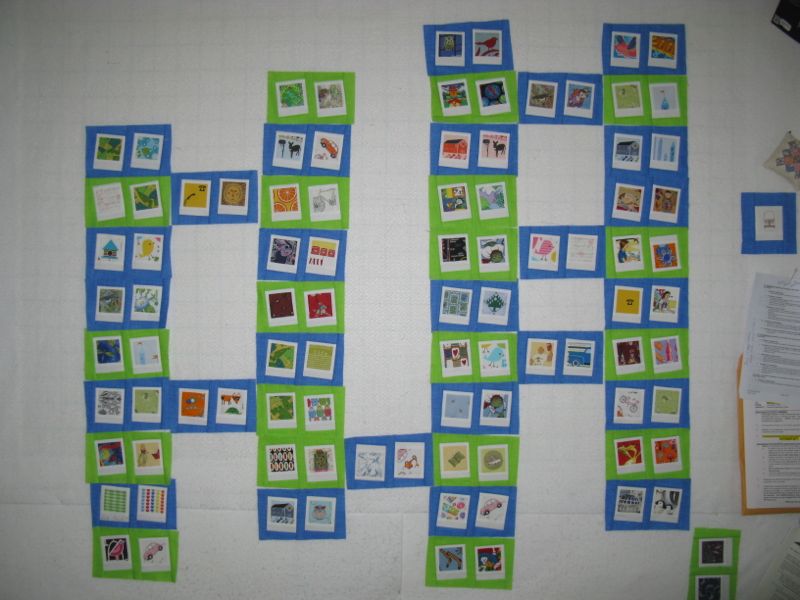
Start throwing up blocks onto your pin wall.  This was my first attempt. I knew I wanted a stacked coins effect, but was playing around with inserting blocks into the middle of the stacks.  Meh.

Second try.  I like this one better, but not keen about the four blue blocks across the top, so I switched them around.  Check the previous post for the doctors-office-view of the quilt, which shows how I ended up arranging all my blocks.  I also checked to make sure that there wasn’t a glob of orangey-red blocks, or too many of one type or color.

After getting the blocks the way you like them, sew them together.  My row tags, made from embroidery holders, indicate which row it is, and which is the top. I pinned them all together in a row, then stitched them.

Cutting the white internal strips and borders:
Internal rows are 4 x 52″ (w/o s.a.) so cut three strips that are 4-1/2″ by 52-1/2″.  I’d STRONGLY advise cutting them on grain, that is, cut them parallel to the selvages of your white fabric.  All these double-Polaroid blocks are slightly on the bias, so they need the strong stable edges of an on-grain piece of fabric.

Borders (seam allowance included):
Border #1, top/bottom: cut two pieces 2-1/2″ x 40-1/2″; for the sides, cut two pieces 2-1/2″ x 56-1/2″” long
Border #2 (print), top/bottom: cut  two pieces 2-1/2″ x 44-1/2″; for the sides: cut two pieces 2-1/2″ x 60-1/2″” long
Border #3, top/bottom: cut two pieces 2-1/2″ x 48-1/2″; for the sides, cut two pieces 2-1/2″ x 64-1/2″” long
NOTE: I’d cut the border pieces slightly longer, to give allowance here and there for ease needed when sewing on borders.

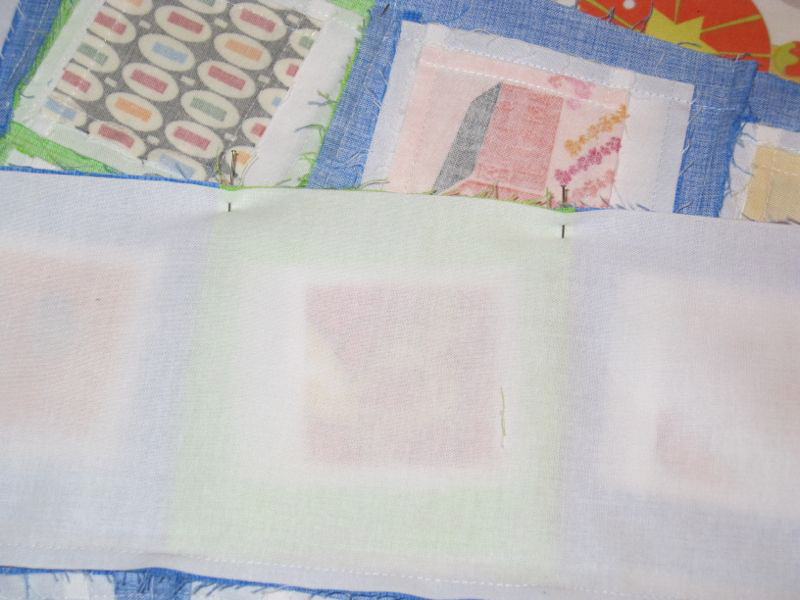
Matching centers and edges, ease the stacked quilt blocks onto the white on-grain strip of white fabric.  Repeat until four rows of stacked quilt blocks and three strips of white fabric are sewn together.  I sewed the seam with the quilt blocks to the throat plate of my sewing machine, allowing the motion of the feed dogs to help ease in any extra fabric.

Sew on the first top border, then the bottom.  Then, matching centers and edges, sew on the side borders as you did above, keeping the white strip UP and the quilt block stack to the feed dogs.  Press seams toward quilt blocks.

Attach the print borders next in this order: top, bottom, side, side.  I was exacting on the lengths and matching edges and centers, but I should have given a little more ease to the side borders.  It’s a challenge sometimes, as you don’t want to get the borders too small so that the quilt “bows” with a curved edge, but you also don’t want it so loosey-goosey that it ripples.  Pin and check, is my advice.  Then press the seams toward the print fabric.

Lastly, attach the last white borders in the same order: top, bottom, side, side.  Press toward the second (print) border.

You’re done!

How do I plan to quilt this?  I’m thinking I’d first stabilize those long stacks with either stitching in the ditch white white thread, or a quarter-inch away into the white.  I’d like to outline along the Polaroids to make them pop.  The white sections call out for some sort of overall pattern, like this pattern from Leah Day of Free-Motion Quilting, Bow-tie Parade:

Go and visit Leah’s site for lots of ideas and a stimulating blog.  I love reading her posts.  I do plan to bind this with more of that print shown in my border.

Now! Leave a message if you are interested in scooping up some of my Polaroid blocks, and mention what you’ll do with them–have you started your collection?  Do you have a few and want more?  Do you have plans for them?  And for fun, tell me about your favorite vacation photo, since this quilt is, after all, a tribute to vacation photos everywhere.

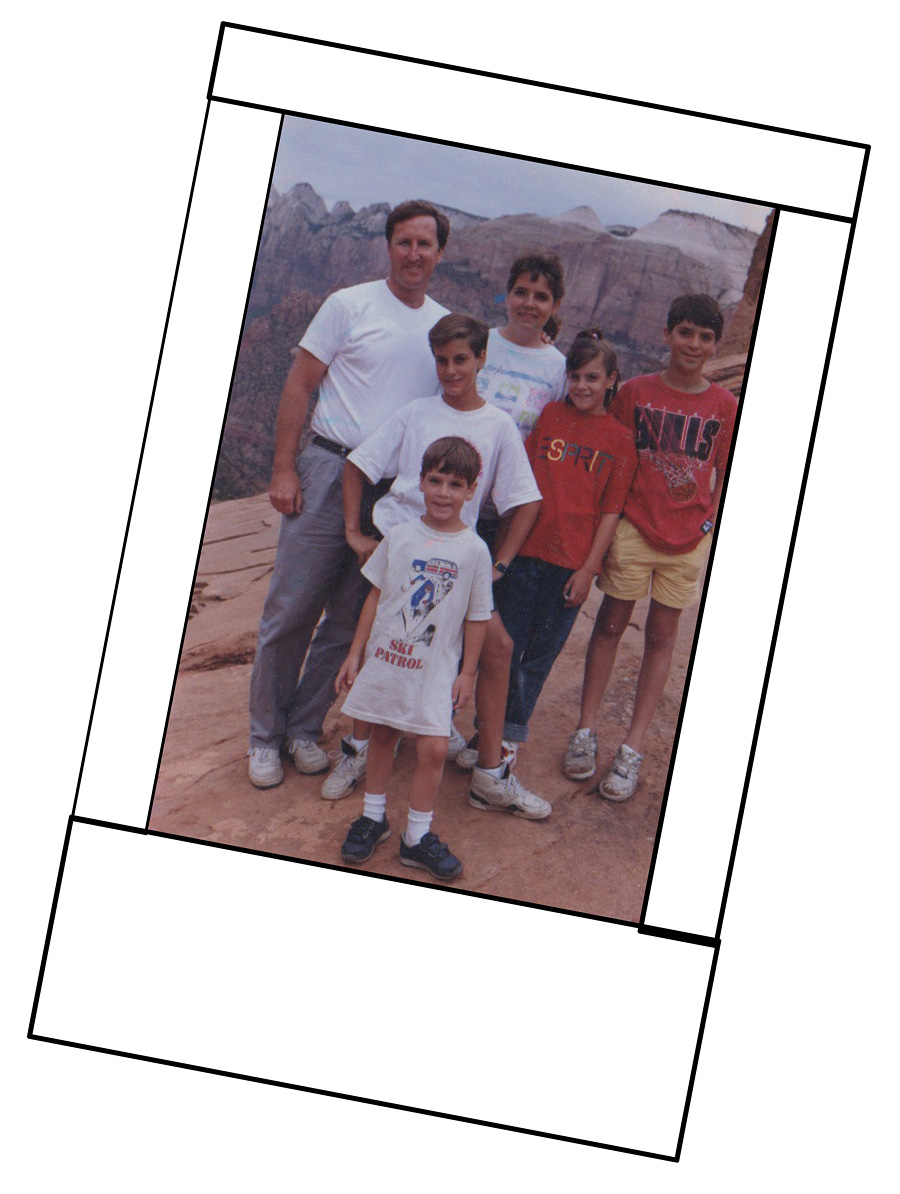
Mine favorite vacation photo is from when Dave and I were newly married (under a year) and we took all the kids to Zion National Park.  We are standing there in the middle of red rock country in our slightly dirty T-shirts, a group of 2 adults and 4 children who were on their way to becoming a family. Now let me hear about yours.


UPDATE:  Congrats to the winners of the Polaroid Blocks: Mary, Cindy and Marilyn.  I’ll look forward to seeing what they do with their blocks, so send those photos over to my email when that future finish day arrives.