300 Quilts · Affinity Tutorial · Appliqué

Wrapping Up the Leftovers • Affinity Tutorial

Far Away Doors, Quilt Number 216 • Merrion Square Pattern

Do you ever finish a quilt, but not quite finish it? Like forget the label? Or find scraps that needed to be put away from a quilt that is two years old? Or do you have tasks that still await you even as you transfer them from list to list to list? Or do you add tasks to your list of things to get done? Or do you feel like you spend so much time working off your list that you have no time to think, to create, to play, to imagine?

Signature Blocks: lost, then found, then lost again, and now found once more!

All of these are types of things that plague creatives, as we are known now. The list is endless, and we can keep adding to it. I was quite intrigued, then, with Mark McGuiness’s solution: a 3″ x 3″ Post-It Note. Actually, he uses two of them. On the first one — as outlined in this article from 99U — he writes one main task in the upper left corner, and then adds the rest of the day’s chores to the Post-It Note. Since it is only 3″ by 3″ it can’t get overrun. McGuiness writes: “But what about all the rest? All the phone calls, emails, and requests that come in during the day? Not to mention all the new ideas that pop into my head as I work? Good question. There’s a place for all of these things, and that place is the second Post-It on the stack, a.k.a. my to-do list for tomorrow.”

He then quotes Mark Forster, noting the idea of an “open” and “closed” list. The first Post-It Note is closed. The second one, is open.
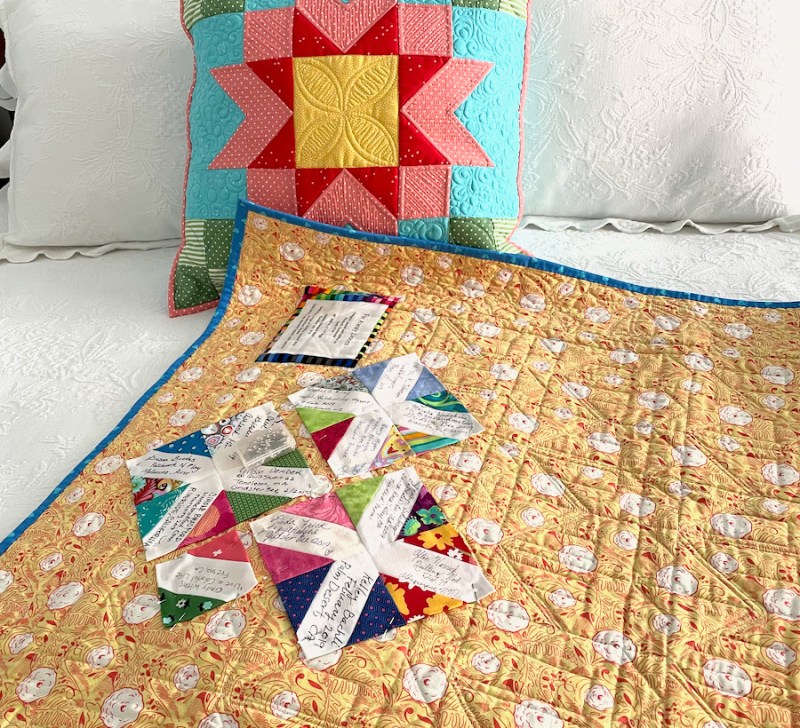
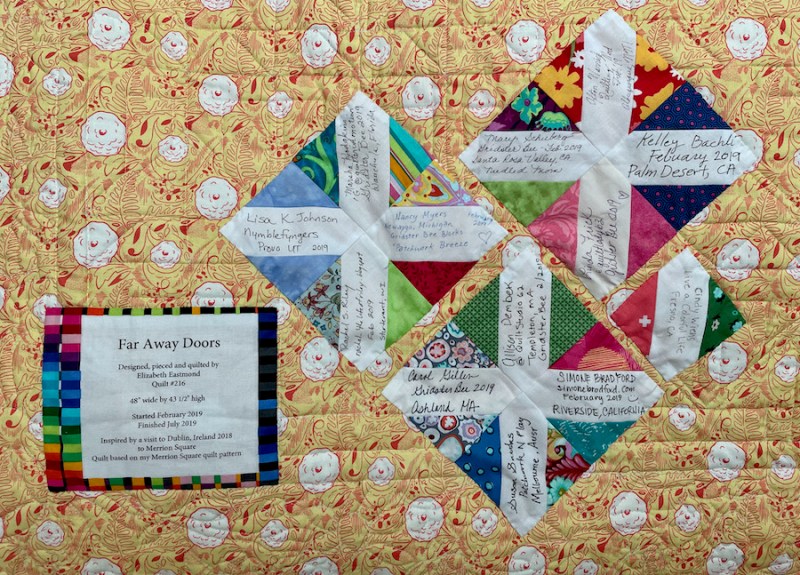
Signature blocks sewn together, then pinned onto the back of the quilt

Here are some of the things I did this week that were on my list, putting together disparate parts of my life. I made this quilt with the help of the Gridster Bee, but had misplaced the signature blocks. And then when I would find the signature blocks, I couldn’t remember which quilt they went to. But we put a new shelf in our closet to hold the stack of quilts, and in the shuffling, I was able to put the two together.
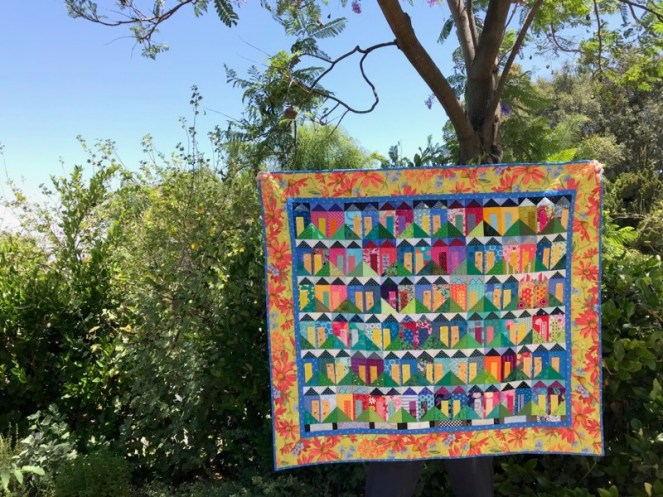
I did the bulk of the little houses on the front of the quilt, but it’s fun to look at all the different houses my bee-mates and others sent to me. I often keep my quilts hanging up around my house, because I enjoy them finished.

That is something that Janet Choi might appreciate: “The simple act of pausing to reflect and acknowledge your efforts provides valuable boosts of motivation, focus, and insight that would otherwise be lost amidst your busy day.” It’s like the other side of the To Do List…it’s the Done List.

“Your done list acts as a signpost, a manifestation of all that day’s hard work. This flips an overwhelmed mindset into action mode to correct course, learn from mistakes, and ultimately make better progress” (Choi).
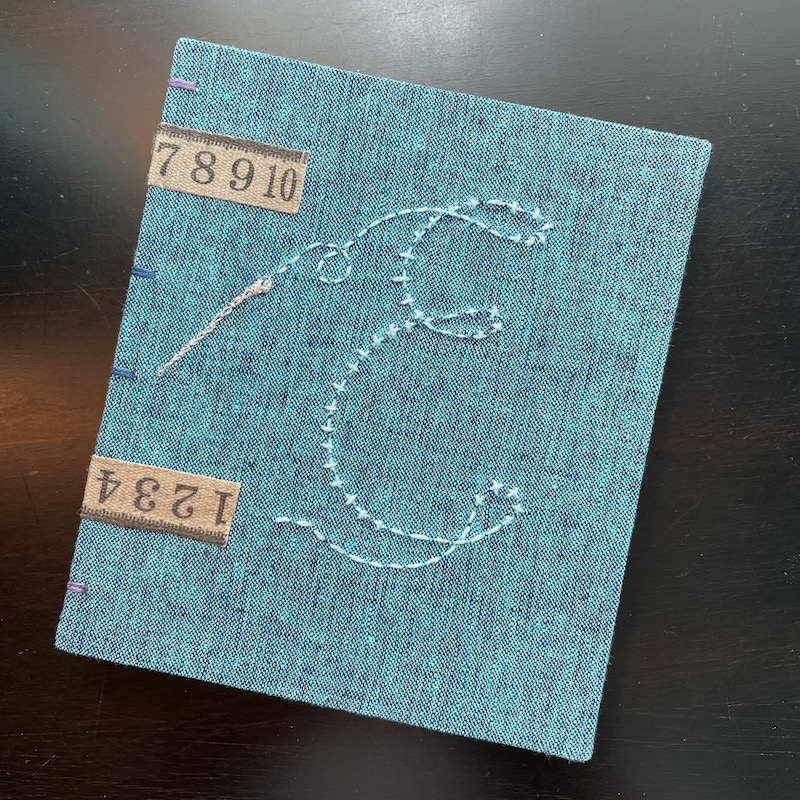
I tend to write my “Dones” at the end of the day in my journal, made for me by Amy, an artisan book maker. I was in a workshop of hers at Camp Create, and she made me this. It’s a treasure, but not only for what it is: it holds a lot of my Dones, but I also like reading backwards to find out what I thought about things a year ago, or even a month. Although I don’t write every day, I write enough that there is a general trend.

I also write my Quilt Dones up on my master Quilt Index at the top of this page, cataloging them on this blog, and then listing them one by one. I know several of you have started a Quilt Index of your own, judging by my emails.

Choi says to count our smaller wins, too: “Don’t wait until you’ve hit big goals like completing a project or getting a promotion — which happen only occasionally and make it difficult to appreciate small but important advancements. Don’t dismiss all the smaller things that fill out your days and are building up in the long run.”

Which brings me to this: the little rotary cutter in the illustration above. I was making images for my new workshop, Blossom, and I always like to have a visual header as to what is going on in the paragraph where it links to the instructional video, and gives tips. I had the scissors in my digital image file, but when I went hunting for a rotary cutter, I thought: I could make my own. So I did. I have the how-to’s below for those of you who are so inclined (including a video!), but for the rest of you, I leave you with this: I hope you will now not only consider not only a To-Do List, but also a Done List. Isn’t that why we started quilting in the first place? To have things stay done?

Happy Quilting!
How to Make a Digital Rotary Cutter in Affinity Designer, by a Verified Amateur.
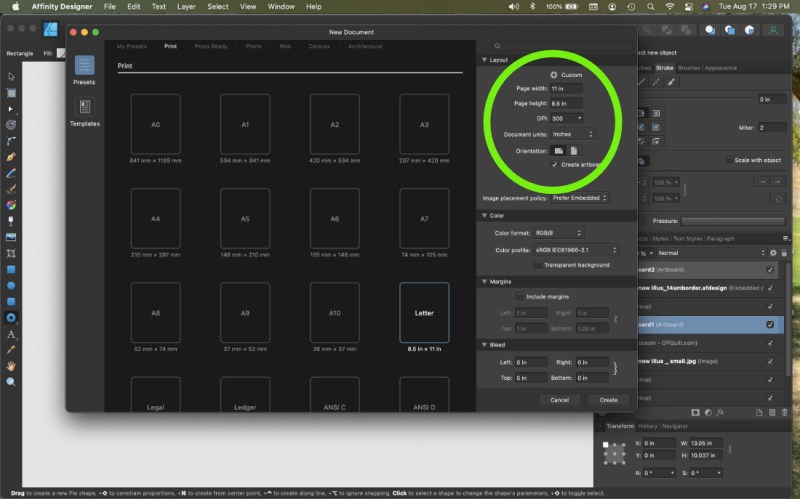
  1. Start the program. Open an artboard. If that already feels like a foreign language, an artboard is basically just a big scratch pad. I can open multiple artboards in one file and save them all under one name. So I can have a scratchpad for rotary cutter, a scratchpad for a quilt block, etc.
  2. Open Affinity Designer, click on “New.” A screen will show up with lots of sizes to choose from. I usually go with 9 x 11 as I can always resize it, but it fits on my laptop screen neatly. I choose “inches” not pixels from the set-up screen and I like mine sideways, so I click on Landscape. Don’t forget to click “Create Artboard.”

3. And then I realized I would be writing a book, so instead, I made a video.

And then I uploaded the video to YouTube, where you can watch it. (And I do not know why the full-screen version is blurry. Working on that.)

It runs about six minutes, if you have that much time. Of course, it took me three Google searches to figure out how to record from screen (pretty nifty, once you learn it), then I uploaded into iMovie so I could cut off the end where I keep saying, “How do I stop recording this?” over and over all the while critiquing my voice. I then uploaded titles on the front and back and even a little Title Card saying Thank You For Watching. Yes, sirree. I’m a rank amateur trying to act professional.

But there you go. Obviously I should have majored in graphic design in college, but that was some years ago when it was Photoshop Version 1.0. (Now, I’ve left Adobe behind and moved over to Affinity where there are NO monthly subscription fees. I’m just saying.)

Illustration from Newest Project…coming in October

I’m most excited about how Affinity Designer now has a gazadget that will let me automatically draw quarter-inch seam allowances around any shape I make (called a Contour Tool). So, so happy with this!

Happy Drawing! Happy Quilting!

Quilts

Quilt Labels, part II

First up, some answers to all those questions that came in about the label post I did a while back.  I provided a tutorial for my easy-peasy way to back your fabric with freezer paper and send it through your printer.  Then the comments and questions came in about colorfastness and ink and fabric.  Sigh.  I am not a computer-printer expert.  All lot of people noted that HP inks run and disappear.  To figure out how your inks behave in the wash, I strongly suggest that you make a test sample with YOUR printer and put it in a lingerie bag and run it through your washer and dryer to see what happens.

Used Computer-printed label

While I was in Washington DC, praying for the cherry blossoms to open (they almost did), my husband and I visited my son and were able to sleep under the quilt I made him when he went away to college, some twelve years ago (my, how time flies!).  He admits that he doesn’t wash it too often, but here is a picture of the label, printed on my EPSON printer.  I think it looks pretty good for being done all those many years ago.

I have printed labels with my laser jet printer which did not survive the wash, so later on, when I visited that grandchild’s house, I simply traced over the wording with a Micron pen.

And For the Pansies Label

This quilt was made sixteen years ago, and I wrote on the label with a Micron Pen (I think I used about a .05 or .07).  It’s been washed scads of times, and given that I hardly knew what I was doing at that time in the Label Department, it seems to have held up.

And For the Pansies Poem on Label

The poem that goes with the quilt, an homage to my mother, who loves pansies. I think what I’m trying to say is that there is no one way to make a quilt label, and if you like buying the fabric that’s pretreated, or making your own with some Bubble Jet and Bubble Jet set (a la Caryl Bryer Fallert-Gentry), have at it.  If you have a success, please let me know and I’ll pass it along.  But for now, I will keep plugging along with my EPSON printer and their fabulous inks and my easy-peasy freezer paper method.

4-in-art_3


A reminder that tomorrow is our quarterly reveal for our Four-in-Art group.  See you then!

200 Quilts · Four-in-Art · Quilts

Congruence, Deconstructed

Congruence Owl quilt front 2

Our reveal for the fourth challenge quilt in our art group, Four-in-Art Quilters, was yesterday and today I’ll tell you how it came together.

I first started by looking a what seemed like billions of photos of owls.  I did a lot of this through Flickr, where I found this photo:

OWL ese

I wrote to Matt Smith, the person who posted it, and asked permission to use this photo and he gave it to me.  And then I sat on it for a couple of months, not knowing how to approach this.  Did I want to paper-piece it?  Not really.  Embroider it?  Pixelate it into little squares?  None seemed satisfying.  And then it was in the background reading that it came to me that I would fracture it, play with it a little and see where that went.

OWL ps desktop

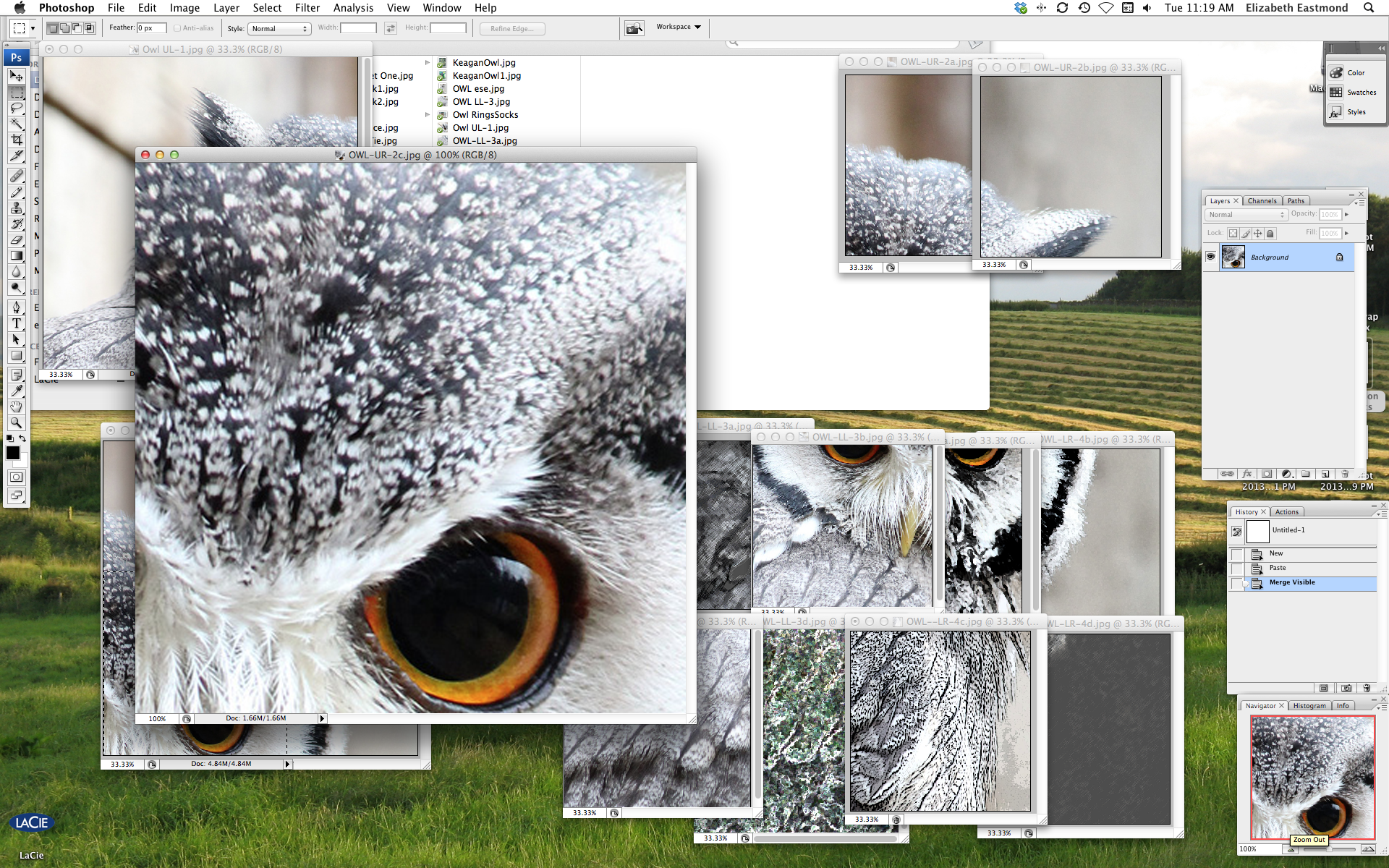
I digitally chopped the owl picture into fourths and then chopped into fourths again, making sixteen parts.  And then I began to play with filters, one of the least used, but really fun parts of Photoshop.  I applied at least one, and sometimes multiple filters to each segment, approximating the sizes so I could get this bird back together again in the end.  You can see the mock-up on the lower right.  That was me, trying to reassure myself.

Congruence Owl quilt construction 1

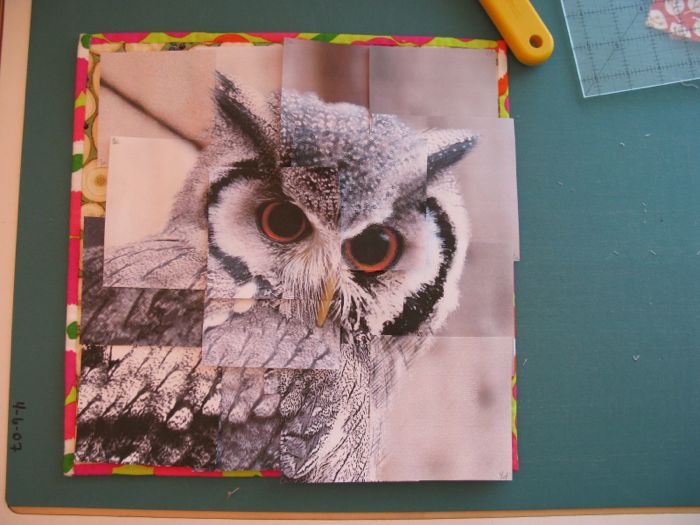
Then I printed it off on paper, cut it apart, and still tried to reassure myself. I grabbed a previous art quilt off the wall (I knew it was 12″ square) to use as a template.  It seemed okay. But how to get it to fabric?  I usually iron freezer paper to the back of a piece of fabric, tape that to a piece of paper like I did in English Elizabeth, then run it through my Epson color printer. But I’d read in a blog about someone who simply ironed the fabric and freezer paper together, making sure it was a standard paper size, and then ran it through the printer.

Congruence Owl quilt construction 2

Don’t you love the ink smudges?  The next time, I made sure the freezer paper was really well-adhered to the fabric, then set the printings for thick matte paper on high quality and ran it through again, using a long thin tool to assist it through the last phases and so the fabric wouldn’t touch anything.  The closest thing I could grab was a nail file — but it worked.

Congruence Owl quilt construction 4

I peeled off the freezer paper carefully and cut apart my sixteen squares of Mr. Owl.

Congruence Owl quilt Layering up the backing

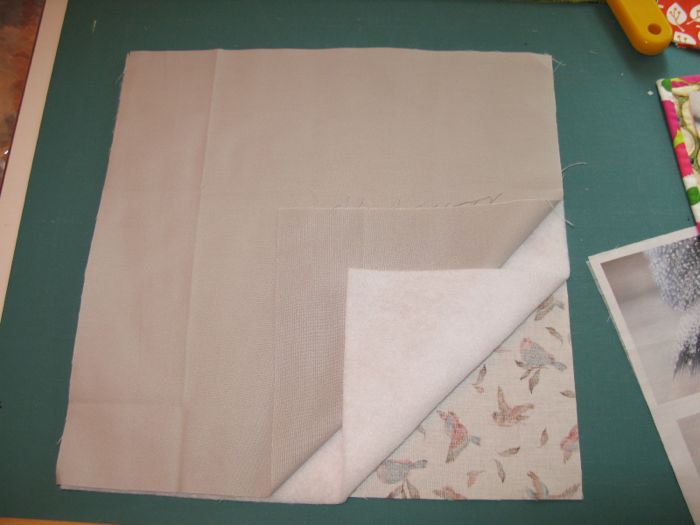
Layering the background — Kona Ash — with the backing and batting.  Kona Ash?  Light taupey gray?  Cindy of Live a Colorful Life is probably laughing her head off now because she knows how much I hate gray.  Really, I do.  In so many modern quilts it acts as a big hole in the composition, especially if it’s a medium gray.  I think if a quilter has to go gray in a quilt (and I’m not talking about those low-volume quilt compositions where it is intentional and where it works) they ought to go charcoal.  Or slate.  Ash is what I had on hand, as I don’t generally keep gray around (I bought it for a bee block I had to do).  But it worked for this as the picture, except for the owl’s eyes, is all in taupes and grays.  Yeah, low-volume.

Congruence Owl quilt construction 3

Using the paper mock-up as a guide, I start layering the cloth images onto the backing.

Congruence Owl quilt 2 layout

Congruence Owl quilt 1 layout

Moving things around, trimming down the pieces so some aren’t square, trying for balance.  Trying for that little artist’s lightbulb to go off in my head.  I got about a night-light’s worth of illumination, but from my writing in grad school, I knew that showing up wouldn’t get you anywhere–you have to keep trying.  To fully put this concept into action,  I went to dinner, then let it sit for a week while I went to our quilt retreat.

Congruence Owl 1

Then one morning it was simply time to tackle it again.  I couldn’t decide between satin-stitching a thicker line (close zig-zagging) or straight-stitching a narrow line of thread around each piece.  Narrow won.  I trimmed it up to 12 inches and then thought I’d like to try a faced binding (tutorial on how to do a faced binding coming in a couple of days).

Congruence Owl 2

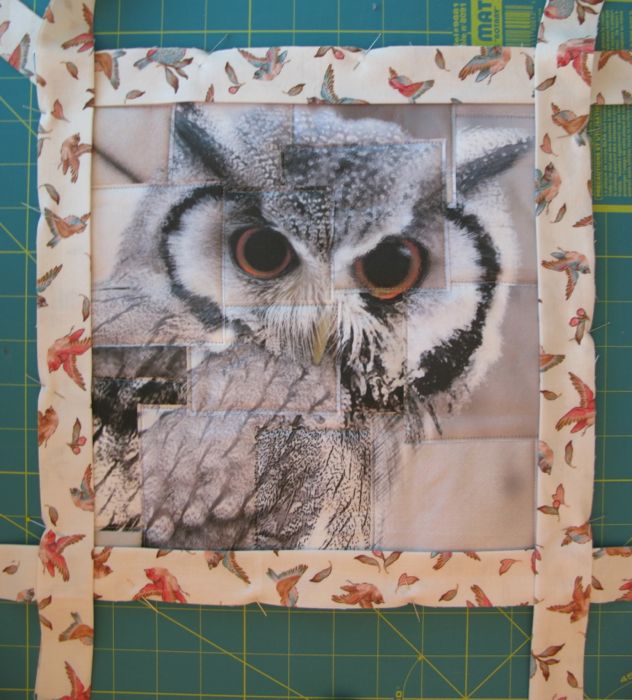
I cut strips to match the backing, sewed them on.

Congruence Owl 3

When I ironed them to the back on a couple of sides, it became apparent that I needed that “frame” of the binding for this particular quilt.  Rip off the binding.

Congruence Owl quilt tiling

I kind of liked the way the binding corralled those tiled pieces.

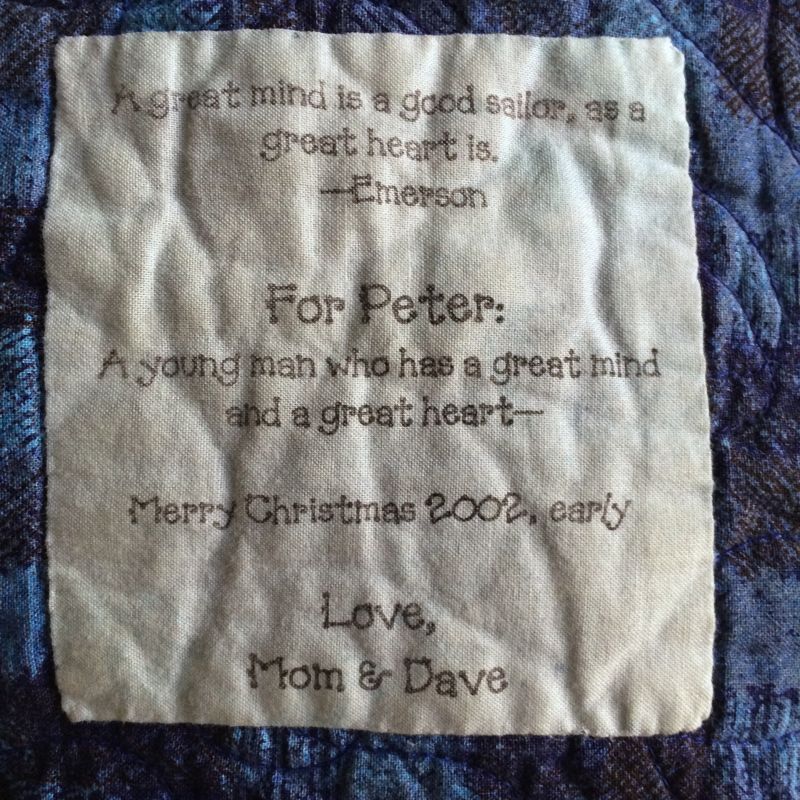
Congruence Owl quilt label

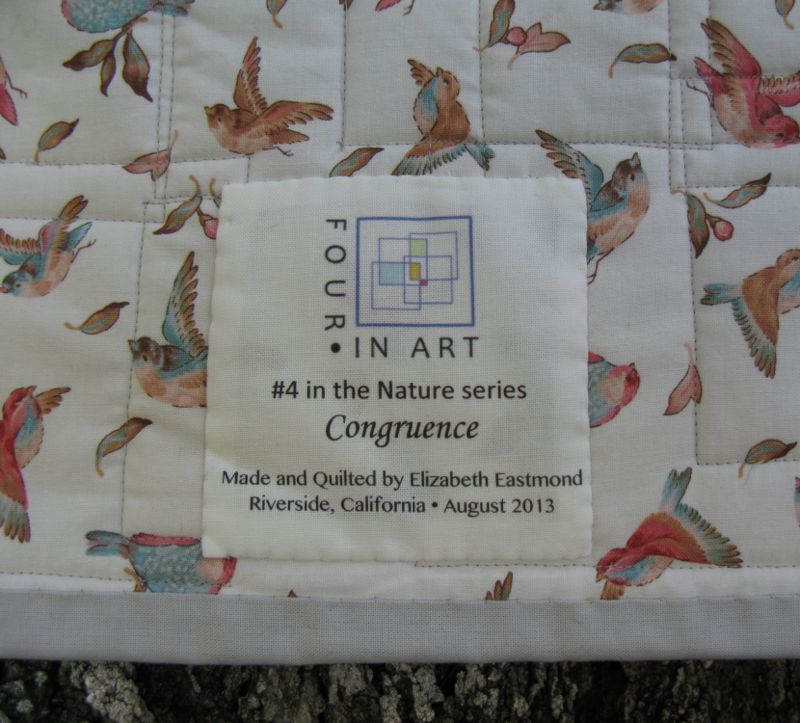
I made the label, sewed it on, then went outside to photograph it.  I made an interesting discovery.

Congruence Owl quilt 5 textures

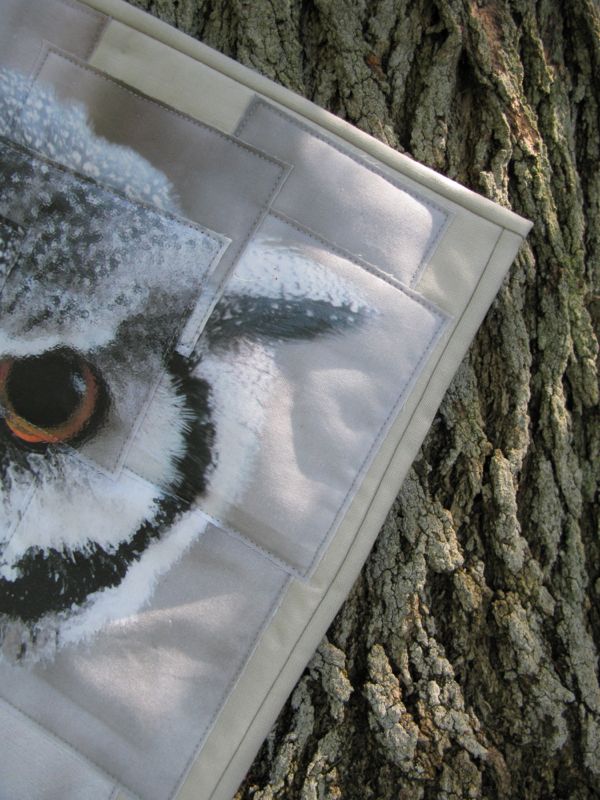
This lower section of the feathered wing imitated the gnarly bark of my silk oak tree in my backyard.  Maybe because I’d dampened the literal image of feathers with Photoshop filters?  I don’t know, but I liked the effect.

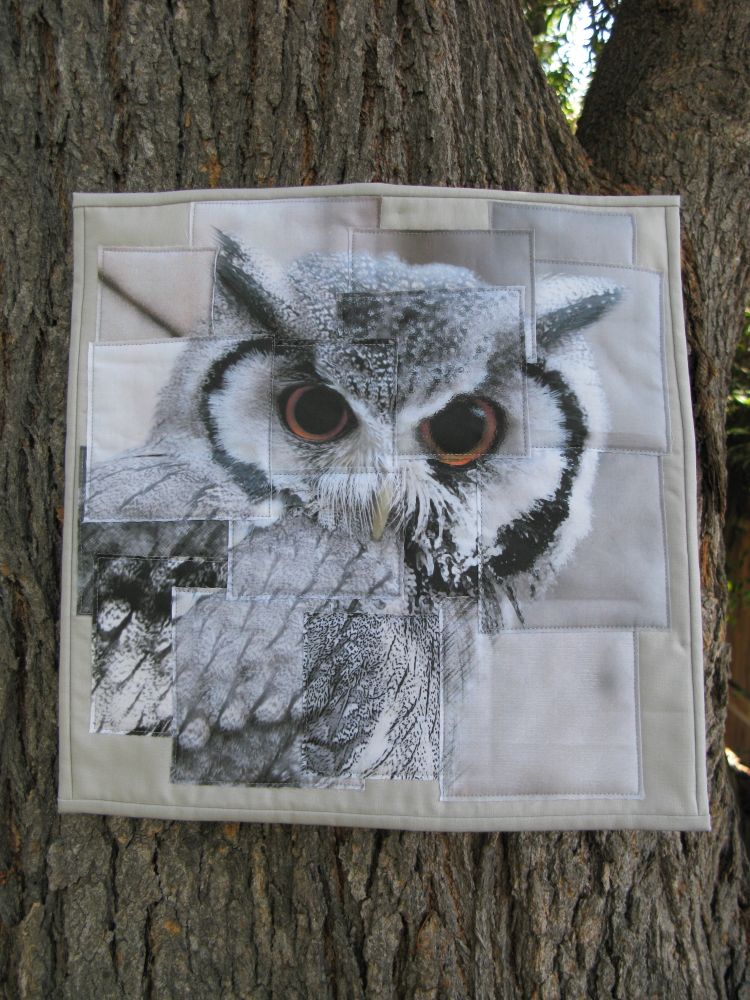
Congruence Owl quilt front tilted

So, all the incongruent small pieces — the images, the tiling, the layering, the stitching — all merged into a lovely congruence of an owl, just like the metaphoric meanings discussed yesterday.  All combine into that creature that captures our imagination while mystifying us as well.

And now I leave you with a poem by Mary Oliver, that I think captures this idea:

“Praise,” by Mary Oliver

Knee-deep
in the ferns
springing up
at the edge of the whistling swamp,

I watch the owl
with its satisfied,
heart-shaped face
as it flies over the water–

back and forth–
as it flutters down
like a hellish moth
wherever the reeds twitch–

whenever, in the muddy cover,
some little life sighs
before it slides into moonlight
and becomes a shadow.

In the distance,
awful and infallible,
the old swamp belches.
Of course

It stabs my heart
whenever something cries out
like a teardrop.
But isn’t it wonderful,

What is happening
in the branches of the pines:
the owl’s young,
dressed in snowflakes,

are starting to fatten–
they beat their muscular wings,
they dream of flying
for another million years

over the water,
over the ferns,
over the world’s roughage
as it bleeds and deepens.

from House of Light, 1990

200 Quilts

Village Faire

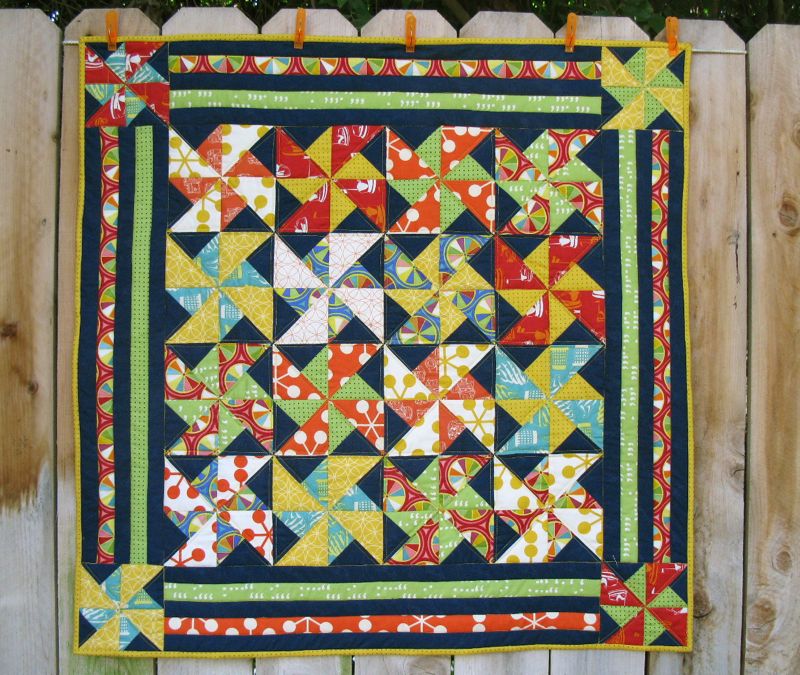
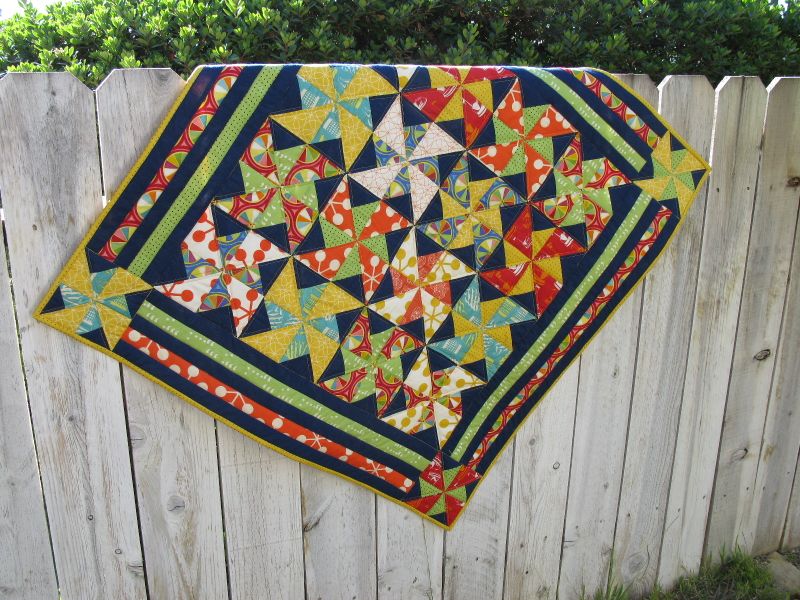
Village Faire Top

Village Faire, quilt #117 on my 200 Quilts List

A part of the Year of Schnibbles, hosted by Sherri and Sinta.

This quilt reminded me of summer days, of green lawns that you can lay down in and drift off, and of course, pinwheels that spin with the flick of a finger, or by holding them overhead while running.  I was also reminded of local faires and immediately thought of Babe, the Gallant Pig, and Mr. and Mrs. Hoggett, cotton candy, ferris wheels.

Little Machine Sewing

I started it on the small machine, as the big machine was set up downstairs, quilting Kaleidoscope.

DulcineaFrontCoverSMHere’s the original.  You can see I changed up the border.

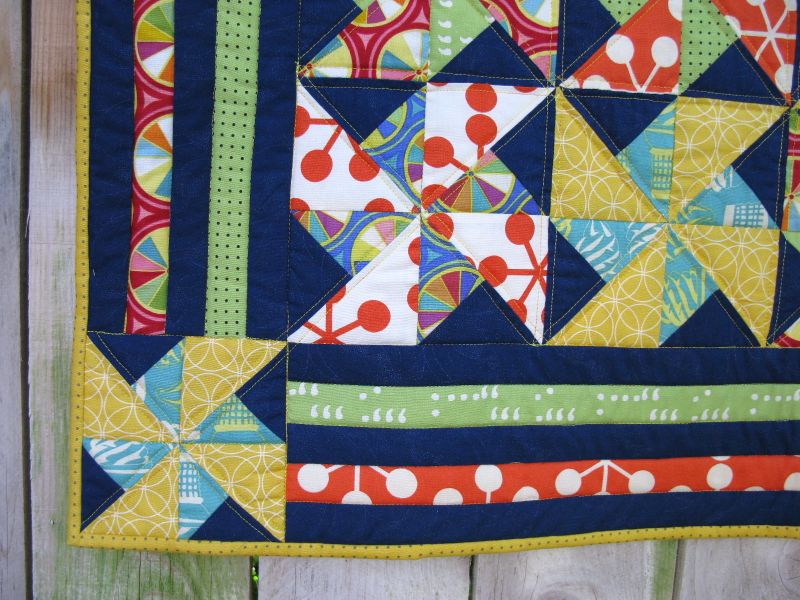
Village Faire Top detail

Given the bold prints of my fabrics, I felt the border was too busy for what I had going on in the center, and as we are given license to modify and create and have fun with Carrie Nelson’s patterns, I indulged and put a series of bars along the edges, with pinwheels for cornerstones.  I have a fabrics from the Comma collection from Moda and from Thomas Knauer’s Asbury collection, which has summer-time things like bumper cars and soft-serve ice cream cones.

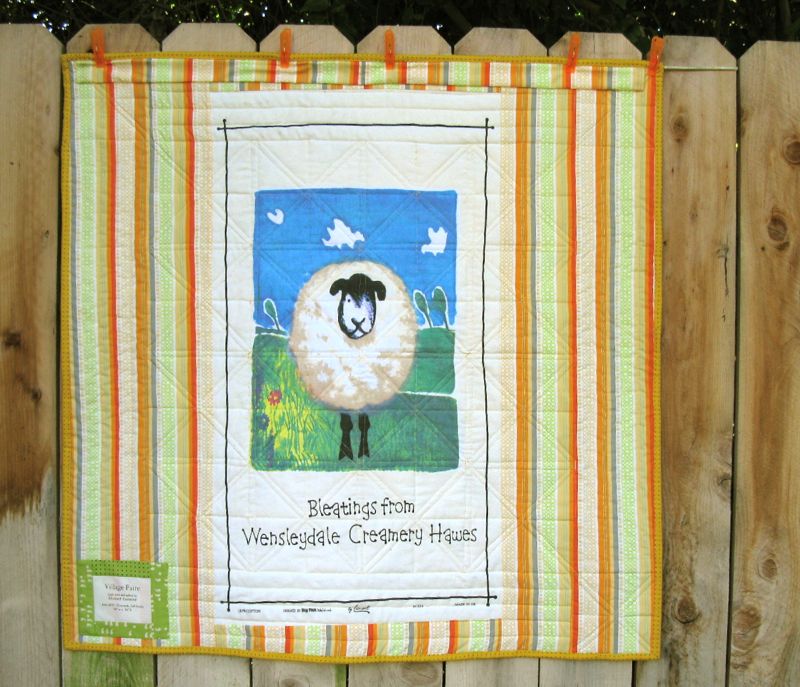
Village Faire Back2

And on the back?  Yep–a tea towel.  This one is from Wensleydale in the Yorkshire Dales region of England.  We went on vacation there a few years back and as we are enamoured of Wallace and Grommit, we knew we had to head over to Hawes and sample some Wensleydale cheese.  (Even though it was raining.  And rained all day, which explains why England is so green.)

YorkshireDales1

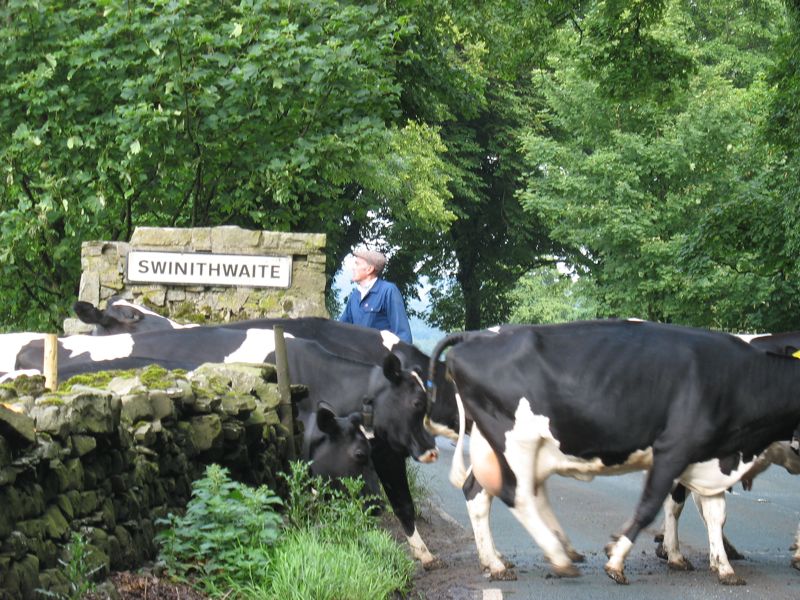
Swinithwaite1

A scene or two from Yorkshire.  I can now get this Wensleydale cheese in Costco, during the holidays.  Will wonders never cease.

Village Faire on fence

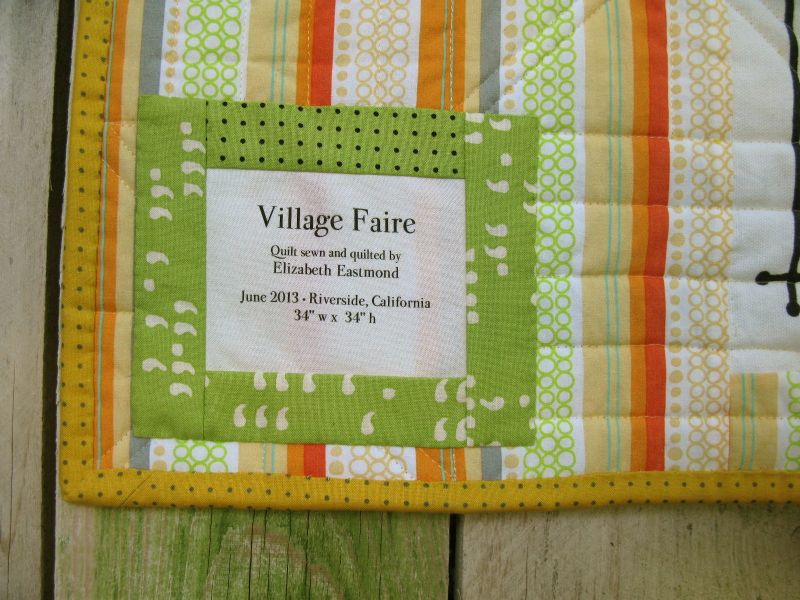
Village Faire Label

This measures a little larger than the other two Schnibbles designs, coming in at 34″ square.  I think this design would morph perfectly into a baby quilt, or a quilt for a child, by adding another row of the pinwheels.

Village Faire in guest bedroom

After taking the outside photos, I gimped upstairs (yes, I can walk around now, but not much, and have that lovely blue boot on my foot) and threw the quilt on the guest bedroom bed.  I really like these bold colors.  Given that we are heading into a weekend of 100+ degree heat, I declare that summer has arrived!

This summer may you find a Village Faire to attend, and a pinwheel to spin with a quick puff of breath.

windmill_template