100 Quilts · Finishing School Friday

Be My Valentine

Okay, I know I’m late.  Late for Valentine’s Day.  But better late than never, right? Another entry into Friday Finishing School.  In fact, today I have two!mini-love-quilt
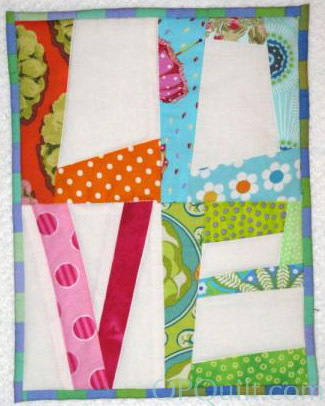
I finished sewing down the binding on my LOVE mini quilt–here it is!  Okay, on to the red and white.

be-my-valentine

Be My Valentine, Quilt #94

I threw a color catcher into the washer to catch the red dye–obviously I needed two, judging by the fact that the little ladies now have a light pink background instead of a white background.  It’s interesting how some of the whites were tinted pink and others were not.  Go figure.

The back.
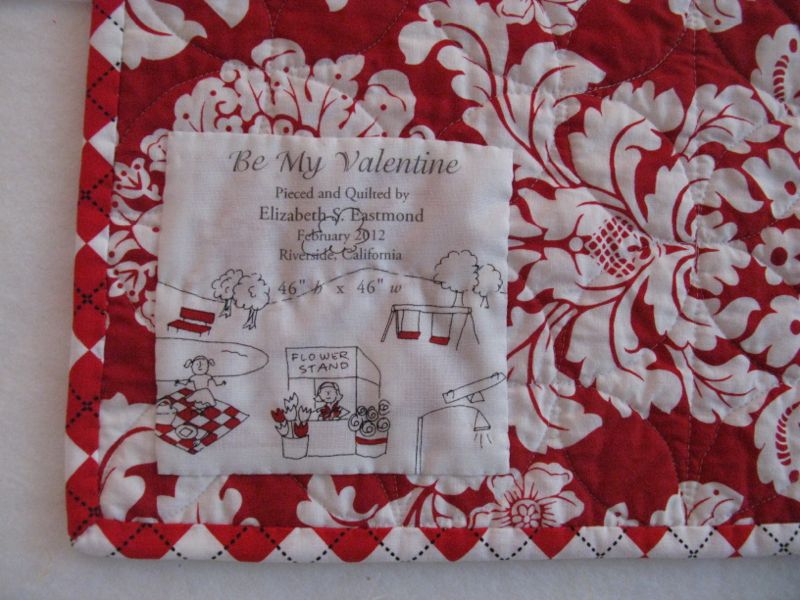
I wanted something fun for the label, so I cut out a piece of fabric from the front, and printed onto that. It really is squared up.  Ignore the photo.
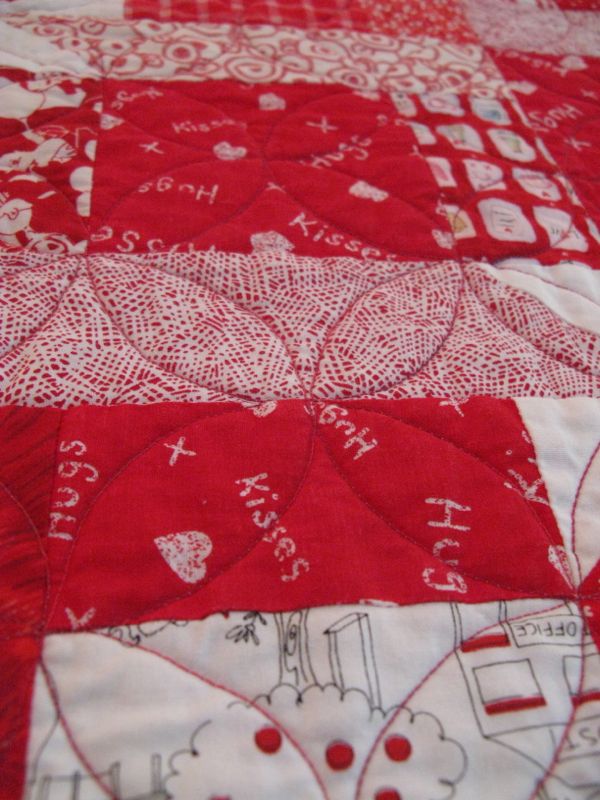
Beauty shot of the quilting on the front.  I used a thicker thread–King Tut, because I wanted those circles to stand out.  I have to say I really like quilting with Superior Thread’s King Tut.  And I buy my thread from them, just like everyone else does.  No, they are not a sponsor.  Yes, we are having a giveaway but only because I like their product.  I also use the Guterman that I get on a 50% off coupon at  the big box fabric store, but I’ve only really been happy with that for piecing, not for quilting the top.  (And no, I don’t buy into that myth about polyester thread “cutting” the cloth.)  I have also used Sulky on occasion, but sometimes I don’t like the shiny look of the polyester, and head back to the cottons.  Some quilts call for one kind of thread, other quilts call for other threads.

And on the back I used Superior’s Bottom Line thread in white. How did I ever start using this?  It was when I was sewing my Empty Nest, Full Life quilt, and I just couldn’t get the threads to balance properly with their locking of the stitch in between the front and the back.  I think I had purchased a spool of Bottom Line at the last quilt show I’d gone to and in desperation, wound it onto the bobbin to try.  It’s a lighter weight thread, and I think Heather (Mother Superior, as she is known on the website) told me that a lot of show quilters used it because they could more densely quilt their quilts.  That fact didn’t sway me at all (you know how much I hate densely quilted quilts), but the fact that I didn’t have loopy loops or pulled threads to the front did convince me it was something to have around.  I loosen the tension on the top a little, sometimes a lot.  Then I write that on a post-it note and keep it near the machine for when I have to come back to it.  Generally, with a thicker thread on top, I lower it by one full point–from a 4.0 to a 3.0.

So I tend to use it always in the bobbin.  I’ve always wanted to try it in hand piecing, as it is as fine as silk.  Some day.  There you go–two Friday Finishes!
Quilts

Checkerboard Border

Been one of those weeks when I’ve felt more wobbly than usual for some reason, so everything’s been on Slo-Mo.  That’s slow-motion.  But today I woke up without a headache and headed to Free-Mo.  That’s Free-Motion Quilting.

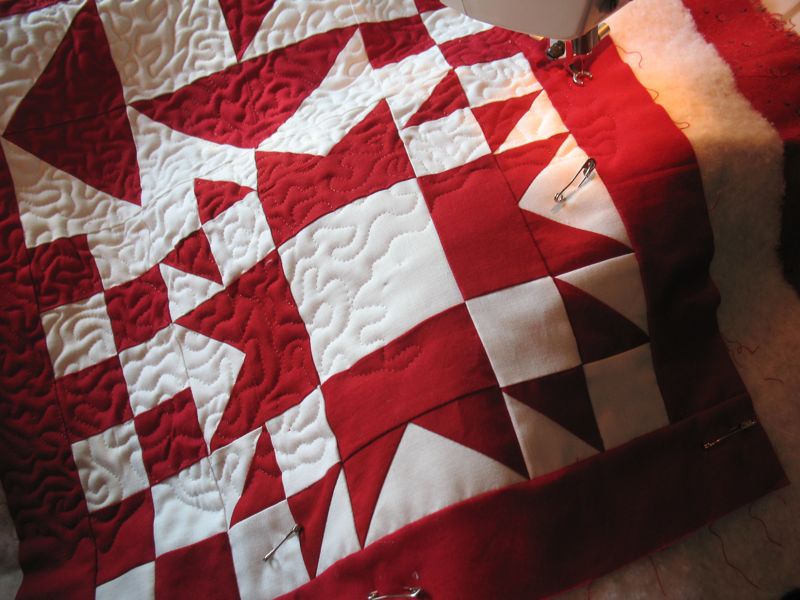
I’m working on the table runner for the Red/White Challenge hosted by Temecula Quilt Company, and the deadline is September 15th.  All the blocks came in from local quilters and from around the world, so I put it together in a quilt sandwich and went to town.  It went quickly, and it was good to just dig into something to get it done.

I’ve had this idea to put a checkerboard border on it, as this will be used at Christmastime and during the patriotic holidays, and I wanted to jazz up that edge a little.

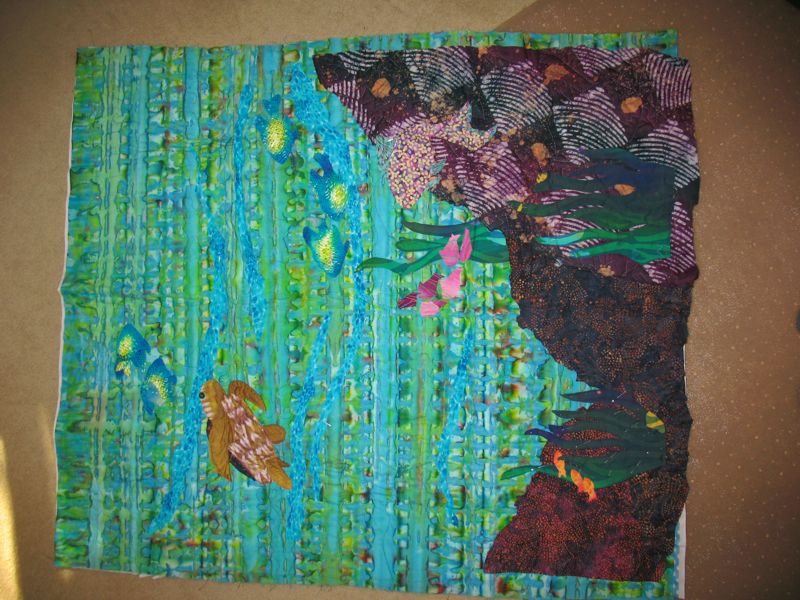
Okay, while I was trying to put away the box of French fabrics (it goes on the top shelf, and I’m a shortie), this quilt fell down.  It’s a seaside quilt that I stated long long ago.  And abandoned.  It is NOT on my list of lifetime quilts, as it’s sort of in this limbo of that place whether or not I want to finish it or not.  I mean, I LOVE the background fabric and the turtle (raw-edge applique) turned out well.  But I know to really make this quilt something else, it will require digging into that drawer marked “Coral Reef” and cutting and sewing and appliqueing a whole host of creatures.  I even have a child’s picture book in that drawer, purchased after I took the class, because oh my! the teacher’s quilts were so incredibly cool and I wanted to learn from her.

True Confession:  I also have a Ricky Tims quilt in about the same stages, but it’s a square-within-a-square quilt.  I went down the night before the class to hear him speak at our quilt guild and loved every minute of it.  So I showed up for class and . . . didn’t love every minute of it.  I felt he was distracted and just punching a time clock that day.  We all have days like that but it taught me one more truth about the quilt world: some of the famous personalities we see are fabulous in front of the camera and some are terrific teachers and sometimes you have both.  But not always.

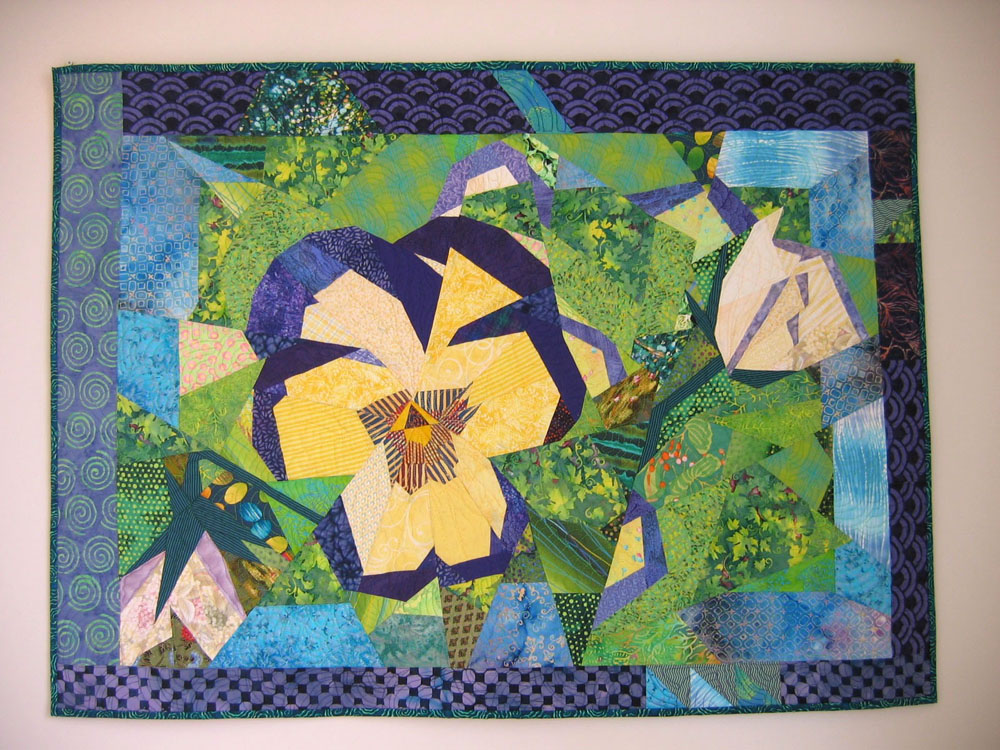
One teacher I’d take again in a New York Minute would be Roberta Horton.  I’ve had several classes from her (is she even teaching anymore?) and I’ve gone away from every one of them amazed at her ability to gently, yet firmly, bring her students to the place of creativity.  I’ve finished very quilt I have started in her classes.  Two other honor roll teachers are Jane Sassaman and Katie Pasquini-Masopust.  I’ve finished all of their class samples, but by then I’d learned to make a small quilt–less than 15″ on the longest side–in order to learn the technique and to have a “finishable” piece of art.  I have also taken a class with Ruth McDowell, and she ranks right up there as well, although after a 4-day class, I don’t know how she kept us motivated and going.  We were all exhausted!  It took me more than a year to finish that quilt, as I wanted it to be nearly perfect.  I think you’ve seen it all before, but to contrast with the unfinished seaside quilt, I present Heart’s-ease.

One of pansy’s other names is Heart’s-ease, as it was thought to be involved with the affairs of the heart.  It actually refers to the “viola tricolor” which is an ancestor of our modern-day pansy.  Now you know more than you ever needed to know about these sunny little flowers that bloom around here in Spring.  And which, because of Ruth McDowell and this quilt,  I have blooming on the guest-bedroom wall all the time.

Creating · Sewing

Squiggles, AKA, Stipples

It all started with this video, which I saw on Boing Boing:

It reminded me of quilting.  Of our famous all-over squiggle quilting, AKA, “The Stipple.”  But the gal in the video goes on to create some really interesting things.

When I walked through the Springville Art Museum’s Quilt Show, I, too, focused on the quilting, and on the different iterations of it, although not to the Hilbert Curve level.  And since I’m always collecting interesting photos of quilting patterns, I thought you might be doing the same.  Enjoy the show.

This slideshow requires JavaScript.

100 Quilts · Creating

Family Tree

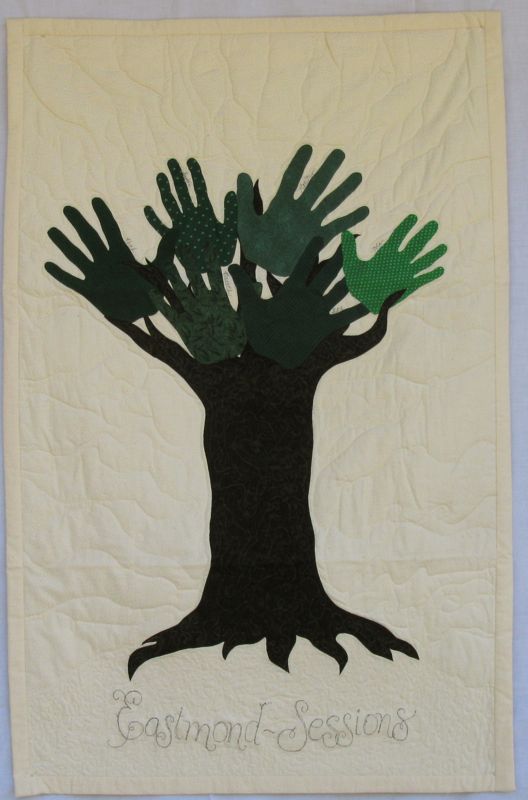
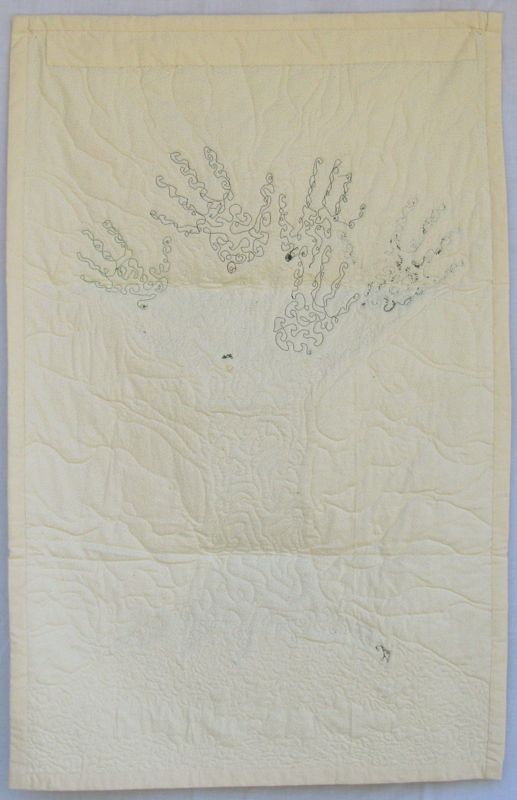
I really shouldn’t let this quilt show its face in the quilt world.  Really, it has that many problems.  But sometimes these quilts are fun to look and to remind myself of how far I’ve come as a quilter.

So the idea was, since we were headed to a family reunion, to make a banner for my husband and I, like I’d made for my mother.  Hers was more successful, and it’s all on account of the quilting.  I hadn’t yet taken a fusible class, so I was working with my old stand-by which unfortunately leaves the fabric like a slab of wallboard.

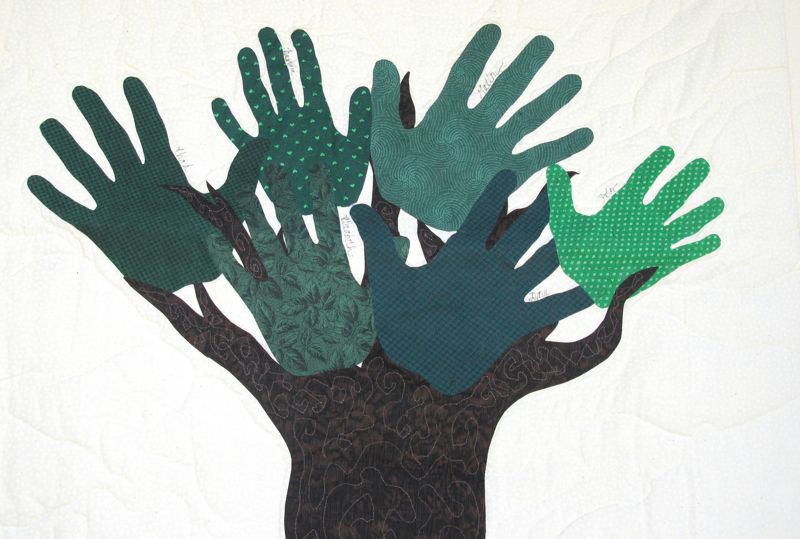
I cut out the tree, and then traced everyone’s hand for the leaves.  I slabbed on them on to a tone-on-tone background fabric (which, thankfully we don’t have around much as the fabric can change colors turning more yellow–I think the newer ones are better).

I then wrote our name using a Pigma pen, copying the style of my sister-in-law’s handwriting.

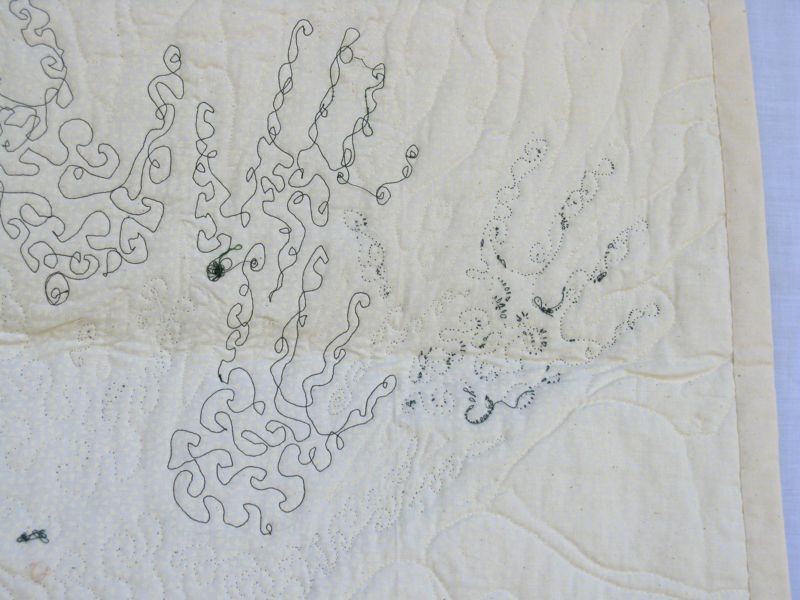
Then, for some strange reason, I decided to put it under my machine and quilt it.  Maybe I did that because this idea of quilting the quilt yourself was an idea that was percolating around; back in the Olden Days (when we wore skins and cooked over an open fire and used cardboard templates and cut everything out by scissors) there was no machine quilting on your own machine.  Either you hand-quilted it or you tied your quilt.  That was it.  Then the longarms started showing up, and then the idea came that you of course could do your own quilting.  This quilt is a testament as to why sometimes you shouldn’t.  Or you should take a class and get better.  (Which I’ve tried to do.)

Okay, here comes the prelude to the scary part.  Can you believe I switched out the color in the bobbin?  I did it again this year.  I’d better write this one down on the Things Not To Do list, and tack it up by my machine.

ACK!!! ACK!!! ACK!!!
Don’t you just love all the loose bobbin stitches, the globs of thread that burped out on the back, the horrendously balanced thread tension?  I give myself a little break because I WAS sewing through bunches of wallboard-glued-on-fused fabrics and that’s just about impossible.

But I have to say I learned a lot, and still am continuing to learn about the Big Three Elements of Free-Motion Quilting.  They are:

  • Speed of the machine (how heavy your foot is in on the pedal)
  • Speed of your hands moving the quilt around
  • Tension/Thread/Needle Size.

I now sew with a size 14 Topstitching needle most of the time when I’m machine quilting.  Sometimes I bump up to a 16.  I ALWAYS test drive the thread tension — it can change with the thread you use —  on a small quilt sandwich that I keep by the machine.  And I really hope I never use a different color of thread in the bobbin again. (Cue: sound of head banging.)

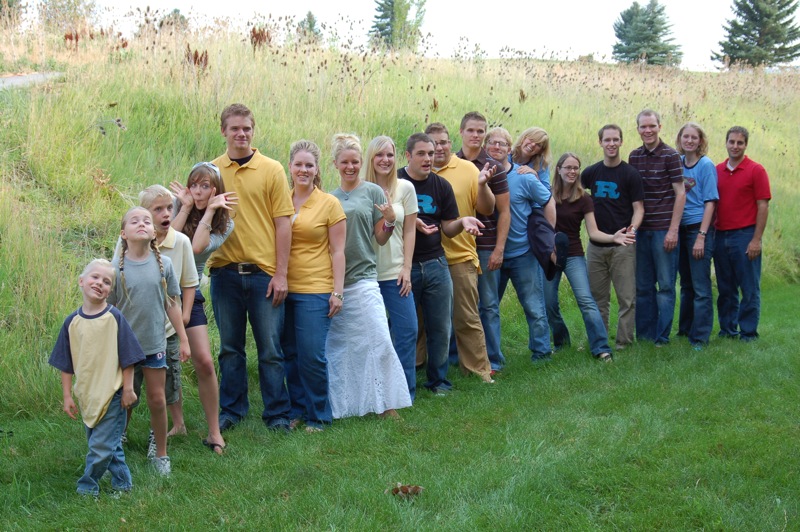
Here’s a photo of my parents’ grandchildren all lined up by age.  Not all of them are shown here, but overall there are 27 of them.  And now we’re working on the next generation with nearly 20 great-grandchildren (an adoption or two are in process).  We’ve been at our bi-annual Reunion this past week, where I got to see all those new cute little great-grands, and they got to meet their auntie–me!