
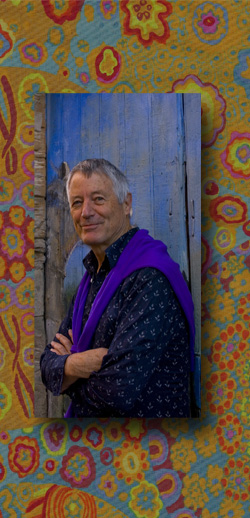
 I’m totally jazzed.
I bought my ticket this week for “An Evening with Kaffe Fassett” in Los Angeles, sponsored by the Westside Quilters. I’m dragging taking my husband along for company–should be a delightful evening!
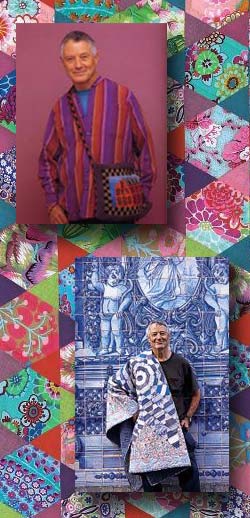
I’m totally jazzed.
I bought my ticket this week for “An Evening with Kaffe Fassett” in Los Angeles, sponsored by the Westside Quilters. I’m dragging taking my husband along for company–should be a delightful evening!

Now that we’ve found our new Six-Step process to alleviate fabric-aholism (see previous post, below), I wanted to show you my constructed closet (vs. de-constructed, all over the floor, spilling off the shelves, closet). This only took two days of moaning and then sending my husband on an out-of-town trip to take care of. And like I mentioned in the post last week, I found lots of interesting things. I mean, I knew I had them, but they had been back-burnered so many times as to be invisible.

Like this group of fabrics. No, they are not a “line” like we’re used to buying now (kind of like voting a straight party political ticket). I do like doing buying a line because everything coordinates, but this is from the early 90s, when variety was considered a virtue. I was inspired by a friend’s autumn-colored quilt that positively glowed on the wall of her book shop.
Covet.
This week, I rinsed then washed the batiks to rid the fabrics of excess dye, then ironed and folded them all.
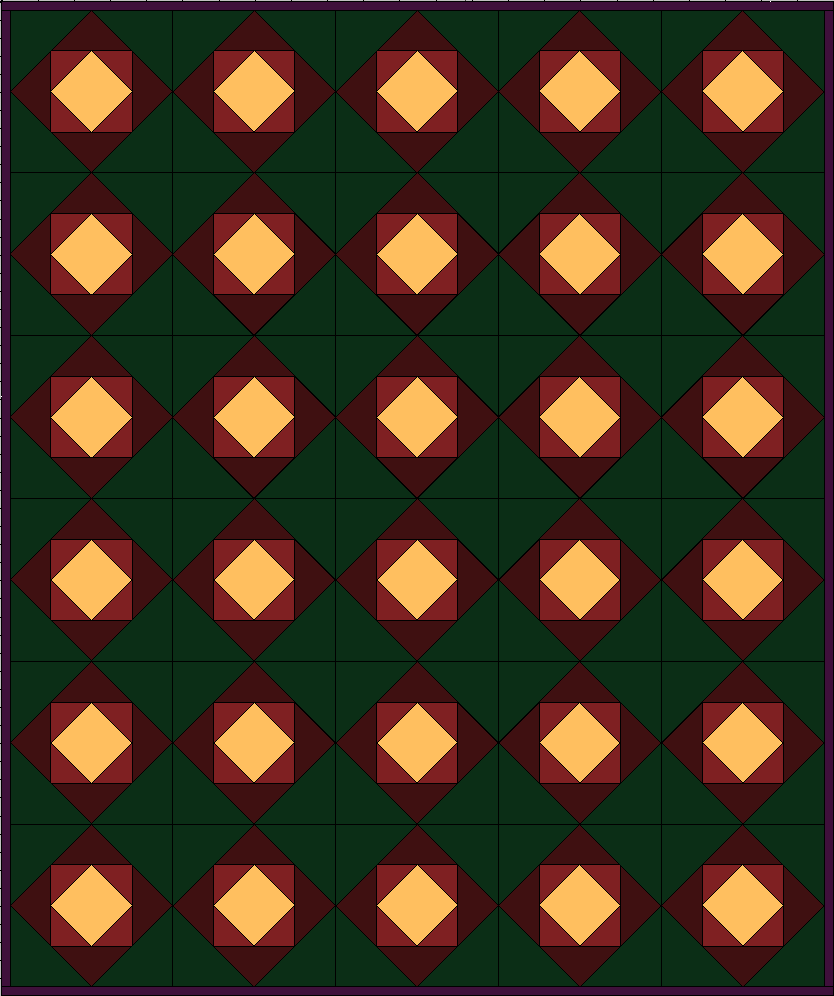
This is my mock-up of what it could be. Nine-inch blocks. Elegant in its simplicity. But it will be richer looking with all those different fabrics shown above.
I decided to try it out.

Here it is for the dress rehearsal, all laid out. Yes, this is one of my famous I’m-in-my-jammies-nighttime-photo-shots.
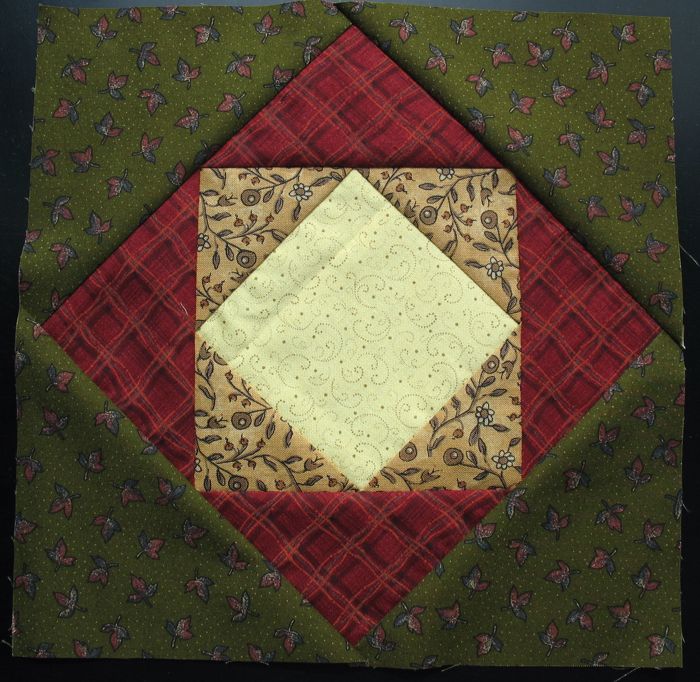
Stitched! Now on to make 29 more of these. The colors are so much more subdued than I’m used to working with, but I don’t know–isn’t it just time for a quilt in fall colors?
That’s what I’m working on. And good luck to Lee on her fabric line. I may go back there to Freshly Pieced from last week’s WIP to see what you’re all doing THIS week.
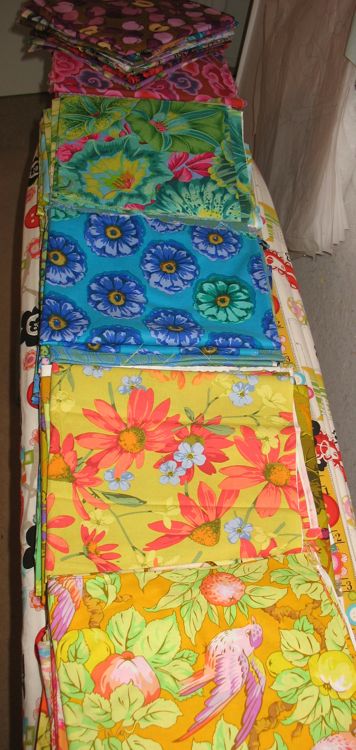 To every addict comes a time when they must admit they have overstepped the line and must seek help. Hence, a fabric-aholics Six-Step Process, condensed down from a 12-step process therapy.
1. Take everything out of your fabric closet, your fabric shelves, and leave it in a heap while your husband/spouse/other walks in and says nothing. Their eyes say it all. Like, Wow.
2. Refold the fabrics because we all know that really helps. Because you can always get more in the closet after you refold them, right? And because scientific studies have proven that working with tactile items keeps the old blood pressure down. It’s a health issue.
3. Start putting them back in. Realize that you’ll never get your stash back in its “box” after its been sprung. Organized fabrics take WAAAY more space.
4. Re-think your organization plan. Try sorting them by color groups — only six: yellow, green, blue, red, purple, grays (see photo). Browns? Decide if they are a yellow-brown or an orange-brown or a yellow-orange brown because that’s the basic three places brown comes from. (I learned this in college. I give it to you now, free of charge.) Or you can group the browns/blacks together. Put the darkest of the colors on the bottom of the color stack. Or try organizing by theme: like those food fabrics you’ve been collecting since you learned how to thread a needle. It was always going to be a “basket quilt” and now you look at some of them and wonder if you could stand to see them in a quilt.
5. Realize that you have accumulated enough fabric for 20 years worth of quilts. Why? We need to subdivide this category. These observations are not all autobiographical, but come from almost forty years of being a quilter/involved with fabric (before I was a quilter, I was a sewer and don’t even kid yourself — they’re stashers too):
a) you were at a quilt show and we all know they spray fabric pheromones in the air at those events, or
b) you were shopping with friends and they bought some, and you didn’t want to be left out, so you did too, or
c) you were feeling blue and needed a little cheering up, or
d) you were taking a class with _________ (fill in the blank) and needed more yellow-green, or
e) it was a beautiful day (weather or other) and you just felt like a stroll through a fabric store would be a great thing and you noticed the clearance racks, or
f) you are doing your part to help the economy and your local fabric store, or
g) the online email that your favorite online shop sent you had that new line and while you were really excited about only four of the prints, their fat-quarter bundle of nine prints would be a better bargain, or
h) it was a really horrid day (weather or other) and you just felt like visiting those people who you have made friends with at your local shop would cheer your day, or
i) you were in the mood for some new fabric, or
j) you saw a quilt on the blogs or in a magazine that you wanted to make, and of course, this required new fabric, or
k) you are a blogger and have to have something new to show on the blog, or
l) ______________ (fill in the blank).
6. Realize that you will probably always buy fabric (here’s where we differ from traditional 12-step programs) but that a little restraint now and again would be a good idea. And if you are going to buy, consider making a quick quilt or two to give away to a woman’s shelter, or the Quilts of Valor , Home of the Brave, or other such charitable and worthy causes** such as 100 Quilts for Kids because they don’t need the latest fabric and you can use up the stash at the back of the closet.
But most of all, enjoy the process! Enjoy the new idea, the cutting out with friends or while listening to a great book, the stitching (gives you time to think about your loved ones) the colors coming together, the design working, and the glorious finished quilt top. Because if you fill yourself up with high-quality experiences while creating out of cloth, it will satisfy you far longer than a stack of fabrics in your closet. I love my Come A-Round quilt, and I still savor the many months it took to create. I have stories associated with all my quilts, and they are my legacy.
They’ll be yours, too.
(**Caveat: don’t give the charities junk! I worked with a woman’s shelter quilt drive once and we had to pitch a few smelly quilts (think: mildew) and quilts that were made of sub-standard fabric. Just throw that shoddy stuff away and don’t acquire any more.)
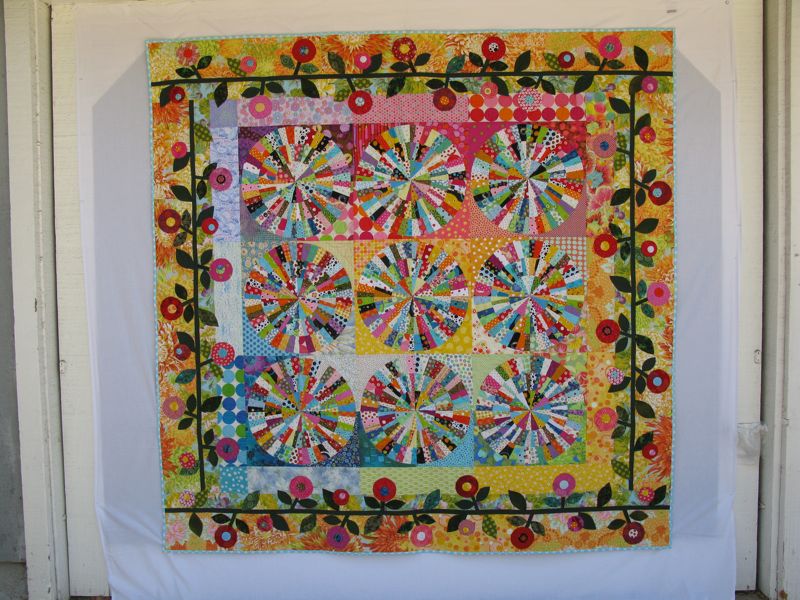 I haven’t entered a quilt show for ages, largely because I haven’t had time to make a quilt that was quilt-show level. I’ve been making lots of quilts for children and daughter/daughters-in-law and some to throw over our sofa at home, but I always think it has to be a hard-enough quilt to enter a show.
I read the application and they said clearly, “no color correction.” Oh-oh. I’d taken all those photos for my quilt journal, but I had to color correct some to get the gray day out of them. And then they said “no cropping.” So I had to retake them all. I hope the judges enjoy the photo of my garage door studio. I tried to get in close enough, and covered the lock with a tissue (for disguise). Above is Come A-Round, one I’m going to enter. I’ve seen this design before in this show, and they may not want to have it in again. Plus I don’t quilt every 1/4″ all over the top of the quilt (I like my quilts to “move” a little) and that has sort of become popular at this particular show.
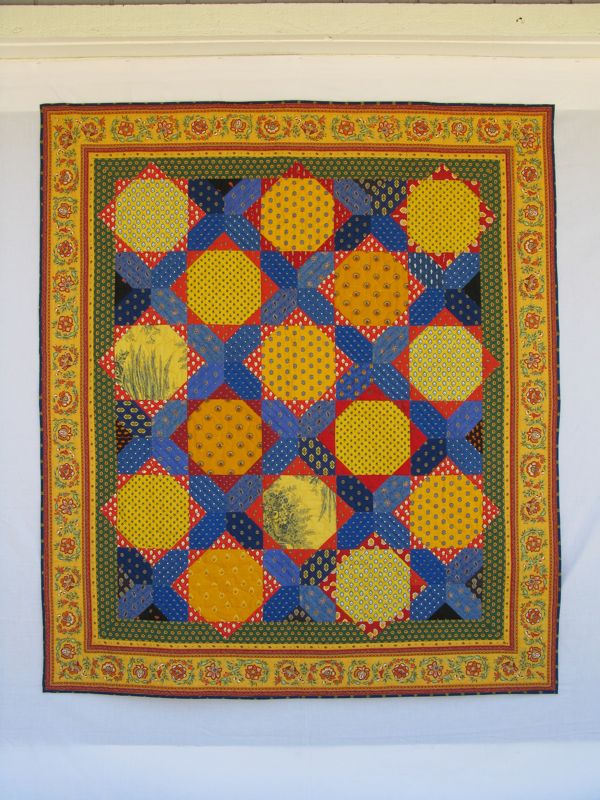
But still. I’m going to try. Lyon Carolings, above. This one doesn’t have the garage-door-studio look. I found out a setting on the camera to counteract the grayed photos I’d been getting, so I didn’t think that was cheating. I guess it’s only after-the-fact that they don’t want us messing around in Photoshop.

The last one is I want to enter is All Is Safely Gathered In. It’s harder than you think to get the quilt perfectly squared up in the frame, and it has to do with making sure that your camera lens plane is absolutely parallel to the quilt plane, or surface, and that your camera is also physically level with the center of the quilt. This is trickier than it sounds. (I have seven of this photo to prove it.)
Then I thought about the close-up, and what they’ll do with the close-up. We have to submit digital photos and I just know they are going to get their computer out and magnify everything. Every missed stitch, every unbalanced thread, every backstitch instead of burying the tails.
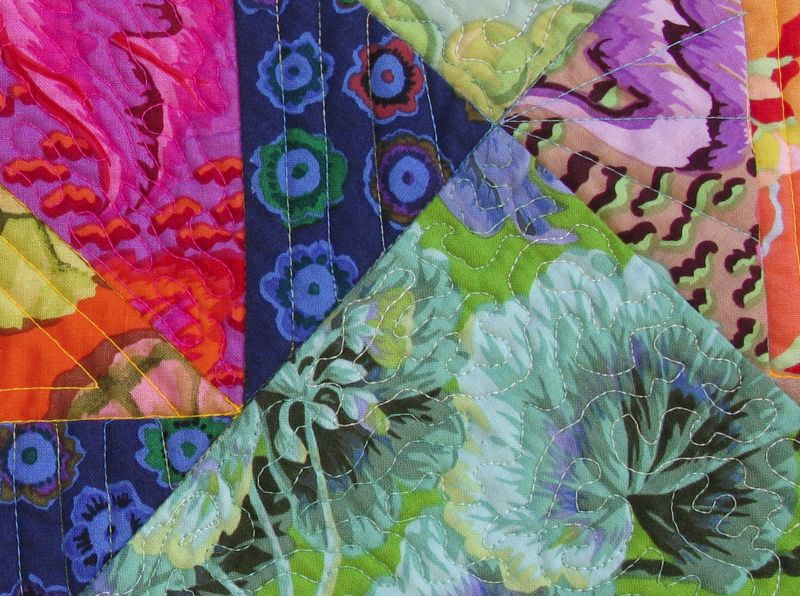
It’s like looking at your morning face in a 15x magnifying mirror. Frightening! Now to fill the application out, put the photos on a CD, write the checks for entry fees, and wait for the rejection acceptance letters.
 OccasionalPiece--Quilt!