

Merry Christmas to all!
Not quilting with organic fabric. I was thinking more along the lines of a quilt that just sort of evolves from one stage to the next, getting stalled, then moving forward again. But Quilting Evolutionarily (is that a word?) just sounded like it was heading somewhere different. Often I feel the pressure to rush things–you know, to Get-It-Done so I can have something to show off to everyone in the blogosphere. Because why would anyone want to read about my humdrum, inch-by-inch progress in my projects? Only because that’s probably how things are going for many of us, especially at the holidays, when we are pulled too many directions.
So, after I put the blue borders on my wonky log cabin, it sat. Then after finishing the grading, the finals, I actually had a night when I was waiting for my husband to come home from a trip back East, and I wanted to stay up and I had a good novel going, so I was ready to sew.

Forgive the blurry picture–it was at night. I sewed white strips onto the blue borders. I also had a stack of “middles” without the blue borders (I’d run out of fabric). I added red strips to those, and then green.

And then I alternated them up on the pinwall. And there they’ve been for a few days now, while I try to figure out the next step. They are all different sizes, so I’m trying to decide which ones to cut down, and to which ones I should add a deep blue strip or two in order to get them to become roughly the same size.
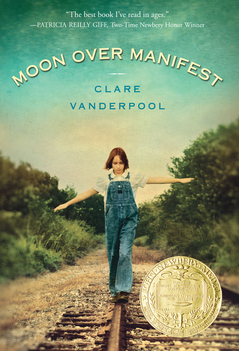
The novel I’m listening to is Moon Over Manifest and it’s written for a bit younger crowd; I’m still really enjoying it as it combines two periods of history in the story of the twelve-year-old protagonist. I’m considering it for my English class next semester: since the main character is 12, I don’t have to worry about inappropriate romantic entanglements that I’d have to deal with in class discussions. I’m teaching a developmental class (one below Freshman Comp) so this level might be appropriate to most of their reading skills.
So, not that anyone’s reading with a week left until Christmas, and Hanukkah just beginning, and the general rush rush of buying gifts and decorating and baking, but I am making progress on this quilt. It’s interesting to sew without a plan. I’m sewing just for the pleasure of it, just to discover what will unfold — the kind of sewing I need right now.
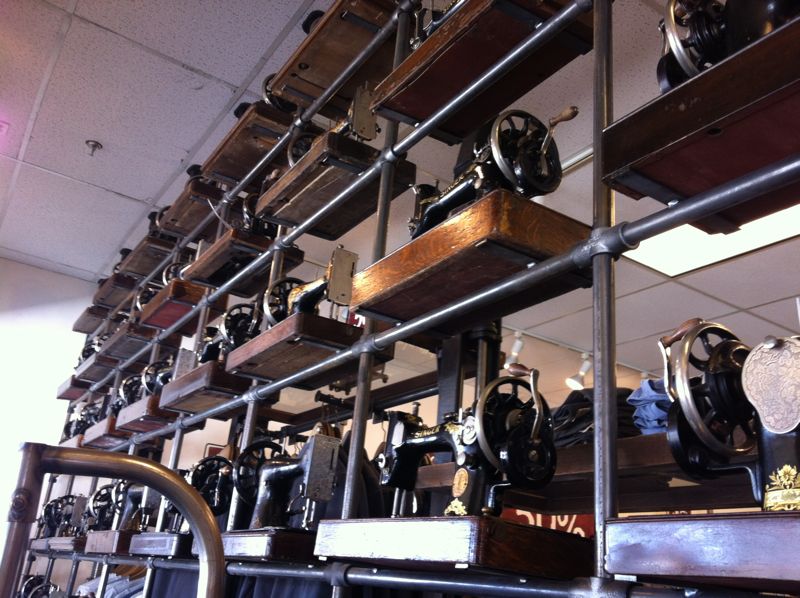
Out at the outlet shops, gathering Christmas gifts, I spy this window display of antique sewing machines. Covet. Covet them all.
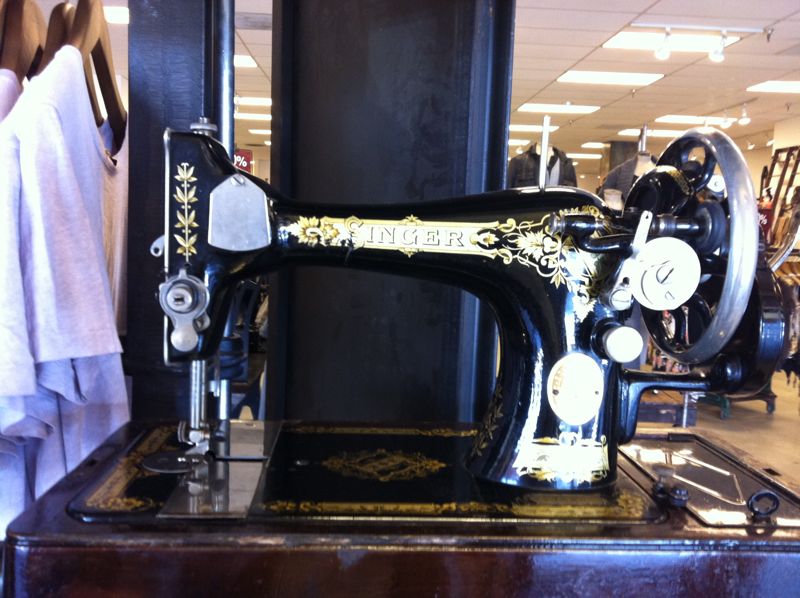


If your friend quilted on this machine, you could give truth to the phrase that you are merely sewing in order to keep up with the Joneses. [Lame humor, I know.] Makes our sleek, shiny machines look boring boring by comparison, doesn’t it? (Although I like the way our new machines sew.)
I feel like I’ve been gone a long time, in a galaxy far, far away–and I have: I’ve been in the grading galaxy. Two sets of papers, with one super-duper plagiarizing student which caused me to obsess about this to a lot of people in my life. My apologies to those who listened to the never-ending conversations that gave me the courage to fail her for the paper. Papers graded. Grades done and will be posted after my final meeting with them today. Then my Christmas Break will really start!
So let me go in WayBack Machine to a lovely morning in New York City when I visited City Quilter.

(Yes, I asked permission to take these photos.) Entering the store, it extends out long and thin, but up there on near the hanging quilt, it doglegs off to the right with more. And running parallel to this is the ArtQuilt Gallery.

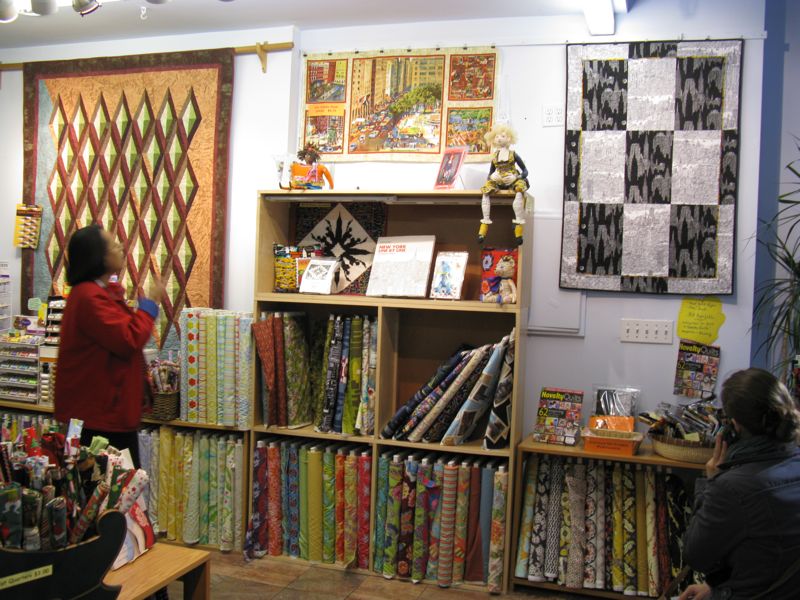
Along the right hand wall are lots of patterns, samples and a whole section of fabric with a New York City theme, from which I culled my purchases.

They also had some New York-themed quilts on the walls; this is the Empire State Building quilt.

More beautiful fabrics in that right hand section. Really the store was shaped in an H-sort of layout.
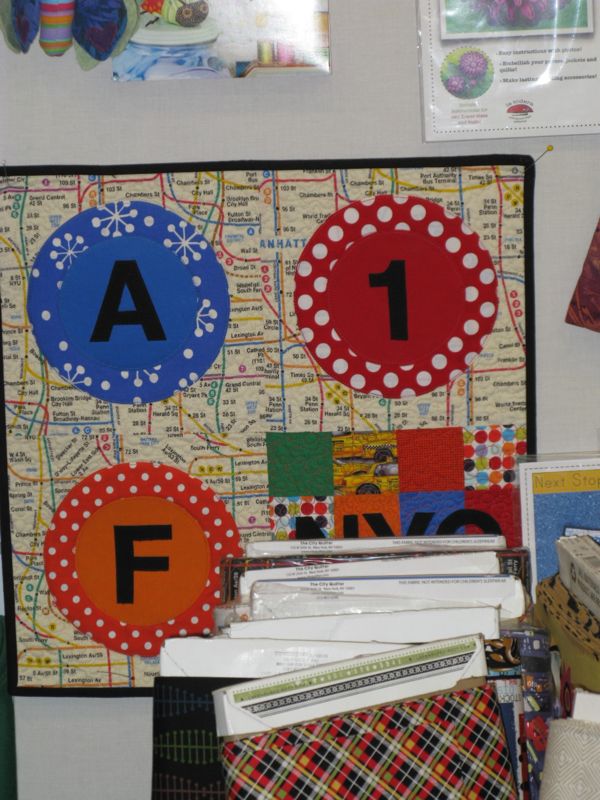
I knew about City Quilter when my sister moved to Manhattan for a year. I wanted to make her a tote bag that would remind her of the city, so purchased via mail order some New York fabrics, including some of this subway fabric, and made her shopping totes. She loves them.

Adjoining the City Quilt fabric shop is the ArtQuilt Gallery, where they were having a display by the Manhattan Quilt Guild. The quilts were very interesting, with everyone interpreting a facet of New York City living, gathered under the title of Material Witnesses.

The quilt of the lower right, The Triangle, is made by Teresa Barkley and pays homage to the Triangle Shirtwaist Fire in Little Italy. I had been walking around in that section of town the day before. My daughter’s great-grandmother immigrated from Italy, and found work in a hat factory in Little Italy, so the idea of young women working in these tall buildings had some resonance.

Closer view.

This is pieced. Lots of little tiny pieces, made by Erin Wilson and titled Shape Study: Dark and Light. I thought they may have represented some buildings in New York, but her artist’s statement notes that this “continues my work of building an intricate language of pattern, abstract shapes and symbols.”
 Detail.

This is a quilt sandwich: fabrics sandwiches in between two layers of sheer fabric. Ruth Marchese’s No Escape is in homage to the earthquake in Japan in March of 2011. In this quilt are references to the tsunami waves, the nuclear power plants, and the changes to the landscape.
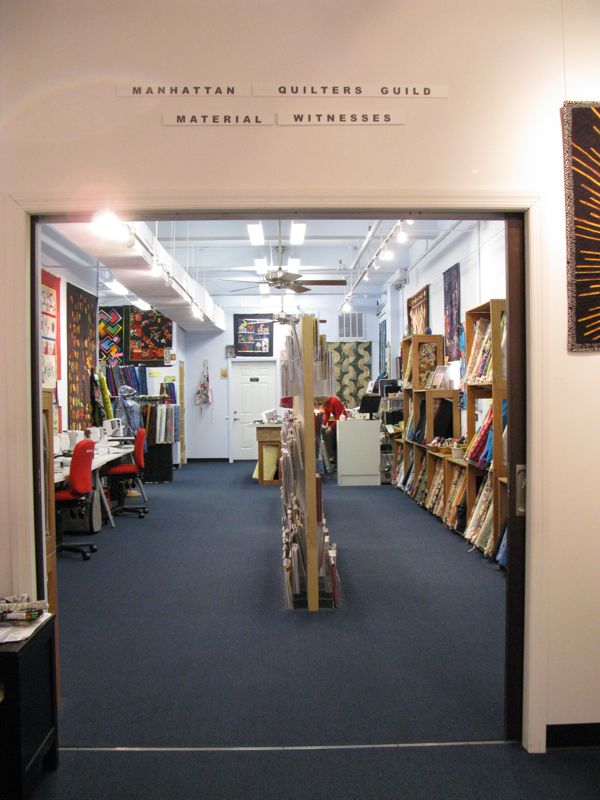
Looking from the gallery into a section of the shop.
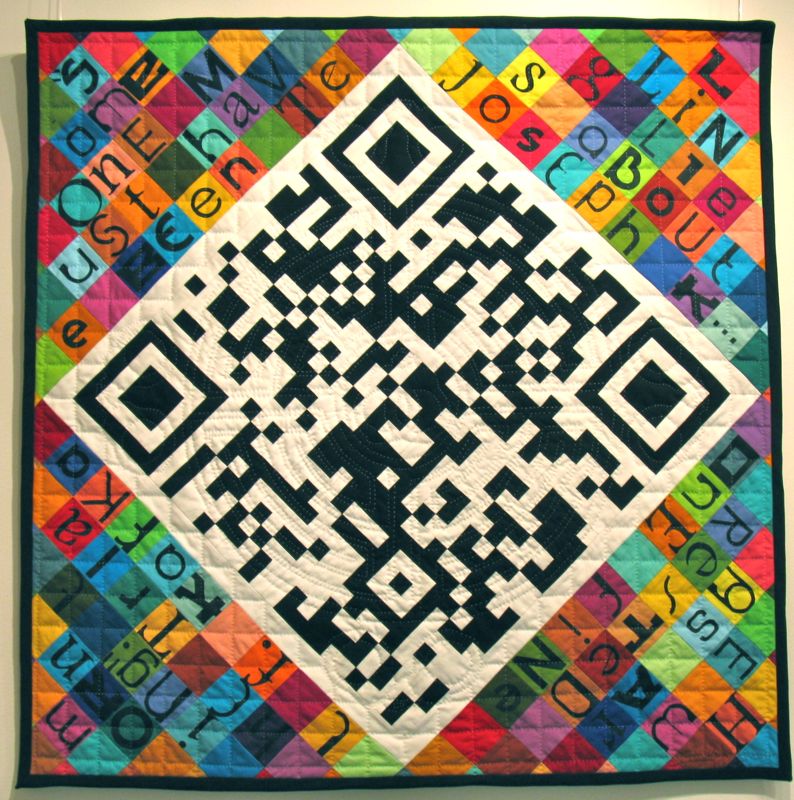
There were many beautiful and intriguing quilts, but this one really caught my eye. Central Booking uses a QR code to “spell out the first sentence of The Trial, Kafka’s nightmarish tale of bureaucratic and legal injustice” (from her artist’s statement). I asked the woman at the desk in this gallery if this was a functional QR code. She didn’t know, so I held up my phone so it could read the square; it is.
When I came home, I looked up QR codes on the web, and found you could type in a short phrase and have it converted into QR-ese.

I remember Elizabeth Fransson making Japanese Subway Map quilts, interpreting the grid into fabric. I think this idea could also be interesting: we could write secret messages (shades of Fourth Grade!) into our quilts and display them for only those who know how to interpret them. What does the above say? (Remember I was grading, so my creative faculties were in a low ebb.)
It’s the name of this blog: OccasionalPiece-Quilt!

