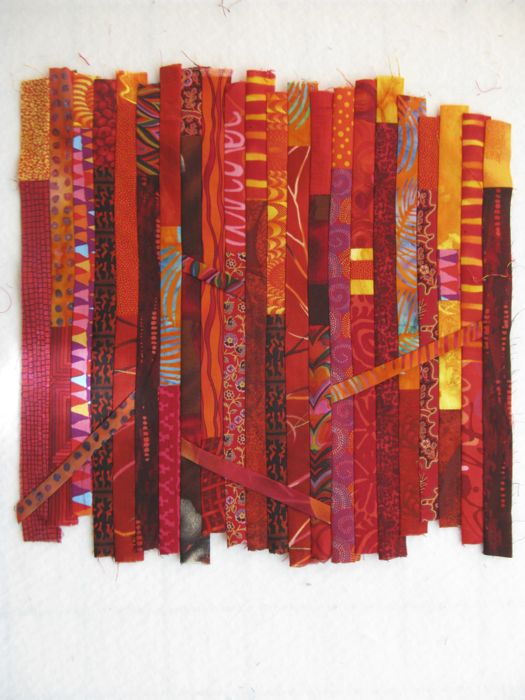
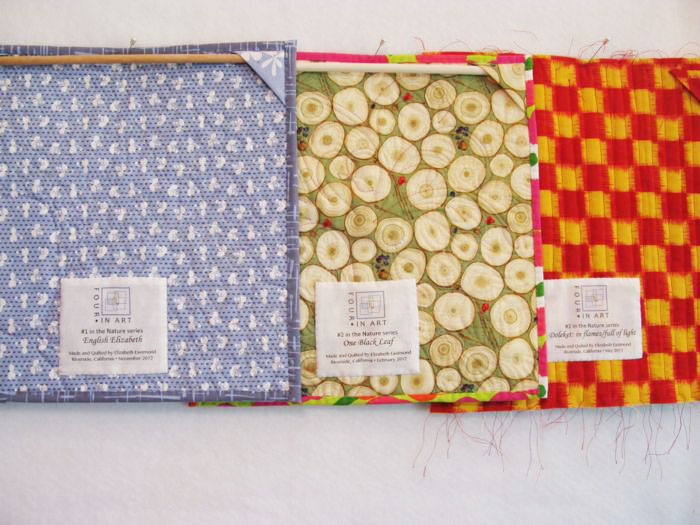
Four-in-Art · Quilts

Four-in-Art: Maps

The Four-in-Art group has chosen Urban as our overarching theme for this next year of quilts.  We will reveal quilts on the first of November in 2013, and February, May and August of 2014.

Our challenge for November 2013 is Maps, so it was with great interest that I viewed the exhibit sponsored by Quilts on the Wall, hanging at the Long Beach Quilt Show.  Their theme was also “maps.”
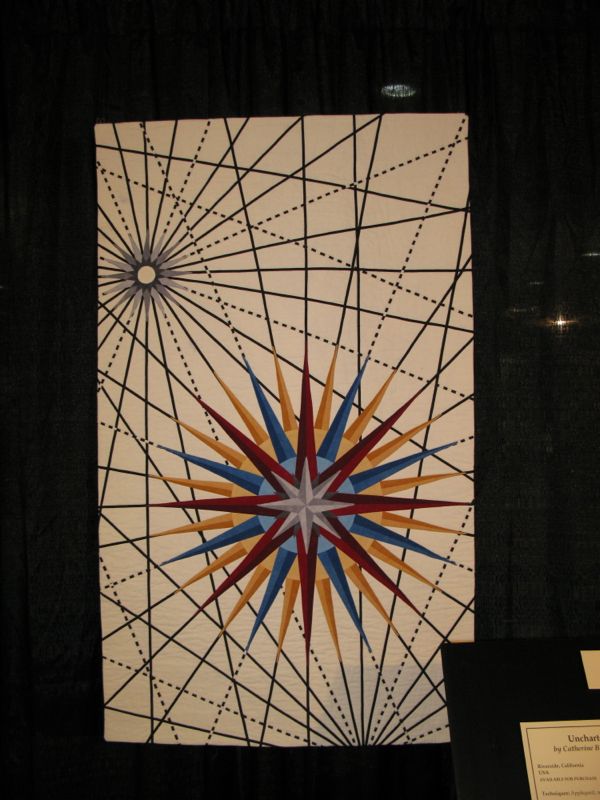
Maps12_Baltgalvis

Uncharted, by Catherine Baltgalvis
Based on an antique chart with traditional compass symbols
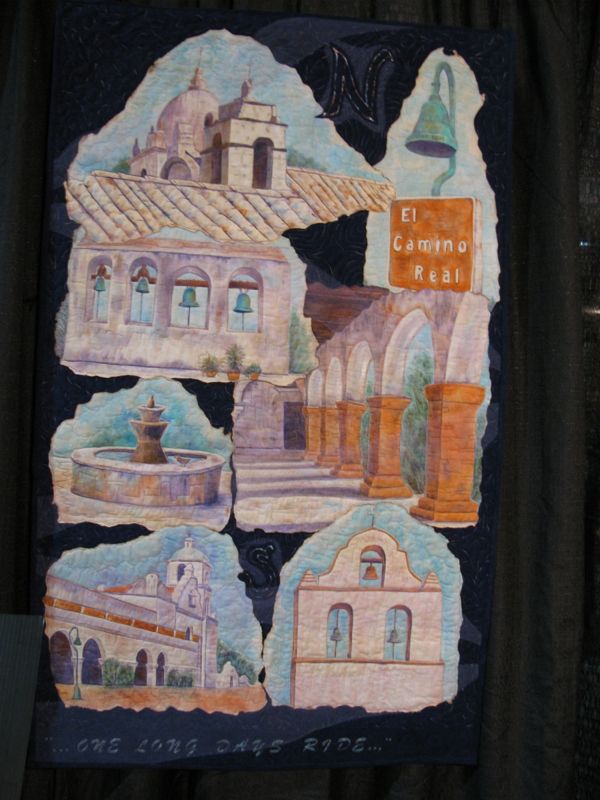
Maps 12_Wintemute

El Camino Real, by Eileen Wintemute
Views of the early California Missions, found by traveling “The Royal Road”
Maps8_Wright

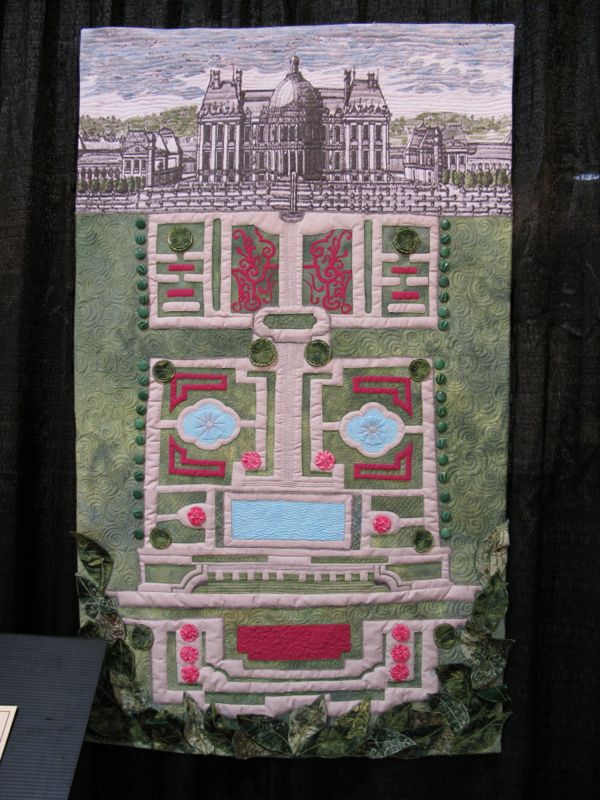
A La Carte, by Shirley Wright
A garden plan for Vaux-Le-Viconte, a great chateau in France, built in the late 1650s

Some map quilts might be literal, as in the renditions above, from a garden to a quilt paying homage to traditional compass symbols.

Maps3_Bisagna

Gone, by Laura Bisagna
An aerial map of her street, showing the houses claimed by wildfires

Other map quilts might show traditional maps, like the one above, but reveal pieces of the heart, like when Bisagna was evacuated from her home during a run of California wildfires.  She searched aerial photos, trying to discover any news about her house.  And through one of these photos, she realized that her “house was indeed gone,” as she wrote in her artist’s statement.

Maps4_Villars

Tour de Apple Valley, by Carolyn Villars depicts a 50-mile race completed by her daughter-in-law, the map in the background showing the route taken.

Maps6_Anderson

Linda Anderson created this exquisite map of the “Mother Road,” or Route 66 in her quilt One Man’s Dream.  While I couldn’t discover from her statement whether or not her husband had actually traveled the road, I think the bas relief of the white quilting is effective not only as a map, but also as a background for the motorcycling figure.

Maps5_Guerrero

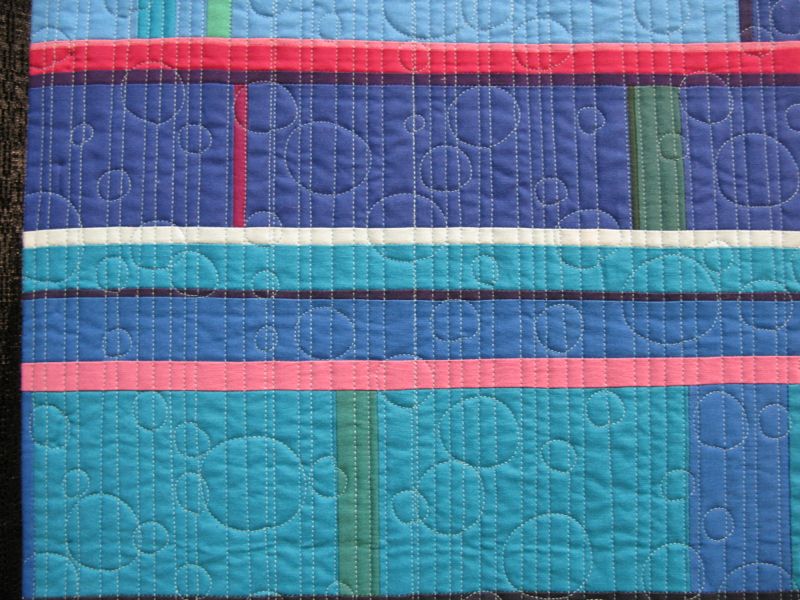
“This quilt (Ice Core) was inspired by ice cores that are used to map climate change” wrote Annette Guerrero, the maker.
Maps5a

I loved the secondary layer of quilting over the color bands.

Maps15_Friedman

Body Map in Honor of  DaVinci’s Vetruvian Man, by Linda Friedman, pays homage to the classic map of the human form by Leonardo Da Vinci.

Maps14_PCharity

I loved this rendition by Patricia Charity of the romantic era of travel, of steamships and steam trains and great adventures.  She titled it It’s the Journey, for in those days, getting from point A to point B was a huge part of travel.
Maps10_Markley

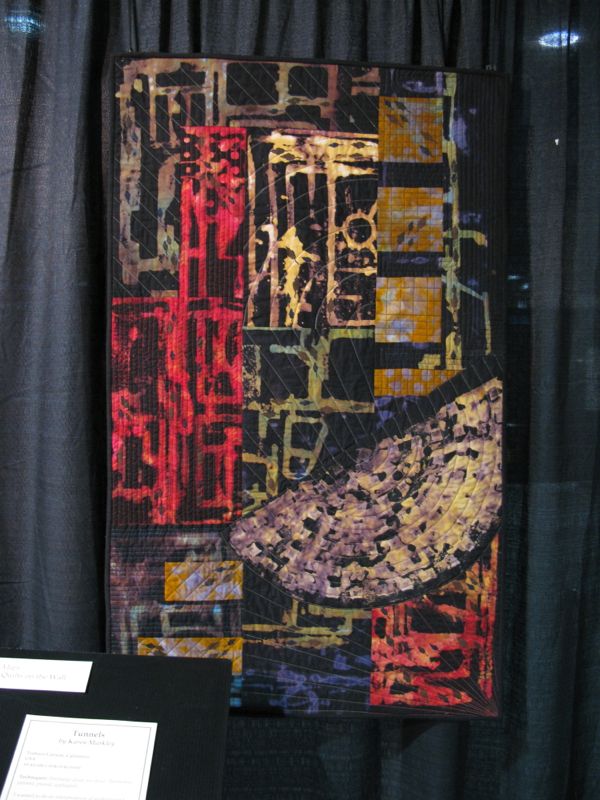
Karen Markley wanted to make a map of subterranean tunnels, such as those that contain subways, water and electrical lines, in her quilt titled Tunnels. This quilt is less representative and more evocative of what a person might find under their feet.
Maps11_Shibley

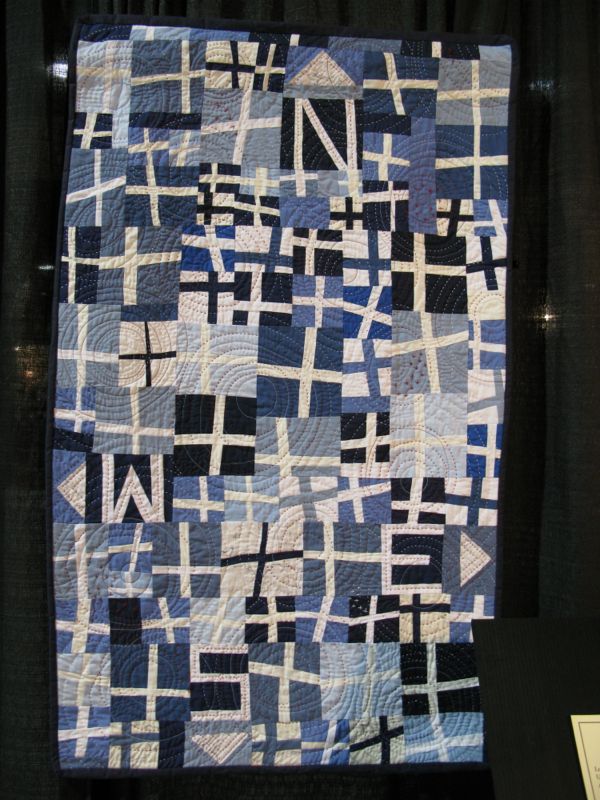
Beth Shibley’s Finding North is a rendition of a “modern compass,” and includes bits of maps that her husband used while hiking the Pacific Crest Trail.
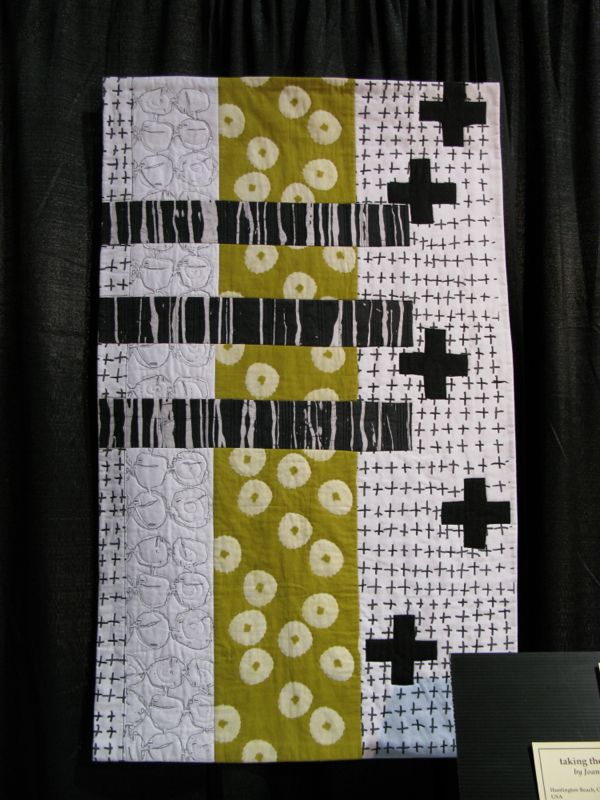
Maps1_Connolley

taking the back roads, by Joanell Connolly was so interesting to look at.  While you might decide that the crosses imitate a vast cemetery or that the white circular shapes might represent trees as if drawn by an architect, Connolly gives no indication of what her map might represent, only saying “when life gives you a choice. . .”

Maps2_Nilson

How many times have I peered out of an airplane window, snapping pictures of irrigation circles with my phone?  This aerial photograph by Tom Lamb, inspired Carol Nilsen to create Layered Marks From the Sky, a map of a runway and taxiway at nearby John Wayne Airport in Southern California.  But it’s not just the landscape she’s mapped in her quilt, but “the routes of a millions of people aboard thousands of aircraft.”
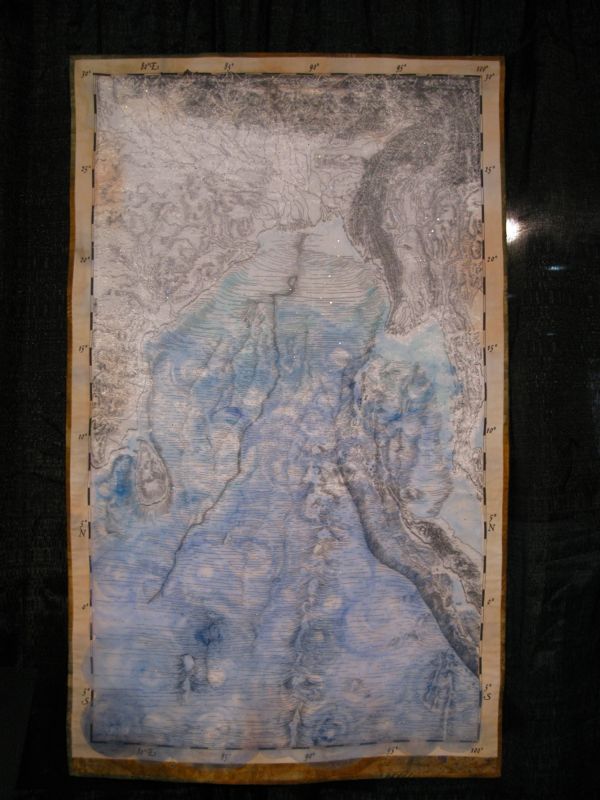
Maps13_Griffith

Last three map quilts.

Somewhere Between Science and Fantasy, a quilt by Jo Griffith had a chifffon overlayer on a drawn, or printed, background.  Two closeups are below.
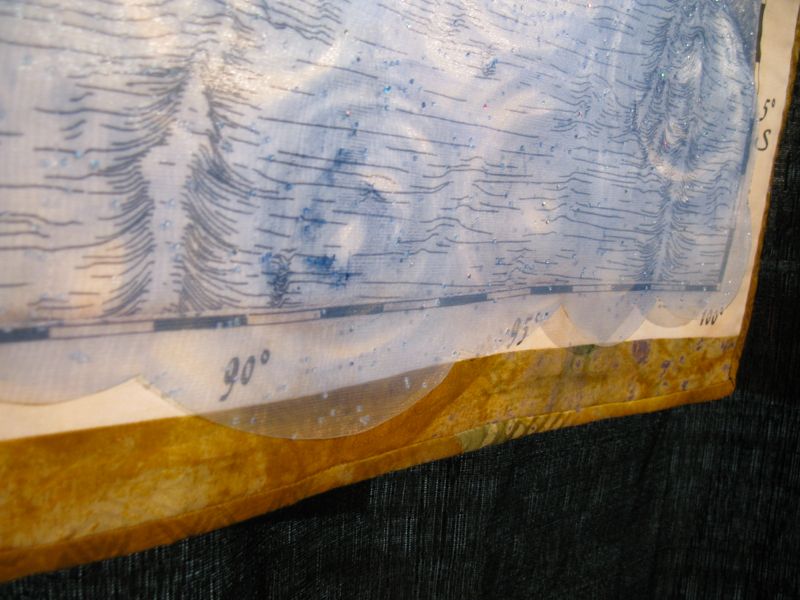
Maps13a_Griffith

Maps13b_Griffith

Maps9_Charity

Bit Map, by David Charity.  All the puns you need.  Close up below.

Maps9a_Charity

Maps7_TabarGaits of Lake Hodges, by Mary Tabar

Not only is this a map of a lake, but also the “gaits” of the critters who frequent there.
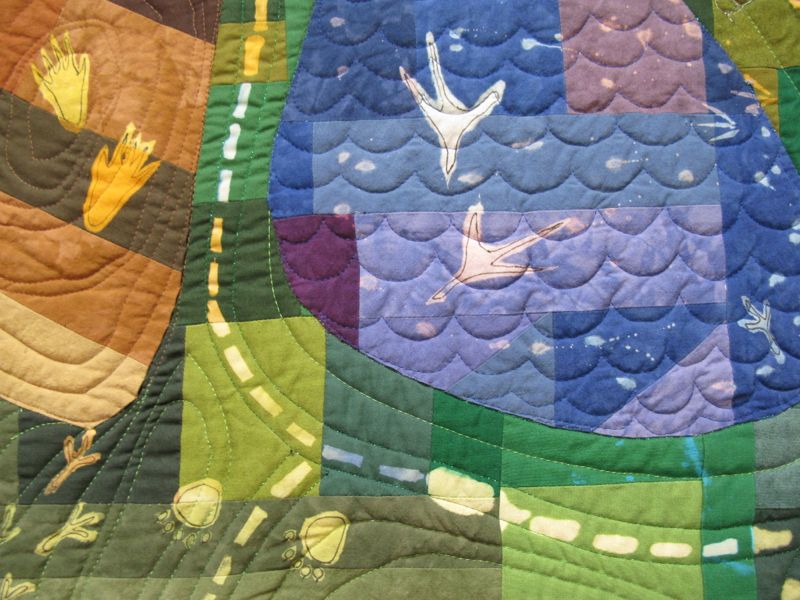
Maps7a_Tabar

I’ll leave you with Tabar’s thoughts:
“Every trail starts with a map.  A map helps us navigate our desires.”

I look forward to our group’s challenge quilt, coming this November.
200 Quilts · Four-in-Art · Quilts

Congruence, Deconstructed

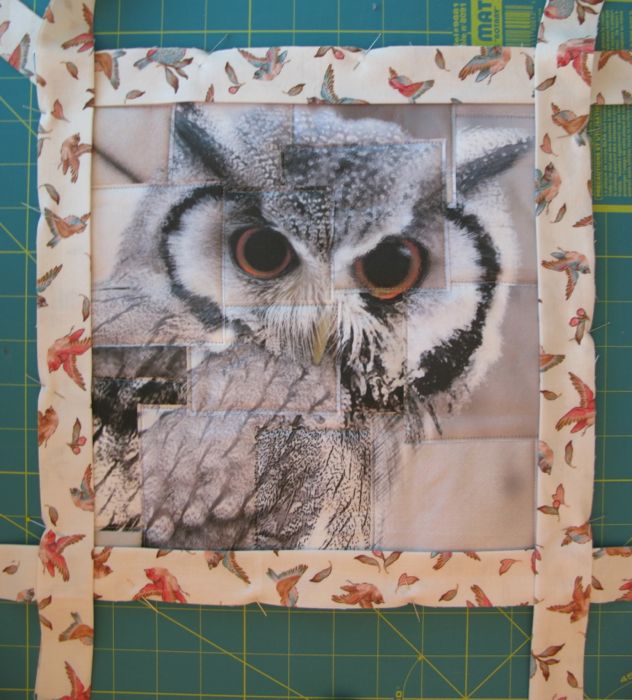
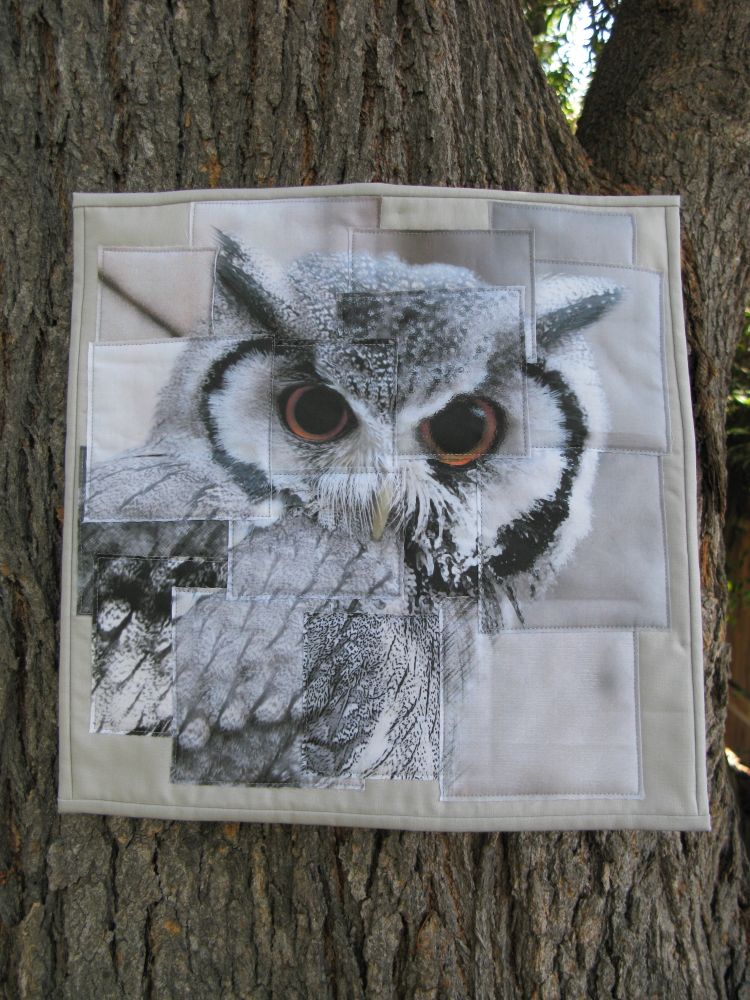
Congruence Owl quilt front 2

Our reveal for the fourth challenge quilt in our art group, Four-in-Art Quilters, was yesterday and today I’ll tell you how it came together.

I first started by looking a what seemed like billions of photos of owls.  I did a lot of this through Flickr, where I found this photo:

OWL ese

I wrote to Matt Smith, the person who posted it, and asked permission to use this photo and he gave it to me.  And then I sat on it for a couple of months, not knowing how to approach this.  Did I want to paper-piece it?  Not really.  Embroider it?  Pixelate it into little squares?  None seemed satisfying.  And then it was in the background reading that it came to me that I would fracture it, play with it a little and see where that went.

OWL ps desktop

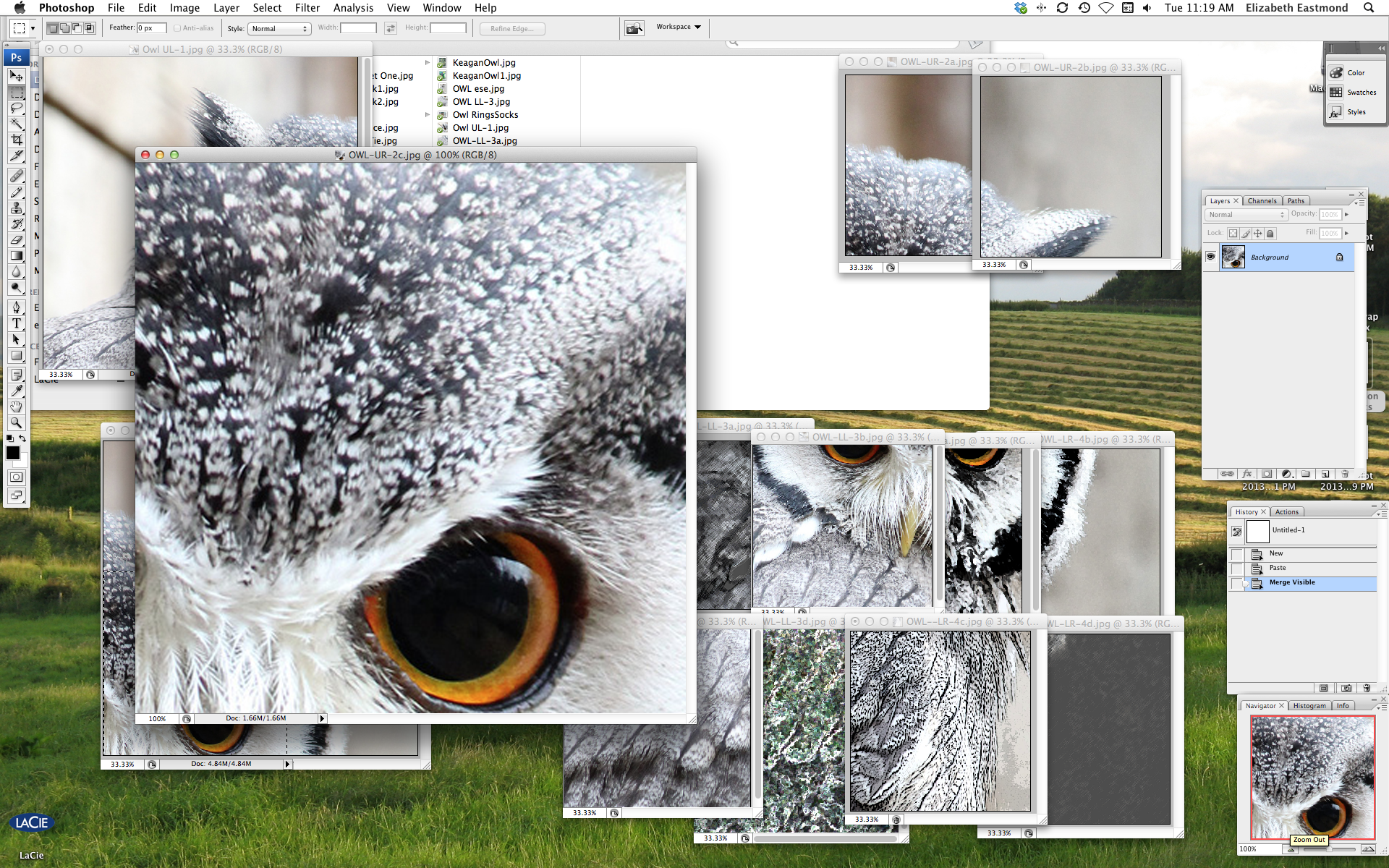
I digitally chopped the owl picture into fourths and then chopped into fourths again, making sixteen parts.  And then I began to play with filters, one of the least used, but really fun parts of Photoshop.  I applied at least one, and sometimes multiple filters to each segment, approximating the sizes so I could get this bird back together again in the end.  You can see the mock-up on the lower right.  That was me, trying to reassure myself.

Congruence Owl quilt construction 1

Then I printed it off on paper, cut it apart, and still tried to reassure myself. I grabbed a previous art quilt off the wall (I knew it was 12″ square) to use as a template.  It seemed okay. But how to get it to fabric?  I usually iron freezer paper to the back of a piece of fabric, tape that to a piece of paper like I did in English Elizabeth, then run it through my Epson color printer. But I’d read in a blog about someone who simply ironed the fabric and freezer paper together, making sure it was a standard paper size, and then ran it through the printer.

Congruence Owl quilt construction 2

Don’t you love the ink smudges?  The next time, I made sure the freezer paper was really well-adhered to the fabric, then set the printings for thick matte paper on high quality and ran it through again, using a long thin tool to assist it through the last phases and so the fabric wouldn’t touch anything.  The closest thing I could grab was a nail file — but it worked.

Congruence Owl quilt construction 4

I peeled off the freezer paper carefully and cut apart my sixteen squares of Mr. Owl.

Congruence Owl quilt Layering up the backing

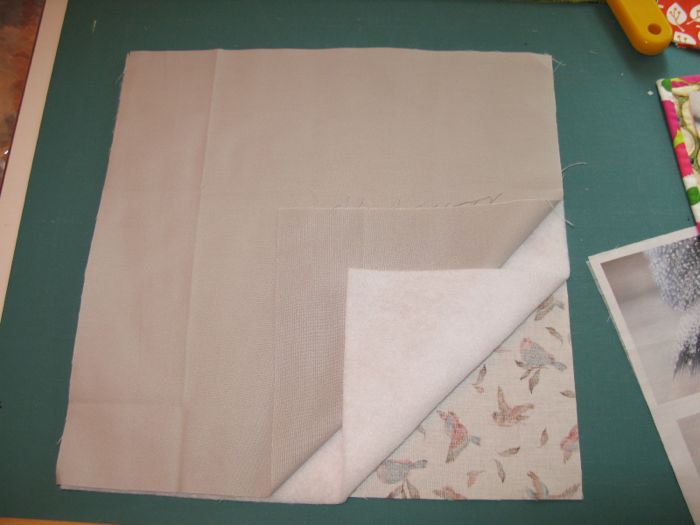
Layering the background — Kona Ash — with the backing and batting.  Kona Ash?  Light taupey gray?  Cindy of Live a Colorful Life is probably laughing her head off now because she knows how much I hate gray.  Really, I do.  In so many modern quilts it acts as a big hole in the composition, especially if it’s a medium gray.  I think if a quilter has to go gray in a quilt (and I’m not talking about those low-volume quilt compositions where it is intentional and where it works) they ought to go charcoal.  Or slate.  Ash is what I had on hand, as I don’t generally keep gray around (I bought it for a bee block I had to do).  But it worked for this as the picture, except for the owl’s eyes, is all in taupes and grays.  Yeah, low-volume.

Congruence Owl quilt construction 3

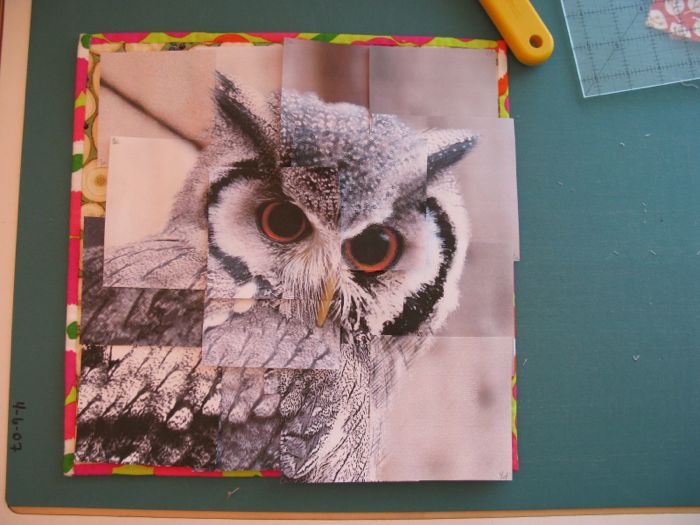
Using the paper mock-up as a guide, I start layering the cloth images onto the backing.

Congruence Owl quilt 2 layout

Congruence Owl quilt 1 layout

Moving things around, trimming down the pieces so some aren’t square, trying for balance.  Trying for that little artist’s lightbulb to go off in my head.  I got about a night-light’s worth of illumination, but from my writing in grad school, I knew that showing up wouldn’t get you anywhere–you have to keep trying.  To fully put this concept into action,  I went to dinner, then let it sit for a week while I went to our quilt retreat.

Congruence Owl 1

Then one morning it was simply time to tackle it again.  I couldn’t decide between satin-stitching a thicker line (close zig-zagging) or straight-stitching a narrow line of thread around each piece.  Narrow won.  I trimmed it up to 12 inches and then thought I’d like to try a faced binding (tutorial on how to do a faced binding coming in a couple of days).

Congruence Owl 2

I cut strips to match the backing, sewed them on.

Congruence Owl 3

When I ironed them to the back on a couple of sides, it became apparent that I needed that “frame” of the binding for this particular quilt.  Rip off the binding.

Congruence Owl quilt tiling

I kind of liked the way the binding corralled those tiled pieces.

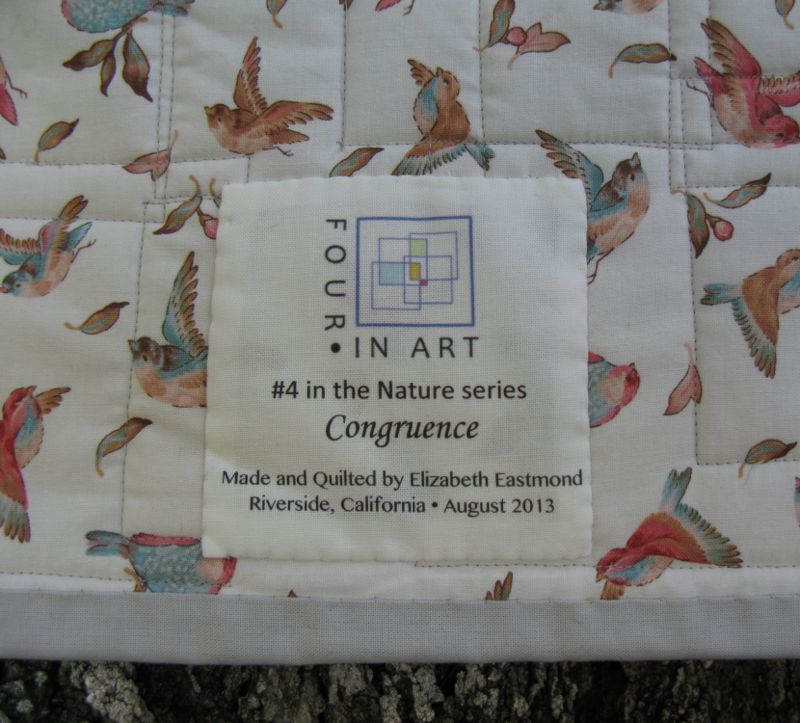
Congruence Owl quilt label

I made the label, sewed it on, then went outside to photograph it.  I made an interesting discovery.

Congruence Owl quilt 5 textures

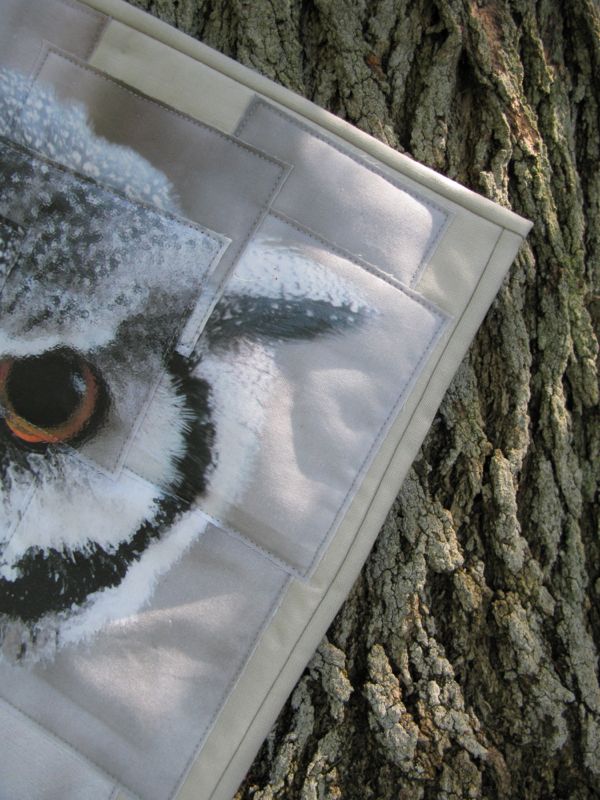
This lower section of the feathered wing imitated the gnarly bark of my silk oak tree in my backyard.  Maybe because I’d dampened the literal image of feathers with Photoshop filters?  I don’t know, but I liked the effect.

Congruence Owl quilt front tilted

So, all the incongruent small pieces — the images, the tiling, the layering, the stitching — all merged into a lovely congruence of an owl, just like the metaphoric meanings discussed yesterday.  All combine into that creature that captures our imagination while mystifying us as well.

And now I leave you with a poem by Mary Oliver, that I think captures this idea:

“Praise,” by Mary Oliver

Knee-deep
in the ferns
springing up
at the edge of the whistling swamp,

I watch the owl
with its satisfied,
heart-shaped face
as it flies over the water–

back and forth–
as it flutters down
like a hellish moth
wherever the reeds twitch–

whenever, in the muddy cover,
some little life sighs
before it slides into moonlight
and becomes a shadow.

In the distance,
awful and infallible,
the old swamp belches.
Of course

It stabs my heart
whenever something cries out
like a teardrop.
But isn’t it wonderful,

What is happening
in the branches of the pines:
the owl’s young,
dressed in snowflakes,

are starting to fatten–
they beat their muscular wings,
they dream of flying
for another million years

over the water,
over the ferns,
over the world’s roughage
as it bleeds and deepens.

from House of Light, 1990

Creating · Four-in-Art · Quilts

Owls

OwlCOllection

Our Four-in-Art theme this round is Owls, under the year-long theme of Nature.  When Betty chose it, I went blank.  Then she wrote about it, I did a search on Flickr, and ideas starting percolating.  Slowly.

Owl RingsSocks

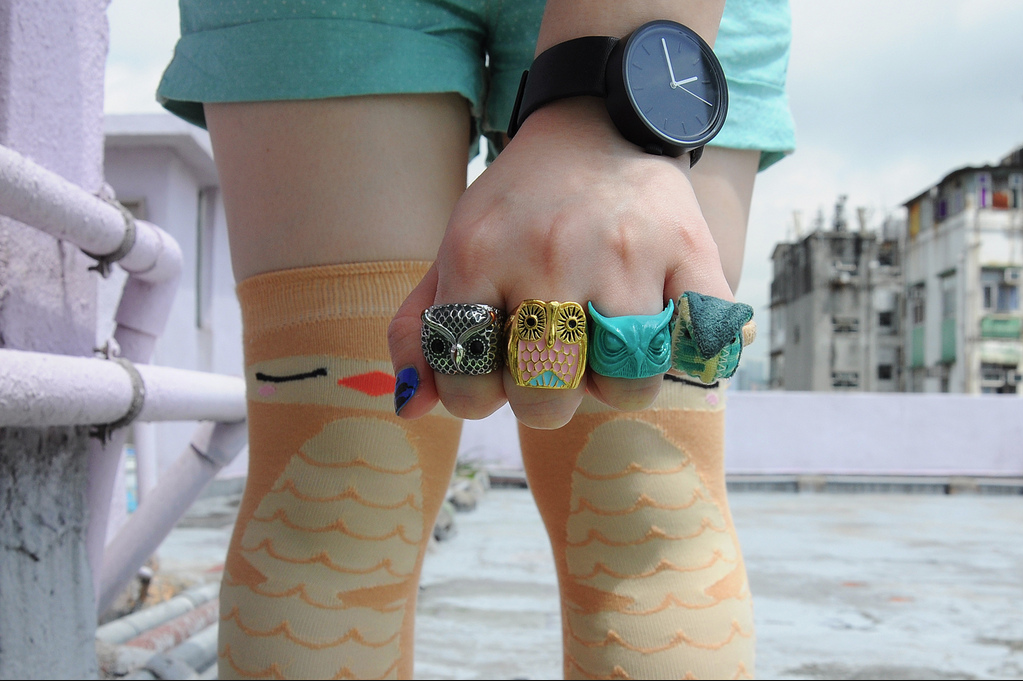
This chick has owl rings and owl socks, but is not the same person that owns the collection up above.  I found out my daughter liked owls, as does my niece, one of my husband’s colleagues and Suz, of Patchworknplay.  I had no idea there were so many owl enthusiasts in my life.

KeaganOwl

KeaganOwl1

This card was from my granddaughter when I had my surgery. More owls:

OWL flying OWL harry potter OWL pins OWL1

But how to move an owl idea into a quilt?  What aspect to focus on?  I looked up the meanings of owls, the folklore and those were all over the map, fragmented.  Sometimes they are good, other times they portent evil or bad things, sometimes they bring luck, in other cultures they spell disaster.  Just about anything can be pinned on an owl.

The only “experience” I’ve had with an owl was when we were traveling in Canada around the Sunshine Circle (Vancouver and above).  We were standing waiting for the ferry to take us across one night.  The sun was fading into pinks and golds and it was pretty quiet up there near Comox that evening.  I was focused on the water and thinking about where we had to get to before we could stop traveling, when all of a sudden I heard a whoosh–a rush of air.  I spun around and an owl was just moving away, its wings unfurled and climbing toward the sky. It was eerie, out of nowhere.  No wonder these birds get pinned with all sorts of intents and purposes.

OWL ps desktop

This was my computer desktop yesterday, with all sort of bits and pieces of my owl scattered over the screen.  Whenever I approach these art quilt deadlines, I feel like a child being dragged kicking and screaming toward home.  Deadline, I moan to no one in particular.  I’d better get crackin’ because I know my Four-in-Art-mates will have theirs ready.

But one thing leads to another and to another and pretty soon I hear my husband arrive home and I’ve been working and veering through a creative journey for hours, absorbed in my task.  And then I can’t wait to get back to where I’m headed–which of course, I have no real idea of where it will end.  For now, I know only the next step, and that’s where I’ll go.

Creativity

(from *here*)

We’ve decided to open our group up to four more quilters to participate in our art quilt adventure.  You do not need to be an artist (hey–I’m not), but only want to stretch your creative wings.  We have four art quilt deadlines a year: February, May, August and November.  So far, the quilts are experimental in size: 12″ square. You’ll need to have a blog or a Flickr site, and a sense of adventure.  We welcome beginners, but most of us have some years of experience either in handcrafting or sewing.  I think we went this direction just because we wanted to try something new.
Leave a comment if you are interested, along with a comment as to why you might think taking a jump into this kind of creating is where you want to tread.  Make sure I have a link to either your blog or your Flickr site, so I can get a feel for what type of quilter you are.

Creating is a do to list

200 Quilts · Four-in-Art · Quilts

Doleket, deconstructed

Doleket Art Quilt-front

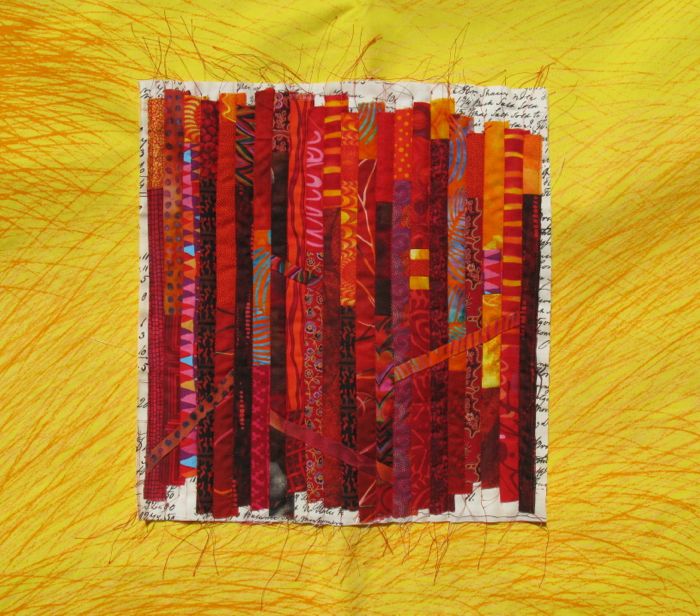
When the theme of fire was announced for our Four-in-Art group, I immediately thought of all those days spent roasting marshmallows over campfires, just like Betty did.  And then afterward, when people would gather back and just sit and watch the flames, as they moved and shifted.  It was that movement I was trying for.  I had thought about taking a lot of pictures of fire and scanning them onto fabric.  What was I going to do, light a bunch of bonfires and take photos?  Nyet.  Then it was patch together a lot of squares, and “color” them by doing rubbings of a textile crayon onto the surface.  Because I couldn’t come to a vision of that one, it faded, too.  So one day in a church meeting, I sketched the bit on the left:

Doleket Sketch Two

I dropped the notebook and when I picked it up, I noticed I liked it better the other way (the version on the right).  With the triangles pointed upwards, it also had a birthday candle effect.

Gathering Fabrics Doleket

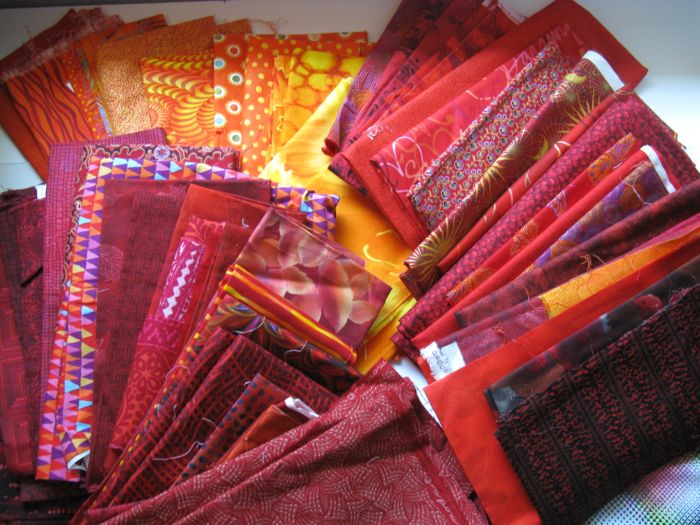
I dutifully drafted and cut out a bunch of orange and yellow-gold miniature triangles, and pulled red, ochre, rust, magenta fabrics from the stash.

Doleket beginning

I chose whatever colors I had in my stash that had that “fire” color to them.

Laying out strips

Because I wanted that idea of movement, I pieced up the strips with two colors.  It’s about this stage in the process that I begin to talk about it to my husband.  I told him I’d been reading in a book, Why Faith Matters, by David J. Wolpe, and although I hadn’t gotten very far, I had read the section about Abraham and the idea of doleket, and how the duality of fire was presented in that passage.  I began to research this idea, and to think about it as I worked.

Sewing strips

If this was to be a consuming fire, then wouldn’t there be fallen timbers?  I took a few of the strips, laid them across the upright timbers, stitched down on edge, then folded them over.  I figured I didn’t need to really nail these appliqued pieces to the cloth, for it was in a place of construction/destruction.  I may sound like I’m spouting malarky, but how do you explain where the brain wanders?
first draft Doleket

First draft Doleket.  This measured way over our constraints of 12″ per side.

Doleket too tidy

So I laid two pieces of cloth over the top and bottom, trying to figure out where the trim line would be.  Whoa!  Tidying up that jagged line really bothered me.  I’m usually one who likes her quilts — and edges — all tidy and pristine, but this wasn’t where this quilt was going.  Construction, or creativity, and destruction by fire happen in a random, haphazard manner.
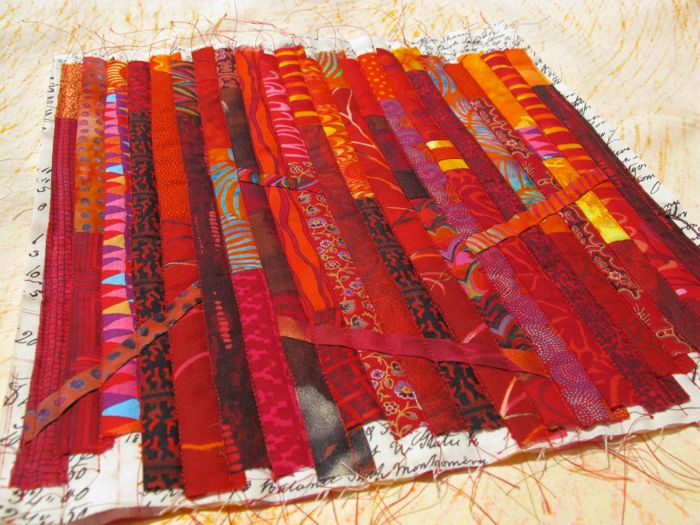
second draft Doleket

So from the back, I raggedly hacked at the edges, purposely making them uneven and slightly unkempt.
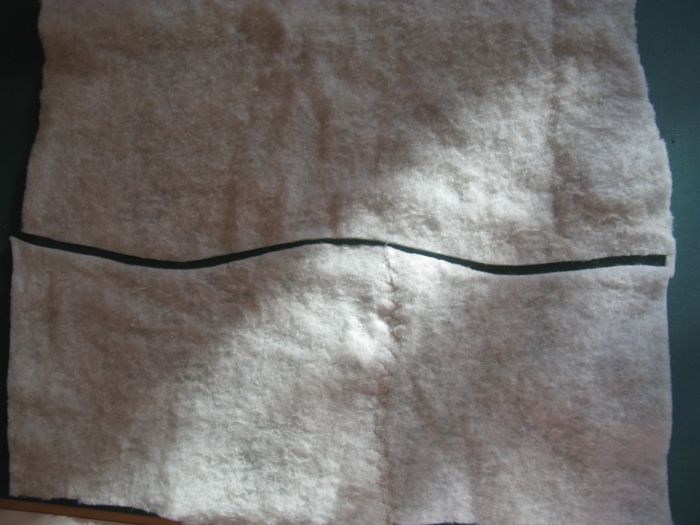
Piecing Batting

Our group is keeping to the idea of a quilt sandwich and I knew I wanted the batting to be organic–cotton, rather than my usual.  But I needed to piece some scraps. I auditioned several pieces for the background of the burnt timbers, but ended up going with a text written in a vintage style.  I was thinking about words, how they also are permanent, yet ephemeral.

Doleket side view

Now to quilt.  I just started stitching along the strips, quilting right over the crosswise strips.  I’d done a few, and really liked the hanging threads — they reminded me a prayer shawl (seen mostly in the movies, to be quite frank), and I liked them.

Doleket on yellow ground

I took it outside on a bright sunny day, laid it on this yellow cloth and took a photo, but realized that the small details of the threads couldn’t be seen.  I also had a hard time photographing this because the reds would freak out the camera sensors.  I think this version is the best representation of the color.

Three in a Row

Betty had started making labels for her pieces, and I wanted to follow suit.  So here are the three we’ve finished so far.  Our next theme is “owl.”  I’ve known lots of owl collectors (of trinkets, mostly) in this world and I’ve never been one.  But it’s really in nod to wisdom, so Betty says, so I’ll have to think about that.  Our next reveal is August 1st–right after Rachel delivers her baby.

We’ve settled into a comfortable groove now, and while sometimes it’s been interesting to bring the discipline to get these done on time (we did move one deadline), I’ve appreciate how the process, and the product, has been gratifying.  I was curious to see if I could make “art.”  And with this last piece, I think I can say I’m approaching it, if only in my small way.

I’ll end with a few thoughts from a recent obituary for Eudorah Moore in the LATimes, describing her as someone who “blurred the boundaries between art, design and craft.”  She championed “mixed-media inclusivenss,” working for years as curator at the Pasadena Art Museum, which later became the Norton Simon Museum.  In 1973, she wrote:

“We’re going to put down the 19th-century idea that unless you are an easel painter you aren’t an artist.  We’re going to accept that an artist is a person who has a definite statement to make, and can make it in any material.”

Now onward to wisdom, and owls!