New York Beauties · Something to Think About

Vespers, NYBeauties Block 10

Is it a hard-to-make block? Not at all.

But it kinda broke my brain a little.

This picture illustrates my vexation. On the left, and using the color swatches in the top row, is Version 1 of this block. Not happy with how the ombre effect worked out, I tried Version 2 of this block (on the right), using the color swatches in the bottom row. So, first, color broke my brain.

Color

I’d envisioned this block to be a representation of that time in the evening when everything is settling down, with glowing shades of pink and yellow and deeply colored purple. On the left in the background of the rays, you can see that range of hues goes just so far. Then there is a huge color jump from the light pinks to that dark coral at the far left. Likewise in Version 2 on the right, there is a progression from soft yellows to corals and pinks, then another color jump at the end. I faced that sort of thing ages ago when I made Annularity. I ended up making two of these quilts:

Do you spot the anomaly in color? It’s at the very bottom, the warm-lavender diamond just to the left of center. That quilt went to Paintbrush Studio, because it was made from their first drop of their solids line. In the version on the right, made for myself, I pulled the exact blue-lavender color from another solids line that I needed to make the transition flow smoothly.

This is because we live in a world with limitations. And fabric colors, especially in solids, are one of those things. The fabric line, my favorite — Painter’s Palette by Paintbrush Studios — has since fixed that awkward color jump and they now have a perfect blue-lavender.

But now there’s a jump in the pinky coral tones. But I’m really giving this fabric line a workout: I’m creating color in my Affinity Designer program, using sliders and sampling colors from photos to get the exact color that I want in my designs. But the fabric manufacturers are working with cloth, dye, finishes, and budgets and no, they can’t make every color. (This is why I believe some people dye their own fabrics — just to get that precise color they want. But I decided long ago not to go down that road.) If this really bugs me, I may just buy it from another line, but I will be sure to prewash it twice to try and mimic what I have (both for colorfastness — the PPSolids are incredibly colorfast) and to shrink up the weave a little (PPSolids have a tight weave with a nice hand, or feel, to the cloth). Who am I kidding? I’ll just use what I’ve got.

Technique

And the other reason I was struggling is technique, or “how I sewed it.” In that Version 1, above, if you use your critical eye you can see that the narrow green band seems more “lumpy” that the one on the right. When I was majoring in Clothing and Textiles at Brigham Young University (a major no longer offered), we had to make a wool suit. Our teacher had worked in the industry and precision was her specialty. I resewed the lower front corner of my jacket with its sloping curve from center front to hem probably four times, but in the end she still gave me a B. She wrote on my grading sheet that she knew I worked hard on it, but it still wasn’t as smooth as needed.

It wasn’t necessarily my skillset that wasn’t up to succeeding, it was my technique. I needed to slow down. We all are familiar with this feeling when we finish the center of a quilt and then its borders. Borders? And we throw on just something, and then it’s quilting, and then it’s the binding, which apparently many people don’t like. They just want to Be Done.

So I slowed way down in my sewing of the narrow bands on the Version 2 block. Pressing carefully, using a different order of construction, improving my technique as I went.

This is not a hard block. So choose your colors carefully, use your best techniques in sewing, and it will go well. That’s all I wanted to say on this, but I do include my tips and tricks for the block and sewing it together below.
This is what my cutting table usually looks like, however I crop out the mess when I post photos, to keep the distraction level down. There’s a free pattern for Block One in my PayHip shop, where you can also pick up the patterns for all the blocks. Don’t forget to look at the other posts about this quilt, all found on the Master New York Beauties page.

Thanks for reading, and good luck with your colors and technique, in whatever you are stitching–

Tips and Tricks for Block 10: Vespers

Many other of the New York Beauties posts give you specific instructions on how to make that ray section; feel free to look at them for more help. We now pick it up after the parts are ready to be assembled. Please read all the way through before beginning.

Arrange the pieces so you’ll pin the INSIDE curve of the rays to the OUTSIDE edge of the narrow curved band. The Cereus block (9) discusses this. Divide the ray section and the small upper band into four sections, marking with pins, or finger pressing. Pin.

Sew a scrap, and at the edge, line up the two pieces to sew. I use a clay tool (the handle is nice and big) but you can also use a stiletto. Keeping the right-hand edges aligned, S L O W L Y stitch 1/4-inch away from the edge, easing in the fullness as you go. Remove pins as you go. To be truthful, It’s easier to put the concave on the bottom (the curving-out piece), but I think I flipped it for this photograph. The post on Cereus shows what I mean.

Press the band away from the rays.

Now we’ll attach the corner quarter-circle. Again, divide the edge into fourths. And made sure you are sewing the INSIDE edge of the narrow curved band to the outside curved edge of the quarter-circle.

All pinned up. The purple (convex side) will be placed next to the feed dogs:

Again, I use a scrap to get started. I nudge those two edges on the right together with my clay tool and sew in a quarter-inch seam, slowly.

I like dimension in my blocks, so that seam is pressed under the quarter-circle. (I’m sure you’ve noticed the pieced wedge in the center. My order from Keepsake Quilting hadn’t arrived when I was making this sample.)

Readying the next joining: outer narrow band to the lower edge of the rays.

Preparing the last seam: narrow band to outside corner. All those curved edges have bias, with the grain on the outer edges because I cut them like this:

All finished. In every step I took my time, keeping a good technique and not rushing.

Trimming is keeping several balls in the air at once, juggling them all.
  • First thing to check: your center. Make sure that diagonal line is as close to center of that center ray as you can get.
  • Next, go for the bright green arrows, seeing if you can get the outer edge of that band as close to 9 1/4″ as you can. On both sides.
  • Last, and only if you can, the bright blue arrows are asking you to see if the inner narrow band measurements are the same. Or similar.

Then trim off the excess. I designed the pattern so you would have some “play” on that outer edge.

Okay, that’s all for this block. Make 3. Will I use both blocks? Probably. In our lively quilt, I don’t think anyone will object:

I put them both up in our progress chart, and they are fine. This is all to say that if you make one and want to make a shift in colors of the same block, it will be fine. There’s another double-colored block up there now!

300 Quilts · Quilt Finish

For the Beauty of the Earth: Quilt Finish

For the Beauty of the Earth • Quilt No. 287

Just a little postscript to what I’ve been working on lately, and you’ve seen it all before.
Thank you all for noticing my little corner of the world, even in these Times of Great Distraction.

For the beauty of the earth,
For the beauty of the skies,
For the love which from our birth
Over and around us lies,

Lord of all, to thee we raise
This our hymn of grateful praise.

For the beauty of each hour
Of the day and of the night,
Hill and vale, and tree and flow’r,
Sun and moon, and stars of light,

Lord of all, to thee we raise
This our hymn of grateful praise.

Lord of all, to thee we raise
This our hymn of grateful praise.

Other posts about this quilt:

Collage: My Sewing Desk is a Mess!
A Basket/Quilt of Fruit for Mother’s Day
Multiple posts on Instagram (#beautyoftheearth_collagequilt)

300 Quilts · New York Beauties · Patterns by Elizabeth of OPQuilt

Cereus: New York Beauties Block 9

If you say “Cereus” it sounds like “Sirius” which is a legit star in our heavens. And if you spell it slightly differently — like Cerus (which I think it was started out to be) — that is the largest object in the asteroid belt between Mars and Jupiter. But no, it’s Cereus, which is a night-blooming cactus, usually only for one night. Most all the names of these New York Beauties have a name related to light or the sun, but this one is related to the moon — when it shines, the cereus flowers open up and bloom.

I start, as always, by layering up the fabrics. I use Painters Palette Solids, by Paintbrush Studios, and since two of our fabric shops have closed recently, I purchase them from Keepsake Quilting online. I have updated the colors chart online, where you can find this pattern. The colors chart is a free print-out: find the Preview Icon just underneath the buttons for purchasing, and you can download it to get the colors I used for the blocks. Since we are doing the blocks bit by bit, I’ll update them as we sew.

From Left to Right: Section 1 is ironed onto the purple, paper is folded back and like Photo 2, we are ready to sew that seam just to the wide of the fold of the freezer paper. In Photo 3, I trimmed it a little narrower than 1/4″ wide, maybe somewhere between an 1/8″ and a 1/4-inch. I have many seams on this section, so I don’t want a lot of huge seam allowances clogging up the works. But this is the only section that is pieced, making Cereus a quick block to make.

I have become completely besotted with the freezer paper method. Some quilters are using regular paper, dabbing glue on it, and continuing as if it were freezer paper, but I’ll put up with the prep work as I like how the freezer paper adheres well as I’m working. Plus I’m not a fan of glue (but maybe that’s because I worked on the collage fruits quilt in between sewing this block, and…ugh).

I lift the folded edge between section 1 and section 2 and iron the fabric toward the dark, then lay it down and iron section 2 onto the fabric. There are many tips on the other blocks I’ve sewn; a complete listing is here, at the tab at the top of the blog. But you can count on the freezer paper lasting for about 4-5 times of use.

Here I just press the freezer paper section straight over onto the fabric.

And here again, I lift the fold, slip the seam allowances under the paper, and press into place.

One trimmed up.

Both trimmed up.

Fold back the sections at the ends, and pin to join the C1 and the C2 pieces together. Make sure you don’t sew the paper anywhere (fold the bits of it out of the way if needed).

Press and there you are!

I always place the C-curve shape on top with the reverse-C-shape on the bottom. The correct term is the Convex on the bottom, and the Concave (now backwards as it is right sides together…and looks like a “C”) on the top. I mark it into sections with pins, match those up, and sew slowly, nudging the edges into place.

I was sewing these on the weekend that the Northern Lights came really low on the hemisphere, during the recent magnetic sun storms. When I stepped outside to see if we had any, alas, we were too low on the globe. I have really enjoyed all the photos I’ve seen of them. I saw the Northern Lights when I was a child, but it’s too far back in the memory bank for me to have any recollection. So I’ll just have to continue with these!

Six blocks mock-up.

How I pressed the different arcs. I like dimension in my quilts.

We need three blocks, but I made four…just because it looks really fun this way.
Enjoy making Cereus!


Yes, I’m a bonafide freezer paper enthusiast. Remember this one? When I about lost my marbles with that outside edge? (although I like the block a lot). Hurry if you want to sign up and get all their blocks — it ends in June.) I printed out the remaining blocks on my freezer paper, and will tackle those soon.

300 Quilts

A Basket/Quilt of Fruit for Mother’s Day

All the fruits are finished, and applied to the background this week.

I tried three different centers, from white daisies on red (no), a double plaid (no), a beautiful radish print (no).

Dots. That’s what worked, was dots.

This was my first tentative step forward. As I peeled the fruits from their parchment paper backgrounds, I would occasionally find a place where the light crept through, so I reached for my bag of scraps and cut another tiny angular piece to cover up the holes. I have now learned that obsessing over these scraps is a fool’s errand.

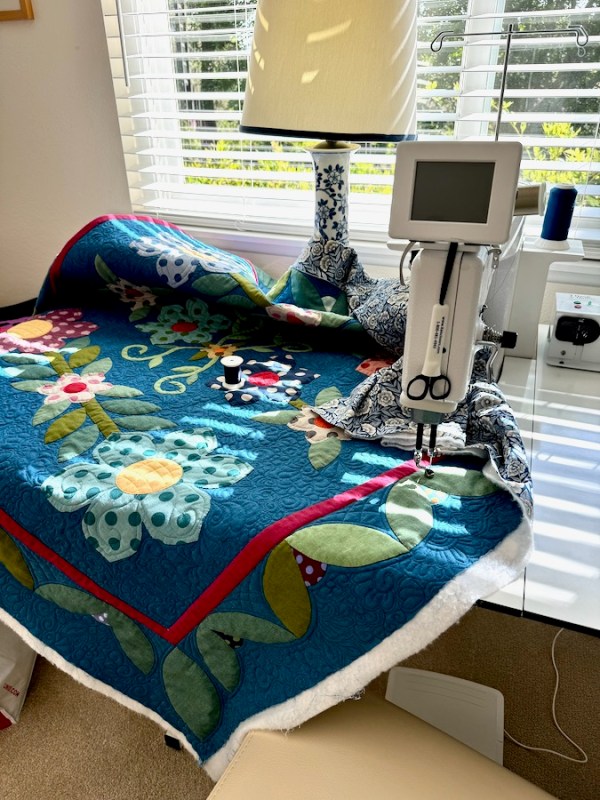
I’ve got a good start, but the needle keeps gumming up. I looked for anti-stick needles, but they don’t make them for the big quilting machines (I have a Handiquilter Sweet Sixteen) so I’m resigned to changing out the needle often and in between, swipes with nail polish remover. We run a high-tech shop, here.

When my mother was 90 years old, just the seven children hosted a luncheon for her, celebrating her life, which led me to think about mothers.

Mothers come in tall, medium and large. Mothers come in grumpy and happy. Mothers come in tired. Mothers come in a combination of adoring their children, frustrated with their children, and when will this kid ever go to college. Mothers love flowers, stroking babies’ cheeks, catching them when they dash through the mall as toddlers, pining for them when they go off to college, usually never to return home. Mothers come in all colors. Mothers come in street-smart, book-smart, and not-so-smart, but they all come in surprised at the task that lies before them and hope they will make it. Mothers mostly do, and if and when they don’t, other mothers somehow find their way to us, to teach us, bring us up, and leave us with memories.

Happy Mother’s Day–