You know how we feel when we watch an elderly (read: ten years older than my parents) person cross the street, one hesitating step at a time, and there we are in our cars, cheering them on realizing that we are witnessing a tiny heroic moment?
Okay. Here’s the jump from that metaphor: making a quilt.
And here are some of my tiny steps.

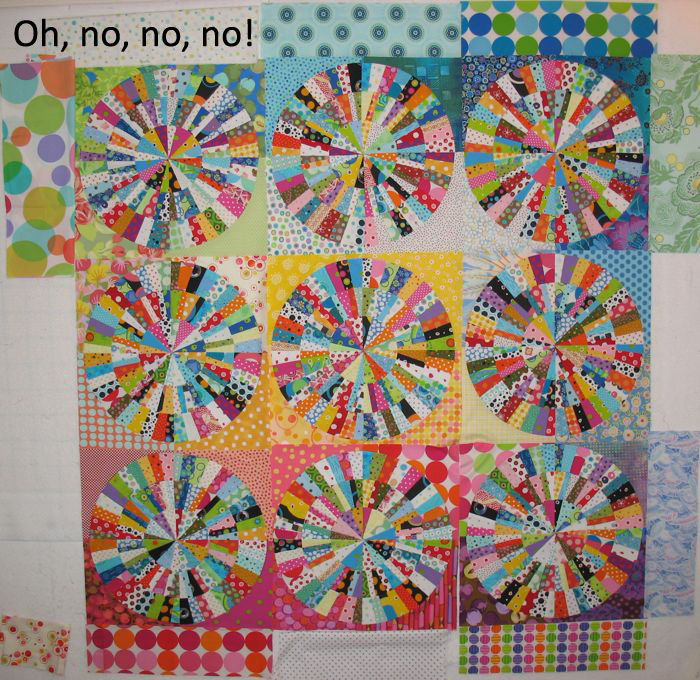
This puzzle shows my pin board, with the last sections of the circles being sewn. I pull them off, one arc at a time. I forgot to show paper-piecing instructions, but here’s some of the finishing pictures.

I pin the outside piece to the first arc, then stitch. . .

. . . upside down, with the paper UP. This is the opposite of what the instructions in the book say, but I found it more helpful to tuck my hand in between the paper-pieced segment and the fabric segment, “pulling” or easing the underneath fabric straight out from the needle, and allowing the paper to dictate my seam allowance. I don’t go very fast, but have only had one or two puckers in the whole quilt top, so this system must work for me okay.

Then before I rip off all the paper segments (fold back along the stitched line, score with my fingernail, rip), I make a tiny hash mark on the center line, so I can line up the next segment (paper-pieced to fabric).

Here I go again–hand underneath the paper-pieced segment, gently drawing the fabric underneath away from the needle, as I stitch along the paper guidelines.

One of the challenges of this quilt has been controlling the bulk of the seams, as you can imagine. I finally hit on the system of pressing one segment toward the center, and the next door neighbor segment toward the edge. Then when they line up, the seam bulk alternates. Make sure you are consistent all the way around the wheel. I know there’s that idea about pressing so the wheel looks like it’s floating on top of the pieced background, but I gave up that notion because the bulk was a bigger problem than appearance.

I have to unpick the center stitching lines that are visible just outside the seams. When paper piecing, I stitched down that line (uneccesary) and now I have a few things to unpick. But I’m happy with how all the seams are converging in the center. On the original design (Everyday Best, by Becky Goldsmith and LInda Jenkins), they have dots covering their centers. I am seriously thinking of leaving those off.

So here it is, as I left it last night: a tiny heroic achievement on the road to the rest of the quilt.




 OccasionalPiece--Quilt!