Creating

Lollypop Tree Block Three

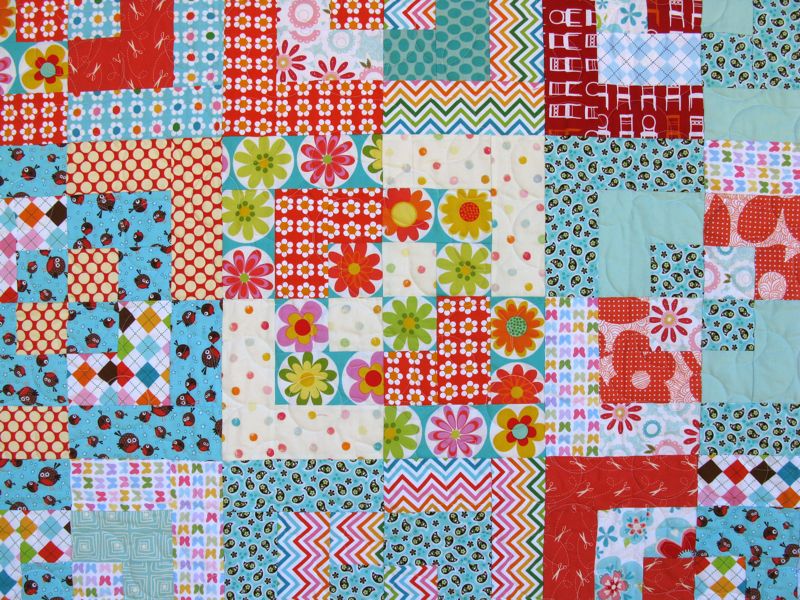
Yep–I made it to Friday!  Here’s Lollypop Tree Block Three, on a yellow check.  I’m discovering that the more I do these, and am familiar with the different swoops and swirls of the fabric stash I have, the easier it is.  I learned on this block the importance of contrast–light against dark–as well as the idea of balancing geometric/angular designs against the curvilinear/floral designs.  I was kind of worried about that upper middle flower petal.  Although I like the rosebud is intriguing, it does look washed out in the above photo.  It’s a little less so in the real-life version, however.  It cracks me up how many circles I’ve had to make.

Block One has 4 ovals and 27 circles.
Block Two has 2 ovals and 33 circles.
This block has only (!) 2 ovals and 15 circles.  This was faster to lay out and faster to sew.

Total Circle Count: 75 thus far.

I have to say, I really like the softer yellows and the hot pinks.  Making these blocks gives me a chance to explore the world of color in a new way.

And P.S. My husband calls this the Avatar quilt, after all the strange vegetation shown in that movie.  (A botanist at our local university was the consultant, so we feel we have a home-grown tie to all those wild looking plants.)

Quilt Shops

Quilter’s Coop, Temecula California

Last week I went for a little field trip and visited this shop in downtown Temecula California.  It’s Quilter’s Coop, and I had a great time there.

Joann, shown here helping a customer, is the owner and I had a great time chatting with her about different aspects of her shop.  She proved to me again that most of the shop owners I’ve encountered, as well as people who work there, are friendly and helpful.  And cheerful.  And probably brave and thrifty, too, but I don’t really know about that.

When you walk in the front door, you enter what I came to think of as The Americana Room: full of primitives and reds, whites, and blues and flag quilts and all sort of things to get you in a patriotic mood.  I loved the flag quilt on their deacon’s bench up front, with the use of the different colors for the flag blocks.

Cutting table in the Americana room.

Her table displays are inventive and have a mini-quilt or two, along with some fun antiques.  This fits in with the general tone of downtown Temecula–that of a frontier Western town, with lots of cute shops and antiques.  One of my favorite shops in Temecula is the soda place–with tons of different kinds of soda to choose from (I do like the Route 66 root beer). But I digress.

Here’s the Christmas room, which they were getting ready for the Southern California Quilters’ Run, happening this coming weekend (and next, too). Click on the link to see a map, as well as information about the run on the weekends of June 18th and 25th.

This quilt, titled “The Reason,” is designed by Laural of Simply PutPlus Patterns, who works at Quilter’s Coop (and who cut my fabric for me).  I saw quite a few other patterns I wanted as well.

Next to that was this display of Lighthouse Fabrics, as well as the ironing board.  I must have ironing board covers on my mind, but I picked up a pattern to make myself a new cover.  I’m sure you know by know (after looking at all my pictures of my ironing board cover) that I am in serious need of a new one.  Or maybe I just shouldn’t take anymore pictures of my ironing board.  Either one. . .

Quilter’s Coop has just about everything: holiday fabrics (Halloween, above), a few novelties, a wall of 1930s, a sale room, a room dedicated to creams and white, a corner for batiks–as I was shooting pictures I kept thinking of how to write about this shop.  How about this: they have something for every style of quilter.  Here are the photos to prove it:

I had a great time shopping here, the attitude personified by this sign that hung over the doorway to their classroom.

I loved the look of this–stacks of colorful fabrics, pins hanging from hooks, and the orange cutting mat.

Here’s my takeaway: the ironing board cover, a selection of brights, and fun prints–including a lovely fabric from Japan.  If you go there, they are on the corner of 3rd and Old Town Front Street, across from the market.  They have a parking lot next to their store.

Quilts

Quilt Label

What am I working on today? Quilt Labels!

I used to be very diligent about getting labels on all my quilts, but somewhere between the last child getting off to college and grad school and beginning teaching, I sort of forgot to keep doing this.  So this summer, one of my Works In Progress is to get labels on all my quilts.  I thought I’d share with you my favorite method.  Come back Friday for Finishing School Friday to see what I’ve completed this week.

I’m completely in love with Jaybird’s labels, printed up at Spoonflower, but it you want a personalized label for each quilt, you’ll have to make each one individually.  There are tons of ways to do this, but here’s one I use and am comfortable with (because it’s easy). The printer method works best for wallhangings that won’t be washed a lot.  I have an Epson inkjet, and have done test samples on both machines about what happens to the fabric in the laundry. The inkjet holds up better to washing, if you are not going to go to the trouble of using BubbleJet Set on your fabric.  If you really want the wording on the label to stick around on a quilt that will be washed a lot, I think that the Bubble Jet is mandatory.

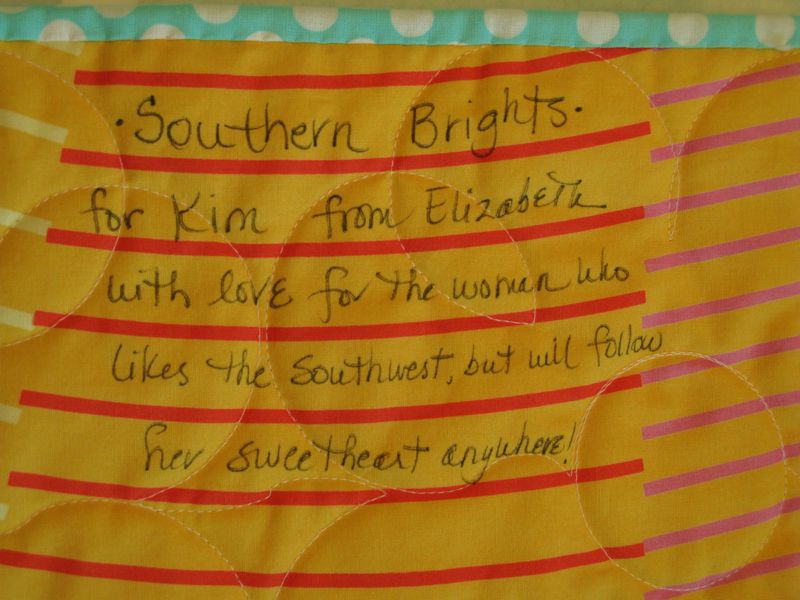
Or, get out your pigma pens and WRITE the label.  I’ve done the latter several times.  This was a label for a quilt by our little quilting group: The Good Heart Quilters.

Here’s a more elaborate one (the lower part is a poem) which I bordered, then cut out the pansies and appliqued them around the border.  Both of these quilts have been washed a lot of times and the print is still fine and readable.  It’s just the photographer who is shaky!

But for the printed label, write up what you want on your label in a word processing program on your computer.  My basic items are the name of the quilt, who made it and quilted it (sometimes there are different quilters and it’s only fair they should get some credit).  Then after that it varies.  I generally always put the date I finished and sometimes I put the date I began.  I learned also that having the size of the quilt was handy for when I wanted to enter it into quilt shows.  Sometimes I add the name of the city (I’ve moved a couple of times) as it all shows some of the quilt’s history. I like to write a little blurb of one or two lines about the quilt, but sometimes this blurb gets out of hand.  Then I’ll call it History of the The Quilt and break it out onto a separate label.

At any rate, when you finish that, print this out on your printer using regular paper (to check spelling, placement, etc.).  Cut a piece of fabric the size of your words, back it with freezer paper and place it right on that paper you just printed out.  Tape it down on three sides with masking/painter’s tape (Picture 1).  Run it through your printer, then peel off the tape (Picture 2).  You now have a printed label (Picture 3).

To “set” the label, get out a few more sheets of plain paper, lay over the top and press, with a bit of steam.  I do this several times with several sheets of paper until I see that there is no transfer of ink onto the blank paper.  I’m still cautious after that about laying my iron down on the laserjet printing, as it’s kind of “plastic-y” and you can melt it with a hot iron.

Trim up the label.  Use a gridded ruler to keep  the edges square to the printing.  On the label, I keep a 3/4″ margin all the way around.  On the History bit, I use a 1/2″ margin.

Trimmed.

 I like to border my labels.  On the left, sewn.  On the right, sewn and ironed into shape.  Trim off extra fabric, leaving a 1/4″ inch edge to be ironed under.

Here it is pinned onto the quilt.  I like to place my labels so that, when facing the quilt and if the right hand lower corner was picked up, you would see the label.

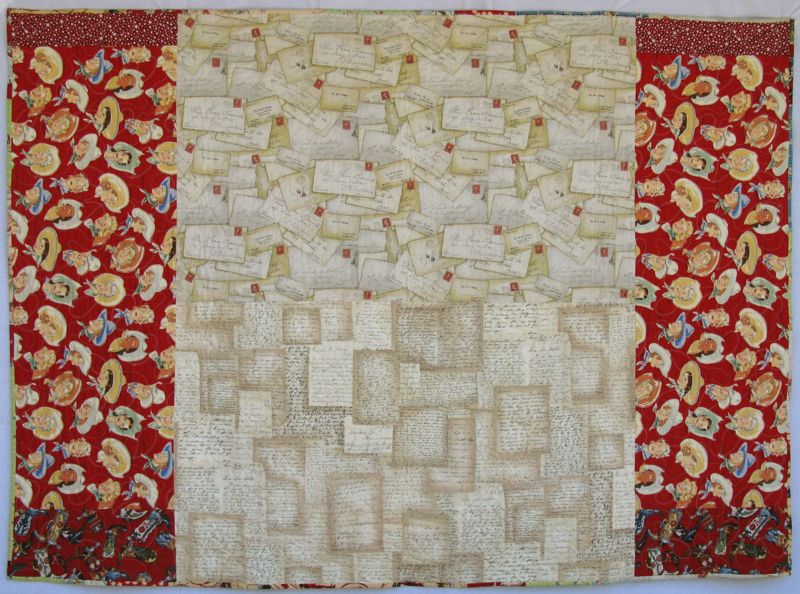
Here’s one of my quilts from the back (I used a tea towel from France as the backing) and you can see the label placement. Here are some more examples:

I don’t know if you can tell, but I made a little flap (the upside-down people) for this quilt label.  When you enter a quilt show they like you to cover up your name (for judging purposes).

This was one of my favorite labels: an envelope on the back of the Valentine’s quilt about hearts being drawn together like “Twined Threads.”  And that was the name I gave to the quilt. A snap keeps the envelope shut.

And that’s what I’ve been working on–Quilt Labels! Click *here* to see what everyone else is doing.

Quilts

Quilt Sleeve

Notice no computer on the computer desk, although my father’s painting of a valley in Utah is still there.  I’m computer-dependent.  I like the web–it’s my friend and occasionally my enemy (Time-Sucking Enemy) but I like reading everyone’s blogs and getting new ideas.  And I love reading newspapers online, even though we subscribe to two already. (I’m doing my part for print media, trust me.)  This morning all I saw was the spinning ball of death (I have a Mac).  So, since I was computerless today, I worked on getting a very old quilt finished.

I began it in February of 2005 and the quilt is appliqued, pieced and I had already quilted it.  HAND-quilted it. Here we are in June 2011.  Time flies.  First up–the quilt sleeve.  I hope to enter this in a local show, and they require a 4″ quilt sleeve.  There are many fancy ways to do this but here’s mine:

Cut a single strip of fabric the width of the top of your quilt, minus 2 inches.  For a 4″ sleeve, it should be 9″ wide.

I usually try to do this on the length of grain, but if you are doing cross-grain, and need extra width, it’s okay to piece this.  If your quilt is more than 70″ wide, some people like to make it in two parts just in case the want to put a hook in the middle to help hold up the rod and support the weight.  But I rarely hang that size of quilt so I’ve never done it.

Fold in the short ends and stitch down.  Then fold it lengthwise in half and align the raw edges with the top edge of your quilt.  Pin.

Stitch on the binding.

That brings us here.  The binding is stitched on, the corners folded into their miters and pinned down.  I used to use straight pins to pin down ALL the binding, then went to the clippie-thing.  My quilty friend Tracy convinced me to only do the corners and let the rest be.  So this is how I do it now–it’s much easier not having to fight all that equipment, and yes, the binding gets on straight, thank you very much.  Here’s the souped-up version of the above picture:

See how much work I’m getting done since I can’t surf the web?

Now, pin down the folded edge of the sleeve, placing pins 1/2″ away from the edge.  When you sew down that sleeve, LIFT UP the folded edge, and stitch 1/4″ from the fold on the lower (closest to the quilt) part of the sleeve, catching only one layer of the fabric.  You are tacking this into place.  You don’t want to sew more than this, otherwise the sleeve will be visible above the binding.

All sewn.

Spool of Thread in her undercover work posing as a Quilt Rod.

 But by doing it this way, you leave a little slack in the sleeve tube, so that the quilt show rods won’t distort your quilt from the front.

My version of a label is in the next post, as I have to go and stitch this all down while I watch Foyle’s War (we’re on Season Five) with my husband.

UPDATE!

The computer came home!
It was a faulty partition in the skizzy-dingbat area of the software, which only cost me $85 and the computer guy shared with me that the hard drive could go at any moment.
Or not.